 |
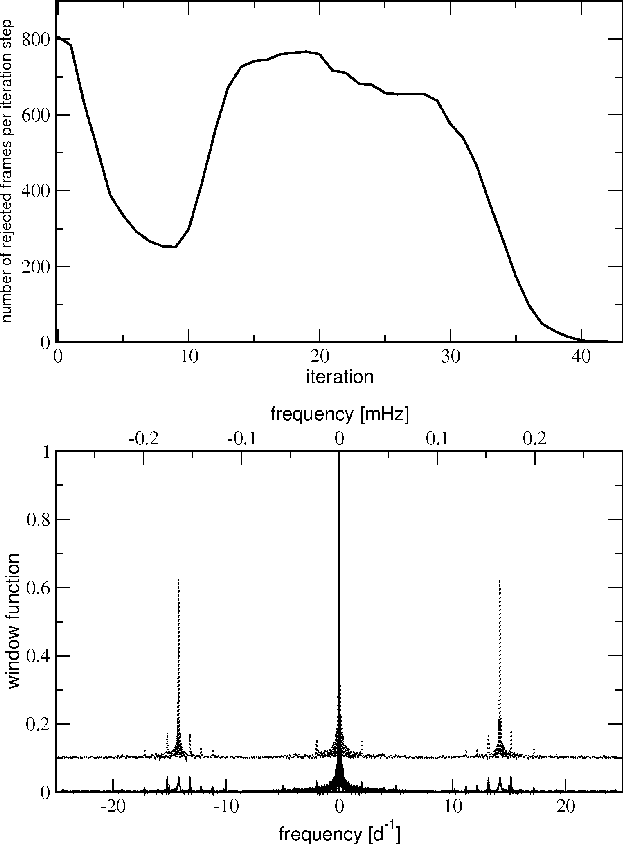
Figure 1: Upper panel: iterative elimination of frames with deviating image geometry. The increasing number of rejections with higher iterations followed by a second decline indicates two separate mechanisms responsible for distorting the Fabry image geometry. Lower panel: window function of the data sets including (solid line) and excluding (dotted line) frames with deviating image geometry. The dotted graph has been shifted by 0.1 for better visibility. |
| Open with DEXTER | |
In the text
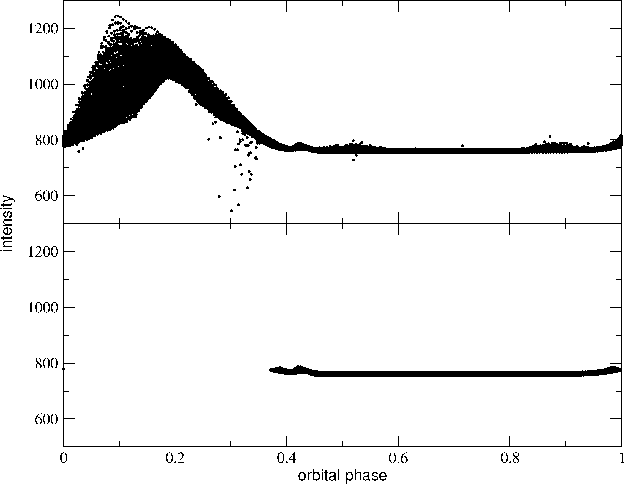 |
Figure 2: Upper panel: the raw light curve after cosmic ray correction, phased with the M OST orbital period. The stray light contamination is mostly confined to orbital phases 0-0.4. Lower panel: same as in the upper panel, but after correcting for deviating image geometry. |
| Open with DEXTER | |
In the text
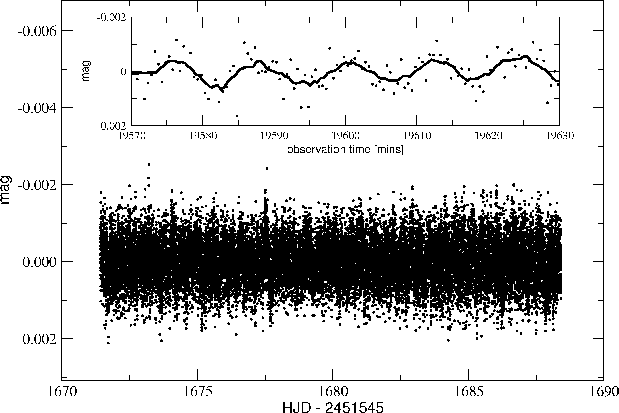 |
Figure 3:
Final light curve using decorrelation resulting in a duty cycle of
 53%. All long-term variations with periods >1 d have been prewhitened. The inset shows a subset spanning about 50 min together with a 10 point (4 min) running average. The 12 min oscillation is clearly visible. 53%. All long-term variations with periods >1 d have been prewhitened. The inset shows a subset spanning about 50 min together with a 10 point (4 min) running average. The 12 min oscillation is clearly visible. |
| Open with DEXTER | |
In the text
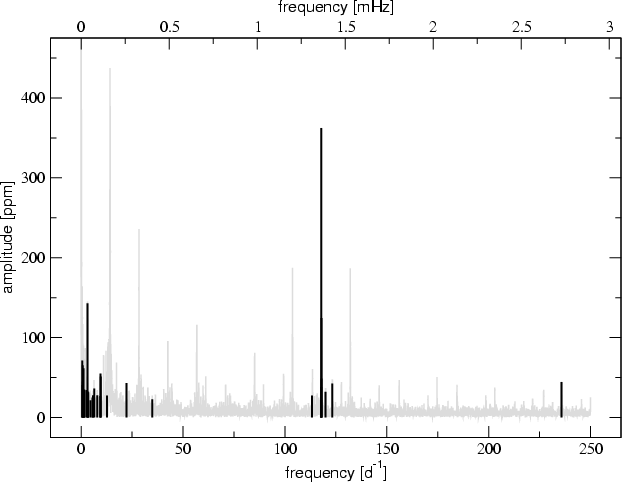 |
Figure 4:
The amplitude spectrum of the final light curve ( gray) presented in Fig. 3 and all frequencies found by S IGS PEC in both reduction methods described in this paper ( black). We consider only frequencies with f > 50 d-1 to be unaffected by the instrument.  Equ's pulsation is obvious in the range of 100 to 125 d-1 and the first of two harmonics of Equ's pulsation is obvious in the range of 100 to 125 d-1 and the first of two harmonics of
 is evident at 235 d-1.
 |
| Open with DEXTER | |
In the text
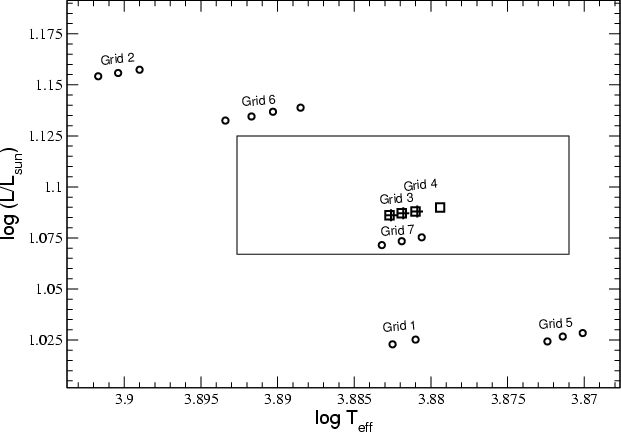 |
Figure 5:
A schematic diagram of the calculated grids and their model parameters following the notation of Table 3. Since Grid 3 and Grid 4 partially overlap, all grid points for Grid 3 are shown as + symbols, while Grid 4 is indicated by rectangles. Observational uncertainties for
Equ's estimated position in the HR diagram (Kochukhov & Bagnulo 2006) are represented by the large rectangle. |
| Open with DEXTER | |
In the text
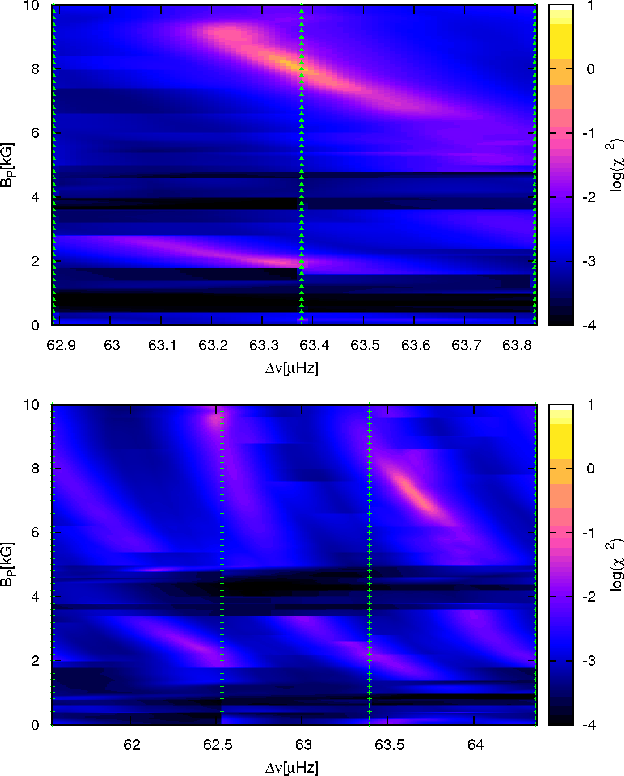 |
Figure 6:
Upper panel: color coded inverse  values obtained when fitting the 5 intrinsic frequencies of Equ to model frequencies of Grid 3. The vertically aligned symbols represent the calculated model positions - all other model frequencies are derived via linear interpolation.
Discontinuities are due to a lack of converging model frequencies. Some modes of a certain degree and radial order are missing in the individual genuine models. Also, sudden changes of the frequency spacing due to the magnetic field, can change the quality of the fit quite rapidly. Lower panel: Grid 6 shows a pattern similar to Grid 3 but delivers larger
values. It gives, however, the same mode identification. Note the different scale of the abscissa!
values obtained when fitting the 5 intrinsic frequencies of Equ to model frequencies of Grid 3. The vertically aligned symbols represent the calculated model positions - all other model frequencies are derived via linear interpolation.
Discontinuities are due to a lack of converging model frequencies. Some modes of a certain degree and radial order are missing in the individual genuine models. Also, sudden changes of the frequency spacing due to the magnetic field, can change the quality of the fit quite rapidly. Lower panel: Grid 6 shows a pattern similar to Grid 3 but delivers larger
values. It gives, however, the same mode identification. Note the different scale of the abscissa! |
| Open with DEXTER | |
In the text
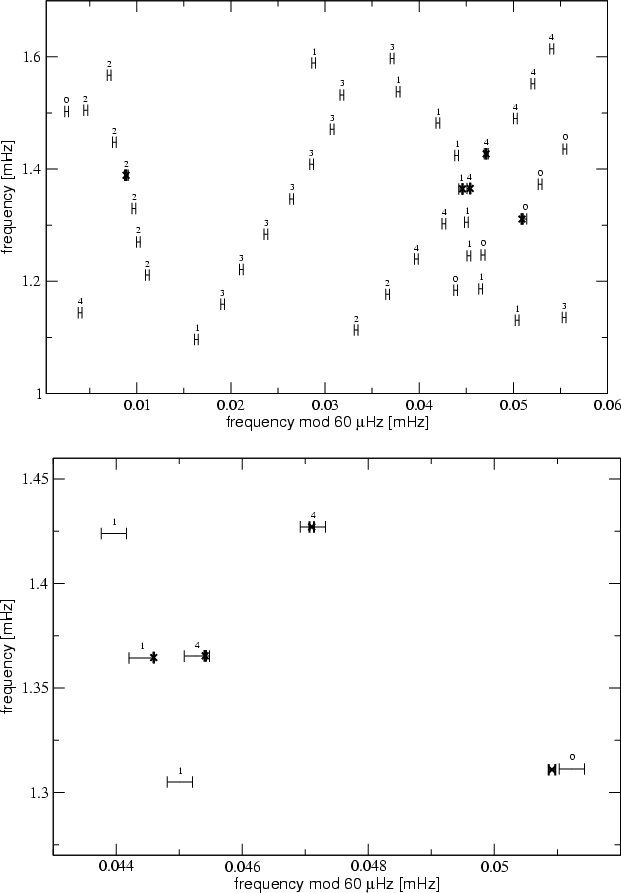 |
Figure 7:
Upper panel: échelle diagram of the best fitted stellar model (
 ,
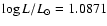
Grid 3). The corresponding parameters are ,
Grid 3). The corresponding parameters are
 , ,
 ,
and ,
and
 kG. The model frequencies are represented by their estimated error bars, the numbers above denote the mode degree kG. The model frequencies are represented by their estimated error bars, the numbers above denote the mode degree  .
Black cross symbols indicate the position of the observed frequencies with error bars. Lower panel: a close-up of the region in the échelle diagram including
, .
Black cross symbols indicate the position of the observed frequencies with error bars. Lower panel: a close-up of the region in the échelle diagram including
,
 , ,
 ,
and ,
and
 illustrating the quality of the fit more clearly.
is not matched to within the 1
illustrating the quality of the fit more clearly.
is not matched to within the 1 -error, but
to
dominate the
statistics because of their high significance. -error, but
to
dominate the
statistics because of their high significance. |
| Open with DEXTER | |
In the text
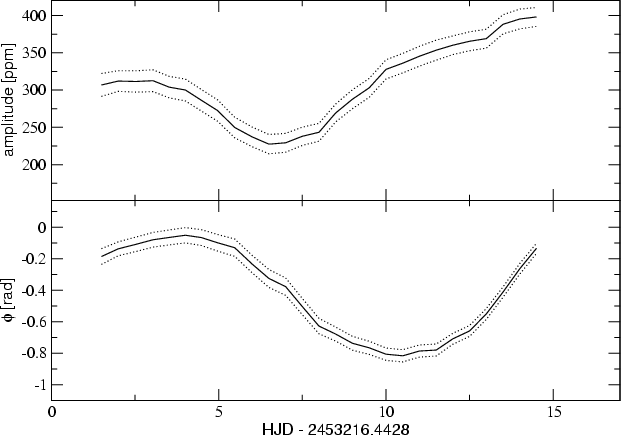 |
Figure 8:
Upper panel: amplitude modulation of the primary frequency,
,
as found by a least-squares fit with a fixed frequency to subsets of the light curve. Lower panel: phase changes of
determined in the same way as the amplitude modulation. The dotted lines represent the 1-confidence limits. The similarity of amplitude modulation and phase shift, as well as the minimum amplitude coinciding with the time of the phase shift turning point, suggest an amplitude modulation due to beating of two closely spaced frequencies with a beat frequency of 0.07 d-1 (0.0008 mHz). This corresponds to the beat frequency of
and
. |
| Open with DEXTER | |
In the text
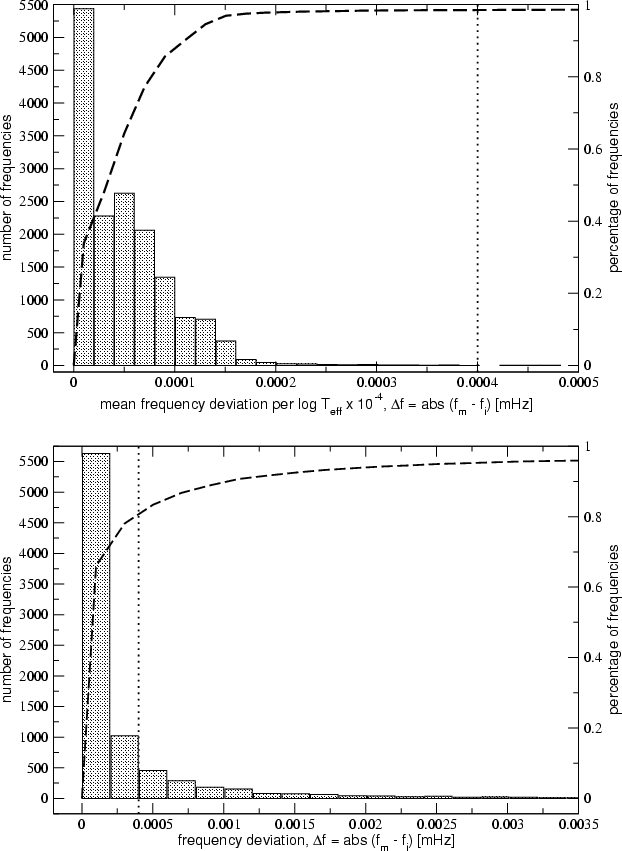 |
Figure 9:
Upper panel: a histogram of the normalized deviation of 16 050 frequencies, interpolated as a function of
 ,
from their values in genuine models. The bars show the number of frequencies deviating within a certain range. The dotted line gives the estimated upper limit of the model uncertainties. The dashed line shows the total percentage of frequencies, as indicated by the right-hand side ordinate, as a function of frequency deviation. Lower panel: a histogram of the absolute frequency deviation of
8523 frequencies, interpolated as a function of ,
from their values in genuine models. The bars show the number of frequencies deviating within a certain range. The dotted line gives the estimated upper limit of the model uncertainties. The dashed line shows the total percentage of frequencies, as indicated by the right-hand side ordinate, as a function of frequency deviation. Lower panel: a histogram of the absolute frequency deviation of
8523 frequencies, interpolated as a function of
 ,
from their genuine counterparts. No normalization was necessary, since the interpolation was performed with a step size of 0.2 kG for each frequency. The dashed and dotted lines have the same meaning as in the upper panel. ,
from their genuine counterparts. No normalization was necessary, since the interpolation was performed with a step size of 0.2 kG for each frequency. The dashed and dotted lines have the same meaning as in the upper panel. |
| Open with DEXTER | |
In the text
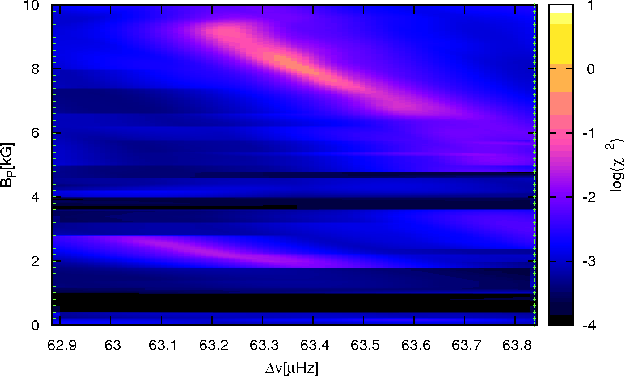 |
Figure 10:
The result of fitting our observed frequencies to a model grid calculated by interpolation between 3a and 3c. Although the 3b-models
are omitted and no fit with
 is found, the figure compares well to the upper panel of Fig. 6. Linear interpolation in
is therefore
a reasonable approximation to genuine models for our fitting procedure.
is found, the figure compares well to the upper panel of Fig. 6. Linear interpolation in
is therefore
a reasonable approximation to genuine models for our fitting procedure. |
| Open with DEXTER | |
In the text
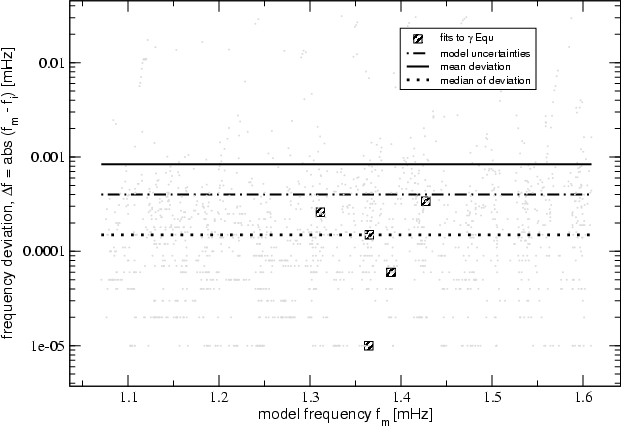 |
Figure 11:
The absolute deviations of all interpolated frequencies at the position
of 3b, using Grid models 3a and 3c, from the genuine frequency values. All
5 modes, which match the observed frequencies of Equ best and are indicated by boxes, are deviating less than the model uncertainties. |
| Open with DEXTER | |
In the text
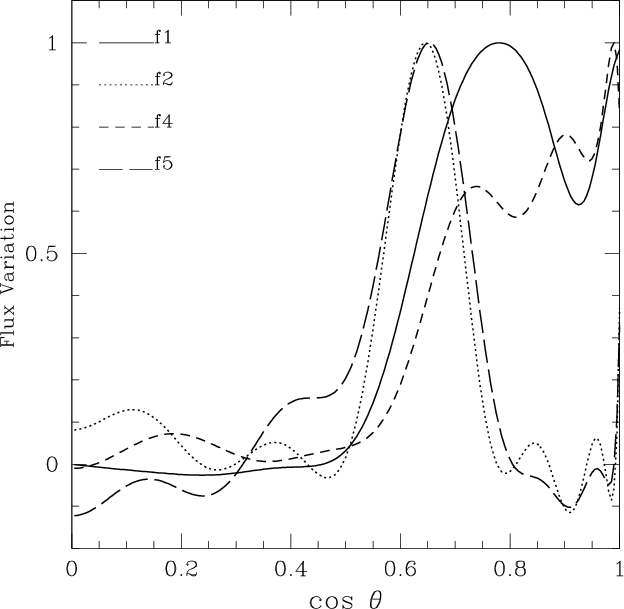 |
Figure 12:
Latitudinal variation of the perturbation of radiative flux on the surface is shown for each mode matched to Equ. (The case of
is not shown because it is very close to that of
.) The ordinate shows
 with
with  being co-latitude (
 at poles). The plots are the real parts of the eigenfunctions for the flux perturbation at
 kG for model 3b (Table 3). Each curve is normalized as that the maximum is unity. kG for model 3b (Table 3). Each curve is normalized as that the maximum is unity. |
| Open with DEXTER | |
In the text