![[*]](/icons/foot_motif.gif)
A&A 479, L41-L44 (2008)
DOI: 10.1051/0004-6361:20079158
LETTER TO THE EDITOR
O. Berné1 - C. Joblin1 - M. Rapacioli2 - J. Thomas3 - J.-C. Cuillandre4 - Y. Deville3
1 - Centre d'Étude Spatiale des Rayonnements, Université Paul
Sabatier Toulouse 3 et CNRS, Observatoire Midi-Pyrénées, 9 Av. du Colonel Roche,
31028 Toulouse Cedex 04, France
2 -
Laboratoire de Chimie et Physique Quantique, IRSAMC, Université Paul
Sabatier Toulouse 3 et CNRS, 118 route de Narbonne, 31062 Toulouse Cedex, France
3 -
Laboratoire d'Astrophysique de Toulouse-Tarbes, Université Paul
Sabatier Toulouse 3 et CNRS, Observatoire Midi-Pyrénées, 14 Av. Edouard Belin,
31400 Toulouse, France
4 -
Canada-France-Hawaii Telescope Corporation, 65-1238 Mamalahoa Highway, Kamuela, Hawaii 96743, USA
Received 27 November 2007 / Accepted 27 December 2007
Abstract
Context. Extended Red Emission (ERE) was recently attributed to the photo-luminescence of either doubly ionized Polycyclic Aromatic Hydrocarbons (PAH++), or charged PAH dimers ([PAH2]+).
Aims. We analysed the visible and mid-infrared (mid-IR) dust emission in the North-West and South photo-dissociation regions of the reflection nebula NGC 7023.
Methods. Using a blind signal separation method, we extracted the map of ERE from images obtained with the Hubble Space Telescope, and at the Canada France Hawaii Telescope. We compared the extracted ERE image to the distribution maps of the mid-IR emission of Very Small Grains (VSGs), neutral and ionized PAHs (PAH0 and PAH+) obtained with the Spitzer Space Telescope and the Infrared Space Observatory.
Results. ERE is dominant in transition regions where VSGs are being photo-evaporated to form free PAH molecules, and is not observed in regions dominated by PAH+. Its carrier makes a minor contribution to the mid-IR emission spectrum.
Conclusions. These results suggest that the ERE carrier is a transition species formed during the destruction of VSGs. [PAH2]+ appear as good candidates but PAH++ molecules seem to be excluded.
Key words: astrochemistry - ISM: dust, extinction - ISM: lines and bands - reflection nebulae - infrared: ISM - methods: observational
Unveiling the composition, structure and charge state of the smallest interstellar dust particles remains one of today's challenges in astrochemistry. Progress in this field requires a detailed analysis of the spectral signatures of these dust populations. Amongst these signatures is the Extended Red Emission (ERE), a broad emission feature ranging from 540 to beyond 900 nm and with a peak wavelength longward of 600 nm to beyond 800 nm (Smith & Witt 2002). ERE is likely due to the photo-luminescence of carbonaceous macromolecules or nanograins exposed to UV photons (see Witt et al. 2006, and references therein). The ERE is observed in many environments exposed to UV photons (Photo-dissociation Regions; PDR) found for instance in the diffuse interstellar medium, reflection nebulae and planetary nebulae. It has been observed in galaxies, NGC 3034 (Perrin et al. 1995) and NGC 4826 by (Pierini et al. 2002).
The possible link with the carriers of the Aromatic Infrared Bands (AIBs; also called unidentified infrared bands at 3.3, 6.2, 7.7, 8.6 and 11.3  m) has been discussed by several authors.
Both types of emission features, ERE and AIBs, were found to be relatively cospatial although
not matching (Furton & Witt 1990), pointing to different but related materials for their carriers (Furton & Witt 1992). Recently, a detailed study of the spatial distribution of the ERE in the northern PDR
of NGC 7023 has been performed by Witt et al. (2006) who concluded that the ERE mechanism is a two-step process involving the formation of the carrier and then the excitation of the luminescence,
and proposed doubly-ionized Polycyclic Aromatic Hydrocarbons (PAHs) as plausible carriers.
On the other hand, recent quantum chemistry
calculations point to PAH dimers ([PAH2]+) as the carrier of ERE (Rhee et al. 2007).
m) has been discussed by several authors.
Both types of emission features, ERE and AIBs, were found to be relatively cospatial although
not matching (Furton & Witt 1990), pointing to different but related materials for their carriers (Furton & Witt 1992). Recently, a detailed study of the spatial distribution of the ERE in the northern PDR
of NGC 7023 has been performed by Witt et al. (2006) who concluded that the ERE mechanism is a two-step process involving the formation of the carrier and then the excitation of the luminescence,
and proposed doubly-ionized Polycyclic Aromatic Hydrocarbons (PAHs) as plausible carriers.
On the other hand, recent quantum chemistry
calculations point to PAH dimers ([PAH2]+) as the carrier of ERE (Rhee et al. 2007).
In this letter, we provide an efficient and non biased way to extract the ERE map in NGC 7023 from the Hubble Space Telescope (HST) data and new Canada France Hawaii Telescope (CFHT) images using a blind signal separation method. We then compare the extracted ERE map to the maps of the different mid-IR emission carriers, namely Very Small Grains (VSGs), neutral and ionized PAHs (PAH0 and PAH+), as extracted by Rapacioli et al. (2005) and Berné et al. (2007) from the Infrared Space Observatory (ISO) and Spitzer Space Telescope (Spitzer) observations.
![\begin{figure}
\par\includegraphics[width=8cm,clip]{9158fig1.ps}\end{figure}](/articles/aa/full/2008/09/aa9158-07/img2.gif) |
Figure 1: On the left: HST images of the NGC 7023 North-West PDR in three SDSS wide-band filters (cf. Witt et al. 2006). On the right: scattered light and ERE images extracted with FastICA from the observations. |
| Open with DEXTER | |
The analysis of the mid-IR emission of the North-West (NW) and South PDRs was first performed by Rapacioli et al. (2005) using ISOCAM-CVF data from ISO. More recent data on the NW PDR obtained with the Infrared Spectrograph (IRS) onboard Spitzer in mapping mode was analysed by Berné et al. (2007). The achieved angular resolution is 3.6'' for IRS and 5'' for ISOCAM.
ERE was observed in NGC 7023 by Witt & Boroson (1990) and Witt et al. (2006). The NW PDR was observed with the HST by Witt et al. (2006), using the Advanced Camera for Surveys (ACS) and the Near Infrared Camera and Multi-Object Spectrometer (NICMOS). We retrieved from the archive the calibrated, geometrically corrected, dither-combined ACS images (Fig. 1) in three wide-band Sloan Digital Sky Survey filters (Smith et al. 2002): g, r, and z (respectively called F475W, F625W and F850LP on HST). The whole NGC 7023 nebula was observed in August 2002 in the B, V and R filters at the CFHT using the CFH12K CCD mosaic (Cuillandre et al. 2001) as part of the CFHT outreach program. A set of 5 dithered exposures of 60 s each were obtained in each filter in order to remove the mosaic gaps and other physical blemishes. No sky subtraction, nor convolution of any sort was applied to the data during the detrending and stacking process, ensuring no alteration of the intrinsic brightness features of the nebula.
![\begin{figure}
\par\includegraphics[width=8.1cm,clip]{9158fig2.ps}\end{figure}](/articles/aa/full/2008/09/aa9158-07/img3.gif) |
Figure 2: On the left: CFHT images of the NGC 7023 North-West PDR in three BVR filters. On the right: scattered light and ERE images extracted with FastICA from the observations. |
| Open with DEXTER | |
One of the difficulties in properly extracting the ERE map is to remove
the contribution of the scattered light from the central Herbig Be star, HD 200775.
To perform this analysis in an unbiased way,
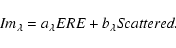
we applied a Blind Signal Separation (BSS) method successively to the ACS and CFHT images obtained in the three wide-band filters (F475W, F625W, F850LP, for ACS and B, V, R for CFHT: see Figs. 1, 2). For a wide-band filter centered at  ,
it is assumed that the observed image
,
it is assumed that the observed image
 can be written as:
 and
and
 are unknown and vary with the filter central wavelength .
ERE arises from the UV-illuminated layers of the cloud and therefore does not suffer from
significant extinction in the studied reflection nebula. It is thus reasonable to assume that its spatial pattern (ERE in Eq. (1)) is
independent of wavelength. In the case of scattered light, this
might not be true if strong radiative transfer is present as shown for instance
by Nuzillard & Bijaoui (2000) in the case of galaxies. However, in the present object, the scattered
light is subject to much less extinction than in galaxies, we therefore assume that
its spatial pattern (Scattered in Eq. (1)) is independent of wavelength.
The BSS method we used here, called FastICA (Hyvarinen 1999), enables us to recover
the spatial patterns of ERE and scattered light using
the statistical information available in the three images.
FastICA uses the assumptions of independence and
non-Gaussianity of the original sources (here the spatial patterns of ERE and scattered light)
and thus belongs to the class of methods called Independent Component Analysis (ICA).
The FastICA algorithm maximizes the non-Gaussianity of the output signals
(i.e. estimations of the sources) by using a fixed-point algorithm.
The extracted images of ERE and scattered light from ACS and CFHT images are
presented on the right of Figs. 1 and 2 respectively.
We can qualitatively compare these extracted ERE images to the one obtained by
Witt et al. (2006). The images are very similar but we find a small contribution
of ERE in the cavity. The CFHT and HST ERE patterns appear to be consistent with each other.
are unknown and vary with the filter central wavelength .
ERE arises from the UV-illuminated layers of the cloud and therefore does not suffer from
significant extinction in the studied reflection nebula. It is thus reasonable to assume that its spatial pattern (ERE in Eq. (1)) is
independent of wavelength. In the case of scattered light, this
might not be true if strong radiative transfer is present as shown for instance
by Nuzillard & Bijaoui (2000) in the case of galaxies. However, in the present object, the scattered
light is subject to much less extinction than in galaxies, we therefore assume that
its spatial pattern (Scattered in Eq. (1)) is independent of wavelength.
The BSS method we used here, called FastICA (Hyvarinen 1999), enables us to recover
the spatial patterns of ERE and scattered light using
the statistical information available in the three images.
FastICA uses the assumptions of independence and
non-Gaussianity of the original sources (here the spatial patterns of ERE and scattered light)
and thus belongs to the class of methods called Independent Component Analysis (ICA).
The FastICA algorithm maximizes the non-Gaussianity of the output signals
(i.e. estimations of the sources) by using a fixed-point algorithm.
The extracted images of ERE and scattered light from ACS and CFHT images are
presented on the right of Figs. 1 and 2 respectively.
We can qualitatively compare these extracted ERE images to the one obtained by
Witt et al. (2006). The images are very similar but we find a small contribution
of ERE in the cavity. The CFHT and HST ERE patterns appear to be consistent with each other.
Rapacioli et al. (2005) and Berné et al. (2007) have used signal processing methods to analyse the mid-IR spectral cubes form ISO and Spitzer and extract the spectra and associated spatial distributions for the different emitting populations, VSGs, PAH0 and PAH+ as shown in Figs. 3, 4. In Fig. 3, the HST ERE map was overlayed on the Spitzer maps showing that ERE arises from the region where the population identified as PAH0 dominates the mid-IR emission. In Fig. 4, we overlayed the ERE extracted from the CFHT observations on the maps extracted from ISOCAM data. The same correlation is found for the NW PDR as with Spitzer/HST, though the level of detail reached here is lower due to the lower spatial resolution of both ISOCAM vs. IRS and CFHT vs. HST. However, Fig. 4 provides the information on the South PDR, where again, the ERE filament is found in a region dominated by PAH0, and close to the frontier with VSGs.
![\begin{figure}
\par\includegraphics[width=8.25cm,clip]{9158fig3.ps}\end{figure}](/articles/aa/full/2008/09/aa9158-07/img9.gif) |
Figure 3: Distribution maps of the three populations of mid-IR emitters in NGC 7023 NW from Spitzer-IRS observations: VSGs in red, PAH0 in green and PAH+ in blue (cf. Berné et al. 2007). Overlayed in contours is the emission map of ERE extracted from HST images (Fig. 1). |
| Open with DEXTER | |
![\begin{figure}
\par\includegraphics[width=8.3cm,clip]{9158fig4.ps}\end{figure}](/articles/aa/full/2008/09/aa9158-07/img10.gif) |
Figure 4: Distribution maps of the three populations of mid-IR emitters in NGC 7023 from ISOCAM observations: VSGs in red, PAH0 in green and PAH+ in blue first presented by Rapacioli et al. (2005) and reanalysed in this work. Overlayed in contours is the emission map of ERE extracted from CFHT images (Fig. 2). |
| Open with DEXTER | |
A simple energy budget including ERE and the mid-IR emission can be made.
First, we can consider that the ERE carrier is excited by photons of at least 7 eV energy. This corresponds to the mean energy absorbed by VSGs according to Rapacioli et al. (2005).
If we assume that one ERE photon is emitted at an energy of about 1.7 eV (corresponding to a central wavelength of the ERE band at 680 nm detected by Witt & Boroson 1990), then the rest of the absorbed energy (5.3 eV) will be emitted in the IR. Thus, about 25 of the absorbed light is converted into ERE. Table 1 summarizes the values of the mid-IR and ERE fluxes for the regions of
NGC 7023 where ERE is detected as well as for the prototypical case of the Red Rectangle.
The gross ratio between ERE and mid-IR flux for NGC 7023 NW PDR is below 2
(0.4
for the South PDR). Considering the above approximation for the ratio of energy emitted in the IR vs. visible for one particle, this yields a proportion
of less than about 3
of the absorbed light is converted into ERE. Table 1 summarizes the values of the mid-IR and ERE fluxes for the regions of
NGC 7023 where ERE is detected as well as for the prototypical case of the Red Rectangle.
The gross ratio between ERE and mid-IR flux for NGC 7023 NW PDR is below 2
(0.4
for the South PDR). Considering the above approximation for the ratio of energy emitted in the IR vs. visible for one particle, this yields a proportion
of less than about 3 
 =
=  of the mid-IR emission due to the ERE carrier in the NW PDR (1.2
for the South PDR). As a comparison, in the Red Rectangle protoplanetary nebula, the strongest known source of ERE, we find that this ratio
is around 3
of the mid-IR emission due to the ERE carrier in the NW PDR (1.2
for the South PDR). As a comparison, in the Red Rectangle protoplanetary nebula, the strongest known source of ERE, we find that this ratio
is around 3
 =
=  .
This implies that the ERE carrier contributes to only a few percent of the mid-IR emission, and thus its signature will be difficult to identify in this spectral region. Following our assignment, PAH0 are excluded
as possible candidates for the ERE, though they were initially proposed as potential carriers by d'Hendecourt et al. (1986).
.
This implies that the ERE carrier contributes to only a few percent of the mid-IR emission, and thus its signature will be difficult to identify in this spectral region. Following our assignment, PAH0 are excluded
as possible candidates for the ERE, though they were initially proposed as potential carriers by d'Hendecourt et al. (1986).
Table 1: Mid-IR and ERE fluxes in NGC 7023 and the Red Rectangle.
Using the ACS observations, Witt et al. (2006) showed that ERE is likely a two step process involving the formation of the carrier and then the excitation of the luminescence. The first step requires far-UV photons (E > 10.5 eV) and supports the idea that the carrier of ERE is produced by the photo-dissociation/photo-ionization of a precursor. From this result, they proposed PAH++ as the carrier of ERE, invoking that these species have an ionisation potential above 10.5 eV and have strong absorption bands in the optical and near-UV regions. In the previous section, we have shown that the ERE in NGC 7023 arises from the region where PAH0are abundant, which differs from the region where PAH+ are abundant. Thus, in the framework of our previous work (Rapacioli et al. 2005; Berné et al. 2007) this rules out the possibility that ERE is carried by doubly ionized PAHs as proposed by Witt et al. (2006).
In a recent theoretical work (Rhee et al. 2007), it was shown that charged PAH dimers ([PAH2]+),
more specifically the subclass made of closed-shell species, can fluoresce in the ERE range with a
quantum yield that is consistent with this emission.
The overlays of Figs. 3 and 4 clearly show that ERE is dominant in regions where VSGs are dissociated and PAH0 species are abundant. This suggests that the ERE carrier is a
transient species produced during the evaporation of VSGs. This fits well with the two-step scenario
of Witt et al. (2006). Indeed, Rapacioli et al. (2006) have found that PAH clusters such as (C24H12)4 and (C24H12)13 start being dissociated into monomers at internal energies of around 10 eV. This is in agreement with the threshold of 10.5 eV set by Witt et al. (2006) for the production of the
ERE carrier. Then, for ERE to be observed, the carrier should survive long
enough in the PDR i.e. be reformed as efficiently as it is destroyed.
[PAH2]+ appear as good candidates because (1) their stability is expected to be increased
relative to neutral dimers because
of charge delocalization effects (Bouvier et al. 2002); (2) their abundance is favored because they
constitute the final stage in the photodissociation cascade starting from larger clusters;
(3) they can be reformed efficiently by collision of a neutral and ionized PAH
as this process is favored by the long range ion
 induced dipole interaction
(see discussion in Rapacioli et al. 2006).
PAH+ are not abundant species in the ERE region but are present (
induced dipole interaction
(see discussion in Rapacioli et al. 2006).
PAH+ are not abundant species in the ERE region but are present (
 of total mid-IR emission). This fraction of PAH+ would be enough to lead to the reformation of [PAH2]+ in regions where PAH0 are abundant.
Thus, [PAH2]+ are favorable candidates since they are expected to be relatively
more stable and, perhaps more important, to have an efficient reformation path.
of total mid-IR emission). This fraction of PAH+ would be enough to lead to the reformation of [PAH2]+ in regions where PAH0 are abundant.
Thus, [PAH2]+ are favorable candidates since they are expected to be relatively
more stable and, perhaps more important, to have an efficient reformation path.
In this Letter we have compared in NGC 7023 the spatial distribution of ERE and that of the mid-IR emitters: VSGs, PAH0, PAH+. We find strong evidence that the ERE carrier is produced in the region of destruction of VSGs and show that it has a negligible contribution to the mid-IR emission. We show that PAH++ are unlikely to be the carrier of ERE and conclude that [PAH2]+ are attractive candidates, on the basis of qualitative arguments on the balance between photodissociation and reformation of these clusters. Further investigations are needed, following the strategy presented in this letter, but in other PDRs. Spectro-imagery of such regions in the mid-IR with a high spatial resolution is needed in order to be able to trace the thin frontier between PAHs and VSGs where small clusters are likely to be present. Finally, laboratory spectroscopic studies on [PAH2]+ are needed to progress in this identification. In particular, closed-shell cation dimers as proposed by Rhee et al. (2007) deserve additional studies.
Acknowledgements
We acknowledge the anonymous referee for his comments on the manuscript.