A&A 478, 409-417 (2008)
DOI: 10.1051/0004-6361:20078805
When GRB afterglows get softer, hard components come into play
A. Moretti1 - R. Margutti1,2 - F. Pasotti1,2 - A. P. Beardmore3 - S. Campana1 - G. Chincarini2,1 -
S. Covino1 - O. Godet3 - C. Guidorzi2,1 - J. P. Osborne3 - P. Romano2,1 - G. Tagliaferri1
1 - INAF - Osservatorio Astronomico di Brera, via E. Bianchi 46, 23807 Merate (LC), Italy
2 - Università degli Studi di Milano-Bicocca, Dipartimento di Fisica, Piazza delle Scienze 3, 20126 Milano, Italy
3 - University of Leicester, LE1 7RH, UK
Received 6 October 2007 / Accepted 21 November 2007
Abstract
Aims. We aim to investigate the ability of simple spectral models to describe the early afterglow emission of GRBs.
Methods. We performed a time-resolved spectral analysis of a bright GRB sample detected by the Swift Burst Alert Telescope and promptly observed by the Swift X-ray Telescope,with spectroscopically measured redshift in the period April 2005-January 2007. The sample consists of 22 GRBs and a total of 214 spectra. We restricted our analysis to the softest spectra sub-sample which consists of 13 spectra with photon index >3.
Results. In this sample we found that four spectra, belonging to the GRB 060502A, GRB 060729, GRB 060904B, GRB 061110A prompt-afterglow transition phase, can be modeled neither by a single power-law nor by the Band model. Instead we find that the data present high-energy (>3 keV, in the observer frame) excesses with respect to these models. We estimated the joint statistical significance of these excesses at the level of 4.3 .
In all four cases, the deviations can be modeled well by adding either a second power law or a blackbody component to the usual synchrotron power law spectrum. The additional power law would be explained by the emergence of the afterglow, while the blackbody could be interpreted as the photospheric emission from X-ray flares or as the shock breakout emission. In one case these models leave a 2.2
excess that can be fit by a Gaussian line at the energy of the highly ionized nickel recombination.
.
In all four cases, the deviations can be modeled well by adding either a second power law or a blackbody component to the usual synchrotron power law spectrum. The additional power law would be explained by the emergence of the afterglow, while the blackbody could be interpreted as the photospheric emission from X-ray flares or as the shock breakout emission. In one case these models leave a 2.2
excess that can be fit by a Gaussian line at the energy of the highly ionized nickel recombination.
Conclusions. Although the data do not allow an unequivocal interpretation, the importance of this analysis consists in showing that a simple power-law model or a Band model is insufficient to describe the X-ray spectra of a small homogeneous sample of GRBs at the end of their prompt phase.
Key words: gamma rays: bursts
The X-ray telescope (XRT, Burrows et al. 2005) on board the Swift
satellite (Gehrels et al. 2004) allows us to perform time-resolved
spectroscopy of a large number of gamma ray burst (GRB) afterglows in
the 0.3-10 keV energy band. The vast majority of the spectra can be
modeled by a single absorbed power-law (SPL) model. In most of the
afterglows a strong spectral evolution is observed in the early phases
with spectral indexes varying in the range 0.5-5 (O'Brien et al. 2006; Butler 2007a; Zhang et al. 2007). These observations are consistent with the classical fireball model which describes the burst and afterglow emission due to synchrotron radiation.
It is possible that detection of different spectral features, signature of other emission mechanisms, like thermal components or recombination lines might give some insights into GRB progenitors, chemical composition, physical conditions and geometry of the GRB environment. Before the Swift mission, several X-ray line detections were reported in GRB late (>10 h) afterglow observations. The statistical significance of these detections has been questioned by Sako et al. (2005), who concluded that there were no credible X-ray features in any GRB afterglow. Butler et al. (2005), however, showed that for GRB 011211 the different estimates of the statistical significance can be explained by the different approach in the continuum modelling.
In the Swift afterglow observations only a few deviations from SPL
have been reported. Most of them have been explained by the curvature
of the synchrotron spectrum and the presence of the
 peak
(
peak
(
 )
within the XRT band (Falcone et al. 2006; Butler & Kocevski 2007; Goad et al. 2007; Mangano et al. 2007; Godet 2007a).
)
within the XRT band (Falcone et al. 2006; Butler & Kocevski 2007; Goad et al. 2007; Mangano et al. 2007; Godet 2007a).
Moreover Butler (2007) found anomalous soft X-ray emission in the
spectra of four GRBs which can be interpreted as multiple emission
lines due to K shell transition in light metals as well as thermal
emission from a blackbody with temperature  0.1 keV.
Grupe et al. (2007) and Godet et al. (2007a) found that early afterglow data of GRB 060729 and GRB 050822, respectively, can be fitted with a SPL plus a blackbody with decreasing temperature in the first few hundreds seconds from the beginning of the prompt emission. Campana et al. (2006) found a cooling thermal component in the spectrum of SN2006aj/XRF060218, interpreted as due to the supernova shock break-out (this interpretation has been subsequently questioned by Li 2007; and Ghisellini et al. 2007).
0.1 keV.
Grupe et al. (2007) and Godet et al. (2007a) found that early afterglow data of GRB 060729 and GRB 050822, respectively, can be fitted with a SPL plus a blackbody with decreasing temperature in the first few hundreds seconds from the beginning of the prompt emission. Campana et al. (2006) found a cooling thermal component in the spectrum of SN2006aj/XRF060218, interpreted as due to the supernova shock break-out (this interpretation has been subsequently questioned by Li 2007; and Ghisellini et al. 2007).
Starting from the idea that any deviation from a SPL spectral model,
if present, would be a faint signal mostly covered by the high level
"noise'' of synchrotron emission, we searched for the best
observational conditions to detect it. In particular, we searched for
high-energy excesses with respect to the SPL when the spectrum is
steepest and, at least in the hard part of the energy band, could be
the non dominating component.
Throughout this paper, all errors are quoted at 68% confidence level
for one parameter of interest, unless otherwise specified. The reduced
 will be denoted as
 and the number of degrees of
freedom with the abbreviation "d.o.f.''. We follow the convention
and the number of degrees of
freedom with the abbreviation "d.o.f.''. We follow the convention
 ,
where
,
where  and
and
 are the temporal decay slope and the spectral index,
respectively. We adopt the Burst Alert Telescope
(BAT) trigger (T0) as the zero time. The photon index is
are the temporal decay slope and the spectral index,
respectively. We adopt the Burst Alert Telescope
(BAT) trigger (T0) as the zero time. The photon index is
 .
Last, we adopt the standard "concordance'' cosmology parameters,
.
Last, we adopt the standard "concordance'' cosmology parameters,
 ,
,
 ,
h0 = 0.71.
,
h0 = 0.71.
![\begin{figure}
\par\begin{tabular}{c@{\hspace*{1cm}}c}
\includegraphics[width=6...
...
\includegraphics[width=6.8cm,clip]{8805f1_g.ps} & \\
\end{tabular}\end{figure}](/articles/aa/full/2008/05/aa8805-07/Timg19.gif) |
Figure 1:
The 13 very soft spectra are shown together with their best SPL fit. They are sorted in time from
the top-left corner. The observed time interval
and the photon index are indicated in the figures. The asterisks denote the four spectra for which we
found significant departures from SPL model. |
| Open with DEXTER |
We considered the GRB sample detected by the BAT,
in the period April 2005-January 2007 which was observed promptly by the XRT and collected at least 800 photons. We restricted our analysis to the sample with spectroscopically measured redshift in order to separate the local contribution to the total absorbing column from the Galactic one. We excluded GRB 060218 from our analysis because of its peculiarity (Campana et al. 2006). For each burst, when possible, we split the XRT data in different time intervals in such a way that in each of them there are 2000 photons, before the background subtraction (the last spectrum collects the remaining photons). The final sample consists of 22 bursts for a total of 214 time intervals. The data reduction was performed using the standard software (HEADAS software, v6.1, CALDB version Jul07) and following the procedures reported in the instrument user guides![[*]](/icons/foot_motif.gif) . The spectral analysis was performed using XSPEC (v11.3). The 214 spectra were binned in order to ensure a minimum of 20 counts per energy bin, ignoring channels below 0.3 keV and above 10 keV. For the Galactic hydrogen column density
. The spectral analysis was performed using XSPEC (v11.3). The 214 spectra were binned in order to ensure a minimum of 20 counts per energy bin, ignoring channels below 0.3 keV and above 10 keV. For the Galactic hydrogen column density
 we assumed the value reported in Dickey & Lockman (1990) along the GRB direction. We used an extra neutral absorber at the source redshift with the column density
 which was free to vary.
SPL provided very good fits in most cases and we found that the photon
index
which was free to vary.
SPL provided very good fits in most cases and we found that the photon
index  ranges from 0.5 to 3.9. In particular there are 13
spectra (6% of the total), belonging to 5 different bursts with
ranges from 0.5 to 3.9. In particular there are 13
spectra (6% of the total), belonging to 5 different bursts with
 3 . These are: one from GRB 060502A, GRB 060614 and GRB
060904B, three from GRB 061110A and seven from GRB 060729.
They are all collected in Windowed Timing (WT)
mode (see Hill et al. 2004, for a description of the different
operational modes of the XRT) and belong to the prompt-afterglow
transition phase, observed less than 500 s after the event
triggers. In Fig. 1 the 13 very soft spectra are shown
together with their best SPL fit. The mean
value of this
13 spectra sub-sample is
3 . These are: one from GRB 060502A, GRB 060614 and GRB
060904B, three from GRB 061110A and seven from GRB 060729.
They are all collected in Windowed Timing (WT)
mode (see Hill et al. 2004, for a description of the different
operational modes of the XRT) and belong to the prompt-afterglow
transition phase, observed less than 500 s after the event
triggers. In Fig. 1 the 13 very soft spectra are shown
together with their best SPL fit. The mean
value of this
13 spectra sub-sample is
 ,
significantly worse than the
average of the entire sample that is
,
significantly worse than the
average of the entire sample that is
 (chance probability
<10-4). In particular there are some departures from SPL
model evident at high energies in four spectra from four bursts.
(chance probability
<10-4). In particular there are some departures from SPL
model evident at high energies in four spectra from four bursts.
3 Excess statistical significance
Bearing in mind the rules of thumb given by Protassov et al. (2002), to determine if there are statistically significant
departures from SPL, we followed the method described by Rutledge & Sako (2003) which was used to calculate the significance of many
X-ray features by Sako et al. (2005).
First, we considered the redistribution matrix (
 (PI,E)) and we
fitted each column of the matrix (2400 in total;
see)
by a Gaussian function. Then, following Rutledge & Sako (2003), we built a new
RMF with the 2400 columns replaced by the Gaussian fit of the original
RMF. Because our features are broader than the instrumental spectral
resolution (which is 0.11 keV at 4 keV) we also built four artificial
RMFs with Gaussian functions 3, 5, 10, 16 times wider than the best fit of
the original RMF value. In practice, we built a set of 4 different RMF
worsening the spectral resolution to look for the scale which
maximizes the signal-to-noise ratio.
(PI,E)) and we
fitted each column of the matrix (2400 in total;
see)
by a Gaussian function. Then, following Rutledge & Sako (2003), we built a new
RMF with the 2400 columns replaced by the Gaussian fit of the original
RMF. Because our features are broader than the instrumental spectral
resolution (which is 0.11 keV at 4 keV) we also built four artificial
RMFs with Gaussian functions 3, 5, 10, 16 times wider than the best fit of
the original RMF value. In practice, we built a set of 4 different RMF
worsening the spectral resolution to look for the scale which
maximizes the signal-to-noise ratio.
For each of the 13 spectra being tested, we convolved the PI count
spectrum with the 5 (1 nominal, 4 smoothed) RMFs. Then, for each of
the 13 observed spectra, we created 100 000 Montecarlo (MC)
realizations of the raw pulse-invariant (PI) spectra based on the
respective best-fit SPL models using a fixed number of source plus
background photons. Background events were randomly selected from a
background spectral model, derived from fits to spectra obtained from
a source-free region of a deep exposure.
To check the accuracy of our MC simulations for each GRB we ran the
XSPEC grouping and fit procedures on a sample of 20 000 simulated
spectra. In Fig. 2, for one spectrum of GRB 060729, we
compare the results of the SPL model fit to the observed data, with
the results of the fit to simulated data.
As we did for the observed data, we convolved all the 100 000
simulated PI spectra with the 5 matrices corresponding to the 5 filter
scales. For each spectrum and each scale we counted the number of MC
realizations exceeding the feature in the data and recording the
energy and the scale for which this number is minimum. There are four
spectra, in the sample of 13, for which we found excesses in the data
that can be reproduced as statistical fluctuations of the SPL in less
than 10 trials out of 100 000. This correspond to a single trial
significance higher than 99.99%. These are the last WT spectra,
coinciding with the last phase of the X-ray light curve steep decay,
of GRB 060502A, 060729, 060904B and 061110A (Table 1 and
Figs. 3, 4). In the rest of the paper we will limit our analysis to these four spectra.
In order to improve the accuracy of the calculation of the excess
statistical significance, for the sample of four spectra we enlarged
the simulated sample to 1 000 000. Results are reported in
Table 1 and illustrated in Fig. 5. We note
that in the case of GRB 060729, with 1 000 000 MC tests we obtained a
significance value slightly lower than the one we obtained with
100 000 tests and slightly lower than the 99.99% threshold
(99.9875%). Because the two results are perfectly consistent (within
 errors) we kept GRB 060729 in our sample.
To calculate the corresponding multi-trial significance, we took into
account that we searched for excesses in a sample of 13 spectra on
five different energy resolution scales. For each energy scale we
considered a different number of energy resolution elements:
40, 14, 8, 4, 3 respectively for the 1, 3, 5, 10, 16 scales. The results are
reported in Table 1. Because we searched for features on
a homogeneous sample of 13 spectra, resulting in 4 successes, we can
also estimate the joint statistical significance. In particular, we
set a lower limit to the total joint probability using the binomial
distribution and assuming that all the four spectra have the same
multi-trial significance equal to the lowest (P=99.04%). Then we
searched for the probability to have a rate of 4 successes out of 13
tests with mean probability P, resulting in a joint significance of
99.9994% (
errors) we kept GRB 060729 in our sample.
To calculate the corresponding multi-trial significance, we took into
account that we searched for excesses in a sample of 13 spectra on
five different energy resolution scales. For each energy scale we
considered a different number of energy resolution elements:
40, 14, 8, 4, 3 respectively for the 1, 3, 5, 10, 16 scales. The results are
reported in Table 1. Because we searched for features on
a homogeneous sample of 13 spectra, resulting in 4 successes, we can
also estimate the joint statistical significance. In particular, we
set a lower limit to the total joint probability using the binomial
distribution and assuming that all the four spectra have the same
multi-trial significance equal to the lowest (P=99.04%). Then we
searched for the probability to have a rate of 4 successes out of 13
tests with mean probability P, resulting in a joint significance of
99.9994% (
 )
which ensures that the features we detected
cannot be explained as statistical fluctuations beyond any reasonable
doubt.
)
which ensures that the features we detected
cannot be explained as statistical fluctuations beyond any reasonable
doubt.
![\begin{figure}
\par\includegraphics[width=7.5cm,clip]{8805f2.ps}\end{figure}](/articles/aa/full/2008/05/aa8805-07/Timg27.gif) |
Figure 2:
Black point and black contour are the best fit and 1, 2, 3
confidence contour of the fit on one observed spectrum of GRB 060729. Grey dots are the best fit results on a sample of 20 000 simulated spectra. |
| Open with DEXTER |
Table 1:
(I) GRB: name of the GRB;
(II) rest-frame time interval;
(III) redshift;
(IV) energy of the excess maximum (observer frame);
(V) energy scale in times of instrumental resolution;
(VI) single trial significance;
(VII) multi trial significance.
Reference 1 La Parola (2006); 2 Cucchiara et al. (2006); 3 Grupe et al. (2007); 4 Thoene et al. (2006a);
5 Grupe et al. (2006); 6 Fugazza et al. (2006); 7 Fox et al. (2006); 8 Thoene et al. (2006b).
We investigated the possibility that these features are produced by
some instrumental effects such as pile-up. This cannot be the case,
because the mean count rate in all the four cases is less than 33
counts s-1 and it is always below 70 counts s-1, a factor 3
below the pile-up threshold in WT (200 counts s-1, see
Campana et al. 2008). We can also exclude that these features are
produced by some anomalous hot pixels from the comparison with the
expected point spread function (Moretti et al. 2005).
We can also rule out that the excesses are due to uncertainties in the
instrument response calibration. All the excesses are found at
energies >3.5 keV (Table 1) in the central part of the
CCD (<70 pixels, equivalent to 3 arcmin). In this position
and energy range the systematics in the effective area, quantum
efficiency and energy redistribution calibrations are less than 5%.
(See
and Godet et al. 2007b.) In fact all the major instrumental edges are
below 3.5 keV (Au for the mirror, Al for the filter, C, N, O and Si
for the CCD) and there is no evidence of a position dependent
redistribution effect at energies higher than 0.5 keV.
The excesses cannot result from the background subtraction procedure.
In fact, the expected background events, in the extraction region we
considered, in a 100 s exposure, is  ;
among them
0.6 are expected with energy higher than 2 keV (Moretti et al. 2007).
Moreover, we checked our data against uncovered anomalies performing
our analysis with different background extraction regions and we found
perfectly consistent results.
;
among them
0.6 are expected with energy higher than 2 keV (Moretti et al. 2007).
Moreover, we checked our data against uncovered anomalies performing
our analysis with different background extraction regions and we found
perfectly consistent results.
![\begin{figure}
\par\begin{tabular}{cc}
\includegraphics[width=7.5cm,clip]{8805f3...
...} & \includegraphics[width=7.5cm,clip]{8805f3_d.ps}\\
\end{tabular}\end{figure}](/articles/aa/full/2008/05/aa8805-07/Timg30.gif) |
Figure 3:
The spectra (in energy units) of the four GRB afterglows for which we detect
significant departures from SPL model which is plotted in grey. |
| Open with DEXTER |
![\begin{figure}
\par\begin{tabular}{cc}
\includegraphics[width=7.5cm,clip]{8805f4...
...} & \includegraphics[width=7.5cm,clip]{8805f4_d.ps}\\
\end{tabular}\end{figure}](/articles/aa/full/2008/05/aa8805-07/Timg31.gif) |
Figure 4:
Upper panels: the luminosity (0.3-10 keV rest-frame
energy band) curves of the four GRB afterglows for which we detect
significant departures from SPL model. Continuous lines
plot the best fit using the model described by Willingale et al. (2007),
split in prompt and afterglow contributions (dashed lines). Filled
circles plot the luminosity of the spectral excesses we
detect. The upper limits to the detection of the extra components
(see Sect. 4) in the different time slices are also
reported as top-down arrows (for the clarity of the picture we report
only the value calculated assuming a DPL model, see Sect. 4). The dotted line shows the fit of the prompt
emission re-normalized to the luminosity of the extra component.
Lower panels: the spectral indexes
given by SPL fit,
measured in the different time slices. |
| Open with DEXTER |
![\begin{figure}
\par\begin{tabular}{cc}
\includegraphics[width=8cm,clip]{8805f5_a...
...ps} & \includegraphics[width=8cm,clip]{8805f5_d.ps}\\
\end{tabular}\end{figure}](/articles/aa/full/2008/05/aa8805-07/Timg32.gif) |
Figure 5:
Data are compared with the single trial confidence contours
as resulted from MC simulations (106 tests for each GRB; see
Table 1). In the plot, data and simulation contours are
both smoothed to the energy resolution scale which maximizes the
spectral feature signal. These are 7, 10, 3 and 5 times the
instrumental spectral resolution, approximately corresponding to 0.7,
1.0, 0.3, 0.5 keV respectively for the four afterglows (note that
energy resolution varies within the XRT energy band so these are only
rough estimates). The circles indicate where the most significant
excess is detected. |
| Open with DEXTER |
In the case of GRB 060904B, a galaxy cluster with a core radius of 12
arcsec is present in the foreground, at a projected distance of 2.3 arcmin from the GRB. By modeling the cluster surface brightness
with a King profile in the extraction region of the afterglow we
expect to find <1 photon (99.99% confidence) from the cluster in
the 80 s exposure.
4 Modeling the data with an extra component
Table 2:
(I) GRB: name of the GRB; (II) model: fitting model (see
text); (III)
:
neutral absorber column density at the
source redshift; (IV)  ,
(
,
( ): photon index of the
first (second, present if model is DPL) power-law; second photon index
is fixed to the value of the late afterglow; (V) E: rest frame
blackbody temperature if Model is BB1, or BB2 or mean value of the
Gaussian line if model is GAU; (VI)
): photon index of the
first (second, present if model is DPL) power-law; second photon index
is fixed to the value of the late afterglow; (V) E: rest frame
blackbody temperature if Model is BB1, or BB2 or mean value of the
Gaussian line if model is GAU; (VI)  :
blackbody radius;
(VII)
:
blackbody radius;
(VII)
 :
of the Gaussian line; (VIII) L: unabsorbed luminosity of the extra component in the rest-frame [0.3-10] keV energy band; (IX) (d.o.f.): reduced
(degrees of freedom) in two different energy bands.
:
of the Gaussian line; (VIII) L: unabsorbed luminosity of the extra component in the rest-frame [0.3-10] keV energy band; (IX) (d.o.f.): reduced
(degrees of freedom) in two different energy bands.
![\begin{figure}
\par\begin{tabular}{cc}
\includegraphics[width=8.2cm,clip]{8805f6...
...} & \includegraphics[width=8.2cm,clip]{8805f6_d.ps}\\
\end{tabular}\end{figure}](/articles/aa/full/2008/05/aa8805-07/Timg117.gif) |
Figure 6:
The anomalous spectra in the GRB 060502A and GRB 060729
afterglows. For the sake of clarity, we use two plots for each
spectrum: we plot DPL (dotted grey line) and GAU (dashed line) on the
left plots and BB1 (dashed line) and BB2 (dotted grey line) on the
right plots. In each plot we show the contribution of the single
components and their sum, with the same line style and color. SPL best
models are plotted with the continuous black step-line. In the lower
panels of each plot we show the ratio between data and models with the
same color code. For the sake of clarity we plot errors only for SPL
models. |
| Open with DEXTER |
As discussed in the previous section we found a sub-sample of four
spectra, belonging to four different GRBs which present highly
significant deviations from the SPL models. In fact, if fitted with SPL,
all four present a clear excess at high energies.
As already said, most of the departures from SPL models found in time
resolved spectral analysis of Swift observations of early afterglow
have been explained, so far, by the curvature of the spectrum and the
presence of the
peak (
)
within the XRT
band (Falcone et al. 2006; Butler & Kocevski 2007; Goad et al. 2007;
Mangano et al. 2007). The four spectra we are considering can be
modeled neither by a Band model (Band et al. 1993) nor by a power-law
with an exponential cutoff. In the time intervals we are considering,
the BAT signal is almost null. This prevented us from studying the
spectrum in both energy bands. However, any attempt at fitting
the XRT spectra with a cutoff power-law or with a Band model could not
constrain the
within the XRT band and therefore did not
improve the SPL fit. We found that our analysis is consistent with
previous papers. In particular, Butler & Kocevski (2007) performed
time resolved spectroscopic analysis of BAT and XRT simultaneous
observations of a large sample of Swift GRBs. For GRB 060729 and GRB
060904B, in particular, they found that, during the early phases of
the afterglow, the energy peak (
)
of the prompt emission
spectrum transits in the X-ray band. The time intervals where we
observe excesses in the spectrum of GRB 060904B (Table 1)
roughly correspond to the last 5 temporal bins of their analysis
(240-315 s in the observer frame). Although they do not
explicitly report the best fit parameter and the
values, it
is clear from their Fig. 9 (third panel from the top on the right)
that while the Band model is a good description of the data at the
beginning of the XRT observation, in these five particular intervals,
it gives a very poor description of the data, always leaving
one parameter unconstrained. The same conclusion can be also drawn
for GRB 060729, where our time interval corresponds to their last
three time slices. We also note that for this GRB the same conclusion
is also confirmed by Grupe et al. (2007) who found that cutoff power
law model gives
values larger than 1.5 in the same time
interval.
Therefore, we tried to fit the data adding three different components
to the SPL: (i) a second power-law component with the slope frozen to
the value of the late afterglow spectrum letting only the
normalization vary (DPL); (ii) a blackbody; (iii) a Gaussian line
(GAU). As it will be explained later (Sect. 5.3), we
found that, with the blackbody model, two equally good fits could be
found with quite distinct parameter values. Therefore we considered a
blackbody with temperature varying in the 0.1-10 keV energy band with
initial guess kT=0.2 keV (BB1) and kT=2 keV (BB2)
. The results are reported in
Table 2 and shown in Figs. 6, 7.
![\begin{figure}
\par\begin{tabular}{cc}
\includegraphics[width=8cm,clip]{8805f7_a...
...ps} & \includegraphics[width=8cm,clip]{8805f7_d.ps}\\
\end{tabular}\end{figure}](/articles/aa/full/2008/05/aa8805-07/Timg118.gif) |
Figure 7:
Same of Fig. 6, for GRB 060904B and GRB 061110A afterglow anomalous spectra. |
| Open with DEXTER |
5.1 Energetics and time variability of the spectral features
The DPL, BB2 provided an extra component to the SPL model which compensates the
high-energy residuals. In the BB1 models, the blackbody component
represents a significant fraction of the softer part of the spectrum,
while the excesses at high energies are accounted for by the power-law
component. The (unabsorbed) luminosities of the additional components
calculated in the [0.3-10] keV rest-frame energy band are typically
1-10% of the total, in DPL, BB2 and GAU models, while it is 10-20%
of the total in BB2 models (Table 2 and
Figs. 6, 7). As illustrated in
Fig. 4, for all the four afterglows we could perform time
resolved spectroscopy. The time intervals from which we extracted the
anomalous spectra correspond to the last WT spectrum, right before the
canonical steep-shallow light-curve break (Nousek et al. 2006). With
the same criteria adopted for the original 13 very soft spectra we did
not find any other significant deviation from SPL model in any of the
time slices considered. In order to study the time variability of the
spectral features, for each of the four GRBs, we estimated the
detection upper limits. To do this, for each slice, we added an extra
component (second power-law, blackbody and Gaussian) with the
parameter value set to the best DPL, BB1, BB2 and GAU values, allowing
the normalization to be free to vary. We set the upper limits for the
detection when these additional components produce a factor of 3
worsening in terms of null hypothesis probability of the
of the SPL fit. We note that this should be considered as a rough
estimate of the upper limits; a rigorous calculation of all the upper
limits would have required an unrealizable number of
simulations. However we verified that, at least in one case, the upper
limit, roughly calculated, differs by less than 30% from the one
rigorously calculated.
The upper limits vary during the afterglow depending on the flux and
on the softness of the spectrum. In particular, as shown in
Fig. 4, the detection of the spectral features, in the last
spectrum before the plateau phase, coincides with a drop of the
detection threshold. This is due to the simultaneous flux decay and
spectral softening which allow the detection of spectral features in
the higher part of the energy band. We note that GRB 060904B did not
show this component at early times, although the sensitivity was also
good then. We also note that in at least three cases the extra
components present in the last part of the light curve steep decay
disappear in the shallow phase, although the upper limits in the time
slices are very low (in the case of GRB 060904B, the observation
stopped during the steep decay of a giant X-ray flares). Evidently,
whatever its nature, the emission mechanism responsible for these
spectral features varies on a time scale similar to the prompt
emission.
In three cases the DPL model provides the best improvement in the fit,
taking into account that we add only one extra parameter to the SPL
model. This model would provide a natural explanation to the excesses
we observe. In fact, because the afterglow spectrum is significantly
harder than the prompt tails, when the prompt flux decreases and
softens, the afterglow emission becomes visible at higher
energies. This would easily explain the fact that the excesses are
detected just before the steep-shallow light-curve break and
disappear in the following time slice. On the other hand, as shown in
Fig. 4, the excess luminosity is much larger than the
expected contribution of the afterglow forward shock component alone
(e.g. Sari 1997; Willingale et al. 2007). But it might be
explained by the radiation produced by an extreme reverse shock in the
X-ray band (see Zhang et al. 2006; Kobayashi & Zhang 2007).
5.3 power-law plus blackbody (BB1, BB2)
Good fits are also provided by adding to the SPL a blackbody component
(2 extra parameters). With this model, for all four afterglows, the
fit results depend on the initial guess of the blackbody temperature.
As shown in Fig. 8,
surface has two (and only two)
different but equally significant minima. BB1, with initial guess
kT=0.2 keV, gives good fits with (redshift-corrected) temperatures in
the range 0.20-0.33 keV, radii in the range
(
 12 cm and power-law indexes in the range
2.2-2.9. BB2, with initial guess kT=2 keV gives good fits with
red-shift corrected temperatures in the range 1.3-3.2 keV, radii in
the range (
12 cm and power-law indexes in the range
2.2-2.9. BB2, with initial guess kT=2 keV gives good fits with
red-shift corrected temperatures in the range 1.3-3.2 keV, radii in
the range (
 10 cm and power-law indexes in the
range 3.8-4.5. For GRB 060502A and GRB 061110A, BB1 fits provided a
slightly better
as calculated on the whole energy band, while
for GRB 060729 and GRB 060904B the fits yield equivalent
results. Interestingly, in each of the four cases, the matrix projection on the photon index - temperature parameter plane
has always two well defined minima which are split in two different
regions of the plane (Fig. 8). This explains why fit
results depend on the initial guess value of the blackbody
temperature.
10 cm and power-law indexes in the
range 3.8-4.5. For GRB 060502A and GRB 061110A, BB1 fits provided a
slightly better
as calculated on the whole energy band, while
for GRB 060729 and GRB 060904B the fits yield equivalent
results. Interestingly, in each of the four cases, the matrix projection on the photon index - temperature parameter plane
has always two well defined minima which are split in two different
regions of the plane (Fig. 8). This explains why fit
results depend on the initial guess value of the blackbody
temperature.
In the case of GRB 060729, our BB1 model is consistent with the results of Grupe et al. (2007) and Godet (2007a). They interpreted the thermal emission as due to the photospheric emission from X-ray flares. In fact, assuming that X-ray flares, in the early afterglow, are produced by the same mechanism as the prompt phase, a thermal
component in the early afterglow spectra is expected in a similar way
to the prompt emission (Ryde et al. 2006). This interpretation can be
easily extended to the other three GRBs that have very similar
characteristics.
The prompt thermal emission described by the BB2 model can also be
explained as a shock break-out. The shock-heated plasma would be at
temperatures of (
 7 K, with a luminosity of
(
7 K, with a luminosity of
(
 47 erg s-1 corresponding to a radius of
(
10 cm. Assuming the duration of the time
slice in which we extracted the spectrum as the duration of the
emission, we obtain a total energy of (
47 erg s-1 corresponding to a radius of
(
10 cm. Assuming the duration of the time
slice in which we extracted the spectrum as the duration of the
emission, we obtain a total energy of (
 erg.
The energy, variability, luminosity and temperature we observe in the
detected excesses are consistent with the characteristics of the
transient event from shock breakout in type Ibc supernovae, produced
by the core-collapse of Wolf-Rayet stars surrounded by dense winds
(Li 2007).
erg.
The energy, variability, luminosity and temperature we observe in the
detected excesses are consistent with the characteristics of the
transient event from shock breakout in type Ibc supernovae, produced
by the core-collapse of Wolf-Rayet stars surrounded by dense winds
(Li 2007).
![\begin{figure}
\par\includegraphics[width=7.5cm,clip]{8805f8.ps}\end{figure}](/articles/aa/full/2008/05/aa8805-07/Timg124.gif) |
Figure 8:
Confidence contours (68% and 90%) of the single power-law+blackbody model for the
four different GRBs. |
| Open with DEXTER |
Adding a Gaussian line to the SPL in three cases does not improve the
fit with respect to BB2, although it uses one extra parameter. In
fact, for GRB 060502A, 060729 and 061110A the best fit is given by low
energy and very broad lines (1-3 keV with
= 2-8 keV), with
best fit values poorly constrained. The case of GRB060904B is
different and much more intriguing: here the Gaussian fit provides
very well constrained values for the line. In the rest frame the mean
value is
 keV, the width
 keV and its luminosity is (
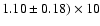 47erg s-1. Interestingly, the Gaussian component can be explained as a
line emission of highly ionized Nickel (7.81 keV). We refer the
reader to an accompanying paper (Margutti et al. 2007) for a detailed
discussion of the theoretical implications of the possible detection
of Nickel emission at 200 s after the onset of the GRB.
47erg s-1. Interestingly, the Gaussian component can be explained as a
line emission of highly ionized Nickel (7.81 keV). We refer the
reader to an accompanying paper (Margutti et al. 2007) for a detailed
discussion of the theoretical implications of the possible detection
of Nickel emission at 200 s after the onset of the GRB.
As we saw in the previous sections, the DPL, BB1 and BB2 models
provided significant improvement in the fits with respect to SPL model
in all four cases. In the GRB 060904B afterglow spectrum these models
left some residuals in the high-energy part of the spectrum which can
be fit well only by the GAU model (Fig. 7). Since we cannot
lean only on
statistics to evaluate the goodness of the DPL,
BB1, BB2 fits, we tested the probability that these residuals are
statistical fluctuations of the DPL, BB1, BB2 models.
To this aim, we adopted the same procedure we previously used to test
the hypothesis that the residuals were fluctuations of a SPL model
(Sect. 3). We replaced the SPL model with the DPL,
BB1, BB2 as the input model for the MC simulations. When we tested the
GRB 060904B afterglow residual significance as a fluctuation of a SPL
model, we found 4.2
(i.e. 99.9993%) as a single trial,
corresponding to 3.2
(i.e. 99.9461%) as multi-trial (see
Table 1). If we test, instead, the possibility that this
is a statistical fluctuation of a more complex spectral model (DPL,
BB1, BB2) the single (multi-) trial statistical significance of this
detection is 2.7 (2.2),
with very small differences among the
three models. This means that the deviation from SPL model that we
observe in GRB 060904B can be described as a Gaussian deviation from a
SPL model at 3.2
or from a two component model at 2.2.
Our most solid result is that we found a small homogeneous and fairly
defined sample of afterglow spectra (the soft sample) for which
deviations from the SPL spectral model are highly probable. We
started from an homogeneous sample of bright GRB afterglows with known
redshift and we studied their spectral evolution. We split the data in
different time slices and we focused on the softest spectra. In this
sub-sample at least 4 cases out of total of 13 present highly
significant deviations from the SPL spectral model during the
prompt-afterglow transition phase. We could firmly exclude that
these excesses can be explained as statistical fluctuations of a SPL
spectrum or some instrumental effects. We also excluded that data can
be fitted by a Band or a cutoff power-law model. We fitted these
spectra adding one of three different trial components to the SPL
model. We did not try to discriminate among these different models on
a purely statistical basis, and we discussed them based on their
time variability and energetics.
In a very recent paper Yonetoku et al. (2007) show that the very
soft spectrum of the early afterglow of GRB 060904A presents a feature
which is very similar to what we described in the present work. They
selected and stacked the data in the time intervals of the GRB 060904A
early afterglow, where the spectral photon index is larger than 4.0
(we note that this GRB is not included in our sample because its
redshift is not known). In a very similar way to our results, they
found that, in this spectrum, the data show a clear hardening break
around 2 keV. This feature leaves a significant excess with respect to
the double power-law model above 2 keV. They conclude that this
spectrum consists of two emission components, the second being
consistent with the spectrum of the late afterglow (our DPL model).
These two (independent) studies represent a direct piece of evidence that
the emission observed in the early phases of the afterglow is composed of
more than one component. Differently from Yonetoku et al. (2007), in
our sample, we showed that, if the second component were the emerging
afterglow emission, at early time this should be much more luminous
than the expectation from the classical afterglow model. We showed
that spectral studies of the prompt-afterglow transition phase can be
the starting point to separate different emitting components and could
provide useful information in order to better understand the afterglow
light curve complexity.
Acknowledgements
This work is supported at OAB-INAF by ASI grant I/011/07/0 and by the Ministry of University and Research of Italy
(PRIN 2005025417).
- Band, D., Matteson, J.,
Ford, L., et al. 1993, ApJ, 413, 281 [NASA ADS] [CrossRef]
(In the text)
- Butler, N. R. 2007,
ApJ, 656, 1001 [NASA ADS] [CrossRef]
(In the text)
- Butler, N. R.,
& Kocevski, D. 2007, ApJ, 663, 407 [NASA ADS] [CrossRef]
(In the text)
- Burrows, D. N.,
Hill, J. E., Nousek, J. A., et al. 2005, Space Sci. Rev., 120,
165 [NASA ADS] [CrossRef]
(In the text)
- Campana, S.,
Mangano, V., Blustin, A. J., et al. 2006, Nature, 442, 1008 [NASA ADS] [CrossRef]
(In the text)
- Campana, S., et
al. 2008, in prep.
(In the text)
- Cash, W. 1979, ApJ, 228,
939 [NASA ADS] [CrossRef]
- Cucchiara,
A., Price, P. A., Fox, D. B., et al. 2006, GCN, 5052
(In the text)
-
Dickey, J. M., & Lockman, F. J. 1990, ARA&A, 28, 215 [NASA ADS] [CrossRef]
(In the text)
- Falcone, A. D.,
Burrows, D. N., Lazzati, D., et al. 2006, ApJ, 641, 1010 [NASA ADS] [CrossRef]
(In the text)
- Fugazza, D.,
D'Avanzo, P., Malesani, D., et al. 2006, GCN, 5513
(In the text)
- Fox, D. B., Barthelmy, S.
D., Chester, M. M., et al. 2006, GCN, 5800
(In the text)
- Gehrels, N.,
Chincarini, G., Giommi, P., et al. 2004, ApJ, 611, 1005 [NASA ADS] [CrossRef]
(In the text)
- Ghisellini,
G., Ghirlanda, G., & Tavecchio, F. 2007, MNRAS, in press
[arXiv:0707.0689]
(In the text)
- Goad, M. R., Page, K.
L., Godet, O., et al. 2007, A&A, 468, 103 [NASA ADS] [CrossRef] [EDP Sciences]
(In the text)
- Godet, O., Page,
K., Osborne, J. P., et al. 2007a, A&A, 471, 385 [NASA ADS] [CrossRef] [EDP Sciences]
(In the text)
- Godet, O.,
Beardmore, A. P., Abbey, A. F., et al. 2007b, Proc. SPIE, 6686, in
press [arXiv:0708.2988]
(In the text)
- Grupe, D., Barthelmy,
S. D., Chester, M. M., et al. 2006, GCN 5505
(In the text)
- Grupe, D., Gronwall,
C., Wang, X. Y., et al. 2007, ApJ, 662, 443 [NASA ADS] [CrossRef]
(In the text)
- Hill, J. E., Burrows,
D. N., Nousek, J. A., et al. 2004, Proc. SPIE, 5165, 175
(In the text)
- Kobayashi, S., &
Zhang, B. 2007, ApJ, 655, 973 [NASA ADS] [CrossRef]
(In the text)
- Markwardt, C., Barbier,
L., Barthelmy, S. D., et al. 2006, GCN, 5520
- La Parola, V.,
Barthelmy, S. D., Burrows, D. N., et al. 2006, GCN, 5047
(In the text)
- Li, L.-X 2007 MNRAS 375,
240
(In the text)
- Mangano, V., Holland,
S. T., Malesani, D., et al. 2007, A&A, 470, 105 [NASA ADS] [CrossRef] [EDP Sciences]
(In the text)
- Margutti, R.,
2007, A&A, submitted
(In the text)
- Moretti, A.,
Campana, S., Mineo, T., et al. 2005, Proc. SPIE, 5898, 348 [NASA ADS]
(In the text)
- Moretti, A.,
Perri, M., Capalbi, M., et al. 2007, Proc. SPIE, 6688-12, in
press
(In the text)
- Nousek, J. A.,
Kouveliotou, C., Grupe, D., et al. 2006, ApJ, 642, 389 [NASA ADS] [CrossRef]
(In the text)
- O'Brien, P. T.,
Willingale, R., Osborne, J., et al. 2006, ApJ, 647, 1213 [NASA ADS] [CrossRef]
(In the text)
- Protassov,
R., Van Dyk, D., Connors, A., et al. 2002, ApJ, 571, 545 [NASA ADS] [CrossRef]
(In the text)
- Rutledge, R.
E., & Sako, M. 2003, MNRAS, 339, 600 [NASA ADS] [CrossRef]
(In the text)
- Ryde, F., Bjornsson,
C.-I., Kaneko, Y., et al. 2006, ApJ, 652, 1400 [NASA ADS] [CrossRef]
(In the text)
- Sako, M., Harrison, F.
A., & Rutledge, R. E. 2005, ApJ, 623, 973 [NASA ADS] [CrossRef]
(In the text)
- Sari, R., 1997, ApJ,
489, 37L [NASA ADS] [CrossRef]
(In the text)
- Thoene, C.
C.,Levan, A., Jakobsson, P., et al. 2006a, GCN, 5373
(In the text)
- Thoene, C. C.,
Fynbo, J.P.U., Jakobsson, P., et al. 2006b, GCN, 5812
(In the text)
- Willingale,
R., O'Brien, P. T, Osborne, J. P., et al. 2007, ApJ, 662, 1093 [NASA ADS] [CrossRef]
(In the text)
- Yonetoku, D.,
Tanabe, S., Murakami, T., et al. 2007, PASJ, in press
[arXiv:0708.3968]
(In the text)
- Zhang, B. B., Liang,
E. W., & Zhang, B., 2007, ApJ, 666, 1002 [NASA ADS] [CrossRef]
(In the text)
- Zhang, B., Yan, Y.
Z., Dyks, J., et al. 2006, ApJ, 642, 354 [NASA ADS] [CrossRef]
(In the text)
Copyright ESO 2008
![\begin{figure}
\par\begin{tabular}{c@{\hspace*{1cm}}c}
\includegraphics[width=6...
...
\includegraphics[width=6.8cm,clip]{8805f1_g.ps} & \\
\end{tabular}\end{figure}](/articles/aa/full/2008/05/aa8805-07/img19.gif)
![\begin{figure}
\par\includegraphics[width=7.5cm,clip]{8805f2.ps}\end{figure}](/articles/aa/full/2008/05/aa8805-07/img27.gif)
![\begin{figure}
\par\begin{tabular}{cc}
\includegraphics[width=7.5cm,clip]{8805f3...
...} & \includegraphics[width=7.5cm,clip]{8805f3_d.ps}\\
\end{tabular}\end{figure}](/articles/aa/full/2008/05/aa8805-07/img30.gif)
![\begin{figure}
\par\begin{tabular}{cc}
\includegraphics[width=7.5cm,clip]{8805f4...
...} & \includegraphics[width=7.5cm,clip]{8805f4_d.ps}\\
\end{tabular}\end{figure}](/articles/aa/full/2008/05/aa8805-07/img31.gif)
![\begin{figure}
\par\begin{tabular}{cc}
\includegraphics[width=8cm,clip]{8805f5_a...
...ps} & \includegraphics[width=8cm,clip]{8805f5_d.ps}\\
\end{tabular}\end{figure}](/articles/aa/full/2008/05/aa8805-07/img32.gif)
![\begin{figure}
\par\begin{tabular}{cc}
\includegraphics[width=8.2cm,clip]{8805f6...
...} & \includegraphics[width=8.2cm,clip]{8805f6_d.ps}\\
\end{tabular}\end{figure}](/articles/aa/full/2008/05/aa8805-07/img117.gif)
![\begin{figure}
\par\begin{tabular}{cc}
\includegraphics[width=8cm,clip]{8805f7_a...
...ps} & \includegraphics[width=8cm,clip]{8805f7_d.ps}\\
\end{tabular}\end{figure}](/articles/aa/full/2008/05/aa8805-07/img118.gif)
![\begin{figure}
\par\includegraphics[width=7.5cm,clip]{8805f8.ps}\end{figure}](/articles/aa/full/2008/05/aa8805-07/img124.gif)