![\begin{figure}
\par\includegraphics[width=8cm]{figure/8089fig1.ps}\end{figure}](/articles/aa/full/2008/05/aa8089-07/img20.gif) |
Figure 1: Distribution of the sample galaxies over the Hubble types ( left panel) and radial velocities with respect to the 3 K background ( right panel). |
| Open with DEXTER | |
In the text
![\begin{figure}
\par\includegraphics[width=6cm,angle=90]{figure/8089fig2.ps}\end{figure}](/articles/aa/full/2008/05/aa8089-07/img104.gif) |
Figure 2:
Comparison between the axis ratios ( left panel)
and the position angles ( right panel) measured in this paper
and by MH01. Filled dots and open diamonds correspond to
values measured for bulges and disks, respectively. Residuals
 and
and
 are defined as
 and
and
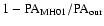 ,
respectively. ,
respectively. |
| Open with DEXTER | |
In the text
![\begin{figure}
\par\includegraphics[width=12.7cm,clip]{figure/8089fig3.ps}
\end{figure}](/articles/aa/full/2008/05/aa8089-07/img107.gif) |
Figure 3: Correlations between the bulge parameters. Correlation between the Hubble type and effective radius (A), effective surface brightness (B), and shape parameter (C). Correlations between the effective radius and shape parameter (D), effective surface brightness (E), and absolute magnitude (F). In each panel the solid line represent the linear regression through all the points. The Pearson correlation coefficient (r), and the results of the linear fit (y =a + bx) are also given. |
| Open with DEXTER | |
In the text
![\begin{figure}
\par\includegraphics[width=7cm]{figure/8089fig4.ps}\end{figure}](/articles/aa/full/2008/05/aa8089-07/img127.gif) |
Figure 4:
Edge-on view of the FP for the 98 early-to-intermediate type
bulges of our sample with measured velocity dispersion. The solid
line represents the linear fit to the data. The dotted lines
represent the  deviation from the fit. The error bars in
the lower right corner of the panel indicate the mean errors of the
data.
deviation from the fit. The error bars in
the lower right corner of the panel indicate the mean errors of the
data. |
| Open with DEXTER | |
In the text
![\begin{figure}
\par\includegraphics[width=7cm]{figure/8089fig5.ps}\end{figure}](/articles/aa/full/2008/05/aa8089-07/img128.gif) |
Figure 5:
FJ relation for the 98 early-to-intermediate type bulges of
our sample with measured velocity dispersion. The solid line
represents the linear fit to the data. The dotted lines represent
the
deviation from the fit. The error bars in the lower
right corner of the panel indicate the mean errors of the data. |
| Open with DEXTER | |
In the text
![\begin{figure}
\par\includegraphics[width=7cm]{figure/8089fig6.ps}\end{figure}](/articles/aa/full/2008/05/aa8089-07/img132.gif) |
Figure 6:
Edge-on view of the PP for early-to-intermediate bulges of
our sample. The solid line represents the linear fit to the data.
The dotted lines represent the
deviation from the fit. The
error bars in the lower right corner of the panel indicate the mean
errors of the data. |
| Open with DEXTER | |
In the text
![\begin{figure}
\par\includegraphics[width=13cm,clip]{figure/8089fig7.ps} \end{figure}](/articles/aa/full/2008/05/aa8089-07/img136.gif) |
Figure 7: Correlations between the disk parameters. Correlations between the Hubble type and disk scale length (A) and central surface brightness (B). Correlation between the disk scale length and absolute luminosity (C) and central surface brightness (D). Solid lines and coefficients as in Fig. 3. |
| Open with DEXTER | |
In the text
![\begin{figure}
\par\includegraphics[width=13.2cm,clip]{figure/8089fig8.ps} \end{figure}](/articles/aa/full/2008/05/aa8089-07/img137.gif) |
Figure 8: (A) Correlation between the disk scale length and central velocity dispersion for the 98 galaxies of our sample with a measured velocity dispersion. (B) Correlation between the disk scale length and bulge effective radius. (C) The ratio between the bulge and disk exponential scale lengths as a function of the bulge shape parameter. Filled circles and crosses represent the results of our measurements and simulations by Tissera et al. (2006), respectively. Solid lines and coefficients as in Fig. 3. |
| Open with DEXTER | |
In the text
![\begin{figure}
\par\includegraphics[width=7cm]{figure/8089fig9.ps}\end{figure}](/articles/aa/full/2008/05/aa8089-07/img180.gif) |
Figure 9: Probability distribution function of E for the galaxy IC 4310. The dotted line represents the value of T=0.098 derived for this galaxy. The value of E1/2 is also shown in the plot. |
| Open with DEXTER | |
In the text
![\begin{figure}
\par\includegraphics[width=7cm]{figure/8089fi10.ps}\end{figure}](/articles/aa/full/2008/05/aa8089-07/img199.gif) |
Figure 10: PDF of T. The probability is normalized over 10 bins, which are geometrically distributed to cover the interval (0,1). The width of the first bin is 0.03 and the width ratio of two consecutive bins is 1.25. Error bars correspond to Poisson statistics. |
| Open with DEXTER | |
In the text
![\begin{figure}
\par\includegraphics[width=7cm]{figure/8089fi11.ps}\end{figure}](/articles/aa/full/2008/05/aa8089-07/img204.gif) |
Figure 11: PDF of E. The probability is normalized over 10 bins, which are geometrically distributed to cover the interval (0,1). The width of the first bin is 0.03 and the width ratio of two consecutive bins is 1.25. The error bar of each Pk(E) bin corresponds to the Poisson statistics of 1000 realizations of Pk(T) after excluding non-physical cases. |
| Open with DEXTER | |
In the text
![\begin{figure}
\par\includegraphics[width=15cm,clip]{figure/8089fi12.ps}\end{figure}](/articles/aa/full/2008/05/aa8089-07/img209.gif) |
Figure 12:
PDF of E for the different subsamples. (A) Lenticular
galaxies (
 ). (B) Spiral galaxies ( ). (B) Spiral galaxies (
 ). (C) Galaxies with ). (C) Galaxies with  .
(D) Galaxies with n< 2. (E)
Faint bulges ( .
(D) Galaxies with n< 2. (E)
Faint bulges (
 ). (F) Bright bulges ( ). (F) Bright bulges (
 ). Bin widths and error bars as in Fig. 11. The mean
intrinsic ellipticity and the number of galaxies of the subsample are
given in each panel. ). Bin widths and error bars as in Fig. 11. The mean
intrinsic ellipticity and the number of galaxies of the subsample are
given in each panel. |
| Open with DEXTER | |
In the text
![\begin{figure}
\par\includegraphics[width=7cm]{figure/8089fi13.ps}\end{figure}](/articles/aa/full/2008/05/aa8089-07/img245.gif) |
Figure 13: PDF of E for the original sample (solid lines), for a sample with 30% of bulges with a nuclear bar (dotted line) and for a 100% fraction of galaxies hosting a nuclear bar (dashed line). Bin widths and error bars as in Fig. 11. |
| Open with DEXTER | |
In the text