![[*]](/icons/foot_motif.gif)
A&A 477, 535-541 (2008)
DOI: 10.1051/0004-6361:20078388
C. B. Pereira1 -
L. F. Miranda2 -
V. V. Smith3 -
K. Cunha3,
1 - Observatório Nacional-MCT, Rua José Cristino, 77,
CEP 20921-400 São Cristóvão, Rio de Janeiro-RJ, Brazil
2 -
Instituto de Astrofísica de Andalucía, CSIC,
Apdo. 3004, 18080 Granada, Spain
3 -
NOAO, Casilla 603, La Serena, Chile
Received 31 July 2007 / Accepted 18 October 2007
Abstract
Aims. We determined the atmospheric parameters and evolutionary state of the cool stellar component of the peculiar planetary nebula Me 1-1 and analyzed its spatio-kinematic structure.
Methods. High-resolution optical spectroscopy was used in an abundance analysis of the cool component in Me 1-1. Narrow-band images were used to study the nebula.
Results. The stellar parameters derived for the cool star in Me 1-1 are
 = 4500 K and
 ,
which correspond to a spectral type of K(1-2) II. This star is rapidly rotating with a projected rotational velocity of
,
which correspond to a spectral type of K(1-2) II. This star is rapidly rotating with a projected rotational velocity of
 km s-1. Its estimated mass is 3.5
  with a distance of 6 kpc and a luminosity of 370
  .
The cool star in Me 1-1 has nearly solar iron and calcium abundances. Barium, a monitor of s-process nucleosynthesis, is not enriched. We show that this cool star has reached the base of the RGB and its accreted matter has been diluted by the deepening convective envelope. The images strongly suggest that Me 1-1 is an edge-on ring with incipient bipolar lobes. The central star is displaced
.
The cool star in Me 1-1 has nearly solar iron and calcium abundances. Barium, a monitor of s-process nucleosynthesis, is not enriched. We show that this cool star has reached the base of the RGB and its accreted matter has been diluted by the deepening convective envelope. The images strongly suggest that Me 1-1 is an edge-on ring with incipient bipolar lobes. The central star is displaced  400 AU from the center of the nebula. The expansion velocity of the ring ranges from 10 and 13 km s-1 in the different emission lines. Broad (
 600 km s-1) wings are detected in the H
 emission, probably with a stellar origin. A comparison of Me 1-1 with other ring-like planetary nebula shows that most of them host off-center binary central stars.
Key words: ISM: planetary nebulae: individual: Me 1-1 - stars: binaries: general - stars: late-type - stars: abundances
The Strasbourg-ESO Catalogue of Planetary Nebulae reports that 1820 objects have been classified at least once as planetary nebulae (PNe; Acker et al. 1992). However, there are only a few PNe known to contain close binary nuclei. Bond (2000) lists 16 objects, which he divides into three classes: those that behave as eclipsing binaries and/or show heating effects into the atmosphere of a main sequence star; those that behave as spectroscopic binaries; and, finally, those that are classified as "Abell 35-type'' objects. The "Abell 35-type'' objects represent what has been previously classified as "peculiar PNe'' according to Lutz (1977). In particular, Lutz (1977) called peculiar PNe, those objects that have nebular emission lines in combination with an absorption spectrum of a cool central star (of spectral types A to K). Since the cool star is not hot enough to account for the ionization of the nebulae, these peculiar PNe should be binary systems consisting of a faint hot star (responsible for the ionization of the nebulae) plus a bright cool star that is the source of the absorption spectrum. Nowadays, it is known that some of the objects in Lutz's (1977) list belong to a small subsample of symbiotic stars called yellow symbiotics (Schmid & Nussbaumer 1993).
The cool central stars of peculiar PNe are interesting to study because mass-transfer may have happened from the former AGB star, which is now the hot star in the binary system. Another interesting point to investigate is the rotational velocities of the cool central stars. As discussed by Jeffries & Stevens (1996) there is a class of wide binaries containing hot white dwarfs and rapidly rotating magnetically active cool stars. In the mechanism proposed by these authors the rapid rotation of the cool star is probably due to spin-up from the accretion of material from a massive AGB wind. In fact, some peculiar PNe with such spectroscopic characteristics, such as Abell 35 and LoTr 5, have already been reported in the literature (Thévenin & Jasniewicz 1997). In addition, Smith et al. (2001) and Pereira et al. (2005) show that the cool stellar components of the D'-type symbiotics S 190, HD 330036 and AS 201 also behave like those in Abell 35 and LoTr 5. In particular, these stars are rapid rotators that show enhanced abundances of carbon and heavy elements produced by s-process nucleosynthesis.
Recently, Shen et al. (2004) have used low-resolution spectroscopy to detect a cool stellar component at the center of the PN Me 1-1 (Hen 2-441). Therefore, Me 1-1 can be included in this family of peculiar PNe. Motivated by the above discussion, in this paper we investigate via high-resolution spectroscopy whether Me 1-1 behaves like the other peculiar PNe and D'-type symbiotics analyzed so far. In particular, our goal is to investigate whether the cool star of Me 1-1 is a rapid rotator and if it shows enhanced abundances of heavy elements produced by s-process nucleosynthesis. In addition, high resolution spectroscopy is useful in investigating the internal kinematics of the nebulae.
Spectroscopic observations were obtained using the FOCES
spectrograph (Pfeiffer et al. 1998) with the 2.2 m telescope at the Calar
Alto Observatory (Almería, Spain) on August 1, 2006. The detector was a
Site#1d CCD with 2168 pixels in the spectral direction. The fibre of the
spectrograph was combined with a diaphragm of 2.5'' centered on the central
star and covering the central regions of the nebula. A slit width of 200  m was used resulting in a resolving power of R=40 000 and wavelength coverage from
  4750 Å to 9600 Å. The nominal
S/N ratio of the observed spectra was evaluated by measuring the rms flux
fluctuation in selected continuum windows, and typical values were
4750 Å to 9600 Å. The nominal
S/N ratio of the observed spectra was evaluated by measuring the rms flux
fluctuation in selected continuum windows, and typical values were
 for
for
 s of integration time. The spectra were reduced
using the IRAF data package and the data reduction consisted of the following
standard steps: CCD bias correction, flat-fielding, spectrum extraction and
wavelength calibration with a ThAr lamp. No absolute flux calibration was
obtained.
s of integration time. The spectra were reduced
using the IRAF data package and the data reduction consisted of the following
standard steps: CCD bias correction, flat-fielding, spectrum extraction and
wavelength calibration with a ThAr lamp. No absolute flux calibration was
obtained.
In order to complement the analysis of Me 1-1, we have used
images from the IAC Catalog of Northern Galactic Planetary Nebulae (Manchado
et al. 1996). These images (kindly provided by Guerrero) have been
obtained with the Nordic Optical Telescope at Roque de los Muchachos
Observatory (La Palma, Spain) in three narrow-band filters that isolate the
light of the H,
[N II]6584 and [O III]5007 emission
lines. The spatial scale and spatial resolution of the images are
0.139'' pixel-1 and 0.7'', respectively. More details about
the observations can be found in Manchado et al. (1996).
The high resolution absorption spectrum of Me 1-1 shows the
presence of large numbers of absorption features
broadened by a large rotational velocity, similar to what has been previously observed for
other D'-type symbiotics. The top panels of Figs. 1 and 2
show the observed Calar Alto spectra of Me 1-1 in the spectral
regions around 6150 Å and 6440 Å, respectively.
The region around 6150 Å contains Fe I, Fe II
and Ba II lines while the region around 6440 Å contains
Fe I and Ca I lines. In the bottom panels of Figs. 1 and 2 we also show the
rotationally broadened spectra of the D'-type symbiotic S 190
taken with FEROS spectrograph at ESO, for comparison.
![\begin{figure}
\par\includegraphics[width=6.2cm,clip]{8388fig1.eps}
\end{figure}](/articles/aa/full/2008/02/aa8388-07/img25.gif) |
Figure 1:
Observed and synthetic spectra for Me 1-1
a) and S 190 b) displaying broad lines and indicating rotationally
broadened profiles. The observed spectra are plotted along with three
synthetic spectra computed for three different surface gravities showing the
sensitivity of the Fe II (and Ba II to  ). ). |
| Open with DEXTER | |
![\begin{figure}
\par\includegraphics[width=6.2cm,clip]{8388fig2.eps}
\end{figure}](/articles/aa/full/2008/02/aa8388-07/img28.gif) |
Figure 2:
Observed and synthetic spectra for Me 1-1 ( top panel)
and S 190 ( bottom panel) in the spectral regions 6425-6453 Å.
The solid lines in each panel correspond to the observed spectra and dotted lines correspond to the
synthetic spectra calculated for
 using
using
 K and
for Me 1-1 and K and
for Me 1-1 and
 K and K and
 for S 190.
 |
| Open with DEXTER | |
Due to rapid rotation, the spectral lines in Me 1-1 become blended and this prevents a photospheric analysis based on traditional methods of measuring the equivalent widths of individual lines. Thus in order to do an abundance analysis it is necessary to carefully select spectral regions that contain broadened features whose respective strengths are approximately dominated by single species. In particular, the spectral region near 6150 Å (Fig. 1) was selected as it contains a number of broadened features whose respective strengths are dominated by single species of Fe I, Fe II (as well as Ba II). We note that unfortunately only a few isolated Fe II lines are found in spectra of rapidly rotating cool stars such as the one studied here. In this paper, we also analyzed one Ba II feature whose abundance serves as a monitor of s-process nucleosynthesis.
Synthetic spectra were calculated using the MOOG LTE synthesis code (Sneden 1973)
together with a Kurucz & Bell (1995) linelist and Kurucz ATLAS9 model
atmospheres. We computed a grid of synthetic spectra for model atmospheres
covering a range in effective temperature (
from 4500 to 7000 K), surface gravity (;
from 0.0 to 4.0), microturbulent velocity
( ;
from 1.0 to 4.0 km s-1), and five values of metallicity
([A/H]; 0.0, -0.5, -1.0, -1.5 and -2.0). Each of these synthetic
spectra was compared to the observed spectrum in the interval between
6133-6152 Å (Fig. 1). Our derivation of the effective temperature
and surface gravity for the studied cool star is based upon the
analysis Fe I and Fe II lines. It is worth noting that these
behave as "single'' spectral lines, since the whole absorption profile is
dominated by them.
;
from 1.0 to 4.0 km s-1), and five values of metallicity
([A/H]; 0.0, -0.5, -1.0, -1.5 and -2.0). Each of these synthetic
spectra was compared to the observed spectrum in the interval between
6133-6152 Å (Fig. 1). Our derivation of the effective temperature
and surface gravity for the studied cool star is based upon the
analysis Fe I and Fe II lines. It is worth noting that these
behave as "single'' spectral lines, since the whole absorption profile is
dominated by them.
More precisely, our determination of the atmospheric
parameters relied on fits to observed and synthetic spectra of two Fe I lines (at 6136.62 Å and 6137.69 Å) and two Fe II lines (at 6147.74 Å and 6149.26 Å). We adopted in this study basically the
same approach as the one discussed in our previous study (Smith et al. 2001).
Table 1 provides the final adopted atmospheric parameters for the cool star in
Me 1-1. We note that
and
were also re-derived here for the
comparison star S 190 and these are in agreement, as expected, with those
obtained previously by Smith et al. (2001).
For each synthetic spectrum, corresponding to given values of
,
,
,
[A/H], we first determined the abundance
of Fe I and the projected rotational velocity ( )
that best
reproduce the observed profile of the two Fe I lines mentioned above.
This is done by searching for the values of the Fe abundance and that minimize the merit function
)
that best
reproduce the observed profile of the two Fe I lines mentioned above.
This is done by searching for the values of the Fe abundance and that minimize the merit function
 (f represents the normalized spectral flux around the
selected lines). Then, we repeated the procedure to determine the abundance of
Fe and
that reproduce the profile of the two Fe II lines
mentioned above. In this way, we derive the best fit values of the Fe abundance and
for each set of
,
,
,
[A/H]. The atmospheric parameters are then determined as those values of
,
,
and [A/H] for which the abundance derived
from Fe I equals the abundance of Fe II at the same projected
rotational velocity.
(f represents the normalized spectral flux around the
selected lines). Then, we repeated the procedure to determine the abundance of
Fe and
that reproduce the profile of the two Fe II lines
mentioned above. In this way, we derive the best fit values of the Fe abundance and
for each set of
,
,
,
[A/H]. The atmospheric parameters are then determined as those values of
,
,
and [A/H] for which the abundance derived
from Fe I equals the abundance of Fe II at the same projected
rotational velocity.
The estimated
 uncertainties in the atmospheric parameters are related to the
resolution of the grid of synthetic spectra used, and indicate that
and
are constrained to about
uncertainties in the atmospheric parameters are related to the
resolution of the grid of synthetic spectra used, and indicate that
and
are constrained to about  100 K and 0.5,
respectively. The uncertainty in rotational velocity comes from the fit
procedure and is about 10 km s-1.
100 K and 0.5,
respectively. The uncertainty in rotational velocity comes from the fit
procedure and is about 10 km s-1.
Figure 1 shows three synthetic spectra and the observed data for
Me 1-1 (top panel), as well as that of S 190 (bottom panel), which is shown
for comparison. The profiles represented by solid lines in each panel
correspond to the synthetic spectra which were calculated with the adopted
stellar parameters in Table 1. The best fit synthesis was obtained for iron
and barium abundances roughly solar. The dotted and dashed lines represent
synthetic spectra for 's differing by 1.0 dex. Note that smaller
surface gravities increase the line strength and this effect for the Fe II
lines is used in order to estimate log g. Best fits to the observed spectra
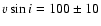
indicate that the rotational velocity for the cool star in Me 1-1 is
 km s-1. The large projected rotational velocity found for
our target is similar to what has been previously obtained for the other
D
km s-1. The large projected rotational velocity found for
our target is similar to what has been previously obtained for the other
D -type symbiotic stars S 190, HD 330036, and AS 201 (Smith et al.
2001; Pereira et al. 2005;
-type symbiotic stars S 190, HD 330036, and AS 201 (Smith et al.
2001; Pereira et al. 2005;
 ,
,
 and
and  km s-1, respectively).
Table 1: Atmospheric parameters for the cool central star in Me 1-1.
In the top panel of Fig. 2 we show the synthetic spectrum for the cool
star in Me 1-1 in the spectral region around 6440 Å, where Fe I
and Ca I lines are observed. The synthetic spectra were calculated for
the adopted stellar parameters which are presented in Table 1. The agreement
between the observed and synthetic profiles in this region confirms the
atmospheric parameters obtained from the 6150 Å region and, in addition,
it indicates that the Ca abundance is also nearly solar. Finally, the derived
values of
and
from this high-resolution study of the
cool component in Me 1-1 suggest that it is a K(1-2)II spectral type
(Schmidt-Kaler 1982) that is comparable to the K(3-4)II type given by Shen et al. (2004).
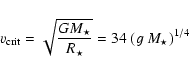
The critical breakup velocity as a function of
stellar mass and surface gravity can be written as:
 |
(1) |
 is in km s-1,
  is in units of
and g is the surface gravity in cm s-2. Figure 3 shows
the curves
versus
for several constant values
of .
The dashed horizontal line in Fig. 3 corresponds to the
derived projected rotational velocity (see above). Figure 3 shows that for
any stellar mass, the surface gravity of the cool central star in Me 1-1 must be larger
than
is in units of
and g is the surface gravity in cm s-2. Figure 3 shows
the curves
versus
for several constant values
of .
The dashed horizontal line in Fig. 3 corresponds to the
derived projected rotational velocity (see above). Figure 3 shows that for
any stellar mass, the surface gravity of the cool central star in Me 1-1 must be larger
than
 in the sense that its rotational velocity never exceeds the
critical velocity. The spectroscopically derived value of
does
not violate this minimum .
in the sense that its rotational velocity never exceeds the
critical velocity. The spectroscopically derived value of
does
not violate this minimum .
![\begin{figure}
\par\includegraphics[width=7cm,clip]{8388fig3.eps}
\end{figure}](/articles/aa/full/2008/02/aa8388-07/img43.gif) |
Figure 3:
The critical breakup velocity as a function of stellar
mass for different values of
from 0.0 to 2.0 (solid lines).
The dashed horizontal line with arrows shows v sin i for the cool
central star in Me 1-1 (90 km s-1). The arrows indicate that this value
is a lower limit to the true equatorial rotational velocity. |
| Open with DEXTER | |
![\begin{figure}
\par\includegraphics[width=7.5cm,clip]{8388fig4.eps}
\end{figure}](/articles/aa/full/2008/02/aa8388-07/img44.gif) |
Figure 4:
Line profiles of several emission lines in Me 1-1. The intensity of
each line has been normalized to its intensity peak. The H
profile is presented
at two different scales in order to show the broad wings of the H
emission. |
| Open with DEXTER | |
 7751,
[Cl IV]7530,8046 and [S III]9069,9531
emission lines.
7751,
[Cl IV]7530,8046 and [S III]9069,9531
emission lines.
Figure 4 shows the line profiles of several emission lines. All metal lines in our spectrum present a double-peaked profile. Surprinsingly, the velocity separation between the peaks presents a very narrow range of values between 20-21 km s-1 for the He I and [Cl IV] lines and 27 km s-1 for the [S II] lines. For the [N I], [N II], [O I], [O III], [Ar III] and [S III] emission lines the velocity separation is 22-25 km s-1 without any trend to higher velocity separation with lower ionization potential, as it is usually observed in PNe. The velocity separation between the peaks indicates expansion velocities between 10 and 13 km s-1.
The nebular H
and H emission lines do not show a double-peaked profile
(Fig. 4). However, the H
profile cannot be fitted with a single
gaussian line profile and H
shows a shoulder that suggests the presence
of two velocity components. Probably, the lack of double-peaked profiles is
due to the large thermal width in the hydrogen lines. In addition, broad wings
are detected in H
and H
extending 600 km s-1 and 400 km s-1, respectively. These broad wings probably have a
stellar origin. We note that the velocity centroid of the nebular H emission seems to be blueshifted by
emission lines do not show a double-peaked profile
(Fig. 4). However, the H
profile cannot be fitted with a single
gaussian line profile and H
shows a shoulder that suggests the presence
of two velocity components. Probably, the lack of double-peaked profiles is
due to the large thermal width in the hydrogen lines. In addition, broad wings
are detected in H
and H
extending 600 km s-1 and 400 km s-1, respectively. These broad wings probably have a
stellar origin. We note that the velocity centroid of the nebular H emission seems to be blueshifted by
 km s-1 with respect to
the velocity centroid of the broad wings. Given the different origins of the
narrow (nebular) and the broad (stellar) H
emission components, the
velocity difference could be related to orbital motion of the central star
(see Miranda et al. 2001). New high-resolution spectra would be very valuable
to study the H line profile in more detail.
km s-1 with respect to
the velocity centroid of the broad wings. Given the different origins of the
narrow (nebular) and the broad (stellar) H
emission components, the
velocity difference could be related to orbital motion of the central star
(see Miranda et al. 2001). New high-resolution spectra would be very valuable
to study the H line profile in more detail.
Shen et al. (2004) tentatively identified the Raman scattering feature at 6825 Å. In our spectrum this feature is not present. We have also checked for the possible presence of the Raman features at 4850 Å, 6545 Å and 7088 Å but they could not be identified in our spectrum.
Figure 5 shows a grey-scale representation of the [N II] image of
Me 1-1 (the H
and [O III] images are not show here). Me 1-1
consists of three bright knots, a central one corresponding to the central
star, and two outer ones. The three knots are aligned along
 .
Faint emission with a "V'' (or inverted "V'') shape emanates
from the outer knots. The separation between the outer knots amounts 1.9'' in H
and [O III] and 2.3'' in [N II].
A visual inspection of the [N II] and H
images shows that the
central star is not located at the middle of the outer knots but displaced
towards PA 352
.
Faint emission with a "V'' (or inverted "V'') shape emanates
from the outer knots. The separation between the outer knots amounts 1.9'' in H
and [O III] and 2.3'' in [N II].
A visual inspection of the [N II] and H
images shows that the
central star is not located at the middle of the outer knots but displaced
towards PA 352 (Fig. 1; see also Manchado et al. 1996). Given the
brightness and compactness of the outer knots (and central star), their
relative positions (defined by their centroid) can be determined with high
accuracy. We have used different methods (one- and two-dimensional gaussian
and paraboloid line fits) to determinate the centroids, and both the Hand [N II] images are consistent with a displacement of 0.067
(Fig. 1; see also Manchado et al. 1996). Given the
brightness and compactness of the outer knots (and central star), their
relative positions (defined by their centroid) can be determined with high
accuracy. We have used different methods (one- and two-dimensional gaussian
and paraboloid line fits) to determinate the centroids, and both the Hand [N II] images are consistent with a displacement of 0.067
 towards PA 352.
![\begin{figure}
\par\includegraphics[width=7.3cm,clip]{8388fig5.eps}
\end{figure}](/articles/aa/full/2008/02/aa8388-07/img49.gif) |
Figure 5: Grey-scale representation of the [N II] image of Me 1-1. The grey leves are linear. The origin (0, 0) corresponds to the position of the central star (labelled). |
| Open with DEXTER | |
The stellar parameters derived here for the cool star in
Me 1-1 are found in Table 1. These parameters can be used to locate the
star on a
 diagram so that its
position can be compared to stellar evolutionary model tracks.
Figure 6 shows the location of cool star of Me 1-1 as well as
that of three yellow D-type symbiotic stars
(Smith et al. 2001; Pereira et al. 2005) plus model tracks
computed by Schaerer et al. (1993) for solar metallicity. The stellar
parameters derived for the cool star of Me 1-1 place it on the giant branch
with a mass of
diagram so that its
position can be compared to stellar evolutionary model tracks.
Figure 6 shows the location of cool star of Me 1-1 as well as
that of three yellow D-type symbiotic stars
(Smith et al. 2001; Pereira et al. 2005) plus model tracks
computed by Schaerer et al. (1993) for solar metallicity. The stellar
parameters derived for the cool star of Me 1-1 place it on the giant branch
with a mass of
 .
.
The relation among temperature, gravity and mass, and the V magnitude and
the interstellar absorption (AV) is given by:
 = = 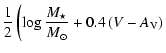 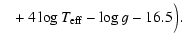 |
(2) |
K and
,
Eq. (2), can be written as
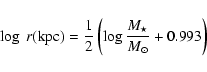 |
(3) |
 (Bessel 1998). For
 (Fig. 6),
we obtain a distance
(Fig. 6),
we obtain a distance
 kpc. Previous distance
determinations for Me 1-1 found 4.6 kpc (Cahn et al. 1992;
Phillips 2004) and 8 kpc (Shen et al. 2004). At 6 kpc, the
luminosity of the cool star in Me 1-1 is 370 .
kpc. Previous distance
determinations for Me 1-1 found 4.6 kpc (Cahn et al. 1992;
Phillips 2004) and 8 kpc (Shen et al. 2004). At 6 kpc, the
luminosity of the cool star in Me 1-1 is 370 .
![\begin{figure}
\par\includegraphics[width=6cm,clip]{8388fig6.eps}
\end{figure}](/articles/aa/full/2008/02/aa8388-07/img59.gif) |
Figure 6:
The position of Me 1-1 (filled circle) in a
diagram along with stellar model evolutionary tracks from Schaerer et al.
(1993). The positions of three D-type symbiotic stars
is also shown, S 190 (filled square), AS 201 (open circle) and HD 330036
(open square). |
| Open with DEXTER | |
-type symbiotic stars
Although Figs. 1 and 2 show that the absorption spectrum of Me 1-1 is similar to
that of the D-type symbiotic star S 190, from our spectroscopic analysis we
did not find any barium enrichment. In fact, Shen et al. (2004) also
failed to detect any barium line at 4554 Å, 5854 Å and at 6142 Å.
Had Me 1-1 been barium-enriched, some of these Ba lines would not have
escaped detection even in a low resolution spectrum.
The abundance analyses by Smith et al. (2001) and Pereira et al. (2005)
of other three D'-symbiotics (S190, HD 330036, and AS201) have all found
[Ba/Fe] enhancements of +0.5-0.9 dex, thus the lack of a similar
enrichment in Me 1-1 seems to be puzzling. A closer inspection of the evolutionary
states of the three D'-symbiotics, however, may reveal the reason why Me 1-1
does not exhibit a measurably elevated Ba/Fe abundance ratio. Figure 7
illustrates the derived values of [Ba/Fe] as a function of the effective
temperatures for these D'-symbiotics. This figure reveals a significant
decline in [Ba/Fe] as
decreases. Reinspection of Fig. 7 shows
that the D'-symbiotic stars under discussion here consist of subgiants
evolving across the so-called "Hertzsprung Gap'' to the red giant branch
(RGB). Stars of the approximate mass range spanned by these three
D'-symbiotics (2-4 )
have very small, to near-zero mass
convective envelopes on, or near the main sequence. As they evolve across the
Hertzsprung Gap and transform from core H-burning to shell H-burning
around an inert He-core (at the base of the RGB), an increasingly massive
convective envelope forms. As a point of reference, a 3
star
arrives at the base of the RGB with a convective envelope mass of
1.9 .
Thus, any barium enriched material that was transferred
onto a 2-4
star while it was near the main sequence or just
beginning to evolve onto the subgiant branch, would find the accreted material
significantly diluted by the time the star had evolved to the base of the RGB.
The interpretation of the rapidly rotating Ba-enriched D'-symbiotic stars
is that they result from wind accretion on the currently observed star from
its companion, when the companion was a luminous, mass-losing, s-process
enriched AGB star. This model was developed by Jeffries & Stevens (1996) and
their modelling suggests that typical accreted masses would be roughly
0.1-0.3 .
If such a mass of Ba-enriched material were accreted onto
the less-evolved star while it was near the main-sequence, this material would
subsequently be diluted by roughly a factor of 10 as the star evolved to the
base of the RGB. This effect is what is observed in Fig. 7 and strengthens
the wind accretion model.
![\begin{figure}
\par\includegraphics[width=6.8cm,clip]{8388fig7.eps}
\end{figure}](/articles/aa/full/2008/02/aa8388-07/img60.gif) |
Figure 7: [Ba/Fe] vs. effective temperature for D'-type symbiotics and Me 1-1. Symbols have the same meaning as in Fig. 6. |
| Open with DEXTER | |
The non-detection of barium enrichment is not the only difference observed
between Me 1-1 and the D-type symbiotic stars. The nebular density
of Me 1-1 is 104 cm-3 (Shen et al. 2004), which is much lower than
that found in typical D-type symbiotics of 106-107 cm-3. Therefore, in the diagram 5007/H
versus 4363/H Me 1-1 occupies a different position from the D-type symbiotics.
In Fig. 8 we show such a diagram for PNe and symbiotic stars, where the
position of Me 1-1 is indicated with an open circle.
Me 1-1 occupies a different position from the D-type symbiotics.
In Fig. 8 we show such a diagram for PNe and symbiotic stars, where the
position of Me 1-1 is indicated with an open circle.
Cross-correlation techniques as those employed to obtain the orbital periods of the D'-type symbiotics (Zamanov et al. 2006) would be necessary to provide a better understanding of the formation of such binary systems.
![\begin{figure}
\par\includegraphics[width=7cm,clip]{8388fig8.eps}
\end{figure}](/articles/aa/full/2008/02/aa8388-07/img61.gif) |
Figure 8:
Position of planetary nebulae, D'-, D- and S-type
symbiotics, in the 5007/H-4363/H
plane.
Open squares, planetary nebulae; filled square points, D-type symbiotics;
filled triangles, S-type symbiotics; D'-type symbiotics, asterisks;
Me 1-1, open circle. Data from Kingsburgh & Barlow
(1994), Schmid & Nussbaumer (1993), Gutiérrez-Moreno & Moreno (1996),
Schmid & Schild (1990), Pereira (1995), Pereira et al.
(1998), Gutiérrez-Moreno et al. (1999). |
| Open with DEXTER | |
Morphologically, Me 1-1 has been classified as a peculiar or an
elliptical PN (Manchado et al. 1996; Stanghellini et al. 2002). However, the
direct images strongly suggest that Me 1-1 is a ring nebula seen edge-on. The
two outer emission knots trace the edges of the ring while, as already
mentioned, the central knot is the central star. The plane of the ring is
oriented at PA 352.
The faint "V''-shaped emission emmanating from
the outer knots points to the existence of incipient bipolar lobes. Therefore,
within the classical morphological classification of PNe (round, elliptical
and bipolar), Me 1-1 would fit better into the bipolar class. The small
range of expansion velocities (10-13 km s-1) suggests that the ring
expands like a "solid'' structure with a very small internal velocity
gradient. Assuming a mean radius of 1.1'' for the ring, a mean expansion
velocity of 12 km s-1 and the distance of 6 kpc derived above, the
kinematical age of Me 1-1 is 2600 yr.
The morphology of Me 1-1 is very similar to that of other PNe in which a
bright ring/toroid is the dominant nebular structure, usually accompanied by
incipient and/or faint bipolar lobes. This is the case of IC 2149, A 79,
He 2-428, SuWt 2, WeBo 1 and Sp 1 (Vázquez et al. 1999; Exter et al.
2003; Bond et al. 2003; Bond & Livio 1990; Rodríguez et al. 2001). It is
worth noting that most of these ring-like PNe host binary central stars. In
the case of Me 1-1, the central star appears displaced from the nebular
center by 400 AU. This displacement is within the range of those found
in other PNe (e.g., Soker 1994; and Miranda et al. 2001, references
therein). Remarkably, off-center central stars are observed in most ring-like
PNe, after visual inspection of their images (see references above). This
result provides strong support to models that interprete off-center central
stars as a consequence of their binary nature (Soker 1994; Soker et al. 1998).
Although the evolutionary status of these ring-like PNe and the binary
characteristics of their central stars differ among the different objects, the
morphological similarities suggest that these PNe share a common formation
history. In particular, the formation of a ring-like PN requires that the
former AGB star in the system ejects virtually all mass towards a plane,
probably forming a circumbinary ring or a highly flattened envelope. The
presence of a companion appears to be crucial in this processes (see, e.g.,
Bond & Livio 1990).
We have analyzed the absorption and emission spectrum of the peculiar planetary nebula Me 1-1 using high resolution spectroscopy, complemented with direct images. The main conclusions of this work can be summarized as follows:
K,
and
km s-1.
These result in a K(1-2)II spectral type, a mass of 3.5 ,
a distance
of 6 kpc and a luminosity of 370 .
400 AU from the center of the nebula,
a fact consistent with its binary nature.
600 km s-1) are detected in the H
emission line,
probably with a stellar origin.
Acknowledgements
We thank our referee for useful comments that have improved the presentation and interpretation of the data. We thank the Calar Alto Observatory for allocation of director's discretionary time to this programme and to the staff for the FOCES spectrum of Me 1-1. We are grateful to M. A. Guerrero for providing us with the narrow-band images of Me 1-1. This paper has been supported partially by MEC grant AYA2005-01495 (co-funded with Feder Funds) and Junta de Andalucía grant FQM1747.