A&A 476, 331-333 (2007)
DOI: 10.1051/0004-6361:20078330
A strong upper limit on the pulsed radio luminosity of the compact object 1RXS J141256.0+792204
(Research Note)
J. W. T. Hessels1 -
B. W. Stappers1,2 -
R. E. Rutledge3 -
D. B. Fox4 -
A. H. Shevchuk4
1 - Astronomical Institute "Anton Pannekoek'', University of
Amsterdam, Kruislaan 403, 1098 SJ Amsterdam, The Netherlands
2 -
Stichting ASTRON, Postbus 2, 7990 AA Dwingeloo, The Netherlands
3 -
Department of Physics, McGill University, 3600 University,
H3A 2T8 Montreal, QC, Canada
4 -
Department of Astronomy & Astrophysics, 525 Davey Laboratory,
Pennsylvania State University, University Park, PA 16802, USA
Received 21 July 2007 / Accepted 11 October 2007
Abstract
Context. The ROSAT X-ray source 1RXS J141256.0+792204 has recently been identified as a likely compact object whose properties suggest it could be a very nearby radio millisecond pulsar at
d = 80-260 pc.
Aims. We investigated this hypothesis by searching for radio pulsations using the Westerbork Synthesis Radio Telescope.
Methods. We observed 1RXS J141256.0+792204 at 385 and 1380 MHz, recording at high time and frequency resolution in order to maintain sensitivity to millisecond pulsations. These data were searched both for dispersed single pulses and using Fourier techniques sensitive to constant and orbitally modulated periodicities.
Results. No radio pulsations were detected in these observations, resulting in pulsed radio luminosity limits of
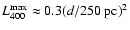 mJy kpc2 and
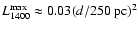 mJy kpc2 at 400 and 1400 MHz respectively.
Conclusions. The lack of detectable radio pulsations from 1RXS J141256.0+792204 brings into question its identification as a nearby radio pulsar, though, because the pulsar could be beamed away from us, this hypothesis cannot be strictly ruled out.
Key words: stars: neutron - stars: pulsars: general
Recently, Rutledge et al. (2007), hereafter RFS07, have identified the X-ray source
1RXS J141256.0+792204 (from the ROSAT All-Sky Survey Bright Source Catalog) as having
an X-ray to optical flux ratio
 (
( ). Such a high ratio is strong evidence that 1RXS J141256.0+792204, dubbed
"Calvera'' by RFS07, is a compact object. RFS07 consider several specific
source classes to explain 1RXS J141256.0+792204's X-ray spectrum and luminosity: an X-ray dim
isolated neutron star (INS), an anomalous X-ray pulsar (AXP), a compact
central object (CCO), or a nearby radio pulsar. Based on careful comparison
of 1RXS J141256.0+792204's properties with the canonical features displayed by these
different classes of neutron star, RFS07 conclude that the most likely
explanation is that 1RXS J141256.0+792204 is a very nearby radio pulsar (
d = 80-260 pc)
similar to the radio millisecond pulsars (MSPs) residing in the globular
cluster 47 Tuc.
). Such a high ratio is strong evidence that 1RXS J141256.0+792204, dubbed
"Calvera'' by RFS07, is a compact object. RFS07 consider several specific
source classes to explain 1RXS J141256.0+792204's X-ray spectrum and luminosity: an X-ray dim
isolated neutron star (INS), an anomalous X-ray pulsar (AXP), a compact
central object (CCO), or a nearby radio pulsar. Based on careful comparison
of 1RXS J141256.0+792204's properties with the canonical features displayed by these
different classes of neutron star, RFS07 conclude that the most likely
explanation is that 1RXS J141256.0+792204 is a very nearby radio pulsar (
d = 80-260 pc)
similar to the radio millisecond pulsars (MSPs) residing in the globular
cluster 47 Tuc.
We have investigated this interpretation by conducting sensitive searches
for radio pulsations using the Westerbork Synthesis Radio Telescope (WSRT)
in the Netherlands. No pulsations were found by these searches, and we use
these non-detections to place strong limits on the pulsed radio luminosity
of 1RXS J141256.0+792204. These limits bring into question the interpretation of this object
as a nearby radio pulsar.
We observed 1RXS J141256.0+792204 a total of 4 times with WSRT at central observing
frequencies of 385 and 1380 MHz and with integration times of 0.5 or 1 h
(Table 1). All observations were centered on J2000 coordinates
RA = 14:12:55.51, Dec = +79:22:06.7 (
 ,
,
 ). WSRT was used in its tied array mode with 14 25-m dishes
phased together to form a
). WSRT was used in its tied array mode with 14 25-m dishes
phased together to form a 
 wide beam at
385/1380 MHz, with a gain of 1.2 K/Jy. The most precise X-ray position
available, which is derived from Chandra/HRC-I observations of the
source taken by RFS07, falls well within the WSRT beam. We recorded data
using the PuMa I pulsar backend (Voûte et al. 2002), which provided 0.16/0.32-MHz
channels, 10/80 MHz of bandwidth, and 102.4/102.4
wide beam at
385/1380 MHz, with a gain of 1.2 K/Jy. The most precise X-ray position
available, which is derived from Chandra/HRC-I observations of the
source taken by RFS07, falls well within the WSRT beam. We recorded data
using the PuMa I pulsar backend (Voûte et al. 2002), which provided 0.16/0.32-MHz
channels, 10/80 MHz of bandwidth, and 102.4/102.4  s sampling at
385/1380 MHz. We made multiple, multi-frequency observations because of
potential scintillation. If 1RXS J141256.0+792204 is indeed very close, then it likely has
a very low DM (
s sampling at
385/1380 MHz. We made multiple, multi-frequency observations because of
potential scintillation. If 1RXS J141256.0+792204 is indeed very close, then it likely has
a very low DM ( 10 pc cm-3), and could strongly scintillate.
The 385-MHz data also gave high sensitivity in the event that 1RXS J141256.0+792204 is a very
steep spectrum source. The resulting intra-channel dispersive smearing in
these configurations, scaled to a dispersion measure (DM) of 25 pc cm-3, is
10 pc cm-3), and could strongly scintillate.
The 385-MHz data also gave high sensitivity in the event that 1RXS J141256.0+792204 is a very
steep spectrum source. The resulting intra-channel dispersive smearing in
these configurations, scaled to a dispersion measure (DM) of 25 pc cm-3, is
 ms at 385 MHz and merely
 s for the 1380-MHz observations. At the high Galactic
latitude of the source, interstellar scattering is unlikely to add
significant additional smearing. The resolution of the 1380-MHz data was
more than adequate to be sensitive to an MSP with spin period
s for the 1380-MHz observations. At the high Galactic
latitude of the source, interstellar scattering is unlikely to add
significant additional smearing. The resolution of the 1380-MHz data was
more than adequate to be sensitive to an MSP with spin period
 ms and DM up to the highest trial DM we searched (100 pc cm-3). In the 385-MHz data, we were sensitive to millisecond periodicities as well, as long as the DM was less than 25 pc cm-3.
Table 1:
Summary of observations.
The DM and spin period of this source are unknown and thus we must search
over these parameters. To search over DM space, we constructed trial
timeseries dedispersed in the range DM = 0-100 pc cm-3, with a
spacing of 0.2/1 pc cm-3 for the 385/1380 MHz data. Integrating to
the edge of the Galaxy, the maximum predicted DM in the direction of 1RXS J141256.0+792204 is 45 pc cm-3 (from the NE2001 free electron density model of
the Galaxy, Cordes & Lazio 2002). Thus, even if it is distant, it is very unlikely that
1RXS J141256.0+792204 has a DM outside our search range. Radio frequency interference (RFI)
was removed from the data both by eliminating some of the spectral channels
before dedispersion and by removing known interference peaks, or
"birdies'', in the Fourier power spectrum. Each of these timeseries was
then searched for periodicities using a Fourier-based technique and also
checked for strong single pulses. As the majority of MSPs are in binaries,
we employed searches that are sensitive to orbitally modulated periodicities
by encorporating a further search over frequency drift in the Fourier
domain. Overlapping sections of the timeseries, each 15-min in length,
were also searched to improve sensitivity to the shortest orbital periods.
To perform these searches, we used the package PRESTO![[*]](/icons/foot_motif.gif) (see Ransom et al. 2002, for a description
of some of the search techniques included in this package). Overall,
our search method was very similar, both in terms of the techniques and
specific software used, to that presented in greater detail in e.g.
Hessels et al. (2007).
(see Ransom et al. 2002, for a description
of some of the search techniques included in this package). Overall,
our search method was very similar, both in terms of the techniques and
specific software used, to that presented in greater detail in e.g.
Hessels et al. (2007).
The resulting candidate lists were examined by eye and automatically sifted
in order to identify periodicities that occur at several trial DMs, peak in
signal strength at non-zero DM, and occur in multiple observations. We
folded the raw data at the periodicity, acceleration, and DM of potentially
interesting candidates in order to further investigate whether they
constituted likely astronomical signals or just RFI. As the predicted DM
for a pulsar in this direction at d < 260 pc is only <3 pc cm-3,
we paid special attention to very-low-DM candidates, which would
normally be dismissed automatically as RFI, carefully checking to see
whether they could plausibly be pulsar signals. These low-DM candidates
were all at the period of known WSRT RFI birdies, or failed to show up in
both the 385 and 1380-MHz data.
No plausible astronomical radio pulsations or bright, dispersed single
pulses were detected in any of our observations. Using the radiometer
equation modified for pulsar signals (Dewey et al. 1985), we can place limits on
1RXS J141256.0+792204's flux density in these observations (Table 1). We find
that 1RXS J141256.0+792204 has a maximum flux density at 400 MHz
 mJy and a maximum flux density at 1400 MHz
 mJy, where the fractional uncertainty on these limits is roughly 50%.
RFS07 argue that 1RXS J141256.0+792204 may be a radio pulsar with a nearby distance
d =
80-260 pc. Assuming the pulsar is isolated, we were sensitive to spin
periods encompassing the observed range for radio pulsars (
mJy, where the fractional uncertainty on these limits is roughly 50%.
RFS07 argue that 1RXS J141256.0+792204 may be a radio pulsar with a nearby distance
d =
80-260 pc. Assuming the pulsar is isolated, we were sensitive to spin
periods encompassing the observed range for radio pulsars (
 ms-10 s), with a factor of roughly 2-5 degredation in sensitivity
due to red-noise at the longest periods. Using an assumed distance d =
250 pc, we can convert our flux density limits to pseudo luminosity (
ms-10 s), with a factor of roughly 2-5 degredation in sensitivity
due to red-noise at the longest periods. Using an assumed distance d =
250 pc, we can convert our flux density limits to pseudo luminosity (
 )
limits. We find
mJy kpc2 and
mJy kpc2. A simple check of the ATNF pulsar catalog (Manchester et al. 2005) shows that
1% of the known pulsars have a luminosity below these limits.
This suggests that if 1RXS J141256.0+792204 is a radio pulsar, then it is either especially
weak, not beamed towards the Earth, or significantly further away than 250 pc.
)
limits. We find
mJy kpc2 and
mJy kpc2. A simple check of the ATNF pulsar catalog (Manchester et al. 2005) shows that
1% of the known pulsars have a luminosity below these limits.
This suggests that if 1RXS J141256.0+792204 is a radio pulsar, then it is either especially
weak, not beamed towards the Earth, or significantly further away than 250 pc.
Assuming 1RXS J141256.0+792204 is a radio MSP, what is the probability that its radio beam
will pass the Earth (i.e. what is the beaming fraction of such pulsars)? A
period-dependent beaming fraction proportional to
 has
been shown for normal, un-recycled pulsars (see e.g. Rankin 1993). When
extrapolated to millisecond spin periods, this relation implies a 100% beaming fraction for MSPs. However, Kramer et al. (1998) find
observational evidence that this relationship does not apply directly to
MSPs and that the beaming fraction of MSPs is more like 50-90%. These
estimates are consistent with considerations of the MSP population in
47 Tuc. Heinke et al. (2005) used a deep Chandra observation of the cluster
to perform a population analysis which concluded that there are likely 25 radio MSPs (<60 at 95% confidence) residing in the cluster,
independent of beaming. Comparing this with optical and radio studies of
the MSP population by Edmonds et al. (2003) and McConnell et al. (2004) respectively, who
both conclude that the total MSP population in 47 Tuc is 30,
Heinke et al. (2005) conclude that the beaming fraction is
has
been shown for normal, un-recycled pulsars (see e.g. Rankin 1993). When
extrapolated to millisecond spin periods, this relation implies a 100% beaming fraction for MSPs. However, Kramer et al. (1998) find
observational evidence that this relationship does not apply directly to
MSPs and that the beaming fraction of MSPs is more like 50-90%. These
estimates are consistent with considerations of the MSP population in
47 Tuc. Heinke et al. (2005) used a deep Chandra observation of the cluster
to perform a population analysis which concluded that there are likely 25 radio MSPs (<60 at 95% confidence) residing in the cluster,
independent of beaming. Comparing this with optical and radio studies of
the MSP population by Edmonds et al. (2003) and McConnell et al. (2004) respectively, who
both conclude that the total MSP population in 47 Tuc is 30,
Heinke et al. (2005) conclude that the beaming fraction is  37%. While
these various studies suggest that the beaming fraction of MSPs is
significantly larger than for normal pulsars, and could be quite high, we
cannot strongly rule out beaming as the cause of our non-detection of 1RXS J141256.0+792204.
37%. While
these various studies suggest that the beaming fraction of MSPs is
significantly larger than for normal pulsars, and could be quite high, we
cannot strongly rule out beaming as the cause of our non-detection of 1RXS J141256.0+792204.
It is also possible, though we feel unlikely, that we have not seen 1RXS J141256.0+792204 because it is in a compact binary orbit and/or is highly accelerated by a
binary companion. Our luminosity limits are for a coherent search and do
not include these effects. However, given that we have employed acceleration
searches, which are generally sensitive in cases where the total integration
time
 is less than roughly 1/10 of the orbital period
 ,
1RXS J141256.0+792204 would have to be in a 2-h orbit and fairly weak (or
eclipsed) not to have been detected in our searches of 15-min data sections.
The shortest orbital period of any known radio MSP is 1.6 h
(Camilo et al. 2000, PSR J0024-7204R in the GC 47 Tuc).
,
1RXS J141256.0+792204 would have to be in a 2-h orbit and fairly weak (or
eclipsed) not to have been detected in our searches of 15-min data sections.
The shortest orbital period of any known radio MSP is 1.6 h
(Camilo et al. 2000, PSR J0024-7204R in the GC 47 Tuc).
In conclusion, given the caveats we have discussed, primarily pertaining to
extreme orbital or spin parameters, we believe that these searches were
sensitive enough to detect any nearby radio pulsar coincident with 1RXS J141256.0+792204,
assuming it is beamed towards the Earth. We have checked for catalogued
radio sources in the FIRST, NVSS, and WENSS surveys and find no counterpart
to 1RXS J141256.0+792204. Future, deeper observations detecting a radio, optical, or X-ray
pulsar wind nebula could address whether this source is a nearby radio
pulsar beamed away from Earth. Alternate scenarios for 1RXS J141256.0+792204's nature, for
instance that it might be the first unhosted CCO (RFS07), should continue to
be investigated.
Acknowledgements
J. W. T. H. acknowledges support from an NSERC postdoctoral fellowship and a
CSA supplement, tenured at the University of Amsterdam. We would also like
to thank Gemma Janssen for help taking the observations. The Westerbork
telescope is run by the Dutch radio astronomy institute ASTRON.
- Camilo, F., Lorimer, D. R.,
Freire, P., Lyne, A. G., & Manchester, R. N. 2000,
ApJ, 535, 975 [NASA ADS] [CrossRef]
(In the text)
- Cordes, J. M., &
Lazio, T. J. W. 2002
[arXiv:astro-ph/0207156]
(In the text)
- Dewey, R. J.,
Taylor, J. H., Weisberg, J. M., & Stokes, G. H.
1985, ApJ, 294, L25 [NASA ADS] [CrossRef]
(In the text)
- Edmonds, P. D., Gilliland,
R. L., Heinke, C. O., & Grindlay, J. E. 2003,
ApJ, 596, 1197 [NASA ADS] [CrossRef]
(In the text)
- Heinke, C. O., Grindlay,
J. E., Edmonds, P. D., et al. 2005, ApJ, 625,
796 [NASA ADS] [CrossRef]
(In the text)
- Hessels, J. W. T.,
Ransom, S. M., Stairs, I. H., Kaspi, V. M., &
Freire, P. C. C. 2007, ApJ, 670, 363 [NASA ADS] [CrossRef]
(In the text)
- Kramer, M., Xilouris, K. M.,
Lorimer, D. R., et al. 1998, ApJ, 501, 270 [NASA ADS] [CrossRef]
(In the text)
- Manchester, R. N.,
Hobbs, G. B., Teoh, A., & Hobbs, M. 2005, AJ, 129,
1993 [NASA ADS] [CrossRef]
(In the text)
- McConnell, D.,
Deshpande, A. A., Connors, T., & Ables, J. G. 2004,
MNRAS, 348, 1409 [NASA ADS]
(In the text)
- Rankin, J. M. 1993,
ApJ, 405, 285 [NASA ADS] [CrossRef]
(In the text)
- Ransom, S. M.,
Eikenberry, S. S., & Middleditch, J. 2002, AJ, 124,
1788 [NASA ADS] [CrossRef]
(In the text)
- Rutledge, R. E.,
Fox, D. B., & Shevchuk, A. H. 2007
[arXiv:astro-ph/0705.1011]
(In the text)
- Voûte, J. L. L.,
Kouwenhoven, M. L. A., van Haren, P. C., et al.
2002, A&A, 385, 733 [NASA ADS] [CrossRef] [EDP Sciences]
(In the text)
Copyright ESO 2007