![[*]](/icons/foot_motif.gif)
(Research Note)
A&A 476, 59-62 (2007)
DOI: 10.1051/0004-6361:20053734
R. A. H. Morris1 - S. Phillipps1 - J. B. Jones2 - M. J. Drinkwater3 - M. D. Gregg4,5 - W. J. Couch6 - Q. A. Parker7,8 - R. M. Smith9
1 - Astrophysics Group, Department of Physics, University of
Bristol, Bristol BS8 1TL, UK
2 -
Astronomy Unit, School of Mathematical Sciences, Queen Mary
University of London, Mile End Road, London E1 4NS, UK
3 -
Department of Physics, University of Queensland, QLD 4072, Australia
4 -
Department of Physics, University of California Davis, CA 95616, USA
5 -
Institute for Geophysics and Planetary Physics, Lawrence
Livermore National Laboratory, Livermore, CA 94550, USA
6 -
School of Physics, University of New South Wales, Sydney 2052, Australia
7 -
Department of Physics, Macquarie University, Sydney, NSW, Australia
8 -
Anglo-Australian Observatory, Epping, NSW 1710, Australia
9 -
School of Physics and Astronomy, Cardiff University, Cardiff, CF24 3AA, UK
Received 30 June 2005 / Accepted 27 August 2007
Abstract
Context. The Fornax cluster spectroscopic survey (FCSS) is an all-object survey of a region around the Fornax cluster of galaxies undertaken using the 2dF multi-object spectrograph on the Anglo-Australian telescope. Its aim was to obtain spectra for a complete sample of all objects with
16.5<bj<19.7 irrespective of their morphology (i.e. including "stars'', "galaxies'' and "merged'' images).
Aims. We explore the extent to which (nearby) cluster galaxies are present in 2MASS. We consider the reasons for the omission of 2MASS galaxies from the FCSS and vice versa.
Methods. We consider the intersection (2.9 square degrees on the sky) of our data set with the infra-red 2 micron all-sky survey (2MASS), using both the 2MASS extended source catalogue (XSC) and the point source catalogue (PSC). We match all the XSC objects to FCSS counterparts by position and also extract a sample of galaxies, selected by their FCSS redshifts, from the PSC.
Results. We confirm that all 114 XSC objects in the overlap sample are galaxies, on the basis of their FCSS velocities. A total of 23 Fornax cluster galaxies appear in the matched data, while, as expected, the remainder of the sample lie at redshifts out to z = 0.2 (the spectra show that 61% are early type galaxies, 18% are intermediate types and 21% are strongly star forming).The PSC sample turns out to contain twice as many galaxies as does the XSC. However, only one of these 225 galaxies is a (dwarf) cluster member. On the other hand, galaxies which are unresolved in the 2MASS data (though almost all are resolved in the optical) amount to 71% of the non-cluster galaxies with 2MASS detections and have redshifts out to z=0.32.
Key words: surveys - galaxies: statistics - galaxies: clusters: individual: Fornax
There are obvious differences between infra-red and optically selected catalogues of galaxies. In this note we discuss the results obtained by cross-referencing objects in our "all-object'' Fornax Cluster Spectroscopic Survey (FCSS: Drinkwater et al. 2000b) with those in the infra-red 2 Micron All-Sky Survey (2MASS: Jarrett et al. 2000) in the direction of the Fornax cluster. Brief details of these surveys are presented in Sect. 2. At first glance, these two catalogues are poorly matched, in that 2MASS is a much larger area but comparatively shallow survey, relative to the FCSS. However, the FCSS is designed to cover all types of object within its magnitude range, so a wide range of objects may inhabit the overlap in parameter space. Many of the objects in common are stars, but we will concentrate here on the galaxy component, and especially on the cluster members. Cole et al. (2001, henceforth C2001), have previously matched 2MASS to the general 2dF Galaxy Redshift Survey (2dFGRS: Colless et al. 2001). However, here we consider the 2MASS XSC objects which would not have had 2dFGRS counterparts and the galaxy content of the unresolved sources in the PSC.
The 2dF multi-fibre spectrograph (Lewis et al. 2002) on the Anglo-Australian Telescope, provides the opportunity to make truly complete spectroscopic surveys of a given area on the sky, down to well determined, faint limits, irrespective of target type. The FCSS exploited this by fully surveying a region centred on the Fornax Cluster of galaxies (Drinkwater et al. 2000a,b).
In common with the main 2dFGRS (which did not cover the Fornax area),
our input catalogue for the FCSS comes from
UKST Sky Survey plates digitised by the APM machine (Irwin et al. 1994),
but unlike other surveys, we avoid any morphological pre-selection and
include all objects, both resolved and unresolved (i.e. "stars''
and "galaxies'') between our sample limits at
 ,
as well as the confused sources classified as "merged''.
We report results here from the central 2 degree diameter field from
the FCSS (centred close to the first ranked cluster galaxy NGC 1399)
for which the redshift measurements are 92% complete (Deady et al. 2002). In order to obtain a greater overlap with 2MASS,
we have
also added in the galaxies brighter than
bj = 16.5 in our survey
area by utilising our companion survey (Drinkwater et al. 2001b) which
used the FLAIR spectrograph on the UK Schmidt Telescope, as well as
literature sources. Note that these were morphologically selected as
galaxies but we do not expect any confusion of compact galaxies with
stars at these very bright magnitudes.
,
as well as the confused sources classified as "merged''.
We report results here from the central 2 degree diameter field from
the FCSS (centred close to the first ranked cluster galaxy NGC 1399)
for which the redshift measurements are 92% complete (Deady et al. 2002). In order to obtain a greater overlap with 2MASS,
we have
also added in the galaxies brighter than
bj = 16.5 in our survey
area by utilising our companion survey (Drinkwater et al. 2001b) which
used the FLAIR spectrograph on the UK Schmidt Telescope, as well as
literature sources. Note that these were morphologically selected as
galaxies but we do not expect any confusion of compact galaxies with
stars at these very bright magnitudes.
The 2MASS Second Incremental Data Release (March
2000) (also used by C2001) includes both a Point Source Catalogue
(PSC) and an Extended Source Catalogue (XSC). The XSC should be be
complete for all galaxies brighter than
 and contains
objects down to
and contains
objects down to
 ,
depending on their degree of
extension, surface brightness etc. Given the resolution of 2MASS, XSC
objects are typically in excess of 10'' in diameter
(Jarrett et al. 2000). For the photometry below we used the extrapolated
`total'' magnitudes.
,
depending on their degree of
extension, surface brightness etc. Given the resolution of 2MASS, XSC
objects are typically in excess of 10'' in diameter
(Jarrett et al. 2000). For the photometry below we used the extrapolated
`total'' magnitudes.
The FCSS area was used to define our potential sky coverage, viz. a
 diameter circle centred at
 ,
,
 (J2000). We used the "Gator'' query tool in the
IPAC IRSA web interface to extract sources from the 2MASS PSC and XSC
satisfying the same area constraint. In fact, Fornax lies close to the
edge of the region surveyed for the 2MASS Second Incremental Data
Release, so the overlap region is slightly less than the nominal 2dF
area and covers 2.9 square degrees, containing 3204 FCSS objects, of
which the great majority are Galactic stars or galaxies behind the
cluster. In reprocessing data for the later All Sky Data Release, several
former PSC objects were reclassified into the XSC. In what follows we
have used this updated information but retained our original field
area limit.
(J2000). We used the "Gator'' query tool in the
IPAC IRSA web interface to extract sources from the 2MASS PSC and XSC
satisfying the same area constraint. In fact, Fornax lies close to the
edge of the region surveyed for the 2MASS Second Incremental Data
Release, so the overlap region is slightly less than the nominal 2dF
area and covers 2.9 square degrees, containing 3204 FCSS objects, of
which the great majority are Galactic stars or galaxies behind the
cluster. In reprocessing data for the later All Sky Data Release, several
former PSC objects were reclassified into the XSC. In what follows we
have used this updated information but retained our original field
area limit.
A generous search radius of 3'' was used in matching 2MASS to FCSS
objects although it is already known that for point sources 2MASS
positions agree with those from the APM catalogue to  0.5''.
The relatively large search radius of 3'' was retained to allow
matching of large, possibly irregular, galaxies with larger centroid
uncertainties. A significant contribution to the difference in object
centroids between 2MASS and APM will be variations in colour for
large irregular galaxies. In total 114 XSC and 2021 PSC objects (not
also in the XSC) match with ones in the FCSS or the brighter
sample. Our matched catalogues are available from the CDS in electronic form.
0.5''.
The relatively large search radius of 3'' was retained to allow
matching of large, possibly irregular, galaxies with larger centroid
uncertainties. A significant contribution to the difference in object
centroids between 2MASS and APM will be variations in colour for
large irregular galaxies. In total 114 XSC and 2021 PSC objects (not
also in the XSC) match with ones in the FCSS or the brighter
sample. Our matched catalogues are available from the CDS in electronic form.
Of the 114 2MASS XSC objects in the area, 84 are matched in
the FCSS itself, 28 are in the brighter
FLAIR sample and two are 15th magnitude galaxies in the
Ferguson (1989) Fornax Cluster
Catalogue (FCC). All are confirmed as galaxies, with
redshifts showing them to be in or behind the Fornax Cluster.
This compares with  of XSC objects not matched in the
2dFGRS in C2001. In our area there are no saturated or multiple stars
in the XSC and none wrongly classed as stars by APM,
while 4 were erroneously classed as extended in the original XSC -
consistent with the combined tally of
of XSC objects not matched in the
2dFGRS in C2001. In our area there are no saturated or multiple stars
in the XSC and none wrongly classed as stars by APM,
while 4 were erroneously classed as extended in the original XSC -
consistent with the combined tally of  in C2001 - but the
latter 4 were removed in the next release. The remaining
in C2001 - but the
latter 4 were removed in the next release. The remaining  of unmatched 2MASS
objects in C2001 were "merged'' images in the r band APM
images, whereas we spectroscopically observed all of these. (In fact,
in our area we have a surprisingly large number of merged images,
amounting to
of unmatched 2MASS
objects in C2001 were "merged'' images in the r band APM
images, whereas we spectroscopically observed all of these. (In fact,
in our area we have a surprisingly large number of merged images,
amounting to  of the 2MASS sample).
Given the range of colours seen for the galaxies (up to
 ),
one would expect the FCSS to be deep enough in magnitude to pick up
all the genuinely extended 2MASS sources in the complete sample to
,
as was found by C2001 for the comparably deep 2dFGRS. It
is just possible for objects in the faint tail down to
to be missed by the FCSS if they were also of the very
reddest colours
),
one would expect the FCSS to be deep enough in magnitude to pick up
all the genuinely extended 2MASS sources in the complete sample to
,
as was found by C2001 for the comparably deep 2dFGRS. It
is just possible for objects in the faint tail down to
to be missed by the FCSS if they were also of the very
reddest colours
 ,
but as we have seen there are
no examples of this in our sample.
,
but as we have seen there are
no examples of this in our sample.
A total of 23 cluster galaxies (
 km s-1) appear in the matched data. All bar one is an early type according to the types assigned in
Drinkwater et al. (2001b), the FCSS or NED. Note that only 2 of the
cluster objects are from the actual 2MASS/FCSS paired data, and one of
those was only included because of an erroneous input magnitude, as it
is actually significantly brighter than the FCSS bright limit. All the
rest are from the brighter spectroscopic surveys. Thus genuine
cluster dwarfs, as sampled by the FCSS, are virtually absent from the
2MASS XSC, despite having exactly the same bj magnitudes as detected
background galaxies. This is a result of a combination of the cluster
dwarfs'' blue colours and, especially, low surface brightnesses
(Monnier Ragaigne et al. 2003).
km s-1) appear in the matched data. All bar one is an early type according to the types assigned in
Drinkwater et al. (2001b), the FCSS or NED. Note that only 2 of the
cluster objects are from the actual 2MASS/FCSS paired data, and one of
those was only included because of an erroneous input magnitude, as it
is actually significantly brighter than the FCSS bright limit. All the
rest are from the brighter spectroscopic surveys. Thus genuine
cluster dwarfs, as sampled by the FCSS, are virtually absent from the
2MASS XSC, despite having exactly the same bj magnitudes as detected
background galaxies. This is a result of a combination of the cluster
dwarfs'' blue colours and, especially, low surface brightnesses
(Monnier Ragaigne et al. 2003).
![\begin{figure}
\par\includegraphics[width=8.8cm,clip]{3734fig1.eps} \end{figure}](/articles/aa/full/2007/46/aa3734-05/img17.gif) |
Figure 1:
Central surface brightness versus
 colour for
matched XSC objects. Open (filled) circles are cluster (background)
early types, squares intermediate types and triangles late types.
colour for
matched XSC objects. Open (filled) circles are cluster (background)
early types, squares intermediate types and triangles late types. |
| Open with DEXTER | |
Matching to various template spectra,
of the 83 FCSS galaxies (i.e. counting
the interacting pair only once), 50 ( )
have the classic K star-like
spectrum of an early type galaxy (Morgan & Mayall 1957),
)
have the classic K star-like
spectrum of an early type galaxy (Morgan & Mayall 1957),  match F or G star spectra (intermediate type) and
  are emission line galaxies (late types).
These are extremely similar to the fractions obtained by C2001 -
are emission line galaxies (late types).
These are extremely similar to the fractions obtained by C2001 -  early type,
Sa-Sb,
early type,
Sa-Sb,  late type - on the basis of a completely independent spectral typing using a principal component analysis (see Madgwick et al. 2002). The types match reasonably well to the galaxies'
colours, though there exist a few late types with red colours and the cluster dwarfs
have rather blue colours compared to Poggianti (1997) models (see
Fig. 1). The bluest colours are found amongst the low surface brightness
cluster members (cf. Bell et al. 2003).
late type - on the basis of a completely independent spectral typing using a principal component analysis (see Madgwick et al. 2002). The types match reasonably well to the galaxies'
colours, though there exist a few late types with red colours and the cluster dwarfs
have rather blue colours compared to Poggianti (1997) models (see
Fig. 1). The bluest colours are found amongst the low surface brightness
cluster members (cf. Bell et al. 2003).
There are also some low surface brightness but very red objects, several of which are clearly edge-on spirals from their images, in agreement with their spectral typing. Otherwise, the
overall trend for decreasing surface brightness with redder colour is
as expected from the combined effect of the k-correction reddening and
the cosmological dimming of surface brightness with redshift for the
dominant early type background galaxy population. (The redshift range
is more extended than that shown by C2001, as they limited their sample at
 ;
we can also note that the galaxies that would have been missed by
2dFGRS selection have the same redshift range as the others).
;
we can also note that the galaxies that would have been missed by
2dFGRS selection have the same redshift range as the others).
Now consider any "small'' galaxies hidden among the 2MASS Point Source
Catalogue (PSC) objects. These may be, of course, merely distant rather
than physically small. Finlator et al. (2000), in a study of stars
detected in 2MASS, have previously noted (but not discussed further)
the fact that 
 of PSC objects correspond to resolved
images in the Sloan Digital Sky Survey (SDSS) commissioning data.
of PSC objects correspond to resolved
images in the Sloan Digital Sky Survey (SDSS) commissioning data.
In all there are 2021 matches of 2MASS point sources with FCSS objects
out of a total of 3204 objects (both optically resolved and
unresolved) in the FCSS catalogue in the overlap region. This region
contains 3982 PSC objects which are not already covered by the
XSC. Thus only just over half ( )
have FCSS counterparts. Given the
expected stellar number counts, a substantial number of unmatched PSC
objects will be stars brighter than bj= 16.5. From the
Bahcall & Soneira (1980) models, we expect around 1200 stars brighter than
the FCSS bright limit in a 3 square degree area at
)
have FCSS counterparts. Given the
expected stellar number counts, a substantial number of unmatched PSC
objects will be stars brighter than bj= 16.5. From the
Bahcall & Soneira (1980) models, we expect around 1200 stars brighter than
the FCSS bright limit in a 3 square degree area at
 .
The PSC contains significantly fainter sources than does the XSC,
down to
.
The PSC contains significantly fainter sources than does the XSC,
down to
 (with a few even fainter), so given the very
broad range of colours exhibited by both stars and galaxies (Bessell & Brett 1988, C2001), many of the fainter 2MASS PSC sources will be red enough to fall off the faint end of the FCSS
sample. Clearly anything fainter than
(with a few even fainter), so given the very
broad range of colours exhibited by both stars and galaxies (Bessell & Brett 1988, C2001), many of the fainter 2MASS PSC sources will be red enough to fall off the faint end of the FCSS
sample. Clearly anything fainter than
 and/or redder than
 is likely to be lost. Going the other way, a
smaller fraction (
is likely to be lost. Going the other way, a
smaller fraction ( )
of FCSS objects do not have 2MASS
counterparts. As 2MASS has no bright limit, these must be lost because
they are too faint in the IR (i.e. too blue in optical to IR colour).
)
of FCSS objects do not have 2MASS
counterparts. As 2MASS has no bright limit, these must be lost because
they are too faint in the IR (i.e. too blue in optical to IR colour).
After removing galaxies also present in the XSC we are left with 228 PSC objects (including 3 QSOs) which have FCSS redshifts showing them to be extragalactic (cz > 900 km s-1),
i.e. twice as many galaxies as are found in the XSC. As a minimum,  (228/3982) of PSC objects must be extragalactic (
of matched PSC/FCSS objects). This is rather lower than the
of PSC objects found to be resolved in SDSS by Finlator et al. (2000). Unmatched PSC
objects may include fainter, but still resolved, galaxies; almost all the PSC/FCSS objects have
(228/3982) of PSC objects must be extragalactic (
of matched PSC/FCSS objects). This is rather lower than the
of PSC objects found to be resolved in SDSS by Finlator et al. (2000). Unmatched PSC
objects may include fainter, but still resolved, galaxies; almost all the PSC/FCSS objects have
 and most have
 .
.
![\begin{figure}
\par\includegraphics[width=9cm,clip]{3734fig2} \end{figure}](/articles/aa/full/2007/46/aa3734-05/img36.gif) |
Figure 2:
Optical - IR colour,
,
versus redshift for
matched PSC objects with galaxy spectra. Different optical
image morphologies are indicated. The model tracks are from
Poggianti (1997). |
| Open with DEXTER | |
The 225 PSC galaxies (Fig. 2) again contain a substantial number classified as "merged'' (36 in the bj band, though only 13 in rf) and 2 which are optically unresolved (one is an ultra-compact dwarf (UCD) from Phillipps et al. 2001; and the other a compact emission line galaxy from Drinkwater et al. 1999). Both merged and unresolved objects would typically be ignored in galaxy redshift surveys. The matched sample has a median z of 0.16, essentially the same as that of the whole FCSS galaxy sample, and reaches z = 0.32. However, with many fewer objects over the same redshift range, the matched sample is obviously picking out only the physically more luminous, redder, and presumably more massive, galaxies. 2MASS misses just as large a fraction (or even a larger fraction) of the nearby FCSS galaxies as distant ones. Indeed, just one cluster galaxy is detected, the UCD mentioned above.
The PSC sample goes 1 magnitude deeper in K than the XSC sample (and 2
magnitudes deeper than the quoted completeness limit of the XSC), though with
less well determined selection criteria. There is rather little overlap in
magnitude with the XSC sample, as the vast majority of the PSC galaxies have
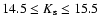 (see Fig. 3 below). The numbers as a function
of magnitude suggest that the PSC sample is fairly complete to
.
Kochanek et al. (2001) show that at these magnitudes the canonical 0.6 slope
fits the counts rather well, so going 1 magnitude deeper we
should get a factor 4 more detections, compared to the observed 315/91
= 3.5 for the ratio of XSC and PSC non-cluster galaxies.
This means that the PSC is a rich source of moderately faint galaxies not included in the XSC due to
their lack of spatial extension. XSC galaxies represent
only 29% of the (non-cluster) galaxies actually measured by 2MASS in this area.
Virtually all (99%) of the galaxies revealed by their spectra could also have been found
purely in terms of optical image classification (provided one included "merged'' images among the potential galaxies). Thus, with the benefit of the results obtained from all-object surveys such as ours we extend the search for PSC galaxies by simply matching to,
say, resolved images in APM or SDSS data. Note however, that a substantial
fraction of the PSC galaxies will be fainter than the SDSS or even 2dF
spectroscopic limit, and the "merged'' images would remain problematic.
(see Fig. 3 below). The numbers as a function
of magnitude suggest that the PSC sample is fairly complete to
.
Kochanek et al. (2001) show that at these magnitudes the canonical 0.6 slope
fits the counts rather well, so going 1 magnitude deeper we
should get a factor 4 more detections, compared to the observed 315/91
= 3.5 for the ratio of XSC and PSC non-cluster galaxies.
This means that the PSC is a rich source of moderately faint galaxies not included in the XSC due to
their lack of spatial extension. XSC galaxies represent
only 29% of the (non-cluster) galaxies actually measured by 2MASS in this area.
Virtually all (99%) of the galaxies revealed by their spectra could also have been found
purely in terms of optical image classification (provided one included "merged'' images among the potential galaxies). Thus, with the benefit of the results obtained from all-object surveys such as ours we extend the search for PSC galaxies by simply matching to,
say, resolved images in APM or SDSS data. Note however, that a substantial
fraction of the PSC galaxies will be fainter than the SDSS or even 2dF
spectroscopic limit, and the "merged'' images would remain problematic.
![\begin{figure}
\par\includegraphics[width=9cm,clip]{3734fig3}\end{figure}](/articles/aa/full/2007/46/aa3734-05/img38.gif) |
Figure 3:
A bj (Drinkwater et al. 2001a) vs.  plot of our XSC
sample, PSC sample and 6dfGRS completeness limits. XSC magnitudes were slightly underestimated in
the 2MASS 2nd data release (see C2001) accounting for some of the gap between
the XSC and PSC galaxies.
plot of our XSC
sample, PSC sample and 6dfGRS completeness limits. XSC magnitudes were slightly underestimated in
the 2MASS 2nd data release (see C2001) accounting for some of the gap between
the XSC and PSC galaxies. |
| Open with DEXTER | |
Template matching suggests that in this deeper sample 43% of the
galaxies (97/225) are now best fitted by a K star
spectrum (slightly fewer than before) and 33% (75/225) by G or F star
spectra. This implies a significant shift towards the
"intermediate'' type spectra for these objects, which are
forced towards slightly bluer
since they are
fainter in
than the XSC objects, but have the same bjlimit. Intermediate types predominate amongst the most distant
matched objects; again suggesting the loss of the reddest galaxies.
Only 23% (53/225) of the PSC/FCSS objects
are fitted by emission line templates
(essentially the same as in the XSC sample), compared to almost 50%
of FCSS objects as a whole, i.e. 2MASS has a
lower content of star forming galaxies than
does a blue selected sample.
Indeed, 680 of the FCSS galaxies (and 55 AGN) are
not bright enough in the near IR to enter the 2MASS
catalogues. Thus, only 300 out of 1000 FCSS
galaxies are in 2MASS, whereas 1800 of 2200 stars are
present: in the same, fixed optical magnitude range,
galaxies are far less likely to be included in the 2MASS
catalogues than stars, again because of a combination of their
surface brightnesses and colours.
As we have seen, cluster dwarf galaxies are less likely still.
Given that many galaxies are not large enough to appear in the XSC, it
is appropriate to consider whether unresolved objects have an impact
on the IR galaxy luminosity function. C2001 have already made careful allowance for this, using the expected isophotal radii of galaxies to correct for the numbers lost because of the
rather large isophotal diameter limit implied for the XSC
(see also Andreon 2002). As previously stated, our PSC and XSC samples have little overlap in
band magnitude and no overlap with the brighter, complete sample from the XSC. Thus
few galaxies which should have been present at, say,
 have in
actuality been overlooked because of their small size. Thus existing LFs from
data limited at
have in
actuality been overlooked because of their small size. Thus existing LFs from
data limited at
 should not suffer from significant
incompleteness.
should not suffer from significant
incompleteness.
The caveat is that there may be galaxies which, because of the isophotal limit, fail to make the cut for either the XSC or the PSC. In particular, low surface brightness galaxies could have very low signal-to-noise ratios in the IR bands. As noted above, our matched sample actually contains rather few dwarfs, which typically are of low surface brightness. As we do not yet have an accurate distribution of optical to IR colours for dwarfs and other low surface brightness galaxies, it is not possible to estimate how many of the optically selected dwarfs should have been included in the 2MASS samples purely on the grounds of their total magnitudes but were omitted because of their surface brightness. The Millennium Galaxy Catalogue (Driver et al. 2005) should give a good indication of the numbers of low surface brightness objects that might be missed (assuming plausible optical/IR colours).
Some implications of this work for other surveys based on the
XSC, for example, the 6dfGRS (Jones et al. 2004) are shown in Fig.3. The 6dfGRS XSC galaxies were supplemented by other
catalogues including SuperCOSMOS (Hambly et al. 2001) allowing us to plot
the completeness limits at
bj=16.75 and
 .
The extra PSC galaxies are below the faint
limit of the 6dfGRS (dashed lines) confirming its completeness to its stated limits.
.
The extra PSC galaxies are below the faint
limit of the 6dfGRS (dashed lines) confirming its completeness to its stated limits.
Acknowledgements
The FCSS project would not have been possible without the superb 2dF facility provided by the AAO. MDG acknowledges support from grant No. 0407445 from the National Science Foundation; part of the work reported here was done at the Institute of Geophysics and Planetary Physics, under the auspices of the U.S. Department of Energy by Lawrence Livermore National Laboratory under contract No. W-7405-Eng-48. RAHM and SP thank project students Rebecca Groves and Yvonne Relf for the initial catalogue matching. MJD thanks the Australian Research Council for support of this work.