![[*]](/icons/foot_motif.gif)
A&A 475, 209-216 (2007)
DOI: 10.1051/0004-6361:20066706
R. Kurtev1, - J. Borissova1 - L. Georgiev2 - S. Ortolani3 - V. D. Ivanov4
1 - Departamento de Fisíca y Astronomía, Facultad de Ciencias, Universidad de Valparaíso, Av. Gran Bretaña 644, Playa Ancha, Casilla 5030, Valparaíso, Chile
2 - Instituto de Astronomia, Universidad Nacional Autónoma de México, Apartado Postal 70-254, CD Universitaria, CP 04510, Mexico DF, Mexico
3 - Universitá di Padova, Dipartimento di Astronomia, Vicolo dell'Osservatorio 5, 35122 Padova, Italy
4 -
European Southern Observatory, Ave. Alonso de Cordova 3107, Casilla 19, Santiago 19001, Chile
Received 7 November 2006 / Accepted 17 August 2007
Abstract
Context. Young massive clusters are usually deeply embedded in dust and gas. They represent excellent astrophysical laboratories for the study of massive stars. Clusters with Wolf-Rayet (WR) stars are of special importance, since this enables us to study a coeval WR population at a uniform metallicity and known age.
Aims. We started a long-term project to search the inner Milky Way for hidden star clusters and to study them in detail. GLIMPSE 30 (G30) is one of these clusters. It is situated near the Galactic plane (
 ,
,
 )
and we determine its physical parameters and investigate its high-mass stellar content especially WR stars.
)
and we determine its physical parameters and investigate its high-mass stellar content especially WR stars.
Methods. Our analysis is based on SOFI/NTT
 imaging and low resolution (
 )
spectroscopy of the brightest cluster members in the K atmospheric window. For the age determination we applied isochrone fits for MS and Pre-MS stars. We derived stellar parameters of the WR stars candidates using a full nonLTE modeling of the observed spectra.
)
spectroscopy of the brightest cluster members in the K atmospheric window. For the age determination we applied isochrone fits for MS and Pre-MS stars. We derived stellar parameters of the WR stars candidates using a full nonLTE modeling of the observed spectra.
Results. Using a variety of techniques we found that G30 is very young cluster, with age t  4 Myr. The cluster is located in the Carina spiral arm, it is deeply embedded in dust and suffers reddening of
 mag. The distance to the object is
 kpc. The mass of the cluster members down to 2.35
 is
is  1600
.
The cluster's MF for the mass range of 5.6 to 31.6
shows a slope of
1600
.
The cluster's MF for the mass range of 5.6 to 31.6
shows a slope of
 .
The total mass of the cluster obtained by this MF down to 1
is about
.
The total mass of the cluster obtained by this MF down to 1
is about
 .
The spectral analysis and the models allow us to conclude that at least one Ofpe/WN and two WR stars can be found in G30. The WR stars are of the WN6-7 hydrogen rich type with progenitor masses of more than 60
.
.
The spectral analysis and the models allow us to conclude that at least one Ofpe/WN and two WR stars can be found in G30. The WR stars are of the WN6-7 hydrogen rich type with progenitor masses of more than 60
.
Conclusions. G30 is a new member of the family of young Galactic clusters hosting WR stars. It is a factor of two to three less massive than some of the youngest super-massive star clusters like Arches, Quintuplet and the Central cluster and is their smaller analog.
Key words: Galaxy: open clusters and associations: general - stars: Wolf-Rayet
Stars rarely form in isolation. It is well known that most of the stars in our Galaxy, and in nearby galaxies, ever born in groups ranging from small associations and open clusters, compact young massive clusters to old globulars. Young clusters are often difficult to find because they can be heavily embedded in dust, making them visible only in the infrared. We embarked on a long-term project to search the inner Milky Way for hidden star clusters and to study them in details (Borissova et al. 2003, 2005, 2006; Ivanov et al. 2002, 2005). This project was based on the 2MASS mission (Skrutskie et al. 2006), taking advantage of the reduced extinction in the near-IR. Recent advances in mid-IR instrumentation have made it possible to carry out all-sky IR surveys in this spectral region too. The recent Spitzer Space Telescope Galactic Legacy Infrared Mid-Plane Survey Extraordinaire (GLIMPSE, Benjamin et al. 2003) offers an excellent opportunity to carry out a deep census of such objects. GLIMPSE is an excellent tool for finding obscured clusters in the Galactic disk because the extinction in the mid-IR is a factor of 2-5 lower than in the near-IR. Recently, Mercer et al. (2005) carried a comprehensive search for clusters in the mid-IR. They used the point source catalog of GLIMPSE and reported 92 cluster candidates. In our project we continued the investigation of some of these objects using near-IR imaging and low resolution IR spectroscopy.
Massive stars themselves play an important role in the ecology of
galaxies, providing a major source of ionizing UV radiation,
mechanical energy and chemical enrichment. Wolf-Rayet (WR) stars represent an
evolved phase of the most massive stellar population, and are characterized by
high mass loss rates from fast and dense winds. Their short lifetimes and
high luminosities make them excellent tracers of active recent star formation.
However, serious gaps in our understanding of massive stars exist because of
their rapid evolution and rarity. WRs in clusters are particularly interesting
because this enables us to study a coeval population with uniform metallicity.
There are about three hundred known WR stars in our Galaxy (van der Hucht 2006).
At the same time from thousands of known open clusters and stellar associations
only small number contain WRs and only a few of them host more than one such star.
This is because a typical cluster (103
)
contains a
limited number of stars more massive than 30-35
that can evolve to the WR phase. Therefore, most cluster WRs are
concentrated in the high-mass clusters, i.e. Arches, Quintuplet, Westerlund 1.
Here we report our first results for GLIMPSE 30 (hereafter G30;
Fig. 1) - a compact young cluster located near the Galactic
plane (
 )
containing many massive stars
including at least one Of and three Wolf-Rayet members. The
presence of at least three WRs in G30 puts this cluster into the
family of WR rich clusters. The cluster membership provides excellent
observational constraints upon the ages and initial masses of this type
of stars. In this paper we present the main results of our
photometric and spectral analysis of the cluster and the newly
discovered WRs.
)
containing many massive stars
including at least one Of and three Wolf-Rayet members. The
presence of at least three WRs in G30 puts this cluster into the
family of WR rich clusters. The cluster membership provides excellent
observational constraints upon the ages and initial masses of this type
of stars. In this paper we present the main results of our
photometric and spectral analysis of the cluster and the newly
discovered WRs.
![\begin{figure}
\par\includegraphics[width=8cm,clip]{6706fig1.eps}\end{figure}](/articles/aa/full/2007/43/aa6706-06/img28.gif) |
Figure 1:
Pseudo-true color images of the G30. The left panel image
is composed from  - blue, H - green and
  -
red SofI/NTT images covering
-
red SofI/NTT images covering
 2 centered at
the cluster. The right panel is composed from 3.6 2 centered at
the cluster. The right panel is composed from 3.6  m - blue,
5.8 m - green and 8.0 m - red Spitzer Space
Telescope images. The SofI field of view from the left panel is
marked with a square. The Galactic coordinates l and b are shown
on the right panel. m - blue,
5.8 m - green and 8.0 m - red Spitzer Space
Telescope images. The SofI field of view from the left panel is
marked with a square. The Galactic coordinates l and b are shown
on the right panel. |
| Open with DEXTER | |
All observations were obtained with SofI/NTT (Son of ISAAC; Moorwood et al. 1998). The instrument is equipped with a Hawaii HgCdTe
 detector, with a pixel scale of 0.288 arcsec px-1.
For the spectroscopy we used a 1 arcsec slit and the medium-resolution
grism. The seeing for all observations was 1-1.5 arcsec
and the sky was photometric.
detector, with a pixel scale of 0.288 arcsec px-1.
For the spectroscopy we used a 1 arcsec slit and the medium-resolution
grism. The seeing for all observations was 1-1.5 arcsec
and the sky was photometric.
Deep
imaging of G30 were carried out on April 15,
2006. We took 16 images in each filter in jittering mode with 3 arcmin
jitter box size to ensure that there is no overlapping of the cluster
on different images. Each individual image was the average of
 s frames in ,
 s frames in
H, and
s frames in
H, and  s frames in .
The total integration
time was 16 min in each filter. To obtain photometry of
the brightest cluster members we took additional shallow images on
August 10, 2006, using the same jittering pattern but shorter
integrations:
s frames in .
The total integration
time was 16 min in each filter. To obtain photometry of
the brightest cluster members we took additional shallow images on
August 10, 2006, using the same jittering pattern but shorter
integrations:
 s. The total integration time was 1.58 min
in each filter. The data reduction included: sky-subtraction, flat-fielding,
image alignment and combination into a single final image for each filter.
A 3-color composite image of G30 is shown in Fig. 1.
s. The total integration time was 1.58 min
in each filter. The data reduction included: sky-subtraction, flat-fielding,
image alignment and combination into a single final image for each filter.
A 3-color composite image of G30 is shown in Fig. 1.
The stellar photometry of the final images was carried out with
ALLSTAR in DAOPHOT II (Stetson 1987). The typical
photometric errors vary from 0.01 mag for stars with
10 mag to 0.10 mag for
18 mag
and 0.15 mag for
19 mag. The photometric
calibration was performed by comparing our instrumental magnitudes
with the 2 MASS measurements of about 1330 stars, covering the color
range
 mag and magnitude range
 mag. A least squares fit of the instrumental
jhk magnitudes to the standard 2MASS system gave the following relations:
mag. A least squares fit of the instrumental
jhk magnitudes to the standard 2MASS system gave the following relations:
 magnitudes of 7469 stars with photometric errors
less than 0.15 mag. Artificial star tests show that the 80% completeness
limit of the photometry is at =19.1 and =17.4.
magnitudes of 7469 stars with photometric errors
less than 0.15 mag. Artificial star tests show that the 80% completeness
limit of the photometry is at =19.1 and =17.4.
The spectra were obtained on Apr 14, 2006. They cover the region from
2.00 to 2.35 m. The slit was aligned on a sample of
bright cluster members and the telescope was nodded along the slit
between the exposures. We obtained 16 images of 150 s each, in one
slit position. In total, spectra of 8 stars were extracted from
the data. To correct for the telluric absorption we observed the star
HIP59642 (HD106290) - a solar near-analog of spectral class G1V.
The reduction process included: sky subtraction, flat fielding,
geometric distortion correction, image alignment and combination into
a final 2-dimensional spectrum. Next, we extracted 1-dimensional
spectra, wavelength calibrated them, and corrected them for the
telluric absorption by multiplying by the telluric standard. After
this the target spectra were multiplied by a solar spectrum to remove
the artificial emission lines due to the intrinsic absorption features
in the spectra of the standard (see Maiolino et al. 1996).
 color-magnitude and two-color diagrams
The cluster G30 is located extremely close to the Galactic plane
and therefore is in a crowded stellar field. However, it is rather
concentrated and occupies a small area with diameter 1.3 arcmin,
always near the center of the SofI field of view. This allows us to
define and subtract reliable the fore- and background field star
contamination.
![\begin{figure}
\par\includegraphics[width=8cm,clip]{6706fig2.eps}\end{figure}](/articles/aa/full/2007/43/aa6706-06/img37.gif) |
Figure 2:
(
 ,
)
color-magnitude
diagrams of the stars within the circle with radius R=43.2 arcsec
(R=150 px) around G30 (left panel) and a comparison field (right
panel). See Sect. 3.1 for details. ,
)
color-magnitude
diagrams of the stars within the circle with radius R=43.2 arcsec
(R=150 px) around G30 (left panel) and a comparison field (right
panel). See Sect. 3.1 for details. |
| Open with DEXTER | |
Photometric and spatial criteria were used to select probable
cluster members. First, only the stars in a circle with radius
R=150 px (43 arcsec), similar to the apparent cluster size,
and centered on the cluster were chosen. This limits the candidate
members to 592 stars. The color-magnitude diagram (CMD) of this
sample is shown on the left panel of Fig. 2. The locus
of the cluster Main Sequence (MS) stars can be easily seen at
 mag. Some fore- and
background stars are also present in this diagram. In order to
define their locus, the CMD of the stars falling into a circle with
the same radius but centered 100 arcsec to the North-East from the
cluster's center is shown on the right panel of Fig. 2.
The contamination becomes significant only at K>17 mag while the
rest of the cluster locus is almost entirely devoted to field stars.
mag. Some fore- and
background stars are also present in this diagram. In order to
define their locus, the CMD of the stars falling into a circle with
the same radius but centered 100 arcsec to the North-East from the
cluster's center is shown on the right panel of Fig. 2.
The contamination becomes significant only at K>17 mag while the
rest of the cluster locus is almost entirely devoted to field stars.
![\begin{figure}
\par\includegraphics[width=8cm,clip]{6706fig3.eps}\end{figure}](/articles/aa/full/2007/43/aa6706-06/img39.gif) |
Figure 3:
(
 , ,
 )
two-color diagrams
of the stars within the circle with radius R=43.2 arcsec (R=150 px)
around G30 (left panel) and the comparison field (right panel). The
continuous and dotted lines represent the sequence of the
zero-reddening stars of luminosity classes I (Koornneef 1983) and V
(Schmidt-Kaler 1982), respectively. Reddening vectors for O5V and M5I
stars are also shown. )
two-color diagrams
of the stars within the circle with radius R=43.2 arcsec (R=150 px)
around G30 (left panel) and the comparison field (right panel). The
continuous and dotted lines represent the sequence of the
zero-reddening stars of luminosity classes I (Koornneef 1983) and V
(Schmidt-Kaler 1982), respectively. Reddening vectors for O5V and M5I
stars are also shown. |
| Open with DEXTER | |
The majority of the cluster candidate members occupies a well-defined locus
on the two-color diagram (TCD) as well, at
 mag
and
mag
and
 mag. Figure 3 shows that there
is only a small number of field stars falling in the cluster locus on the
right panel of the same figure where the TCD of the comparison field
(defined above) is shown.
mag. Figure 3 shows that there
is only a small number of field stars falling in the cluster locus on the
right panel of the same figure where the TCD of the comparison field
(defined above) is shown.
The decontamination procedure was based on the color and magnitude distributions of the field stars in five stellar fields around G30, to improve the field star statistics. Each field covers the same area as the cluster. Their combined CMD was divided into bins and the number of stars in each bin was divided by five to normalize the combined field area to the cluster area. Then, we randomly subtracted from the corresponding bin of the cluster's CMD as many stars as were present in the corresponding field CMD bin. The bin sizes varied depending on the number of stars per bin. In other words, we merged nearby bins, if they contained less than 2 stars. The total number of stars subtracted throughout the decontamination was 191.
The decontaminated CMD and TCD of the cluster are shown in Fig. 4.
The CMD morphology presents an extended MS reaching down to 17 mag.
The majority of these stars form a well-defined compact sequence on the TCD
around
mag. The spectroscopically confirmed Of/WN
and WR stars (marked with diamonds) are among the brightest stars in the
field and they are located to the right of the MS, as expected for evolved
objects. There is a hint of deviation of the most massive stars from the MS
at
 mag.
mag.
The CMD shows a population of 45 likely pre-main sequence stars (PMS; marked
with crossed circles) at
 mag and
 mag. We cannot exclude the possibility
that some of them might be unresolved binaries or MS stars subjected to higher
differential reddening. To constrain the age and masses of these stars we
applied isochrone fits with PMS tracks of different ages: 0.1, 1, 4, 7, and
10 Myr from Siess et al. (2000) shifted by the obtained
distance modulus and reddening to the cluster (see Sect. 5 for
details). Considering the photometric errors and the crowding effects we reach
the tentative conclusion that the majority of the PMS candidates have ages between
1 and 10 Myr.
mag. We cannot exclude the possibility
that some of them might be unresolved binaries or MS stars subjected to higher
differential reddening. To constrain the age and masses of these stars we
applied isochrone fits with PMS tracks of different ages: 0.1, 1, 4, 7, and
10 Myr from Siess et al. (2000) shifted by the obtained
distance modulus and reddening to the cluster (see Sect. 5 for
details). Considering the photometric errors and the crowding effects we reach
the tentative conclusion that the majority of the PMS candidates have ages between
1 and 10 Myr.
A non-negligible number of objects (23) fall to the right of the reddening vector
for the reddest stars on the TCD. Most likely they have an excess due to circumstellar
envelopes and/or discs. We marked with solid dots those stars that are more than
 mag redder than the reddening vector for the reddest MS
stars.
mag redder than the reddening vector for the reddest MS
stars.
![\begin{figure}
\par\includegraphics[width=16cm,clip]{6706fig4.eps}\end{figure}](/articles/aa/full/2007/43/aa6706-06/img47.gif) |
Figure 4:
Left: decontaminated (
 ,
)
color-magnitude
diagram. An isochrone for 4 Myr from Girardi et al. (2002) and PMS isochrones
for various ages and solar metallicity from Siess et al. (2000)
are shown. The 80% completeness limit of
the photometry is marked with a dashed line. Solid dots indicate stars with
color excess, as defined in the right panel.
Right: decontaminated (
,
)
two-color
diagram. The continuous and dotted lines represent the sequence of the
zero-reddening stars of luminosity classes I (Koornneef 1983) and V
(Schmidt-Kaler 1982), respectively. Reddening vectors for O5V and M5I stars
are also shown. The probable PMS stars are marked with crosses. The ,
)
color-magnitude
diagram. An isochrone for 4 Myr from Girardi et al. (2002) and PMS isochrones
for various ages and solar metallicity from Siess et al. (2000)
are shown. The 80% completeness limit of
the photometry is marked with a dashed line. Solid dots indicate stars with
color excess, as defined in the right panel.
Right: decontaminated (
,
)
two-color
diagram. The continuous and dotted lines represent the sequence of the
zero-reddening stars of luminosity classes I (Koornneef 1983) and V
(Schmidt-Kaler 1982), respectively. Reddening vectors for O5V and M5I stars
are also shown. The probable PMS stars are marked with crosses. The
 -limit line of the reddening vector for OV stars is drawn
0.12 mag to the right of the reddening vector. The stars redder than
this line show color excess and are marked with solid circles. -limit line of the reddening vector for OV stars is drawn
0.12 mag to the right of the reddening vector. The stars redder than
this line show color excess and are marked with solid circles. |
| Open with DEXTER | |
The Ofpe/WNL and WR members of G30 are marked with diamonds in
Fig. 4. Their coordinates and infrared broadband
properties are listed in Table 1, and their spectra are
plotted in Fig. 5. The S/N at
 m
for the stars 1 to 4 is 90, 80, 80, and 60, respectively.
m
for the stars 1 to 4 is 90, 80, 80, and 60, respectively.
Table 1: Of and WR stars in G30.
The equivalent widths of the emission lines were measured from the normalized spectra. To quantify the subtypes of WR stars, we compared our data with the near-IR spectral atlases of Crowther & Smith (1996) and Figer et al. (1997), following the spectral classification scheme of Crowther et al. (2006). The results are summarized in Table 2.
Our analysis shows that star No. 1 is WN7, based on the presence of
strong N III at 2.116 m. The He II line at
2.189 m is weaker than Br ,
but He I lines are also
weak.
,
but He I lines are also
weak.
Star No. 2 is WN6 because the observed ratio He II
2.189 m / Br > 1 shows a lack of hydrogen.
The spectrum is similar to that of WR136 = HD192163 (van der Hucht 2001).
![\begin{figure}
\par\includegraphics[width=7.8cm,clip]{6706fig5.eps}\end{figure}](/articles/aa/full/2007/43/aa6706-06/img51.gif) |
Figure 5:
Infrared spectra of the G30 stars. The spectra are continuum
normalized and shifted vertically by 0.5 for display purposes. The
S/N at
m for the stars 1 to 4 is approximately 90,
80, 80, and 60, respectively. |
| Open with DEXTER | |
Star No. 3 is particularly interesting. The presence of
Br
emission, the weak He I lines and the lack of He II
lines in absorption and in emission suggest that it is
Ofpe/WNL. The spectrum resembles those of HD 47129 (O8p),
HD 148937 (O6fp), HD 152408 (O8Iafpe), and HD 269582 (Ofpe/WN9).
There are only a few known stars of this type in the Galaxy.
Interestingly, Ofpe stars also reside in clusters: in Quintuplet
(Figer et al. 1999) and in the Galactic Center cluster
(Cotera et al. 1999). This warrants further study of this star.
Star No. 4 shows a strong He II line (as strong as
 ),
but it also has an He I and no N III line. The measured line
intensities (Table 2) suggest a tentative WN7-8 classification.
Unfortunately, the star was located at the edge of the slit and its
spectrum has the lowest S/N ratio of all four WR and O star candidates.
We compared this spectrum with the template spectra of WN and O stars
given in Conti et al. (1995), Hanson et al. (1996), Figer et al.
(1997) and Crowther et al. (2006), smoothing the
templates to the resolution of our data. The closest matches are with
WR131 (WN+a) and HD16691 (O4 If+), shown in Fig. 6.
Note that the intensities of He II and Br
are
higher in the template spectra and they have much more reliable
He I + N III lines. This comparison also shows similarities
to the WN7 class but the He II emission suggest an early or mid-O star.
),
but it also has an He I and no N III line. The measured line
intensities (Table 2) suggest a tentative WN7-8 classification.
Unfortunately, the star was located at the edge of the slit and its
spectrum has the lowest S/N ratio of all four WR and O star candidates.
We compared this spectrum with the template spectra of WN and O stars
given in Conti et al. (1995), Hanson et al. (1996), Figer et al.
(1997) and Crowther et al. (2006), smoothing the
templates to the resolution of our data. The closest matches are with
WR131 (WN+a) and HD16691 (O4 If+), shown in Fig. 6.
Note that the intensities of He II and Br
are
higher in the template spectra and they have much more reliable
He I + N III lines. This comparison also shows similarities
to the WN7 class but the He II emission suggest an early or mid-O star.
Another four stars fall onto the slit by chance but their S/N is too low for a quantitative analysis and they show no strong emission lines.
Table 2:
Spectral classification of Of and WR stars in G30. For each
object the equivalent widths (first line) and FWHM (second line) in
Å for prominent near-IR lines in the spectrum are presented. The
central wavelengths of the lines are in m.
![\begin{figure}
\par\includegraphics[width=8.8cm,clip]{6706fig6.eps}\end{figure}](/articles/aa/full/2007/43/aa6706-06/img53.gif) |
Figure 6: Comparison of the spectrum of star #4 with template spectra of WR131 (WN+a) and HD16691 (O4 If+) from Figer et al. (1997) and Hanson et al. (1996). |
| Open with DEXTER | |
The spectral classification described above gives a rough estimate of the temperature and luminosity of the stars. The precision of these estimates is related to the intrinsic variation within the classes. Unfortunately, the parameters of the WR stars are not truly homogeneous. Later in the text we use WR stars as distance indicators, so having better estimates is crucial.
The limited number of emission lines in the K atmospheric window makes the line ratios less reliable than a full line modeling. We used the CMFGEN model (Hillier & Miller 1998) to obtain synthetic line profiles. Even though the spectra do not contain a lot of spectral features we run models with complex atoms including CNO, Si, P, S and Fe because they have an effect on the electron density, temperature, etc. and therefore on the properties of the hydrogen and helium lines.
The two main lines in our spectra Br
and
He II 2.18 m are sensitive to both temperature and mass
loss rate. Their ratio is sensitive to the helium abundance. To
measure all parameters simultaneously we calculated a grid of models
spanning a range of temperatures from 35 000 to 40 000 K and mass loss
rates from
 to
to

 .
The chemical composition was set to solar except for He/H which was
set to
.
The chemical composition was set to solar except for He/H which was
set to
 ,
in terms of number of atoms.
Initially, the luminosity of each star was set to
,
in terms of number of atoms.
Initially, the luminosity of each star was set to
 and the terminal velocity to
 km s-1, determined from the
width of the spectral lines. There are no lines with good P Cyg profiles
in the K spectrum, so the value of
km s-1, determined from the
width of the spectral lines. There are no lines with good P Cyg profiles
in the K spectrum, so the value of  should be treated with
caution. We discus the values of the luminosity below.
should be treated with
caution. We discus the values of the luminosity below.
![\begin{figure}\par\includegraphics[width=8cm,clip]{6706fig7.eps}\end{figure}](/articles/aa/full/2007/43/aa6706-06/img61.gif) |
Figure 7: CMFGEN model (Hillier & Miller 1998) fit to the observed spectra of stars #1, #2, and #4. |
| Open with DEXTER | |
The synthetic spectra were degraded to the resolution of the observed
spectra, using the profile of the arc lamps as a measure of the
instrumental profile (Fig. 7). Then, we measured the
intensities of Br,
He I 2.05 m, He I 2.11 m
and He II 2.18 m on both the models and the observed
spectra. The grid of models defines a surface in
 vs.
vs.
 space. The observed value of each spectral feature
is an iso-line on that surface. The crossing of the iso-lines,
determined by different features, sets the parameters that reproduce
simultaneously all measured features. The temperature depends mainly
on the ratio of He I/He II lines while the intensity of
Br
is mainly related to
.
The intensity
of He II 2.18 m is sensitive to
,
and to the helium composition but the first two are
already constrained by the other parameters. We had to adjust the
He/H ratio to reproduce this line well.
space. The observed value of each spectral feature
is an iso-line on that surface. The crossing of the iso-lines,
determined by different features, sets the parameters that reproduce
simultaneously all measured features. The temperature depends mainly
on the ratio of He I/He II lines while the intensity of
Br
is mainly related to
.
The intensity
of He II 2.18 m is sensitive to
,
and to the helium composition but the first two are
already constrained by the other parameters. We had to adjust the
He/H ratio to reproduce this line well.
As pointed out above, the values of the stellar luminosities were
assumed. There is no easy way to determine the exact luminosity
from the spectra alone. We broke the luminosity-radius-mass loss rate
degeneracy applying the relation between modified wind momentum
 V
V
 and the luminosity (Kudritzki et al. 1995). The derived
,
and
set a family of possible
modified wind momenta and stellar luminosities, where the stellar
radius is a free parameter. We calculated the possible
and the luminosity (Kudritzki et al. 1995). The derived
,
and
set a family of possible
modified wind momenta and stellar luminosities, where the stellar
radius is a free parameter. We calculated the possible  and Lfor a range of radii and plotted them on the Kudritzki et al.
(1995) diagram together with data for WNha stars from Hamann et al. (2006).
The crossing between this line and
the observed
and Lfor a range of radii and plotted them on the Kudritzki et al.
(1995) diagram together with data for WNha stars from Hamann et al. (2006).
The crossing between this line and
the observed
 relation determines the stellar
luminosity which gives the same emitted spectrum and satisfies the
relation - the least square fit to the data
(open diamonds) and is shown in Fig. 8 with a dashed line.
The obtained
relation determines the stellar
luminosity which gives the same emitted spectrum and satisfies the
relation - the least square fit to the data
(open diamonds) and is shown in Fig. 8 with a dashed line.
The obtained
 is 5.77, 5.57 and 5.43 for stars #1,
#2, and #4 respectively. However, the sample of WN stars containing
hydrogen is very small and we added the data of O-type stars given in
Lamers et al. (1999; shown with squares) to improve the statistics.
The new relation based on the expanded dataset is shown with
a continuous line in Fig. 8. The luminosities are
listed in Table 3 and we will use them as our final estimates.
is 5.77, 5.57 and 5.43 for stars #1,
#2, and #4 respectively. However, the sample of WN stars containing
hydrogen is very small and we added the data of O-type stars given in
Lamers et al. (1999; shown with squares) to improve the statistics.
The new relation based on the expanded dataset is shown with
a continuous line in Fig. 8. The luminosities are
listed in Table 3 and we will use them as our final estimates.
![\begin{figure}
\par\includegraphics[width=8cm,clip]{6706fig8.eps}\end{figure}](/articles/aa/full/2007/43/aa6706-06/img68.gif) |
Figure 8:
Modified wind momentum
versus luminosity L diagram for
a range of radii, for stars #1, #2, and #4. The crosspoint between
the individual line for each star and the observed
relation determines the stellar luminosity. WNha stars from Hamann
et al. (2006) are marked with diamonds. The least
square fit to these data alone is shown with a dashed line. O stars
from Lamers et al. (1999) are marked with squares. The least square fit
to all data is shown with a solid line. |
| Open with DEXTER | |
Table 3: Physical parameters of WR stars in G30. The bolometric corrections BC from Crowther et al. (2006), the absolute K magnitude and the true distance modulus, obtained from WR stars are also listed.
This technique allowed us to determine the temperature and the mass
loss rate of the strong He II 2.18 m emission stars #1,
#2, and #4. We cross-checked the model predictions with the features
expected in K spectra. The N III at 2.115 m is heavily
blended with a He I line which makes the accurate determination
of the nitrogen composition difficult. Nevertheless, the profile fitting
favors an increase of N abundance by a factor of 10 with respect to
solar. Higher resolution spectra are required to achieve better
precision. The C IV 2.07 m is absent from the observed
spectra, which suggests a reduction of the carbon abundance by a factor
of at least 10. In general, these three stars have increased mass loss
rates and relatively low terminal velocity, higher helium abundance and
reduced carbon. All these characteristics make the first two of them
good candidates to be hydrogen rich WN stars. The type of the third star
cannot be constrained with our data.
We used photometric and positional criteria to select probable cluster
members. The candidates occupy a well-defined locus on the color-color
diagram at
 -0.6 mag and
 -1.2 mag allowing us to determine the
reddening to the cluster. First, we simply measured the color excesses
of this locus on the color-color diagram with respect to the sequences
of unreddened MS stars (Schmidt-Kaler 1982), obtaining
-1.2 mag allowing us to determine the
reddening to the cluster. First, we simply measured the color excesses
of this locus on the color-color diagram with respect to the sequences
of unreddened MS stars (Schmidt-Kaler 1982), obtaining
 mag and
 mag,
corresponding to
mag,
corresponding to
 mag and
 mag.
Throughout the paper we used the reddening law of Rieke & Lebofsky (1985).
mag.
Throughout the paper we used the reddening law of Rieke & Lebofsky (1985).
The reddening also can be determined from the apparent MS colors, given
that the MS of young clusters is nearly vertical. Applying this method
and fitting only unevolved cluster MS stars with the 4 Myr Geneva
isochrone (Girardi et al. 2002) we obtained
 mag, corresponding to
 mag and
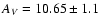 mag.
mag.
We verified these estimations once again against the spectral type
classification of the WR cluster members, adopting the intrinsic WR
colors of Crowther et al. (2006). The averaged color excesses for the
WN stars are
 mag and
 mag, corresponding to
 mag and
 mag, in
reasonable agreement with our previous estimates.
mag, in
reasonable agreement with our previous estimates.
Ideally, to obtain an accurate distance to the cluster we need the
spectral class and respectively the absolute magnitude of some of the
MS stars because they are much more uniform in comparison with the
WR stars.
Unfortunately, we do not have spectra of MS stars. The WN luminosities
however allow us to obtain relatively good estimates of the distance.
The bolometric corrections (BC) for WN stars from Crowther et al. (2006)
were used to transform the luminosities to absolute
band
magnitudes. The BCs and the distance moduli of G30 WR stars are listed
in Table 3. Averaging the individual estimates, we obtain
 and
and
 mag,
corresponding to distance of
kpc.
mag,
corresponding to distance of
kpc.
We also used the mean absolute -band magnitudes of the WN
subtypes given in Crowther et al. (2006) to verify our distance modulus
estimate. Averaging over the G30 WR members we obtained
(
 mag. This corresponds
to a shorter distance of
mag. This corresponds
to a shorter distance of
 kpc.
kpc.
In our further analysis we will use the larger distance modulus to the cluster because the models of WR stars yield more reliable temperature and luminosity estimates (and respectively - distance) than the spectral classification based on comparison with template spectra. Furthermore, the shorter distance modulus moves the hydrogen burning turn-on point, (where the isochrone of the PMS of 4 Myr reaches the MS), to about 1 mag above the observed lower MS cut-off. This is in disagreement with the estimated age of the cluster (see Fig. 4 and Sect. 5.2 for details).
It is difficult to obtain a reliable age using only an isochrone MS
fitting of young stellar clusters because of the nearly vertical
linear MS locus. The first constraint comes from the lack of red
supergiants in G30, evident from the CMD (Fig. 2). The
stellar evolutionary models with rotation predict the onset of red
supergiants at 4.5-5 Myr, defining an upper limit to the
cluster age.
The WR phase is very short lived and the presence of WR stars limits
the maximal age of the cluster (Meynet & Maeder 2005). All known WR
stars in G30 are of the WN6-7ha (hydrogen rich) subtype. There are
indications that hydrogen rich WN7 stars are descendants of massive
stars with initial masses above 50-60
 (e.g., Crowther
et al. 1995). Then an upper age limit of 4-4.5 Myr can be set,
independently of the exact metallicity and mass-loss scenario.
(e.g., Crowther
et al. 1995). Then an upper age limit of 4-4.5 Myr can be set,
independently of the exact metallicity and mass-loss scenario.
The MS turn-off MS point provides a consistency check. Our final
true distance modulus (
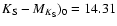 mag
suggests that the brightest unevolved star is O9.5 or B0 setting the
cluster age to 3-4.5 Myr. This estimate is not independent,
because we used WR stars to obtain the distance to the cluster.
mag
suggests that the brightest unevolved star is O9.5 or B0 setting the
cluster age to 3-4.5 Myr. This estimate is not independent,
because we used WR stars to obtain the distance to the cluster.
The age of the PMS stars was determined by fitting theoretical 0.1, 1.0, 4.0, 7.0, and 10 Myr PMS isochrones from Siess et al. (2000) to the CMD (Fig. 4). Note that the PMS stars spread over a wide age range but the main locus is between the 1 and 4 Myr isochrones. There are some stars with ages less than 1 Myr and also a possible concentration of stars around 10 Myr but it is too close to the depth of our photometry to draw a certain conclusion. We refrain from making more accurate conclusion about the age and the age spread because a significant fraction of the PMSs falls into the zone of photometric incompleteness. Deeper CMD is needed for that. However, we point that continuous star formation scenario or at least an extended burst cannot be excluded to have occurred in G30, based on our data.
The fraction of stars with NIR-excess correlates inversely with
the stellar age, over small age ranges (Hillenbrand 2005). The vast
majority (90%) of stars older than 3-8 Myr ceases to show
evidence for accretion. The fraction of IR-excess stars in a very
young stellar cluster such as G30 can be used as an age indicator.
We determined that for G30 the fraction is 12%. The empirical
calibration of Hillenbrand (2005) suggests an age of 3-4 Myr, in
agreement with our previous estimations.
Similar to Hillenbrand et al. (2007) we point out that ages may be affected by the photometric uncertainties and astrophysical effects such as variability of young objects, unresolved binaries, etc. In this regard it is important to discuss the following two questions:
1) How does the distance uncertainty affect the PMS-age? - As discussed
above, we have two distance modulus estimates that differ by
0.7 mag. Propagated to the PMS age this corresponds to
age difference of 6-7 Myr. The shorter distance modulus gives an age
of more than 10 Myr which is inconsistent with the presence of WNha
stars so the true age uncertainty is even smaller.
2) How do the photometric errors affect the age spread? - The formal
photometric uncertainties at the turn-on point are

 and
and
 mag.
Adding the errors due to the transformations to the standard
system, we see that the contribution of the
photometric errors to the age range does not exceed 1-2 Myr.
Therefore, most of the observed age spread is intrinsic to the PMS
population.
mag.
Adding the errors due to the transformations to the standard
system, we see that the contribution of the
photometric errors to the age range does not exceed 1-2 Myr.
Therefore, most of the observed age spread is intrinsic to the PMS
population.
To calculate the IMF we converted the stellar magnitudes into masses
using the Geneva models. The total mass of the observed cluster
members down to 2.35
(including the WR stars)
is 1600
adopting a distance modulus
(
and
reddening
mag. The mass estimation of G30
measured from the ((
 ,
,
 )
diagram as described in Borissova et al. (2003; see their Fig. 8)
gives similar result.
)
diagram as described in Borissova et al. (2003; see their Fig. 8)
gives similar result.
We also constructed a background subtracted mass function of the
cluster and fitted it with a single power-law, obtaining
(in these terms the Salpeter slope is
 )
over the mass range
)
over the mass range
 .
The integration over this MF down to
.
The integration over this MF down to
 combined
with the masses of the WR stars leads to a total cluster mass of
.
Naturally, this is only a
lower limit.
combined
with the masses of the WR stars leads to a total cluster mass of
.
Naturally, this is only a
lower limit.
These results make G30 only two to three times less massive than some of the most massive young clusters in the Galaxy - Arches and Quintuplet.
The physical properties of the G30 together with data for Quintuplet,
Arches and the Central cluster from Figer (2004) are summarized in
Table 4. Here
 is the total cluster mass in
observed stars,
is the total cluster mass in
observed stars,
 is the total cluster mass for all stars
integrated down to 1
,
assuming a Salpeter IMF. The
radius is the radius in parsecs, from the central stellar surface
density peak. The mass densities
is the total cluster mass for all stars
integrated down to 1
,
assuming a Salpeter IMF. The
radius is the radius in parsecs, from the central stellar surface
density peak. The mass densities  and
and  are simply
and
divided by the cluster volume. The
age and luminosity are the estimated cluster age and total
luminosity.
are simply
and
divided by the cluster volume. The
age and luminosity are the estimated cluster age and total
luminosity.
Quintuplet shows very similar characteristics to G30. They both have a larger radius and lower stellar density than Arches and Central cluster but Quintuplet is a factor of two more massive and a factor of three more luminous than G30. The Quintuplet is also older than G30 because it contains one RSG. The properties of G30, especially the presence of WR stars, make G30 a smaller analog of Arches, Westerlund 1 and Quintuplet.
Table 4: Parameters of G30 compared to the massive clusters in the Galactic Center (see Sect. 5.3 for more details). The data for Quintuplet, Arches and the Central cluster are from Figer (2004; see their Table 1). Note that the total mass and the corresponding density of G30 are only lower limits.
The galactocentric distance of G30 is
 kpc, assuming
that the Sun is at
kpc, assuming
that the Sun is at
 kpc from the Galactic
Center (Fig. 9).
G30 is located between Carina and Crux spiral arms, closer to Carina.
It probably belongs to some lateral branch of the farther inner side
of this arm. We see the cluster through a dust window in the nearer
side of the Carina arm. Note that if the distance to the cluster is
underestimated it can belong to the farther side of the main Carina
arm.
kpc from the Galactic
Center (Fig. 9).
G30 is located between Carina and Crux spiral arms, closer to Carina.
It probably belongs to some lateral branch of the farther inner side
of this arm. We see the cluster through a dust window in the nearer
side of the Carina arm. Note that if the distance to the cluster is
underestimated it can belong to the farther side of the main Carina
arm.
![\begin{figure}
\par\includegraphics[width=8.5cm,clip]{6706fig9.eps}\end{figure}](/articles/aa/full/2007/43/aa6706-06/img105.gif) |
Figure 9:
Location of G30 in the Galaxy. The galactocentric distance of
the cluster is
 kpc. The error bar shows the
1
error of 0.9 kpc in the distance to the Sun.
The spiral structure is taken from Cordes & Lazio (2002).
The solid lines show the modified spiral model of the Galaxy from Taylor &
Cordes (1993).
The dashed lines are a four-arm logarithmic spiral model combined with a
local arm.
The "+'' sign marks the Galactic center and the Sun is labeled. kpc. The error bar shows the
1
error of 0.9 kpc in the distance to the Sun.
The spiral structure is taken from Cordes & Lazio (2002).
The solid lines show the modified spiral model of the Galaxy from Taylor &
Cordes (1993).
The dashed lines are a four-arm logarithmic spiral model combined with a
local arm.
The "+'' sign marks the Galactic center and the Sun is labeled. |
| Open with DEXTER | |
We report new results of our long term project to study obscured Milky
Way star clusters. We obtained deep
imaging of
G30, a dense stellar cluster with spectroscopically confirmed WR stars
and a sizable population of young stellar objects. G30 is deeply embedded
into gas and dust and suffers a reddening of
 mag. The
object probably belongs to the Carina spiral arm and is located at a
distance of
mag. The
object probably belongs to the Carina spiral arm and is located at a
distance of  kpc from the Sun. The cluster is approximately
4 Myr old. The uppermost MS stars have evolved away from the zero-age
MS. G30 is massive, with a lower limit of the total mass of
.
This estimate includes only stars with masses
above 1.0
.
kpc from the Sun. The cluster is approximately
4 Myr old. The uppermost MS stars have evolved away from the zero-age
MS. G30 is massive, with a lower limit of the total mass of
.
This estimate includes only stars with masses
above 1.0
.
Spectral analysis and modeling of K spectra for four objects
show that one of these is an Ofpe/WN star, two are hydrogen rich WN6-7
stars, and the last is a WN or O-type star, all with progenitor
masses above 60
.
The CMD suggests that there might be
more WR or O type cluster members and additional observations are planned
to address this possibility. G30 is a new member of the family of
massive young Galactic clusters, hosting WR stars.
Acknowledgements
This research is partially supported by the Universidad de Valparaíso under DIPUV grant No 36/2006. The data used in this paper have been obtained with SofI/NTT at the ESO La Silla Paranal observatory. This publication makes use of data products from the Two Micron All Sky Survey, which is a joint project of the University of Massachusetts and the Infrared Processing and Analysis Center/California Institute of Technology, funded by the National Aeronautics and Space Administration and the National Science Foundation. This research has made use of the SIMBAD database, operated at CDS, Strasbourg, France. The authors would like to thank Donald Figer and Paul Crowther for placing their spectral libraries to our disposal. The authors gratefully acknowledge the very useful comments of the anonymous referee.