![[*]](/icons/foot_motif.gif) ,
,
A&A 472, 835-846 (2007)
DOI: 10.1051/0004-6361:20077474
, A. Zavagno1 - M. Pomarès1 - L. Deharveng1 - T. Hosokawa2 - D. Russeil1 - J. Caplan1
1 - Laboratoire d'Astrophysique de Marseille, 2 place Le Verrier, 13248 Marseille Cedex 4, France
2 -
Division of Theoretical Astrophysics, National Astronomical Observatory, 2-21-1 Osawa, Mitaka, Tokyo 181-8588,
Japan
Received 14 March 2007 / Accepted 21 May 2007
Abstract
Context. To investigate the process of star formation triggered by the expansion of an H II region, we present a multi-wavelength analysis of the Galactic H II region RCW 120 and its surroundings. The collect and collapse model predicts that the layer of gas and dust accumulated between the ionization and shock fronts during the expansion of the H II region collapses and forms dense fragments, giving rise to potential sites of massive-star formation.
Aims. The aim of our study is to look for such massive fragments and massive young stars on the borders of RCW 120.
Methods. We mapped the RCW 120 region in the cold dust continuum emission at 1.2 mm to search for these fragments. We supplemented this study with the available near- (2MASS) and mid-IR (GLIMPSE) data to locate the IR sources observed towards this region and to analyse their properties. We then compared the observational results with the predictions of Hosokawa & Inutsuka's model (2005, ApJ, 623, 917; 2006, ApJ, 646, 240).
Results. At 1.2 mm we detected eight fragments towards this region, five located on its borders. The largest fragment has a mass of about 370  .
Class I and Class II young stellar objects are detected all over the region, with some observed far from the ionization front. This result emphasises the possible importance of distant interactions between the radiation, escaping from the ionized region, and the surrounding medium.
.
Class I and Class II young stellar objects are detected all over the region, with some observed far from the ionization front. This result emphasises the possible importance of distant interactions between the radiation, escaping from the ionized region, and the surrounding medium.
Key words: stars: formation - stars: early-type - ISM: H II regions - ISM: individual objects: RCW 120
We have shown that the collect and collapse process has triggered massive-star formation in Sh 104 (Deharveng et al. 2003) and RCW 79 (Zavagno et al. 2006); however, many questions remain. In particular, the theoretical predictions are sometimes difficult to match with the observations, since the "real'' physical environment (inhomogeneous medium, evidence of champagne flow in some H II regions, turbulence) is more complicated than described in the models. Is the collect and collapse process an efficient way of forming massive stars? How does star formation proceed in the condensations formed via this process? Up to what distance can a massive star have an impact on its surrounding?
We are engaged in a systematic study of a sample of H II regions selected on the basis of their simple morphology and their potential for being collect and collapse regions (see Deharveng et al. 2005, for details). These are choice locations for studying the onset of massive-star formation in detail, and RCW 120 is one of these regions.
In the present paper we examine the distribution of the cold dust
associated with RCW 120, determine the nature of the IR sources
observed towards it, and discuss the star formation processes
possibly at work in this region. Section 2 gives the distance,
identifies the exciting star and describes the morphology of
RCW 120. Section 3 presents new 1.2-mm continuum observations
giving an emission map over a
 area.
Information derived from the 1.2-mm continuum emission (the cold
dust distribution and the mass of the observed fragments), along
with the properties of the YSOs observed in the direction of
RCW 120, are given in Sect. 4. The properties of YSOs are
discussed using the complete set of data available from the
large-scale IR surveys GLIMPSE (Benjamin et al. 2003),
2MASS (Skrutskie et al. 2006), and MSX (Egan et al. 1999). Section 5 presents a discussion of the geometry of
RCW 120, the various star-forming processes identified towards
this region, and a comparison with the theoretical model of H II region evolution of Hosokawa & Inutsuka (2005).
Conclusions are given in Sect. 6.
area.
Information derived from the 1.2-mm continuum emission (the cold
dust distribution and the mass of the observed fragments), along
with the properties of the YSOs observed in the direction of
RCW 120, are given in Sect. 4. The properties of YSOs are
discussed using the complete set of data available from the
large-scale IR surveys GLIMPSE (Benjamin et al. 2003),
2MASS (Skrutskie et al. 2006), and MSX (Egan et al. 1999). Section 5 presents a discussion of the geometry of
RCW 120, the various star-forming processes identified towards
this region, and a comparison with the theoretical model of H II region evolution of Hosokawa & Inutsuka (2005).
Conclusions are given in Sect. 6.
 ,
,
 .
RCW 120 is an
optical H II region, of about
.
RCW 120 is an
optical H II region, of about
 in size, located at
1.3 kpc (Russeil 2003 and Sect. 2.1). It is excited
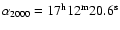
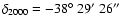
by an O8V star, LSS 3959, or CD-38
in size, located at
1.3 kpc (Russeil 2003 and Sect. 2.1). It is excited
by an O8V star, LSS 3959, or CD-38
 11636
(
11636
(
 ,
,
 ), identified
spectroscopically by Georgelin & Georgelin (1970). This
star is visible in Fig. 1, taken from the DSS2-red
survey, showing the H
), identified
spectroscopically by Georgelin & Georgelin (1970). This
star is visible in Fig. 1, taken from the DSS2-red
survey, showing the H emission.
![\begin{figure}
\par\includegraphics[width=8.5cm,clip]{7474fig1.eps} \end{figure}](/articles/aa/full/2007/36/aa7474-07/img21.gif) |
Figure 1:
H
emission of RCW 120 taken from the DSS2-red survey.
The main exciting star, CD-38
11636, is identified. |
| Open with DEXTER | |
The molecular material associated with RCW 120 has a radial
velocity
 (CO) of -8.7 km s-1 (Blitz et
al. 1982). Using the Galactic rotation curve of Brand &
Blitz (1993) we derive a kinematic distance of 1.35 kpc.
(CO) of -8.7 km s-1 (Blitz et
al. 1982). Using the Galactic rotation curve of Brand &
Blitz (1993) we derive a kinematic distance of 1.35 kpc.
The main exciting star of RCW 120 has been observed at various
wavelengths. Its magnitudes are B=11.93, V=10.79 (Avedisova &
Kondratenko 1984), J=8.013, H=7.708, and K=7.523(2MASS Point Sources Catalog [PSC]). Using the new calibrations of
Martins & Plez (2006), and the spectral type O8V, we
estimate a visual extinction  of 4.36 mag and a
distance of 1.33 kpc. This photometric distance agrees with the
kinematic distance. We adopt a distance of 1.34 kpc in the
following.
of 4.36 mag and a
distance of 1.33 kpc. This photometric distance agrees with the
kinematic distance. We adopt a distance of 1.34 kpc in the
following.
RCW 120 is a thermal radio-continuum source. Its flux density has
been measured at various wavelengths, and is in the range
5.5-8.5 Jy (Manchester 1969; Altenhoff et al. 1970; Reifenstein et al. 1970; Griffith et al. 1994; Langston et al. 2000). Adopting a flux
density of  Jy, a distance of 1.34 kpc, and using
Simpson & Rubin's Eq. (1) (1990), we derive the ionizing
photon flux,
Jy, a distance of 1.34 kpc, and using
Simpson & Rubin's Eq. (1) (1990), we derive the ionizing
photon flux,
 .
According to
thecalibration of Martins et al. (2005), this
corresponds to a star of spectral type O8.5V-O9V. This is
somewhat later than the O8V spectral type estimated directly from
spectroscopy (Georgelin & Georgelin 1970). But this is
not surprising as ionizing photons are very probably absorbed by
dust grains inside this H II region; indeed, the emission of
these grains is observed at 21.3
.
According to
thecalibration of Martins et al. (2005), this
corresponds to a star of spectral type O8.5V-O9V. This is
somewhat later than the O8V spectral type estimated directly from
spectroscopy (Georgelin & Georgelin 1970). But this is
not surprising as ionizing photons are very probably absorbed by
dust grains inside this H II region; indeed, the emission of
these grains is observed at 21.3  m (MSX Band E) clearly in
the direction of the ionized gas (see Fig. 1 of Deharveng et al. 2005).
m (MSX Band E) clearly in
the direction of the ionized gas (see Fig. 1 of Deharveng et al. 2005).
RCW 120 is notable for its high degree of symmetry. On the one
hand, the ionization front, traced by the 8 m emission, is
almost circular. On the other, the whole region presents a nearly
north-south symmetry axis, with the exciting star lying on this
axis.
Several facts indicate that a nearly north-south density gradient is
present in the region, with density increasing towards the south: i)
the zones of brightest H
emission are observed in the
southern part of the H II region (see Figs. 1 and 2); ii) the exciting star lies in the southern part of
the H II region; and iii) the ionized gas is beginning to break out
of the H II region, northwards. We come back to this point in the
next section and in Sect. 4.4.
![\begin{figure}
\par\includegraphics[angle=0,width=12cm,clip]{7474fig2.eps} \end{figure}](/articles/aa/full/2007/36/aa7474-07/img26.gif) |
Figure 2:
Spitzer-IRAC 4.5 m (green) and 8 m (red) images from the GLIMPSE survey
superimposed on a SuperCOSMOS H
image (turquoise) of
RCW 120. The 8 m emission is dominated by the polycyclic
aromatic hydrocarbon (PAH) molecules. Note the presence of a PAH
layer, corresponding to the hot photodissociation region that
surrounds the ionized region. The field size is 24 (E-W) (E-W)
 27 (N-S). North is up and east is left.
 |
| Open with DEXTER | |
emission (taken from the Super-COSMOS survey, Parker et al. 2005) and the 4.5 m and 8 m emission (from
the Spitzer-GLIMPSE survey, http://www.astro.wisc.edu/sirtf/). The
8 m IRAC band contains emission bands centred at 7.6, 7.8, and 8.6 m, commonly attributed to polycyclic aromatic hydrocarbon
(PAH) molecules and a continuum contribution from very small grains.
PAHs are believed to be destroyed in the ionized gas, but larger
molecules can survive (Verstraete et al. 1996; Peeters et al. 2005). PAHs are excited by UV photons (
 eV)
(Sellgren 1984) in the photo-dissociation region (PDR). PAH
emission is a good tracer of the hot PDR that surrounds the H II region. Figure 2 shows that PAH emission completely
surrounds the ionized gas. Filaments extend far from the ionization
front, suggesting the idea of a "leaky'' H II region, probably due
to small-scale inhomogeneities in the ionization front and in the
surrounding medium. This point is important, as it could explain how
triggered star formation may occur far from the ionization front
(see Sect. 5.2).
Figure 3 (left) is a mosaic
eV)
(Sellgren 1984) in the photo-dissociation region (PDR). PAH
emission is a good tracer of the hot PDR that surrounds the H II region. Figure 2 shows that PAH emission completely
surrounds the ionized gas. Filaments extend far from the ionization
front, suggesting the idea of a "leaky'' H II region, probably due
to small-scale inhomogeneities in the ionization front and in the
surrounding medium. This point is important, as it could explain how
triggered star formation may occur far from the ionization front
(see Sect. 5.2).
Figure 3 (left) is a mosaic  image of
RCW 120 from the 2MASS survey. This clearly shows the presence of
an absorbing region surrounding RCW 120, with some filamentary
structures that extend far from the ionized region. The clear
limits of the absorbing zone and its large width (especially to
the north) suggest that we are seeing the remaining part of the
parental molecular cloud. The right part of Fig. 3
shows, on the same scale, an image of the RCW 120 region, taken
from the Spitzer-GLIMPSE survey in the band centred at 8 m.
The absorption zones, clearly visible at 2 m, are still
observed at 8 m (especially to the north), indicating the
presence of high-density material in those regions. Lacking
velocity information, we cannot prove the direct association of
the absorbing zones with the ionized region. The high contrast
seen at 2 m (Fig. 3, left), between the absorbing
zones that closely surround RCW 120 and the surrounding medium
observed at a larger distance, indicates that the association may
be real. The black box shown in Fig. 3 on the 8 m
GLIMPSE image shows the zone that we have selected to search for
YSOs using colour criteria in the near and mid IR. This part is
described in Sect. 4.2.
image of
RCW 120 from the 2MASS survey. This clearly shows the presence of
an absorbing region surrounding RCW 120, with some filamentary
structures that extend far from the ionized region. The clear
limits of the absorbing zone and its large width (especially to
the north) suggest that we are seeing the remaining part of the
parental molecular cloud. The right part of Fig. 3
shows, on the same scale, an image of the RCW 120 region, taken
from the Spitzer-GLIMPSE survey in the band centred at 8 m.
The absorption zones, clearly visible at 2 m, are still
observed at 8 m (especially to the north), indicating the
presence of high-density material in those regions. Lacking
velocity information, we cannot prove the direct association of
the absorbing zones with the ionized region. The high contrast
seen at 2 m (Fig. 3, left), between the absorbing
zones that closely surround RCW 120 and the surrounding medium
observed at a larger distance, indicates that the association may
be real. The black box shown in Fig. 3 on the 8 m
GLIMPSE image shows the zone that we have selected to search for
YSOs using colour criteria in the near and mid IR. This part is
described in Sect. 4.2.
![\begin{figure}
\par\includegraphics[angle=0,width=17.6cm,clip]{7474fig3.eps} \end{figure}](/articles/aa/full/2007/36/aa7474-07/img28.gif) |
Figure 3:
Dust associated with RCW 120. Left:
(2.17 m) mosaic image
of the RCW 120 region from the 2MASS survey. Zones of high absorption surround the
ionized region. Absorption filaments extend far away from the ionization front, revealing a non-homogenous medium. Right:
PAH emission at 8 m from Spitzer-GLIMPSE. Absorption features are still seen at this wavelength, indicating the presence of
dense material. The black box represents the region that has been searched for young
stellar objects |
| Open with DEXTER | |
Of the two sets of observations, the SEST-SIMBA contains continuum
maps at 1.2-mm (250 GHz) of a
 field
centred on RCW 120 were obtained using the 37-channel SIMBA
bolometer array (SEST Imaging Bolometer Array) on May 7-8, 2003. The
beam size is 24
field
centred on RCW 120 were obtained using the 37-channel SIMBA
bolometer array (SEST Imaging Bolometer Array) on May 7-8, 2003. The
beam size is 24
 .
The positional uncertainty of the SIMBA
observations is less than 3
.
The positional uncertainty of the SIMBA
observations is less than 3
 .
Six individual maps covering
the whole region were obtained with the fast scanning speed
(80
per second). The total integration time was 10 h.
The final map was constructed as described in Zavagno et al. (2006). The residual noise in the final map is about
20 mJy/beam (1
.
Six individual maps covering
the whole region were obtained with the fast scanning speed
(80
per second). The total integration time was 10 h.
The final map was constructed as described in Zavagno et al. (2006). The residual noise in the final map is about
20 mJy/beam (1 ). We then used the emission above 5(100 mJy/beam level) to delineate the 1.2-mm condensations.
The H
Fabry-Perot observations of RCW 120 were obtained with
CIGALE on a 36-cm telescope (La Silla, ESO). CIGALE uses a
Fabry-Perot interferometer scanning the H profile to give
the kinematics over the field. The field of view is 39
 square with a pixel size of 9
.
The Fabry-Perot
interferometer has an interference order of 2604 at H,
i.e. a free spectral range of 115 km s-1. The finesse is 10 (FWHM
11.5 km s-1) and the sampling step is 5 km s-1. The
velocity and FWHM uncertainties are both
square with a pixel size of 9
.
The Fabry-Perot
interferometer has an interference order of 2604 at H,
i.e. a free spectral range of 115 km s-1. The finesse is 10 (FWHM
11.5 km s-1) and the sampling step is 5 km s-1. The
velocity and FWHM uncertainties are both  1 km s-1. A
complete description of the instrument, including data acquisition
and reduction techniques, can be found in Le Coarer et al. (1992).
1 km s-1. A
complete description of the instrument, including data acquisition
and reduction techniques, can be found in Le Coarer et al. (1992).
The H
profiles need to be decomposed into two components:
the night-sky lines (geocoronal H
and OH) and the nebular
lines. The night-sky lines are modelled by the instrumental
profile, while the nebular lines are modelled by Gaussians
convolved with that profile. In order to increase the
signal-to-noise ratio we extracted and analysed profiles from
large areas (
 ). The profile analysis
shows that the LSR radial velocity of the ionized gas of RCW 120
ranges from -8 km s-1 to -15 km s-1.
). The profile analysis
shows that the LSR radial velocity of the ionized gas of RCW 120
ranges from -8 km s-1 to -15 km s-1.
![\begin{figure}
\par\includegraphics[angle=0,width=16.5cm,clip]{7474fig4.eps} \end{figure}](/articles/aa/full/2007/36/aa7474-07/img35.gif) |
Figure 4:
Left: millimetre continuum emission contours superimposed on a SuperCOSMOS H
image of the
region. Contours range from 60 (3)
to 960 mJy/beam in steps of
100 mJy/beam
and from 1000 to 3000 mJy/beam in steps of 400 mJy/beam. Right: millimetre continuum emission contours superimposed on the GLIMPSE 5.8 m
image of the region. Contours range from 100 mJy/beam (5)
to 400 in steps of 100 mJy/beam and then from 500
to 3000 in steps of 250 mJy/beam. Condensations at 1.2 mm are identified in Table 1. |
| Open with DEXTER | |
Figure 4 (left) shows the 1.2-mm continuum emission contours
superimposed on a SuperCOSMOS H
image of RCW 120. Eight
condensations are observed at a 5
level. Five of these (Nos. 1, 2, 3, 4, and 7) are immediately adjacent to the ionized region.
This location suggests that these condensations may result from the
fragmentation of a layer of collected material accumulated between
the ionization front and the shock front, as predicted by the
collect and collapse model. The two most massive condensations (Nos. 1 and 2) are observed to the south. Condensations 5, 6, and 8 are
observed farther away from the ionization front but coincide with
regions of high extinction in Fig. 3. Note that only low
extinction is detected in the optical and 8 m images in the
direction of the most massive condensations (1 and 2), indicating
that most of the absorbing material must be located behind the
emitting region.
Figure 4 (right) presents the 1.2-mm continuum emission
contours superimposed on the 5.8 m GLIMPSE image of RCW 120.
The lowest contour delineates the condensations' surfaces as
defined, for the mass estimates, at the 5
level
(100 mJy/beam, Sect. 3).
The millimetre continuum emission from the condensations identified
in Fig. 4 (right) is mainly due to optically thin thermal
dust emission. We used the formula given by Hildebrand
(1983) and proceeded as explained in Zavagno et al. (2006). Table 1 lists the measured and
derived properties obtained for the millimetre fragments identified
in Fig. 4. Column 1 gives the fragment numbers, Cols. 2 and 3 give the emission peak coordinates, Col. 4 gives the 1.2-mm
integrated flux, and Col. 5 the range of derived masses for the
corresponding fragment depending on the adopted temperature (20 or
30 K). The lower mass values correspond to the higher dust
temperature. Because of possible molecular line contamination
(overestimation of the continuum flux) and the possible presence of
an internal source of heating (a higher dust temperature than
expected), the fragments' mass estimate is an upper limit (see also
Beuther et al. 2002). If an outflow is present, the
molecular line contamination to the measured 1.2-mm flux may be as
much as 30% (Gueth et al. 2003) but is probably about 10%
if no outflow is present (Guilloteau, private communication).
The two most massive fragments, Nos. 1 and 2, are located to the
south, probably a consequence of the higher density in this area.
The other fragments, located on the borders of the ionized region or
even farther away, are less massive. Fragment 1 shows some
structure, in particular a highly peaked emission. The 1.2-mm
emission peak of 3.08 Jy/beam indicates an H2 column density
greater than
 cm-2 for a temperature of
20 K, corresponding to a visual extinction
cm-2 for a temperature of
20 K, corresponding to a visual extinction
 mag. This
fragment is a potential site of high-mass star formation (see also
Beuther et al. 2002). However, as discussed in
Sect. 4.2, no 8 m source is observed towards this
emission peak. This could be due to the low sensitivity of the
GLIMPSE survey. A source should be sought at longer wavelengths.
mag. This
fragment is a potential site of high-mass star formation (see also
Beuther et al. 2002). However, as discussed in
Sect. 4.2, no 8 m source is observed towards this
emission peak. This could be due to the low sensitivity of the
GLIMPSE survey. A source should be sought at longer wavelengths.
Table 1: Mass estimates for the millimetre fragments.
Our purpose is to look for star formation towards RCW 120. For
this we use the Spitzer-GLIMPSE survey to do a systematic search
for YSOs using colour selection criteria. Indeed, YSOs are
expected to have specific colours depending on mass and
evolutionary status (see Allen et al. 2004). We have
selected the absorbing zone, centred on RCW 120, seen in the near
IR (Fig. 3), from
 from 17
 to
to
 and
from
and
from
 from -38
 40 to
40 to
 .
.
We extracted the 35 178 objects in this zone from the GLIMPSE PSC
(http://www.astro.wisc.edu/sirtf/). Then, to avoid sources near
the detection limit, we selected the 2654 sources that had been
measured in the four IRAC bands and were brighter than 11 mag in
the 8 m band. From these we selected those objects with
colours corresponding to Class II and Class I, i.e.
![$[3.6]{-}[4.5]
\geq 0.4$](/articles/aa/full/2007/36/aa7474-07/img63.gif) and
and
![$[5.8]{-}[8.0] \geq 0.4$](/articles/aa/full/2007/36/aa7474-07/img64.gif) (Allen et al. 2004).
The final selection is listed in Table 2 to which we have added
the exciting star of RCW 120 and a few giants.
(Allen et al. 2004).
The final selection is listed in Table 2 to which we have added
the exciting star of RCW 120 and a few giants.
Table 2, available at the CDS,
gives the position and photometry from 1.25 m to 8 m of
the detected YSOs, sorted by location (towards the millimetre
condensations, towards and outside from the H II region). Column 1
gives their identification numbers. Columns 2 and 3 give their
coordinates according to the GLIMPSE PSC. Columns 4 to 6 give their
J, H, and
magnitudes from the 2MASS PSC (http://tdc-www.harvard.edu/software/catalogs/tmpsc.html). Columns 7
to 10 give their [3.6], [4.5], [5.8], and [8.0] mag from the
GLIMPSE PSC. When not available from the PSC, we measured the
magnitudes (aperture photometry) using the Basic Calibrated Data
frames; these are indicated with asterisks in Table 2. Column 11
gives general comments about the nature of each source (Class I,
Class II, giant).
![\begin{figure}
\includegraphics[width=12cm,clip]{7474fig5.eps} \end{figure}](/articles/aa/full/2007/36/aa7474-07/img66.gif) |
Figure 5:
Spatial distribution of the YSOs detected towards
RCW 120. The red circles are Class I sources, the green triangles
Class II sources. In both cases, the largest symbols are for the
brightest sources, with
![$[8.0]\leq 6$](/articles/aa/full/2007/36/aa7474-07/img8.gif) mag. Bright Class I sources
observed far from the ionization front are identified (see
Sect. 5.2). The field size is 25 mag. Bright Class I sources
observed far from the ionization front are identified (see
Sect. 5.2). The field size is 25
 . . |
| Open with DEXTER | |
Figure 5 shows the spatial distribution of the Class I and Class II YSOs identified in the direction of RCW 120 and shows that these YSOs are located in three main zones: i) near the cold dust condensations identified in Fig. 4; ii) in the direction of the ionized region; and iii) far from the ionization front and, in some cases, not associated with a detected millimetre condensation. The lack of velocity information makes it impossible to firmly associate the detected YSOs with RCW 120. However, the statistical analysis presented in Sect. 5.2 suggests that most of these objects are associated with this region. The GLIMPSE colour-colour diagram is shown in Fig. 6. The sources discussed in the text are identified by the labels given in Table 2. A large number of objects are Class I sources. We do not consider those sources located in the lower part of the Class II box, since main sequence and giant stars (located in the elliptical region centred on 0, 0 in this [3.6]-[4.5] versus [5.8]-[8.0] diagram) may be falsely displaced into this zone if they are faint and superimposed on background emission (the colours of the extended emission are [3.6]-[4.5]=0.1 and [5.8]-[8.0]=1.9). Giant stars can be bright IR sources. We used the 2MASS J-H versus H-K diagram, not presented here, to identify such stars.
![\begin{figure}
\includegraphics[origin=rb,angle=270,width=12cm,clip]{7474fig6.eps} \end{figure}](/articles/aa/full/2007/36/aa7474-07/img67.gif) |
Figure 6: GLIMPSE colour-colour diagram, [3.6]-[4.5] versus [5.8]-[8.0], for the sources observed towards RCW 120. Class I and Class II zones are indicated according to criteria given by Allen et al. (2004). The black arrow is the reddening vector for a visual extinction of 40 mag. The ellipse centred on 0, 0 encloses the region of main sequence and giant stars. The black star represents the exciting star of RCW 120. |
| Open with DEXTER | |
Below we give information about some specific properties of the sources, due either to their locations and/or evolutionary stages. Sources observed towards millimetre condensations may be affected by local extinction. Apparently, Class I sources may in fact be reddened Class II. This is particularly critical for deeply embedded sources classified as Class I with no 2MASS counterparts.
Condensation 1
Figure 7 is a composite colour image of condensation 1.
Source 12C1, the brightest object at 8 m near condensation 1,
is located in the transition region between Class I and Class II
sources (Fig. 6). This source is not directly
associated with 1.2-mm emission but is observed towards a
filamentary structure observed in absorption at 8 m (see
Fig. 3); it is far (about 1.2 pc) from the ionization
front but is observed surrounded by diffuse 8 m emission,
indicating that far UV photons leaking from the ionized region have
reached this zone. This radiation may have influenced the formation
of this young source. We discuss this point in Sect. 5.2.
![\begin{figure}
\par\includegraphics[width=8cm,clip]{7474fig7CMJN.eps} \end{figure}](/articles/aa/full/2007/36/aa7474-07/img68.gif) |
Figure 7:
Top: colour composite image of condensation 1, showing the K image (blue) from
2MASS, and
the 3.6 m (green) and 8 m (red) image from the
GLIMPSE survey. Bottom: The sources discussed in the text are identified on the 5.8 m GLIMPSE image. |
| Open with DEXTER | |
Source 16C1, a Class I object, is the brightest source observed
towards condensation 1, and it has no 2MASS counterpart. This source
coincides with an extension of the 1.2-mm continuum emission and is
observed at the head of a finger-shaped absorbing region observed at
8 m. Faint 8 m emission surrounds this region,
indicating that UV photons reach this zone. The location of this
source at the vertex of an absorbing structure indicates that
globule squeezing may have occurred here, triggering star formation.
Source 13C1 is also a Class I object having no 2MASS counterpart. It is observed in the direction of a 1.2-mm emission extension.
The sources 4C1, 5C1, 6C1, 7C1, 8C1, and 21C1 are observed towards
the main 1.2-mm emission peak. Most of these are low-luminosity
Class I objects. This strong emission peak does not coincide with an
absorbing zone at 8 m, so the condensation must be located
behind the 8 m emitting region. The nature of source 21C1,
observed exactly coincident with the 1.2-mm peak, is unclear, as
this source has no measured magnitudes in the [3.6], [5.8], and
[8.0] bands.
Condensation 4
Figure 8 shows a detailed view of condensation 4.
As seen in Fig. 8, two bright extended sources called
objects 1 and 2 and not given in the GLIMPSE PSC (probably due to
their extended nature), dominate the 8 m emission. At their
centres lie near-IR stellar objects. Objects 1 and 2 are also seen
in the MSX images and are classified from their MSX colours as
Herbig Ae/Be objects (for object 1, see source 19 in Deharveng et al. 2005). We have verified from its MSX colours that
object 2 (not included in Deharveng et al. 2005) is a Herbig
Ae/Be object as well. The extended nebulae are probably local PDRs
created by the radiation of the central sources. These are not
massive enough to form H II regions but they can, with lower energy
photons, heat the surrounding dust, thus creating local PDRs.
![\begin{figure}
\par\includegraphics[width=8cm,clip]{7474fig8CMJN.eps} \end{figure}](/articles/aa/full/2007/36/aa7474-07/img69.gif) |
Figure 8:
Top: same as Fig. 7, but for condensation 4. The sources discussed in the text are
identified in the 8 m GLIMPSE image ( bottom). |
| Open with DEXTER | |
Class I sources including Nos. 2, 3, and 4C4, are observed in the immediate surroundings, in addition to these two Herbig Ae/Be stars. No source is detected towards the peak of the 1.2-mm condensation. Note that the shape of the ionization front is distorted in the direction of condensation 4. We discuss this point in Sect. 5.2.
Condensation 5
Condensation 5 is observed far from the ionization front and
coincides with a region of high extinction observed at both
2 m and 8 m (Fig. 3). An interesting point is
the presence of numerous radial structures seen in absorption
at 8 m, perpendicular to the IF (Fig. 3). This
suggests that radiation passes through this rather dense medium,
with enough energy to shape it, and may have favoured subsequent
star formation within this possible pre-existing condensation.
![\begin{figure}
\par\includegraphics[width=8cm,clip]{7474fig9.eps} \end{figure}](/articles/aa/full/2007/36/aa7474-07/img70.gif) |
Figure 9:
Same as Fig. 7 but for condensation 6. The sources discussed in the text
are identified in the 5.8 m GLIMPSE image ( bottom). |
| Open with DEXTER | |
Two Class I sources, 1C5 and 2C5, are observed towards condensation 5. The bright source 1C5 is observed towards the condensation's centres.
Condensation 6
Figure 9 shows condensation 6 in detail. This object,
like condensations 5 and 8, is observed far from the ionization
front (about 1.5 pc away) and coincides with an absorption region
seen in the 2 m and 8 m images (Fig. 3).
Five sources are observed towards condensation 6, source 5C6 being
the brightest. Source 3C6 is a very faint red object observed
towards the peak of the 1.2-mm emission (Fig. 9). Objects
2C6 and 4C6, also classified as Class I, are located farther from
the centre of the 1.2-mm emission peak.
Sources observed towards the ionized region
As seen in Table 2 and in Fig. 5, all of the sources
observed towards the ionized region are Class II objects, apart
from one Class I source, 13H II. The ionizing star of RCW 120 is
identified in Fig. 1. Its GLIMPSE colours correspond to
those of main sequence stars (Fig. 6).
A Class I source (5H II) and a Class II source (1H II) are
observed towards the ionized region, lying on the vertices of
triangular structures. Both (the sources and the structures) are
seen in emission at 8 m (see Fig. 12) and are
discussed in Sect. 5.1.
velocity field
![\begin{figure}
\par\includegraphics[width=8cm,clip]{7474fig10.eps} \end{figure}](/articles/aa/full/2007/36/aa7474-07/img71.gif) |
Figure 10:
Top: H
velocity field (grey scale plus black dashed contours). Bottom: H
line width (grey scale).
The H
emission is superimposed as white contours. |
| Open with DEXTER | |
Figure 10 presents the velocity field of the ionized gas
observed towards RCW 120 and the width of the H
emission
line over the field. The uncertainty of the H
line width is 1 km s-1.
The velocity field displays a gradient, from about -9 km s-1 to the south of the H II region, up to -16 km s-1to the north of the region. In Fig. 2 RCW 120 looks
like a bottle full of ionized gas, its "neck'' turned to the north
where a clear opening in the 8 m indicates a break in the
ionization front and the surrounding dust layer. The H velocity field shows that the ionized gas flows towards the
observer. This result is consistent with the most massive
condensation being located to the south where dense material has
accumulated. The northern part is probably less dense, allowing
the ionized gas to break the surrounding shell and flow away. We
are probably observing the beginning of a "champagne'' phase
(Tenorio-Tagle 1979), and the observed shape of the region
is also consistent with this result.
Figure 10 shows that on the borders of the ionized region
the H
line width is narrow - around 18 km s-1 - when
compared to the central parts where the width is  24 km s-1. This is expected for an expanding H II region: whereas
the expansion velocity has no radial component on the borders of
this region (thus the line is narrow), the expansion velocity is
purely radial in the direction of the centre and we see both the
approaching and receding sides (thus broadening the line). We
expected this to be confirmed by the H I emission but it was not,
as described below.
24 km s-1. This is expected for an expanding H II region: whereas
the expansion velocity has no radial component on the borders of
this region (thus the line is narrow), the expansion velocity is
purely radial in the direction of the centre and we see both the
approaching and receding sides (thus broadening the line). We
expected this to be confirmed by the H I emission but it was not,
as described below.
![\begin{figure}
\par\includegraphics[width=8cm,clip]{7474fig11} \end{figure}](/articles/aa/full/2007/36/aa7474-07/img73.gif) |
Figure 11:
H I emission (in white) from the SGPS integrated between -15.66 km s-1 and -10.72 km s-1.
H
emission is superimposed as green contours. |
| Open with DEXTER | |
The H I emission from the Southern Galactic Plane Survey (SGPS,
McClure-Griffiths et al. 2005) is shown in Fig. 11,
integrated between -10.72 km s-1 and -15.66 km s-1.
The angular resolution of these observations is 40
and
the velocity resolution is 0.82 km s-1.
The emission shows an annular structure. The H II region and
condensations 1 and 2 lie in the direction of the central hole.
The annular structure is larger near -11 km s-1 (the
systemic velocity) than near -15 km s-1, so the whole
structure appears to be in expansion. However, we only see the
approaching side of the cloud, as no emission is observed around -5 km s-1, as would be expected from the receding side of
the cloud. We have no explanation for this fact.

![\begin{figure}
\par\includegraphics[width=8.6cm,clip]{7474fig12.eps} \end{figure}](/articles/aa/full/2007/36/aa7474-07/img76.gif) |
Figure 12:
Instabilities of the ionization front. Top: the ionized gas traced by the H
emission (in blue) leaks between condensations 1 and 2,
at the
locations shown by the blue arrows.
Bottom: structure of the ionization front (GLIMPSE 5.8 m image). The black arrows point to two YSOs
(1H II and 5H II)
observed at the vertices of triangular structures possibly created by dynamical instabilities in the ionization front. |
| Open with DEXTER | |
In the absence of velocity information, it is impossible to be
sure that the observed YSOs are all associated with RCW 120. Only
a statistical approach can give us some insight into this point.
We have considered two zones located at the same Galactic latitude
as RCW 120 (
 )
and on either side of it (at Galactic
longitudes
)
and on either side of it (at Galactic
longitudes
 and
and
 ). Each of these zones
has the same area as the region we searched for YSOs around
RCW 120 (Sect. 4.2). The same selection criteria was applied
to search for Class I and Class II sources in these zones as in
RCW 120 (i.e.
[3.6]-[4.5] and
mag). The
result is as follows: 15 and 25 YSOs, respectively, are detected
in these zones compared to 107 YSOs in the RCW 120 zone. This
suggests that most of the YSOs detected towards RCW 120 are
probably associated with it.
). Each of these zones
has the same area as the region we searched for YSOs around
RCW 120 (Sect. 4.2). The same selection criteria was applied
to search for Class I and Class II sources in these zones as in
RCW 120 (i.e.
[3.6]-[4.5] and
mag). The
result is as follows: 15 and 25 YSOs, respectively, are detected
in these zones compared to 107 YSOs in the RCW 120 zone. This
suggests that most of the YSOs detected towards RCW 120 are
probably associated with it.
Which process can trigger star formation far from the ionization
front? Figure 3 shows that low-brightness PAH emission
features also extend far from the ionization front. It seems that
the hot photon-dominated region, where PAH emission originates, is
more extended than would be expected if the ionization front were
impermeable. Examination of a wide-field H image also
clearly shows extended H
emission surrounding the RCW 120
region. This suggests a leaky H II region bounded by a porous
ionization front, allowing a fraction of the UV radiation to reach
regions far away from the front.
![\begin{figure}
\par\includegraphics[width=8.8cm,clip]{7474fig13.eps} \end{figure}](/articles/aa/full/2007/36/aa7474-07/img80.gif) |
Figure 13:
Unsharp-masked image of the southern part of RCW 120 at 8 m (see text for details). |
| Open with DEXTER | |
m, obtained by subtracting a median-filtered
version of the same image produced with a
 window from the original GLIMPSE image. The extended
bright structures are thus removed, leaving the low-brightness,
small-scale structures. The left part of Fig. 13 shows
the highly irregular aspect of the IF. The right side, where the
contrast has been enhanced, shows the outer part of the PDR, with
many radial structures originating from the IF. This structure
clearly indicates that the UV radiation can penetrate far inside the
surrounding medium. Can the high pressure of the warm, partially
ionized inter-clump medium trigger star formation far from the
ionization front?
window from the original GLIMPSE image. The extended
bright structures are thus removed, leaving the low-brightness,
small-scale structures. The left part of Fig. 13 shows
the highly irregular aspect of the IF. The right side, where the
contrast has been enhanced, shows the outer part of the PDR, with
many radial structures originating from the IF. This structure
clearly indicates that the UV radiation can penetrate far inside the
surrounding medium. Can the high pressure of the warm, partially
ionized inter-clump medium trigger star formation far from the
ionization front?
A rough estimate of n0 can be obtained by assuming that all the
material now observed, either ionized in the H II region or neutral
in the massive fragments surrounding RCW 120, was previously located
in a sphere of density n0 and of radius equal to that of the
H II region. We used only the southern half of RCW 120 for this
estimate of n0. From the radio-continuum flux density, we
estimate the mass of ionized gas to be M(H II
 (thus
(thus
 for half the H II region). The mass of neutral
material in condensations 1, 2, 3, 4, and 7 is
for half the H II region). The mass of neutral
material in condensations 1, 2, 3, 4, and 7 is
 (the
maximum value, for T=20 K). The mass of neutral material in the
collected layer, but not detected in the direction of the centre of
the H II region because its emission is below the sensitivity limit
of the 20 mJy/beam, is
(the
maximum value, for T=20 K). The mass of neutral material in the
collected layer, but not detected in the direction of the centre of
the H II region because its emission is below the sensitivity limit
of the 20 mJy/beam, is 
 (thus
(thus
 for half the layer), hence an upper limit of 3000 atoms cm-3for n0. A lower limit of 1400 atoms cm-3 is obtained for
T=30 K.
for half the layer), hence an upper limit of 3000 atoms cm-3for n0. A lower limit of 1400 atoms cm-3 is obtained for
T=30 K.
The dynamical expansion of RCW 120 and its PDR can be analysed
using the model of Hosokawa & Inutsuka (2006). A
one-dimensional, spherically symmetric numerical method is used.
The UV and far-UV radiation transfer, as well as the thermal and
chemical processes, are solved with a time-dependent hydrodynamic
code. We suppose a central star of
 (which,
according to Diaz-Miller et al. 1998, emits the same
number of ionizing photons as the exciting star of RCW 120) and a
uniform ambient density of 3000 atoms cm-3.
Figure 14 shows the time evolution of several physical
quantities. The radius of RCW 120, 1.67 pc, is reached at
t=0.4 Myr. At this time the electron density of the ionized gas
agrees with the observed value of 86 cm-3.
(which,
according to Diaz-Miller et al. 1998, emits the same
number of ionizing photons as the exciting star of RCW 120) and a
uniform ambient density of 3000 atoms cm-3.
Figure 14 shows the time evolution of several physical
quantities. The radius of RCW 120, 1.67 pc, is reached at
t=0.4 Myr. At this time the electron density of the ionized gas
agrees with the observed value of 86 cm-3.
Figure 14
also shows the gas shell swept up by the shock front, with
densities in the range 104-105 cm-3; the highest
density is found on the outside of the shell, close to the SF. The
shell mass is about
 at this time, and most of the
swept-up hydrogen gas remains in the shell as hydrogen molecules.
Figure 15 shows the evolution of the positions of various
fronts. The swept-up shell very quickly becomes mainly molecular
(H2); later on, at about 0.3 Myr, the dissociation front of the
CO molecule is engulfed by the expanding shell. Parts of the shell
become unstable when
at this time, and most of the
swept-up hydrogen gas remains in the shell as hydrogen molecules.
Figure 15 shows the evolution of the positions of various
fronts. The swept-up shell very quickly becomes mainly molecular
(H2); later on, at about 0.3 Myr, the dissociation front of the
CO molecule is engulfed by the expanding shell. Parts of the shell
become unstable when
 .
Figure 15
shows that the unstable region appears at about 0.3 Myr, near the
SF, and gradually spreads over the shell. Thus we would expect to
see, at the age of 0.4 Myr, a shell of mainly molecular collected
material, with the outside parts of the shell (near the SF)
fragmented. Of course, the model does not tell us if stars have
already formed in these fragments. Note that these estimates
are rough, due to the uncertainties concerning both the density
and the uniformity of the medium into which RCW 120 evolves.
.
Figure 15
shows that the unstable region appears at about 0.3 Myr, near the
SF, and gradually spreads over the shell. Thus we would expect to
see, at the age of 0.4 Myr, a shell of mainly molecular collected
material, with the outside parts of the shell (near the SF)
fragmented. Of course, the model does not tell us if stars have
already formed in these fragments. Note that these estimates
are rough, due to the uncertainties concerning both the density
and the uniformity of the medium into which RCW 120 evolves.
![\begin{figure}
\par\includegraphics[width=7.5cm,clip]{7474fig14.eps} \end{figure}](/articles/aa/full/2007/36/aa7474-07/img90.gif) |
Figure 14: Snapshots of the gas dynamical evolution at t=0.2, 0.4, 0.6, 0.8, and 1.0 Myr. |
| Open with DEXTER | |
![\begin{figure}
\par\includegraphics[width=7.5cm,clip]{7474fig15.eps} \end{figure}](/articles/aa/full/2007/36/aa7474-07/img91.gif) |
Figure 15:
Top: evolution of the positions of the various fronts (ionization front [IF], shock front
[SF] and
dissociation front [DF] of the H2 and CO molecules). Bottom: time evolution of the column density of the H2 and
CO components.
The shaded region corresponds to
within the shell and hence
indicates that gravitational fragmentation is expected. The contours show where the
fractions of molecular gas
 (dashed contours) and
 (dot-dashed contours) = 0.2, 0.5, and 0.8.
 |
| Open with DEXTER | |
It appears as an almost perfect sphere full of ionized gas - a Strömgren sphere around the exciting star. The sphere is open in the direction of lower density, in the north, and the ionized gas is escaping from the sphere. We are most probably seeing the very beginning of a "champagne flow''. This is shown by the shape of the H II region, the shape of its IF as shown by the PAH emission and by the velocity field.
Dense material, now mostly molecular, has been collected around the
ionized gas during the expansion of the H II region. The collected
layer has begun to fragment. This is shown by the millimetre
emission of the cold dust. Some fragments are massive, but no
massive YSO is detected (up to 8 m at the GLIMPSE sensitivity)
in the direction of the fragments. If a massive Class 0 object is
forming, it may be detectable but only at longer wavelengths at the
emission peak of condensation 1.
Several Class I and Class II objects, of low and intermediate mass, are observed in the direction of the PDR, near the IF. Their formation was probably triggered by the expansion of the H II region, via various processes such as dynamical instabilities of the IF and the radiation-driven implosion of pre-existing molecular clumps.
Two other points are pending and need further observations for them to be understood:
 eV). This is shown by the presence of a
low-brightness H
zone surrounding RCW 120, which has the
same shape and almost the same extent as that of the low-brightness
PAH PDR. The low-density PDR, beyond the collected layer, appears to
be very irregular. If hydrogen-ionizing UV photons escape from the
H II region, they ionize the low-density inter-clump medium,
destroying the PAH there. The photons may carve radial tunnels.
Lower energy photons heat PAHs at the surface of the high-density
neutral clumps. The pressure of this partially-ionized,
high-temperature, inter-clump medium may trigger star formation in
the low-mass clumps.
eV). This is shown by the presence of a
low-brightness H
zone surrounding RCW 120, which has the
same shape and almost the same extent as that of the low-brightness
PAH PDR. The low-density PDR, beyond the collected layer, appears to
be very irregular. If hydrogen-ionizing UV photons escape from the
H II region, they ionize the low-density inter-clump medium,
destroying the PAH there. The photons may carve radial tunnels.
Lower energy photons heat PAHs at the surface of the high-density
neutral clumps. The pressure of this partially-ionized,
high-temperature, inter-clump medium may trigger star formation in
the low-mass clumps.
If real, such structures and such signatures of star formation should be found around other H II regions. Long-distance triggering by radiation through a permeable medium should be investigated in more detail by models and observations, as the results may change our view of triggered versus spontaneous star formation.
Acknowledgements
This research has made use of the Simbad astronomical database operated at the CDS, Strasbourg, France, and of the interactive sky atlas Aladin (Bonnarel et al. 2000). Our long-term collaborators on this project, B. Lefloch, J. Brand and F. Massi, are warmly thanked for stimulating discussions. We thank R. Cautain for his help in creating the