![[*]](/icons/foot_motif.gif)
A&A 472, 403-419 (2007)
DOI: 10.1051/0004-6361:20066330
L. Tresse1 - O. Ilbert1,2 - E. Zucca3 - G. Zamorani3 - S. Bardelli3 - S. Arnouts1 - S. Paltani4,5 - L. Pozzetti3 - D. Bottini6 - B. Garilli6 - V. Le Brun1 - O. Le Fèvre1 - D. Maccagni6 - J.-P. Picat7 - R. Scaramella8,9 - M. Scodeggio6 - G. Vettolani8 - A. Zanichelli8 - C. Adami1 - M. Arnaboldi9 - M. Bolzonella3 - A. Cappi3 - S. Charlot10 - P. Ciliegi3 - T. Contini7 - S. Foucaud11 - P. Franzetti6 - I. Gavignaud 12 - L. Guzzo13 - A. Iovino13 - H. J. McCracken10,14 - B. Marano15 - C. Marinoni1,16 - A. Mazure1 - B. Meneux6,13 - R. Merighi3 - R. Pellò7 - A. Pollo1,17 - M. Radovich9 - M. Bondi8 - A. Bongiorno15 - G. Busarello9 - O. Cucciati13,17 - F. Lamareille7 - G. Mathez7 - Y. Mellier10,14 - P. Merluzzi9 - V. Ripepi9
1 - Laboratoire d'Astrophysique de Marseille (UMR 6110), CNRS-Université de Provence, BP 8, 13376 Marseille Cedex 12, France
2 -
Institute for Astronomy, 2680 Woodlawn Dr., University of Hawaii, Honolulu, Hawaii 96822, USA
3 -
INAF-Osservatorio Astronomico di Bologna, via Ranzani 1, 40127 Bologna, Italy
4 -
Integral Science Data Centre, Ch. d'Écogia 16, 1290 Versoix, Switzerland
5 -
Geneva Observatory, Ch. de Maillettes 51, 1290 Sauverny, Switzerland
6 -
INAF-IASF, via Bassini 15, 20133 Milano, Italy
7 -
Laboratoire d'Astrophysique de l'Observatoire Midi-Pyrénées (UMR 5572), CNRS-Université Paul Sabatier, 14 avenue E. Belin, 31400 Toulouse, France
8 -
INAF-IRA, via Gobetti 101, 40129 Bologna, Italy
9 -
INAF-Osservatorio Astronomico di Roma, via di Frascati 33, 00040 Monte Porzio Catone, Italy
10 -
INAF-Osservatorio Astronomico di Capodimonte, via Moiariello 16, 80131 Napoli, Italy
11 -
Institut d'Astrophysique de Paris (UMR 7095), 98bis boulevard Arago, 75014 Paris, France
12 -
School of Physics & Astronomy, University of Nottingham, University Park, Nottingham NG72RD, UK
13 -
Astrophysical Institute Potsdam, An der Sternwarte 16, 14482 Potsdam, Germany
14 -
INAF-Osservatorio Astronomico di Brera, via Brera 28, 20121 Milano, Italy
15 -
Observatoire de Paris-LERMA, 61 avenue de l'Observatoire, 75014 Paris, France
16 -
Università di Bologna, Dipartimento di Astronomia, via Ranzani 1, 40127 Bologna, Italy
17 -
Centre de Physique Théorique (UMR 6207), CNRS-Université de Provence, 13288 Marseille, France
18 -
Astronomical Observatory of the Jagiellonian University, ul Orla 171, 30-244 Kraków, Poland
19 -
Università di Milano-Bicocca, Dipartemento di Fisica, Piazza delle Science 3, 2016 Milano, Italy
Received 31 August 2006 / Accepted 26 April 2007
Abstract
Context. The VIMOS VLT Deep Survey (VVDS) was undertaken to map the evolution of galaxies, large scale structures, and active galaxy nuclei from the redshift spectroscopic measurements of  105 objects down to an apparent magnitude
IAB = 24, in combination with a multi-wavelength acquisition for radio, infrared, optical, ultraviolet, and X-rays data.
105 objects down to an apparent magnitude
IAB = 24, in combination with a multi-wavelength acquisition for radio, infrared, optical, ultraviolet, and X-rays data.
Aims. We present the evolution of the comoving star formation rate (SFR) density in the redshift range 0 < z < 5 using the first epoch data release of the VVDS, that is 11564 spectra over 2200 arcmin2 in two fields of view, the VVDS-0226-04 and the VVDS-CDFS-0332-27, and the cosmological parameters (
 ,
,
 ,
h)=(0.3, 0.7, 0.7).
,
h)=(0.3, 0.7, 0.7).
Methods. We study the multi-wavelength non dust-corrected luminosity densities at 0 < z < 2 from the rest-frame far ultraviolet to the optical passbands, and the rest-frame 1500 Å luminosity functions and densities at
2.7 < z < 5.
Results. They evolve from z=1.2 to z=0.05 according to (1+z)x with
x = 2.05, 1.94, 1.92, 1.14, 0.73, 0.42, and 0.30 in the FUV-1500, NUV-2800, U-3600, B-4400, V-5500, R-6500, and I-7900 passbands, respectively. From z=1.2 to z=0.2 the B-band density for the irregular-like galaxies decreases markedly by a factor 3.5 while it increases by a factor 1.7 for the elliptical-like galaxies. We identify several SFR periods; from z=5 to 3.4 the FUV-band density increases by at most 0.5 dex, from z=3.4 to 1.2 it decreases by 0.08 dex, from z=1.2 to z=0.05 it declines steadily by 0.6 dex. For the most luminous
 galaxies the FUV-band density drops by 2 dex from z=3.9 to z=1.2, and for the intermediate
 galaxies it drops by 2 dex from z=0.2 to z=0. Comparing with dust corrected surveys, at
 the FUV seems obscured by a constant factor of
  -2 mag, while at z<0.5 it seems progressively less obscured by up to
  -1 mag when the dust-deficient early-type population is increasingly dominating the B-band density.
Conclusions. The VVDS results agree with a downsizing picture where the most luminous sources cease to efficiently produce new stars 12 Gyrs ago (at  ), while intermediate luminosity sources keep producing stars until 2.5 Gyrs ago (at
 ). A modest contribution of dry mergers and morphologies evolving towards early-type galaxies might contribute to increase the number density of the bright early types at z<1.5. Our observed SFR density is not in agreement with a continuous smooth decrease since
  .
.
Key words: cosmology: observations - galaxies: evolution - galaxies: luminosity function, mass function
The history of the comoving space density of the star formation rate
(SFR) is a key study which has undergone a spectacular explosion of
publications since the pioneer work of Madau et al. (1996) in which galaxy
surveys were used for the first time. Madau et al. (1996) derived the
global star formation as a function of redshift combining emissivities
from three distinct surveys: the H -selected UCM survey
(Gallego et al. 1995) at z < 0.05, the largest spectroscopic sample at
that time, the I-band selected Canada-France Redshift Survey at
0.2
< z < 1 (CFRS; Lilly et al. 1996), and their own galaxy
sample at
2 < z < 4.5 using the Lyman continuum break
colour-selection technique (Steidel et al. 1996) applied on the deep
optical imaging, the Hubble Deep Field (HDF) survey. Nevertheless
high-z sources were lower limits, and incompleteness corrections and
uniform limiting magnitude were required.
-selected UCM survey
(Gallego et al. 1995) at z < 0.05, the largest spectroscopic sample at
that time, the I-band selected Canada-France Redshift Survey at
0.2
< z < 1 (CFRS; Lilly et al. 1996), and their own galaxy
sample at
2 < z < 4.5 using the Lyman continuum break
colour-selection technique (Steidel et al. 1996) applied on the deep
optical imaging, the Hubble Deep Field (HDF) survey. Nevertheless
high-z sources were lower limits, and incompleteness corrections and
uniform limiting magnitude were required.
The SFR density is usually derived from the mean luminosity density,
or emissivity, that is
 .
At first sight the SFR
density appears a simple and useful tool to trace back the evolution
of star formation and to link it with the evolution of stellar mass,
but a large spread between different measurements have led to
controversy. Uncertainties in conversion factors from luminosity to
SFR, and in the amount of dust obscured SFR, coupled with the
different selection criteria of each survey and with the uncertainty
about the shape of the luminosity function, meant that the SFR history
of the Universe was poorly determined, and thus hotly debated. In the
mid-90's the main questions that arose were: is there a peak of the
cosmic star-formation history at 1.3<z<2.7? By how much does
interstellar dust attenuate the ionizing flux? Is the evolution so
rapid below z = 1? Is the high-redshift dropout population
representative? Does the red galaxy population evolve passively or
not?
.
At first sight the SFR
density appears a simple and useful tool to trace back the evolution
of star formation and to link it with the evolution of stellar mass,
but a large spread between different measurements have led to
controversy. Uncertainties in conversion factors from luminosity to
SFR, and in the amount of dust obscured SFR, coupled with the
different selection criteria of each survey and with the uncertainty
about the shape of the luminosity function, meant that the SFR history
of the Universe was poorly determined, and thus hotly debated. In the
mid-90's the main questions that arose were: is there a peak of the
cosmic star-formation history at 1.3<z<2.7? By how much does
interstellar dust attenuate the ionizing flux? Is the evolution so
rapid below z = 1? Is the high-redshift dropout population
representative? Does the red galaxy population evolve passively or
not?
Measuring the cosmic star-formation history has advanced rapidly in
the last decade meanwhile one had to translate results using the
standard cold dark matter (CDM) into the  CDM cosmology. It
adds uncertainties since the cosmological constant introduces a
redshift dependence to the luminosity function unless one can take
back all the data needed to compute the luminosity function. Still the
inferred larger distances and volumes result in decreasing
luminosities and densities, and thus in a shallower SFR evolution.
CDM cosmology. It
adds uncertainties since the cosmological constant introduces a
redshift dependence to the luminosity function unless one can take
back all the data needed to compute the luminosity function. Still the
inferred larger distances and volumes result in decreasing
luminosities and densities, and thus in a shallower SFR evolution.
On the one hand, a wealth of multi-wavelength emissivities (far- and
near-ultraviolet, far- and near-infrared, radio, H,
etc.) has
been obtained, all of them being more or less directly proportional to
the ionizing ultraviolet stellar spectra at
 Å mainly produced by massive, young, short-lived stars (OB stars, t <few
  106 yr). On the other hand, supernovae events and their
by-products (neutrinos and gamma rays) are proportional to the
star-death rate and are also used to probe the SFR. Nevertheless
these results depend most strongly on stars more massive than 3 solar
mass, and require extrapolation of the initial mass function (IMF) to
lower masses to obtain the SFR for all masses. Futhermore, the
ultimate desired value is the amount of the interstellar gas mass
transformed into stars, and the correlated gas mass return into the
interstellar medium as stars deplete their initial fuel sources; it
requires assumptions and models for stellar atmospheres and stellar
evolution tracks.
106 yr). On the other hand, supernovae events and their
by-products (neutrinos and gamma rays) are proportional to the
star-death rate and are also used to probe the SFR. Nevertheless
these results depend most strongly on stars more massive than 3 solar
mass, and require extrapolation of the initial mass function (IMF) to
lower masses to obtain the SFR for all masses. Futhermore, the
ultimate desired value is the amount of the interstellar gas mass
transformed into stars, and the correlated gas mass return into the
interstellar medium as stars deplete their initial fuel sources; it
requires assumptions and models for stellar atmospheres and stellar
evolution tracks.
An example of an extensive compilation drawn from the literature of
SFR density measurements at 0 < z < 6 was done by Hopkins (2004),
and Hopkins & Beacom (2006), and it led to a cosmic SFR history constrained
to within factors of about  .
There is now growing evidence that
the evolution has no peak at
.
There is now growing evidence that
the evolution has no peak at  ,
however it is still unclear
whether at z>3 the evolution flattens, or declines or continues to
increase. Those remaining uncertainties show the necessity to further
investigate galaxy redshift surveys to constrain galaxy assemblies. In
particular, one needs to explore multi-wavelength datasets over the
same field of view, and to obtain homogeneous datasets over a large
redshift range.
,
however it is still unclear
whether at z>3 the evolution flattens, or declines or continues to
increase. Those remaining uncertainties show the necessity to further
investigate galaxy redshift surveys to constrain galaxy assemblies. In
particular, one needs to explore multi-wavelength datasets over the
same field of view, and to obtain homogeneous datasets over a large
redshift range.
A detailed picture of the SFR history is emerging with the advent of large, deep redshift surveys, coupled with multi-wavelength ground and space observations over the same sky area. These new multi-wavelength surveys are providing a better understanding of the nature and the evolution of the galaxy population (i.e., e.g. Bell et al. 2004, and references within). Indeed on one hand, one can probe the same galaxy population at different wavelengths which gives insights about stellar masses (near-infrared) and star formation (far-ultraviolet, far-infrared), possibly coupled with spectroscopic indexes. On the other hand, one can measure reliable comoving volumes with accurate redshifts and intrinsic luminosities of objects which both are key measurements to estimate luminosity functions. Futhermore observing in various windows of the electromagnetic spectrum enable to select the largest galaxy sample which includes sources with specific energy distributions, and detectable at only some wavelengths. The accuracy in the measurement of the shape of the luminosity function, coupled with the stellar mass-to-light ratio of galaxies, is crucial to estimate the amount of baryons in stars at a given epoch of the Universe.
The VIsible Multi-Object Spectrograph (VIMOS) installed on the
European Southern Observatory (ESO) Very Large Telescope (VLT) was
built to produce systematic large redshift surveys thanks to its high
multiplex capabilities, e.g. 550
 spectra of sources
observed simultaneously over 218 arcmin2 (Le Fèvre et al. 2003). We
conducted the VIMOS VLT Deep Survey (VVDS), a major multi-wavelength
spectroscopic survey, to investigate the evolution of galaxies, Active
Galaxy Nuclei (AGN), and large-scale
structures.
spectra of sources
observed simultaneously over 218 arcmin2 (Le Fèvre et al. 2003). We
conducted the VIMOS VLT Deep Survey (VVDS), a major multi-wavelength
spectroscopic survey, to investigate the evolution of galaxies, Active
Galaxy Nuclei (AGN), and large-scale
structures.
Here we detail our work in using the I-selected VVDS first epoch data described in Le Fèvre et al. (2005a) to study the evolution of the luminosity density within the redshift range 0<z<5. It is part of a series of papers which analyse different aspects related to the luminosity function evolution with this data set. Ilbert et al. (2005) describe the global optical luminosity functions over 0<z<2. Zucca et al. (2006) explore the color-type luminosity functions over 0<z<1.5. Ilbert et al. (2006a) investigate the contribution of different morphological types to the luminosity functions. Ilbert et al. (2006b) analyse the luminosity functions in different environments over 0<z<1.5. Paltani et al. (2007) analyse in detail the 1700 Å luminosity function at 3<z<4. Arnouts et al. (2005) describe the 1500 Å luminosity functions over 0<z<1.3 using GALEX-VVDS data. The infrared luminosity functions with K-band data and with SWIRE-VVDS data, and the luminosity functions for different spectroscopic-based classes are in preparation.
This paper is organized as follows. In Sect. 2 we present the data.
In Sect. 3 we detail the methods used to estimate the comoving
luminosity densities and associated uncertainties. In Sect. 4 we
present the multi-wavelength global luminosity densities at 0<z<2derived in the UBVRI and in the near-UV, far-UV passbands. In
Sect. 5 we compare our results to other surveys at z<2. In
Sect. 6 we investigate the luminosity densities for different galaxy
types at z<2. In Sect. 7 we measure the rest-frame 1500 Å luminosity functions and densities at 2.7<z<5 and we compare our
results to other surveys. In Sect. 8 we detail the evolution of the
global far-UV luminosity density all the way from z=5 to z=0, and
we analyse its dependency to the luminosity. In Sect. 9 we derive
the history of the star formation rate density since z=5 and discuss
the issue of dust obscuration. Finally in Section 10 we recap our
conclusions about the evolution of the rest-frame luminosity densities
in a well controlled and homogeneous I-selected population over the
large redshift range 0<z<5 as observed by the VVDS. Throughout this
paper we use the AB flux normalization (Oke 1974). We adopt the
set (
,
,
h)=(0.3, 0.7, 0.7)
for the cosmological parameters.
Our studied sample is taken from the I-band selected spectroscopic
data of the first epoch observations obtained in two fields of view,
VVDS-0226-04 and VVDS-CDFS (i.e. VVDS-0332-27 in the Chandra Deep
Field-South) and described in Le Fèvre et al. (2005a) and
Le Fèvre et al. (2004b). It consists of 11564 spectra and it covers
2200 arcmin2 of sky area observed in five optical passbands U,
B, V, R, and I (Le Fèvre et al. 2004a). In this paper we
consider the well-defined selection function of the spectroscopic
targets selected from the VVDS photometric parent catalogue with
apparent magnitudes in the range
 .
We do
not use any serendipitous sources observed randomly in the slit other
than the target. Spectroscopic observations were efficiently targeted
using the VMMPS tool developed by our team for the spectrograph
VIMOS-VLT/ESO (see Bottini et al. 2005, for details). We used the red
grism (5500 to 9500 Å) and a resolution of R=227. No
pre-selection has been applied in terms of colors, sizes, photometric
redshifts, or peculiar sources. The VVDS is based on the sole
criterion of a IAB flux limit.
.
We do
not use any serendipitous sources observed randomly in the slit other
than the target. Spectroscopic observations were efficiently targeted
using the VMMPS tool developed by our team for the spectrograph
VIMOS-VLT/ESO (see Bottini et al. 2005, for details). We used the red
grism (5500 to 9500 Å) and a resolution of R=227. No
pre-selection has been applied in terms of colors, sizes, photometric
redshifts, or peculiar sources. The VVDS is based on the sole
criterion of a IAB flux limit.
Spectroscopic observations have been automatically processed using the
VIPGI tool that we developed (Scodeggio et al. 2006) and spectroscopic
determination is described in Le Fèvre et al. (2005a). The 1 accuracy of the redshift measurements is estimated at 0.0009 from
repeated VVDS observations. We emphasize that we have obtained an
excellent efficiency for determining redshifts at z < 2 and at z >
2.7. At 2<z<2.7 reliable spectral features are difficult to
detect, and thus the efficiency to measure a redshift in this range is
very poor. Observations extending further to the blue or into the
near-IR are required to fill in this gap with more redshifts. We
therefore present our measurements in the redshift ranges [0.05-2]
and [2.7-5]. In total our targets have been classified as 7840 galaxies, 751 stars, and 71 quasars with a reliable spectroscopic
identification at a confidence level higher than 81 percent
(corresponding to the VVDS quality flags 2, 3, 4, and 9), 1580
spectra with an uncertain spectroscopic identification at a confidence
level within [48-58] percent (corresponding to the VVDS quality
flags 1) and 792 spectra not identified (corresponding to the
VVDS quality flags 0). There are 7631 (1182), 31 (47) and 178 (271) reliable (uncertain) galaxy redshifts at 0<z<2, 2<z<2.7, and
2.7<z<5 respectively. In our study, we exclude the quasars, which
are easily identified thanks to the presence of large broad
spectrocopic emission lines. Under the term "galaxies'' we note that we
include any narrow emission line AGN.
accuracy of the redshift measurements is estimated at 0.0009 from
repeated VVDS observations. We emphasize that we have obtained an
excellent efficiency for determining redshifts at z < 2 and at z >
2.7. At 2<z<2.7 reliable spectral features are difficult to
detect, and thus the efficiency to measure a redshift in this range is
very poor. Observations extending further to the blue or into the
near-IR are required to fill in this gap with more redshifts. We
therefore present our measurements in the redshift ranges [0.05-2]
and [2.7-5]. In total our targets have been classified as 7840 galaxies, 751 stars, and 71 quasars with a reliable spectroscopic
identification at a confidence level higher than 81 percent
(corresponding to the VVDS quality flags 2, 3, 4, and 9), 1580
spectra with an uncertain spectroscopic identification at a confidence
level within [48-58] percent (corresponding to the VVDS quality
flags 1) and 792 spectra not identified (corresponding to the
VVDS quality flags 0). There are 7631 (1182), 31 (47) and 178 (271) reliable (uncertain) galaxy redshifts at 0<z<2, 2<z<2.7, and
2.7<z<5 respectively. In our study, we exclude the quasars, which
are easily identified thanks to the presence of large broad
spectrocopic emission lines. Under the term "galaxies'' we note that we
include any narrow emission line AGN.
As we do not have a measured redshift for every source to a fixed
magnitude limit in the observed field of view, we introduced a
statistical weight, which is a function of apparent magnitude and
redshift and corrects for sources not observed (Target Sampling
Rate; TSR) and for sources for which the spectroscopic
identification failed or is uncertain (Spectroscopic Success
Rate; SSR). This statistical weight has been applied to each
measured galaxy at 0<z<2 as described in Ilbert et al. (2005). The SSR
was estimated in two ways; using the photometric redshifts, and
using the uncertain redshifts with a confidence level within [48-58]
percent and assuming that the failed identifications have the same
redshift distribution. The two SSR estimates were discrepant in the
redshift bin 1.5<z<2 only, with the former being twice as large as
the latter. Using the deeper multi-wavelength observations of the
Canada-France-Hawaii Legacy
Survey over the
VVDS-0226 field, Ilbert et al. (2006c) obtained better photometric
redshifts than in Ilbert et al. (2005). And thus we have refined our SSR
estimations. In the redshift bin 1.4<z<2 the SSR is changed by a
multiplicative factor of 0.50, otherwise the SSR estimations did not
change within the redshift range 0<z<1.4 with respect to those
presented in Ilbert et al. (2005).
Absolute magnitude measurements are optimized accounting for the full information given by the multi-band photometric data in a way which minimizes the dependency on the templates used to fit the observed colors (see Fig. A.1 in Ilbert et al. 2005). That is, we automatically choose the observed apparent magnitude which is as close as possible to the rest-frame band redshifted in the observer frame, so the dependency to the template is null or the smallest possible. We use the templates generated with the galaxy evolution model PEGASE.2 (Fioc & Rocca-Volmerange 1997). Finally, we use a sample of galaxies which are equally visible, that is within a given absolute magnitude range which depends on the rest-frame wavelength as we describe in the next section.
![\begin{figure}
\par\includegraphics[width=7.5cm,clip]{6330f1.ps}\end{figure}](/articles/aa/full/2007/35/aa6330-06/img45.gif) |
Figure 1:
a). Quantitative change in log of the comoving luminosity
density,  ,
as a function of the faint-end slope, ,
of the LF for fixed L* and ,
as a function of the faint-end slope, ,
of the LF for fixed L* and  values, compared to Log
for
values, compared to Log
for  .
b) Fraction of
as a function of
due to sources fainter than L* (dotted line), 0.4L* (dashed line), and 0.1L* (dot-dashed line). .
b) Fraction of
as a function of
due to sources fainter than L* (dotted line), 0.4L* (dashed line), and 0.1L* (dot-dashed line). |
| Open with DEXTER | |
Comoving luminosity densities,
 ,
depend on the shape of the
luminosity function,
,
depend on the shape of the
luminosity function,
 .
In our present
study, the galaxy luminosity function (LF) follows a Schechter (1976)
function characterized by a luminosity, L*, a faint-end slope,
,
and a normalization density parameter, ,
and thus
.
In our present
study, the galaxy luminosity function (LF) follows a Schechter (1976)
function characterized by a luminosity, L*, a faint-end slope,
,
and a normalization density parameter, ,
and thus

 .
The
LF is a fundamental measurement of the statistical properties of the
population of galaxies; it is the distribution of the comoving number
density of galaxies as a function of their intrinsic luminosity at a
given epoch. Despite its simple definition, its estimation requires
careful analyses of the survey strategy, the selection criteria, and
the completeness.
.
The
LF is a fundamental measurement of the statistical properties of the
population of galaxies; it is the distribution of the comoving number
density of galaxies as a function of their intrinsic luminosity at a
given epoch. Despite its simple definition, its estimation requires
careful analyses of the survey strategy, the selection criteria, and
the completeness.
The faint-end slope is often measured in the range
 ;
thus for a non-diverging density of galaxies, the LF must have a
cut-off at faint luminosities. Such a cut-off has not yet been
observed. This implies a high-space density of low-luminosity
galaxies, but although these galaxies are very numerous, they
contribute little to the mean luminosity density; for instance,
sources fainter than 0.1L* contribute less than 20 percent to
for
;
thus for a non-diverging density of galaxies, the LF must have a
cut-off at faint luminosities. Such a cut-off has not yet been
observed. This implies a high-space density of low-luminosity
galaxies, but although these galaxies are very numerous, they
contribute little to the mean luminosity density; for instance,
sources fainter than 0.1L* contribute less than 20 percent to
for
 (see Fig. 1). As we do not
observe the faintest galaxies, we use the Schechter functional form
for the STY estimate (Sandage et al. 1979) to suppose the behavior of the
LF at low luminosities. As the three Schechter parameters are highly
correlated, it is necessary to build the luminosity function over the
largest possible range of luminosities. Indeed, a weak constraint of
the slope may have a strong impact on the determination of L*,
which is directly translated into the luminosity density estimation.
Nevertheless, the latter is more robust than the estimation of each
single parameter of the Schechter function alone.
(see Fig. 1). As we do not
observe the faintest galaxies, we use the Schechter functional form
for the STY estimate (Sandage et al. 1979) to suppose the behavior of the
LF at low luminosities. As the three Schechter parameters are highly
correlated, it is necessary to build the luminosity function over the
largest possible range of luminosities. Indeed, a weak constraint of
the slope may have a strong impact on the determination of L*,
which is directly translated into the luminosity density estimation.
Nevertheless, the latter is more robust than the estimation of each
single parameter of the Schechter function alone.
We estimated the LF parameters, ,
M* (or L*), and
,
using the Algorithm for Luminosity Functions (ALF)
developed within the VVDS consortium. ALF uses the non-parametric
 ,
SWML and C+ and the parametric STY luminosity
function estimators (see Appendixes in Ilbert et al. 2005, and references within). Each estimator presents advantages and drawbacks,
and each one is affected differently by different visibility limits
for the various galaxy types detected in deep flux-limited surveys.
Galaxies are not equally visible in the same absolute magnitude range
mainly due to the spectral type dependency on the k corrections.
The bias was quantified in Ilbert et al. (2004); it affects
the faint-end slope of the global LF which can be over/underestimated
depending on the adopted estimator. When the differences between the
estimators are larger than the statistical uncertainties, it indicates
the presence of a significant bias. Thus in a given redshift range
our LF parameters are estimated with data restricted to the absolute
magnitude range in which all galaxy types are visible. It enables us
to calculate an unbiased LF slope.
,
SWML and C+ and the parametric STY luminosity
function estimators (see Appendixes in Ilbert et al. 2005, and references within). Each estimator presents advantages and drawbacks,
and each one is affected differently by different visibility limits
for the various galaxy types detected in deep flux-limited surveys.
Galaxies are not equally visible in the same absolute magnitude range
mainly due to the spectral type dependency on the k corrections.
The bias was quantified in Ilbert et al. (2004); it affects
the faint-end slope of the global LF which can be over/underestimated
depending on the adopted estimator. When the differences between the
estimators are larger than the statistical uncertainties, it indicates
the presence of a significant bias. Thus in a given redshift range
our LF parameters are estimated with data restricted to the absolute
magnitude range in which all galaxy types are visible. It enables us
to calculate an unbiased LF slope.
We apply two approaches to derive the luminosity density from the LF. First, we derive minimal comoving luminosity densities in summing the LFs over the observed luminosities; in this case there is no assumption made over the bright or faint end of the LF which may be not observable in the lowest or highest redshift bins. Secondly, we derive the estimated mean comoving luminosity densities in summing the LFs over all luminosities. As we do not observe the faintest galaxies, the latter estimates are derived by extrapolating the LF obtained using the STY estimator. This approach is the only way to compare data through cosmic epochs since we integrate to the same faintest luminosity, as long as a cut-off at faint luminosities is not observed.
Table 1:
Comoving multi-wavelength non dust-corrected luminosity densities at 0<z<2 of the VVDS with the cosmology (
,
 ,
h) =(0.3, 0.7, 0.7).
,
h) =(0.3, 0.7, 0.7).
The LF parameters are correlated to each other, and the effect of this correlation is that the uncertainty in the LF integral requires the incorporation of the LF parameter error ellipse, in addition to the Poisson uncertainties typically quoted.
Thus for the two correlated parameters,
 ,
the
uncertainty of
is derived from the optimal confidence
regions as determined using the STY errors. The error ellipse implies
that the uncertainty is not given by the squares of the
one-standard-deviation ()
errors of
and M* as
done in the case of two individual, normally-distributed parameters
which give an estimated value within a 68 percent confidence interval.
Actually, the correlation increases the errors on the other parameter.
Indeed, the probability that
and M* simultaneously
take on values with the one-
likelihood contour is 39 percent
only. We use the likelihood contour corresponding to a 68 percent
confidence interval, that is at 2.3.
Using the number
counts, we derive
for each point of this contour. Our
final uncertainties correspond to the two points of the error contour
which give the lowest and highest values of .
,
the
uncertainty of
is derived from the optimal confidence
regions as determined using the STY errors. The error ellipse implies
that the uncertainty is not given by the squares of the
one-standard-deviation ()
errors of
and M* as
done in the case of two individual, normally-distributed parameters
which give an estimated value within a 68 percent confidence interval.
Actually, the correlation increases the errors on the other parameter.
Indeed, the probability that
and M* simultaneously
take on values with the one-
likelihood contour is 39 percent
only. We use the likelihood contour corresponding to a 68 percent
confidence interval, that is at 2.3.
Using the number
counts, we derive
for each point of this contour. Our
final uncertainties correspond to the two points of the error contour
which give the lowest and highest values of .
In this procedure none of the two parameters,
or M*, has
been fixed. If we fix one of the two parameters, then it decreases the
errors on the other parameter. In this case, errors are usually not
realistic, so we use another method to give uncertainties as follows.
We derive L*
using the
estimated Schechter parameters with the low, high, and mean values
chosen for the fixed parameter, and with the 1
error on the
other free parameter. Using the number counts, we derive for each point of the single free parameter axis. In the case of a
fixed parameter, we take the extreme uncertainties given by the
highest (lowest)
estimation calculated with the high (low)
value of the fixed parameter, and subtracted to the lowest (highest)
estimation calculated with the mean value. When we fix either M*or ,
we footnote it in our tables of
values.
The brightest galaxies are not sampled in the first redshift bin
(
0.05<z<0.2) because of the VVDS bright limit at
IAB=17.5.
Thus in this redshift range we fix
 to its mean local
value, as found by the SDSS at z=0.1 in the U, B, V, R, and I bands
(Blanton et al. 2003). We gave these values in Sect. 5.1 and Table 1 of
Ilbert et al. (2005). In the far-UV band we fix
to its mean local
value, as found by the SDSS at z=0.1 in the U, B, V, R, and I bands
(Blanton et al. 2003). We gave these values in Sect. 5.1 and Table 1 of
Ilbert et al. (2005). In the far-UV band we fix
 to the one
derived by Wyder et al. (2005) from the GALEX-2dFGRS survey at
to the one
derived by Wyder et al. (2005) from the GALEX-2dFGRS survey at
 The resulting STY parameters are with
 mag,
mag,
 ,
and
,
and
 Mpc-3.
At high redshift (z>1.2), we need to fix
because the VVDS
faint limit, IAB=24, prevents us from observing luminosities faint
enough to constrain the LF faint-end slope. One of the most important
things done to obtain a reliable estimate of
is to sample the LF
around the knee of the luminosity distribution. If we do not observe
magnitudes fainter than the LF knee, (i.e. L<L*), then is underestimated whatever the value given to .
As long as
is greater than -1 the total luminosity density is little
dependent on the slope, as illustrated in Fig. 1, and is
dominated by the product of
and L*. For slopes <-1,
and constant
 ,
increases of 32, 78,
and 209 percent from
to
-1.3, -1.5, and -1.7,
respectively. Thus uncertainties on
can be quite large when
.
The low, high, and mean values for a fixed slope are
described in the appropriate sections.
,
increases of 32, 78,
and 209 percent from
to
-1.3, -1.5, and -1.7,
respectively. Thus uncertainties on
can be quite large when
.
The low, high, and mean values for a fixed slope are
described in the appropriate sections.
The Schechter parameters are those derived in Ilbert et al. (2005) in the
rest-frame U-3600, B-4400, V-5500, R-6500, and I-7900 passbands from
z=0.05 to z=1. In the redshift bins 1.0<z<1.3 and 1.3<z<2.0we were very cautious in fixing the LF faint-end slope to the value of
the slope estimated in the redshift bin 0.8<z<1.0. Now, we estimate
the slope in the redshift bin 1.0<z<1.2, and at z>1.2 we use our
result from Fig. 9 in Ilbert et al. (2005) illustrating the steepening of
the LF faint-end slope with increasing redshift. It corresponds to
 between
 and
and
 ,
that is an
increase of 0.0375 at each step of 0.1 in redshift. We have fixed
in keeping this increment since there is no reason why it
should suddenly stop increasing. In particular, for the bin
1.2<z<1.4 (
,
that is an
increase of 0.0375 at each step of 0.1 in redshift. We have fixed
in keeping this increment since there is no reason why it
should suddenly stop increasing. In particular, for the bin
1.2<z<1.4 (
 ), we take the value of
measured in the
bin 1.0<z<1.2 (
), we take the value of
measured in the
bin 1.0<z<1.2 (
 )
and we increase it by
)
and we increase it by
 .
For the bin 1.4<z<2.0 (
.
For the bin 1.4<z<2.0 (
 ), we take
the value of
in the bin 1.2<z<1.4 (
)
and we
increase it by 0.075 also. In these two redshift bins, we assume
), we take
the value of
in the bin 1.2<z<1.4 (
)
and we
increase it by 0.075 also. In these two redshift bins, we assume
 for the error bars of the fixed
values.
for the error bars of the fixed
values.
We have derived the rest-frame FUV-1500 and NUV-2800 luminosity
densities. While the rest-frame 2800 Å luminosities are sampled by
the observed reference bands from U-band to I-band from z=0.3 to
z=2.0, the rest-frame 1500 Å luminosities are sampled only at
z>1.4. Our LFs computed at 1500 Å therefore strongly rely on the
spectral eneygy distribution (SED) fit at longer wavelengths.
However, in Arnouts et al. (2005) we have already derived the 1500 Å LFs using data from GALEX (Martin et al. 2005). These data were a
(NUV-2300+I)-selected GALEX-VVDS sample from z=0.2 to z=1.2and they were mainly based on a one-to-one identification between
optical images and NUV images. Our present FUV results are
SED-dependent but derived from a pure I-selected sample similar to what
was done in the other bands. At 0.2<z<0.8 the I-selected VVDS and the
(NUV+I)-selected GALEX-VVDS LFs are in agreement within the error
bars. This implies that even though our FUV result is SED dependent,
our SED fitting is globally correct using a fixed -1.6 slope at
0<z<2. At 0.8<z<1.2, the two FUV luminosity densities differ
significantly of 0.2 dex because of a lower
for the
(NUV+I)-selected sample. The weights we adopted in Arnouts et al. (2005)
were preliminary and slightly underestimated at 0.8<z<1.2.
Values of
for each passband in various redshift bins are given in Table 1, and they are displayed in Figs. 2-4 for the B, V, R and I, and U and NUV and FUV bands, respectively.
![\begin{figure}
\par\includegraphics[width=7.5cm,clip]{6330f2.ps}\end{figure}](/articles/aa/full/2007/35/aa6330-06/img142.gif) |
Figure 2:
The estimated non dust-corrected comoving luminosity
densities in the rest-frame B-4400 passband as a function of
 and represented with filled circles. The
crosses are the minimal comoving densities, derived from
the observed luminosities without extrapolation neither at the
bright nor at the faint part of the LF. Data are displayed at the
mean redshift of the galaxies within each redshift bin. Error bars
are derived from the 2.3
error contours of the Schechter
parameters, except at z<0.2 where M* is fixed and at z>1.2 where
is fixed. The dot at z=0.1 is the SDSS local
point. The VVDS B-band luminosity densities increase as
(1+z)1.14 up to z=1.1. Data are listed in Table 1.
The open triangles and open circles are the DEEP2 and
COMBO-17 data displayed for clarity at -0.05 and +0.05 in
redshift respectively and taken from Table 2 in Faber et al. (2005), the
open squares are the HDF data from Poli et al. (2003), and the
open stars are the FDF data from Gabasch et al. (2004).
and represented with filled circles. The
crosses are the minimal comoving densities, derived from
the observed luminosities without extrapolation neither at the
bright nor at the faint part of the LF. Data are displayed at the
mean redshift of the galaxies within each redshift bin. Error bars
are derived from the 2.3
error contours of the Schechter
parameters, except at z<0.2 where M* is fixed and at z>1.2 where
is fixed. The dot at z=0.1 is the SDSS local
point. The VVDS B-band luminosity densities increase as
(1+z)1.14 up to z=1.1. Data are listed in Table 1.
The open triangles and open circles are the DEEP2 and
COMBO-17 data displayed for clarity at -0.05 and +0.05 in
redshift respectively and taken from Table 2 in Faber et al. (2005), the
open squares are the HDF data from Poli et al. (2003), and the
open stars are the FDF data from Gabasch et al. (2004). |
| Open with DEXTER | |
The dependence of the emissivity of the global population on the
rest-frame band is noticeable. The non dust-corrected luminosity
densities evolve with redshift over
 ,
as
,
as
 with
x=2.05, 1.94, 1.92, 1.14, 0.73, 0.42,
and 0.30 in FUV-1500, NUV-2800, U-3600, B-4400, V-5500, R-6500, and
I-7900 passbands, respectively (see Figs. 2-5). There is a clear differential, wavelength-dependent evolution of the whole population. Indeed, the average (FUV-I) rest-frame color emissivity of the whole galaxy population becomes four times redder from z=1.2 to nowadays. Futhermore, the data suggest an up-turn in the emissivity evolution at redder wavelengths than the I-band. Nevertheless a possible up-turn is likely a selection effect due to the fact that the rest-frame I-band emissivities from an I-selected sample could be underestimated in missing the very red galaxies at z>1.
with
x=2.05, 1.94, 1.92, 1.14, 0.73, 0.42,
and 0.30 in FUV-1500, NUV-2800, U-3600, B-4400, V-5500, R-6500, and
I-7900 passbands, respectively (see Figs. 2-5). There is a clear differential, wavelength-dependent evolution of the whole population. Indeed, the average (FUV-I) rest-frame color emissivity of the whole galaxy population becomes four times redder from z=1.2 to nowadays. Futhermore, the data suggest an up-turn in the emissivity evolution at redder wavelengths than the I-band. Nevertheless a possible up-turn is likely a selection effect due to the fact that the rest-frame I-band emissivities from an I-selected sample could be underestimated in missing the very red galaxies at z>1.
The FUV is related to the formation of young, massive, short-lived,
hot stars, while the NIR is related to long-lived, old stars which
relate closely to the stellar mass of a galaxy. And thus, over the
last 8.5 Gyrs (z<1.2) there has been a substantial decline of the
star formation rate, while the old stellar content shows a smoother
change in terms of emissivity. In Pozzetti et al. (2007), we derive the
stellar masses using a rest-frame K-band sample, and we conclude that
at z<1 the stellar mass density increases by a factor of  .
Since the global rest-frame ultraviolet emissivity continues to
decline, merger events should produce little star formation, either
via minor mergers with e.g. satellite galaxy accretion, or via majors
mergers between cold gas-depleted galaxies so there is not enough gas
to efficiently produce new stars.
.
Since the global rest-frame ultraviolet emissivity continues to
decline, merger events should produce little star formation, either
via minor mergers with e.g. satellite galaxy accretion, or via majors
mergers between cold gas-depleted galaxies so there is not enough gas
to efficiently produce new stars.
At  our luminosity densities exhibit a transition in the
evolutionary trend. In particular, from z=2 to z=1.2, the FUV-,
B-, V- and R-band
increase, the U- and I-band
flatten; and then below z=1.2, they all decrease. Only the
NUV
follows a continuous evolution since z=2.
Nevertheless, error bars at z>1.2 are large, and thus the observed
transition is still uncertain.
our luminosity densities exhibit a transition in the
evolutionary trend. In particular, from z=2 to z=1.2, the FUV-,
B-, V- and R-band
increase, the U- and I-band
flatten; and then below z=1.2, they all decrease. Only the
NUV
follows a continuous evolution since z=2.
Nevertheless, error bars at z>1.2 are large, and thus the observed
transition is still uncertain.
![\begin{figure}
\par\includegraphics[width=7.5cm,clip]{6330f3.ps}\end{figure}](/articles/aa/full/2007/35/aa6330-06/img147.gif) |
Figure 3: Comoving non dust-corrected luminosity densities in the rest-frame V-5500, R-6500, and I-7900 passbands. The filled circles, crosses, and the dot are the same as in Fig. 2. The VVDS V-, R-, and I-band densities increase as (1+z)0.73, (1+z)0.42, and (1+z)0.30 up to z=1.1 respectively. |
| Open with DEXTER | |
![\begin{figure}
\par\includegraphics[width=7.5cm,clip]{6330f4.ps}\end{figure}](/articles/aa/full/2007/35/aa6330-06/img148.gif) |
Figure 4:
Comoving non dust-corrected luminosity densities in the
rest-frame U-3600, NUV-2800, and FUV-1500 passbands. The filled
circles, crosses, open stars, and the dot come from the same data as in Fig. 2. The VVDS U-, NUV-, and FUV-band densities increase as
(1+z)1.92,
(1+z)1.94, and
(1+z)2.05 up to z=1.1 respectively. The asterisk is the
FUV-band local point from the GALEX-2dFGRS survey (
Wyder et al. 2005). The plain squares are the FUV-band data, displayed for clarity at +0.02 in redshift, and taken from the GALEX-VVDS survey (Schiminovich et al. 2005). The small open circles are the NUV-band points from the SDSS (Baldry et al. 2005). |
| Open with DEXTER | |

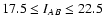
The CFRS is an I-selected survey like the VVDS. The CFRS galaxy
sample consists of 730 I-band selected galaxies at
 ,
of which 591 (i.e., more than 80 percent) have reliable
redshifts in the range
0 < z < 1.3 (Le Fèvre et al. 1995).
Lilly et al. (1996) estimated the comoving luminosity
densities of the Universe from the CFRS sample in the rest-frame
NUV-2800, B-4400, and NIR-10 000 passbands over the redshift range
0 < z < 1 with the cosmology (
,
,
h)=(1, 0, 0.5). Here, we compare with the
B-band results which require very little extrapolation from models,
contrary to the NUV or NIR data. From the best estimate of the
B-4400 band LF (see Lilly et al. 1995), the rest-frame
B-band emissivities directly-observed (correspond to our minimal
estimates) and estimated were derived. The CFRS estimated
,
of which 591 (i.e., more than 80 percent) have reliable
redshifts in the range
0 < z < 1.3 (Le Fèvre et al. 1995).
Lilly et al. (1996) estimated the comoving luminosity
densities of the Universe from the CFRS sample in the rest-frame
NUV-2800, B-4400, and NIR-10 000 passbands over the redshift range
0 < z < 1 with the cosmology (
,
,
h)=(1, 0, 0.5). Here, we compare with the
B-band results which require very little extrapolation from models,
contrary to the NUV or NIR data. From the best estimate of the
B-4400 band LF (see Lilly et al. 1995), the rest-frame
B-band emissivities directly-observed (correspond to our minimal
estimates) and estimated were derived. The CFRS estimated
 was derived fitting with a Schechter
function the data given by the
was derived fitting with a Schechter
function the data given by the
 LF estimator. The VVDS
estimated
is derived from the integration
of the LF estimate with ,
M*, and
as determined
with the STY method. The two fits give similar results as long as
each type of galaxies is visible within the redshift range studied (see Ilbert et al. 2004).
LF estimator. The VVDS
estimated
is derived from the integration
of the LF estimate with ,
M*, and
as determined
with the STY method. The two fits give similar results as long as
each type of galaxies is visible within the redshift range studied (see Ilbert et al. 2004).
The upper panel of Fig. 6 compares the CFRS
to the VVDS
with a magnitude cut at
IAB = 22.5 over the same redshift range,
 ,
and with the same cosmology adopted in the CFRS
analysis. The CFRS and the VVDS-[17.5-22.5]
are very well consistent with each other
(see Table 2). Even though the CFRS contains 4.5 times fewer galaxies than the VVDS at the same depth, the CFRS error
bars are smaller than the VVDS error bars. This is due to different
procedures used to estimate the uncertainties in the two surveys. The
CFRS "ad-hoc'' uncertainty procedure is described in
Lilly et al. (1996), and ours are derived from the
error contour of 68 percent confidence level of our
STY estimate. In both surveys, the minimal and the estimated B-band
emissivities become more discrepant as the redshift increases. This is
due to the combination of brighter limiting luminosities sampled at
higher redshifts, and to a lesser extent, a steeper faint-end slope of
the rest-frame B-band LF. The CFRS
0.2 < z <1.0 values are thus
found to be very reliable up to
IAB =22.5.
,
and with the same cosmology adopted in the CFRS
analysis. The CFRS and the VVDS-[17.5-22.5]
are very well consistent with each other
(see Table 2). Even though the CFRS contains 4.5 times fewer galaxies than the VVDS at the same depth, the CFRS error
bars are smaller than the VVDS error bars. This is due to different
procedures used to estimate the uncertainties in the two surveys. The
CFRS "ad-hoc'' uncertainty procedure is described in
Lilly et al. (1996), and ours are derived from the
error contour of 68 percent confidence level of our
STY estimate. In both surveys, the minimal and the estimated B-band
emissivities become more discrepant as the redshift increases. This is
due to the combination of brighter limiting luminosities sampled at
higher redshifts, and to a lesser extent, a steeper faint-end slope of
the rest-frame B-band LF. The CFRS
0.2 < z <1.0 values are thus
found to be very reliable up to
IAB =22.5.
![\begin{figure}
\par\includegraphics[width=7.5cm,clip]{6330f5.ps}\end{figure}](/articles/aa/full/2007/35/aa6330-06/img153.gif) |
Figure 5: Comoving non dust-corrected VVDS luminosity densities in the rest-frame FUV-1500, NUV-2800, U-3600, B-4400, V-5500, R-6500, and I-7900 passbands from bottom to top respectively, as displayed in Figs. 2-4. The solid line connects points where the rest-frame band is observed in the optical. |
| Open with DEXTER | |
The lower panel of Fig. 6 compares the VVDS
cut at
IAB= 22.5 with the global VVDS
at
IAB= 24.0 over the same redshift range,
,
and with the same cosmology as the CFRS. In the redshift range,
0.2<z<1.0,
from the global VVDS is
consistent within the error bars with the one from the
VVDS-[17.5-22.5] (see Table 2). Our VVDS local value at
z=0.138 is derived by fixing M* to the SDSS value,
(
 ) mag at z=0.1 (see Table 2 in Blanton et al. 2003, with
0.1g-band
) mag at z=0.1 (see Table 2 in Blanton et al. 2003, with
0.1g-band  -band at less than a 0.05 mag difference
level), since we do not span the brightest luminosities at
z<0.2. In this redshift range, we observe fainter luminosities than
the SDSS, and we find a steeper faint-end slope than the SDSS (see discussion in Sect. 5.1 in Ilbert et al. 2005).
-band at less than a 0.05 mag difference
level), since we do not span the brightest luminosities at
z<0.2. In this redshift range, we observe fainter luminosities than
the SDSS, and we find a steeper faint-end slope than the SDSS (see discussion in Sect. 5.1 in Ilbert et al. 2005).
![\begin{figure}
\par\includegraphics[width=12.5cm,clip]{6330f6.ps}\end{figure}](/articles/aa/full/2007/35/aa6330-06/img156.gif) |
Figure 6:
Rest-frame B-band comoving non dust-corrected luminosity
densities with the (
,
,
h)=(1, 0,
0.5) cosmology at 0<z<1 of the I-selected CFRS and VVDS surveys.
Values are listed in Table 2. For clarity the z>0.2 data
are represented by symbols slightly displaced horizontally from the
center of the redshift bins delimited with the vertical dotted
lines. The plain square points at
z=0.05, 0.07, and 0.1 are local
points from the SAPM (Loveday et al. 1992), the 2dFGRS
(Norberg et al. 2002), and SDSS (Blanton et al. 2003) respectively.
The dashed line shows the best-fit power law and its associated
uncertainties for the "LF-estimated''
of
the CFRS 17.5-22.5 data derived in Lilly et al. (1996),
 ,
and the solid line is the one for the VVDS
17.5-24.0 data, ,
and the solid line is the one for the VVDS
17.5-24.0 data,
 . . |
| Open with DEXTER | |
The best fit power law for the estimated
of the VVDS data gives
to be compared with the
one of the CFRS,
(see Lilly et al. 1996) in cosmology (
,
,
h) = (1, 0, 0.5). The steeper slope of the CFRS
data is due to the combination of the adopted low local reference at
z=0 and the high normalization of the CFRS LF at z=0.85 due to a
poor constraint of
and M* with a sample limited at
IAB=22.5.
The CFRS
 evolution was found as
 (see Lilly et al. 1996). With the same
cosmology (
,
,
h) = (1, 0, 0.5)
and IAB<24 the VVDS
evolves as
(see Lilly et al. 1996). With the same
cosmology (
,
,
h) = (1, 0, 0.5)
and IAB<24 the VVDS
evolves as
 .
The rest-frame NUV-2800 is observed in the
optical in the VVDS at z>0.2, while in the CFRS it is observed at
z>0.5. It adds uncertainties due to the extrapolation of templates.
Thus the NUV CFRS evolution was found too steep as it was already
seen by Wilson et al. (2002).
.
The rest-frame NUV-2800 is observed in the
optical in the VVDS at z>0.2, while in the CFRS it is observed at
z>0.5. It adds uncertainties due to the extrapolation of templates.
Thus the NUV CFRS evolution was found too steep as it was already
seen by Wilson et al. (2002).
In conclusion we find that the B-band luminosity density estimated from the VVDS is in excellent agreement with that estimated from the CFRS at 0.2<z<0.75 (see Table 2). We demonstrate that going deeper in magnitude is superior to assembling larger samples as far as the galaxy sample is not dependent on cosmic variance and has a well-defined selection function. Futhermore, comparing the estimates of the VVDS at 22.5 mag to the ones of the VVDS at 24 mag shows that the error bars determined in the VVDS are well-defined. Indeed the estimate at 24 mag is within the error bars of the one at 22.5 mag since we account for the uncertainty on the LF slope. Finally, we confirm that the uncertainties due to template extrapolation led to the very steep slope of the NUV CFRS luminosity density evolution.
In Fig. 2 we added the B-band luminosity densities from
DEEP2 and COMBO-17 surveys (values taken in Table 2
in Faber et al. 2005), from the FORS Deep Fields (FDF) survey where Schechter
parameters are taken from Table A.5 in Gabasch et al. (2004), and from the
HDF survey where Schechter parameters are taken from Table 2 in
Poli et al. (2003). These surveys at 0.2<z<1 are in excellent agreement
with the VVDS, except for the Poli et al. (2003) at 0.4<z<0.7 which has
a steeper faint-end slope (
 )
than the VVDS,
and thus presents a B-band
higher by 0.1 dex than the
other surveys in this redshift range. At 1<z<1.2 the VVDS is higher
by 0.1 dex than DEEP2 because the faint-end slope of the B-band LF
is better constrained in the VVDS, a deeper sample by 1 mag than
DEEP2. We note that both the I-selected VVDS and the deeper by 2.8 mag I-selected FDF exhibit a drop of the B-band luminosity density at
)
than the VVDS,
and thus presents a B-band
higher by 0.1 dex than the
other surveys in this redshift range. At 1<z<1.2 the VVDS is higher
by 0.1 dex than DEEP2 because the faint-end slope of the B-band LF
is better constrained in the VVDS, a deeper sample by 1 mag than
DEEP2. We note that both the I-selected VVDS and the deeper by 2.8 mag I-selected FDF exhibit a drop of the B-band luminosity density at  .
.
Table 2:
Comparison of comoving luminosity densities betweenI-selected surveys, the CFRS and VVDS, with the cosmology (
,
,
h) = (1, 0, 0.5).
Our 1500 Å
results are slightly higher than the ones from
the FDF by 0.1 dex at 0.6<z<2. It is likely due to their lower fixed
(
 )
value than our fixed (
)
value than our fixed (
 )
value. However,
the difference is usually within the error bars. Our 2800 Å
results are in good agreement with the ones from the FDF at
0.4<z<1.2, and in excellent agreement with the ones from the SDSS
(Baldry et al. 2005) at z<0.3.
)
value. However,
the difference is usually within the error bars. Our 2800 Å
results are in good agreement with the ones from the FDF at
0.4<z<1.2, and in excellent agreement with the ones from the SDSS
(Baldry et al. 2005) at z<0.3.
The large VVDS sample enables us to study the luminosity density evolution for different galaxy types. To associate a spectral type to our galaxies with a known spectroscopic redshift, we used the best fitting type between UBVRI photometric data and a set of SEDs that were lineary interpolated between the four observed spectra of Coleman et al. (1980), i.e. E/S0, Sbc, Scd, and Irr, and two starburst models from the GISSEL library (Bruzual & Charlot 1993). Then we divided the galaxy population into four rest-frame color classes, the elliptical-like (type-1), the early spiral-like (type-2), the late spiral-like (type-3), and the irregular-like ( type-4) types. We describe in detail in Zucca et al. (2006) the fitting process and the robustness of the classification.
We note that several previous deep surveys were limited to the study of two population sub-samples. For instance in the CFRS, Lilly et al. (1995) studied blue and red populations, simply dividing the galaxy population into two equal number sub-samples and corresponding to a Sbc color separation. This allowed us to identify little evolution of the red population while the blue population evolves strongly. In more recent deep surveys, the bimodal rest-frame color distribution observed at least up to z=1.5 is being used to define an empirical separation between red and blue galaxies (K20; Fontana et al. 2004, DEEP2 and COMBO-17; Faber et al. 2005, VVDS; Franzetti et al. 2007). While the bimodality is clearly observed for the bright galaxies, the faint population does not exhibit two contrasting modes (see Franzetti et al. 2007). Also, the bimodality hides a strong differential, color evolution of the bright population (i.e. L>L*) as shown in Fig. 2 of Zucca et al. (2006). Or, the extensive analysis of De Lapparent (2003) shows that estimations of LFs based on two color sub-samples lacks the necessary discriminatory power for detecting the variations in luminosity as a function of type which are traced by the intrinsic LFs. From a theoretical study using semi-analytical models, Kaviraj et al. (2006) show that the red-sequence traces the progenitor set of early-type galaxies in terms of numbers and masses for the bright galaxies, but breaks down severely at faint (L<L*) luminosities. And thus, using the bimodality does not seem to be robust in classifying galaxies in types unambiguously related to passively evolving galaxies on one side and star-forming galaxies on the other. Whereas, in fact, our selection relies on the complete SED available from the multi-band imaging. We note that Seyfert 2 galaxies are included in our sample. We analyse these galaxies with the true starburst population in another paper. Nevertheless we do not expect a large contribution of the Seyfert 2 population at z<1.
We emphasize that our four types are nicely correlated with colors and
asymmetry-concentration parameters from HST images (see Fig. 2
in Ilbert et al. 2006a) and with spectroscopic features (e.g, emission
line strength, 4000 Å break, see Fig. 1 in Zucca et al. 2006). The four
individual LFs were derived between 0.2<z<1.5 where our sample is
essentially complete for every type, and Fig. 7 displays the
four luminosity densities in the rest-frame B-band where there is
very little extrapolation.
![\begin{figure}
\par\includegraphics[width=7.5cm,clip]{6330f7.ps}\end{figure}](/articles/aa/full/2007/35/aa6330-06/img186.gif) |
Figure 7:
Comoving non dust-corrected luminosity densities in the
rest-frame B-passband from early to late galaxy types (see details
in Sect. 6.1). For clarity, data are represented by symbols
slightly displaced horizontally from the center of the redshift
bins. Error bars are at 1.
The irregular-like type
emissivity decreases markedly by a factor 4, while the
elliptical-like type increases by a factor 1.7 from z=1.1 to
z=0.2. We note that at z<0.4 the total emissivity is dominated
by the early-type population. |
| Open with DEXTER | |
per type
The evolution of the B-band LF per type and the evolution of the
fraction of bright (
 )
galaxies has been
described in detail in Zucca et al. (2006), and consequently, the
B-band luminosity densities evolve as follows.
)
galaxies has been
described in detail in Zucca et al. (2006), and consequently, the
B-band luminosity densities evolve as follows.
Type-4: irregular, starburst, very blue galaxies. The fraction
of bright galaxies decreases from  to
to  percent from
z=1.5 to z=0.2. The LF undergoes a strong evolution in density
(negative) and luminosity (negative). There is a strong decrease in
volume density by a factor
percent from
z=1.5 to z=0.2. The LF undergoes a strong evolution in density
(negative) and luminosity (negative). There is a strong decrease in
volume density by a factor  coming from both the bright and
faint parts of the LF. And thus
decreases markedly from
z=1.5 to z=0.2, by a factor
coming from both the bright and
faint parts of the LF. And thus
decreases markedly from
z=1.5 to z=0.2, by a factor  .
.
The three other types have an LF which corresponds to a mild evolution in density (positive) and luminosity (negative).
Type-3: late-spirals, star forming, blue galaxies. The fraction
of bright galaxies decreases from  to
to  percent from
z=1.5 to z=0.2, and meanwhile the
decreases by a factor
percent from
z=1.5 to z=0.2, and meanwhile the
decreases by a factor
 .
To keep decreasing
this population is
strongly faintening by
.
To keep decreasing
this population is
strongly faintening by  mag.
decreases markedly at
z<0.4 by a factor
due to the faintening by
mag.
decreases markedly at
z<0.4 by a factor
due to the faintening by  mag of
the LF.
mag of
the LF.
The last two types present an increasing fraction of bright galaxies.
Type-2: early-spirals, post-starburst, red galaxies. The
fraction of bright galaxies increases from  to percent from z=1.5 to z=0.2, and globally
increases by a
factor
to percent from z=1.5 to z=0.2, and globally
increases by a
factor  .
To keep increasing
luminous red
galaxies must appear at low redshifts since this population is
modestly faintening by
.
To keep increasing
luminous red
galaxies must appear at low redshifts since this population is
modestly faintening by  mag. Nevertheless there is a
significant variation at low z. Indeed,
increases from
z=1.5 to z=0.6, by a factor
mag. Nevertheless there is a
significant variation at low z. Indeed,
increases from
z=1.5 to z=0.6, by a factor  ,
then decreases from z=0.6to z=0.4, by a factor
,
then decreases from z=0.6to z=0.4, by a factor  ,
and finally increases from z=0.4to z=0.2, by a factor .
This transition implies that a
small fraction of luminous type-2 galaxies disappears (13
percent) while the luminosity decreases by a small factor of
0.15 mag.
,
and finally increases from z=0.4to z=0.2, by a factor .
This transition implies that a
small fraction of luminous type-2 galaxies disappears (13
percent) while the luminosity decreases by a small factor of
0.15 mag.
Type-1: elliptical, red galaxies. The fraction of bright
galaxies increases from
 to
to  percent from z=1.5 to
z=0.2, and meanwhile
increases continuously, by a factor
.
That is luminous red galaxies must appear at low redshifts
to keep increasing
since this population is
faintening by 0.3 mag only.
percent from z=1.5 to
z=0.2, and meanwhile
increases continuously, by a factor
.
That is luminous red galaxies must appear at low redshifts
to keep increasing
since this population is
faintening by 0.3 mag only.
In addition, Fig. 7 shows that the type-1 and type-2 red populations dominate the total light at z<0.4, while
at 0.4<z<1.2 the late-type does. Since we know that red spheroids
are the majority of our type-1 population from our work in
Ilbert et al. (2006a), we conclude that a dust deficient population is
dominant at z<0.4. The luminosity density increasing of the type-1 and type-2 red populations suggests a contribution
from merging phenomena. Indeed in a downsizing scenario where luminous
red galaxies are already in place at high redshifts ( ), and low
luminosity red galaxies appear at low redshifts, a flat luminosity
density would be expected as a function of redshift, whilst adding
merging would increase the luminosity density of the luminous red
population as redshift decreases.
), and low
luminosity red galaxies appear at low redshifts, a flat luminosity
density would be expected as a function of redshift, whilst adding
merging would increase the luminosity density of the luminous red
population as redshift decreases.
Table 3: STY parameters for the rest-frame FUV-1500 LFs of the extended 2.7<z<5 data set.
We note also that from z=0.7 to z=0.5,
for type-2
decreases by a factor ,
while
for type-1
increases by a factor
 ;
this might suggest that <15 percent of ellipticals are formed from early-spiral major mergers
within this 1.3 Gyr period. It might be evidence for mergers between
gas-deficient bright galaxies. Futhermore, the fact that the type-2 population luminosity density increases again from z=0.5to z=0.3 by a factor 1.7 might suggest a density growth due of
an evolution of type-4 galaxies towards type-2 galaxies.
;
this might suggest that <15 percent of ellipticals are formed from early-spiral major mergers
within this 1.3 Gyr period. It might be evidence for mergers between
gas-deficient bright galaxies. Futhermore, the fact that the type-2 population luminosity density increases again from z=0.5to z=0.3 by a factor 1.7 might suggest a density growth due of
an evolution of type-4 galaxies towards type-2 galaxies.
The
decreasing of the type-4 population is markedly
different from that of the remaining population. This population is
dominated by dwarf galaxies (see Zucca et al. 2006). The evolution of
this population supports a downsizing scenario where most star
formation is shifting to low-mass galaxies at z<1.2, while the
global luminosity density is dominated by other galaxy types.
Table 4: Comoving FUV-1500 luminosity densities at 2.7<z<5 of the VVDS for the extended high-z dataset.
In the high-redshift range, 2.7<z<5.0, the rest-frame 1500 Å corresponds to the observed frames R and I passbands. Thus
uncertainties on absolute magnitudes related to k-corrections and
galaxy types are small. Our data set consists of 161 redshifts with
VVDS quality flags 2, 3, and 4, and 237 redshifts with VVDS
quality flags 1 in the VVDS-0226-04 field (0.5 deg2). The
latter fraction is not negligible since the difficulty in determining a
redshift is increased at the faintest apparent magnitudes. The
confidence levels for the single high-z population are >50 percent
for the flags 2, 3, and 4 dataset, and  percent for the flags 1, 2, 3, and 4 dataset (Le Fèvre et al. 2005b).
Here, we correct our sample for the target sampling rate only (see
Sect. 2). That is, there is no assumption for the redshift
distribution of the sources that were not spectroscopically observed
or for which no redshift could be reliably identified from the
spectrum obtained. This is a more restricted approach than what was
adopted in Ilbert et al. (2005), where the photometric redshifts were used
to obtain a spectroscopic success rate as a function of redshift, and
thus to correct further for incompleteness. We could not use the
same approach here because our photometric redshifts have been thoroughly
tested only up to  (Ilbert et al. 2006c). The correction for
incompleteness has for effect to steepen the slope of the unweighted
LF, and since
is correlated with M*, it produces a
brightening (see Fig. 4 in Ilbert et al. 2005).
(Ilbert et al. 2006c). The correction for
incompleteness has for effect to steepen the slope of the unweighted
LF, and since
is correlated with M*, it produces a
brightening (see Fig. 4 in Ilbert et al. 2005).
We consider the two following high-z datasets. The standard dataset is composed of quality flags 2, 3, and 4 redshifts and the extended dataset is composed of quality flags 1, 2, 3, and 4 redshifts. It is likely that the true luminosity function/density lies between these two cases, assuming that the 7 percent of flags 0 over the whole 0<z<5 sample makes little difference. Using one field of view is likely to induce uncertainty due to cosmic variance. Nevertheless Sawicki & Thompson (2006a) observed an effective area of 169 arcmin2, i.e. one third of ours, 410 arcmin2, split into five fields (the Keck Deep Fields; KDF) and found a quite moderate cosmic-variance effect.
In Paltani et al. (2007) we do a comprehensive study about the impact of the large uncertain redshift population at 3<z<4, in using a somewhat different analysis. Here we choose to use the same analysis as at z<2. We note that results are qualitatively similar.
For the rest-frame FUV analysis, we fixed
to -1.6. As
shown in Fig. 1 the uncertainty in a slope
may
lead to large discrepancies in the estimation of .
For
consistency, we have derived error bars of the rest-frame FUV
from the STY estimations assuming
 and
and
 for the extended high-z data set as we did at
z<2. The LF parameters are given in Table 3.
Figure 8 displays the LF estimations of the standard and
extended high-z datasets, and the incompleteness-corrected LF
estimated at 3<z<4 in Paltani et al. (2007). We do a detailed
comparison for different fixed
values found in the literature
in Paltani et al. (2007). The rest-frame FUV
at 2.7<z<5 are
displayed in Fig. 9 together with those at z<2, and they
are listed in Table 4.
for the extended high-z data set as we did at
z<2. The LF parameters are given in Table 3.
Figure 8 displays the LF estimations of the standard and
extended high-z datasets, and the incompleteness-corrected LF
estimated at 3<z<4 in Paltani et al. (2007). We do a detailed
comparison for different fixed
values found in the literature
in Paltani et al. (2007). The rest-frame FUV
at 2.7<z<5 are
displayed in Fig. 9 together with those at z<2, and they
are listed in Table 4.
![\begin{figure}
\par\includegraphics[width=13cm,clip]{6330f8.ps} \end{figure}](/articles/aa/full/2007/35/aa6330-06/img216.gif) |
Figure 8:
Unweighted non dust-corrected luminosity functions in the
rest-frame FUV-1500 passband estimated with
fixed to
-1.60. The circles and the solid line represent the
and the STY estimates for the extended dataset where the
number of galaxies is given within parenthesis next to the redshift range. The vertical dot-dashed line corresponds to the faint absolute magnitude limits considered in the STY estimate (see Sect. 3.2). The hashed area is limited by the LFs derived with
fixed to -1.20 and -1.75. The dotted lines represent the STY estimates with
fixed to -1.60 for the
standard dataset. The standard dataset LF is below the extended dataset LF since it does not include quality flags 1 (see Sect. 7.1). In the top-left panel, the long-dashed line is the incompleteness-corrected dataset FUV-1500 LF at 3<z<4 derived as in Paltani et al. (2007), with fixed
 . . |
| Open with DEXTER | |
![\begin{figure}
\par\includegraphics[width=7.5cm,clip]{6330f9.ps}\end{figure}](/articles/aa/full/2007/35/aa6330-06/img217.gif) |
Figure 9: Comoving non dust-corrected FUV luminosity densities from z=0 to z=5. The plain circles represent the 1500 Å VVDS data (0.05<z<5) (see values and error bars in Tables 1 & 4), the plain triangle represents the 1500 Å VVDS data at 3<z<4 derived as in Paltani et al. (2007), and the plain squares represent the 1500 Å GALEX-VVDS data at z<1, plotted at +0.02 in redshift for clarity, from Schiminovich et al. (2005). Other data are the 1500 Å GALEX-2dFGRS from Wyder et al. (2005) (asterisk), the 1500 Å HDF data from Arnouts et al. (2005) (crossed circles), the 1700 Å KDF data from Sawicki & Thompson (2006b) (open rhombus), the 1500 Å FDF data from Gabasch et al. (2004) (open stars), and the 1700 Å data from Iwata et al. (2007) (crossed square). |
| Open with DEXTER | |
Figure 9 displays other rest-frame FUV luminosity densities
from the literature. At 2<z<5, our I-selected rest-frame FUV
are broadly in agreement with the other estimations. At
 ,
rest-frame FUV
estimations are found within
0.1 dex (19.47 for the VVDS; 19.58 for Steidel et al. 1999; 19.43 for
Gabasch et al. 2004; 19.52 Arnouts et al. 2005, and 19.51 for
Sawicki & Thompson 2006b). We note that the luminosity functions exhibit
noticeable discrepancies, in particular at the bright end, and
furthermore that the faint end slope is not constrained (see detailed comparisons in Paltani et al. 2007). As at z<2, our high-zluminosity densities are slightly higher than those estimated from the
FDF (due to their lower adopted slope of
)
except at
3.9<z<5. The decrease from z=3.4 to z=5 is smaller in the FDF
(0.25 dex) than in the VVDS (0.5 dex), however our error bars are
compatible with the FDF result. This may suggest that our unsuccessful
spectroscopic identification rate has a strong effect in our highest
VVDS redshift bin, while our data points at 2.7<z<3.9 appear fully
consistent with the FDF.
,
rest-frame FUV
estimations are found within
0.1 dex (19.47 for the VVDS; 19.58 for Steidel et al. 1999; 19.43 for
Gabasch et al. 2004; 19.52 Arnouts et al. 2005, and 19.51 for
Sawicki & Thompson 2006b). We note that the luminosity functions exhibit
noticeable discrepancies, in particular at the bright end, and
furthermore that the faint end slope is not constrained (see detailed comparisons in Paltani et al. 2007). As at z<2, our high-zluminosity densities are slightly higher than those estimated from the
FDF (due to their lower adopted slope of
)
except at
3.9<z<5. The decrease from z=3.4 to z=5 is smaller in the FDF
(0.25 dex) than in the VVDS (0.5 dex), however our error bars are
compatible with the FDF result. This may suggest that our unsuccessful
spectroscopic identification rate has a strong effect in our highest
VVDS redshift bin, while our data points at 2.7<z<3.9 appear fully
consistent with the FDF.
Figure 9 displays the rest-frame FUV luminosity densities
within the redshift range 0<z<5. We find that the global luminosity
density increases by a factor
from z=0.05 to z=1.2, by a
factor  from z=1.2 to z=3.4, and decreases by a factor
 from z=3.4 to z=5. Futhermore the evolution at
1.1<z<3.0 might be more complex than a modest increase. Indeed, even
though our large error bars cannot exclude an increase or a plateau,
our data points taken at face value exhibit a decrease by a factor
from z=1 to z=2, and an increase by a factor from z=2.0 to z=3.4. One could mention dust attenuation effects
since at these redshifts, targets are selected from their rest-frame
UV, and thus a fixed I-band flux cut could miss a non-negligible
fraction of highly dust enshrouded targets. However, UV luminosity
densities at
are larger than at 1<z<2 while they should be
even more dust affected since selected at shorter ultraviolet
wavelengths.
from z=3.4 to z=5. Futhermore the evolution at
1.1<z<3.0 might be more complex than a modest increase. Indeed, even
though our large error bars cannot exclude an increase or a plateau,
our data points taken at face value exhibit a decrease by a factor
from z=1 to z=2, and an increase by a factor from z=2.0 to z=3.4. One could mention dust attenuation effects
since at these redshifts, targets are selected from their rest-frame
UV, and thus a fixed I-band flux cut could miss a non-negligible
fraction of highly dust enshrouded targets. However, UV luminosity
densities at
are larger than at 1<z<2 while they should be
even more dust affected since selected at shorter ultraviolet
wavelengths.
The 1500 Å luminosity density as a function of redshift from the
FDF (Gabasch et al. 2004) presents a similar shape to that derived from
the VVDS. We stress that both datasets, the FDF and the VVDS, span
the redshift range 0.5<z<5 within one single survey and have the
same unique I-band selection criterion. We note that the FDF used
photometric redshift techniques with NIR photometry, which gives
reliable redshifts at 1<z<2. The VVDS and the FDF are
complementary; the VVDS is  times larger in surface than the
FDF and it consists of spectroscopic redshifts, while the FDF goes 2.8
mag deeper than the VVDS using photometric redshfits. Both estimates
are in agreement, in particular at 1<z<2.
times larger in surface than the
FDF and it consists of spectroscopic redshifts, while the FDF goes 2.8
mag deeper than the VVDS using photometric redshfits. Both estimates
are in agreement, in particular at 1<z<2.
We note that the empirical models from Pérez-Gonzàlez et al. (2005) also show a decrease in the cosmic SFR density between z=1.4 and z=2.2, varying from 10 to 29 percent depending on the model but with luminosity evolution solely. It is interesting to see that their model including a combined luminosity plus number density evolution does not exhibit a decrease. Rather than excluding a number density evolution it indicates that the global emissivity is dominated by the luminosity evolution. We go into more detail about this effect in the next section.
We emphasize that our I-selected sample misses the very red (I-K)>2.6 galaxy population at 1.2<z<2.5. This population concerns the most massive star forming dusty galaxies, as detailed in our K-selected sample described in Pozzetti et al. (2007).
The luminosity density is dominated by the evolution of the bright
population. Thus we have integrated the LF from the three following
absolute magnitude limits:
 mag,
mag,
 mag, and
mag. According
to our LFs, these magnitude cutoffs correspond about to L>L*galaxies at 0.1<z<0.6, 0.6<z<2, and 2<z<3.4 respectively. At
mag, and
mag. According
to our LFs, these magnitude cutoffs correspond about to L>L*galaxies at 0.1<z<0.6, 0.6<z<2, and 2<z<3.4 respectively. At
 ,
,
 mag (Wyder et al. 2005). We
choose a fixed cutoff rather than a luminosity evolving cutoff to make
a comparison over a long time baseline because this does not depend on
the modeling of the luminosity evolution of the LF. The change of
M* with redshift implies that at
mag (Wyder et al. 2005). We
choose a fixed cutoff rather than a luminosity evolving cutoff to make
a comparison over a long time baseline because this does not depend on
the modeling of the luminosity evolution of the LF. The change of
M* with redshift implies that at  the most luminous
galaxies were forming stars at a rate 5, and 7 times
higher than at
the most luminous
galaxies were forming stars at a rate 5, and 7 times
higher than at  0.15, and 0.05 respectively. We
have applied the same cutoffs to the LF integration of the 1500 Å HDF (Arnouts et al. 2005), the 1700 Å KDF (Sawicki & Thompson 2006b), and the
1700 Å data point of Steidel et al. (1999). Figure 10 displays
these different luminosity densities for the bright population. We
also produced the rest-frame FUV-band luminosity densities for three
range of luminosities,
0.15, and 0.05 respectively. We
have applied the same cutoffs to the LF integration of the 1500 Å HDF (Arnouts et al. 2005), the 1700 Å KDF (Sawicki & Thompson 2006b), and the
1700 Å data point of Steidel et al. (1999). Figure 10 displays
these different luminosity densities for the bright population. We
also produced the rest-frame FUV-band luminosity densities for three
range of luminosities,
 mag (dwarf and
intermediate population, <
mag (dwarf and
intermediate population, <
 ),
),
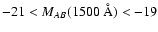 (luminous population), and
(very luminous population,
(luminous population), and
(very luminous population,
 ), as shown in Fig. 11.
We observe that on average the rest-frame FUV-band luminosity density
of the (2.7<z<5) population is significantly brighter by a factor at
least 6 than the (0.2<z<1.4) population. This implies a
transition phase for the population dominating the FUV emissivity.
Another transition phase is observed at z<0.2 with a steep decline
by a factor of at least 10 of the bright population luminosity
density. Concentrating on the most luminous galaxies, and taking the
values of
at their face value, we can tentatively identify
five phases from z=5 to z=0 as follows.
(a) From z=5 to 3.4, the emissivity due to galaxies brighter
than
and -21 mag increases by a factor of 3 and
2.5 respectively. The whole population, from the dwarf to the very
luminous galaxies, sees its FUV luminosity increasing. This
corresponds to a very active phase in terms of newly formed stars in
every galaxy.
(b) From z=3.4 to 1.4, the emissivity due to galaxies
brighter than
and -21 mag steadily decreases by a
factor 6 and 25 respectively. This 3 Gyr phase corresponds to
the progressive, but relatively quick, drop of star formation in the
most luminous galaxies which are formed earlier than z=3.4, and
whose contribution to the global FUV luminosity density becomes less
important toward lower redshifts. Lotz et al. (2006) observe that the
distribution of the HST rest-frame FUV morphologies at
are
similar to the ones at
with an identical fraction of
major-merger candidates. This suggests that this drop is due to the
same luminous galaxy population, and that it is not caused by a
decrease in the number of mergers. Thus from z=3.4, the most FUV
luminous galaxy population has suddently finished its stellar mass
assembly and active star forming phase, while the less FUV luminous
population is still very active and becomes the dominant star forming
galaxy population until nowdays.
![\begin{figure}
\par\includegraphics[width=13cm,clip]{6330f10.ps}\end{figure}](/articles/aa/full/2007/35/aa6330-06/img232.gif) |
Figure 10:
Comoving rest-frame FUV non dust-corrected luminosity densities from z=0 to z=5 for three bright populations defined as
 ,
and -21 mag. Symbols are the same
as in Fig. 9. Error bars correspond to the fixed slopes, ,
and -21 mag. Symbols are the same
as in Fig. 9. Error bars correspond to the fixed slopes,
 and -1.75 at 0.2<z<5, at
0.05<z<0.2 to the fixed
and -1.75 at 0.2<z<5, at
0.05<z<0.2 to the fixed
 ;
those which are not visible are smaller than the size of the data point, i.e. <0.1 dex. We do not plot the local values
for M<-21 which have low values, at z=0.14 and 0.055 Log ;
those which are not visible are smaller than the size of the data point, i.e. <0.1 dex. We do not plot the local values
for M<-21 which have low values, at z=0.14 and 0.055 Log
 and 12.10 Watt Hz-1 Mpc-3, respectively. In each panel, the solid line connects the VVDS points
of the global FUV luminosity density as displayed in Fig. 9, and the vertical lines delimit the approximative redshift range in which the bright population is more luminous than
the characteristic FUV luminosity of the whole population.
and 12.10 Watt Hz-1 Mpc-3, respectively. In each panel, the solid line connects the VVDS points
of the global FUV luminosity density as displayed in Fig. 9, and the vertical lines delimit the approximative redshift range in which the bright population is more luminous than
the characteristic FUV luminosity of the whole population. |
| Open with DEXTER | |
(c) From z=1.4 to 0.6, the emissivity due to galaxies
brighter than
and -21 mag increases by a factor
2 and 4 respectively. This corresponds to Fig. 2 in
Zucca et al. (2006), where the fraction of the bright population (i.e.
L>L*) of early-type (E- and Sab-like) galaxies increases while
the one for late-type (Scd-, Irr-like) galaxies decreases even though
the latter still dominate in terms of numbers and also in emissivity
(see Fig. 7) up to  .
This phase could correspond to
merger events; indeed very disrupted HST morphologies in the very
luminous galaxy population are generally observed. In the CDFS, we
observe mergers within the early-type population as shown in Fig. 2 of
Ilbert et al. (2006a) and also that the volume density of red, bright
bulge-dominated galaxies increases by a factor 2.7 from
.
This phase could correspond to
merger events; indeed very disrupted HST morphologies in the very
luminous galaxy population are generally observed. In the CDFS, we
observe mergers within the early-type population as shown in Fig. 2 of
Ilbert et al. (2006a) and also that the volume density of red, bright
bulge-dominated galaxies increases by a factor 2.7 from  to .
Furthermore from z=1.5 to z=0.6 we find in
Ilbert et al. (2006b) that rest-frame B-band
for galaxies
lying in over-dense environments (at a scale of 5h-1 Mpc)
increases by a factor 1.2, while the one for those in under-dense
environments continuously decreases by a factor of 2.3. Since the most
luminous galaxies are usually found in dense environments, our results
favor the merging event to build-up early-type galaxies. The exact
percentage of merger events is still hotly debated. We note also that
it corresponds also to the phase where the less luminous population
has reached its peak of star formation activity at .
Another point is that at 1.5<z<2.5, our I-selection is missing the
reddest galaxies (Pozzetti et al. 2007), the dusty and massive sources as
discovered in infrared surveys (i.e., e.g. Daddi 2004), and
undergoing strong star forming and dusty phase. This population would
be an excellent contributor to populate the FUV luminous population at
z<1.4 once the dusty phase linked to intense burst does not dominate
anymore.
to .
Furthermore from z=1.5 to z=0.6 we find in
Ilbert et al. (2006b) that rest-frame B-band
for galaxies
lying in over-dense environments (at a scale of 5h-1 Mpc)
increases by a factor 1.2, while the one for those in under-dense
environments continuously decreases by a factor of 2.3. Since the most
luminous galaxies are usually found in dense environments, our results
favor the merging event to build-up early-type galaxies. The exact
percentage of merger events is still hotly debated. We note also that
it corresponds also to the phase where the less luminous population
has reached its peak of star formation activity at .
Another point is that at 1.5<z<2.5, our I-selection is missing the
reddest galaxies (Pozzetti et al. 2007), the dusty and massive sources as
discovered in infrared surveys (i.e., e.g. Daddi 2004), and
undergoing strong star forming and dusty phase. This population would
be an excellent contributor to populate the FUV luminous population at
z<1.4 once the dusty phase linked to intense burst does not dominate
anymore.
(d) From z=0.6 to 0.2, the emissivity due to galaxies
brighter than
and -21 mag decreases by a factor
1.3 and 1.5 respectively. The decrease of the bright part of the
emissivity corresponds to a phase entirely dominated by the early-type
galaxies for which the star formation decreases passively.
(e) From z=0.2 to 0.05, the emissivity due to galaxies
brighter than
and -21 mag decreases by a factor
100 and 25 respectively; the bright part of the global FUV
luminosity density abruptly drops. Analysing the 0<z<0.3 CFRS
spectra, Tresse et al. (1996) found that only 54 percent of galaxies
exhibit strong star formation with H
and H both in
emission and 15 percent have H
and H
both in
absorption. The remaining 31 percent is the intermediate population
which shows spectral features from both star burst and quiescent
stellar evolution. Therefore star formation seems to have slowed down
or stopped in a significant fraction of galaxies in the nearby
Universe. This population might correspond to the descendants of
L* galaxies at 0.2<z<1.4 which when they fade in luminosity, stop
dominating the rest-frame FUV-band luminosiy densities. We note that
the local sudden drop might be combined with the local underdensity
seen in optical redshift surveys (Zucca et al. 1997; Tresse & Maddox 1998).
both in
emission and 15 percent have H
and H
both in
absorption. The remaining 31 percent is the intermediate population
which shows spectral features from both star burst and quiescent
stellar evolution. Therefore star formation seems to have slowed down
or stopped in a significant fraction of galaxies in the nearby
Universe. This population might correspond to the descendants of
L* galaxies at 0.2<z<1.4 which when they fade in luminosity, stop
dominating the rest-frame FUV-band luminosiy densities. We note that
the local sudden drop might be combined with the local underdensity
seen in optical redshift surveys (Zucca et al. 1997; Tresse & Maddox 1998).
In resume, we observe a first major crisis for producing efficiently
new stars, lasting 3 Gyr, from
to ,
which
involves the most massive and luminous galaxies
(
,
 ). While gradual
fading of the global population starts at ,
we observe a
second major crisis which started 3 Gyr ago when star formation
was progressively stoping in intermediate mass and luminosity galaxies
(
). While gradual
fading of the global population starts at ,
we observe a
second major crisis which started 3 Gyr ago when star formation
was progressively stoping in intermediate mass and luminosity galaxies
(
 ,
,
 ). The
period from z=1.4 to z=0.6 is highly intricate due to
intertwining populations that follow different evolutionary path.
Nevertheless the combined effects of decreasing both luminous and
intermediate population is to make the global luminosity density
decrease faster at z<1.2 than at 1.2<z<3.9.
). The
period from z=1.4 to z=0.6 is highly intricate due to
intertwining populations that follow different evolutionary path.
Nevertheless the combined effects of decreasing both luminous and
intermediate population is to make the global luminosity density
decrease faster at z<1.2 than at 1.2<z<3.9.
According to the Schmidt law of star-forming galaxies
(Kennicutt et al. 1998), the SFR is scaled to the cold gas density to the
1.4 power. Thus, once the gas reservoir is exhausted, star formation
ceases. The old, most luminous and massive galaxies have exhausted
their gas reservoir during their early intense star formation
 (see previous section), and since then they undergo passive
evolution as star formation ceases. This creates excellent dry
candidates, that is cold gas-depleted to prevent new star formation.
(see previous section), and since then they undergo passive
evolution as star formation ceases. This creates excellent dry
candidates, that is cold gas-depleted to prevent new star formation.
Creation of new galaxies occurs as the threshold amplitude for forming
bright galaxies decreases as described in Marinoni et al. (2005) from the
VVDS data. That is, the typical L* of the population created at a
given z will decrease with decreasing redshift. This implies that
younger, less massive and less luminous L* galaxies continue to
efficiently form stars with a large reservoir of cold gas at
0.2<z<3.9. This intermediate galaxy population presents a peak of
SFR at .
And at z<0.2 these galaxies appear to have also
exhausted their gas as suggested by the 1500 Å
drop, and
start to evolve passively. The gas-exhaustion would favor the
evolution of morphologies toward early-type galaxies.
![\begin{figure}
\par\includegraphics[width=7.5cm,clip]{6330f11.ps}\end{figure}](/articles/aa/full/2007/35/aa6330-06/img241.gif) |
Figure 11:
Comoving rest-frame FUV non dust-corrected VVDS luminosity densities from z=0 to z=5 for three luminosity-class populations defined as
(dwarf and intermediate-luminosity galaxies,
 ), - ), -
 (luminous galaxies), and
(very luminous galaxies,
). We used and connected the same VVDS dataset as displayed in Fig. 10.
(luminous galaxies), and
(very luminous galaxies,
). We used and connected the same VVDS dataset as displayed in Fig. 10. |
| Open with DEXTER | |
In resume, the global FUV luminosity density decreases faster at
z<1.2 than at z<3.9 since it combines the decrease from both
luminous and intermediate populations. During the phase 1.2<z<3.9 it
undergoes a decline of 0.06 dex, while for the phase 0.2<z<1.2 it is
0.45 dex. The small decrease corresponds to the phase where the dwarf
and intermediate galaxy population increases its SFR, while the
luminous population start to undergo its SFR decline. In
Fig. 9, the global luminosity density might decrease by
 dex from z=3.9 to ,
then increase by dex
from
to z=1.2. Nevertheless, our large error bars do not
exclude a smooth decrease by 0.06 dex from z=3.9 to z=1.2.
dex from z=3.9 to ,
then increase by dex
from
to z=1.2. Nevertheless, our large error bars do not
exclude a smooth decrease by 0.06 dex from z=3.9 to z=1.2.
At  ,
both processes, i.e. dry mergers toward decreasing
redshift and morphologies evolving toward early-type galaxies, might
contribute to an increase of the bright early-type population by a
factor
to reach
percent of the total population from
z=1.5 to z=0.2, while the early-type population undergoes a
passive luminosity evolution as shown by Zucca et al. (2006). It is in
agreement with semi-analytical studies, e.g. Kaviraj et al. (2006) find
that less than 50 percent of the stellar mass which ends up in
early-types today is actually in early-type progenitors at ,
or De Lucia et al. (2006) find that 50 percent of local elliptical accrete
half of their stellar mass out
,
both processes, i.e. dry mergers toward decreasing
redshift and morphologies evolving toward early-type galaxies, might
contribute to an increase of the bright early-type population by a
factor
to reach
percent of the total population from
z=1.5 to z=0.2, while the early-type population undergoes a
passive luminosity evolution as shown by Zucca et al. (2006). It is in
agreement with semi-analytical studies, e.g. Kaviraj et al. (2006) find
that less than 50 percent of the stellar mass which ends up in
early-types today is actually in early-type progenitors at ,
or De Lucia et al. (2006) find that 50 percent of local elliptical accrete
half of their stellar mass out  .
.
We derive the SFR densities hich are not dust corrected using the rest-frame
1500 Å luminosity densities of the VVDS from z=0 to z=5. The
SFR calibration of Madau et al. (1998) yields
 for a
Salpeter (1955)'s IMF including stars from 0.1 to 125 solar mass.
We recall that at 0<z<1, our 1500 Å rest-frame band spans
ultraviolet wavelengths shorter than 3000 Å, that is a non-observed
wavelength range with the optical bands. Nevertheless, we
checked that our results are fully consistent with the rest-frame
1500 Å GALEX-VVDS data (see details in Sect. 4.2). We present our
SFR density in Fig. 12.
for a
Salpeter (1955)'s IMF including stars from 0.1 to 125 solar mass.
We recall that at 0<z<1, our 1500 Å rest-frame band spans
ultraviolet wavelengths shorter than 3000 Å, that is a non-observed
wavelength range with the optical bands. Nevertheless, we
checked that our results are fully consistent with the rest-frame
1500 Å GALEX-VVDS data (see details in Sect. 4.2). We present our
SFR density in Fig. 12.
![\begin{figure*}
\par\includegraphics[width=13cm,clip]{6330f12.ps}\end{figure*}](/articles/aa/full/2007/35/aa6330-06/img246.gif) |
Figure 12:
Star formation rate densities as a function of redshift. Symbols ( plain large circles, plain large squares, asterisk, crossed circles, open rhombus, open stars, crossed square) and error bars are the same as in Fig. 9, and they represent the SFR densities with no reddening correction. The dotted, long-dashed line connects the reddening corrected H
data (small plain circles) from the CFRS (Tresse & Maddox 1998; Tresse et al. 2002). The dotted, short-dashed line connects the 12  m data (small plain squares) from Pérez-Gonzàlez et al. (2005). Models from Somerville et al. (2001), Croton et al. (2006) and Nagamine et al. (2006) are represented with the dashed, the dotted, and the short-long dashed lines respectively. Everything is for a Salpeter (1955) IMF. The derived m data (small plain squares) from Pérez-Gonzàlez et al. (2005). Models from Somerville et al. (2001), Croton et al. (2006) and Nagamine et al. (2006) are represented with the dashed, the dotted, and the short-long dashed lines respectively. Everything is for a Salpeter (1955) IMF. The derived
 dust obscuration between the VVDS data not dust corrected and the 12 m data at z<2 is represented in the inset.
 |
| Open with DEXTER | |
Our FUV data are not dust corrected. In the following, we compare them
to data which account for dust at z<2.0 to estimate the global
correction needed to recover the total SFR density. That is, we use
the H
nebular emission line dust-corrected data taken from Tresse et al. (2002),
and the 12 m mid-infrared continuum data from Pérez-Gonzàlez et al. (2005). These results are both described with an evolution proportional to
 ,
while the evolution of 1500 Å
in the VVDS is best described by
,
while the evolution of 1500 Å
in the VVDS is best described by
 (see Sect. 4.1). Assuming an average dust correction for the whole field galaxy population, the dust obscuration at 1500 Å is 1.8-2 mag from z=2 to z=0.4. And from z=0.4 to z=0, it becomes smaller from 2 down to 0.9-1 mag.
The apparent dust transition at z<0.5 corresponds exactly to the
change of the dominant population as seen in Fig. 7 where the
early-type galaxy B-band emissivity starts to dominate below
z=0.4. The early-type population is known to be dust deficient, and
thus the needed amount of dust obscuration is less strong as redshift
decreases. Our argument assumes that the increasing early-type
dominant population in the B-band emissivity holds in the UV-band
emissivity. From z=0.5 to z=2, the B-band emissivity is
dominated by the late-type population, which form stars from gaseous
nebulae, and thus is attenuated by a constant factor. From z=2 to
z=4, the star-forming high-mass galaxies still dominate the
emissivity, and thus we expect a constant dust attenuation of 2 mag.
We note that near-infrared surveys miss the faint blue galaxies at
z<1.2, while they include the extremely red galaxies at z>1.2 as
shown in Pozzetti et al. (2007). Still the 12 m data from
Pérez-Gonzàlez et al. (2005) exhibit a similar shape than the FUV data, which
reinforces the no evolution of the dust content as shown by
Bell et al. (2004) at z<1 and Reddy et al. (2006) at z>1. The dust
correction might change again at z>4 where the by-products of the
physical processes to actively form star in massive galaxies will
dominate through AGN and SN feedback.
We will make detailed dust obscuration estimates at 0<z<2 in future papers using the VVDS-GALEX and -SWIRE data.
In Fig. 12 we display the simulations from
Somerville et al. (2001), Croton et al. (2006), and Nagamine et al. (2006).
Comparing simulations with observational measurements might be
severely affected by the assumed IMF, and the dust obscuration. These
three simulations use the stellar population synthesis models of
Bruzual & Charlot (1993). Nagamine et al. (2006) uses the IMF of
Chabrier (2003), while the others use the one of
Salpeter (1955). The SFR calibration of Nagamine et al. (2006) yields a
conversion factor of
 for a Chabrier (2003)
IMF including stars from 0.01 to 100 solar mass. It differs by 0.2 in log from a Salpeter (1955) IMF, and thus, for consistency, we add this factor to the simulations of
Nagamine et al. (2006). The dust prescription differs in a complex manner in each simulation. We do not attempt to homogenize the simulations in terms of dust obscuration.
for a Chabrier (2003)
IMF including stars from 0.01 to 100 solar mass. It differs by 0.2 in log from a Salpeter (1955) IMF, and thus, for consistency, we add this factor to the simulations of
Nagamine et al. (2006). The dust prescription differs in a complex manner in each simulation. We do not attempt to homogenize the simulations in terms of dust obscuration.
The simulations all exhibit a peak of the SFR density at
with
a smooth decrease up to z=0. At a quick glance, they do not seem to
go through the observational points, either dust corrected or not.
However, at 2<z<3.9, the simulations are close to our FUV data taken
at face value if we assume a constant dust attenuation of 2 mag
as discussed in the previous paragraph. And, at 0<z<0.2, the
simulations are in good agreement with the dust corrected data
(H
and 12 m), or with FUV dust-corrected data by 1 mag.
We note that Nagamine et al. (2006) used the dust extinction factors
of Steidel et al. (1999), i.e. 1 mag for z<2 and 1.7 mag for z>2.
Still, at 0.2<z<2, the simulations do not reproduce the
observational data. At z<0.2 and z>2, the global FUV emissivity
is dominated by luminous, massive, large galaxies, while at 0.2<z<2it is dominated by the intermediate population.
We studied the first epoch VVDS data purely I-selected at [17.5-24] mag in (AB). The sample is unique in the sense that it goes deeper than previous I-selected spectroscopic samples, it has a well-defined selection function and it has enough data to study sub-samples. Within a single survey, we trace the evolution of the galaxy population dominating the total light at different redshifts all the way from z=5 to z=0. The main results of our comprehensive study are summarised below.
evolve with time over
,
as
with
x=2.05,
1.94, 1.92, 1.14, 0.73, 0.42, and 0.30 in the FUV-1500, NUV-2800,
U-3600, B-4400, V-5500, R-6500, and I-7900 passbands, respectively.
Although error bars are still large, we note that most luminosity
densities exhibit a transition at
 in the evolutionnary
tendency. Over the last 8.5 Gyrs, the SFR-related FUV-band
luminosity density drops by a factor 4. Recent merger events should
produce little star formation.
in the evolutionnary
tendency. Over the last 8.5 Gyrs, the SFR-related FUV-band
luminosity density drops by a factor 4. Recent merger events should
produce little star formation.
 )
for the majority of this red population.
,
and it corresponds to the end of the mass
assembly of the most luminous galaxies,
(
)
for the majority of this red population.
,
and it corresponds to the end of the mass
assembly of the most luminous galaxies,
(
 ), which present a peak of SFR at
 .
From z=3.4 to z=1.2 it decreases by a factor 1.2.
Notwithstanding the large error bars this small decrease might be
the result of two opposite processes; a decrease by a factor
from z=3.4 to z=2 due to the fading of the giant
galaxy population by a factor 40, and an increase by a factor
from z=1.2 to z=1.0 due to the shift of the star
formation activity towards the less luminous
(
)
galaxy population which presents a peak
of SFR at .
From z=1.2 to z=0.05 it declines steadily
by a factor 4, since this phase undergoes the fading of both the
giant and the intermediate galaxy populations. Nevertheless it hides
a strong SFR drop by a factor 100 at z<0.2 of the intermediate
galaxy population. This phenomena might be combined to the local
underdensity seen in optical redshift surveys (see Zucca et al. 1997;
Tresse & Maddox 1998), and thus the local Universe might not be an
excellent reference local point to trace back the evolution of the
global galaxy population. Our observed global evolution does not
seem to be in agreement with a continous smooth decrease from
to
.
From z=3.4 to z=1.2 it decreases by a factor 1.2.
Notwithstanding the large error bars this small decrease might be
the result of two opposite processes; a decrease by a factor
from z=3.4 to z=2 due to the fading of the giant
galaxy population by a factor 40, and an increase by a factor
from z=1.2 to z=1.0 due to the shift of the star
formation activity towards the less luminous
(
)
galaxy population which presents a peak
of SFR at .
From z=1.2 to z=0.05 it declines steadily
by a factor 4, since this phase undergoes the fading of both the
giant and the intermediate galaxy populations. Nevertheless it hides
a strong SFR drop by a factor 100 at z<0.2 of the intermediate
galaxy population. This phenomena might be combined to the local
underdensity seen in optical redshift surveys (see Zucca et al. 1997;
Tresse & Maddox 1998), and thus the local Universe might not be an
excellent reference local point to trace back the evolution of the
global galaxy population. Our observed global evolution does not
seem to be in agreement with a continous smooth decrease from
to  as predicted by the simulations.
SFR-derived densities, we find that at
the FUV is obscured by a constant factor of 1.8-2 mag, and at
z<0.5 it is progressively less obscured down to 0.9-1 mag. In
parallel, we find that from z=0.4 to z=0.05 the B-band
luminosity density is more and more dominated by the early-type
(E/Sab-like) galaxy population which is known to be dust deficient.
Futher analysis combining VVDS-GALEX-SWIRE data will refine this
result.
,
and since
,
i.e. 12 Gyrs, they undergo passive
evolution as star formation cease. This creates excellent dry
merger candidates, that is, in which gas has been sufficiently
depleted that it prevents new star formation. The small level of
contribution of dry-mergers remains to be quantified. Younger, less
massive and less luminous L* galaxies continue to efficiently
form stars with a large reservoir of cold gas up to z=0.2. And at
z<0.2 these galaxies appear to have also exhausted their gas
supply as suggested by the FUV-band luminosity density noticeable
drop, and start to evolve passively, and might be combined with a
local underdensity. This picture is consistent with the downsizing
scenario for the star formation (Cowie et al. 1996). We recall that the
luminosity and SFR densities are mainly dominated by the
as predicted by the simulations.
SFR-derived densities, we find that at
the FUV is obscured by a constant factor of 1.8-2 mag, and at
z<0.5 it is progressively less obscured down to 0.9-1 mag. In
parallel, we find that from z=0.4 to z=0.05 the B-band
luminosity density is more and more dominated by the early-type
(E/Sab-like) galaxy population which is known to be dust deficient.
Futher analysis combining VVDS-GALEX-SWIRE data will refine this
result.
,
and since
,
i.e. 12 Gyrs, they undergo passive
evolution as star formation cease. This creates excellent dry
merger candidates, that is, in which gas has been sufficiently
depleted that it prevents new star formation. The small level of
contribution of dry-mergers remains to be quantified. Younger, less
massive and less luminous L* galaxies continue to efficiently
form stars with a large reservoir of cold gas up to z=0.2. And at
z<0.2 these galaxies appear to have also exhausted their gas
supply as suggested by the FUV-band luminosity density noticeable
drop, and start to evolve passively, and might be combined with a
local underdensity. This picture is consistent with the downsizing
scenario for the star formation (Cowie et al. 1996). We recall that the
luminosity and SFR densities are mainly dominated by the
 galaxies rather than the dwarf population which is
usually undergoing density evolution (Ilbert et al. 2005). At z<3.5 dry mergers and morphologies evolving towards early-type galaxies
might contribute to increase the number density of the bright
early-types in maintaining a passive luminosity evolution as
observed by Zucca et al. (2006) at 0<z<1.5, and also to increase the
emissivity in over-dense regions as observed by Ilbert et al. (2006b).
galaxies rather than the dwarf population which is
usually undergoing density evolution (Ilbert et al. 2005). At z<3.5 dry mergers and morphologies evolving towards early-type galaxies
might contribute to increase the number density of the bright
early-types in maintaining a passive luminosity evolution as
observed by Zucca et al. (2006) at 0<z<1.5, and also to increase the
emissivity in over-dense regions as observed by Ilbert et al. (2006b).
Acknowledgements
This research was developed within the framework of the VVDS consortium. We thank the ESO staff at Paranal for their help in the acquisition of the data. We thank C. Moreau for her work on the VVDS database at LAM. This work was partially supported in France by the Institut National des Sciences de l'Univers of the Centre National de la Recherche Scientifique (CNRS), and its Programme National de Cosmologie and Programme National de Galaxies, and in Italy by the Ministry (MIUR) grants COFIN2000 (MM02037133) and COFIN2003 (num. 2003020150). The VLT-VIMOS observations were carried out on guaranteed time (GTO) allocated by the European Southern Observatory (ESO) to the VIRMOS consortium under a contractual agreement between the CNRS, heading a consortium of French and Italian institutes, and ESO to design, manufacture and test the VIMOS instrument.