![[*]](/icons/foot_motif.gif)
A&A 470, 105-118 (2007)
DOI: 10.1051/0004-6361:20077232
V. Mangano1 - S. T. Holland2,3 - D. Malesani4 - E. Troja1,5,6 - G. Chincarini7,8 - B. Zhang9 - V. La Parola1,7 - P. J. Brown10 - D. N. Burrows10 - S. Campana8 - M. Capalbi11 - G. Cusumano1 - M. Della Valle12 - N. Gehrels2 - P. Giommi11 - D. Grupe10 - C. Guidorzi7,8 - T. Mineo1 - A. Moretti8 - J. P. Osborne5 - S. B. Pandey13 - M. Perri11 - P. Romano7,8 - P. W. A. Roming10 - G. Tagliaferri8
1 - INAF - Istituto di Astrofisica Spaziale e Fisica Cosmica Sezione di Palermo,
via Ugo La Malfa 153, 90146 Palermo, Italy
2 - NASA/Goddard Space Flight Center, Greenbelt, MD 20771, USA
3 - Universities Space Research Association, 10227 Wincopin Circle,
Suite 221, Columbia, MD 21044 USA
4 - Dark Cosmology Centre, Niels Bohr Institut, University of Copenhagen,
Juliane Maries vej 30, 2100 København, Denmark
5 - Department of Physics and Astronomy, University of Leicester,
Leicester LE1 7RH, UK
6 - Dipartimento di Scienze Fisiche ed Astronomiche, Sezione di
Astronomia, Università di Palermo, piazza del Parlamento 1, 90134
Palermo, Italy
7 - Università degli studi di Milano-Bicocca,
Dipartimento di Fisica, piazza delle Scienze 3,
20126 Milano, Italy
8 - INAF - Osservatorio Astronomico di Brera,
via Emilio Bianchi 46, 23807 Merate (LC), Italy
9 - Department of Physics, University of Nevada, Las Vegas, NV 89154, USA
10 - Department of Astronomy & Astrophysics, 525 Davey Lab.,
Pennsylvania State University, University Park, PA 16802, USA
11 - ASI Science Data Center, via Galileo Galilei,
00044 Frascati (Roma), Italy
12 - INAF - Osservatorio Astrofisico di Arcetri, largo E. Fermi 5,
50125 Firenze, Italy
13 - Mullard Space Science Laboratory, University College of London,
Holmbury St Mary, Dorking, Surrey, RH5 6NT, UK
Received 2 February 2007 / Accepted 13 April 2007
Abstract
GRB 060614 is a remarkable gamma-ray burst (GRB) observed by Swift
with puzzling properties, which challenge current progenitor models.
In particular, the lack of any bright supernova (SN) down to
very strict limits and the vanishing spectral lags
during the whole burst are typical of short GRBs, strikingly at odds
with the long (102 s) duration of this event.
Here we present detailed spectral and temporal analysis of the Swift
observations of GRB 060614.
We show that the burst presents standard optical, ultraviolet and X-ray afterglows,
detected beginning 4 ks after the trigger. An achromatic break is observed
simultaneously in the optical and X-ray bands, at a time consistent with
the break in the R-band light curve measured by the VLT. The achromatic
behaviour and the consistent post-break decay slopes make GRB 060614 one
of the best examples of a jet break for a Swift burst.
The optical and ultraviolet afterglow light curves have also
an earlier break at 29.7  4.4 ks, marginally consistent
with a corresponding break at 36.6
2.4 ks observed in the X-rays.
In the optical, there is strong spectral evolution around this break, suggesting the
passage of a break frequency through the optical/ultraviolet band.
The very blue spectrum at early times suggests this may be the injection
frequency, as also supported by the trend in the light curves: rising at
low frequencies, and decaying at higher energies.
The early X-ray light curve (from 97 to 480 s) is well interpreted as the X-ray
counterpart of the burst extended emission.
Spectral analysis of the BAT and XRT data in the
4.4 ks, marginally consistent
with a corresponding break at 36.6
2.4 ks observed in the X-rays.
In the optical, there is strong spectral evolution around this break, suggesting the
passage of a break frequency through the optical/ultraviolet band.
The very blue spectrum at early times suggests this may be the injection
frequency, as also supported by the trend in the light curves: rising at
low frequencies, and decaying at higher energies.
The early X-ray light curve (from 97 to 480 s) is well interpreted as the X-ray
counterpart of the burst extended emission.
Spectral analysis of the BAT and XRT data in the  80 s overlap time interval
show that the peak energy of the burst has decreased to as low as 8 keV at the beginning
of the XRT observation.
Spectral analysis of following XRT data shows that the peak energy of the burst
continues to decrease through the XRT energy band and exits it at about 500 s
after the trigger.
The average peak energy
80 s overlap time interval
show that the peak energy of the burst has decreased to as low as 8 keV at the beginning
of the XRT observation.
Spectral analysis of following XRT data shows that the peak energy of the burst
continues to decrease through the XRT energy band and exits it at about 500 s
after the trigger.
The average peak energy  of the burst is likely below
the BAT energy band (<24 keV at the 90% confidence level) but larger than 8 keV.
The initial group of peaks observed by BAT (5 s) is however
distinctly harder than the rest of the prompt emission, with a peak energy of
about 300 keV as measured by Konus Wind. Considering the time-averaged spectral
properties, GRB 060614 is consistent with the
of the burst is likely below
the BAT energy band (<24 keV at the 90% confidence level) but larger than 8 keV.
The initial group of peaks observed by BAT (5 s) is however
distinctly harder than the rest of the prompt emission, with a peak energy of
about 300 keV as measured by Konus Wind. Considering the time-averaged spectral
properties, GRB 060614 is consistent with the
 ,
,
 ,
and
,
and
 correlations.
Key words: gamma rays: bursts - X-rays: individuals: GRB 060614
The Swift Gamma-Ray Burst Explorer (Gehrels et al. 2004),
successfully launched on 2004 Nov. 20, is a multi-wavelength
space observatory with a payload that includes one wide-field instrument,
the Burst Alert Telescope (BAT, 15-350 keV energy band; Barthelmy et al. 2005b),
and two narrow-field instruments (NFIs),
the X-Ray Telescope (XRT, 0.2-10 keV; Burrows et al. 2005)
and the Ultraviolet/Optical Telescope (UVOT, 1700-6500 Å; Roming et al. 2005).
BAT has been designed for burst detection and localization to 
 accuracy.
It triggers an autonomous slew of the observatory to point the two narrow-field instruments,
typically within 100 s from the burst onset. XRT can provide
accuracy.
It triggers an autonomous slew of the observatory to point the two narrow-field instruments,
typically within 100 s from the burst onset. XRT can provide
 positions,
while UVOT further refines the afterglow localization to
positions,
while UVOT further refines the afterglow localization to
 .
.
Swift-BAT triggered on GRB 060614 (trigger 214805)
on 2006 June 14 at 12:43:48 UT, and located it
at the coordinates RA
 ,
Dec
,
Dec
 ,
with an uncertainty of 3
,
with an uncertainty of 3
 (90% containment, including
systematic uncertainty; Parsons et al. 2006).
The spacecraft executed an automatic and immediate slew
to the burst location and started observing with XRT and UVOT 91 and 101 s after the trigger, respectively. The afterglow emission was monitored for more than 30 days.
(90% containment, including
systematic uncertainty; Parsons et al. 2006).
The spacecraft executed an automatic and immediate slew
to the burst location and started observing with XRT and UVOT 91 and 101 s after the trigger, respectively. The afterglow emission was monitored for more than 30 days.
The BAT mask-weighted light curve showed a multi-peaked structure beginning
with an initial 5 s series of hard, bright peaks followed by a fainter, softer and highly variable extended prompt emission. The
observed fluence in the 15-150 keV energy band was estimated at the level of
(2.17
0.04)  10-5 erg cm-2 for a burst duration of
T90= 102
5 s (15-350 keV; Barthelmy et al. 2006). This is one of the
highest fluences ever observed for a Swift bursts located by BAT.
10-5 erg cm-2 for a burst duration of
T90= 102
5 s (15-350 keV; Barthelmy et al. 2006). This is one of the
highest fluences ever observed for a Swift bursts located by BAT.
XRT found a very bright (1300 counts s-1)
uncatalogued source inside the BAT error circle. The object
showed an initial fast exponential decay and then a flattening
at the level of 0.2 counts s-1, followed by a steepening
to a standard afterglow evolution.
The initial decay was accompanied by strong hard-to-soft
spectral evolution (Mangano et al. 2006).
The optical counterpart, originally detected in the White (160-650 nm)
filter at the level of 18.4
0.5 mag, was later visible in all
of the UVOT bands (White, V, B, U, UVW1, UVM2, and UVW2 filters).
The detection in the UVW2 filter allows us to set a strong upper
limit to the burst redshift (z<1.3 at the 99.99% confidence level;
Gehrels et al. 2006) and implies very low dust extinction.
Konus-Wind was also triggered by GRB 060614 at 12:43:51.59 UT,
4 s after the BAT trigger.
The spectrum of the first group of intense peaks was fitted in the 20 keV-2 MeV energy range by a power law with an exponential cut-off model (
 ).
The derived photon index was
).
The derived photon index was
 with
a peak energy
with
a peak energy
 keV.
The spectrum of the remaining part of the prompt emission was
described by a simple power law model with photon index 2.13
0.05.
The total fluence in the 20 keV-2 MeV energy band was
keV.
The spectrum of the remaining part of the prompt emission was
described by a simple power law model with photon index 2.13
0.05.
The total fluence in the 20 keV-2 MeV energy band was
 erg cm-2 (Golenetskii et al. 2006).
Ground-based optical and infrared follow-up observations were performed with
several instruments.
Optical/infrared imaging, made with the ANDICAM instrument on the 1.3 m telescope at the
Cerro Tololo Inter-American Observatory (CTIO),
revealed the GRB 060614 afterglow 15.5 h after the trigger both in the I and J bands
(Cobb et al. 2006; Cobb 2006).
In the R band, the afterglow was first detected by the Siding Spring
Observatory (SSO) 1 m telescope, brightening from a magnitude of R=20.2
0.3
25 min after the BAT trigger to R=18.8
0.1 after 6 h
(Schmidt et al. 2006).
Later observations were performed by the Watcher 0.4 m Telescope
located in Boyden Observatory, South Africa
(R=19.0
0.3, 7.1 h after the trigger; French et al. 2006),
by the ESO VLT-UT1 (R=19.3
0.2 after 14.4 h;
Malesani et al. 2006; Della Valle et al. 2006) and by the Danish 1.5 m Telescope equipped with the Danish Faint Object Spectrograph and Camera (DFOSC; Thoene et al. 2006; Fynbo et al. 2006b).
The last two monitored the source for several weeks.
The observed flattening of the optical and infrared emission few days after
the burst was attributed to the host galaxy by Fynbo et al. (2006a) and Cobb & Bailyn (2006).
Based on the detection of the host galaxy emission lines, a redshift of
z=0.125 was proposed by Price et al. (2006) and confirmed by Fugazza et al. (2006).
The GRB host is a faint (
MV=-15.5) star-forming galaxy (Della Valle et al. 2006; Fynbo et al. 2006b)
with a specific star formation rate at the low end of the distribution for long GRB hosts
(Sollerman et al. 2005; Christensen et al. 2004).
The GRB counterpart is located in the outskirts of the host (Gal-Yam et al. 2006).
The probability of chance alignment between the GRB and this galaxy
has been carefully estimated to be as low as 5.6
10-6 by
Gal-Yam et al. (2006).
The long monitoring campaigns of the ESO VLT and of the Danish 1.5 m Telescope at La Silla in Chile, and the target of opportunity observations of the Hubble Space Telescope (HST) did not detect any SN component emerging out of the host galaxy light (Gal-Yam et al. 2006; Della Valle et al. 2006; Fynbo et al. 2006b). Any associated SN had to be more than 100 times fainter than events previously known to be associated with long GRBs (SN1998bw/GRB980425, Galama et al. 1998; SN2003dh/GRB030329, Stanek et al. 2003; Hjorth et al. 2003; SN2003lw/GRB031203, Malesani et al. 2004; SN2006aj/GRB 060218, Campana et al. 2006a). These robust limits might suggest either that GRB 060614 has been produced during a merger process, or during the explosion of a "fall back'' SN (Nomoto et al. 2004), or by a "dark hypernova'' (Nomoto et al. 2007). Recently, Tominaga et al. (2007) showed through numerical simulations that jet-induced explosions in metal-poor massive stars can produce faint type-II SNe or dark HNe consistent with existing upper limits.
Gehrels et al. (2006) noted that the first 5 s of the prompt emission, including the brightest peaks of the BAT light curve, show many sub-pulses with time lags consistent with zero, like short bursts and unlike long GRBs, which usually have positive lags (Norris 2002). In particular, in the peak luminosity-time lag plane, the brightest peak of GRB 060614 lies in the region occupied by short bursts (Gehrels et al. 2006). Another similarity with short bursts is the structure of the BAT light curve, starting with a series of bright, hard peaks, followed by a group of lower luminosity, softer peaks and a smooth tail. This is reminiscent of the long soft hump seen in several short GRBs such as GRB 050709 (Villasenor et al. 2005), GRB 050724 (Campana et al. 2006b; Barthelmy et al. 2005c), GRB 051227 (Barthelmy et al. 2005a), GRB 060121 (HETE-2; Donaghy et al. 2006), GRB 061006 (Krimm et al. 2006), GRB 061210 (Palmer et al. 2006), and a few bursts in the BATSE sample (Norris & Bonnell 2006; see also Lazzati et al. 2001). Indeed Zhang et al. (2007) showed that GRB 060614, were it 8 times less energetics, would have been detected by BATSE as a marginal short-duration GRB and by Swift as an analog to GRB 050724.
However, current models of compact binary merger progenitors
can hardly account for 100 s prolonged emission (Lee et al. 2004; Rosswog et al. 2003),
even if the complexity of the physics involved does not allow
to set firm conclusions yet.
In addition we note that recently Amati et al. (2007) have shown that
GRB 060614 is consistent with the vs.
 relationship
which applies only to long-duration GRBs (Amati 2006).
For these reasons GRB 060614 has been proposed to belong to a new
class of GRBs sharing observational properties with both the
long and short GRBs (Gehrels et al. 2006)
and possibly coming from different progenitors (King et al. 2007).
relationship
which applies only to long-duration GRBs (Amati 2006).
For these reasons GRB 060614 has been proposed to belong to a new
class of GRBs sharing observational properties with both the
long and short GRBs (Gehrels et al. 2006)
and possibly coming from different progenitors (King et al. 2007).
Here we present a detailed analysis of Swift observations of GRB 060614. Details on the BAT, XRT and UVOT observations are given in Sect. 2; data reduction is described in Sects. 2.1, 2.2, and 2.3; the temporal and spectral analysis results are reported in Sect. 3, a summary of the results and discussion are presented in Sect. 4. Conclusions are drawn in Sect. 5.
Throughout this paper the quoted uncertainties are given at 90% confidence level for one interesting parameter (i.e.,
 )
unless otherwise stated. Times are referred to the BAT trigger T0, t=T-T0, unless otherwise specified. We also adopt the notation
)
unless otherwise stated. Times are referred to the BAT trigger T0, t=T-T0, unless otherwise specified. We also adopt the notation
 for the afterglow monochromatic flux
as a function of time, where
for the afterglow monochromatic flux
as a function of time, where  represents the frequency of the observed
radiation. The energy index
represents the frequency of the observed
radiation. The energy index  is related to the photon index
  according to
 .
We adopt a standard cosmology model with H0 = 70 km s-1 Mpc-1,
.
We adopt a standard cosmology model with H0 = 70 km s-1 Mpc-1,
 ,
,
 .
.
The list of all BAT, XRT and UVOT observations of GRB 060614 used for the present analysis is shown in Tables 1 and 2. XRT and UVOT follow-up lasted 51 days and consisted of 38 sequences numbered from 0 to 37. The total XRT exposure spent on GRB 060614 was 514 ks. For both XRT and UVOT, merging data of many sequences was necessary to attain source detection at later times. In these cases only information about the merged data is reported.
![\begin{figure}
\par\includegraphics[angle=-90,width=9cm,clip]{7232f1.ps}\end{figure}](/articles/aa/full/2007/28/aa7232-07/img28.gif) |
Figure 1: BAT light curves in four energy bands. |
| Open with DEXTER | |
The BAT event data were re-analyzed using the standard BAT analysis software (Swift2.4) as described in the Swift BAT Ground Analysis Software Manual
(Krimm et al. 2004). This incorporates post-launch updates to the
BAT response and to the effective area and includes the systematic error
vector to be applied to the spectrum.
The ground analysis of BAT data gave a refined position of the burst
at RA
 ,
Dec
,
Dec
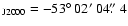 ,
with
an error radius of
,
with
an error radius of
 (90% containment, including systematics; Barthelmy et al. 2006).
Mask-weighted BAT light curves were created in the standard 4 energy bands
(15-25, 25-50, 50-100, 100-150 keV), and in the total 15-150 keV
band (Figs. 1 and 2) at 1 s time resolution.
These light curves show an unusual multi-peaked burst structure
that begins with an initial bright group of peaks with a 5 s FWHM
duration, followed by a set of fainter and somewhat softer peaks that increase
in intensity. At about T0+60 s, the light curve shows a hint of
a last faint peak and then decays smoothly.
Sub-pulses on the timescale of tens of ms are present, especially
during the initial 5-8 s (see the inset in Fig. 2).
The duration of the burst can be estimated as
T90 = 102
5 s,
but there is observable signal over the interval
T100 = 178
5 s
with more than 70 s of very faint extended emission after the end of
the T90 time interval.
Since XRT started its observation at full timing and spectral resolution
in windowed timing (WT) mode at T0+97 s,
there is a 80 s overlap between the BAT and XRT observations.
(90% containment, including systematics; Barthelmy et al. 2006).
Mask-weighted BAT light curves were created in the standard 4 energy bands
(15-25, 25-50, 50-100, 100-150 keV), and in the total 15-150 keV
band (Figs. 1 and 2) at 1 s time resolution.
These light curves show an unusual multi-peaked burst structure
that begins with an initial bright group of peaks with a 5 s FWHM
duration, followed by a set of fainter and somewhat softer peaks that increase
in intensity. At about T0+60 s, the light curve shows a hint of
a last faint peak and then decays smoothly.
Sub-pulses on the timescale of tens of ms are present, especially
during the initial 5-8 s (see the inset in Fig. 2).
The duration of the burst can be estimated as
T90 = 102
5 s,
but there is observable signal over the interval
T100 = 178
5 s
with more than 70 s of very faint extended emission after the end of
the T90 time interval.
Since XRT started its observation at full timing and spectral resolution
in windowed timing (WT) mode at T0+97 s,
there is a 80 s overlap between the BAT and XRT observations.
![\begin{figure}
\par\includegraphics[angle=-90,width=9cm,clip]{7232f2.ps}\end{figure}](/articles/aa/full/2007/28/aa7232-07/img32.gif) |
Figure 2: In the upper panel the 15-150 keV BAT light curve is shown at 1 s time resolution. Solid (dotted-dashed) vertical lines mark the T100(T90) time interval. Dotted vertical lines mark the start and the end of satellite slew. The inset shows the first group of peaks at 50 ms time resolution. Note that rate units are unchanged but peaks are higher because of the finer time resolution. The lower panel gives the hardness curve computed as the ratio of the count rate in the 25-150 keV and in the 15-25 keV band. |
| Open with DEXTER | |
Table 3: Results of BAT time resolved spectral analysis.
![\begin{figure}
\par\includegraphics[width=13.5cm,clip]{7232f3.ps}\end{figure}](/articles/aa/full/2007/28/aa7232-07/img54.gif) |
Figure 3: Upper panel: the XRT light curve converted to flux in the 0.2-10 keV energy range is shown together with the BAT light curve extrapolated to the same energy range. The joint best fit of the BAT and XRT spectra in the time interval 97-175 s has been used to calculate conversion factors for the BAT and XRT WT mode data. The best power-law fit of the average PC spectrum was used to convert XRT data in PC mode. The XRT light curve best fit model (solid line) is over-plotted on the data. The dashed vertical lines show the time intervals used for extraction of the BAT spectra (Table 3), while the solid vertical lines show the time intervals used for extraction of XRT spectra (corresponding to break times in the light curve during PC observation, i.e. t > 1000 s). The R-band light curve (with the host galaxy contribution subtracted) is shown in arbitrary flux units for comparison. This light curve is mainly composed of VLT data (Della Valle et al. 2006) and complemented with other data available in the literature (French et al. 2006; Gal-Yam et al. 2006; Fynbo et al. 2006b). The U-band light curve by UVOT is also plotted in arbitrary flux units (with the possible host galaxy contribution subtracted). Lower panel: plot of the photon index of BAT and XRT spectra as a function of time (see Tables 3-5). Note that during the BAT and XRT overlap time interval, the BAT and XRT photon indices correspond to the high energy and low energy branches of a Band model (Band et al. 1993), respectively (see results of BAT and XRT joint fit in Table 8). |
| Open with DEXTER | |
BAT spectra were extracted over the T100 time interval (from T0-1.55 s to T0+176.5 s, first row in Table 3), over the time interval corresponding to the Konus-Wind observation of the first group of peaks of the burst (from T0-2.83 s to T0+5.62 s), over the time interval of simultaneous BAT/XRT observation (from T0+97 s to T0+176.5 s), and for the central part of the burst emission (from T0+5.62 s to T0+97 s). The last three spectra are indicated in Table 3 (first column) as BAT-A, BAT-C and BAT-B, respectively. Moreover, BAT spectra were extracted over the 16 time intervals listed in Table 3 to allow for time resolved spectral analysis. These time intervals are shown by vertical dotted lines in Fig. 3.
Response matrices were generated with the task batdrmgen
using the latest spectral redistribution matrices.
For each spectrum, relevant keywords for response matrix generation
were updated with the batupdatephakw task.
For our spectral fitting (XSPEC v11.3.2) we considered the 14-150 keV
energy range and applied the latest energy-dependent systematic error
vector provided by the CALDB distribution.
The XRT data were first processed by the Swift Data Center at NASA/GSFC
into Level 1 products (event lists). Then they were further processed
with the XRTDAS (v1.8.0) software package, written by the
ASI Science Data Center (ASDC) and distributed within
FTOOLS to produce the final, cleaned event lists.
In particular, we ran the task xrtpipeline (v0.10.3) applying calibration
and standard filtering and screening criteria.
For our analysis we selected XRT grades 0-12 and 0-2 for photon counting (PC) and
WT data, respectively (according to Swift nomenclature; Burrows et al. 2005; Hill et al. 2004).
The X-ray counterpart was detected at the position
RA
 ,
Dec
,
Dec
 ,
with an estimated uncertainty of
,
with an estimated uncertainty of
 .
This position was determined using the xrtcentroid task (v0.2.7) on the PC data in sequence 000, that are not affected by pile-up,
and it takes into account the correction for the misalignment
between the telescope and the satellite optical axis.
It is
.
This position was determined using the xrtcentroid task (v0.2.7) on the PC data in sequence 000, that are not affected by pile-up,
and it takes into account the correction for the misalignment
between the telescope and the satellite optical axis.
It is
 from the refined BAT position.
During sequence 000 the count rate of the burst was high enough
to cause pile-up in the WT mode data, that covered
the entire first orbit XRT observation from T0+97 to T0+480 s.
Therefore, to account for this effect, the WT data were
extracted in a rectangular 40
20-pixel region
with a 9
20-pixel region excluded from its centre.
The size of the exclusion region was determined following the
procedure illustrated in Romano et al. (2006): the analysis of
the fraction of events at grade 0 for different sizes of the
central hole in the extraction region saturates to a constant
value for sizes greater than 10 pixels.
To account for the background, WT events were also extracted within a rectangular box (40
20 pixels) far from background sources.
Background subtracted WT light curves were extracted in the 0.2-1.0 keV, 1.0-10 keV and 0.2-10 keV energy ranges (see Figs. 3 and 4). They were corrected for both the fraction of point spread function (PSF) lost due to the central hole in the extraction region and exposure variations within the extraction region. A vignetting correction was also properly applied.
Time-resolved spectral analysis of WT data was performed on 7 time intervals
(see Table 4 and Fig. 3)
selected according to the source brightness
and requiring at least 2000 net counts each.
The time resolved spectra were extracted from a rectangular
40
20-pixel region with a central rectangular region excluded.
Different sizes of the excluded region were used according to
the analysis of the fraction of events at grade 0 (see details
in Table 4). Note that spectra WT-1 and WT-2 are simultaneous to spectra BAT-15 and BAT-16, respectively.
An average WT spectrum and a spectrum simultaneous to the tail of the BAT light curve (i.e. simultaneous to the BAT-C spectrum) were also extracted. The former is labeled as WT in the first column of Table 4, and the latter is labeled as WT-0. Both were extracted using the 10 pixels wide central hole to correctly account for the highest degree of pile-up at the beginning of the observation.
From the second orbit on, XRT observed in PC mode.
For the PC data, which were never affected by pile-up throughout all the
XRT observations, we extracted the source events in a circular
region of 30 pixel radius up to segment 003 (i.e.  ks).
PC background data were also extracted in a source-free
circular region (radius 40 pixels), and the background subtracted
light curves (in the 0.2-1.0 keV, 1.0-10 keV and 0.2-10 keV
energy ranges) were corrected for the fraction of PSF lost,
for time-dependent exposure variations within the extraction region
and for the vignetting effect.
ks).
PC background data were also extracted in a source-free
circular region (radius 40 pixels), and the background subtracted
light curves (in the 0.2-1.0 keV, 1.0-10 keV and 0.2-10 keV
energy ranges) were corrected for the fraction of PSF lost,
for time-dependent exposure variations within the extraction region
and for the vignetting effect.
For sequences from 004 to 037 the light curve points were calculated using the task sosta of the ximage package, which calculates vignetting- and PSF-corrected count rates within a specified box, and the background in a user-specified region. The background was estimated in the same region as the one used for the initial part of the light curve. Starting from sequence 006, data segments were merged until source detection with signal to noise ratio larger than 3 was attained (see Table 1). The last detection shown in Fig. 3 at 2.7 Ms, having a signal to noise ratio of 1.8, may be a statistical fluctuation.
Three PC spectra were extracted according to different evolutionary stages in the light curve (see Sect. 3.1). They are listed in Table 5. Ancillary response files were generated with the task xrtmkarf within FTOOLS, and account for different extraction regions and PSF corrections. The basic files describing the XRT effective area used were the swxpc0to12_20010101v008.arf (for PC) and swxwt0to2_20010101v008.arf (for WT) from the latest distribution of the XRT Calibration Database (CALDB 2.4) maintained by HEASARC. We also used the latest spectral redistribution matrices in the Calibration Database, namely the file swxpc0to12_20010101v008.rmf for PC spectra and the file swxwt0to2_20010101v008.rmf for WT spectra.
![\begin{figure}
\par\includegraphics[angle=-90,width=9cm,clip]{7232f4.ps}\end{figure}](/articles/aa/full/2007/28/aa7232-07/img60.gif) |
Figure 4: XRT light curves in the 0.2-1.0 keV ( upper panel) and 1.0-10 keV ( middle panel) energy bands and hardness ratio curve ( lower panel). |
| Open with DEXTER | |
The first UVOT observation was a 97 s White finding chart taken
in IMAGE&EVENT mode starting 104 s after the BAT trigger (Holland 2006b).
In this first observation the UVOT located the optical afterglow
of GRB 060614 at RA
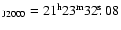 ,
Dec
,
Dec
 with a 90% confidence interval of
 .
This is 3
.
This is 3
 3 from the centre of the XRT error circle.
Table 4: Results of XRT time-resolved spectral analysis: WT data.
To extract UVOT light curves we performed aperture photometry on the UVOT exposures using a circular aperture with a radius of
 centred on the UVOT position of the afterglow. A sky annulus of width
 and inner radius
 was used. This annulus
includes a large number of sky pixels and is large enough to exclude
the faint outer regions of the point-spread function of the afterglow.
We performed aperture corrections to convert the
aperture
photometry to the standard photometric apertures used to define the
UVOT photometric zero points (
was used. This annulus
includes a large number of sky pixels and is large enough to exclude
the faint outer regions of the point-spread function of the afterglow.
We performed aperture corrections to convert the
aperture
photometry to the standard photometric apertures used to define the
UVOT photometric zero points (
 for UBV and
 for the UVW1, UVM2, UVW2, and White filters).
Approximately between 5 and 7 isolated stars (depending on the filter)
were used to compute aperture corrections for each exposure.
The rms scatter in the aperture
corrections for each source in a single exposure is typically 0.02 mag.
The instrumental magnitudes were transformed to Vega magnitudes
using the photometric zero points in the Swift/UVOT calibration database (CALDB). Colour terms have not been applied, but
preliminary calibrations suggest that they are negligible for sources
with typical afterglow colours. The adopted photometric zero points
are ZP
V = 17.88
0.09, ZP
B = 19.16
0.12, ZP
U = 18.38
0.23, ZP
UVW1 = 17.69
0.02, ZP
UVM2 = 17.29
0.23, ZP
UVW2 = 17.77
0.02, and ZP
for the UVW1, UVM2, UVW2, and White filters).
Approximately between 5 and 7 isolated stars (depending on the filter)
were used to compute aperture corrections for each exposure.
The rms scatter in the aperture
corrections for each source in a single exposure is typically 0.02 mag.
The instrumental magnitudes were transformed to Vega magnitudes
using the photometric zero points in the Swift/UVOT calibration database (CALDB). Colour terms have not been applied, but
preliminary calibrations suggest that they are negligible for sources
with typical afterglow colours. The adopted photometric zero points
are ZP
V = 17.88
0.09, ZP
B = 19.16
0.12, ZP
U = 18.38
0.23, ZP
UVW1 = 17.69
0.02, ZP
UVM2 = 17.29
0.23, ZP
UVW2 = 17.77
0.02, and ZP
 0.02.
0.02.
Table 5: Results of XRT time-resolved analysis: PC data.
Figure 5 shows the Swift-UVOT UVW2, UVM2, UVW2, U, B, V and White light curves, together with the R-band light curve of the afterglow mostly composed by VLT data (Della Valle et al. 2006) and complemented with points taken from the literature (French et al. 2006; Gal-Yam et al. 2006; Fynbo et al. 2006b). The flux densities are monochromatic fluxes for the central wavelength of each filter. They have been corrected for the Schlegel et al. (1998) Galactic extinction along the line of sight to GRB 060614 (AV=0.07 mag).
![\begin{figure}
\par\includegraphics[angle=-90,width=7.15cm,clip]{7232f5.ps}\end{figure}](/articles/aa/full/2007/28/aa7232-07/img160.gif) |
Figure 5: UVOT light curves in different filters and R-band light curve obtained from VLT data (Della Valle et al. 2006) and other data in the literature (French et al. 2006; Gal-Yam et al. 2006; Fynbo et al. 2006b). All light curves are corrected for the Galactic extinction along the line of sight to GRB 060614. The best fit model discussed in the text is represented by solid lines. |
| Open with DEXTER | |
The afterglow of GRB 060614 becomes brighter at optical and ultraviolet (UV) wavelengths until approximately eight hours after the BAT trigger and then fades. There is weak evidence for small-timescale fluctuations around the average light curve between approximately 3 and 28 h. This may be due to energy injection during the first day after the burst; however, due to the photometric uncertainty in the data, and the inherent difficulties with co-adding images of a variable source, it is not clear if these fluctuations are real. We note that the R-band light curve (as observed by ground based telescopes) shows small-timescale variability as well. The U and UVM2 light curves show weak evidence for change in the decay rate at approximately 28 h after the BAT trigger.
The UVOT U-band detection above the power law fit to the light curve at 500 ks
was previously interpreted as a possible SN (Holland 2006a; Brown 2006).
In view of the extremely low limits on a SN contribution obtained by
ground-based and HST observations (Gal-Yam et al. 2006; Della Valle et al. 2006; Fynbo et al. 2006b),
we now interpret this excess as a statistical fluctuation.
The shape of the excess is hard to determine due to the faintness
of the afterglow and the subsequent exposure time (spanning days)
needed to detect it, and is dependent on how the power-law is
fitted to the earlier data and how the late time data are co-added.
We present here the most conservative version, consisting of a single detection about five days after the burst which lies above the power-law fit, with the later data co-added together
to determine the host galaxy brightness.
The XRT light curve in 0.2-10 keV flux units is shown in Fig. 3 together with the BAT light curve extrapolated to the XRT energy band. Both light curves have been converted to flux using the best fit model parameters of the joint fit of the
BAT and XRT spectra extracted from the BAT/XRT overlap time interval 97-176.5 s
(spectra BAT-C and WT-0, respectively; see Sect. 3.3).
Note that the best fit model to the BAT and XRT spectra
in the overlap time interval, as presented in Sect. 3.3,
is a Band model (Band et al. 1993) with peak energy
 keV,
and the extrapolation of the BAT light curve to the XRT energy range
according to this model naturally leads to a very good match between
the tail of the BAT and the start of the XRT light curve,
but it underestimates slightly the 0.2-10 keV emission of
the burst before the start of the XRT observation, when the
peak energy of the spectrum was certainly higher
(as high as 300 keV during the first episode in BAT).
However, a time-dependent conversion of the BAT light curve
to the XRT energy range cannot be performed because of our
ignorance about the exact value after the initial group of BAT peaks and before the start of the XRT observation.
keV,
and the extrapolation of the BAT light curve to the XRT energy range
according to this model naturally leads to a very good match between
the tail of the BAT and the start of the XRT light curve,
but it underestimates slightly the 0.2-10 keV emission of
the burst before the start of the XRT observation, when the
peak energy of the spectrum was certainly higher
(as high as 300 keV during the first episode in BAT).
However, a time-dependent conversion of the BAT light curve
to the XRT energy range cannot be performed because of our
ignorance about the exact value after the initial group of BAT peaks and before the start of the XRT observation.
The XRT/WT light curve can be modeled as an exponential decay, while the XRT/PC light curve is well fitted by a doubly broken power law model. Results of the light curve fit
are presented in Table 6. Note that points
at t > 1.8 Ms slightly deviate from the best fit model
and suggest a late re-brightening or a flattening of the X-ray
afterglow. However, the last detection at 2.7 Ms is only a 1.8- detection, and the following upper limit tells us that at the
end the source faded below the XRT sensitivity limit.
detection, and the following upper limit tells us that at the
end the source faded below the XRT sensitivity limit.
A fit with an additional constant (to account for the
late flattening seen in the light curve) gives a slightly
steeper slope
 0.1, and a constant flux
of (8
4)
10-15 erg cm-2 s-1.
This would correspond to an X-ray luminosity of about
3
1041 erg s-1. This value is by far larger than what can be provided by the ongoing star formation activity: using the star formation rate 1.3
0.1, and a constant flux
of (8
4)
10-15 erg cm-2 s-1.
This would correspond to an X-ray luminosity of about
3
1041 erg s-1. This value is by far larger than what can be provided by the ongoing star formation activity: using the star formation rate 1.3
 (Della Valle et al. 2006) and the conversion
factor by Grimm et al. (2003), this could contribute 1036 erg s-1.
The X-ray luminosity could however be due to a small AGN.
A further study of the optical spectrum of the galaxy mighty clarify
this issue. We note however that Gal-Yam et al. (2006) show that the
light profile of the galaxy is well fitted by an exponential disk model,
without the need of a nuclear component.
Therefore, the apparent flattening of the late X-ray light curve
may also be a statistical fluctuation.
(Della Valle et al. 2006) and the conversion
factor by Grimm et al. (2003), this could contribute 1036 erg s-1.
The X-ray luminosity could however be due to a small AGN.
A further study of the optical spectrum of the galaxy mighty clarify
this issue. We note however that Gal-Yam et al. (2006) show that the
light profile of the galaxy is well fitted by an exponential disk model,
without the need of a nuclear component.
Therefore, the apparent flattening of the late X-ray light curve
may also be a statistical fluctuation.
The 0.2-1.0 keV and 1.0-10 keV XRT light curves are shown in the first two panels of Fig. 4. They have been rebinned so as to have at least 100 counts per bin in each energy band during the first orbit (WT data) and at least 20 counts per bin in each energy band afterwards (PC data). A hardness ratio curve was computed and it is shown in the third panel. A strong hard to soft evolution is visible in the first 400 s of data. This is likely due to the passage of the peak energy across the XRT band (see Sect. 3.3).
Note that portions of smooth bumps are visible during the nearly flat
light curve segment from 4 to 30 ks and the hardness curve
tracks them, although the hardness variations are small.
Then, the light curve shows a hardening trend up to the time of the second break
 ks, and an irregular behaviour with
oscillating hardness later on. However, the hardness curve at t>4 ks
is well fitted by a constant with best fit value 1.42
0.05
(
ks, and an irregular behaviour with
oscillating hardness later on. However, the hardness curve at t>4 ks
is well fitted by a constant with best fit value 1.42
0.05
(
 ,
with 56 d.o.f.).
,
with 56 d.o.f.).
Table 6: GRB 060614 X-ray light curve best fit parameters.
Table 7: GRB 060614 optical light curve best fit parameters.
The Swift-UVOT UVW2, UVM2, UVW2, U, B, V and White
light curves shown in Fig. 5 are too sparse for a detailed
filter-dependent fit. On the other hand, the R band light curve of the afterglow
obtained using data from the literature (French et al. 2006; Gal-Yam et al. 2006; Della Valle et al. 2006; Fynbo et al. 2006b),
shown in the seventh panel from the top in Fig. 5
can be well fitted by a constant (accounting for the host galaxy emission)
plus a doubly broken power law. We performed a joint fit to the UVOT and R-band light curves using the same model, with filter-dependent initial slope (
 ),
host galaxy contribution (h), and normalization.
The values of h for the filters B, V and R were fixed to measured values:
B=23.73
0.13, V=22.75
0.05, and R=22.46
0.01 (Della Valle et al. 2006).
The White filter UVOT light curve, shown in the bottom panel of Fig. 5,
does not sample uniformly the observation time interval and has not been included
in the fit. The best fit parameters are listed in Table 7.
),
host galaxy contribution (h), and normalization.
The values of h for the filters B, V and R were fixed to measured values:
B=23.73
0.13, V=22.75
0.05, and R=22.46
0.01 (Della Valle et al. 2006).
The White filter UVOT light curve, shown in the bottom panel of Fig. 5,
does not sample uniformly the observation time interval and has not been included
in the fit. The best fit parameters are listed in Table 7.
We find that the behaviour of all our optical and ultraviolet
light curves is consistent with a first break at
 = 29.7
4.4 ks,
an after-break decay with slope
= 29.7
4.4 ks,
an after-break decay with slope
 = 1.11
0.05,
a second break at
= 1.11
0.05,
a second break at
 = 104
22.0 ks, and a final decay
with slope
= 104
22.0 ks, and a final decay
with slope
 = 2.44
0.08.
The decay slope before the first break (
)
has a well defined trend with wavelength (decreasing from
the ultraviolet to the optical), although errors are quite large.
We note that, on the contrary, the light curve in the White filter is constant
up to 30 ks.
= 2.44
0.08.
The decay slope before the first break (
)
has a well defined trend with wavelength (decreasing from
the ultraviolet to the optical), although errors are quite large.
We note that, on the contrary, the light curve in the White filter is constant
up to 30 ks.
The best fit values of the host galaxy contributions h in the ultraviolet filters (UVW2, UVM2, UVW1, U) are roughly consistent with those of a dwarf star-forming galaxy.
All BAT spectra are best fitted by single power law models.
Results are shown in Table 3.
The BAT average spectrum of the burst has a photon index
 0.04,
corresponding to a 15-150 keV fluence of 2.2
10-5 erg cm-2.
A fit with a Band model (Band et al. 1993) with low energy index
0.04,
corresponding to a 15-150 keV fluence of 2.2
10-5 erg cm-2.
A fit with a Band model (Band et al. 1993) with low energy index
 fixed to -1 does not represent an improvement, but allows us to set an upper limit
to the average peak energy of
fixed to -1 does not represent an improvement, but allows us to set an upper limit
to the average peak energy of
 keV at the 90% confidence
level. The BAT spectrum of the first episode of peaks (spectrum BAT-A in Table 3)
has a photon index of
keV at the 90% confidence
level. The BAT spectrum of the first episode of peaks (spectrum BAT-A in Table 3)
has a photon index of
 ,
consistent with the Konus-Wind low energy index
,
consistent with the Konus-Wind low energy index
 (Golenetskii et al. 2006).
The average spectrum of the following five broad peaks (spectrum BAT-B) is softer
(
(Golenetskii et al. 2006).
The average spectrum of the following five broad peaks (spectrum BAT-B) is softer
(
 0.04). The BAT spectrum of the tail of the prompt emission
(spectrum BAT-C) has a similar photon index,
0.04). The BAT spectrum of the tail of the prompt emission
(spectrum BAT-C) has a similar photon index,
 0.13.
The 15-150 keV fluence in the initial group of peaks
is 3.4
10-6 erg cm-2, while the rest of the burst provides a fluence of 1.9
10-5 erg cm-2.
The softening of the BAT emission is well represented in the lower panel of
Fig. 3, where the best fit photon indices of the 16 BAT spectra
are plotted as a function of time.
0.13.
The 15-150 keV fluence in the initial group of peaks
is 3.4
10-6 erg cm-2, while the rest of the burst provides a fluence of 1.9
10-5 erg cm-2.
The softening of the BAT emission is well represented in the lower panel of
Fig. 3, where the best fit photon indices of the 16 BAT spectra
are plotted as a function of time.
Table 8: Results of BAT and XRT joint spectral analysis.
The XRT WT spectra have also been modeled with an absorbed single power law
(see Table 4, top panel). All the fits were done in the 0.3-10 keV energy range excluding channels between 0.45 and 0.55 keV where an instrumental artefact commonly
appears in XRT spectra.
Two absorption components were included in the model: a Galactic absorption
component, fixed to the expected value
 1020 cm-2 according to Dickey & Lockman (1990), and an absorption
component intrinsic to the host which was left free to vary.
The simple power law fits implied intrinsic absorption at the level of
5
1020 cm-2 in all of the XRT/WT spectra
but showed an unphysical trend in the
1020 cm-2 according to Dickey & Lockman (1990), and an absorption
component intrinsic to the host which was left free to vary.
The simple power law fits implied intrinsic absorption at the level of
5
1020 cm-2 in all of the XRT/WT spectra
but showed an unphysical trend in the  consisting of a rise
followed by a decay. Moreover, the reduced
consisting of a rise
followed by a decay. Moreover, the reduced  of the fits are marginally
acceptable and careful inspection of the fit residuals put in evidence
systematic trends below 2 keV that suggest the presence of curvature
in the spectra.
of the fits are marginally
acceptable and careful inspection of the fit residuals put in evidence
systematic trends below 2 keV that suggest the presence of curvature
in the spectra.
To account for the curvature of the WT spectra we fit them also with
i) an absorbed cut-off power law model, ii) an absorbed
Band model (Band et al. 1993), and iii) an absorbed power law model plus a blackbody component.
The choice of the first two models is justified by the possibility that
the early XRT light curve is the tail of the prompt emission, which usually
has a Band spectrum (the Band spectrum can be approximated by a cut-off power law over a limited energy band). Model iii) was suggested by recent results obtained by Campana et al. (2006a)
on GRB 060218 and Grupe et al. (2007) on GRB 060729.
Best fit parameters of all XRT/WT spectra with these three models
are shown in Table 4.
All the three models gave us a significant improvement in the fit
and are statistically equivalent. They give total reduced (calculated over the WT-1 to WT-7 spectra) of 1.02 (990 d.o.f),
1.01 (988 d.o.f.), and 1.01 (983 d.o.f.), respectively.
They also constrain intrinsic absorption to the level
of a few
1020 cm-2 or less.
In the model (iii) fits, the temperature of the blackbody component
 smoothly decreases from 0.8 to 0.2 keV, while the photon index
grows from 1.3 to 2.8.
The radius of the emitting region is of the order of 1011 cm and seems to peak
at
T0 + 250 s, as does the fraction of total flux contributed by the blackbody
component. The fits with models i) and ii), on the other hand, give us the
alternative picture of a smooth peak energy decrease from 8 keV
to a value below the XRT energy range at about
T0 + 250 s.
smoothly decreases from 0.8 to 0.2 keV, while the photon index
grows from 1.3 to 2.8.
The radius of the emitting region is of the order of 1011 cm and seems to peak
at
T0 + 250 s, as does the fraction of total flux contributed by the blackbody
component. The fits with models i) and ii), on the other hand, give us the
alternative picture of a smooth peak energy decrease from 8 keV
to a value below the XRT energy range at about
T0 + 250 s.
A clue to the true nature of the spectrum is found by a simultaneous
fit to the BAT and XRT spectra during the overlap time when both
instruments were detecting the burst
(spectral pairs BAT-C and WT-0; BAT-15 and WT-1; BAT-16 and WT-2).
When fitted with power laws, the BAT and XRT spectra show substantially different
photon indices during these intervals, implying the existence of a break in the
broad band spectrum. A joint fit of these pairs of spectra was therefore performed with
an absorbed Band model. Results are shown in Table 8 (top panel)
and in Fig. 6. A peak energy
of 8 keV is detected during the BAT/XRT overlap (Fig. 6). A description of the joint BAT/XRT spectra with an absorbed power law model plus a blackbody is statistically less successful and
requires an absorption column ten times higher than all previous fits
(bottom panel of Table 8).
This argues against the presence of a blackbody component in the
early XRT spectra, though we cannot rule it out after 176 s post-burst.
The PC spectra (starting after 4 ks from the trigger) are well fitted
by a single power law model and did not show evidence of intrinsic absorption.
Results are in Table 5.
The low absorption values are consistent with those
found for the WT data fit to intrinsically curved spectral models,
adding additional evidence that the power law fits to the WT data are inappropriate.
No significant spectral variation is seen throughout the XRT/PC observation.
The three spectra extracted, corresponding to the three decay phases observed
after 4 ks, show photon indices consistent with the average value of 1.85 0.12.
![\begin{figure}
\par\includegraphics[angle=-90,width=8.4cm,clip]{7232f6.ps}\end{figure}](/articles/aa/full/2007/28/aa7232-07/img205.gif) |
Figure 6:
Joint fit of the BAT and XRT spectra in the BAT/XRT overlap time
interval. The best fit model is an absorbed Band model with peak
energy 8 keV. See Table 8. |
| Open with DEXTER | |
![\begin{figure}
\par\includegraphics[width=11.3cm,clip]{7232f7.ps}\end{figure}](/articles/aa/full/2007/28/aa7232-07/img206.gif) |
Figure 7: Optical, ultraviolet and X-ray spectral energy distribution at 10, 30, 60 and 150 ks after the trigger. Optical and UV data, shown as points, have been corrected for the Galactic extinction along the line of sight (AV=0.07 mag) and for a host extinction of AV=0.05 mag with an SMC-like extinction curve. The SED at 150 ks also contains the I magnitude of the afterglow obtained by VLT observations (Della Valle et al. 2006). The solid lines define the cone corresponding to the 90% uncertainty on the spectral slope in the X-ray band. The extrapolation of the cone to the optical band is shown by the dotted lines. The dashed lines represent the best fit to the optical/UV data. |
| Open with DEXTER | |
The spectral energy distribution (SED) of the afterglow
from optical to X-rays have been computed at several different times
using the best fit models of the UVOT and VLT light curves presented in Sect. 3.2, the best fit model
of the XRT light curve (Sect. 3.1) and the average
XRT spectrum of the PC observation (Sect. 3.3
and Table 5). We selected the following times as representative of the afterglow
evolutionary stages: 10, 30, 60 and 150 ks, i.e. a time before
the first break/peak, the time of the first break/peak,
a time between the first and the second break and a time after the second break.
The SED at 150 ks also contains the I magnitude of the afterglow
extrapolated from VLT observations (Della Valle et al. 2006).
Infrared, optical and UV data have been corrected for the Galactic extinction
along the line of sight (AV=0.07) and for a host extinction of
AV=0.05
0.02 with an SMC-like extinction curve.
The value for the host galaxy extinction was computed in order
to provide the best match for the last three SEDs.
Results are shown in Fig. 7. The SED at 10 ks implies a spectral break between the X-ray and optical bands. We note that since the early optical light curves are different at different frequencies the spectrum is changing, and
 gets redder with time for
 .
After
all the SEDs are consistent with the
optical and X-ray data belonging to the same power-law segment.
Since the PC data do not show spectral evolution, the slope and
opening of the cone representing the spectral distribution in the X-ray band
and its uncertainty are constant and given by
.
After
all the SEDs are consistent with the
optical and X-ray data belonging to the same power-law segment.
Since the PC data do not show spectral evolution, the slope and
opening of the cone representing the spectral distribution in the X-ray band
and its uncertainty are constant and given by
 0.07.
The best fit of the optical and UV data has a slope of
0.07.
The best fit of the optical and UV data has a slope of
 0.14 at 10 ks, and
 0.08
at later times. So
0.08
at later times. So
 0.16 at 10 ks,
and
0.16 at 10 ks,
and
 0.11 at later times.
The GRB 060614 prompt emission consists of an initial short hard
emission structure with many bright peaks
(5 s FWHM duration,
 keV)
followed by a longer (170 s), softer and highly variable
bump which ends in a tail that smoothly matches the early and
partly simultaneous X-ray light curve observed by XRT.
keV)
followed by a longer (170 s), softer and highly variable
bump which ends in a tail that smoothly matches the early and
partly simultaneous X-ray light curve observed by XRT.
The XRT light curve shows strong spectral evolution during the
very steep decay up to the end of the first orbit (500 s),
then enters a nearly flat decay phase followed by steeper decay phases
that will be discussed later in Sect. 4.3.
We now focus only on data before 500 s.
The X-ray light curve over this time interval is not a power-law.
In Table 6, we report fit results assuming
an exponential shape, adopted for sake of simplicity only.
The spectral fits suggest a physical interpretation of this steepening decline.
The combined BAT/XRT spectrum is in fact well described by a Band model (or a cutoff power law) with decreasing peak energy .
The passage of
through the XRT band would naturally produce a steepening in the light curve, since the flux density at
 decreases faster than at
 .
The width of the XRT bandpass
(0.2-10 keV) will make the transition smooth when considering
the band-integrated flux.
This behaviour is represented in Fig. 8, where we show
the expected 0.2-10 keV light curve for a Band spectrum with decreasing
peak energy and normalization.
We fixed the low and high-energy photon indices to
.
The width of the XRT bandpass
(0.2-10 keV) will make the transition smooth when considering
the band-integrated flux.
This behaviour is represented in Fig. 8, where we show
the expected 0.2-10 keV light curve for a Band spectrum with decreasing
peak energy and normalization.
We fixed the low and high-energy photon indices to
 and
and
 (see third panel of Table 4).
The time behaviour of
was obtained by interpolating the
observed values (Fig. 8, inset), which show a regular
decay
(see third panel of Table 4).
The time behaviour of
was obtained by interpolating the
observed values (Fig. 8, inset), which show a regular
decay
 with
with
 0.11.
The agreement with the observed data is satisfactory, so that
the light curve shape provides further support for the spectral
evolution pattern described in Sect. 3.3.
The observation of
passing through the XRT band during early XRT observations is indeed a natural possibility (Butler & Kocevski 2007), being
consistent with the well-known hard-to-soft evolution observed in the prompt
emission spikes (Ford et al. 1995).
Then, the measured variation strongly supports the interpretation
of the early XRT light curve of GRB 060614 as the low energy counterpart
of the fading and softening tail seen by BAT.
According to the analysis of Zhang et al. (2006b),
the GRB 060614 tail behaviour cannot be explained as the simple superposition
of high latitude radiation (Kumar & Panaitescu 2000; Dermer 2004) and a possible prolonged
and steady central engine emission (Zhang & Mészáros 2004), but may be explained
as the result of the cooling frequency decrease associated to adiabatic cooling
of shock heated shells after an internal collision.
0.11.
The agreement with the observed data is satisfactory, so that
the light curve shape provides further support for the spectral
evolution pattern described in Sect. 3.3.
The observation of
passing through the XRT band during early XRT observations is indeed a natural possibility (Butler & Kocevski 2007), being
consistent with the well-known hard-to-soft evolution observed in the prompt
emission spikes (Ford et al. 1995).
Then, the measured variation strongly supports the interpretation
of the early XRT light curve of GRB 060614 as the low energy counterpart
of the fading and softening tail seen by BAT.
According to the analysis of Zhang et al. (2006b),
the GRB 060614 tail behaviour cannot be explained as the simple superposition
of high latitude radiation (Kumar & Panaitescu 2000; Dermer 2004) and a possible prolonged
and steady central engine emission (Zhang & Mészáros 2004), but may be explained
as the result of the cooling frequency decrease associated to adiabatic cooling
of shock heated shells after an internal collision.
In their combined analysis of BAT and XRT data of Swift GRBs,
O'Brien et al. (2006) and Willingale et al. (2006) concluded that all X-ray light
curves can be well described by an exponential that relaxes into a power law,
often with flares superimposed.
There have also been a few cases with clearly detected exponential phases
in the early XRT light curve (e.g. Vaughan et al. 2006).
By analogy with GRB 060614, we suggest that also for these cases the light curve
was shaped by the passage of the peak energy inside the XRT band. Hardness ratio
plots can be used to test this hypothesis as done in the case of XRF 050416A
by Mangano et al. (2007a) to show the consistency of Swift observations with
a decaying scenario.
![\begin{figure}
\par\includegraphics[width=7.65cm,clip]{7232f8.ps}\end{figure}](/articles/aa/full/2007/28/aa7232-07/img221.gif) |
Figure 8:
Modeling of the early XRT light curve (black points) as the
emission of a Band spectrum with evolving peak energy (red solid line).
The evolution law used is the best fit of the measured
values obtained through time resolved spectral analysis and
presented in Table 4. The
decay law with time
is shown in the inset (blue dashed line). |
| Open with DEXTER | |
The alternative time-dependent fit of early XRT data of GRB 060614 with the power law plus blackbody model (fourth panel in Table 4) may be unphysical, particularly given the fact that the broad band spectrum from 97 to 176 s is clearly fitted by a Band function, which may well continue up to 500 s. The blackbody fit may be just a computational way to fit the curvature in a Band spectrum peaking within the narrow XRT energy range, and the observed decrease of the blackbody radius (related the normalization of the blackbody component) may be associated to the exit of the peak energy from the XRT energy band.
However, it is worth noticing that in GRB 060614 the long bump
of the prompt emission peaks at about 40-50 s since the trigger.
According to Kobayashi & Zhang (2007), in the thick shell scenario
the onset of the afterglow (and the corresponding peak
in the light curve) would occur at about the fireball
deceleration time
 ,
where E is the fireball total energy,
,
where E is the fireball total energy,  is the mass density
of the surrounding medium,
is the mass density
of the surrounding medium,  is the initial Lorentz factor of the expanding fireball
and c is the speed of light. If we assume a radiation efficiency of shocks
is the initial Lorentz factor of the expanding fireball
and c is the speed of light. If we assume a radiation efficiency of shocks
 we can estimate
 with
with
 1051 erg
(see Sect. 4.2).
Under the further assumptions
1051 erg
(see Sect. 4.2).
Under the further assumptions
 cm-3(with
  being the proton mass)
we obtain
being the proton mass)
we obtain
 s for
s for
 .
.
On the other hand, the putative blackbody component observed after 100 s
from the trigger has a temperature
 keV and
radius
keV and
radius
 1011 cm. This is similar to
what expected from the slowly expanding (10 000 km s-1)
SN shock front after break-out from the stellar surface
if the SN radiation energy budget is of the order of 1051 erg.
Then, the radiation we observe may be the superposition of standard internal
shock activity up to 100 s from the trigger, afterglow onset and blackbody
radiation from expanding SN shock. In this scenario, the absence of SN detection in the optical could be explained by a very under-luminous SN explosion due to fall back over the nuclear region of heavy elements (mainly Ni) synthetized in the core collapse (Nomoto et al. 2004) or by a "dark
hypernova'' from a metal-poor massive star (Tominaga et al. 2007; Nomoto et al. 2007). Given
the deep optical upper limits (Gal-Yam et al. 2006; Della Valle et al. 2006; Fynbo et al. 2006b), this would
be one of the most under-luminous SN associated to a GRB ever detected, and one
of the faintest SNe ever discovered.
1011 cm. This is similar to
what expected from the slowly expanding (10 000 km s-1)
SN shock front after break-out from the stellar surface
if the SN radiation energy budget is of the order of 1051 erg.
Then, the radiation we observe may be the superposition of standard internal
shock activity up to 100 s from the trigger, afterglow onset and blackbody
radiation from expanding SN shock. In this scenario, the absence of SN detection in the optical could be explained by a very under-luminous SN explosion due to fall back over the nuclear region of heavy elements (mainly Ni) synthetized in the core collapse (Nomoto et al. 2004) or by a "dark
hypernova'' from a metal-poor massive star (Tominaga et al. 2007; Nomoto et al. 2007). Given
the deep optical upper limits (Gal-Yam et al. 2006; Della Valle et al. 2006; Fynbo et al. 2006b), this would
be one of the most under-luminous SN associated to a GRB ever detected, and one
of the faintest SNe ever discovered.
An accurate estimate of the isotropic equivalent energy radiated
by GRBs requires the knowledge of their intrinsic average spectrum over
the 1 keV-10 MeV energy band in the source rest frame.
The narrow BAT sensitivity bandpass (15-150 keV)
makes it hard to detect GRB peak energies in most cases.
The average spectrum of GRB 060614 is well fitted by a single
power-law with photon index  2. This indicates that we are observing
the high energy branch of the Band law generally used to describe GRBs
spectra, and a 24 keV upper limit to the average peak energy can be set
in the observer frame (see Sect. 3.3). Moreover, we know
that the burst presented strong spectral evolution and the peak energy
decreased from 300 keV measured during the initial group of peaks
to 8 keV during the BAT/XRT overlap. Then we expect that
the average peak energy of the burst should be larger than 8 keV.
With a peak energy in the 8-24 keV range, GRB 060614 is definitely
an X-ray rich burst and may even be an X-ray flash (Lamb et al. 2005).
A lower limit to the isotropic equivalent energy
can be
obtained under the extreme assumption that the GRB emission below
24
(1+z) keV in the source rest frame is zero. An upper
limit can be obtained under the assumption that the peak energy is
below 1 keV (i.e. extrapolating the
2. This indicates that we are observing
the high energy branch of the Band law generally used to describe GRBs
spectra, and a 24 keV upper limit to the average peak energy can be set
in the observer frame (see Sect. 3.3). Moreover, we know
that the burst presented strong spectral evolution and the peak energy
decreased from 300 keV measured during the initial group of peaks
to 8 keV during the BAT/XRT overlap. Then we expect that
the average peak energy of the burst should be larger than 8 keV.
With a peak energy in the 8-24 keV range, GRB 060614 is definitely
an X-ray rich burst and may even be an X-ray flash (Lamb et al. 2005).
A lower limit to the isotropic equivalent energy
can be
obtained under the extreme assumption that the GRB emission below
24
(1+z) keV in the source rest frame is zero. An upper
limit can be obtained under the assumption that the peak energy is
below 1 keV (i.e. extrapolating the
 power law
to low energies). In this way we obtain
1.8
power law
to low energies). In this way we obtain
1.8
 1051 erg,
and can reasonably assume
1051 erg,
and can reasonably assume
 1051 erg.
According to this estimate and the limits on the average peak
energy discussed above, GRB 060614 is consistent at about 2 sigma
with the
1051 erg.
According to this estimate and the limits on the average peak
energy discussed above, GRB 060614 is consistent at about 2 sigma
with the
 correlation found
by Amati et al. (2002) for long GRBs with known
redshift and recently updated including a larger sample of events
(Amati 2006; see also Amati et al. 2007).
correlation found
by Amati et al. (2002) for long GRBs with known
redshift and recently updated including a larger sample of events
(Amati 2006; see also Amati et al. 2007).
The rest-frame peak isotropic luminosity in the 30-10 000 keV range (calculated assuming the broad band spectrum given by Konus-Wind, Golenetskii et al. 2006)
is
 1049 erg s-1.
This value is consistent with the extrapolation to low luminosities
of the
1049 erg s-1.
This value is consistent with the extrapolation to low luminosities
of the
 relation found by
Yonetoku et al. (2004).
relation found by
Yonetoku et al. (2004).
The isotropic equivalent energy radiated during the initial hard
episode of peaks
 can also be estimated. The best fit photon index
of the BAT spectrum of the initial group of peaks,
can also be estimated. The best fit photon index
of the BAT spectrum of the initial group of peaks,
 ,
is in good agreement with the best fit photon index
of Konus-Wind data over the same energy range and indicates
that the peak energy was above the BAT energy range.
Based on the 302 keV peak energy detected by Konus-Wind, we obtain
,
is in good agreement with the best fit photon index
of Konus-Wind data over the same energy range and indicates
that the peak energy was above the BAT energy range.
Based on the 302 keV peak energy detected by Konus-Wind, we obtain
 1050 erg. Then, only about one seventh of the
isotropic energy was released during the initial group of peaks. As noted also
by (Gehrels et al. 2006), the first hard episode of GRB 060614 is not
consistent with the Amati correlation. This is not surprising, since the
Amati correlation was computed using global, and not time-resolved, properties.
1050 erg. Then, only about one seventh of the
isotropic energy was released during the initial group of peaks. As noted also
by (Gehrels et al. 2006), the first hard episode of GRB 060614 is not
consistent with the Amati correlation. This is not surprising, since the
Amati correlation was computed using global, and not time-resolved, properties.
The XRT light curve for t > 4 ks shows
an initial flat decay with slope
 0.05
and a constant spectral energy index
0.05
and a constant spectral energy index
 0.10,
a steepening to a slope
0.10,
a steepening to a slope
 0.02
at 36.6
2.4 ks without significant spectral evolution
(
0.02
at 36.6
2.4 ks without significant spectral evolution
(
 0.16) and a final steepening to a slope
 0.07 at 104
22 ks without significant
changes in the spectrum (
0.07 at 104
22 ks without significant
changes in the spectrum (
 0.12).
This behaviour resembles the typical behaviour of Swift detected
X-ray afterglows (O'Brien et al. 2006; Nousek et al. 2006).
The slow decay rate of phase A can be interpreted as the effect of forward
shock refreshing mechanisms, likely ending at the time of the first break
(Zhang et al. 2006a; Panaitescu et al. 2006; Nousek et al. 2006).
The slope of the phase B decay is intermediate between the value expected in
the cases
0.12).
This behaviour resembles the typical behaviour of Swift detected
X-ray afterglows (O'Brien et al. 2006; Nousek et al. 2006).
The slow decay rate of phase A can be interpreted as the effect of forward
shock refreshing mechanisms, likely ending at the time of the first break
(Zhang et al. 2006a; Panaitescu et al. 2006; Nousek et al. 2006).
The slope of the phase B decay is intermediate between the value expected in
the cases
 and
and
 (
(
 being the synchrotron cooling frequency), namely
 0.10 and
 0.10. Since
phase B lasted for a relatively short time (only half a decade), the value of
may be affected by systematic errors due to the choice of the
fitting function (we chose for simplicity a piecewise-connected power law,
while the real shape of the transition will be smooth; Granot & Sari 2002). The
hard spectral shape suggests that
is above the X-ray band.
0.10. Since
phase B lasted for a relatively short time (only half a decade), the value of
may be affected by systematic errors due to the choice of the
fitting function (we chose for simplicity a piecewise-connected power law,
while the real shape of the transition will be smooth; Granot & Sari 2002). The
hard spectral shape suggests that
is above the X-ray band.
The striking feature of the multi-band light curve, however, is the presence of
an achromatic break at
,
observed simultaneously in the XRT light
curve as well as in the UVOT and R-band ones. An achromatic transition is
expected when the edge of the jet enters the visible portion of the emitting
surface. Note that Della Valle et al. (2006) found a break in the optical afterglow
light curve at 119
3.4 ks with pre-break slope 1.08
0.03 and post-break
slope 2.48
0.07. Then, our simultaneous fit of the UVOT light curves with
the R-band light curve from Della Valle et al. (2006) points toward the
consistency of all the optical/UV data with a break at 117.2
4.4 ks.
This confirms the jet-break nature of the second break of our X-ray light
curve. The X-ray and optical slopes after the break are roughly consistent
with each other, and consistent with the decay predicted after a jet break.
To our knowledge, this is one of the best examples of a jet break for a Swift burst.
A jet-break at 104 ks implies a jet opening angle of
 =
=
![$0.161~[t_{\rm b}/(1+z)]^{3/8}(n~\eta_{\gamma}/E_{52})^{1/8}$](/articles/aa/full/2007/28/aa7232-07/img256.gif) rad
(Sari et al. 1999) where,
rad
(Sari et al. 1999) where,  is the break time in days, E52 is the
isotropic energy release in units of 1052 erg, n is the particle density
of the circumburst matter in cm-3 and
is the break time in days, E52 is the
isotropic energy release in units of 1052 erg, n is the particle density
of the circumburst matter in cm-3 and
 is the conversion
efficiency of internal energy to gamma-rays. For an isotropic
energy
1051 erg we obtain
is the conversion
efficiency of internal energy to gamma-rays. For an isotropic
energy
1051 erg we obtain
 .
This corresponds to a beaming-corrected energy
.
This corresponds to a beaming-corrected energy
 1049 erg and makes GRB 060614 roughly consistent with the
 relation originally found by Ghirlanda et al. (2004) and re-investigated
by Liang & Zhang (2005) and Ghirlanda et al. (2007).
Note that the beaming-corrected energy of GRB 060614
is lower than typical
relation originally found by Ghirlanda et al. (2004) and re-investigated
by Liang & Zhang (2005) and Ghirlanda et al. (2007).
Note that the beaming-corrected energy of GRB 060614
is lower than typical
 of long GRBs (1051 erg)
and comparable to the beaming-corrected energy of the short burst
GRB 051221A (Burrows et al. 2006).
of long GRBs (1051 erg)
and comparable to the beaming-corrected energy of the short burst
GRB 051221A (Burrows et al. 2006).
![\begin{figure}
\par\includegraphics[width=12cm,clip]{7232f9.ps}\end{figure}](/articles/aa/full/2007/28/aa7232-07/img263.gif) |
Figure 9: Rest-frame luminosity light curves of several GRBs detected by Swift: GRB 060614 (black points), the 3 short-duration GRBs with secure redshift (GRB 050724, GRB 051221A, and GRB 061006) and 37 long bursts with known redshift (light and dark grey curves). The only two long GRBs with redshift z<0.5 are evidenced (dark grey curves). Note that the sample contains other 5 long bursts with 0.5 < z < 1. Each light curve consists of i) the BAT light curve of the prompt emission extracted in the 15-150 keV energy band, extrapolated to flux in the 0.2-10 keV energy band using the best fit parameters of the BAT spectrum and then converted into 0.2-10 keV luminosity using the appropriate k-correction; ii) the XRT light curves, converted to 0.2-10 keV luminosity with the appropriate k-correction required for the best fit model of the XRT spectra. See Mangano et al. (2007b) for further details. |
| Open with DEXTER | |
The interpretation of the first break of the X-ray light curve as a hydrodynamical break due to the end of forward shock refreshing mechanisms
would also require an achromatic break. Indeed, the optical and ultraviolet
light curves of the afterglow show another common break at about 30 ks, nearly
simultaneous with the first X-ray break (that occurs at about 37 ks). However,
the initial slope
is dependent upon wavelength at optical
frequencies. This implies that the spectrum was changing at these wavelengths
around  ks. In particular, since the UV light curves are initially
decaying, while at lower frequencies a clear rise is observed, the spectrum is
evolving from blue to red.
A way to explain this behaviour is the passage of a break frequency through the
optical/UV band. This kind of transition should also be accompanied by a light
curve slope change as well, but is not achromatic. The observed behaviour of
all our afterglow light curves could be accounted for if the break frequency
passed through the observed band slightly earlier than the hydrodynamical
break. In this scenario the observed initial break/peak in the UVOT and VLT light curves would be due to the superposition of the two effects (causing the
change in the spectrum) while the initial break in the X-ray light curve would
be purely hydrodynamical (with no spectral evolution across it, as observed).
Which kind of break frequency can produce the observed behaviour? The simplest
possibility is that we were observing the injection frequency
ks. In particular, since the UV light curves are initially
decaying, while at lower frequencies a clear rise is observed, the spectrum is
evolving from blue to red.
A way to explain this behaviour is the passage of a break frequency through the
optical/UV band. This kind of transition should also be accompanied by a light
curve slope change as well, but is not achromatic. The observed behaviour of
all our afterglow light curves could be accounted for if the break frequency
passed through the observed band slightly earlier than the hydrodynamical
break. In this scenario the observed initial break/peak in the UVOT and VLT light curves would be due to the superposition of the two effects (causing the
change in the spectrum) while the initial break in the X-ray light curve would
be purely hydrodynamical (with no spectral evolution across it, as observed).
Which kind of break frequency can produce the observed behaviour? The simplest
possibility is that we were observing the injection frequency
 ,
that is the frequency at which the lowest-energy electrons are radiating.
For
,
that is the frequency at which the lowest-energy electrons are radiating.
For
 ,
where the spectrum is very blue (
,
where the spectrum is very blue (
 ), rising light curves are expected, while a standard decay occurs
for
), rising light curves are expected, while a standard decay occurs
for
 .
As the injection frequency moves to longer wavelengths,
the curves above
would be decaying, while the curves below
would be still rising. The very blue spectrum is confirmed
by our spectral analysis of the early-time SED
(which has
0.14).
If this interpretation is correct, this could be the first time for which the
injection frequency was directly observed in the optical band.
.
As the injection frequency moves to longer wavelengths,
the curves above
would be decaying, while the curves below
would be still rising. The very blue spectrum is confirmed
by our spectral analysis of the early-time SED
(which has
0.14).
If this interpretation is correct, this could be the first time for which the
injection frequency was directly observed in the optical band.
The other possibility is that the change in the spectral shape around
t = 10 ks is due to the passage of the cooling frequency.
For this model to work, however, the shocked electron power law slope
should be
 .
Using the formulae of Dai & Cheng (2001) and Zhang & Mészáros (2004) to
predict the light curve slope in case of forward shock propagation in the slow
cooling regime in a uniform interstellar medium when p < 2, we obtain
.
Using the formulae of Dai & Cheng (2001) and Zhang & Mészáros (2004) to
predict the light curve slope in case of forward shock propagation in the slow
cooling regime in a uniform interstellar medium when p < 2, we obtain
 between 0.9 and 1, roughly consistent with the observation.
The main problem of this interpretation is that the required p value (1.7) is
substantially lower than the value consistent with the jet break interpretation
of the second break (2.2). A temporal evolution of the shocked electron power law slope within the first 30 ks could reconcile the models. A p change, i.e. a shock microphysics change, during an afterglow evolution is not an implausible event and could be related to changes in the dynamics of the shock like those associated with the end of shock refreshing mechanisms.
This would however produce a change in the X-ray spectrum as well,
which is not observed.
between 0.9 and 1, roughly consistent with the observation.
The main problem of this interpretation is that the required p value (1.7) is
substantially lower than the value consistent with the jet break interpretation
of the second break (2.2). A temporal evolution of the shocked electron power law slope within the first 30 ks could reconcile the models. A p change, i.e. a shock microphysics change, during an afterglow evolution is not an implausible event and could be related to changes in the dynamics of the shock like those associated with the end of shock refreshing mechanisms.
This would however produce a change in the X-ray spectrum as well,
which is not observed.
Despite the contrasting properties of GRB 060614, which make it difficult to classify unambiguously, its afterglow does not show anomalous features. Phenomenologically, its X-ray light curve shows all the "canonical'' components identified in long GRB afterglows (Willingale et al. 2006; O'Brien et al. 2006; Nousek et al. 2006). Furthermore, its properties are in remarkable agreement with the predictions of jetted fireball models (Sari et al. 1999,1998). However, several recent studies have outlined that the X-ray afterglows of short GRBs show the same basic features as well: power law decay with changing slopes, X-ray flares (GRB 050724: Campana et al. 2006b; Grupe et al. 2006; GRB 051210: La Parola et al. 2006), shallow decay phases (GRB 060313: Roming et al. 2006; GRB 061006: Schady et al. 2006), breaks (GRB 061201: Marshall et al. 2006; GRB 061006: Schady et al. 2006) and possibly jet breaks (GRB 051221A: Burrows et al. 2006). This makes it difficult to infer conclusions about the nature of GRB 060614 based on its light curve properties. An interesting feature observed in a fraction of short-duration GRBs is the existence of a soft hump following the initial short, hard spike (Norris & Bonnell 2006). As noted by several authors (Zhang et al. 2007; Gehrels et al. 2006), this feature resembles what observed in GRB 060614, which may be an extreme case of such behaviour.
In Fig. 9 we plotted the (rest-frame) luminosity light curves of
several GRBs detected by Swift, including GRB 060614, the 3 short GRBs with
secure spectroscopic redshift (GRB 050724, GRB 051221A, GRB 061006), and 37 long GRBs with measured redshift (mostly from Mangano et al. 2007b).
The light curve of GRB 060614 is strikingly similar to those of GRB 050724 and
GRB 061006, in terms of both shape and luminosity. Note that these two bursts
showed an extended soft emission episode
(Barthelmy et al. 2005c; Campana et al. 2006b; Schady et al. 2006). We note, however, that the shape
of the GRB 060614 light curve is quite similar to that of several long-duration
GRBs. In terms of luminosity, taken at a face value, it looks that GRB 060614
is at the faint end of the distribution, being 50 times fainter than
the average. This comparison, however, is a bit misleading given the big
difference in the (average) redshift of most long-duration bursts and
GRB 060614. Among the plotted objects, only GRB 060218 and GRB 050803 have
z < 0.5 (
z = 0.0331 and z = 0.422, respectively;
Bloom et al. 2005; Mirabal et al. 2006), and, not surprisingly, they have both
faint light curves, comparable in luminosity to GRB 060614 and to the short
GRBs. Of course, given the steep GRB luminosity function (Firmani et al. 2004),
closeby objects are most likely to be faint on the average, given the small
sampled volume at low redshift. It is also whortwhile to mention that one of
the striking features of GRB 060614, namely the lack of a bright associated
supernova, would pass unnoticed at larger redshift, so that the number of
SN-less event is actually poorly constrained. Only the detection of a statistically significant number of long-duration events at moderate/low
redshift will make it possible a meaningful comparison.
GRB 060614 is a very peculiar, nearby (z=0.125) burst.
Despite the long duration of its prompt emission
(
T90=102
5 s), it presents null time lags in the BAT bandpass (similar to short bursts) and has no evidence of an associated supernova down to very deep limits
(
 ). GRB 060614 lies close to the region occupied by short
bursts in the time-lags/peak-luminosity plane, but, on the other hand,
satisfies the
(Amati) correlation, that
holds for long bursts only. Its BAT light curve shows a prolonged softening
tail that smoothly matches the partly simultaneous early XRT light curve. The
temporal decay of this tail is well described by an exponential function, with
an e-folding time of 76 s, and the spectral evolution is associated
with the drift of the peak energy of the Band function towards lower energy and
crossing the XRT energy band.
). GRB 060614 lies close to the region occupied by short
bursts in the time-lags/peak-luminosity plane, but, on the other hand,
satisfies the
(Amati) correlation, that
holds for long bursts only. Its BAT light curve shows a prolonged softening
tail that smoothly matches the partly simultaneous early XRT light curve. The
temporal decay of this tail is well described by an exponential function, with
an e-folding time of 76 s, and the spectral evolution is associated
with the drift of the peak energy of the Band function towards lower energy and
crossing the XRT energy band.
The X-ray, UV and optical afterglow light curves and SEDs
of GRB 060614 are well interpreted within the standard afterglow theory.
In particular, the afterglow of GRB 060614 shows a truly achromatic
break from optical to X-ray frequencies at 104 ks after the trigger,
fully consistent with being a jet break. The burst satisfies the
(Ghirlanda) correlation.
The observed softening of the optical/UV afterglow
before 30 ks can be interpreted as an evidence of passage of the
injection frequency through the optical band.
The good agreement of the afterglow of GRB 060614 with the jetted fireball models does not allow us to draw firm conclusions on the nature of the event and its possible progenitor, but is indeed remarkable since many Swift bursts hardly reconcile with the very same models.
Acknowledgements
This work is supported at INAF by funding from ASI on grant number I/R/039/04 and from MIUR grant 2005025417, at Penn State by NASA contract NASS5-00136, and at the University of Leicester by the Particle Physics and Astronomy Research Council. We gratefully acknowledge the contribution of dozens of members of the XRT team at OAB, PSU, UL, GSFC, ASDC and our sub-contractors, who helped make this instrument possible. D.M. acknowledges support from the Instrument Center for Danish Astrophysics.
Table 1: BAT and XRT data log.
Table 2: UVOT data.