![[*]](/icons/foot_motif.gif)
A&A 469, 539-551 (2007)
DOI: 10.1051/0004-6361:20066587
A. Contursi1 - M. Rubio2 - M. Sauvage3 - D. Cesarsky1,5 - R. Barba4 - F. Boulanger5
1 - Max-Planck-Institut für Extraterrestrische Physik (MPE),
Postfach 1312, 85741 Garching, Germany
2 -
Departamento de Astronomía Universidad de Chile, Casilla
36-D, Santiago, Chile
3 - CEA/DSM/DAPNIA/Service d'Astrophysique, CE Saclay, 91191 Gif-sur-Yvette Cedex, France
4 - Departamento de Física, Universidad de La Serena, Chile
5 -
Institut d'Astrophysique Spatiale, Bat. 121, Université Paris XI, 91450 Orsay Cedex, France
Received 18 October 2006 / Accepted 16 January 2007
Abstract
Context. We present the analysis of ISOCAM-CVF and the J, H, and  photometry data for the HII region complex N4 in the Large Magellanic Cloud (LMC).
Aims. The aim is twofold: 1) to study the connection between the interstellar medium and the star content of this region; 2) to investigate the effects of the lower-than-Galactic metallicity on dust properties.
Methods. A dust-features - gas lines - continuum fitting technique on the whole ISOCAM-CVF data cube allows the production of images in each single emission and detailed analysis of dust (both continuum and bands), and ionized gas. The near infrared (NIR) photometry provides, for the first time, information on the stellar content of N4.
Results. The mid-infrared (MIR) spectral characteristics of N4 are those expected for an HII region complex, i.e. very similar to those observed in galactic HII regions. The images in single dust feature bands and gas lines clearly show that the HII region core is completely devoid of the carriers responsible for the aromatic features (AFs). On the other hand, the ionized gas arises almost completely in this dust cavity, where the two main exciting stars of N4 are also located. The HII region models from Stasinska (1982, A&AS, 48, 2999) predict an HII region size that corresponds to the observed size of the dust cavity.
We find evidence that the effect of lower-than-Galactic metallicity (although not as extreme as in the case of LMC) on the carriers responsible for the AFs is not to prevent their formation or to modify their chemical properties, but to enhance their destruction by the high and hard interstellar radiation field. We argue that this is the dominant process responsible for the absence of AFs in the HII region core. We show that this mechanism is more efficient on smaller dust particles/molecules thus affecting the dust-size distribution. We argue that effects on dust-size distribution, rather than the different dust properties due to a lower metallicity, should be taken into account when analyzing more distant, relatively low-metallicity galaxies.
Finally, the analysis of the stellar content of N4 reveals 7 stars: 4 reddened O MS stars and three stars with envelopes. In particular, one of these seems to be an ultra compact HII region containing an embedded young stellar object.
Key words: HII regions - ISM: lines and bands - ISM: structure
The H emission of N4 (Fig. 1, kindly provided by Heydari-Malayeri) clearly shows that this HII complex is composed of two ionized nebulae: N4A and N4B.
In this paper we will concentrate only on N4A, which is brighter and younger than N4B and is
composed of a bright dense front to its northeastern part and a more diffuse low-surface brightness (partially density bounded) component in its southern part.
The main ionizing sources in N4A are two stars not visible at optical wavelengths (marked in Fig. 1 as A and B). Heydari-Malayeri & Lecavelier des Etangs (1994) calculated that the main ionizing sources correspond to either one 60
emission of N4 (Fig. 1, kindly provided by Heydari-Malayeri) clearly shows that this HII complex is composed of two ionized nebulae: N4A and N4B.
In this paper we will concentrate only on N4A, which is brighter and younger than N4B and is
composed of a bright dense front to its northeastern part and a more diffuse low-surface brightness (partially density bounded) component in its southern part.
The main ionizing sources in N4A are two stars not visible at optical wavelengths (marked in Fig. 1 as A and B). Heydari-Malayeri & Lecavelier des Etangs (1994) calculated that the main ionizing sources correspond to either one 60  star
or two 40
stars.
star
or two 40
stars.
![\begin{figure}
\par\includegraphics[width=8.5cm,clip]{6587fig1.ps}\end{figure}](/articles/aa/full/2007/26/aa6587-06/img11.gif) |
Figure 1:
H
emission of the LMC HII complex N4A and N4B (from Heydari-Malayeri
& Lecavelier des Etangs 1994). The image has been rotated to the same orientation as the
ISOCAM-CVF images. |
| Open with DEXTER | |
The average extinction in N4 derived from optical gas emission is quite
low,
 although it is presumably higher in the northeastern front where the gas density reaches its maximum. The parental molecular cloud is formed by two spatial components: one peaking on N4A and the other peaking to the east of the HII region. The molecular
cloud has two velocity components: a high- velocity, optically-thick red component and a thin blue molecular sheet. This sheet is probably pushed towards us by the HII region pressure (Heydari-Malayeri & Lecavelier des Etangs 1994).
although it is presumably higher in the northeastern front where the gas density reaches its maximum. The parental molecular cloud is formed by two spatial components: one peaking on N4A and the other peaking to the east of the HII region. The molecular
cloud has two velocity components: a high- velocity, optically-thick red component and a thin blue molecular sheet. This sheet is probably pushed towards us by the HII region pressure (Heydari-Malayeri & Lecavelier des Etangs 1994).
A complementary study of the hot dust emission in N4A has been done by Contursi et al. (1998) using broad band ISOCAM filters centered at 7 and 15  m. At these wavelengths, the emission is dominated by the Aromatic Features seen in Emission (AFEs) between 3 and 10 m and a continuum steeply rising at wavelengths longer than
  10 m.
The overall mid-infrared (MIR) morphology in N4A is generally very similar to the CO emission, although the MIR and CO peaks do not coincide exactly. The strongest MIR emission comes from the dense northeastern front as expected, since here the density of the matter is at its
highest. The 15/7 m ratio peaks in the region of N4A where the two main exciting stars are supposed to be. Its high value, typical of an HII region, indicates that the emission at 15 m is dominated by a strong continuum and that the emission at 7 m is significantly reduced. Contursi et al. (1998) suggests that this decrease is due primarily to destruction of the AFEs carriers in hard and strong interstellar radiation fields (ISRF).
10 m.
The overall mid-infrared (MIR) morphology in N4A is generally very similar to the CO emission, although the MIR and CO peaks do not coincide exactly. The strongest MIR emission comes from the dense northeastern front as expected, since here the density of the matter is at its
highest. The 15/7 m ratio peaks in the region of N4A where the two main exciting stars are supposed to be. Its high value, typical of an HII region, indicates that the emission at 15 m is dominated by a strong continuum and that the emission at 7 m is significantly reduced. Contursi et al. (1998) suggests that this decrease is due primarily to destruction of the AFEs carriers in hard and strong interstellar radiation fields (ISRF).
This analysis was part of a wide ISOCAM campaign aiming at studying the interstellar medium
(ISM) properties in the Magellanic Clouds with particular emphasis on the role
played by metallicity, taking full advantage of the unprecedented (at that time) spatial resolution provided by ISO at these wavelengths and to the proximity of the Magellanic Clouds.
One of the outcomes of the broad band ISOCAM imaging study of N4
was that this region appears as a classical Galactic HII complex, composed mainly of three phases: 1) the HII region itself close to the exciting stars corresponding to the maximum of the 15/7 m ratio; 2) the interface between the HII region and the molecular cloud (photon-dominated region or PDR) where the MIR emission reaches its maximum due to both high dust density and relatively high ISRF; 3) the parental molecular cloud, where the MIR emission is still dominated by AFEs probably arising from the outskirts of the molecular clouds and excited mainly by the general LMC ISRF.
In this paper we present a more detailed study of the MIR emission
properties of N4A analyzing a very high signal-to-noise
spectro-imaging data set carried out with the circular variable filter (CVF)
on ISOCAM. Thanks to the spectral capabilities, we are able to directly show that our previous physical interpretation of the broad band MIR photometry data of N4
were correct. We also present new high resolution J, H and
images,
taken at Las Campanas Observatory (Chile). All these data allow us to better investigate the existence of detailed metallicity signatures
on the dust emission that do not show up in the broad band emission
and to relate dust, ionized gas, and stellar content. These data provide high
resolution analogs for the study of the ISM in conditions similar to those of young galaxies
in the distant Universe that are becoming more and more available
with the advent of large ground-based telescopes (VLT, Keck, ALMA) and space missions
(SPITZER, HERSCHEL).
![\begin{figure}
\par\includegraphics[angle=-90,width=13.5cm,clip]{6587fig2.ps}\end{figure}](/articles/aa/full/2007/26/aa6587-06/img14.gif) |
Figure 2:
ISOCAM CVF spectra of four different regions of N4A. The regions where
the spectra were extracted are shown in each panel on the gray-scale image in the 7.7 m aromatic feature. Note that the steep rise or decrease at the very end of the spectrum is an instrument artifact and should not be considered as real. |
| Open with DEXTER | |
A complete scan of the two long-wavelength Circular Variable
Filters (CVF) was performed going down in wavelengths, step by step, first
from 16.2 to 9.0 m (LW-CVF2) and second from 9.4 to 5.0 m (LW-CVF1). At each CVF step, between 7 and 11 frames of 2.1 s were taken. The total observing time was 2974 s. The pixel field of view was 6
 and the full field of the observation
 centered on RA = 4:52:8.2 and Dec = -66:55:16 (J2000). The data reduction was performed as described in Boulanger et al. (2004). The reduced data cube can be retrieved from the ISO archive at the site http://www.iso.vilspa.esa.es as Highly Porcessed Data Products (HPDP)
under the name Mid-IR Spectro Imaging ISOCAM CVF Observations.
centered on RA = 4:52:8.2 and Dec = -66:55:16 (J2000). The data reduction was performed as described in Boulanger et al. (2004). The reduced data cube can be retrieved from the ISO archive at the site http://www.iso.vilspa.esa.es as Highly Porcessed Data Products (HPDP)
under the name Mid-IR Spectro Imaging ISOCAM CVF Observations.
Near infrared J, H, and
deep images of N4A were obtained with the Dupont 2.5 m
telescope at Las Campanas Observatory (Chile) in the night of December 27, 1996 with the
 NICMOS III camera IRCAM (Persson et al. 1992). The spatial resolution of the system was 0.35''/pixel, and the typical seeing was 0.9
in .
NICMOS III camera IRCAM (Persson et al. 1992). The spatial resolution of the system was 0.35''/pixel, and the typical seeing was 0.9
in .
The observation consisted of a series of 10 frames, each individual frame with
an integration time of 20 s per filter. This procedure was repeated in a
9-position mosaic with a separation of 20
.
The total integration time in each filter resulted in 1800 s in ,
1800 s in H, and 2000 s in J. Sky frames in each filter
were taken in a field with faint stars and no extended
emission at 12
W and 134
S of the source position. The sky field
was observed in a similar way as for N4. To produce the final images, each image
was flat-fielded and sky-subtracted, and then median-averaged-combined
using IRAF procedures. The final images were registered with respect to the
image by means of several common stars. The resulting mosaic covers a
 area.
area.
Aperture photometry in each
filter was performed with IRAF/DAOPHOT on the mosaic. For the purpose of this study
we concentrated on those sources brighter than
 .
The stars associated to N4A are shown in Fig. 5, and Table 1 gives the NIR magnitudes and colors of these stars. The photometric errors are
.
The stars associated to N4A are shown in Fig. 5, and Table 1 gives the NIR magnitudes and colors of these stars. The photometric errors are
 mag,
mag,
 and
and
 .
Photometry of stars in our mosaic far from the N4A nebulosity were compared
to their 2MASS photometry and showed a good agreement. We estimated the flux contribution from the nebulosity to our measured photometry to be less than 10% and 5% in the
J bands, respectively.
.
Photometry of stars in our mosaic far from the N4A nebulosity were compared
to their 2MASS photometry and showed a good agreement. We estimated the flux contribution from the nebulosity to our measured photometry to be less than 10% and 5% in the
J bands, respectively.
 /pix) centered on the position of the two main exciting stars in N4A. The upper right panel (b) shows the spectrum of the ionized gas peak emission. The bottom left spectrum (c) is the average of 18 pixels on the bright northeastern front of N4A; the bottom right spectrum (d) corresponds to the CO eastern peak, outside the ionized cloud (Contursi et al. 1998).
The spectra around the stars (a) and on the northeastern front (c)
are dominated by the AFEs and a continuum longward of 10 m which
becomes more and more prominent approaching the stars (b and a). AFEs are stronger
on the northeastern front of N4A, as expected in a region where both density and ISRF are high. This spectrum (c) is typical of PDRs, thus confirming that this region is
the interface between the HII region and the molecular cloud of N4A.
In the spectra (panel a) corresponding to the regions close to the stars, the prominent
features are the fine-structure gas lines of SIV at 10.5 m, NeII at
12.8 m (although blended with the AFE at 12.7 m), and NeIII at 15.6
m. The AFEs to continuum ratio reaches its minimum in the region where the fine-structure lines are the most intense (b) and AFEs practically
disappear. The spectrum (d) towards the eastern CO peak presents very weak AFEs and almost no continuum. These are characteristics of quiescent regions, which suggests that the emission arises from a thin external shell of the molecular cloud probably corresponding
to its red velocity component.
From this global spectral analysis, it appears that N4 MIR dust and gas properties are very similar to what is found in galactic HII complexes (Cesarsky et al. 1996b,a), i.e. its MIR emission spectrum is typical of a HII/PDR/molecular cloud combination.
Thanks to the very high signal-to-noise ratio and
the fact that we have spatial and spectral information on a region
of
 centered on N4A, this data set is
perfectly suitable for a detailed spectral and spatial analysis in the single
AFEs, gas lines, and pure continuum. We produced images in each dust feature (namely,
6.2 m, 7.7 m 8.6 m 11.3 m) and
fine structure lines (SIV, NeII and NeIII) in the following way.
Following Boulanger et al. (1998), we performed a Lorentzian fit on the
dust bands and a Gaussian fit on the gas lines, to the whole data cube, producing maps in each dust feature and fine-structure line of the ionized gas. First we fit the 6.2 m, 7.7 m, and 8.6 m bands together and a straight line as a continuum letting the slope vary at each pixel.
Then, we fit the SIV, 11.3 NeII (+12.7 m) and NeIII lines together , and a straight line as
a continuum. The reason we separately fit the two parts of the spectrum is that in the HII region core the continuum shortward and longward 10 m might not have the same origin and therefore the same slopes (see discussion in Sect. 4.2). We then subtracted the fitted lines and bands from the original data cube, pixel by pixel, producing "pure'' continuum spectra. We visually inspected the subtracted data cube to ensure that no "absorption'' features were produced due to overestimated lines/features.
From the "pure'' continuum spectrum, we built images in the ISOCAM LW5 (6.5-7.0 m) and LW9 (14-16 m) filters. They represent the pure continua shortward and longward of 10 m, respectively. The NeII (12.7 m) line was fitted with a Gaussian on the whole cube,
even though we know that it is blended with the aromatic feature at 12.7 m,
which should be fitted with a Lorentzian. Therefore the NeII image also contains the 12.7 m AFE. The resulting images are shown in Figs. 3 and 4.
All emission shown hereafter are clipped at 3
centered on N4A, this data set is
perfectly suitable for a detailed spectral and spatial analysis in the single
AFEs, gas lines, and pure continuum. We produced images in each dust feature (namely,
6.2 m, 7.7 m 8.6 m 11.3 m) and
fine structure lines (SIV, NeII and NeIII) in the following way.
Following Boulanger et al. (1998), we performed a Lorentzian fit on the
dust bands and a Gaussian fit on the gas lines, to the whole data cube, producing maps in each dust feature and fine-structure line of the ionized gas. First we fit the 6.2 m, 7.7 m, and 8.6 m bands together and a straight line as a continuum letting the slope vary at each pixel.
Then, we fit the SIV, 11.3 NeII (+12.7 m) and NeIII lines together , and a straight line as
a continuum. The reason we separately fit the two parts of the spectrum is that in the HII region core the continuum shortward and longward 10 m might not have the same origin and therefore the same slopes (see discussion in Sect. 4.2). We then subtracted the fitted lines and bands from the original data cube, pixel by pixel, producing "pure'' continuum spectra. We visually inspected the subtracted data cube to ensure that no "absorption'' features were produced due to overestimated lines/features.
From the "pure'' continuum spectrum, we built images in the ISOCAM LW5 (6.5-7.0 m) and LW9 (14-16 m) filters. They represent the pure continua shortward and longward of 10 m, respectively. The NeII (12.7 m) line was fitted with a Gaussian on the whole cube,
even though we know that it is blended with the aromatic feature at 12.7 m,
which should be fitted with a Lorentzian. Therefore the NeII image also contains the 12.7 m AFE. The resulting images are shown in Figs. 3 and 4.
All emission shown hereafter are clipped at 3 .
.
![\begin{figure}
\par\includegraphics[width=8.8cm,angle=-90,origin=c,clip]{6587fig3.ps}\end{figure}](/articles/aa/full/2007/26/aa6587-06/img25.gif) |
Figure 3:
Image: map from the Lorentzian fit of the 7.7 m dust emission feature.
Gray and black contours: from the map of Gaussian fit in the SIV line and the "pure'' continuum in the LW9 filter (15 m) emission, respectively. |
| Open with DEXTER | |
Figure 3 shows the 7.7 m emission obtained through Lorentzian fits. Contours represent
the SIV line emission obtained by applying Gaussian fits and the
"pure'' 15 m (LW9) continuum emission. In this image it is clear that the AFE is coming from a shell surrounding the HII region core and that this shell is particular bright in the PDR (i.e. on the northeastern front). There are 2 bright compact knots on this shell (numbered in Fig. 3), not resolved at the 7.7 m resolution
(7
). Most of the ionized gas emission arises from the cavity formed
by the dust shell, and it seems centered on a point-like source. A similar result has been
published recently by Zavagno et al. (2006) on the massive galactic
star-forming region RCW 79. The 15 m pure continuum
emission peaks close to knot#2 in the PDR dust shell and
has a weaker emission in the 7.7 m cavity where SIV peaks.
Figure 4 shows the 7.7 m image with the NeIII contours. The general picture is
very similar to what is shown in Fig. 3: the ionized gas traced by the NeIII emission is mostly contained in the dust cavity and does not show a secondary peak corresponding to the secondary peak seen in the SIV line emission, although this can be due
in part to the poorer resolution at 15.6 m than at 10.5 m. The main
difference between the two ionized gas lines emission is that the NeIII
emission is much more extended than the SIV emission towards the southern part
of the nebula. This is also the side where the HII region is partially bounded
(Heydari-Malayeri & Lecavelier des Etangs 1994) and where the gas can expand.
All other images in the other dust bands (not shown here) are very similar
to the 7.7 m emission. The NeII(+12.7 m) distribution is also very similar to
the distribution of the other AFEs everywhere but in the HII region core where
there is a peak. This suggests, as expected, an increasing contribution by the NeII line to the
12.7 m feature when approaching the exciting stars. We will come back to the
relative contribution of the NeII line and the 12.7 m AFE in Sect. 4.1.
![\begin{figure}
\par\includegraphics[width=8.8cm,angle=-90,origin=c,clip]{6587fig4.ps}\end{figure}](/articles/aa/full/2007/26/aa6587-06/img26.gif) |
Figure 4:
Image: map from Lorentzian fit of the 7.7 m dust emission feature. Contours: from the
map of Gaussian fit in the NeIII line. |
| Open with DEXTER | |
 photometry
 composite image of N4A (Fig. 5) shows an extended and diffuse
emission whose morphology is very similar to the shape of the
H
emission seen in Fig. 1 and with NIR color quite uniform
across the nebula.
Seven stars are visible (numbered in Fig. 5).
Stars
composite image of N4A (Fig. 5) shows an extended and diffuse
emission whose morphology is very similar to the shape of the
H
emission seen in Fig. 1 and with NIR color quite uniform
across the nebula.
Seven stars are visible (numbered in Fig. 5).
Stars  and
and  are the bluest, while the others are much redder.
Star
are the bluest, while the others are much redder.
Star  ,
to the north-west of the nebula, is bright and red. Star
,
to the north-west of the nebula, is bright and red. Star  is located
on the border north of the nebula and shows diffuse emission around it.
Photometry of all the seven stars is listed in Table 1 ordered by J magnitudes.
Star numbers refer to Fig. 5. Star #1 and #3 are associated with stars A and B in Fig. 1.
is located
on the border north of the nebula and shows diffuse emission around it.
Photometry of all the seven stars is listed in Table 1 ordered by J magnitudes.
Star numbers refer to Fig. 5. Star #1 and #3 are associated with stars A and B in Fig. 1.
The comparison with the position of the stars indicated by Heydari-Malayeri
& Lecavelier des Etangs (1994) as the two main exciting stars
(marked as A and B in Fig. 1) suggests that they correspond to stars  1 and 3 in Fig. 5. This
association, however, is not certain because of the lack of astrometry in their data (their Fig. 2).
We believe that these are the exciting stars, because if one associates
the H
knot visible in their figure at about (0
,
-27
)
from
the center of their field with our star 7, the position of the two
exciting stars as indicated in their paper corresponds to the position of stars 1 and 3.
1 and 3 in Fig. 5. This
association, however, is not certain because of the lack of astrometry in their data (their Fig. 2).
We believe that these are the exciting stars, because if one associates
the H
knot visible in their figure at about (0
,
-27
)
from
the center of their field with our star 7, the position of the two
exciting stars as indicated in their paper corresponds to the position of stars 1 and 3.
The comparison between the
band and the
15 m "pure'' continuum emission (shown in Fig. 6) clearly indicates
that star 4 corresponds to the strongest peak of the pure continuum emission at 15 m.
Figure 7 shows the
band emission contours on the SIV line image.
The SIV emission arises almost entirely in the region where the 2 bluest stars are located.
Finally, Fig. 8 shows that one of the AFE peaks (knot
in Fig. 3) is close but does not totally correspond to the bright continuum source (star 4) and that knot
is located north of the blue stars, very close to where the red elongated feature is visible in the NIR composite map (associated with 2 in Fig. 5). This suggests that this source and star 4 are embedded in a high-density dusty region.
Note, however, that the uncertainty on ISO-CVF data astrometry
( 6
), plus the fact that the images at different wavelengths are slightly displaced with respect to each other (by up to 1 pixel over the whole ISOCAM spectral range),
prevents us from using the ISOCAM astrometry to superpose images at different
wavelengths. We align the CVF images with respect to each other and the CVF images on
the
band image by matching the peak emission of the WOH53 star (marked in Fig. 1).
6
), plus the fact that the images at different wavelengths are slightly displaced with respect to each other (by up to 1 pixel over the whole ISOCAM spectral range),
prevents us from using the ISOCAM astrometry to superpose images at different
wavelengths. We align the CVF images with respect to each other and the CVF images on
the
band image by matching the peak emission of the WOH53 star (marked in Fig. 1).
From the comparison between the ISOCAM and NIR data, we conclude that SIV and NeIII emission, i.e. the ionized gas, is mostly associated with the bluest stars in the cavity of the dust shell. The 15 m continuum peak is mostly associated with the red star 4 very close but not coincident to one of the peaks of the 7.7 m emission (knot ). Object
corresponds to knot
in the 7.7 m emission.
![\begin{figure}
\par\includegraphics[width=7.5cm,clip]{6587fig5.eps}\end{figure}](/articles/aa/full/2007/26/aa6587-06/img33.gif) |
Figure 5:
NIR Composite map oriented like the ISOCAM images: red is ,
green is H and blue is J. Point sources identified as stars are
numbered as in Table 1. |
| Open with DEXTER | |
Table 1: Observed colors of the 7 stars stars visible in NIR images.
![\begin{figure}
\par\includegraphics[width=8.8cm,height=8.8cm,origin=c,angle=-90,clip]{6587fig6.ps}\end{figure}](/articles/aa/full/2007/26/aa6587-06/img36.gif) |
Figure 6:
Image: LW9 (15 m) pure continuum emission; Contours = K band. |
| Open with DEXTER | |
![\begin{figure}
\par\includegraphics[width=8.8cm,height=8.8cm,origin=c,angle=-90,clip]{6587fig7.ps}\end{figure}](/articles/aa/full/2007/26/aa6587-06/img37.gif) |
Figure 7:
Image: SIV at 10.5 m from the Gaussian fit; Contours = K band.
Contours are shown in two colors (black and white) for the purpose of visualization. |
| Open with DEXTER | |
![\begin{figure}
\par\includegraphics[width=8.8cm,height=8.8cm,origin=c,angle=-90,clip]{6587fig8.ps}\end{figure}](/articles/aa/full/2007/26/aa6587-06/img38.gif) |
Figure 8:
Image: PAH, 7.7 m feature from the Lorentzian fit; Contours = K band. |
| Open with DEXTER | |
![\begin{figure}
\par\includegraphics[width=8.8cm,height=8.8cm,angle=-90,origin=c,angle=90,clip]{6587fig9.ps}\end{figure}](/articles/aa/full/2007/26/aa6587-06/img39.gif) |
Figure 9:
Image: PAH, 7.7 m feature from Lorentzian fit; Contours = NeIII/NeII(+12.7) ratio. Contour values are: 0.7, 1, 2, 3, 4, 5, 6, 7, 8, 9, 10.5. |
| Open with DEXTER | |
m map.
As explained above, this ratio has to be considered a
lower limit, because AFE at 12.7 m and the NeII at 12.8 m are blended at
the ISO spectral resolution. In general, the infrared NeIII/NeII ratio, practically not affected by extinction (Thornley et al. 2000, and references therein), is sensitive to the hardness of the UV radiation field.
Thornley et al. (2000) studied how this ratio changes in
a sample of star-forming regions belonging to starburst galaxies and find that,
after excluding the two systems (IZw 40 and NGC5253) in their sample with low metallicity, the
NeIII/NeII ranges from 0.05 to 1. In a comparable range of NeIII/NeII ratios, Brandl et al. (2006) show that in a sample of starburst galaxies the equivalent width (EW) of the 7.7 m feature does not vary significantly. At higher (>1) NeIII/NeII ratios,
a weak anti-correlation has been found by Wu et al. (2006) in a sample of
blue compact dwarf galaxies, i.e. low metallicity systems.
In N4 the NeIII/NeII ratio peaks in the HII region core, right on top of the bluest stars,
with a value equal to 10 that is comparable to what has been found
in IZw 40 and in 30Dor (Thornley et al. 2000) and in other low metallicity galaxies
(Wu et al. 2006; Madden et al. 2006).
However, the global ratio is  0.9, comparable to the typical value of the normal
metallicity extragalactic HII regions. It is also noteworthy that there is an extended emission in NeIII/NeII(+12.7 m) ratio map in the southern part of the HII region.
0.9, comparable to the typical value of the normal
metallicity extragalactic HII regions. It is also noteworthy that there is an extended emission in NeIII/NeII(+12.7 m) ratio map in the southern part of the HII region.
Table 2 shows the total flux of the fine structure lines SIV, NeII(+12.7 m), and NeIII. We checked whether the emission in the ionized gas lines of N4A agrees
with the prediction of HII region models. We did not perform detailed calculation
with models such as CLOUDY (Ferland et al. 1998) or similar, because we have only 3 lines available, one of which is an upper limit. We instead compared our results with the model prediction from Stasinska (1982), which gives the intensity of these lines relative to I(H ). Heydari-Malayeri & Lecavelier des Etangs (1994) give an I(H)
intensity equal to
). Heydari-Malayeri & Lecavelier des Etangs (1994) give an I(H)
intensity equal to
 erg/s/cm2 for a region centered on the exciting stars of a radius equal to 21
.
In the same region we calculate the following ratios:
erg/s/cm2 for a region centered on the exciting stars of a radius equal to 21
.
In the same region we calculate the following ratios:
 |
|||
 |
|||
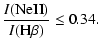 |
(1) |
 -45 000 K,
  cm-3, [N]/[H ] = 11.3e-6, [O]/[H] = 2.6e-4, [Ne]/[H] = 3.2e-5, [S]/[H] = 6e-6, and a metallicity equal to
 ,
we found that the corresponding model from Stasinska (1982) (IDD2) predicts the following ratios:
,
we found that the corresponding model from Stasinska (1982) (IDD2) predicts the following ratios:
 |
|||
|
|||
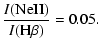 |
(2) |
(assuming a
distance for LMC equal to 52 kpc). This is comparable to the size
of the NeIII/NeII emission if one does not include the extended emission on the south,
outside the dust shell. Therefore, what we have called the HII region core,
is justified here. It also roughly corresponds to the size of the aromatic-feature cavity.
Table 2: Flux in the fine structure lines from ionized gas: first row gives the total fluxes; second row gives fluxes recovered in an aperture comparable to that of ISO-SWS.
We now compare the flux we obtained with previously published, similar data from ISO-SWS.
Giveon et al. (2002) studied the mid-infrared fine structure lines emission
of a sample of galactic and extragalactic HII regions, based on ISO-SWS spectra.
N4A belongs to this sample.
In order to compare our flux with those given in Giveon et al. (2002),
we should extract the flux in the exact same
aperture
as ISO-SWS (
 ). This is not possible with
the ISOCAM data because the pixel size of the images is 6
per pixel, and any rebinning is unwarranted for quantitative calculation
because the pixel size undersamples the PSF at all ISOCAM wavelengths.
Therefore we can extract the flux in a box that is as close as possible
(12
). This is not possible with
the ISOCAM data because the pixel size of the images is 6
per pixel, and any rebinning is unwarranted for quantitative calculation
because the pixel size undersamples the PSF at all ISOCAM wavelengths.
Therefore we can extract the flux in a box that is as close as possible
(12
 )
to the size of the
ISO-SWS aperture centered on the HII region peak. The fluxes we recovered are listed in Table 2.
They agree within 30% with the ISO-SWS fluxes. This is less than the total
uncertainties, calculated taking into account the ISOCAM photometry
uncertainties (
)
to the size of the
ISO-SWS aperture centered on the HII region peak. The fluxes we recovered are listed in Table 2.
They agree within 30% with the ISO-SWS fluxes. This is less than the total
uncertainties, calculated taking into account the ISOCAM photometry
uncertainties ( 10%), uncertainties introduced by the fitting that we
estimate to be 10%, and the ISO-SWS photometric uncertainties (30%).
Thus the total uncertainty is >33% because we did not include
in the calculation the uncertainties due to the
differences in apertures and in pointings that cannot be estimated.
10%), uncertainties introduced by the fitting that we
estimate to be 10%, and the ISO-SWS photometric uncertainties (30%).
Thus the total uncertainty is >33% because we did not include
in the calculation the uncertainties due to the
differences in apertures and in pointings that cannot be estimated.
The agreement between the fluxes we recovered from the ISOCAM data
treated with the continuum-plus feature-fitting technique and the ISO-SWS
fluxes, makes us confident of the reliability of the analysis presented here.
An interesting point is that the ISOCAM NeII+12.7AFE flux accounts for all the flux
in the ISO-SWS spectrum for NeII alone. This suggests that the contribution of the
12.7 m dust emission in the center of the HII region is negligible, as it could have been guessed from the weakness of the other dust features. Therefore, in the HII region core, the NeIII/NeII value we calculated can be considered not as an upper limit but as the actual value that can now be directly compared with the typical ratios of poor metallicity systems
given by Thornley et al. (2000).
The AFE carriers are thought to be polycyclic aromatic hydrocarbons (PAHs),
composed by 50 up to few a hundred atoms, and transiently heated mainly by far UV photons (6-13.6 eV). Their emission intensity is proportional to the product
of the dust density and the ISRF, although it certainly also depends on the hardness of the radiation field but in an
unknown way. The VSGs emit through a mechanism that is intermediate between the stochastic heating typical of PAHs and the thermal equilibrium of the classical big grains. In quiescent regions dominated by the general interstellar field, the dominant VSGs' exciting mechanism is the stochastic heating that results in a smooth continuum peaking between 30-40 m. The emission mechanism becomes closer and closer to a standard thermal behavior when the radiation field gets more intense, such as in star-forming regions and PDRs. In these conditions the VSGs emission spectrum shifts toward shorter
wavelengths, because of their quasi thermal behavior.
Our observations agree completely with the generally accepted picture to explain the dust feature and continuum emission at MIR wavelengths. First, we have shown in Sect. 3.2 that the morphology of the emissions in all dust features, including the NeII+12.7 m if one excludes the HII region core, are very similar to one another, which strongly points towards a common origin and excitation mechanism for all AFEs.
Second, the spectra of N4 A presented in Fig. 2 can be fully explained with
the classical picture illustrated above: in the HII region core the continuum longward
10 m increases simply because VSGs reach the thermal equilibrium regime and get hotter, thus producing a shift in their thermal emission spectrum to wavelengths shorter than 30 m. The opposite happens in quiescent regions, such as the one corresponding to the eastern CO peak outside the HII region, where in fact almost no continuum is detected.
m, we can also investigate how these continua relate to AFEs. The origin of the MIR continuum in star-forming regions, PDRs and diffuse ISM, is a controversial issue. In principle it can be due to hot VSGs whose emission, as we have explained above, shifts into the MIR ISOCAM wavelengths and/or a continuum related to the AFE (maybe simply due to a superposition of
unresolved and weak bands).
Figure 10 shows the 6.7 m "pure'' continuum's contours on the 15 m "pure''
continuum emission image smoothed at the same resolution. Maps have
been aligned on the WOH53 star. The two continua are very similar, thus suggesting a common
origin. On the other hand, their morphology is not totally similar to the dust-feature emission morphology:
they are more centrally peaked than the dust feature emission which forms a cavity.
We therefore conclude that in N4, most of the continuum at MIR wavelengths
arises from VSGs and not from unresolved
weak aromatic bands, even at wavelengths shorter than 10 m. This might not be the case in more quiescent regions
like diffuse ISM, as indicated by the spectrum corresponding to the eastern
CO peak (Fig. 2) where almost no continuum at all has been detected.
![\begin{figure}
\par\includegraphics[width=8.8cm,height=8.8cm,angle=-90,origin=c,clip]{6587fig10.ps}\end{figure}](/articles/aa/full/2007/26/aa6587-06/img57.gif) |
Figure 10:
Image: map from the 15 m "pure'' continuum emission. Contours: "pure'' continuum at
6.7 m smoothed to the 15 mresolution. |
| Open with DEXTER | |
In this section we investigate the reason no AFEs are detected in the HII region core.
The depression of AFE in high ISRF environments has been already
observed in the Milky Way (Cesarsky et al. 1996b,a), Small Magellanic Cloud (Contursi et al. 2000) and in external galaxies (Galliano et al. 2003; Lu et al. 2003; Houck et al. 2004). Recently, a high-resolution study of the 3.3 m AFE (not included in the ISOCAM-CVF wavelength range) with ISAAC at the VLT in NGC253 and NGC1808 (Tacconi-German et al. 2005), has shown that AFE are strongly depressed with respect to the continuum close to where the super star clusters are located. For this reason these authors conclude that the PAHs may be a better tracer of B stars rather than of more massive and earlier spectral type stars, as was already
previously suggested by Peeters et al. (2004) on the basis of the analysis
of a large sample of galactic HII regions observed with ISO.
In the case of N4, almost no AFE is detected at all in the HII region core. This can be explained in principle by three possibilities:
m has a secondary peak in the region
where the ionized gas peaks. This is also visible in the MIR spectrum centered on
SIV and the NeIII peak (Fig. 1 panel b) where almost no AFEs are visible but a
significant continuum is still detectable. This shows that dust can survive in HII cores.
As a consequence, the first two possibilities would imply that AFE carriers, VSGs, and gas are
decoupled, which is physically quite improbable.
We therefore conclude that the dominant mechanism has to be the destruction of AFE
carriers.
The question now is whether dust destruction is due
to the intensity or the hardness of
the radiation field, or both.
Recent results from Wu et al. (2006) and Brandl et al. (2006) have shown
that PAHs EW stay quite constant for a wide range of UV hardness as traced by the NeIII/NeII
ratio and start to slightly decrease only at high (1) NeIII/NeII ratio in
low-metallicity galaxies. More important is the result from Wu et al. (2006)
who show that PAH EW is strongly anti correlated with the product of the radiation field intensity and hardness.
![\begin{figure}
\par\includegraphics[width=7.2cm,height=15cm,angle=-90,origin=c,clip]{6587fig11.ps}\end{figure}](/articles/aa/full/2007/26/aa6587-06/img59.gif) |
Figure 11:
The 7.7 m PAH emission (filled circle), 5 m and 15 m pure continuum
emission (triangles and diamonds, respectively) versus the intensity of the radiation field at 1600 Å ( left panel) and NeIII/NeII ratio that traces the UV hardness ( right panel). Values are above the 3
for the 3 wavelengths. In the right panel, the maximum at 7.7 m and 5 m have been scaled to the maxima at 15 m to ease the relative comparison among the different emissions. |
| Open with DEXTER | |
We tried to investigate this issue as illustrated in Fig. 11. Here both panels show the 7.7 m dust feature emission, the 6.75, and 15 m "pure'' continua emission
as functions of the ISRF energy density at 1600  (left panel) and as functions of the NeIII/NeII ratio (right panel). The energy density at 1600
is in units of the solar neighborhood at the same wavelengths as measured from Gondhalekar Phillips and Wilson
(1980), and it has also been estimated in Contursi et al. (1998). These authors calculated the average emissions at each wavelength in annuli centered on the main ionizing stars till 3
level. The NeIII/NeII ratio is a tracer of the UV hardness. However, as already discussed in Sect. 4.1, at the ISOCAM spectral resolution, the NeII line emission at 12.8 m is blended with the AFE at 12.7 m. Therefore, in the case of N4, this ratio is a lower limit everywhere but in the HII region core, where most of the flux can be ascribed to the NeII emission line alone, as shown in Sect. 4.1. In order to enhance differences among AFE and "pure'' continua emission, we normalized each emission to its maxima.
(left panel) and as functions of the NeIII/NeII ratio (right panel). The energy density at 1600
is in units of the solar neighborhood at the same wavelengths as measured from Gondhalekar Phillips and Wilson
(1980), and it has also been estimated in Contursi et al. (1998). These authors calculated the average emissions at each wavelength in annuli centered on the main ionizing stars till 3
level. The NeIII/NeII ratio is a tracer of the UV hardness. However, as already discussed in Sect. 4.1, at the ISOCAM spectral resolution, the NeII line emission at 12.8 m is blended with the AFE at 12.7 m. Therefore, in the case of N4, this ratio is a lower limit everywhere but in the HII region core, where most of the flux can be ascribed to the NeII emission line alone, as shown in Sect. 4.1. In order to enhance differences among AFE and "pure'' continua emission, we normalized each emission to its maxima.
In Fig. 11 we observe the following behavior:
m continuum and then
by the 15 m continuum.
m is steepper than the drop of the 15 m
continuum, can be interpreted as being the destruction mechanism more efficient
on smaller molecules/grains. This means that: the destruction
mechanism is likely to affect the dust size distribution.
This conclusion may have some important implications for understanding the ISM
physics in dwarf galaxies.
Thornley et al. (2000) find
a NeIII/NeII ratio for IZw40 similar to what we measured in the very center of N4A (roughly a shell of
10 pc in radius) but in a much larger region (
 1000 pc).
This means that the phenomena of destruction in such galaxies must occur in
much larger regions than in normal galaxies. This can be explained
by the fact that dwarf low-metallicity galaxies have an average UV spectrum that is harder
than normal or starburst galaxies, due both to a higher star-formation rate per unit mass and
to the presence of more young and massive star clusters. The UV photons can travel longer
before being absorbed because these systems have less dust (Madden et al. 2006).
All these factors point to a scenario where,
in dwarf galaxies, PAHs have a higher probability of being destroyed than in normal metallicity
environments, leading to an overall change of the galaxy dust size distribution. It
also seems that,
at least in not extremely poor metallicity systems, this phenomenon is more important
than intrinsic modification of chemical dust properties.
1000 pc).
This means that the phenomena of destruction in such galaxies must occur in
much larger regions than in normal galaxies. This can be explained
by the fact that dwarf low-metallicity galaxies have an average UV spectrum that is harder
than normal or starburst galaxies, due both to a higher star-formation rate per unit mass and
to the presence of more young and massive star clusters. The UV photons can travel longer
before being absorbed because these systems have less dust (Madden et al. 2006).
All these factors point to a scenario where,
in dwarf galaxies, PAHs have a higher probability of being destroyed than in normal metallicity
environments, leading to an overall change of the galaxy dust size distribution. It
also seems that,
at least in not extremely poor metallicity systems, this phenomenon is more important
than intrinsic modification of chemical dust properties.
Unfortunately, no firm conclusion can be achieved from this analysis about the possible different roles played by the ISRF intensity and hardness on the dust destruction mechanism. However, weak evidence that the latter has a stronger impact than the ISRF intensity might be deduced by the steeper drop that all dust emissions show with the NeIII/NeII ratio than with the ISRF energy density.
In Sect. 4.2.3 we have shown that dust destruction in N4 could be, at least in part, responsible for the lack of small molecules/grains, already detected on a much larger scale with IRAS in the Magellanic Clouds (Sauvage et al. 1990), although we might have a lower total amount of carbon-based molecule/grains than in Galactic HII regions. On the other hand, we detected strong aromatic features that are very similar to what is observed in the Milky Way's ISM. In this section we analyse the N4 dust features widths and intensity ratios in more detail, in order to understand their physical characteristics and how they compare with similar observations in galactic environments.
m feature of N4 by eye. There is no evidence, at least at the CVF spectral resolution ( /
/
 ), of grain/molecules modifications due to
metallicity resulting in differences in the features' profiles or peak-wavelength shifts. Indeed,
the shape and the relative intensities of the 6.2, 7.7, and 8.6 m features in NGC7023 and N4
almost match perfectly. There is an indication of a relatively lower 11.3 m feature in N4 than in NGC7023, which may be due to a higher level of PAH ionization in N4 . This is plausible, since N4 is more active than NGC7023, even in its PDR region, as shown by the presence of ionized
gas lines that are totally absent in the NGC7023 spectrum (but see more details below in
this section). This confirms the result obtained by Vermeij et al. (2002), who find that the AFEs characteristics of LMC HII regions are similar to those
in the Milky Way.
), of grain/molecules modifications due to
metallicity resulting in differences in the features' profiles or peak-wavelength shifts. Indeed,
the shape and the relative intensities of the 6.2, 7.7, and 8.6 m features in NGC7023 and N4
almost match perfectly. There is an indication of a relatively lower 11.3 m feature in N4 than in NGC7023, which may be due to a higher level of PAH ionization in N4 . This is plausible, since N4 is more active than NGC7023, even in its PDR region, as shown by the presence of ionized
gas lines that are totally absent in the NGC7023 spectrum (but see more details below in
this section). This confirms the result obtained by Vermeij et al. (2002), who find that the AFEs characteristics of LMC HII regions are similar to those
in the Milky Way.
![\begin{figure}
\par\includegraphics[width=12cm,clip]{6587fig12.ps}\end{figure}](/articles/aa/full/2007/26/aa6587-06/img65.gif) |
Figure 12:
Comparison between the spectrum of the galactic region NGC7023 (thick solid line) and the PDR spectrum of N4 (thin solid line), after being continuum-subtracted. NGC7023 spectrum has been scaled to match the 7.7 m feature of N4. |
| Open with DEXTER | |
One of the byproducts of the fitting technique we used are the widths of the
fitted Lorentzian through the entire data cube (i.e. wavelengths).
We can therefore compare what was obtained for N4 with the range of widths that Boulanger
et al. (1998) found for typical galactic regions
(namely  Ophiuchus and NGC7023).
Figure 13 shows this comparison. We calculated the mean widths of N4
obtained by the fit, taking into account all pixels with a signal greater than the 3of the rms at each wavelength (filled circles) and the mean only
for the PDR region (filled triangles),
i.e. the same region shown in panel c of Fig. 2. The open stars
corresponds to the mean FWHM values found for the two galactic regions by Boulanger et al.
(1998). We exclude the 12.7 m feature because we fitted it with a Gaussian
and not with the Lorentzian as in Boulanger et al. (1998).
The agreement is very good at all wavelengths showing that this parameter is also very similar to
what is observed in galactic environments despite the fact that
Ophiuchus and NGC7023
are in ISRF much less intense than N4.
Ophiuchus and NGC7023).
Figure 13 shows this comparison. We calculated the mean widths of N4
obtained by the fit, taking into account all pixels with a signal greater than the 3of the rms at each wavelength (filled circles) and the mean only
for the PDR region (filled triangles),
i.e. the same region shown in panel c of Fig. 2. The open stars
corresponds to the mean FWHM values found for the two galactic regions by Boulanger et al.
(1998). We exclude the 12.7 m feature because we fitted it with a Gaussian
and not with the Lorentzian as in Boulanger et al. (1998).
The agreement is very good at all wavelengths showing that this parameter is also very similar to
what is observed in galactic environments despite the fact that
Ophiuchus and NGC7023
are in ISRF much less intense than N4.
m ratio
is higher in SMCB1-1 than in various ISM regions in the Milky Way. SMCB1-1 ia
a relatively quiescent cloud in the Small Magellanic Cloud (SMC) that is
not associated with on-going star formation.
This difference was
attributed to an enhancement of the C-H bonds with respect to the C-C
bonds,
due to the higher H/C abundance ratio in the SMC than in the Milky Way.
We have produced AFE feature ratio maps
(not shown here), to study their variation across the region. The mean 11.3/7.7 m
(C-H/C-C) value is 0.25 very similar to what was found by Boulanger et. al. (1996) in
-Oph and lower than the value in SMCB1-1 ( 0.8).
A collection of 11.3/7.7 m ratios in different galactic ISM by
Lu et al. (1998) though, clearly indicates that this ratio has a large dispersion
even in similar ISM phases. Therefore, the analysis of the dust-feature ratios
confirms that the dust feature ratio in N4 are comparable to what is found in many other regions.
An important result is that this ratio is quite constant on
the dust shell, indicating that whatever the state of the AFE carriers,
i.e. ionized/neutral, hydrogenated or modified from metallicity,
there are no strong differential effects on the dust feature emission and, therefore
presumably, on the dust conditions, at least at
this spatial resolution (2 pc assuming a LMC distance of 52 kpc).
The changes in the profiles of the dust features and their relative intensities can tell a lot about the physical state of AFEs carriers if associated with PAHs (Pauzat et al. 1997; Le Page et al. 2003; Dartois & D'Hendecourt 1997; Bakes et al. 2001). While the first analysis is impossible at the ISOCAM-CVF spectral resolution, we can analyze how AFE ratios change in N4 as a function of the ISRF intensity.
It is believed that PAHs in PDRs are
mostly ionized. Ionization of PAHs leads to an enhancement of the intensities
of the features arising from the C-C bonds (6.2 and 7.7 m bands in the ISOCAM wavelengths
range) with respect to those arising from the C-H bonds (8.6 m in-plane and out-of
plane (oop) solo, duo, trio, and quatro at 11.3, 11.9, 12.7, and 14 m, respectively).
Dehydrogenation weakens the C-H bonds. Therefore the ratio
between any feature arising from C-H bonds with a feature arising from C-C bonds, should
decrease as ionization and dehydrogenation increase. Figure 14 upper panel shows the 11.3/7.7 m ratio (oop C-H/ vibration C-C) as function of the ISRF. There is a weak decreasing trend indicating that
either ionization or dehydrogenation are perhaps weakly increasing when approaching the HII region core.
On the other hand, there is an increase of this ratio in the very center probably due to the
fact that here smaller molecules (which emit at shorter wavelengths) are destroyed
before the
larger species.
Verstraete et al. (1996) analyzed the oop C-H to in-plane C-C dust-feature
ratio, traced by the (11-13)/(6.2+7.7) m ratio. Theoretical predictions show that this ratio is
2.5 for neutral PAHs and 0.25 for cations. The bottom panel of Fig. 14 shows a similar
ratio where, in place of the 11-13 emission features, we calculated the 11.3+12.8 m
emission. These ratios are well below those predicted for neutral PAHs everywhere in N4,
and very close to the value for ionized PAHs, suggesting that PAHs are ionized in the whole region. Note that in the HII region core, this ratio is an upper limit because the
12.7 m emission is almost entirely due to NeII rather than the AFE at 12.7 m.
We therefore conclude that, if PAHs are the carriers responsible for the dust features,
they are almost totally ionized in N4 , and that their state of ionization and /or dehydrogenation is
constant all over the region. In order to detect the transition between neutral to ionized PAH, one
probably has to trace the
PAH emission from diffuse ISM to active regions.
![\begin{figure}
\par\includegraphics[width=8.5cm,height=8.5cm,origin=c]{6587fig13.ps}\end{figure}](/articles/aa/full/2007/26/aa6587-06/img66.gif) |
Figure 13:
Typical widths of the AFEs obtained by the Lorentzian fit for all N4 (filled circles),
the PDR only (solid triangles), and the typical values found with the same fitting technique by
Boulanger et al. (1998) in
Oph and NGC7023 (open stars). |
| Open with DEXTER | |
![\begin{figure}
\par\includegraphics[width=8.3cm,height=6.5cm,origin=c]{6587fig14.ps}\end{figure}](/articles/aa/full/2007/26/aa6587-06/img67.gif) |
Figure 14:
Different dust feature ratios as functions of the ISRF. Upper panel: the 11.3/7.7 m dust feature ratio, which traces the
[out of plane C-H]/[vibration C-C] ratio. Bottom panel: the (11-13)/(6.2+7.7) m dust feature ratio, which traces the [out of plane C-H]/[in plane C-C] dust features ratio. |
| Open with DEXTER | |
The NIR data presented in this paper unveil at least 7 bright sources. Figure 15 shows a NIR color-magnitude diagram (right panel) and a JHKs color-color (left panel) of stars numbered as in Fig. 5 whose photometry is reported in Table 1. These are shown as filled pentagons in Fig. 15. This figure includes for comparison the IR data obtained for two other LMC star forming regions, 30 Doradus (Rubio et al. 1998) and N11 (Barbá et al. 2003). In each figure's panel the zero age main sequence (ZAMS) is plotted asadopted from Hanson et al. (1997), as well as the extinction tracks for the reddening law of Rieke & Lebofsky (1985).
Note that the extinction for star
is likely to be much higher
than the average, as this star falls in the dust shell and on the 15 m
continuum peak. Four N4 IR sources show colors that are consistent
with reddened main sequence O stars, while the other three are IR objects.
From Fig. 15 we can conclude the following:
and
are probably moderately reddened main-sequence
O stars with
 .
They are the main ionizing stars
responsible for the HII region (Heydari-Malayeri & Lecavelier des Etangs 1994)
and labeled as A and B in Fig. 1.
.
They are the main ionizing stars
responsible for the HII region (Heydari-Malayeri & Lecavelier des Etangs 1994)
and labeled as A and B in Fig. 1.
 and
and  are highly reddened main-sequence O stars with
 .
They do not have optical counterparts.
.
They do not have optical counterparts.
,
,
and
have large IR excess and their colors
are not that of reddened young main-sequence stars. They lie on the border
of the molecular cloud seen in CO (Contursi et al. 1998) and at the edge of
the cavity formed by the
ionizing stars. These three objects have J band brightness corresponding
to Class I and /or Herbig Ae/Be-object candidates (see Brandner et al. 2001).
Stars  and
have the largest IR excess of the sample. They have the IR characteristics
of massive young stellar objects (YSOs) similar to N122 in 30Dor.
Object
is an extended object that shows nebulosity around and a second
red component.
and
have the largest IR excess of the sample. They have the IR characteristics
of massive young stellar objects (YSOs) similar to N122 in 30Dor.
Object
is an extended object that shows nebulosity around and a second
red component.
![\begin{figure}
\par\includegraphics[width=9cm,height=18cm,angle=-90]{6587fig15.eps}\end{figure}](/articles/aa/full/2007/26/aa6587-06/img73.gif) |
Figure 15:
NIR color-magnitude ( left) and color-color ( right) diagrams of
N4 with the IR sources shown as red filled points.
For comparison we include the 30 Doradus IR sources as open
circles and the N11 IR sources as open squares.
In the color-magnitude diagram the upper zero-age main sequence
between O3 V and O9 V corresponds to a distance modulus of 18.6 and is
indicated by a dashed line. The reddening track for a normal O3 V
star is plotted with a dotted line and extends to
 mag.
In the color-color diagram, the main-sequence locus from O3 V to M2 V and
the cool-giant branch are indicated by a solid line. The reddening tracks
for normal O3 V and cool giant stars are plotted as dashed lines,
with crosses indicating mag.
In the color-color diagram, the main-sequence locus from O3 V to M2 V and
the cool-giant branch are indicated by a solid line. The reddening tracks
for normal O3 V and cool giant stars are plotted as dashed lines,
with crosses indicating
 and 20 mag. Sources 1, 4, and 7 show IR excesses that
cannot be explained by reddening.
and 20 mag. Sources 1, 4, and 7 show IR excesses that
cannot be explained by reddening. |
| Open with DEXTER | |
4
This is the brightest member of a small cluster that is of particular interest because
it corresponds to
a bright point-source emission in the hot dust pure continuum emission. Its
position on the NIR color-color and color-magnitude diagram is similar to that of
IR sources found in 30 Doradus, i.e. source W30, N122, and N126 (Rubio et al. 1998).
These 30 Doradus sources were resolved into multiple, compact,
young massive systems from high-resolution
HST/NICMOS observations, with a dominant IR source (Walborn et al. 2002;
Walborn et al. 1999). The IR color of star #4 can be either
interpreted as an early O type star with AV = 20 and with an IR K excess of about 4 magnitudes or a multiple object containing several ZAMS O3 stars
extinguished by 20 mag. In fact, the star profile is wider than the point-spread function derived for the stars in the
image, which could be a hint of
the presence of a much redder component, thus favoring the hypothesis of a multiple system.
We can check the results on the nature of star
obtained from NIR photometry,
by comparing of our ISOCAM and NIR data with those
published by the ISOGAL team (Felli et al. 2002). The LW2 and LW3 broad band magnitudes
obtained through PSF fitting are: m(LW2) = 6.1 and
m(LW3) = 3.4. Then, the position of star 4 on the [15]-[7]-[15] magnitude-color diagram published by Felli et al. (2002) falls exactly in the region occupied by YSOs.
A third indication that this object indeed contains a YSO, is given by its
CVF spectrum shown in Fig. 16. It shows a deep silicate absorption at 10 m that suggests this is a highly embedded source. This is also confirmed by the fact that star
corresponds to the strongest peak of the 15 m pure-continuum emission. In the spectrum two weak absorption features are also visible at 13 m 15m.
We checked whether they are due to memory effects of the detector after a glitch. The result is that, most
likely, the feature at 13 m is fake but that at 15 m seems real.
If this is so, it could be associated with the solid CO2 bending mode at 15.2 m or to gas-phase CO2 at 15.0 m. Both types of emission are detected in YSOs
(van Dishoeck 2004). The fact that the overall spectrum shown
in Fig. 16 does not look like a typical YSO MIR spectrum (van Dishoeck 2004) could be due to the ISO spatial resolution; the ISOCAM beam is in fact sufficiently large (2 pc at the LMC distance) to include a considerable amount of ISM surrounding the YSO, as
suggested by the presence of AFEs. Since this feature, together with the solid CO2 stretch mode at 4.25 m and H2O at 3 m (out of our wavelength range), has been observed at a higher resolution with ISO-SWS in some ultra compact HII regions (Roelfsema et al. 1998), this would support our hypothesis that star 4 is an embedded YSO.
![\begin{figure}
\includegraphics[angle=-90,width=8.4cm,clip]{6587fig16.ps}\end{figure}](/articles/aa/full/2007/26/aa6587-06/img74.gif) |
Figure 16:
ISOCAM CVF spectrum of star 4 corresponding to the 15 m pure continuum peak. |
| Open with DEXTER | |
 photometry data of the
HII region complex N4 in the Large Magellanic Clouds.
The analysis had two principal aims: 1) to relate dust, gas and stellar content;
2) to look for effects of the lower-than-galactic metallicity on the dust features.
The main conclusions are the following.
photometry data of the
HII region complex N4 in the Large Magellanic Clouds.
The analysis had two principal aims: 1) to relate dust, gas and stellar content;
2) to look for effects of the lower-than-galactic metallicity on the dust features.
The main conclusions are the following.
Acknowledgements
A.C. wishes to thank D. Lutz for his useful comments, which significantly improved this paper.
R.H.B. acknowledges support from FONDECYT (Chile) No. 1050052