A&A 469, 189-199 (2007)
DOI: 10.1051/0004-6361:20065523
Physical properties of a very diffuse HI structure at high Galactic latitude
M.-A. Miville-Deschênes1,2 - P. G. Martin2
1 - Institut d'Astrophysique Spatiale, bâtiment 121, Université Paris-XI, 91405 Orsay, France
2 - Canadian Institute for Theoretical Astrophysics, 60 St-George st, Toronto, Ontario, M5S 3H8, Canada
Received 28 April 2006 / Accepted 27 February 2007
Abstract
Aims. The main goal of this analysis is to present a new method to estimate the physical properties of diffuse cloud of atomic hydrogen observed at high Galactic latitude.
Methods. This method, based on a comparison of the observations with fractional Brownian motion simulations, uses the statistical properties of the integrated emission, centroid velocity and line width to constrain the physical properties of the 3D density and velocity fields, as well as the average temperature of H I.
Results. We applied this method to interpret 21 cm observations obtained with the Green Bank Telescope of a very diffuse HI cloud at high Galactic latitude located in Firback North 1. We first show that the observations cannot be reproduced solely by highly-turbulent CNM type gas and that there is a significant contribution of thermal broadening to the line width observed. To reproduce the profiles one needs to invoke two components with different average temperature and filling factor. We established that, in this very diffuse part of the ISM, 2/3 of the column density is made of WNM and 1/3 of thermally unstable gas (
 K). The WNM gas is mildly supersonic (
 )
and the unstable phase is definitely sub-sonic (
)
and the unstable phase is definitely sub-sonic (
 ). The density contrast (i.e., the standard deviation relative to the mean of density distribution) of both components is close to 0.8. The filling factor of the WNM is 10 times higher that of the unstable gas, which has a density structure closer to what would be expected for CNM gas. This field contains a signature of CNM type gas at a very low level (
 )
which could have been formed by a convergent flow of WNM gas.
)
which could have been formed by a convergent flow of WNM gas.
Key words: ISM: clouds - radio lines: ISM - turbulence - methods: data analysis
Neutral atomic hydrogen (H I) is the most abundant phase of the interstellar medium (ISM) and
it plays a key role in the cycle of interstellar matter from hot and diffuse plasma to the formation of stars.
The 21 cm transition has been used since the 1950s (Muller & Oort 1951; Ewen & Purcell 1951)
to study the properties of Galactic H I but some of its basic properties are still unknown.
The general picture of interstellar H I, first modeled by Field et al. (1969)
(see also Wolfire et al. 2003,1995), is of spatially confined
cold structures (CNM - Cold Neutral Medium,
 K)
surrounded by a more diffuse and warmer phase (WNM - Warm Neutral Medium,
K)
surrounded by a more diffuse and warmer phase (WNM - Warm Neutral Medium,
 K). The heating and cooling mechanisms in the diffuse ISM
are such that these two phases can co-exist in pressure equilibrium.
On the other hand the exact physical conditions in which the thermal
transition from WNM to CNM occurs - most probably related to a local increase of the density and to the
temperature dependence of the cooling function - are still unclear.
Turbulence plays a dominant role in the kinematics and density structure of H I:
both phases (CNM and WNM) have a self-similar density and velocity structure and
an energy spectrum compatible with a turbulent flow (Miville-Deschênes et al. 2003a).
K). The heating and cooling mechanisms in the diffuse ISM
are such that these two phases can co-exist in pressure equilibrium.
On the other hand the exact physical conditions in which the thermal
transition from WNM to CNM occurs - most probably related to a local increase of the density and to the
temperature dependence of the cooling function - are still unclear.
Turbulence plays a dominant role in the kinematics and density structure of H I:
both phases (CNM and WNM) have a self-similar density and velocity structure and
an energy spectrum compatible with a turbulent flow (Miville-Deschênes et al. 2003a).
With the advent of more sensitive and higher angular resolution observations,
new challenges have come up (e.g., tiny scale atomic structures - TSAS -,
self-absorption structures and thermally unstable gas).
An important advance came recently from the Millennium Arecibo Survey
conducted by Heiles & Troland (2003a,b). These authors claimed that a significant fraction ( 30%)
of the H I is in a thermally unstable regime. This observational evidence seems to be
in accord with recent numerical simulations devoted to the study of the H I thermal
instability (Audit & Hennebelle 2005).
30%)
of the H I is in a thermally unstable regime. This observational evidence seems to be
in accord with recent numerical simulations devoted to the study of the H I thermal
instability (Audit & Hennebelle 2005).
Here we contribute to this effort by analyzing 21 cm observations
of a very diffuse high-latitude region of the Galactic ISM.
The main advantage of studying the properties of weak H I feature
is that no modeling of radiative transfer is required to
interpret the brightness observed which can be converted directly in H I column density.
Furthermore the 21 cm emission of such high latitude regions
do not suffer from velocity crowding which facilitates the decomposition of the spectra.
Our goal is to study the dynamical and thermo-dynamical properties of the neutral gas in
a diffuse region of the solar neighborhood.
Unlike previous analysis of 21 cm spectra we do not use a combination of emission and absorption
observations to study the thermal and kinematical properties of the H I
but instead we use the statistical properties of the emission on the plane of the sky
to infer the three-dimensional (3D) properties of the gas. In particular we exploit the
idea that variations of the value of the velocity centroid on the plane of the
sky can be used to constrain the amplitude of the turbulent motions on the line of sight
and therefore put limits on the average thermal broadening over the field.
In Sect. 2 we describe the 21 cm observations used for this analysis and
some quantities computed from them that will be used further to infer the H I physical properties.
Then we describe (Sect. 3) the method used to simulate realistic 21 cm observations
using fractional Brownian motion and to test the hypothesis of an isothermal and turbulent H I.
In Sect. 4 we estimate the H I physical properties in the hypothesis
of a two components model, and we conclude in Sect. 5.
2 The HI emission
The present study focuses on a very diffuse H I filament located
in the extra-galactic window known as Firback North 1 (FN1) (Dole et al. 2001) located
at Galactic coordinates (
 ,
,
 ).
The 21 cm H I emission observations used in this analysis
were obtained with the Green Bank Telescope (GBT).
The size of the sub-field of FN1 observed is
).
The 21 cm H I emission observations used in this analysis
were obtained with the Green Bank Telescope (GBT).
The size of the sub-field of FN1 observed is
 ,
the half-power beam width is 9
,
the half-power beam width is 9
 2 and the spectral
coverage spans the range from -169 km s-1 to 69 km s-1, with a channel width
of
2 and the spectral
coverage spans the range from -169 km s-1 to 69 km s-1, with a channel width
of
 km s-1 and a spectral resolution of 2.5 km s-1. The noise level in a channel is 0.035 K.
The 21 cm emission of this small patch of the sky is characterized by a single
spectral component at local velocities typical of H I emission at high Galactic latitude,
with a narrow core and extended wings (see Fig. 1). The GBT has
also detected a faint High-Velocity Cloud (HVC) centered at  km s-1. The average H I
column density of the HVC over the field is
km s-1. The average H I
column density of the HVC over the field is
 cm-2 with a maximum
column density
cm-2 with a maximum
column density![[*]](/icons/foot_motif.gif) of
of
 cm-2.
The 21 cm spectra are also characterized by a weak (0.1-0.2 K)
Intermediate Velocity Cloud (IVC) component centered at
cm-2.
The 21 cm spectra are also characterized by a weak (0.1-0.2 K)
Intermediate Velocity Cloud (IVC) component centered at  km s-1
(see Fig. 1-bottom).
km s-1
(see Fig. 1-bottom).
![\begin{figure}
\par\includegraphics[width=7.5cm,clip]{5523_f01.eps}
\end{figure}](/articles/aa/full/2007/25/aa5523-06/Timg33.gif) |
Figure 1:
GBT average 21 cm spectrum of the FN1 field
shown in linear-linear ( top) and linear-log ( bottom) scales. The spectrum
in linear-log scale helps to highlight the faint IVC ( km s-1) and HVC ( km s-1) components. |
| Open with DEXTER |
![\begin{figure}
\par\includegraphics[width=15.5cm,clip]{5523_f02.ps}
\end{figure}](/articles/aa/full/2007/25/aa5523-06/Timg34.gif) |
Figure 2:
H I column density ( left),
centroid velocity ( middle) and velocity dispersion ( right column) of the
local H I gas in FN1. |
| Open with DEXTER |
Table 1:
Statistical properties of the local H I emission.
The 21 cm emission profiles observed are shaped by density, velocity
and thermal fluctuations of interstellar neutral hydrogen on the line of sight.
In this section we define quantities that can be deduced from the observations
and that will be used further to constrain the physical properties
of the region observed.
In the optically thin limit where
H I self-absorption is negligible (Spitzer 1978), the brightness
temperature (in K) observed at position (x,y) on the sky and in the velocity range
between u and
 is:
is:
 |
|
|
(1) |
where n(x,y,z) and v(x,y,z) are the three-dimensional
density and velocity fields.
The term
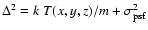 represents the thermal broadening of the 21 cm line
and the instrumental broadening;
T(x,y,z) is the 3D temperature field, B(x,y) is the instrumental beam,
H is the depth of the line of sight, m is the hydrogen atom mass and k is the
Boltzmann constant.
Even when radiative transfer effects are negligible, like for the diffuse
filament observed here, the 21 cm emission depends in a complex manner on
the density, velocity and temperature distribution on the line of sight.
In addition several studies showed (e.g., Miville-Deschênes et al. 2003a)
that the H I density and velocity
distributions are self-similar, which reflect the impact
of turbulence on the interstellar medium dynamics.
represents the thermal broadening of the 21 cm line
and the instrumental broadening;
T(x,y,z) is the 3D temperature field, B(x,y) is the instrumental beam,
H is the depth of the line of sight, m is the hydrogen atom mass and k is the
Boltzmann constant.
Even when radiative transfer effects are negligible, like for the diffuse
filament observed here, the 21 cm emission depends in a complex manner on
the density, velocity and temperature distribution on the line of sight.
In addition several studies showed (e.g., Miville-Deschênes et al. 2003a)
that the H I density and velocity
distributions are self-similar, which reflect the impact
of turbulence on the interstellar medium dynamics.
One of the challenges of the analysis of 21 cm emission is to
disentangle density, velocity and temperature
fluctuations, using quantities averaged along the line of sight.
To constrain the properties of the density, velocity and
temperature of the gas in 3D we use the integrated emission map
 ,
the centroid velocity map C(x,y) and the velocity dispersion
map
,
the centroid velocity map C(x,y) and the velocity dispersion
map
 .
.
In the optically thin limit, the integrated emission is proportional to
the column density (in cm-2), which is simply
the integral of the density fluctuations on the line of sight:
The velocity centroid map is the average of the velocity as
weighted by the brightness temperature at each position on the sky:
 |
(4) |
In the optically thin limit, the velocity centroid map is equal to
the following expression:
 |
(5) |
The velocity centroid map is thus the density-weighted average velocity
on each line of sight. It depends non-linearly on the density and
velocity distribution in 3D, but not on the gas temperature.
The second velocity moment, the velocity dispersion map, is the velocity dispersion
on the line of sight. It is computed the following way:
 |
(6) |
This quantity is more affected by instrumental noise but it allows one to
estimate the gas temperature. It is related to the 3D quantities
by the following equation:
 |
(7) |
where
 is the instrumental broadening due to the finite spectral resolution,
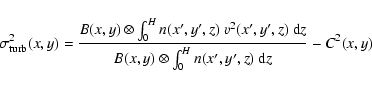 |
(8) |
is the broadening from turbulent motions and
 |
(9) |
is the thermal broadening.
The H I integrated emission, centroid velocity and velocity dispersion maps of the FN1 sub-field,
computed respectively using Eqs. (2), (4) and (6),
are shown in Fig. 2.
These three maps were computed by using only data points with a value higher than 2 times the noise level
in a single channel.
The average and standard deviations of these three maps
are given in the first row of Table 1 (labeled "Total'').
To estimate the uncertainties listed we have computed
the same three maps by selecting data points with a value higher than 1 time and 3 times the noise level.
Without any 21 cm absorption measurements in that field,
our idea was to use the statistical properties of the projected quantities
together with the spectral shape of the 21 cm line (Fig. 1)
as the basis for some constraints on the level of turbulence.
More specifically we wanted to estimate the relative contributions
of the temperature and turbulence fluctuations to the line profile and to study
if the observed profiles can be the result of relatively cool gas with strong turbulent motions.
As stated previously the statistical quantities given in the first row of Table 1 represent
a mixture of density, velocity and temperature fluctuations on the line-of-sight.
They depend on the statistical properties
of the 3D density, velocity and temperature fields, and of course on the depth of the line-of-sight.
In this section we describe how we produced simulated GBT observations to
constrain the properties of the 3D density n and velocity v fields
as well as the average kinetic temperature of the gas.
One solution to simulate GBT observations would be to use
hydrodynamics or magneto-hydrodynamics simulations
of the H I that would include the thermal instability (e.g., Audit & Hennebelle 2005).
Such simulations give a close representation of the
actual physics. On the other hand they do not provide a direct handle on
the power spectrum of the density and velocity, nor on the average
density and velocity, or on the axis ratio of the cloud (i.e., depth over extent
on the sky). Finally, doing such simulations is computationally intensive and it is not
practical to make a large number of them to estimate statistical variance
of the results.
To have explicit control on the statistical properties of the fields and
the axis ratio of the cloud, and to be able to make a large number of realizations,
we chose to simulate 3D velocity and density fields
using fractional Brownian motion (fBm), which are Gaussian random fields
with a given power spectrum (Miville-Deschênes et al. 2003b).
To simulate the GBT observation
we made the assumptions that we are observing a single H I cloud
on the line of sight, that its 3D density and velocity fields
are self-similar and characterized by power law power spectra
and that the gas structure and kinematics are statistically isotropic in three dimensions.
In this framework the statistical properties (mean and variance) of the observed
quantities (
,
C(x,y) and
)
will depend on a relatively limited number of parameters:
the index of the density and velocity power spectra
( and
and  ), the 3D average density
 ,
the
3D density dispersion
,
the
3D density dispersion  ,
the 3D average velocity
,
the 3D average velocity
 ,
the 3D velocity
dispersion
,
the 3D velocity
dispersion  ,
the average gas temperature
,
the average gas temperature
 ,
the cloud depth along the line of sight H and the distance to the cloud D.
In fact we reached the conclusion that for given value
of ,
and to reproduce given
,
the cloud depth along the line of sight H and the distance to the cloud D.
In fact we reached the conclusion that for given value
of ,
and to reproduce given
 and
and  ,
there is a close one to one
relation between the required ratio
,
there is a close one to one
relation between the required ratio
 and
the cloud axis ratio H/L, where L is the physical size of the field on the plane of the sky,
that is independent of the distance D to the cloud.
The model
and observed
and
the cloud axis ratio H/L, where L is the physical size of the field on the plane of the sky,
that is independent of the distance D to the cloud.
The model
and observed  are also independent of distance and
only depend on the density contrast
.
It is thus convenient to produce simulations for a constant distance D (we adopted 100 pc)
but with a variable H/L.
are also independent of distance and
only depend on the density contrast
.
It is thus convenient to produce simulations for a constant distance D (we adopted 100 pc)
but with a variable H/L.
One important ingredient of our analysis is the
power spectrum of the density and velocity fluctuations in 3D.
Miville-Deschênes et al. (2003b) showed that the power spectrum of 21 cm
integrated emission and of the centroid velocity fields can be used to estimate
the spectral indexes
and
of the 3D density and velocity
fields.
Miville-Deschênes et al. (2003a)
used this property to estimate the power spectrum of velocity fluctuations
in 3D of a high-latitude cloud.
Such power spectra cannot be computed solely with the GBT observations which
have a very limited spatial dynamic range (from 9.2' to 1.1 ). Instead we
used the 21 cm Leiden/Dwingeloo data (Burton & Hartmann 1994) of a
). Instead we
used the 21 cm Leiden/Dwingeloo data (Burton & Hartmann 1994) of a
 region centered on the GBT field. The integrated emission
and centroid velocity maps extracted from these data are shown in
Fig. 3 together with their respective power spectrum.
We have taken great care here to select velocity channels with emission
from the local gas only. The power spectra of the integrated emission and
centroid velocity are both well fitted by a slope of
region centered on the GBT field. The integrated emission
and centroid velocity maps extracted from these data are shown in
Fig. 3 together with their respective power spectrum.
We have taken great care here to select velocity channels with emission
from the local gas only. The power spectra of the integrated emission and
centroid velocity are both well fitted by a slope of
 on scales
smaller than
on scales
smaller than  .
At larger scales the power spectra flatten slightly
which could be partly due to an effect of the tangent plane projection.
It could also be an indication that we have reached the angular scales on
the sky that correspond to the depth of the medium (i.e., the transition from 2D to 3D) (Miville-Deschênes et al. 2003b; Elmegreen et al. 2001; Ingalls et al. 2004).
.
At larger scales the power spectra flatten slightly
which could be partly due to an effect of the tangent plane projection.
It could also be an indication that we have reached the angular scales on
the sky that correspond to the depth of the medium (i.e., the transition from 2D to 3D) (Miville-Deschênes et al. 2003b; Elmegreen et al. 2001; Ingalls et al. 2004).
It is interesting to note at this point that the spectral indices measured here are
compatible with what has been measured in another high-latitude field
by Miville-Deschênes et al. (2003a) also using 21 cm observations.
In the GBT simulations we consider that the power spectrum indices of the
3D density and velocity fields are
 following
what is observed at larger scales.
following
what is observed at larger scales.
![\begin{figure}
\par\includegraphics[width=7.8cm,clip]{5523_f03.ps}
\end{figure}](/articles/aa/full/2007/25/aa5523-06/Timg82.gif) |
Figure 3:
Power spectrum analysis of
the H I emission in the FN1 region. Top: 21 cm integrated emission
( left) and centroid velocity map ( right) obtained with the Leiden/Dwingeloo
data (Burton & Hartmann 1994). The two maps were computed using velocity channels
from -86.7 km s-1 to 47.2 km s-1 to avoid contamination by high-velocity clouds.
Bottom: power spectrum of the
above maps with corresponding power law fit. Both power spectra
were divided by the instrumental response
of the Leiden antenna (beam of 30 arcmin FWHM). |
| Open with DEXTER |
We made simulations of n(x,y,z) and v(x,y,z) using fBm (Miville-Deschênes et al. 2003b)
with
.
We performed 150 simulations each for 20 different values of the H/L ratio
(from 0.05 to 10, equally spaced logarithmically).
The size of our cubes were from
 pixels (for H/L=0.05)
to
pixels (for H/L=0.05)
to
 pixels (for H/L=10).
To minimize the effect of periodicity of fBm objects
each cube of size
pixels (for H/L=10).
To minimize the effect of periodicity of fBm objects
each cube of size
 was in fact extracted at a random position
from a larger fBm cube of 10243 pixels.
For each of these 3000 simulations the n(x,y,z) and v(x,y,z) fields were constructed independently
with no correlation between them.
was in fact extracted at a random position
from a larger fBm cube of 10243 pixels.
For each of these 3000 simulations the n(x,y,z) and v(x,y,z) fields were constructed independently
with no correlation between them.
Each pair of (n, v) cubes were then combined to produce a brightness temperature cube
 (using Eq. (1)) on the grid of the GBT observation
(
(using Eq. (1)) on the grid of the GBT observation
(
 pixels times 116 channels of width
km s-1)
and taking into account the spatial and spectral instrumental response of the GBT.
The pixel size in our original
pixels times 116 channels of width
km s-1)
and taking into account the spatial and spectral instrumental response of the GBT.
The pixel size in our original
 cube is 1.1' which has to be compared
with the GBT beam of 9'. We have tested that this was enough spatial resolution to take
into account fluctuations at scales smaller than the beam.
cube is 1.1' which has to be compared
with the GBT beam of 9'. We have tested that this was enough spatial resolution to take
into account fluctuations at scales smaller than the beam.
To normalize the cubes n and v
we computed the column density (
)
and centroid velocity (C(x,y)) maps
from the simulated
using Eqs. (2) and (4).
For the velocity, the normalized field is simply
We find A and B such that our simulation reproduces the observed values
 and
and  .
.
For the density field the normalization process is more complicated because it has to be positive everywhere.
Being Gaussian, fBm fields are limited to contrast lower than 1/3 as 99% of the fluctuations are within 3
of the mean. Interstellar density fields
are expected to have higher contrast than 1/3 which calls for a modification of the
usual fBm. To produce positive and higher-contrast fBm we use the following method
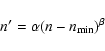 |
(11) |
where
 is the minimum value of n.
We estimate
is the minimum value of n.
We estimate  and
and  so that the simulated column density map has the same
and
as the observations.
We have tested that this modification of the fBm does not impact on its power spectrum.
An example of a simulated 3D density field is shown in Fig. 4.
so that the simulated column density map has the same
and
as the observations.
We have tested that this modification of the fBm does not impact on its power spectrum.
An example of a simulated 3D density field is shown in Fig. 4.
This method is very similar to the exponentiation method described by Elmegreen (2002) and Brunt & Heyer (2002)
but it seems closer to the statistical properties of interstellar emission.
At a given scale, our method produces a fluctuations distribution with a larger FWHM and less
extreme values (lower skewness and kurtosis)
which is closer to the brightness fluctuations of dust emission at 100  m
for instance (Miville-Deschenes et al. 2007).
m
for instance (Miville-Deschenes et al. 2007).
![\begin{figure}
\par\includegraphics[width=7cm,clip]{5523_f04.ps}
\end{figure}](/articles/aa/full/2007/25/aa5523-06/Timg97.gif) |
Figure 4:
Simulation of a
 density field with
 and
and
 .
The figure shows the
density fluctuations at surface of three sides of the cube. .
The figure shows the
density fluctuations at surface of three sides of the cube. |
| Open with DEXTER |
For each normalized simulation we obtain directly a set of quantities that are independent of the
distance D to the cloud: the density contrast (
),
the standard deviation of the velocity field ()
and the turbulent
broadening on each line of sight (
 using Eq. (8)).
By comparing the average
using Eq. (8)).
By comparing the average
 to the observed averaged line width
 (both quantities being averaged over the field) one can estimate the average gas temperature
 |
(12) |
and the average Mach number at the scale of the whole cloud
 |
(13) |
where
is the standard deviation of the 3D velocity field v. These are also independent
of D.
Assuming a distance D to the cloud,
 where
where  is the angular size of the GBT field (
 )
one can also compute the average gas density
)
one can also compute the average gas density
 |
(14) |
and the average pressure
 .
.
![\begin{figure}
\par\includegraphics[width=7.2cm,clip]{5523_f05.ps}
\end{figure}](/articles/aa/full/2007/25/aa5523-06/Timg113.gif) |
Figure 5:
One component model: physical parameters (density contrast
 ,
average turbulent broadening ,
average turbulent broadening
 ,
average temperature ,
average temperature
 ,
average Mach number ,
average Mach number
 )
as a function of the axis ratio H/L. Also given are the average density
and average pressure )
as a function of the axis ratio H/L. Also given are the average density
and average pressure
 for distances to the cloud of 75 pc (solid), 150 pc (dotted) and 450 pc (dashed). for distances to the cloud of 75 pc (solid), 150 pc (dotted) and 450 pc (dashed). |
| Open with DEXTER |
The results of these normalized simulations are compiled in Fig. 5.
On the top four panels are
the density contrast
,
the turbulent broadening
 ,
the average temperature
- in units of 1000 K - and the average Mach number
,
as a function of the axis ratio H/L. The solid line is from the average
for the 150 realizations done at a given H/L and
the error bars represent the standard deviation.
,
the average temperature
- in units of 1000 K - and the average Mach number
,
as a function of the axis ratio H/L. The solid line is from the average
for the 150 realizations done at a given H/L and
the error bars represent the standard deviation.
The bottom two panels of Fig. 5
give the average density and pressure as a function
of H/L and for three distances D=75, 150 and 450 pc.
In the absence of any measurement of the distance to the cloud we have
estimated a range and a most probable value.
Lockman & Gehman (1991) showed that the scale height (HWHM) of H I is 125 pc in the solar neighborhood.
At the Galactic latitude of FN1 (
)
we can consider that most of the clouds lies
within 150 pc ( of the scale height) from the Sun, and
that 99% of the H I is closer than 450 pc. In addition, using a mapping of NaI absorption
against local stars Sfeir et al. (1999) showed that there is very little neutral
gas at a distance <75 pc from the Sun.
So we consider 75 and 450 pc as the lower and upper limit on distance and 150 pc as the most
probable value.
of the scale height) from the Sun, and
that 99% of the H I is closer than 450 pc. In addition, using a mapping of NaI absorption
against local stars Sfeir et al. (1999) showed that there is very little neutral
gas at a distance <75 pc from the Sun.
So we consider 75 and 450 pc as the lower and upper limit on distance and 150 pc as the most
probable value.
As expected the required density contrast and the turbulent broadening increases
with H/L. The brightness fluctuations average out as the depth of the line
of sight increases, and so stronger density contrasts are needed
to explain the observed level of column density fluctuations ().
The same is true for the turbulent broadening: for deeper clouds
the central limit theorem tends to wash out the differences of centroid velocity
between two adjacent lines of sight, and therefore, to explain a given
level of fluctuations in the centroid velocity map ( ), one needs
stronger turbulent motions.
), one needs
stronger turbulent motions.
Another important way of analyzing the results of these simulations is to inspect the shape of
simulated 21 cm spectra. In Fig. 6 we show typical
simulated 21 cm spectra, averaged over the
field,
for different values of H/L. On the top row the spectra represent what would be
observed with no thermal and instrumental broadenings: the spectral structure is only due to
turbulent motions. As discussed, with the increase of the depth of the cloud
the spectra get wider but also smoother due to the averaging of density and velocity
fluctuations on the line of sight.
Compared to the GBT observations in the bottom row, this turbulent line profile is very narrow.
For this specific field, we have to reject the hypothesis
that the observed spectra is a product of highly turbulent cold gas: the fluctuations seen
in the centroid velocity maps are to small for that.
On the bottom row, we show the simulated spectra when thermal and instrumental
broadening are added (dotted line)
to reproduce the observed line width; these curves have the same velocity dispersion,
as defined by Eq. (6), as the average GBT spectrum (solid line).
The most important result here is the fact that the simulated spectra do not
reproduce well the observations. The simulated spectra in the bottom row are very close to Gaussian:
the turbulent contribution being relatively small, strong thermal broadening (
T=13 000-15 000 K)
is needed to get to the
observed. More specifically the simulated spectra
failed to reproduce the peaked central part and the extended wings of the observed spectrum.
The conclusion drawn from this analysis is that gas at a single hot temperature
cannot reproduce the observed spectra adequately either.
The fact that the observed spectra have a relatively narrow core and extended wings
is instead suggestive of two components, one colder than the other.
In the following we explore this possibility.
![\begin{figure}
\par\includegraphics[width=16cm,clip]{5523_f06.ps}
\end{figure}](/articles/aa/full/2007/25/aa5523-06/Timg116.gif) |
Figure 6:
Comparison of simulated and observed spectra.
Top: typical simulated spectra, averaged over the
field,
for 5 values of the axis ratio H/L. These spectra represent only the turbulent part of the
broadening. Bottom: observed average GBT spectrum (solid line) compared to the
average simulated spectra (dotted line) in which thermal and instrumental broadening
were added to the turbulence to reproduce the observed
 . . |
| Open with DEXTER |
4 Two components model
4.1 Gaussian decomposition
Many studies of 21 cm observations rely on a Gaussian decomposition of the spectra and make the
assumption that each Gaussian component is a physical structure (a cloud)
on the line of sight (e.g., Heiles & Troland 2003a).
On the other hand, it is not always conceptually easy to reconcile such a decomposition
with the fact that the interstellar medium
has structure at all scales. In fact the Gaussian decomposition is
facilitated by the significant thermal broadening of the 21 cm line
and by the instrumental response (spectral and spatial) which often have quasi-Gaussian
functions. In addition, with an increase of the path length along a line of sight, the central limit
theorem also tends to bring the velocity and density fluctuations closer to a Gaussian distribution.
As stated by Heiles & Troland (2003b) the Gaussian fitting procedure is also subjective and non-unique.
To make a Gaussian decomposition of the data we used a constrained fit method
that 1) limits the parameter space (centroid and sigma)
for each component and 2) iterates to find a spatially smooth solution for N,
and ,
which reduces slightly the subjectivity of the fit and certainly increases its robustness.
The spectra are in fact very well fitted by a sum of three Gaussian components,
a wide one typical of the Warm Neutral Medium (WNM),
a narrow one representing colder gas and a very weak one at intermediate velocity.
Typical fits are preseted in Fig. 7.
The intermediate velocity component is very weak (average column density is
 cm-2,
maximum is
cm-2,
maximum is
 cm-2). It probably does represent a physically
distinct component and will not be used in the following analysis.
The resulting column density, velocity centroid and velocity dispersion found
for the two local components are shown in Fig. 8.
The uncertainty maps computed using the uncertainties on the fit parameters are
shown for each quantity in Fig. 9.
The statistical properties of the integrated emission, centroid
velocity and velocity dispersion of the narrow and wide components are given in Table 1.
The uncertainty on these statistical properties were computed using 1000 realizations of each parameter
maps shown in Fig. 8 to which we have added a random value at each position.
The random value was taken from a Gaussian distribution of width given by the uncertainty on the
fit parameters given in Fig. 9.
The uncertainties given in Table 1 are the variance (for the average) or the
bias (for the standard deviation) of the resulting statistical properties.
cm-2). It probably does represent a physically
distinct component and will not be used in the following analysis.
The resulting column density, velocity centroid and velocity dispersion found
for the two local components are shown in Fig. 8.
The uncertainty maps computed using the uncertainties on the fit parameters are
shown for each quantity in Fig. 9.
The statistical properties of the integrated emission, centroid
velocity and velocity dispersion of the narrow and wide components are given in Table 1.
The uncertainty on these statistical properties were computed using 1000 realizations of each parameter
maps shown in Fig. 8 to which we have added a random value at each position.
The random value was taken from a Gaussian distribution of width given by the uncertainty on the
fit parameters given in Fig. 9.
The uncertainties given in Table 1 are the variance (for the average) or the
bias (for the standard deviation) of the resulting statistical properties.
This decomposition shows that the column density of the field is
dominated by the wide component (2/3). On the other hand
the fluctuations of the total integrated emission are dominated
by the narrow component. For the discussion in Sect. 3
this is compatible with the wide component having a depth much larger than the narrow component.
We note a significant increase of the wide component column density at
the tip of the main filament of the field, which does not show up
in the narrow component column density. On the other hand the narrow component
reaches its smallest velocity dispersion (2.5 km s-1) at that position
which coincide spatially with an interesting convergence of the centroid velocity of the warm component.
This spatial correlation of the column density of the wide component and the
velocity dispersion of the narrow component at the tip of the filament
is significant and can't be explained by an artifact of the fitting procedure.
As it can be seen in Fig. 9, this is the location
where the constraints on the fit are the strongest.
![\begin{figure}
\par\includegraphics[width=7.3cm,clip]{5523_f07.eps}
\end{figure}](/articles/aa/full/2007/25/aa5523-06/Timg119.gif) |
Figure 7:
Example of the Gaussian decomposition of the 21 cm spectra.
The H I integrated emission is shown in the central panel, surrounded by 8 typical spectra
(solid histogram) with their associated Gaussian decomposition (dotted lines). Three components
were used to fit the data: two local components (one narrow and one wide) and
one intermediate velocity component. |
| Open with DEXTER |
![\begin{figure}
\par\includegraphics[width=15.3cm,clip]{5523_f08.ps}
\end{figure}](/articles/aa/full/2007/25/aa5523-06/Timg120.gif) |
Figure 8:
Column density ( left column),
centroid velocity ( middle column) and velocity dispersion ( right column) of the
21 cm emission of the narrow ( bottom) and wide ( top) components in the local-velocity gas.
Note the widely different ranges indicated on the color bars. |
| Open with DEXTER |
![\begin{figure}
\par\includegraphics[width=13.5cm,clip]{5523_f10.ps}
\end{figure}](/articles/aa/full/2007/25/aa5523-06/Timg122.gif) |
Figure 10:
Two components model: physical parameters (density contrast
,
average turbulent broadening
,
average temperature
,
average Mach number
)
as a function of the axis ratio H/L. Are also given the average density
and average pressure
for distances to the cloud of 75 pc (solid), 150 pc (dotted) and 450 pc (dashed). |
| Open with DEXTER |
To estimate the physical properties of the narrow and wide components we
used the exact same method as described previously. We made fBm simulations of 3D density
and velocity fields
in order to reproduce the observed statistical properties of the narrow and wide
components, as a function the axis ratio H/L.
In the absence of constraints we made the assumption that the narrow and wide
components are both characterized by the
same power spectrum (
)
and that they are uncorrelated.
Like for the previous simulations we made 150 realizations per H/L value
both for the narrow and wide components.
We also made 30 realizations for
 and for
 in order to test the
robustness of our results on the uncertainty on the power spectrum slope.
in order to test the
robustness of our results on the uncertainty on the power spectrum slope.
The results of the simulations are compiled in
Figs. 10 and 11.
Like for the simulations done in the one-component hypothesis, the density contrast and
turbulent broadening increase with H/L but with different average values.
At a given H/L the narrow component has a higher contrast and a lower turbulent velocity dispersion
than the wide component.
The effect of the uncertainty on the
power spectrum slope on these two quantities is shown in 11.
There is a bias introduced by the value of
and
used. At a given H/L,
steeper (flatter) power spectra leads to lower (larger) density contrast and turbulent broadening.
Nevertheless, even for the extreme values of the power spectrum index used here (-3.0 and -3.8)
we find very similar results than for
.
Typical simulated spectra are compared to the average observed spectrum
in Fig. 12. As in Fig. 6,
on that latter figure the top panels show typical
narrow (dotted line) and wide (dashed line) spectra if there was only turbulence contributing to the broadening.
On the bottom panels thermal and instrumental
broadening were added to the narrow and wide spectra to match the corresponding
velocity dispersions
given in Table 1. Contrary to the
one component model (see Fig. 6) the sum of the two components
matches very well the observations (solid line).
![\begin{figure}
\par\includegraphics[width=6.8cm,clip]{5523_f11.ps}
\end{figure}](/articles/aa/full/2007/25/aa5523-06/Timg124.gif) |
Figure 11:
Effect of a variation of the power spectrum index (
and )
for the one component model ( left column) and the two components models ( middle and right columns).
Result of the simulation for the density contrast
 and turbulent broadening
when one considers a power spectrum index
of
(dashed) and
(dotted) (30 realizations per H/L value).
The solid line with error bars is the results for
(150 realizations per H/L value - the same curves as shown in Figs. 5 and 10).
and turbulent broadening
when one considers a power spectrum index
of
(dashed) and
(dotted) (30 realizations per H/L value).
The solid line with error bars is the results for
(150 realizations per H/L value - the same curves as shown in Figs. 5 and 10).
|
| Open with DEXTER |
This simulation, based on a simple representation of the density and
velocity fields (self-similar), gives insight into the physical parameters of the H I
in this very diffuse region of the Galaxy. If we consider a typical pressure (
 K cm-3)
and distance (
K cm-3)
and distance ( pc) for this high latitude cloud, the bottom panels
of Fig. 10 suggests that
the H/L ratio of the narrow component is about 1 but reaches 10 for the wide component. The
wide component is therefore much more spread out on the line of sight than
the narrow one which is more confined spatially.
In Sect. 3.1 we noted a break in the Leiden/Dwingeloo data power spectrum
at a scale
pc) for this high latitude cloud, the bottom panels
of Fig. 10 suggests that
the H/L ratio of the narrow component is about 1 but reaches 10 for the wide component. The
wide component is therefore much more spread out on the line of sight than
the narrow one which is more confined spatially.
In Sect. 3.1 we noted a break in the Leiden/Dwingeloo data power spectrum
at a scale  (see Fig. 3), also an indication
that
(see Fig. 3), also an indication
that  for the wide component which dominates the column density.
Using these values of H/L as basis, we found that
 for both
phases, which are relatively low contrast values.
These values of density contrasts are compatible with what is usually obtained in MHD
simulations of interstellar clouds (Brunt & Low 2004).
We also find that the turbulent broadening is 2 km s-1 for the narrow component
and 10 km s-1 for the wide component.
for both
phases, which are relatively low contrast values.
These values of density contrasts are compatible with what is usually obtained in MHD
simulations of interstellar clouds (Brunt & Low 2004).
We also find that the turbulent broadening is 2 km s-1 for the narrow component
and 10 km s-1 for the wide component.
In the hypothesis that H/L=1 for the narrow component and H/L=10 for the wide component,
the wide component has a temperature (
 K)
and a density (
K)
and a density (
 )
which are typical of WNM gas.
On the other hand the narrow component has an average temperature (
)
which are typical of WNM gas.
On the other hand the narrow component has an average temperature (
 K)
that is clearly not representative of CNM gas (the median CNM temperature obtained
by Heiles & Troland 2003b is 70 K). The temperature of the narrow component is
in fact in the thermally unstable range.
Globally CNM type gas does not contribute a large fraction of the column density in the GBT field.
This is not totally unexpected as Heiles & Troland (2003b) found several lines of sight with no CNM.
This analysis in fact leads to the conclusion that, in this field,
K)
that is clearly not representative of CNM gas (the median CNM temperature obtained
by Heiles & Troland 2003b is 70 K). The temperature of the narrow component is
in fact in the thermally unstable range.
Globally CNM type gas does not contribute a large fraction of the column density in the GBT field.
This is not totally unexpected as Heiles & Troland (2003b) found several lines of sight with no CNM.
This analysis in fact leads to the conclusion that, in this field,  of the total H I column density is in the thermally unstable regime.
This is similar to the average obtained by Heiles & Troland (2003b) using a completely
different technique. In addition, we argue that the unstable phase has a
lower filling factor (lower H/L) than the WNM.
In that respect the unstable gas would have a structure closer to the CNM.
of the total H I column density is in the thermally unstable regime.
This is similar to the average obtained by Heiles & Troland (2003b) using a completely
different technique. In addition, we argue that the unstable phase has a
lower filling factor (lower H/L) than the WNM.
In that respect the unstable gas would have a structure closer to the CNM.
Regarding the turbulent motions, the unstable gas is
definitely sub-sonic with
.
On the other hand the WNM gas
is quite turbulent and likely to be supersonic with
.
This could give an indication on the dissipation of turbulent motions
associated with the phase transition (WNM
 unstable
CNM).
unstable
CNM).
Globally our results are in good accord with the simulations by Audit & Hennebelle (2005) of
the H I thermal instability. They
show that, for slightly turbulent fields, up to 30% of the gas is in the
thermally unstable phase (
200<T<5000 K) with an average density  cm-3.
For H/L=1 and pc we also find
cm-3.
For H/L=1 and pc we also find
 cm-3 for our narrow component.
It is also interesting that Audit & Hennebelle (2005) found the thermally unstable gas to be
filamentary in accord with the low H/L ratio of the observed narrow component.
cm-3 for our narrow component.
It is also interesting that Audit & Hennebelle (2005) found the thermally unstable gas to be
filamentary in accord with the low H/L ratio of the observed narrow component.
![\begin{figure}
\par\includegraphics[width=16cm,clip]{5523_f12.eps}
\end{figure}](/articles/aa/full/2007/25/aa5523-06/Timg137.gif) |
Figure 12:
Comparison of simulated and observed spectra.
Same as Fig. 6 but for the narrow (dotted line) and wide (dashed line)
components. The solid line in the bottom row plots is the observed spectrum which matches very well
the sum of the narrow and wide components for all values of H/L. |
| Open with DEXTER |
The analysis above gives average values over the field of view
but one can also estimate the physical parameters of a specific structure
seen in the column density map, like the main filament for instance which has a low velocity
dispersion and could contain classical CNM gas.
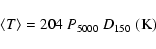
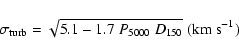
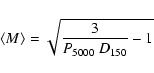
This filament has an angular transverse size of 10 arcmin (which is barely resolved by the GBT).
Considering the properties of the narrow component at the position of minimum (
 cm-2 and
 km s-1) and assuming H/L=1one can derive its depth
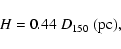 |
(15) |
its average density
 |
(16) |
average temperature
 |
(17) |
turbulent broadening
 |
(18) |
and average Mach number
 |
(19) |
where
D150=D/(150 pc) and
P5000=P/(5000 K cm-3).
For those typical values of distance and pressure we get
 km s-1
and
km s-1
and
 .
These physical parameters are typical of CNM gas,
we therefore conclude that it is likely that a significant fraction of the column density
at the tip of the filament seen in the FN1 field is CNM gas.
The fact that we observe opposite velocity gradients of WNM gas at the
same position (see Fig. 8)
is reminiscent of what is seen in the simulations of Audit & Hennebelle (2005) where
CNM structures are efficiently formed in a large scale convergent flow.
.
These physical parameters are typical of CNM gas,
we therefore conclude that it is likely that a significant fraction of the column density
at the tip of the filament seen in the FN1 field is CNM gas.
The fact that we observe opposite velocity gradients of WNM gas at the
same position (see Fig. 8)
is reminiscent of what is seen in the simulations of Audit & Hennebelle (2005) where
CNM structures are efficiently formed in a large scale convergent flow.
In this paper we presented a new technique
to constrain the physical properties of the 3D density and velocity fields of H I clouds.
We showed that from a set of statistical quantities computed with the observations
(
,
,
,
,
,
 ,
,
 )
and the spectral shape of the 21 cm line, it is possible to
constrain the physical properties of the H I on the line of sight like
density contrast, turbulent broadening, average temperature and average Mach number.
)
and the spectral shape of the 21 cm line, it is possible to
constrain the physical properties of the H I on the line of sight like
density contrast, turbulent broadening, average temperature and average Mach number.
The basis of the method is to constrain the underlying physical properties of the cloud by
producing a large number of 3D realizations of the density and velocity fields with proper statistical properties.
This type of method is routinely used in the analysis of the cosmic microwave background (CMB).
One important difference with the CMB analysis is the fact that we do not have a complete
description of the statistical properties of interstellar fields and that Gaussian random
fields (or fBm) are not a perfect representation of the observations.
One known limitation of fBms for the analysis of interstellar matter
is the fact that they are isotropic and Gaussian objects.
In this analysis we used a method to modify classical fBm objects such that they
reproduce the power spectrum and the non-Gaussian properties of density fields
observed in numerical simulations and observations of interstellar clouds.
A further step would be to produce such artificial fields with anisotropic structure
(obvious in interstellar emission) and a better description of the non-Gaussianity
of the velocity field (weaker than the non-Gaussianity of the density field).
Nevertheless we argue that the statistical properties used here to estimate the
3D physical properties of the gas are more controlled by the power-law power spectrum
of the density and velocity fields (and by the non-Gaussian
properties of the density field) rather than by their anisotropy.
We applied this new technique to analyze 21 cm observations obtained at the GBT
of the FN1 field, a very diffuse region at high Galactic latitude used for extra-galactic studies.
First we showed that the observed spectra of FN1 cannot be explained by CNM type gas affected by
strong turbulent motions. We were able to exclude this hypothesis by showing that
it is incompatible with the statistical properties of the centroid velocity.
More importantly we showed that the shape of the spectra (narrow core and extended wings)
cannot be well reproduced with only one H I component, whatever its temperature.
Instead the observations are well fitted by a combination of two spectral components:
one narrow (
 km s-1) that traces thermally unstable gas,
and one wide (
km s-1) that traces thermally unstable gas,
and one wide (
 km s-1) which has the physical properties of the WNM.
The results of our analysis show that there is no significant CNM type gas in the field
and that the thermally unstable phase contributes 30% of the column density,
near the average reported in recent observational results (Heiles & Troland 2003b) and numerical simulations
(Audit & Hennebelle 2005).
Both components have a density contrast
close to 0.8 but the WNM component
is much more spread out on the line of sight with a filling factor 10 times higher than
the unstable gas. We also conclude that the WNM gas is mildly supersonic (
)
and the unstable phase is definitely sub-sonic (
).
km s-1) which has the physical properties of the WNM.
The results of our analysis show that there is no significant CNM type gas in the field
and that the thermally unstable phase contributes 30% of the column density,
near the average reported in recent observational results (Heiles & Troland 2003b) and numerical simulations
(Audit & Hennebelle 2005).
Both components have a density contrast
close to 0.8 but the WNM component
is much more spread out on the line of sight with a filling factor 10 times higher than
the unstable gas. We also conclude that the WNM gas is mildly supersonic (
)
and the unstable phase is definitely sub-sonic (
).
Finally this portion of the FN1 field contains a narrow filament (axis ratio >4),
almost unresolved by the GBT, which has a low velocity dispersion (2.5 km s-1).
Our analysis indicates that this structure, which could contain CNM type gas,
is found at the locus of opposite velocity gradients in the WNM
which could have triggered a phase transition.
Acknowledgements
The authors thanks Felix Jay Lockman for providing
the GBT observations used in this analysis and the anonymous referee for very constructive
comments.
- Audit, E., &
Hennebelle, P. 2005, A&A, 433, 1 [NASA ADS] [CrossRef] [EDP Sciences] (In the text)
- Brunt,
C. M., & Heyer, M. H. 2002, ApJ, 566, 289 [NASA ADS] [CrossRef] (In the text)
- Brunt,
C. M., & Low, M. M. M. 2004, ApJ, 604, 196 [NASA ADS] [CrossRef] (In the text)
- Burton,
W. B., & Hartmann, D. 1994, Ap&SS, 217, 189 [NASA ADS] (In the text)
- Dole, H., Gispert,
R., Lagache, G., et al. 2001, A&A, 372, 364 [NASA ADS] [CrossRef] [EDP Sciences] (In the text)
-
Elmegreen, B. G. 2002, ApJ, 564, 773 [NASA ADS] [CrossRef] (In the text)
-
Elmegreen, B. G., Kim, S., & Staveley-Smith, L. 2001, ApJ,
548, 749 [NASA ADS] [CrossRef]
- Esquivel,
A., & Lazarian, A. 2005, ApJ, 631, 320 [NASA ADS] [CrossRef]
- Ewen, H. I.,
& Purcell, E. M. 1951, Nature, 168, 350 [CrossRef]
- Field,
G. B., Goldsmith, D. W., & Habing, H. J. 1969,
ApJ, 155, L149 [NASA ADS] [CrossRef] (In the text)
- Heiles, C.,
& Troland, T. H. 2003a, ApJSS, 145, 329 [NASA ADS] [CrossRef]
- Heiles, C.,
& Troland, T. H. 2003b, ApJ, 586, 1067 [NASA ADS] [CrossRef]
- Ingalls,
J. G., Miville-Deschnes, M. A., Reach, W. T.,
et al. 2004, ApJS, 154, 281 [NASA ADS] [CrossRef]
- Lockman,
F. J., & Gehman, C. S. 1991, ApJ, 382, 182 [NASA ADS] [CrossRef] (In the text)
- Miville-Deschênes,
M. A., Joncas, G., Falgarone, E., & Boulanger, F. 2003a,
A&A, 411, 109 [NASA ADS] [CrossRef] [EDP Sciences] (In the text)
- Miville-Deschênes,
M. A., Levrier, F., & Falgarone, E. 2003b, ApJ, 593,
831 [NASA ADS] [CrossRef] (In the text)
- Miville-Deschenes, M. A.,
Lagache, G., Boulanger, F., & Puget, J.-L. 2007, A&A,
accepted
(In the text)
- Muller,
C. A., & Oort, J. H. 1951, Nature, 168, 357 [NASA ADS] [CrossRef]
- Sfeir,
D. M., Lallement, R., Crifo, F., & Welsh, B. Y. 1999,
A&A, 346, 785 [NASA ADS] (In the text)
- Spitzer, L.
1978, Physical processes in the interstellar medium (New York:
Wiley-Interscience)
(In the text)
- Wolfire,
M. G., Hollenbach, D., McKee, C. F., Tielens, A. G.
G. M., & Bakes, E. L. O. 1995, ApJ, 443,
152 [NASA ADS] [CrossRef]
- Wolfire,
M. G., McKee, C. F., Hollenbach, D., & Tielens, A. G.
G. M. 2003, ApJ, 587, 278 [NASA ADS] [CrossRef]
Copyright ESO 2007
![\begin{figure}
\par\includegraphics[width=7.5cm,clip]{5523_f01.eps}
\end{figure}](/articles/aa/full/2007/25/aa5523-06/img33.gif)
![\begin{figure}
\par\includegraphics[width=15.5cm,clip]{5523_f02.ps}
\end{figure}](/articles/aa/full/2007/25/aa5523-06/img34.gif)


![\begin{figure}
\par\includegraphics[width=7.8cm,clip]{5523_f03.ps}
\end{figure}](/articles/aa/full/2007/25/aa5523-06/img82.gif)
![\begin{figure}
\par\includegraphics[width=7cm,clip]{5523_f04.ps}
\end{figure}](/articles/aa/full/2007/25/aa5523-06/img97.gif)
![\begin{figure}
\par\includegraphics[width=7.2cm,clip]{5523_f05.ps}
\end{figure}](/articles/aa/full/2007/25/aa5523-06/img113.gif)
![\begin{figure}
\par\includegraphics[width=16cm,clip]{5523_f06.ps}
\end{figure}](/articles/aa/full/2007/25/aa5523-06/img116.gif)
![\begin{figure}
\par\includegraphics[width=7.3cm,clip]{5523_f07.eps}
\end{figure}](/articles/aa/full/2007/25/aa5523-06/img119.gif)
![\begin{figure}
\par\includegraphics[width=15.3cm,clip]{5523_f08.ps}
\end{figure}](/articles/aa/full/2007/25/aa5523-06/img120.gif)
![\begin{figure}
\par\includegraphics[width=15.5cm,clip]{5523_f09.ps}
\end{figure}](/articles/aa/full/2007/25/aa5523-06/img121.gif)
![\begin{figure}
\par\includegraphics[width=13.5cm,clip]{5523_f10.ps}
\end{figure}](/articles/aa/full/2007/25/aa5523-06/img122.gif)
![\begin{figure}
\par\includegraphics[width=6.8cm,clip]{5523_f11.ps}
\end{figure}](/articles/aa/full/2007/25/aa5523-06/img124.gif)
![\begin{figure}
\par\includegraphics[width=16cm,clip]{5523_f12.eps}
\end{figure}](/articles/aa/full/2007/25/aa5523-06/img137.gif)