![[*]](/icons/foot_motif.gif) -
A. H. Córsico1,2 - M. M. Miller Bertolami1,2,
-
A. H. Córsico1,2 - M. M. Miller Bertolami1,2,
A&A 467, 1175-1180 (2007)
DOI: 10.1051/0004-6361:20066887
L. G. Althaus1,2, -
A. H. Córsico1,2 - M. M. Miller Bertolami1,2,
1 - Facultad de Ciencias Astronómicas y Geofísicas,
Universidad Nacional de La Plata, Paseo del Bosque S/N, (B1900FWA) La Plata, Argentina
2 - Instituto de Astrofísica La Plata, IALP, CONICET-UNLP
Received 6 December 2006 / Accepted 21 February 2007
Abstract
Aims. We examine a recently-proposed evolutionary scenario that could explain the existence of the low-mass, helium-enriched PG 1159 stars. We focus in particular on studying the pulsational stability properties of the evolutionary models predicted by such a scenario.
Methods. We assess the overstability of pulsation g-modes of stellar models as evolution proceeds in the PG 1159 domain. Stellar models are extracted from the full evolution of a 1- model star that experiences its first thermal pulse as a late thermal pulse (LTP) after leaving the AGB. The evolutionary stages corresponding to the born-again episode and the subsequent helium sub-flashes are taken into account in detail.
Results. Under reasonable assumptions of mass-loss rate, the evolutionary scenario reproduces the high helium abundances observed in some PG 1159 stars. We find that, despite the high helium abundance in the driving layers, a narrow region exists in the 
 -
- diagram for which the helium-enriched PG 1159 sequence exhibits unstable pulsation modes with periods in the range 500 to 1600 s. In particular, the nonpulsating helium-enriched PG 1159 star, MCT 0130-1937, is located outside the theoretical instability domain. Our results suggest that MCT 0130-1937 is a real non-pulsating star and that the lack of pulsations should not be attributed to unfavorable geometry.
Conclusions. Our study hints at a consistent picture between the evolutionary scenario that could explain the existence of helium-enriched PG 1159 stars and the nonvariable nature of MCT 0130-1937. We also present theoretical support for the unusually high helium abundance observed in the nonpulsating PG 1159 star HS 1517+7403. We suggest that HS 1517+7403 could be a transition object linking the low-mass helium-rich O(He) stars with the helium-enriched PG 1159 stars via the evolutionary connection K1-27
 HS 1517+7403
MCT 0130-1937.
HS 1517+7403
MCT 0130-1937.
Key words: stars: evolution - stars: abundances - stars: AGB and post-AGB - stars: interiors - stars: variables: general - white dwarfs
PG 1159 stars constitute the evolutionary link between the
asymptotic giant branch (AGB) stars and most of the hydrogen-deficient
white dwarf (WD) stars.
Currently, 37 stars are members of the PG 1159 family, which span a
wide domain in the
-
diagram (g in cgs units):
 and 75 000 K
 200 000 K; see Werner & Herwig
(2006) for a review. These hot stars are thought to be formed via a born-again
episode resulting either from a very late thermal pulse (VLTP) experienced by a
hot WD during its early cooling phase - see Schönberner
(1979) and Iben et al. (1983) for earlier references - or a late thermal
pulse (LTP) that occurs during the post-AGB evolution when hydrogen burning
is still active; see Blöcker (2001) for references. During the
VLTP, the convection zone driven by the helium flash reaches the hydrogen-rich
envelope of the star, with the
consequence that most of the hydrogen content is burnt. The star is
then forced to evolve rapidly back to the AGB and finally into the
domain of the PG 1159 stars at high
values. LTP
also leads to a hydrogen-deficient composition, but this is a result
of a dilution episode.
200 000 K; see Werner & Herwig
(2006) for a review. These hot stars are thought to be formed via a born-again
episode resulting either from a very late thermal pulse (VLTP) experienced by a
hot WD during its early cooling phase - see Schönberner
(1979) and Iben et al. (1983) for earlier references - or a late thermal
pulse (LTP) that occurs during the post-AGB evolution when hydrogen burning
is still active; see Blöcker (2001) for references. During the
VLTP, the convection zone driven by the helium flash reaches the hydrogen-rich
envelope of the star, with the
consequence that most of the hydrogen content is burnt. The star is
then forced to evolve rapidly back to the AGB and finally into the
domain of the PG 1159 stars at high
values. LTP
also leads to a hydrogen-deficient composition, but this is a result
of a dilution episode.
Interest in PG 1159 stars is likewise motivated by the fact that eleven
of them exhibit multiperiodic luminosity variations
induced by nonradial g-mode pulsations. Pulsating PG 1159 - commonly
referred to as GW Virginis variables - show low-degree
(
 ), high-radial order (
 )
g-modes
with periods in the range from about 300 to 3000 s. About half of them are still surrounded by a planetary nebula.
Since the pioneering works of Starrfield et al. (1983, 1984) - see also Starrfield et al. (1985) and Stanghellini et al. (1991) - the pulsation driving mechanism and, in particular,
the chemical composition of the driving zone in PG 1159 stars have
been the subject of hot debate. The works of Saio (1996) and Gautschy
(1997) and, more recently, Quirion et al. (2004), Gautschy et al. (2005),
and Córsico et al. (2006) have convincingly demonstrated
that g-mode pulsations in the range of the periods of GW Virginis stars can
be easily driven in PG 1159 models with a uniform envelope
composition - compatible with observed photospheric abundances
- through the
)
g-modes
with periods in the range from about 300 to 3000 s. About half of them are still surrounded by a planetary nebula.
Since the pioneering works of Starrfield et al. (1983, 1984) - see also Starrfield et al. (1985) and Stanghellini et al. (1991) - the pulsation driving mechanism and, in particular,
the chemical composition of the driving zone in PG 1159 stars have
been the subject of hot debate. The works of Saio (1996) and Gautschy
(1997) and, more recently, Quirion et al. (2004), Gautschy et al. (2005),
and Córsico et al. (2006) have convincingly demonstrated
that g-mode pulsations in the range of the periods of GW Virginis stars can
be easily driven in PG 1159 models with a uniform envelope
composition - compatible with observed photospheric abundances
- through the  -mechanism associated with the cyclical partial ionization of the K-shell electrons of carbon and/or oxygen in the envelope of these models.
A distinctive feature characterizing PG 1159 stars is their peculiar
surface chemical composition. Indeed, PG 1159 stars exhibit surface
layers dominated by helium, carbon, and oxygen, the main
nucleosynthetic constituents of the previous intershell layer of their
AGB progenitor stars. Typically, surface abundances of about 0.33
He, 0.5 C, and 0.17 O are reported, with notable variations from star
to star (Dreizler & Heber 1998; Werner 2001). In fact, almost every
star has its individual He/C/O mixture. As reported by Werner (2001)
and Werner & Herwig (2006), the helium abundance ranges between 0.30-0.85,
and carbon and oxygen abundances span the ranges 0.15-0.60 and 0.02-0.20,
respectively. In particular, the helium abundance mostly covers the range 0.3-0.5; only a minority of PG 1159 stars show a helium-enriched abundance in the range 0.6-0.85.
The dispersion in the atmospheric composition of PG 1159 stars is
relevant to the question of the excitation of pulsation modes
in models of these stars and, particularly, of the coexistence of
variable and non-variable stars in the domain of the GW Virginis, a
longstanding issue recently addressed by
Quirion et al. (2004). The helium-enriched and
nitrogen-deficient nonpulsating
PG 1159 star MCT 0130-1937 is particularly outstanding. In fact, this
object - characterized by a surface composition of about 0.74
He, 0.22 C, and 0.03 O (Werner & Herwig 2006) and a stellar mass of
0.54
(Miller Bertolami & Althaus 2006) - is well inside
the PG 1159 instability domain in the
-
diagram (Córsico et al.
2006). Even more remarkable is the fact that, in
the
-
diagram, this star is located between two
pulsating stars, PG 2131+066 and PG 1707+427, where both of them have
standard helium abundances (0.44). Other relevant
examples of nonpulsating PG 1159 stars within the instability domain
are the low-mass stars HS 0704+6153 with a surface
helium abundance of 0.69 and HS 1517+7403 with an unusually high helium abundance of 0.85.
With the help of static PG 1159 models, Quirion et al. (2004) find that
the high helium abundance should be
the cause of the absence of pulsations in MCT 0130-1937. Indeed, the envelope
of MCT 0130-1937 is so helium-enriched compared to its two neighboring GW
Virginis stars that the "helium poisoning'' would be responsible for the
lack of pulsations in this star. However, it should be noted that the
non detection of pulsations in this object could be due to unfavorable
geometry. For instance if the star is observed pole-on,
modes with  will not be detected.
The wide variety of surface patterns observed in PG 1159 stars poses
a major challenge to the theory of post-AGB evolution. Although
the dispersion in the surface composition observed in PG 1159 stars can
admittedly be understood in terms of the standard born-again AGB
star scenario (Herwig et al. 1999; Miller Bertolami & Althaus 2006), the existence
of helium-enriched and nitrogen-deficient objects such as MCT 0130-1937 is
certainly more difficult
to explain, and it still deserves investigation. This is the precise focus
of the present work. Specifically, we examine
the evolutionary scenario for the formation of low-mass, helium-enriched
PG 1159 stars as recently proposed by Miller Bertolami & Althaus (2006)
by assessing the overstability of pulsation g-modes of
the resulting
stellar models as evolution proceeds in the PG 1159 domain.
As shown in Miller Bertolami & Althaus (2006), this scenario could provide a possible explanation for the
existence of PG 1159 stars, such as the above-mentioned
HS 0704+6153,
HS 1517+7403, and MCT 0130-1937,
three helium-enriched and nitrogen-deficient objects in the sample of
Dreizler & Heber (1998). The following section contains details
about the main aspects of this evolutionary scenario and the stellar
models we used as a background for the pulsation stability
analysis described in
Sect. 3. Our aim is to assess to what extent the pertinent
sequence of
stellar models do not show any sign of variability in the domain of
the GW Virginis stars, thus having a consistent picture of the
evolutionary and pulsational status of MCT 0130-1937.
Finally, Sect. 4 is devoted to discussing and summarizing our results.
In particular, we discuss there the evolutionary connection
K1-27
HS 1517+7403
MCT 0130-1937 that would link
the helium-rich O(He) stars with the helium-enriched PG 1159 stars
and would explain the unusually high helium abundance observed in HS 1517+7403.
The evolutionary scenario proposed by Miller Bertolami & Althaus (2006)
involves computating
the advanced stages of the evolution of a low-mass star that, as a result
of mass-loss events, avoids the thermally pulsing AGB phase,
and it experiences its first thermal pulse as an LTP after leaving the AGB.
Indeed, helium
abundances as high as observed in the helium-enriched PG 1159 stars are
typical of the intershell helium abundances that develops during the
first thermal pulse ( 0.75).
Because of the small envelope mass characterizing low-mass stars, this scenario appears to be quite likely in these stars.
0.75).
Because of the small envelope mass characterizing low-mass stars, this scenario appears to be quite likely in these stars.
![\begin{figure}
\par\includegraphics[width=350pt,clip]{6887fig1.eps}\end{figure}](/articles/aa/full/2007/21/aa6887-06/img16.gif) |
Figure 1: Hertzsprung-Russell diagram for the evolutionary scenario that leads to the formation of helium-enriched PG 1159 stars. The star experiences its first thermal pulse as an LTP. Numbers beside filled circles and squares along the track give, respectively, the age (in 103 yr) counted from the occurrence of the LTP and the surface abundances (1H/4He/12C/14N/16O) in percent. The evolutionary track resulting from a VLTP episode is also shown with dashed lines for the PG 1159 regime; the complete track is depicted in the inset. |
| Open with DEXTER | |
The Hertzsprung-Russell diagram corresponding to the evolutionary
scenario is shown in Fig. 1.
Artificial mass-loss rates force the initially 1-
model star
to undergo its first thermal pulse as an LTP at about 10 000 K,
after leaving the AGB. After the
short-lived born-again episode and before the PG 1159 domain, the remnant
experiences two additional excursions to lower temperatures - the
two double-loop paths in Fig. 1 - by virtue of helium
sub-flashes. The total time spent by the remnant in the red during
these loop episodes amounts to about 3000 yr. During this time,
mass-loss episodes are expected to erode the outer envelope
considerably. For instance, mass-loss rates as high as 10-5 /yr and even higher have been observed in Sakurai's object (Hajduk et al. 2005).
In the interest of helping to understand the evolutionary connections
to be studied later, we show the chemical
stratification by the end of the born-again stage in Fig. 2 (about 300 yr after the
occurrence of the LTP). This figure illustrates the inner
1H, 4He, 12C, 14N, and 16O distribution
in terms of the outer mass fraction q,
where
q=1-mr/M*.
Note the presence of the intershell layer below the thin
helium buffer, which results from the short-lived mixing episode during
the helium flash at the LTP. This intershell layer of 0.04
is
substantially enriched in helium and deficient in nitrogen: [4He,
12C, 16O] = [0.73, 0.21, 0.03]. Despite the small envelope
(
 )
overlying the intershell region, no
strong dredge-up occurs. This is expected because of
the low intensity of the first thermal pulse in low-mass stars.
By assuming mass-loss rates within observational expectations, Miller Bertolami & Althaus (2006) found that the hydrogen-rich outer envelope is eroded and surface abundances start to change gradually by log
4.6, well before the sequence reaches the domain of the PG 1159 stars.
)
overlying the intershell region, no
strong dredge-up occurs. This is expected because of
the low intensity of the first thermal pulse in low-mass stars.
By assuming mass-loss rates within observational expectations, Miller Bertolami & Althaus (2006) found that the hydrogen-rich outer envelope is eroded and surface abundances start to change gradually by log
4.6, well before the sequence reaches the domain of the PG 1159 stars.
From this point until the intershell chemistry is uncovered, the nitrogen surface abundance remains 0.012 with no trace of carbon. Thirty thousand yr later -
at
108 000 K - the last vestiges of hydrogen-rich material left in the star are removed and the surface exhibits the buffer abundances: [4He,
12C,14N, 16O] = [0.98, 0, 0.012, 0]. These will be the
surface abundances until the helium buffer is eroded by further
mass loss during the subsequent 50 000 yr of evolution (see
Fig. 1). During this time, the surface abundance will be typical of
those exhibited by O(He) stars. Finally, when the helium buffer is
removed, the models diplay the intershell abundances - [4He,12C,14N, 16O] = [0.74, 0.20, 0, 0.029] -
characteristic of the helium-enriched PG 1159 stars.
![\begin{figure}
\par\includegraphics[clip,width=242pt]{6887fig2.eps}\end{figure}](/articles/aa/full/2007/21/aa6887-06/img18.gif) |
Figure 2: Internal abundance distribution of 1H, 4He, 12C, 14N, and 16O as a function of the outer mass fraction q for a model at 300 yr after the occurrence of the LTP (see Fig. 1). The location of the helium buffer and the underlying intershell layer are indicated. |
| Open with DEXTER | |
![\begin{figure}
\par\includegraphics[clip,width=250pt]{6887fig3.eps}\end{figure}](/articles/aa/full/2007/21/aa6887-06/img19.gif) |
Figure 3:
The
-
evolution of the 0.514
remnant.
Surface abundances [1H/4He/12C/14N/16O] are given at
selected stages (black dots). We also show the observational predictions
for two low-mass O(He) stars and three helium-enriched PG 1159 stars
(triangles and square symbols, respectively) taken from Rauch et al. (1998) and Dreizler & Heber (1998). |
| Open with DEXTER | |
The location of these
abundance changes in the
-
diagram is shown in Fig. 3.
We also depict the location of two
helium-rich O(He) stars: K1-27 and
HS 2209+8229. In particular K1-27,
for which detailed abundances have been derived, displays
an almost pure helium composition (0.98) with traces of 14N (0.017) -
however, small hydrogen and carbon contents cannot be excluded, see Rauch
et al. (1998) - which are similar
to the surface abundances predicted by the evolutionary scenario by the time
the small helium buffer is uncovered: 0.98 4He and 0.012 14N. In addition, we include in this figure the three helium-enriched and nitrogen-deficient PG 1159 stars from the sample of the non-pulsating stars of Dreizler & Heber (1998):
HS 0704+6153, HS
1517+7403, and MCT 0130-1937 with abundances of He/C/O = 0.69/0.21/0.09,
0.84/0.13/0.02, and 0.74/0.22/0.03, respectively.
Note that the
evolutionary sequence nearly reproduces both the location in the
-
diagram and the surface composition of the three
helium-enriched PG 1159 stars (in particular MCT 0130-1937) and the O(He)
star K1-27. It is apparent from Fig. 3 that
this scenario suggests an evolutionary connection between the O(He) stars with low mass (namely K1-27 and HS 2209+8229) and the helium-enriched PG 1159 stars.
Note from Fig. 3 that K1-27
is consistent with a stellar mass value
of M< 0.514 .
This is markedly lower than the value quoted
by Rauch et al. (1998) of 0.55 .
The difference can be traced back
to the fact that the Rauch et al. (1998) determination is based on the
Blöcker (1995) hydrogen-burning evolutionary tracks, while our determination
is based on evolutionary sequences with surface abundances consistent with
those observed in this star. The same trend is also present in the new mass
determinations of PG 1159 stars given in Miller Bertolami & Althaus (2006),
as compared with the mass values quoted by Werner & Herwig (2006),
based also on hydrogen-burning post-AGB tracks.
A relevant issue given by the evolutionary scenario concerns the
age predicted for K1-27. Specifically, we find that our sequence predicts
an age of about 30-60 Kyr at the observed effective temperature and
surface composition of K1-27. This age is a factor of 5-3 smaller than
the age quoted by Rauch et al. (1994), strongly alleviating the discrepancy
between the evolutionary age and the expansion age of the nebula. This fact makes
the plausibility of the evolutionary scenario for the origin of this star
even more attractive.
Needless to say, the exact location in the
-
diagram where
the star will show O(He)- or helium-enriched surface abundances
depends on the actual course of mass-loss events.
To assess this, we re-computed the post VLT evolution of
the sequence but for the case in which mass-loss
rates are one order of magnitude lower than assumed in Miller Bertolami
& Althaus (2006).
In particular, we assumed a mass-loss rate during the giant state
of only 10-7 /yr. As a result, the surface layers of the models
stay hydrogen- and helium-rich throughout the evolution. This
places a lower limit - below observational expectations - on the
mass-loss rates for which the evolutionary scenario may explain the
existence of helium-enriched PG 1159 stars like MCT 0130-1937.
Finally, we note that the low-mass, helium-enriched PG 1159 stars could
be the result of a VLTP instead an LTP.
To assess this we forced our post-AGB sequence to undergo a VLTP episode. In
Fig. 1 we include the resulting track. The full track is shown
in the inset. Note that for the PG 1159 regime, both tracks are almost
indistinguishable.
As in the of case for the LTP, the surface chemistry of the
emerging star will essentially be that of the intershell layer [4He,
12C, 16O] = [0.74, 0.16, 0.03],
but - because of the burning of the hydrogen content - enriched in 13C and
nitrogen (0.01). The presence of nitrogen is at odds with
observations in the low-mass, helium-enriched PG 1159 stars.
This fact discards the possibilty that the progenitors
of these stars have experienced a VLTP episode. Note also that because the
entire helium-rich buffer is engulfed by the helium flash convection zone
during the VLTP, the development of a helium-rich surface composition
characteristic of the O(He) stars is certainly not expected in this case.
In addition, we want to comment on the fact that, from our numerical
experiments, the occurrence of a VLTP episode in very low-mass stars (
 )
appears to require a delicate fine tuning of the mass-loss rate. Thus, we are tempted to conclude that in these stars, VLTP episodes might be less likely than the LTP ones.
)
appears to require a delicate fine tuning of the mass-loss rate. Thus, we are tempted to conclude that in these stars, VLTP episodes might be less likely than the LTP ones.
The evolutionary scenario proposed in Miller Bertolami & Althaus (2006) provides a possible explanation for the existence of helium-enriched PG 1159 stars like MCT 0130-1937, linking them with the low-mass O(He) stars. In the frame of recent stability calculations (Quirion et al. 2004), we should expect that - as a result of helium poisoning - the pertinent stellar configurations do not show any sign of variability in the domain of the pulsating PG 1159 stars. To assess this, we performed pulsation stability analysis on our models. It is important to note that we are examining the stability properties of stellar models belonging to a real evolutionary sequence derived from the complete history of the progenitor star, an aspect that renders robustness to our pulsational results.
We performed a pulsation g-mode stability analysis by employing the linear, nonradial, nonadiabatic pulsation code described in Córsico et al. (2006), which has recently been employed to reexamine the theoretical instability domain of pulsating PG 1159 stars. This code assumes the "frozen-in convection'' approximation in which the perturbation of the convective luminosity is ignored.
![\begin{figure}
\par\includegraphics[clip,width=240pt]{6887fig4.eps}\end{figure}](/articles/aa/full/2007/21/aa6887-06/img22.gif) |
Figure 4:
Upper panel:
-
evolution of our 0.514-
remnant
and the location of the three helium-enriched PG 1159 stars according
to Dreizler & Heber (1998): HS 1517+7403, HS 0704+6153, and MCT 0130-1937. The thick portion of the curve corresponds to the instability domain of our
sequence, and the thickest portion near the knee of the track
corresponds to the case for which the helium abundance of our
model sequence is artificially changed to 0.85 (see Sect. 4). Bottom panel:
Chemical abundances at the driving region (
 )
in terms
of the effective temperature. Arrows indicate the course of evolution. )
in terms
of the effective temperature. Arrows indicate the course of evolution. |
| Open with DEXTER | |
We analyzed the stability properties of stellar models
covering a range of
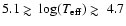 .
For each model we restricted our
study to
.
For each model we restricted our
study to  g-modes with periods in the range
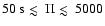 s, thus comfortably embracing the full
period spectrum observed in pulsating PG 1159 stars. Surprisingly
enough, we find that, despite the high helium abundance in the driving
layers, there is a region in the
-
diagram for which our
helium-enriched PG 1159 sequence
exhibits unstable pulsation modes. These modes are driven by
the -mechanism associated with the opacity bump due to partial ionization of carbon
and oxygen; see Gautschy et al. (2005) and Córsico et al. (2006).
To illustrate this, we present two panels in Fig. 4 that
display the
-
plane (upper panel) and the chemical abundances at the
driving region (bottom panel) in terms of the effective temperature.
Note the presence of a well-defined, though short, instability domain on the
-
plane (thick portion of the track). It is clear that the
extension of the instability domain is markedly dependent on the
helium abundance in the outer layers. Indeed, it is only by the time
mass loss has eroded the helium buffer and exposed the helium-and carbon-rich intershell layer - bottom panel
in Fig. 4 - that our models start to
exhibit pulsational instability. From the modal diagram in
Fig. 5, this instability starts to manifest itself at
the longest pulsation periods. Note that unstable mode
periods range from about 500 to 1600 s. Also note the strong decrease in
the longest expected periods; this is because the
high helium content in the driving region. By the time evolution
has proceeded to
100 000 K our models can no longer drive
unstable modes and they become stable with further evolution (see
Fig. 5). This behavior
is in sharp contrast to the situation encountered in low-mass PG 1159 models
with standard surface helium abundances, which show
pulsational instability throughout this region of the
-
diagram (Córsico et al. 2006).
s, thus comfortably embracing the full
period spectrum observed in pulsating PG 1159 stars. Surprisingly
enough, we find that, despite the high helium abundance in the driving
layers, there is a region in the
-
diagram for which our
helium-enriched PG 1159 sequence
exhibits unstable pulsation modes. These modes are driven by
the -mechanism associated with the opacity bump due to partial ionization of carbon
and oxygen; see Gautschy et al. (2005) and Córsico et al. (2006).
To illustrate this, we present two panels in Fig. 4 that
display the
-
plane (upper panel) and the chemical abundances at the
driving region (bottom panel) in terms of the effective temperature.
Note the presence of a well-defined, though short, instability domain on the
-
plane (thick portion of the track). It is clear that the
extension of the instability domain is markedly dependent on the
helium abundance in the outer layers. Indeed, it is only by the time
mass loss has eroded the helium buffer and exposed the helium-and carbon-rich intershell layer - bottom panel
in Fig. 4 - that our models start to
exhibit pulsational instability. From the modal diagram in
Fig. 5, this instability starts to manifest itself at
the longest pulsation periods. Note that unstable mode
periods range from about 500 to 1600 s. Also note the strong decrease in
the longest expected periods; this is because the
high helium content in the driving region. By the time evolution
has proceeded to
100 000 K our models can no longer drive
unstable modes and they become stable with further evolution (see
Fig. 5). This behavior
is in sharp contrast to the situation encountered in low-mass PG 1159 models
with standard surface helium abundances, which show
pulsational instability throughout this region of the
-
diagram (Córsico et al. 2006).
![\begin{figure}
\par\includegraphics[clip,width=240pt]{6887fig5.eps}\end{figure}](/articles/aa/full/2007/21/aa6887-06/img26.gif) |
Figure 5:
Dipole modal diagram (periods vs. effective temperature) for our
helium-enriched evolutionary sequence. Solid (dotted) lines denote pulsational instability (stability). Unstable mode periods range from about 500 to 1600 s. Below
100 000 K, no unstable pulsation modes are found. |
| Open with DEXTER | |
It is clear from Fig. 4 that the nonpulsating MCT 0130-1937 star is located well outside the theoretical instability domain. In fact, we do not find any sign of instability in our models by the time evolution has reached the domain of MCT 0130-1937. This result hints at a consistent picture between the evolutionary scenario described in Sect. 2 that could explain the existence of helium-enriched PG 1159 stars and the nonvariable nature of MCT 0130-1937.
We have examined the evolutionary scenario proposed by Miller Bertolami
& Althaus (2006), which could explain the existence of low-mass,
helium-enriched PG 1159 stars.
In particular, this scenario remarkably reproduces both
the location in the
-
diagram and the helium-enriched and nitrogen-deficient composition
of MCT 0130-1937, and also suggests a possible evolutionary connection
between the low-mass, helium-rich O(He) stars (namely K1-27 and
HS 2209+8229) and the helium-enriched PG 1159 stars.
In this paper we have assessed the overstability of g-modes of the pertinent
stellar models as evolution proceeds in the PG 1159 domain. We find
that - despite the high helium abundance in the driving layers - there
exists a region in the
-
diagram for which
our helium-enriched PG 1159 sequence exhibits unstable pulsation modes
with periods in the range 500 to 1600 s. The domain of
instability is
restricted to a rather narrow region of the
-
diagram.
In particular, MCT 0130-1937 is located outside the theoretical
instability domain.
In this sense, this finding reinforces the conclusions arrived at in
Quirion et al. (2004) about the nonvariability of MCT 0130-1937. This result hints
at a consistent picture between the evolutionary scenario proposed
by Miller Bertolami & Althaus (2006) for the origin of low-mass,
helium-enriched PG 1159 stars and the nonvariable nature of MCT 0130-1937. We conclude
that MCT 0130-1937 is probably a real non-pulsating star and that the
lack of pulsations cannot be attributed to unfavorable geometry.
However, as documented in Fig. 4, the nonpulsating helium-enriched object HS 1517+7403 lies well inside the predicted instability domain of our sequence. The presence of this non-variable star in the unstable region of our sequence could be understood in terms of its higher surface helium abundance (about 0.85, see Werner & Herwig 2006) as compared with that of MCT 0130-1937. In fact, the helium surface abundance of HS 1517+7403 is intermediate between the intershell helium abundance (0.75) of our models and that of the helium buffer (0.98), for which no unstable modes are found at all. For a quantitative inference, we have recomputed the post born-again evolution of our sequence by artificially changing the surface abundance to be compatible with that of HS 1517+7403. Our pulsational analysis shows in this case that, though a very narrow instability domain still persists - see Fig. 4 - HS 1517+7403 is outside the resulting theoretical unstable region. A helium abundance as high as observed in HS 1517+7403 appears to be required to starve pulsations in this star. In contrast, we saw that unstable modes are excited for a helium abundance of 0.75. This theoretical finding strongly supports the observational expectation for the unusually high helium abundance in HS 1517+7403.
From an evolutionary point of view, the high helium abundance
in HS 1517+7403 is difficult to understand.
Indeed, helium abundances larger than about
0.75 are not expected in the intershell layer during the AGB evolution.
In addition, the presence of
abundant carbon at its surface - about 0.13 by mass, Werner & Herwig (2006
- reflects the occurrence of helium burning in prior evolutionary stages.
It is conceivable that the surface composition observed
in HS 1517+7403 could be reflecting the chemical abundance distribution
existing in the narrow transition layer between the helium buffer
and the massive intershell region - see Fig. 2.
This layer comprises only about
 .
With our adopted
mass-loss rates, this layer is rapidly eroded in a matter of 6500 yr. During
this time our sequence barely evolves in the
-
diagram
- see Fig. 3. But for similar mass-loss
rates to those charaterizing O(He) stars (about 10-9 /yr) -
a strong reduction in the mass-loss rate is indeed expected with decreasing luminosity - this layer would be eroded slow enough for the remnant to evolve to the domain of HS 1517+7403 with surface
abundances similar to those observed in this star. This prompts us to suggest
that HS 1517+7403 could be a transition object between the low-mass O(He)
stars and the helium-enriched PG 1159 stars like MCT 0130-1937.
.
With our adopted
mass-loss rates, this layer is rapidly eroded in a matter of 6500 yr. During
this time our sequence barely evolves in the
-
diagram
- see Fig. 3. But for similar mass-loss
rates to those charaterizing O(He) stars (about 10-9 /yr) -
a strong reduction in the mass-loss rate is indeed expected with decreasing luminosity - this layer would be eroded slow enough for the remnant to evolve to the domain of HS 1517+7403 with surface
abundances similar to those observed in this star. This prompts us to suggest
that HS 1517+7403 could be a transition object between the low-mass O(He)
stars and the helium-enriched PG 1159 stars like MCT 0130-1937.
The evolutionary scenario proposed by Miller Bertolami & Althaus (2006)
suggests the possibility that low-mass O(He) stars could be the direct
progenitors of the helium-enriched PG 1159 stars, and not form a distinct
post-AGB evolutionary channel, for instance, the result of a stellar
merging event.
The plausibility of this scenario is sustained not only by spectroscopic
evidence but also,
as shown in this work, by consistent pulsational stability calculations of
helium-enriched PG 1159 models. In addition, the substantially
younger ages predicted by this scenario for K1-27 are in line with
the expected kinematical age of the nebula. Finally,
we have put forward the possibility of an evolutionary connection
K1-27
HS 1517+7403
MCT 0130-1937.
The existence of
these evolutionary links appears more attractive in view of the
observational fact that the helium-enriched PG 1159 stars
are nitrogen-deficient, which rules out the occurrence of a VLTP episode
during the progenitor evolution.
In case a VLTP had occurred, then an homogeneous composition
- corresponding to the intershell chemistry - throughout
the envelope would have been expected immediately after the born again
episode, with the result that no marked surface abundance change
would have resulted from mass-loss episodes during the later evolution.
Finally, detailed tabulations of the calculations presented here are
available at our web site: http://www.fcaglp.unlp.edu.ar/evolgroup/.
Acknowledgements
We warmly acknowledge the comments and suggestions of our referee, which have improved both the contents and presentation of the paper. This research was supported by the Instituto de Astrofísica La Plata and by the PIP 6521 grant from CONICET. We thank H. Viturro and R. Martinez for technical support.