![[*]](/icons/foot_motif.gif) -
M. Rosado2 - P. Amram3 - H. Salo4 - E.
Laurikainen4
-
M. Rosado2 - P. Amram3 - H. Salo4 - E.
Laurikainen4
A&A 466, 847-854 (2007)
DOI: 10.1051/0004-6361:20077071
I. Fuentes-Carrera1, -
M. Rosado2 - P. Amram3 - H. Salo4 - E.
Laurikainen4
1 - Instituto de Astronomía, Geofísica e Ciencias
Atmosféricas, Universidade de São Paulo,
Rua do Matão 1226-Cidade Universitária, 05508-900 São Paulo SP, Brazil
2 - Instituto de Astronomía,
Universidad Nacional Autónoma de México (UNAM),
Apdo. Postal 70-264, 04510,
México, D.F., México
3 - Laboratoire d'Astrophysique
de Marseille, 2 place Le Verrier,
Marseille Cedex 4, France
4 - Department of Physical
Sciences, Division of Astronomy,
University of Oulu, 90570 Oulu, Finland
Received 9 January 2007 / Accepted 23 January 2007
Abstract
Aims. We study the kinematics and dynamics of the M 51-type interacting galaxy pair KPG 302 (NGC 3893/96). We analyze the perturbations induced by the encounter on each member of the pair, as well as the distribution of the dark matter (DM) halo of the main galaxy in order to explore possible differences between DM halos of "isolated'' galaxies and those of galaxies belonging to a pair.
Methods. The velocity field of each galaxy was obtained using scanning Fabry-Perot interferometry. A two-dimensional kinematic and dynamical analysis of each galaxy and the pair as a whole are done emphasizing the contribution of circular and non-circular velocities. Non-circular motions can be traced on the rotation curves of each galaxy allowing us to differentiate between motions associated to particular features and motions that reflect the global mass distribution of the galaxy. For the main galaxy of the pair, NGC 3893, optical kinematic information is complemented with HI observations from the literature to build a multi-wavelength rotation curve. We try to fit this curve with a mass-distribution model using different DM halos.
Results. Non-circular motions are detected on the velocity fields of both galaxies. These motions can be associated to perturbations due to the encounter and, in the case of the main galaxy, to the presence of a structure such as spiral arms. The location of the corotation radius of this galaxy is also explored. We find that the multi-wavelength rotation curve of NGC 3893, "cleaned'' from the effect of non-circular motions, cannot be fitted whether by a pseudo-isothermal or by a NFW DM halo.
Key words: galaxies: interactions - galaxies: kinematics and dynamics - galaxies: individual: NGC 3893, NGC 3896 - galaxies: spiral - galaxies: halos
The difference between the mass distribution implied by the luminosity of a disk galaxy and the distribution of mass implied by the rotation velocities offers strong evidence that disk galaxies are embedded in extended halos of dark matter (Sofue & Rubin 2001, and references therein). Detailed knowledge of dark matter (DM) halos around galaxies holds important clues to the physics of galaxy formation and evolution and is an essential ingredient for any model aiming to link the observable Universe with cosmological theories. In practice, realistic DM halos are neither static nor spherically symmetric (Knebe et al. 2004) and it is still unknown if their structure and distribution is intrinsically related to the environment of their galaxies. The question remains as to whether an intrinsic difference exists between the DM halo of an "isolated'' galaxy, the DM halo of a galaxy belonging to a pair or that of a galaxy that is part of a larger group such as a compact group or a cluster.
In this sense, rotation curves (RCs) are a powerful tool for studying the distribution of matter (both baryonic and non-baryonic) in interacting disk galaxies. For a description of the classical method for studying mass distribution, see Blais-Ouellette et al. (2001), and references therein. The RCs also allow us to determine the maximum rotation velocity of a galaxy and thus infer the total mass within a certain radius using methods such as that of Lequeux (1983). Nevertheless, care must be taken when using kinematic information from interacting galaxies, since they are subject to kinematical perturbations that may affect the correct determination of an RC that actually traces the global mass distribution of the galaxy. For this reason, 3D spectroscopy observations are required to separate circular from non-circular motions in the velocity field of a galaxy and its rotation curve as shown in Fuentes-Carrera et al. (2004).
In this work, we present scanning Fabry-Perot observations of the M 51-type interacting galaxy pair NGC 3893/96 (KPG 302). Section 2 presents the scanning Fabry-Perot (FP) observations and data reductions. Section 3 introduces the pair of galaxies KPG 302 (NGC 3893/96). In Sect. 4 we present the kinematic information derived from the F-P observations. Section 5 presents the dynamical analysis of both galaxies, mass estimates and the mass distribution for NGC 3893. The discussion and conclusions are presented in Sects. 6 and 7, respectively.
Observations of NGC 3893/96 (KPG 302) were done at the 2.1 m
telescope at the OAN-SPM (México) using the scanning Fabry-Perot
interferometer PUMA (Rosado et al. 1995). PUMA is a focal reducer built
at the Instituto de Astronomía-UNAM used to make direct images
and Fabry-Perot (FP) interferometry of extended emission sources
(field of view
 ). The FP used is an ET-50 (Queensgate
Instruments) with a servostabilization system having a free
spectral range of 19.95 Å (912 km s-1) at
H
). The FP used is an ET-50 (Queensgate
Instruments) with a servostabilization system having a free
spectral range of 19.95 Å (912 km s-1) at
H .
Its finesse (
.
Its finesse ( 24) leads to a sampling spectral
resolution of 0.41 Å (19.0 km s-1) achieved by
scanning the interferometer free spectral range through 48
different channels. A
24) leads to a sampling spectral
resolution of 0.41 Å (19.0 km s-1) achieved by
scanning the interferometer free spectral range through 48
different channels. A
 Tektronix CCD detector
with a resolution of 0.58
Tektronix CCD detector
with a resolution of 0.58
 pixel was used. We used a
 binning to enhance the signal. The final spatial
sampling equals 1.16
pixel. To isolate the
redshifted H
binning to enhance the signal. The final spatial
sampling equals 1.16
pixel. To isolate the
redshifted H
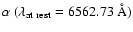 emission of the galaxies, we used an interference filter centered
at 6584 Å with an FWHM of 10 Å. To average the
sky variations during the exposure, we got two data cubes with an
exposure time of 48 min each (60 s per channel). These data
cubes were co-added leading to a total exposure time of 96
minutes. For the calibration, we used a H lamp whose 6562.78 Å line was close to the redshifted nebular wavelength. Two
calibration cubes were obtained at the beginning and at the end of
the galaxy observation to check the metrology.
emission of the galaxies, we used an interference filter centered
at 6584 Å with an FWHM of 10 Å. To average the
sky variations during the exposure, we got two data cubes with an
exposure time of 48 min each (60 s per channel). These data
cubes were co-added leading to a total exposure time of 96
minutes. For the calibration, we used a H lamp whose 6562.78 Å line was close to the redshifted nebular wavelength. Two
calibration cubes were obtained at the beginning and at the end of
the galaxy observation to check the metrology.
Data reduction and analysis were done using mainly the
ADHOCw and CIGALE softwares (LeCoarer et al. 1993).
Standard corrections (cosmic rays removal, bias subtraction,
flat-fielding, etc.) were done on each cube. Once the object cubes
were co-added, the night sky continuum and 6577.3 Å OH sky
line were subtracted. A spectral Gaussian smoothing (
 km s-1) was also performed. Once the spectral smoothing
was done, the calibration in wavelength was fixed for each profile
at each pixel using the calibration cube. The Fabry-Perot scanning
process allows us to obtain a flux value at pixel level for each
of the 48 scanning steps. The intensity profile found along the
scanning process contains information about the monochromatic
emission (H)
and the continuum emission of the object. The
continuum image computation was done considering the mean of the 3
lowest intensities of the 48 channels cube. For the monochromatic
image, the H
line intensity was obtained by integrating
the monochromatic profile in each pixel. The velocity maps were
computed using the barycenter of the H
profile peaks at
each pixel. To get a sufficient signal-to-noise ratio on the outer
parts of each galaxy, we performed three spatial Gaussian
smoothings (
km s-1) was also performed. Once the spectral smoothing
was done, the calibration in wavelength was fixed for each profile
at each pixel using the calibration cube. The Fabry-Perot scanning
process allows us to obtain a flux value at pixel level for each
of the 48 scanning steps. The intensity profile found along the
scanning process contains information about the monochromatic
emission (H)
and the continuum emission of the object. The
continuum image computation was done considering the mean of the 3
lowest intensities of the 48 channels cube. For the monochromatic
image, the H
line intensity was obtained by integrating
the monochromatic profile in each pixel. The velocity maps were
computed using the barycenter of the H
profile peaks at
each pixel. To get a sufficient signal-to-noise ratio on the outer
parts of each galaxy, we performed three spatial Gaussian
smoothings (
 )
on the
resulting calibrated cube. A variable-resolution radial velocity
map was built using high spatial resolution (less
spatially-smoothed pixels) for regions with an originally higher
signal-to-noise ratio.
)
on the
resulting calibrated cube. A variable-resolution radial velocity
map was built using high spatial resolution (less
spatially-smoothed pixels) for regions with an originally higher
signal-to-noise ratio.
NGC 3893/96 is an interacting galaxy pair with number 302 in the Catalogue of Isolated Pairs of Galaxies in the Northern Hemisphere (KPG, Karachentsev 1972). Morphologically, it resembles M 51 (NGC 5194/95) since it is composed of a main spiral galaxy and a considerably smaller companion. KPG 302 is situated in the Ursa Major cluster. With only 79 members, this cluster is poorly defined with a velocity dispersion of only 148 km s-1and a virial radius of 880 kpc (Tully et al. 1996). It essentially contains only late-type galaxies distributed with no particular concentration toward the center. Given the isolation criteria used in the KPG and the nature of the cluster, it is possible that the DM halo (or halos) of the galaxies in the pair are isolated from those of the cluster.
NGC 3893 is a grand-design spiral similar to NGC 5194 in M 51 (Fig. 1a). It has been classified as SABc in LEDA
database, and as SAB(rs)c in the NED database
and in the RC3 (de Vaucouleurs et al. 1991). However, Hernández-Toledo & Puerari (2001) classify it
as a non-barred galaxy without any inner ring. The HI observations
(Verheijen & Sancisi 2001) show that this galaxy is slightly warped in its
outer parts - both in its HI distribution and its HI kinematics.
Its companion, NGC 3896, appears to be an intermediate type galaxy
between and S0 and a spiral, which also has a bar. It shows
extended H
emission. NGC 3893 shows no color excess,
whereas NGC 3896 has a predominantly blue B - V color in the
central parts of the galaxy (Laurikainen et al. 1998; Hernández-Toledo & Puerari 2001).
![\begin{figure}
\par\includegraphics[width=9cm]{7071Fig1CMJN.eps}\end{figure}](/articles/aa/full/2007/18/aa7071-07/img16.gif) |
Figure 1:
a) Direct B image of NGC 3893/96 (KPG 302) from
"The Carnegie Atlas of Galaxies. Volume II'' (Sandage & Bedke 1994).
b) Monochromatic  (continuum subtracted) image of the
pair obtained from the scanning Fabry-Perot interferometer PUMA
data cubes. Upper panel: Optical image with HI isophotes
superposed. Image taken from Verheijen & Sancisi (2001) in "An HI Rogues
Gallery''
(http://www.nrao.edu/astrores/HIrogues/webGallery/RoguesGallery06.html)
(continuum subtracted) image of the
pair obtained from the scanning Fabry-Perot interferometer PUMA
data cubes. Upper panel: Optical image with HI isophotes
superposed. Image taken from Verheijen & Sancisi (2001) in "An HI Rogues
Gallery''
(http://www.nrao.edu/astrores/HIrogues/webGallery/RoguesGallery06.html)
|
| Open with DEXTER | |
![\begin{figure}
\par\includegraphics[width=7.8cm,clip]{7071Fig2.eps}\end{figure}](/articles/aa/full/2007/18/aa7071-07/img17.gif) |
Figure 2:
Top: velocity field of NGC 3893 in KPG 302. The
solid line indicates the
galaxy's position angle (PA) and the
slash-dotted lines indicate the angular sectors from both sides of
the major axis considered for the computation of the galaxy's the
computation of the galaxy's rotation curve. Bottom: rotation
curve (RC)
of NGC 3893. Both sides of the curve have been superposed. Open squares
correspond to the receding side of the galaxy. Filled squares correspond to
the approaching side. RC was plotted considering an inclination value of 45 .
Horizontal solid arrow indicates the maximal rotation velocity.
Vertical dotted arrow indicates the radius associated with
corotation according to Kranz et al. (2003). .
Horizontal solid arrow indicates the maximal rotation velocity.
Vertical dotted arrow indicates the radius associated with
corotation according to Kranz et al. (2003). |
| Open with DEXTER | |
The star-formation rate (SFR) of each member of the pair was
derived by James et al. (2004). These authors find a value of
 yr-1 for NGC 3893 and a value of
 yr-1 for its companion. NGC 3893 was
also part of a dynamical
analysis of high surface brightness spiral galaxies using
long-slit observations and numerical modeling in order to quantify
the luminous-to-dark matter ratio inside their optical radii
(Kranz et al. 2003). According to these authors, NGC 3893 has a massive
stellar disk that dominates the dynamics of the central regions
with a disk mass of
yr-1 for its companion. NGC 3893 was
also part of a dynamical
analysis of high surface brightness spiral galaxies using
long-slit observations and numerical modeling in order to quantify
the luminous-to-dark matter ratio inside their optical radii
(Kranz et al. 2003). According to these authors, NGC 3893 has a massive
stellar disk that dominates the dynamics of the central regions
with a disk mass of
 solar masses. They infer
the location of the corotation resonance of this galaxy at
solar masses. They infer
the location of the corotation resonance of this galaxy at
 kpc. Though optical images of this pair do not show an
apparent connection between the two galaxies, radio images by
Verheijen & Sancisi (2001) show extended HI emission encompassing both galaxies
(small panel in Fig. 1). This common HI envelope
is elongated from SE to NW, parallel to the line that joins the
nuclei of both galaxies. HI isophotes also show what could be
considered as a broad arm going from NGC 3893 to NGC 3896. Table 1
lists the main parameters of each galaxy.
kpc. Though optical images of this pair do not show an
apparent connection between the two galaxies, radio images by
Verheijen & Sancisi (2001) show extended HI emission encompassing both galaxies
(small panel in Fig. 1). This common HI envelope
is elongated from SE to NW, parallel to the line that joins the
nuclei of both galaxies. HI isophotes also show what could be
considered as a broad arm going from NGC 3893 to NGC 3896. Table 1
lists the main parameters of each galaxy.
Table 1: Parameters of NGC 3893 and NGC 3896.
Figure 1b displays the monochromatic Himage of the pair. Knotty HII regions lie along the spiral arms of
NGC 3893. Although they mainly follow the two main arms, they also
outline small segments of fainter and less pronounced flocculent
arms. Intense HII regions are seen on the east side of the galaxy
along the western spiral arm. A very bright HII region is seen in
the central parts of the galaxy.
For NGC 3896, significant H
emission is seen within the
inner 13.9
 (1.3 kpc) southeast of the center of the
galaxy. This emission displays two maxima that form a rather
elongated region (left panel in Fig. 1b). The
northern parts of the galaxy show weak diffuse emission. This type
of emission is also seen on the western side of the galaxy. These
sides are closer to NGC 3893.
(1.3 kpc) southeast of the center of the
galaxy. This emission displays two maxima that form a rather
elongated region (left panel in Fig. 1b). The
northern parts of the galaxy show weak diffuse emission. This type
of emission is also seen on the western side of the galaxy. These
sides are closer to NGC 3893.
The upper panel in Fig. 2 shows the velocity field of NGC 3893. It is a smooth and regular field; the isovelocities show no significant distortions. Although the galaxy has an elongated inner structure in the monochromatic image (see Fig. 1), the central parts of the galaxy show no kinematic signatures that could be associated to the presence of a nuclear bar. The minor kinematic axis is almost perpendicular to the main axis of the galaxy, outlined by isovelocities with 955 km s-1. Small wiggles seen along these isovelocities could be a signature of an inner ring, similar to what is shown by the simulations by Salo et al. (1999) of IC4214. The velocity field is symmetrical with respect to the kinematical minor axis. Locally, minor irregularities are seen in the distribution of radial velocities, especially along the spiral arms of the galaxy. These might be associated to the passage of gas through the spiral density wave. For NGC 3896, the velocity field is very perturbed, displaying a mild velocity gradient from the SE to the NW (upper panel in Fig. 3). Isovelocities are very patchy and crooked.
![\begin{figure}
\par\includegraphics[width=7.8cm,clip]{7071Fig3CMJN.eps}\end{figure}](/articles/aa/full/2007/18/aa7071-07/img62.gif) |
Figure 3:
Top: velocity field of NGC 3896 in KPG302. The
solid line indicates the galaxy's position angle (PA) and
slash-dotted lines indicate the angular sectors from both sides of
the major axis considered for the computation of the galaxy's RC.
Bottom: RC of NGC 3893. Both sides of the curve have been
superposed. Open squares correspond to the receding side of the
galaxy. Filled squares correspond to the approaching side. RC was
plotted considering an inclination value of 49.
The solid
arrow indicates maximal rotation velocity. |
| Open with DEXTER | |
In the case of early-stage interactions, the inner parts of
galaxies are not strongly perturbed, velocity fields are still
smooth and symmetrical, resulting in symmetric and low-scattered
rotation curves (RCs) up to a certain radius (Fuentes-Carrera et al. 2004). With
this assumption in mind, the RC of each galaxy was computed
considering different values for the kinematical parameters
involved in order to obtain a symmetric curve in the inner parts
of the galaxy and to minimize scatter on each side of the curve.
The rotation curves are sampled with bins of 2 pixels (
 ). Error bars give the dispersion of the rotation
velocities computed for all the pixels found inside each
elliptical ring defined by the successive bins. This approach is
described in more detail in Fuentes-Carrera et al. (2004) and Garrido et al. (2005).
). Error bars give the dispersion of the rotation
velocities computed for all the pixels found inside each
elliptical ring defined by the successive bins. This approach is
described in more detail in Fuentes-Carrera et al. (2004) and Garrido et al. (2005).
The RC of NGC 3893 was computed considering points on the
velocity field within an angular sector of  on each
side of the galaxy's PA. The kinematic center used to compute
the rotation curve matches the photometric center from the PUMA
continuum image within
on each
side of the galaxy's PA. The kinematic center used to compute
the rotation curve matches the photometric center from the PUMA
continuum image within
 .
The most symmetrical,
smooth, and less-scattered RC was derived using the following set
of values:
.
The most symmetrical,
smooth, and less-scattered RC was derived using the following set
of values:
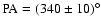 ,
,
 and
and
 km s-1. These
are presented in Table 1 along with values obtained in previous
works. The RC superposing both the approaching and receding sides
is shown in the lower panel in Fig. 2. Globally the
RC of NGC 3893 is symmetric up to the last H
emission
point at
km s-1. These
are presented in Table 1 along with values obtained in previous
works. The RC superposing both the approaching and receding sides
is shown in the lower panel in Fig. 2. Globally the
RC of NGC 3893 is symmetric up to the last H
emission
point at
 (7.55 kpc). Both sides of the curve
display oscillations of about 10 km s-1. The maximum
rotation velocity is
(7.55 kpc). Both sides of the curve
display oscillations of about 10 km s-1. The maximum
rotation velocity is
 km s-1 and is
reached at
km s-1 and is
reached at
 (6.1 kpc). Our RC is very similar to
the one derived by Garrido et al. (2002) using FP observations. To
compare with the results derived by Kranz et al. (2003), a long slit was
simulated by considering radial velocities on the velocity field
within a sector of
(6.1 kpc). Our RC is very similar to
the one derived by Garrido et al. (2002) using FP observations. To
compare with the results derived by Kranz et al. (2003), a long slit was
simulated by considering radial velocities on the velocity field
within a sector of
 on each side of the slit
position angle. The values of the kinematic parameters were equal
to those used by these authors. These "long-slit'' RCs show the
same increasing behavior and oscillations as those found by
Kranz et al. (2003).
on each side of the slit
position angle. The values of the kinematic parameters were equal
to those used by these authors. These "long-slit'' RCs show the
same increasing behavior and oscillations as those found by
Kranz et al. (2003).
Though the velocity field of this galaxy is very perturbed, we
were still able to derive an RC reflecting the circular motions of
the southwestern side of the galaxy (approaching side). The
following set of values were used:
 ,
,
 ,
and
,
and
 km s-1, considering an angular sector
of
km s-1, considering an angular sector
of  on each side of the galaxy's PA. These values, along
with values from previous works, are presented in Table 1.
The lower panel in Fig. 3 shows the RC derived for this galaxy
superposing both the approaching and
receding sides. Globally the curve increases up to the last
emission point at
on each side of the galaxy's PA. These values, along
with values from previous works, are presented in Table 1.
The lower panel in Fig. 3 shows the RC derived for this galaxy
superposing both the approaching and
receding sides. Globally the curve increases up to the last
emission point at
 (1.5 kpc) where the velocity
equals 48 km s-1. Rather low velocity values appear near
the center of the galaxy, within
(1.5 kpc) where the velocity
equals 48 km s-1. Rather low velocity values appear near
the center of the galaxy, within
 (0.4 kpc).
Two-dimensional kinematic fields of disk galaxies portray the motion of the gas over the whole galaxy enabling us to match these motions with different morphological structures. One can determine to what extent the gas is following circular motion around the center of the galaxy and to what extent there are large contributions from non-circular velocities (radial, azimuthal, and vertical ) due to the presence of these structures or to external perturbations. For NGC 3893, we analyzed the influence of morphological features on the kinematics of the gas. This was done by comparing the monochromatic image with each side of the RC (Fig. 4). Through this comparison we were able to differentiate points in the RC associated to circular motions of the gas - associated with the global mass distribution of the galaxy - from non-circular motions - associated to the response of the gas to local morphological features.
![\begin{figure}
\par\includegraphics[width=7.8cm,clip]{7071Fig4.eps}\end{figure}](/articles/aa/full/2007/18/aa7071-07/img79.gif) |
Figure 4: Top: Monochromatic image of NGC 3893. Letters indicate features associated to points on the RC (shown in the bottom panel) in order to differentiate the contribution of circular from non-circular motions. Solid line indicates the galaxy's position angle (PA) and the thin lines indicate the angular sector from both sides of the major axis considered for the computation of the galaxy's RC. |
| Open with DEXTER | |
The H
kinematic information from our FP observations of
NGC 3893 was complemented with HI synthesis observations by
Verheijen & Sancisi (2001). To match both curves, we considered the averaged
optical rotation curve that was derived using the same kinematic
parameters as those used for the HI RC (these values do not differ
much from the values we used for the optical RC - see Table 1). The
superposed curves are shown in Fig. 5. Both
curves superpose smoothly except for the external parts of the
optical RC (
 ), which appear to be more
perturbed. The HI RC also decreases for
), which appear to be more
perturbed. The HI RC also decreases for
 and up to the last HI emission point at
 (21.76 kpc). Verheijen & Sancisi (2001) mention that the determination of
the HI rotation curve beyond
(21.76 kpc). Verheijen & Sancisi (2001) mention that the determination of
the HI rotation curve beyond
 is uncertain because
of the tidal interaction with NGC 3896. We set this radius as our
limit for the computation of the mass through the RC of NGC 3893.
is uncertain because
of the tidal interaction with NGC 3896. We set this radius as our
limit for the computation of the mass through the RC of NGC 3893.
![\begin{figure}
\par\includegraphics[width=9cm,clip]{7071Fig5.eps}\end{figure}](/articles/aa/full/2007/18/aa7071-07/img84.gif) |
Figure 5:
Multi-wavelength curve of NGC 3893. Small dots in the inner parts of the curve
correspond to optical Fabry-Perot H
observations. Larger dots in the
outer parts correspond to the HI curve derived by Verheijen & Sancisi (2001). The
horizontal arrow indicates the point with maximum rotation
velocity. The vertical arrow shows the radius considered for mass estimation
using the method by Lequeux (1983). |
| Open with DEXTER | |
Using this composite rotation curve, a range of possible masses
was computed using the method proposed by Lequeux (1983) according
to which the total mass of a galaxy within a radius R lies
between 0.6 (in the case of a disk-like mass distribution) and
 (in the case of a spheroidal mass
distribution). As a first estimate, we considered the maximum
rotation velocity (190 km s-1) given by both the optical
and radio RCs to estimate the mass within
(in the case of a spheroidal mass
distribution). As a first estimate, we considered the maximum
rotation velocity (190 km s-1) given by both the optical
and radio RCs to estimate the mass within
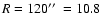 kpc = 0.99 D25/2. The range of masses within this radius
is given by 0.50 to
kpc = 0.99 D25/2. The range of masses within this radius
is given by 0.50 to
 .
To derive the
mass of NGC 3896, we considered the last emission point on the
approaching side of the curve, which shows the maximum amplitude
of that curve. This value equals 48 km s-1 at
.
To derive the
mass of NGC 3896, we considered the last emission point on the
approaching side of the curve, which shows the maximum amplitude
of that curve. This value equals 48 km s-1 at
 .
The masses within this
radius range from 4.78 to
.
The masses within this
radius range from 4.78 to
 .
.
The mass ratio of the galaxies was computed from the NIR
luminosities, calculated from the  -magnitudes taken from
2MASS (Skrutskie et al. 2006). These luminosities for NGC 3893/96 lead to
a mass ratio of 0.031. On the other hand, the mass ratio derived
from the RC of each galaxy within 0.4 D25/2 falls around
0.0255. These values are fairly similar, particularly if
considering the uncertainty of the mass-to-light ratio. This
strengthens the reliability of the mass estimates based on the
rotation curves.
-magnitudes taken from
2MASS (Skrutskie et al. 2006). These luminosities for NGC 3893/96 lead to
a mass ratio of 0.031. On the other hand, the mass ratio derived
from the RC of each galaxy within 0.4 D25/2 falls around
0.0255. These values are fairly similar, particularly if
considering the uncertainty of the mass-to-light ratio. This
strengthens the reliability of the mass estimates based on the
rotation curves.
![\begin{figure}
\par\includegraphics[scale=0.25, angle=270]{7071Fg6a.eps}\include...
...]{7071Fg6c.eps}\includegraphics[scale=0.25, angle=270]{7071Fg6d.eps}\end{figure}](/articles/aa/full/2007/18/aa7071-07/img91.gif) |
Figure 6:
Best mass model fits for the multi-wavelength rotation
curve of NGC 3893 once the points associated with non-circular
motions have been removed. Top left: pseudo-isothermal halo
and non-maximal disk. Top right: pseudo-isothermal halo and
maximal disk. Bottom left: NFW halo and non-maximal disk.
Bottom right: NFW halo and maximal disk. The long-dashed
curve represents the dark-matter halo contribution and the
short-dashed curve represents the stellar disk contribution. The
parameters displayed stand for the mass-to-light ratio of the
stellar disk (
 ), the characteristic radius of the
dark-matter halo and density (R0 and ), the characteristic radius of the
dark-matter halo and density (R0 and  ,
respectively)
and the minimized ,
respectively)
and the minimized  in the three-dimensional parameter
space. Mass-model taken from Blais-Ouellette et al. (2001).
in the three-dimensional parameter
space. Mass-model taken from Blais-Ouellette et al. (2001). |
| Open with DEXTER | |
We used the mass model from Blais-Ouellette et al. (2001) to study the mass
distribution in NGC 3893. This model uses both the light
distribution of the galaxy and a theoretical dark-halo profile to
compute an RC that best-fits the observed one. The mass-to-light
ratio of the disk
 ), as well as the properties of
the dark matter, characteristic density (), and radius
(R0), are free parameters. We used a DM halo described by a
pseudo-isothermal sphere (Begeman 1987) and a Navarro, Frenk &
White (NFW) profile (Navarro et al. 1996) to fit the multi-wavelength RC
of NGC 3893. Optical photometry in the I band was taken from
Hernández-Toledo & Puerari (2001) and the HI superficial distribution from
Verheijen & Sancisi (2001). Making use of the possibility of disentangling
circular from non-circular velocities in the optical RC, our
multi-wavelength RC was "cleaned'' from points associated to
non-circular motions (see Sect. 4.4) and to the warp
in the outer parts of the HI disk. We removed points in the
optical part of the observed RC between
), as well as the properties of
the dark matter, characteristic density (), and radius
(R0), are free parameters. We used a DM halo described by a
pseudo-isothermal sphere (Begeman 1987) and a Navarro, Frenk &
White (NFW) profile (Navarro et al. 1996) to fit the multi-wavelength RC
of NGC 3893. Optical photometry in the I band was taken from
Hernández-Toledo & Puerari (2001) and the HI superficial distribution from
Verheijen & Sancisi (2001). Making use of the possibility of disentangling
circular from non-circular velocities in the optical RC, our
multi-wavelength RC was "cleaned'' from points associated to
non-circular motions (see Sect. 4.4) and to the warp
in the outer parts of the HI disk. We removed points in the
optical part of the observed RC between
 -
-
 ,
,
 -
-
 ,
and at
,
and at
 (see Fig. 5). Only points from the HI rotation curve were
taken into account after
(see Fig. 5). Only points from the HI rotation curve were
taken into account after
 and up to
considering the fact that the RC in HI is uncertain beyond this
radius.
and up to
considering the fact that the RC in HI is uncertain beyond this
radius.
Table 2: Mass models parameters for NGC 3893 from best fits of the multi-wavelength rotation curve, considering only points associated to circular motions.
![\begin{figure}
\par\includegraphics[scale=0.25, angle=270]{7071Fg7a.eps}\include...
...]{7071Fg7c.eps}\includegraphics[scale=0.25, angle=270]{7071Fg7d.eps}\end{figure}](/articles/aa/full/2007/18/aa7071-07/img100.gif) |
Figure 7: Best mass-model fit for the multi-wavelength rotation curve of NGC 3893 considering all observed points - including those associated with non-circular motions. Top left: pseudo-isothermal halo and non-maximal disk. Top right: pseudo-isothermal halo and maximal disk. Bottom left: NFW halo and non-maximal disk. Bottom right: NFW halo and maximal disk. |
| Open with DEXTER | |
Figure 6 shows different fits for this
multi-wavelength RC: a pseudo-isothermal DM halo with non-maximal
disk (top left), a pseudo-isothermal DM halo with a maximal
disk (top right), a NFW halo with non-maximal disk (bottom left), and an NFW halo with a maximal disk (bottom
left). Table 2 displays the mass-model parameters
used in each case. We used the definition of Sackett (1997) for
the "maximal disk" that is taken to be a galactic disk such that
 of the total rotational support of a galaxy at a
radius
of the total rotational support of a galaxy at a
radius
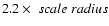 is contributed by the
stellar-disk mass component. For NGC 3893, this radius corresponds
to 1.80 kpc (Kranz et al. 2003). The best fit (
is contributed by the
stellar-disk mass component. For NGC 3893, this radius corresponds
to 1.80 kpc (Kranz et al. 2003). The best fit (
 )
is
obtained using a pseudo-isothermal halo with a non-maximal disk
leading to
)
is
obtained using a pseudo-isothermal halo with a non-maximal disk
leading to
 in the I band, yet it misses
the last two points of the RC. The fit with an NFW halo and a
non-maximal disk gives
in the I band, yet it misses
the last two points of the RC. The fit with an NFW halo and a
non-maximal disk gives
 (
(
 ),
also missing the two outermost points of the RC. Both a
pseudo-isothermal and NFW halo with a maximal disk give higher
values of
(1.25 in both cases) and also higher
values (1.53 and 3.11, respectively). They also miss both
outer and inner points on the RC.
),
also missing the two outermost points of the RC. Both a
pseudo-isothermal and NFW halo with a maximal disk give higher
values of
(1.25 in both cases) and also higher
values (1.53 and 3.11, respectively). They also miss both
outer and inner points on the RC.
To evaluate the effect of non-circular motions on the fits, we
fitted the above mass models by including the points associated to
non-circular motions to the multi-wavelength RC. The fits can be
seen in Fig. 7. The values for the mass-model
parameters are shown in Table 2. These fits are
less precise. In all cases, the mass-to-luminosity ratio using the
maximal disk assumption is higher than the one obtained by
Kranz et al. (2003) (
 - in both K and I bands). We
must take into account that Kranz et al. (2003) only fit the optical
part of the RC derived with long-slit spectroscopy. For the sake
of comparison, we fitted our H
RC (with and without points
associated to non-circular motions) using the value for
derived by these authors. Results are shown in Fig. 8 and
Table 2. Fits are very good for
both the pseudo-isothermal and the NFW halo; nevertheless,
does not render the disk maximal. Finally we
also fitted these mass models to the HI RC without points at
- in both K and I bands). We
must take into account that Kranz et al. (2003) only fit the optical
part of the RC derived with long-slit spectroscopy. For the sake
of comparison, we fitted our H
RC (with and without points
associated to non-circular motions) using the value for
derived by these authors. Results are shown in Fig. 8 and
Table 2. Fits are very good for
both the pseudo-isothermal and the NFW halo; nevertheless,
does not render the disk maximal. Finally we
also fitted these mass models to the HI RC without points at
 where tidal effects might affect the correct
determination of the RC. Figure 9 and Table
2 show the resulting parameters of the fits. The
fit using the NFW halo misses the innermost point of the curve and
is not very accurate (
where tidal effects might affect the correct
determination of the RC. Figure 9 and Table
2 show the resulting parameters of the fits. The
fit using the NFW halo misses the innermost point of the curve and
is not very accurate (
 ). The fit using the
pseudo-isothermal halo misses the middle point of the curve, yet
). The fit using the
pseudo-isothermal halo misses the middle point of the curve, yet
 - which is one of the lowest values found for all
fits presented. Nevertheless it should be noticed that for both
halos, the
- which is one of the lowest values found for all
fits presented. Nevertheless it should be noticed that for both
halos, the
 ,
which is higher than the value
found with the multi-wavelength RC. This highlights the importance
of the multi-wavelength approach for the mass model.
,
which is higher than the value
found with the multi-wavelength RC. This highlights the importance
of the multi-wavelength approach for the mass model.
That no model fits the last point in the multi-wavelength RC of
NGC 3893 "cleaned'' from the effects of non-circular motions can
be explained either by a truncated halo for this galaxy or by the
existence of a common halo for both galaxies. Since the derived
mass of the NGC 3896 is low, then it most probably resides inside
the halo of NGC 3893, and both galaxies share a single halo.
Nevertheless this halo would have a different distribution than in
an isolated galaxy. When considering an isothermal halo and the
HI curve, the
that fits this curve best is much
higher than the M/L found for the multi-wavelength curve. In
general, the information on the inner parts of the galaxy given by
the optical observations imposes an
 ,
which
would imply the presence of a disk with a large population of
young stars -which is not the case given the B - V value
derived by Hernández-Toledo & Puerari (2001). This supports the idea that the structure
of the DM halo of this pair differs from that of a single-disk
galaxy. As shown by Laurikainen & Salo (2001), M 51-type pairs companions tend
to have extremely large bulge sizes relative to their disk
scale-lengths. Consequently, the bulge-to-disk luminosity ratios
for the companions were also generally higher than known for any
of the Hubble types of normal galaxy. This is the case for NGC 3896, whose RC displays almost solid body rotation up to the last
emission point.
,
which
would imply the presence of a disk with a large population of
young stars -which is not the case given the B - V value
derived by Hernández-Toledo & Puerari (2001). This supports the idea that the structure
of the DM halo of this pair differs from that of a single-disk
galaxy. As shown by Laurikainen & Salo (2001), M 51-type pairs companions tend
to have extremely large bulge sizes relative to their disk
scale-lengths. Consequently, the bulge-to-disk luminosity ratios
for the companions were also generally higher than known for any
of the Hubble types of normal galaxy. This is the case for NGC 3896, whose RC displays almost solid body rotation up to the last
emission point.
![\begin{figure}
\par\includegraphics[width=3.35cm,angle=270]{7071Fg8a.eps}\hspace*{1mm}
\includegraphics[width=3.35cm,angle=270]{7071Fg8b.eps}\end{figure}](/articles/aa/full/2007/18/aa7071-07/img113.gif) |
Figure 8:
Best mass-model fit for the H
rotation curve of
NGC 3893 considering all observed points -including those
associated with non-circular motions and using the
 value by Kranz et al. (2003). Left: pseudo-isothermal halo.
Right: NFW halo.
value by Kranz et al. (2003). Left: pseudo-isothermal halo.
Right: NFW halo. |
| Open with DEXTER | |
![\begin{figure}
\par\includegraphics[width=3.35cm,angle=270]{7071Fg9a.eps}\hspace*{1mm}
\includegraphics[width=3.35cm,angle=270]{7071Fg9b.eps}\end{figure}](/articles/aa/full/2007/18/aa7071-07/img114.gif) |
Figure 9: Best mass-model fit for the HI rotation curve of NGC 3893 after removing points associated with non-circular motions and the warp of the outer parts of the disk. Left: pseudo-isothermal halo. Right: NFW halo. |
| Open with DEXTER | |
We have presented the kinematic and dynamical analysis of the M 51-type galaxy pair, KPG 302 (NGC 3893/96). NGC 3893 is a grand-design spiral with a regular velocity field that displays no major distortions. The companion, NGC 3896, displays ongoing star formation that was probably triggered by the interaction with the main galaxy. This galaxy displays important non-circular motions in localized regions, especially on the side of the galaxy that is closer to the companion. The total mass of each galaxy was derived from the RC. The optical RC of NGC 3893 was matched with the existing HI curve to determine the distribution of the luminous and dark matter. This multi-wavelength rotation curve was analyzed in light of the 3D observations in order to differentiate the contribution of non-circular motions associated to particular features and the contribution of circular motions, which reflect the mass distribution of the galaxy. No "classical'' DM halo fits the observed rotation curve, which could imply a different mass distribution for the DM halo of M 51-type binary galaxies.
Acknowledgements
We wish to thank the staff of the Observatorio Astronómico Naconal (OAN-SPM) for their support during PUMA data acquisition. We also thank C. Carignan for letting us use his mass model. I.F.-C. acknowledges the financial support of FAPESP and CONACYT grants No. 03/01625-2 and No. 121551 - respectively. M.R. acknowledges financial support from grants 46054-F from CONACYT and IN100606 from DGAPA-UNAM. H.S. and E.L. acknowledge the support from the Academy of Finland. We acknowledge the use of the HyperLeda database (http://leda.univ-lyon1.fr), the NASA/IPAC Extragalactic Database (NED), and the Two Micron All Sky Survey.