Pictoris system
A&A 466, 201-213 (2007)
DOI: 10.1051/0004-6361:20053425
Pictoris system![[*]](/icons/foot_motif.gif)
H. Beust - P. Valiron
Laboratoire d'Astrophysique de Grenoble, UMR 5571 CNRS, Université J. Fourier, BP 53, 38041 Grenoble Cedex 9, France
Received 13 May 2005 / Accepted 15 December 2006
Abstract
Context. The puzzling detection of Ca II ions at fairly high latitude (
 )
above the outer parts of the Pictoris circumstellar disk was recently reported. Surprisingly, this detection does not extend to Na I atoms, in contradiction with our modelling of the emission lines in and out of the mid-plane of the disk.
)
above the outer parts of the Pictoris circumstellar disk was recently reported. Surprisingly, this detection does not extend to Na I atoms, in contradiction with our modelling of the emission lines in and out of the mid-plane of the disk.
Aims. We propose that the presence of these off-plane Ca II ions (and to a lesser extent Fe I atoms), and the non-detection of off-plane Na I atoms, could be the consequence of the evaporation process of Falling Evaporating Bodies (FEBs), i.e., star-grazing planetesimals that evaporate in the immediate vicinity of the star.
Methods. Our model is two-fold. Firstly, we show numerically and theoretically that in the star-grazing regime, the FEBs are subject to inclination oscillations up to 30-
 ,
and that most metallic species released during each FEB sublimation keep track of their initial orbital inclination while starting a free expansion away from the star, blown out by a strong radiation pressure. Secondly, the off-plane Ca II and Fe I species must be stopped prior to their detection at rest with respect to the star, about 100 AU away. We revisit the role of energetic collisional processes, and we investigate the possible influence of magnetic interactions.
,
and that most metallic species released during each FEB sublimation keep track of their initial orbital inclination while starting a free expansion away from the star, blown out by a strong radiation pressure. Secondly, the off-plane Ca II and Fe I species must be stopped prior to their detection at rest with respect to the star, about 100 AU away. We revisit the role of energetic collisional processes, and we investigate the possible influence of magnetic interactions.
Results. This dynamical process of inclination oscillations explains the presence of off-plane Ca II (and Fe I). It also accounts for the absence of Na I because once released by the FEBs, these atoms are quickly photoionized and no longer undergo any significant radiation pressure. Our numerical simulations demonstrate that the deceleration of metallic ions can be achieved very efficiently if the ions encounter a dilute neutral gaseous medium. The required H I column density is reduced to 
 ,
one order of magnitude below present detection limits. We also investigate the possibility that the ions are slowed down magnetically. While the sole action of a magnetic field of the order of
,
one order of magnitude below present detection limits. We also investigate the possibility that the ions are slowed down magnetically. While the sole action of a magnetic field of the order of  G is not effective, the combined effect of magnetic and collisional deceleration processes lead to an additional lowering of the required H I column density by one order of magnitude.
Key words: stars: circumstellar matter - stars: individual: Pic - celestial mechanics - methods: numerical - molecular processes - magnetic fields
The dusty and gaseous disk surrounding the young main-sequence star
Pictoris has been the subject of intense investigation since its discovery
(Smith & Terrile 1984). The main motivation for these studies is that
this disk constitutes the most convincing example of a probable
young extrasolar planetary system, possibly analogous to the early
solar system. Pic is a young star, but it is not a pre-main sequence star.
Its age has been subject to controversy in past years, but successive
determinations based on the kinematics of the socalled Pictoris moving
group (Ortega et al. 2004; Zuckerman et al. 2001; Barrado y Navascués et al. 1999) lead to a most recent estimate of 11.2 Myr
(Ortega et al. 2004). This shows that
its disk should be called a young planetary rather than
a protoplanetary disk, meaning that planet formation already should
have had enough time to occur. Indeed, although
no direct planet detection has been made so far, several indirect
observational facts suggest that planets are present in the disk.
This mainly concerns asymmetries found in the disk images from
both scattered stellar light by the dust (Kalas & Jewitt 1995; Heap et al. 2000)
and thermal emission by the dust (Weinberger et al. 2003), that have been
modelled as resulting from the gravitational perturbations by
one Jupiter-sized planet (Augereau et al. 2001; Mouillet et al. 1997; Heap et al. 2000).
The gaseous counterpart of the dust disk was detected in absorption in the stellar spectrum (Hobbs et al. 1985), and has been regularly observed since that time. Observations of many metallic species such as Na I, Ca II, Fe II... have been reported (Vidal-Madjar et al. 1994), extending more recently to more fragile species like CO (Lecavelier des Etangs et al. 2001; Jolly et al. 1998).
The gas was first detected at rest with respect to the star, but Doppler-shifted, highly time-variable components are regularly observed in the spectral lines of many elements (Lagrange et al. 1996; Ferlet et al. 1987; Petterson & Tobin 1999). These transient spectral events have been successfully modelled as resulting from the sublimation of numerous star-grazing planetesimals (several hundred per year) in the immediate vicinity of the star (see Beust et al. 1996,1998, and refs. therein). This scenario has been termed the Falling Evaporating Bodies scenario (FEBs).
From a dynamical point of view, the origin of these numerous star-grazers
seem to be related to mean-motion resonances (mainly 4:1 and 3:1) with
a Jovian planet orbiting the staron a moderately eccentric
orbit (
 -0.1) (Beust & Morbidelli 2000,1996). In this
context though, the suspected resonance reservoirs are expected to clear out
very quickly. In Thébault & Beust (2001), it was shown that collisions
among the population of the planetesimals constituting the disk
could help replenish the resonances from adjacent regions and
subsequently sustain the FEB activity. However, there are still unsolved
questions concerning this scenario. The main one concerns the amount
of material available (Thébault et al. 2003). There is a large discrepancy
between the number of planetesimals deduced from the FEB model and
that deduced from an extrapolation of the dust observed population
up to kilometre-sized bodies. We nevertheless note in Thébault et al. (2003)
that the mass determination of Thébault & Beust (2001) from the FEB scenario
is very imprecise as it is indirect. Indeed if the collisions
are supplemented by some more violent transport processes,
then the planetesimals population required to sustain the
FEB activity could be much lower.
-0.1) (Beust & Morbidelli 2000,1996). In this
context though, the suspected resonance reservoirs are expected to clear out
very quickly. In Thébault & Beust (2001), it was shown that collisions
among the population of the planetesimals constituting the disk
could help replenish the resonances from adjacent regions and
subsequently sustain the FEB activity. However, there are still unsolved
questions concerning this scenario. The main one concerns the amount
of material available (Thébault et al. 2003). There is a large discrepancy
between the number of planetesimals deduced from the FEB model and
that deduced from an extrapolation of the dust observed population
up to kilometre-sized bodies. We nevertheless note in Thébault et al. (2003)
that the mass determination of Thébault & Beust (2001) from the FEB scenario
is very imprecise as it is indirect. Indeed if the collisions
are supplemented by some more violent transport processes,
then the planetesimals population required to sustain the
FEB activity could be much lower.
An important outcome of this model is that it implies an important
reservoir of planetesimals in the disk and the presence of at least
one giant planet at 10 AU from the star. This is another
argument in favour of the presence of planets in the Pic disk.
Moreover, the presence of numerous planetesimals is also a
requirement of the dust models. Due to an intense radiation pressure,
many dust particles should be quickly removed from the system.
The particles observed consist of second
generation material continuously replenished from inside the disk
by planetesimals, either by slow
evaporation (Lecavelier et al. 1996) or by collisions (Artymowicz 1997).
This justifies the name second generation or debris
disks given to the Pic disk and other similar disks, such as
the HD 141569 disk (see Augereau & Papaloizou 2004, and refs. therein).
Radiation pressure affects not only dust particles, but also the
metallic species seen in absorption with respect to the star. Many of
them undergo a radiation force from the star that largely overcomes
the stellar gravity (Lagrange et al. 1998). This is for instance the case of
Ca II for which the radiation pressure is 35 times larger than the
stellar gravity. This seems in contradiction with the detection of
circumstellar gas at rest with respect to the star. Lagrange et al. (1998)
suggested that this stable gas was produced from inside by the FEBs
themselves, that it is then blown away by the radiation pressure, and
afterwards slowed down by a dense enough H I ring where it
accumulates. The exact shape of this ring is of little importance,
the main parameter being the integrated H I column density, of the
order of
 .
Detailed modelling shows that all
stable circumstellar lines can be reproduced this way.
.
Detailed modelling shows that all
stable circumstellar lines can be reproduced this way.
In a recent paper, Brandeker et al. (2004, hereafter B04) report the detection with VLT/UVES of
emission lines of metals (Fe I, Na I, Ca II) in the Pic disk,
i.e., away from the direction of the star. They report the detection
of Na I and Fe I up to more than 300 AU from the star. Na I was
resolved earlier by Olofsson et al. (2001), but the detection
of B04 extends further out.  was also claimed
to be detected in emission by Thi et al. (2001), implying huge quantities
(
was also claimed
to be detected in emission by Thi et al. (2001), implying huge quantities
(
 )
in the Pic system, but this was questioned by
Lecavelier des Etangs et al. (2001), who reported from FUSE/LYMAN observations an upper
limit
)
in the Pic system, but this was questioned by
Lecavelier des Etangs et al. (2001), who reported from FUSE/LYMAN observations an upper
limit
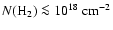 for the
column density towards Pic.
for the
column density towards Pic.
A particularly puzzling outcome of the B04 observations
is the detection of Ca II emission at fairly high latitude above the
mid-plane of the disk. Ca II is detected at 77 AU height above and below
the mid-plane at 116 AU from the star. This corresponds to an inclination
of
 above the mid-plane. At this distance, Ca II is detected
in both branches of the disk and on both sides of the mid-plane, and
the emission at
inclination largely overcomes that in
the mid-plane. Surprisingly, the Fe I and Na I emission do not
exhibit such a structuring. It is conversely concentrated in the mid-plane
of the disk. However, the Fe I emission is broader than the Na I.
At the height above the mid-plane corresponding to the peak emission
in the Ca II lines, the Fe I is still detected.
The gas shares the same radial velocity as the star
within 1 or 2 km s-1 at most.
above the mid-plane. At this distance, Ca II is detected
in both branches of the disk and on both sides of the mid-plane, and
the emission at
inclination largely overcomes that in
the mid-plane. Surprisingly, the Fe I and Na I emission do not
exhibit such a structuring. It is conversely concentrated in the mid-plane
of the disk. However, the Fe I emission is broader than the Na I.
At the height above the mid-plane corresponding to the peak emission
in the Ca II lines, the Fe I is still detected.
The gas shares the same radial velocity as the star
within 1 or 2 km s-1 at most.
There is no straightforward explanation for the presence of species like Ca II at such latitudes above the disk, nor for the absence of other species. The purpose of this paper is to propose that this gas could constitute material released by the FEBs in the vicinity of the star, first blown away by radiation pressure, and then stopped far away from the star by friction with some gaseous medium, and/or by magnetic interaction. The Ca II and possibly the Fe I reach a significant inclination because the parent bodies (the FEBs) initially orbiting within the plane of the disk undergo inclination oscillations up so several tens of degrees when they reach the star-grazer state. Once released by the FEBs, the ions keep track of that inclination. In Sect. 2, we model the formation of the emission lines in and out of the mid-plane of the disk. We show that all the emissions are compatible with solar relative abundances between the elements under consideration, except that sodium should necessarily not be present (or strongly depleted) in the high latitude gas. In Sect. 3, we expose the dynamical model for high latitude gas generation, and we detail the theoretical background for inclination oscillations in the FEB state. We show that due to a negligible radiation pressure on Na II, sodium should not be present in this gas, in agreement with the observations.
In Sect. 4, we investigate how the Ca II ions could be slowed down at the stellar distance they are observed. We show that this deceleration can be achieved by collision with a dilute neutral medium, and we discuss the role of elastic and inelastic collisional processes. We also discuss the effect of a non-radial magnetic field. While the magnetic field in itself is inefficient to decelerate the ions, we show that its presence increases the efficiency of the deceleration by a neutral medium by an order of magnitude or more.
 Å line. The modelling is
done using the radiative transfer code CLOUDY by Ferland et al. (1998).
Å line. The modelling is
done using the radiative transfer code CLOUDY by Ferland et al. (1998).
We take the synthetic ATLAS9 (Kurucz 1991) stellar model for
Pic with
 K,
K,
 and
a total luminosity of
and
a total luminosity of
 .
We put gas at 116 AU
from the star and compute the line emission. The chemical composition
of the gas is assumed to be solar. The gas is modelled as a
10 AU wide layer with solar composition and a given hydrogen density.
.
We put gas at 116 AU
from the star and compute the line emission. The chemical composition
of the gas is assumed to be solar. The gas is modelled as a
10 AU wide layer with solar composition and a given hydrogen density.
Without any additional energy source other than the stellar radiation
flux, the emission in all lines as computed by CLOUDY appears
negligible, because the gas remains very cold (a few Kelvins). Thus,
in order to generate detectable lines, the gas must be heated by some
energy source. There can be some turbulence, but in the framework of
our model, the strong deceleration of the weak flux of incoming
metallic ions might constitute a sufficient heating source. In the
following we thus assume the emission lines to be excited thermally.
The incoming ions, once blown away by the radiation pressure, reach a
velocity of
 at 100 AU. The
various surveys of the FEB activity towards Pic (Beust et al. 1996) led to
estimate that one roughly 1 kilometer-sized body is destroyed in front
of the line of sight every day, with temporal fluctuations around one
order of magnitude. Assuming that not all FEBs cross the line of
sight, we estimate the total number of FEBs evaporated as
at 100 AU. The
various surveys of the FEB activity towards Pic (Beust et al. 1996) led to
estimate that one roughly 1 kilometer-sized body is destroyed in front
of the line of sight every day, with temporal fluctuations around one
order of magnitude. Assuming that not all FEBs cross the line of
sight, we estimate the total number of FEBs evaporated as
 per day. Taking kilometer-sized bodies with an average density of
 ,
assuming that half of their mass is
made of metallic ions that are pushed away by radiation pressure, and
assuming that the ions spread over an open cone of
,
assuming that half of their mass is
made of metallic ions that are pushed away by radiation pressure, and
assuming that the ions spread over an open cone of  half-opening angle (in order to disperse ions at that
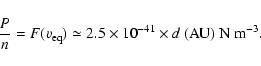
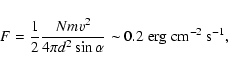
latitude), we may estimate the incoming kinetic energy flux F at
100 AU as
half-opening angle (in order to disperse ions at that
latitude), we may estimate the incoming kinetic energy flux F at
100 AU as
 |
(1) |
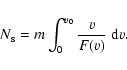
 is the velocity of the
incoming ions and m is the average mass of the FEBs.
This kinetic energy heats the
local H I gas over a distance corresponding to the stopping path of
the metallic ions. This depends on the density of the local gas, but
we see in Sect. 4 that an H I column density of
is expected to be sufficient to stop
the ions over a distance of a few AU.
is the velocity of the
incoming ions and m is the average mass of the FEBs.
This kinetic energy heats the
local H I gas over a distance corresponding to the stopping path of
the metallic ions. This depends on the density of the local gas, but
we see in Sect. 4 that an H I column density of
is expected to be sufficient to stop
the ions over a distance of a few AU.
We thus decided to perform
runs of CLOUDY with an extra heating source, with a volume-heating
rate (parameter hextra) corresponding to the incoming kinetic
energy flux deposited over the stopping distance.
We performed several runs for
hydrogen densities ranging
between 106 and
 .
The result listed in
Table 1 are for
.
The result listed in
Table 1 are for
 .
For other values, the
absolute values of the emissions changes, but their relative
behaviour remains comparable.
.
For other values, the
absolute values of the emissions changes, but their relative
behaviour remains comparable.
Table 1:
Measured circumstellar ratios, and simulated emission
intensities for the transitions under consideration. The circumstellar
factors are taken from calibrated ESO/HARPS spectra of Pic (Galland F., Priv. Comm.). The emission intensities (given
in arbitrary units) out of the mid-plane are derived from the
CLOUDY run and those in the midplane are estimated by
multiplying the former ones by the circumstellar factors.
In almost all runs the same line behaviour is reported (Table 1): the Ca II K and H emissions are comparable, the Ca II K emission being slightly stronger; the Na I D2 emission is typically twice as strong as the Ca II K one, while the Fe II emission is as strong as the Na I one.
This simulation is intended to hold for the gas out of the
disk mid-plane. The spectrum of Pic as seen from Earth is known to
present stable circumstellar components (Lagrange et al. 1998) due to the
gaseous counterpart of the disk. These componenents appear as sharp
(0.1 Å wide) additional absorptions at the bottom
of the rotationally broadened photospheric stellar lines.
There is a major difference
between ions located in and out of the mid-plane of the disk: the
former ones see a stellar spectrum with these circumstellar
components, while the latter ones see a stellar spectrum
without these components (because they view the star across
the disk, as Earth observers).
The ATLAS9 stellar model does not take into account these
circumstellar absorptions. Hence we must add them to the model.
Unfortunately, adding additional
spectral absorptions to the stellar models provided
is not a standard procedure for CLOUDY.
It is thus not possible to accurately model the emission in the
mid-plane of the disk. A first order approximation in order to take
these absorptions into account is to apply
reduction factors of the stellar flux to ions
in the mid-plane of the disk (and only to them).
These factors are defined as the
ratio of the stellar flux at the bottom of the circumstellar
additional absorptions (if present) to the flux at the bottom of
the corresponding photospheric lines
(or equivalently the top of the circumstellar lines). They are simply
measured from observed Pic spectra. We used ESO/HARPS spectra
communicated by F. Galland.
The factors are listed in Table 1. We note that the circumstellar
lines are particularly deep for the Ca II lines.
In order to derive a rough estimate of the line emissions, we may assume that the emission is proportional to the incoming flux. This only applies if the lines are optically thin, but the ratio of 2 between the Na I D2 and D1 emission shows that this is the case here. We apply the circumstellar factors of Table 1 to the emission intensities derived from CLOUDY with no circumstellar absorptions. The ratio between Na I and Fe I emissions remains unchanged (thanks to similar circumstellar factors), but the Ca II emissions (in both lines) appears now far weaker (a few hundredth in relative intensity) than the Na I and Fe I ones.
The observational constrains to fulfill (B04)
are the following: in the mid-plane, the Ca II emission is small
compared to the Na I and Fe I ones; the Na I D2 to Na I D1ratio is close to 2, showing that the emission is optically thin;
the emission in the Fe I
Å line is comparable to
that in the Na I D2 line. Out of the mid-plane, the Ca II emission
dominates, but the Fe I line may still be detected, because the
wing of the line is much larger than for the Na I lines; the
Ca II K to Ca II H ratio is close to one.
Our simple model succeeds in reproducing the emissions in the mid-plane. Out of the mid-plane though, the Na I emission is always stronger than the Ca II one and comparable to the Fe I one. It is thus impossible to simultaneously have a strong Ca II emission, a Fe I emission a few times weaker, and an undetectable Na I emission. The only possibility is to exclude the hypothesis of solar composition.
We come therefore to the following conclusions: 1) for the emission in the mid-plane, the observations can be reproduced assuming solar relative abundances between iron, sodium and calcium; 2) out of the mid-plane, the Fe I and Ca II line intensities can be consistently simulated assuming solar relative abundances; 3) the non-detection of Na I emission out of the mid-plane cannot be explained in these conditions, unless sodium is strongly depleted with respect to solar abundance. The model presented in next section provides a plausible explanation for such sodium depletion.
above the mid-plane of the disk?
ii) why does sodium seem not to be present in this gas? We propose that
this high latitude gas could be produced by the Falling Evaporating
Bodies (FEBs).
The FEBs are star-grazing bodies that fully evaporate in the vicinity
of the star. Dynamically speaking, they are planetesimals that have
been extracted from the disk orbiting the star and driven to high
eccentricity orbits. They enter the FEB regime when their periastron
reaches a threshold value (0.4 AU) that allows the refractory
material to evaporate. The details of the evaporation process of the
bodies as their periastron decreases down to a few stellar radii are
described in Karmann et al. (2003). The bodies start to evaporate at each
periastron passage, and their evaporation rate increases as the
periastron distance gets smaller. For the sizes considered (10 km), the FEBs are fully evaporated when they reach a periastron
value
 AU.
AU.
Star-grazers may be produced from a disk of planetesimals by planetary perturbations. The most efficient mechanism is the Kozai resonance (Kozai 1962), which concerns bodies that have initial high inclination with respect to the orbital plane of the planetary system. Under secular perturbations, the initially highly inclined body is periodically driven to low inclination, but very eccentric, star-grazing orbits. This mechanism is responsible for most of the sun-grazing bodies reported in the Solar System, such as the Kreutz group (Bailey et al. 1992).
However, the Kozai resonance is due to the secular, circular part of the interaction Hamiltonian with the planet(s). It is therefore invariant with respect to any rotation in the planet's orbital plane. Bodies driven by the Kozai mechanism are thus expected to reach the FEB state with random orbit orientations. This does not match the statistics of the Doppler velocities of the variable spectral events observed, which shows a strong bias towards redshifts. Most of the suspected FEBs share some kind of common preferred periastron orientation range which is not compatible with the Kozai resonance (Beust et al. 1996).
Beust & Morbidelli (1996) proposed that the FEBs could be generated by another
mechanism involving mean-motion resonances with at least one major
perturbing planet. The secular motion of bodies trapped in a given
mean-motion resonance with a planet is usually characterised by coupled
oscillations of the semi-major axis and the eccentricity around a
median value, but if the planet's orbit is slightly eccentric,
these oscillations are superimposed on a long-term drift
of the eccentricity that can in some cases bring it to star-grazing
values. Yoshikawa (1989) showed that these changes are particularly
important for resonances 4:1, 3:1 and 5:2. Beust & Morbidelli (1996) showed that
the 4:1 resonance is a potential source of FEBs via this mechanism,
and in Thébault & Beust (2001), it was shown that the 3:1 may also contribute
to the FEB phenomenon. The planet's eccentricity e' does not need
to be very high;
 is enough, e'=0.07 or 0.1 being typical
convenient values. Such eccentricity values are regularly reached
by Jupiter due to its secular evolution. This mechanism is
close to the one that gave birth to the Kirkwood gaps in the asteroid
belt, even if in the latter case, the overlapping of mean-motion resonances
with secular resonances considerably enhances the mechanism (Morbidelli & Moons 1995; Farinella et al. 1994; Moons & Morbidelli 1995; Morbidelli & Moons 1993). We cannot exclude this enhancement as being effective
in the Pic system (this would imply the presence of more than one
planet), but there is no way to constrain it. We are perhaps
witnessing in the Pic system a process similar to what occurred
in the Solar System, as it was of comparable age to Pics current age.
is enough, e'=0.07 or 0.1 being typical
convenient values. Such eccentricity values are regularly reached
by Jupiter due to its secular evolution. This mechanism is
close to the one that gave birth to the Kirkwood gaps in the asteroid
belt, even if in the latter case, the overlapping of mean-motion resonances
with secular resonances considerably enhances the mechanism (Morbidelli & Moons 1995; Farinella et al. 1994; Moons & Morbidelli 1995; Morbidelli & Moons 1993). We cannot exclude this enhancement as being effective
in the Pic system (this would imply the presence of more than one
planet), but there is no way to constrain it. We are perhaps
witnessing in the Pic system a process similar to what occurred
in the Solar System, as it was of comparable age to Pics current age.
Due to this mean-motion resonance mechanism,
a given body, initially orbiting the star in 3:1
or 4:1 mean-motion resonance with a Jupiter-sized planet, may reach
the FEB state within 104 orbital periods of the planet.
Contrary to the Kozai case,
the periastron longitudes of
the FEBs at high eccentricity are now constrained by that
of the perturbing planet, and share some common orientation
in closer agreement with the observations.
This scenario was numerically tested over a large number of particles
(Beust & Morbidelli 2000; Thébault & Beust 2001), using the popular symplectic integration package
SWIFT_MVS (Levison & Duncan 1994; Wisdom & Holman 1991). It was shown that the suspected mechanism
was able to fairly well match the statistics of the observed
FEB velocities, provided the orbit of the perturbing planet adopts
a given longitude of periastron with respect to the line of sight.
If the disk of planetesimals holds a large enough population of bodies,
collisions may help refill the resonance and sustain the FEB activity
(Thébault & Beust 2001).
The orbits of the FEB progenitors in the mean-motion resonances are supposed to
be roughly coplanar with the plane of the disk. In the simulations of
Beust & Morbidelli (2000) and Thébault & Beust (2001), the initial inclinations of the particles
with respect to the orbit of the perturbing planet were initially
chosen as less than
 and
and
 respectively, in order to mimic
the typical distribution within a cold planetesimal disk. During their
evolution within the resonance, as long as their eccentricity grows,
the inclination of the particles remains small, but as they reach the FEB
state close to
respectively, in order to mimic
the typical distribution within a cold planetesimal disk. During their
evolution within the resonance, as long as their eccentricity grows,
the inclination of the particles remains small, but as they reach the FEB
state close to  ,
their inclination is subject to oscillations
of larger amplitude, up to several tens of degrees. This is illustrated in
Fig. 1, which shows the secular evolution of the eccentricity
and of the inclination of a typical particle trapped in 4:1 resonance
with a planet orbiting Pic. The particle starts at eccentricity e=0.05and evolves towards the FEB state at
(the peak eccentricity
is about 0.998), and then starts a decrease of its eccentricity. Of course
the decrease phase is purely fictitious, as a real FEB would be destroyed
by the successive periastron passages at peak eccentricity.
,
their inclination is subject to oscillations
of larger amplitude, up to several tens of degrees. This is illustrated in
Fig. 1, which shows the secular evolution of the eccentricity
and of the inclination of a typical particle trapped in 4:1 resonance
with a planet orbiting Pic. The particle starts at eccentricity e=0.05and evolves towards the FEB state at
(the peak eccentricity
is about 0.998), and then starts a decrease of its eccentricity. Of course
the decrease phase is purely fictitious, as a real FEB would be destroyed
by the successive periastron passages at peak eccentricity.
![\begin{figure}
\par\includegraphics[angle=-90,width=8.8cm]{3425fg1a.ps}\par\includegraphics[angle=-90,width=8.8cm]{3425fg1b.ps}\end{figure}](/articles/aa/full/2007/16/aa3425-05/img40.gif) |
Figure 1:
Temporal evolution of the eccentricity ( top) and
of the inclination ( bottom) of a typical particle trapped in 4:1 resonance
with a planet orbiting Pic at 10 AU with eccentricity e'=0.07. The planet's mass is 1/1000 of that of the star. The initial eccentricity of the particle is 0.05 and its
initial inclination is
 . . |
| Open with DEXTER | |
,
remains small for
 yr and then starts oscillations that brings it far above
the initial value, up to
.
This oscillation regime
stops after
yr and then starts oscillations that brings it far above
the initial value, up to
.
This oscillation regime
stops after
 yr; it corresponds to the
high eccentricity phase, when
yr; it corresponds to the
high eccentricity phase, when  .
Hence the FEBs
may remain within the disk during most of their secular evolution,
but finish in the FEB state with inclinations that might bring them
significantly out of the disk. The FEB themselves do not
have excursions far out of the plane of the disk, because, as we will
see below, when their inclination is high, their argument of
periastron
.
Hence the FEBs
may remain within the disk during most of their secular evolution,
but finish in the FEB state with inclinations that might bring them
significantly out of the disk. The FEB themselves do not
have excursions far out of the plane of the disk, because, as we will
see below, when their inclination is high, their argument of
periastron  is close to
 or
or
 .
This causes the
major axis of their orbit to lie roughly in the plane of the disk at the time
the inclination is high. As the orbit is very eccentric, the vertical
excursion of the particle is limited. This is why this effect,
present in the simulations of Beust & Morbidelli (2000) and Thébault & Beust (2001),
does not have much influence on the visibility of the FEBs (they need to
cross the line of sight to be detected in absorption).
.
This causes the
major axis of their orbit to lie roughly in the plane of the disk at the time
the inclination is high. As the orbit is very eccentric, the vertical
excursion of the particle is limited. This is why this effect,
present in the simulations of Beust & Morbidelli (2000) and Thébault & Beust (2001),
does not have much influence on the visibility of the FEBs (they need to
cross the line of sight to be detected in absorption).
What is true for the parent body is not necessary true for its byproducts.
The metallic ions released by the FEBs such as Ca II start to expand
radially around the nucleus and stay for a while in a surrounding
cloud that enables
the FEB to be detected in absorption when it crosses the line of sight;
but they are quickly expelled from there by the intense radiation pressure
they suffer and then start a free expansion out of the system. This process
is extensively described in dedicated simulations in Beust et al. (1996,1998,1990).
Dynamically speaking, the ratio of the radiation pressure to stellar
gravity is a constant (usually noted  )
for a given ion or dust
grain. This is equivalent to the view that
with radiation pressure, the ion feels the gravity of star as if its
mass was multiplied by
)
for a given ion or dust
grain. This is equivalent to the view that
with radiation pressure, the ion feels the gravity of star as if its
mass was multiplied by  .
For Ca II,
.
For Ca II,  (
( ), so that the ions feel a negative mass and are strongly repelled
by the star. They nevertheless follow a purely Keplerian orbit, namely
a hyperbolic repulsive one, similar to the relative motion of two charged
particles with charges of the same sign. This orbit is very
different to that of the parent body. Both orbits share however the
same orbital plane. Indeed, the ejection velocity of the material
escaped from the FEB (typically
), so that the ions feel a negative mass and are strongly repelled
by the star. They nevertheless follow a purely Keplerian orbit, namely
a hyperbolic repulsive one, similar to the relative motion of two charged
particles with charges of the same sign. This orbit is very
different to that of the parent body. Both orbits share however the
same orbital plane. Indeed, the ejection velocity of the material
escaped from the FEB (typically
 ;
see refs. in Beust et al. 1996) is very small compared to the orbital velocity
of the FEB itself at a few stellar radii from the star (typically
several hundreds of km s-1). The Ca II ions may thus be considered
with reasonable accuracy to have the same orbital velocity at ejection
time as their parent body. Both Keplerian orbits are very different
because of radiation pressure, but they share roughly the same orbital
plane. In particular, the Ca II ions keep memory of the orbital inclination
of their parent body at ejection time, even if this inclination is large
thanks to inclination oscillations in the FEB state. But contrary to the
parent body, the orbit of Ca II ions are not confined close to the plane.
As explained above, the argument of periastron of the parent bodies is close to 0 or 180
;
see refs. in Beust et al. 1996) is very small compared to the orbital velocity
of the FEB itself at a few stellar radii from the star (typically
several hundreds of km s-1). The Ca II ions may thus be considered
with reasonable accuracy to have the same orbital velocity at ejection
time as their parent body. Both Keplerian orbits are very different
because of radiation pressure, but they share roughly the same orbital
plane. In particular, the Ca II ions keep memory of the orbital inclination
of their parent body at ejection time, even if this inclination is large
thanks to inclination oscillations in the FEB state. But contrary to the
parent body, the orbit of Ca II ions are not confined close to the plane.
As explained above, the argument of periastron of the parent bodies is close to 0 or 180 in the high inclination state;
this forces the FEB to remain close to the mid-plane of the disk.
Due to radiation pressure, the shape of the Ca II ions is very different from
that of their parent body, and their argument of periastron is not constrained
in the same way. If they have
a high initial inclination, they may evolve far off the plane of the disk
as they escape from the system. If some dense medium is present at a given
distance to brake them, they may be detected as an extended emission
significantly above the plane such as in the B04 observation.
Their detection of Ca II at
off the mid-plane could then
well correspond to ions that have been produced close to the star
by FEBs with similar inclination, and that have freely escaped
up to 100 AU before being stopped there.
in the high inclination state;
this forces the FEB to remain close to the mid-plane of the disk.
Due to radiation pressure, the shape of the Ca II ions is very different from
that of their parent body, and their argument of periastron is not constrained
in the same way. If they have
a high initial inclination, they may evolve far off the plane of the disk
as they escape from the system. If some dense medium is present at a given
distance to brake them, they may be detected as an extended emission
significantly above the plane such as in the B04 observation.
Their detection of Ca II at
off the mid-plane could then
well correspond to ions that have been produced close to the star
by FEBs with similar inclination, and that have freely escaped
up to 100 AU before being stopped there.
Then, why should this process only concern Ca II and not the other species detected in emission by B04? Iron and sodium are byproducts of dust sublimation in FEBs like calcium. Contrary to Ca II, Na I and Fe I are quickly photoionized by the star in the FEB environment. Fe II (like Fe I) still undergoes a radiation pressure that overcomes the stellar gravity (Lagrange et al. 1998), so that iron is expected to behave like calcium. However, unless the electronic density is high, as is the case in the vicinity of the mid-plane disk, iron remains predominantly in the Fe II state whose spectral lines were not searched for by B04. Conversely, Na II does not feel any noticeable radiation pressure, so that once produced, the Na II ions keep following the original orbit of the FEB. They may afterwards diffuse slowly in the mid-plane of the disk, but they are not subject to a quick off-plane ejection like the other species. In this context, we thus expect the gas expelled off-plane by this process to contain calcium and iron with solar relative abundances, but no sodium. This matches our analysis of the emission lines.
In the following we detail the theoretical background of the origin of the inclination oscillations of the FEBs in high eccentricity regime, and we show examples from the simulations from Beust & Morbidelli (2000) and Thébault & Beust (2001).
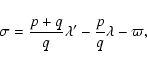
The full analytical analysis is presented in Appendix A. We assume
that the particle is locked in a (p+q): p mean-motion resonance with
the planet. The resonant motion is usually described by the
"critical angle of the resonance''  (Moons & Morbidelli 1995), with
 |
(2) |
 is the mean longitude of the particle
along its orbit;
is the mean longitude of the particle
along its orbit;  is the same for the planet;
 is the longitude of periastron.
Non-resonant orbits are characterised by a more or less
regular circulation of ,
while resonant orbits exhibit
libration of
around a stable position. If the planet's orbit
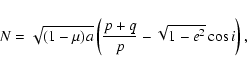
is circular, then the following quantity is a secular constant of
motion (Moons & Morbidelli 1995; Morbidelli & Moons 1993):
 |
(3) |
 is
the mass parameter, i.e. the ratio of the planet's mass to the total
mass. The inclination oscillations are controlled by this
parameter. If the planet's orbit is not circular, then strictly
speaking N is no longer constant, but as the planet's eccentricity
e' is moderate, its variation is slow.
is
the mass parameter, i.e. the ratio of the planet's mass to the total
mass. The inclination oscillations are controlled by this
parameter. If the planet's orbit is not circular, then strictly
speaking N is no longer constant, but as the planet's eccentricity
e' is moderate, its variation is slow.
![\begin{figure}
\par\makebox[\textwidth]{
\includegraphics[width=0.49\textwidth]{...
...]{3425fg2c}\hfil
\includegraphics[width=0.49\textwidth]{3425fg2d} }
\end{figure}](/articles/aa/full/2007/16/aa3425-05/img59.gif) |
Figure 2:
Level curves of the Hamiltonian
 in the
 plane for the circular problem, for particles having
negligible -libration amplitude, for different values of the
constant parameter N. The eccentricity scale (denoted "e'' on the
right of the plots) is related to the inclination scale to the left by
the constant value of N.
plane for the circular problem, for particles having
negligible -libration amplitude, for different values of the
constant parameter N. The eccentricity scale (denoted "e'' on the
right of the plots) is related to the inclination scale to the left by
the constant value of N. |
| Open with DEXTER | |
in powers of e',
and retaining only the leading term. The leading
(circular) term is responsible for the -libration, but
also for the inclination oscillations at high eccentricity. The
higher order terms in e' cause a slow drift of the N parameter.
This drift can drive the particle to high eccentricity, even in the
planar problem; this is the way the FEBs are generated.
Finally, the dynamics
of the particle is characterised by three time-scales: a first,
small one related to the -libration; a second, larger one
characterising the inclination oscillations; a third, long one
describing the secular eccentricity changes from 0to 1. The second time-scale is larger than the first
one, but significantly smaller than the third one. Hence during
one inclination oscillation, the value of N may be considered
as const., which is equivalent to considering the circular
problem.
In the circular problem, the secular Hamiltonian
depends only on the inclination i and on the argument of periastron
,
once the value of N is fixed.
It is possible
to explore the dynamics just drawing level curves of
in
plane, exactly as done in Beust & Morbidelli (1996). This
is done in Fig. 2 for the 4:1 resonance, for 4 different
values of N.
Instead of giving the value of N, we give a value
for the eccentricity and compute the value of N that gives
this eccentricity value for i=0.
The value of
was fixed to 0.001 as typical for a Jupiter-sized
planet. The value of N is indicated above each plot, and
a corresponding eccentricity scale is given to the right of the
plots. The four plots corresponds to eccentricity values at i=0 of
0.5, 0.8, 0.9 and 0.99 (these values appear at the lower right
corner of the plots). In all these plots,
the eccentricity variation over most of the plot is very moderate.
Hence each of these plots should be regarded as a picture of
the dynamics in a given eccentricity regime. The plots of Fig. 2
are equivalent to those of Fig. 5 from Morbidelli & Moons (1993) for the 2:1
resonance.
Consider now a given particle trapped in the 4:1 resonance which
starts its eccentricity growth. In a low eccentricity regime,
like the one for e=0.5 (N=1.973), the inclination remains
low while
circulates. Following a level curve of
,
if the inclination is initially low (a few degrees), it undergoes
small variations that keep it in the same range. At a higher eccentricity
regime, the phase portrait changes. We note in Fig. 2
that two islands of libration for
appear around
 .
However, these islands of libration do not concern the particles
we are considering. Our particles start within the plane of the disk
with an inclination that does not exceed a few degrees. Hence the curves
they follow are those located below the islands of libration.
For our particles,
still circulates, but
following the level curves, the inclination i is subject
to periodic jumps up to possibly several tens of degrees when
reaches
0 or
.
However, these islands of libration do not concern the particles
we are considering. Our particles start within the plane of the disk
with an inclination that does not exceed a few degrees. Hence the curves
they follow are those located below the islands of libration.
For our particles,
still circulates, but
following the level curves, the inclination i is subject
to periodic jumps up to possibly several tens of degrees when
reaches
0 or  .
The higher the eccentricity regime, the higher the
inclination jumps. This is the origin of the inclination
oscillations reported in the numerical integration.
.
The higher the eccentricity regime, the higher the
inclination jumps. This is the origin of the inclination
oscillations reported in the numerical integration.
This dynamics is a resonant version of the Kozai dynamics. In the
non-resonant circular restricted problem, the Kozai Hamiltonian
describes the secular dynamics of the particle. It is obtained by a
double averaging of the original Hamiltonian over the orbital motions
of the planet and of the particles (Kinoshita & Nakai 1999). It is well known
that this Hamiltonian has a secular constant of motion which is the
z-component of the angular momentum (or equivalently
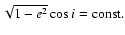 ). It is also well known that at high
inclination, this Hamiltonian shows two islands of libration in
). It is also well known that at high
inclination, this Hamiltonian shows two islands of libration in
 space around
 ,
and that particles moving
in these islands evolve periodically from a high inclination and low
eccentricity regime to a low inclination and high eccentricity. This
behaviour constitutes the Kozai resonance (Kozai 1962).
,
and that particles moving
in these islands evolve periodically from a high inclination and low
eccentricity regime to a low inclination and high eccentricity. This
behaviour constitutes the Kozai resonance (Kozai 1962).
The islands of libration in the plots of Fig. 2
describe a Kozai resonance, within a mean-motion resonance.
Indeed, as a is fixed the condition
 is exactly equivalent to the Kozai condition
The FEBs trapped in the 4:1 resonance
that evolve at very high eccentricity regimes are concerned by
this, but they are not trapped into the Kozai resonance,
as their argument of periastron
still circulates, and
as they periodically return to
is exactly equivalent to the Kozai condition
The FEBs trapped in the 4:1 resonance
that evolve at very high eccentricity regimes are concerned by
this, but they are not trapped into the Kozai resonance,
as their argument of periastron
still circulates, and
as they periodically return to  .
However the Kozai
dynamics influences them and causes periodic inclination jumps
up to several tens of degrees, even if the initial inclination
is low (a few degrees).
.
However the Kozai
dynamics influences them and causes periodic inclination jumps
up to several tens of degrees, even if the initial inclination
is low (a few degrees).
![\begin{figure}
\par\includegraphics[angle=-90,width=8.8cm]{3425fg3a.ps}\par\includegraphics[angle=-90,width=8.8cm]{3425fg3b.ps}\end{figure}](/articles/aa/full/2007/16/aa3425-05/img67.gif) |
Figure 3:
A statistical test of the inclination oscillation regime for
FEBs. These results concern a typical simulation described in Beust & Morbidelli (2000)
with e'=0.07 and  .
Each dot corresponds to a series of
periastron passages of a body that has entered the FEB regime (periastron .
Each dot corresponds to a series of
periastron passages of a body that has entered the FEB regime (periastron  0.4), and that is not yet fully evaporated. Top plot: inclination as a function of periastron; Bottom plot: inclination as a function of the argument of periastron . 0.4), and that is not yet fully evaporated. Top plot: inclination as a function of periastron; Bottom plot: inclination as a function of the argument of periastron . |
| Open with DEXTER | |
.
As described in that paper, the simulation
is made over 104 particles initially chosen orbiting the star in
4:1 mean motion resonances with the perturbing planets. The initial
eccentricities are randomly chosen  0.1 and the inclinations
.
In Beust & Morbidelli (2000), it was shown that many of the
particles evolve to the FEB regime, and we perform statistics over the
expected Doppler velocities when the FEBs cross the line of sight.
This statistic appears in agreement with the observational one.
In Fig. 3, we display information about the inclinations
of the particles when they are in the FEB regime. More specifically,
we count all periastron passages for the particles with periastron values
less than 0.4 AU (the FEB regime), and that are not yet destroyed
by evaporation.
Figure 3 shows that the highest inclinations correspond
to the smallest periastron values. This is in agreement with the
theory outlined above (Fig. 2) which shows that the high
inclination oscillations are to be expected in the high eccentricity
regime only, i.e. in the FEB regime. Figure 3 also shows
that whenever they reach high inclinations, the FEBs assume
an argument of periastron close to
0.1 and the inclinations
.
In Beust & Morbidelli (2000), it was shown that many of the
particles evolve to the FEB regime, and we perform statistics over the
expected Doppler velocities when the FEBs cross the line of sight.
This statistic appears in agreement with the observational one.
In Fig. 3, we display information about the inclinations
of the particles when they are in the FEB regime. More specifically,
we count all periastron passages for the particles with periastron values
less than 0.4 AU (the FEB regime), and that are not yet destroyed
by evaporation.
Figure 3 shows that the highest inclinations correspond
to the smallest periastron values. This is in agreement with the
theory outlined above (Fig. 2) which shows that the high
inclination oscillations are to be expected in the high eccentricity
regime only, i.e. in the FEB regime. Figure 3 also shows
that whenever they reach high inclinations, the FEBs assume
an argument of periastron close to  .
This is in
agreement with the theory, and demonstrates the reality
of the proposed mechanism. Moreover, the concentration of points
close to
.
This is in
agreement with the theory, and demonstrates the reality
of the proposed mechanism. Moreover, the concentration of points
close to
 shows that the FEBs spend more time in
high inclination regimes than in low regimes. This is confirmed
directly by the temporal evolution of the inclination in Fig. 1.
1000 km s-1. However, such velocities would be in sharp
contradiction to the observations by B04, where the Ca II ions are found at rest with respect to the star, about 116 AU
away. This implies that some process is able to efficiently slow down
the ions despite the intense radiation pressure they undergo
(,
see above).
shows that the FEBs spend more time in
high inclination regimes than in low regimes. This is confirmed
directly by the temporal evolution of the inclination in Fig. 1.
1000 km s-1. However, such velocities would be in sharp
contradiction to the observations by B04, where the Ca II ions are found at rest with respect to the star, about 116 AU
away. This implies that some process is able to efficiently slow down
the ions despite the intense radiation pressure they undergo
(,
see above).
This issue was investigated recently by Fernández et al. (2006, hereafter F06) as many
metallic species are observed at rest relative to the star despite a strong
radiation pressure. They identified three possible braking processes:
collisions among ions, collisions with charged ions, and collisions
with a neutral gas. Collisions among ions are very efficient
(Beust et al. 1989), and the whole plasma tends to behave like a single
fluid with a weighted average .
However, F06 show
that unless carbon is overabundant, the fluid is still accelerated
by the star. Collisions with charged grains are only efficient
if the grains are mostly carbonaceous. Moreover, at high latitude
in the disk where the Ca II is observed, the density of the dust
is low (0.3% of that of the midplane according to the profile given by Fernández et al. 2006). Collisions with neutral gas are conversely
a good candidate. F06 showed that a minimum mass of neutral gas
of
 is enough to stop the ions.
However, due to the high incoming velocity of the Ca II ions,
the basic analytic model must be revised. We detail this below,
and conclude that the actual braking is even more effective than in
the basic formulation.
is enough to stop the ions.
However, due to the high incoming velocity of the Ca II ions,
the basic analytic model must be revised. We detail this below,
and conclude that the actual braking is even more effective than in
the basic formulation.
is
enough to slow down the Ca II ions. Here we investigate whether the
same mechanism could also apply to decelerate faster off-plane ions.
The rapid off-plane ions are
not stopped at a few AU like those that stay within the plane
because they do not encounter any noticeable gaseous
medium at their orbital inclination. Why should they be stopped
around 116 AU? We must assume that at such a distance, the disk tends
to flare.
Hence some dilute material could be
present at
or more in the outer disk while remaining
absent in the inner disk. But why 116 AU? This distance corresponds
approximately
to the location of the power law break-up in the surface brightness
radial profile of the disk (Heap et al. 2000). Closer to this threshold,
the surface brightness decreases as r-1.1, while further away
it falls off much more steeply as r-5.5. This was interpreted by
Augereau et al. (2001) as a consequence of the distribution of planetesimals
in the disk. The dust particles are produced by the planetesimals and
then scattered into the outer disk by the stellar radiation pressure.
The power law break-up at 120 AU is consistent with a planetesimal
disk presenting a rather sharp outer edge located at
this distance (Augereau et al. 2001). The planetesimals disk appears thus to be
truncated at the same distance where the off-plane Ca II ions stop.
These facts may be related. The flaring of the disk that we invoke
at that distance for stopping the Ca II ions could be due to the
perturbations by successive stellar
flybys, as was invoked by Larwood & Kalas (2001) as an explanation
for asymmetries and arc-like structures in the outer parts of
the circumstellar dust disk. But the same mechanism could also be
invoked to account for the truncation of the planetesimal disk
at the same distance. Further away than 120 AU, the planetesimals
are perturbed by stellar flybys, and may not remain in a thin
disk. Also the planetesimals themselves may not have had
the opportunity to form there. The stellar flybys may
have scattered away (and probably in the vertical direction)
the initial material from which the planetesimals were expected
to form. Thus, the Pic disk beyond 120 AU could still
be in a kind of primordial state where no refractory material
condensation would have occurred, with a significant flaring due
to stellar flybys.
inclination than in the plane at a few AU; therefore no significant
pressure effect is to be expected and the hydrodynamic description may
be dropped; ii) the incoming velocity of the Ca II ions is likely to
be much higher. In the limiting case of a free ballistic runaway
driven by the radiative pressure of the unobscured star, the resulting
velocity is 1000 km s-1, about two orders of magnitude
higher than was considered in Lagrange et al. (1998).
A simple collisional decelerating mechanism was initially described in
Beust et al. (1989) for moderate velocities. When a charged ion approaches a
neutral atom, a dipole is induced on the neutral atom, from which an
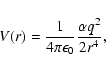
interaction results between the two particles that may be well
described by the potential energy
 is the polarizability of the atom, r is the
interaction distance, and q is the charge of the ion, the other
symbols having their usual meaning (McDaniel 1964). The relative motion
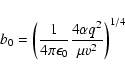
in this potential cannot be solved exactly, but there is a critical
impact parameter b0 (that depends on the impact velocity v)
separating two regimes: for b>b0 there is a minimum approach
distance between the particles preventing any close collision; for
b<b0 this is not so, and the particles undergo a physical
collision (see Appendix B). A fairly correct approximation is then to
neglect the effect of the encounter for b>b0, and to consider that
the mean impulsion loss by the ion in the physical collision is
is the polarizability of the atom, r is the
interaction distance, and q is the charge of the ion, the other
symbols having their usual meaning (McDaniel 1964). The relative motion
in this potential cannot be solved exactly, but there is a critical
impact parameter b0 (that depends on the impact velocity v)
separating two regimes: for b>b0 there is a minimum approach
distance between the particles preventing any close collision; for
b<b0 this is not so, and the particles undergo a physical
collision (see Appendix B). A fairly correct approximation is then to
neglect the effect of the encounter for b>b0, and to consider that
the mean impulsion loss by the ion in the physical collision is  ,
where
is the reduced mass. The interaction cross section is
then
,
where
is the reduced mass. The interaction cross section is
then  and the resulting drag force
  is opposed to
velocity:
is opposed to
velocity:
 with
with
Table 2: Values of the critical impact parameter b0 as a function of the relative velocity v, as computed from Eq. (6) for the Ca II-H I interaction.
We confirmed to within 5% this simple analytical approximation of the drag force using the more general numerical treatment described later on.
However this induced dipole regime holds as long as the drift velocity
v is not too large. When v grows, b0 becomes smaller than the
physical size of the particles. In this regime the interaction cannot
be described any longer as attractive, and it rather approaches a hard
sphere regime at shorter range with a constant cross section that does
not depend on v. According to Eq. (5), the drag force
turns out now to be proportional to v2 instead of
v. Table 2 lists computed values of b0 for different
values of v for the Ca II-H I interaction (the polarisability
of H I is
 m3). We note that as soon as
  km s-1, this induced dipole model becomes unrealistic
because b0 becomes comparable to or smaller than typical atomic radii.
km s-1, this induced dipole model becomes unrealistic
because b0 becomes comparable to or smaller than typical atomic radii.
![\begin{figure}
\par\includegraphics[angle=-90,origin=br,width=8.8cm]{3425fg4}\end{figure}](/articles/aa/full/2007/16/aa3425-05/img83.gif) |
Figure 4: The ab-initio calculated interaction potential between Ca II and H I (in their ground triplet state) as a function of the mutual distance (fat line), superimposed on the induced dipole potential (thin line). |
| Open with DEXTER | |
1000 km s-1 undergo a collisional interaction that is similar
to a hard sphere regime. As the velocity decreases
along successive collisions, the interaction
finally enters the induced dipole regime. A correct description of the
decelerating process of the Ca II ions implies therefore to be able
to describe the interaction at every velocity, in particular in
the intermediate velocity regime between the two above described
extremes.
In order to have a more coherent description, we introduced a "smooth'' sphere approximation based upon a continuous description of the interaction potential U(r) between Ca II and H I as a function of the relative distance r. The interaction originates from a quantum-mechanical interaction at the microscopic level. During a collision, the incoming Ca II and H I particles form an intermediate molecular ion. This molecular complex possess two valence electrons originating from each incoming particle. In a quantum description of the interaction, these two electronic spins recouple to form either a singlet or triplet state with a 3 to 1 probability in favour of the triplet state. However in the case of energetic collisions these input states will interact with various excited states of the same spin multiplicity, leading to numerous inelastic processes that will be sketched in the the next subsection.
Fortunately the ground state triplet state is not expected to be very reactive for moderate collisional energies and could provide a realistic basis for our "smooth'' sphere model. Using the ab initio Gaussian 94 package (Frisch et al. 1995) we investigated the triplet input state using a restricted open-shell approach (in order to preserve the total spin). We performed ROMP2 calculations to take into account the electronic correlation and also to some extent the interactions with excited states. We added diffuse and polarization functions on both centers, paying special attention to the proper description of the polarisation of the hydrogen atom. We also performed a population analysis at the Mulliken level to check that charge transfer effects were small (contrary to the singlet state where strong inverse charge transfer effects were found). The resulting triplet potential is plotted in Fig. 4 as a function of r, superimposed on the induced dipole interaction. Our ab-initio potential is consistent with the induced dipole approximation beyond 0.5 nm, but closer to 0.5 nm, it exhibits a repulsive wall providing a smooth transition towards the limiting hard sphere regime.
Let us now take into account this "smooth'' sphere potential for a
determination of the drag force.
Given any interaction potential U(r), the drag force acting on the
ion is opposed to the velocity and may be written as
![\begin{displaymath}\vec{f}=-4\pi n\mu v\left[\int_0^{+\infty}b~\sin^2\left(
\frac{\chi(b,v)}{2}\right)~{\rm d}b\right]~\vec{v},
\end{displaymath}](/articles/aa/full/2007/16/aa3425-05/img84.gif) |
(8) |
 is the deflection angle
due to the encounter corresponding to b and v. itself depends on the form of the potential and may be obtained
from an integral along the relative motion during the encounter
(see Appendix B).
is the deflection angle
due to the encounter corresponding to b and v. itself depends on the form of the potential and may be obtained
from an integral along the relative motion during the encounter
(see Appendix B).
On the contrary, energetic collisions are likely to trigger various
inelastic processes. For impact velocities in the range
100-
 ,
the energy available in the center
of mass is huge, from 50 eV to 5000 eV, and is able to induce a
large variety of excitations in both the valence and core electronic
space. Beyond the mere electronic excitation of either particles,
these energetic collisions can thus trigger a whole range of inelastic
and reactive processes including inverse charge transfer, single or
multiple electronic ionizations, etc. Collisions with He I or
H2 will be even more energetic due to the larger reduced mass. A
detailed theoretical description of all these processes and of their
cross sections and branching ratios is beyond the range of the present
study. Experimental investigations might provide a better starting
point for further studies.
,
the energy available in the center
of mass is huge, from 50 eV to 5000 eV, and is able to induce a
large variety of excitations in both the valence and core electronic
space. Beyond the mere electronic excitation of either particles,
these energetic collisions can thus trigger a whole range of inelastic
and reactive processes including inverse charge transfer, single or
multiple electronic ionizations, etc. Collisions with He I or
H2 will be even more energetic due to the larger reduced mass. A
detailed theoretical description of all these processes and of their
cross sections and branching ratios is beyond the range of the present
study. Experimental investigations might provide a better starting
point for further studies.
All these inelastic processes will convert a part of the incoming
kinetic energy into internal energy of the particles and also, if
ionization occurs, into kinetic energy of the secondary electrons. Of
course the internal excitations will mostly decay radiatively and will
never be converted back to kinetic energy of the Ca II ions. In
addition, the Ca II ions are likely to increase their charge,
following either simple or multiple ionization, or inverse charge
transfer with H I. Once ionized to Ca III or higher, the calcium ions are expected to recombine to Ca II after
a while. But during the time they spend at higher ionization states,
they should be decelerated even more effectively, because they no
longer feel any significant radiation pressure from the star (as the
species under consideration have no strong spectral lines in the
visible-UV domain), while the drag force is expected to increase with
ionization level.
Moreover, the neutral H I gas, once shocked by the incoming high
velocity ions, is expected to be partly ionized by this process. The
gas will thus tend to behave like a plasma with a collective dynamical
behaviour, resulting in an averaged
ratio, as described by
F06. These collective effects should enhance significantly
the efficiency of the braking process.
All these inelastic effects will increase the energy loss by the
Ca II ions and thus the drag force predicted by the smooth sphere
model. Their description is beyond the scope of the present paper.
In the following we propose an order-of-magnitude calculation
using a very crude model to describe the ionization processes
involving collisions between Ca II ions and H I atoms. A simple way
to treat possible ionization is to monitor the available kinetic
energy
 before the collision in the inertial referential
frame. First we select close collisions for which the interaction departs
from the induced-dipole model. Second we consider the opening of
successive ionization channels when the energy is augmented. We
model the ionization for H I and up to 7 electrons for Ca II,
assuming an average energy loss
before the collision in the inertial referential
frame. First we select close collisions for which the interaction departs
from the induced-dipole model. Second we consider the opening of
successive ionization channels when the energy is augmented. We
model the ionization for H I and up to 7 electrons for Ca II,
assuming an average energy loss
 eV per electron.
This loss is supposed to take into account both the extraction
energy and the kinetic energy of the expelled electron. The ionization
limit of 7 electrons for Ca II is rather arbitrary and includes the
eV per electron.
This loss is supposed to take into account both the extraction
energy and the kinetic energy of the expelled electron. The ionization
limit of 7 electrons for Ca II is rather arbitrary and includes the
 shell and the outer
  electron. The most energetic collisions
might rather ionize an inner
electron. The most energetic collisions
might rather ionize an inner  electron, but this would result in a
comparable energy loss because their binding energy is higher, about
150 eV.
electron, but this would result in a
comparable energy loss because their binding energy is higher, about
150 eV.
In practice, we modify the smooth sphere model with
the following prescription. If
the available kinetic energy exceeds
 with
with
 and if the closest approach between the two particles is
less than 0.5 nm, the incoming
kinetic energy is arbitrarily reduced by
.
This causes the relative velocity after the encounter
v' to be less than the initial velocity v. We define the energy
restitution coefficient e<1 as v'=ev. This may be written as:
and if the closest approach between the two particles is
less than 0.5 nm, the incoming
kinetic energy is arbitrarily reduced by
.
This causes the relative velocity after the encounter
v' to be less than the initial velocity v. We define the energy
restitution coefficient e<1 as v'=ev. This may be written as:
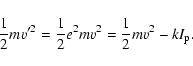 |
(9) |
 is
unchanged with respect to the elastic case, then the expression of
the force becomes now
is
unchanged with respect to the elastic case, then the expression of
the force becomes now
![\begin{displaymath}\vec{f}=-2\pi n\mu v\left[\int_0^{+\infty}\left(2e\sin^2\left(
\frac{\chi(b,v)}{2}\right)+1-e\right)b~{\rm d}b\right]~\vec{v}.
\end{displaymath}](/articles/aa/full/2007/16/aa3425-05/img96.gif) |
(10) |
![\begin{figure}
\par\includegraphics[angle=-90,origin=br,width=8.8cm]{3425fg5}\end{figure}](/articles/aa/full/2007/16/aa3425-05/img98.gif) |
Figure 5:
The drag force on Ca II ions due to a H I medium of
unit density (
 ), as a function of the drift velocity
v. The thin line corresponds to the induced dipole model,
the thick grey line to the smooth model (based upon the triplet potential
shown in Fig. 4) and the thick black line to the inelastic model (based upon the combination of the triplet potential and a crude treatment for ionization effects, see text). ), as a function of the drift velocity
v. The thin line corresponds to the induced dipole model,
the thick grey line to the smooth model (based upon the triplet potential
shown in Fig. 4) and the thick black line to the inelastic model (based upon the combination of the triplet potential and a crude treatment for ionization effects, see text). |
| Open with DEXTER | |
The result of the force computation in the various cases is shown in
Fig. 5 as a function of the relative velocity v. As in any
case the drag force is proportional to the density of the H I medium
encountered, showing the force for a unit density medium is enough for
comparison purposes. In the induced dipole approximation case, we find
as expected
 ,
and we see that this approximation is valid
up to
,
and we see that this approximation is valid
up to
 .
At the higher velocity regime,
we have
.
At the higher velocity regime,
we have
 when the triplet potential is taken into
account, corresponding to our smooth sphere regime. When ionization
is also taken into account, the non-elastic character of the
interactions adds an extra force term to the elastic smooth sphere
case. Inelastic effects turns out to be particularly noticeable for
when the triplet potential is taken into
account, corresponding to our smooth sphere regime. When ionization
is also taken into account, the non-elastic character of the
interactions adds an extra force term to the elastic smooth sphere
case. Inelastic effects turns out to be particularly noticeable for
 (at higher
velocity ionization is present but the smooth sphere regime
dominates). This velocity regime concerns
Ca II ions encountering a H I medium at about 116 AU.
Consequently, this order-of-magnitude calculation suggests that a
proper inclusion of ionization and other inelastic effects would
significantly enhance the effective drag force beyond the predictions
of the smooth sphere model.
(at higher
velocity ionization is present but the smooth sphere regime
dominates). This velocity regime concerns
Ca II ions encountering a H I medium at about 116 AU.
Consequently, this order-of-magnitude calculation suggests that a
proper inclusion of ionization and other inelastic effects would
significantly enhance the effective drag force beyond the predictions
of the smooth sphere model.
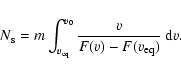
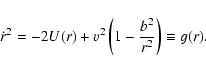
 the ions need to cross before being
stopped. Let us first consider a simplified case where radiation
pressure is not taken into account. The ions arrive at initial
velocity v0 and encounter an H I medium with volume density n.
The equation of motion of an ion along its path will be
the ions need to cross before being
stopped. Let us first consider a simplified case where radiation
pressure is not taken into account. The ions arrive at initial
velocity v0 and encounter an H I medium with volume density n.
The equation of motion of an ion along its path will be
 |
(11) |
 ):
):
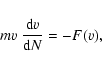 |
(12) |
required to slow the ions from v0 to 0:
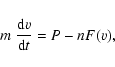 |
(14) |
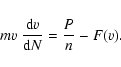 |
(15) |
 characterised by
 .
In practice this terminal
velocity is low, so that the ions may be considered as stopped.
The radiation pressure P at 116 AU on Ca II ions is
.
In practice this terminal
velocity is low, so that the ions may be considered as stopped.
The radiation pressure P at 116 AU on Ca II ions is
 N (35 times stellar gravity). Let us take
the upper limit of
for the hydrogen column
density given by Lecavelier des Etangs et al. (2001), spread over a distance d. We derive
a ratio
is less than
1 km s-1 and that it falls well within the induced dipole regime.
This result still holds even if we assume a column density lower
by one or even two orders of magnitudes.
N (35 times stellar gravity). Let us take
the upper limit of
for the hydrogen column
density given by Lecavelier des Etangs et al. (2001), spread over a distance d. We derive
a ratio
is less than
1 km s-1 and that it falls well within the induced dipole regime.
This result still holds even if we assume a column density lower
by one or even two orders of magnitudes.
![\begin{figure}
\par\includegraphics[angle=-90,origin=br,width=8.8cm]{3425fg6}\end{figure}](/articles/aa/full/2007/16/aa3425-05/img114.gif) |
Figure 6: H I column density necessary to stop Ca II ions, as a function of the initial velocity v0, as derived from Eq. (13), according to several models (see text). The plotting conventions are the same as in Fig. 5. |
| Open with DEXTER | |
.
We should write
,
we have
 ,
we derive that
the integral diverges logarithmically towards
.
But
reaching a velocity that is of the same order of magnitude as
is enough for our purpose. Moreover, for
,
we derive that
the integral diverges logarithmically towards
.
But
reaching a velocity that is of the same order of magnitude as
is enough for our purpose. Moreover, for
 we have
 ,
so that
,
so that
 can be neglected in Eq. (17). Finally,
Eq. (13) turns out to be a good estimate for even in the presence of radiation pressure. This is due to the fact
that the terminal velocity
is very low.
can be neglected in Eq. (17). Finally,
Eq. (13) turns out to be a good estimate for even in the presence of radiation pressure. This is due to the fact
that the terminal velocity
is very low.
as given from Eq. (13) is plotted on Fig. 6
as a function of the initial velocity, for the various interaction
models considered. As expected, in the induced dipole regime,
we have
 ,
but at higher velocity, is reduced by several orders of magnitude with respect to that crude
estimate.
The smooth sphere model causes
to
stay below a few 1017 cm-2 (asymptotically
,
but at higher velocity, is reduced by several orders of magnitude with respect to that crude
estimate.
The smooth sphere model causes
to
stay below a few 1017 cm-2 (asymptotically
 ).
With v0=1000 km s-1, we predict
).
With v0=1000 km s-1, we predict
 .
This is one order of magnitude
below the upper limit to the H2 column density towards Pic (Lecavelier des Etangs et al. 2001).
As suggested by our inelastic model, the inclusion of inelastic effects
would further lower the required column density. Moreover, the
collective effects decribed by F06, due to partial
ionization of the neutral gas, are expected to enhance the braking
process.
could thus be even less than the
value we derive.
.
This is one order of magnitude
below the upper limit to the H2 column density towards Pic (Lecavelier des Etangs et al. 2001).
As suggested by our inelastic model, the inclusion of inelastic effects
would further lower the required column density. Moreover, the
collective effects decribed by F06, due to partial
ionization of the neutral gas, are expected to enhance the braking
process.
could thus be even less than the
value we derive.
Hence we stress that the model we present here
provides a plausible mechanism for stopping the Ca II ions at 100 AU
from Pic, in order to render them detectable in emission.
 they would encounter at 100 AU. In the presence
of a magnetic field, the equation of motion of an ion is
they would encounter at 100 AU. In the presence
of a magnetic field, the equation of motion of an ion is
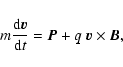 |
(18) |
 is the radial radiation pressure. Let us consider for
simplicity that
is constant (the ions are supposed to be stopped
over a short distance), as is .
The equation of motion
has a well-known analytical solution. Introducing a referential frame
is the radial radiation pressure. Let us consider for
simplicity that
is constant (the ions are supposed to be stopped
over a short distance), as is .
The equation of motion
has a well-known analytical solution. Introducing a referential frame
 where
where
 and
lies in the
and
lies in the
 plane, and the angle
  between
and the
between
and the  plane,
the solution may be described in that referential as
plane,
the solution may be described in that referential as
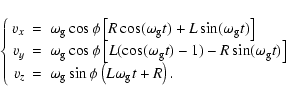 |
(19) |
 is the gyromagnetic frequency; R=mv0/qB is the
gyromagnetic radius associated with the velocity v0; L is defined
as
is the gyromagnetic frequency; R=mv0/qB is the
gyromagnetic radius associated with the velocity v0; L is defined
as
 ,
i.e., it is a characteristic length associated
with the strength of the radiation pressure. The motion perpendicular
to the field is a cycloid-like motion, i.e., a combination of a
circular motion of radius
,
i.e., it is a characteristic length associated
with the strength of the radiation pressure. The motion perpendicular
to the field is a cycloid-like motion, i.e., a combination of a
circular motion of radius
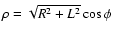 at frequency
 and of a linear drift at velocity
 .
The
motion parallel to the field is uniformly accelerated by the radiation
pressure. It is important to note that here, contrary to the neutral
drift model, the velocity does not reach an asymptotic value. If the
field is not perpendicular to
(
.
The
motion parallel to the field is uniformly accelerated by the radiation
pressure. It is important to note that here, contrary to the neutral
drift model, the velocity does not reach an asymptotic value. If the
field is not perpendicular to
(
 )
the
velocity even increases continuously. But even if
)
the
velocity even increases continuously. But even if
 the
motion in the
plane is still cycloid-like, and the modulus of
velocity undergoes a periodic modulation of amplitude
the
motion in the
plane is still cycloid-like, and the modulus of
velocity undergoes a periodic modulation of amplitude
 .
Let us now consider a typical magnetic field of
G, at 116 AU from the star, and
.
Let us now consider a typical magnetic field of
G, at 116 AU from the star, and
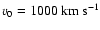 .
We derive
.
We derive
 AU and R=0.028 AU. Hence
  (i.e., the
Lorentz force dominates the radiation pressure), and
(i.e., the
Lorentz force dominates the radiation pressure), and
 .
This yields
.
This yields
 .
The ions turn out to have
velocities relative to the star randomly distributed over a range of
.
The ions turn out to have
velocities relative to the star randomly distributed over a range of
 .
Even if the ions do not drift away
significantly, their residual velocity range remain far above the
spectral resolution of the instruments, and they should not be
observed as a single line at rest with respect to the star. In
consequence, this purely magnetic deceleration model cannot account
for the observations.
.
Even if the ions do not drift away
significantly, their residual velocity range remain far above the
spectral resolution of the instruments, and they should not be
observed as a single line at rest with respect to the star. In
consequence, this purely magnetic deceleration model cannot account
for the observations.
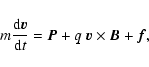 |
(20) |
is the gas drag force. In the general case where
is given by Fig. 5, this equation cannot
be solved analytically, but at low velocity in the induced dipole
regime where
,
the differential system remains
linear and may be solved exactly after a somewhat lengthy but
straightforward algebra. Keeping the definitions and notations
of the preceding sections, the solution is
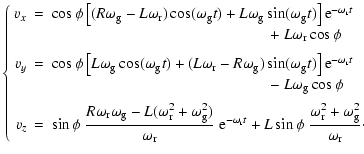 |
(21) |
and R are defined as above,
 is a
frequency characterising the drag force; L is now defined as
is a
frequency characterising the drag force; L is now defined as
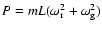 .
The motion is still combination of a circular motion and
a linear drift, but the circular motion is damped exponentially at
frequency
.
The motion is still combination of a circular motion and
a linear drift, but the circular motion is damped exponentially at
frequency
 ,
so that the velocity assumes an asymptotic value
like in the gas drag case without a magnetic field.
,
so that the velocity assumes an asymptotic value
like in the gas drag case without a magnetic field.
Taking now the numbers given above, and considering a typical expected
neutral density of
 (a column density
of
over 1 AU), we derive
(a column density
of
over 1 AU), we derive
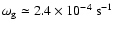 and
and
 .
Hence the exponential damping is a slower
process than the gyromagnetic motion. As
.
Hence the exponential damping is a slower
process than the gyromagnetic motion. As
 ,
the numerical value of L is virtually unchanged with respect
to the preceding definition, and we still have .
After damping,
the ions have a terminal velocity with respect to the gas given by
,
the numerical value of L is virtually unchanged with respect
to the preceding definition, and we still have .
After damping,
the ions have a terminal velocity with respect to the gas given by
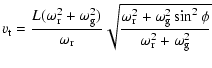 |
= | 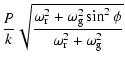 |
|
 |
 |
(22) |
given by Eq. (16)
in the gas drag case, in the case of the induced dipole
regime. Hence the terminal velocity  appears in any case
less than
.
It can even reach zero if the field is
perpendicular to the initial motion.
appears in any case
less than
.
It can even reach zero if the field is
perpendicular to the initial motion.
Finally, the net result of the interaction is a deceleration of
the ions that is similar to the non-magnetic case. The terminal
velocity is comparable (or even less), and it is reached within
the same characteristic time
 .
The only difference
concerns the path of the ions. When no magnetic field is present,
the motion of the ions is linear and they are stopped after
having encountered a column density of
,
i.e., 0.7 AU with
.
The only difference
concerns the path of the ions. When no magnetic field is present,
the motion of the ions is linear and they are stopped after
having encountered a column density of
,
i.e., 0.7 AU with
 .
With a magnetic field,
the path is no longer linear. When
.
With a magnetic field,
the path is no longer linear. When  ,
the radial extent
of the spiral motion of the ions before being stopped is
,
the radial extent
of the spiral motion of the ions before being stopped is

 at t=0, i.e.,
  .
With the values quoted
above, this is about 0.055 AU;
with
,
the
corresponding column density is
.
With the values quoted
above, this is about 0.055 AU;
with
,
the
corresponding column density is
 .
Hence the ions appear to be stopped over a much shorter distance.
This is only due to the fact that the motion is not linear.
As the ions spiral into the quoted distance, they encounter
the required
to stop them, but not in
a linear fashion, rather inside a box of smaller dimensions.
.
Hence the ions appear to be stopped over a much shorter distance.
This is only due to the fact that the motion is not linear.
As the ions spiral into the quoted distance, they encounter
the required
to stop them, but not in
a linear fashion, rather inside a box of smaller dimensions.
The magnetic field appears then as an additional source of deceleration for the ions, but the gas drag remains unavoidable. Our conclusion is then that a magnetic field may be invoked as a refinement to the model, but that it is not necessary, the basic process of deceleration remaining the gas drag.
The main issue concerning the magnetic field should be its sudden
presence around 100 AU. Why should a magnetic field of G appear
there while not present closer to the star? The only
possibility is to invoke a kind of heliopause. Pictoris is the only normal
A type star for which a chromospheric activity was detected by
Bouret et al. (2002). These authors derive a mass loss rate
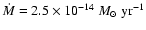 ,
with a terminal
velocity of
,
with a terminal
velocity of
 .
Roughly speaking, the suspected
heliopause should be expected where the magnetic pressure
.
Roughly speaking, the suspected
heliopause should be expected where the magnetic pressure
 of the surrounding galactic field equals the kinetic pressure
of the wind. With the values of Bouret et al. (2002) and
of the surrounding galactic field equals the kinetic pressure
of the wind. With the values of Bouret et al. (2002) and  G, it occurs
at 529 AU; alternatively, if we want this to occur at 116 AU, a
galactic field of
G, it occurs
at 529 AU; alternatively, if we want this to occur at 116 AU, a
galactic field of  G is required. Inside this cavity, the
field would be radial and have no effect on the motion of the ions.
These are likely values, so that the possibility cannot be excluded.
G is required. Inside this cavity, the
field would be radial and have no effect on the motion of the ions.
These are likely values, so that the possibility cannot be excluded.
Pic circumstellar disk, as observed by
B04, can be very well explained as a consequence of the FEB
process. Whenever the evaporating bodies enter the star grazing
regime, they are subject to inclination oscillations up to
30-
.
The Ca II ions released by the FEB during this phase
start a free, almost radial expansion pushed by a strong radiation
pressure, keeping track of their initial orbital inclination. Iron is
also concerned by this process, and we expect Fe I ions to be present
at high latitude together with Ca II. The Fe I in the data of
B04 is not null where Ca II is detected. We nevertheless
explain in our emission line analysis that, unless the electronic
density is high, the Fe I emission is expected to be weaker than the
Ca II one, thanks to a predominant ionization of Fe I into Fe II.
This process does not concern Na I ions because, once produced by the FEBs, they are quickly photoionized into Na II and subsequently no longer experience any noticeable radiation pressure. Hence we explain the absence of Na I emission at high latitude.
Blown away by strong radiative pressure from the star, the
Ca II ions reach the distance of 100 AU in about 1 yr with
final velocities of 1000 km s-1. They need thus to be
slowed down in order to gather at the star velocity and to form an
observable line. This can be achieved if the ions encounter at that
distance a neutral gaseous medium, in agreement with the conclusions
of F06.
A rough estimate of the incoming ion flux due to
the FEB activity shows that it can account for the necessary heating
source to render the lines observable.
In addition to the induced dipole drag
force considered by F06, we estimated additional braking
effects arising for rapid collisional velocities. If we consider the
effect of repulsive core and inelastic interactions discussed in Sects. 4.1.2 and 4.1.3, a column density of
of H I is sufficient to stop the ions over a distance of a few AU. The
inelastic model we introduced is probably very crude, but it is still
likely to underestimate the effective drag force. Therefore
irrespective of the detailed description of the interaction processes,
the required column density remains below the upper detection limit of
given by Lecavelier des Etangs et al. (2001). Following
F06, it should even be less if we took into account the
collective plasma behaviour due to partial ionization of the neutral
gas into account. Conversely, due to the high latitude over the dust
disk, we do not expect collisions with dust grains (invoked
by F06 as a possible braking mechanism) to play a significant role
in the decelerating process of the incoming ions.
We also investigate the possible role of a magnetic field in stopping the ions. While the sole action of a magnetic field is unable to sufficiently slow down the ions, magnetic interactions provide an additional braking process to the basic gas drag model invoked. Combining gas drag and magnetic interactions can thus be a very efficient way to decelerate the ions, still reducing the requirements on the neutral gas density by an order of magnitude. This nevertheless constitutes a refinement of the model, as gas drag in itself is sufficient to account for current observational constraints.
The key parameter in this model is the distance (100 AU)
at which
the ions are stopped. In the gas drag model, we need to assume that
no neutral medium is present at
inclination
up to that distance, so that the ions can freely expand
radially, and that they suddenly encounter some medium there.
This would mean that the disk begins to significantly flare
at that distance. As explained above, this distance corresponds
also to the expected outer edge of the planetesimal disk that
produces the dust, according to Augereau et al. (2001). These two facts
are probably related.
Our conclusion is thus that the proposed scenario is plausible. Another important issue in this study is the number of Ca II or Fe I ions necessary to account for the observations of B04. It cannot be determined easily even if we may estimate the incoming flux, as it depends highly on the time the ions stay within the neutral medium before diffusing away, and subsequently on the small asymptotic drift velocity they reach. If a magnetic field plays a role, this velocity is expected to be significantly lower than without a field; hence the ions should drift more slowly across the neutral medium. At a given epoch, for the same incoming Ca II flux more ions are therefore expected to be trapped in the neutral gas if magnetic forces are active than in the opposite case. This is why deriving an incoming Ca II flux in order to compare to the expected number of FEBs is very imprecise. This could be the purpose of future investigations. Fortunately the uncertainties in the proposed deceleration models are irrelevant here, because once the ions have been decelerated, the analytical induced dipole model should be valid.
Our estimate of the incoming ions flux due to FEB activity (Sect. 2) is very rough, mainly because the FEB activity itself is hard to constrain. Moreover, we expect this activity to be time-variable, as changes have been observed between various observing epochs (Tobin et al. 2004). As the emission lines are supposed to depend on this flux (via the heating source), we expect the strength of the emission lines to present temporal variations (at least those at high latitude). It would thus be of interest to initiate a follow-up of these lines to check for temporal changes.
The FEB scenario is reinforced by the present analysis.
The off-plane presence of some metallic species, and the absence of
some others, appear as a natural consequence of the FEB scenario
and of the mean-motion resonance model with a giant planet. This
strengthens our view of the Pic system as a young planetary system.
Acknowledgements
All the computations presented in this paper were performed at the Service Commun de Calcul Intensif de l'Observatoire de Grenoble (SCCI). Comments by our referee, V. Grinin, and by the Editor, M. Walmsley, inspired the emission model presented in Sect. 2.
 and
and  respectively. As usual,
we call
the ratio of the mass of the planet to the total mass
of the system m. We assume that
respectively. As usual,
we call
the ratio of the mass of the planet to the total mass
of the system m. We assume that  .
In this framework,
the Hamiltonian of the problem is (see, for instance Morbidelli & Moons 1993)
.
In this framework,
the Hamiltonian of the problem is (see, for instance Morbidelli & Moons 1993)
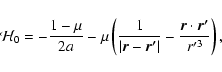 |
(A.1) |
 ,
where
,
where
 is the constant of gravitation.
The usual way is then to start from the classical canonically
conjugate Delaunay variables:
is the constant of gravitation.
The usual way is then to start from the classical canonically
conjugate Delaunay variables:
![\begin{displaymath}\begin{array}{ll}
\dy M , & L=\sqrt{(1-\mu)a}\\ [\jot]
\dy \o...
... G=L\sqrt{1-e^2}\\ [\jot]
\dy \Omega , & H=G\cos i.
\end{array}\end{displaymath}](/articles/aa/full/2007/16/aa3425-05/img178.gif) |
(A.2) |
is its argument of periastron,  its longitude of ascending node,
e its eccentricity and i its inclination with respect to the orbital
plane of the planet.
its longitude of ascending node,
e its eccentricity and i its inclination with respect to the orbital
plane of the planet.
We assume here that the particle is locked in a (p+q): p
mean-motion
resonance with the planet. It is then of interest to introduce new
canonically conjugate angle-action variables that take into
account the resonance:
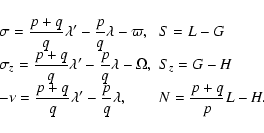 |
(A.3) |
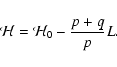 |
(A.4) |
 is the mean longitude of the particle
along its orbit;
is the same for the planet;
is the mean longitude of the particle
along its orbit;
is the same for the planet;
 is the longitude of periastron. These variables
are introduced by Morbidelli & Moons (1993) and Moons (1994). The angle is often called the "critical angle of the resonance'' (Moons & Morbidelli 1995).
Resonant orbits are characterised by a
libration of
around a stable position.
is the longitude of periastron. These variables
are introduced by Morbidelli & Moons (1993) and Moons (1994). The angle is often called the "critical angle of the resonance'' (Moons & Morbidelli 1995).
Resonant orbits are characterised by a
libration of
around a stable position.
The secular dynamics is investigated by performing a time-averaging
of
over the only remaining fast variable, .
If the orbit of the planet is circular, then the averaged Hamiltonian
turns out to be independent of  ,
showing that N is a secular
constant of motion (Moons & Morbidelli 1995; Morbidelli & Moons 1993). This can be checked with explicit
expressions, but this arises from the d'Alembert rules:
and
,
showing that N is a secular
constant of motion (Moons & Morbidelli 1995; Morbidelli & Moons 1993). This can be checked with explicit
expressions, but this arises from the d'Alembert rules:
and
 are independent of any axis rotation within the orbital
plane of the planet, while this is not the case for .
If the
planet's orbit is circular, the whole Hamiltonian is expected to
be invariant for any rotation in that plane, and should consequently
not depend on .
In that case, the Hamiltonian
has two degrees of freedom. If we restrict our study to planar motion,
then the variables
and Sz disappear and the averaged
Hamiltonian is integrable. The secular motion is characterised, together
with the librations of ,
by coupled oscillations in the (a,e) plane
around the equilibrium value, along a curve
This dynamics
is described for many specific resonances by Moons & Morbidelli (1995); Morbidelli & Moons (1993).
are independent of any axis rotation within the orbital
plane of the planet, while this is not the case for .
If the
planet's orbit is circular, the whole Hamiltonian is expected to
be invariant for any rotation in that plane, and should consequently
not depend on .
In that case, the Hamiltonian
has two degrees of freedom. If we restrict our study to planar motion,
then the variables
and Sz disappear and the averaged
Hamiltonian is integrable. The secular motion is characterised, together
with the librations of ,
by coupled oscillations in the (a,e) plane
around the equilibrium value, along a curve
This dynamics
is described for many specific resonances by Moons & Morbidelli (1995); Morbidelli & Moons (1993).
If the orbit of the planet is not circular, the action N is
no longer constant. It is thus able to evolve, but on a much longer
time-scale than the main librations of .
Therefore, on
a short time-scale the oscillations in (a,e) space are preserved,
but on a longer time-scale, the value of N is subject to changes
that may drive the eccentricity to high values. As quoted by
Yoshikawa (1989), these changes are particularly important for
resonances 4:1, 3:1 and 5:2. Beust & Morbidelli (1996) showed that
the 4:1 resonance is a potential source of FEBs via this mechanism,
and Thébault & Beust (2001) show that the 3:1 resonance may also contribute
to the FEB phenomenon.
If we return to the spatial problem and give an initially moderate inclination to the particle, these dynamics are preserved. In fact all the simulations presented in Beust & Morbidelli (2000) and Thébault & Beust (2001) were three-dimensional, and the behaviour reported was in perfect agreement with the planar description. However, the planar model does not describe the inclination oscillations observed whenever the eccentricity reaches high values. In order to explain them, we must consider the spatial problem as a whole.
To further study the problem, Morbidelli & Moons (1993) introduce
the following canonically conjugate action-angle variables:
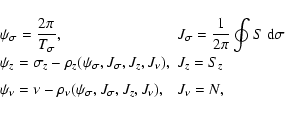 |
(A.5) |
 is the libration period of ,
t is the time,
and
is the libration period of ,
t is the time,
and  is computed over one libration cycle of .
 and
and  are functions that are periodic with zero
average in
are functions that are periodic with zero
average in
 .
.
We are interested in the secular dynamics inside the resonance;
hence we perform a second averaging of
over
.
The function
and
disappear then and is a new secular constant of motion.
is
the normalised area enclosed by the libration trajectory in
 space. It is close to the amplitude of the libration in .
Thus in the non-circular problem, the value of N may change,
but the amplitude of the libration is roughly preserved. Curves
of
space. It is close to the amplitude of the libration in .
Thus in the non-circular problem, the value of N may change,
but the amplitude of the libration is roughly preserved. Curves
of
 for various resonances are given in Moons & Morbidelli (1995); Morbidelli & Moons (1993).
The inclination oscillations are related to the coupled evolution
of  and Jz. This is not easy to describe in the general case
as the Hamiltonian
,
even averaged over
,
is still not integrable, as depending on several angles,
and because the relationship between ,
and
and the
usual orbital elements is not straightforward. A convenient way to
investigate the dynamics is to restrict the study to the case
and Jz. This is not easy to describe in the general case
as the Hamiltonian
,
even averaged over
,
is still not integrable, as depending on several angles,
and because the relationship between ,
and
and the
usual orbital elements is not straightforward. A convenient way to
investigate the dynamics is to restrict the study to the case
 ,
i.e., orbits with negligible libration amplitude.
In this case, the semi-major axis a assumes a fixed value
(the pericentric equilibrium) close to the unperturbed value
of the resonance;
also is fixed to an equilibrium value
,
i.e., orbits with negligible libration amplitude.
In this case, the semi-major axis a assumes a fixed value
(the pericentric equilibrium) close to the unperturbed value
of the resonance;
also is fixed to an equilibrium value
 .
The value of
depends on the resonance under
consideration. It is then easy to show that under these conditions
.
The value of
depends on the resonance under
consideration. It is then easy to show that under these conditions
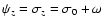 .
This method of considering
zero amplitude libration was used in Beust & Morbidelli (1996)
to draw Hamiltonian maps in the planar problem.
.
This method of considering
zero amplitude libration was used in Beust & Morbidelli (1996)
to draw Hamiltonian maps in the planar problem.
If we consider the circular (but non-planar)
problem, the secular Hamiltonian
,
once averaged over
,
has only one degree
on freedom left. It is a function of
and Jz, or
alternatively of i and ,
the constant value of N
acting as a parameter.
 ),
the encounter between a Ca II ion and an H I atom may be studied using
energy and momentum conservation:
),
the encounter between a Ca II ion and an H I atom may be studied using
energy and momentum conservation:
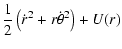 = =  |
(B.1) |
 = bv, = bv, |
(B.2) |
 ,
v is the incoming velocity, b is the impact parameter,
and
,
v is the incoming velocity, b is the impact parameter,
and  and
and
 are as usual shorthands for
 and
and
 .
Eliminating
leads to the radial equation
.
Eliminating
leads to the radial equation
 .
This is done demanding
.
This is done demanding
 in the preceding
equation. There may be no root for .
Let us for example
consider the dipole induced potential
in the preceding
equation. There may be no root for .
Let us for example
consider the dipole induced potential
 where V(r)is taken from Eq. (4). The resulting equation for is quadratic, and it is a matter of straightforward algebra to show
that a root exists only if
where V(r)is taken from Eq. (4). The resulting equation for is quadratic, and it is a matter of straightforward algebra to show
that a root exists only if  ,
where b0 is given by Eq. (6).
In the opposite case, the distance is expected to decrease to zero.
However, with a more realistic potential
presenting a repulsive core at small distance, there will always be
a root for :
at infinity, Eq. (B.3) gives
g(r)=v2>0 while at small distance, as U(r)>0, obviously
Eq. (B.3) gives g(r)<0.
,
where b0 is given by Eq. (6).
In the opposite case, the distance is expected to decrease to zero.
However, with a more realistic potential
presenting a repulsive core at small distance, there will always be
a root for :
at infinity, Eq. (B.3) gives
g(r)=v2>0 while at small distance, as U(r)>0, obviously
Eq. (B.3) gives g(r)<0.
corresponds to a polar angle
 ,
and it
is easy to see that the defection angle
is related to
by
,
and it
is easy to see that the defection angle
is related to
by
 |
(B.4) |
itself can be deduced from the fact that at infinity
before the encounter, we have
 :
:
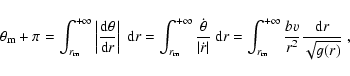 |
(B.5) |
 ,
this expression may be rewritten as
,
this expression may be rewritten as
![\begin{displaymath}\theta_{\rm m}+\pi=\frac{b}{r_{\rm m}}\int_{0}^{1}
\frac{{\rm...
...2+\frac{2}{v^2}\left[y^2U(r_{\rm m})
-U(r_{\rm m}/y)\right]}},
\end{displaymath}](/articles/aa/full/2007/16/aa3425-05/img217.gif) |
(B.6) |
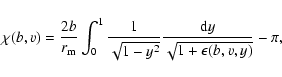 |
(B.7) |
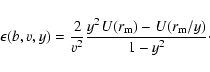 |
(B.8) |
for any potential:
 has a finite limit towards
 ,
so that the presence of the kernel
,
so that the presence of the kernel
 allows a rapid computation using a Gauss-Chebychev quadrature technique.
Once
is known, the impulsion change to the ion during
the encounter reads
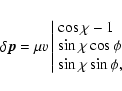 |
(B.9) |
is an
azimuthal angle characterising the plane of the encounter. Of course
over many encounters
is a random angle, so that the y and zcomponents of
 vanish. On average then, we have
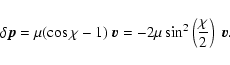 |
(B.10) |
 at
at  within
 and
and
 is
is
 .
Multiplying then
by this number of encounters
and integrating over
.
Multiplying then
by this number of encounters
and integrating over  and b, we derive the drag force as:
 |
= | 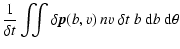 |
|
| = | ![$\displaystyle -4\pi n\mu v\left[\int_0^{+\infty}b~\sin^2\left(
\frac{\chi(b,v)}{2}\right)~{\rm d}b\right]~\vec{v}.$](/articles/aa/full/2007/16/aa3425-05/img234.gif) |
(B.11) |
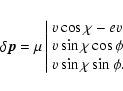 |
(B.12) |
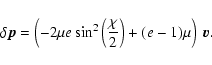 |
(B.13) |
we derive the drag force
as
|
(B.14) |