![[*]](/icons/foot_motif.gif)
M. Krips1,2 - A. Eckart1 - R. Neri3 - T. Bertram1 - C. Straubmeier1 - S. Fischer1 - J. G. Staguhn4 - S. N. Vogel5
1 - I. Physikalisches Institut, Universität zu Köln,
Zülpicher Str. 77, 50937 Köln, Germany
2 -
Harvard-Smithsonian Center for Astrophysics, SMA
project, 645 North A`ohoku Place, Hilo, HI 96720, USA
3 -
Institut de Radio Astronomie Millimetrique (IRAM), 300 rue de
la Piscine, 38406 Saint Martin d'Hères, France
4 -
NASA/Goddard Space Flight Center, Code 665, Building 21,
Greenbelt, MD 20771, USA
5 -
University of Maryland, College Park, MD 20742, USA
Received 14 June 2006 / Accepted 29 November 2006
Abstract
We present CO(1-0) and CO(2-1) line emission maps of
the barred spiral active galaxy HE 1029-1831 (z=0.0403)
obtained with the IRAM Plateau de Bure Interferometer (PdBI) and
in part by the Berkeley-Illinois-Maryland Association (BIMA)
observatory. The CO emission is well associated with the optical
bar and extended along it. The FWHM of the CO emission is
estimated to be  (
( ) kpc. The CO emission shows a
strong velocity gradient along the minor axis of the bar
(
) kpc. The CO emission shows a
strong velocity gradient along the minor axis of the bar
(

 ). The molecular gas mass is estimated to be

 which indicates a very gas rich
host galaxy. Most of the molecular gas appears to be subthermally
excited and cold but we also find weak evidence for a warmer
and/or denser gas component at the southern part of the bar
emission, about 4 kpc from the galactic
nucleus.
which indicates a very gas rich
host galaxy. Most of the molecular gas appears to be subthermally
excited and cold but we also find weak evidence for a warmer
and/or denser gas component at the southern part of the bar
emission, about 4 kpc from the galactic
nucleus.
Key words: galaxies: active - galaxies: kinematics and dynamics - galaxies: individual: HE 1029-1831 - radio lines: galaxies - galaxies: Seyfert
100 sources from the Hamburg/ESO survey for bright
QSOs. The sole selection criterion of these sources is their low
redshift of z<0.06 providing the capability of observations on the
smallest observationally available angular scales and the
accessibility of several important diagnostic lines in the NIR (e.g.,
the CO(2-0) rotation vibrational band head absorption line). We aim at
determining the distribution and dynamics of molecular gas in the
inner 1 kpc of these objects. This will add to a systematic study of
the different mechanisms of gas fueling into active galactic nuclei
(AGN). Together with the NUGA PdBI survey containing Seyfert and LINER
galaxies with
 (García-Burillo et al. 2003,2003,2005;
Combes et al. 2004; Krips et al. 2005) this study will
cover a large part of the activity sequence of AGN. Especially, the role of nuclear
embedded bars, rings, spirals as well as mini-spirals, warps and
micro-warps in the fueling process is an important issue to
investigate possible links between different nuclear disk morphologies
and activity types.
(García-Burillo et al. 2003,2003,2005;
Combes et al. 2004; Krips et al. 2005) this study will
cover a large part of the activity sequence of AGN. Especially, the role of nuclear
embedded bars, rings, spirals as well as mini-spirals, warps and
micro-warps in the fueling process is an important issue to
investigate possible links between different nuclear disk morphologies
and activity types.
Thirty objects of this sample were observed in CO with the SEST
telescope and ten with the BIMA array (Bertram et al., in prep.)
resulting in a low detection rate of 15% which might be a
result of a lack of instrumental sensitivity and uncertainties in the
given redshifts; these two observing campaigns were initially
conducted to identify the objects with the strongest CO emission. As a
consequence of the low detection rate, we have carried out deeper
integration of an additional 26 sources with the IRAM 30 m telescope
leading to 19 further detections (Betram et al.2006; Bertram et
al. in prep.). The BIMA observations resulted in a clear detection
of the source HE 1029-1831 and in a tentative one of
HE 1136-2304. Both have thus been observed as a follow-up with the
IRAM PdBI array but only the first one could be detected and mapped
while the tentative BIMA detection of HE 1136-2304 could not be
confirmed. HE 1136-2304 most likely lacks an exact redshift, too.
HE 1029-1831 contains (m=2) spiral arms and a prominent bar
(
 )
in the optical (H-band; Fischer et al. 2006;
see Fig. 1). Its redshift was recently determined to
be
)
in the optical (H-band; Fischer et al. 2006;
see Fig. 1). Its redshift was recently determined to
be
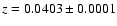 (Kaldare et al. 2003). The classifications of
its active nucleus range from an HII region and extreme starburst to
an AGN (Kewley et al. 2001). However, recent NIR observations have
given evidence that HE 1029-1831 may be classified as a luminous
infrared galaxy with a weak narrow line Seyfert nucleus of type 1
(Fischer et al. 2006).
(Kaldare et al. 2003). The classifications of
its active nucleus range from an HII region and extreme starburst to
an AGN (Kewley et al. 2001). However, recent NIR observations have
given evidence that HE 1029-1831 may be classified as a luminous
infrared galaxy with a weak narrow line Seyfert nucleus of type 1
(Fischer et al. 2006).
![\begin{figure}
\par\includegraphics[angle=-90,width=7cm,clip]{5832fi01.eps}\end{figure}](/articles/aa/full/2007/10/aa5832-06/img21.gif) |
Figure 1:
H-band image of HE1029-1831 (from Fischer et al. 2006)
superimposed with contours of the integrated CO(2-1) line
emission. Contours are from 3
 Jy/beam km s-1 to 13 Jy/beam km s-1 in steps of
  . . |
| Open with DEXTER | |
![\begin{figure}
\par\includegraphics[angle=-90,width=7cm,clip]{5832fi02.eps}\end{figure}](/articles/aa/full/2007/10/aa5832-06/img22.gif) |
Figure 2:
Integrated CO(1-0) emission as observed with BIMA ( grey
scale + dotted grey contours). The PdBI CO(1-0) ( solid black
contours) are superimposed on the image. The contour lines for the
BIMA data represent multiples of 1 levels, starting at
3,
where
levels, starting at
3,
where
 Jy/beam km s-1. The contours for the
PdBI CO(1-0) emission run from Jy/beam km s-1. The contours for the
PdBI CO(1-0) emission run from
 Jy/beam km s-1 to 7.3 Jy/beam km s-1 in steps of . Jy/beam km s-1 to 7.3 Jy/beam km s-1 in steps of . |
| Open with DEXTER | |

 was achieved in this antenna array
configuration.
was achieved in this antenna array
configuration.
 line
emission in HE 1029-1831 were conducted in February 2002 with 6
antennae in B and C configurations of the IRAM PdBI and again in March
2003 with 6 antennae in A configuration. The bandpass calibrator was
set to 3C273 and amplitude and phase calibrators were 1048-191 and
1055+018. The latter were observed every twenty minutes. The 3.5 mm
receiver was tuned to the redshifted 12CO(1-0) line and the
1.2 mm receiver to the redshifted 12CO(2-1) line. The amount of
water vapor is calculated to be
line
emission in HE 1029-1831 were conducted in February 2002 with 6
antennae in B and C configurations of the IRAM PdBI and again in March
2003 with 6 antennae in A configuration. The bandpass calibrator was
set to 3C273 and amplitude and phase calibrators were 1048-191 and
1055+018. The latter were observed every twenty minutes. The 3.5 mm
receiver was tuned to the redshifted 12CO(1-0) line and the
1.2 mm receiver to the redshifted 12CO(2-1) line. The amount of
water vapor is calculated to be  6 mm for both sets of
observations thus providing reasonable weather conditions and system
temperatures for a low declination target. At both frequencies we used
a total bandwidth of 580 MHz with a frequency resolution of
1.25 MHz. The phase tracking centre was set to
6 mm for both sets of
observations thus providing reasonable weather conditions and system
temperatures for a low declination target. At both frequencies we used
a total bandwidth of 580 MHz with a frequency resolution of
1.25 MHz. The phase tracking centre was set to

 31
31 57.3
57.3 and
and
 46'34.0'' taken from the Nasa/IPAC
Extragalactic Database (NED). The total integration time on source (6
antennae) amounted to 5 h for the 2002 data and to
3 h for the 2003 data.
46'34.0'' taken from the Nasa/IPAC
Extragalactic Database (NED). The total integration time on source (6
antennae) amounted to 5 h for the 2002 data and to
3 h for the 2003 data.
Table 1: Line parameters for CO(1-0) and CO(2-1) at the peak and integrated over the central 10-20''.
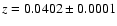 for both transitions and both arrays which is consistent with the
optical redshift of
(Fig. 3;
Kaldare et al. 2003). A gaussian profile has been fitted to both
lines. The calculated line parameters are given in
Table 1. The integrated maps are plotted in
Figs. 2 and 4. Both CO lines are
centered at the same position of
for both transitions and both arrays which is consistent with the
optical redshift of
(Fig. 3;
Kaldare et al. 2003). A gaussian profile has been fitted to both
lines. The calculated line parameters are given in
Table 1. The integrated maps are plotted in
Figs. 2 and 4. Both CO lines are
centered at the same position of
 :31:57.3 and
 18:46:33.2 (Table 1). The
CO(1-0) emission is not resolved by the modest angular resolution
(14'') of the BIMA observations; the velocity integrated flux
at peak and in the inner 20'' are almost identical (see
Table 1). This excludes the existence of
significant, very large scale (>10 kpc) CO emission. The CO emission
is, however, clearly extended in both transitions at the higher
angular resolution (1-3'') of the PdBI and reveals elongations in
north to south direction with a position angle (PA) of
0-20
(see Table 1) which is slightly
smaller than the one derived for the optical bar (
;
see Fischer et al. 2006). A combination of the BIMA and IRAM PdBI
CO(1-0) maps enables an estimate of the CO size (
18:46:33.2 (Table 1). The
CO(1-0) emission is not resolved by the modest angular resolution
(14'') of the BIMA observations; the velocity integrated flux
at peak and in the inner 20'' are almost identical (see
Table 1). This excludes the existence of
significant, very large scale (>10 kpc) CO emission. The CO emission
is, however, clearly extended in both transitions at the higher
angular resolution (1-3'') of the PdBI and reveals elongations in
north to south direction with a position angle (PA) of
0-20
(see Table 1) which is slightly
smaller than the one derived for the optical bar (
;
see Fischer et al. 2006). A combination of the BIMA and IRAM PdBI
CO(1-0) maps enables an estimate of the CO size ( FWHM) by
fitting an elliptical component to the uv data. We find a FWHM of
(
FWHM) by
fitting an elliptical component to the uv data. We find a FWHM of
( )'' which corresponds to () kpc. The
integrated CO(1-0) line intensity results in a total gas mass of
)'' which corresponds to () kpc. The
integrated CO(1-0) line intensity results in a total gas mass of
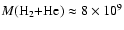 for the PdBI map and of
for the lower angular resolution BIMA
map assuming a M(H2) to
for the PdBI map and of
for the lower angular resolution BIMA
map assuming a M(H2) to
 conversion factor of
4.8
(K km s-1 pc2)-1 (Solomon & Barrett 1991) and
conversion factor of
4.8
(K km s-1 pc2)-1 (Solomon & Barrett 1991) and
 (H2). The difference in integrated
intensity between the PdBI and BIMA maps indicates that the PdBI has
filtered out approximately 30% of the total CO emission due to the
lack of short-spacings. Taking the IRAS flux of 3.7 Jy at 3 THz (taken
from NED) and assuming optically thin dust emission with a
(rest-frame) dust temperature of 40 K, we obtain a dust mass of
(H2). The difference in integrated
intensity between the PdBI and BIMA maps indicates that the PdBI has
filtered out approximately 30% of the total CO emission due to the
lack of short-spacings. Taking the IRAS flux of 3.7 Jy at 3 THz (taken
from NED) and assuming optically thin dust emission with a
(rest-frame) dust temperature of 40 K, we obtain a dust mass of
 .
For a standard galactic gas-to-dust mass
ratio of 150, the expected gas mass would be
.
For a standard galactic gas-to-dust mass
ratio of 150, the expected gas mass would be
 ,
i.e., a factor of 4-6 lower than
using the CO luminosity. However, the assumed gas-to-dust mass ratio
contains a large uncertainty and can increase in the cases of a few
active Ultra-Luminous InfraRed Galaxies (ULIRGs) even up to 1000 or
more (e.g., Contini & Contini 2003) so that the galactic value might
not be applicable for HE 1029-1831. Alternatively, Downes & Solomon
(1998) pointed out that the M(H2) to
conversion
factor might be lower by a factor of 6 in the circumnuclear regions of
ULIRGs.
,
i.e., a factor of 4-6 lower than
using the CO luminosity. However, the assumed gas-to-dust mass ratio
contains a large uncertainty and can increase in the cases of a few
active Ultra-Luminous InfraRed Galaxies (ULIRGs) even up to 1000 or
more (e.g., Contini & Contini 2003) so that the galactic value might
not be applicable for HE 1029-1831. Alternatively, Downes & Solomon
(1998) pointed out that the M(H2) to
conversion
factor might be lower by a factor of 6 in the circumnuclear regions of
ULIRGs.
As the angular resolutions of the PdBI for both transitions are
comparable when using uniform weighting for CO(1-0) and natural
weighting for CO(2-1), we can estimate the central (8'') line
ratio
 (in temperature scale; i.e.,
 (Jy)
(Jy)
 )/(
)/(
 (Jy)
(Jy)
 )
for equal beamsizes)
between both lines to be
)
for equal beamsizes)
between both lines to be  0.5, indicating subthermal excitation
conditions and cold gas. However, one has to keep in mind that this
estimate might still be biased by artifacts due to different
uv-coverages for both lines in terms of spatial frequencies. One can
reduce such a bias by apodising and truncating the respective
uv-coverages to the overlapping region. This results in the map of
line temperature ratios shown in Fig. 5. The ratio map in this figure
is not significantly different from one obtained simply from the
unchanged uniformly weighted CO (1-0) and naturally weighted CO (2-1)
maps. However, the resulting line ratio map still has to be
interpreted with caution as it heavily depends on the adopted
weighting factors. Thus, the integrated line ratio must be regarded as
a best estimate. Although most of the CO appears to be subthermally
excited and cold, the CO(2-1) line also indicates asymmetric emission
at the south which has only a very weak counterpart in the CO(1-0)
line. Such a difference cannot be explained by resolution effects but
could still be accounted for by a residual calibration error in the
visibilities and a poor coverage of the uv-plane although no obvious
inconsistencies were found. The high line ratio at the southern part
of 1 might thus indicate different excitation conditions of the
gas. The location of the southern CO component is close to the
southern spiral arm seen in the optical (see
Fig. 1). This might suggest that the CO at this
position traces the contact point of the bar and the southern spiral
arm. The high line ratio could be then indicative of gas compression
caused by a crossing of the bar- with the spiral arm orbits outside
the bar corotation, consistent with standard theory. However, the
southern CO emission has to be verified by further observations using
higher transitions of the CO line or denser gas tracers such as
13CO or HCN.
0.5, indicating subthermal excitation
conditions and cold gas. However, one has to keep in mind that this
estimate might still be biased by artifacts due to different
uv-coverages for both lines in terms of spatial frequencies. One can
reduce such a bias by apodising and truncating the respective
uv-coverages to the overlapping region. This results in the map of
line temperature ratios shown in Fig. 5. The ratio map in this figure
is not significantly different from one obtained simply from the
unchanged uniformly weighted CO (1-0) and naturally weighted CO (2-1)
maps. However, the resulting line ratio map still has to be
interpreted with caution as it heavily depends on the adopted
weighting factors. Thus, the integrated line ratio must be regarded as
a best estimate. Although most of the CO appears to be subthermally
excited and cold, the CO(2-1) line also indicates asymmetric emission
at the south which has only a very weak counterpart in the CO(1-0)
line. Such a difference cannot be explained by resolution effects but
could still be accounted for by a residual calibration error in the
visibilities and a poor coverage of the uv-plane although no obvious
inconsistencies were found. The high line ratio at the southern part
of 1 might thus indicate different excitation conditions of the
gas. The location of the southern CO component is close to the
southern spiral arm seen in the optical (see
Fig. 1). This might suggest that the CO at this
position traces the contact point of the bar and the southern spiral
arm. The high line ratio could be then indicative of gas compression
caused by a crossing of the bar- with the spiral arm orbits outside
the bar corotation, consistent with standard theory. However, the
southern CO emission has to be verified by further observations using
higher transitions of the CO line or denser gas tracers such as
13CO or HCN.
![\begin{figure}
\par\includegraphics[angle=-90,width=8cm,clip]{5832fi03.eps}\end{figure}](/articles/aa/full/2007/10/aa5832-06/img65.gif) |
Figure 3:
CO(1-0) ( upper panel) and CO(2-1) ( lower panel)
line spectrum taken at the peak emission. The (optical) redshift of
is indicated. The velocity resolution is 3.4 km s-1 (34 km s-1) at both lines for the PdBI (BIMA). |
| Open with DEXTER | |
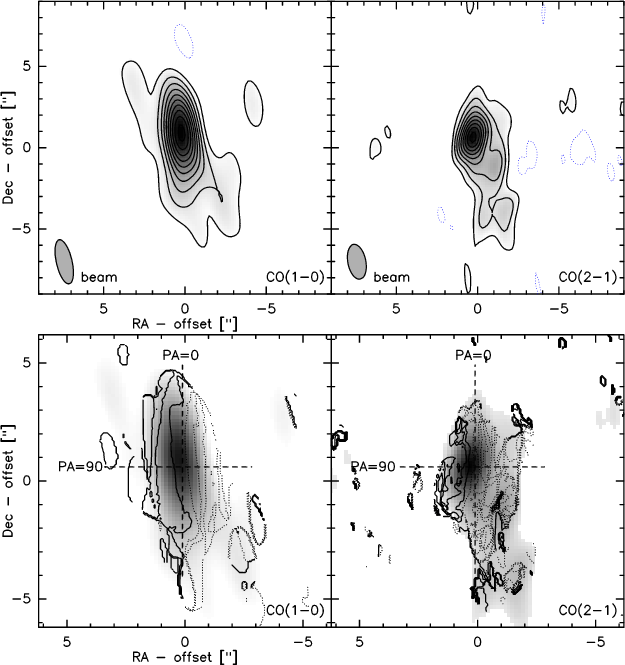 |
Figure 4:
Upper panel: velocity integrated CO(1-0) ( left)
and CO(2-1) ( right) emission in HE 1029-1831 (between
 200 km s-1). Contours are from 3 200 km s-1). Contours are from 3
 Jy/beam km s-1 (1.4 Jy/beam km s-1) to 7.3 Jy/beam km s-1 (13 Jy/beam km s-1) in steps of
for CO(1-0) (CO(2-1)). Lower panel: iso-velocity
maps of the CO(1-0) and CO(2-1) emission CO(1-0) ( left) and
CO(2-1) ( right) emission in HE 1029-1831. Contours are around
the dynamic centre in steps of 10 km s-1. The dashed lines indicate the
cuts along which the position-velocity diagrams in
Fig. 6 were taken.
Jy/beam km s-1 (1.4 Jy/beam km s-1) to 7.3 Jy/beam km s-1 (13 Jy/beam km s-1) in steps of
for CO(1-0) (CO(2-1)). Lower panel: iso-velocity
maps of the CO(1-0) and CO(2-1) emission CO(1-0) ( left) and
CO(2-1) ( right) emission in HE 1029-1831. Contours are around
the dynamic centre in steps of 10 km s-1. The dashed lines indicate the
cuts along which the position-velocity diagrams in
Fig. 6 were taken. |
| Open with DEXTER | |
![\begin{figure}
\par\includegraphics[angle=-90,width=6.8cm,clip]{5832fi06.eps}\end{figure}](/articles/aa/full/2007/10/aa5832-06/img67.gif) |
Figure 5: The CO(2-1)/CO(1-0) line ratio in temperature scale ( color scale) overlaid with the velocity integrated CO(2-1) emission ( contours). Increments for the velocity integrated CO(2-1) emission are the same as in Fig. 4. |
| Open with DEXTER | |
We have taken position velocity diagrams at all position angles with a
separation of 10 showing that the cuts in the direction of
the CO extension (position angle:
 )
and perpendicular to it
(
)
represent the extremes in velocity structure: the cuts
at
in both transitions reveal a clear and strong
velocity gradient (Fig. 6, upper panels) which
extends over a positional range of 0.5''; by comparison,
velocity gradients along the CO elongation, i.e., at
,
are
weaker and much less apparent (Fig. 6, lower
panels). Assuming a radius of 1'' equivalent to 0.8 kpc and a
velocity of 80 km s-1, the total dynamical mass within the central
0.8 kpc - not corrected for inclination effects - can be calculated to
be
)
and perpendicular to it
(
)
represent the extremes in velocity structure: the cuts
at
in both transitions reveal a clear and strong
velocity gradient (Fig. 6, upper panels) which
extends over a positional range of 0.5''; by comparison,
velocity gradients along the CO elongation, i.e., at
,
are
weaker and much less apparent (Fig. 6, lower
panels). Assuming a radius of 1'' equivalent to 0.8 kpc and a
velocity of 80 km s-1, the total dynamical mass within the central
0.8 kpc - not corrected for inclination effects - can be calculated to
be  2
2
 .
Probably, the gas disk is seen closer to
face-on than to edge-on (compare also Fischer et al. 2006) so that
this value must be regarded as lower limit. Since the dynamical mass
includes the mass of the gas and of the stars, we can estimate
the inclination of the galaxy by assuming that the gas mass of
0.2-
contributes 10% to the total mass
of the galaxy. This results in an inclination of 5-10.
By
equating directly the estimated gas mass with the dynamical mass, the
inclination would increase to <15-30 giving a more
conservative upper limit.
.
Probably, the gas disk is seen closer to
face-on than to edge-on (compare also Fischer et al. 2006) so that
this value must be regarded as lower limit. Since the dynamical mass
includes the mass of the gas and of the stars, we can estimate
the inclination of the galaxy by assuming that the gas mass of
0.2-
contributes 10% to the total mass
of the galaxy. This results in an inclination of 5-10.
By
equating directly the estimated gas mass with the dynamical mass, the
inclination would increase to <15-30 giving a more
conservative upper limit.
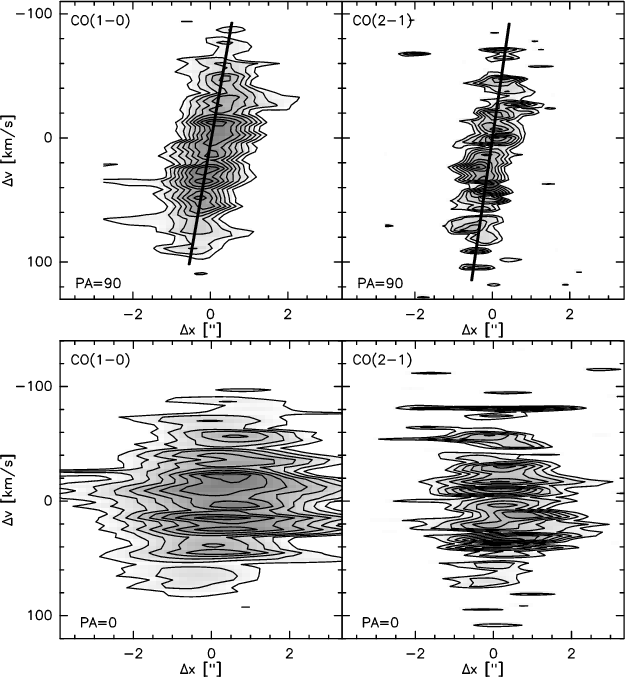 |
Figure 6:
The upper panels show the position velocity diagrams taken
across the bar (
), and the lower panel those of a cut
perpendicular to it, i.e., along the bar (
;
see
Fig. 4). Increments are in steps of 10% from 20%
and 30% of the maximum for the CO(1-0) and the CO(2-1) line
respectively. The thick lines indicate the steepness of the gradient
at
and are supposed to guide the reader's eyes. |
| Open with DEXTER | |
 mJy at 3 mm and to
  mJy at 1 mm. The two
upper limits are compatible with the mm-values predicted by the grey
body spectrum of the (infrared) dust emission (compare previous
section) which are of the order of 1-5 mJy.
mJy at 1 mm. The two
upper limits are compatible with the mm-values predicted by the grey
body spectrum of the (infrared) dust emission (compare previous
section) which are of the order of 1-5 mJy.
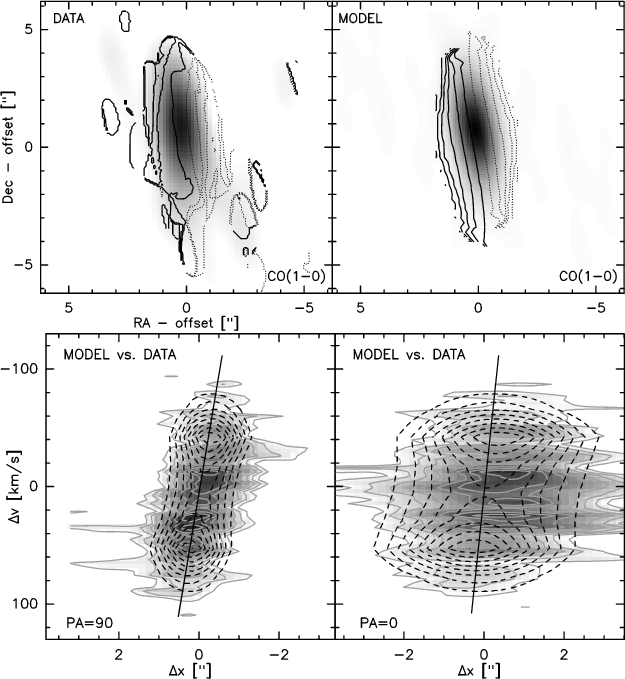 |
Figure 7:
Upper panel: iso-velocity diagrams of the CO(1-0)
emission in HE 1029-1831 ( left) and of a first-order bar model
( right) overlaid to the respective integrated line emission
maps. Increments are again in steps of 10 km s-1. Lower panel:
position-velocity diagram simulated with a bar model for the emission
in HE 1029-1831 taken along a cut with a PA of 90
( left)
and of 0
( right); compare Figs. 4 and
6. The dashed contours are superimposed on the
observed data presented in Fig. 6. Increments are in
steps of 10% from 20% of the maximum. |
| Open with DEXTER | |
 and position angles (pa(r)) which are both smooth
functions of the radius. Each ring, i.e., each radius has also an
assigned velocity. For simplification,
we adopt a constant rotation curve and a constant intensity over all
rings. As fixed input parameters, we used the estimated PA of the
emission of 0-20 and the inclination of
10-30.
To find the best-fit model, we compared the
simulated distribution and kinematics for different sets of
and pa(r) with those from the observed gas emission.
Figure 7 shows the result of these simulations. To
facilitate a comparison to the observed CO(1-0) data, the simulated
CO distribution has been transformed to a uv-table based on the
uv-coverage from the CO(1-0) PdBI observations; this is a more
accurate method than just convolving the model with the beamsize of
the CO(1-0) observations as it considers also spatial filtering
effects due to the discrete uv-coverage. This simplified model already
reproduces the observed emission. The simulated distribution and the
kinematics of the gas agree very well with each other indicating that
the gas properties can be almost completely explained by assuming a
barred potential. However, the asymmetry between the CO(1-0) and
CO(2-1) line cannot be explained by the symmetric bar model.
and position angles (pa(r)) which are both smooth
functions of the radius. Each ring, i.e., each radius has also an
assigned velocity. For simplification,
we adopt a constant rotation curve and a constant intensity over all
rings. As fixed input parameters, we used the estimated PA of the
emission of 0-20 and the inclination of
10-30.
To find the best-fit model, we compared the
simulated distribution and kinematics for different sets of
and pa(r) with those from the observed gas emission.
Figure 7 shows the result of these simulations. To
facilitate a comparison to the observed CO(1-0) data, the simulated
CO distribution has been transformed to a uv-table based on the
uv-coverage from the CO(1-0) PdBI observations; this is a more
accurate method than just convolving the model with the beamsize of
the CO(1-0) observations as it considers also spatial filtering
effects due to the discrete uv-coverage. This simplified model already
reproduces the observed emission. The simulated distribution and the
kinematics of the gas agree very well with each other indicating that
the gas properties can be almost completely explained by assuming a
barred potential. However, the asymmetry between the CO(1-0) and
CO(2-1) line cannot be explained by the symmetric bar model.
.
The difference
between the dynamical mass (2
,
not corrected
for inclination) indicates a low inclination
of 10-30.
The CO(1-0) and CO(2-1) emission are
extended along the optical bar. The FWHM of the CO emission is
calculated to be () kpc. Also, a striking velocity
gradient is found at a position angle of 90,
i.e., along the
minor axis of the bar, extending over 1'' approximately. In the
direction of the bar (
), almost no velocity gradient is
seen. Adopting the approach from Schinnerer et al. (2000), the line emission can be simulated with a very simple bar model explaining the detected distribution and kinematics. Following Roberts et al. (1979), the strong velocity gradient across the bar (
)
can be interpreted as bar-driven inflow of the gas
while the motions along the bar (
)
indicate a velocity
dispersion of 
 80 km s-1. The line ratio between CO(2-1)
and CO(1-0) is estimated to be 0.5 over most areas of the bar
although probably still biased by resolution effects. This indicates
subthermally excited and cold gas which is typical for gas in a
bar/disk. The southern increase of the CO(2-1)/CO(1-0) line ratio to
over 1 indicates different excitation conditions which might be caused
by gas compression at the crossing point of the bar and the southern
spiral arm. However, this southern CO component still requires further
support.
80 km s-1. The line ratio between CO(2-1)
and CO(1-0) is estimated to be 0.5 over most areas of the bar
although probably still biased by resolution effects. This indicates
subthermally excited and cold gas which is typical for gas in a
bar/disk. The southern increase of the CO(2-1)/CO(1-0) line ratio to
over 1 indicates different excitation conditions which might be caused
by gas compression at the crossing point of the bar and the southern
spiral arm. However, this southern CO component still requires further
support.
Acknowledgements
Part of this work was supported by the German Sonderforschungsbereich, SFB, project number 494. MK was partly funded by a pre-doctoral fellowship of the german academic exchange service (DAAD) and the french government. This research has made use of the NASA/IPAC Extragalactic Database (NED) which is operated by the Jet Propulsion Laboratory, California Institute of Technology, under contract with the National Aeronautics and Space Administration. We thank the anonymous referee for useful and careful comments.