![[*]](/icons/foot_motif.gif)
A&A 463, 957-967 (2007)
DOI: 10.1051/0004-6361:20065626
R. Krivonos1,2 - M. Revnivtsev1,2 - E. Churazov1,2 - S. Sazonov1,2 - S. Grebenev2 - R. Sunyaev1,2
1 - Max-Planck-Institute für Astrophysik,
Karl-Schwarzschild-Str. 1, 85740 Garching bei München,
Germany
2 -
Space Research Institute, Russian Academy of Sciences,
Profsoyuznaya 84/32, 117997 Moscow, Russia
Received 17 May 2006 / Accepted 13 October 2006
Abstract
We present results of a study of the Galactic ridge X-ray
emission (GRXE) in hard X-rays performed with the IBIS telescope
aboard INTEGRAL. The imaging capabilities of this coding aperture
telescope make it possible to account for the flux from bright
Galactic point sources whereas the wide field of view permits us to
collect large flux from the underlying GRXE. Extensive study of the
IBIS/ISGRI detector background allowed us to construct a model that
predicts the detector count rate with  1-2% accuracy in the
energy band 17-60 keV. The derived longitude and latitude profiles of
the ridge emission are in good agreement with the Galactic
distribution of stars obtained from infrared observations. This, along
with the measured hard X-ray spectrum of the Galactic ridge emission
strongly indicates its stellar origin. The derived unit stellar mass
emissivity of the ridge in the energy band 17-60 keV,
(0.9-1.2)
1-2% accuracy in the
energy band 17-60 keV. The derived longitude and latitude profiles of
the ridge emission are in good agreement with the Galactic
distribution of stars obtained from infrared observations. This, along
with the measured hard X-ray spectrum of the Galactic ridge emission
strongly indicates its stellar origin. The derived unit stellar mass
emissivity of the ridge in the energy band 17-60 keV,
(0.9-1.2)  1027 erg s-1
 (assuming a bulge mass of 1-1.3
 ), agrees with that of local (in the Solar neigborhood) accreting magnetic white dwarf binaries - dominant
contributors to the GRXE at these energies. In addition, the shape
of the obtained GRXE spectrum can be used to determine the average
mass of white dwarfs in such systems in the Galaxy as
), agrees with that of local (in the Solar neigborhood) accreting magnetic white dwarf binaries - dominant
contributors to the GRXE at these energies. In addition, the shape
of the obtained GRXE spectrum can be used to determine the average
mass of white dwarfs in such systems in the Galaxy as
 .
The total hard X-ray luminosity of the GRXE is
.
The total hard X-ray luminosity of the GRXE is
 1037 erg s-1 in the 17-60 keV band. At energies 70-200 keV no additional contribution to the total
emission of the Galaxy apart from the detected point sources is seen.
1037 erg s-1 in the 17-60 keV band. At energies 70-200 keV no additional contribution to the total
emission of the Galaxy apart from the detected point sources is seen.
Key words: Galaxy: structure - Galaxy: bulge - Galaxy: disk - X-rays: diffuse background - stars: white dwarfs - X-rays: general
Broad-band studies of the radiative output of the Galaxy demonstrate
that different physical mechanisms contribute to the brightness of the
Galaxy in different energy bands. In the near-infrared and optical
spectral bands, the bulk of the emission is provided by different types
of stars. In the high energy ( GeV) band the Galactic emission
is likely a result of interactions of cosmic rays with interstellar
matter (e.g., Stecker 1973; Hunter et al. 1997; Kraushaar et al. 1972; Stecker 1977; Kniffen et al. 1978).
GeV) band the Galactic emission
is likely a result of interactions of cosmic rays with interstellar
matter (e.g., Stecker 1973; Hunter et al. 1997; Kraushaar et al. 1972; Stecker 1977; Kniffen et al. 1978).
From the first all sky surveys in X-rays (2-10 keV) it became
clear that in this energy band the emission of the Galaxy as a whole
is dominated by the contribution from bright point sources, mainly
accreting black holes and neutron star binaries. However, emission
that was not resolved into separate point sources - the Galactic
ridge X-ray emission (GRXE, e.g. Worrall et al. 1982) - was also
discovered. Even the significant increase of the sensitivity of X-ray
instruments over the last decades has not led to resolving all the
Galactic ridge emission into discrete sources
(Ebisawa et al. 2005; Hands et al. 2004; Sugizaki et al. 2001). This was considered as an indication of a truly diffuse origin of the Galactic ridge emission.
The latest studies of the morphology and volume emissivity of the GRXE in
the energy band 3-20 keV provide convincing evidence that the majority
of the GRXE consists of a large number of stellar type X-ray sources,
namely white dwarf binaries and coronally active stars
(Sazonov et al. 2006; Revnivtsev et al. 2005). In particular for the energy band >20 keV, this means that the GRXE must be dominated by the contribution of
magnetic white dwarf binaries - intermediate polars (IP) and polars (P). Assuming that the GRXE traces the stellar mass density in the
Galaxy, one can obtain a proxy of the GRXE spectrum in hard X-rays
(20-200 keV) from the spectrum of the inner 30 pc ( )
of our Galaxy (Revnivtsev et al. 2005). However, since the Galactic center
region may be peculiar in many respects, study of the true GRXE in
hard X-rays is necessary.
)
of our Galaxy (Revnivtsev et al. 2005). However, since the Galactic center
region may be peculiar in many respects, study of the true GRXE in
hard X-rays is necessary.
The GRXE spectrum above >20 keV is not yet accurately measured (e.g., Purcell et al. 1996; Kinzer et al. 1999; Skibo et al. 1997). The most recent results on GRXE were obtained with the instruments aboard INTEGRAL observatory (Winkler et al. 2003). Lebrun et al. (2004) and Terrier et al. (2004) using IBIS telescope (Ubertini et al. 2003) have shown that although bright point sources dominate the emission from the Galaxy at 30 keV, there is a significant unresolved component. Bouchet et al. (2005) and Strong et al. (2005) using SPI spectrometer (Vedrenne et al. 2003) found an unresolved Galactic X-ray emission at energies higher than 50 keV.
To determine the origin of the hard X-ray Galactic
background it is very important to investigate whether the GRXE in hard
X-rays is distributed similar to the stellar distribution,
indicating its stellar origin, or whether it more closely
follows the interstellar gas density distribution, thus connecting
to the high energy gamma-ray background seen, e.g., by EGRET. Either
the spectrum of the GRXE has a cutoff at energies 30-50 keV
due to the typical cutoff in spectra of magnetic CVs
(e.g., Suleimanov et al. 2005), or it has a power-law spectral shape
up to higher energies as would be expected if the Galactic
background emission were induced by cosmic ray electrons
(e.g., Sacher & Schoenfelder 1984; Skibo & Ramaty 1993; Mandrou et al. 1980; Stecker 1977).
Previous attempts to study the hard X-ray component of the GRXE were severely inhibited by the poor angular resolution of the instruments used, which precluded effective subtraction of the contribution of bright point sources. Only now has this become possible thanks to the hard X-ray telescopes aboard the INTEGRAL observatory. The IBIS telescope on INTEGRAL possesses an optimal combination of properties to perform such a study:
 at zero response) that allows a large flux of the diffuse emission to be collected, but not too large
to preclude the construction of a GRXE map if the telescope is used as
a collimated instrument;
at zero response) that allows a large flux of the diffuse emission to be collected, but not too large
to preclude the construction of a GRXE map if the telescope is used as
a collimated instrument;
1 Ms is 10-11 erg s-1 cm-2, which
for the Galactic center distance corresponds to a luminosity
1035 erg s-1. Subtraction of sources with luminosities higher
than this limit allows one to avoid significant contamination of the
GRXE by point sources (see, e.g., Sazonov et al. 2006).
In this work we will study the spectral and morphological properties of the GRXE in the hard X-ray energy band 17-200 keV. At higher energies the positronium annihilation continuum of the Galactic center (e.g., Knödlseder et al. 2005; Leventhal et al. 1978; Gehrels et al. 1991; Churazov et al. 2005) should be carefully taken into account, which requires a different approach from the one used in this work (which is especially related to the detector background modeling). For this reason we leave the study of the Galactic background emission at energies higher then 200 keV for a separate paper.
For our analysis we used all the IBIS data available to us,
including public data, some proprietary data (Galactic center
observations and Crux Spiral arm deep exposure observations) and
data available to us through the INTEGRAL Science Working Team. In
total we analyzed 33 Ms of the data (deadtime corrected
value of exposure). We considered only the data of the ISGRI detector of the IBIS telescope, which provides data in the energy band 17-1000 keV with high sensitivity in hard X-rays (17-200 keV) and has sufficient angular resolution ()
for
studying crowded fields like the Galactic center region.
The method of the sky reconstruction employed in the IBIS telescope
(coded mask imaging) does not allow one to study directly
diffuse structures that are significantly larger than the size of
the mask pixels. Therefore, to study large-scale structures,
such as the GRXE (
 ), we should use
IBIS/ISGRI as a collimated instrument. The detector collects
photons from point sources and diffuse emission. Measurement of the point
source' contribution to the total detector count rate makes it
possible to recover the flux of the GRXE. The success of such approach
strongly depends on the accuracy of the instrumental background
modeling.
), we should use
IBIS/ISGRI as a collimated instrument. The detector collects
photons from point sources and diffuse emission. Measurement of the point
source' contribution to the total detector count rate makes it
possible to recover the flux of the GRXE. The success of such approach
strongly depends on the accuracy of the instrumental background
modeling.
Prior to subsequent analysis we screened the data. If an individual
observation (SCW - "science window'') did not fulfill all the imposed
criteria it was dropped. However, we should note that screening of
individual events is likely more flexible and could have saved
slightly more data. We screened all the data near the beginning and
end of revolutions (due to increased background near the radiation
belts), the data when ISGRI was operated not in its main regime (modes 41 and 43), and science windows with exposure times less then
700 s. We also applied filtering using information about the
electron count rate provided by IREM (INTEGRAL Radiation Environment
Monitor, Hajdas et al. 2003). Analysis of the detector 10-s binned
light curve in the energy band 17-200 keV was used to screen science
windows with all types of bursts. As a final step in the screening
procedure, we filtered out all observations that had a high level of
noise on source-free images (sky images with removed point
sources). Upon the data filtering only  of observations were
accepted for further analysis.
of observations were
accepted for further analysis.
At any given time the detector count rate of IBIS/ISGRI consists of:
0.5 Crab in the energy
band 17-100 keV and can be considered very uniform over the sky.
Taking into account the IBIS/ISGRI field of view, we can expect that
CXB flux variability over the sky for ISGRI will not exceed 1%
(e.g., Churazov et al. 2006). Therefore, the contribution of the CXB to
the detector count rate can be considered independent of observation
orientation and can be estimated from observations at high Galactic
latitudes. The contribution of point sources to the detector count
rate can be almost perfectly predicted using the telescope coded mask
imaging technique (more on this below). The list of detected sources
used in our subtraction procedure includes more than 360 sources on
the entire sky. Typically, the detection limit for regions near the
Galactic plane is at the level of 1 mCrab. The complete list of
sources will be presented elsewhere. To predict the detector count
rate not caused by photons arriving from the sky one should use a background model. We followed two different approaches to study the ridge morphology and its energy spectrum. For the study of the energy spectrum we used only specially performed INTEGRAL observations for
which the systematical uncertainties are minimal (see description
below, model 2), whereas for the study of the ridge emission
distribution in the Galaxy we used all the available observations.
Among possible tracer candidates that might be used in the background
modeling, we considered the IREM count rates, SPI saturated events
count rates, ISGRI veto count rates, and ISGRI high energy band count
rates. We finally chose the ISGRI detector count rate in the energy
band
600-1000 keV. At these energies the effective area of the ISGRI detector is very small (<40 cm2), and the detector count rate is
expected to be dominated by the internal detector background. We also
took into account gain variations of the ISGRI detector, which shift
the detector background spectrum along the energy axis causing
additional variations of the count rates in the studied energy bands.
As we are mainly interested in the energies 17-200 keV, we estimated
the ISGRI detector gain by observing the position of strong background
lines at energies
Our final model of the ISGRI background consists of a linear
combination of the
600-1000 keV detector count rate H and the gain
parameter G. To make allowance for possible long-term
variations of the ISGRI detector background, we also included time (T) in the cubic polynomial form:
To test the background model we derived coefficients for
our model using pointings in region "A'' Fig. 1 and
applied the model to pointings from region "B''. The result of the
background model implementation is presented in Fig. 2
(bottom panel). The employed background model leaves residuals with an rms scatter
Part of the Galactic center region observations - Galactic center
latitude scans (March 2005-March 2006) - were taken by INTEGRAL
using a specially designed pattern, which presents considerable
advantages from the point of view of the study of the Galactic ridge
energy spectrum. The pointing direction of INTEGRAL instruments were
moved across the Galactic center region on a timescale
We checked the quality of the ISGRI instrumental background
subtraction on high energy channels (>600 keV) where the
instrumental background totally dominates. We found that the
systematical uncertainties of the background subtraction using the
employed technique (
One of the key steps in studying the GRXE with the large field of view
instrument IBIS/ISGRI is the subtraction of the contribution of bright
point sources from the detector count rate. The unsubtracted count
rate due to bright point sources can significantly distort the map of
the GRXE and its energy spectrum. There are two main constituents of
this problem: imperfect mask shadow modeling in the software, which
will result in leftover unsubtracted count rate on the detector, and
the finite opacity of the IBIS mask, which will lead to an underestimation of source count rates by the coded mask technique and
therefore to an unsubtracted source count rate on the detector. To
check the quality of our source removal procedure and the accuracy of
our constructed IBIS collimator response function, we studied a number
of observations of the Crab nebula. Our model of the IBIS/ISGRI collimator response function includes a geometry of the instrument and
also an angle and energy dependent absorption caused by the "NOMEX'' structure, supporting IBIS mask. (see, e.g., Reglero 2001). Examples of used response functions in the
energy bands 17-60 keV and 86-129 keV are presented in
Fig. 4.
The residuals between the predicted count rates during Crab
observations (which include the results of our background model and
our collimator response function model) and the actually measured
detector count rates do not demonstrate any dependence on
source flux and the rms scatter of the residuals does not exceed the
uncertainty of the our detector background model estimated in
Sect. 3.1. Therefore, we can conclude
that neither our source removal procedure nor finite mask opacity in
the energy range 17-200 keV introduced additional systematic
uncertainties into our analysis.
Using the method described above for each INTEGRAL/IBIS/ ISGRI
observation we obtain two numbers in any considered energy channel: 1) the summed detector count rate caused by resolved point sources and 2) the detector count rate left after subtraction of the contribution of point sources and modeled detector background. The possible remaining
contribution of undetected point sources on the detector can be
estimated using the luminosity function of Galactic X-ray sources
(Grimm et al. 2002; Sazonov et al. 2006). The majority of the inner Galactic plane
was observed by INTEGRAL/IBIS for more than 0.5-0.8 Ms. Such an exposure corresponds to an IBIS/ISGRI detection sensitivity
We constructed longitude and latitude profiles of the integrated
emission from point sources and of the hard X-ray Galactic ridge
emission. For construction of the longitude profile of the GRXE we
selected those INTEGRAL observations where the IBIS axis was directed
within
As we used the IBIS/ISGRI with the field of view
The map of the Galaxy in the near infrared spectral band was obtained
using data of COBE/DIRBE observations (zodi-subtracted mission average
map provided by the LAMBDA archive of the Goddard Space Flight Center,
http://lambda.gsfc.nasa.gov). To reduce the influence of the
interstellar reddening we considered DIRBE spectral band
The map of the NIR intensity was then convolved with the IBIS/ISGRI collimator response function (see Fig. 4). The resulting
longitude and latitude profiles of the COBE/DIRBE NIR intensity are
shown by the solid line on Figs. 7 and 8
correspondingly. We also constructed a map of the IBIS/ISGRI surface brightness distribution of the GRXE in the 17-60 keV energy
band (see Fig. 9). The map of the NIR intensity is shown
by contours. Correlation of observed values of hard X-ray flux with the
NIR fluxes is presented in Fig. 10.
It is clearly seen that the GRXE intensity distribution very closely
follows the NIR intensity distribution and thus traces the stellar
mass density in the Galaxy. To show that the correlation of
the hard X-ray GRXE with the cosmic-ray induced gamma-ray background
emission is not nearly as good as its correlation with the NIR intensity, we present Fig. 11. Here one can see the
distributions (convolved with the IBIS/ISGRI collimator response
function) of the EGRET gamma-ray background, Galactic neutral
hydrogen (HI), and molecular gas (CO emission)
We can conclude that the emissivity profile of the GRXE in hard X-rays
(17-60 keV) supports the finding of Revnivtsev et al. (2005) that the GRXE
traces the stellar mass distribution. This allows us to estimate the
emissivity of the GRXE in hard X-rays using the known NIR luminosity
measured with COBE/DIRBE observations. The ratio of NIR- and hard
X-ray intensities averaged over the whole Galaxy is
The ratios averaged over the Galactic bulge (
Using the
Using the data from Galactic latitude scans, which have the smallest
systematic uncertainties of the ISGRI background subtraction, we
obtained the spectrum of the GRXE in the energy band 17-200 keV. It is
presented in Fig. 14 together with the summed spectrum
of all detected point sources in the Galactic center region. Note
that after subtraction of bright point sources detected by IBIS/ISGRI,
we do not detect any additional hard X-ray emission at energies
After we showed that hard GRXE volume emissivity traces the stellar
mass density in the Galaxy, we can construct a broad-band unit stellar
mass spectrum of the GRXE. We obtained ratios of hard X-ray surface
brightness in each energy band to NIR surface brightness. NIR surface
brightness was obtained after convolution of reddening-corrected
COBE/DIRBE
The obtained spectrum of the GRXE can now be compared with a composite
spectrum of known types of weak Galactic X-ray sources. Unfortunately
we do not have broad-band spectra of all sources that were used in the
construction of the luminosity function of weak Galactic X-ray sources
(Sazonov et al. 2006). Therefore we tried to obtain some "toy'' composite
spectra that would possess the main properties of the ideal sample of
sources. As the input templates of spectra of individual classes of
sources we take: the spectrum of V711 Tau as an RS CVn binary, AM Her
as a polar, and SU UMa as a dwarf nova. For the spectrum of
intermediate polars, which are the dominant contributors in hard
X-rays, we adopt the model spectrum of Suleimanov et al. (2005) with the
white dwarf mass
The important difference of this "toy'' composite spectrum from that
used in the work of Revnivtsev et al. (2005) is the value of the white dwarf
mass in the intermediate polar binary system. The temperature of the
optically thin plasma emitting X-ray radiation in the case of
accreting magnetic CVs (in particular - in intermediate polars,
which dominate in hard X-rays) strongly depends on the mass of the
white dwarf (e.g., Aizu 1973). In the range of masses
Note that according to the above reasoning the shape of the GRXE spectrum in hard X-rays can be used to determine the average mass of
the white dwarfs in accreting magnetic CVs in the Galaxy. The exact
determination of the average WD mass is subject to uncertainties of
relative contribution of different types of Galactic X-ray sources,
but our first estimate shows that it is approximately consistent with
At energies higher than 100-200 keV a more detailed study of the
IBIS/ISGRI detector background is needed to recover the
properties of the unresolved emission in the Galaxy. In addition to
the instrumental problems at these energies there is a strong
contribution of the diffuse positronium continuum in the Galactic
Center region, which should be carefully taken into account. We plan
to study the unresolved Galactic continuum at these high energies in
our future work.
Images of the Galactic center obtained by IBIS/ISGRI
(e.g., Revnivtsev et al. 2004b; Bélanger et al. 2006) showed a bright spot at the
position of the Galactic center (Sgr A*), which was designated as
an INTEGRAL source IGR J17456-2901. Association of this source with a low-mass X-ray binary located near Sgr A* (Revnivtsev et al. 2004b) or
with emission from Sgr A* itself (e.g., Bélanger et al. 2004) does
not allows one to explain the properties of the source. In particular,
it was shown that this source is most likely not a point-like source
and does not consist of a small number of bright LMXBs
(Neronov et al. 2005). Bélanger et al. (2006) argued that the emission of
IGR J17456-2901 might have the same origin as the source of
ultra-high energy (TeV) photons seen by HESS (Aharonian et al. 2006).
It was argued by Revnivtsev et al. (2005) based on the proportionality of the
GRXE volume emissivity to the Galactic stellar mass density that the
emission of IGR J17456-2901 should consist (or contain a large
contribution) of the integrated (due to the limited angular
resolution of IBIS/ISGRI) emission of all the stars
(
The spectrum of the central
The surroundings of the Galactic center is a very complex region populated
by different types of compact and diffuse sources of emission.
The telescope IBIS, whose data were used here to derive the spectrum of
IGR J17456-2901, has angular resolution
This possibility finds relatively solid support from the fact that the
peak of hard X-ray emission at energies >70-80 keV, where the
contribution of compact sources visible at lower energies vanishes,
has a large offset with respect to Sgr A* -
The nuclear stellar cluster is one of the densest regions in the Galaxy.
The stellar density within a few parsecs of Sgr A* exceeds 105 stars pc-3. It is not unreasonable to assume that such an exotic
environment may provide conditions for formation of a population of
X-ray emitting systems different from those in the rest of the Galaxy.
Tens or hundreds of sources per the
If the average mass of accreting white dwarfs in the Galactic center
region is systematically higher than in the rest of the Galaxy,
we can also anticipate a considerably harder cumulative spectrum of
weak X-ray sources. Induced massive white dwarf binaries formation
due to tidal capture process in dense environment, similar to
that in globular clusters (e.g., Ivanova et al. 2006), is not very
likely due to the much higher velocities of stars in the nuclear stellar
cluster. In principle, more massive white dwarfs might concentrate
in regions with deeper gravitational potential due to gravitational
mass segregation, similar to what is observed in globular clusters
(e.g., Grindlay 2006), but in the case of our Galactic center
this scenario is also not very likely (see, e.g., simulations in Freitag et al. 2006).
1) We have shown that the surface brightness distribution of the
GRXE in the energy band 17-60 keV very closely follows the near
infrared surface brightness distribution throughout the Galaxy. This
strongly supports the conclusion of Revnivtsev et al. (2005) based on
lower energies (3-20 keV) data. The surface brightness
distributions of the gamma-ray background (EGRET data, 30 MeV-10 GeV), neutral interstellar matter (HI map), and molecular interstellar gas (CO map) do not show such correspondence with
the hard GRXE intensity. The hard X-ray (17-60 keV) emissivity of
the Galactic ridge, recalculated per unit stellar mass is
(0.9-1.2)
However, we should note that the difference in the morphology of the
EGRET Galactic gamma-ray background and hard X-ray (17-60 keV)
ridge emission observed by IBIS/ISGRI cannot by itself be considered
as a strong argument against the hypothesis of the cosmic ray origin
for the GRXE. Indeed, if the hard X-ray background emission of the
Galaxy were dominated by bremsstrahlung of low energy
(
2) Subtracting the flux of detected point sources from the total
IBIS aperture sky flux we have obtained the spectrum of the GRXE.
Its shape well agrees with the spectral shape of accreting magnetic
white dwarfs, which are expected to provide a dominant contribution to
the Galactic X-ray emission in this energy band. The shape of the spectrum of
the GRXE allows us to estimate the average mass of accreting
magnetic white dwarfs in the Galaxy
3) We have shown that the Galactic background emission is
undetectable in the energy range
4) Our results fit in the model in which the Galactic ridge X-ray
emission in energy band 3-100 keV originates as the superposition of
weak Galactic point sources. This suggests that at energies
As the Galactic center region at energies 200-500 keV contains a powerful diffuse emission of the positronium continuum that is very hard to disentangle from the cosmic-ray induced radiation, we
anticipate that an answer to the question where the cosmic-ray
induced radiation begins to dominate can be obtained only either by
studying regions away from the Galactic center or at energies 0.5-10 MeV.
Model 1: Background model using tracers
60 keV (e.g., Terrier et al. 2004).
The coefficients in Eq. (1) for the 17-60 keV energy band
were calculated using observations pointed away from the Galactic
center and away from the inner Galactic plane, where the GRXE is
negligible (Revnivtsev et al. 2005) - regions "A'' and "B'' in
Fig. 1 (hereafter we consider only the detector
count rates after removal of the contribution of point sources).
![\begin{figure}
\par\includegraphics[width=8.6cm,clip]{5626fig1.ps}\end{figure}](/articles/aa/full/2007/09/aa5626-06/img40.gif)
Figure 1:
Labeling of the sky areas used in this work. Area "A''
(
 and
and
 ,
excluding a
,
excluding a  -radius circle around the Crab nebula) and "B'' (
 and
and
 )
contain extragalactic fields used for
calibration of the background model. Area "B'' was also used to
estimate the accuracy of the method. The Galactic ridge X-ray emission
was studied in field "C'' observations (
)
contain extragalactic fields used for
calibration of the background model. Area "B'' was also used to
estimate the accuracy of the method. The Galactic ridge X-ray emission
was studied in field "C'' observations (
 and
and
 ). Contours of the total (deadtime corrected) exposure
time are shown overimposed. The contour levels correspond to 5.3, 3.5,
and 1.8 Ms, and 50 ks. The IBIS FOV is shown for comparision at the
right bottom corner of the plot.
). Contours of the total (deadtime corrected) exposure
time are shown overimposed. The contour levels correspond to 5.3, 3.5,
and 1.8 Ms, and 50 ks. The IBIS FOV is shown for comparision at the
right bottom corner of the plot.Open with DEXTER
![\begin{figure}
\par\includegraphics[width=8.15cm,clip]{5626fig2.ps}\end{figure}](/articles/aa/full/2007/09/aa5626-06/img41.gif)
Figure 2:
Top panel: ISGRI count rate in the 17-60 keV energy
band as a function of SCW sequence number. The pointings were selected
in area "B'' (see Fig. 1). Bottom panel: residuals
after subtracting the model-predicted count rate from the observed
count rate (in percent with respect to the observed count
rate).
Open with DEXTER
![\begin{figure}
\par\includegraphics[width=7.85cm,clip]{5626fig3.ps}\end{figure}](/articles/aa/full/2007/09/aa5626-06/img42.gif)
Figure 3:
Residuals of the detector count rate of field "B'' observations
from the background model averaged over Galactic longitude. Dotted
lines represent a
 deviation (1.1
10-4 cts s-1 pix-1) of averaged values from zero.
deviation (1.1
10-4 cts s-1 pix-1) of averaged values from zero.Open with DEXTER
![\begin{figure}
\par\includegraphics[width=7.6cm,clip]{5626fig4a.eps}\hspace*{7mm}
\includegraphics[width=7.6cm,clip]{5626fig4b.eps}\end{figure}](/articles/aa/full/2007/09/aa5626-06/img43.gif)
Figure 4:
IBIS/ISGRI efficiency as a function of point source
position within the field of view. The model of the IBIS/ISGRI efficiency
in the energy band 17-60 keV ( left panel) and 86-129 keV ( right
panel). Observations of the Crab nebula were used for the calibration.
Open with DEXTER
1.8% of the mean background level
(see bottom panel in Fig. 2). However, it should be
noted that this rms scatter contains significant contribution from
the pure statistical variation of the (point sources removed) detector
count rate. To reduce the contribution of this statistical
scatter and to reveal only systematic uncertainties we averaged the
measured field "B'' residuals (differences between the measured
detector count rates and model predictions) over the Galactic
latitude. The resulting residuals are presented in Fig. 3.
The root-mean-squared value of the residuals is 1.1
10-4 cnts/sec/pix in the energy band 17-60 keV ( of the detector background), which approximately corresponds to a flux 10 mCrab for a Crab-like spectrum.
Model 2: Rocking mode
10 h, which is smaller than that of significant changes of the
INTEGRAL/IBIS/ISGRI instrumental background. This mode of observations
turns the IBIS/ISGRI instrument into some kind of a rocking collimator
experiment. Therefore, the prediction of the ISGRI/IBIS instrumental
background in this mode of observations was calculated using
interpolation between ISGRI flux measurements done at high
(
of the detector background), which approximately corresponds to a flux 10 mCrab for a Crab-like spectrum.
Model 2: Rocking mode
10 h, which is smaller than that of significant changes of the
INTEGRAL/IBIS/ISGRI instrumental background. This mode of observations
turns the IBIS/ISGRI instrument into some kind of a rocking collimator
experiment. Therefore, the prediction of the ISGRI/IBIS instrumental
background in this mode of observations was calculated using
interpolation between ISGRI flux measurements done at high
(
 )
Galactic latitudes, where the surface brightness of
the Galactic background emission is negligible
(e.g., Revnivtsev et al. 2005)
)
Galactic latitudes, where the surface brightness of
the Galactic background emission is negligible
(e.g., Revnivtsev et al. 2005)
 of the detector count rate) do not
exceed the statistical uncertainties of the 1 Ms dataset
used. In particular, for energy channels 100-200 keV this means
approximately 7 times better quality of the background subtraction
than when using the method described in previous paragraphs (model 1) - 15 and 100 mCrab correspondingly. Thus for the
construction of the Galactic ridge energy spectrum we used only these
observations. Unfortunately this method cannot be used for studying
the whole Galaxy because the special pattern of observations (Galactic
latitude scans) is available only for the Galactic center region.
of the detector count rate) do not
exceed the statistical uncertainties of the 1 Ms dataset
used. In particular, for energy channels 100-200 keV this means
approximately 7 times better quality of the background subtraction
than when using the method described in previous paragraphs (model 1) - 15 and 100 mCrab correspondingly. Thus for the
construction of the Galactic ridge energy spectrum we used only these
observations. Unfortunately this method cannot be used for studying
the whole Galaxy because the special pattern of observations (Galactic
latitude scans) is available only for the Galactic center region.
3.2 Accuracy of the sources subtraction, IBIS collimator efficiency,
and influence of the IBIS mask transparency
4 Results
1 mCrab 10-11 erg s-1 cm-2 in the energy band 17-60 keV, which in turn corresponds to a source luminosity 1035 erg s-1 for the
Galactic center distance. The contribution of sources brighter than
this limit was subtracted from the detector count rate. Therefore,
from Fig. 12 of Sazonov et al. (2006) we can conclude that the contribution of undetected
point sources does not significantly affect the emission of the GRXE.
4.1 Morphology
of the Galactic plane and then averaged the obtained
GRXE flux measurements in nearby longitude bins. The obtained profile
is presented in Fig. 5. The blue (upper) histogram
represents the summed flux of point sources seen by the IBIS/ISGRI detector. Error bars on this histogram represent the rms deviations of
the individual measurements of the summed point source fluxes. On this
plot one can clearly see the contributions of a number of sources in
the Galactic center region (
 )
and well-known bright
Galactic X-ray sources Cyg X-1 (
)
and well-known bright
Galactic X-ray sources Cyg X-1 (
 ), GRS 1915+105
(
), GRS 1915+105
(
 ), and GX 301-2 (
 ). The latitude
profiles (detected sources and unresolved background) were obtained by
averaging those GRXE flux measurements made when the IBIS telescope
was directed within
). The latitude
profiles (detected sources and unresolved background) were obtained by
averaging those GRXE flux measurements made when the IBIS telescope
was directed within
 (Fig. 6). The
contributions of bright Galactic center sources and Sco X-1
(
(Fig. 6). The
contributions of bright Galactic center sources and Sco X-1
(
 )
are clearly seen.
)
are clearly seen.
 (FWHM) as a collimated instrument, the
angular resolution of our resulting profiles is approximately
.
This angular resolution is not ideal for studying the
innermost (angular scales 1-2
(FWHM) as a collimated instrument, the
angular resolution of our resulting profiles is approximately
.
This angular resolution is not ideal for studying the
innermost (angular scales 1-2 )
regions of the Galaxy and
latitude profiles of the GRXE (exponential scale heights
1.5-3,
see, e.g., Revnivtsev et al. 2005). Also taking into
account the limited accuracy of our obtained IBIS collimator response
function, we concluded that at the present level of uncertainties
involved in our analysis we cannot make an accurate multiparameter
model fitting of the GRXE volume emissivity. To extract information
about the three-dimensional structure of the Galactic ridge in hard
X-rays we have compared the profiles of GRXE proxies (with known
properties) with those we obtained from INTEGRAL/ISGRI data. In
particular, the current understanding of the GRXE morphology implies
that the best tracer of the GRXE is the near infrared surface
brightness (Revnivtsev et al. 2005).
)
regions of the Galaxy and
latitude profiles of the GRXE (exponential scale heights
1.5-3,
see, e.g., Revnivtsev et al. 2005). Also taking into
account the limited accuracy of our obtained IBIS collimator response
function, we concluded that at the present level of uncertainties
involved in our analysis we cannot make an accurate multiparameter
model fitting of the GRXE volume emissivity. To extract information
about the three-dimensional structure of the Galactic ridge in hard
X-rays we have compared the profiles of GRXE proxies (with known
properties) with those we obtained from INTEGRAL/ISGRI data. In
particular, the current understanding of the GRXE morphology implies
that the best tracer of the GRXE is the near infrared surface
brightness (Revnivtsev et al. 2005).
![\begin{figure}
\par\includegraphics[width=8.05cm,clip]{5626fig5.ps}\end{figure}](/articles/aa/full/2007/09/aa5626-06/img52.gif)
Figure 5:
Longitude profile of the ridge emission in the 17-60 keV
energy range. Only observations during which the center of the ISGRI field of view was directed within
 were used for the
construction of this profile. The profile is shown by the red
histogram with the shaded region representing systematic
uncertainties. The contribution of source emission is shown by the
blue histogram. Error bars represent rms-deviations of individual
measurements of the summed point source fluxes from the average flux
values in bins.
were used for the
construction of this profile. The profile is shown by the red
histogram with the shaded region representing systematic
uncertainties. The contribution of source emission is shown by the
blue histogram. Error bars represent rms-deviations of individual
measurements of the summed point source fluxes from the average flux
values in bins.Open with DEXTER
![\begin{figure}
\par\includegraphics[width=8.05cm,clip]{5626fig6.ps}\end{figure}](/articles/aa/full/2007/09/aa5626-06/img53.gif)
Figure 6:
Ridge emission latitude profile (
). The plot
description is the same as for Fig. 5.Open with DEXTER
 m. We
applied first-order corrections to the NIR map of the Galaxy obtained
by COBE/DIRBE. We assumed that the intrinsic NIR color temperature
(i.e., the ratio of intrinsic surface brightnesses
m. We
applied first-order corrections to the NIR map of the Galaxy obtained
by COBE/DIRBE. We assumed that the intrinsic NIR color temperature
(i.e., the ratio of intrinsic surface brightnesses
 and
and
 )
of the Galactic disk and the Galactic bulge/bar is
uniform and its true value can be derived at high Galactic latitudes
where the interstellar reddening is negligible. Then the foreground
extinction map may be expressed as:
)
of the Galactic disk and the Galactic bulge/bar is
uniform and its true value can be derived at high Galactic latitudes
where the interstellar reddening is negligible. Then the foreground
extinction map may be expressed as:
![\begin{eqnarray*}A_{\rm 4.9~\mu m}={-2.5\over{A_{1.2~\mu{\rm m}}/A_{4.9~\mu
{\rm...
...mu{\rm m}}^{0}\over{I_{4.9~\mu
{\rm m}}^{0}}}\right)\right]\cdot
\end{eqnarray*}](/articles/aa/full/2007/09/aa5626-06/img57.gif)
Here the A values are the reddening coefficients at different
wavelengths. We have used the interstellar reddening values from works
of Lutz et al. (1996) and Indebetouw et al. (2005). The employed correction of course
removed only main effects of interstellar extinction on the COBE/DIRBE map, therefore we do not expect that the obtained COBE/DIRBE map and profiles have accuracy higher than  .
.
![\begin{figure}
\par\includegraphics[width=7.8cm,clip]{5626fig7.ps}\end{figure}](/articles/aa/full/2007/09/aa5626-06/img59.gif)
Figure 7:
Longitude profile of the GRXE measured by
INTEGRAL/IBIS/ISGRI (histogram and shaded region) in the 17-60 keV
energy band along with the intensity profile of the Galactic NIR emission obtained by COBE/DIRBE at 4.9
 m (solid line). The NIR map was convolved with the IBIS collimator response. Normalization of the NIR profile is determined from X-ray-NIR correlation function (see
Fig. 10).
m (solid line). The NIR map was convolved with the IBIS collimator response. Normalization of the NIR profile is determined from X-ray-NIR correlation function (see
Fig. 10).Open with DEXTER
![\begin{figure}
\par\includegraphics[width=7.7cm,clip]{5626fig8.ps}\end{figure}](/articles/aa/full/2007/09/aa5626-06/img60.gif)
Figure 8:
Latitude profile of the GRXE. IBIS telescope pointings were selected
within
.
For plot description see
Fig. 7. Open with DEXTER
![\begin{figure}
\par\includegraphics[width=8.6cm,clip]{5626fig9.eps}\end{figure}](/articles/aa/full/2007/09/aa5626-06/img62.gif)
Figure 9:
Map of the Galactic diffuse emission observed by INTEGRAL/IBIS/ISGRI
in the energy band 17-60 keV.
Contours represent the near infrared intensity measured
by COBE/DIRBE at
 .
NIR contours were convolved with the IBIS collimator response function. The contour levels correspond to
1.0,1.4,1.8,2.2
10-5 erg s-1 cm-2 per IBIS FOV.
.
NIR contours were convolved with the IBIS collimator response function. The contour levels correspond to
1.0,1.4,1.8,2.2
10-5 erg s-1 cm-2 per IBIS FOV.Open with DEXTER
![\begin{figure}
\par\includegraphics[width=8cm,clip]{5626fig10.ps}\end{figure}](/articles/aa/full/2007/09/aa5626-06/img64.gif)
Figure 10:
Correlation of the near infrared measurements of COBE/DIRBE
at 4.9
m with the hard X-ray fluxes observed by IBIS/ISGRI in
the energy band 17-60 keV. Every point corresponds to a single
INTEGRAL/IBIS pointing. Value of axis y is the GRXE flux measured
by IBIS/ISGRI when pointed at a certain sky position, value of axis x is the 4.9 m flux obtained by convolution of the DIRBE NIR map with the IBIS/ISGRI collimator response function. Scatter of points in "y'' direction is compatible with statistical and
systematic uncertainties of IBIS/ISGRI measurements. Values
obtained by averaging of hard X-ray measurements in NIR flux bins
are shown by blue squares. The half height of the squares represents
the uncertainty of our measurements. In most cases the uncertainty
is dominatedby systematic errors of our background model
10 mCrab. The solid blue line is the linear correlation of NIR and
hard X-ray fluxes:
 .
.
Open with DEXTER
![\begin{figure}
\par\includegraphics[width=7.3cm,clip]{5626fig11.ps}\end{figure}](/articles/aa/full/2007/09/aa5626-06/img65.gif)
Figure 11:
Profile of the GRXE in hard X-rays (17-60 keV) observed by
IBIS/ISGRI along with the profiles of EGRET gamma-ray background,
neutral hydrogen (HI) emission, and molecular gas (CO) emission. All
the profiles were convolved with the IBIS/ISGRI collimator response
function and arbitrary normalized for better
visibility.
Open with DEXTER
![\begin{figure}
\par\includegraphics[width=7.7cm,clip]{5626fig12.ps}\end{figure}](/articles/aa/full/2007/09/aa5626-06/img66.gif)
Figure 12:
Correlation between NIR (COBE/DIRBE, 4.9
m) and hard X-ray
(IBIS/ISGRI, 17-60 keV) fluxes. ISGRI detector count rate was measured
using Galactic center latitude scans in "rocking mode'' approach
(background model "2'', see text). Each black point represents individual
measurement. ISGRI detector count rate was averaged over NIR flux as
shown by red data points. Linear correlation coefficient was found as
 10-5 (red line). Blue dashed line represents NIR to
hard X-ray correlation obtained using all available observations
(background model "1'').
10-5 (red line). Blue dashed line represents NIR to
hard X-ray correlation obtained using all available observations
(background model "1'').Open with DEXTER
![\begin{figure}
\par\includegraphics[width=7.7cm,clip]{5626fig13.ps}\end{figure}](/articles/aa/full/2007/09/aa5626-06/img67.gif)
Figure 13:
NIR- and hard X-ray correlation (similar to
Fig. 10) measured in the Galactic bulge
(
 ,
red boxes) and Galactic disk (
,
green boxes) regions separately. The linear correlation between NIR
and hard X-ray fluxes measured using all GRXE observations is shown
in blue (shaded region and fit).
,
red boxes) and Galactic disk (
,
green boxes) regions separately. The linear correlation between NIR
and hard X-ray fluxes measured using all GRXE observations is shown
in blue (shaded region and fit).Open with DEXTER
.
 (Fig. 10). The ratio derived using data of Galactic center
latitude scans only (background model 2, see Sect. 3) is
(Fig. 10). The ratio derived using data of Galactic center
latitude scans only (background model 2, see Sect. 3) is
 (see Fig. 12)
agrees with that measured over the whole Galaxy.
)
and
the Galactic disk (
)
regions separately are
(see Fig. 12)
agrees with that measured over the whole Galaxy.
)
and
the Galactic disk (
)
regions separately are
 10-5 and
 10-5correspondingly (Fig. 13). Note that there is
no statistically significant difference in the obtained ratios for
the bulge and disk regions.
luminosity of the Galactic bulge
10-5correspondingly (Fig. 13). Note that there is
no statistically significant difference in the obtained ratios for
the bulge and disk regions.
luminosity of the Galactic bulge

 by Dwek et al. (1995) and
NIR to hard X-ray flux ratio, we can estimate the 17-60 keV
luminosity of the Galactic bulge as
by Dwek et al. (1995) and
NIR to hard X-ray flux ratio, we can estimate the 17-60 keV
luminosity of the Galactic bulge as
 1037 erg s-1. Assuming a Galactic bulge mass of
 (e.g., Dwek et al. 1995), we can estimate the unit
stellar mass hard X-ray emissivity of the GRXE as
(e.g., Dwek et al. 1995), we can estimate the unit
stellar mass hard X-ray emissivity of the GRXE as
 erg/s/
 .
Taking the disk-to-bulge mass ratio to be 2, we can estimate that the
total hard X-ray (17-60 keV) luminosity of the Galaxy in the ridge
emission is
.
Taking the disk-to-bulge mass ratio to be 2, we can estimate that the
total hard X-ray (17-60 keV) luminosity of the Galaxy in the ridge
emission is
 1037 erg s-1.
![\begin{figure}
\par\includegraphics[width=7.8cm,clip]{5626fig14.ps}\end{figure}](/articles/aa/full/2007/09/aa5626-06/img78.gif)
Figure 14:
Spectrum of the Galactic center region in the energy band
3-200 keV as it would be seen by a
field-of-view instrument. The data points at energies >17 keV are
obtained by IBIS/ISGRI. The arrows at energies >60 keV are  -upper
limits. The points at 3-20 keV were obtained from the
data of RXTE/PCA (Galactic bulge scan data taken on March 15, 1999)
and scaled to match the IBIS/ISGRI points at 20 keV. Circles
show the spectrum of the GRXE, open circles - RXTE/PCA data, and filled
circles - INTEGRAL/IBIS/ISGRI data. The histogram shows the integrated
emission of detected point sources. The shaded region represents a model
fit to the spectrum of the GC region measured by OSSE. The contribution
of positron annihilation radiation, which consists of a 511 keV line
and annihilation continuum, was subtracted (Kinzer et al. 1999). Its
normalization was scaled to match that of the IBIS/ISGRI points at 30-40 keV.
-upper
limits. The points at 3-20 keV were obtained from the
data of RXTE/PCA (Galactic bulge scan data taken on March 15, 1999)
and scaled to match the IBIS/ISGRI points at 20 keV. Circles
show the spectrum of the GRXE, open circles - RXTE/PCA data, and filled
circles - INTEGRAL/IBIS/ISGRI data. The histogram shows the integrated
emission of detected point sources. The shaded region represents a model
fit to the spectrum of the GC region measured by OSSE. The contribution
of positron annihilation radiation, which consists of a 511 keV line
and annihilation continuum, was subtracted (Kinzer et al. 1999). Its
normalization was scaled to match that of the IBIS/ISGRI points at 30-40 keV.Open with DEXTER
4.2 Spectrum
![\begin{figure}
\par\includegraphics[width=7.55cm,clip]{5626fig15.ps} \end{figure}](/articles/aa/full/2007/09/aa5626-06/img79.gif)
Figure 15:
Latitude profile of the GRXE in the energy band
57-86 keV. Profile is averaged over GRXE measurements in
.
Only an upper limit on the ridge emission in this
energy band can be obtained.Open with DEXTER
60-200 keV. Our upper limit on such emission is
60 mCrab for the IBIS field of view in the 57-86 keV energy
band. To demonstrate that the GRXE above 60 keV vanishes, we
present the latitude profile of the IBIS/ISGRI detector count rate in
the energy band 57-86 keV (Fig. 15). It
should be noted that the observed cutoff in the GRXE spectrum above 60 keV does not agree with the unresolved hard X-ray excess reported by Strong et al. (2005) and
Bouchet et al. (2005) in the SPI data. The reason for this discrepancy
is not yet understood. One can speculate that it might be related to
significantly more coarse spatial resolution of SPI (2.5 degrees). The correction for the contribution of bright point sources
in the crowded fields (like GC) might be less accurate for SPI than
for IBIS/ISGRI and some of the excess could be due the residual signal
from point sources. A work on the detailed comparison of the SPI and
IBIS data is now in progress and will be reported elsewhere.
m measurements with the IBIS collimator response
function in appropriate energy bins. Using the obtained ratios and
unit stellar mass 4.9 m luminosity we calculated the unit stellar
mass hard X-ray spectrum of the GRXE (Fig. 16).
![\begin{figure}
\par\includegraphics[width=7.65cm,clip]{5626fig16.ps}\end{figure}](/articles/aa/full/2007/09/aa5626-06/img81.gif)
Figure 16:
Broad-band spectrum of GRXE per unit stellar mass. Blue
points represent result of this work. Shaded region represents a "toy''
composite spectrum of weak Galactic X-ray sources with weights
according to Sazonov et al. (2006). For the input template spectrum of
intermediate polars we adopted a white dwarf mass
 .
The approximate (due to uncertainties in the
relative weights of CVs and coronally active stars) contribution of
magnetic CVs (intermediate polars and polars) to the GRXE emissivity
is shown by the dashed curve. For comparison the thin and
thick dotted lines show the composite GRXE spectra calculated assuming
the white draft masses of 0.3 and 1
respectively.
.
The approximate (due to uncertainties in the
relative weights of CVs and coronally active stars) contribution of
magnetic CVs (intermediate polars and polars) to the GRXE emissivity
is shown by the dashed curve. For comparison the thin and
thick dotted lines show the composite GRXE spectra calculated assuming
the white draft masses of 0.3 and 1
respectively.Open with DEXTER
5 Discussion
5.1 GRXE spectrum
.
 ,
the optically thin plasma temperature, which is a measure of the virial temperature of protons near the white dwarf, is approximately
,
the optically thin plasma temperature, which is a measure of the virial temperature of protons near the white dwarf, is approximately
 (see, e.g., WD mass-radius relation in Nauenberg 1972). Therefore, it would be
more reasonable to use the average mass of the white dwarfs in the
Galaxy rather than some peculiar mass value. Revnivtsev et al. (2005) used the
spectrum of the binary system V1223 Sgr, which harbors a white dwarf
with mass
(see, e.g., WD mass-radius relation in Nauenberg 1972). Therefore, it would be
more reasonable to use the average mass of the white dwarfs in the
Galaxy rather than some peculiar mass value. Revnivtsev et al. (2005) used the
spectrum of the binary system V1223 Sgr, which harbors a white dwarf
with mass
 (e.g., Suleimanov et al. 2005),
while the average mass of white dwarfs in the Galaxy is apparently
considerably smaller -
(e.g., Suleimanov et al. 2005),
while the average mass of white dwarfs in the Galaxy is apparently
considerably smaller -
 (e.g., Politano 1996; Bergeron et al. 1995,1992; de Kool 1992). Therefore,
the hard X-ray part of the true spectrum of the GRXE if it were
composed of
white dwarfs is expected to be
significantly softer than shown in Fig. 8 of Revnivtsev et al. (2005). This is
indeed seen in Fig. 16. For illustration the
spectrum generated for the lower end of the possible WD mass range
(
(e.g., Politano 1996; Bergeron et al. 1995,1992; de Kool 1992). Therefore,
the hard X-ray part of the true spectrum of the GRXE if it were
composed of
white dwarfs is expected to be
significantly softer than shown in Fig. 8 of Revnivtsev et al. (2005). This is
indeed seen in Fig. 16. For illustration the
spectrum generated for the lower end of the possible WD mass range
(
 )
is also shown in Fig. 16
)
is also shown in Fig. 16
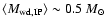 .
At the energies
60-200 keV we did not detect any hard X-ray emission of the Galaxy
apart from the contribution of a relatively small number of bright
point sources visible by IBIS/ISGRI.
.
At the energies
60-200 keV we did not detect any hard X-ray emission of the Galaxy
apart from the contribution of a relatively small number of bright
point sources visible by IBIS/ISGRI.
5.2 IGR J17456-2901
 )
within central 30 pc (at the Galactic center distance, which is approximately equal to the
INTEGRAL/IBIS angular resolution) around Sgr A*. Therefore, we
could anticipate that the spectrum of IGR J17456-2901 would be
similar to that of the true GRXE (e.g., Revnivtsev et al. 2005). This is
partially true (see Fig. 17).
)
within central 30 pc (at the Galactic center distance, which is approximately equal to the
INTEGRAL/IBIS angular resolution) around Sgr A*. Therefore, we
could anticipate that the spectrum of IGR J17456-2901 would be
similar to that of the true GRXE (e.g., Revnivtsev et al. 2005). This is
partially true (see Fig. 17).
 around Sgr A* is very
similar to that of the GRXE at least in the energy band 3-30 keV, except for the somewhat higher normalization, which would
correspond better to an integrated stellar mass 2
rather then
as we assumed. Whether this is just due to the uncertain value of the total stellar mass within 30 pc around Sgr A* (e.g., Lindqvist et al. 1992), or in fact
due to a different value of X-ray emissivity per unit stellar mass in
this area is the subject of a special detailed
study that is beyond the scope of this paper. However, as can be seen
from Fig. 17, the spectrum of IGR J17456-2901 at
energies 60-100 keV is obviously harder than that of the GRXE. Below
we outline several possible origins of the observed spectral
difference.
around Sgr A* is very
similar to that of the GRXE at least in the energy band 3-30 keV, except for the somewhat higher normalization, which would
correspond better to an integrated stellar mass 2
rather then
as we assumed. Whether this is just due to the uncertain value of the total stellar mass within 30 pc around Sgr A* (e.g., Lindqvist et al. 1992), or in fact
due to a different value of X-ray emissivity per unit stellar mass in
this area is the subject of a special detailed
study that is beyond the scope of this paper. However, as can be seen
from Fig. 17, the spectrum of IGR J17456-2901 at
energies 60-100 keV is obviously harder than that of the GRXE. Below
we outline several possible origins of the observed spectral
difference.
![\begin{figure}
\par\includegraphics[width=7.65cm,clip]{5626fig17.ps}\end{figure}](/articles/aa/full/2007/09/aa5626-06/img89.gif)
Figure 17:
The spectrum of the Galactic ridge X-ray emission
calculated for a
stellar mass (blue squares). The spectrum
of Galactic center source IGR J17456-2901 is shown by black symbols.
Measurements by INTEGRAL/IBIS are shown by filled symbols. The hard
X-ray spectrum is complemented by a spectrum of integrated emission
of the central
around Sgr A*, measured by ASCA/GIS (lower
spectrum showed by black crosses) and corrected for interstellar
absorption
 1022 cm-2 (upper spectrum showed by
black crosses).
1022 cm-2 (upper spectrum showed by
black crosses).Open with DEXTER
Confusion?
,
therefore we cannot exclude that some emission region spatially
distinct from the nuclear stellar cluster contributes to the flux
that we measure from the position of IGR J17456-2901.
 (see also Bélanger et al. 2006). At the peak of the hard X-ray emission
there are no known persistently bright compact X-ray sources
(see, e.g., Sakano et al. 2002), while high energy (GeV and TeV)
non-thermal emission has been observed, presumably originating as a result of interaction of cosmic rays with interstellar matter (Aharonian et al. 2006). If the spectrum of this non-thermal emission has a relatively flat slope (e.g.,
(see also Bélanger et al. 2006). At the peak of the hard X-ray emission
there are no known persistently bright compact X-ray sources
(see, e.g., Sakano et al. 2002), while high energy (GeV and TeV)
non-thermal emission has been observed, presumably originating as a result of interaction of cosmic rays with interstellar matter (Aharonian et al. 2006). If the spectrum of this non-thermal emission has a relatively flat slope (e.g.,
 ), then its relative
contribution in the standard X-ray energy band (<10 keV) should be
very small and should strongly rise with energy, therefore leading to
the observed difference in the spectra of IGR J17456-2901 and the
GRXE. Another example of possible confusion of different sources is a strongly photoabsorbed hard X-ray source, which is bright in hard
X-rays but practically absent in the standard X-ray band, located at
), then its relative
contribution in the standard X-ray energy band (<10 keV) should be
very small and should strongly rise with energy, therefore leading to
the observed difference in the spectra of IGR J17456-2901 and the
GRXE. Another example of possible confusion of different sources is a strongly photoabsorbed hard X-ray source, which is bright in hard
X-rays but practically absent in the standard X-ray band, located at  of Sgr A*. If, to the contrary, the hard X-ray emission
of IGR J17456-2901 does belong to the Galactic nuclear stellar
cluster, then different possible scenarios may be proposed.
Additional population of sources in the nuclear stellar
cluster?
stellar mass of
the central 30 pc with luminosities 1032 erg/s and hard
X-ray spectra could significantly contribute to the observed
difference between the spectra of the GRXE and IGR J17456-2901.
Massive white dwarfs?
of Sgr A*. If, to the contrary, the hard X-ray emission
of IGR J17456-2901 does belong to the Galactic nuclear stellar
cluster, then different possible scenarios may be proposed.
Additional population of sources in the nuclear stellar
cluster?
stellar mass of
the central 30 pc with luminosities 1032 erg/s and hard
X-ray spectra could significantly contribute to the observed
difference between the spectra of the GRXE and IGR J17456-2901.
Massive white dwarfs?
6 Conclusion
1027 erg s
 .
This value is in
good agreement (after correction for the energy band) with the unit
stellar mass X-ray emissivity of weak Galactic X-ray sources
(Sazonov et al. 2006; Revnivtsev et al. 2005). The total Galactic hard X-ray luminosity
of the GRXE is
1037 erg s-1 in the 17-60 keV
energy band.
.
This value is in
good agreement (after correction for the energy band) with the unit
stellar mass X-ray emissivity of weak Galactic X-ray sources
(Sazonov et al. 2006; Revnivtsev et al. 2005). The total Galactic hard X-ray luminosity
of the GRXE is
1037 erg s-1 in the 17-60 keV
energy band.
![\begin{figure}
\par\includegraphics[width=15.6cm,clip]{5626fig18.ps} \end{figure}](/articles/aa/full/2007/09/aa5626-06/img95.gif)
Figure 18:
Schematic luminosity spectrum of "unresolved'' emission of the Galaxy
in the energy band 3 keV-4 TeV. In the X-ray energy band the
luminosity spectrum was scaled from the GRXE unit stellar mass emissivity spectrum (Fig. 16) assuming a mass of the Galaxy of 3.9
.
For scaling the  -ray part of the spectrum we adopted a value
of the total Galactic luminosity at >100 MeV of
-ray part of the spectrum we adopted a value
of the total Galactic luminosity at >100 MeV of
 1039 erg/s (Bloemen et al. 1984). Measurements in -rays by CGRO/OSSE and CGRO/EGRET are adopted from
Kinzer et al. (1999), the measurement at TeV energies is rescaled from
Prodanovic et al. (2006); Atkins et al. (2005). The shaded region at energies
200-500 keV denotes the area where positron annihilation
radiation in the Galactic center region strongly dominates.
1039 erg/s (Bloemen et al. 1984). Measurements in -rays by CGRO/OSSE and CGRO/EGRET are adopted from
Kinzer et al. (1999), the measurement at TeV energies is rescaled from
Prodanovic et al. (2006); Atkins et al. (2005). The shaded region at energies
200-500 keV denotes the area where positron annihilation
radiation in the Galactic center region strongly dominates.Open with DEXTER
 0.5 MeV) cosmic ray electrons (see,
e.g., Sacher & Schoenfelder 1984; Harris et al. 1990; Mandrou et al. 1980; Stecker 1977), then these electrons
might be confined to an almost immediate vicinity of their birthplace
if the interstellar magnetic field is sufficiently tangled. This would
happen because electrons at these energies have very small mean free
paths in the presence of tangled interstellar magnetic field
(e.g., Zwickl & Webber 1978). If the places of origin of such electrons
somehow followed the stellar mass distribution in the Galaxy, then
the hard X-ray background, induced by such cosmic-rays would also
follow the NIR intensity distribution.
0.5 MeV) cosmic ray electrons (see,
e.g., Sacher & Schoenfelder 1984; Harris et al. 1990; Mandrou et al. 1980; Stecker 1977), then these electrons
might be confined to an almost immediate vicinity of their birthplace
if the interstellar magnetic field is sufficiently tangled. This would
happen because electrons at these energies have very small mean free
paths in the presence of tangled interstellar magnetic field
(e.g., Zwickl & Webber 1978). If the places of origin of such electrons
somehow followed the stellar mass distribution in the Galaxy, then
the hard X-ray background, induced by such cosmic-rays would also
follow the NIR intensity distribution.
 .
60-200 keV. The signal that was
previously ascribed to the Galactic background emission at these
energies was most likely due to emission of unresolved point
sources.
.
60-200 keV. The signal that was
previously ascribed to the Galactic background emission at these
energies was most likely due to emission of unresolved point
sources.
 200 keV a change of the nature of the unresolved Galactic emission to
cosmic-ray induced background should occur. To illustrate this we
present a scheme of the luminosity spectrum of unresolved emission of
the whole Galaxy in Fig. 18. One should remember
that according to our model the ratio of the -ray to X-ray
unresolved background luminosities strongly varies across the Galaxy;
therefore the presented broad-band spectrum should be considered as
only a schematic representation of the real luminosity spectrum of the
whole Galaxy.
200 keV a change of the nature of the unresolved Galactic emission to
cosmic-ray induced background should occur. To illustrate this we
present a scheme of the luminosity spectrum of unresolved emission of
the whole Galaxy in Fig. 18. One should remember
that according to our model the ratio of the -ray to X-ray
unresolved background luminosities strongly varies across the Galaxy;
therefore the presented broad-band spectrum should be considered as
only a schematic representation of the real luminosity spectrum of the
whole Galaxy.
This research was done thanks to unique capabilities of the INTEGRAL
observatory. The data used were obtained from the European and Russian
INTEGRAL Science Data Centers and from the High Energy Astrophysics
Science Archive Research Center Online Service of the NASA/Goddard
Space Flight Center. We acknowledge the use of the Legacy Archive for
Microwave Background Data Analysis (LAMBDA). Support for LAMBDA is
provided by the NASA Office of Space Science. Authors thank Hans
Ritter for useful discussion regarding WD masses in the Galaxy. The
work was supported by the President of the Russian Federation (through
the program of support of leading scientific schools, project NSH-1100.2006.2), by the Presidium of the Russian Academy of
Sciences/RAS (the program "Origin and evolution of stars and
galaxies''), by the Division of Physical Sciences of the RAS (the
program "Extended objects in the Universe''), and by the Russian
Basic Research Foundation (the project 05-02-16540).
References
Copyright ESO 2007