 line observed from stellar black holes and
AGN, the reflection component, and also the timing properties might point to
emission from cool gas in the innermost region or from the edge of the disk.
line observed from stellar black holes and
AGN, the reflection component, and also the timing properties might point to
emission from cool gas in the innermost region or from the edge of the disk.
A&A 463, 1-9 (2007)
DOI: 10.1051/0004-6361:20066203
F. Meyer1 - B. F. Liu2 - E. Meyer-Hofmeister1
1 - Max-Planck-Institut für Astrophysik, Karl-
Schwarzschildstr. 1, 85740 Garching, Germany
2 -
National Astronomical Observatories/Yunnan Observatory,
Chinese Academy of Sciences, PO Box
110, Kunming 650011, PR China
Received 7 August 2006 / Accepted 13 October 2006
Abstract
Context. Accretion onto galactic and supermassive black holes occurs in different modes, which are documented in hard and soft spectral states, commonly attributed to an advection-dominated flow (ADAF) inside a truncated disk and standard disk accretion, respectively. At the times of spectral transition an intermediate state is observed, for which the accretion flow pattern is still unclear.
Aims. We analyze the geometry of the accretion flow when the mass flow rate in the disk decreases (soft/hard transition) and evaporation of gas into the coronal flow leads to disk truncation.
Methods. We evaluate the physics of an advection-dominated flow affected by thermal conduction to a cool accretion disk underneath.
Results. We find re-condensation of gas from the ADAF into the underlying inner disk at distances from the black hole and at rates, that depend on the properties of the hot ADAF and vary with the mass accretion rate. This sustains an inner disk for longer than a viscous decay time after the spectral transition occurred, in accordance with the spectra that indicate cool gas in the neighborhood of the accreting black hole. The model allows us to understand why Cyg X-1 does not show hysteresis in the spectral state transition luminosity that is commonly observed for X-ray transient sources.
Conclusions. Our results shed new light on the complex mass flow pattern during spectral state transition.
Key words: accretion, accretion disks - black hole physics - X-rays: binaries - stars: individual: Cyg X-1
But from the large number of observations for X-ray binaries
during the last years (McClintock & Remillard 2006) it became
obvious that for many sources the spectra document a highly complex
appearance of accretion processes. Intermediate states were found,
especially in connection with the change between the hard and soft spectral
state (in both directions), or even the very high state, in both kind
of sources, neutron star and black hole transients (Psaltis
2006). Hardness-intensity diagrams, e.g. the diagram for the
outburst of GX 339-4 in 2002/2003 (Belloni et al. 2005),
show that the evolution of hardness
with count rate is different during outburst rise and decay,
indicating differences in the accretion flows via disk and ADAF.
Similar changes in hardness are visible in diagrams for XTE J1650-500 (Homan et al. 2003) and 4U 1630-47,
(Tomsick et al. 2005). The variety in diagrams for the hard/soft
change can be seen from the recent compilation of Gierlinski &
Newton (2006).
Kalemci et al. (2003) in their work on black hole X-ray transients
during outburst decay characterize the observed features as
"several global patterns of evolution for spectral and temporal
parameters before, during, and after the transition''.
In general the Fe K
line observed from stellar black holes and
AGN, the reflection component, and also the timing properties might point to
emission from cool gas in the innermost region or from the edge of the disk.
Our work concerns the pattern of accretion
flow at the time of spectral state transition. It is not yet
clear how the accretion flow changes from one mode to the other,
e.g. from disk accretion inward to the last stable orbit to a
truncated disk with a hot advection-dominated flow in the inner
region. We investigate this change starting from the picture that
gas evaporated that from the disk feeds the coronal flow. What happens
when the mass flow rate in the disk decreases (as during decline from an
outburst) and becomes lower than the evaporation rate maximum? Then
only a hot flow exists. We discuss that the disk reaching inward to
the last stable orbit breaks up where the evaporation efficiency is
maximal (at a distance of some hundred Schwarzschild radii
(
 )). Farther inside, the cool disk would still
exist. however,But not being fed by a connection to the outside disk, such a
relic inner disk would disappear in a viscous time. Apparently observed
intermediate states last longer. An inner disk can then only survive if
it is kept up by condensation of gas from the ADAF into the disk.
Since these intermediate states are poorly understood at the
present time we consider, as a first step, a new situation: can cool
gas exist underneath an ADAF? We discuss the physics for this kind
of accretion flow in an analytical model. To include more detailed
physics, an evaluation by numerical simulation has to be performed. We
cannot yet answer in detail the question of how such cool gas could be
recognized in the observed spectra.
)). Farther inside, the cool disk would still
exist. however,But not being fed by a connection to the outside disk, such a
relic inner disk would disappear in a viscous time. Apparently observed
intermediate states last longer. An inner disk can then only survive if
it is kept up by condensation of gas from the ADAF into the disk.
Since these intermediate states are poorly understood at the
present time we consider, as a first step, a new situation: can cool
gas exist underneath an ADAF? We discuss the physics for this kind
of accretion flow in an analytical model. To include more detailed
physics, an evaluation by numerical simulation has to be performed. We
cannot yet answer in detail the question of how such cool gas could be
recognized in the observed spectra.
In the past the difficulty in interpreting the spectral observations of transient low-mass X-ray binaries (LMXB) led to the question of whether the observations indicate "two independent simultaneous accretion flows'', as discussed by Smith et al. (2002) and Pottschmidt et al. (2006). But whatever the geometrical configuration is in which accretion would happen simultaneously via a hot flow and via a cool disk, at the same distance these flows would not be independent of each other. This especially concerns thermal conduction. An interaction with cold clumps embedded in the hot flow causing thermal conduction of the ADAF in the radial direction was discussed by Yuan & Zdziarski (2005).
One of the key questions in the study of the hot flow above cool gas is whether heat can be drained from the upper ADAF and be radiated away, so that matter condenses onto the cool disk. We investigate the physical properties of an ADAF affected by thermal conduction to an accretion disk below the ADAF. In particular, the energy balance of the hot flow at low height above the cool disk surface where ion and electron temperature couple is important. (For a discussion of the problem see Liu et al. 2006.)
A peculiar aspect of such evaporation and condensation processes is the wide disparity between the amount of mass contained in the ADAF and in the disk, at each moment at each distance. This is a direct consequence of widely disparate temperatures in the two media. The velocities of the inward flow, proportional to the temperature, are thus also different by orders of magnitude and, for comparable mass flow rates lead to the very different column densities in ADAF and disk. How then can such a tenuous ADAF or corona, by condensation or evaporation affect and support a much more massive disk underneath? Even as a column of the ADAF loses only a fraction of its small mass during the short time that it passes over the disk surface, the underlying disk receives the contributions of many such columns before it has moved significantly inward, and the accumulated mass received can amount to a significant fraction of its own mass content.
In Sect. 2 we discuss the diversity of the outburst light curves of X-ray transients and the observations for an intermediate spectral state. In Sect. 3 we describe the accretion flow pattern related to the soft/hard spectral change. The physics of the hot flow affected by thermal conduction is treated in Sects. 4 to 6. Using an analytical procedure we show in Sect. 7 how the energy balance in the radiating layer close to the disk surface determines whether evaporation or condensation occurs. In Sect. 8 we determine the re-condensation rate of gas from the ADAF onto an inner relic disk. The model allows us to evaluate how the condensation depends on the mass flow rate in the ADAF and the parameters involved. We draw conclusions regardingunder which circumstances condensation would lead to an inner weak disk below the ADAF, appearing in the spectrum as soft contribution. In Sect. 9 we show how our model can explain why Cyg X-1 does not have hysteresis in the transition luminosity, which is observed for all X-ray transient sources. In Sect. 10 we compare our model with observations for an intermediate state of X-ray transients, discuss the inner edge of the disk and the application to disks in AGN. Conclusions are given in Sect. 11.
A better understanding of the pattern of the accretion flow should also give insight to the observed complex timing characteristics, the occurrence and type of quasi-periodic oscillations (QPO) and the radio connections to the spectral states. Jet production corresponding to special accretion modes (Gallo & Fender 2005) also is part of the picture, arising from the accretion physics.
The observations show that generally the intermediate state phase during the hard/soft transition (in outburst rise) is shorter than that during the soft/hard transition (in outburst decay). For the former transition durations, of 3 to 11 days were found (Corbel et al. 2004; Gögüs et al. 2004; Belloni et al. 2005).
Our work focuses on the accretion flow pattern during the latter transition. Kalemci et al. (2003) analyze the evolution of spectral and temporal properties of several galactic black hole transients during outburst decay: XTE J1650-500, GRO J1655-40, XTE J1748-288, XTE J1755-324, 4U 1630-47, XTE J1550-564, XTE J1859+226 and GX 339-4 (for this source see also Revnivtsev et al. 2000) and the spectral analysis shows a decrease of the disk component until it becomes unobservable with PCA /RXTE within 15 days after the transition. Similar times were found for GRS 1758-258 (Smith et al. 2001; Pottschmidt et al. 2006). Cyg X-1 is a special case with an intermediate state lasing for weeks (Cui et al. 1997; Zdziarski et al. 2002). The results for neutron star sources show the same trend with shorter timescales (Barret & Olive 2002).
 is reached at
 .
The mass flow rate in the disk determines whether the coronal flow
is important. If it is higher than
the disk is essentially unaffected and reaches
inward to the last stable orbit, and the hot flow is unimportant (this is
the usual situation when the luminosity is high during an outburst,
see also discussion in Sect. 8.3).
If the mass flow rate in the disk is low,
the disk is truncated where the evaporation has transfered all gas to the
hot flow/ADAF (the usual situation in quiescence). According to the mass flow
rate, spectral transitions occur. Note that these two transitions occur at
different luminosities, an observational feature known as hysteresis in
X-ray transient light curves. This is theoretically understood as due
to the different hard/soft character of the irradiation from the
central region in the two cases (Meyer-Hofmeister et al. 2005; Liu et al. 2005).
.
The mass flow rate in the disk determines whether the coronal flow
is important. If it is higher than
the disk is essentially unaffected and reaches
inward to the last stable orbit, and the hot flow is unimportant (this is
the usual situation when the luminosity is high during an outburst,
see also discussion in Sect. 8.3).
If the mass flow rate in the disk is low,
the disk is truncated where the evaporation has transfered all gas to the
hot flow/ADAF (the usual situation in quiescence). According to the mass flow
rate, spectral transitions occur. Note that these two transitions occur at
different luminosities, an observational feature known as hysteresis in
X-ray transient light curves. This is theoretically understood as due
to the different hard/soft character of the irradiation from the
central region in the two cases (Meyer-Hofmeister et al. 2005; Liu et al. 2005).
![\begin{figure}
\par\includegraphics[width=7.8cm,clip]{6203fig1.eps}
\end{figure}](/articles/aa/full/2007/07/aa6203-06/img11.gif) |
Figure 1: Accretion flow in soft, intermediate and hard spectral state (with decreasing mass flow rate). Upper panel: in the soft state accretion occurs via the disk, some gas is evaporated to a coronal flow, but re-condenses onto the disk; in the inner region only the disk flow exists, which causes the soft spectrum. Middle panel: in the intermediate state the ADAF and an inner disk contribute to the spectrum. Lower panel: in the hard state only the hot ADAF contributes to the spectrum. |
| Open with DEXTER | |
When during the decrease from an outburst the mass flow rate in the
disk becomes equal to the evaporation rate maximum, the disk truncation
starts at the distance
,
and a gap appears, filled by an
ADAF, as illustrated in Fig. 1. With the further decrease of mass flow the gap should widen due to
evaporation. What happens to the left-over inner cool disk?
Diffusion causes a spread inwards and outwards, decreasing
the amount of disk matter due to accretion onto the compact object and
evaporation in outer regions. Only if matter can condense from the
ADAF onto the disk can such a disk survive longer than the viscous
time for these processes, which is only a few days in the inner disk.
If the disks still exists the spectrum can show contributions
from the ADAF and a reflection from the left-over inner cool disk.
 ratio of gas pressure
to total pressure,
ratio of gas pressure
to total pressure,  density and
  isothermal sound speed. Shearing box simulations of
turbulence driven by the magneto-rotational instability in a
collisionless plasma by Sharma et al. (2006) yield
values
around 0.8. We use this value in our analysis.
As the ratio of specific heats of
the magnetized plasma we take
isothermal sound speed. Shearing box simulations of
turbulence driven by the magneto-rotational instability in a
collisionless plasma by Sharma et al. (2006) yield
values
around 0.8. We use this value in our analysis.
As the ratio of specific heats of
the magnetized plasma we take
 (Esin
1997) though the true value would require a more detailed analysis.
(Esin
1997) though the true value would require a more detailed analysis.
For the chemical abundance a hydrogen mass fraction of 0.75 was used.
The solutions for pressure, electron number density, viscous dissipation of
energy per unit volume q+ and isothermal sound speed are
(Narayan & Yi 1995)
is the viscous coefficient,
m the black hole mass in units of
solar mass  ,
,
 the mass flow rate in units of the
Eddington accretion rate
the mass flow rate in units of the
Eddington accretion rate
 ,
and r the radius in units of the Schwarzschild radius
,
and r the radius in units of the Schwarzschild radius
 .
The ion number density is
.
The ion number density is
 .
In an ADAF, ion and electron temperatures Ti and
.
In an ADAF, ion and electron temperatures Ti and  closely follow
 |
(3) |
is much smaller than Ti this value can be taken for
Ti alone.
Besides viscous heating, q+ compressive heating
 (Esin 1997) is important.
This situation changes if there is a disk below the
ADAF. Due to the large temperature difference between the hot ADAF and
the cool disk, thermal conduction results in further cooling of the
electrons. While the ion temperature is not much affected, the electron
temperature drops with height until, near the bottom, a temperature
 is reached at which coupling between ions and electrons
becomes efficient, and from then on ion and electron temperatures are the
same,
is reached at which coupling between ions and electrons
becomes efficient, and from then on ion and electron temperatures are the
same,
 ,
as illustrated in Fig. 2.
,
as illustrated in Fig. 2.
![\begin{figure}
\par\includegraphics[width=7.4cm,clip]{6203fig2.eps}
\end{figure}](/articles/aa/full/2007/07/aa6203-06/img33.gif) |
Figure 2: The hot two-temperature ADAF together with the radiating one-temperature layer below the coupling interface. |
| Open with DEXTER | |
The electron temperature has practically no influence on the dynamics
of the flow and the thermodynamics of the ion gas and is
subrelativistic,
 (k Boltzmann constant,
  electron mass, c speed of light). The rate of energy
transfer from ions to electrons is given by Stepney (1983). Since in
the two-temperature advection-dominated hot flow the ions are at a
much higher temperature than the electrons a simplified
formula (Liu et al. 2002) can be used
electron mass, c speed of light). The rate of energy
transfer from ions to electrons is given by Stepney (1983). Since in
the two-temperature advection-dominated hot flow the ions are at a
much higher temperature than the electrons a simplified
formula (Liu et al. 2002) can be used
 .
This then
determines the coupling temperature
.
This then
determines the coupling temperature
 .
Since the
coupling occurs at low height the density there is higher than
the height averaged value (Eq. (2)), by a factor
.
Since the
coupling occurs at low height the density there is higher than
the height averaged value (Eq. (2)), by a factor
 (vertical density distribution
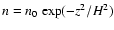 ). This yields the coupling temperature as
 and
and
 (see
Sect. 8.1).
(see
Sect. 8.1).
In the case considered here, conductive cooling limits the peak electron
temperature in the ADAF to a value Tm somewhat lower than the limit
where radiation losses balance collisional heating. The
synchrotron radiation is optically thick, which makes the synchrotron
radiation losses drop steeply with temperature (Narayan & Yi 1995;
Mahadevan 1997). As bremsstrahlung also decreases with
temperature we may neglect to a first approximation the radiation losses
and calculate the resulting thermal electron profile from the balance
between thermal conduction and collisional heating alone,
 we take the standard value (for the effect of on the coronal structure see Meyer & Meyer-Hofmeister 2006).
Formally multiplying the left sides and the right sides of these two
equations by each other and multiplying by dz reduces this to a
first order differential equation for
we take the standard value (for the effect of on the coronal structure see Meyer & Meyer-Hofmeister 2006).
Formally multiplying the left sides and the right sides of these two
equations by each other and multiplying by dz reduces this to a
first order differential equation for
 with the solution
 .
The integration constant Tm is the maximal electron temperature
reached with height. Note that the downward directed heat flow
has a negative value. Integration of
.
The integration constant Tm is the maximal electron temperature
reached with height. Note that the downward directed heat flow
has a negative value. Integration of
 (Eq. (6))
using Eq. (8) yields the electron temperature profile
in the ADAF,
(Eq. (6))
using Eq. (8) yields the electron temperature profile
in the ADAF,
 where
has dropped
to the coupling temperature
,
in Eq. (9)
we may neglect
where
has dropped
to the coupling temperature
,
in Eq. (9)
we may neglect
 compared to
  ,
and with
,
and with
 small compared to one, the integral
may be extended from zero to one to give 0.719. Equation (9) then
yields the maximal electron temperature in the ADAF,
one may take the vertical
scale height for
small compared to one, the integral
may be extended from zero to one to give 0.719. Equation (9) then
yields the maximal electron temperature in the ADAF,
one may take the vertical
scale height for
 which is
 of the density
scale height
of the density
scale height
 (
(
 Kepler angular velocity) of Narayan et al. (1998),
 from Eq. (10).
Equation (8), neglecting
from Eq. (10).
Equation (8), neglecting
 compared to
 ,
finally yields the thermal flux drained from the ADAF that enters
the coupling interface at
from above,
,
finally yields the thermal flux drained from the ADAF that enters
the coupling interface at
from above,
into the radiating
layer from the ADAF above. This is the borderline case
considered by Liu et al. (2006). However if mass condenses
from the ADAF onto the disk it carries the high thermal
heat content of the ADAF ions to the interface. Energy
conservation across the interface yields
 arises when we include magnetic work and
internal energy advection together with the corresponding gas terms
in the simplified ADAF parameterization of the magnetic field.
Here
arises when we include magnetic work and
internal energy advection together with the corresponding gas terms
in the simplified ADAF parameterization of the magnetic field.
Here
 is the heat flow leaving the interface on the
lower side,
is the heat flow leaving the interface on the
lower side,  is the gas constant, T is the common temperature
of ions and electrons on that side, and
is the gas constant, T is the common temperature
of ions and electrons on that side, and  is the mass flow
rate of the condensing gas per unit area. (It has the dimension of
is the mass flow
rate of the condensing gas per unit area. (It has the dimension of
 and should not be confused
with the non-dimensional ADAF mass accretion rate
and
similar quantities defined later.) In condensation flow it has a
negative value. The heat flow
entering the
radiating layer below the ADAF from above is thus increased over
and should not be confused
with the non-dimensional ADAF mass accretion rate
and
similar quantities defined later.) In condensation flow it has a
negative value. The heat flow
entering the
radiating layer below the ADAF from above is thus increased over
 ,
). It depends on the ADAF
parameters. The ratio
,
). It depends on the ADAF
parameters. The ratio
(In the case of evaporation (
 )
the situation
at the boundary between the radiating layer and the ADAF is
different. While for a descending flow, collisional coupling
immediately heats the electrons and adds to their thermal
flux, in an ascending flow, on passing through the boundary,
the ions becoming uncoupled must first be heated up by friction
to the ADAF temperature before they are fully incorporated
in the ADAF. Here we consider only the condensation case.)
)
the situation
at the boundary between the radiating layer and the ADAF is
different. While for a descending flow, collisional coupling
immediately heats the electrons and adds to their thermal
flux, in an ascending flow, on passing through the boundary,
the ions becoming uncoupled must first be heated up by friction
to the ADAF temperature before they are fully incorporated
in the ADAF. Here we consider only the condensation case.)
![\begin{figure}
\par\includegraphics[width=5.6cm,clip]{6203fig3.eps}
\end{figure}](/articles/aa/full/2007/07/aa6203-06/img80.gif) |
Figure 3:
Changes of ion temperature, electron temperature and density at the distance of 80 Schwarzschild radii and for a mass flow rate of
in the ADAF. The vertical height z is measured in units of the vertical scale height for
.
|
| Open with DEXTER | |
Case (1): if the pressure is high, the density in the lower layer also is high. Then the conductive flux drained from the ADAF is already efficiently radiated away at some height before the disk surface is reached. Radiative cooling however continues and must be served by additional heat released from gas descending through the temperature profile to the disk surface, i.e. matter condenses from the ADAF onto the disk.
Case (2): if the pressure is low, only part of the conductive flux can be radiated away; the remaining part is taken up by cool disk matter heating up as it rises through the temperature profile, i.e. matter evaporates from the disk into the corona.
A borderline case in between, case (3), occurs if the ADAF pressure allows the thermal heat flux drained from the ADAF to be radiated away exactly on reaching the disk surface. Then there is neither condensation nor evaporation, i.e. no mass is exchanged between disk and ADAF.
 ,
,
 .
This value is taken at the bottom of the ADAF
region, and, as for the density, is slightly higher than the
vertical mean pressure (Eq. (2)). Assuming free-free
radiation for
.
This value is taken at the bottom of the ADAF
region, and, as for the density, is slightly higher than the
vertical mean pressure (Eq. (2)). Assuming free-free
radiation for
 ,
becomes
,
becomes
 with
with
 (Sutherland & Dopita
1993).
For simplicity we use this law also for smaller T. The
justification is that because of the very steep temperature profile
below 107.5 K such regions contribute only a negligible amount to
cooling of this layer (Liu et al. 1995).
Contributions of gravitational energy release, frictional heating, and
side-wise advection of mass and energy can be neglected for a small
extent of this layer. Likewise, kinetic energy is negligible since at
high density the flow is highly subsonic.
(Sutherland & Dopita
1993).
For simplicity we use this law also for smaller T. The
justification is that because of the very steep temperature profile
below 107.5 K such regions contribute only a negligible amount to
cooling of this layer (Liu et al. 1995).
Contributions of gravitational energy release, frictional heating, and
side-wise advection of mass and energy can be neglected for a small
extent of this layer. Likewise, kinetic energy is negligible since at
high density the flow is highly subsonic.
To solve the second-order differential equation Eq. (17),
we use T as the independent variable and define a new
dependent variable
 .
We now obtain the
first-order differential equation
.
We now obtain the
first-order differential equation
This equation has to be solved with the upper and lower boundary
conditions
 at
at
 and
and
 at T=0. In reality, the temperature does not drop
to zero at the disk surface but the solution is practically independent
of the exact values at the lower boundary (except for a very
narrow range in z at the bottom) as long as flux and
temperature there become small compared to those at the
upper boundary, with no consequence for our results.
is the
Eigenvalue to be determined.
at T=0. In reality, the temperature does not drop
to zero at the disk surface but the solution is practically independent
of the exact values at the lower boundary (except for a very
narrow range in z at the bottom) as long as flux and
temperature there become small compared to those at the
upper boundary, with no consequence for our results.
is the
Eigenvalue to be determined.
The only solution that fulfills the lower boundary condition is the
singular solution
 ,
i.e. a linear relation between
,
i.e. a linear relation between
 and T. The ratio of these two quantities at the upper
boundary determines the value of g1. This requires
and T. The ratio of these two quantities at the upper
boundary determines the value of g1. This requires
,
is positive and the heat flow
is used up to heat the evaporating gas to the (un-)coupling
boundary temperature
.
If, on the other hand,
C>1, the gas in this layer is efficiently cooled, sinks
down and condenses.
,
,
and r, but not on m. This shows that
the same situation holds for supermassive and
stellar black holes alike. Also note a significant dependence
on ,
C scales almost with  (Eq. (21)).
For
(Eq. (21)).
For  we get
 at which C=1 marks the transition
between outside evaporation and inside condensation of
an inner disk below the ADAF,
(corresponding to
at which C=1 marks the transition
between outside evaporation and inside condensation of
an inner disk below the ADAF,
(corresponding to
 in
Shakura-Sunyaev notation) but note the extremely
strong dependence of
in
Shakura-Sunyaev notation) but note the extremely
strong dependence of  on the choice of this parameter.
Since
incorporates several underlying physical
processes of unresolved detail its exact
value is not known. Various values of the above order of
magnitude are quoted in the literature (see Narayan et al.1998).
The re-condensation process discussed here occurs in
connection with spectral state transitions for which
Maccarone (2003) found
from a detailed
investigation of these transitions in X-ray binaries. For these
values C becomes 1 at a distance of about 80 Schwarzschild
radii, an order of magnitude discussed for inner disks
in intermediate states (Ibragimov et al. 2005). The dependence
of C on mass flow rate and distance obtained allows us to derive
conditions for the existence of an inner disk below the ADAF.
on the choice of this parameter.
Since
incorporates several underlying physical
processes of unresolved detail its exact
value is not known. Various values of the above order of
magnitude are quoted in the literature (see Narayan et al.1998).
The re-condensation process discussed here occurs in
connection with spectral state transitions for which
Maccarone (2003) found
from a detailed
investigation of these transitions in X-ray binaries. For these
values C becomes 1 at a distance of about 80 Schwarzschild
radii, an order of magnitude discussed for inner disks
in intermediate states (Ibragimov et al. 2005). The dependence
of C on mass flow rate and distance obtained allows us to derive
conditions for the existence of an inner disk below the ADAF.
 where
condensation begins down to an inner cut-off radius
where
condensation begins down to an inner cut-off radius
 ,
e.g. the radius of the innermost stable orbit around a non-rotating
black hole,
,
e.g. the radius of the innermost stable orbit around a non-rotating
black hole,
 .
As discussed later, the inner
edge may well lie at some larger distance. Like the ADAF accretion
rate, the total condensation rate will be measured in Eddington
accretion rate. (In our definition condensation rates have a negative
sign.) Using Eq. (20), (for
.
As discussed later, the inner
edge may well lie at some larger distance. Like the ADAF accretion
rate, the total condensation rate will be measured in Eddington
accretion rate. (In our definition condensation rates have a negative
sign.) Using Eq. (20), (for
 ) the total rate
of condensation onto both sides of the disk becomes
) the total rate
of condensation onto both sides of the disk becomes
 gives the
contribution of logarithmic intervals in r. Its distribution
is shown in Fig. 4 for various values
of .
The ordinate is the integrand relative to
the ADAF mass flow rate .
The area underneath
each graph gives the relevant total condensation rate.
gives the
contribution of logarithmic intervals in r. Its distribution
is shown in Fig. 4 for various values
of .
The ordinate is the integrand relative to
the ADAF mass flow rate .
The area underneath
each graph gives the relevant total condensation rate.
![\begin{figure}
\par\includegraphics[width=5.5cm,clip]{6203fig4.eps}
\end{figure}](/articles/aa/full/2007/07/aa6203-06/img117.gif) |
Figure 4:
Re-condensation of gas from the ADAF onto
an inner disk as function of the distance r (in units of  )
for various mass flow rates in the ADAF (in units of )
for various mass flow rates in the ADAF (in units of
 ). The curves
display the spatial distribution of contributions of
logarithmic intervals in r as areas below the
curve. The ordinate is re-condensation rate relative to
the mass flow rate in the ADAF. Re-condensation occurs
at a larger distances for higher .
Below ). The curves
display the spatial distribution of contributions of
logarithmic intervals in r as areas below the
curve. The ordinate is re-condensation rate relative to
the mass flow rate in the ADAF. Re-condensation occurs
at a larger distances for higher .
Below
 the
curves are dotted.
the
curves are dotted. |
| Open with DEXTER | |
Introducing
 instead of r in Eq. (26) and
making use of Eqs. (24), (25), and (28) one can
evaluate the integral and obtain the total re-condensation rate as
instead of r in Eq. (26) and
making use of Eqs. (24), (25), and (28) one can
evaluate the integral and obtain the total re-condensation rate as
 that is large compared to the inner cut-off
radius
that is large compared to the inner cut-off
radius  .
As the ADAF mass flow rate decreases
moves inward, f and the re-condensation rate,
i.e. the mass flow rate in the inner disk
decrease until at a certain lower ADAF mass flow rate the outer disk edge
reaches
where
f becomes 0 and the disk size has shrunk to zero. For even
lower mass flow rates there is no
re-condensation and the inner disk disappears. This intriguing
behavior appears able to explain why Cyg X-1 does not
show the hysteresis between hard/soft and soft/hard spectral
state transitions that all transient X-ray sources display.
We discuss this in the next section.
.
As the ADAF mass flow rate decreases
moves inward, f and the re-condensation rate,
i.e. the mass flow rate in the inner disk
decrease until at a certain lower ADAF mass flow rate the outer disk edge
reaches
where
f becomes 0 and the disk size has shrunk to zero. For even
lower mass flow rates there is no
re-condensation and the inner disk disappears. This intriguing
behavior appears able to explain why Cyg X-1 does not
show the hysteresis between hard/soft and soft/hard spectral
state transitions that all transient X-ray sources display.
We discuss this in the next section.
The model results depend on the parameters used to describe the
ADAF. The dependence on the parameters
and
is particularly strong for the re-condensation rate
(Eq. (29)) and the radius at which re-condensation
begins, i.e. the outer radius of an inner disk below the ADAF
(Eq. (25)). In the example given above both values
are rather small. However, a small decrease of
and
a slight increase of
can bring these values to 100%
re-condensation with re-condensation beginning already at 1000 Schwarzschild radii (this is an extrapolation as our integral
Eq. (26) neglects changes of
by re-condensation).
This is relevant for standard disk evaporation models (e.g. Meyer et al. 2000). They predict that at distances of a few hundred to a thousand Schwarzschild radii there is a significant mass flow rate in an accretion disk corona, of a few percent of the Eddington value. If the mass accretion rate drops below that value, all the mass evaporates into the corona and from there on flows inward as a pure coronal flow, i.e. an ADAF. This yields a standard model for spectral state transitions. If the mass flow rate in the disk exceeds that critical value the disk is not truncated and continues to the last stable orbit. This accretion mode gives the characteristic soft state spectrum of a multi-temperature black body. But even in this case the rather strong coronal flow at the distances of a few hundred Schwarzschild radii must exist. Why does it not flow on as a 2-temperature ADAF above the disks and shows as a significant hard contribution to the soft state spectra? The answer from our intermediate state analysis is that re-condensation becomes complete for mass accretion rates as high as the coronal evaporation rate at a few hundred Schwarzschild radii. This explanation connects the processes of disk truncation and re-condensation. The upper part of Fig. 1 illustrates the situation.
Cyg X-1 shows only moderate changes in the mass accretion rate, attributed to the fact that it is a wind accretor. This is very different from transient X-ray sources where the accretion rate increases and decreases 100 fold during an outburst. Cyg X-1 stays in the hard state most of the time, but several spectral transitions to the soft state were observed. Because of the narrow range in mass accretion rate the hard state of Cyg X-1 is still intermediate in nature as the observations of Ibragimov et al. (2005) show.
Also by another fact Cyg X-1 differs from the transient sources. There is no noticeable hysteresis in Cyg X-1 (Zdziarski et al. 2002; Zdziarski & Gierlinski 2005). This was pointed out as a problem also by Lachowicz & Czerny (2005). Lightcurves of transient sources show a clear hysteresis in the transition luminosities (the soft/hard transition occurs at luminosities lower by a factor of 3 to 5 than the hard/soft transition, e.g. in Aql X-1 (Maccarone & Coppi 2003), GX 339-4 (Miyamoto et al. 1995; Nowak et al. 2002; Zdziarski et al. 2004), XTE J1650-500 (Rossi et al. 2003), XTE J1500-564 (Rodrigues et al. 2003). The different luminosities at spectral transition can be understood as due to different maximal evaporation rates in the two states (triggering the transition) for either hard or soft irradiation of the corona by the central source (Meyer-Hofmeister et al. 2005).
The new feature discussed in our work here, an inner re-condensation disk, offers a solution for the mystery of why Cyg X-1 has no hysteresis while all the transients have it.
In transient sources the re-condensation disk recedes inward and finally disappears completely as the mass accretion rate continues to fall, as is the case in the decline from outburst into quiescence. Then, no inner disk remains on which re-condensation could occur when the system moves into the next outburst. The spectrum remains hard at increasing luminosity. Only when the accretion rate reaches the higher critical value for which the transition under hard irradiation occurs does it become soft.
Cyg X is different. When that system changes from a soft state excursion back to its usual hard state it does so with only a modest decrease of the mass accretion rate and never falls into deep quiescence. This allows an inner re-condensation disk to survive as the observations indicate. When now another episode of transition to a soft state occurs the mass accretion rate rises, re-condensation increases, the inner disk expands and carries an increasing disk mass flow until it smoothly merges with the outer disk to form the standard soft accretion state. Together with re-condensation the irradiation is completely reversible and no hysteresis occurs. This explanation relates the special character of the wind accretor to the otherwise enigmatic feature of "no hysteresis'' in a natural way and seems a strong support for the re-condensation model.
When the mass accretion rate gradually decreases further as a source declines from outburst the re-condensation rate onto the receding inner disk declines, a significant part of the accretion flow stays in the ADAF and shows characteristics of the hard state but modified by the existence of cool material in the form of a weakly accreting inner disk. From our analysis we find that the intermediate states during the outburst decline last longer for a slow decrease of the mass flow rate and less time for a fast decrease.
Observations for transient black hole X-ray sources show those features. During the slow luminosity decline after the 1999 outburst of XTE J1859+226 (Corbel et al. 2004, Fig. 9) the spectrum was classified as due to an intermediate state. The steep luminosity decline of GX 339-4 in 2003 (Remillard 2005, Fig. 3) is related to the very short intermediate state.
Short intermediate states of a few days
might be caused by an inner disk disappearing in its viscous
time. Similar to these short states is the situation
during rise to outburst, where the inner edge of the disk moves inward
within a viscous time, only an ADAF inside. If the mass flow rate in
the disk is always well below the maximal evaporation rate the disk is
truncated all the time, and no thermal conduction affects the ADAF.
XTE J1118+480 is a well studied source which stays in the hard state
even during outburst. We would expect a disk truncation
at several hundred .
But Esin et al. (2001) from
multiwavelength observations concluded that the disk truncation lies at about
55
in outburst. How can this be understood? The highest mass flow
rate during outburst was found to be about 0.02
,
the value
generally accepted for state transition (Maccarone 2003). This means
that
the mass flow rate could have surpassed the critical rate for a short
while and the outer disk began to extend inward. Re-condensation
immediately would begin. This re-condensation can then continue
even as the accretion rate drops below the critical rate, leading to
an intermediate state.
 (e.g. Esin et al. 1997; Narayan et al. 1997;
Narayan 2005). For X-ray binaries with higher mass accretion rates
in phases of rise to an outburst or decay, from a
multicolor disk model smaller values for the inner
disk radius were deduced (compare Sobczak et al. 2000; see examples in the
review of McClintock & Remillard 2006). In a recent detailed
investigation of the spectrum of Cyg X-1 Ibragimov et al. (2005) found
truncation radii around 50-100 .
Note that the mass flow rate
was not much below the transition rate, i.e. a typical intermediate
state.
(e.g. Esin et al. 1997; Narayan et al. 1997;
Narayan 2005). For X-ray binaries with higher mass accretion rates
in phases of rise to an outburst or decay, from a
multicolor disk model smaller values for the inner
disk radius were deduced (compare Sobczak et al. 2000; see examples in the
review of McClintock & Remillard 2006). In a recent detailed
investigation of the spectrum of Cyg X-1 Ibragimov et al. (2005) found
truncation radii around 50-100 .
Note that the mass flow rate
was not much below the transition rate, i.e. a typical intermediate
state.
Comparing with the predictions of the standard evaporation model we find good agreement for the low luminosity sources. The model also is consistent with no disk truncation for high mass flow rates.
For the intermediate state of Cyg X-1, Ibragimov
et al. (2005) analyzed spectral observations
in terms of Compton reflection, the index of the hard
power law spectrum, the width of the Fe K
line,
and an additional soft excess of a few keV of unknown origin.
With the correlation between photon index and amplitude of
reflection they inferred disk cut-off distances of 50-100 ,
varying with the accretion rate.
Esin et al. (2001) inferred a similar truncation at 55
for
XTE J1118+480 in an apparently similar hard (-intermediate)
state (see the discussion in the preceding subsection).
On the other hand, Miller et al. (2006a) argue for an untruncated disk extending to the last stable orbit during the low-hard state of the 2004 outburst of GX 339-4, at a luminosity of 5% of the Eddington value. From a preliminary analysis of data from SWIFT J17335-0127 in the low-hard state of its 2005 outburst, Miller et al. (2006b) see indication for a similarly untruncated disk, here at a luminosity of one third of a per cent of the Eddington value. (Note that in optical thin emission the accretion luminosity can be lower than the corresponding accretion rate, both measured in their Eddington units.) This would suggest an untruncated re-condensation disk in these systems. The situation deserves further clarification.
The re-condensation model discussed here leaves open the
question of if and where a remaining inner disk may itself be
truncated.
Neglected terms in the analysis, different assumptions about
 ,
and a more detailed calculation all can affect the
outcome of the re-condensation rate estimates. One also
cannot exclude that a parameter used to describe the ADAF
varies with distance. The ratio of magnetic pressure to gas
pressure, for example, could increase at smaller radii as
accretion carries magnetic flux inwards. This decreases
and C (Eq. (21)). If C falls below one
(Eq. (23)), condensation turns into evaporation
and the disk can become truncated before the final last stable
orbit is reached. The effect of disk magnetic fields on evaporation in
the standard model is discussed in Meyer & Meyer-Hofmeister (2002).
,
and a more detailed calculation all can affect the
outcome of the re-condensation rate estimates. One also
cannot exclude that a parameter used to describe the ADAF
varies with distance. The ratio of magnetic pressure to gas
pressure, for example, could increase at smaller radii as
accretion carries magnetic flux inwards. This decreases
and C (Eq. (21)). If C falls below one
(Eq. (23)), condensation turns into evaporation
and the disk can become truncated before the final last stable
orbit is reached. The effect of disk magnetic fields on evaporation in
the standard model is discussed in Meyer & Meyer-Hofmeister (2002).
The solutions discussed in this paper are independent of the mass mof the black hole. Thus they should be applicable also to accretion on
supermassive black holes in AGN. Recently Jester (2005) studied
the distribution of AGN bolometric luminosities and black hole masses
for objects from the SDSS spectroscopic quasar survey to test the existence
of two different accretion modes (as predicted theoretically, Narayan et
al. 1998) and found a change of mode at an Eddington-scaled accretion
rate of about 0.01. Markowitz & Uttley (2005), comparing power
density functions pointed out the analogy of low luminosity AGN to
low/hard state black hole X-ray binaries. This suggests that some of
the AGN accretors should be found in an intermediate state like their
galactic stellar mass counterparts. To actually observe a transition
through the different accretion states might be difficult as dynamical
and viscous timescales scale with the mass of the black hole.
Yuan et al. (2004) compared ROSAT and XMM Newton observations of 386
sources and found in one of them, the Seyfert-LINER galaxy NGC 7589,
an increase in X-ray flux by a factor of >10 over a time of 5
years, a timescale of the order of the diffusion time at a
distance of a few hundred Schwarzschild radii from a
 black hole. As the XMM high state luminosity was estimated to be a
few percent of the Eddington value the authors suggest that the system
might have been found during a spectral transition.
black hole. As the XMM high state luminosity was estimated to be a
few percent of the Eddington value the authors suggest that the system
might have been found during a spectral transition.
We have presented a simple analytical model for re-condensation of gas from an ADAF onto a disk below under the action of thermal conduction and radiation. The model is able to explain how cool gas can exist in the close neighborhood of an accreting black hole, after a standard accretion disk has become truncated and an ADAF has formed, a situation that occurs when the mass flow rate decreases during the transition from soft to hard spectral state of galactic black hole X-ray binaries. A fairly complete re-condensation of the ADAF into the disk would extend an inner thin disk accretion with its soft spectral state to lower mass accretion rates, and suggests a hysteresis effect independent of and in addition to the irradiation effect discussed earlier. The model also clarifies why in soft state the considerable coronal flow at distances of several hundred Schwarzschild radii predicted theoretically does not continue as a hot 2-temperature flow to the interior. Such a flow would appear as a hard contribution in the spectrum that is not observed. The model receives considerable support from being able to resolve the mystery of why Cyg X-1 does not show hysteresis between the luminosity at soft/hard and hard/soft spectral transition that all X-ray transient sources display.
This simple model deserves further, more detailed investigation.
Acknowledgements
We thank Marat Gilfanov for helpful discussions. B. F. Liu acknowledges support by the National Natural Science Foundation of China (NSF-10533050) and the BaiRenJiHua program of the Chinese Academy of Sciences.


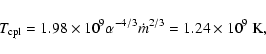


![\begin{displaymath}
F_{\rm {cpl}}=F_{\rm {c}}^{\rm {ADAF}}\left[1-\frac{\dot m_z}{\dot
m_z^*}\right]
\end{displaymath}](/articles/aa/full/2007/07/aa6203-06/img76.gif)


![\begin{displaymath}
\frac{\rm d}{{\rm d}z} \left[\dot m_z \frac{\gamma}{\gamma-1...
...c{\Re T}{\mu} +
F_{\rm c} \right] = -n_{\rm e} n_i \Lambda(T).
\end{displaymath}](/articles/aa/full/2007/07/aa6203-06/img82.gif)


![\begin{displaymath}
\dot m_z = \frac{\gamma-1}{\gamma}
\frac{-F_{\rm {c}}^{\rm {...
...\left[1- C \frac{1}{1-(\frac{\dot m_z}{\dot m_z^*})^2} \right]
\end{displaymath}](/articles/aa/full/2007/07/aa6203-06/img96.gif)


![\begin{displaymath}
\frac{\dot m_z}{\dot m_z^*}=1-
\frac{\epsilon}{2}-\sqrt{\frac{\epsilon2}{4} +(1-\epsilon)C}].
\end{displaymath}](/articles/aa/full/2007/07/aa6203-06/img99.gif)


