![[*]](/icons/foot_motif.gif)
A&A 463, 175-186 (2007)
DOI: 10.1051/0004-6361:20065731
S. Vig - S. K. Ghosh - D. K. Ojha - R. P. Verma
Tata Institute of Fundamental Research, Mumbai 400 005, India
Received 31 May 2006 / Accepted 26 September 2006
Abstract
Aims. Our goal was to carry out an infrared study of the southern Galactic massive star-forming region associated with IRAS 14416-5937.
Methods. This star-forming region has been mapped simultaneously in two far infrared bands at  150 and 210
  m, using the TIFR 1-m balloon borne telescope with 1' angular resolution. We have used 2MASS
 ,
as well as Spitzer-GLIMPSE data of this region to study the stellar populations of the embedded young cluster. This region comprises two sources, designated as A and B and separated by 2 pc. The spectrum of a region located close to the source A obtained using the Long Wavelength Spectrometer (LWS) on board the Infrared Space Observatory (ISO) is presented. Emission from warm dust and from Unidentified Infrared Bands (UIBs) is estimated using the mid-infrared data of the MSX survey.
,
as well as Spitzer-GLIMPSE data of this region to study the stellar populations of the embedded young cluster. This region comprises two sources, designated as A and B and separated by 2 pc. The spectrum of a region located close to the source A obtained using the Long Wavelength Spectrometer (LWS) on board the Infrared Space Observatory (ISO) is presented. Emission from warm dust and from Unidentified Infrared Bands (UIBs) is estimated using the mid-infrared data of the MSX survey.
Results. The spatial distributions of (1) the temperature of cool dust and (2) optical depth at 200 m have been obtained taking advantage of the similar beams in both the TIFR bands. A number of atomic fine structure lines have been detected in the ISO-LWS spectrum, which have been used to estimate the electron density and the effective temperature of the ionising radiation in this region. From the near- and mid-infrared images, we identify a dust lane due north-west of source A. The dust lane is populated by Class I type sources. Class II type sources are found further along the dust lane as well as below it. Self consistent radiative transfer models of the two sources (A and B) are in good agreement with the observed spectral energy distributions.
Conclusions. The spatial distribution of young stellar objects in and around the dust lane suggests that active star formation is taking place along the dust lane and is possibly triggered by the expanding HII regions of A and B.
Key words: infrared: ISM - ISM: H II regions - ISM: individual objects: IRAS 14416-5937 - stars: pre-main sequence
The southern Galactic high mass star-forming region associated with IRAS 14416-5937 is located at a distance of 2.8 kpc (Busfield et al.
2006). It corresponds to the radio source G316.8-0.1. A number
of masers and molecular
lines have been detected close to this star-forming region. Both OH (Caswell
& Haynes 1987) and H2O (Caswell et al. 1989) masers have
been observed here. A methanol (CH3OH) maser (Caswell et al. 1995)
showing variability has also been detected here.
NH3 (Vilas-Boas et al. 2000), CI (Huang et al. 1999), CO (Whiteoak et al. 1982; White & Phillips 1983), CS (Bronfman
et al. 1996; Juvela 1996), and H2CO (Gardner & Whiteoak
1984) lines have been detected in this star-forming region. Walsh et al.
(1998) present high angular resolution (1.5'') radio continuum
and methanol maser data at 6.67 GHz for this source as a part of their survey.
Given the location of IRAS 14416-5937 in the extreme southern sky, no detailed
study of this region exists in the literature. In this Paper, we have carried
out a systematic study of the star-forming region associated with IRAS 14416-5937.
IRAS 14416-5937 has been studied in the infrared wavebands with the aim of investigating the emission from dust, the dust temperature, the energetics, and the stellar populations of the associated cluster in this region. In Sect. 2, we present the far infrared observations and a description of other available data used in this Paper. Section 3 describes the results, and Sect. 4 deals with the radiative transfer modelling carried out. In Sect. 5, we discuss all the results, and a brief summary is presented in Sect. 6.
 north, longitude
 east) on Feb. 20, 1994.
Details of the telescope and the observational procedure are given by Ghosh et al. (1988). The two FIR bands use a pair of
east) on Feb. 20, 1994.
Details of the telescope and the observational procedure are given by Ghosh et al. (1988). The two FIR bands use a pair of
 composite
silicon bolometer arrays, cooled to 0.3 K by liquid 3He, which view
identical parts of the sky simultaneously. The field of view corresponding to
each detector is 1.6'. The sky is chopped along the cross-elevation axis at 10 Hz with a throw of 4.2'.
The bandpasses of the two bands are defined by sets of cool filters.
The spectral response was measured with a Michelson interferometer using a
Golay cell as a comparison detector. The effective wavelengths of the two FIR bands are 150 and 210 m, respectively. These effective wavelengths
correspond to a source spectrum of a 30 K
gray body with an emissivity dependence of
composite
silicon bolometer arrays, cooled to 0.3 K by liquid 3He, which view
identical parts of the sky simultaneously. The field of view corresponding to
each detector is 1.6'. The sky is chopped along the cross-elevation axis at 10 Hz with a throw of 4.2'.
The bandpasses of the two bands are defined by sets of cool filters.
The spectral response was measured with a Michelson interferometer using a
Golay cell as a comparison detector. The effective wavelengths of the two FIR bands are 150 and 210 m, respectively. These effective wavelengths
correspond to a source spectrum of a 30 K
gray body with an emissivity dependence of
 .
The absolute positions were calibrated using the
observations of catalogued stars with the optical photometer located at the
focal plane of the telescope. The field of view of this optical photometer is
offset with respect to the infrared field.
The planet Jupiter was observed for absolute flux calibration as well as
for the determination of the instrumental Point Spread Function (PSF).
.
The absolute positions were calibrated using the
observations of catalogued stars with the optical photometer located at the
focal plane of the telescope. The field of view of this optical photometer is
offset with respect to the infrared field.
The planet Jupiter was observed for absolute flux calibration as well as
for the determination of the instrumental Point Spread Function (PSF).
The simultaneous mapping in the two FIR bands was carried out by
raster-scanning the telescope along the cross-elevation axis across the
target area under study and stepping along the elevation at both
the ends of the scans. A
 region
centred around IRAS 14416-5937 was mapped.
The FIR signals were gridded
into a two-dimensional (elevation
region
centred around IRAS 14416-5937 was mapped.
The FIR signals were gridded
into a two-dimensional (elevation  cross-elevation) matrix with a
pixel size of
cross-elevation) matrix with a
pixel size of
 .
The observed chopped signal
matrix was deconvolved using the Maximum Entropy Method similar
to that of Gull & Daniell (1978; see Ghosh et al. 1988, for
details). An angular resolution of
.
The observed chopped signal
matrix was deconvolved using the Maximum Entropy Method similar
to that of Gull & Daniell (1978; see Ghosh et al. 1988, for
details). An angular resolution of
 has been achieved in the FIR maps using this method. The estimated error on absolute flux densities
for the TIFR bands is 10%, primarily from the calibration uncertainties
using the planet.
has been achieved in the FIR maps using this method. The estimated error on absolute flux densities
for the TIFR bands is 10%, primarily from the calibration uncertainties
using the planet.
The Infrared Astronomical Satellite (IRAS) survey data at all the four
wavelength bands (12, 25, 60, 100 m) for the region around IRAS 14416-5937 were HIRES-processed
at the Infrared Processing and Analysis Center (IPAC), Caltech.
HIRES processing employs the Maximum Correlation Method (MCM, Aumann
et al. 1990) to construct (resolution enhanced) co-added images.
These maps have been used in the present study to quantify the flux
densities and angular sizes at the four infrared bands. They have also been
used to generate the temperature and optical depth maps of interstellar dust.
An upper limit on error in flux density in each band has been estimated
by integrating several circular regions (3' diameter) with no point-like
source, in the local neighbourhood of the respective maps.
The Midcourse Space Experiment (MSX) was a satellite experiment that surveyed
the entire Galactic plane within |b
 in four mid-infrared
wavebands: 8.3, 12.1, 14.7, and 21.3 m with a spatial resolution of
in four mid-infrared
wavebands: 8.3, 12.1, 14.7, and 21.3 m with a spatial resolution of
 (in all four bands) during 1996-1997 (Price et al. 2001). The infrared instrument on MSX, designated SPIRIT III, was a 35 cm clear aperture off-axis telescope with focal plane arrays.
In the present study, we have used the panoramic
images of the region around IRAS 14416-5937 to extract sources and obtain the
integrated flux densities for constructing the spectral energy distribution
(SED) of IRAS 14416-5937. Upper limits to errors on flux densities
have been estimated using a procedure similar to that for IRAS-HIRES (see
Sect. 2.2.1).
(in all four bands) during 1996-1997 (Price et al. 2001). The infrared instrument on MSX, designated SPIRIT III, was a 35 cm clear aperture off-axis telescope with focal plane arrays.
In the present study, we have used the panoramic
images of the region around IRAS 14416-5937 to extract sources and obtain the
integrated flux densities for constructing the spectral energy distribution
(SED) of IRAS 14416-5937. Upper limits to errors on flux densities
have been estimated using a procedure similar to that for IRAS-HIRES (see
Sect. 2.2.1).
The Two Micron All Sky Survey (2MASS) used two highly-automated 1.3-m
telescopes, one at Mt. Hopkins, Arizona (USA), and one at Cerro Tololo
Inter-American Observatory (CTIO), Chile, to uniformly
scan the entire sky in three near-infrared bands: J (1.25 m), H (1.65 m), and Ks (2.17 m), using a pixel size of 2.0''. The survey was
completed in 2001.
We have used the point sources from the region around
IRAS 14416-5937 from the 2MASS Point Source Catalog (PSC) in this
study.
The 2MASS PSC is complete down to  ,
,
 ,
and
,
and
 mag for S/N>10, in the absence of confusion. The J, H, and
 magnitudes of the extracted sources have been used to make
colour-magnitude and colour-colour diagrams to study the
embedded cluster in this region. The
magnitudes and images were
taken from IPAC.
magnitudes of the extracted sources have been used to make
colour-magnitude and colour-colour diagrams to study the
embedded cluster in this region. The
magnitudes and images were
taken from IPAC.
The Spitzer Space Telescope (Werner et al. 2004) was launched
in space in August 2003 and
consists of a 0.85-m telescope with three cryogenically cooled instruments:
InfraRed Array Camera (IRAC), InfraRed Spectrograph, and Multiband Imaging
Photometer for Spitzer. IRAC is a four-channel camera that provides
simultaneous
 images at 3.6, 4.5, 5.8, and 8 m with a
pixel size of
images at 3.6, 4.5, 5.8, and 8 m with a
pixel size of
 (Fazio et al. 2004). In the GLIMPSE
(Galactic Legacy Infrared Midplane Survey Extraordinaire, Benjamin et al.
2003) project, Spitzer Space Telescope surveys approximately 220
square degrees of the Galactic plane covering a latitude range of
(Fazio et al. 2004). In the GLIMPSE
(Galactic Legacy Infrared Midplane Survey Extraordinaire, Benjamin et al.
2003) project, Spitzer Space Telescope surveys approximately 220
square degrees of the Galactic plane covering a latitude range of
 and a longitude range of
 ,
,
 .
This survey is carried out in the 4 IRAC bands. The catalog lists sources within each surveyed
.
This survey is carried out in the 4 IRAC bands. The catalog lists sources within each surveyed
 region. The sources around IRAS 14416-5937
have been extracted from the GLIMPSE More Complete Archive.
The GLIMPSE archive
catalogs contain point sources with peak signal-to-noise ratio greater than 5
in at least one band. The magnitudes of the extracted sources have been used
in making the colour-colour diagram. The
Spitzer-GLIMPSE images have been obtained using the software "Leopard''. These
images have been used to study the spatial distribution of sources as well as
mid-infrared emission from this region.
region. The sources around IRAS 14416-5937
have been extracted from the GLIMPSE More Complete Archive.
The GLIMPSE archive
catalogs contain point sources with peak signal-to-noise ratio greater than 5
in at least one band. The magnitudes of the extracted sources have been used
in making the colour-colour diagram. The
Spitzer-GLIMPSE images have been obtained using the software "Leopard''. These
images have been used to study the spatial distribution of sources as well as
mid-infrared emission from this region.
The Sydney University Molonglo Sky Survey (SUMSS) is a radio imaging survey of
the southern sky (
 ,
Bock et al. 1999).
This survey, using the Molonglo Observatory Synthesis Telescope (MOST),
is being carried out at 843 MHz. The MOST consists of two
cylindrical paraboloids,
,
Bock et al. 1999).
This survey, using the Molonglo Observatory Synthesis Telescope (MOST),
is being carried out at 843 MHz. The MOST consists of two
cylindrical paraboloids,
 m,
separated by 15 m and aligned east-west.
The radio image of IRAS 14416-5937, extracted from the SUMSS Archive,
has been used to study the
distribution of ionised gas around this region. The synthesised beam size is
m,
separated by 15 m and aligned east-west.
The radio image of IRAS 14416-5937, extracted from the SUMSS Archive,
has been used to study the
distribution of ionised gas around this region. The synthesised beam size is
 .
.
The Infrared Space Observatory (ISO) was an astronomical satellite
experiment consisting of a telescope with primary mirror of size 60 cm,
operational between 1995 and 1998. The various scientific instruments on board
the ISO operated between 2.5-240 m.
We have used the data from the Long Wavelength Spectrometer
(LWS, Clegg et al. 1996) for a region close to IRAS 14416-5937
between 43-197 m.
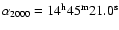
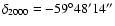
The LWS spectrum is for a region centred at
 ,
,
 .
The version of the ISO data used in this Paper corresponds to the Highly Processed Data
Product (HPDP)
sets called "Uniformly processed LWS L01 spectra'' by Lloyd et al. (2003),
obtained from the ISO Data Archive.
.
The version of the ISO data used in this Paper corresponds to the Highly Processed Data
Product (HPDP)
sets called "Uniformly processed LWS L01 spectra'' by Lloyd et al. (2003),
obtained from the ISO Data Archive.
![\begin{figure}
\par\includegraphics[width=5.8cm,clip]{5731f1a.ps}\hspace*{4mm}
\includegraphics[width=5.8cm,clip]{5731f1b.eps}
\end{figure}](/articles/aa/full/2007/07/aa5731-06/img34.gif) |
Figure 1:
The intensity map for the region around IRAS 14416-5937 at 150 m
( left) and 210 m ( right). Contour levels are at 5, 10, 20, 30, 40,
50, 60, 70, 80, 90, and 95% of peak intensity of 2450 Jy/sq arcmin ( left) and 1367 Jy/sq arcmin ( right). |
| Open with DEXTER | |
![\begin{figure}
\par\includegraphics[width=5.8cm,clip]{5731f2a.ps}\hspace*{4mm}
\...
...f2c.ps}\hspace*{4mm}
\includegraphics[width=5.8cm,clip]{5731f2d.ps}
\end{figure}](/articles/aa/full/2007/07/aa5731-06/img35.gif) |
Figure 2:
The IRAS-HIRES intensity map for the region covering IRAS 14416-5937 at 12 m ( top left), 25 m ( top right), 60 m ( bottom
left), and 100 m ( bottom right). The contours are at 5, 10, 20, 30, 40,
50, 60, 70, 80, 90, and 95% of the peak value of 155 Jy arcmin-2, 1380 Jy arcmin-2, 3360 Jy arcmin-2, and 2410 Jy arcmin-2 at 12, 25, 60, and 100 m, respectively. |
| Open with DEXTER | |
The thermal emission from dust in the TIFR-bands at 150 and 210 m is shown in
Fig. 1. These deconvolved maps show emission from two sources
designated A (east) and B (west). The dynamic range of the maps is quite good
and contours
are shown up to the 5% level of the respective peak intensities (2450 Jy/sq arcmin and 1367 Jy/sq arcmin at 150 and 210 m, respectively). The HIRES-processed
maps at all the four IRAS bands (12, 25, 60, and 100 m) are shown in
Fig. 2.
Similar to the TIFR maps, both the peaks A and B are seen clearly in
the 12, 25, and 60 m maps, but only a hint of B appears at 100 m.
The peak intensities in the HIRES maps correspond to 155, 1380, 3360, and 2410 Jy/sq arcmin at 12, 25, 60, and 100 m, respectively.
The flux densities, obtained by integrating circular regions of diameter
3' centred on peaks A and B from the TIFR, IRAS-HIRES, and MSX maps, are
listed in Table 1.
The IRAS PSC lists a single source in this region. The corresponding flux
densities and
position of the IRAS PSC source are also listed in the table.
Table 1: Flux density details of IRAS 14416-5937.
![\begin{figure}
\par\includegraphics[width=5.8cm,clip]{5731f3a.ps}\hspace*{4mm}
\includegraphics[width=5.8cm,clip]{5731f3b.ps}
\end{figure}](/articles/aa/full/2007/07/aa5731-06/img44.gif) |
Figure 3:
The distribution of dust temperature T(150/210) ( left), and
optical depth at 200 m,
 ,
( right) from the region around IRAS 14416-5937 assuming a dust emissivity law of
.
The isotherms correspond to 20, 25, 27, 32, 40, 50, and 60 K. The
contours represent 5, 10, 20, 30, 40, 50, 60, 70, 80, and 90% of the peak value of 0.06. ,
( right) from the region around IRAS 14416-5937 assuming a dust emissivity law of
.
The isotherms correspond to 20, 25, 27, 32, 40, 50, and 60 K. The
contours represent 5, 10, 20, 30, 40, 50, 60, 70, 80, and 90% of the peak value of 0.06. |
| Open with DEXTER | |
m) because of the smaller and circular beams employed. Since the TIFR
beams are nearly identical at both the FIR bands and all the observations are
simultaneous, this data set is useful in mapping the colour
temperature and dust optical depth with good angular resolution.
The flux density,  ,
for optically thin emission
can be written as
,
for optically thin emission
can be written as
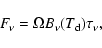
 is the solid angle of the region under consideration,
 is the Planck function, and
  is the dust temperature. Assuming
 ,
it can be shown that the ratio of flux densities at any two wavelengths is a function of
and
,
it can be shown that the ratio of flux densities at any two wavelengths is a function of
and  .
For
various dust temperatures ()
and an assumed value of ,
a look-up
table is generated for the ratio of flux densities. The colour temperature and
optical depth maps have been generated using this interpolation table relating
the ratio of signals
detected for the two bands to the dust temperature for the assumed emissivity
law,
.
It is important to note that the
morphology of the contours of dust temperature and opacity are not sensitive
to the assumption .
Further details can be found in
Appendix A of Mookerjea et al. (2000). The generated maps of colour
temperature T(150/210) and dust optical depth at 200 m (
)
are shown in Fig. 3.
.
For
various dust temperatures ()
and an assumed value of ,
a look-up
table is generated for the ratio of flux densities. The colour temperature and
optical depth maps have been generated using this interpolation table relating
the ratio of signals
detected for the two bands to the dust temperature for the assumed emissivity
law,
.
It is important to note that the
morphology of the contours of dust temperature and opacity are not sensitive
to the assumption .
Further details can be found in
Appendix A of Mookerjea et al. (2000). The generated maps of colour
temperature T(150/210) and dust optical depth at 200 m (
)
are shown in Fig. 3.
Using the emission in the MSX bands (8.3, 12.1, 14.7, 21.3 m)
for the region
around IRAS 14416-5937, we have modelled the thermal continuum from
interstellar dust along with emission in the Unidentified Infrared Bands
(UIBs) following the scheme developed by Ghosh & Ojha (2002).
In this scheme, the emission from each pixel in the MSX images is a combination of two
components: (i) thermal continuum from dust grains
(gray body) and (ii) the emission from the UIB features falling within the MSX
band. The scheme assumes that dust emissivity follows the power
law of the form
 and the total radiance
due to UIBs in the 12 m band is proportional to that in the 8 m
band.
The dust emissivity law depends on wavelength. We have used
emissivity laws,
,
for
and the total radiance
due to UIBs in the 12 m band is proportional to that in the 8 m
band.
The dust emissivity law depends on wavelength. We have used
emissivity laws,
,
for
 m, and
,
for
m, and
,
for
 m,
which is generally used (Scoville & Kwan 1976).
A self consistent non-linear chi-square minimisation technique is used to
estimate the total emission from the UIBs, dust temperature, and optical depth
in the mid-infrared (10 m).
The spatial distribution of UIB emission is shown in Fig. 4.
The peak strength of the modelled UIB emission is
m,
which is generally used (Scoville & Kwan 1976).
A self consistent non-linear chi-square minimisation technique is used to
estimate the total emission from the UIBs, dust temperature, and optical depth
in the mid-infrared (10 m).
The spatial distribution of UIB emission is shown in Fig. 4.
The peak strength of the modelled UIB emission is
 W m-2 Sr-1, close to peak A.
![\begin{figure}
\par\includegraphics[width=7.5cm,clip]{5731f4.ps}
\end{figure}](/articles/aa/full/2007/07/aa5731-06/img55.gif) |
Figure 4:
The emission in UIBs for the region around IRAS 14416-5937. The
contour levels are at 1, 5, 10, 20, 30, 40, 50, 60, 65, 70, 80, 90, and 95% of
peak value of
W m-2 Sr-1. |
| Open with DEXTER | |
![\begin{figure}
\par\includegraphics[width=7.5cm,clip]{5731f5.ps}
\end{figure}](/articles/aa/full/2007/07/aa5731-06/img56.gif) |
Figure 5:
The SUMSS radio flux density map for the region around IRAS 14416-5937
at 843 MHz. The contour levels are at 5,
10, 20, 30, 40, 50, 60, 70, 80, 90, and 95% of peak flux of 4.4 Jy/beam. The
beam is
 . . |
| Open with DEXTER | |
![\begin{figure}
\par\includegraphics[width=7.5cm,clip]{5731f6.ps}
\end{figure}](/articles/aa/full/2007/07/aa5731-06/img57.gif) |
Figure 6:
ISO-LWS spectrum (solid line) shown along with the model calculations
(dash-dotted line). The ISO-LWS spectrum is taken for a region 1.4' to
the north-west of IRAS 14416-5937 - A. However, the model calculations are
carried out for IRAS 14416-5937 - A. |
| Open with DEXTER | |
Table 2:
Fluxes derived from Gaussian fits to the fine-structure lines observed with ISO-LWS grating positioned at

 (J2000).
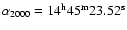
The radio continuum emission from the region around IRAS 14416-5937 from SUMSS survey at 843 MHz is shown in Fig. 5.
The rms noise in the map is 6 mJy/beam. The
radio emission peaks at (
 ,
,
 ). The integrated
radio flux density up to 5% contour level is 37.5 Jy over 30 arcmin2.
). The integrated
radio flux density up to 5% contour level is 37.5 Jy over 30 arcmin2.
The ISO-LWS beam, centred at a location that is 1.4' to the
north-west of IRAS 14416-5937 - A is shown in Fig. 1
(right). This spectrum, extending from 43-197 m is shown in Fig. 6. A
number of lines are prominently detected. The atomic fine structure
lines with good signal-to-noise ratios are identified in the figure, and their
line fluxes are given in Table 2. The spectrum is dominated by
the fine structure lines of [N II], [N III], [O III], [C II], and [O I]. The line fluxes are extracted by fitting Gaussian functions and
integrating the area under the curve after removing the underlying local
continuum estimated through a polynomial fit to the baseline.
The line fluxes, normalised to [C II] line at 158 m, are also
presented in Table 2.
![\begin{figure}
\par\includegraphics[width=5.8cm,clip]{5731f7a.ps}\hspace*{4mm}
\includegraphics[width=5.7cm,clip]{5731f7b.ps}
\end{figure}](/articles/aa/full/2007/07/aa5731-06/img61.gif) |
Figure 7: Colour-magnitude ( left) and colour-colour diagram ( right) for sources detected in all the three 2MASS bands for the region around IRAS 14416-5937. In the colour-magnitude diagram, the nearly vertical solid lines from left to right represent the zero age main sequence (ZAMS) curves reddened by AV = 0, and 20 mag, respectively. The slanting lines trace the reddening vectors of these ZAMS stars. In the colour-colour diagram, the locii of the main sequence and giant branches are shown by the solid and dotted lines, respectively. The short-dash line represents the locus of T-Tauri stars. The three parallel dash-dotted straight lines follow the reddening vectors of giants, main sequence stars (or dwarfs), and the T-Tauri stars. The long dashed line represents the locus of Herbig Ae/Be stars. The asterisk symbols represent sources lying above the ZAMS curve B0. The open circles represent sources depicting an infrared excess in the colour-colour diagram. The dots are sources lying below the ZAMS spectral curve of B0 (see text for details). |
| Open with DEXTER | |
8.3' around
the IRAS source. This square region includes the sources A and B as
well as the dust
lane seen in the near- and mid-infrared images (details in Sect. 5.3).
A total of 1847 sources are present in the 2MASS catalogue, of which 722 are detected in all
bands with good quality flags
(i.e., rdflg = 1 to 3). The stellar populations of this region have been
investigated using the colour-magnitude (CM; J vs. J - H) and colour-colour
(CC; J - H vs. H - K) diagrams of this sample of 722 sources.
These are shown in Fig. 7.
In the CM diagram, the ZAMS curves (for a distance of 2.8 kpc) reddened by
AV = 0 and 20 mag, respectively, are presented. The lines tracing the
reddening vectors of these main sequence stars are also presented. In the CC diagram, the locii of the main sequence and giant branches are shown. The
locus of T Tauri stars (Meyer et al. 1997), the reddening vectors
(of main sequence stars, giants and T Tauri stars), and the locus of the
Herbig Ae/Be stars (Lada & Adams 1992) are also shown. We have assumed
extinction values of AJ/
AV = 0.282,
AH/
AV = 0.175, and
 /
AV = 0.112 from Rieke & Lebofsky
(1985). All the 2MASS magnitudes as well as the curves are in the
Bessel & Brett (1988) system. In Fig. 7, the sources
lying above the reddening curve of the ZAMS spectral type B0 are shown as
asterisks, while the stars with infrared
excess are shown as open circles. These are sources to the right of
the reddening vector drawn from the bottom of the main sequence stars or
sources lying in the T tauri and HeAeBe zones in the CC diagram. The other
sources are represented by dots.
It is important to note that the CM and CC diagrams are useful tools
for estimating the approximate nature of the stellar populations within the
cluster in the absence of any spectroscopic data.
/
AV = 0.112 from Rieke & Lebofsky
(1985). All the 2MASS magnitudes as well as the curves are in the
Bessel & Brett (1988) system. In Fig. 7, the sources
lying above the reddening curve of the ZAMS spectral type B0 are shown as
asterisks, while the stars with infrared
excess are shown as open circles. These are sources to the right of
the reddening vector drawn from the bottom of the main sequence stars or
sources lying in the T tauri and HeAeBe zones in the CC diagram. The other
sources are represented by dots.
It is important to note that the CM and CC diagrams are useful tools
for estimating the approximate nature of the stellar populations within the
cluster in the absence of any spectroscopic data.
While the near-infrared sources in this region have been studied using 2MASS, the near- to mid-infrared sources in this region have been extracted from the Spitzer-GLIMPSE catalogs. In a region identical to the one used for extracting the 2MASS sources, a total of 2087 sources were detected. For our analysis, those sources that have a flux calculation method flag (MF) equal to 0 (good quality) were selected. A total of 130 sources (with MF = 0) were detected in all the four IRAC bands. All these 130 sources have been plotted in a colour-colour diagram ([3.6]-[4.5] vs. [5.8]-[8.0]), which is shown in Fig. 8. We have used the IRAC colour-colour diagram and the models of Allen et al. (2004) to identify the young stellar objects in this region. The solid-line square in the diagram approximately delineates the region occupied by the Class II sources, whereas the dotted-line square covers the region occupied by the Class I sources, as shown in the models of Allen et al. (2004, see their Fig. 4). There is a region of overlap of these two boxes, and the sources in this region will be referred to as Class I/II sources. In our sample of 130 sources, we find that 14 sources can be classified as Class I, and 11 sources each can be classified as Class I/II, and Class II sources. These are likely to be associated with IRAS 14416-5937 and to be evolving towards the main sequence. In Fig. 8, the open circles denote Class I sources, the open squares represent Class I/II sources, the filled triangles denote Class II sources, and the cross symbols represent the other sources.
The modelling procedure described in this section has been used to interpret the results obtained.
![\begin{figure}
\par\includegraphics[width=7.5cm,clip]{5731f8.ps}
\end{figure}](/articles/aa/full/2007/07/aa5731-06/img63.gif) |
Figure 8: Colour-colour diagram of the sources detected in all the four bands of Spitzer-IRAC for the region around IRAS 14416-5937. The open circles, open squares, filled triangles, and cross symbols denote Class I, Class I/II, Class II, and other sources, respectively. The solid-line square in the diagram approximately delineates the region occupied by the Class II sources, whereas the dotted-line square covers the region occupied by the Class I sources as shown in the models of Allen et al. (2004). |
| Open with DEXTER | |
![\begin{figure}
\par\includegraphics[width=5.8cm,clip]{5731f9a.ps}\hspace*{4mm}
\includegraphics[width=5.8cm,clip]{5731f9b.ps}
\end{figure}](/articles/aa/full/2007/07/aa5731-06/img64.gif) |
Figure 9: Comparison of the spectral energy distribution from observations and the best-fit radiative transfer model of IRAS 14416-5937 - A ( left) and IRAS 14416-5937 - B ( right). The open circles, triangles, and squares represent the TIFR, IRAS-HIRES and MSX data, respectively. The solid line is the best-fit radiative transfer model to the data. See text and Table 3 for details of the model parameters. |
| Open with DEXTER | |
Table 3: Best-fit parameters of the radiative transfer models for IRAS 14416-5937 - A and IRAS 14416-5937 - B.
For modelling the observed spectral energy distribution, two types of dust have been explored. The first type of dust grains is from Draine & Lee (1984), hereafter referred to as DL type of grains. The physical properties of the grains, viz., absorption and scattering efficiencies, the scattering anisotropy factor for all sizes, and the frequencies used in the model were taken from the tables of Draine's homepage, which are computed in a similar
manner to that by Laor
& Draine (1993). Three types of the most commonly accepted variety of
dust grains have been used here: (i) Graphite; (ii) Astronomical Silicate; and
(iii) Silicon Carbide. The second type of dust is from Mezger et al. (1982, hereafter MMP). This type of dust consists of
graphite and
silicate only, but their absorptive and scattering properties differ
substantially from those for the DL case, particularly in the mid-infrared.
The relative abundances of the types of grains are used as parameters of our
modelling.
The cloud is parameterised by the following quantities: the geometry of the cloud (outer size and inner size of dust cavity), total radial optical depth at a specified wavelength and the radial dust and gas density distribution laws (r0, r-1, r-2). The gas-to-dust ratio is a parameter that is held constant throughout the cloud (except for the central dust-free cavity). The luminosity of the embedded source is obtained by integrating the area under the observed SED. The physical sizes of the cloud, the radial optical depth, dust composition, and the radial density distribution are varied to obtain a good match to the observations. The observed angular sizes and luminosity have been used to constrain the model. With this scheme, a best-fit model matching the observed SED and angular sizes at selected wavelengths and the radio continuum flux are obtained. Further details of the modelling scheme are given by Mookerjea & Ghosh (1999).
The SEDs of both these sources (IRAS 14416-5937 A and B) are constructed using
the flux densities at the two TIFR bands, the four IRAS bands (from HIRES maps), and the four MSX bands. It may be noted that the position of the peak
emission associated with B shifts northward with increasing wavelength. This
could be attributed to the
cold dust lane. Although the details of the geometry are unclear, we have
considered the peak emission of B associated with MSX bands and integrated the
flux density in a circle of diameter 3' around this MSX peak in all the
bands. Since A and B are separated by 2.5', the flux densities in the
slight overlap region are distributed in the ratio of the intensities of A and B peaks.
The total luminosity of this source is
 for a
distance of 2.8 kpc. The best-fit radiative transfer model corresponds to a
uniform density distribution of dust and gas. The DL type of dust fits the data
better. The relative fraction of the two constituent grain types Si:Gr is 11:89 for the best-fit model. The predicted spectrum by the
best-fit model has been compared with the observations in Fig. 9
(left) and
the corresponding parameters obtained from this model are tabulated in Table 3. The cloud size (outer radius) is 3.4 pc and the radial optical depth at 100 m is 0.007. A single ZAMS star of spectral type O7-O6.5 has
been used as the centrally exciting source. From the model, the radius of the
ionised region is determined to be 0.5 pc. The radio flux density predicted
by the model at 843 MHz is 2.6 Jy for a gas-to-dust ratio of 100. This is
lower than the
measured value of 10.2 Jy obtained by integrating within a circular region of
radius 0.5 pc around the radio peak (see Fig. 5). This
could be due to either gas-to-dust ratio and/or due to clumpy/inhomogeneous
medium. Increasing the gas-to-dust ratio, however, does not increase the
predicted radio flux beyond 5 Jy. It is, therefore, probable that the
difference is due to non-uniform distributions of gas in this region.
for a
distance of 2.8 kpc. The best-fit radiative transfer model corresponds to a
uniform density distribution of dust and gas. The DL type of dust fits the data
better. The relative fraction of the two constituent grain types Si:Gr is 11:89 for the best-fit model. The predicted spectrum by the
best-fit model has been compared with the observations in Fig. 9
(left) and
the corresponding parameters obtained from this model are tabulated in Table 3. The cloud size (outer radius) is 3.4 pc and the radial optical depth at 100 m is 0.007. A single ZAMS star of spectral type O7-O6.5 has
been used as the centrally exciting source. From the model, the radius of the
ionised region is determined to be 0.5 pc. The radio flux density predicted
by the model at 843 MHz is 2.6 Jy for a gas-to-dust ratio of 100. This is
lower than the
measured value of 10.2 Jy obtained by integrating within a circular region of
radius 0.5 pc around the radio peak (see Fig. 5). This
could be due to either gas-to-dust ratio and/or due to clumpy/inhomogeneous
medium. Increasing the gas-to-dust ratio, however, does not increase the
predicted radio flux beyond 5 Jy. It is, therefore, probable that the
difference is due to non-uniform distributions of gas in this region.
By integrating the observed SED, the total luminosity obtained for IRAS 14416-5937 - B is
 .
The best-fit
radiative transfer model along with the observed SED is shown in Fig. 9 (right), and the parameters of the best-fit model are presented
in Table 3. The best-fit model is a uniform density
distribution of gas and dust. The outer size of the cloud is 2.8 pc and the
optical depth at 100 m is 0.018. We have used a single ZAMS star
of spectral type O8-O7.5 to carry out the radiative transfer
modelling. In the best-fit model, the DL type of dust has been used.
.
The best-fit
radiative transfer model along with the observed SED is shown in Fig. 9 (right), and the parameters of the best-fit model are presented
in Table 3. The best-fit model is a uniform density
distribution of gas and dust. The outer size of the cloud is 2.8 pc and the
optical depth at 100 m is 0.018. We have used a single ZAMS star
of spectral type O8-O7.5 to carry out the radiative transfer
modelling. In the best-fit model, the DL type of dust has been used.
Since high resolution spectroscopic observations of a region near IRAS 14416-5937 - A are available from ISO-LWS, an attempt has been made to model this source using a sophisticated scheme that includes the gas component with significant details. This scheme, based on CLOUDY, predicts infrared nebular/ionic fine structure line emission from the interstellar gas in IRAS 14416-5937 - A, which has been compared with the ISO-LWS observations.
To model line emission from gas, several prominent
elements in the gas phase of the cloud have been considered. Physical
processes like thermal balance considering various heating and cooling
processes, photoionisation,
recombination, collisional excitation and de-excitation, grain photoionisation,
and gas-dust coupling have been included in the model. The detailed modelling
involves the use of the photoionisation code CLOUDY (Ferland 1996),
which
has been supplemented with a software scheme developed by Mookerjea & Ghosh
(1999).
This scheme improves the modelling by (a) emulating the exact structure of
the HII region and (b) including absorption effects of dust (present within
the line emitting zones) on the emergent line intensities. Typical HII region
abundance of the gas component, tabulated by Ferland (1996) has been taken
into consideration. Elements with relative abundance higher than
 have been used; these are H, He, C, N, O, Ne, Mg, Si, S, and Ar.
The geometry of the cloud has been taken to be identical to that
obtained from the modelling of the continuum SED (see Sect. 4.1.1).
CLOUDY is
run twice. First, it
is for the pure gas inner shell. The emerging spectrum comprises of continuum
and line emission. This emerging continuum from the inner shell is input to
the second shell comprising gas and dust. The line emission from the inner
shell in the first run is transported outside through extinction by the dust
column in the second shell. The emerging line luminosities from both the shells
are finally added to predict the total luminosity. A total of 27 spectral
lines in the wavelegth range
 m have been considered. The
predicted emerging spectrum has been computed by convolving the
spectral lines with typical spectral resolutions of ISO-SWS and LWS, viz.,
1000 for
m have been considered. The
predicted emerging spectrum has been computed by convolving the
spectral lines with typical spectral resolutions of ISO-SWS and LWS, viz.,
1000 for
 m, 20 000 for
 m, 8100
for
m, 8100
for
 m, and 6800 for
 m.
m.
For IRAS 14416-5937 - A, the emergent spectrum (obtained using the
above procedure) shows a total of 18 nebular/ionic lines satisfying our
detectability criterion (power in the line >1% of power in the
neighbouring continuua). The wavelengths and luminosities of these lines are
presented in Table 4. The ratio of luminosity of each line to
that of [C II] line at 158 m is also listed. The complete emerging
spectrum, including lines from the 10 elements considered as well as the
continuum predicted by this model, is shown in Fig. 10.
Table 4: Emergent line luminosities predicted by the model for IRAS 14416-5937 - A.
![\begin{figure}
\par\includegraphics[width=8cm,clip]{5731f10.ps}
\end{figure}](/articles/aa/full/2007/07/aa5731-06/img82.gif) |
Figure 10: Emergent spectrum from model calculations of IRAS 14416-5937 - A. Few lines are identified and the details of the lines are given Table 4. |
| Open with DEXTER | |
The far infrared TIFR (150 and 210 m) and IRAS-HIRES (60 and 100 m)
maps probe emission from relatively colder dust in the complex including
IRAS 14416-5937 A and B. The temperature of the far infrared emitting
cold dust
is 25-30 K (Fig. 3). It is interesting to note that, of
the IRAS-HIRES images in the four wavebands, the peak emission at 12 m is at B, while
for the other three bands (25, 60, and 100 m), it is at A.
From the IRAS-HIRES maps, too, we see extended dust emission. Also, in all the
six maps, there is extended diffuse emission towards the south of
source A. The flux densities from the TIFR maps at 150 and 210 m have
been used to compute the mass of the dust component using the formulation of
Hildebrand
(1983) and Sandell (2000). For a temperature of 27 K and 24 K,
obtained for IRAS 14416-5937 A and B (see Fig. 3), we find their dust masses to be 31 and 36  ,
respectively. This is in fairly good agreement with the dust masses
of 25 and 49
obtained from the radiative transfer modelling.
,
respectively. This is in fairly good agreement with the dust masses
of 25 and 49
obtained from the radiative transfer modelling.
From Fig. 3, we see that the observed peak optical depth at 200 m is 0.06, located near B. However, we find from radiative transfer
modelling
that the optical depth at 100 m is 0.02. This apparent
inconsistency (of lower value of
 compared to
)
could possibly indicate a clumpy/inhomogeneous medium and/or dust
grains of different properties than those used here.
The modelled UIB emission (Fig. 4) peaks close to A. The UIB emission map shows that both A and B are resolved into two sources each. This
is due to higher angular resolution of the MSX maps compared to the
IRAS-HIRES and TIFR maps. These secondary peaks could be due to locally higher
radiation fields caused by early-type stars (since the UIB is
expected to be
excited by UV photons). To locate the possible sources responsible for exciting
the secondary UIB peaks, we looked at the sources in 2MASS and Spitzer
catalogs. However, we do not find any such candidates around these peaks. This
may perhaps be due to the high extinction around IRAS 14416-5937
region.
compared to
)
could possibly indicate a clumpy/inhomogeneous medium and/or dust
grains of different properties than those used here.
The modelled UIB emission (Fig. 4) peaks close to A. The UIB emission map shows that both A and B are resolved into two sources each. This
is due to higher angular resolution of the MSX maps compared to the
IRAS-HIRES and TIFR maps. These secondary peaks could be due to locally higher
radiation fields caused by early-type stars (since the UIB is
expected to be
excited by UV photons). To locate the possible sources responsible for exciting
the secondary UIB peaks, we looked at the sources in 2MASS and Spitzer
catalogs. However, we do not find any such candidates around these peaks. This
may perhaps be due to the high extinction around IRAS 14416-5937
region.
We compare radio continuum emission from the SUMSS radio map
at 843 MHz with the high angular resolution map at 6.67 GHz of Walsh et al.
(1998). The high angular resolution (1.5'') map at 6.67 GHz shows
two main peaks at (
 ,
,
 )
and (
)
and (
 ,
,
 ). These are nearly 14'' and 17'' offset from the SUMSS peak
at 843 GHz, respectively. This could be either due to the effect of
lower angular
resolution of the SUMSS map or the effect of opacity. It is also important to
note that the radio map at 6.67 GHz at high angular resolution covers only the
very compact features in this HII region. A comparison of the radio
peaks with the peaks of UIB emission shows that the
secondary peak near A of the UIB emission is close (12'') to the high
angular resolution radio peaks at 6.67 GHz of Walsh et al. (1998).
). These are nearly 14'' and 17'' offset from the SUMSS peak
at 843 GHz, respectively. This could be either due to the effect of
lower angular
resolution of the SUMSS map or the effect of opacity. It is also important to
note that the radio map at 6.67 GHz at high angular resolution covers only the
very compact features in this HII region. A comparison of the radio
peaks with the peaks of UIB emission shows that the
secondary peak near A of the UIB emission is close (12'') to the high
angular resolution radio peaks at 6.67 GHz of Walsh et al. (1998).
In the ISO-LWS spectrum, we notice that the cooling lines from the Photo-Dissociated Regions (PDRs): [O I] 63,
145 m and [C II] 158 m have been clearly detected. In addition, lines coming
from the higher excitation potential ions such as [N II] 122 m, [N III] 57 m, as well as [O III] 52 and 88 m lines are also detected. The maximum flux is observed in the [O III] 52 m line. Since the
spectrum is taken at a position that is located around 1.4' to the
north-west of IRAS 14416-5937 - A, it is likely that the observed
fluxes in the highly ionised species like [O III] and [N III] are due to an
extended component of
low density ionised gas rather than compact source(s). In the highest density
regions of compact cores, these lines are collisionally de-excited (Morisset
et al. 2002). The ratio of fluxes in [O III] lines has been
used to estimate the electron density,
 cm-3 in this region
(details are given in Appendix A).
Using the fluxes in [N III] 57 m and [N II] 122 m lines, the
effective temperature of the ionising radiation is found to be 37 500 K
(details in Appendix A). This compares well with the effective
temperature, 39 500 K, of the centrally exciting source required by the
radiative transfer model (see Sect. 4.1.1). Next, we consider the flux ratio
of [N III] 57 m to [O III] 52 m. Since the ionisation potentials of these two
ions are similar (O
++ = 35.1 eV; N
++ = 29.6 eV), they are likely
to sample the same volume of gas (Mizutani et al. 2002). In our case,
the intensity ratio from the observed ISO-LWS spectrum is
I([N III] 57)/I([O III] 52
cm-3 in this region
(details are given in Appendix A).
Using the fluxes in [N III] 57 m and [N II] 122 m lines, the
effective temperature of the ionising radiation is found to be 37 500 K
(details in Appendix A). This compares well with the effective
temperature, 39 500 K, of the centrally exciting source required by the
radiative transfer model (see Sect. 4.1.1). Next, we consider the flux ratio
of [N III] 57 m to [O III] 52 m. Since the ionisation potentials of these two
ions are similar (O
++ = 35.1 eV; N
++ = 29.6 eV), they are likely
to sample the same volume of gas (Mizutani et al. 2002). In our case,
the intensity ratio from the observed ISO-LWS spectrum is
I([N III] 57)/I([O III] 52
 .
Mizutani et al. (2002) find that this ratio is almost constant and
obtain the value of 0.3 for the optically bright regions of the Carina
nebula and a value ranging from
0.25-0.5 for the surrounding region.
We have also estimated the density and the radiation field using the ratio
([C II]+ [O I]63)/
.
Mizutani et al. (2002) find that this ratio is almost constant and
obtain the value of 0.3 for the optically bright regions of the Carina
nebula and a value ranging from
0.25-0.5 for the surrounding region.
We have also estimated the density and the radiation field using the ratio
([C II]+ [O I]63)/
 ,
which is a measure of the gas heating
efficiency and the ratio of line intensities [C II]/[O I]63. The
total far infrared emission is obtained by integrating the ISO-LWS continuum.
We obtain FIR flux for this region to be
,
which is a measure of the gas heating
efficiency and the ratio of line intensities [C II]/[O I]63. The
total far infrared emission is obtained by integrating the ISO-LWS continuum.
We obtain FIR flux for this region to be
 W m-2.
The gas density
and radiation field are found to be 100 cm-3 and 300 G0
(G0 is Habing Field =
W m-2.
The gas density
and radiation field are found to be 100 cm-3 and 300 G0
(G0 is Habing Field =
 W m-2),
respectively, from the Fig. 4 (right) of Peeters et al. (2005).
W m-2),
respectively, from the Fig. 4 (right) of Peeters et al. (2005).
Figure 6 shows comparison of the spectra from ISO-LWS and
the model calculations. The flux densities from the model
calculations are higher than that observed from ISO. This is expected since the
ISO-LWS beam is centred 1.4' away from the IRAS 14416-5937 - A peak.
Also, the ISO-LWS beam is
of size 84'', whereas the model computes the total emergent
intensities from the entire cloud. It is instructive to compare the observed
and modelled fine structure line ratios, normalised with respect to [C II] 158 m line. The ratio of the lines corresponding to the doubly ionised
atoms [O III] 52 and 88 m and [N III] 57 m are overestimated by the
model as compared to the observations by a factor of up to 2. On the other
hand, the ratio of the lines [O I] 63 m and [N II] 122 m is
underestimated by the model by a factor of 3. The major difference is found for the [O I] 145 m line
ratio, which is underestimated by the model by a factor of 16.
Next we consider the embedded star clusters associated with the IRAS 14416-5937 region based on the near- and mid-infrared emission. From the 2MASS CM diagram in Fig. 7 (left),
we find that there are 98 sources lying above the reddening curve of
the ZAMS spectral type B0 for a distance of 2.8 kpc. It is unlikely that all
these objects are ZAMS stars of spectral type earlier than B0 and associated
with the cluster since the combined luminosity of these stars would be
much higher
than the observed luminosity. It is reasonable to consider that many of these
objects are foreground stars or bright background giants not associated with
the star-forming region, although a few of these may be O-B stars belonging to
the cluster. From the 2MASS CC diagram,
in Fig. 7 (right), we find that there are 72 sources having
an infrared excess (based on the CC diagram). These sources have
been overplotted on the
2MASS
band image of the region around IRAS 14416-5937 in Fig. 11. The grayscale 2MASS image of this region shows diffuse
emission apart from a number of sources. A dust lane 3.5 pc long running
diagonally across
the image commencing from the source A is clearly observed. As compared to the
rest of the image where a number of 2MASS sources are detected, very few
sources are seen in the region of the dust lane. From the spatial distribution
of the sources in the figure, we find that most of the 2MASS sources within
the dust lane are those with infrared excess. A larger number of sources with
infrared excess are present in the IRAS 14416-5937 - A region as
compared to B. On the other hand, we find sources of "spectral type'' earlier than B0 clustered near IRAS 14416-5937 - B. This suggests the possibility that the
complex B could be more evolved than A. While the sources lying above the
reddening vector of ZAMS spectral type B0 in the 2MASS CM diagram are
distributed everywhere in the image other than the dust lane, we see a larger
number of sources with infrared excess below the dust lane (i.e., bottom right
part of the image). These objects with infrared excess are likely
to be pre-main
sequence candidate objects in this star-forming region. We have also compared
the statistics of the infrared excess
sources with that obtained from two neighbouring control fields of the same
size. We find that the number of infrared excess sources in the star-forming
field is larger than those obtained from the control fields by a factor of 2.
![\begin{figure}
\par\includegraphics[width=7.5cm,clip]{5731f11.ps}
\end{figure}](/articles/aa/full/2007/07/aa5731-06/img92.gif) |
Figure 11:
The radio contours (SUMSS; 843 MHz) overlaid over the 2MASS
band image for the region around IRAS 14416-5937. The labelled axes are
in J2000 coordinates. The regions "A'' and "B'' are shown and various
near-infrared sources are marked. The asterisk symbols represent sources of
spectral type earlier than B0, and the
circles denote the infrared excess sources. The solid triangle represents J14452143-5949251 (2MASS source closest to radio peak detected in all the
three (
)
bands and of spectral type earlier than O6 from the CM diagram). |
| Open with DEXTER | |
Table 5: Details of 2MASS PSC sources lying above the reddening vector of the ZAMS spectral type O6 in the 2MASS (J-H vs. J) CM diagram and lying within the 30% contour of the radio peak at 843 MHz (see Fig. 11 and text for details).
In Fig. 11, the SUMSS radio contours at 843 MHz have
been overplotted on the grayscale
band image of 2MASS. Within the radio
nebulosity, we find that there are a number of asterisks (sources lying above
the reddening vector of ZAMS spectral type B0 and without infrared excess in
the 2MASS CM diagram). Within the 30% contour level, there are six asterisks.
The details of these sources are listed in Table 5. Among these,
J14452143-5949251 is closest to the radio peak (15.7''). We, however, do
not find a Spitzer-GLIMPSE counterpart of J14452143-5949251 within a search
radius of 0.8'' (search radius used for associating the 2MASS and
Spitzer-GLIMPSE sources). An investigation of the IRAC images reveals strong
emission at the
location of this source in all the 4 IRAC (3.6, 4.5, 5.8, and 8.0 m)
bands. The spectral energy distribution of this source is shown in Fig. 12. The fluxes in the IRAC bands were obtained by
integrating within an aperture of diameter 6'' (and applying the
aperture corrections) centred on peak emission at 3.6 m after
subtracting the background. From the SED, we observe that this is a young
reddened source possibly with a dust envelope/disk around it. The lower
limit of the luminosity of this source obtained after integrating the SED is
 .
It would be interesting to do spectroscopy of this source, J14452143-5949251,
to ascertain its spectral type and additional details.
.
It would be interesting to do spectroscopy of this source, J14452143-5949251,
to ascertain its spectral type and additional details.
We have attempted to identify protostars and pre main-sequence objects among
the Spitzer-GLIMPSE sources located around IRAS 14416-5937, detected in all
the four IRAC bands, based on the models of Allen et al. (2004). These
sources have been overplotted on the Spitzer-GLIMPSE 5.8 m band image, shown in Fig. 13.
The details of these young Spitzer objects are available in Table 6
(available only as electronic table).
We have also searched for 2MASS counterparts of these young GLIMPSE objects in
this star-forming region. A search radius of 0.8'' has been taken as a
criterion for associating the 2MASS and Spitzer-GLIMPSE objects.
While only 2 of the 14 Class I
objects have 2MASS counterparts, 10 out of the 11 Class I/II objects have
2MASS counterparts and all the 11 Class II objects have 2MASS
counterparts.
This is probably because most Class I objects suffer large amounts of
extinction. We
also searched for Spitzer-GLIMPSE counterparts to the 2MASS infrared excess
objects detected in all the bands of 2MASS (
). We find that 36
out of 72 2MASS IR excess objects have Spitzer-GLIMPSE counterparts. It is to be noted
that most of these objects are towards the lower right part of the image
with few along the farther end of the dust lane. The details of these 2MASS IR excess objects with Spitzer GLIMPSE counterparts are given in Table 7
(available only as electronic table).
The presence of diffuse near-infrared emission around IRAS 14416-5937 - A and B in Figs. 11 and 13 indicates
that these are relatively evolved regions.
The presence of HII regions around them is seen from the radio image
in Fig. 5.
The OH (Caswell & Haynes 1987), H2O (Caswell et al. 1989),
and CH3OH (Walsh et al. 1998) masers are marked in the figure in
different colours. All these three
masers are located close to A, near the peak of radio emission. The H2O maser is closest (12'') to the radio peak. The dust lane is very clearly
seen in the
IRAC images. It is interesting to note that the dust lane is lined up
with only Class I sources. The dust lane has Class I sources extending up to 5'. It is to be further noted that Class I and Class I/II, as well as
Class II sources are present further along the dust lane and beyond B.
Below B (i.e., the bottom right part of the image), we find Class I/II and
Class II sources. As seen earlier, most of the 2MASS infrared
excess sources with Spitzer-GLIMPSE counterparts are also located here. It is
likely that the sources here represent an earlier generation of stars in the
sequence of star formation. The other sources are distributed
over the entire image, but away from the dust lane.
![\begin{figure}
\par\includegraphics[width=5.8cm,clip]{5731f12.ps}
\end{figure}](/articles/aa/full/2007/07/aa5731-06/img114.gif) |
Figure 12:
The spectral energy distribution of J14452143-5949251 (2MASS source
closest to radio peak detected in all the three (
)
bands and of spectral type earlier than O6 from the CM diagram) constructed using the fluxes from
2MASS and Spitzer-GLIMPSE (details in text).
|
| Open with DEXTER | |
![\begin{figure}
\par\includegraphics[width=7.5cm,clip]{5731f13.ps}
\end{figure}](/articles/aa/full/2007/07/aa5731-06/img115.gif) |
Figure 13:
Spitzer-GLIMPSE sources detected in all the four IRAC bands
overlaid over the Spitzer-GLIMPSE 5.8 m band image for the region around
IRAS 14416-5937. The labelled axes are in J2000 coordinates. The open
circles, open squares, filled triangles, and cross symbols represent the Class I, Class I/II, Class II, and the other sources, respectively (see text for
details). The sources "A'' and "B'' are marked. The OH, H2O, and CH3OH maser
positions are shown by the light blue, yellow, and orange plus symbols,
respectively. |
| Open with DEXTER | |
The massive star-forming region associated with IRAS 14416-5937 has
been studied using the (near, mid-, and far) infrared wavebands. The dust
and gas environment as well as the stellar sources of this
region have been probed using data from the TIFR balloon-borne telescope, MSX,
IRAS-HIRES, Spitzer-GLIMPSE, 2MASS, and ISO. The spatial distribution of far
infrared emission from cold dust at 150 and 210 m has been obtained
along with the maps of optical depth (
)
and colour temperature, T(150/210). Using MSX data, the emission from warm dust and UIBs in
this region has been studied. This region comprises two sources: A (east)
and B (west), as well as a dust lane due north-west of A. Using
2MASS PSC as well as the GLIMPSE catalogs, the near- and mid-infrared sources
associated with this region have been studied using colour-magnitude
and colour-colour diagrams. The atomic fine structure lines from the ISO-LWS
spectrum of a region close to A have been used in estimating the
electron density (
cm-3), as well as the effective temperature
of the
ionising radiation (37 500 K) in this region. Self-consistent radiative
transfer modelling constrained by observations has been carried out
through spherical gas-dust clouds for both the sources (A and B). A constant
radial density distribution (
 )
is preferred.
The geometric details of the gas-dust clouds, the dust composition and
optical depths, etc. have been obtained for the best-fit models. We have also
carried out the modelling of line emission from source A using CLOUDY. The
line ratios
obtained from the model have been compared with the ISO-LWS spectrum of the
region close to A. The Spitzer-GLIMPSE sources detected in all the
IRAC bands (3.6, 4.5, 5.8, 8.0 m) have been classified into Class I (14),
Class I/II (11), and Class II (11) sources based on the models of Allen et al.
(2004). Their
spatial distribution shows that Class I sources line up the dust lane.
The Class II sources
are found further along the dust lane indicating this to be a more evolved
region. This suggests that the star formation is occuring along the
dust lane possibly triggered by the shocks of the expanding HII regions of A and B.
)
is preferred.
The geometric details of the gas-dust clouds, the dust composition and
optical depths, etc. have been obtained for the best-fit models. We have also
carried out the modelling of line emission from source A using CLOUDY. The
line ratios
obtained from the model have been compared with the ISO-LWS spectrum of the
region close to A. The Spitzer-GLIMPSE sources detected in all the
IRAC bands (3.6, 4.5, 5.8, 8.0 m) have been classified into Class I (14),
Class I/II (11), and Class II (11) sources based on the models of Allen et al.
(2004). Their
spatial distribution shows that Class I sources line up the dust lane.
The Class II sources
are found further along the dust lane indicating this to be a more evolved
region. This suggests that the star formation is occuring along the
dust lane possibly triggered by the shocks of the expanding HII regions of A and B.
Acknowledgements
We thank the anonymous referee for useful suggestions that improved the paper. It is a pleasure to thank the members of the Infrared Astronomy Group at TIFR for their support during laboratory tests and balloon flight campaigns. All members of the Balloon Group and Control Instrumentation Group of the TIFR Balloon Facility, Hyderabad, are thanked for their technical support during the flight. We thank M. Walmsley and L. Testi for many useful suggestions regarding the improvement of this work. We thank A. Walsh for providing us the radio continuum map of IRAS 14416-5937 at 6.67 GHz.We thank IPAC, Caltech, for providing us the HIRES-processed IRAS products. This research made use of data products from the Midcourse Space Experiment. Processing of the data was funded by the Ballistic Missile Defense Organization with additional support from NASA Office of Space Science. This research has also made use of the NASA/ IPAC Infrared Science Archive, which is operated by the Jet Propulsion Laboratory, Caltech, under contract with the NASA. This publication makes use of data products from the Two Micron All Sky Survey, which is a joint project of the University of Massachusetts and the Infrared Processing and Analysis Center/California Institute of Technology, funded by the NASA and the NSF. This work is based in part on observations made with the Spitzer Space Telescope, which is operated by the Jet Propulsion Laboratory. The MOST is operated by the University of Sydney and supported in parts by grants from the Australian Research Council. Based on observations with ISO, an ESA project with instruments funded by ESA Member States (especially the PI countries: France, Germany, the Netherlands, and the UK) and with the participation of ISAS and NASA.
The ratio of flux in [O III] 52 m to that in
[O III] 88 m (hereafter denoted as [O III] 52/88) can be used to estimate
the electron density,  ,
in this region (Rubin et al. 1994). This is
because these are atomic fine structure lines of the same ionic species and
are emitted from levels with nearly the same excitation temperature. The ratio
[O III] 52/
,
in this region (Rubin et al. 1994). This is
because these are atomic fine structure lines of the same ionic species and
are emitted from levels with nearly the same excitation temperature. The ratio
[O III] 52/
 (see Table 2) implies
cm-3 from the semi-empirical treatment of Rubin et al. (1994).
(see Table 2) implies
cm-3 from the semi-empirical treatment of Rubin et al. (1994).
It is also possible to estimate the effective
temperature of the ionising radiation (
 )
using the fluxes in
the [N III] 57 m and [N II] 122 m lines under the assumption that
the nebula is ionisation bounded (Rubin et al. 1994). The volume
emissivities of [N III] 57 m and [N II] 122 m were obtained for
determined above. It is possible to derive the ion
abundance ratio N++/N+ using these volume emissivities and fluxes
in the lines (Fig. 4 of Rubin et al. 1994). This abundance
ratio is found to be N++/N
+ = 0.91, which corresponds to an effective
temperature of 37 500 K.
)
using the fluxes in
the [N III] 57 m and [N II] 122 m lines under the assumption that
the nebula is ionisation bounded (Rubin et al. 1994). The volume
emissivities of [N III] 57 m and [N II] 122 m were obtained for
determined above. It is possible to derive the ion
abundance ratio N++/N+ using these volume emissivities and fluxes
in the lines (Fig. 4 of Rubin et al. 1994). This abundance
ratio is found to be N++/N
+ = 0.91, which corresponds to an effective
temperature of 37 500 K.
Table 6: Young stellar objects (Class I, Class I/II, Class II) from the Spitzer-GLIMPSE survey as identified in the IRAC colour-colour diagram (see details in the text).
Table 7: Infrared excess (young stellar objects) as identified from the 2MASS colour-colour diagram and which are also detected by Spitzer-GLIMPSE (details in text).