![\begin{figure}
\par\mbox{\resizebox{8.5cm}{!}{\includegraphics[clip]{5501_fig1a....
...2mm}
\resizebox{8.5cm}{!}{\includegraphics[clip]{5501_fig1b.eps}} }
\end{figure}](/articles/aa/full/2007/05/aa5501-06/img2.gif) |
Figure 1: The multiplicity of superclusters at various distances from the observer. Here we have used groups of galaxies in the left panel and DF-clusters in the right panel as supercluster multiplicity indicators. Solid lines show median values of multiplicities at various distance. In the case of DF-clusters almost half the superclusters have a multiplicity 1, and a few have multiplicity 0 (i.e. the peak density of the central cluster lies below the threshold used to define DF-clusters), thus the median value is very close to 1. |
| Open with DEXTER | |
In the text
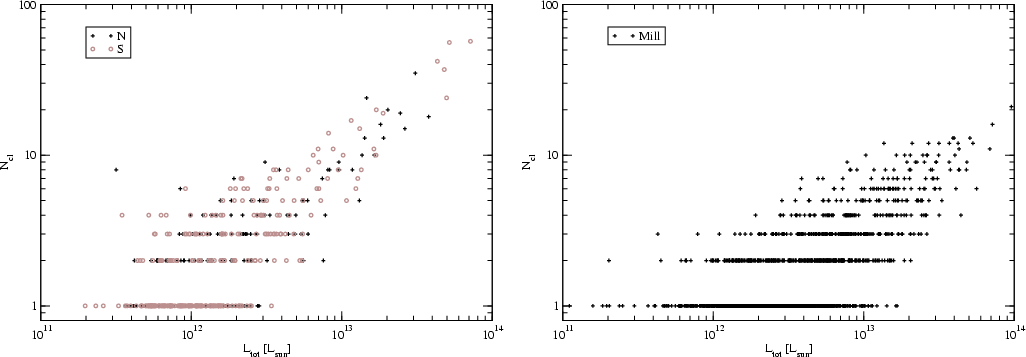 |
Figure 2: The number of DF-clusters as functions of the total luminosity of the supercluster. Left: 2dF superclusters, right: Millennium Run superclusters. |
| Open with DEXTER | |
In the text
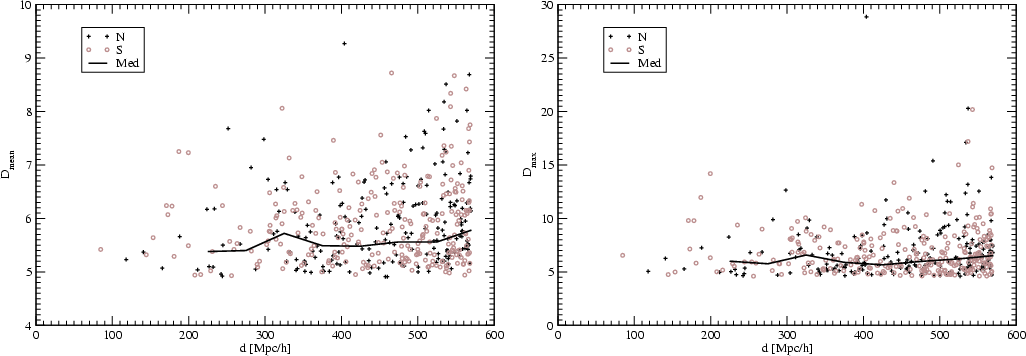 |
Figure 3: The mean ( left panel) and the maximal density ( right panel) of superclusters at various distances from the observer. Solid lines show median values of densities at various distances. |
| Open with DEXTER | |
In the text
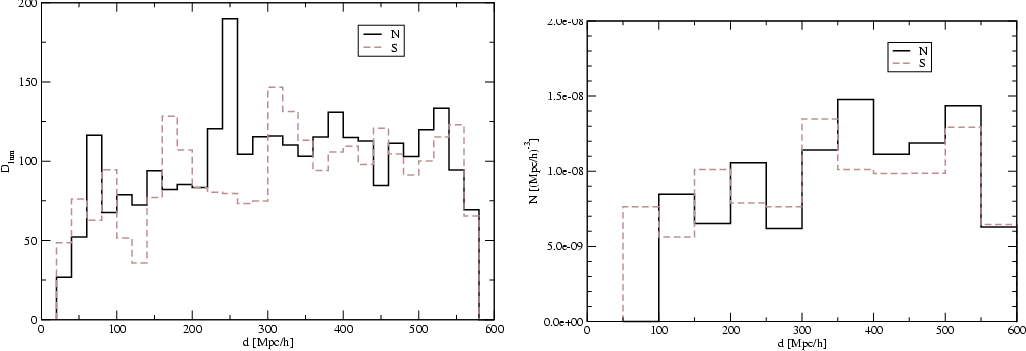 |
Figure 4: Left panel: the mean luminosity density in the Northern and Southern regions of the 2dF as a function of distance (in arbitrary units). Right panel: the mean number density of 2dF superclusters as functions of distance. |
| Open with DEXTER | |
In the text
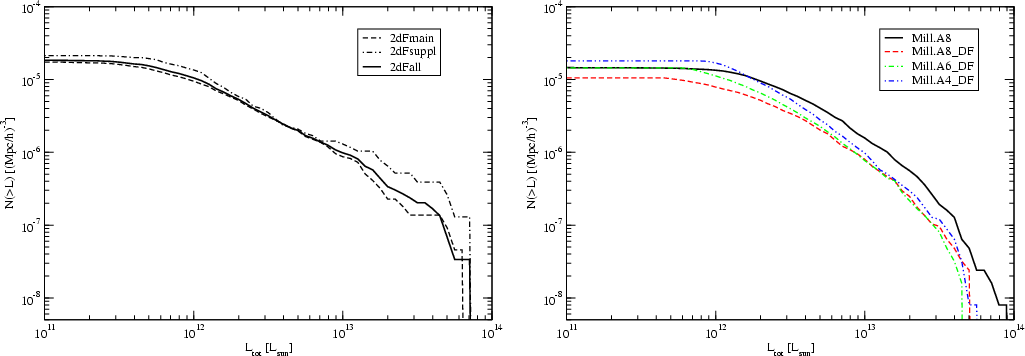 |
Figure 5: The luminosity functions of superclusters. Left: 2dF superclusters, right: Millennium Run superclusters. The supercluster luminosity function for the 2dFGRS was calculated for the main, supplementary, and the total supercluster samples (North and South added), plotted with dashed, dot-dashed and solid curve, respectively. For simulated superclusters the solid bold curve is the luminosity function calculated by adding luminosities of supercluster member galaxies; dashed, dot-dashed and dot-dot-dashed curves correspond to Millennium samples Mill.A8, Mill.A6 and Mill.A4, in these cases the luminosity of superclusters was found from the density field. |
| Open with DEXTER | |
In the text
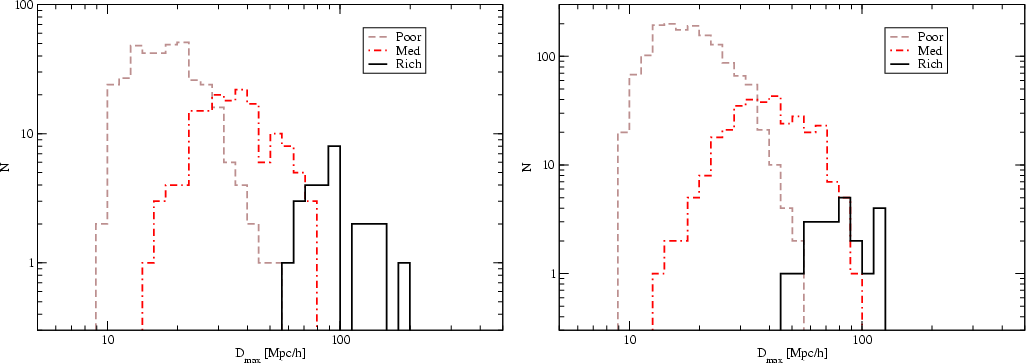 |
Figure 6: The distribution of maximal diameters of poor, medium, and rich superclusters, defined by supercluster multiplicity. The left panel shows data for 2dFGRS superclusters (Northern and Southern regions together), the right panel Mill.A8 superclusters. |
| Open with DEXTER | |
In the text
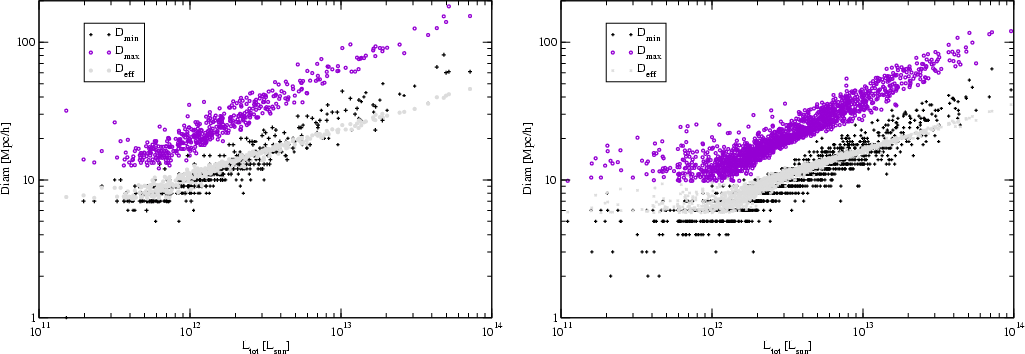 |
Figure 7: The minimal, maximal and effective diameter of superclusters of various total luminosity. The left panel shows data for 2dF superclusters, the right panel for Millennium Run superclusters. |
| Open with DEXTER | |
In the text
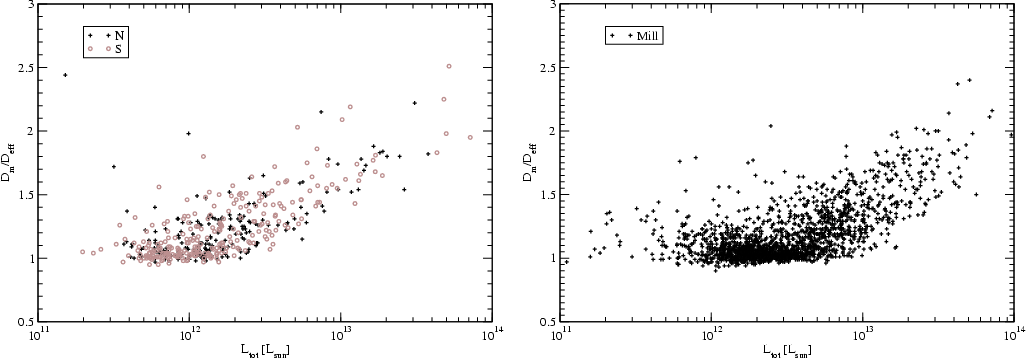 |
Figure 8: The ratio of the mean diameter to the effective diameter in superclusters of various total luminosity. The left panel shows data for 2dF superclusters, the right panel for Millennium Run superclusters. |
| Open with DEXTER | |
In the text
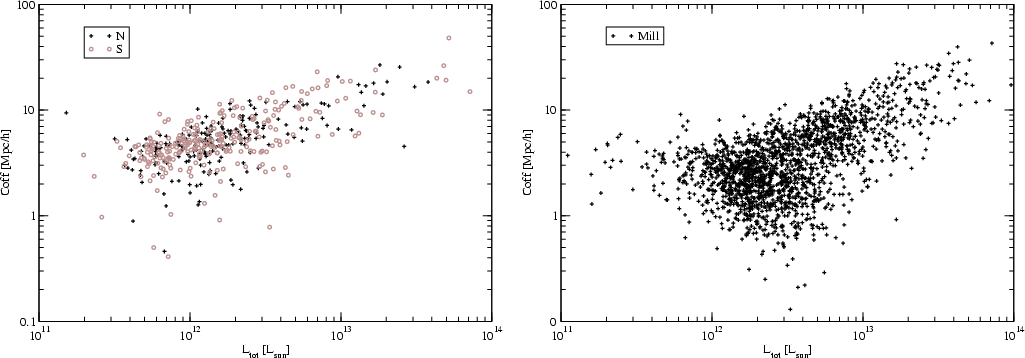 |
Figure 9: The offset of the geometrical center from the dynamical one as a function of the total estimated luminosity of superclusters. The left panel shows 2dF superclusters, right panel Millennium Run superclusters. |
| Open with DEXTER | |
In the text
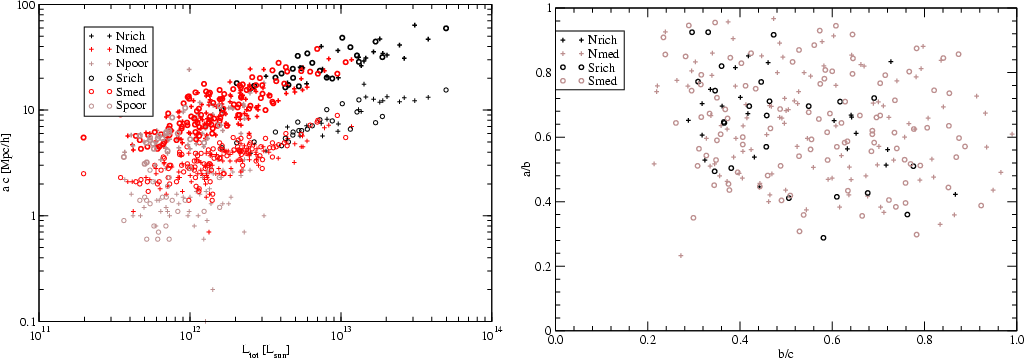 |
Figure 10: Left panel: the semi-minor and semi-major axes of the mass ellipsoid, a and c, are plotted for superclusters of different total luminosities. Bold symbols are for the semi-major axis, and thin ones for the semi-minor axis. Superclusters of various richness are shown with different symbols. Right panel: axial ratios of superclusters a/b vs. b/c for superclusters with at least 10 member groups. Filamentary superclusters populate the upper left part of the figure, spherical superclusters the upper right part, and pancake-like structures the lower right section. Triaxial superclusters are located in the central region. |
| Open with DEXTER | |
In the text
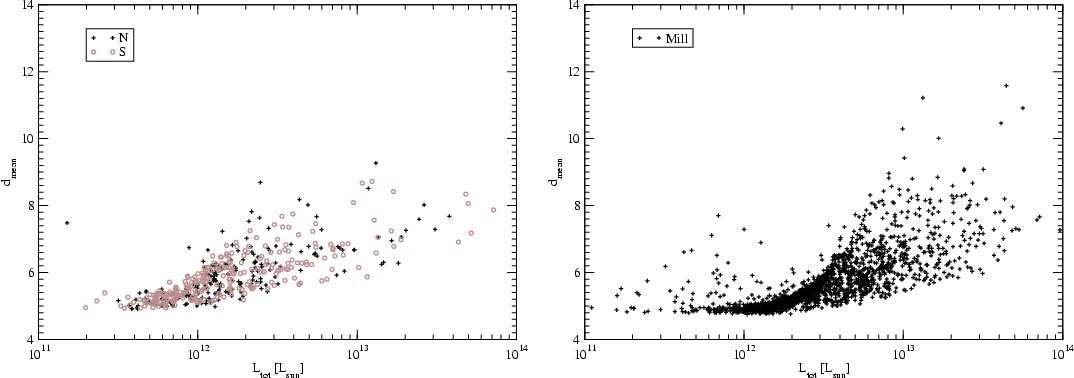 |
Figure 11: Mean density of superclusters as functions of the total luminosity of the supercluster. Left panel shows data for 2dF samples, right panel for Millennium Run data, calculated with a minimal volume 100 (h-1Mpc)3. |
| Open with DEXTER | |
In the text
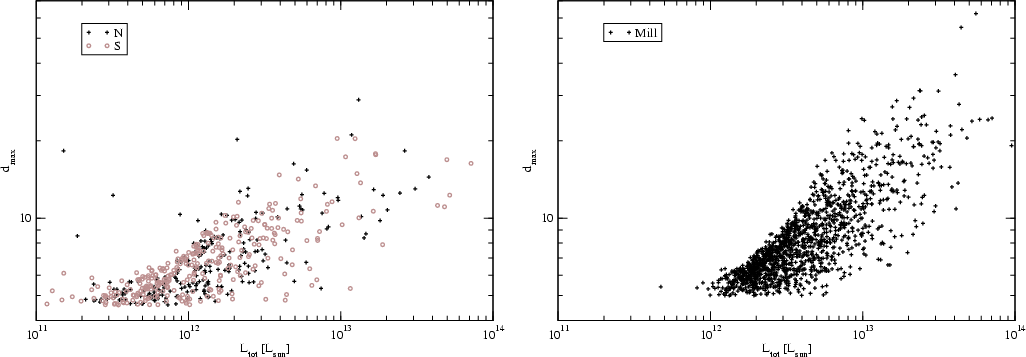 |
Figure 12: Maximal density of superclusters as functions of the total luminosity of the supercluster. Left panel shows data for 2dFGRS samples, right panel for Millennium Run data, calculated with minimal volume 200 (h-1Mpc)3. Notice the difference in the number of poor superclusters. |
| Open with DEXTER | |
In the text
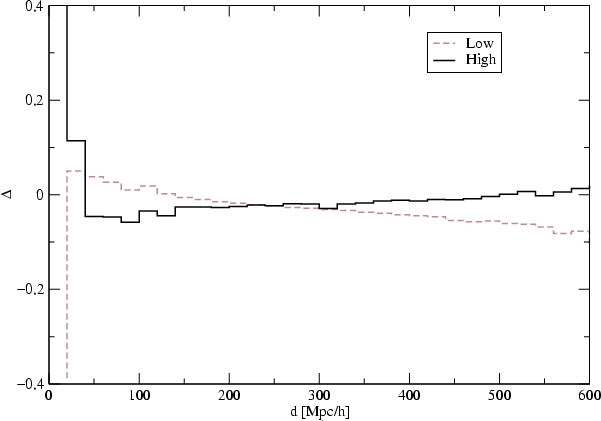 |
Figure 13: The mean difference of the density between density fields of Mill.A8 and Mill.F8, at various distances from the "observer''. The solid line shows differences in overdensity regions, the dashed line in under-density regions. |
| Open with DEXTER | |
In the text
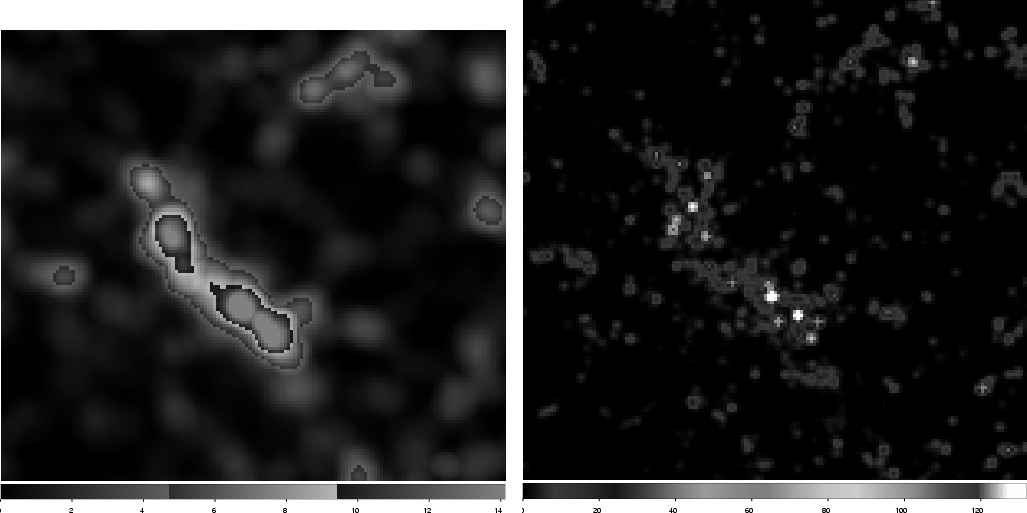 |
Figure 14: The density field through the supercluster SCL126. Left panel shows the low-resolution field, the right panel the high-resolution field. In the low-resolution field the contour limiting green and blue regions corresponds to threshold density 4.6 in units of the mean density, which separates supercluster regions from low-density ones. The length of the box is 150 h-1Mpc. |
| Open with DEXTER | |
In the text