![[*]](/icons/foot_motif.gif) ,
,
A&A 462, 107-122 (2007)
DOI: 10.1051/0004-6361:20054197
,M. Fagiolini1,2 - G. Raimondo3 - S. Degl'Innocenti1,2
1 -
Dipartimento di Fisica, Università di Pisa,
Largo B. Pontecorvo 3, 56126 Pisa, Italy
2 -
INFN, Sezione di Pisa,
Largo B. Pontecorvo 3, 56126 Pisa, Italy
3 -
INAF, Osservatorio Astronomico di Teramo,
via M. Maggini, 64100 Teramo, Italy
Received 13 September 2005 / Accepted 7 August 2006
Abstract
Context. Metal-poor globular clusters (GCs) can provide a probe of the earliest epoch of star formation in the Universe, being the oldest observable stellar systems. In addition, young and intermediate-age low-metallicity GCs are present in external galaxies. Nevertheless, inferring their evolutionary status by using integrated properties may suffer from large intrinsic uncertainty caused by the discrete nature of stars in stellar systems, especially in the case of faint objects.
Aims. In this paper, we evaluate the intrinsic uncertainty (due to statistical effects) affecting the integrated colours and mass-to-light ratios as a function of the cluster's integrated visual magnitude (
 ), which represents a directly measured quantity. We investigate the case of metal-poor, single-burst stellar populations with age from a few million years to a likely upper value for the Galactic globular cluster ages (
 15 Gyr).
Methods. Our approach is based on Monte Carlo techniques for randomly generating stars distributed according to the cluster's mass function.
Results. Integrated colours and mass-to-light ratios in different photometric bands are checked for good agreement with the observational values of low-metallicity Galactic clusters; the effect of different assumptions on the horizontal branch (HB) morphology is shown to be irrelevant, at least for the photometric bands explored here. We present integrated colours and mass-to-light ratios as a function of age for different assumptions on the cluster total V magnitude. We find that the intrinsic uncertainty cannot be neglected. In particular, in models with
 the broad-band colours show an intrinsic uncertainty high enough to prevent the precise age of the cluster from being evaluated. The effects of different assumptions on the initial mass function and on the minimum mass for which carbon burning is ignited for both integrated colours and mass-to-light ratios are also analysed. Finally, the present predictions are compared with recent results available in the literature, showing non-negligible differences in some cases.
Key words: stars: evolution - Galaxy: globular clusters: general - galaxies: star clusters
A key issue in astronomy is to determine the ages and chemical
compositions of those stars and stellar systems that are needed to
reconstruct the formation and evolution of galaxies. Toward this
goal, analysing the stellar cluster population in external
galaxies and in the Milky Way is fundamental for tracing the history
of the parent galaxy (see, e.g. Cote et al. 1998; West et al. 2004).
In contrast to the situation in the Galaxy where massive
(
 stars) stellar clusters are old (
 10 Gyr) and metal poor (
![$\rm [Fe/H]\la -0.7$](/articles/aa/full/2007/04/aa4197-05/img30.gif) ), observations indicate that
in the Magellanic Clouds, in the Local Group galaxies, and even in
galaxies beyond the Local Group, massive stellar clusters offer a wide
range of both metallicity and age, so they are considered the main
indicators of stellar formation events in the galaxies history
(Matteucci et al. 2002; Harris 2003; Larsen 2000). We use
the term "globular clusters'' (GCs) to signify the massive clusters of
any given age and chemical composition.
), observations indicate that
in the Magellanic Clouds, in the Local Group galaxies, and even in
galaxies beyond the Local Group, massive stellar clusters offer a wide
range of both metallicity and age, so they are considered the main
indicators of stellar formation events in the galaxies history
(Matteucci et al. 2002; Harris 2003; Larsen 2000). We use
the term "globular clusters'' (GCs) to signify the massive clusters of
any given age and chemical composition.
GCs have the advantage of being bright objects and then of being easily observed beyond the Local Group. In addition, they are thought to be simple stellar populations (SSPs) consisting of a gravitationally bound group of stars born at nearly the same moment and with a nearly identical chemical composition. The integrated broad-band colours, line indices, and mass-to-light ratios that we observe from those systems are the unique observational tools for understanding their properties. Since the pioneering work by Tinsley (1972), different groups have developed population synthesis models for interpreting these observables: e.g. Renzini & Buzzoni (1986), Brocato et al. (1990b), Charlot & Bruzual (1991), Buzzoni (1993), Bressan et al. (1994), Worthey (1994), Maraston (1998), Kurth et al. (1999), Brocato et al. (2000), Vazdekis (1999), Girardi et al. (2000), Anders & Fritze-v. Alvensleben (2003), Bruzual & Charlot (2003), and Maraston (2005).
Besides the systematic uncertainties due to different sets of stellar evolutionary tracks and different spectral libraries used to transform the models from luminosity and effective temperature to observable quantities (see e.g. Bruzual & Charlot 2003; Yi 2003; Brocato et al. 2000; Maraston 1998; Charlot et al. 1996), broad-band colours may suffer from large intrinsic fluctuations caused by the discrete nature of the number of stars in the system. The first studies were carried out in the optical by Barbaro & Bertelli (1977) for population I clusters and by Chiosi et al. (1988) for intermediate (Z=0.001) and solar metallicity, while Santos & Frogel (1997) analysed the case for near-infrared (NIR) bands. Among other results, these authors conclude that it is necessary to include stochastic effects when deriving ages and metallicities from integrated broad-band colours.
Most studies normalized their theoretical predictions to the total
number of stars or total mass in the cluster, while
Brocato et al. (2000,1999) derived the mean broad-band colours
and the corresponding dispersions as a function of the cluster's
visual magnitude (
)
for selected values of ages. This
approach directly links theory and observations and is crucial
when the cluster age and metallicity are inferred from the observed
broad-band colours, especially for clusters at the faint end of the
GC luminosity function.
In this paper we extend the investigations by Brocato et al. (1999) and
Brocato et al. (2000) and analyse stochastic effects not only on
broad-band colours, but also on mass-to-light ratios as a
function of the adopted cluster visual magnitude,
.
We
provide a comprehensive study of this problem by investigating the
time-evolution of both integrated colours and mass-to-light
ratios for a fine grid of stellar ages and for three different
values of
.
The analysis is carried out using new
single-burst low-metallicity models (Z=0.0002) based on the
updated database of stellar models by Cariulo et al. (2004). We choose
this metallicity because the metal-poor GCs can provide a probe of
the earliest epoch of star formation in the Universe, being the
oldest observable stellar systems. In addition, young and
intermediate-age low-metallicity GCs are present in external
galaxies (Larsen & Richtler 1999). For these reasons, and
also because analysing young metal-poor clusters gives an idea
on how old GCs appeared when they formed, we explore a wide range of
ages (
![$7.7 \leq \log [{\rm age (yr)}] \leq 10.3$](/articles/aa/full/2007/04/aa4197-05/img31.gif) ). We note that we did not
take redshift effects into account, so that our calculations can be used
only for objects with a redshift lower than about 0.1.
). We note that we did not
take redshift effects into account, so that our calculations can be used
only for objects with a redshift lower than about 0.1.
The results are compared with a sample of low-metallicity clusters in the Galaxy with different HB morphology, chosen as prototypes of the old stellar populations studied in this work. The present theoretical predictions are also compared with recent results available in the literature showing in some cases non-negligible differences.
We also discuss the influence of the adopted initial mass function
(IMF) on integrated colours and mass-to-light ratios and the
effect of changing the maximum mass (
 )
for which carbon
burning is not ignited, due to effects by the degenerate pressure
and neutrino energy losses in the core. The assumption of a fixed
can lead to a peculiar behaviour when varying the shape
of the IMF, since an adjustment of the total number of stars might
be required to keep the
value fixed.
)
for which carbon
burning is not ignited, due to effects by the degenerate pressure
and neutrino energy losses in the core. The assumption of a fixed
can lead to a peculiar behaviour when varying the shape
of the IMF, since an adjustment of the total number of stars might
be required to keep the
value fixed.
The layout of the paper is the following. In Sect. 2 the ingredients of the stellar population synthesis code are outlined, including a brief description of the method adopted to derive the integrated quantities. In Sect. 3 we show the comparison of the theoretical results with selected observations of galactic globular clusters. Then, we discuss the uncertainties affecting integrated colours (Sect. 4) and mass-to-light ratios (Sect. 5), together with a comparison with previous works.
Synthetic CMDs and magnitudes presented in this paper are based on
the stellar population synthesis code developed by
Brocato et al. (2000,1999) and Raimondo et al. (2005). In this section, we briefly
describe the main ingredients and recall the method used to derive
integrated magnitudes and colours, and refer the reader to the cited papers for
more details.
The present SSP models rely on the evolutionary tracks of the "Pisa
Evolutionary library'' for masses
 (Cariulo et al. 2004). The input physics adopted in the stellar evolution models has
already been discussed in Cariulo et al. (2004). We only point out here
that the models take atomic diffusion into account, including the
effects of gravitational settling and thermal diffusion with
diffusion coefficients given by Thoul et al. (1994); radiative
acceleration (see e.g. Richard et al. 2002; Richer et al. 1998) is not
included. The effects of rotation (see
e.g. Palacios et al. 2003; Maeder & Zahn 1998) are also not included.
Convective regions, identified following the Schwarzschild criterion, are
treated with the mixing-length formalism. Moreover, the canonical
assumption of inefficient overshooting is used, so the He-burning structures are
calculated according to the prescriptions of canonical semiconvection
induced by the penetration of convective elements in the radiative region
(Castellani et al. 1985). The efficiency and presence of a mild
overshooting are still open questions (Brocato et al. 2003; Barmina et al. 2002); however, as discussed in Yi (2003), a modest amount of
overshooting (i.e.
(Cariulo et al. 2004). The input physics adopted in the stellar evolution models has
already been discussed in Cariulo et al. (2004). We only point out here
that the models take atomic diffusion into account, including the
effects of gravitational settling and thermal diffusion with
diffusion coefficients given by Thoul et al. (1994); radiative
acceleration (see e.g. Richard et al. 2002; Richer et al. 1998) is not
included. The effects of rotation (see
e.g. Palacios et al. 2003; Maeder & Zahn 1998) are also not included.
Convective regions, identified following the Schwarzschild criterion, are
treated with the mixing-length formalism. Moreover, the canonical
assumption of inefficient overshooting is used, so the He-burning structures are
calculated according to the prescriptions of canonical semiconvection
induced by the penetration of convective elements in the radiative region
(Castellani et al. 1985). The efficiency and presence of a mild
overshooting are still open questions (Brocato et al. 2003; Barmina et al. 2002); however, as discussed in Yi (2003), a modest amount of
overshooting (i.e.
 ,
see also Brocato et al. 2003) influences
only integrated colours of those stellar populations
with ages
,
see also Brocato et al. 2003) influences
only integrated colours of those stellar populations
with ages  1.5 Gyr for a maximum amount of 0.1 mag. Finally, the stellar models span the
evolutionary phases from the main sequence up to C ignition or the onset of
thermal pulses (TP) in the advanced asymptotic giant branch (AGB) in the mass
range
1.5 Gyr for a maximum amount of 0.1 mag. Finally, the stellar models span the
evolutionary phases from the main sequence up to C ignition or the onset of
thermal pulses (TP) in the advanced asymptotic giant branch (AGB) in the mass
range
 .
This allows us to calculate stellar
population models in the age range
.
This allows us to calculate stellar
population models in the age range
 Gyr.
Gyr.
Beyond the early-AGB phase, thermally pulsating (TP) stars are
simulated in our synthesis code using the analytic formulas of
Wagenhuber & Groenewegen (1998) which describes the time evolution of
the core mass and luminosity of TP stars. These formulae include
three important effects: (i) the first pulses do not
reach the full amplitude, (ii) the hot bottom burning process that
occurs in massive stars, and (iii) the third dredge-up. The
effective temperature ( )
of each TP-AGB star is
evaluated using prescriptions by Renzini & Voli (1981), considering
the appropriate slope d
)
of each TP-AGB star is
evaluated using prescriptions by Renzini & Voli (1981), considering
the appropriate slope d
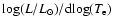 of the
adopted evolutionary tracks. The analytic procedure ends up
providing the time evolution of the temperature and luminosity for a
given mass (see for details Raimondo et al. 2005).
of the
adopted evolutionary tracks. The analytic procedure ends up
providing the time evolution of the temperature and luminosity for a
given mass (see for details Raimondo et al. 2005).
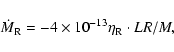
Mass loss affecting red giant branch (RGB) stars and early-AGB
stars is taken into account following prescriptions by
Reimers (1975)
 are, respectively, the star luminosity, radius,
total mass, and envelope mass in solar units;
are, respectively, the star luminosity, radius,
total mass, and envelope mass in solar units;
 ,
being
,
being
 the envelope mass at the
first TP. Equation (2) is a modification of the Reimers formula
with
the envelope mass at the
first TP. Equation (2) is a modification of the Reimers formula
with
 ,
which also includes a dependence on the actual mass
envelope. The initial-final mass relation is from
Dominguez et al. (1999), and no white dwarfs (WD) more massive than
,
which also includes a dependence on the actual mass
envelope. The initial-final mass relation is from
Dominguez et al. (1999), and no white dwarfs (WD) more massive than
 are accepted (Prada Moroni & Straniero 2006).
In this paper the TP phase is included, but we do not adopt any separation between C-rich and O-rich TP-stars. All stars are oxygen-rich when they enter the AGB phase. Whether or not they become C-stars primarily depends on the efficiency of the third dredge-up (TDU) occurring in the TP-AGB phase and on the extent and time-variation of the mass loss (e.g. Marigo et al. 1999; Straniero et al. 2003). In low-metallicity stars (Z < 0.004), the amount of oxygen in the envelope is so low that a few thermal pulses are sufficient to convert an O-rich star into a C-star (Renzini & Voli 1981). In addition, the lower the metallicity the lower the minimum mass for the onset of TDU (e.g. Straniero et al. 2003). On the other hand, TP-AGB stars may experience episodes of strong mass loss, which in the case of low mass stars may cause a reduction of the envelope mass that may delay or even prevent the TDU occurrence and the formation of C-rich stars (Marigo et al. 1999).
In conclusion, the presence of C-rich stars may affect NIR-bands luminosity and its uncertainty in the case of low-metallicity, intermediate-age massive clusters (see e.g. Maraston 1998), while at the typical age of Galactic globular clusters their presence becomes more uncertain, as confirmed by the fact that AGB stars in GGC are all observed to be oxygen-rich, so that carbon does not appear to have been dredged up into the envelop during thermal pulses (Lattanzio & Wood 2003). Our assumption is also expected to have a marginal effect on integrated quantities of faint populations, as bright TP-AGB stars are statistically less frequent, or even absent. Finally, it will be shown that the details and the treatment of the physical processes at work in the TP-AGB phase, as well as their impact on synthetic colours, is still uncertain (Sect. 4).
The adopted colour transformations for the standard
 bands
are from Castelli (1999), see also Castelli et al. (1997). To
calculate integrated colours in the Hubble Space Telescope (HST)
bands (WFPC2 and NICMOS systems),
we adopt the colour transformations by Origlia & Leitherer (2000)
based on the Bessell et al. (1998) stellar atmospheric
models.
bands
are from Castelli (1999), see also Castelli et al. (1997). To
calculate integrated colours in the Hubble Space Telescope (HST)
bands (WFPC2 and NICMOS systems),
we adopt the colour transformations by Origlia & Leitherer (2000)
based on the Bessell et al. (1998) stellar atmospheric
models.
As is well-known, the mixing-length parameter ( )
governs the
efficiency of convection in the convective envelope of a stellar
structure. In the evolutionary tracks of
Cariulo et al. (2004) the parameter has been calibrated in
such a way that the isochrones reproduce, with the adopted colour
transformations, the observed RG branch colour of GCs with the proper
metallicity and age. This is evident from Fig. 2 in which
our synthetic models nicely reproduce the RGB colours of the selected GCs. The parameter needed to obtain this agreement is
)
governs the
efficiency of convection in the convective envelope of a stellar
structure. In the evolutionary tracks of
Cariulo et al. (2004) the parameter has been calibrated in
such a way that the isochrones reproduce, with the adopted colour
transformations, the observed RG branch colour of GCs with the proper
metallicity and age. This is evident from Fig. 2 in which
our synthetic models nicely reproduce the RGB colours of the selected GCs. The parameter needed to obtain this agreement is
 ,
but it is worth
noticing that
is a free parameter that is sensitive to
the chosen colour transformations and on all the adopted physical
inputs that affect the effective temperature of a
model. Cariulo et al. (2004) show that tracks with the same physical
assumptions for metallicity up to
,
but it is worth
noticing that
is a free parameter that is sensitive to
the chosen colour transformations and on all the adopted physical
inputs that affect the effective temperature of a
model. Cariulo et al. (2004) show that tracks with the same physical
assumptions for metallicity up to
 reproduces the RGB colours of galactic GCs for the same values, while metal-rich
(Z>0.001) and standard solar models require a slightly
lower
(see Ciacio et al. 1997; Castellani et al. 2003).
reproduces the RGB colours of galactic GCs for the same values, while metal-rich
(Z>0.001) and standard solar models require a slightly
lower
(see Ciacio et al. 1997; Castellani et al. 2003).
In this work the very low-mass tracks (VLM,
 )
are taken
from Baraffe et al. (1997). The tracks have been already transformed by
the authors to the observational plane in the Johnson-Cousins system
after adopting the colour transformations by Allard et al. (1997),
particularly suitable for low-mass stars. We checked that low-mass
models satisfactorily match the higher
mass models in all the available colours (Fagiolini 2004).
However, as already discussed by
e.g. Brocato et al. (2000), VLM stars do not contribute to the
photometric indices, although their contribution to the cluster mass
is fundamental. Masses lower than the minimum mass for the central H ignition
)
are taken
from Baraffe et al. (1997). The tracks have been already transformed by
the authors to the observational plane in the Johnson-Cousins system
after adopting the colour transformations by Allard et al. (1997),
particularly suitable for low-mass stars. We checked that low-mass
models satisfactorily match the higher
mass models in all the available colours (Fagiolini 2004).
However, as already discussed by
e.g. Brocato et al. (2000), VLM stars do not contribute to the
photometric indices, although their contribution to the cluster mass
is fundamental. Masses lower than the minimum mass for the central H ignition
 do not significantly contribute to the total
mass of the cluster (see e.g. Chabrier & Mera 1997), and so
they are not taken into account.
do not significantly contribute to the total
mass of the cluster (see e.g. Chabrier & Mera 1997), and so
they are not taken into account.
Post-AGB evolution experienced by stars before entering the white dwarfs (WD)
cooling sequence is not considered because the evolutionary time
is too short to have a significant influence (see
e.g Bloecker & Schoenberner 1997). WDs are included in the code using
evolutionary models by Salaris et al. (2000). The tracks have been
transformed by
the authors after adopting the atmospheric models by
Saumon & Jacobson (1999) for DA WDs, which include
the collision-induced absorption of H2 molecules for T<4000 K. For higher temperatures, the transformations of
Bergeron et al. (1995) were used.
Our standard model adopts
 (Dominguez et al. 1999). As expected, and as already noted by
e.g. Angeletti et al. (1980), the contribution of the WD population to
optical and NIR photometric indices is negligible, although they
contribute to the total mass of the cluster significantly.
(Dominguez et al. 1999). As expected, and as already noted by
e.g. Angeletti et al. (1980), the contribution of the WD population to
optical and NIR photometric indices is negligible, although they
contribute to the total mass of the cluster significantly.
The IMF of Kroupa (2002) is adopted in the mass interval
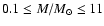 ,
unless explicitly stated otherwise. To
simulate the mass distribution of stars in the synthetic CMD, we
used a Monte Carlo method: the position of each randomly created star in
the
,
unless explicitly stated otherwise. To
simulate the mass distribution of stars in the synthetic CMD, we
used a Monte Carlo method: the position of each randomly created star in
the
 vs.
vs.
 diagram was determined for each
given age. As already discussed, the chemical composition is fixed
to Z=0.0002 and Y=0.23.
diagram was determined for each
given age. As already discussed, the chemical composition is fixed
to Z=0.0002 and Y=0.23.
![\begin{figure}
\par\includegraphics[width=7cm,clip]{4197f1.eps}
\end{figure}](/articles/aa/full/2007/04/aa4197-05/img55.gif) |
Figure 1:
Synthetic CMDs for Z=0.0002, Y=0.23, and three different ages: 500 Myr (black), 2 Gyr (red), and 11 Gyr (blue). For each
population,
 mag is adopted. The simulation of photometric errors is not
included.
mag is adopted. The simulation of photometric errors is not
included. |
| Open with DEXTER | |
Figure 1 shows, as an example, synthetic CMDs (without
simulation of photometric errors) for the selected chemical
composition, a total absolute visual magnitude
mag,
and three different ages (500 Myr, 2 Gyr, and 11 Gyr). All the
evolutionary phases described above are clearly visible.
To compute integrated fluxes and magnitudes, we assume that the
integrated light from the stellar population is dominated by light
emitted by its stellar component. This implies that i) no source of
non-thermal emission are at work, ii) the thermal emission by
interstellar gas gives no sizeable contribution to the integrated
flux, and iii) the absorption from dust and gas are negligible. On
this basis, the integrated flux in each photometric filter mainly
depend on two quantities. The first is the flux fi emitted by the
ith star of mass M, age t (stellar system age), luminosity l,
effective temperature
 ,
and chemical composition (Y, Z):
,
and chemical composition (Y, Z):
![\begin{displaymath}f_{i}[l(M,t,Y,Z),T_{\rm eff}(M,t,Y,Z),Y,Z]
\end{displaymath}](/articles/aa/full/2007/04/aa4197-05/img57.gif) |
(3) |
here fi is defined by the stellar evolutionary-tracks library and
by the adopted temperature-colour transformation tables.
The second quantity is  ,
which describes the number of
stars with mass M in a population globally constituted of N stars with age t and chemical composition (Y, Z). It is
strictly related to the IMF.
,
which describes the number of
stars with mass M in a population globally constituted of N stars with age t and chemical composition (Y, Z). It is
strictly related to the IMF.
A fundamental point of our code is that the mass of each generated star is obtained by using Monte Carlo techniques, while the mass distribution is ruled by the IMF. The mass of each star is generated randomly, and its proper evolutionary line is computed by interpolating the available tracks in the mass grid. This method is crucial for poorly populated stellar systems, as we study in the following. It ensures that the undersampled evolutionary phases are treated properly; for instance, NIR colours may be dominated by a handful of red giant stars (Raimondo et al. 2005; Santos & Frogel 1997; Cerviño & Valls-Gabaud 2003; Brocato et al. 1999).
In each model, stars are added until reaching a given value of the absolute visual magnitude, MV, at any age. The mass values are generated randomly and distributed according to the chosen IMF. It is relevant that the random extraction of masses is fully independent from model to model even if the same input quantities (MV, t, N, Y, Z, IMF, etc.) are assumed.
Both the previous quantities (fi and )
are
combined and integrated by the stellar population code to derive
the total integrated flux F in a given photometric band
![\begin{displaymath}F[N,t,Y,Z] = \sum _{i=1}^N f_{i},
\end{displaymath}](/articles/aa/full/2007/04/aa4197-05/img59.gif) |
(4) |
Table 1:
Observed and theoretical integrated colours for the selected globular clusters. Values from
the Harris catalogue are dereddened according to Reed et al. (1988). The J-K near-IR colour is from
Brocato et al. (1990a), dereddened according to Cardelli et al. (1989).
 is from the
compilation by Pryor & Meylan (1993).
is from the
compilation by Pryor & Meylan (1993).
![\begin{figure}
\par\includegraphics[width=5cm,clip]{4197f2a.eps}\par\vspace*{2mm...
...}\par\vspace*{2mm}
\includegraphics[width=5cm,clip]{4197f2c.eps}
\end{figure}](/articles/aa/full/2007/04/aa4197-05/img61.gif) |
Figure 2: Comparison between present synthetic CMDs (red dots), without the inclusion of simulated photometric errors, and the observed ones of the globular clusters M 68, M 15, and M 30 (black dots). The assumed age is 11 Gyr, and the adopted chemical composition is Z=0.0002 and Y=0.23 (see text). The values of the distance modulus and the reddening obtained from the analysis are also indicated. |
| Open with DEXTER | |
Before studying the general behaviour of colours and mass-to-light
ratios as a function of MV, the natural test for SSP models is to
compare their predictions to the observed properties of Galactic
star clusters. Three old galactic globular clusters (GGCs) were
selected for checking our capability of reproducing both the CMD
morphology of each cluster and the integrated magnitudes: NGC 4590
(M 68), NGC 7078 (M 15), and NGC 7099 (M 30). They are all metal-poor,
span a relativity wide range of the visual magnitude
(Table 1), and show different horizontal branch
morphologies. This allows us to check the effect of HB morphologies
on the integrated colours in the selected bands. The [Fe/H] values
estimated for the three clusters are, respectively,
[Fe/H
]= -2.06,-2.26,-2.12 (Harris 1996), while the -elements enhancement can
be evaluated as
![$[\alpha/{\rm Fe}] \approx 0.3$](/articles/aa/full/2007/04/aa4197-05/img62.gif) (see, e.g.,
the discussion in Ferraro et al. 1999); thus we can assume
(see, e.g.,
the discussion in Ferraro et al. 1999); thus we can assume
 .
We include M 15 due to its brightness (
.
We include M 15 due to its brightness (
 ), even if it is recognised as a cluster that should have
undergone a gravothermal catastrophe. This results in a contraction
of the cluster core while the external regions expand, with some
stars escaping the system. As a possible consequence of such a
dynamical evolution, observational evidence of mass segregation and
of radial color gradients has been found (Bailyn et al. 1989; De Marchi & Paresce 1994; Stetson & West 1994).
), even if it is recognised as a cluster that should have
undergone a gravothermal catastrophe. This results in a contraction
of the cluster core while the external regions expand, with some
stars escaping the system. As a possible consequence of such a
dynamical evolution, observational evidence of mass segregation and
of radial color gradients has been found (Bailyn et al. 1989; De Marchi & Paresce 1994; Stetson & West 1994).
Figure 2 shows the observed CMDs for the selected clusters. The B and V photometry comes from the HST-Snapshot Catalog by Piotto et al. (2002), except for M 68 whose data are from Walker (1994). The synthetic CMD that better reproduces the observational data is over-plotted in each panel. An age of 11 Gyr is assumed for each cluster; we are not interested in a detailed calibration of the cluster ages, which is far from our purpose. Results for each comparison between synthetic and observed cluster are, briefly:
- M 68 (NGC 4590): We find
(m-M)V = 15.29 and
EB-V =
0.05 in agreement, within the uncertainties, with the current
distance modulus and reddening determinations
(e.g. Di Criscienzo et al. 2004; Harris 1996; Carretta et al. 2000). The HB
morphology is reproduced using
 with a dispersion
 .
Due to the present uncertainties in the
factors that influence the HB morphology and in the precise
treatment of mass loss in the RG branch (see e.g. Lee et al. 1994; Rey et al. 2001), the tuning of the adopted value of
.
Due to the present uncertainties in the
factors that influence the HB morphology and in the precise
treatment of mass loss in the RG branch (see e.g. Lee et al. 1994; Rey et al. 2001), the tuning of the adopted value of  is just a way
to obtain the observed HB morphology, but it should not be
interpreted in terms of the physical parameters of the stellar cluster.
is just a way
to obtain the observed HB morphology, but it should not be
interpreted in terms of the physical parameters of the stellar cluster.
- M 15 (NGC 7078): The best fit is obtained by assuming
(m-M)V = 15.50 and
EB-V = 0.09, in agreement with current
determinations of the cluster distance modulus and reddening
(Di Criscienzo et al. 2004; Harris 1996; McNamara et al. 2004). The HB morphology
is reproduced using
 and
and
 .
The
cluster contains one of the few planetary nebulae (PN) known in
GGCs: the star K648 identified as a PN by Pease (1928), for which
Alves et al. (2000) measured an apparent magnitude of V=14.73.
.
The
cluster contains one of the few planetary nebulae (PN) known in
GGCs: the star K648 identified as a PN by Pease (1928), for which
Alves et al. (2000) measured an apparent magnitude of V=14.73.
- M 30 (NGC 7099): Assuming
EB-V =0.05, we obtain
(m-M)V=14.93 in agreement with Sandquist et al. (1999). The HB
morphology is reproduced using the same parameters as in
Brocato et al. (2000), i.e.
 and
and
 .
.
Table 1 gives the observed integrated colours for the
selected clusters, taken from the Catalog of Parameters for
Milky Way Globular Clusters
(Harris 1996) and synthetic integrated colours obtained
from the present models by reproducing, within the errors, the
observed total visual magnitude of each cluster. Optical
observational data are de-reddened according to Reed et al. (1988) with
reddening values taken from Harris (1996). To give an idea of
uncertainties for the colours, we report the "residual'' values
computed by Reed (1985) that result from his homogenization
procedure based on measurements of cluster colours by various
authors. In some cases the availability of only one measurement
prevents the determination of an uncertainty. The NIR colours are from
Brocato et al. (1990a), de-reddened according to Cardelli et al. (1989)
with reddening values taken from Harris (1996).
Table 2:
Integrated colours in the standard UBVRIJHK photometric filters for our standard model with
 and Z=0.0002. (Full version available at CDS.)
Theoretical errors correspond to  dispersion evaluated
from 10 independent simulations. Table 1 lists:
cluster identifier (Col. 1), total absolute V magnitude
(
,
Col. 2), integrated U-B, B-V, V-R, V-I,
V-J, and V-K colours (Cols. 3-7), and
(Col. 8) from
Pryor & Meylan (1993). The last values are strongly
model-dependent, as stressed by the authors themselves.
Hereinafter we indicate dereddened colours such as, e.g., U-B instead of (U-B)0.
dispersion evaluated
from 10 independent simulations. Table 1 lists:
cluster identifier (Col. 1), total absolute V magnitude
(
,
Col. 2), integrated U-B, B-V, V-R, V-I,
V-J, and V-K colours (Cols. 3-7), and
(Col. 8) from
Pryor & Meylan (1993). The last values are strongly
model-dependent, as stressed by the authors themselves.
Hereinafter we indicate dereddened colours such as, e.g., U-B instead of (U-B)0.
Table 3: As in Table 2 but for WFPC2 (first three columns) and NICMOS1 (last two columns) photometric bands. (Full version available at CDS.)
![\begin{figure}
\par\includegraphics[width=7cm,clip]{4197f3a.eps}\hspace*{4mm}
\...
....eps}\hspace*{4mm}
\includegraphics[width=7cm,clip]{4197f3d.eps}
\end{figure}](/articles/aa/full/2007/04/aa4197-05/img72.gif) |
Figure 3:
Time evolution of selected integrated colours in the
standard UBVRIJHK filters
for models with
(red triangles, dashed lines) and
(black points, solid lines). colour dispersion is reported for each model, see text. |
| Open with DEXTER | |
For each cluster, numerical simulations were performed by populating
the synthetic CMD until the observed
of the cluster is
reproduced (Sect. 2.1). Synthetic colours agree with data of all the
clusters to within the uncertainties and theoretical statistical
fluctuations. The only exception is the V-I colour of M 15 that is
found to be redder than observations. The observed V-I colour of
this cluster is significantly bluer than that of other clusters with
similar metallicity (Harris 1996). In this regard, we recall
that the available V-I measure is based only on one photoelectric
measurement (Kron & Mayall 1960), and it is not possible to estimate
the uncertainty (Reed 1985). To investigate this issue, we used VI stellar photometry by Rosenberg et al. (2000), which contains more than 90% of the cluster light (
 ). By adding the flux of
individual stars, we derived an integrated colour
). By adding the flux of
individual stars, we derived an integrated colour
 ,
in fair agreement with our prediction. This value is higher than
the integrated value by Kron & Mayall (1960), even if it might be
affected by incompleteness at the faint end of the observed
luminosity function. To investigate the origin of the latter
inconsistency in detail is well beyond the purpose of this paper, but what we wish
to point out here is that the observed integrated V-I colour of such a cluster, reported in Table 1, could
be peculiar and hence not representative of metal-poor clusters.
,
in fair agreement with our prediction. This value is higher than
the integrated value by Kron & Mayall (1960), even if it might be
affected by incompleteness at the faint end of the observed
luminosity function. To investigate the origin of the latter
inconsistency in detail is well beyond the purpose of this paper, but what we wish
to point out here is that the observed integrated V-I colour of such a cluster, reported in Table 1, could
be peculiar and hence not representative of metal-poor clusters.
Additional indications may come from analysing the M 15 NIR
colours. The J-K prediction agrees well with the value by
Brocato et al. (1990a, J-K=0.67, reddened) and is also consistent
with data by Burstein et al. (1984), who found J-K=0.62 (reddened).
Interestingly, Burstein et al. (1984) also provide the observed
(V-K)=2.14 (reddened), which becomes
(V-K)=1.86 if corrected
according to our reddening assumptions. By comparing this value with
theory (V-K=2.05), it appears that our models predict a V-K colour
about 0.2 mag redder than observations. Unfortunately, a similar
comparison cannot be made for M 30 and M 68, since they are not listed
by Burstein et al. (1984). Instead, the authors observed M 92 (NGC 6341),
whose metallicity is estimated to be close to M 15, being
![$\rm [Fe/H]=-2.29$](/articles/aa/full/2007/04/aa4197-05/img75.gif) .
Since M 92 is as bright as MV=-8.20, its colours
data can be easily compared with our predictions, as reported in
Table 2, at age 11-13 Gyr. Interestingly,
the observed optical-NIR colour V-K=2.13 agrees well with our
prediction, together with all the optical colours U-B=0.01,
B-V=0.61, and V-I= 0.86 (from Harris's catalog).
.
Since M 92 is as bright as MV=-8.20, its colours
data can be easily compared with our predictions, as reported in
Table 2, at age 11-13 Gyr. Interestingly,
the observed optical-NIR colour V-K=2.13 agrees well with our
prediction, together with all the optical colours U-B=0.01,
B-V=0.61, and V-I= 0.86 (from Harris's catalog).
In conclusion, except for the peculiarity concerning M 15, our models are able to properly predict the integrated colours of, let us say, "normal'' metal-poor clusters, as confirmed by the comparison with the observational data of M 30, M 68 (Table 1), and the additional cluster M 92.
As noted above,
 values reported in the last column of
Table 1 (upper section), derived using isotropic King
models by Pryor & Meylan (1993), are strongly model-dependent, and
thus the reported values are only indicative. Moreover, dynamical
processes, such as star evaporation
(e.g. Spitzer 1987; Vesperini & Heggie 1997), may affect the total
mass and the inferred IMF shape as a function of time. Observed
integrated colours of the selected clusters, as well as theoretical
results, indicate that they are not influenced by the HB morphology,
at least in our modeled photometric bands. Shorter wavelength
ultraviolet colours are expected to be more sensitive to the
presence of an extended blue HB.
values reported in the last column of
Table 1 (upper section), derived using isotropic King
models by Pryor & Meylan (1993), are strongly model-dependent, and
thus the reported values are only indicative. Moreover, dynamical
processes, such as star evaporation
(e.g. Spitzer 1987; Vesperini & Heggie 1997), may affect the total
mass and the inferred IMF shape as a function of time. Observed
integrated colours of the selected clusters, as well as theoretical
results, indicate that they are not influenced by the HB morphology,
at least in our modeled photometric bands. Shorter wavelength
ultraviolet colours are expected to be more sensitive to the
presence of an extended blue HB.
In this section we examine the effects on integrated colours of stochastic fluctuations for different values of the assumed total absolute visual-magnitude and the effects of the still present uncertainty on the IMF shape. The Kroupa (2002) IMF is adopted for the standard model.
Results are presented at fixed absolute visual-magnitude to aid
comparisons with observational data. For these calculations the
evaluation of the statistical fluctuations is
fundamental. Statistical fluctuations of broad-band colours, as well
as mass-to-light ratios, were evaluated by computing a series of
10 independent simulations for a fixed set of population's
parameters (Z, age, IMF, ...) at fixed
,
and
by assuming a 1 error. When fluctuations become large, and
the value above is not fully representative of colours variations,
we extend the analysis up to 100 runs.
This is especially the case of very
poorly populated clusters (MV=-4) and young ages.
error. When fluctuations become large, and
the value above is not fully representative of colours variations,
we extend the analysis up to 100 runs.
This is especially the case of very
poorly populated clusters (MV=-4) and young ages.
The standard models are computed assuming:
 ,
and Kroupa's IMF. As an example, Tables 2 and 3 report integrated colours
as a function of age for models with
;
Johnson-Cousins
colours in Table 2 and HST colours in
Table 3. Table 2 lists from left to
right: age,
,
integrated (U-B), (B-V), (V-R),
(V-I),(V-J), and (V-K) colours. Table 3 reports
from left to right: age, V-F439W2, V-F555W2, V-F814W2 for
the WFPC2 and V-F110W1, V-F160W1 for the NICMOS camera.
,
and Kroupa's IMF. As an example, Tables 2 and 3 report integrated colours
as a function of age for models with
;
Johnson-Cousins
colours in Table 2 and HST colours in
Table 3. Table 2 lists from left to
right: age,
,
integrated (U-B), (B-V), (V-R),
(V-I),(V-J), and (V-K) colours. Table 3 reports
from left to right: age, V-F439W2, V-F555W2, V-F814W2 for
the WFPC2 and V-F110W1, V-F160W1 for the NICMOS camera.
 sensitivity
 ,
and -4 (all
the results for both broad-band colours and mass-to-light
ratios for
and -4 models are available as
electronic tables at the CDS).
,
and -4 (all
the results for both broad-band colours and mass-to-light
ratios for
and -4 models are available as
electronic tables at the CDS).
In Fig. 3 the time evolution of selected integrated
colours is shown for the two extreme cases (
and -4).
In general, broad-band colours
become redder with age, because of the increasing fraction of cool
stars in the populations. For the same reason, the (U-B) colour is
quite age-insensitive for age 1 Gyr.
Within the statistical uncertainties, the mean colours at different
do not show significant differences, except in a few
cases at young ages and for optical-NIR colours. This is due to
the strong variation in the number of very bright red stars
significantly affecting the total luminosity of the cluster.
In an SSP with a total brightness as faint as
,
most of the stars occupy the MS phase, and only a few (or none)
red giants are present, including stars burning He in the core and stars
in the double-shell phase
(see for example Fig. 14 in Raimondo et al. 2005). Hence, the mean V-K colour
(and to a lesser extent V-I) is generally
bluer than in models with
,
where the post-MS phase is
always widely populated. This effect is large in young clusters, for which
colours are more sensitive to the cluster luminosity,
see also Fig. 5 in Santos & Frogel (1997),
and Fig. 8 in Brocato et al. (1999).
To clarify this point, Fig. 4 illustrates the V-K colour distribution for
an SSP model with age 100 Myr and for each choice on
.
The V-K colour distribution of faint clusters shows a populous blue peak, due to the
large fraction of simulations containing mainly
blue stars, and a few sparse simulations at redder colours
containing a few red giants. Consequently, the average colour
is bluer than found for brighter clusters (Fig. 3), which
show a broadened colour distribution shifted towards the red side,
since the probability of having a large number of red stars is higher.
We emphasise that, in the present paper,
for a given cluster age the integrated colours at different cluster
brightnesses are obtained by properly adding stars in all
evolutionary phases according to the IMF and evolutionary
time-scales (i.e. keeping the proportion between the number of stars in
different stages fixed). By
decreasing their absolute magnitude (mass), the natural trend is that the cluster progressively
misses post-MS stars. In other words, due to the discreteness of stars
"if an SSP is far less luminous, then there would be no post-MS stars and the integrated fluxes
would be dominated by upper MS stars with little spread in color, which results
in smaller color fluctuations'' (Santos & Frogel 1997).
The colour behaviour described above is in agreement with Santos & Frogel (1997) and
Brocato et al. (1999), while opposite to what was found by Bruzual & Charlot (2003).
A discussion of the nature of such a discrepancy is beyond the purpose of this paper, since it would require a
detailed comparison between all the assumptions adopted in all the
codes (evolutionary tracks, atmospheres, etc.).
In general, for a further increase in the cluster brightness, the stochastic effects decrease, the colour distribution becomes more regular, and the standard deviation decreases (small spread in colour).
At a given age, the size of errorbars increases as the cluster
luminosity decreases, due to the small number of stars
present in faint clusters (
)
with respect
to bright ones (
). From the figure it
is evident that the statistical errors at
are high enough to prevent a precise
evaluation of the age of the cluster.
The errorbars also increase from B-V to V-K, as shown by
Brocato et al. (1999). This last finding is related to the
expected small number of post-MS stars shining in the infrared
wavelengths, especially in the case of low-luminosity clusters
(
). Moreover, in faint clusters it may happen that
giant stars are not present in each of the simulations we computed
at a fixed age, since their appearance is highly driven by stochastic
phenomena. At a fixed total magnitude, the intrinsic
uncertainty lessens with age, also because a larger number of stars
is needed to reach the given total magnitude.
![\begin{figure}
\par\includegraphics[width=6cm,clip]{4197f4.eps}
\end{figure}](/articles/aa/full/2007/04/aa4197-05/img79.gif) |
Figure 4:
V-K colour distribution resulting from 100 simulations for a model with 100 Myr, Z=0.0002, and
(solid) and -8 mag (dotted). |
| Open with DEXTER | |
![\begin{figure}
\par\includegraphics[width=7.4cm,clip]{4197f5a.eps}\hspace*{4mm}
...
...ps}\hspace*{4mm}
\includegraphics[width=7.4cm,clip]{4197f5d.eps}
\end{figure}](/articles/aa/full/2007/04/aa4197-05/img81.gif) |
Figure 5:
Time evolution of
selected integrated colours for SSPs with
calculated with the lower, central, and upper values for the
Kroupa (2002) IMF exponent ()
for
 .
Black dots indicate our reference model ( .
Black dots indicate our reference model (
 ), red
triangles indicate models with ), red
triangles indicate models with
 ,
and blue stars
models with ,
and blue stars
models with
 . . |
| Open with DEXTER | |
Table 4: The physical ingredients adopted in the models plotted in Fig. 6.
![\begin{figure}
\par\includegraphics[width=7.4cm]{4197f6a.eps}\hspace*{4mm}
\inc...
...f6c.eps}\hspace*{4mm}
\includegraphics[width=7.4cm]{4197f6d.eps}
\end{figure}](/articles/aa/full/2007/04/aa4197-05/img85.gif) |
Figure 6: Integrated colours (B-V, upper panels; V-K, lower panels) from recent papers: present models (black dots); Kurth et al. (1999, red Z=0.0001, green Z=0.0004 squares, solid line), Brocato et al. (2000, cyan dots), Anders & Fritze-v. Alvensleben (2003, orange solid line), Girardi et al. (2000, blue squares, short-dashed line), Zhang et al. (2002, pink circles, dotted line), Bruzual & Charlot (2003, violet Z=0.0001, brown Z=0.0004 circles, dashed line). Maraston (2005, red triangles, dashed line). |
| Open with DEXTER | |
![\begin{figure}
\par\includegraphics[width=7cm,clip]{4197f7a.eps}\hspace*{4mm}
\includegraphics[width=7cm,clip]{4197f7b.eps}
\end{figure}](/articles/aa/full/2007/04/aa4197-05/img88.gif) |
Figure 7:
Left panel: fraction of very low-mass stars (
)
that contribute to
the mass-luminosity ratio (
)
(in solar units) as a function of
the age for
.
Filled circles represent our standard model in
which all masses with
 are included;
the effect of considering only stars with
are included;
the effect of considering only stars with
 (filled triangles) or
(filled
squares) is analysed separately. Right panel: as in the left panel, but
when the WD population is (filled circles, standard model) or is not (filled squares)
included.
(filled triangles) or
(filled
squares) is analysed separately. Right panel: as in the left panel, but
when the WD population is (filled circles, standard model) or is not (filled squares)
included. |
| Open with DEXTER | |
To evaluate the effect of IMF variations on integrated colours, we
changed the Kroupa (2002) IMF exponent ()
within the estimated
uncertainty for masses
 .
In
Fig. 5 models with
calculated with
the lower, central, and upper values of the IMF exponent are plotted
in selected pass-bands; the corresponding data tables are available
as electronic tables at the CDS.
.
In
Fig. 5 models with
calculated with
the lower, central, and upper values of the IMF exponent are plotted
in selected pass-bands; the corresponding data tables are available
as electronic tables at the CDS.
As obtained for metal-rich models investigated in previous papers
(see e.g. Bruzual & Charlot 2003; Brocato et al. 2000; Yi 2003; Maraston 1998),
we find that colour variations are also negligible for very
low-metallicity models, at least in the range of exponents
investigated here, being the colour variations well within the
intrinsic uncertainty, for both values of the brightness of the
cluster (
mag and -8 mag). The errorbars behavior is
similar to what described above: colour fluctuations increase from
the optical-optical to optical-NIR colours and for ages 1 Gyr.
Changing the distribution of very low-mass stars (
 )
has negligible effects on photometric indices whatever
the total visual magnitude, as already shown by Brocato et al. (2000)
for ages greater than 5 Gyr. In poorly populated clusters
as much as in the richest ones,
reducing the number of stars with
)
has negligible effects on photometric indices whatever
the total visual magnitude, as already shown by Brocato et al. (2000)
for ages greater than 5 Gyr. In poorly populated clusters
as much as in the richest ones,
reducing the number of stars with
 does not
affect the integrated colours since the contribution of these stars
to the total V light is only of the order of a few percent
(Brocato et al. 2000). The contribution of such stars slightly
increases with age, but it remains comparable to the statistical
errors even at the oldest ages (at least in the range explored
here).
does not
affect the integrated colours since the contribution of these stars
to the total V light is only of the order of a few percent
(Brocato et al. 2000). The contribution of such stars slightly
increases with age, but it remains comparable to the statistical
errors even at the oldest ages (at least in the range explored
here).
Table 4 summarises the main ingredients used
by various authors in their synthesis code, and
Fig. 6 compares the time-evolution of B-V and
V-K colours of the present work with similar recent results
available in the literature. In the figure our models are plotted
with
intrinsic error, while other authors do not estimate
the colours' statistical errors, except for Brocato et al. (2000). If
colours are not available for exactly the same metallicity value
adopted in the present work (Z=0.0002), the two closest Z values
are plotted. In Fig. 6 we plot an updated
version of the models of Anders & Fritze-v. Alvensleben (2003).
The present predictions agree well with those by Brocato et al. (2000).
There is also good agreement with Kurth et al. (1999) and
Bruzual & Charlot (2003), both based on Padua 1994 stellar
evolutionary tracks (see the quoted papers for the detailed list of
references). Differences can be found in the age range
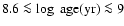 for optical-NIR colours, possibly due to
the treatment of the AGB and TP-AGB phases. Girardi et al. (2000) and
Anders & Fritze-v. Alvensleben (2003) predict redder colours than
all the other authors for
for optical-NIR colours, possibly due to
the treatment of the AGB and TP-AGB phases. Girardi et al. (2000) and
Anders & Fritze-v. Alvensleben (2003) predict redder colours than
all the other authors for
 Myr, as do
Zhang et al. (2002) for
Myr, as do
Zhang et al. (2002) for
 Gyr. In contrast the
others, both Maraston (2005) and our models are based on
no-overshooting tracks. Nevertheless, while the present B-V colours agree well with Maraston's models at all the ages in common,
V-K predictions are bluer than those by Maraston (2005) at ages
younger than
Gyr. In contrast the
others, both Maraston (2005) and our models are based on
no-overshooting tracks. Nevertheless, while the present B-V colours agree well with Maraston's models at all the ages in common,
V-K predictions are bluer than those by Maraston (2005) at ages
younger than  3 Gyr.
Figure 6 shows that the B-V and V-K predictions
from different authors agree within 0.1 mag at
 .
Large model-to-model differences arise at young and intermediate
ages, when the contribution of AGB and TP-AGB stars to the total
flux is high, especially in the NIR bands (see for a
discussion Girardi & Bertelli 1998; Maraston 1998). This has a direct consequence
on predicted colours, since a wide variety of stellar ingredients
and prescriptions are used to simulate these phases.
Temperature-colour relations, mass-loss prescriptions, and the
analytical description of the TP evolution all affect the
photometric properties of such stars, so that it is not
straightforward to individuate a single origin (or multiple ones) to
explain the differences shown in Fig. 6 in the
intermediate-age range.
.
Large model-to-model differences arise at young and intermediate
ages, when the contribution of AGB and TP-AGB stars to the total
flux is high, especially in the NIR bands (see for a
discussion Girardi & Bertelli 1998; Maraston 1998). This has a direct consequence
on predicted colours, since a wide variety of stellar ingredients
and prescriptions are used to simulate these phases.
Temperature-colour relations, mass-loss prescriptions, and the
analytical description of the TP evolution all affect the
photometric properties of such stars, so that it is not
straightforward to individuate a single origin (or multiple ones) to
explain the differences shown in Fig. 6 in the
intermediate-age range.
For instance, mass-loss processes are one of
the physical mechanisms largely affecting the evolution of a TP-AGB star.
However, the effect of mass loss on the observational
properties of TP stars is largely unknown to date. To give an
indication of how mass loss may affect colour predictions, we made
numerical experiments by computing integrated colours in the extreme
case when no TP-AGB stars are present in the population, thus
mimicking a very efficient mass-loss rate (see also Maraston 1998).
As expected, the effect is greater for
intermediate-age populations and in the optical-NIR colours. The
V-K colour becomes bluer than the
 value by 0.5 mag at
 Myr, and the B-V colour decreases only by 0.06 mag at the same age. This effect tends to vanish by increasing the
age. On the other hand, if we lower the mass-loss efficiency with
respect to our standard assumption (BH) by using a Reimers'
law with
Myr, and the B-V colour decreases only by 0.06 mag at the same age. This effect tends to vanish by increasing the
age. On the other hand, if we lower the mass-loss efficiency with
respect to our standard assumption (BH) by using a Reimers'
law with  of the order of 1, and V-K colours redder than our
"standard'' models are obtained. As a consequence the colour decline
at an age corresponding to the appearance of He-core degenerate stars
is more evident (
of the order of 1, and V-K colours redder than our
"standard'' models are obtained. As a consequence the colour decline
at an age corresponding to the appearance of He-core degenerate stars
is more evident ( Gyr), similar to what is obtained by
Maraston (2005) for integrated colours and by Raimondo et al. (2005) for surface
brightness fluctuation colours.
Gyr), similar to what is obtained by
Maraston (2005) for integrated colours and by Raimondo et al. (2005) for surface
brightness fluctuation colours.
Table 6 lists our predictions for the mass-to-light
ratio (
)
in various photometric bands as a function of age
for
;
similar tables for
and
are available at the CDS.
![\begin{figure}
\par\includegraphics[width=8cm,clip]{4197f8.eps}
\end{figure}](/articles/aa/full/2007/04/aa4197-05/img101.gif) |
Figure 8:
Time behaviour of the logarithm of the cluster total mass
needed to reach
normalized to the maximum value,
as a function of age. |
| Open with DEXTER | |
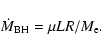
The total mass  includes all the evolving stars up to the
AGB tip (
includes all the evolving stars up to the
AGB tip (
 )
and WDs. Stars with mass higher
than
)
and WDs. Stars with mass higher
than
 are assumed to leave a neutron star (NS)
as a remnant. To evaluate the maximum mass fraction of NS, we set
the neutron star mass at its upper limit (2
are assumed to leave a neutron star (NS)
as a remnant. To evaluate the maximum mass fraction of NS, we set
the neutron star mass at its upper limit (2  ,
see e.g. Bombaci et al. 2004), and we chose high cluster
age (12 Gyr); we found that the NS mass fraction
constitutes at most a few percent of the cluster mass, in agreement
with the calculations by Vesperini & Heggie (1997) who found an
upper value of 1%. The contribution of massive
black holes to the total mass depends on the assumption on the mass of
the remnant and IMF (Maraston 2005). By using the same
prescriptions on the black hole mass as Maraston (2005), we
estimated that for a Kroupa IMF the mass fraction of both neutron
stars and black holes does not exceed 5-10%.
,
see e.g. Bombaci et al. 2004), and we chose high cluster
age (12 Gyr); we found that the NS mass fraction
constitutes at most a few percent of the cluster mass, in agreement
with the calculations by Vesperini & Heggie (1997) who found an
upper value of 1%. The contribution of massive
black holes to the total mass depends on the assumption on the mass of
the remnant and IMF (Maraston 2005). By using the same
prescriptions on the black hole mass as Maraston (2005), we
estimated that for a Kroupa IMF the mass fraction of both neutron
stars and black holes does not exceed 5-10%.
In this paper, the
values are calculated without taking
any dynamical processes into account, e.g. evaporation of stars due
to two-body relaxation or disk shocking (see
e.g. Spitzer 1987; Boily et al. 2005; Vesperini & Heggie 1997). A treatment of
these phenomena is beyond the scope of this work; N-body simulations
showing the effects of these processes on the total mass and IMF
shape as a function of time and on the galactocentric distance of
the cluster can be found in e.g. Vesperini & Heggie (1997). We only
note that, since stellar evaporation is more efficient for low mass
stars, one expects a flattening of the IMF as the dynamical
evolution of a cluster proceeds. Evaluations of the mass fraction of
WDs expected to be lost from clusters due to dynamical evaporation
can be found in Vesperini & Heggie (1997) (see
also Hurley & Shara 2003; Fellhauer et al. 2003). The presence of binary stars
is not taken into account either; the lack of information about the
binary frequency, the distribution of binaries of different mass
ratios, the separation of the components, and the occurrence of
explosions of novae and supernovae prevents a quantitative treatment
of this phenomenon. An attempt to include binary systems in
population synthesis models has recently been presented by
Zhang et al. (2005).
In Fig. 7 we show the influence of VLM stars (
)
and WDs on the
,
where L is the
bolometric luminosity in solar units, at a fixed absolute visual
magnitude (MV=-8). As already known, VLM and WDs provide a
nearly negligible contribution to the total luminosity (see
for example Maraston 1998), while contributing significantly
to the total mass. Figure 7 shows that the fraction of
low-mass stars and white dwarfs increases with the cluster age
(see also Maraston 1998). Since the simulations
are performed at fixed absolute visual magnitude, the total mass of
the cluster varies with age, as shown in Fig. 8,
where we plot the case of MV=-8. This is because, as the age
increases, the mass of the typical star in the cluster decreases.
Table 5:
Mass-to-light ratios for selected ages in
several photometric passbands from our standard model with
different assumptions for
.
Changing
affects the number of
stars cooling as WDs, or in other words the mass fraction locked as WDs,
and thus the total mass of the cluster.
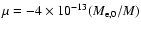
Different input ingredients of stellar evolutionary tracks, as e.g. the
neutrino energy losses in the core, lead to different predictions
of
at fixed metallicity, see e.g.
Tornambe & Chieffi (1986,  ),
Pols et al. (1998,
),
Pols et al. (1998,  ),
Dominguez et al. (1999, ),
Cariulo et al. (2004,
),
Dominguez et al. (1999, ),
Cariulo et al. (2004,  ). We explore
the effect of changing
.
We find that increasing
from 5
up to 7
does not cause
variations in the mass-to-light ratios, at least for the adopted IMF. Even
pushing
up to 10
does not change the mass-to-light ratios
significantly (Table 5).
). We explore
the effect of changing
.
We find that increasing
from 5
up to 7
does not cause
variations in the mass-to-light ratios, at least for the adopted IMF. Even
pushing
up to 10
does not change the mass-to-light ratios
significantly (Table 5).
sensitivity
Figure 9 shows the time evolution of
ratio
in selected passbands for standard models with
(Table 6) and -4 mag. The corresponding data tables
for the case of
and -6 are available
at the CDS. Note that the mass-to-light ratios generally increase with
age independently of the photometric band, because the total mass
increases. This result is similar to what has been obtained by other authors,
who do not keep the luminosity LV constant (see
e.g. Maraston 2005; Bruzual & Charlot 2003).
The only effect of changing the absolute magnitude from MV=-8 to -4 on mass-to-light ratios in the optical bands is to increase the intrinsic uncertainties. In contrast, other than this effect mass-to-light ratios in the NIR bands suffer a larger scatter due to the decrease in red giant contributors to the total NIR luminosity, as shown in the right lower panel of the figure for K-band.
Table 6:
Theoretical
as a function of
the age in different photometric bands (solar units) obtained
for standard models with
.
(Full version available at CDS.)
Since
is fixed, the behaviour of (
)
as a
function of the age reflects the trend of the cluster mass
(Fig. 8); it is quite linear for ages  1 Gyr
in all passbands indicating it is driven by the growth in the total
mass. For ages
1 Gyr
in all passbands indicating it is driven by the growth in the total
mass. For ages  1 Gyr, NIR colours are flatter than the
optical (U,B,V) ones due to the increase in the infrared
luminosity following the development of an extended AGB.
We also find a dimming in
1 Gyr, NIR colours are flatter than the
optical (U,B,V) ones due to the increase in the infrared
luminosity following the development of an extended AGB.
We also find a dimming in
 at the age
corresponding to the AGB phase-transition confirming the result
found by Maraston (2005) for higher metallicity.
at the age
corresponding to the AGB phase-transition confirming the result
found by Maraston (2005) for higher metallicity.
Finally, Fig. 10 compares the present values with the
ones by Bruzual & Charlot (2003), Anders & Fritze-v. Alvensleben (2003), and
Maraston (2005) in two photometric bands, namely B and K.
Concerning the B-band, the agreement with
Bruzual & Charlot (2003) and Maraston (2005) is very
satisfactory, while Anders & Fritze-v. Alvensleben (2003) predict slightly higher values
at
 .
.
A more complex behaviour is shown by
:
at
 the
is independent of the model, but
model-dependent at younger ages. This reflects the great
uncertainties in simulating the AGB phase we have already discussed
for colours.
the
is independent of the model, but
model-dependent at younger ages. This reflects the great
uncertainties in simulating the AGB phase we have already discussed
for colours.
![\begin{figure}
\par\includegraphics[width=7.4cm,clip]{4197f9a.eps}\hspace*{4mm}
...
...ps}\hspace*{4mm}
\includegraphics[width=7.4cm,clip]{4197f9d.eps}
\end{figure}](/articles/aa/full/2007/04/aa4197-05/img173.gif) |
Figure 9:
Time behaviour of the
ratio (in solar units) for selected
passbands (U,B,V,K). For each model, dispersion is shown.
Red triangles (dashed line) indicate models with
,
and black dots (continuos line)
models with
 . .
|
| Open with DEXTER | |
![\begin{figure}
\par\includegraphics[width=7cm,clip]{4197f10a.eps}\hspace*{4mm}
\includegraphics[width=7cm,clip]{4197f10b.eps} \end{figure}](/articles/aa/full/2007/04/aa4197-05/img174.gif) |
Figure 10:
Time evolution of
 ( left panel) and
( right panel)
in our reference model (black dots) compared with
the Bruzual & Charlot (2003, B&C 2003) for models with Z=0.0001 (violet dashed
line), and Z=0.0004 (brown dashed line), Anders & Fritze-v. Alvensleben
(2003, A&F 2003) models (orange solid
line), and Maraston (2005, M2005) for Z=0.0003 (red triangles, dashed line).
The IMF adopted by various authors are
reported in Table 4.
( left panel) and
( right panel)
in our reference model (black dots) compared with
the Bruzual & Charlot (2003, B&C 2003) for models with Z=0.0001 (violet dashed
line), and Z=0.0004 (brown dashed line), Anders & Fritze-v. Alvensleben
(2003, A&F 2003) models (orange solid
line), and Maraston (2005, M2005) for Z=0.0003 (red triangles, dashed line).
The IMF adopted by various authors are
reported in Table 4. |
| Open with DEXTER | |
![\begin{figure}
\par\includegraphics[width=7.4cm,clip]{4197f11a.eps}\hspace*{4mm}...
...s}\hspace*{4mm}
\includegraphics[width=7.4cm,clip]{4197f11d.eps}
\end{figure}](/articles/aa/full/2007/04/aa4197-05/img175.gif) |
Figure 11:
Time evolution of
(in
solar units) in selected passbands (
U, B, V, K) for models with
calculated with the lower,
central, and upper values for the Kroupa (2002) IMF exponent for
.
Black dots indicate our reference model (
 ), red triangles
indicate models with ), red triangles
indicate models with
 ,
and blue stars models with ,
and blue stars models with
 . .
|
| Open with DEXTER | |
![\begin{figure}
\par\includegraphics[width=7.4cm]{4197f12a.eps}\hspace*{4mm}
\in...
...2c.eps}\hspace*{4mm}
\includegraphics[width=7.4cm]{4197f12d.eps}
\end{figure}](/articles/aa/full/2007/04/aa4197-05/img176.gif) |
Figure 12:
Time evolution of
(in
solar units) in selected passbands (
U, B, V, K)
for models with
calculated with the lower,
central, and upper values for the Kroupa (2002) IMF exponent for
.
Black dots indicate our reference model (
), red triangles
indicate models with
,
and blue stars indicate models with
. |
| Open with DEXTER | |
To evaluate the effect of the IMF shape on
,
we changed
the IMF exponents within the estimated uncertainty (Kroupa 2002).
Figures 11 and 12 show the
effect of changing the IMF exponents with respect to the Kroupa
formulation for masses higher and lower than 0.5 ,
respectively. Models with
mag are plotted in selected
passbands while results for other passbands, and for
mag are available at the CDS.
The
ratio is more sensitive than integrated colours to
the IMF shape, as already noted by Maraston (1998),
Bruzual & Charlot (2003), and Maraston (2005).
From Fig. 11 it is
evident that, by decreasing the IMF slope at
,
the mass of the system decreases, while the luminosity remains
almost constant. The final effect is to have lower
ratios than in the standard models (
). At age
lower than few billion years, the uncertainty due to stochastic
effects is comparable or larger than the effects of exponent
variations. Indeed, the IMF variations can be appreciated at ages of
the order of 1010 yr. We also find that the uncertainty
predicted for
models prevents of any detection of significant
variations at any age.
A different situation is found in Fig. 12. The
slightly depend on IMF for ages younger than a
few billion years, while they are nearly insensitive at old
age. This is because an IMF flatter than
at
 requires a total mass lower than in the
standard case (
)
to reach the
given luminosity, thus predicting low
.
The effect is
enhanced in young stellar populations in which the total mass is
dominated by massive stars. On the other hand, by increasing the
exponent up to 2.6, the cluster mass needed to have
MV=-8 increases, leading to high
values. Again,
in the NIR bands are more affected by
stochastic phenomena.
requires a total mass lower than in the
standard case (
)
to reach the
given luminosity, thus predicting low
.
The effect is
enhanced in young stellar populations in which the total mass is
dominated by massive stars. On the other hand, by increasing the
exponent up to 2.6, the cluster mass needed to have
MV=-8 increases, leading to high
values. Again,
in the NIR bands are more affected by
stochastic phenomena.
Finally, note that in the case of small variations (
 )
explored here, the contribution of massive remnants to the
total mass does not change significantly, while it is shown to be
effective if large variations (
)
explored here, the contribution of massive remnants to the
total mass does not change significantly, while it is shown to be
effective if large variations (
 )
are adopted,
see the discussion in Maraston (1998).
)
are adopted,
see the discussion in Maraston (1998).
In this work we have analysed the intrinsic uncertainties due to
stochastic effects on integrated colours and
of metal-poor stellar clusters as a function of the total visual
magnitude. The calculations were performed for three different
values of
and for a fine grid of stellar ages.
Statistical errors are shown to be crucial; especially in the
extreme case
,
they are high enough to prevent precise
quantitative evaluations for all ages. Calculations were made in the
standard UBVRIJHK photometric passbands and in the Hubble Space
Telescope bands (WFPC2 and NICMOS systems).
We checked the consistency of our models on the observational properties of three metal poor clusters, namely M 68, M 15, and M 30, which mainly differ in their absolute visual magnitude and HB morphology. For each cluster we were able to reproduce both the features of the observed CMD and the integrated colours, showing that the HB morphology does not influence the photometric indices being considered.
The comparison with recent results available in the literature shows, in some cases, non-negligible differences due to the wide variety of prescriptions used in the model calculations.
The uncertainties in the results on both colours and mass-to-light
ratios due to the still present uncertainty on the IMF shape
were quantitatively estimated; and while the colour fluctuations
remain within theoretical uncertainties, the
ratio is
more sensitive to the IMF shape. We also showed that the influence
on
of the adopted value for the minimum mass for which
carbon burning is ignited is quite negligible.
Acknowledgements
This work is dedicated to the memory of Vittorio Castellani, whose advise always supported us, and whose enthusiasm and dedication in challenging the astrophysics questions are an invaluable example for all of us. We warmly thank E. Brocato, P.G. Prada Moroni, and S.N. Shore for useful discussions and for a careful reading of the manuscript. We are grateful to the anonymous referee for her/his suggestions and comments that greatly improved the paper. Financial support for this work was provided by MIUR-COFIN 2003. This work made use of computational resources granted by the Consorzio di Ricerca del Gran Sasso according to the Progetto 6 Calcolo Evoluto e sue Applicazioni (RSV6)-Cluster C11/B. This paper utilises the HST-snapshot database by the Globular Cluster Group of the Padova Astronomy Department, and the Catalog of parameters for Milky Way Globular Clusters by W.E. Harris.