Scuti star
  Cephei
A&A 461, 619-630 (2007)
DOI: 10.1051/0004-6361:20065766
Scuti star CepheiH. Bruntt1,2 - J. C. Suárez3,4,![[*]](/icons/foot_motif.gif) - T. R. Bedding2 - D. L. Buzasi5 - A. Moya4 - P. J. Amado6,3 - S. Martín-Ruiz3 - R. Garrido3 - P. López de Coca3 - A. Rolland3 - V. Costa3 - I. Olivares3 - J. M. García-Pelayo3
- T. R. Bedding2 - D. L. Buzasi5 - A. Moya4 - P. J. Amado6,3 - S. Martín-Ruiz3 - R. Garrido3 - P. López de Coca3 - A. Rolland3 - V. Costa3 - I. Olivares3 - J. M. García-Pelayo3
1 - Niels Bohr Institute, Juliane Maries Vej 30, University of Copenhagen, Denmark
2 -
School of Physics A28, University of Sydney, 2006 NSW, Australia
3 - Instituto de Astrofísica de Andalucía, CSIC, CP3004 Granada, Spain
4 - Observatoire de Paris, LESIA, UMR 8109, Meudon, France
5 - US Air Force Academy, Department of Physics, CO, USA
6 -
Universidad de Granada, Departamento Física Teórica y del Cosmos,
Campus Fuentenueva, Granada, Spain
Received 7 June 2006 / Accepted 20 September 2006
Abstract
Aims. We have analysed ground-based multi-colour Strömgren photometry and single-filter photometry from the star tracker on the WIRE satellite of the Scuti star Cephei.
Methods. The ground-based data set consists of 16 nights of data collected over 164 days, while the satellite data are nearly continuous coverage of the star during 14 days. The spectral window and noise level of the satellite data are superior to the ground-based data and this data set is used to locate the frequencies. However, we can use the ground-based data to improve the accuracy of the frequencies due to the much longer time baseline.
Results. We detect 26 oscillation frequencies in the WIRE data set, but only some of these can be seen clearly in the ground-based data. We have used the multi-colour ground-based photometry to determine amplitude and phase differences in the Strömgren b-y colour and the y filter in an attempt to identify the radial degree of the oscillation frequencies. We conclude that the accuracies of the amplitudes and phases are not sufficient to constrain theoretical models of Cep. We find no evidence for rotational splitting or the large separation among the frequencies detected in the WIRE data set.
Conclusions. To be able to identify oscillation frequencies in Scuti stars with the method we have applied, it is crucial to obtain more complete coverage from multi-site campaigns with a long time baseline and in multiple filters. This is important when planning photometric and spectroscopic ground-based support for future satellite missions like COROT and KEPLER.
Key words: stars: oscillations - stars: variables:
Sct - stars: individual: Cephei (HD 211336; HR 8494) - techniques: photometric
Scuti stars are main sequence population I A- and F-type stars.
They are found in the classical Cepheid instability strip
on the main sequence, have masses around twice solar,
and temperatures around 7500 K.
They have only very shallow
outer convection zones but their cores are fully convective.
Most stars found in the instability strip are variable
and most are multi-periodic, with
periods around 1-2 h and amplitudes typically at the mmag level,
although some have amplitudes above 0.1 mag (Rodríguez et al. 2000).
To get a better understanding of Scuti stars,
several multi-site ground-based campaigns have carried
out extensive monitoring of selected targets.
For example, the Delta Scuti Network (Zima et al. 2002; Zima 1997)
has monitored FG Virginis during several
seasons and 79 frequencies have been detected (Breger et al. 2005). In that
case, data from several ground-based observatories collected over 13 years
were combined, which allowed the detection of frequencies down to amplitudes
of just 0.2 mmag in Strömgren y. It is important to note that
about 50 of the reported frequencies have amplitudes below 0.5 mmag.
Breger et al. (2005) stated that typical
multi-site campaigns with a duration of 200 to 300 h detect only
5-10 frequencies. Since so few frequencies are detected, while
theory predicts a much higher number of excited modes, Breger et al. (2005)
concluded that either longer ground-based photometric campaigns or
high-precision space-based campaigns are necessary.
Buzasi et al. (2005) recently found Altair to be a low-amplitude
Scuti star based on high-precision photometry from the star tracker on the
Wide-field InfraRed Explorer ( WIRE) satellite. They found only
seven frequencies but three of these had amplitudes around 0.1 mmag.
The reason why so few frequencies were detected in Altair compared to
FG Vir may be the much higher rotation rate of Altair,
which has 
 km s-1 while FG Vir has
around 21 km s-1 (Mittermayer & Weiss 2003; Mantegazza & Poretti 2002). Suarez et al. 2005 have calculated models of Altair and used the
constraints from the frequencies detected by Buzasi et al. (2005).
Suarez et al. (2005) found that high rotational
velocity makes the interpretation of the frequencies difficult, due to
the limits of the applied second order perturbation theory
and effects of near degeneracy.
The Scuti star treated in this paper has
km s-1 while FG Vir has
around 21 km s-1 (Mittermayer & Weiss 2003; Mantegazza & Poretti 2002). Suarez et al. 2005 have calculated models of Altair and used the
constraints from the frequencies detected by Buzasi et al. (2005).
Suarez et al. (2005) found that high rotational
velocity makes the interpretation of the frequencies difficult, due to
the limits of the applied second order perturbation theory
and effects of near degeneracy.
The Scuti star treated in this paper has
 90 km s-1 and may present a simpler case.
The studies of Breger et al. (2005) and Buzasi et al. (2005) both
agree that high photometric precision and long temporal coverage is
needed to fully explore the oscillation spectra of Scuti stars.
90 km s-1 and may present a simpler case.
The studies of Breger et al. (2005) and Buzasi et al. (2005) both
agree that high photometric precision and long temporal coverage is
needed to fully explore the oscillation spectra of Scuti stars.
![\begin{figure}
\par\includegraphics[width=17.8cm,clip]{5766f01.eps}\end{figure}](/articles/aa/full/2007/02/aa5766-06/img15.gif) |
Figure 1:
Each panel shows the light curve of Cep from WIRE and OSN in the
uvby filters and b-y. The top panel shows the complete set of light curves and
the bottom panel shows the details of a small part.
Note that the OSN data were collected about 2.9 years prior to the WIRE data,
i.e. the zero points t0 are different (see main text). |
| Open with DEXTER | |
In the present study we have combined two quite different
photometric data sets for the multi-mode Scuti star Cephei (HD 211336).
One data set is from the WIRE satellite covering 14 days
with very high signal-to-noise (S/N). The other data set is
single-site ground-based Strömgren uvby photometry from 16 nights collected during 164 days, thus having gaps from a single day to several weeks. We find that by combining the very different properties of the data sets in terms of S/N and spectral window, we can measure the
frequencies very accurately. We assess the uncertainties on the measured frequencies from
extensive simulations to see if mode identification is possible using amplitude ratios and phase differences in the modes measured with the Strömgren filters.
Cep
Cep was first identified as a Scuti star by Breger (1966) who found a single frequency at
 c/day based on only two nights of data. One night of y band photometry
by Fesen (1973) showed an apparent change in amplitude, but today we know that this is likely due to beating of frequencies. Spectroscopy was first carried out during three nights by Gray (1971), who confirmed the period known from photometry. The mean radial velocity amplitude measured on the three nights was
c/day based on only two nights of data. One night of y band photometry
by Fesen (1973) showed an apparent change in amplitude, but today we know that this is likely due to beating of frequencies. Spectroscopy was first carried out during three nights by Gray (1971), who confirmed the period known from photometry. The mean radial velocity amplitude measured on the three nights was  km s-1, but this disagrees with upper limits of
 1 km s-1 found by Kennelly et al. (1999) and Baade et al. (1993).
Line profile variations (LPVs) were detected by Baade et al. (1993). Based on only nine spectra they suggested that the observed LPV could be explained by a p mode with
high azimuthal order  -8. More extensive monitoring with high-resolution spectroscopy was done by Kennelly et al. (1999). They monitored Cep in a multi-site campaign
during eight nights. They detected a rich set of frequencies in the range 17-40 c/day
with radial degrees l=5-15 using two-dimensional Fourier analysis, but their results were preliminary.
-8. More extensive monitoring with high-resolution spectroscopy was done by Kennelly et al. (1999). They monitored Cep in a multi-site campaign
during eight nights. They detected a rich set of frequencies in the range 17-40 c/day
with radial degrees l=5-15 using two-dimensional Fourier analysis, but their results were preliminary.
Costa et al. (2003) monitored Cep with Strömgren filters but they concluded that the rich amplitude spectrum could not be adequately resolved based on their single-site data set. We will use this data set in the present study.
Cephei (HD 211336) was monitored with simultaneous uvby measurements from Observatorio de Sierra Nevada ( OSN) in 2001-2 on 16 nights during a period of 164 days (Costa et al. 2003). Eight nights of data were collected from 2001 August 9-25. There is data from October 8 and two nights on 2001 November 13 and 17. Four nights were obtained from 2001 December 3 to 9. Finally, data from a single night was obtained on 2002 January 20.
Cep was observed for 6-8 h each night and a total of 2250 data points
were collected. After removal of the oscillations the rms noise is 3.3 mmag in u and 1.8 mmag in v,b and y. The complete light curve is shown in the top panel in Fig. 1 while details of the stellar oscillations are seen in the bottom panel. The zero point in time is
t0 = 2 452 130.
The Wide-field InfraRed Explorer ( WIRE) satellite mission was designed to study star-burst galaxies in the infrared (Hacking et al. 1999). Unfortunately, the hydrogen which was to be used for cooling the main camera was lost soon after launch. Since 1999 the 52 mm star tracker on WIRE has been used to monitor bright stars continuously for one to six weeks (see Bruntt & Buzasi 2006).
Cep was observed with WIRE from 2004 June 20 to July 4.
The raw data set consists of around 600 000
 pixel
CCD windows centered on the star with a time-sampling of 0.5 s.
The data were reduced as described by Bruntt et al. (2005) and points taken within 15 s were binned.
The resulting light curve has 25 293 data points collected during 13.6 days
with three short gaps with durations of 0.2, 0.2, and 0.5 days.
The complete light curve is shown in Fig. 1 where the zero point in time
is
t0 = 2 453 175.5. Note that the WIRE observations started about 2.9 years after the OSN run.
pixel
CCD windows centered on the star with a time-sampling of 0.5 s.
The data were reduced as described by Bruntt et al. (2005) and points taken within 15 s were binned.
The resulting light curve has 25 293 data points collected during 13.6 days
with three short gaps with durations of 0.2, 0.2, and 0.5 days.
The complete light curve is shown in Fig. 1 where the zero point in time
is
t0 = 2 453 175.5. Note that the WIRE observations started about 2.9 years after the OSN run.
The rms noise level in the WIRE data set after removal of the oscillations
is 1.7 mmag. To estimate the white noise component we calculated the noise in
the amplitude spectrum at high frequencies ( mHz; the Nyquist frequency is 33.3 mHz).
From this we found the noise level to be 12.3 ppm or 1.2 mmag per 15 s bin.
Each WIRE observation collects about
mHz; the Nyquist frequency is 33.3 mHz).
From this we found the noise level to be 12.3 ppm or 1.2 mmag per 15 s bin.
Each WIRE observation collects about
 electrons, and after binning
every 30 data points (15 s sampling), the theoretical Poissonian noise is
0.6 mmag or more than a factor two lower than the actual observed noise level.
The higher noise level is due to the relatively high sky level during the Cep run.
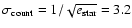
We estimate the noise contribution from the background to be
electrons, and after binning
every 30 data points (15 s sampling), the theoretical Poissonian noise is
0.6 mmag or more than a factor two lower than the actual observed noise level.
The higher noise level is due to the relatively high sky level during the Cep run.
We estimate the noise contribution from the background to be
 following Eq. (31) in Kjeldsen & Frandsen (1992); here
 is the number of pixels
in the aperture,
is the number of pixels
in the aperture,
 is the readout noise,
while
is the readout noise,
while
 and
and
 are the number of electrons
from the star and sky background, respectively.
We use
are the number of electrons
from the star and sky background, respectively.
We use
 ,
a gain of 15 e-1/ADU,
,
a gain of 15 e-1/ADU,
 ADU,
and a
ADU,
and a
 e-1 to obtain
 mmag which is
comparable to the Poissionian noise
mmag which is
comparable to the Poissionian noise
 mmag.
This explains the relatively high noise level.
mmag.
This explains the relatively high noise level.
Table 1:
Basic photometric indices for Cephei.
Cep
The basic photometric indices for Cep are summarized in Table 1.
The V magnitude and B-V colour are based on 12 measurements and
are taken from Mermilliod's compilation of Eggen's UBV data (available through SIMBAD).
The Strömgren indices are from Hauck & Mermilliod (1998) and are based on a combination of
60 measurements, while H is based on 47 measurements. The projected rotational velocity ()
of Cep is 105 km s-1 according to 10 measurements from Bernacca & Perniotto (1970), while Royer et al. (2002) found 91 km s-1. The typical uncertainty on
is 5% (Royer et al. 2002), i.e.
is based on 47 measurements. The projected rotational velocity ()
of Cep is 105 km s-1 according to 10 measurements from Bernacca & Perniotto (1970), while Royer et al. (2002) found 91 km s-1. The typical uncertainty on
is 5% (Royer et al. 2002), i.e.  () =5 km s-1.
We used TEMPLOGG (Rogers 1995) to determine the fundamental atmospheric parameters of
Cep and the results are
 =
=  ,
,  =
=  ,
[Fe/H] =
,
[Fe/H] =
 .
This is consistent with the spectral type F0 IV. We stress that the quoted uncertainties are based solely on the uncertainty on the photometric indices. Realistic uncertainties on
,
,
and [Fe/H] are 150 K, 0.2 dex, and 0.2 dex (Kupka & Bruntt 2001; Rogers 1995). Based on the Strömgren b-y and H
indices there is no significant interstellar reddening.
.
This is consistent with the spectral type F0 IV. We stress that the quoted uncertainties are based solely on the uncertainty on the photometric indices. Realistic uncertainties on
,
,
and [Fe/H] are 150 K, 0.2 dex, and 0.2 dex (Kupka & Bruntt 2001; Rogers 1995). Based on the Strömgren b-y and H
indices there is no significant interstellar reddening.
Erspamer & North (2002,2003) used an automated procedure to determine individual abundances of
140 A- and F-type stars and Cep was included in their data set.
They used Geneva photometry to fix
 K and the HIPPARCOS parallax and evolution models to find
 ,
which both agree with our Strömgren photometry
when using TEMPLOGG. The abundance analysis of Cep yielded [Fe/H]
,
which both agree with our Strömgren photometry
when using TEMPLOGG. The abundance analysis of Cep yielded [Fe/H]
 ,
which is also in good agreement with TEMPLOGG. The error estimate on [Fe/H] given here is based on the various contributions to the error budget, as discussed in detail
by Erspamer & North (2002).
,
which is also in good agreement with TEMPLOGG. The error estimate on [Fe/H] given here is based on the various contributions to the error budget, as discussed in detail
by Erspamer & North (2002).
The location of Cep in the Hertzsprung-Russell (HR) diagram is shown in
Fig. 2. We show evolutionary tracks from Lejeune & Schaerer (2001) for
solar metallicity (Z=0.02). The dashed track is for a metallicity
of twice the solar value for a mass
 .
To estimate the luminosity, we used the visual magnitude
.
To estimate the luminosity, we used the visual magnitude
 and the HIPPARCOS parallax
of
and the HIPPARCOS parallax
of
 mas (ESA 1997). We found the bolometric
correction (BC) by interpolation in the tables by Bessell et al. (1998),
i.e. BC
mas (ESA 1997). We found the bolometric
correction (BC) by interpolation in the tables by Bessell et al. (1998),
i.e. BC
 .
For the solar bolometric magnitude we used
.
For the solar bolometric magnitude we used
 .
Thus, we find
.
Thus, we find
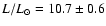 and
adopt
=
and
adopt
=
 K. The 1
error box is indicated
in Fig. 2.
K. The 1
error box is indicated
in Fig. 2.
From the location of Cep in the HR diagram relative
to the evolutionary tracks from Lejeune & Schaerer (2001),
and adopting a metallicity [Fe/H] =  ,
we estimate the mass to be
,
we estimate the mass to be
 .
.
From the estimated mass, temperature, and parallax we can calculate
the surface gravity using
![$\log g_\pi = 4 [T_{\rm eff}] + [M] + 2 \log \pi + 0.4 (V + BC_V + 0.26) + 4.44$](/articles/aa/full/2007/02/aa5766-06/img49.gif) ,
where
,
where
![$[T_{\rm eff}] = \log (T_{\rm eff}/T_{{\rm eff}~\odot})$](/articles/aa/full/2007/02/aa5766-06/img50.gif) and
and
![$[M] = \log (M/M_\odot)$](/articles/aa/full/2007/02/aa5766-06/img51.gif) .
For Cep we find
.
For Cep we find
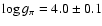 which agrees with Erspamer & North (2003) and the photometric calibration from TEMPLOGG.
![\begin{figure}
\par\includegraphics[width=8.8cm,clip]{5766f02.eps} \end{figure}](/articles/aa/full/2007/02/aa5766-06/img53.gif) |
Figure 2:
HR diagram with evolution tracks from Lejeune & Schaerer (2001) for
Z=0.02 (solar) and Z=0.04. The 1
error box for Cep is indicated and is
consistent with a slightly evolved star with mass
for a metallicity of [Fe/H] = 0.1. |
| Open with DEXTER | |
To illustrate the difference between the WIRE and OSN data sets in the frequency domain we have calculated the spectral windows. To do this we used the same observation times as in the real data sets and inserted an artificial sinusoidal signal at f=20 c/day. The resulting spectral windows for the WIRE and OSN data sets are shown in Fig. 3 in the top and bottom panels, respectively.
The complexity of the OSN spectral window is apparent,
with several alias peaks at 1.0, 0.5, and 0.01 c/d.
The latter is seen in the inset in Fig. 3 and arises from the
large gaps in the OSN time series, i.e.
 c/day,
since the total observing time is
c/day,
since the total observing time is
 days.
Note that we decided not to use the last night from OSN in the analysis
since it degrades the spectral window. The reason is the
long gap of 42 nights from night 15 to night 16.
days.
Note that we decided not to use the last night from OSN in the analysis
since it degrades the spectral window. The reason is the
long gap of 42 nights from night 15 to night 16.
As a result of the long gaps in the OSN time series,
the peaks in the amplitude spectrum at
 -
where n is an integer - are almost equally good solutions.
However, if one can be sure about selecting the
"right peak,'' the accuracy of the frequency is significantly
better than in the WIRE data set.
This may prove difficult since in the real data set the spectrum
is affected by closely spaced frequencies and noise sources
such as photon shot noise and non-white
instrumental drift noise.
-
where n is an integer - are almost equally good solutions.
However, if one can be sure about selecting the
"right peak,'' the accuracy of the frequency is significantly
better than in the WIRE data set.
This may prove difficult since in the real data set the spectrum
is affected by closely spaced frequencies and noise sources
such as photon shot noise and non-white
instrumental drift noise.
The WIRE spectral window has a much more well-defined peak.
During each WIRE orbit the satellite switches between two targets in order to
minimize the effect of scattered light from the illuminated face of the Earth.
Thus, Cep was observed with a duty cycle
of 40% (cf. bottom panel in Fig. 1).
As a consequence, significant alias peaks are
seen at frequencies that are combinations of the frequency of the oscillation signal
and the orbital frequency of WIRE,
 ,
where
f is the genuine frequency, n is an integer, and
,
where
f is the genuine frequency, n is an integer, and
 is the orbital frequency:
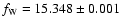 c/day. The first set of
side lobes have amplitudes relative to the main peak of 76%.
c/day. The first set of
side lobes have amplitudes relative to the main peak of 76%.
![\begin{figure}
\par\includegraphics[width=8.8cm,clip]{5766f03.eps}\end{figure}](/articles/aa/full/2007/02/aa5766-06/img60.gif) |
Figure 3: Spectral windows for the WIRE ( top panel) and OSN data sets ( bottom panel) computed for a single frequency at f = 20 c/day. The insets show the details of the main peak. |
| Open with DEXTER | |
![\begin{figure}
\par\includegraphics[width=15.6cm]{5766f04.eps}\end{figure}](/articles/aa/full/2007/02/aa5766-06/img61.gif) |
Figure 4:
The two top panels are the amplitude spectra of Cep based on the WIRE data set. The frequencies extracted from WIRE and the orbital frequency at
 c/day (dashed line) have been marked. The peaks below 12 c/day and above 28 c/day are alias peaks due to the orbit of the WIRE satellite. The two bottom panels are the amplitude spectra of the OSN y and b-y data sets. c/day (dashed line) have been marked. The peaks below 12 c/day and above 28 c/day are alias peaks due to the orbit of the WIRE satellite. The two bottom panels are the amplitude spectra of the OSN y and b-y data sets. |
| Open with DEXTER | |
The observed amplitude spectra are shown in Fig. 4. In the two top panels we have used the WIRE data set: the first panel is an overview and the second panel shows the details of the region 12-28 c/day where the oscillations intrinsic to the star are found. In the two bottom panels we used 15 nights from OSN in the y filter and b-y colour, respectively. The different properties of the time series are reflected in the amplitude spectra.
There are many frequencies present in Cep and their location can be identified in the WIRE spectrum. The periods range from 0.7-1.9 h and the amplitudes of highest peaks
are in the range 1-3 ppt, which is
typical for low amplitude Scuti stars. The OSN amplitude spectra are more complicated to interpret, with two main regions of excess power around 12-17 and 24-28 c/day.
This makes the extraction of closely spaced frequencies difficult
and is a well-known problem for single-site observations of Scuti stars (Costa et al. 2003).
For example, as a result of the combination of the frequencies f2 to f4, the highest peak in the OSN amplitude spectra is found at 14 c/day. Also, above 20 c/day the
highest peak in the OSN y amplitude spectrum is found around 25.2 c/day due to the combinations of f1 and the close pair of frequencies f5 and f9.
In the following section we describe how we have extracted the individual frequencies from the light curves.
Cep light curves
Since the spectral window of the WIRE data set is less complicated than for the OSN data, we used the WIRE data to detect the significant frequencies. Also, the S/N level is much higher in the WIRE data: in the cleaned amplitude spectrum the noise level is about 85 and 460 ppm in the range 10-30 c/day for the WIRE and y OSN data, respectively. In the OSN v filter the noise level is 645 ppm but the amplitudes are about 50% higher than in y. The WIRE data set is useful for avoiding the 1 c/day aliasing problem that hamper our single-site ground-based data set and we can also detect additional frequencies with low amplitude.
We used the software package PERIOD04 by Lenz & Breger (2005) for the extraction of the frequencies. After the extraction of the first frequency, the detection of additional frequencies is based
on prewhitening or "cleaning'' of the already detected frequencies. However, the solution is improved by a least-squares fit to the observations by a function of the form
![$\Sigma_{i=1}^N A_i \sin (2 \pi [f_i~t + \phi_i]~)$](/articles/aa/full/2007/02/aa5766-06/img62.gif) ,
thus each of the N terms is determined by frequency (fi), phase (
,
thus each of the N terms is determined by frequency (fi), phase ( )
and amplitude (Ai). We note that the WIRE data set is very homogeneous and we therefore did not apply point weights.
)
and amplitude (Ai). We note that the WIRE data set is very homogeneous and we therefore did not apply point weights.
The WIRE satellite observed Cep during 40% of its orbit, but the last part of each orbit is affected by scattered light which systematically offsets the measured flux. To minimize the effect of this we only used the part of the light curve which was unaffected by scattered light, i.e. this data set had a 30% duty cycle. From this data set we extracted 25 frequencies with S/N above 4. After subtracting these terms from the light curve we performed a decorrelation of the light curve with the background level and orbital phase. This allowed us to use the complete data set and increase the duty cycle from 30% to 40%. This greatly improves the spectral window and the first set of side lobes decrease from 88% to 76% while the second set of side lobes decrease from 58% to 25% (cf. top panel in Fig. 3).
Table 2: Frequencies, amplitudes, phases, and S/N for 26 individual frequencies extracted from the WIRE data set.
Using the WIRE data set with 40% duty cycle we extracted 26 frequencies. The frequencies are marked in Fig. 4 and in Table 2 we list the frequency, amplitude, and phase of each frequency. Phases in Table 2 are given relative to the zero point in time, t0 = 2 453 175.5. In the last column we give the S/N which is the ratio of the amplitude and the noise level estimated in the cleaned amplitude spectrum. We will estimate the uncertainties on the frequency, phase, and amplitude based on simulations in Sect. 6.3. The first 24 frequencies in Table 2 have S/N above 6, and are numbered according to their S/N. The remaining two frequencies are less certain and are labeled a and b.
We have searched for frequencies that are given as linear combinations
of other terms within the frequency resolution, and for the WIRE data set this is
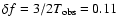 c/day (Loumos & Deeming 1978). The three frequencies f20, f22, and fa are found to have low amplitude and found near these linear combinations:
f20 = f2 + f3,
f22=f10+f13, and
fa = f12-f4 = f20 - f13 = f22-f15. The many combinations for fa indicate that it is probably not intrinsic to the star. In addition, we find
c/day (Loumos & Deeming 1978). The three frequencies f20, f22, and fa are found to have low amplitude and found near these linear combinations:
f20 = f2 + f3,
f22=f10+f13, and
fa = f12-f4 = f20 - f13 = f22-f15. The many combinations for fa indicate that it is probably not intrinsic to the star. In addition, we find
 and
and
 ,
which may be chance alignments.
,
which may be chance alignments.
The OSN data set was collected 2.9 years prior to the WIRE data set. While some Scuti stars are known to have variable amplitudes we expect that the frequencies remain constant over such a short time scale. However, Breger & Pamyatnykh (2006) found that the amplitude variation seen in FG Vir during several observing seasons can be explained by closely spaced frequencies. With this in mind we searched for frequencies using PERIOD04 while using the frequencies extracted from WIRE as a guide. We recovered the frequencies f1 to f9, but in some cases we had to apply an offset of the apparently highest peak by exactly  c/day. We found evidence for
f11, f12, and f19 but these frequencies have low amplitude and the systematic offsets due to close neighbours and their aliases become significant.
c/day. We found evidence for
f11, f12, and f19 but these frequencies have low amplitude and the systematic offsets due to close neighbours and their aliases become significant.
Due to the long gaps in the OSN data sets there are aliases in the
spectral window separated by
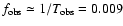 c/day. These aliases have
almost equal amplitude but we can pick the right peak in the amplitude spectrum using the approximate frequency from the WIRE data set as we will demonstrate in Sect. 6.4. From the simulations in Sect. 6.3 we find
the uncertainty on the WIRE frequencies to be 0.001-0.003 c/day for the frequencies f1 to f6 and up to 0.004 c/day for the frequencies f7 to f9. This means that the shift from one alias to the next in the OSN amplitude spectrum is at least at the 3-sigma level for f1 to f6 and about 2-sigma for f7 to f9.
c/day. These aliases have
almost equal amplitude but we can pick the right peak in the amplitude spectrum using the approximate frequency from the WIRE data set as we will demonstrate in Sect. 6.4. From the simulations in Sect. 6.3 we find
the uncertainty on the WIRE frequencies to be 0.001-0.003 c/day for the frequencies f1 to f6 and up to 0.004 c/day for the frequencies f7 to f9. This means that the shift from one alias to the next in the OSN amplitude spectrum is at least at the 3-sigma level for f1 to f6 and about 2-sigma for f7 to f9.
![\begin{figure}
\par\includegraphics[width=8.8cm,clip]{5766f05.eps}\end{figure}](/articles/aa/full/2007/02/aa5766-06/img69.gif) |
Figure 5: We fitted all 26 frequencies found from the WIRE data set to the OSN y data set. The panels show the ratio of the input and output amplitudes ( top) and the difference between input and output frequencies. |
| Open with DEXTER | |
Another method of cleaning the OSN data set
is to assume that all frequencies with S/N above 4 found in WIRE can be fitted to the OSN data set. In Fig. 5 we compare the frequencies and
amplitudes found in the WIRE and OSN y data sets. The top panel in Fig. 5 shows the ratio of amplitudes
 .
The bottom panel shows the difference between the frequencies vs. the WIRE amplitude. The individual error bars are found from simulations. We find that the uncertainties are very large for the frequencies with low amplitude,
but all frequencies agree within the uncertainties. That fact that several
frequencies are found to have amplitudes that are different by more than 50%
(marked by horizontal dashed lines in the top panel in Fig. 5)
indicates that it is not sensible to fit all these frequencies to the
OSN data, although they are present in the WIRE data set. The fact that we cannot extract all the frequencies found in the WIRE data set will systematically affect the parameters of the frequencies we extract from the OSN data sets. We have assessed this by doing simulations (see Sect. 6.3).
.
The bottom panel shows the difference between the frequencies vs. the WIRE amplitude. The individual error bars are found from simulations. We find that the uncertainties are very large for the frequencies with low amplitude,
but all frequencies agree within the uncertainties. That fact that several
frequencies are found to have amplitudes that are different by more than 50%
(marked by horizontal dashed lines in the top panel in Fig. 5)
indicates that it is not sensible to fit all these frequencies to the
OSN data, although they are present in the WIRE data set. The fact that we cannot extract all the frequencies found in the WIRE data set will systematically affect the parameters of the frequencies we extract from the OSN data sets. We have assessed this by doing simulations (see Sect. 6.3).
Table 3: Frequencies and amplitudes in the Strömgren filters for frequencies extracted from the OSN data set. The frequencies are the weighted mean of the fit to each of the uvby light curves. Amplitudes are given for each filter in parts per thousand (ppt). Phases fitted to y and b-y are also given and indicated in units of the period. The three frequencies labeled cl have a close neighbouring frequency with similar amplitude and the parameters are likely to be affected by this.
In Table 3 we summarize the frequency, amplitude, and phase of f1 to f8,
which are clearly identified in the OSN data set. The frequencies are the weighted mean values of the individual fits to uvby. The quoted error is the weighted mean error and
is based on simulations done in Sect. 6.3. We give amplitudes in each of the four Strömgren filters and the colour light curve b-y. The phases of y and b-y are given
relative to the zero point in time,
t0 = 2 452 130.0. Three of the frequencies, f5, f7, and f8 have some closely spaced frequencies seen in the WIRE data set, namely
f9, f10, and f14. It is very likely that the parameters listed for these frequencies in Table 3 are systematically affected by this. We also note that
 c/day and this will also affect the amplitude and phase.
The formal uncertainty on the frequency determined from a light curve is determined by the duration of the observing run, the number of data points, and S/N ratio, i.e. the ratio of the amplitude to the noise in the light curve. The standard estimate of the uncertainty of the frequency is based on the least-squares covariance matrix or the Rayleigh resolution criterion. However, Schwarzenberg-Czerny (1991) demonstrated that both estimates are statistically incorrect. On one hand the least-squares covariance matrix does not account for correlation of residuals in the fit. Neglecting this may cause a large under-estimation of the uncertainty. On the other hand the Rayleigh resolution criterion is insensitive to the S/N and therefore does not reflect the quality of the observations.
![\begin{figure}
\par\includegraphics[width=9.2cm,clip]{5766f06.eps}\end{figure}](/articles/aa/full/2007/02/aa5766-06/img84.gif) |
Figure 6: Part of the light curves from WIRE ( top panel) and OSN y ( bottom panel) including the fitted light curves in grey colour. The residuals are also shown but offset by -0.02 mag. As in Fig. 1 the zero-points t0 are different. |
| Open with DEXTER | |
For an ideal light curve with only white noise Montgomery & O'Donoghue (1999)
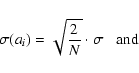
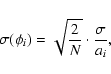
derived the uncertainty on the frequency, amplitude and
phase (in radians) as
is the rms uncertainty per data point, ai is the amplitude, N is the number of data points, and
 is the observational time baseline. These uncertainties are strictly lower limits in the case of uncorrelated white noise. Using simple assumptions for correlated noise, Montgomery & O'Donoghue (1999) found that the error estimates using the above equations are too optimistic by up to a factor of five. Following the suggestion by Montgomery & O'Donoghue (1999) we calculated the correlation length D from the autocorrelation of the cleaned amplitude spectra (after subtracting the mean) and located the intersection with zero. From the WIRE and OSN data sets we find
 ,
,
 ,
and
,
and
 ,
respectively, and we multiplied the error estimates from Eqs. (1)-(3)
by the square root of the corresponding correlation length, D.
,
respectively, and we multiplied the error estimates from Eqs. (1)-(3)
by the square root of the corresponding correlation length, D.
![\begin{figure}
\par\includegraphics[width=8.8cm,clip]{5766f07.eps}\end{figure}](/articles/aa/full/2007/02/aa5766-06/img92.gif) |
Figure 7: Smoothed power density spectrum of the OSN y data set before and after cleaning (solid lines). The dashed line is for a simulation after cleaning. The location of the oscillations is marked by the hatched region. |
| Open with DEXTER | |
In Fig. 6 we show part of the light curve of Cep from OSN y and WIRE.
The grey curves show the fit to each of the complete light curves. The residuals are also shown, offset by -0.02 mag. It is seen that there are significant systematic trends in the
residuals which may be due to a combination of unresolved frequencies and instrumental drift.
The significance of this is seen more clearly in the frequency domain, and in Fig. 7 we show a smoothed version of the power density (PD) spectra of the OSN y data set
before and after the cleaning process. The region of excess power due to the oscillations is indicated by the hatched region (12-35 c/day). The PD is seen to increase by about an order of magnitude from the theoretical white noise level (>80 c/day). The slight increase in noise level above 200 c/day (marked by the arrow) is because the telescope at OSN switched between the Cep and the comparison stars every 2-4 min.
![\begin{figure}
\par\includegraphics[width=8.8cm,clip]{5766f08.eps}\end{figure}](/articles/aa/full/2007/02/aa5766-06/img93.gif) |
Figure 8: Smoothed power density spectra of the cleaned OSN and WIRE data sets. The dashed line indicates the increase in noise towards low frequencies. |
| Open with DEXTER | |
A virtue of the PD spectrum is that we can compare the frequency dependence of the noise in different data sets even though the temporal coverage, time sampling, and number of data points are quite different. In Fig. 8 we compare the PD spectra of the cleaned OSN y (grey) and WIRE spectra (black solid line). The curves are similar in shape but there are fundamental differences. At the high frequency end the noise in OSN y is higher
by an order of magnitude and this is because the WIRE data set has 10 times more data points than OSN and slightly lower uncertainty on each data point. At low frequencies (f<40 c/day) the PD is still smaller for WIRE at all frequencies which means that there are
additional noise sources present in the OSN data set. If the noise were intrinsic to the star
the PD in WIRE and OSN would be identical at low frequencies. However, a large number of frequencies is present in Cep and a perfect cleaning of the OSN data set is not possible.
This probably explains the higher PD at f<40 c/day compared to WIRE by a factor of 3.
![\begin{figure}
\par\includegraphics[width=8.8cm]{5766f09a.eps}\includegraphics[width=8.8cm]{5766f09b.eps}\end{figure}](/articles/aa/full/2007/02/aa5766-06/img94.gif) |
Figure 9: Uncertainties on frequency, amplitude, and phase as found from simulations of WIRE (black) and OSN (grey) data sets. The WIRE results are shown in both panels and the OSN results for y and b-y are shown in the left and right panels, respectively. When fixing the frequencies in the OSN data set the uncertainties on the amplitudes and phases decrease as indicated by arrows. The solid lines are the theoretical predictions for the uncertainty from Eqs. (1)-(3). |
| Open with DEXTER | |
The increase in the noise towards lower frequencies in the WIRE data set is likely due to a combination of instrumental drift and a number of undetected frequencies. This possibility was also discussed by Breger et al. (2005) in their analysis of the residuals after cleaning about 80 frequencies
in the Scuti star FG Vir. We motioned in Sect. 1.1 that Kennelly et al. (1999) found several frequencies of high degree based on LPV studies. These frequencies will have negligible amplitude in photometry due to geometrical cancellation effects, but they may produce part of the increase in the noise that we observe.
To confirm the theoretical error estimates in Sect. 6.1
and to better understand the
different properties of the OSN and WIRE data sets
we computed a large set of simulations.
The OSN data set has long gaps of up to a month and thus the
frequency analysis is hampered by a complicated spectral window.
The interaction between frequencies can only be estimated by doing
a large number of realistic simulations.
![\begin{figure}
\par\includegraphics[width=17.4cm,clip]{5766f10.eps}\end{figure}](/articles/aa/full/2007/02/aa5766-06/img95.gif) |
Figure 10:
Histogram of frequencies recovered in simulations of the
OSN (black) and WIRE (grey) data sets for f1 to f12.
In the panel for f2 two groups of solutions in OSN separated by
 c/day are marked. It is seen that the WIRE data set can be used to pick the right group,
and that within this group the OSN data set has significantly lower uncertainty. c/day are marked. It is seen that the WIRE data set can be used to pick the right group,
and that within this group the OSN data set has significantly lower uncertainty. |
| Open with DEXTER | |
To mimic the large increase towards low frequencies discussed in Sect. 6.2, we added a number of frequencies with low amplitude in a wide frequency range. The simulations of the OSN y filter and b-y data set were done by including the 26 frequencies detected in WIRE but using the frequencies, amplitudes, and phases fitted to the observed data. We then added 110 frequencies with random (low) amplitudes from 0.0 to 0.4 ppt and frequencies in the range 1-35 c/day for the y filter. For the b-y light curve we added 350 frequencies with amplitudes 0.0-0.1 ppt in the same frequency range. Finally, we added a white noise component with rms of 1.85 and 1.60 mmag for y and b-y, respectively. In the simulations of the WIRE data set we added 75 frequencies with random frequencies in the range 10-35 c/day, random amplitudes in the range 0.0-0.3 ppt, random phases, and a white noise component with rms 1.7 mmag. An example of the cleaned PD spectrum of a simulation of an OSN y time series is shown with a dashed line in the left panel in Fig. 7.
These ad hoc simulations roughly reproduce the increase in noise towards low frequencies while still no significant frequencies are present above the noise. We made 800 simulations of the OSN y, b-y, and WIRE light curves. We extracted frequencies from all simulations using an automated cleaning program using the procedure described in Sect. 5.1. For the OSN data set we also fitted the light curves when assuming the known frequencies and only fitting amplitudes and phases. We found the uncertainty by calculating the rms scatter in frequency, amplitude, and phase extracted from the 800 simulations.
In Fig. 9 we compare the uncertainties on frequency, amplitude, and phases as found from Eqs. (1)-(3) (solid lines) and the simulations (points).
The left panel shows the uncertainties on the frequency, amplitude, and phase
for OSN y and the right panel is for OSN b-y, while the results for WIRE are shown with black points in both panels. The uncertainties of the simulations of the OSN data sets are shown when both frequency, amplitude and phase are fitted (grey  symbols)
and the systematically lower uncertainties when only amplitude
and phase are fitted (grey circle symbols).
The improvement is indicated by a vertical arrow for each frequency.
It can be seen that the frequencies are more
accurately determined when using the OSN y data set.
This is in agreement with Eq. (1) where
the time baseline enters linearly while the number of data points enters as the square root; for the two data sets we approximately have the ratios
symbols)
and the systematically lower uncertainties when only amplitude
and phase are fitted (grey circle symbols).
The improvement is indicated by a vertical arrow for each frequency.
It can be seen that the frequencies are more
accurately determined when using the OSN y data set.
This is in agreement with Eq. (1) where
the time baseline enters linearly while the number of data points enters as the square root; for the two data sets we approximately have the ratios
 ,
while the point-to-point noise, ,
is very similar. For the frequencies f1 to f8 the errors on frequency are about 0.001-0.003 c/day in WIRE and 0.0005-0.0010 c/day in OSN. We should note that the OSN results rely on the important fact that we can select the right alias peak in the OSN data by using the approximate frequency
found with WIRE; this is discussed in detail in Sect. 6.4.
The uncertainties on amplitude and phase are independent of the time baseline and therefore they are more accurately determined from the WIRE data set since
,
while the point-to-point noise, ,
is very similar. For the frequencies f1 to f8 the errors on frequency are about 0.001-0.003 c/day in WIRE and 0.0005-0.0010 c/day in OSN. We should note that the OSN results rely on the important fact that we can select the right alias peak in the OSN data by using the approximate frequency
found with WIRE; this is discussed in detail in Sect. 6.4.
The uncertainties on amplitude and phase are independent of the time baseline and therefore they are more accurately determined from the WIRE data set since
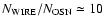 .
.
Due to long gaps in the OSN data set the spectral window has aliases of similar amplitude separated by
 c/day. If we only had the OSN data set, each frequency found in
the observed data set can be offset by
c/day. If we only had the OSN data set, each frequency found in
the observed data set can be offset by
 c/day for any
 .
However, using the frequencies found from WIRE we may choose the right alias sub-peak in the OSN amplitude spectrum.
.
However, using the frequencies found from WIRE we may choose the right alias sub-peak in the OSN amplitude spectrum.
The results from our simulations in Fig. 10 illustrate that this is indeed possible. Each panel shows two histograms of the difference between the input frequency and the extracted frequency for f1 to f12: the grey histogram is for the simulations of the WIRE data and black is used for OSN y. Several "groups'' of frequencies separated by 0.009 c/day are seen for the OSN simulations while a single but broader peak is seen for the distribution of extracted WIRE frequencies.
It can be seen that the uncertainty of the frequencies in the WIRE data set is sufficiently small that we can select the right peak in the OSN data set, at least for the dominant frequencies. We note that the uncertainties in the OSN simulations shown in Fig. 9 are based on the internal rms scatter within one "group'' of extracted frequencies.
By measuring the parameters of frequencies in different filters we can infer the spherical degree, l, of the associated spherical harmonic. Each frequency can in principle be identified
by measuring the phase difference and amplitude ratio in two filters as shown by Garrido et al. (1990) and Moya et al. (2004). In Fig. 11 we show the
the amplitude ratio vs. the phase differences in the y filter and b-y colour
for the three frequencies f1 to f3. The uncertainties are based on the simulations described in Sect. 6.3. The solid and dashed lines are results for a model with mass
 and
= 7720 K. We used an over-shooting parameter of
and
= 7720 K. We used an over-shooting parameter of
 but
did not include the effects of rotation. We note that in Sect. 3 we inferred a slightly cooler temperature, i.e.
=
and an evolutionary mass of
.
In the model shown in Fig. 11 the solid
line is for Q=0.033 (fundamental radial mode, n=1) and the dashed line for Q=0.017 (third overtone, n=4) for a mixing length parameter
but
did not include the effects of rotation. We note that in Sect. 3 we inferred a slightly cooler temperature, i.e.
=
and an evolutionary mass of
.
In the model shown in Fig. 11 the solid
line is for Q=0.033 (fundamental radial mode, n=1) and the dashed line for Q=0.017 (third overtone, n=4) for a mixing length parameter
 .
Amplitude ratios and phase differences were calculated for l=0,1, and 2: the highest amplitude ratio is for l=2 at
ab-y/ay>0.4 and becomes progressively lower for decreasing l. The frequencies f1 and f2 are compatible with l=1 or 2.
.
Amplitude ratios and phase differences were calculated for l=0,1, and 2: the highest amplitude ratio is for l=2 at
ab-y/ay>0.4 and becomes progressively lower for decreasing l. The frequencies f1 and f2 are compatible with l=1 or 2.
In general, the amplitude ratio and phase diagrams depend on the assumed mixing length parameter (Moya et al. 2004; Daszynska-Daszkiewicz et al. 2003). Although the model used here does not describe Cep in detail, we can see that the observational uncertainties on the amplitude ratios and phases are too
large to distinguish between the radial degree and overtone.
Regular frequency spacings similar to the large separation seen in solar-like stars have also been reported for some Scuti stars (Handler et al. 2000). Such a measurement would enable us to compare with theoretical predictions. We used the 24 most significant frequencies seen in Cep, namely
those with S/N above 6 to look for significant spacings using autocorrelation and histograms of frequency differences for different bin sizes.
![\begin{figure}
\par\includegraphics[width=8.8cm,clip]{5766f11.eps}\end{figure}](/articles/aa/full/2007/02/aa5766-06/img104.gif) |
Figure 11:
Amplitude ratio and phase difference for the frequencies f1 to f3
measured in the OSN y and b-y light curves. The solid and dashed lines correspond to the fundamental mode and third overtone for a theoretical model with mass
. |
| Open with DEXTER | |
In Fig. 12 we plot the power vs. the spacing frequency.
We find a peak at
 c/day. We did a series of simulations to see if the
  spacing is indeed significant. Each simulation consist of 24 frequencies
randomly distributed in the range 12-28 c/day. In many cases we found peaks in the amplitude spectrum with the same approximate location and amplitude as .
Therefore we are extremely cautious about associating this with e.g. half of the large separation. The low number of observed frequencies as well as the narrow frequency range that is covered, are insufficient to consider
as being statistically significant.
spacing is indeed significant. Each simulation consist of 24 frequencies
randomly distributed in the range 12-28 c/day. In many cases we found peaks in the amplitude spectrum with the same approximate location and amplitude as .
Therefore we are extremely cautious about associating this with e.g. half of the large separation. The low number of observed frequencies as well as the narrow frequency range that is covered, are insufficient to consider
as being statistically significant.
We also used another technique to look for repetitive spacings among the frequencies by calculating frequency splitting histograms. Several frequency binning widths were used in order to search for recurring peaks. The only peak prevailing for all binning values is around 1.3 c/day
which roughly corresponds to the peak at 1.2 c/day seen in Fig. 12.
This spacing can be interpreted as the rotational splitting or perhaps the small separation.
In the region of large differences, when varying the binning, two peaks are observed in the range of 4.8-5.0 and 5.7-5.9 c/day. We are cautious about these large "candidate'' splitting values,
since we only observe frequencies in a narrow frequency range. The frequencies cover 12.7-34.0 c/day, so any spacing above half the width of this range cannot be considered:
 c/day. Even at 5 c/day we would only be able to detect an even spacing of four consecutive frequencies.
We computed a number of pulsation models within the photometric error box for Cep (cf. Fig. 2). We selected those models consistent with
being
half the value of the mean large separation, i.e.
 c/day.
The parameters of these models are given in Table 4. For each model we give the mass, radius, and luminosity in solar units, the effective temperature, the fractional hydrogen content in the central region, the large spacing of the frequencies, and the mean stellar density in solar units. We find that the observed peak in the histogram at 1.3 c/day is unlikely to be due to rotational splitting, since this peak is only seen in histograms of theoretical models for m=0 modes. Thus, if the reality of this spacing can be established from a more ambitious campaign, this splitting can only correspond to the small separation.
c/day.
The parameters of these models are given in Table 4. For each model we give the mass, radius, and luminosity in solar units, the effective temperature, the fractional hydrogen content in the central region, the large spacing of the frequencies, and the mean stellar density in solar units. We find that the observed peak in the histogram at 1.3 c/day is unlikely to be due to rotational splitting, since this peak is only seen in histograms of theoretical models for m=0 modes. Thus, if the reality of this spacing can be established from a more ambitious campaign, this splitting can only correspond to the small separation.
![\begin{figure}
\par\includegraphics[width=8.8cm,clip]{5766f12.eps}\end{figure}](/articles/aa/full/2007/02/aa5766-06/img109.gif) |
Figure 12:
The power spectrum used to search for frequency spacings in Cep. The 24 most significant frequencies found from the WIRE data set were used. |
| Open with DEXTER | |
Scuti star Cep from
the WIRE satellite and ground-based multi-colour uvby photometry from OSN.
In some respects the WIRE data set is superior to OSN because the S/N is a factor 5 higher and the spectral window is much more simple. Thus, we used the WIRE data set
to extract the location of the oscillation frequencies. Due to the long gaps in the OSN light curve, the resulting spectral window is complicated. In addition to aliases
at 1.0 and 0.5 c/day, there are also "fine structure'' sub-peaks with a spacing of 0.009 c/day (roughly
 ). We performed a large set of realistic simulations to demonstrate that
we can select the right sub-peak in the OSN amplitude spectrum, and in turn determine the frequencies of the dominant frequencies with accuracies of just 0.0005 c/day.
The frequencies found with each of the four Strömgren filters agree and we have computed
the weighted mean frequency, thus improving in accuracy to 0.0003 c/day for the main frequencies (cf. Table 3).
). We performed a large set of realistic simulations to demonstrate that
we can select the right sub-peak in the OSN amplitude spectrum, and in turn determine the frequencies of the dominant frequencies with accuracies of just 0.0005 c/day.
The frequencies found with each of the four Strömgren filters agree and we have computed
the weighted mean frequency, thus improving in accuracy to 0.0003 c/day for the main frequencies (cf. Table 3).
Accurate frequencies are only of interest if they can be compared with theoretical models, and this requires that the degree of the mode can be determined. This can be done from the amplitude ratio and phase difference in different filters. We used the amplitudes and phases from
the OSN y filter and b-y colour light curve, but our comparison with a theoretical model
clearly indicates that the observed accuracies of phases and amplitude ratios are insufficient to perform a mode identification. While accurate frequencies can be obtained very effectively by extending the time baseline of the observations, accurate phases and amplitudes require higher S/N. The uncertainties we estimate from simulations tell us that around 25 000 data points with 2 mmag point-to-point uncertainty are required, but we only have 10% of this available from OSN.
Table 4:
Parameters of selected theoretical models for Cep. The mass, radius, and luminosity are given in solar units,
is the surface temperature,  is the central
hydrogen fraction,
is the central
hydrogen fraction,
 is the large separation, and
  is the stellar mean density in solar units.
In order to use the method of the amplitude ratio vs. phase difference diagram we need a
more complete monitoring of Cep. This would require a multi-site campaign with monitoring in two or more filters. This has been done for a number of Scuti stars where extensive multi-site campaigns with long temporal coverage were carried out. Examples are XX Pyx (Handler et al. 2000) and BI CMi (Breger et al. 2002). We propose to use high-resolution time-series spectroscopy to study line-profile variations, which will make it possible to identify the modes. In addition, information on mode splitting (and azimuthal order m) can be achieved. When this is combined with additional photometric observations from ground (or space) we may hope to improve on the present work.
Perhaps the most interesting result from the current study is that we have detected several significant (S/N = 4.5-6.5) frequencies with very low amplitude: seven frequencies have amplitudes below 0.5 ppt. For many years is has been a puzzle why only some of the frequencies predicted from models of Scuti stars were in fact detected. Breger et al. (2005) discuss their results for FG Vir and point out that the "missing modes'' are indeed there but that the detection level in
previous studies was too poor. About two thirds of the frequencies detected in FG Vir have amplitudes in y below 0.5 ppt. From the WIRE data of Cep we also find that several frequencies have amplitudes below 0.5 ppt (y filter). The reason why we do not find even more frequencies with low amplitude is most likely that the frequency resolution in the data is too low. Even so, our results give support to the suggestion by Breger et al. (2005) that
the modes predicted by models of Scuti stars are indeed present in the stars
but one must have long temporal coverage with high photometric precision to be able to detect them.
The Canadian MOST satellite (Walker et al. 2003)
can monitor stars for up to 60 days with a duty cycle close to 100% with high photometric precision. Preliminary results for a Scuti star observed as a secondary target by MOST show about 80 frequencies to be present with amplitudes as low
as 0.1 mmag (J. M. Matthews, private communication). In the coming years two more dedicated photometry missions will be launched: COROT and KEPLER. The COROT mission (Baglin et al. 2001) will monitor several relatively bright stars for up to 150 days to obtain photometry with very high precision and with a duty cycle close to 100%. However, observations are done in one filter
only for all the missions mentioned here: WIRE, MOST, COROT, and KEPLER.
Hence, ground-based support observations with multiple filters and/or spectroscopic measurements
are needed in order to be able to identify the modes.
The present analysis of Cep has shown that much more complete and carefully planned ground-based observations are needed to avoid problems resulting from a complex spectral window.
Also, it is necessary to collect enough multi-colour photometry to be able to measure phases
and amplitudes with the required accuracy to be able to identify the modes. Multi-site campaigns that overlap in time with the space-based observations should be arranged for the future missions. For example, most primary COROT targets are quite bright ( )
and so long-term (i.e. months) monitoring with small 20-80 cm class telescopes with Strömgren filters and a stable photometer will be adequate to collect the necessary data. The missions have several secondary targets which are monitored at the same time as the primary target. Thus it will be a difficult but potentially valuable task to coordinate and collect all the necessary data.
)
and so long-term (i.e. months) monitoring with small 20-80 cm class telescopes with Strömgren filters and a stable photometer will be adequate to collect the necessary data. The missions have several secondary targets which are monitored at the same time as the primary target. Thus it will be a difficult but potentially valuable task to coordinate and collect all the necessary data.
Acknowledgements
H.B. is supported by the Danish Research Agency (Forskningsrådet for Natur og Univers), the Instrument center for Danish Astrophysics (IDA), and the Australian Research Council. H.B. is grateful to Torben Arentoft and Gerald Handler for useful discussions. J.C.S. acknowledges support from the Instituto de Astrofísica de Andalucía through an I3P contract financed by the European Social Fund and from the Spanish Plan Nacional del Espacio under project ESP2004-03855-C03-01.