A&A 461, 143-151 (2007)
DOI: 10.1051/0004-6361:20065579
A complete 12CO 2-1 map of M 51 with HERA
I. Radial
averages of CO, H I, and radio continuum
K. F. Schuster1 -
C. Kramer2 -
M. Hitschfeld2 -
S. Garcia-Burillo3 -
B. Mookerjea2,4
1 -
IRAM, 300 rue de la Piscine, 38406 St. Martin d'Hères, France
2 -
KOSMA, I. Physikalisches Institut, Universität zu Köln,
Zülpicher Straße 77, 50937 Köln, Germany
3 -
Centro Astronomico de Yebes,
IGN, 19080 Guadalajara, Spain
4 -
Department of Astronomy, University of Maryland, College Park, MD 20742, USA
Received 8 May 2006 / Accepted 20 September 2006
Abstract
Context. The mechanisms governing the star formation rate in spiral galaxies are not yet clear. The nearby, almost face-on, and interacting galaxy M 51 offers an excellent opportunity to study at high spatial resolutions the local star formation laws.
Aims. In this first paper, we investigate the correlation of H2, H I, and total gas surface densities with the star forming activity, derived from the radio continuum (RC), along radial averages out to radii of 12 kpc.
Methods. We have created a complete map of M 51 in 12CO 2-1 at a resolution of 450 pc using HERA at the IRAM-30 m telescope. These data are combined with maps of H I and the radio-continuum at 20 cm wavelength. The latter is used to estimate the star formation rate (SFR), thus allowing to study the star formation efficiency and the local Schmidt law
 .
The velocity dispersion from CO is used to study the critical surface density and the gravitational stability of the disk.
.
The velocity dispersion from CO is used to study the critical surface density and the gravitational stability of the disk.
Results. The total mass of molecular material derived from the integrated 12CO 2-1 intensities is

 .
The
.
The  detection limit corresponds to a mass of
 .
The global star formation rate is 2.56 yr-1 and the global gas depletion time is 0.8 Gyr. H I and RC emission are found to peak on the concave, downstream side of the outer south-western CO arm, outside the corotation radius. The total gas surface density
.
The global star formation rate is 2.56 yr-1 and the global gas depletion time is 0.8 Gyr. H I and RC emission are found to peak on the concave, downstream side of the outer south-western CO arm, outside the corotation radius. The total gas surface density
 drops by a factor of
  20 from 70 pc-2 at the center to 3 pc-2 in the outskirts at radii of 12 kpc. The fraction of atomic gas gradually increases with radius. The ratio of H I over H2 surface densities,
 ,
increases from 0.1 near the center to 20 in the outskirts without following a simple power-law.
,
increases from 0.1 near the center to 20 in the outskirts without following a simple power-law.
 starts to exceed
 at a radius of 4 kpc. The star formation rate per unit area drops from 400 pc-2 Gyr-1 in the starburst center to 2 pc-2 Gyr-1 in the outskirts. The gas depletion time varies between 0.1 Gyr in the center and 1 Gyr in the outskirts, and is shorter than in other non-interacting normal galaxies. Neither the H I surface densities nor the H2 surface densities show a simple power-law dependence on the star formation rate per unit area. In contrast,
and
at a radius of 4 kpc. The star formation rate per unit area drops from 400 pc-2 Gyr-1 in the starburst center to 2 pc-2 Gyr-1 in the outskirts. The gas depletion time varies between 0.1 Gyr in the center and 1 Gyr in the outskirts, and is shorter than in other non-interacting normal galaxies. Neither the H I surface densities nor the H2 surface densities show a simple power-law dependence on the star formation rate per unit area. In contrast,
and
 are well characterized by a local Schmidt law with a power-law index of
 .
The index equals the global Schmidt law derived from disk-averaged values of
and
of large samples of normal and starburst galaxies. The critical gas velocity dispersions needed to stabilize the gas against gravitational collapse in the differentially rotating disk of M 51 using the Toomre criterion, vary with radius between 1.7 and 6.8 km s-1. Observed radially averaged dispersions derived from the CO data vary between 28 km s-1 in the center and 8 km s-1 at radii of 7 to 9 kpc. They exceed the critical dispersions by factors
.
The index equals the global Schmidt law derived from disk-averaged values of
and
of large samples of normal and starburst galaxies. The critical gas velocity dispersions needed to stabilize the gas against gravitational collapse in the differentially rotating disk of M 51 using the Toomre criterion, vary with radius between 1.7 and 6.8 km s-1. Observed radially averaged dispersions derived from the CO data vary between 28 km s-1 in the center and 8 km s-1 at radii of 7 to 9 kpc. They exceed the critical dispersions by factors
 of 1 to 5. We speculate that the gravitational potential of stars leads to a critically stable disk.
Key words: galaxies: evolution - galaxies: individual: M 51 - galaxies: ISM - galaxies: spiral -
galaxies: structure
M 51 is an interacting, grand-design spiral galaxy at a distance of
only 8.4 Mpc seen nearly face-on (Table 1).
It is rich in molecular gas, most of which is found in the two very
prominent spiral arms which are presumably caused by the tidal
interaction
(Tully 1974b; Howard & Byrd 1990).
Kinematic studies reveal unusually large streaming motions implying a
strong density wave and the presence of galactic shocks
(Aalto et al. 1999). The [C II] map of Nikola et al. (2001) shows two
secondary lobes of emission to the northeast and southwest near the
corotation radius of the density wave pattern, presumably due to
cloud-cloud collisions, stimulating star formation.
Calzetti et al. (2005) combine
Spitzer infrared data of the Infrared Array Camera (IRAC) and the
Multi Imaging Photometer for Spitzer (MIPS) with UV data from the
Galaxy Evolution Explorer (GALEX). These data are used
to discuss the various tracers of star formation in M 51. Enhanced star
formation activity at the two lobes seen in [C II] is probably
triggered by the interaction (Nikola et al. 2001). This is also
indicated by disk simulations of Toomre & Toomre (1972) which show
tidal tails emerging from the disk at the positions of enhanced star
formation. VLA observations of the H I line show a prominent tail
outside the main disk extending to the south and east, and covering
more than 25', i.e. 100 kpc, in projected distance (Rots et al. 1990)
(cf. Tilanus & Allen 1991).
Meijerink et al. (2005) find that a
major fraction of cold dust emission at 850 m stems from an
extended exponential disk with a scale height of 5.45 kpc, possibly
also tracing total gas column densities. The kinematics of H
m stems from an
extended exponential disk with a scale height of 5.45 kpc, possibly
also tracing total gas column densities. The kinematics of H emission of M 51 were recently studied by the SINGS team
(Daigle et al. 2006), improving on the work of Tilanus & Allen (1991).
emission of M 51 were recently studied by the SINGS team
(Daigle et al. 2006), improving on the work of Tilanus & Allen (1991).
Its proximity and inclination make M 51 an ideal target to study the
efficiency at which it forms stars from the gas under the influence
of the interaction, and to compare with the star formation laws
commonly found in spiral galaxies. Spiral galaxies often follow two
empirical laws:
as star formation is fueled by the interstellar gas
reservoir, the star formation rate (SFR) is proportional to a power
of the total gas surface density:
.
This appears to hold globally
when
and
are averaged over the
entire star-forming region of a galaxy (Kennicutt 1998; Schmidt 1959, and
others) with n=1.4. This may be
understood assuming that
is proportional to the
gas surface density over the free-fall time
 and that
the free-fall time and the gas surface density are simple functions
of the average gas density
and that
the free-fall time and the gas surface density are simple functions
of the average gas density  :
:
 and
and
 .
This
simple model leads directly to the Schmidt law with an index of 1.5
(e.g. Elmegreen 1994). More recent studies show that the
global Schmidt law also appears to hold locally in individual spiral
galaxies when studying radially averaged profiles of
and
(Boissier et al. 2003; Wong & Blitz 2002).
The second law is that the total gas surface density is of the order
of a critical gas surface density given by the Toomre (1964)
criterion for gravitational stability
(Martin & Kennicutt 2001; Li et al. 2006).
.
This
simple model leads directly to the Schmidt law with an index of 1.5
(e.g. Elmegreen 1994). More recent studies show that the
global Schmidt law also appears to hold locally in individual spiral
galaxies when studying radially averaged profiles of
and
(Boissier et al. 2003; Wong & Blitz 2002).
The second law is that the total gas surface density is of the order
of a critical gas surface density given by the Toomre (1964)
criterion for gravitational stability
(Martin & Kennicutt 2001; Li et al. 2006).
Table 1:
Basic properties of M 51.
The relative importance of the different components of the
interstellar medium was addressed by Nikola et al. (2001) when trying to
explain the mapped [C II] emission. In a recent study comprising all
major cooling lines of the molecular gas, i.e. those of [C II], [O I], CO, and [C I],
at selected spiral arm positions and the center of M 51,
Kramer et al. (2005) conclude that the bulk of the emission stems from
clumpy photon dominated regions. Only about 15-30% of the [C II]
emission stems from dense H II regions. The [C I] and CO emission of
the center region have also been studied by
Israel & Baas (2002); Gerin & Phillips (2000); Israel et al. (2006).
Schinnerer et al. (2004) mapped two distinct regions in the spiral arms
of M 51 in HCN, HCO+ and other tracers of the chemistry.
Rydbeck et al. (2004) presented a large CO 1-0 map of M 51 obtained
at the Onsala-20m telescope.
The inner region of M 51 were previously mapped in CO 1-0 with the
FCRAO-14 m, IRAM-30 m, and NRO-45 m telescopes by
Scoville & Young (1983); Kuno & Nakai (1997); Lord & Young (1990); Garcia-Burillo et al. (1993b); Nakai et al. (1994); Kuno et al. (1995).
These single-dish observations reveal the large-scale emission for
which interferometric observations are not sensitive. OVRO was used to
create CO 1-0 maps by Rand & Kulkarni (1990) and
Aalto et al. (1999). Helfer et al. (2003) used BIMA in combination with
NRAO-12 m single-dish data to map the inner part of M 51 in CO 1-0.
Here, we present a complete IRAM-30 m CO 2-1 map of M 51, improving on
the previous data of Garcia-Burillo et al. (1993a,b).
Observations of the 12CO 2-1 emission from M 51 were conducted
with the IRAM-30 m telescope in February 2005 using the 18 element
focal plane heterodyne receiver array HERA (Schuster et al. 2004)
together with the WILMA autocorrelator backend. WILMA has a channel
spacing of 2.6 km s-1 (2 MHz) and a bandwidth of 1200 km s-1 (930 MHz). Pixel 2 of the second HERA polarization
showed excess noise and was ignored from further analysis.
Observations were conducted in position switched on-the-fly (OTF) mode
scanning M 51 in right ascension. Sampling was 6'' in RA. HERA was
rotated by
 to obtain a spacing of 7.6'' in declination
between adjacent scan lines (Schuster et al. 2004). This corresponds to
near Nyquist sampling for a half power beamwidth (HPBW) of 11''.
The resulting map has a size of
to obtain a spacing of 7.6'' in declination
between adjacent scan lines (Schuster et al. 2004). This corresponds to
near Nyquist sampling for a half power beamwidth (HPBW) of 11''.
The resulting map has a size of
 .
Figure 1 shows the
.
Figure 1 shows the
 sub-region where CO was detected. An emission-free reference position
was selected at offsets (10', 0'). The mean baseline rms is 18 mK
at 5 km s-1 velocity resolution on the
sub-region where CO was detected. An emission-free reference position
was selected at offsets (10', 0'). The mean baseline rms is 18 mK
at 5 km s-1 velocity resolution on the
 scale. To
correct to first order for the telescope efficiencies, i.e. to go from
the
scale to the
scale. To
correct to first order for the telescope efficiencies, i.e. to go from
the
scale to the
 scale, we simply
multiplied the antenna temperature data with the ratio of forward
efficiency
scale, we simply
multiplied the antenna temperature data with the ratio of forward
efficiency
 over main beam efficiency
 .
These numbers show that the mapped spatial structure of
M 51 is to some extent smeared out by the error beams of the IRAM-30 m
telescope (Greve et al. 1998). All data reduction was done using the
GILDAS
.
These numbers show that the mapped spatial structure of
M 51 is to some extent smeared out by the error beams of the IRAM-30 m
telescope (Greve et al. 1998). All data reduction was done using the
GILDAS![[*]](/icons/foot_motif.gif) software package
supported at IRAM.
software package
supported at IRAM.
3.1 Molecular gas distribution
![\begin{figure}
\par\includegraphics[angle=-90,width=7.5cm,clip]{5579fig1.eps}\end{figure}](/articles/aa/full/2007/01/aa5579-06/Timg44.gif) |
Figure 1:
Map of 12CO 2-1 integrated intensities [K km s-1]
showing M 51, i.e. NGC 5194 and its companion galaxy NGC 5195 in the
north-east. The image has a resolution of 11'' and is constructed
from a masked moment calculation (Adler et al. 1992) to minimize the
noise contribution from emision-free channels when integrating over
the full kinematic extent of M 51, 350 km s
 km s-1. Color coded intensities are on a logarithmic
scale. The cross marks the 0/0 center position at km s-1. Color coded intensities are on a logarithmic
scale. The cross marks the 0/0 center position at
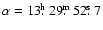 , ,
 (eq.2000).
The noise level is (eq.2000).
The noise level is
 K km s-1.
Contours range in units of 1 K km s-1.
Contours range in units of 1 from 1, 3, 6, 16 to 56 in steps of 10.
The peak intensity is
47.3 K km s-1. All intensities are on the
scale.
from 1, 3, 6, 16 to 56 in steps of 10.
The peak intensity is
47.3 K km s-1. All intensities are on the
scale.
|
| Open with DEXTER |
The HERA map of 12CO 2-1 (Fig. 1) is the first
CO map of M 51 encompassing the companion galaxy as well as the
south-western arm out to a radius of 12 kpc in a homogeneously
sampled data set at linear scales of down to 450 pc.
The emission detected with the 30 m telescope traces the well known
two-armed spiral pattern out to the companion galaxy NGC 5195, which
shows up brightly in the north-east at 10.5 kpc radial
distance, and out to the south-western tip of the second arm at the
opposite side of M 51. The outer parts of the two arms in the west and
in the east appear more fragmented than the inner parts. The western
arm especially is almost unresolved. Inter-arm emission is detected
above the level out to radii of about 6 kpc. Several
spoke-like structures connect the spiral arms radially.
To estimate the total H2 column densities from the
integrated CO 2-1 intensities, we assume a 2-1/1-0 intensity
ratio of 0.8 as found by Garcia-Burillo et al. (1993b). Garcia-Burillo et al. (1993b) and
Guélin et al. (1995) independently derived the CO-to-H2 conversion
factor X, for M 51 from CO 1-0 and dust continuum data. They find
that it is a factor 4 smaller than the Milky Way value
 (Strong & Mattox 1996; Strong et al. 1988) and constant with radius.
Similar X-factors for M 51 were found by Nakai & Kuno (1995),
using CO data and visual extinctions towards H II regions, and by
Adler et al. (1992) using BIMA CO 1-0 data assuming that the GMCs are
in virial equilibrium.
(Strong & Mattox 1996; Strong et al. 1988) and constant with radius.
Similar X-factors for M 51 were found by Nakai & Kuno (1995),
using CO data and visual extinctions towards H II regions, and by
Adler et al. (1992) using BIMA CO 1-0 data assuming that the GMCs are
in virial equilibrium.
For the total H2 column density per beam in M 51, we use:
 with
with
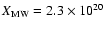 cm-2 (K km s
-1)-1.
cm-2 (K km s
-1)-1.
The X-factor may be a function of the metallicity in spiral
galaxies as has been suggested by several authors
(e.g. Arimoto et al. 1996). However, other factors like the
radiation field or the cosmic-ray rate also have a strong impact on
the CO-to-H2 conversion factor (Bell et al. 2006). The
metallicities of M 51 have been found to be slightly supersolar
showing only a shallow drop with radius by only
-0.02 dex kpc-1 (Bresolin et al. 2004):
 with R0=5.4'. The
almost constant metallicity appears to be consistent with a constant
X-factor.
with R0=5.4'. The
almost constant metallicity appears to be consistent with a constant
X-factor.
The
limit with resolutions of 11'' and 5 km s-1corresponds to a mass of
.
The spatial resolution of
450 pc does not allow to detect individual GMCs if their typical size
is 50 pc. The individual "clumps'' delineating the spiral arms
like beads on a string (Fig. 1) have been labeled
giant molecular associations (GMAs). These may be bound clusters of
GMCs as suggested by Rand & Kulkarni (1990) or random
superpositions of molecular clouds and GMCs (Garcia-Burillo et al. 1993a).
The total mass of the molecular gas of M 51 derived from the CO 2-1
data set is
 .
This value agrees well with the total mass of
.
This value agrees well with the total mass of
 derived by Helfer et al. (2003) from NRAO 12 m CO 1-0 data when using
the same CO-to-H2 conversion factor and distance.
derived by Helfer et al. (2003) from NRAO 12 m CO 1-0 data when using
the same CO-to-H2 conversion factor and distance.
![\begin{figure}
\par\includegraphics[angle=-90,width=7.5cm,clip]{5579fig2.eps}
\end{figure}](/articles/aa/full/2007/01/aa5579-06/Timg51.gif) |
Figure 2:
VLA map of integrated H I intensities [Jy/beam] at 13'' resolution
(Rots et al. 1990) in colors. Contours show integrated 12CO 2-1
intensities (cf. Fig. 1). |
| Open with DEXTER |
3.2 H I and radio continuum
The large-scale distribution of the 21 cm line of atomic hydrogen in
M 51 was analyzed by Rots et al. (1990) using the VLA. Note that the
total flux is in reasonable agreement with single-dish observations
(Rots 1980). The H I emission at 13'' resolution
(Fig. 2) is weak in the inner region while the outer CO arms are clearly delineated in H I. There is patchy H I emission in
the south,
near (0,-250''),
where only very little CO is found.
In the inner arms of M 51, inside the corotation radius of
7.4 kpc (Garcia-Burillo et al. 1993a), H I and H
emission
(Rand & Kulkarni 1990; Scoville et al. 2001; Tilanus & Allen 1991) as well as
young star cluster complexes (Bastian et al. 2005) are seen slightly
towards the convex side, i.e. downstream relative to the CO emission, suggesting that they arise when GMCs are destroyed by
short-lived OB stars.
Figure 2 shows that the H I clouds tracing the
south-western spiral arm, peak on the concave side of the CO arm.
This is outside the corotation radius and thus again downstream,
consistent with the above interpretation.
![\begin{figure}
\par\includegraphics[angle=-90,width=7.5cm,clip]{5579fig3.eps}
\end{figure}](/articles/aa/full/2007/01/aa5579-06/Timg52.gif) |
Figure 3:
Map of radio continuum intensities at 20 cm
(VLA C+D, 15'' resolution) in units of Jy/beam (Patrikeev et al. 2006).
Contours show integrated 12CO 2-1 intensities
(cf. Fig. 1). |
| Open with DEXTER |
Figure 3 shows a map of the radio continuum (RC)
at 20 cm (1.4 GHz) taken with the VLA at 15'' resolution
(Patrikeev et al. 2006).
Further below, we will use this map to derive the star formation
rate per unit area.
The radio continuum map shows strong emission in the inner arms, which
slowly drops off towards the outer arms. There is patchy 20 cm
emission in the south where there is H I but only very little CO.
Again similar to H I, the 20 cm emission tracing the south-western
spiral arm peaks on the concave, downstream side of the CO arm. The
spiral arm near (
-40'',125'') shows an interesting discontinuity and
local lack of radio continuum, H I, and CO emission.
Patrikeev et al. (2006) discuss systematic offsets
between the spiral arms traced by 6 cm radio continuum emission,
ISOCAM data at 15  m, and BIMA CO 1-0 emission over scales of
several kpc.
m, and BIMA CO 1-0 emission over scales of
several kpc.
We investigate the correlation of H2 and H I surface densities
with star forming activity along radial averages, including the
outskirts of the disk where H I dominates.
Various tracers of star formation such as H,
UV, the far
infrared continuum, and the radio continuum are frequently used.
H
emission is directly linked to OB associations but subject
to extinction. See Bastian et al. (2005) for a recent study of the local
star formation rate in M 51, derived from H images. Optically
thin
far-infrared (FIR)
emission is usually taken as the most direct indicator of star
formation. In a recent study, Calzetti et al. (2005) used MIPS/Spitzer
24 m maps to study the star formation rate. Some questions
remain however
in regions of diffuse FIR emission from the atomic ISM. In such
regions the dominant contribution to the FIR flux may be due to
radiation heating of dust by the normal interstellar radiation field
(Cox & Mezger 1989) and thus not trace star formation.
The radio continuum has widely been accepted as an alternative measure
for star formation activity, a fact which is underlined by the very
strong FIR/RC correlation in many different galaxies (see the
review by Condon 1992). The FIR/RC correlation holds also on local
scales of a few hundred parsecs comparable to the resolution of our
data set. See Murphy et al. (2005) who recently studied this
relation in M 51.
Here, we use a new large scale 20 cm map of
Patrikeev et al. (2006)
at 15'' resolution and assume that the 20 cm radiation can be used
as a direct indicator for the star formation rate. We use the FIR/RC correlation and a subsequent SFR/FIR conversion to derive the star
formation rate. We then compare the star formation rate with the H2 and H I surface densities in order to check for star formation
thresholds. We further use the measured CO 2-1 line widths to study
the gravitational stability of the gas disk.
Total H2 column densities are derived from the integrated CO 2-1
intensities as described in
Sect. 3.1. We derive the face-on
surface density via
 with the atomic hydrogen mass
  and the inclination
angle i of M 51 (Table 1).
The total H I column density is derived assuming optically thin
emission:
and the inclination
angle i of M 51 (Table 1).
The total H I column density is derived assuming optically thin
emission:
 .
The corresponding surface density is:
.
The corresponding surface density is:
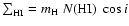 .
The total molecular mass of M 51 is
(Sect. 3.1) and the global ratio of
H I over H2 mass is 1.36. The molecular gas content of M 51 is
similar to the total molecular mass of the Milky Way,
.
The total molecular mass of M 51 is
(Sect. 3.1) and the global ratio of
H I over H2 mass is 1.36. The molecular gas content of M 51 is
similar to the total molecular mass of the Milky Way,
 (Misiriotis et al. 2006). However, the Milky Way
has a larger fraction of H I mass. The ratio of H I over H2 mass in the Milky Way is 6.3.
(Misiriotis et al. 2006). However, the Milky Way
has a larger fraction of H I mass. The ratio of H I over H2 mass in the Milky Way is 6.3.
![\begin{figure}
\par\includegraphics[angle=-90,width=7.5cm,clip]{5579fig4.eps}\end{figure}](/articles/aa/full/2007/01/aa5579-06/Timg59.gif) |
Figure 4:
Radial distributions of surface densities of H2, H I,
the total gas, and the star formation rate per unit area in M 51.
The lower box shows the ratios
 and
and
 . .
|
| Open with DEXTER |
Figure 4 shows the radial profiles of the surface
densities which were created by averaging in elliptical annuli spaced
by 10'', including points of no detection, and centered at the 0/0 position. The annuli were assumed to be circular rings viewed at an
inclination angle i and with a line of nodes rotated from north to
east by the position angle PA as listed in
Table 1.
Total gas surface densities are given by
 which includes helium.
The radially averaged
which includes helium.
The radially averaged
 drops by a factor of 20from 70 pc-2 in the center to 3 pc-2 at
radii of 12.2 kpc (300'') (Fig. 4).
drops by a factor of 20from 70 pc-2 in the center to 3 pc-2 at
radii of 12.2 kpc (300'') (Fig. 4).
Figure 5 shows the variation of
 with radius in M 51. Standard deviations of
the mean
with radius in M 51. Standard deviations of
the mean
 and
and
 are calculated from
the rms values along the annular averages:
are calculated from
the rms values along the annular averages:
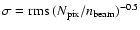 ,
following Wong & Blitz (2002) with
the number of pixels per annulus
,
following Wong & Blitz (2002) with
the number of pixels per annulus
 and the number of
pixels per beam
and the number of
pixels per beam
 .
The fraction of atomic gas gradually increases with radius. In the
inner regions of M 51, up to 6 kpc, the ratio of HI to H2 surface density scales roughly with R1.5. As the radial HI profile in M 51 is roughly constant, varying only by a factor of 5, the power-law dependence of the ratio of molecular and atomic
gas is largely due to the decrease of the molecular gas surface
density which drops by more than 2 orders of magnitude. The H I gas
surface density starts to exceed the molecular surface density at
radii greater than 4 kpc. The outer regions show deviate from any
simple power-law. The peak
fraction
reaches values of 20 in the outer areas of our map.
.
The fraction of atomic gas gradually increases with radius. In the
inner regions of M 51, up to 6 kpc, the ratio of HI to H2 surface density scales roughly with R1.5. As the radial HI profile in M 51 is roughly constant, varying only by a factor of 5, the power-law dependence of the ratio of molecular and atomic
gas is largely due to the decrease of the molecular gas surface
density which drops by more than 2 orders of magnitude. The H I gas
surface density starts to exceed the molecular surface density at
radii greater than 4 kpc. The outer regions show deviate from any
simple power-law. The peak
fraction
reaches values of 20 in the outer areas of our map.
We also plot the fraction of atomic gas for the seven
spirals studied by Wong & Blitz (2002) and for M 33 studied by
Heyer et al. (2004). In the center regions, the
ratio of the nine galaxies varies strongly
between 0.03 in NGC 4321 and slightly more than 1 in M 33. With the
exception of M 33, the inner regions are clearly dominated by
molecular material. For the galaxies of the Wong sample, the ratio
scales roughly with R1.5 for radii upto 6 kpc. In M 33,
the atomic gas dominates the total gas surface density for the
entire disk, in strong contrast to the other 8 spirals
(Fig. 5). The slope is much more shallow: the
fraction of atomic gas scales with R0.6 only (Heyer et al. 2004).
At 7 kpc, the fraction equals the fraction found at that
distance in M 51.
Next, we compare the total gas surface densities with the star
formation rate derived from the 20 cm radio continuum data.
![\begin{figure}
\par\includegraphics[angle=-90,width=7.8cm,clip]{5579fig5.eps}
\end{figure}](/articles/aa/full/2007/01/aa5579-06/Timg65.gif) |
Figure 5:
Radial distribution of the ratio of atomic
to molecular surface densities
for M 51
(thick line), the six spirals of the sample of
Wong & Blitz (2002), and M 33 (Heyer et al. 2004). For comparison,
we show two power-laws, one where the ratio scales with R1.5 and one where it scales with R. |
| Open with DEXTER |
4.2 Star formation rate and local Schmidt law
The radio continuum emission of the disk of M 51 reflects
the spatial distribution of the current star formation rate.
In normal galaxies, such as M 51, most of the radio continuum at
20 cm is non-thermal synchrotron emission (Condon 1992),
radiated by cosmic rays interacting with the magnetic fields of the
interstellar medium. The cosmic rays in turn are emitted by
supernova remnants. The remaining radio continuum emission is
free-free bremsstrahlung emission from thermal electrons in
H II-regions. The radio continuum thus traces the current star
formation rate of massive stars.
The observed optically thin radio continuum emission is known to be
well correlated with FIR dust continuum emission in a large variety of
sources, including normal disk galaxies. The tight correlation was
confirmed by Helou et al. (1985) using IRAS data and is described by the
parameter
![\begin{displaymath}q = \log\left(\frac{{\rm FIR}}
{[3.75\times 10^{12}~{\rm Wm...
... \log\left(\frac{S_{20~{\rm cm}}}
{\rm [Jy]}
\right)\cdot
\end{displaymath}](/articles/aa/full/2007/01/aa5579-06/img66.gif) |
(1) |
The parameter q was found to be 2.3 with a dispersion of 0.2 dex in a wide variety of sources (Condon 1992). We
used this relation to derive the FIR flux at 15'' resolution at each
position in M 51. Murphy et al. (2005) have recently confirmed that this
correlation holds for a map of M 51 at  m using MIPS/Spitzer at
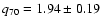
19'' resolution. In the disk, they find a median and scatter of
m using MIPS/Spitzer at
19'' resolution. In the disk, they find a median and scatter of
 .
Note that the correlation is expected to break
down at yet smaller scales of a few hundred parsecs around massive
star-forming regions (Boulanger & Perault 1988).
.
Note that the correlation is expected to break
down at yet smaller scales of a few hundred parsecs around massive
star-forming regions (Boulanger & Perault 1988).
The FIR intensity reflects the current star formation rate (see
e.g. Yun et al. 2001), as young stars form deeply embedded in their
parental molecular clouds, before dispersing their environment by
forming H II regions and by supernovae explosions. Following the
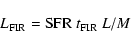
argument of Thronson & Telesco (1986), the FIR luminosity is proportional
to the star formation rate:
 |
(2) |
where L/M is the luminosity-to-mass ratio of the young stellar
clusters. Assuming a typical disruption time-scale of
 yr and a Salpeter initial mass function (IMF), the
current star formation rate is
yr and a Salpeter initial mass function (IMF), the
current star formation rate is
 yr-1. In summary, the star formation
rate per unit area is related to the flux density at 20 cm via
yr-1. In summary, the star formation
rate per unit area is related to the flux density at 20 cm via
![\begin{displaymath}\frac{\sum_{\rm SFR}}{[{M}_{\odot}~{\rm pc}^{-2}~{\rm Gyr}^{-...
...\times 10^5~\frac{S_{20~{\rm cm}}}{[{\rm Jy~beam}^{-1}]}\cdot
\end{displaymath}](/articles/aa/full/2007/01/aa5579-06/img72.gif) |
(3) |
The gas depletion or consumption time is defined as
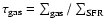 .
This is the time which
would be needed to convert the total gas content into stars assuming
that the SFR is constant with time and that there is no gas infall
or recycling via stellar winds. Note that the inverse of the gas
depletion time is the star formation efficiency.
.
This is the time which
would be needed to convert the total gas content into stars assuming
that the SFR is constant with time and that there is no gas infall
or recycling via stellar winds. Note that the inverse of the gas
depletion time is the star formation efficiency.
The global star formation rate of M 51 is 2.56 yr-1 and
the global gas depletion time 0.76 Gyr. The latter value
corresponds to a global star formation efficiency (SFE) of 13% per
0.1 Gyr. Both values, the depletion time and the SFE, agree to
within a factor of 2 with the values derived by Scoville et al. (2001)
from Hubble Space Telescope (HST) H images and CO data.
Misiriotis et al. (2006) have recently studied the distribution of the
ISM in the Milky Way. They find a similar SFR of
2.7 yr-1 but factor 5 larger gas depletion time
of 3.57 Gyr in the Milky Way. Typical normal spiral galaxies need
less time than found in the Milky Way, but more time than found in
M 51, to consume all the gas into stars. Kennicutt (1998) finds
a median depletion time of 2.1 Gyr for his sample of 61 normal disk
galaxies which shows variations between 0.2 Gyr in starburst
galaxies like NGC 5169 and 12 Gyr in early-type spirals such as M 31.
The SFR peaks above 100 pc-2 Gyr-1 in the center (Fig. 4), indicating a nuclear
starburst, and drops radially to values of
3 pc-2 Gyr-1 at 12 kpc distance. Note that
the C2 cluster complex studied by Bastian et al. (2005) shows a local
SFR of 2600 pc-2 Gyr-1, while the other
complexes studied by these authors show moderate local rates of
60-70 pc-2 Gyr-1. Regions of more than
 pc-2 Gyr-1 (i.e.
0.1 kpc-2 yr-1) are classified as starbursts
(e.g. Kennicutt 1998).
The center of M 51 harbours a Seyfert 2 AGN surrounded by a 100 pc
disk/torus (Kohno et al. 1996) of warm and dense gas
(Matsushita et al. 2004,1998).
pc-2 Gyr-1 (i.e.
0.1 kpc-2 yr-1) are classified as starbursts
(e.g. Kennicutt 1998).
The center of M 51 harbours a Seyfert 2 AGN surrounded by a 100 pc
disk/torus (Kohno et al. 1996) of warm and dense gas
(Matsushita et al. 2004,1998).
Figure 4 shows the variation of the radially averaged
star formation rate in comparison with the H I, H2, and total gas
surface densities in M 51.
Ignoring the center, the radial drop of the star formation rate
closely resembles the drop of the total gas surface density. Neither
does the SFR show the rather flat distribution of the atomic gas nor
the much steeper drop of the molecular gas.
In contrast, we would have anticipated a good correlation
of the star formation rate with the molecular gas since star
formation is known to occur only in molecular clouds. Indeed,
Heyer et al. (2004) find a strong correlation between the star
formation rate and the molecular gas surface density in M 33.
Similarly, Wong & Blitz (2002) report a much better correlation
of
with
than with
in their sample of 6 molecule-rich spirals. However,
Kennicutt (1998) who studied 88 galaxies and found that the
disk-averaged SFR is much better correlated with the disk-averaged
H I surface densities than with the H2 surface densities. In
M 51, H I is often found downstream of the CO arms indicating that
the H I clouds are the remnants of GMCs photo-dissociated by young
massive stars (Sect. 3.2). The star formation rate may
thus regulate the surface density of the atomic gas and hence
explain the observed correlation.
![\begin{figure}
\par\includegraphics[angle=-90,width=7.8cm,clip]{5579fig6.eps}
\end{figure}](/articles/aa/full/2007/01/aa5579-06/Timg75.gif) |
Figure 6:
Radially averaged star formation
rate per unit area,
 ,
versus surface densities of
the total gas
,
and of H2 and H I only. The
solid green line is the local Schmidt-law found in M 51. The
dashed-dotted black line is the global Schmidt-law found by
Kennicutt (1998). Drawn blue lines represent lines of constant
gas depletion time or star formation efficiency. ,
versus surface densities of
the total gas
,
and of H2 and H I only. The
solid green line is the local Schmidt-law found in M 51. The
dashed-dotted black line is the global Schmidt-law found by
Kennicutt (1998). Drawn blue lines represent lines of constant
gas depletion time or star formation efficiency. |
| Open with DEXTER |
Figure 6 shows the variation of SFR in M 51 with gas
surface densities together with lines of constant gas depletion time.
The gas consumption time in M 51 varies between 0.1 Gyr in the center
where the gas surface density and the SFR surface density are high and 1 Gyr at large radii where the gas surface density and SFR density
are low (Figs. 4 and 6). In contrast, the
Milky Way (Misiriotis et al. 2006) and the 6 CO-bright spiral galaxies
studied by Wong & Blitz (2002) exhibit gas depletion times which
are larger by a factor of about 10. They rise from 1 Gyr in the
centers to 10 Gyr and slightly more in the outskirts.
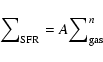
Figure 6 also shows that the star formation rate is
proportional to a power of the total gas surface density im M 51
 |
(4) |
i.e. follows a Schmidt-law (Schmidt 1959), with
normalization
 and the slope
where
is in units of pc-2 Gyr-1
and
in units of pc-2.
and the slope
where
is in units of pc-2 Gyr-1
and
in units of pc-2.
Table 2:
Schmidt Law
 observed in M 51 and other galaxies
in
comparison with the Schmidt-Law derived from simulations.
and A are in units of pc-2 Gyr-1 and
in units of pc-2. The values of the sample of
Wong & Blitz (2002) hold for an extinction correction that depends
on the gas column density.
observed in M 51 and other galaxies
in
comparison with the Schmidt-Law derived from simulations.
and A are in units of pc-2 Gyr-1 and
in units of pc-2. The values of the sample of
Wong & Blitz (2002) hold for an extinction correction that depends
on the gas column density.
In Table 2, we compare the slope found
in M 51 with the results obtained for other galaxies and the results
from simulations. The slope found in M 51 agrees with the global
Schmidt-law, seen in a study of disk-averaged
and
of 61 normal and 36 starburst galaxies
(Kennicutt 1998). Note however that the slope of the 61 normal
galaxies is much less well-defined. Depending on the fitting method
it varies between 1.3 and 2.5 (Kennicutt 1998).
In contrast, the observed slopes of local Schmidt laws,
describing radial averages of
and
in individual galaxies, do not in general agree with the
global value, but vary strongly between 1.2 and 3.3.
Wong & Blitz (2002) studied radial averages of
and
in a sample of spiral galaxies and derive
local Schmidt laws with slopes between 1.2 and 2.1, assuming that
extinction depends on gas column density. Boissier et al. (2003)
study 16 spiral galaxies to study the local star formation laws and
find a slope of 2. In a similar study, Heyer et al. (2004) shows
that M 33 exhibits a significantly steeper slope of 3.3.
Misiriotis et al. (2006) find a slope of 2.2 for the Milky Way.
Exceeding a critical gas density may lead to the
formation of clouds and possibly stars. The critical density may in
turn be determined by gravitation.
Analogous to the well known Jeans stability criterion, the influence
of differential rotation of a homogeneous, thin disk can be described
by a dispersion relation for axially symetric disturbences
(Kley 2004):
 .
Here,
is the oscillation frequency,
.
Here,
is the oscillation frequency,
 the gas velocity dispersion, k the wavenumber,
and
the gas velocity dispersion, k the wavenumber,
and  the epicyclic frequency
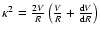 .
For a
flat rotation curve,
.
For a
flat rotation curve,
 .
The system becomes
unstable when the Toomre parameter (Toomre 1964)
.
The system becomes
unstable when the Toomre parameter (Toomre 1964)
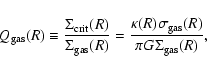 |
(5) |
describing the competition of pressure and rotation on the one side
and gravitation on the other side, at a given radius, is less than 1,
i.e. when the gas surface density exceeds the critical surface
density.
![\begin{figure}
\par\includegraphics[angle=-90,width=7.8cm,clip]{5579fig7.eps} \end{figure}](/articles/aa/full/2007/01/aa5579-06/Timg96.gif) |
Figure 7:
Left: the black drawn line shows the
12CO 2-1 gas dispersion
 derived from the
observed equivalent widths. Positions without detection of
12CO are ignored.
The green drawn line shows the gas dispersion
derived from the
observed equivalent widths. Positions without detection of
12CO are ignored.
The green drawn line shows the gas dispersion
 ,
assuming gravitational stability, i.e. ,
assuming gravitational stability, i.e.
 .
Right: the dashed line gives the rotation curve derived by
Garcia-Burillo et al. (1993a). .
Right: the dashed line gives the rotation curve derived by
Garcia-Burillo et al. (1993a). |
| Open with DEXTER |
In the following, we will assume that the disk of M 51 is
almost unstable as predicted by disk models
(e.g. Lin & Pringle 1987), i.e.
 ,
to calculate the
critical gas velocity dispersion
necessary to
stabilize the gas against gravitational collapse. We will then
compare
with the observed velocity dispersion of
the molecular gas,
,
as function of the
galacto-centric radius.
,
to calculate the
critical gas velocity dispersion
necessary to
stabilize the gas against gravitational collapse. We will then
compare
with the observed velocity dispersion of
the molecular gas,
,
as function of the
galacto-centric radius.
The rotation curve of M 51, needed to calculate the epicyclic frequency
and the critical gas density (Eq. (5)), was derived
by Garcia-Burillo et al. (1993a,b) from the CO 2-1 position-velocity
diagram along the major axis of M 51, using the velocities at the peak
intensities, and correcting for the inclination. The rotation curve
(Fig. 7) rises steeply within 10'' of the
center indicating the presence of a compact nuclear mass component in
addition to the central bulge and then stays constant at 200 km s-1 out to a radius of 10 kpc. We assume here that
the rotation curve stays almost constant further out to at least 12 kpc, ignoring any effect of the companion galaxy. The definition
of the rotation curve used here appears to be more appropriate for the
face-on galaxy M 51 than the definition used by Sofue (1996) who
derived the rotation curve from the terminal velocities at which the
peak intensity has dropped to 20% of its value, which leads to very
high velocities of up to 260 km s-1 at radii between 3 and 9 kpc.
Figure 7 also shows the radially averaged
critical velocity dispersion
derived from the gas
surface density and the rotation curve, assuming
(Eq. (5)). The critical dispersion, necessary to
stabilize the gas against gravitational collapse, lies between 1.7 and 6.8 km s-1. The dispersion peaks near R=5.5 kpc where the H2 surface density is high (Fig. 4). It then declines
slowly to 2 km s-1 at R=12 kpc.
The velocity dispersion of the molecular gas is estimated
here from the equivalent 12CO 2-1 line widths
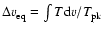 via
via
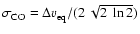 .
Figure 7 shows the radially averaged
velocity dispersion
.
It drops from
28 km s-1 in the center to 6 km s-1 at radii
of 7 to 9 kpc. Further out, it rises again to values of
8 km s-1. The rise of the observed dispersion at radii of
10-13 kpc, is due to the increased line widths in the companion
galaxy.
.
Figure 7 shows the radially averaged
velocity dispersion
.
It drops from
28 km s-1 in the center to 6 km s-1 at radii
of 7 to 9 kpc. Further out, it rises again to values of
8 km s-1. The rise of the observed dispersion at radii of
10-13 kpc, is due to the increased line widths in the companion
galaxy.
Similar vertical velocity dispersions are derived from H I observations of spiral galaxies. Typically, these vary radially from
12-15 km s-1 in the central parts to
4-6 km s-1 in the outer parts (see review
of Dib et al. 2006).
The CO velocity dispersion observed in M 51 exceeds the critical
dispersion at all radii. The ratio between the observed and the
critical dispersions drop from a factor of 5 to almost 1 for
radii between 1 and 5 kpc. This may indicate that the gas is
stabilized against collapse at all radii.
However, the observed gas dispersions are averages over the 450 pc
beam and along the elliptical annuli, and are broadened relative to
the intrinsic dispersions due to systematic motions which do not
contribute necessarily to local support of the gas against gravity.
Moreover, the influence of stars is neglected.
5 Discussion
Several authors have argued that galactic disks are self-regulated
through gravitational instabilities to have their Toomre Qparameter of the order of 1 (see e.g. Combes 2001). As soon as
gas dissipation leads to
 at a
given radius, the disk becomes gravitationally unstable, leading to
density waves transferring angular momentum, causing dissipation and
heating of the gas and thus an increase of the velocity dispersion,
stabilizing the disk again. Models indeed indicate that the disk
settles at the border of instability (Lin & Pringle 1987).
at a
given radius, the disk becomes gravitationally unstable, leading to
density waves transferring angular momentum, causing dissipation and
heating of the gas and thus an increase of the velocity dispersion,
stabilizing the disk again. Models indeed indicate that the disk
settles at the border of instability (Lin & Pringle 1987).
However, in general the velocity dispersion and surface density of
stars may play an important role in the stability analysis.
Bottema (1993) discuss the dispersion of stellar disks and the
self-regulating mechanism that keeps Q near 1 over the entire disk
of spiral galaxies. To take this into account, a total Q parameter
has been used by e.g. Combes (2001):
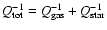 .
Neglecting stars is valid only when
the gas surface density divided by the gas dispersion dominates all
other
.
Neglecting stars is valid only when
the gas surface density divided by the gas dispersion dominates all
other
 terms.
Observationally,
has often been found to be larger than 1 by factors of a few. Kennicutt (1989) derived radial averages
of the Toomre-parameter of a sample of 15 galaxies, assuming a
constant velocity dispersion of 6 km s-1, and found that star
formation is restricted to regions where
 .
A similar
conclusion was drawn from a study of 32 nearby spiral galaxies by
Martin & Kennicutt (2001) with few exceptions. Similarly,
Wong & Blitz (2002) also assume a constant velocity dispersion and
find
.
A similar
conclusion was drawn from a study of 32 nearby spiral galaxies by
Martin & Kennicutt (2001) with few exceptions. Similarly,
Wong & Blitz (2002) also assume a constant velocity dispersion and
find
 over a wider range of
radii for some of their galaxies while others show deviations by
factors of 2.
over a wider range of
radii for some of their galaxies while others show deviations by
factors of 2.
While in the inner 4 kpc of M 51, the gas dispersion is large and
lies between 2 and 5, the stars may contribute here, and
make the disk marginally stable. Streaming motions are a consequence
of spiral waves and gravitational instabilities (Combes 2001).
M 51 shows strong streaming motions of 60-150 km s-1 in the
plane of the galaxy in the inner spiral arms as can be seen in the
interferometric CO maps of Aalto et al. (1999). The broadening of the
velocity dispersions due to streaming motions is naturally taken into
account here. However, the observed dispersion is also broadened by
the very steep, unresolved rotation curve in the center of M 51. A more
careful stability analysis would need to correct the observed
dispersions for rotation gradients, take into account the influence of
stars, and study individual regions of M 51 at high spatial resolution.
Recent smoothed particle hydrodynamics (SPH) simulations of
gravitational instability of isolated disk galaxies comprising a dark
matter halo, a disk of stars, and isothermal gas by
Li et al. (2005,2006) find a slope of 1.31 of the local Schmidt law
(Table 2), close to the slope of the global Schmidt
law, which is also reproduced, and close to the slope of 1.35 found in M 51. On the other hand, the slope of 1.3 is at the low-end of the
local Schmidt law slopes observed so far.
We find a normalization factor A of the local Schmidt law in M 51 of 1.12 pc-2 Gyr-1 (Table 2), similar to A of gas-rich models in Li et al. (2006). This is a factor 5 larger
than the average value of the Li et al. (2006) models. It is also a
factor 5 larger than the normalization found in the large sample of
Kennicutt (1998).
Interestingly, the normal galaxies of the Kennicutt (1998) sample
show on average a factor 3 longer gas consumption times than
found in M 51. In Sect. 4.2 we also noticed that
the Milky Way (Misiriotis et al. 2006) and the 6 CO-bright galaxies
studied by Wong & Blitz (2002) exhibit consumption times which are
larger than the consumption time found in M 51 by about one order of
magnitude. Apparently, the star formation efficiency of M 51 is higher
than in many other normal galaxies.
The reason may be the interaction of M 51 with its neighbouring galaxy
NGC 5195, as has been proposed before as mentioned in the
Introduction
(e.g. Toomre & Toomre 1972; Nikola et al. 2001; Howard & Byrd 1990). This is
supported by the recent simulations of Li et al. (2004) which show that
interaction and merging can lead to instable disks and strong
starbursts.
We mapped completely the interacting spiral galaxy M 51 in the
12CO 2-1 line using HERA at the IRAM-30 m telescope. The map
includes the companion galaxy as well as the south-western arm out to
radii of 12 kpc at linear resolutions of 450 pc (11''). These data
were combined with maps of H I and the radio continuum at 20 cm at
similar resolutions to study radially averagedsurface densities. The
star formation rate per unit area was estimated from the radio
continuum, allowing to study star formation laws like the Schmidt law.
The critical density for gravitational instability was compared with
the total gas surfacedensity along the radial averages. In detail, we
obtain the following results:
In a forthcoming paper we will discuss the distribution of molecular
gas, local Schmidt laws, and local critical gas surface densities,
discerning the conditions in different parts of M 51, i.e. the arm,
interarm, and central regions. We will also study in more detail the
spatial and kinematic distribution of atomic and molecular clouds,
especially in the outer spiral arms.
Acknowledgements
We thank R. Beck for providing us the radio-continuum data and
A.H. Rots for the HI data. We would also like to thank R. Beck,
T. Wong, Y. Sofue, N. Scoville, and F. Combes for valuable
comments and discussions. Insightful comments from an anonymous
referee are appreciated. We are grateful to the IRAM staff at Pico
Veleta for excellent support at the telescope. IRAM is supported by
INSU/CNRS (France), MPG (Germany), and IGN (Spain).
- Aalto, S.,
Huettemeister, S., Scoville, N. Z., & Thaddeus, P. 1999,
ApJ, 522, 165 [NASA ADS] [CrossRef] (In the text)
- Adler,
D. S., Lo, K. Y., Wright, M. C. H., et al.
1992, ApJ, 392, 497 [NASA ADS] [CrossRef] (In the text)
- Arimoto, N.,
Sofue, Y., & Tsujimoto, T. 1996, PASJ, 48, 275 [NASA ADS] (In the text)
- Bastian, N.,
Gieles, M., Efremov, Y. N., & Lamers,
H. J. G. L. M. 2005, A&A, 443, 79 [EDP Sciences] [NASA ADS] [CrossRef] [EDP Sciences] (In the text)
- Bell, T. A.,
Roueff, E., Viti, S., & Williams, D. A. 2006, MNRAS, 371,
1865 [NASA ADS] [CrossRef] (In the text)
- Boissier,
S., Prantzos, N., Boselli, A., & Gavazzi, G. 2003, MNRAS, 346,
1215 [NASA ADS] [CrossRef]
- Bottema, R.
1993, A&A, 275, 16 [NASA ADS] (In the text)
-
Boulanger, F., & Perault, M. 1988, ApJ, 330, 964 [NASA ADS] [CrossRef] (In the text)
- Bresolin,
F., Garnett, D. R., & Kennicutt, R. C. 2004, ApJ,
615, 228 [NASA ADS] [CrossRef] (In the text)
- Calzetti,
D., Kennicutt, R. C., Bianchi, L., et al. 2005, ApJ, 633,
871 [NASA ADS] [CrossRef] (In the text)
- Combes, F.
2001, in The Central Kiloparsec of Starbursts and AGN: The La Palma
Connection, ed. J. H. Knapen, J. E. Beckman,
I. Shlosman, & T. J. Mahoney, ASP Conf. Ser., 249,
475
(In the text)
- Condon,
J. J. 1992, ARA&A, 30, 575 [NASA ADS] (In the text)
- Cox,
P., & Mezger, P. G. 1989, A&ARv, 1, 49 [NASA ADS] (In the text)
- Daigle, O.,
Carignan, C., Amram, P., et al. 2006, MNRAS, 367, 469 [NASA ADS] [CrossRef] (In the text)
-
de Vaucouleurs, G., de Vaucouleurs, A., Corwin,
H. J., et al. 1991, Third reference catalogue of bright
galaxies (New York: Springer-Verlag)
- Dib, S., Bell, E.,
& Burkert, A. 2006, ApJ, 638, 797 [NASA ADS] [CrossRef] (In the text)
-
Elmegreen, B. G. 1994, ApJ, 425, L73 [NASA ADS] [CrossRef] (In the text)
-
Feldmeier, J. J., Ciardullo, R., & Jacoby, G. H.
1997, ApJ, 479, 231 [NASA ADS]
- Garcia-Burillo,
S., Combes, F., & Gerin, M. 1993a, A&A, 274, 148 [NASA ADS]
- Garcia-Burillo,
S., Guelin, M., & Cernicharo, J. 1993b, A&A, 274, 123 [NASA ADS]
-
Gerin, M., & Phillips, T. 2000, ApJ, 537, 644 [NASA ADS] [CrossRef]
- Greve, A.,
Kramer, C., & Wild, W. 1998, A&AS, 133, 271 [EDP Sciences] [NASA ADS] (In the text)
- Guélin,
M., Zylka, R., Mezger, P. G., Haslam, C. G. T., &
Kreysa, E. 1995, A&A, 298, L29 [NASA ADS] (In the text)
- Helfer,
T. T., Thornley, M. D., Regan, M. W., et al.
2003, ApJS, 145, 259 [NASA ADS] [CrossRef] (In the text)
- Helou, G.,
Soifer, B. T., & Rowan-Robinson, M. 1985, ApJ, 298,
L7 [NASA ADS] [CrossRef] (In the text)
- Heyer,
M. H., Corbelli, E., Schneider, S. E., & Young,
J. S. 2004, ApJ, 602, 723 [NASA ADS] [CrossRef] (In the text)
- Howard, S.,
& Byrd, G. G. 1990, AJ, 99, 1798 [NASA ADS] [CrossRef]
-
Israel, F. P., & Baas, F. 2002, A&A, 383, 82 [EDP Sciences] [NASA ADS] [CrossRef] [EDP Sciences]
- Israel,
F. P., Tilanus, R. P. J., & Baas, F. 2006,
A&A, 445, 907 [EDP Sciences] [NASA ADS] [CrossRef] [EDP Sciences]
-
Kennicutt, R. C. 1989, ApJ, 344, 685 [NASA ADS] [CrossRef] (In the text)
-
Kennicutt, R. C. 1998, ApJ, 498, 541 [NASA ADS] [CrossRef]
- Kley,
P. 2004, Theoretische Astrophysik, Wintersemester 2004/05
(Universitaet Tuebingen)
(In the text)
- Kohno, K.,
Kawabe, R., Tosaki, T., & Okumura, S. 1996, ApJ, 461, L29 [NASA ADS] [CrossRef] (In the text)
- Kramer, C.,
Mookerjea, B., Bayet, E., et al. 2005, A&A, 441, 961 [EDP Sciences] [NASA ADS] [CrossRef] [EDP Sciences] (In the text)
- Kuno, N., &
Nakai, N. 1997, PASJ, 49, 279 [NASA ADS]
- Kuno, N., Nakai,
N., Handa, T., & Sofue, Y. 1995, PASJ, 47, 745 [NASA ADS]
- Lin,
D. N. C., & Pringle, J. E. 1987, MNRAS, 225,
607 [NASA ADS] (In the text)
- Li, Y., Mac Low, M.-M.,
& Klessen, R. S. 2004, ApJ, 614, L29 [NASA ADS] [CrossRef] (In the text)
- Li, Y., Mac Low, M.-M.,
& Klessen, R. S. 2005, ApJ, 620, L19 [NASA ADS] [CrossRef]
- Li, Y., Mac Low, M.-M.,
& Klessen, R. S. 2006, ApJ, 639, 879 [NASA ADS] [CrossRef]
- Lord,
S., & Young, J. 1990, ApJ, 356, 135 [NASA ADS] [CrossRef]
- Martin, C. L., &
Kennicutt, R. C. 2001, ApJ, 555, 301 [NASA ADS] [CrossRef]
-
Matsushita, S., Kohno, K., Vila-Vilaro, B., Tosaki, T., &
Kawabe, R. 1998, ApJ, 495, 267 [NASA ADS] [CrossRef]
-
Matsushita, S., Sakamoto, K., Kuo, C.-Y., et al. 2004, ApJ,
616, L55 [NASA ADS] [CrossRef]
-
Meijerink, R., Tilanus, R. P. J., Dullemond, C. P.,
Israel, F. P., & van der Werf, P. P. 2005, A&A,
430, 427 [EDP Sciences] [NASA ADS] [CrossRef] [EDP Sciences] (In the text)
-
Misiriotis, A., Xilouris, E. M., Papamastorakis, J., Boumis,
P., & Goudis, C. D. 2006, in press
(In the text)
- Murphy,
E. J., Armus, L., Helou, G., Braun, R., & the SINGS team.
2005, in The Spitzer Space Telescope: New Views of the Cosmos, ed.
L. Armus & et al. (ASP Conference Series)
(In the text)
- Nakai,
N., & Kuno, N. 1995, PASJ, 47, 761 [NASA ADS] (In the text)
- Nakai, N., Kuno,
N., Handa, T., & Y. Sofue, Y. 1994, PASJ, 46, 527 [NASA ADS]
- Nikola, T.,
Geis, N., Herrmann, F., et al. 2001, ApJ, 561, 203 [NASA ADS] [CrossRef] (In the text)
-
Patrikeev, I., Fletcher, A., Stepanov, R., et al. 2006, in
press
(In the text)
-
Rand, R. J., & Kulkarni, S. R. 1990, ApJ, 349,
L43 [NASA ADS] [CrossRef] (In the text)
- Rots, A. 1980,
A&AS, 41, 189 [NASA ADS] (In the text)
- Rots, A., Crane,
P., Bosma, A., Athanassoula, E., & van der Hulst, J. 1990,
AJ, 100, 387 [NASA ADS] [CrossRef] (In the text)
- Rydbeck, G.,
Thomasson, M., Aalto, S., Johansson, L., & Hüttemeister,
S. 2004, in The Neutral ISM in Starburst Galaxies, ed.
S. Aalto, S. Huttemeister, & A. Pedlar, ASP
Conf. Ser., 320, 152
(In the text)
-
Schinnerer, E., Weiß, A., Aalto, S., & Scoville,
N. Z. 2004, in The Dense Interstellar Medium in Galaxies, ed.
S. Pfalzner, C. Kramer, C. Straubmeier, &
A. Heithausen, 117
(In the text)
- Schmidt, M.
1959, ApJ, 129, 243 [NASA ADS] [CrossRef]
- Schuster,
K.-F., Boucher, C., Brunswig, W., et al. 2004, A&A, 423,
1171 [EDP Sciences] [NASA ADS] [CrossRef] [EDP Sciences] (In the text)
-
Scoville, N., & Young, J. S. 1983, ApJ, 265, 148 [NASA ADS] [CrossRef]
- Scoville,
N. Z., Polletta, M., Ewald, S., et al. 2001, AJ, 122,
3017 [NASA ADS] [CrossRef]
- Sofue, Y. 1996,
ApJ, 458, 120 [NASA ADS] [CrossRef] (In the text)
-
Strong, A. W., & Mattox, J. R. 1996, A&A, 308,
L21 [NASA ADS]
- Strong,
A. W., Bloemen, J. B. G. M., Dame, T. M.,
et al. 1988, A&A, 207, 1 [NASA ADS]
- Takats, K.,
& Vinko, J. 2006, MNRAS, in press
- Thronson,
H. A., & Telesco, C. M. 1986, ApJ, 311, 98 [NASA ADS] [CrossRef] (In the text)
- Tilanus,
R. P. J., & Allen, R. J. 1991, A&A, 244,
8 [NASA ADS] (In the text)
- Toomre, A.
1964, ApJ, 139, 1217 [NASA ADS] [CrossRef] (In the text)
-
Toomre, A., & Toomre, J. 1972, ApJ, 178, 623 [NASA ADS] [CrossRef] (In the text)
- Tully,
R. B. 1974a, ApJS, 27, 437 [NASA ADS] [CrossRef]
- Tully,
R. B. 1974b, ApJS, 27, 449 [NASA ADS] [CrossRef]
- Wong,
T., & Blitz, L. 2002, ApJ, 569, 157 [NASA ADS] [CrossRef]
- Yun, M. S.,
Reddy, N. A., & Condon, J. J. 2001, ApJ, 554,
803 [NASA ADS] [CrossRef] (In the text)
Copyright ESO 2006
![\begin{figure}
\par\includegraphics[angle=-90,width=7.5cm,clip]{5579fig1.eps}\end{figure}](/articles/aa/full/2007/01/aa5579-06/img44.gif)
![\begin{figure}
\par\includegraphics[angle=-90,width=7.5cm,clip]{5579fig2.eps}
\end{figure}](/articles/aa/full/2007/01/aa5579-06/img51.gif)
![\begin{figure}
\par\includegraphics[angle=-90,width=7.5cm,clip]{5579fig3.eps}
\end{figure}](/articles/aa/full/2007/01/aa5579-06/img52.gif)
![\begin{figure}
\par\includegraphics[angle=-90,width=7.5cm,clip]{5579fig4.eps}\end{figure}](/articles/aa/full/2007/01/aa5579-06/img59.gif)
![\begin{figure}
\par\includegraphics[angle=-90,width=7.8cm,clip]{5579fig5.eps}
\end{figure}](/articles/aa/full/2007/01/aa5579-06/img65.gif)
![\begin{figure}
\par\includegraphics[angle=-90,width=7.8cm,clip]{5579fig6.eps}
\end{figure}](/articles/aa/full/2007/01/aa5579-06/img75.gif)
![\begin{figure}
\par\includegraphics[angle=-90,width=7.8cm,clip]{5579fig7.eps} \end{figure}](/articles/aa/full/2007/01/aa5579-06/img96.gif)