![[*]](/icons/foot_motif.gif)
A&A 460, 821-829 (2006)
DOI: 10.1051/0004-6361:20065160
M. L. Arias1,3,
- J. Zorec2
- L. Cidale1,3 - A. E. Ringuelet1 - N. I. Morrell4 - D. Ballereau5
1 - Facultad de Ciencias Astronómicas y Geofísicas, Universidad
Nacional de La Plata, Paseo del Bosque s/n, (1900) La Plata, Argentina
2 - Institut d'Astrophysique de Paris, UMR7095 CNRS, Université Pierre &
Marie Curie, 98bis Bd. Arago, 75014 Paris, France
3 - Instituto de Astrofísica de La Plata (CONICET-UNLP), Paseo del Bosque
s/n, (1900) La Plata, Argentina
4 - Las Campanas Observatory, Carnegie Observatories, Casilla 601, La Serena,
Chile
5 - GEPI, UMR 8111 du CNRS, Observatoire de Paris-Meudon, 92195 Meudon Cedex, France
Received 8 March 2006 / Accepted 22 June 2006
Abstract
Aims. The Fe II emission lines formed in the circumstellar envelopes (CE) of classical Be stars are studied in order to determine whether they are optically thin or optically thick. We also aim at deriving both average Fe II line excitation temperatures and the extent of their formation region in the CE.
Methods. We simultaneously observed several series of Fe II emission lines in the
 Å wavelength interval and the first members of the hydrogen Balmer series of 18 southern classical Be stars. The optical depth regime that controls the formation of the observed Fe II lines and the physical parameters of their CE formation region were studied using the empirical self-aborption-curve (SAC) method.
Results. Our calculations give an average value of
 for the optical depth of the studied Fe II lines, which implies that these lines are optically thick in the CE of Be stars. Qualitative indications that Fe II emission lines should be formed in circumstellar regions close to the central star are inferred from the correlations between Fe II emission line widths and
  .
The application of the SAC method to Fe II emission lines confirms this result, which gives
.
The application of the SAC method to Fe II emission lines confirms this result, which gives
 for the extension of the line-forming region. The proximity of the line-forming region to the central star is also supported by the behavior of the source function of Fe II lines, which rapidly decreases with radii. This prevents the lines from being formed over extended regions and/or far from the star. Finally, the correlations of the central depression in the Balmer emission lines with
are consistent with the flattened geometrical shapes of CEs.
for the extension of the line-forming region. The proximity of the line-forming region to the central star is also supported by the behavior of the source function of Fe II lines, which rapidly decreases with radii. This prevents the lines from being formed over extended regions and/or far from the star. Finally, the correlations of the central depression in the Balmer emission lines with
are consistent with the flattened geometrical shapes of CEs.
Key words: stars: emission-line, Be - stars: circumstellar matter - line: profiles - line: formation
The ionization potential of neutral Fe is 7.8 eV, while that of Fe II ions is 16.2 eV. This implies that due to the average excitation conditions that exist in the atmospheric and exo-photospheric regions of a wide variety of stellar objects, iron is present mainly in the Fe II ionization state. In fact, Fe II lines are observed in the Sun, in Be stars and other objects with the B[e] phenomenon, Be/X stars, LBV, cataclysmic variables, cool variables, novae, supernova remnants, H II regions, planetary nebulae, AGN, quasars, etc.
Although the Grotrian diagram of the Fe II ion is quite complex, its atomic levels can be classified into three categories: low even levels, metastable levels at roughly 3eV above the lower levels, and high odd levels at about 5 eV from the lower or fundamental levels. Transitions among these levels then produce spectral lines that are seen in the UV, optical, and near IR spectral region. In each case, different regions of a given environment can be responsible for the formation of the observed Fe II lines (Viotti 1976; Collin-Soufrin et al. 1979, 1980).
Emission in the first Balmer members can be seen in all sub-spectral types
of Be stars, while emission in Fe II lines is mainly seen in subtypes
earlier than B5 (Hubert-Delplace & Hubert 1979). Qualitative
descriptions of the occurrence of Fe II lines in Be stars were made by
Wellman (1952), Viotti & Koubský (1976), Geisel
(1970), Allen & Swings (1976), Viotti (1976),
Slettebak (1982), and Polidan & Peters (1976).
Hanuschik (1987, 1988) and Ballereau et al.
(1995) carried out somewhat more systematic studies, but they
limited their discussion to the strongest Fe II emission lines in the
visual. In these works the opacity regime that controls the formation of
Fe II emission lines and the actual location and/or extent of their
formation region have not been clearly established. All discussions by
Hanuschik (1987, 1988) and Dachs et al.
(1992) on the average kinematic properties of discs in Be stars and
conclusions that Fe II lines are formed inside the H and
H
and
H emission line-formation zone are both entirely based on the
assumption that Fe II lines are optically thin. In contrast, Ballereau
et al. (1995) claim that Fe II lines in Be stars must be
optically thick, which can lead to a somewhat different vision of the
kinematics of CE and of the actual location of the formation region of these
lines. In general, it is thought that this region is located in the H
II
emission line-formation zone are both entirely based on the
assumption that Fe II lines are optically thin. In contrast, Ballereau
et al. (1995) claim that Fe II lines in Be stars must be
optically thick, which can lead to a somewhat different vision of the
kinematics of CE and of the actual location of the formation region of these
lines. In general, it is thought that this region is located in the H
II H I transition region (Netzer 1988) in a wide variety
of astrophysical objects. Tarafdar & Apparao (1994) argued that
Fe II emission lines in Be stars cannot form in the H II region
around the central object, because of its small extent.
H I transition region (Netzer 1988) in a wide variety
of astrophysical objects. Tarafdar & Apparao (1994) argued that
Fe II emission lines in Be stars cannot form in the H II region
around the central object, because of its small extent.
It follows then that the location of the Fe II emission line-formation
region in the CE of Be stars can be determined less ambiguously, if the
optical depth regime of lines and the extent of their formation region are
analyzed simultaneously. This is the precise aim of the present work. To this
purpose, we used the self-absorption-curve (SAC) method developed by Friedjung
& Muratorio (1987), which enabled us to determine consistently
the optical depth regime of the studied lines, their average excitation
temperature, and the extent of their formation region. The method is based on
the use of many Fe II-line multiplets, each with many emission
lines.
![\begin{figure}
\par\includegraphics[width=15.5cm,clip]{5160fg1.eps}\end{figure}](/articles/aa/full/2006/48/aa5160-06/img21.gif) |
Figure 1:
Fe II and Balmer emission line profiles of some observed Be
stars. The numbers in the upper corners of the left vertical panel of Fe
II line profiles indicate the multiplet number to which the series of lines
just below belong. The Fe II emission line profiles have all the same
intensity scale, and H
and H lines have a common intensity
scale, which is different for H.
Velocities in abscissas are
heliocentric. See also the online catalogue of line profiles observed in
other program stars.
lines have a common intensity
scale, which is different for H.
Velocities in abscissas are
heliocentric. See also the online catalogue of line profiles observed in
other program stars. |
| Open with DEXTER | |
We carried out observations of 18 southern Be stars at the Complejo
Astronómico El Leoncito (CASLEO), San Juan, Argentina in March and September
1996, using the 2.15 m telescope, a REOSC échelle Cassegrain spectrograph
with a 400 mm-1 grating in cross dispersion and a Tek
 CCD. The spectral range from 3900 Å to 8000 Å, with mean resolution R=
11 500, was observed using two different tilts of the grating. Data reduction
was made using the IRAF software package. Most of the
program objects were observed in both above-mentioned epochs.
CCD. The spectral range from 3900 Å to 8000 Å, with mean resolution R=
11 500, was observed using two different tilts of the grating. Data reduction
was made using the IRAF software package. Most of the
program objects were observed in both above-mentioned epochs.
The studied objects are classical Be stars, i.e. non-supergiant B-type
stars whose spectrum has, or had at some time, one or more Balmer lines in
emission (Jaschek et al. 1981; Collins 1987). All selected Be stars
show significant emission in the first terms of the hydrogen Balmer series and in
the Fe II lines. As indicated in the introduction, most of these stars
are then hotter than spectral type B5. Table 1 lists the program
stars and their fundamental parameters and gives the log of observations.
Julian days and detailed spectral ranges observed are given in the online
Table 4. When available, the MK spectral types and the (
 )
parameters are from the BCD (
)
parameters are from the BCD (
 )
system (Divan &
Zorec 1982; Frémat et al. 2005; Zorec et al. 2005). The
are from
Chauville et al. (2001). The inclination angle i of each star is
from Frémat et al. (2005), where this parameter was derived using models of
stellar atmospheres that take into account the gravitational darkening effect
induced by the geometrical distortion produced by the fast rotation of
stars.
)
system (Divan &
Zorec 1982; Frémat et al. 2005; Zorec et al. 2005). The
are from
Chauville et al. (2001). The inclination angle i of each star is
from Frémat et al. (2005), where this parameter was derived using models of
stellar atmospheres that take into account the gravitational darkening effect
induced by the geometrical distortion produced by the fast rotation of
stars.
Table 1: Program stars and log of observations.
We studied several Fe II line multiplets: 27, 28, 37, 38, 48, 49, 55, 73, and 74. For rare cases, we could also measure some lines of multiplets 40, 41, and 43. In the chosen multiplets the emission is the strongest, so much easier to identify and measure. The respective basic atomic data were taken from the National Institute of Standards and Technology (NIST) database (http://physics.nist.gov/cgi-bin/AtData/main_asd) and R. L. Kurucz (1995, private communication).
Figure 1 shows line emission profiles normalized to the continuum
of a sample of Fe II line multiplets observed in some Be stars. The
wavelength of the plotted Fe II lines is shown in the first box of the
figure. Line
 corresponds to multiplet 48, while the remaining
ones are of multiplet 49. Figure 1 is an excerpt of the spectroscopic
data obtained. The profiles of most Fe II lines used to obtain the SAC
curve of each object are available online (online Fig. 7 to
Fig. 12). Although many lines were measured, not all of them are
displayed in the atlas. Due to space limitations, we had to choose a layout
presenting only the most outstanding among the observed transitions. All
Fe II and hydrogen Balmer lines were observed simultaneously. For each
star, the Balmer H,
H,
and H
lines are also shown in
Fig. 1. The online atlas of line profiles also includes the first
three lines of the hydrogen Balmer series (the online Figs. 13 to 15). The velocity scales used are heliocentric.
corresponds to multiplet 48, while the remaining
ones are of multiplet 49. Figure 1 is an excerpt of the spectroscopic
data obtained. The profiles of most Fe II lines used to obtain the SAC
curve of each object are available online (online Fig. 7 to
Fig. 12). Although many lines were measured, not all of them are
displayed in the atlas. Due to space limitations, we had to choose a layout
presenting only the most outstanding among the observed transitions. All
Fe II and hydrogen Balmer lines were observed simultaneously. For each
star, the Balmer H,
H,
and H
lines are also shown in
Fig. 1. The online atlas of line profiles also includes the first
three lines of the hydrogen Balmer series (the online Figs. 13 to 15). The velocity scales used are heliocentric.
As seen in Fig. 1, all Fe II profiles are double peaked and
have a central depression whose depth and shape is different from line to
line. The Fe II lines are quite weak; in general they do not rise above
some 0.2 in intensity over the continuum. Contrary to the hydrogen Balmer
lines, they do not have extended wings. We can roughly distinguish two
types of Fe II line emission profiles: a) fairly symmetrical (e.g. HD 45725, HD 48917); b) asymmetrical, where one of the peaks is either more
intense or wider (e.g. HD 50013). In a given object, most Fe II line
emission profiles have a similar shape. There are, however, few objects where
the central depression in the line profiles, or the relative intensity of
peaks, change from one line to another, even if they have been observed
simultaneously (HD 45725, HD 120991, HD 148184). This may suggest the presence
of some inhomogeneity in the CE. Most objects show similar Fe II line
profiles from one observing date to another. Fe II line emission
profiles show similarities in their global shape i.e., central depression and
relative intensity of the emission peaks to those of H
and H
lines. Only in the extreme cases of pronounced asymmetries in Fe II
lines do they also appear in H.
We performed the following measurements on each emission line profile: 1)
central wavelength of lines, 2) intensity and velocity of the peaks and of
the central depression, 3) line emission equivalent width (W), 4) separation
of emission peaks (
 ), 4) widths at half intensity (
 )
and at intensity
)
and at intensity
 (
(
 ). As is known, some Fe II
lines appear in the wings of stronger lines; for example, Fe
II
). As is known, some Fe II
lines appear in the wings of stronger lines; for example, Fe
II
 or Fe II of multiplet 42 are in the wings of H
and He I lines, respectively. We measured those lines only if the
underlying line wings were well-defined. All these measurements are available
in the online Table 5.
or Fe II of multiplet 42 are in the wings of H
and He I lines, respectively. We measured those lines only if the
underlying line wings were well-defined. All these measurements are available
in the online Table 5.
Figure 2 shows the equivalent widths W of all Fe II lines as
a function of the emission-peak separation
in km s-1,
measured in four of the observed objects. The relation shown in Fig. 2
is representative of the behavior of W against
as seen in
almost all studied objects; i.e. whatever the line strength of the Fe
II line emissions in a given star,
,
is the same within an
average dispersion  50 km s-1. The same relation is also valid for
line widths
and
,
although in the last case, points
are somewhat more scattered due to the measurement difficulties/uncertainties
related to
.
All W vs.
diagrams obtained are shown
in the online Fig. 16.
50 km s-1. The same relation is also valid for
line widths
and
,
although in the last case, points
are somewhat more scattered due to the measurement difficulties/uncertainties
related to
.
All W vs.
diagrams obtained are shown
in the online Fig. 16.
If all Fe II lines were optically thin, this result would mean that
there is a kinematically delimited formation region shared in the CE by all
these lines. The average
 value can then be used as
the typical Fe II-line emission-peak separation, in particular, when
this quantity needs to be studied as a function of another stellar property,
like rotation. Figure 3 shows
versus
of program objects. In the same figure we also plot
value can then be used as
the typical Fe II-line emission-peak separation, in particular, when
this quantity needs to be studied as a function of another stellar property,
like rotation. Figure 3 shows
versus
of program objects. In the same figure we also plot
 and
and
 as a function of .
The correlations obtained agree with results in previous works, although
in most cases authors used a reduced number of individual Fe II lines
from different multiplets (Hanuschik 1987,1988; Ballereau
et al. 1995; Slettebak et al. 1992). The dashed line
in each box of Fig. 3 is the linear regression fit for which the
slopes and correlation coefficients are:
as a function of .
The correlations obtained agree with results in previous works, although
in most cases authors used a reduced number of individual Fe II lines
from different multiplets (Hanuschik 1987,1988; Ballereau
et al. 1995; Slettebak et al. 1992). The dashed line
in each box of Fig. 3 is the linear regression fit for which the
slopes and correlation coefficients are:
 on average. All these results can then be considered
consistent. Since the slopes derived from average widths coincide with those
of individual lines, it can be concluded that all Fe II lines share the
same delimited formation region.
on average. All these results can then be considered
consistent. Since the slopes derived from average widths coincide with those
of individual lines, it can be concluded that all Fe II lines share the
same delimited formation region.
The dotted line added to correlations in Fig. 3 corresponds to
 .
This line gives an upper limit to the expected
rotational broadening of line profiles. Values
.
This line gives an upper limit to the expected
rotational broadening of line profiles. Values
 2
would imply that line-broadening mechanisms other than rotation
can be operating. A tight relation
2
would imply that line-broadening mechanisms other than rotation
can be operating. A tight relation
 would mean coupling or co-rotation of the inner CE layers with the star.
The co-rotation could be produced by magnetic fields whose presence might be
suspected (Neiner et al. 2003; Neiner 2006).
would mean coupling or co-rotation of the inner CE layers with the star.
The co-rotation could be produced by magnetic fields whose presence might be
suspected (Neiner et al. 2003; Neiner 2006).
![\begin{figure}
\par\includegraphics[width=6.8cm,height=8.3cm,clip]{5160fg2.eps}\end{figure}](/articles/aa/full/2006/48/aa5160-06/img41.gif) |
Figure 2:
Equivalent widths W (Å) of individual Fe II
emission lines against their peak separation
(km s-1) in four
observed Be stars. All
are nearly the same for a given star,
which suggests a common formation region. Vertical dotted lines indicate the
average values of
.
See also the online Fig. 16. |
| Open with DEXTER | |
![\begin{figure}
\par\includegraphics[width=7.1cm,height=8.6cm,clip]{5160fg3.eps}\end{figure}](/articles/aa/full/2006/48/aa5160-06/img45.gif) |
Figure 3:
Average widths of Fe II emission lines per star against the
corresponding .
From top to bottom:
 width at intensity
,
width at intensity
,
 width at half
intensity,
width at half
intensity,
 separation of peaks. The dotted
line in each block represents
.
The dashed lines are the
regressions given in (1).
separation of peaks. The dotted
line in each block represents
.
The dashed lines are the
regressions given in (1). |
| Open with DEXTER | |
All measurements carried out on Balmer emission lines were performed on
profiles corrected for the underlying photospheric absorption component
following the procedure applied by Chauville et al. (2001). These
measurements are given in the online Table 6. As in previous works
(cf. Andrillat & Fehrenbach 1982; Dachs et al. 1986;
Slettebak et al. 1992), the widths of Balmer lines correlate
with ,
except the width at intensity
,
which is not only
more difficult to measure but can also be affected by several different
broadening mechanisms, in particular, the electron scattering (Castor et al.
1970). We found, however, that, to our knowledge, it has not yet been
shown so clearly in other previous attempts. We see that the equivalent width
of the central depression,
 ,
of H,
H,
and H
,
of H,
H,
and H emission lines show quite a well-defined trend defined with
(average regression coefficients
emission lines show quite a well-defined trend defined with
(average regression coefficients
 ). This result is shown in
Fig. 4. It appears then that the CE region producing the emission
and the central top-absorption depression in the H,
H,
and
H
lines is somewhat flattened. On the other hand, we note that the
average inclination angle of the rotational axis of program Be stars is low,
). This result is shown in
Fig. 4. It appears then that the CE region producing the emission
and the central top-absorption depression in the H,
H,
and
H
lines is somewhat flattened. On the other hand, we note that the
average inclination angle of the rotational axis of program Be stars is low,
 (see Table 1). Since the mentioned
self absorptions in the Balmer line emission profiles do not have negligible
equivalent widths,
(see Table 1). Since the mentioned
self absorptions in the Balmer line emission profiles do not have negligible
equivalent widths,
 Å, discs must have non negligible
optical depth in the perpendicular direction to the equator.
Å, discs must have non negligible
optical depth in the perpendicular direction to the equator.
![\begin{figure}
\par\includegraphics[width=6.8cm,height=8.3cm,clip]{5160fg4.eps}\end{figure}](/articles/aa/full/2006/48/aa5160-06/img50.gif) |
Figure 4:
Equivalent width of the central depression in Balmer emission lines
against the .
The dotted lines are only indicative of
the observed trends. These trends suggest that the Balmer emission line
formation region is somewhat flattened. |
| Open with DEXTER | |
To analyze emission lines, Wellman (1952) and Viotti (1970) developed empirical methods similar to "curves-of-growth''. Friedjung & Malakpur (1971) proposed a different formalism that later became the self-absorption-curve method (SAC, Muratorio 1985; Friedjung & Muratorio 1987). While the curve-of-growth methods reveal effects related to the atomic level population in the emitting layers, the SAC method makes the opacity effect explicit on the emitted radiation intensity. It then carries information on the optical depth regime that controls the Fe II line emission formation in the CE of Be stars. The SAC method has been successfully applied to studying CE in a number of different types of objects: luminous blue stars (Muratorio & Friedjung 1988, Muratorio et al. 1992), B[e] stars (Muratorio et al. 2002a), P Cygni (Muratorio et al. 2002b), novae (Selvelli & Friedjung 2003), symbiotic stars (Kotnik-Karuza et al. 2002), the Be star component in Z CMa (van den Ancker 2004), etc. In this paper, we use the SAC method to determine the optical depth regime of Fe II emission lines observed in 17 Be classical stars and to estimate the extent of their formation region in the CE (HD 164284 has Fe II lines too small to be measured reliably).
The SAC method assumes that the emitting region is a flat disk with
uniform density and temperature, which is characterized by the optical depth
 in the center of a given spectral line. By comparing the empirical SAC with the theoretical one, we can derive the sought
physical quantities. The theoretical SAC is defined by the relation
in the center of a given spectral line. By comparing the empirical SAC with the theoretical one, we can derive the sought
physical quantities. The theoretical SAC is defined by the relation
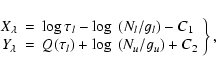
 where the respective variables
 are defined as follows (Friedjung & Muratorio
1987):
are defined as follows (Friedjung & Muratorio
1987):
 is the opacity in the central wavelength of the
spectral line; Nu,l and gu,l are the populations and statistical
weights of the corresponding upper and lower atomic levels, respectively;
is the opacity in the central wavelength of the
spectral line; Nu,l and gu,l are the populations and statistical
weights of the corresponding upper and lower atomic levels, respectively;
 is the theoretical SAC curve that measures the emitting efficiency
of the studied environment and thus, it describes the self absorption in the
spectral line; and C1 contains atomic parameters, while C2 depends on
the area of the emitting region and on its characteristic velocity. The
simplest form of the theoretical SAC function
is:
is the theoretical SAC curve that measures the emitting efficiency
of the studied environment and thus, it describes the self absorption in the
spectral line; and C1 contains atomic parameters, while C2 depends on
the area of the emitting region and on its characteristic velocity. The
simplest form of the theoretical SAC function
is:
![\begin{figure}
\par\includegraphics[width=8.35cm,height=10.2cm,clip]{5160fg5.eps}\end{figure}](/articles/aa/full/2006/48/aa5160-06/img58.gif) |
Figure 5:
Empirical SAC slopes for some stars whose lines are shown in
Fig. 1. Each symbol corresponds to a given multiplet. The
correspondence between symbols and multiplets is shown in the first left upper
panel. In each panel are also given the slope
 and
o= ordinate at X=0. The slopes indicate that Fe II lines are
optically thick. Optically thin lines would produce slopes
and
o= ordinate at X=0. The slopes indicate that Fe II lines are
optically thick. Optically thin lines would produce slopes  .
See also the SAC of all program stars in the online Fig. 17. .
See also the SAC of all program stars in the online Fig. 17. |
| Open with DEXTER | |
From (2) and (3) it follows that for optically
thin lines (
 )
)
 ,
so that the corresponding SAC
curves are horizontal lines (
,
so that the corresponding SAC
curves are horizontal lines (
 ). In contrast,
optically thick lines (
)
produce a nearly straight slope. In the
limit
). In contrast,
optically thick lines (
)
produce a nearly straight slope. In the
limit
 the slope of the SAC curve is
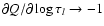 .
Since on average velocity rates in the CE are larger than the
thermal velocity, to derive (3) it was assumed that the intrinsic
line profile is rectangular. The use of more realistic atomic line profiles
complicates considerably the aspect of .
However, it does not
change its formal dependence on the opacity significantly (Friedjung &
Muratorio 1987). In this work we use relation (3). Some
uncertainties related to this approximation are discussed in
Sect. 7.
.
Since on average velocity rates in the CE are larger than the
thermal velocity, to derive (3) it was assumed that the intrinsic
line profile is rectangular. The use of more realistic atomic line profiles
complicates considerably the aspect of .
However, it does not
change its formal dependence on the opacity significantly (Friedjung &
Muratorio 1987). In this work we use relation (3). Some
uncertainties related to this approximation are discussed in
Sect. 7.
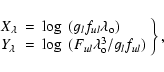
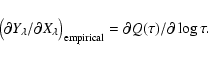
The empirical counterpart of (2) is given by:
 the central
wavelength of the line. The empirical SAC is constructed with individual
(
the central
wavelength of the line. The empirical SAC is constructed with individual
(
 )
multiplet segments, assuming that all multiplets
have the same function ,
i.e. the same formation region. Horizontal
displacements of SAC segments of those multiplets with a common lower level
with respect to a chosen reference multiplet, as well as vertical
displacements of multiplet segments with common upper levels, lead to an
estimate of relative level populations and of the average line excitation
temperature. Comparison of the re-composed empirical SAC with the theoretical
curve
gives the optical depth of the reference-line multiplet and
the radius of the corresponding emitting region.
)
multiplet segments, assuming that all multiplets
have the same function ,
i.e. the same formation region. Horizontal
displacements of SAC segments of those multiplets with a common lower level
with respect to a chosen reference multiplet, as well as vertical
displacements of multiplet segments with common upper levels, lead to an
estimate of relative level populations and of the average line excitation
temperature. Comparison of the re-composed empirical SAC with the theoretical
curve
gives the optical depth of the reference-line multiplet and
the radius of the corresponding emitting region.
The equivalent widths of the Fe II lines studied in this work are
given in the online Table 5. The corresponding atomic data are in
the online Table 7. The continuum fluxes at the respective line
frequencies as a function of the stellar fundamental parameters given in
Table 1 are from the Kurucz (1992) LTE models atmospheres.
As an example of SAC curves obtained, Fig. 5 shows those of
objects referred to in Fig. 1. The whole set of SAC curves obtained
in this work are shown in the online Fig. 17. The
(
 slopes of all program stars were fitted with
straight lines. Figure 5 also gives the respective values of
slopes (p) and y-intercept ordinates (o). The slopes obtained for all
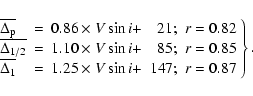
program stars range as:
slopes of all program stars were fitted with
straight lines. Figure 5 also gives the respective values of
slopes (p) and y-intercept ordinates (o). The slopes obtained for all
program stars range as:
 are listed in
Table 2. As no studied line is optically thin, the horizontal part of
the SAC curves in Figs. 5 and 17 is missing.
are listed in
Table 2. As no studied line is optically thin, the horizontal part of
the SAC curves in Figs. 5 and 17 is missing.
Since we cannot determine the location of the flat part of the SAC, the
matching of the empirical SAC with
is not obvious. To evaluate
the optical depth
of the reference Fe II line multiplet, we
thus preferred to equate the empirical slopes obtained using (4) with
the theoretical slope derived from (3):
 ,
where
,
where  and
and  are the excitation potentials
of two given levels and
are the excitation potentials
of two given levels and
 is the corresponding excitation
temperature. However, when the excitation temperature is high, as in program
stars, these displacements are small and the determination of
is
difficult. We then preferred to determine
by using an alternative
iteration process. To this purpose, we defined the following variables U
and V:
is the corresponding excitation
temperature. However, when the excitation temperature is high, as in program
stars, these displacements are small and the determination of
is
difficult. We then preferred to determine
by using an alternative
iteration process. To this purpose, we defined the following variables U
and V:
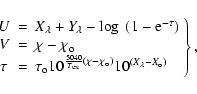
 test, is
 .
According to the star, we used
as reference multiplet the one with the average wavelength lieing roughly in
the middle of the re-composed SAC (frequently multiplet 38). Finally, to
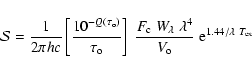
estimate the emitting region extent, we used the explicit form of the SAC
obtained from relations (2) and (4) (Friedjung & Muratorio
(1987):
.
According to the star, we used
as reference multiplet the one with the average wavelength lieing roughly in
the middle of the re-composed SAC (frequently multiplet 38). Finally, to
estimate the emitting region extent, we used the explicit form of the SAC
obtained from relations (2) and (4) (Friedjung & Muratorio
(1987):
 is a
characteristic emission line width in velocity units,
is a
characteristic emission line width in velocity units,  the flux of
the continuum spectrum at the given line wavelength, and
the flux of
the continuum spectrum at the given line wavelength, and
 the
line equivalent width. Using
issued from (6) and
iterated in (7), from relation (8), we obtain
the
line equivalent width. Using
issued from (6) and
iterated in (7), from relation (8), we obtain 
 .
However, as the "observed'' emitting surface is
aspect-angle-dependent, to calculate the radius
.
However, as the "observed'' emitting surface is
aspect-angle-dependent, to calculate the radius
 of the line
emission formation region, we have corrected the area derived from (8) using
of the line
emission formation region, we have corrected the area derived from (8) using
 .
The inclination angle i used in this correction is given in Table 1. We note that
since the effect of i on the estimate of
is proportional to
.
The inclination angle i used in this correction is given in Table 1. We note that
since the effect of i on the estimate of
is proportional to
 ,
the uncertainties on i do not introduce sensitive changes
in
.
In (8) it is implicitly assumed that
,
the uncertainties on i do not introduce sensitive changes
in
.
In (8) it is implicitly assumed that
 .
However, we do not obtain qualitatively
different results for
and
when dropping this approximation.
All quantities describing the Fe II emission region obtained in the
present section are given in Table 2. For comparison, in this table
the radii of the Fe II region calculated from Huang's (1972)
expression are also given:
.
However, we do not obtain qualitatively
different results for
and
when dropping this approximation.
All quantities describing the Fe II emission region obtained in the
present section are given in Table 2. For comparison, in this table
the radii of the Fe II region calculated from Huang's (1972)
expression are also given:
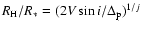 (j=1/2 for Keplerian rotation; j=1 for rotation with conservation
of angular momentum), which actually should be used only for optically thin
lines.
(j=1/2 for Keplerian rotation; j=1 for rotation with conservation
of angular momentum), which actually should be used only for optically thin
lines.
Table 2: Parameters of the Fe II line emission formation derived from the SAC curves.
In this section we briefly discuss three different, but related issues: the incidence of the line opacity regime on the estimate of the extent of the line-formation zone, formulation of the SAC by taking into account the optical depth in the line source function, and the interpretation of the line excitation temperature, which in the SAC method does not straightforwardly relate to the physical properties of the line-formation region.
One of the main results in this work is that the Fe II emission lines
in the CE of the studied classical Be stars are optically thick. This means
that models of Fe II line emission formation in Be stars, which can
help to diagnose the physical properties of CE more precisely, must take the
optical depth effects in these lines into account. The values of optical
depths obtained are on average
 .
Even
though uncertainties may be affecting the estimate of individual
values, the empirical SAC curves of Fig. 5 and those given in the
online Fig. 17, show that slopes are far from being horizontal
lines, which would be the case if Fe II lines were optically thin. The
temperature structure of the CE in Cas and 1 Del between 1 and 2
stellar radii derived by Jones et al. (2004) is also consistent with
optically thick Fe II lines, which could otherwise act as an efficient
cooling agent.
.
Even
though uncertainties may be affecting the estimate of individual
values, the empirical SAC curves of Fig. 5 and those given in the
online Fig. 17, show that slopes are far from being horizontal
lines, which would be the case if Fe II lines were optically thin. The
temperature structure of the CE in Cas and 1 Del between 1 and 2
stellar radii derived by Jones et al. (2004) is also consistent with
optically thick Fe II lines, which could otherwise act as an efficient
cooling agent.
The extent of the Fe II emission-line formation region we obtained is
on average
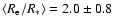 .
It is then systematically
smaller than the one obtained from Huang's (1972) relation with j=0.5:
.
It is then systematically
smaller than the one obtained from Huang's (1972) relation with j=0.5:
 ,
valid only for
optically thin lines. From (8), where
,
valid only for
optically thin lines. From (8), where

 ,
we can see that the smaller is
the larger
becomes, in accordance with Huang's estimates that are valid for
,
we can see that the smaller is
the larger
becomes, in accordance with Huang's estimates that are valid for
 .
Relation (8) can be reformulated for optically thin
lines by considering that in this case
.
Relation (8) can be reformulated for optically thin
lines by considering that in this case
 ,
where
,
where
 thermal Doppler line width. For
some stars the SAC radii given in Table 2 are of the same order of
magnitude as those obtained form Huang's (1972) formula. This is probably due
to the uncertainties related to the
determination.
thermal Doppler line width. For
some stars the SAC radii given in Table 2 are of the same order of
magnitude as those obtained form Huang's (1972) formula. This is probably due
to the uncertainties related to the
determination.
In the present discussion we compare radii issued from two different
formulations. On the one hand, there is relation (8) that ignores
details on the kinematical properties of regions where the lines are formed.
On the other, there is Huang's (1972) relation, which is based only on
the kinematical aspects of the CE. However, several contributions have shown
that the separation of emission peaks is a function of the velocity fields
and the CE optical depth. Cidale & Ringuelet (1989) found that in
static CE the separation of the emission peaks is wider when the value of the
optical depth
is higher. On the contrary, in moving, optically thick
CE the interplay of opacity and velocity fields can lead to a reduction of the
emission peak separation as
increases (Hummel 1994; Arias
2004; Arias et al. 2004, 2006).
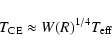
In circumstellar layers where the Fe II line emissions are formed,
 ,
the temperature can be estimated assuming that the only energy
input is from the geometrically diluted stellar radiation filed. Moujtahid
et al. (2000) show that this approximation is valid for a CE
close to the star:
,
the temperature can be estimated assuming that the only energy
input is from the geometrically diluted stellar radiation filed. Moujtahid
et al. (2000) show that this approximation is valid for a CE
close to the star:
,
 is nearly the same as the thin disc temperature
  derived
using more detailed models (Carciofi & Bjorkman 2006). Although the distances
of the Fe II emission line regions derived in the present work are
short, the excitation temperatures
are on average 30% smaller
than
given by (9). This reveals that non-LTE effects
control the population of atomic levels in the line transitions. The
level-populations are currently written as
Nu,l=bu,lN*u,l
(sub-indices "u,l' stand for "upper'' and "lower'' level), bu,l are the
respective non-LTE deviation coefficients and N*u,l are the level
populations in LTE. By definition it is
derived
using more detailed models (Carciofi & Bjorkman 2006). Although the distances
of the Fe II emission line regions derived in the present work are
short, the excitation temperatures
are on average 30% smaller
than
given by (9). This reveals that non-LTE effects
control the population of atomic levels in the line transitions. The
level-populations are currently written as
Nu,l=bu,lN*u,l
(sub-indices "u,l' stand for "upper'' and "lower'' level), bu,l are the
respective non-LTE deviation coefficients and N*u,l are the level
populations in LTE. By definition it is

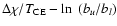 ,
where
,
where
 is the
difference of excitation potentials. We would then expect roughly that
is the
difference of excitation potentials. We would then expect roughly that
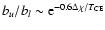 ,
which implies that
,
which implies that
 .
This also means that the source function
.
This also means that the source function
 of each line is
decoupled from the local Planck function
of each line is
decoupled from the local Planck function
 .
As in this
case there must be non-local feeding of energy, the source function becomes
dependent on the line optical depth (Mihalas 1978, Chap. 11). The
line source function
.
As in this
case there must be non-local feeding of energy, the source function becomes
dependent on the line optical depth (Mihalas 1978, Chap. 11). The
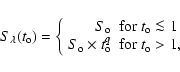
line source function
 can then be approximately written
as (Cidale & Ringuelet 1989):
can then be approximately written
as (Cidale & Ringuelet 1989):
 depends on the nature of the source function
(see next section) and q depends on whether the intrinsic line-absorption
profile is of Lorentz type, or Gaussian:
depends on the nature of the source function
(see next section) and q depends on whether the intrinsic line-absorption
profile is of Lorentz type, or Gaussian:
 .
To derive the SAC
function
.
To derive the SAC
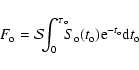
function
 that reflects the opacity dependence of the source
function given in (10), we write the flux per unit wavelength
produced by a CE of total optical depth
as:
that reflects the opacity dependence of the source
function given in (10), we write the flux per unit wavelength
produced by a CE of total optical depth
as:
 is the area of the emitting surface projected in
the observer's direction. Considering
is the area of the emitting surface projected in
the observer's direction. Considering
 constant,
the integration of (11) leads to the function
given by
(3) (Friedjung & Muratorio 1987) and used in the present
work.
is the excitation temperature of the Fe II lines,
which is assumed to be the same for all studied lines. However, adopting
constant,
the integration of (11) leads to the function
given by
(3) (Friedjung & Muratorio 1987) and used in the present
work.
is the excitation temperature of the Fe II lines,
which is assumed to be the same for all studied lines. However, adopting
 as before, but considering the
opacity-dependence of the source function indicated in (10), from
(11) we obtain:
as before, but considering the
opacity-dependence of the source function indicated in (10), from
(11) we obtain:
![\begin{figure}
\par\includegraphics[width=7.48cm,clip]{5160fg6.eps}\end{figure}](/articles/aa/full/2006/48/aa5160-06/img121.gif) |
Figure 6:
Comparison of the SAC curve
given by (12) with
 calculated in (3).
 |
| Open with DEXTER | |
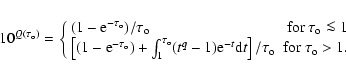
In Fig. 6 the SAC function
defined in (12) is
compared with
given by (3).
has similar
properties as
,
i.e.
 and
and
 for
for
 .
However, for
.
However, for
 a given
slope
a given
slope
 implies
 ,
as is shown in the following table, where the slopes due to
"old'' opacities are reinterpreted with the "new'' SAC curve:
,
as is shown in the following table, where the slopes due to
"old'' opacities are reinterpreted with the "new'' SAC curve:
|
|
||||||||||
| "old'' | 1.0 | 2.0 | 3.0 | 4.0 | 5.0 | 6.0 | 7.0 | 8.0 | 9.0 | 10.0 |
| "new'' | 1.3 | 2.6 | 3.8 | 4.9 | 6.0 | 7.0 | 8.1 | 9.1 | 10.2 | 11.0 |
In the present formulation of the SAC, all information on the nature of the
Fe II-line source function and on its relation to the physical
properties of the line formation region is hidden in the
parameter. To inquire in what way the SAC method can be improved to draw some
information from
,
let us write the line source function
in the two level-atom approximation (Thomas 1965,
1983; Mihalas 1978):
 is the intrinsic line absorption profile;
 is the angle-averaged intensity of the radiation field;
 depends on the upper level collision-depopulating rates;
  represents the depopulation rate of the upper level by photoionization
processes;
is the Planck function for the local
electronic temperature
represents the depopulation rate of the upper level by photoionization
processes;
is the Planck function for the local
electronic temperature
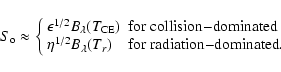
 ;
Tr is a "radiation temperature'',
whose value is set by the photoinization and recombination rates. The source
function can be collision-dominated if
;
Tr is a "radiation temperature'',
whose value is set by the photoinization and recombination rates. The source
function can be collision-dominated if
 and
and
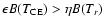 ,
radiation-dominated if
,
radiation-dominated if
 and
and
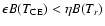 ,
and mixed-dominated in other compararative
combinations of these terms. According to the source function nature, the
factor in (10) becomes:
reflects either the local
electron temperature (collision-dominated), the stellar radiation field
(radiation-dominated), or some combination of both (mixed-domination) that
would be important to specify in further attempts of studying Fe II
lines. By considering only the leading factors of the intervening radiative
and collisional rates in ,
,
and B(Tr), we can determine
the nature of the source function and its incidence on the values of
.
This can also help to appreciate the relation between the value of
and the radius derived of the Fe II line-formation region.
Let us then write
,
and mixed-dominated in other compararative
combinations of these terms. According to the source function nature, the
factor in (10) becomes:
reflects either the local
electron temperature (collision-dominated), the stellar radiation field
(radiation-dominated), or some combination of both (mixed-domination) that
would be important to specify in further attempts of studying Fe II
lines. By considering only the leading factors of the intervening radiative
and collisional rates in ,
,
and B(Tr), we can determine
the nature of the source function and its incidence on the values of
.
This can also help to appreciate the relation between the value of
and the radius derived of the Fe II line-formation region.
Let us then write
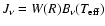 (Vinicius et al. 2005). Table 6 gives the average
source function parameters normalized to the local continuum flux .
They
were calculated using lines of multiplets 27, 38, 49, and the following
parameters for typical Be stars (spectral type B1-B2):
(Vinicius et al. 2005). Table 6 gives the average
source function parameters normalized to the local continuum flux .
They
were calculated using lines of multiplets 27, 38, 49, and the following
parameters for typical Be stars (spectral type B1-B2):
 K,
electron density
K,
electron density
 cm-3, electron temperature
derived with (9).
cm-3, electron temperature
derived with (9).
Table 3: Fe II line source function parameters.
Values in Table 6 show that the source function varies from genuine
radiation-dominated at
R/R*= 1.5 to mixed-dominated in
R/R*= 5.0
[
 and
and
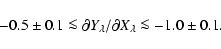
 ]. The lower block of Table 7.3 shows the
dependence of
on distance R, which implies that
]. The lower block of Table 7.3 shows the
dependence of
on distance R, which implies that
 .
Thus, whenever
is low compared to
.
Thus, whenever
is low compared to
 ,
as it is for values in Table 5, it does not mean that the
formation region of Fe II emission lines lies far from the central
star. Since the source function is radiation-dominated in regions of its
maximum emission effectiveness, the effect of the electron temperature on the
production of Fe II lines is marginal, as it acts through negligible
collisional terms. Finally, an explanation of the low values of radii R/R*derived with the SAC is given by the rapid decrease with distance of
,
as it is for values in Table 5, it does not mean that the
formation region of Fe II emission lines lies far from the central
star. Since the source function is radiation-dominated in regions of its
maximum emission effectiveness, the effect of the electron temperature on the
production of Fe II lines is marginal, as it acts through negligible
collisional terms. Finally, an explanation of the low values of radii R/R*derived with the SAC is given by the rapid decrease with distance of
 ,
as seen in Table 6, which indicates that the
Fe II emission-line formation zone in the CE cannot be very extended,
or that it cannot be far from the central star. Short radii of the Fe
II emission-line formation zone in Be stars
,
as seen in Table 6, which indicates that the
Fe II emission-line formation zone in the CE cannot be very extended,
or that it cannot be far from the central star. Short radii of the Fe
II emission-line formation zone in Be stars
 and low
line-excitation temperatures ranging from 4500 to 6000 K have also been
recently found by Brusasco & Cidale (2006, in preparation) using detailed
non-LTE models.
and low
line-excitation temperatures ranging from 4500 to 6000 K have also been
recently found by Brusasco & Cidale (2006, in preparation) using detailed
non-LTE models.
We have performed an empirical analysis of the Fe II emission lines in Be stars to derive insights into the optical depth regime that characterizes these lines (optically thin or optically thick), as well as to obtain the average excitation temperature and the extent of their formation region in the CE.
We have presented observations of several series of Fe II line
emission multiplets in the
 4230-7712 Å wavelength interval
and the first three members of the hydrogen Balmer series, which were observed
simultaneously in 18 southern Be stars. Although Fe II lines in Be
stars have already been studied by several authors, most of them considered
only the strongest lines in different multiplets. On the contrary, the present
analysis is based on the use of a large number of Fe II line
multiplets. Observations were carried out for enough Be stars to render the
obtained statistical insights reliable.
4230-7712 Å wavelength interval
and the first three members of the hydrogen Balmer series, which were observed
simultaneously in 18 southern Be stars. Although Fe II lines in Be
stars have already been studied by several authors, most of them considered
only the strongest lines in different multiplets. On the contrary, the present
analysis is based on the use of a large number of Fe II line
multiplets. Observations were carried out for enough Be stars to render the
obtained statistical insights reliable.
The correlations between the Fe II emission-line widths and
suggest that the line formation region in the circumstellar disc cannot be
situated far from the central star. On the other hand, we found a rather
well-defined correlation between the central depression in the Balmer emission
lines with the ,
which indicates that CE have globally flattened
geometrical structures.
In the present paper we analyze only the Fe II emission lines in
detail. In contrast to previous works on the Fe II lines in Be stars,
where it is systematically assumed that they are optically thin, we have made
allowance for their possibly optically-thick character. The Fe II
emission lines were thus studied using the self-absorption-curve (SAC) method.
This analysis leads us to conclude that Fe II emission lines in Be
stars are optically thick and that the optical depth in the line center is on
average
.
It has also been obtained that the line
formation region lies on average near the central star, within
 .
.
Considering the collision- and radiation-dependent terms of the line source function, we confirm that due to its rapid decrease with the radius, the Fe II line-emission formation region cannot be neither extended nor located far from the star.
Due to the non-LTE effects, the optical-depth dependence of the Fe II line source function should be taken into account explicitly in further improvements to the SAC method. In general, to gain precision in the derived physical parameters, the empirical methods for studying Fe II emission lines need to consider: 1) the opacity regime of lines; 2) their absorption line profile; 3) the nature of the source function regarding the processes determining the excitation of atomic levels, 4) the velocity field in the formation region. This is the aim pursued in a forthcoming paper, where new series of observations of Fe II lines will complete the study.
Acknowledgements
We would like to thank Dr. J. Chauville for his help in the reduction of some of the data. We warmly thank the comments and suggestions formulated by the referee.
![\begin{figure}
\par\includegraphics[width=16.8cm,height=21cm,clip]{5160fg7.eps}\end{figure}](/articles/aa/full/2006/48/aa5160-06/img158.gif) |
Figure 7: Fe II and Balmer line-emission profiles of some observed Be stars. The number in the upper left hand corner of each column of Fe II line profiles indicates the line multiplet. |
| Open with DEXTER | |
![\begin{figure}
\par\includegraphics[width=16.8cm,height=21cm,clip]{5160fg8.eps}\end{figure}](/articles/aa/full/2006/48/aa5160-06/img159.gif) |
Figure 8: Same as in Fig. 7. |
| Open with DEXTER | |
![\begin{figure}
\par\includegraphics[width=16.8cm,height=21cm,clip]{5160fg9.eps}\end{figure}](/articles/aa/full/2006/48/aa5160-06/img160.gif) |
Figure 9: Same as in Fig. 7. |
| Open with DEXTER | |
![\begin{figure}
\par\includegraphics[width=16.8cm,height=21cm,clip]{5160fg10.eps}\end{figure}](/articles/aa/full/2006/48/aa5160-06/img161.gif) |
Figure 10: Same as in Fig. 7. |
| Open with DEXTER | |
![\begin{figure}
\par\includegraphics[width=16.8cm,height=21cm,clip]{5160fg11.eps}\end{figure}](/articles/aa/full/2006/48/aa5160-06/img162.gif) |
Figure 11: Same as in Fig. 7. |
| Open with DEXTER | |
![\begin{figure}
\par\includegraphics[width=16.8cm,height=21cm,clip]{5160fg12.eps}\end{figure}](/articles/aa/full/2006/48/aa5160-06/img163.gif) |
Figure 12: Same as in Fig. 7. |
| Open with DEXTER | |
![\begin{figure}
\par\includegraphics[width=16.8cm,height=21cm,clip]{5160fg13.eps}\end{figure}](/articles/aa/full/2006/48/aa5160-06/img164.gif) |
Figure 13:
Fe II and Balmer line emission profiles of some observed Be
stars. The number in the upper left hand corner of each column of Fe II
line profiles indicates the line multiplet. H
and H
lines have
the same intensity scales, but it is different for H. |
| Open with DEXTER | |
![\begin{figure}
\par\includegraphics[width=16.8cm,height=21cm,clip]{5160fg14.eps}\end{figure}](/articles/aa/full/2006/48/aa5160-06/img165.gif) |
Figure 14: Same as in Fig. 13. |
| Open with DEXTER | |
![\begin{figure}
\par\includegraphics[width=16.8cm,height=21cm,clip]{5160fg15.eps}\end{figure}](/articles/aa/full/2006/48/aa5160-06/img166.gif) |
Figure 15: Same as in Fig. 13. |
| Open with DEXTER | |
![\begin{figure}
\par\includegraphics[width=14.4cm,height=21cm,clip]{5160fg16.eps}\end{figure}](/articles/aa/full/2006/48/aa5160-06/img167.gif) |
Figure 16:
Equivalent widths W (Å) of individual Fe II
emission lines against their peak separation
(km s-1) in
all observed Be stars. |
| Open with DEXTER | |
![\begin{figure}
\par\includegraphics[width=14.5cm,clip]{5160fg17.eps}\end{figure}](/articles/aa/full/2006/48/aa5160-06/img168.gif) |
Figure 17:
Empirical SAC slopes for all observed Be stars. Each symbol
corresponds to a given multiplet. The correspondence between symbols and
multiplets is shown in the first left upper panel. In each panel are also
given the slope
and o= ordinate at X=0. |
| Open with DEXTER | |
Table 4: Journal and spectral ranges of spectroscopic observations.
Table 5: Measurements of the observed Fe II emission lines.
Table 6: Measurements of the observed hydrogen Balmer emission lines.
Table 7: Atomic data of the sudied Fe II lines.
![\begin{displaymath}Q(\tau_l) = \log~[(1-{\rm e}^{-\tau_l})/\tau_l].
\end{displaymath}](/articles/aa/full/2006/48/aa5160-06/img57.gif)
![\begin{displaymath}S_{\lambda} = \left[\int_0^{\infty}\!\!\!\phi_{\lambda}J_{\la...
...a}(T_{\rm CE})+\eta B_{\lambda}(T_r)]/[1+
\epsilon+\eta\right]
\end{displaymath}](/articles/aa/full/2006/48/aa5160-06/img128.gif)
![$\displaystyle \left.
\begin{array}{rcl}
\epsilon & \simeq & C_{ul}/A_{ul} \\
\...
...rac{R_{uk}}{R_{lk}}\frac{R_{kl}}{R_{ku}}-1
\bigr]^{-1} \\
\end{array}\right\},$](/articles/aa/full/2006/48/aa5160-06/img139.gif)