 -ray emission of the Crab pulsar:
a multicomponent model
-ray emission of the Crab pulsar:
a multicomponent model
A&A 459, 859-870 (2006)
DOI: 10.1051/0004-6361:20065118
-ray emission of the Crab pulsar:
a multicomponent modelE. Massaro1 - R. Campana1 - G. Cusumano2 - T. Mineo2
1 - Dipartimento di Fisica, Università di Roma "La Sapienza'', Piazzale
A. Moro 2, 00185, Roma, Italy
2 -
INAF-IASF, Sezione di Palermo, via Ugo La Malfa 153, 90146, Palermo,
Italy
Received 1 March 2006 / Accepted 20 June 2006
Abstract
We present a multicomponent model to explain the
features of the pulsed emission and spectrum of the Crab Pulsar, on the basis of
X and -ray observations obtained with BeppoSAX, INTEGRAL and CGRO.
This model explains the evolution of the pulse shape and of the
phase-resolved spectra, ranging from the optical/UV to the GeV energy band, on
the assumption that the observed emission is due to more components.
The first component, CO, is assumed to have the pulsed double-peaked
profile observed at the optical frequencies, while the second component,
CX, is dominant in the interpeak and second peak phase regions.
The spectra of these components are modelled with log-parabolic laws and
their spectral energy distributions have peak energies at 12.2 and 178 keV,
respectively.
To explain the properties of the pulsed emission in the MeV-GeV band, we
introduce two more components,
 and
and
 ,
with phase
distributions similar to those of CO and CX and log-parabolic spectra
with the same curvature but peak energies at about 300 MeV and 2 GeV.
This multicomponent model is able to reproduce both the broadband phase-resolved
spectral behaviour and the changes of the pulse shape with energy.
We also propose some possible physical interpretations in which CO and CX
are emitted by secondary pairs via a synchrotron mechanism while
and
can originate either from Compton scattered or primary curvature
photons.
,
with phase
distributions similar to those of CO and CX and log-parabolic spectra
with the same curvature but peak energies at about 300 MeV and 2 GeV.
This multicomponent model is able to reproduce both the broadband phase-resolved
spectral behaviour and the changes of the pulse shape with energy.
We also propose some possible physical interpretations in which CO and CX
are emitted by secondary pairs via a synchrotron mechanism while
and
can originate either from Compton scattered or primary curvature
photons.
Key words: stars: pulsars: individual: crab pulsar (PSR B0531+21) - X-rays: stars - gamma rays: observations - stars: pulsars: general
-ray spectrum.
The Crab pulsar (PSR B0531+21) has been the best studied object of this class since
its discovery (Staelin & Reifenstein 1968) and the amount of data collected
is rich enough to search for a detailed physical picture of its
emission properties.
It is well known that the pulse shape of Crab has a characteristic
double peak structure, with a phase separation of 0.4, detected from
the radio band to rays and changing with energy.
A very remarkable feature is that the so-called second peak, hereafter P2,
in the X and soft -ray ranges becomes progressively higher than the
first peak (P1). A similar increase is also evident in the emission
between the peaks, usually named the Interpeak region (Ip) or bridge
(see Fig. 1).
Above about 10 MeV, P1 is again the dominant feature.
A satisfactory explanation for these changes has not been found so far.
On the basis of high quality BeppoSAX data, covering a wide energy
range from 0.1 to about 300 keV, we proposed a two component model (Massaro
et al. 2000, hereafter MCLM) to interpret this behaviour.
In the same paper we studied in detail the energy spectrum of the core of P1
(corresponding to a phase interval having a width of only 0.027 around the
maximum) which shows a continuous steepening at high energies.
We found that in the energy range 0.1-300 keV this spectral distribution is
well represented by a parabolic law in a double logarithmic plot (hereafter
log-parabola) with a rather mild curvature.
The extrapolation of this model in the -ray range, however, fails
to reproduce the data and a more complex modelling is required.
In a subsequent paper Kuiper et al. (2001) introduced three components to
describe the spectrum up to the -ray data obtained with COMPTEL
and EGRET on board ComptonGRO.
These authors based the analysis mainly on finding best fits of the
spectral distributions in rather narrow phase intervals and found
that the spectral variation of the pulsed emission with phase can
be modelled by two log-parabolic components
with a relative normalization changing with phase.
A further third power law component, having a photon index equal
to 2.07, was necessary for the emission of P1 and P2 to
to match the EGRET data at energies higher than about 10 MeV.
In this paper we develop a model able to describe the phase and spectral distributions of the emission over a frequency interval from the optical frequencies to GeV range. This model is an extension of that presented in MCLM and it based on the results of a new detailed data analysis of many BeppoSAX observations which includes PDS data from March 1999 to April 2001 not considered by MCLM. The timing accuracy has been verified using detailed pulse profiles obtained from RXTE archive data. Moreover, to extend the energy range, we analysed several more recent observations performed with the IBIS-ISGRI experiment on board the INTEGRAL satellite and considered the results of Kuiper et al. (2001) on the COMPTEL and EGRET observations up to a few GeV. The main goal of our work is the definiton of a scenario that can be used to develop more detailed physical models of the Crab pulsar high-energy emission.
Table 1: Log of BeppoSAX NFIs Crab Pulsar pointing epochs and net exposure times.
For the imaging instruments we selected all the events within circular
regions centered on the source position and having radii of 4 (MECS) and 8
(LECS).
This choice corresponds to using about 90% of the total
source signal in both instruments, but it allows us to apply the best
tested spectral response matrices.
(MECS) and 8
(LECS).
This choice corresponds to using about 90% of the total
source signal in both instruments, but it allows us to apply the best
tested spectral response matrices.
Phase histograms of the Crab pulsar were evaluated for each NFI and
each pointing using the period folding technique.
The UTC arrival times of all selected events were converted to the
Solar System Barycentre with the DE200 ephemeris.
The values of P and  for each observation epoch were derived
from the Jodrell Bank Crab Pulsar Monthly
Ephemeris
for each observation epoch were derived
from the Jodrell Bank Crab Pulsar Monthly
Ephemeris![[*]](/icons/foot_motif.gif) .
We constructed a large set of 300 bin phase histograms for each
energy channel of each NFI.
The zero phase was fixed at the centre of the first peak, evaluated by Gaussian fits.
All the histograms for the same energy channel of each NFI were
then added.
Before this operation we verified that all the profiles of the various
observation epochs had fully compatible shapes and therefore similar
folding accuracy.
A summary of all these phase histograms is shown in the upper panels of
Fig. 1.
.
We constructed a large set of 300 bin phase histograms for each
energy channel of each NFI.
The zero phase was fixed at the centre of the first peak, evaluated by Gaussian fits.
All the histograms for the same energy channel of each NFI were
then added.
Before this operation we verified that all the profiles of the various
observation epochs had fully compatible shapes and therefore similar
folding accuracy.
A summary of all these phase histograms is shown in the upper panels of
Fig. 1.
A relevant point we stress when working with spectra
obtained with several instruments is that a proper evaluation of the
inter-calibration factors is required.
For the BeppoSAX NFIs, the accurate ground
and in-flight calibrations were used to establish the admissible
ranges for the factors between the MECS and the other
three instruments:
 for the LECS,
 for the HPGSPC and
 for the PDS (Fiore et al. 1999).
When performing the spectral analysis, we left these three parameters free
and found the values
for the PDS (Fiore et al. 1999).
When performing the spectral analysis, we left these three parameters free
and found the values
 and
and
 ,
within the ranges given by Fiore et al. (1999).
For point sources these authors gave
,
within the ranges given by Fiore et al. (1999).
For point sources these authors gave
 ,
reduced
to
,
reduced
to
 for sources with a PDS count rate higher than 2 ct/s.
We found in our best fits
for sources with a PDS count rate higher than 2 ct/s.
We found in our best fits
 ,
very close to the above prescription,
and that we considered fully satisfactory because it was derived with
the log-parabolic model instead of the simple power law used by Fiore et al.
(1999).
,
very close to the above prescription,
and that we considered fully satisfactory because it was derived with
the log-parabolic model instead of the simple power law used by Fiore et al.
(1999).
 s
(Rots et al. 2004) with respect to the spacecraft clock and an absolute
time accuracy of 5-8 s with respect to UTC.
We used the RXTE observation of Crab performed on December 3, 2004.
PCA data were obtained in an "event mode'' that provided 128 energy
channels with 250 s time resolution.
PCA data were screened following standard selection criteria excluding
time intervals corresponding to South Atlantic Anomaly passages, Earth
limb closer than 10 degrees and with angular distance between the source
and pointing direction larger than 0
s
(Rots et al. 2004) with respect to the spacecraft clock and an absolute
time accuracy of 5-8 s with respect to UTC.
We used the RXTE observation of Crab performed on December 3, 2004.
PCA data were obtained in an "event mode'' that provided 128 energy
channels with 250 s time resolution.
PCA data were screened following standard selection criteria excluding
time intervals corresponding to South Atlantic Anomaly passages, Earth
limb closer than 10 degrees and with angular distance between the source
and pointing direction larger than 0
 02.
The total exposure time after all screening criteria was 709 s.
After the conversion of the arrival times to the Solar System Barycentre
by using the DE200 ephemeris, phase histograms were obtained by
folding data with the Jodrell Bank Crab Pulsar Monthly Ephemeris as before.
02.
The total exposure time after all screening criteria was 709 s.
After the conversion of the arrival times to the Solar System Barycentre
by using the DE200 ephemeris, phase histograms were obtained by
folding data with the Jodrell Bank Crab Pulsar Monthly Ephemeris as before.
Figure 2 shows the RossiXTE-PCA pulse profile, extracted in the 2.6-4.1 keV energy band and with 300 phase bins (110 s), together with that
obtained in the same energy range with MECS.
Both profiles have been normalized to unity at the maximum of P1, after
subtraction of the off-pulse constant level (0.6-0.83) and arbitrarily
shifted to set the zero phase at the centre of the first peak.
The comparison shows that the peak widths between the two
instruments are very similar.
The two profiles have differences of only a few percent in amplitude
(Fig. 2, lower panel) and there is no evidence of a systematic effect on
the timing in the MECS data.
We conclude that the BeppoSAX profiles accumulated over multiple
observations do not undergo any significant broadening
due either to the clock time assignment or phase misalignment among the
different histograms added together.
Table 2: Log of INTEGRAL-ISGRI observations of the Crab and of net exposure times.
To gain more information at energies higher than 200 keV we considered
also the recent data obtained with IBIS-ISGRI (Lebrun et al. 2003) on
board the INTEGRAL satellite.
In our analysis we considered only the IBIS observations having an off-axis
angle not larger than 1 which are listed in Table 2.
Phase histograms with 100 bins were obtained for each
pointing using, as before, the period folding technique (see Fig. 1).
The accuracy of INTEGRAL timing with respect to RXTE has been
verified by Kuiper et al. (2003)
The zero phase was shifted at the centre of the first peak, coherently with
the assumption for the other instruments.
A more complete spectral analysis of these data, together with those obtained
using other INTEGRAL instruments, can be found in Mineo et al. (2006).
which are listed in Table 2.
Phase histograms with 100 bins were obtained for each
pointing using, as before, the period folding technique (see Fig. 1).
The accuracy of INTEGRAL timing with respect to RXTE has been
verified by Kuiper et al. (2003)
The zero phase was shifted at the centre of the first peak, coherently with
the assumption for the other instruments.
A more complete spectral analysis of these data, together with those obtained
using other INTEGRAL instruments, can be found in Mineo et al. (2006).
 cm-2 and a
mean solar composition.
This value is higher than those considered in previous papers, usually
lower than
cm-2 and a
mean solar composition.
This value is higher than those considered in previous papers, usually
lower than  21 cm-2 (see, for instance, Toor &
Seward 1977; Ride & Walker 1977; Pravdo & Serlemitsos 1981) and
in agreement with the analysis of ASCA data by Fukuzawa et al. (1997) and
with the result of Sollerman et al. (2000) who estimated
21 cm-2 (see, for instance, Toor &
Seward 1977; Ride & Walker 1977; Pravdo & Serlemitsos 1981) and
in agreement with the analysis of ASCA data by Fukuzawa et al. (1997) and
with the result of Sollerman et al. (2000) who estimated
 cm-2 from STIS/HST observations
of the Ly
cm-2 from STIS/HST observations
of the Ly line.
This column density, however, was not confirmed by subsequent studies
that indicated an even larger
line.
This column density, however, was not confirmed by subsequent studies
that indicated an even larger  and different chemical abundances.
Willingale et al. (2001) on the basis of EPIC-MOS data found a column
density of
and different chemical abundances.
Willingale et al. (2001) on the basis of EPIC-MOS data found a column
density of
 21 cm-2 with an underabundance of
oxygen and iron of 63% with respect to the solar composition.
Weisskopf et al. (2004) obtained
21 cm-2 with an underabundance of
oxygen and iron of 63% with respect to the solar composition.
Weisskopf et al. (2004) obtained
 21 cm-2with the abundances given by Wilms et al. (2000) and using a photoelectric
absorption model that includes the scattering due to interstellar grains.
21 cm-2with the abundances given by Wilms et al. (2000) and using a photoelectric
absorption model that includes the scattering due to interstellar grains.
Table 3:
Estimates of the equivalent hydrogen column density ,
from combined LECS (0.1-4 keV) and MECS (1.6-10 keV) observations with
various absorption models and chemical abundances.
![\begin{figure*}
\par\includegraphics[angle=90,width=14.7cm,clip]{MC_f1.ps}
\end{figure*}](/articles/aa/full/2006/45/aa5118-06/img29.gif) |
Figure 1: The pulse profile and the phase dependent photon index of the Crab pulsar observed with the four Narrow Field Instruments of BeppoSAX and with ISGRI-INTEGRAL experiment. The respective energy ranges are indicated in the upper panels. All the profiles are normalized to unity at the maximum of P1. Note the change of relative intensity of P2 and Ip with respect to P1 and the increase of the photon indices. |
| Open with DEXTER | |
In order to use a more precise estimate of
and the most
suited chemical composition we performed a new analysis of the X-ray
spectrum of the DC emission of Crab (pulse phases 0.60-0.83) using
LECS and MECS data combined.
Background, estimated from archive blank fields, was subtracted from the
events.
We adopted a simple power law (
 )
as the best fitting
model because in this band there is no evidence of a change of the
nebular spectral index with energy (see next Section).
The considered abundances and photoelectric cross sections were those
of the models aneb+wabs (Anders & Ebihara 1982; Morrison
& McCammon 1983) and angr+bcmc (Anders & Grevesse 1989;
Balucinska-Church & McCammon 1992, vphabs) all implemented
in the XSPEC package.
The results are reported in Table 3, where for each model
we give the best fit values of
and of the photon index
)
as the best fitting
model because in this band there is no evidence of a change of the
nebular spectral index with energy (see next Section).
The considered abundances and photoelectric cross sections were those
of the models aneb+wabs (Anders & Ebihara 1982; Morrison
& McCammon 1983) and angr+bcmc (Anders & Grevesse 1989;
Balucinska-Church & McCammon 1992, vphabs) all implemented
in the XSPEC package.
The results are reported in Table 3, where for each model
we give the best fit values of
and of the photon index  ,
the fraction of oxygen and iron with respect to the default
value and the reduced
,
the fraction of oxygen and iron with respect to the default
value and the reduced  .
All the fits were acceptable (reduced
.
All the fits were acceptable (reduced
 )
and the column
densities were systematically higher than
)
and the column
densities were systematically higher than
 21 cm-2.
Photon index values were found to be very stable with a mean value of 2.124.
We also found (see Sect. 6.2) that the residuals at energies lower than
0.8 keV had a systematic deviation which disappeared using column density
values around
21 cm-2.
Photon index values were found to be very stable with a mean value of 2.124.
We also found (see Sect. 6.2) that the residuals at energies lower than
0.8 keV had a systematic deviation which disappeared using column density
values around
 21 cm-2.
We decided, therefore, to adopt in our analysis this
value
together with the angr+bcmc model, as indicated by other instruments
with higher spectral capabilities.
21 cm-2.
We decided, therefore, to adopt in our analysis this
value
together with the angr+bcmc model, as indicated by other instruments
with higher spectral capabilities.
 ratio is equal to
 21 cm-2 mag-1, about 30% higher than the value reported by Predehl &
Schmitt (1995).
21 cm-2 mag-1, about 30% higher than the value reported by Predehl &
Schmitt (1995).
Such a relevant optical-UV intrinsic extinction makes the evaluation
of the pulsed flux and spectrum quite difficult at these frequencies.
Several authors (e.g. Percival et al. 1993; Sollerman et al. 2000) agree that
the dereddened spectrum is a power law with a spectral index close to zero.
The difference to uncorrected data is quite large: in fact,
the observed spectral index is around -2, and small differences in the
values of E(B-V) or  can modify the dereddened slope and flux.
Of course, the extrapolation of UV data in the X-ray range may be affected by large
uncertainties.
can modify the dereddened slope and flux.
Of course, the extrapolation of UV data in the X-ray range may be affected by large
uncertainties.
In MCLM we showed that a simple power law does not provide an acceptable representation of the spectral distribution of the central bins of P1, corresponding to the narrow phase interval 0.99-0.01667. This is not a specific property of P1 but can be extended to the entire pulsed signal as apparent from the phase resolved spectroscopy of Fig. 1, where pulse profiles and best fit photon indices evaluated in the energy bands of the four NFIs of BeppoSAX and of ISGRI-INTEGRAL are shown. Upper panels show the pulse profiles while lower panels show the phase evolution of the photon indices: note the well known increase of Ip and P2 with respect to P1 and that photon indices are also increasing with energy: that of P1 changes from about 1.6 to 2.4 and that of the Ip from 1.3 to 1.95. The power law fit was applied to the events after the subtraction of a DC level, estimated from the phase interval 0.60-0.83, and assumed to be representative of the nebular continuum. High resolution X-ray images obtained with Chandra (Tennant et al. 2001) showed that there is a weak emission from the pulsar also in this phase interval. Its mean intensity is of the order of few percent than that of the peaks and becomes negligible compared to the nebular emission when considering data extracted from wider angular beams, as in our case.
![\begin{figure}
\par\includegraphics[width=7.8cm,height=7.7cm,clip]{MC_f2.ps}
\end{figure}](/articles/aa/full/2006/45/aa5118-06/img38.gif) |
Figure 2: The comparison of the normalized pulse profiles in the 2.6-4.1 keV energy range of BeppoSAX-MECS (solid histogram) and RossiXTE-PCA (dashed histogram) (upper panel). The difference plot in the lower panel has an amplitude of only a few percent and no sign of systematic effects on the timing. In the upper panel we also show the phase intervals of P1, Ip and P2 used in our spectral analysis (solid vertical lines - black) and according to Kuiper et al. (2001) (dotted vertical lines - red) used to compute the broad-band spectral distributions and the P2/P1 and Ip/P1 ratios (see Sect. 4). |
| Open with DEXTER | |
![\begin{figure}
\par\includegraphics[angle=-90,width=8cm,clip]{MC_f3.ps}
\end{figure}](/articles/aa/full/2006/45/aa5118-06/img39.gif) |
Figure 3: The energy dependence of the photon indices of P1, Ip and P2, evaluated in the ranges of the LECS, MECS , HPGSPC, two PDS bands (15-80, 80-200 keV) and INTEGRAL-ISGRI (50-500 keV, large symbols). The off-pulse photon index, representative of the nebular emission, is also shown. Best-fit linear interpolations of BeppoSAX photon indices of P1, Ip and P2 are plotted. |
| Open with DEXTER | |
![\begin{figure}
\par\includegraphics[width=7.8cm,height=7.7cm,angle=-90,clip]{MC_f4.ps}
\end{figure}](/articles/aa/full/2006/45/aa5118-06/img40.gif) |
Figure 4: The shape of P1 in three energy ranges. Maxima have been normalized to unity for a better comparison. Note the broadening of the peak with a marked asymmetry on the right side. Solid lines represent the P1 profiles derived using the two component model (see Sect. 6.3). |
| Open with DEXTER | |
To study the behaviour of the photon index with energy in detail we
considered the following three phase intervals representative
of P1 (0.9833-0.0167), the Interpeak (Ip) region (0.14-0.25) and
P2 (0.3833-0.4137).
This choice was made to have intervals wide enough to obtain estimates
of
with small statistical uncertainties and sufficiently narrow
to consider the emission of P1 mainly due to one of the components
introduced by MCLM.
In subsequent analysis, when comparing the results of our multicomponent
model with literature data (see Sect. 7), it was necessary to consider
for P1 and P2 phase intervals broader than those given above and
we adopted the same definition given by Kuiper et al. (2001).
The phase interval of Ip was the same.
Figure 2 shows the differences between these two sets.
The resulting values of
in the narrow phase intervals are shown
in Fig. 3, together with those of the off-pulse, assumed originating
in the nebula.
The values of the P1 photon index vary from
 in the
0.1-4 keV range to
in the
0.1-4 keV range to
 at (80-200 keV);
correspondingly, those of Ip vary from
at (80-200 keV);
correspondingly, those of Ip vary from
 to
to
 and
those of P2 from
and
those of P2 from
 to
to
 .
We considered also INTEGRAL-ISGRI data in the rather broad interval 50-500 keV and obtained photon indices fully consistent with the increasing
trend of BeppoSAX values.
The nebular spectrum has a remarkably constant value equal to
.
We considered also INTEGRAL-ISGRI data in the rather broad interval 50-500 keV and obtained photon indices fully consistent with the increasing
trend of BeppoSAX values.
The nebular spectrum has a remarkably constant value equal to
 ,
up to the PDS range where it slightly increases to
,
up to the PDS range where it slightly increases to
 (15-80 keV)
and to
(15-80 keV)
and to
 (80-200 keV). Note that the last value agrees very
well with that obtained by Kuiper et al. (2001) from COMPTEL data between 0.75 and 30 MeV.
The very good consistency of the nebular photon index measured in LECS,
MECS and HPGSPC is an indication of the high accuracy of their calibration
and of the correct choice of the intercalibration constants.
(80-200 keV). Note that the last value agrees very
well with that obtained by Kuiper et al. (2001) from COMPTEL data between 0.75 and 30 MeV.
The very good consistency of the nebular photon index measured in LECS,
MECS and HPGSPC is an indication of the high accuracy of their calibration
and of the correct choice of the intercalibration constants.
It is clear from these results that a law more complex than a simple
power law must be used to describe the broad-band spectral properties
of the Crab pulsar when the data of all the NFIs are considered.
A simple power law must be rejected because of the high values
of the reduced ,
found always larger than 2.
In the MCLM analysis of the P1 spectrum, good spectral fits are obtained
using a second order law in the double log representation:
and LogE like
that apparent for the best fit lines plotted in Fig. 3,
which have remarkably similar slopes corresponding to a curvature parameter b between 0.13 and 0.16, the former corresponding to P2 and the latter to Ip.
We are also interested in the spectral energy distribution, defined as E2F(E),
which for a log-parabolic law has a maximum at the energy:
 .
We apply this law to each of the two components introduced by MCLM, as
described in detail in Sect. 6.2.
.
We apply this law to each of the two components introduced by MCLM, as
described in detail in Sect. 6.2.
Figure 4 shows the normalized profiles of P1 in the three energy bands 1.6-3 keV, 16-32 keV and 87-300 keV. As noticed by Mineo et al. (1997), there is an evident broadening which increases with energy. In the lowest energy range the peak profile is asymmetric with a leading side higher than the trailing one, as observed at optical frequencies (see, e.g., Kanbach et al. 2003). This asymmetry changes in the hard X-rays as the trailing side becomes progressively higher. The broadening, however, can be safely detected also on the leading side. We verified that this effect is also present to the same extent in the RXTE data and therefore it cannot be due to possible phase misalignements of the various BeppoSAX data sets.
Pravdo et al. (1997), using a RXTE observation of the Crab
pulsar, found that the central part of P1 has a spectrum softer than the
wings.
In MCLM we confirmed this result from MECS data, but it was after
questioned by Vivekanand (2002), who in a new analysis of the RXTE data
in the range 5-60 keV obtained a stable value of
across P1.
We performed a detailed analysis with a finer phase
resolution and confirmed the previous results:
the photon index in the MECS range changes from  1.7 in the wings of
P1 to 1.82 in the core, as shown in the plot of Fig. 5.
The same effect is also apparent in the PDS data.
As it will be clearer in the following section this result is relevant
to explain the total pulsed emission as due to the superposition of
two components with different spectra.
1.7 in the wings of
P1 to 1.82 in the core, as shown in the plot of Fig. 5.
The same effect is also apparent in the PDS data.
As it will be clearer in the following section this result is relevant
to explain the total pulsed emission as due to the superposition of
two components with different spectra.
![\begin{figure}
\par\includegraphics[width=7.8cm,height=7.8cm,angle=-90,clip]{MC_f5.ps}
\end{figure}](/articles/aa/full/2006/45/aa5118-06/img55.gif) |
Figure 5: Fine phase resolved photon index across P1 in the 1.6-10 keV (MECS) and 20-100 keV (PDS) energy ranges. Solid lines are the photon indices derived using the two-component model as explained in Sect. 6.4. |
| Open with DEXTER | |
To explain at the same time the change of the pulse profile and the phase
evolution of the photon index, in MCLM we proposed a simple model in which
the observed pulsed emission is considered as the superposition of two
components having different phase distributions and energy spectra.
The first component was assumed to have the same pulsed profile observed at
optical frequencies (Smith et al. 1988), with P1
much more prominent than P2 and a very low intensity in the Ip region.
The reason for this choice is that a similar shape is also observed at
energies higher than 30 MeV, despite the profile of P2 being slightly
different (Fierro et al. 1998).
This component was called "optical'' (shortly CO).
The other "X-ray'' component CX reaches the greatest relative
intensity in the hard X to low-energy -rays and it is necessary
to explain the change of the P2/P1 ratio.
We derived its phase profile to reproduce the observed one when
it is added to CO:
we found that CX increases monotonically up to the phase 0.4 and then
it has a rather sharp cut-off (Fig. 6).
The main properties of the latter component were then estimated from the
BeppoSAX data, with a fitting procedure of several
pulse profiles at different energies, as explained in detail in MCLM.
In this new analysis we followed the same approach and considered again the same two components with only slight changes, as explained in the following subsections.
We obtained the phase profile of CO from the recent light curve
observed with the high speed photo-polarimeter OPTIMA with a time
binning of 112 s (Kanbach et al. 2003), comparable to that used
for the BeppoSAX profiles.
We used a high resolution digital scanner to convert the OPTIMA data
and then we applied a rebinning to have the final phase profile with
300 bins, the same used for the X-ray data. This profile is shown
in the upper panel of Fig. 6.
The pulse shape of CX can be obtained by the difference between the
observed profiles and CO.
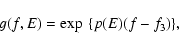
However, using the same approach as in MCLM we preferred to model CX
by means of an analytical expression to make simpler computations.
CX was factorized in two functions:
| FX(E,f)=Y(E) g(f,E) , | (4) |
 |
(5) |
 |
(6) |
In MCLM we found that the phase interval boundaries, equal to
f1=-0.15, f2=0.21, f3=0.40, f4=0.43 and the power law
exponent s=0.4 can be considered constant with the energy, whereas
a better agreement with the data is obtained if p is allowed to vary,
changing from about 11 in the keV range to 8 above 150 keV.
A simple regression gives the relation:
 |
(7) |
![\begin{figure}
\par\includegraphics[height=7.8cm,width=7.9cm,clip]{MC_f6.ps}
\end{figure}](/articles/aa/full/2006/45/aa5118-06/img59.gif) |
Figure 6: Upper panel: phase distributions of the components CO and CX with the proper normalizations. CO is derived from OPTIMA lightcurve (Kanbach et al. 2003). The four vertical bars indicate the phases from f1 to f4 used in the analytical model of CX. Lower panel: comparison between the observed pulse profile in the energy interval (8.0-10.0) keV (MECS data) and that obtained using the two component model computed for the mean energy of 8.85 keV. |
| Open with DEXTER | |
Even though this model has some minor defects of accuracy, it gives an acceptable picture of the broad-band spectral and phase properties of the pulsed emission of Crab, as we will show in the following sections. This model is not only a useful tool to represent a limited data set and it can be successfully used to extrapolate the pulse shape and spectra outside the energy range in which it is established. Note that Kuiper et al. (2001) derived a seven-bin phase profile of their component necessary to explain the spectral difference between Ip and the peaks and found a structure similar to CX.
 |
(8) |
 |
(9) |
 |
(10) |
 and
and
 .
The constants
.
The constants
 and
and
 can be obtained from
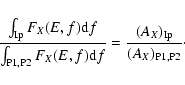
and from the shape g(f,E) of CX.
Let FX(E,f) be the flux of CX component; we have:
can be obtained from
and from the shape g(f,E) of CX.
Let FX(E,f) be the flux of CX component; we have:
 |
(11) |
 |
(12) |
from a spectral fit, we can evaluate
and
.
![\begin{figure}
\par\includegraphics[angle=-90,width=8.3cm,clip]{MC_f7.ps}
\end{figure}](/articles/aa/full/2006/45/aa5118-06/img69.gif) |
Figure 7: Spectral best fit of the four BeppoSAX-NFI data sets of Ip with the log-parabolic law of Eq. (9). |
| Open with DEXTER | |
![\begin{figure}
\par\includegraphics[angle=-90,width=8.2cm,clip]{MC_f8.ps}
\end{figure}](/articles/aa/full/2006/45/aa5118-06/img70.gif) |
Figure 8: Spectral best fit of the four BeppoSAX-NFI data sets of P1 with the combined log-parabolic model of Eq. (8) and with the UV constraint of Eq. (13). |
| Open with DEXTER | |
![\begin{figure}
\par\includegraphics[angle=-90,width=8.2cm,clip]{MC_f9.ps}
\end{figure}](/articles/aa/full/2006/45/aa5118-06/img71.gif) |
Figure 9: Spectral best fit of the four BeppoSAX-NFI data sets of P2 with the combined log-parabolic model of Eq. (10) and with the UV constraint of Eq. (13). |
| Open with DEXTER | |
To obtain a fully consistent picture, in addition to the X-ray data,
the spectral distribution of CO must satisfy the optical-UV observations.
Sollerman et al. (2000), from STIS/HST observations, found that the UV
spectrum of the Crab pulsar is remarkably flat for both peaks and can be
described by a single power law, with an energy index
 .
To better constrain our spectral parameters we impose the condition that
the extrapolation of the CO log-parabolic spectral distribution in the
UV range would be consistent with this value and from Eq. (2) we derived
the following relation between aO and bO:
.
To better constrain our spectral parameters we impose the condition that
the extrapolation of the CO log-parabolic spectral distribution in the
UV range would be consistent with this value and from Eq. (2) we derived
the following relation between aO and bO:
| bO = 0.21 aO - 0.187 | (13) |
The condition of Eq. (13) should not be considered very stringent in the evaluation of the spectral parameters. In fact, when it is released and only X-ray data are used, the best fit values of a and b are consistent with the ones in in Table 4. Equation (13), therefore, must be considered as a useful tool to reduce the parameter space and to avoid possible inconsistencies between the optical-UV and X-ray data. Moreover, the actual spectral distribution at frequencies much lower than that of the peak can deviate from a pure log-parabola and can approximate a less curved law like a simple power law. Unfortunately, in this frequency range extinction effects are important (see Sect. 3.2) and it is not simple to reach a satisfactory picture.
Three other Crab-like pulsars show curved
X-ray spectra that can be fitted by log-parabolae with curvature
parameters very similar to that of Crab: PSR B1509-58 (
 ,
Cusumano et al. 2001), PSR B0540-69 (
,
Cusumano et al. 2001), PSR B0540-69 (
 ,
de Plaa et al. 2003) and PSR J0537-6910 (
,
de Plaa et al. 2003) and PSR J0537-6910 (
 ,
Mineo et al. 2004).
This finding can be considered an indication that the same radiation
mechanism is at work in these sources.
,
Mineo et al. 2004).
This finding can be considered an indication that the same radiation
mechanism is at work in these sources.
We recall that there are important differences between our modelling
and the one of Kuiper et al. (2001).
These authors assumed that the pulsed signal observed above 30 MeV,
modeled by a single power law, extrapolates down to the X-ray range and
therefore fitted the phase resolved spectra by means of this law plus
two log-parabolae.
The estimate of the curvature parameters is thus affected by the power law,
and their values (0.299 and 0.084) are quite different from those found
by us and cannot be directly related to the slopes of the linear best fits
of Fig. 3.
The normalization factors of these components are established independently
in each phase interval considered, increasing the number of free parameters,
whereas we evaluated the normalization factors of CO and CX from
their phase distributions, as explained above.
Table 4: Parameters of the two-component, log-parabolic spectral model fits of BeppoSAX data (LECS, 0.1-4.0 keV; MECS 1.6-10.0 keV; HPGSPC 10-34 keV; PDS 15-300 keV).
The two componenent model is founded only on data from the optical to the hard X-ray range and, in principle, it could fail in describing some specific pulsar properties and the spectral behaviour outside this energy range. A useful test is to verify how the model reproduces the characteristics of P1 described in Sect. 5. Figure 4 shows the model profiles computed at the three energies of 2.0, 22 and 85 keV, approximately the mean values of the considered energy intervals. The pulse broadening is well described and the only deviation is between the phases 0.025 and 0.075, where the data show a small excess, which is likely due to the simple analytical shape adopted for CX. The search for a better agreement would likely require a more complex formula with a greater number of parameters without a clear improvement of the general description of the pulsed emission.
A simple approximate way to evaluate the mean photon index from the
model is to compute the ratio of the summed intensities of
CO and CX at the two extremes of the energy range:
 |
(14) |
 and 2.14 for the MECS and PDS data, respectively, to
match the measured values.
In this case the agreement between the observed points and the model,
shown in Fig. 5, is generally satisfactory, in particular the asymmetric variation
of
and 2.14 for the MECS and PDS data, respectively, to
match the measured values.
In this case the agreement between the observed points and the model,
shown in Fig. 5, is generally satisfactory, in particular the asymmetric variation
of  with the softest value at the P1 centre.
Both these results are due to the CX contribution in the phase interval of P1
necessary to represent the pedestal apparent in the hard-X to low-energy
rays.
These results show that observations are well reproduced if the spectrum of
this pedestal is similar to that of Ip, and therefore it is reasonable to consider
them all as belonging to the same component.
with the softest value at the P1 centre.
Both these results are due to the CX contribution in the phase interval of P1
necessary to represent the pedestal apparent in the hard-X to low-energy
rays.
These results show that observations are well reproduced if the spectrum of
this pedestal is similar to that of Ip, and therefore it is reasonable to consider
them all as belonging to the same component.
Another important verification of the model is the comparison
of pulse profiles and spectra at energies higher than the BeppoSAX-NFI
range.
In particular, we considered the low-energy -ray data obtained by
IBIS-PICsIT on board INTEGRAL (Kuiper et al. 2003) and by COMPTEL-CGRO
(Kuiper et al. 2001).
We computed the expected pulse shapes from the two component model at the three energies 0.306, 0.830 and 1.90 MeV, which are inside the energy ranges of the considered pulse profiles (0.260-0.364), (0.75-1.0) and (1.0-3.0) MeV. We used the spectral parameters of Table 4 and the value of p derived from Eq. (7). The resulting phase histograms are shown in the three panels of Fig. 10 together with the data. We see that the model profiles match well the most important features such as the heights of the two main peaks and gives an acceptable representation of the Ip region. Differences are generally within the observational uncertainties, because of the statistics available in these bands. We see therefore that our model is able to extrapolate well the pulsed emission up to the MeV range.
In order to match the optical points it is not possible to reduce the value
of b because it would be inconsistent with the X-ray data.
The simplest way is to assume that at frequencies lower than 0.1 keV
the log-parabola tends to approach a power law.
A possible spectral distribution, including optical-UV points, is shown in
Fig. 11.
![\begin{figure}
\par\includegraphics[width=8.3cm,height=10.2cm,clip]{MC_f10.ps}
\end{figure}](/articles/aa/full/2006/45/aa5118-06/img81.gif) |
Figure 10: Comparison between the Crab pulse profiles in the energy ranges 0.260-0.364 (IBIS-PICsIT data from Kuiper et al. 2003, upper panel), 0.75-1.0 MeV and 1.0-3.0 MeV (central and lower panel, COMPTEL-CGRO data from Kuiper et al. 2001) computed using the two component model. |
| Open with DEXTER | |
At energies higher than 30 MeV the model developed in the previous
section based only on the two components CO and CX is not
adequate to describe the emission properties of the Crab pulsar.
It has been known since early observations that the -ray pulse shape
is similar to that of CO, although some minor differences
are present.
The results of COMPTEL and EGRET observations (Kuiper et al. 2001)
provided high energy pulse profiles and spectra good enough to develop
a more complete model to describe the overall properties of Crab.
We recall that there are some similarities between the properties of
the pulsed emission in the hard X-rays and in the high energy
-rays.
Kanbach (1999) showed that the relative flux of P2 to that of P1
increases with energy.
The pulse profile above 1 GeV compared to that above 0.5 GeV
shows a clear excess of Ip and P2 with respect to P1 (see, e.g., Fig. 12 of Kuiper et al. 2001),
Moreover, above 5 GeV, P2 seems to be the only dominant
feature in the pulse profile, despite the small number of detected
events (Thompson 2004).
To explain these properties in a consistent way, from the optical
to the GeV band,
we extend the previous two component model assuming
that there are two other high-energy spectral components, hereafter
indicated by
and
,
which are strictly
related to CO and CX, respectively, because their pulse shapes
are similar and the spectral distributions are approximated by
log-parabolic laws, but shifted in energy.
These additional two components imply at least another six adjustable
parameters, i.e. the peak energies, curvatures and normalizations of the two
log-parabolae, but the statistical quality of the available data does
not allow a good estimate of all of them.
We assumed, therefore, that their curvatures are equal to that of the
corresponding low energy components (b=0.16) and found peak
energies and normalization factors able to describe well the observed
spectra.
We first adapted this four component model to the total pulsed spectrum
and evaluated the best normalization factors of
and
.
First we noticed that to be consistent with the upper limits to the pulsed
emission in the TeV range (e.g. Lessard et al. 2000; Aharonian et al.
2004) it was necessary either to increase the values of b or to
include an exponential cut-off in the
spectrum.
We preferred to follow the latter approach, because there is no simple
way to fix the curvatures, and found that a cut-off energy
 GeV gives a reasonable fit, although this value cannot be precisely
evaluated.
The same cut-off energy was also assumed for
,
although
it was not required by the data, because the spectral steepening
of the log-parabola reduces the relevance of this component above
a few GeV.
The resulting spectral energy distribution compared with BeppoSAX,
COMPTEL and EGRET data is shown in Fig. 11.
We also added some data points obtained from the FIGARO II experiment
(Agrinier et al. 1990; Massaro et al. 1998) to fill the gap between 300
keV and 1 MeV.
GeV gives a reasonable fit, although this value cannot be precisely
evaluated.
The same cut-off energy was also assumed for
,
although
it was not required by the data, because the spectral steepening
of the log-parabola reduces the relevance of this component above
a few GeV.
The resulting spectral energy distribution compared with BeppoSAX,
COMPTEL and EGRET data is shown in Fig. 11.
We also added some data points obtained from the FIGARO II experiment
(Agrinier et al. 1990; Massaro et al. 1998) to fill the gap between 300
keV and 1 MeV.
![\begin{figure}
\par\includegraphics[angle=-90,width=8cm,clip]{MC_f11.ps}
\end{figure}](/articles/aa/full/2006/45/aa5118-06/img83.gif) |
Figure 11: The broad-band spectral energy distribution of the total averaged pulse of the Crab Pulsar, with the four components of the model. Data points are from BeppoSAX, Compton-CGRO and FIGARO II. We also included TeV upper limits (downward open triangles) from Aharonian et al. (2004) and the optical data (green circles) from Percival et al. (1993), together with the best fit after reddening corrections (solid cyan line). Also shown (brown dash-dotted line) is the optical dereddened data from Sollerman et al. (2000). A possible low frequency extrapolation of the two component SED to match these optical data is plotted. |
| Open with DEXTER | |
![\begin{figure}
\par\includegraphics[width=6.1cm,height=8cm,angle=-90,clip]{MC_f12.ps}
\end{figure}](/articles/aa/full/2006/45/aa5118-06/img84.gif) |
Figure 12: The broad-band spectral energy distribution of P1 with the four components of the model. Data points are from BeppoSAX, INTEGRAL-ISGRI and Compton-CGRO. |
| Open with DEXTER | |
![\begin{figure}
\par\includegraphics[width=6.1cm,height=8cm,angle=-90,clip]{MC_f13.ps}
\end{figure}](/articles/aa/full/2006/45/aa5118-06/img85.gif) |
Figure 13: The broad-band spectral energy distribution of Ip with the components of the model. Data points are from BeppoSAX, INTEGRAL-ISGRI and Compton-CGRO. |
| Open with DEXTER | |
![\begin{figure}
\par\includegraphics[width=6.1cm,height=8cm,angle=-90,clip]{MC_f14.ps}
\end{figure}](/articles/aa/full/2006/45/aa5118-06/img86.gif) |
Figure 14: The broad-band spectral energy distribution of P2 with the four components of the model. Data points are from BeppoSAX, INTEGRAL-ISGRI and Compton-CGRO. |
| Open with DEXTER | |
The spectra of P1, Ip, and P2 were computed using the phase intervals
of Kuiper et al. (2001) and the intensity ratios derived from the pulse
shapes of CO and CX.
Figures 12-14
show the resulting spectral energy distribution together with the data derived
from the literature and our new analysis of BeppoSAX and ISGRI-INTEGRAL data.
The agreement with the data in the P1 and P2 ranges is satisfactory,
confirming that in these intervals the pulse shapes of the
and
components are similar to those of CO and CX,
respectively, consistent with our assumption.
The poor statistics of data in the Ip region does not allow a good enough
verification of the model.
The SED of Ip has only two components and is poorly known above 10 MeV.
However, the model expectation for the Ip intensity was significantly
higher than the observational points.
Consequently, we reduced the normalization of
by a factor
of about 2 to approximately match the data.
This indicates that the profile of
in this range must be
different from CX, and it does seem to be sharper.
When the same change is applied to the spectrum of P1 we did not find
a significant modification, the relative contribution of
being
much lower than
.
Note in the SEDs of P1 and P2 how the mild spectral curvature is well
reproduced by the superposition of the four components and
that the positions of the minima are not the same: it is around
10 MeV for P1 and around 40 MeV for P2.
At present, however, the data do not allow an accurate estimate of this
difference.
New observations with richer statistics will be useful to constrain
this feature more precisely, to provide further support for our
multi-component model and to evaluate the component parameters.
All the main parameters of the full model are given in
Table 5.
Table 5: Main parameters of the four component model of the pulsed emission of the Crab pulsar.
This model is not univocally determined by data. It is apparent from Fig. 12 that in COMPTEL and EGRET data the P1 spectrum can be fitted by a single power law with the only exception being the point at the highest energy where a cut-off may be present, as already proposed by Kuiper et al. (2001). In the spectral plots evaluated by these authors assuming a power law component with a phase independent spectral index, one can see that EGRET data for P1 are all in excess with respect to the best fit, while practically all those of COMPTEL lie under it. Moreover, large systematic deviations from this best fit are apparent in the leading and trailing wings of P1 and P2 (see also Fierro et al. 1998). We conclude that the model based only on components having spectral distributions approximated by a log-parabolic law gives a simpler picture of this complex spectral behaviour.
Another test of the model is to verify how it reproduces the flux ratios P2/P1 and Ip/P1, frequently considered in the literature to describe the pulsed emission of Crab. We computed these ratios for the phase intervals adopted by Kuiper et al. (2001), and the results are plotted in Figs. 15 and 16 for P2/P1 and Ip/P1, respectively. The general behaviours of both ratios are well reproduced, in particular the sharp decreases between 1 and 10 MeV and the following slow increase to the GeV range. We stress that the sharpness of the decrease depends on the curvature and peak energies of log-parabolic spectra and of the adopted cut-off.
We also calculated the bolometric flux of each component by integrating
the log-parabolic spectral distribution over all energies.
This integral can be easily computed analytically (Massaro et al. 2004)
and the result is:
 |
(15) |
 ,
where d is the distance to the Crab
and
,
where d is the distance to the Crab
and  is the solid angle occupied by the emission beam.
We take
is the solid angle occupied by the emission beam.
We take  kpc
kpc
 cm, whereas the value of
 is difficult to estimate because it depends on
the emission geometry, which is not completely known.
The resulting values for the isotropic case (
is difficult to estimate because it depends on
the emission geometry, which is not completely known.
The resulting values for the isotropic case (
 )
are
given in Table 5, but they are upper limits to the
actual values.
The total bolometric luminosity, obtained by adding the contributions of the
four components, is
)
are
given in Table 5, but they are upper limits to the
actual values.
The total bolometric luminosity, obtained by adding the contributions of the
four components, is
 erg s-1, which drops to
 erg s-1 for
 str.
str.
The development of a detailed physical model for the spectral and phase
distributions of the broad-band emission from the Crab pulsar is a
difficult problem.
It requires a precise geometrical definition of the regions inside
the magnetosphere where the observed radiation originates, and the knowledge of
parameters like the orientation angles between the magnetic axis and the line of
sight to the spin direction.
Several models have appeared in the literature based on either polar cap
or outer gap geometries.
Usually, these models are focused on reproducing either the total
spectrum or the phase profile and generally they are not fully satisfactory
in explaining the complex observational picture.
Moreover, the possibility that the observed features of the pulsed signal
can arise from the superposition of two or more distinct components is not
taken into account.
![\begin{figure}
\par\includegraphics[angle=-90,width=8.3cm,clip]{MC_f15.ps}
\end{figure}](/articles/aa/full/2006/45/aa5118-06/img104.gif) |
Figure 15:
The ratio between the fluxes of P2 and P1 phase regions (P1:
-0.06-0.04; P2: 0.32-0.43), compared to the predictions of the model.
The data points come from various experiments (Kuiper et al. 2001).
The various extrapolations above 1 GeV correspond to different values
of the cut-off energy of the
spectrum: 15 GeV (red), 13 GeV (green),
11 GeV (blue) and 9 GeV (violet) - from bottom to top. |
| Open with DEXTER | |
We followed another approach and searched for a possible interpretation
of the Crab signal based on the superposition of two or more components
that provides a consistent description of the spectral and phase
distributions.
MCLM showed that a possible explanation of the energy dependence
of the pulse shape of Crab in the soft to hard X-rays is that we
are observing two emission components with different phase and
energy distributions.
In that paper we introduced an empiric model, based on a collection of
BeppoSAX observations, covering the energy range from 0.1 to about 300
keV, from which it was possible to estimate some properties of the main
components.
Moreover, we showed that the X-ray spectrum of P1 presents a mild
curvature well fitted by a log-parabola.
At energies higher than 30 MeV, however, this two component model fails
to represent both pulse profiles and spectra, as observed by EGRET-CGRO
(Fierro et al. 1998).
To take into account -ray data, Kuiper et al. (2001) proposed
the existence of three components, two of them having log-parabolic spectra,
while the third one with a power law spectrum and a phase modulated intensity
which reaches the highest level in correspondence of the two peaks and
is almost absent in the Ip region.
According to our point of view, however, this hypothesis is not fully
consistent with the data, because the flux increases of Ip and P2 are
very similar, suggesting that their X-ray emission is dominated by the
same physical mechanism.
Moreover, the parameters describing the curvatures of their two log-parabolic
distributions are very different, while the analysis of X-ray spectra reported in
Sect. 6.2 indicates that the curvature is rather stable with phase at an
intermediate value between them.
Finally, the power-law component does not match well the data in some
phase intervals at -ray energies where its contribution is dominant.
To achieve a more consistent scenario, in the present paper we propose
a model of the pulsed emission from Crab based on four components.
It is properly a two double-component model because each component
pair has similar phase distributions and spectra shifted in energy.
At present, our model gives an empiric description
of the broad-band properties and its validity is based on the limited number
of assumptions and on the resulting capability to obtain a consistent
description of the observations outside the energy ranges used to evaluate
the parameters.
For instance, the model extrapolates well the pulse profiles in the MeV
range (see Sect. 6.4) and the change with energy of the P2/P1 and Ip/P1 ratios.
We stress that Crab is not the only pulsar that shows a behaviour
that can be interpreted by a multicomponent model.
Harding et al. (2002) proposed that the X-ray pulsed emission from Vela
originates from two non-thermal components, one coincindent in phase
with the -ray pulse profile and the other one with the optical.
The physical processes at the origin of these components, and the location
in the magnetosphere where they occur, must be further investigated.
The development of a detailed physical model of the high energy emission
in the Crab magnetosphere is beyond the aim of the present paper, however
some general indications on it can be derived from our conclusions.
The same phase distribution assumed for each pair of components, such as CO
and
,
suggests that their angular pattern and emission sites
must be coincident or very close, otherwise the aberration effects would
modify the pulse shapes.
However, this is not necessarily true because on the trailing last
open field line, aberration and propagation time effects would cancel
to form a caustic, as shown by Dyks & Rudak (2003).
![\begin{figure}
\par\includegraphics[angle=-90,width=8cm,clip]{MC_f16.ps}
\end{figure}](/articles/aa/full/2006/45/aa5118-06/img105.gif) |
Figure 16: The ratio between the fluxes of Ip and P1 phase regions (P1: -0.06-0.04; Ip: 0.14-0.25), compared to the predictions of the model. The data points come from various experiments (Kuiper et al. 2001). |
| Open with DEXTER | |
According to a widely accepted scenario, primary electrons accelerated in a
magnetospheric gap emit high energy photons which produce  pairs
against the magnetic field.
These secondary particles emit synchrotron radiation in the optical
to MeV energy range.
A first possibility to be considered is that CO and CX are synchrotron
radiation from two different places whereas the corresponding high energy
components are inverse Compton upscattered photons.
A very early inverse Compton model for Crab was proposed by Zheleznyakov
& Shaposhnikov (1972), when the -ray emission properties were
known very poorly, and another model was applied to the Vela pulsar by
Morini (1983). A more recent development is that of Cheng & Wei (1995).
Their model is based on the outer gap geometry and assumes that optical to
hard X-ray photons are emitted by secondary
pairs created
outside the accelerating region by high-energy primary curvature photons.
-rays are then emitted via a synchrotron self-Compton (SSC) process.
In this case we expect that Compton scattering of hard X-ray photons occurs
mainly in the Klein-Nishina regime, and therefore the observed high energy
cut-off gives an estimate of the maximum energy of electrons.
The fact that it is in the GeV range could be consistent with their origin
from magnetic pair production.
pairs
against the magnetic field.
These secondary particles emit synchrotron radiation in the optical
to MeV energy range.
A first possibility to be considered is that CO and CX are synchrotron
radiation from two different places whereas the corresponding high energy
components are inverse Compton upscattered photons.
A very early inverse Compton model for Crab was proposed by Zheleznyakov
& Shaposhnikov (1972), when the -ray emission properties were
known very poorly, and another model was applied to the Vela pulsar by
Morini (1983). A more recent development is that of Cheng & Wei (1995).
Their model is based on the outer gap geometry and assumes that optical to
hard X-ray photons are emitted by secondary
pairs created
outside the accelerating region by high-energy primary curvature photons.
-rays are then emitted via a synchrotron self-Compton (SSC) process.
In this case we expect that Compton scattering of hard X-ray photons occurs
mainly in the Klein-Nishina regime, and therefore the observed high energy
cut-off gives an estimate of the maximum energy of electrons.
The fact that it is in the GeV range could be consistent with their origin
from magnetic pair production.
There is, however, another possibility for the origin of the high energy
components.
In a polar cap scenario these photons could be those
emitted by primary electrons via curvature radiation and not absorbed by
magnetic pair production throughout the magnetosphere.
The attenuation length for this process can be approximated by
(Erber 1966):
![\begin{displaymath}x(B_{\perp}, E_{\gamma}) = 2.3 \times 10^{-8} \frac{B_{\rm cr...
...{\perp}} \frac{2 m c^2}{E_{\gamma}} \right]
\mbox{\ \ \ \ cm},
\end{displaymath}](/articles/aa/full/2006/45/aa5118-06/img107.gif) |
(16) |
 is the transverse magnetic field seen by a photon of energy
 ,
and
,
and
 is the quantum critical field.
It is easy to verify that a mean free path of the order of 104 cm for 5
GeV photons is obtained in a transverse field
is the quantum critical field.
It is easy to verify that a mean free path of the order of 104 cm for 5
GeV photons is obtained in a transverse field
 G
and that it increases very rapidly even for decreasing
.
This cut-off in the curvature -ray spectra at GeV energies has been
verified since early numerical calculations, including an accurate evaluation
of the absorption coefficient, for a polar cap acceleration
(Salvati & Massaro 1978; Massaro & Salvati 1979).
G
and that it increases very rapidly even for decreasing
.
This cut-off in the curvature -ray spectra at GeV energies has been
verified since early numerical calculations, including an accurate evaluation
of the absorption coefficient, for a polar cap acceleration
(Salvati & Massaro 1978; Massaro & Salvati 1979).
Although our multi-component model gives a consistent picture of the pulsed
emission from Crab it is not yet completely determined by observational data.
An important test will be the study of the spectra and pulse profiles
at energies higher than a few GeV: in particular, we expect that above
about 5 GeV, P2 would be the dominant feature, while a good measure of
the flux in the Ip region will be very useful to draw the phase structure
of
.
High quality data in this energy range will be obtained with the LAT
telescope on board the GLAST mission to be operative next year.
Another interesting test of the model could be obtained from phase
resolved polarization measures in the X-ray range.
We know that the optical linear polarization of the Ip differs from
those of P1 and P2 both in strength and direction
(Smith et al. 1988; Kanbach et al. 2003).
According to our model the polarization of the P2 X-ray emission must
be more similar to that of Ip, because of the higher contribution of CX.
New generation high sensitivity polarimetry for X-ray astronomy, such as
that proposed by Costa et al. (2001), could be very useful.
Finally, the observation of other young spin powered pulsars, if their high
energy emission is similar to Crab, could also be very useful because we expect
to observe them from different directions and therefore to see other pulse shapes,
depending on the various combinations of the two components.
Acknowledgements
We are grateful to M. Salvati for interesting comments and to L. Kuiper who kindly gave us COMPTEL and EGRET data. This work has been partially supported by Università di Roma "La Sapienza''.


