![[*]](/icons/foot_motif.gif)
A&A 458, 881-884 (2006)
DOI: 10.1051/0004-6361:20065664
B. Link
Dipartimento di Fisica "Enrico Fermi'', Università di Pisa, Largo Pontecorvo 3, Pisa, 56127 Italy
Received 23 May 2006 / Accepted 1 August 2006
Abstract
Aims. To determine whether ``vortex creep'' in neutron stars, the slow motion of neutron vortices with respect to pinning sites in the core or inner crust, is consistent with observations of long-period precession.
Methods. Using the concept of vortex drag, I discuss the precession dynamics of a star with imperfectly-pinned (i.e., ``creeping'') vortices.
Results. The precession frequency is far too high to be consistent with observations, indicating that the standard picture of the outer core (superfluid neutrons in co-existence with type II, superconducting protons) should be reconsidered. There is a slow precession mode, but it is highly over-damped and cannot complete even a single cycle. Moreover, the vortices of the inner crust must be able to move with little dissipation with respect to the solid.
Key words: stars: neutron - stars: pulsars: general - dense matter - stars: rotation
There is mounting evidence that some isolated neutron stars undergo
long-period precession (nutation). The strongest
evidence is found in PSR 1828-11, which shows highly-periodic
variations in pulse phase over a period of  500 d, accompanied
by correlated changes in beam width
(Stairs et al. 2000). PSR 1642-03 also shows periodic changes in pulse phase,
though correlated changes in the beam have not been detected
(Shabanov et al. 2001). RX J0720.9-3125 is the first
X-ray pulsar to show evidence for precession; the precession period is 7 yr, with correlated changes in line depth
(Haberl et al. 2006). Low-level timing "noise'', seen
in all pulsars, is quasi-periodic in many cases, and could represent
precession at low amplitude (for examples see, e.g.,
Downs & Reichley 1983; and D'Alessandro et al. 1993). Physically-motivated
models of precession provide good fits to the data of PSR 1828-11
(Link & Epstein 2001; Akgün et al. 2006) and RX J0720.9-3125 (Haberl et al. 2006),
supporting a precession interpretation.
500 d, accompanied
by correlated changes in beam width
(Stairs et al. 2000). PSR 1642-03 also shows periodic changes in pulse phase,
though correlated changes in the beam have not been detected
(Shabanov et al. 2001). RX J0720.9-3125 is the first
X-ray pulsar to show evidence for precession; the precession period is 7 yr, with correlated changes in line depth
(Haberl et al. 2006). Low-level timing "noise'', seen
in all pulsars, is quasi-periodic in many cases, and could represent
precession at low amplitude (for examples see, e.g.,
Downs & Reichley 1983; and D'Alessandro et al. 1993). Physically-motivated
models of precession provide good fits to the data of PSR 1828-11
(Link & Epstein 2001; Akgün et al. 2006) and RX J0720.9-3125 (Haberl et al. 2006),
supporting a precession interpretation.
The manner in which a neutron star precesses depends on the dynamics of its interior, and so observations of precession can be used to study the stellar interior. The purpose of this Note is to discuss the role that quantized neutron vortices, which are expected to occupy most of the neutron star interior, play in the dynamics of neutron star precession. I focus on recent work on this question and emphasize that pinning of vortices to magnetic flux tubes in the core, or to nuclei in the inner crust, is incompatible with observations of long-period precession.
The first part of this Note is aimed at constraining the vortex dynamics and state of the outer core. To make this argument, I assume a priori that there is no pinning or significant dissipationassociated with the dynamics of vortices in the inner crust. At the end of the Note, I argue that the assumption of weak dissipation in the inner crust is required by observations, and obtain an upper bound on how strong the dissipation can be.
Nucleon pairing calculations predict that the outer core of a neutron
star consists of a neutron superfluid in coexistence with
superconducting protons (for a review, see, Dean & Hjorth-Jensen 2003). The
superconductor is expected to be in a type II state (Baym et al. 1969a), so
that the magnetic field that penetrates the core is organized in flux
tubes (Baym et al. 1969b), long structures of microscopic cross
section. The flux tubes probably have a very complicated arrangement
that froze to the core medium when it became a superconductor shortly
after the star's formation (Jones 2006; Ruderman et al. 1998). The superconducting
protons, other charges (e.g., electrons and muons) and the crust
are all coupled together through magnetic stresses over time scales of
several seconds, nearly corotating as a rigid body
(Easson 1979). By contrast, the neutron superfluid rotates by establishing a
nearly rectilinear array of vortex lines, whose arrangement determines
the angular momentum of the neutron fluid. The neutron vortices of
the outer core, which are themselves magnetized through Fermi liquid
effects
(Alpar et al. 1984a), pin to the flux tubes (Sauls 1989). The origin of the
pinning is that bringing a (magnetized) vortex close to a flux tube
raises (or lowers, depending on orientation) the magnetic energy by 5 MeV per intersection. For typical neutron star rotation rates
and magnetic fields, there are  1016 vortex lines and 1031 flux tubes. The vortices are thus tangled in the flux tube
array, with an intersection spacing of 10-10 cm along a
vortex. This entanglement prevents the neutron fluid from corotating with
the rest of the star.
1016 vortex lines and 1031 flux tubes. The vortices are thus tangled in the flux tube
array, with an intersection spacing of 10-10 cm along a
vortex. This entanglement prevents the neutron fluid from corotating with
the rest of the star.
From the standpoint of precession dynamics, the star can be regarded as consisting of two components: 1) the core protons, other charges and crust, which rotate as a single "body''; and, 2) a neutron superfluid which rotates according to the distribution and movement of its vortices. The angular momentum vector of the superfluid (most of the star) is fixed to the body to the extent that the vortices remain pinned against flux tubes, while, in a precessing body, the angular velocity vector changes its orientation with respect to the body's symmetry axes. As I argue in this Note, this immobilization of vortices with respect to the body gives a precession period that is far to fast to reconcile with observations.
Precession is a rotational mode of a rigid body in which the body's
angular velocity is not aligned with any principal axis.
Recall that for a rigid, biaxial body of oblateness  ,
the
precession frequency
,
the
precession frequency  ,
in units of the spin frequency
,
in units of the spin frequency  ,
is
,
is
 .
If a neutron star precesses
approximately as a rigid body, the observed precession period of PSR 1828-11 implies
.
If a neutron star precesses
approximately as a rigid body, the observed precession period of PSR 1828-11 implies
 ;
the other precession
candidates imply similar values of .
;
the other precession
candidates imply similar values of .
Pinning of vortices anywhere dramatically increases the precession
frequency. Shaham (1977) showed that if vortex pinning is perfectly
effective then precession would occur at very high frequency:
 |
(1) |
 is the angular momentum contained in the pinned superfluid
and
is the angular momentum contained in the pinned superfluid
and  is the moment of inertia of the "body'' (crust plus
charges). The pinned fluid effectively acts as a huge additional
contribution to the star's oblateness, since
is the moment of inertia of the "body'' (crust plus
charges). The pinned fluid effectively acts as a huge additional
contribution to the star's oblateness, since
 and
and
 .
The precession frequency is
thus determined by how much of the neutron vorticity is pinned. If
most of the neutron superfluid of the outer core is pinned to the flux
tubes, the precession frequency will be
.
The precession frequency is
thus determined by how much of the neutron vorticity is pinned. If
most of the neutron superfluid of the outer core is pinned to the flux
tubes, the precession frequency will be
 ,
compared to 10-8 observed for PSR 1828-11. Hence, perfect
pinning in even a small fraction of the core gives a precession
frequency that is far too fast to be consistent with
observations. This result is a consequence of the fact that the vortex
array carries enormous vorticity; with the added constraint that
there is vorticity fixed to the body, the star must precess at a
frequency higher than
in order to conserve angular
momentum. For
precession to occur with long period, the vortices must be able to
closely follow the instantaneous spin vector of the rest of the star,
and so cannot be perfectly pinned in any sizeable region of the star;
the picture of vortex lines entangled in flux tubes appears to be
incompatible with observations of long-period precession
(Link 2003).
,
compared to 10-8 observed for PSR 1828-11. Hence, perfect
pinning in even a small fraction of the core gives a precession
frequency that is far too fast to be consistent with
observations. This result is a consequence of the fact that the vortex
array carries enormous vorticity; with the added constraint that
there is vorticity fixed to the body, the star must precess at a
frequency higher than
in order to conserve angular
momentum. For
precession to occur with long period, the vortices must be able to
closely follow the instantaneous spin vector of the rest of the star,
and so cannot be perfectly pinned in any sizeable region of the star;
the picture of vortex lines entangled in flux tubes appears to be
incompatible with observations of long-period precession
(Link 2003).
The assumption of perfect pinning is, however, an idealization. Some
vortex motion with respect to pinning sites could occur by a
process of creep through thermal activation
(Link et al. 1993; Alpar et al. 1984b; Chau & Cheng 1993) or quantum tunneling
(Link et al. 1993). Alpar (2005) has suggested that vortex creep could
resolve the problem that precession is too fast with perfectly-pinned
vortices. I now show that even if core vortices creep with respect to
the flux tubes against which they are pinned, the precession frequency
is still too fast, by a factor of 109, to explain the
observations.
The problem at hand is how the creep of vortices with respect to
defects affects precession. The defects I will first consider are flux
tube/vortex junctions in the outer core. I will then consider the
nuclei of the inner crust. The formulation of Sedrakian et al. (1999, hereafter SWC), who studied precession of a star with
neutron vortices using a description of vortex motion based on the
concept of vortex drag, is particularly useful for addressing this
question. They introduced a drag force per unit length of vortex of
the form (SWC, Eq. (29), with notational changes)
 is the velocity of a vortex line,
 is the velocity of the background body against which the
vortices are dragged,
is the velocity of the background body against which the
vortices are dragged,  and
and
 are drag coefficients,
and
are drag coefficients,
and
 is a unit vector in the direction of the angular velocity of
the superfluid (coincident with the vorticity axis and also parallel
to the vortex array). In the outer core, the background against
which the vortices are dragged is the fence of flux tubes. The first
term refers to (dissipative) drag anti-parallel to the vortex motion,
while the second term describes a (possible) non-dissipative force
transverse to the vortex motion. It is convenient to define the
dimensionless drag coefficients
is a unit vector in the direction of the angular velocity of
the superfluid (coincident with the vorticity axis and also parallel
to the vortex array). In the outer core, the background against
which the vortices are dragged is the fence of flux tubes. The first
term refers to (dissipative) drag anti-parallel to the vortex motion,
while the second term describes a (possible) non-dissipative force
transverse to the vortex motion. It is convenient to define the
dimensionless drag coefficients
 is the superfluid mass density and
  (
(
 ;
;
 is the neutron mass) is the
quantum of vorticity in a neutron superfluid.
The drag coefficients determine how the vortex moves with respect to
the background (SWC, Eq. (33)):
is the neutron mass) is the
quantum of vorticity in a neutron superfluid.
The drag coefficients determine how the vortex moves with respect to
the background (SWC, Eq. (33)):
 is the velocity of the neutron superfluid.
Vortex creep, by definition, means that
 ,
which from Eqs. (3)-(5), implies that
,
which from Eqs. (3)-(5), implies that
 .
Hence, vortex creep is in the high-drag
limit. To calculate the precession dynamics, however, we must know
the relative magnitudes of
and
.
The transverse
force (second term of Eq. (2)) has not been shown to exist in
any calculation of drag on vortices by any process in a neutron star.
The existence of this term is, in fact, a controversial issue
in laboratory superfluids. On the one hand, Thouless et al. (1996)
and Wexler (1997) have argued that this term is not present at all
for an isolated vortex moving in an infinite, uniform superfluid (but
see the comments by
Hall & Hook 1998 and Sonin 1998 and the replies
therein). On the other hand, mutual friction experiments with
superfluid He (for which the system is, of course, neither infinite
nor uniform) do demonstrate the existence of the transverse force
(e.g., Bevan et al. 1997). Whether a transverse force
exists for a vortex moving with respect to defects in a neutron star
is unknown, so I will consider the possibility that it exists to
maintain generality and appeal to laboratory experiments to obtain a
bound. All mutual friction experiments in superfluid He that measure
find that this coefficient goes to zero for temperatures
well below the superfluid critical temperature (e.g.,
Bevan et al. 1997), the appropriate temperature regime for a
neutron star. As the temperature is increased,
.
Hence, vortex creep is in the high-drag
limit. To calculate the precession dynamics, however, we must know
the relative magnitudes of
and
.
The transverse
force (second term of Eq. (2)) has not been shown to exist in
any calculation of drag on vortices by any process in a neutron star.
The existence of this term is, in fact, a controversial issue
in laboratory superfluids. On the one hand, Thouless et al. (1996)
and Wexler (1997) have argued that this term is not present at all
for an isolated vortex moving in an infinite, uniform superfluid (but
see the comments by
Hall & Hook 1998 and Sonin 1998 and the replies
therein). On the other hand, mutual friction experiments with
superfluid He (for which the system is, of course, neither infinite
nor uniform) do demonstrate the existence of the transverse force
(e.g., Bevan et al. 1997). Whether a transverse force
exists for a vortex moving with respect to defects in a neutron star
is unknown, so I will consider the possibility that it exists to
maintain generality and appeal to laboratory experiments to obtain a
bound. All mutual friction experiments in superfluid He that measure
find that this coefficient goes to zero for temperatures
well below the superfluid critical temperature (e.g.,
Bevan et al. 1997), the appropriate temperature regime for a
neutron star. As the temperature is increased,
 usually increases, but never exceeds
unity. Unless
has very different behavior in a neutron
star, then
usually increases, but never exceeds
unity. Unless
has very different behavior in a neutron
star, then
 in the limit of high drag. I henceforth
assume this, but will return to the unlikely possibility of
in the limit of high drag. I henceforth
assume this, but will return to the unlikely possibility of
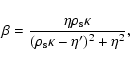
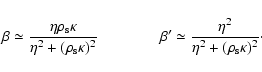
 at the end of this Note. Equations (3) and (4) become
 ,
with
,
with
 ), then
 and the
vortices corotate with the superfluid. When the vortices are dragged,
and
differ. Perfect pinning
corresponds to
and the
vortices corotate with the superfluid. When the vortices are dragged,
and
differ. Perfect pinning
corresponds to
 ,
,
 ,
,
 .
In the high-drag limit (
),
.
In the high-drag limit (
),
 |
(7) |
 )
)
 ,
as found by Shaham (1977),
with little damping (since
,
as found by Shaham (1977),
with little damping (since
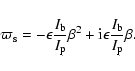
 ). But there is also a new slow
mode, of frequency (SWC, Eq. (80), with
). But there is also a new slow
mode, of frequency (SWC, Eq. (80), with
 )
)
 |
(9) |
.
The mode
is absent (has zero frequency) in the case of perfect pinning; it
arises only if the vortices can move with respect to the body. Since
in the high-drag limit, as relevant to vortex creep, the
damping rate of the mode is faster than the oscillation frequency by a
factor of
 .
Hence, this mode is not oscillatory at all;
it is highly over-damped, and never completes even one
cycle. The problem becomes even more serious the more effective the
pinning is (smaller
.
Hence, this mode is not oscillatory at all;
it is highly over-damped, and never completes even one
cycle. The problem becomes even more serious the more effective the
pinning is (smaller  ). Hence even if the vortices move
through creep, the fast precession mode of Eq. (8) is the
only persistent and dynamically relevant one. The effects of
triaxiality do not change the basic picture (SWC).
). Hence even if the vortices move
through creep, the fast precession mode of Eq. (8) is the
only persistent and dynamically relevant one. The effects of
triaxiality do not change the basic picture (SWC).
Alpar (2005) concluded that the slow mode is under-damped
based on an assumed torque between the crust and the superfluid of the
following linear form:
 is a damping time,
 is the angular velocity of the
superfluid and
is the angular velocity of the
superfluid and
 is the angular velocity of the body. This drag
torque does not correctly describe the dynamics of a dragged vortex
array; the correct form, obtained by integrating
is the angular velocity of the body. This drag
torque does not correctly describe the dynamics of a dragged vortex
array; the correct form, obtained by integrating
 from Eq. (2) throughout the star, takes a
more complicated form (see SWC, Eqs. (50) and (51)), and is much larger
than that of Eq. (10). Use of Eq. (10)
greatly underestimates the strength of the damping that arises from
dissipative vortex motion, and leads to the incorrect conclusion that
the slow precession mode is under-damped.
from Eq. (2) throughout the star, takes a
more complicated form (see SWC, Eqs. (50) and (51)), and is much larger
than that of Eq. (10). Use of Eq. (10)
greatly underestimates the strength of the damping that arises from
dissipative vortex motion, and leads to the incorrect conclusion that
the slow precession mode is under-damped.
Provided the assumption that the vortices of the crust are not significantly dragged remains valid, a simple and general conclusion follows from this analysis: long-period precession demands that the vortices of the outer core move with little drag, that is, they do not creep, but flow essentially everywhere. Hence, in the outer core, vortices and flux tubes cannot co-exist (Link 2003). The possibilities that might be consistent with long-period precession are: 1) normal neutrons, superconducting protons; 2) superfluid neutrons, type I protons; 3) superfluid neutrons, normal protons; 4) normal neutrons and protons; and, 5) the core magnetic field has somehow been almost completely expelled. The existence of proton superconductivity is on rather firm footing, though the type of superconductivity is less clear. In a type I core, the magnetic flux could be organized in slabs or other geometries of mesoscopic dimensions, rather than the flux tubes found in a type II superconductor. It might be possible for vortices to move through a type I superconductor with sufficiently low drag to allow long-period, under-damped precession; Sedrakian (2005) showed that this scenario works for two specific geometries for the magnetic field. The pairing state of neutrons is far less certain. Most pairing calculations show pairing, but at least one calculation does not (Schwenk & Friman 2004). Lacking a mechanism for complete expulsion of the core field, possibilities 1) and 2) seem the most likely within existing uncertainties regarding nucleon pairing. Until the issue of neutron pairing in the outer core is settled by first-principles calculations, astrophysical arguments of the type presented here are useful for constraining the various possibilities for the hadronic ground states.
I now turn to the inner crust, where vortices could pin to lattice nuclei
(Avogadro et al. 2006; Epstein & Baym 1988; Donati & Pizzochero 2006; Pizzochero et al. 1997; Alpar 1977). At the relatively low densities
of the inner crust, neutron pairing is well-understood and neutron
superfluidity there is theoretically well-established (see
Dean & Hjorth-Jensen 2003 for a review).
Assuming, for example, that almost all of the inner-crust superfluid
is pinned to nuclei and that the rest of the star rotates as a rigid
body over time scales less than the precession period, the precession
frequency becomes
 (Shaham 1977), again far too
fast. There is a slow mode if the vortices creep, but as before it is
highly over-damped. This result does not necessarily rule out vortex
pinning in the inner crust; it just cannot happen in stars that are
slowly precessing. In fact, the hydrodynamic forces acting on pinned vortices in a star with a "wobble angle''
(Shaham 1977), again far too
fast. There is a slow mode if the vortices creep, but as before it is
highly over-damped. This result does not necessarily rule out vortex
pinning in the inner crust; it just cannot happen in stars that are
slowly precessing. In fact, the hydrodynamic forces acting on pinned vortices in a star with a "wobble angle''  between
the star's symmetry axis and the angular momentum of
between
the star's symmetry axis and the angular momentum of  ,
as inferred for PSR 1828-11, would be sufficient to unpin the vortices
in the inner crust (Link & Cutler 2002). The question then becomes one of how
strong these unpinned vortices are dragged. For the precession to be
of long period, the vorticity axis must be able to closely follow the
instantaneous rotation axis of the body. To do this, the vortices must
move at a speed
,
as inferred for PSR 1828-11, would be sufficient to unpin the vortices
in the inner crust (Link & Cutler 2002). The question then becomes one of how
strong these unpinned vortices are dragged. For the precession to be
of long period, the vorticity axis must be able to closely follow the
instantaneous rotation axis of the body. To do this, the vortices must
move at a speed
 |
(11) |
is the wobble angle. The
motion of vortices past the nuclei with which they interact excites
waves on the vortices (Kelvin modes), an inherently dissipative
process. Epstein & Baym (1992) and Jones (1992) studied this problem in the
context of explaining the short spin-up time scale of pulsar
glitches. They found Kelvin mode excitation to be highly dissipative
for
 cm s-1,
a characteristic velocity difference that could develop as a consequence
of vortex pinning. These treatments were done in a perturbative
approximation, cannot be extended below
cm s-1,
a characteristic velocity difference that could develop as a consequence
of vortex pinning. These treatments were done in a perturbative
approximation, cannot be extended below
 cm s-1, and so cannot be applied to
the precession problem; instead we require a description of vortex
drag at much lower velocities, in which the vortex response to motion
past a nucleus is highly non-linear. Jones (1998) showed that an
infinitely long vortex moving slowly past a single nucleus tends to be
temporarily trapped by the nucleus, and argued that vortices will pin,
making it theoretically impossible (at least, within our current
understanding of the inner crust) for a neutron star to precess slowly
(Jones 2004). The treatment of Jones (1998), however, gives an unphysical divergence
in the dissipation rate at low velocities when the rate should instead
vanish (Link 2004). For vortex dynamics in the inner crust to allow
long-period precession, assuming no difficulties with the core of the
sort described above, the drag coefficient must satisfy
cm s-1, and so cannot be applied to
the precession problem; instead we require a description of vortex
drag at much lower velocities, in which the vortex response to motion
past a nucleus is highly non-linear. Jones (1998) showed that an
infinitely long vortex moving slowly past a single nucleus tends to be
temporarily trapped by the nucleus, and argued that vortices will pin,
making it theoretically impossible (at least, within our current
understanding of the inner crust) for a neutron star to precess slowly
(Jones 2004). The treatment of Jones (1998), however, gives an unphysical divergence
in the dissipation rate at low velocities when the rate should instead
vanish (Link 2004). For vortex dynamics in the inner crust to allow
long-period precession, assuming no difficulties with the core of the
sort described above, the drag coefficient must satisfy
 (Sedrakian 2005; Link 2004); here
  is the moment of inertia of the inner crust superfluid and
is
now the moment of inertia of the crust plus all other components
tightly coupled to it over time scales less than the precession
period. If
comprises most of the star, then
is the moment of inertia of the inner crust superfluid and
is
now the moment of inertia of the crust plus all other components
tightly coupled to it over time scales less than the precession
period. If
comprises most of the star, then
 ,
which allows some room for vortex motion at moderately strong drag,
,
which allows some room for vortex motion at moderately strong drag,
 for example. Whether or not
can
satisfy this upper bound for
for example. Whether or not
can
satisfy this upper bound for
 is an interesting, unsolved problem.
Based on the above arguments, I conclude that in slowly precessing neutron stars:
 )
with respect to the solid.
is not only finite, but for some reason satisfies
)
with respect to the solid.
is not only finite, but for some reason satisfies
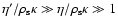 everywhere that
vortices are pinned. Only under these
unlikely circumstances can vortex creep admit a long-period,
under-damped precession mode (SWC).
everywhere that
vortices are pinned. Only under these
unlikely circumstances can vortex creep admit a long-period,
under-damped precession mode (SWC).
Acknowledgements
I thank A. Sedrakian and I. Wasserman for valuable discussions, and the referee, P. B. Jones, for extremely helpful criticisms. Much of the work described here was supported by U.S. NSF grant AST-0406832.