A&A 458, 831-839 (2006)
DOI: 10.1051/0004-6361:20054511
Stellar magnetosphere reconstruction from radio data
Multi-frequency VLA observations and 3D-simulations of CU Virginis
P. Leto1 - C. Trigilio2 - C. S. Buemi2 - G. Umana2 -
F. Leone2
1 - INAF - Istituto di Radioastronomia Sezione di Noto, CP 161, Noto (SR), Italy
2 -
INAF - Osservatorio Astrofisico di Catania, via S. Sofia 78, 95123 Catania, Italy
Received 10 November 2005 / Accepted 26 July 2006
Abstract
Aims. In order to fully understand the physical processes in the magnetospheres of the Magnetic Chemically Peculiar stars, we performed multi-frequency radio observations of CU Virginis. The radio emission of this kind of stars arises from the interaction between energetic electrons and magnetic field. Our analysis is used to test the physical scenario proposed for the radio emission from the MCP stars and to derive quantitative information about physical parameters not directly observable.
Methods. The radio data were acquired with the VLA and cover the whole rotational period of CU Virginis. For each observed frequency the radio light curves of the total flux density and fraction of circular polarization were fitted using a three-dimensional MCP magnetospheric model simulating the stellar radio emission as a function of the magnetospheric physical parameters.
Results. The observations show a clear correlation between the radio emission and the orientation of the magnetosphere of this oblique rotator. The radio emission is explained as the result of the acceleration of the wind particles in the current sheets just beyond the Alfvén radius, that eventually return toward the star following the magnetic field and emitting radiation by gyrosyncrotron mechanisms. The accelerated electrons we probed with our simulations have a hard energetic spectrum (
 )
and the acceleration process has an efficiency of about 10-3. The Alfvén radius we determined is in the range of
)
and the acceleration process has an efficiency of about 10-3. The Alfvén radius we determined is in the range of
 and, for a dipolar field of 3000 Gauss at the magnetic pole of the star, we determine a mass loss from the star of about
 yr-1. In the inner magnetosphere, inside the Alfvén radius, the confined stellar wind accumulates and reaches temperatures in the range of
105-106 K, and a detectable X-ray emission is expected.
yr-1. In the inner magnetosphere, inside the Alfvén radius, the confined stellar wind accumulates and reaches temperatures in the range of
105-106 K, and a detectable X-ray emission is expected.
Key words: stars: chemically peculiar -
stars: circumstellar matter -
stars: individual: CU Vir -
stars: magnetic fields -
radio continuum: stars
Magnetic Chemically Peculiar (MCP) stars
are characterized by periodic variability of the effective
magnetic field through the stellar rotational period.
The magnetic field
topology of this kind of star
has been commonly regarded as a magnetic dipole
tilted with respect to the rotation axis (Babcock 1949; Stibbs 1950),
even if MCP stars with a multipolar magnetic field are also known
(Landstreet 1990; Mathys 1991).
In some cases, MCP stars are characterized by an anisotropic stellar wind
(Shore et al. 1987; Shore & Brown 1990),
as a consequence of the wind interaction with
the dipolar magnetic field (Shore 1987).
The resulting magnetosphere is structured
in a "wind zone'' at high magnetic latitudes,
where the gas flows draw the magnetic field out to open
structures, and a "dead zone'', where the magnetic field
topology is closed and the gas trapped.
Table 1:
Results of the observations. For each observing scan,
the mean UT time, the total flux density (Stokes I)
at the three observed frequency (I5, I8.4 and I15), the corresponding errors ( )
and the circular polarized flux density, Stokes V (V5, V8.4 and V15), are reported:
)
and the circular polarized flux density, Stokes V (V5, V8.4 and V15), are reported:
Currently, non-thermal radio emission is observed from about
25% of MCP stars
and the detection rate seems to be directly correlated to
the effective stellar temperature
(Drake et al. 1987; Linsky et al. 1992; Leone et al. 1994).
Since only MCP stars with high photospheric temperature develop
a radiatively-driven stellar wind, this result
reveals the importance of a stellar wind in driving the radio emission.
To explain the origin of the radio emission from
pre-main sequence magnetic B stars and from MCP stars,
André et al. (1988) proposed a model characterized by
the interaction between the wind and the magnetic field.
The radio emission is understood
in terms of gyrosynchrotron emission from mildly relativistic electrons,
which are accelerated in "current sheets'' formed where the gas flow
brakes the magnetic field lines, close to the magnetic
equator plane, and propagate along the magnetic field lines back to
the inner magnetospheric regions (Havnes & Goertz 1984; Usov & Melrose 1992).
According to the oblique dipole model, Leone (1991) suggested that the radio
emission of MCP stars should be also periodically variable.
The confirmation of this hypothesis comes from
the observations of HD 37017 and HD 37479
(Leone & Umana 1993) and of HD 133880
(Lim et al. 1996), performed at 5 GHz, that
revealed the presence of rotational flux modulation.
In particular, the observed flux light curves of HD 37017
and HD 37479, which are characterized
by a simple dipolar magnetic field,
show a radio emission minimum
coincident with the zero of the longitudinal
magnetic field, whereas the emission is
maximum at the magnetic field extrema.
Among radio MCP stars, only CU Virginis (HD 124224) is
characterized by a strong 1.4 GHz flux enhancement around phases 0.4 and 0.8,
with a right hand circular polarization of almost 100% (Trigilio et al. 2000,
TLL00). This discovery has been explained in terms of Electron
Cyclotron Maser Emission (ECME) from energetic electrons accelerated in the current sheets
near the Alfvén surface (where the thermal plus kinetic plasma pressure equals the
magnetic one) and reflected outward by magnetic mirroring in the inner magnetospheric
layers.
In a previous paper (Trigilio et al. 2004, TLU04),
we developed a three-dimensional numerical
model of the radio emission from MCP stars with a dipolar field.
We use 5 GHz flux light curves of HD 37017 and HD 37479,
whose study allowed us to confirm the qualitative scenario proposed
to explain the origin of non-thermal radio emitting electrons.
We showed that the combined effect
of a tilted dipolar magnetic topology and the
presence of a thermal plasma trapped in the "dead-zone''
can produce the observed phase modulation
of the stellar radio emission.
In this paper we present the multifrequency microwave observations of CU Virginis, a well
studied Si-group MCP star.
To investigate the physical conditions of the stellar magnetosphere,
the radio light curves of CU Vir are compared
with the results of the numerical simulations performed
using our 3D model.
We present here an implementation of our code to
also treat circular polarization.
![\begin{figure}
\par\hspace*{1mm}\includegraphics[width=7.85cm,clip]{4511fg1a.ps}...
...clip]{4511fg1b.ps}\par\includegraphics[width=8cm,clip]{4511fg1c.ps} \end{figure}](/articles/aa/full/2006/42/aa4511-05/Timg36.gif) |
Figure 1:
Top panel: effective magnetic field of CU Vir versus rotational phase
(triangles: data by Borra & Landstreet 1980;
squares: data by Pyper et al. 1998).
Other panels: phase modulation of Stokes I and Stokes V flux density
at 15, 8.4 and 5 GHz. For comparison, the 1.4 GHz Stokes V (lowest panel)
by TLL00 is reported. The three days of observations are distinguished
with different symbols to point out the repeatability of the radio emission in
time. |
| Open with DEXTER |
The observations were carried out using
the VLA![[*]](/icons/foot_motif.gif) in three different runs, on June 02, 07 and 12, 1998. Each run was
approximately eight hours long.
We observed at four frequencies (1.4, 5, 8.4 and 15 GHz) using two independent
and contiguous bands of 50 MHz in Right and Left
Circular Polarizations (RCP and LCP). The observations were
performed using the entire array (configuration array moving A
in three different runs, on June 02, 07 and 12, 1998. Each run was
approximately eight hours long.
We observed at four frequencies (1.4, 5, 8.4 and 15 GHz) using two independent
and contiguous bands of 50 MHz in Right and Left
Circular Polarizations (RCP and LCP). The observations were
performed using the entire array (configuration array moving A
 B)
alternating all the frequencies.
B)
alternating all the frequencies.
Because of the 
 rotational period and with the aim to
obtain a complete rotational phase coverage, we assumed
at any frequency an observing cycle consisting of 10 min
on source, preceded and followed by 2 min on the
phase calibrator (1354-021). To avoid redundancy in the phase
coverage for each frequency, the observing sequence was
changed in each run.
rotational period and with the aim to
obtain a complete rotational phase coverage, we assumed
at any frequency an observing cycle consisting of 10 min
on source, preceded and followed by 2 min on the
phase calibrator (1354-021). To avoid redundancy in the phase
coverage for each frequency, the observing sequence was
changed in each run.
The flux density scale was determined by daily observations of 3C 286.
The data were calibrated and mapped using the standard procedures
of the Astronomical Image Processing System (AIPS).
The flux density and fraction of circular polarization
were obtained by fitting a two-dimensional Gaussian, task JMFIT,
at the source position in the
cleaned maps (separately for the Stokes I and Stokes V) integrated over
the duration of each individual scan. As the uncertainty in the flux density
measurements we assume the rms of the map.
Results are summarized in Table 1.
The measurements performed at 1.4 GHz have been
presented elsewhere (TLL00).
3 The radio behavior of CU Vir
In Fig. 1, for each observed frequency, we report the radio flux density
measured in both Stokes I and V versus the
rotational phase. This was computed adopting the ephemeris referred to light minimum
reported by Pyper et al. (1998):
In the lowest panel of Fig. 1
the measures performed in Stokes V at 1.4 GHz from TLL00 are also displayed.
The top panel of Fig. 1 shows the average longitudinal component of the magnetic field
as a function of the rotational phase (data are from Borra & Landstreet 1980
and Pyper et al. 1998).
The flux variability with the stellar rotational period suggests that the
radio emission at 15, 8.4 and 5 GHz
arises from a stable co-rotating magnetosphere
and that the radio source is optically thick.
For Stokes I the radio emission minimum appears to be
coincident with the null magnetic field (
 and
and
 ),
whereas the two maxima, clearly visible at 5 and 8.4 GHz, are
related to stellar orientations coinciding with the two extrema of the stellar magnetic field
(
),
whereas the two maxima, clearly visible at 5 and 8.4 GHz, are
related to stellar orientations coinciding with the two extrema of the stellar magnetic field
(
 and
and
 ).
Stokes V is detected at all the observed frequencies close to
,
whereas at
the
circular polarization is detected only at 8.4 GHz.
The circularly polarized flux density reaches its positive (RCP) maximum value
when the effective magnetic field strength is also maximum.
This means that radio flux emitted in a direction close to the magnetic north pole,
where magnetic field lines are mainly radially oriented (directed outside the stellar surface),
is partially right hand polarized.
Negative values of Stokes V (LCP) have been detected only at 8.4 GHz around
,
when the magnetic south pole is closest to the line of sight.
).
Stokes V is detected at all the observed frequencies close to
,
whereas at
the
circular polarization is detected only at 8.4 GHz.
The circularly polarized flux density reaches its positive (RCP) maximum value
when the effective magnetic field strength is also maximum.
This means that radio flux emitted in a direction close to the magnetic north pole,
where magnetic field lines are mainly radially oriented (directed outside the stellar surface),
is partially right hand polarized.
Negative values of Stokes V (LCP) have been detected only at 8.4 GHz around
,
when the magnetic south pole is closest to the line of sight.
The phase modulation of the Stokes I flux density has been observed
in other MCP stars at 5 GHz (Leone 1991; Leone & Umana 1993;
Lim et al. 1996). Our dataset represents an extension of previous studies
for the (almost simultaneous) multi-frequency observation of both total
and circular polarized flux with a detailed phase coverage of the rotational period.
This allows us to monitor the variations of an MCP star
radio spectrum through its entire stellar rotation.
On average the observed radio spectra are flat with a slightly
negative power law
index
 (
(
 ).
This, together with the low fraction of circular polarization (about 10%), supports
the idea that non-thermal gyrosynchrotron
from a non-homogeneous source is responsible for the observed radio emission.
).
This, together with the low fraction of circular polarization (about 10%), supports
the idea that non-thermal gyrosynchrotron
from a non-homogeneous source is responsible for the observed radio emission.
Our 3D model samples the magnetosphere of the star in a three dimensional grid,
assumes a set of physical parameters, computes emission and absorption coefficients
for gyrosynchrotron emission, and
solves the equation of transfer for polarized radiation in terms of Stokes I and V (Appendix A). From the best fit of the observed fluxes, we
determine the most probable physics of the magnetosphere.
The model was developed (TLU04) on the basis of the physical
scenario proposed by André et al. (1988) and Linsky et al. (1992).
The model involves the interaction
between the dipolar magnetic field and the stellar wind
resulting in the formation of "current sheets'' outside the
equatorial region of the Alfvén surface (Havnes & Goertz 1984), where the
wind particles can be accelerated up to relativistic energy (Usov & Melrose 1992),
radiating at radio wavelengths by the gyrosynchrotron mechanism.
![\begin{figure}
\par\includegraphics[width=7.8cm,clip]{4511fig2.ps} \end{figure}](/articles/aa/full/2006/42/aa4511-05/Timg46.gif) |
Figure 2:
Schematic view of the magnetosphere of an MCP star assuming a central dipolar magnetic field. The dashed line shows the Alfvén surface:
the largest magnetic field line delimiting the middle magnetosphere is drawn
with a dotted line outside the Alfvén surface.
The length l represents the current sheets region where the non-thermal electrons are
efficiently accelerated. The inner magnetosphere is filled
with hot thermal plasma and cold material accumulates in the form of a torus near the stellar surface. |
| Open with DEXTER |
The adopted geometry is shown in Fig. 2.
The layer where relativistic
electrons propagate is delimited by two magnetic lines: the first is
the largest closed line at a tangent to the Alfvén surface in the plane of the
magnetic equator and the latter is defined by the length of the current sheets
where electrons are efficiently accelerated.
In each point of this shell, the "middle'' magnetosphere in analogy
with André et al. (1988), it is assumed that
emitting electrons have a power law energy spectrum,
isotropic pitch angle distribution and
homogeneous spatial distribution due to magnetic mirroring.
Following the magnetically confined wind shock (MCWS) model by
Babel & Montmerle (1997),
the "inner'' magnetosphere ("dead zone'') is filled by a trapped thermal
plasma heated to a temperature higher then the photospheric value
(
 K, Kuschnig et al. 1999).
This hot thermal plasma progressively pushes the shock front to high magnetic latitudes,
until its thermal pressure equals the wind ram pressure.
K, Kuschnig et al. 1999).
This hot thermal plasma progressively pushes the shock front to high magnetic latitudes,
until its thermal pressure equals the wind ram pressure.
The net effect of this mechanism is the filling of the inner magnetosphere with hot
thermal plasma. If the magnetosphere rotates, the density decreases linearly outward,
while the temperature increases linearly (Babel & Montmerle 1997).
To balance the continuous supply of hot matter from the polar regions,
a cool plasma down-flow is expected from the inner magnetosphere toward the
stellar surface. This process causes the accumulation of
cold dense material, which has been assumed for simplicity as a homogeneous torus with a circular cross-section surrounding the star
(Babel & Montmerle 1997; Smith & Groote 2001).
In Table 2 we list the assumed stellar parameters.
The dependence of our simulations on
the polar magnetic field  ,
inclination i and obliquity
,
inclination i and obliquity  that are not known with great accuracy
will be discussed later in Sect. 5.2.
that are not known with great accuracy
will be discussed later in Sect. 5.2.
Table 2:
Adopted stellar parameters for CU Virginis.
Table 3:
Input parameters of the 3D model.
The free parameters of the model are:

- average radius of the Alfvén surface in
 units;
- l
- thickness of the middle-magnetosphere at
in units;

- total number density of non-thermal electrons;

- spectral index of non-thermal electron
energy distribution;
-

- temperature, at the stellar surface, of the thermal plasma
trapped in the inner-magnetosphere;
-

- electron number density, at the stellar surface, of thermal plasma;
-

- cross-sectional diameter of the cold torus surrounding the star;
-

- temperature of the cold torus;
-

- electron number density of the cold torus.
The range of values and the assumed simulation steps
of these free parameters are reported in Table 3.
In TLU04 the Alfvén surface has been located numerically by solving
the equation of balance between kinetic and magnetic energy density. In this work
is assumed as a free parameter,
since the wind parameters of CU Vir are
still unknown. The mass loss rate  ,
assumed flowing from the whole stellar surface,
and the plasma density of the wind at the Alfvén surface
are thus derived as output parameters for a given
and wind velocity
,
assumed flowing from the whole stellar surface,
and the plasma density of the wind at the Alfvén surface
are thus derived as output parameters for a given
and wind velocity
 .
.
For a detailed discussion of the computational method we refer to TLU04.
Since the computation is quite time consuming,
we split the analysis in two steps.
In this first step we can neglect the presence of the cold torus.
As pointed out by TLU04, it does not have an appreciable effect
in the low frequency radio emission (5 and 8.4 GHz) that
arises from external magnetospheric regions, and we exclude a priori
its effect in the simulations at 8.4 GHz,
reducing the number of free parameters (Table 3 - step 1).
For the choice of the sampling length of the three dimensional grid
we adopt the same criteria as in TLU04, with a narrow
spacing (0.08 )
for the distance from the star center
of less than 2.3 ,
middle spacing (0.3 )
between 2.3 and 7 ,
and rough spacing (1 )
greater than 7 .
We compute the radio emission for the Stokes I and Vat the phases that characterize the observed light curve at 8.4 GHz
(see Sect. 3). The match between simulations and observations
defines the possible configurations of the magnetosphere.
For any set of parameters modeling the observed Stokes I and V at 8.4 GHz
we compute the radio emission at 5 and 15 GHz
to search for the ones fitting the whole observed spectra and their
polarization degree.
However we cannot
rule out the importance of the cold torus on the
stellar emission at the frequency of 15 GHz.
The free parameters that characterize the cold torus and
the adopted ranges are reported in Table 3 - step 2.
![\begin{figure}
\par\includegraphics[width=15cm,clip]{4511fig3.ps} \end{figure}](/articles/aa/full/2006/42/aa4511-05/Timg69.gif) |
Figure 3:
Comparison between CU Vir observed and computed
flux density and degree of circular polarization, as a function of
rotational phase. |
| Open with DEXTER |
Comparison between the observations and simulations
allow us to find the combinations of the model free parameters that
can account for the observational behavior.
The convergence of these quantities gives important informations about the physics
of the external regions of this star.
The solutions derived from our analysis are reported in Table 4;
the corresponding observed and computed
flux light curves are plotted in Fig. 3.
Table 4:
Solutions of the 3D model: the free parameters able to reproduce the observations.
The free parameters
and
are determined with an uncertainty smaller than the simulation steps. We find acceptable solutions for
in the range 12-17 ,
l in 0.05-0.2
and
in 0.88  103-3.54
103 cm-3.
We note that the relation
103-3.54
103 cm-3.
We note that the relation
 holds (Table 4).
An important conclusion can be drawn:
the column density of the relativistic electrons at the Alfvén radius
is univocally determined by .
For the different values of the Alfvén radius
deduced from our simulations the column density is in the
range 3.2
1014-4.6
1014 cm-2.
holds (Table 4).
An important conclusion can be drawn:
the column density of the relativistic electrons at the Alfvén radius
is univocally determined by .
For the different values of the Alfvén radius
deduced from our simulations the column density is in the
range 3.2
1014-4.6
1014 cm-2.
Regarding the physical properties of the thermal plasma trapped in the inner magnetosphere, we found that the values of the electron number density and temperature that account for the
observed spectral index are related as
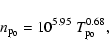 |
(1) |
while for the plasma in the cold torus
In terms of free-free absorption coefficients (Dulk 1985),
The above relations imply that the plasma surrounding the star is almost opaque
at  15 GHz, and that the cold torus around the star is completely opaque at
the same frequency.
15 GHz, and that the cold torus around the star is completely opaque at
the same frequency.
The Alfvén radius
is a free parameter of our model.
It is defined as the point where the magnetic energy density is equal to
the kinetic energy density. If the flowing wind has terminal velocity
and density
 ,
with proton mass
,
with proton mass  ,
then:
,
then:
For a given ,
we obtain the corresponding magnetic field strength
 ,
and consequently the thermal plasma density of the wind
,
and consequently the thermal plasma density of the wind
 at the Alfvén surface.
In Table 5 we list the resulting values for
as a function of
assuming three different values
of the wind velocity (
at the Alfvén surface.
In Table 5 we list the resulting values for
as a function of
assuming three different values
of the wind velocity (
 ,
600 and 800 km s-1).
,
600 and 800 km s-1).
The mass loss rate for a spherically symmetric wind is easily computed
from the continuity equation
In the presence of a magnetic dipole,
only the wind flowing out from the polar caps can escape from the star and
the actual mass loss rate
 is a fraction of ,
defined as the ratio of the area of the polar caps to the whole
stellar surface (see TLU04).
The results for
and
are shown in
Table 5.
is a fraction of ,
defined as the ratio of the area of the polar caps to the whole
stellar surface (see TLU04).
The results for
and
are shown in
Table 5.
We rejected all the solutions that do not satisfy
the condition of equality between
the thermal plasma energy density and the wind ram pressure
in the equatorial region of the Alfvén surface.
As previously discussed, the filling of the inner magnetosphere by thermal plasma is a consequence
of the radiatively driven stellar wind, which accumulates material until a steady state,
along lines of force of the magnetic field, is established, i.e.
the thermal plasma pressure
 balances the wind ram pressure
 .
This condition at the Alfvén point can be written as:
.
This condition at the Alfvén point can be written as:
or
 |
(2) |
The stellar rotation implies
 and
and
 ,
hence
is constant inside the inner magnetosphere,
whereas the
is defined by the
wind velocity
and wind density
at
(Babel & Montermle 1997).
Combining Eqs. (2) and (1), we can derive the
temperature and density of the thermal plasma trapped in the inner magnetosphere.
The so-derived values of
and
are reported in Table 5 (last two columns).
,
hence
is constant inside the inner magnetosphere,
whereas the
is defined by the
wind velocity
and wind density
at
(Babel & Montermle 1997).
Combining Eqs. (2) and (1), we can derive the
temperature and density of the thermal plasma trapped in the inner magnetosphere.
The so-derived values of
and
are reported in Table 5 (last two columns).
In Fig. 4, the shaded area represents the pairs of  and
and  for which the thermal plasma is optically thick
at
15 GHz (cold torus), while
the Eqs. (1) and (2), for different values of ,
are
represented by the continuous and dashed line respectively.
The intersection, marked with a thick segment, defines the ranges of values
of
and
that satisfy the equality condition
and correctly reproduce the observed radio light curves.
for which the thermal plasma is optically thick
at
15 GHz (cold torus), while
the Eqs. (1) and (2), for different values of ,
are
represented by the continuous and dashed line respectively.
The intersection, marked with a thick segment, defines the ranges of values
of
and
that satisfy the equality condition
and correctly reproduce the observed radio light curves.
Table 5:
Results for wind, mass loss and inner magnetosphere:
as a function of the Alfvén radius ,
the spherical wind mass loss rate ,
the effective mass loss
and the number density of the electrons
of the wind at the Alfvén point
are reported.
In the last two columns, temperature (
)
and number density (
)
at the base of the magnetosphere are also reported.
![\begin{figure}
\par\includegraphics[width=7.8cm,clip]{4511fig4.ps}\end{figure}](/articles/aa/full/2006/42/aa4511-05/Timg171.gif) |
Figure 4:
 plane for the magnetospheric plasma.
In the shaded area the cold torus has
plane for the magnetospheric plasma.
In the shaded area the cold torus has
 .
For the inner magnetosphere, the thermal pressure along the dashed lines
equals the wind ram pressure, as computed for the possible values of .
The thick segment of the continuous line (Eq. (1))
represents the loci where the
and
of our model reproduce the observations. .
For the inner magnetosphere, the thermal pressure along the dashed lines
equals the wind ram pressure, as computed for the possible values of .
The thick segment of the continuous line (Eq. (1))
represents the loci where the
and
of our model reproduce the observations. |
| Open with DEXTER |
5.2 Dependence on the stellar parameters
Since the distance and stellar radius of Cu Vir are known with
good accuracy, the major uncertainty on the assumed parameters is
related to the magnetic field strength and geometry.
In particular, the value of
reported in the literature
ranges from 2200 to 3800 Gauss (Landstreet et al. 1977; TLL00).
We thus examined whether our choice of = 3000 Gauss
significantly influences the model results.
We verified that a variation of  25% in results in
a variation of
25% in results in
a variation of  25% in ,
while the other parameters
remain unaffected.
25% in ,
while the other parameters
remain unaffected.
Moreover, we tested the sensitivity of the model to values of
inclination of the rotation axis (i) and obliquity of the magnetic axis ()
different from those adopted in our calculations.
We minimize the normalized  function
for the light curves (total flux density and the fraction of circular
polarization) at 8.4 GHz.
To restrict the computational time, we limit this analysis
to the set of model parameters associated with the lowest value of
the Alfvén radius (
function
for the light curves (total flux density and the fraction of circular
polarization) at 8.4 GHz.
To restrict the computational time, we limit this analysis
to the set of model parameters associated with the lowest value of
the Alfvén radius (
 ).
The maps of are displayed in Fig. 5 (top panels).
Dark areas correspond to pairs of i and
with lower ,
for which we find the best match between simulations and observations.
We note that the
from the total flux fit is
not well correlated to the
relative to the fit of the circular
polarization. The product of these two matrices, Fig. 5 (bottom panel), gives the
combination of i and
that better reproduces both total flux and circular
polarization.
We note that the most probable values of i and
are restricted in a well defined
range of values, respectively:
).
The maps of are displayed in Fig. 5 (top panels).
Dark areas correspond to pairs of i and
with lower ,
for which we find the best match between simulations and observations.
We note that the
from the total flux fit is
not well correlated to the
relative to the fit of the circular
polarization. The product of these two matrices, Fig. 5 (bottom panel), gives the
combination of i and
that better reproduces both total flux and circular
polarization.
We note that the most probable values of i and
are restricted in a well defined
range of values, respectively:
 and
and
 .
We note that the values of i and
from the literature are well inside the previous intervals.
.
We note that the values of i and
from the literature are well inside the previous intervals.
![\begin{figure}
\par\includegraphics[width=8cm,clip]{4511fig5.ps} \end{figure}](/articles/aa/full/2006/42/aa4511-05/Timg177.gif) |
Figure 5:
Top panels: maps, as a functions of i and ,
of the normalized
obtained for the light curves at 8.4 GHz,
total flux ( left) and fraction of circular polarization ( right).
The minima are respectively 2 and 1.6.
Bottom panel: product of the two top panels. |
| Open with DEXTER |
While the modulation of the total flux density light curve observed
at 5 GHz is well reproduced by our simulations, we are
not able to match the two peaks observed
close to the phases 0.40 and 0.85 of the circularly polarized flux light curve.
These are also the phases of the
coherent emission observed at 1.4 GHz (Fig. 1, bottom panel),
a coincidence suggesting that the two peaks are residuals
of the Electron Cyclotron Maser Emission (ECME) mechanism (TLL00).
As the ECME mechanism is not considered in our model,
which computes only incoherent gyrosynchrotron, it cannot
reproduce these observed peaks.
At 15 GHz, a stronger and broader polarization is expected in the range
 0.9-1.3 (Fig. 3). This discrepancy could be ascribed to the simple dipolar configuration adopted for the magnetic field. In the magnetospheric regions close
to the star, where the bulk of 15 GHz radiation is emitted, the high order
components of the magnetic field of CU Vir (Hatzes 1997; Kushinig et al. 1999; TLL00;
Glagolevskij & Gerth 2002) cannot be neglected.
A simple dipole provides
a symmetric total flux light curve and an enhancement of the fraction of polarization
when the line of sight is
close to the magnetic pole, where the magnetic lines
are almost parallel. In the presence of multipolar components
the radio flux light curves would not be symmetric
and the fraction of the polarization would be reduced.
0.9-1.3 (Fig. 3). This discrepancy could be ascribed to the simple dipolar configuration adopted for the magnetic field. In the magnetospheric regions close
to the star, where the bulk of 15 GHz radiation is emitted, the high order
components of the magnetic field of CU Vir (Hatzes 1997; Kushinig et al. 1999; TLL00;
Glagolevskij & Gerth 2002) cannot be neglected.
A simple dipole provides
a symmetric total flux light curve and an enhancement of the fraction of polarization
when the line of sight is
close to the magnetic pole, where the magnetic lines
are almost parallel. In the presence of multipolar components
the radio flux light curves would not be symmetric
and the fraction of the polarization would be reduced.
In the following we will analyze physical information
about the stellar magnetosphere that can be inferred from the results of our
simulations.
![\begin{figure}
\par\includegraphics[width=15.8cm,clip]{4511fig6.ps} \end{figure}](/articles/aa/full/2006/42/aa4511-05/Timg179.gif) |
Figure 6:
Simulated maps for stellar orientations associated with the
radio light curve extrema. On the left side the corresponding radio
maps are displayed; the theoretical brightness
spatial distribution is averaged over half the
rotational period and convolved with the 1 mas
beam of the VLBI array. The contours are  , ,
 , ,
 , ,
 , ,
 , ,
 of the peak brightness.
 |
| Open with DEXTER |
The convergence of the value of the spectral index of the emitting electron distribution
(
 )
toward
)
toward  indicates that the acceleration process occurs in the current sheets just outside the Alfvén radius. This value agrees with the one
derived in the case of solar flares by Zharkova & Gordovskyy (2005), who
found a spectral index
for the non-thermal electrons accelerated in the neutral
reconnecting current sheets of solar magnetic loops.
In addition, from the ratio between
(Table 4) and the density of the electrons of the wind at
the Alfvén point
(Table 5),
we can estimate that the efficiency of the acceleration process
for non-thermal electrons is
2
indicates that the acceleration process occurs in the current sheets just outside the Alfvén radius. This value agrees with the one
derived in the case of solar flares by Zharkova & Gordovskyy (2005), who
found a spectral index
for the non-thermal electrons accelerated in the neutral
reconnecting current sheets of solar magnetic loops.
In addition, from the ratio between
(Table 4) and the density of the electrons of the wind at
the Alfvén point
(Table 5),
we can estimate that the efficiency of the acceleration process
for non-thermal electrons is
2
 .
The efficiency inferred by our analysis
is consistent with the
acceleration efficiency in large stationary unstable current sheets associated
with coronal loops during solar flares (Vlahos et al. 2004).
.
The efficiency inferred by our analysis
is consistent with the
acceleration efficiency in large stationary unstable current sheets associated
with coronal loops during solar flares (Vlahos et al. 2004).
We investigated the possibility
of discrimining among the previous possible values of the Alfvén radius by using high angular resolution radio observations in the future.
In Fig. 6 the brightness spatial distributions at 8.4 GHz obtained for the
extreme values of
(respectively 12 and 17 )
are shown.
The simulated radio maps have been calculated for three rotational phases:
the stellar orientations that show the north and south poles, associated with the two maxima and the
orientation that gives a null effective magnetic field, associated with the minimum of
the radio light curve.
In the right panel of Fig. 6, the different extension of the
radio source for the two cases analyzed is clearly visible.
However such a difference is not so obvious when looking at the radio emission arising from regions
near the stellar surface, where the highest fraction of the magnetospheric radio
emission originates.
For the Very Long Baseline Interferometry (VLBI)
technique, that can be used
to map CU Vir at milli arcsecond scales,
we derived two "synthetic'' maps at VLBI resolution,
shown on the left side of Fig. 6,
obtained as the average of hypothetical 8 h observation around the stellar phase coinciding with the null effective magnetic field, convolved with a Gaussian 1 mas beam.
It is clear that the present capability of VLBI observations
does not allow us to discriminate between the extreme values of the Alfvén radius of CU Vir predicted by our model.
The physical condition in the inner magnetosphere play an important role in the emerging
radio flux because of the free-free absorption by the plasma, which affects the modulation
of the radio light curves and the spectrum of the source.
The comparison between our model prediction and multifrequency observations
reveals the presence of a torus of material colder and denser than the trapped thermal
plasma. This is necessary to reproduce the correct scale of the total flux density in
the 15 GHz light curve of CU Vir.
The electron number density (
)
and temperature (
)
of the plasma of the cold torus are within the shaded area
of the plane
shown in Fig. 4,
where the optical depth of the cold torus is higher than 1 at 15 GHz.
Higher frequency measurements (for example 22 and 43 GHz)
could characterize the spatial distribution of the thermal plasma in the deep magnetospheric regions, near the stellar surface.
The temperature and density of the thermal plasma trapped in the inner magnetosphere
are assigned for a given Alfvén radius and wind velocity (Table 5).
As a by-product of our analysis, we estimate the X-ray emission from the thermal
plasma trapped in the stellar inner magnetosphere of
CU Vir as a function of
and
.
Following the same procedure described in TLU04,
for each element of the 3D cubic grid that samples
the magnetosphere, we computed the thermal bremsstrahlung emission coefficients and
the emerging power integrated between 0.1 and 10 keV,
in the typical energy range of X-ray telescopes like Chandra and XMM.
The resulting X-ray fluxes at the Earth
are displayed in Fig. 7.
The stellar X-ray emission is a function of the size of the Alfvén surface (Fig. 7)
and, in particular, it decreases as
the Alfvén radius increases. This is a consequence of the
lower temperature and density of the plasma in the inner magnetosphere
for increasing .
For the same reason, lower wind velocities cause a lower X-ray emission.
On the basis of the values derived from our calculations, we conclude that the
X-ray emission from CU Vir is below the detection limit of
the ROSAT all sky survey (the average background at the position
of CU Vir in the RASS is higher than 10-12 erg cm-2 s-1).
Nevertheless, for exposure times of a few tens of kilo-seconds,
Chandra and XMM can reach an X-ray detection limit close to 10-15 erg cm-2 s-1,
which is lower than the X-ray fluxes predicted from several
model solutions.
Within our model,
measurement of the X-ray flux of CU Vir could place an important
constraint on the physical condition in the magnetosphere.
![\begin{figure}
\par\includegraphics[width=7.8cm,clip]{4511fig7.ps}\end{figure}](/articles/aa/full/2006/42/aa4511-05/Timg183.gif) |
Figure 7:
Predicted X-ray fluxes of the inner magnetosphere of CU Vir
for the solutions of our 3D model. |
| Open with DEXTER |
The radio magnetosphere of CU Vir has been extensively studied
using the first multifrequency VLA observations, covering the
entire rotational period, for both the total flux density (Stokes I)
and the circular polarization (Stokes V).
We have successfully modeled the observed flux modulation and the
circular polarization light curves using the 3D model developed by us (TLU04),
modified to resolve the circular polarization intensity.
We pointed out the importance of multi-frequency and dual polarization
observations throughout the rotational period to gain insight into the physical conditions of the
circumstellar environments surrounding MCP stars.
Our results are:
- -
- we confirm the physical scenario proposed
by André et al. (1988) and
Linsky et al. (1992) and the MCWS model
proposed by Babel & Montermle (1997);
- -
- the size of the CU Vir
inner magnetosphere has been constrained in the
range:
 ;
;
- -
- we evaluated the mass loss rate of CU Vir,
which up to now was not determined for this
star, to be about
yr-1;
- -
- the temperature of the thermal electrons trapped in the inner magnetosphere
can reach
105-106 K and can give detectable X-ray emission;
- -
- the presence of an accumulation of cold and dense material around
the star has been shown and limits for its size and physical conditions
(temperature and density) are given;
- -
- the acceleration in the current sheets produces a non-thermal electron
population with a hard energetic spectrum (
with ),
and the acceleration process has an efficiency of about 10-3.
The limits of our model to reproduce all the observed features,
for example the two peaks at phases 0.4 and 0.85
observed in the 5 GHz light curve for the
circular polarization and the shape of the light curves at 15 GHz,
have been interpreted respectively as due to the residual of the ECME mechanism (responsible for the features previously observed at 1.4 GHz, TLL00)
and as evidence of a multipolar component in the magnetic field of CU Vir.
Acknowledgements
We thank the referee for his/her constructive criticism which
enabled us to improve this paper.
Appendix A: Calculation of circular polarization
The circularly polarized intensity may be obtained using
the relation, given by Ramaty (1969):
 |
(A.1) |
where  are solutions of the radiative transfer
equation for the ordinary (sign "+'') and
extraordinary (sign "-'') modes (Klein & Trotter 1984):
are solutions of the radiative transfer
equation for the ordinary (sign "+'') and
extraordinary (sign "-'') modes (Klein & Trotter 1984):
 |
(A.2) |
with
 and
and  gyrosynchrotron emission
and absorption coefficients,
gyrosynchrotron emission
and absorption coefficients,
 and
and
 refractive index and polarization coefficient for the two modes respectively.
 is the angle between the wave vector and the group velocity,
given by the equation:
is the angle between the wave vector and the group velocity,
given by the equation:
with  the angle between the wave vector and the magnetic field. Equation (A.2) was numerically solved, along a path parallel to the line of sight,
using the method developed by us in TLU04.
the angle between the wave vector and the magnetic field. Equation (A.2) was numerically solved, along a path parallel to the line of sight,
using the method developed by us in TLU04.
In accordance with classical physics,
for propagation parallel to the magnetic field lines ( and
and
 ),
the ordinary mode is characterized by the electric field vector rotating
in the sense of the electrons, counterclockwise in the case of a wave approaching the observer,
therefore the polarization sense for the ordinary mode is LCP; conversely
the extraordinary mode has a polarization sense RCP.
),
the ordinary mode is characterized by the electric field vector rotating
in the sense of the electrons, counterclockwise in the case of a wave approaching the observer,
therefore the polarization sense for the ordinary mode is LCP; conversely
the extraordinary mode has a polarization sense RCP.
VLA measurements of the wave circular polarization state are in accordance
with the IAU and IEEE orientation/sign convention, unlike the classical physics usage.
Therefore to compare our simulations with the VLA observations
we have to change
the sign of the result of Eq. (A.1).
- André, P.,
Montermle, T., Feigelson, E. D., Stine, P. C., & Klein, K. L.
1988, ApJ, 335, 940 [NASA ADS] [CrossRef] (In the text)
- Babcock, H. W. 1949,
Observatory, 69, 191 [NASA ADS] (In the text)
- Babel, J. 1996, A&A, 309,
867 [NASA ADS]
- Babel, J., & Montmerle,
T. 1997, A&A, 323, 121 [NASA ADS] (In the text)
- Borra, E. F., &
Landstreet, J. D. 1980, ApJS, 42, 421 [NASA ADS] [CrossRef] (In the text)
- Drake, S. A.,
Abbot, D. C., Bastian, T. S., et al. 1987, ApJ, 322, 902 [NASA ADS] [CrossRef] (In the text)
- Dulk, G. A. 1985, ARA&A,
23, 169 [NASA ADS] (In the text)
- European Space Agency
1997, Hypparcos Catalogue SP-1200
- Glagolevskij, Y. V., &
Gerth, E. 2002, A&A, 382, 935 [NASA ADS] [CrossRef] [EDP Sciences] (In the text)
- Havnes, O., & Goertz,
C. K. 1984, A&A, 138, 421 [NASA ADS] [EDP Sciences] (In the text)
- Hatzes, A. P. 1997, MNRAS,
288, 153 [NASA ADS] (In the text)
- Hunger, K., & Groote,
D. 1999, A&A, 351, 554 [NASA ADS]
- Klein, K. L., &
Trotter, G. 1984, A&A, 141, 67 [NASA ADS] (In the text)
- Kuschnig, R.,
Ryabchikova, T. A., Piskunov, N. E., Weiss, W. W., & Gelbmann,
M. J. 1999, A&A, 348, 924 [NASA ADS] (In the text)
- Landstreet, J. D. 1990, ApJ,
352, 5 [NASA ADS] [CrossRef] (In the text)
- Landstreet, J. D., &
Borra, E. F. 1977, ApJ, 212, L43 [NASA ADS] [CrossRef]
- Leone, F. 1991, A&A, 252,
198 [NASA ADS] (In the text)
- Leone, F., & Umana, G.
1993, A&A, 268, 667 [NASA ADS] (In the text)
- Leone, F.,
Trigilio, C., & Umana, G. 1994, A&A, 283, 908 [NASA ADS] (In the text)
- Lim, J., Drake, S.
A., & Linsky, J. L. 1996, ASPC, 93, 324 [NASA ADS] (In the text)
- Linsky, J. L.,
Drake, S. A., & Bastian, T. S. 1992, ApJ, 393, 341 [NASA ADS] [CrossRef] (In the text)
- Mathys, G. 1991, A&AS,
89, 121 [NASA ADS] (In the text)
- North, P. 1998, A&A, 334,
181 [NASA ADS]
- Pyper, D. M.,
Ryabchikova, T., Malanushenko, V., et al. 1998, A&A, 339,
822 [NASA ADS] (In the text)
- Ramaty, R. 1969, ApJ, 158,
753 [NASA ADS] [CrossRef] (In the text)
- Shore, S. N. 1987, AJ, 94,
731 [NASA ADS] [CrossRef] (In the text)
- Shore, S. N., & Brown,
D. N. 1990, ApJ, 365, 665 [NASA ADS] [CrossRef] (In the text)
- Shore, S. N.,
Brown, D. N., & Sonneborn, G. 1987, AJ, 94, 737 [NASA ADS] [CrossRef] (In the text)
- Smith, M. A., & Groote,
D. 2001, A&A, 372, 208 [NASA ADS] [CrossRef] [EDP Sciences] (In the text)
- Stibbs, D. W. N. 1950, MNRAS,
110, 395 [NASA ADS] (In the text)
- Trigilio, C., Leto,
P., Leone, F., Umana, G., & Buemi, C. 2000, A&A, 362, 281 [NASA ADS]
(TLL00)
(In the text)
- Trigilio, C., Leto,
P., Umana, G., Leone, F., & Buemi, C. S. 2004, A&A, 418,
593 [NASA ADS] [CrossRef] [EDP Sciences] (TLU04)
(In the text)
- Usov, V. V., & Melrose,
D. B. 1992, ApJ, 395, 575 [NASA ADS] [CrossRef] (In the text)
- Vlahos, L.,
Isliker, H., & Lepreti, F. 2004, ApJ, 608, 540 [NASA ADS] [CrossRef] (In the text)
- Zharkova, V. V., &
Gordovskyy, M. 2005, MNRAS, 356, 1107 [NASA ADS] (In the text)
Copyright ESO 2006
![\begin{figure}
\par\hspace*{1mm}\includegraphics[width=7.85cm,clip]{4511fg1a.ps}...
...clip]{4511fg1b.ps}\par\includegraphics[width=8cm,clip]{4511fg1c.ps} \end{figure}](/articles/aa/full/2006/42/aa4511-05/img36.gif)

![\begin{figure}
\par\includegraphics[width=7.8cm,clip]{4511fig2.ps} \end{figure}](/articles/aa/full/2006/42/aa4511-05/img46.gif)
![\begin{figure}
\par\includegraphics[width=15cm,clip]{4511fig3.ps} \end{figure}](/articles/aa/full/2006/42/aa4511-05/img69.gif)


![\begin{figure}
\par\includegraphics[width=7.8cm,clip]{4511fig4.ps}\end{figure}](/articles/aa/full/2006/42/aa4511-05/img171.gif)
![\begin{figure}
\par\includegraphics[width=8cm,clip]{4511fig5.ps} \end{figure}](/articles/aa/full/2006/42/aa4511-05/img177.gif)
![\begin{figure}
\par\includegraphics[width=15.8cm,clip]{4511fig6.ps} \end{figure}](/articles/aa/full/2006/42/aa4511-05/img179.gif)
![\begin{figure}
\par\includegraphics[width=7.8cm,clip]{4511fig7.ps}\end{figure}](/articles/aa/full/2006/42/aa4511-05/img183.gif)
