 region in intermediate-redshift quasars
A&A 456, 929-939 (2006)
DOI: 10.1051/0004-6361:20054153
region in intermediate-redshift quasars![[*]](/icons/foot_motif.gif) ,
,J. W. Sulentic1 - P. Repetto2,3 - G. M. Stirpe4 - P. Marziani2 - D. Dultzin-Hacyan3 - M. Calvani2
1 - Department of Physics and Astronomy, University of
Alabama, Tuscaloosa, AL 35487, USA
2 - Osservatorio Astronomico di Padova, INAF,
Vicolo dell' Osservatorio 5, 35122 Padova, Italy
3 -
Instituto de Astronomía, UNAM, Aptdo. Postal 70-264, México, D. F.
04510, México
4 -
Osservatorio Astronomico di Bologna, INAF,
via Ranzani 1, 40127 Bologna, Italy
Received 5 September 2005 / Accepted 16 June 2006
Abstract
We derive black hole masses for a sample of about 300
AGNs in the redshift range
0 < z < 2.5. We use the same virial
velocity measure (FWHM H
 )
for all sources which represents a
significant improvement over previous studies. We review methods
and caveats for determining AGN black hole masses via the virial
assumption for motions in the gas producing low ionization broad
emission lines. We derive a corrected FWHM(H
)
measure for the
broad component of H
that better estimates the virialized line
emitting component by comparing our FWHM measures with a sample of
reverberated sources with H
radial velocity dispersion
measures. We also consider the FWHM of the Fe II
)
for all sources which represents a
significant improvement over previous studies. We review methods
and caveats for determining AGN black hole masses via the virial
assumption for motions in the gas producing low ionization broad
emission lines. We derive a corrected FWHM(H
)
measure for the
broad component of H
that better estimates the virialized line
emitting component by comparing our FWHM measures with a sample of
reverberated sources with H
radial velocity dispersion
measures. We also consider the FWHM of the Fe II 4570 blend as a
potential alternative velocity estimator. We find a range of
black hole mass between
4570 blend as a
potential alternative velocity estimator. We find a range of
black hole mass between 

 6.0-10.0, where
is in solar masses. Estimates using corrected FWHM(H), as well
as FWHM(Fe II) measures, reduce the number of sources with
> 9.5 and suggest that extremely large
values
(
6.0-10.0, where
is in solar masses. Estimates using corrected FWHM(H), as well
as FWHM(Fe II) measures, reduce the number of sources with
> 9.5 and suggest that extremely large
values
(
 10) may not be realistic. Derived
 values show no evidence for a significant population of
super-Eddington radiators especially after correction is made for
sources with extreme orientation to our line of sight. Sources
with FWHM(H
)
values show no evidence for a significant population of
super-Eddington radiators especially after correction is made for
sources with extreme orientation to our line of sight. Sources
with FWHM(H
)
 4000 km s-1 show systematically higher
and lower
values than broader lined AGNs (including
almost all radio-loud sources).
4000 km s-1 show systematically higher
and lower
values than broader lined AGNs (including
almost all radio-loud sources).
Key words: galaxies: quasars: emission lines - galaxies: quasars: general - line: profiles - black hole physics
Gravitational accretion onto supermassive black holes is generally
accepted as the ultimate energy source of Active Galactic Nuclei
(AGNs). The last decade has seen a major effort to derive
reasonable estimates of black hole masses (
)
by assuming
virialized motions in the broad line emitting gas:
 .
The velocity dispersion can be written as
.
The velocity dispersion can be written as
 where FWHM is the full width half maximum measured
for a suitable emission line. The factor f depends on the
geometry and details of the kinematics
(Onken et al. 2004; Krolik 2001; McLure & Dunlop 2001). The usefulness of the
virial assumption for
determination is best exploited using
reverberation-mapping studies, especially for the Balmer lines
(Koratkar & Gaskell 1991; Peterson et al. 2004; Kaspi et al. 2000; Wandel et al. 1999; Peterson & Wandel 1999). Kaspi et al. (2005,2000)
derive a relation between Broad Line Region (BLR) distance
and continuum luminosity
where FWHM is the full width half maximum measured
for a suitable emission line. The factor f depends on the
geometry and details of the kinematics
(Onken et al. 2004; Krolik 2001; McLure & Dunlop 2001). The usefulness of the
virial assumption for
determination is best exploited using
reverberation-mapping studies, especially for the Balmer lines
(Koratkar & Gaskell 1991; Peterson et al. 2004; Kaspi et al. 2000; Wandel et al. 1999; Peterson & Wandel 1999). Kaspi et al. (2005,2000)
derive a relation between Broad Line Region (BLR) distance
and continuum luminosity
 is constrained between 0.5 and 1.0, and is most likely
  0.6-0.7 for broad
H
(H
)
and optical continuum luminosity.
0.6-0.7 for broad
H
(H
)
and optical continuum luminosity.
There are caveats associated with this method. The virial
assumption is not likely to be generally valid for the emission
line gas in AGNs. It has been known for several decades that
different emission lines in a source can show different width and
profile shape (e.g., Sulentic 1989; de Robertis 1985). The virial
assumption implies that the velocity dispersion will steadily
decrease with distance from the central black hole
 .
The time lag between continuum fluctuations and
corresponding emission line responses will therefore
anti-correlate with line width. This trend has been confirmed in
a few objects (Peterson & Wandel 2000).
.
The time lag between continuum fluctuations and
corresponding emission line responses will therefore
anti-correlate with line width. This trend has been confirmed in
a few objects (Peterson & Wandel 2000).
Observations however show that profile width and shape depend on
the ionization potential. The strongest high-ionization lines
(HILs; e.g. C IV1549) often display blueward asymmetric profiles, or
even centroid blueshifts (up to several 1000 km s-1) with respect to
the best estimates of the rest frame of the source (e.g.,
Marziani et al. 1996; Gaskell 1982; Bachev et al. 2004; Richards et al. 2002).
Blueshifts like those observed for C IV1549 are indicative of
obscuration and radial motions which invalidate the virial
assumption.
Low ionization lines (LILs) like H
are the best candidates for
emission arising from a virialized medium. All or much of the
Balmer (and Fe II) line emission is thought to arise from an
accretion disk or a flattened cloud distribution near the disk
(e.g., Marziani et al. 1996; Collin-Souffrin et al. 1988). A major
caveat, especially for the Balmer lines, involves the possibility
that: (1) there are two or more emission components in a line, and
(2) only one of them may arise in a region where the virial
assumption holds. The Balmer lines do not usually show very large
line shifts (i.e., shift  FWHM) although profiles can be
very asymmetric. Both red and blue asymmetries are observed for
H
which is the most studied line because it is relatively
unblended and is observable with optical spectrometers up to
FWHM) although profiles can be
very asymmetric. Both red and blue asymmetries are observed for
H
which is the most studied line because it is relatively
unblended and is observable with optical spectrometers up to
 (Osterbrock & Shuder 1982; Sulentic 1989; Sulentic et al. 1990; Corbin & Francis 1994; Corbin 1991; Stirpe 1990).
The most ambiguous sources from the point of view of
determination show FWHM(H
)
4000 km s-1 (Population B, following Sulentic et al. 2000b) and redshifted profiles and/or
red asymmetries. Not all parts of the H
profile respond to
continuum changes in the same way implying that some of the line
emitting gas may be optically thin or, less likely, is not exposed
to the variable H I ionizing radiation (we will return to this
issue in Sect. 5.2). The broad line profile in Pop. B
sources may be due to two distinct emitting regions: (1) an
optically thick classical BLR and (2) a broader and redshifted
very broad component that may be optically thin or marginally
optically thick to the Lyman continuum, originating in a distinct
Very Broad Line Region (VBLR)
(Marziani & Sulentic 1993; Shields et al. 1995; Sulentic et al. 2000c). The
redshift of the VBLR component raises doubts that it arises from
virialized gas. A strong BLR response to continuum fluctuations,
coupled with a weak or absent response of the VBLR component, can
lead to an overestimate of FWHM for the virialized BLR component
resulting in an overestimate of
(Vestergaard 2002; Kaspi et al. 2000; Wandel et al. 1999).
Sources with FWHM(H
)
4000 km s-1 (Population
A, Sulentic et al. 2000b) should provide more reliable
estimates. The H
profile is usually well fit with a
symmetric function (Véron-Cetty et al. 2001; Sulentic et al. 2002) and
the BLR emission is thought to arise from a Keplerian disk. The
most unreliable Pop. A sources, in a disk emission scenario,
should be those observed near face-on where the rotational (i.e.
virial) contribution to FWHM(H
)
is minimal. At least some of
the face-on sources may be identified as the so-called "blue
outliers'' which show a weak and significantly blueshifted
[OIII]
 4959,5007 lines
(Boroson 2005; Aoki et al. 2005; Marziani et al. 2003b; Zamanov et al. 2002). The
inferences in this, and the preceding paragraph have emerged from
the Eigenvector 1 (E1) scenario that we have pursued for the past
5+ years (Sulentic et al. 2000a,b, following
Boroson & Green 1992). The
results reported in this paper appear to confirm them.
4959,5007 lines
(Boroson 2005; Aoki et al. 2005; Marziani et al. 2003b; Zamanov et al. 2002). The
inferences in this, and the preceding paragraph have emerged from
the Eigenvector 1 (E1) scenario that we have pursued for the past
5+ years (Sulentic et al. 2000a,b, following
Boroson & Green 1992). The
results reported in this paper appear to confirm them.
There are additional caveats connected with using FWHM(H
)
for
derivations. Line asymmetries can affect
estimates for
both Pop. A and B sources. The  displacement of the line
centroid at fractional intensities (at half maximum,
displacement of the line
centroid at fractional intensities (at half maximum,
 )) can give useful information about the
uncertainty of FWHM(H
)
measurements. The average displacement
value is a few hundred km s-1 with median
)
)) can give useful information about the
uncertainty of FWHM(H
)
measurements. The average displacement
value is a few hundred km s-1 with median
)
 km s-1 (Marziani et al. 2003a). This implies that deviations
from a symmetric profile can affect
estimates by 40%. Uncertainties are also introduced by: (1) contamination
from overlapping/nearby lines such as Fe II, He II4686, and
[OIII]
4959,5007 (Osterbrock & Shuder 1982; Joly 1988; Jackson et al. 1991; de Robertis 1985),
(2) FWHM measures based on single-epoch observations, (3) low
S/N spectra and (4) spectra without H
narrow component
(H
km s-1 (Marziani et al. 2003a). This implies that deviations
from a symmetric profile can affect
estimates by 40%. Uncertainties are also introduced by: (1) contamination
from overlapping/nearby lines such as Fe II, He II4686, and
[OIII]
4959,5007 (Osterbrock & Shuder 1982; Joly 1988; Jackson et al. 1991; de Robertis 1985),
(2) FWHM measures based on single-epoch observations, (3) low
S/N spectra and (4) spectra without H
narrow component
(H
 )
subtraction. The
-
)
subtraction. The
-  relation is also not
free from uncertainties. Reverberation mapping-based
determinations are certainly affected by the non-negligible radial
extent of the optically thick BLR. The derived
is not a very
well defined quantity and
is also somewhat uncertain
because of the intrinsic scatter in the correlation. Finally,
reverberation data does not exist for high luminosity/redshift
quasars requiring an extrapolation of the
-
relation in order to estimate
for these sources.
relation is also not
free from uncertainties. Reverberation mapping-based
determinations are certainly affected by the non-negligible radial
extent of the optically thick BLR. The derived
is not a very
well defined quantity and
is also somewhat uncertain
because of the intrinsic scatter in the correlation. Finally,
reverberation data does not exist for high luminosity/redshift
quasars requiring an extrapolation of the
-
relation in order to estimate
for these sources.
Uncertainties for
derivations using single profile
observation of H
are estimated to be a factor of 2-3 (at a 1 confidence level), but may be as low as 30% if the
velocity dispersion of the variable part of H
profile is
employed as a virial estimator and systematic effects are taken into account (Peterson et al. 2004).
estimates based on the virial relation retain a statistical
validity considering that AGNs span a 5 dex range in
(105
confidence level), but may be as low as 30% if the
velocity dispersion of the variable part of H
profile is
employed as a virial estimator and systematic effects are taken into account (Peterson et al. 2004).
estimates based on the virial relation retain a statistical
validity considering that AGNs span a 5 dex range in
(105
 )
and that the relation has
now been applied to large samples of objects (103; McLure & Dunlop 2004).
)
and that the relation has
now been applied to large samples of objects (103; McLure & Dunlop 2004).
With these considerations in mind, and supported by previous
results, we use the virial relation to compute
for 280 AGNs in our E1 sample of low redshift (
 )
sources (Marziani et al. 2003b) supplemented with 25 intermediate
redshift/high luminosity (
)
sources (Marziani et al. 2003b) supplemented with 25 intermediate
redshift/high luminosity (
 )
quasars. We derive
and
values in several ways. New VLT-ISAAC data are
presented for 9 sources (Sect. 2) which supplement data
already published for sixteen quasars (Sulentic et al. 2004). Line
measures are presented in Sect. 4. We use H
and
Fe II4570 line widths in a consistent way over the redshift range
)
quasars. We derive
and
values in several ways. New VLT-ISAAC data are
presented for 9 sources (Sect. 2) which supplement data
already published for sixteen quasars (Sulentic et al. 2004). Line
measures are presented in Sect. 4. We use H
and
Fe II4570 line widths in a consistent way over the redshift range
 (a range of 105 in luminosity). We compute
black hole mass
,
Eddington ratio
(Sect. 5) and
we discuss how mass determinations might be improved (Sect. 5.2) so that the evolution of
and
with
redshift can be considered (Sects. 5.3 and 6).
(a range of 105 in luminosity). We compute
black hole mass
,
Eddington ratio
(Sect. 5) and
we discuss how mass determinations might be improved (Sect. 5.2) so that the evolution of
and
with
redshift can be considered (Sects. 5.3 and 6).
New intermediate redshift data were obtained between 10/2003-03/2004 in service mode with the infrared spectrometer
ISAAC mounted on VLT1 (ANTU) at the European Southern Observatory. Each spectrum corresponds to a wavelength range (IR
windows sZ, J, sH) that covers the region of redshifted H
and Fe II4570 or Fe II5130 at least in
part. Reduction of quasar spectra and standard stars followed exactly the same procedures described in
Sulentic et al. (2004). Wavelength calibration yielded rms residuals of 0.4, 0.6 and 0.9 Å in the sZ, J and sH
windows, respectively. Absolute flux scales of the spectra will be inaccurate because atmospheric seeing almost always
exceeded the slit width (0
 6) resulting in significant light loss.
Table 1 summarizes the new observations and the basic format is given below the table. All sources come
from the Hamburg-ESO (HE) quasar survey, which is a flux limited (with limiting
 ),
color-selected survey (Wisotzki et al. 2000 ). Column 2 of Table 1 lists the blue apparent magnitudes
from the HE survey papers (Wisotzki et al. 2000 ; Reimers et al. 1996) while Col. 3 lists the source redshift z computed
as described in Sect. 3. The brightest sources of the HE at intermediate redshift were preferentially
selected. Column 4 indicates whether [O III]5007 was used to compute z as indicative of the source rest frame. The
absolute magnitude
),
color-selected survey (Wisotzki et al. 2000 ). Column 2 of Table 1 lists the blue apparent magnitudes
from the HE survey papers (Wisotzki et al. 2000 ; Reimers et al. 1996) while Col. 3 lists the source redshift z computed
as described in Sect. 3. The brightest sources of the HE at intermediate redshift were preferentially
selected. Column 4 indicates whether [O III]5007 was used to compute z as indicative of the source rest frame. The
absolute magnitude  reported in Col. 5 was computed by assuming H0 = 70 km s-1 Mpc-1, and relative energy
density
reported in Col. 5 was computed by assuming H0 = 70 km s-1 Mpc-1, and relative energy
density
 and
and
 .
The k correction was computed for a
spectral index a = 0.6 (
.
The k correction was computed for a
spectral index a = 0.6 (
 ). Column 6 gives the ratio of log specific fluxes at 6 cm and 4400
Å (
). Column 6 gives the ratio of log specific fluxes at 6 cm and 4400
Å (
 ). In most cases only NRAO VLA Sky Survey (NVSS) upper limits are available. Columns 7-12 give details of the
observations explained in the footnotes. The continuum S/N estimate given in Col. 12 was measured using a small
region of the spectrum that was as flat and free of line emission as possible.
). In most cases only NRAO VLA Sky Survey (NVSS) upper limits are available. Columns 7-12 give details of the
observations explained in the footnotes. The continuum S/N estimate given in Col. 12 was measured using a small
region of the spectrum that was as flat and free of line emission as possible.
Small offsets are present in the wavelength calibration, because the arc lamp frames were obtained in daytime, and
therefore usually after grism movement. A correction for these shifts was obtained by measuring the centroids of 2-3
OH sky lines against the arc calibration and calculating the average difference, which reached at most 6.5 Å or 2.5
pixels in either direction. Rest frame determination for the 9 new sources was usually estimated from the H
peak
redshift (assumed rest frame
 Å). [O III]5007 (assumed rest frame
= 5006.85 Å) yielded a
consistent measurement in only two sources (where the results were averaged. Two sources show no clear detection of
[OIII]
4959,5007 while the remaining five show a significant disagreement between [O III]5007 and H
.
In these sources (we call
the extreme examples of them "blue outliers'') it is not advisable to use [O III]5007 for redshift determination
(Boroson 2005; Aoki et al. 2005; Marziani et al. 2003b; Zamanov et al. 2002). The adopted estimate was used to deredshift the spectra
while the dopcor IRAF task applied a (1+z)3 correction to convert observed specific fluxes into rest frame
values. Figure 1 shows the deredshifted spectra.
Å). [O III]5007 (assumed rest frame
= 5006.85 Å) yielded a
consistent measurement in only two sources (where the results were averaged. Two sources show no clear detection of
[OIII]
4959,5007 while the remaining five show a significant disagreement between [O III]5007 and H
.
In these sources (we call
the extreme examples of them "blue outliers'') it is not advisable to use [O III]5007 for redshift determination
(Boroson 2005; Aoki et al. 2005; Marziani et al. 2003b; Zamanov et al. 2002). The adopted estimate was used to deredshift the spectra
while the dopcor IRAF task applied a (1+z)3 correction to convert observed specific fluxes into rest frame
values. Figure 1 shows the deredshifted spectra.
Our spectral analysis made use of standard IRAF tasks with
the first step involving continuum modelling and subtraction.
Using Chebyshev polynomials of 3 or 2
or 2 order,
a reasonably smooth continuum subtraction was obtained for all
sources. To estimate errors in the continuum assessment introduced
by noise, we also defined a minimum and a maximum continuum.
Continuum fluxes were chosen at about -3
(minimum) and
+3
(maximum), where
is the noise standard
deviation from the most likely continuum choice. Errors in
continuum placement defined by difference between the extreme
continua and the most probable one were then propagated according
to standard error theory. The results of this procedure are
consistent with continuum fits employing very simple models
(Shang et al. 2005; Malkan & Sargent 1982). We assumed that the continuum
underlying the H
spectral regions is due to two components:
either a blackbody of temperature 25 000 K or a power law
of slope b = 0.7 (
order,
a reasonably smooth continuum subtraction was obtained for all
sources. To estimate errors in the continuum assessment introduced
by noise, we also defined a minimum and a maximum continuum.
Continuum fluxes were chosen at about -3
(minimum) and
+3
(maximum), where
is the noise standard
deviation from the most likely continuum choice. Errors in
continuum placement defined by difference between the extreme
continua and the most probable one were then propagated according
to standard error theory. The results of this procedure are
consistent with continuum fits employing very simple models
(Shang et al. 2005; Malkan & Sargent 1982). We assumed that the continuum
underlying the H
spectral regions is due to two components:
either a blackbody of temperature 25 000 K or a power law
of slope b = 0.7 (
 ;
assumed to be
valid only locally around H). In 5 sources the sole black body
component produces a good fit; in 2 the blackbody component is
dominant, and only in the remaining 2 cases the power-law alone
can provide a good fit. This method has some limitations due to
the small spectral bandwidth covered by our spectra, to the
relative strength of Fe II and to internal reddening effects.
Since we did not attempt to change the blackbody temperature nor
the slope of the power-law, we adopt the empirical continuum which
is visually more accurate.
;
assumed to be
valid only locally around H). In 5 sources the sole black body
component produces a good fit; in 2 the blackbody component is
dominant, and only in the remaining 2 cases the power-law alone
can provide a good fit. This method has some limitations due to
the small spectral bandwidth covered by our spectra, to the
relative strength of Fe II and to internal reddening effects.
Since we did not attempt to change the blackbody temperature nor
the slope of the power-law, we adopt the empirical continuum which
is visually more accurate.
The emission blends of Fe II were subtracted using the template method based upon the spectrum of I Zw 1
(Marziani et al. 2003a; Boroson & Green 1992). The strongest Fe II blends fall in the wavelenghth ranges 4450-4600 Å (blue blend: Fe II4570) and 5200-5600 Å (red blend: Fe II5130). The method includes the following
steps: (1) the template intensity is scaled to roughly match the observed spectrum, (2) a Gaussian broadening factor
is estimated from FWHM H
(3) a careful estimate of minimum and maximum plausible broadening factor is made to
set a reliable
 uncertainty and (4) the template intensity is adjusted as necessary after broadening.
The resultant template was subtracted from the continuum-subtracted spectra. The blue side of the spectrum including
Fe II4570 is missing, or not fully covered, in several sources (HE 0946-0500, HE 1003+0149, HE 1017-0009, HE 1249-0648 and HE 1258-0823). In these cases the best template fit was achieved for the red blend and a fixed ratio
between the red and blue blends was assumed to reproduce Fe II4570. Figure 2 shows the estimated Fe II emission (green lines). Fe II was subtracted before continuum fitting in sources with strong Fe II emission.
uncertainty and (4) the template intensity is adjusted as necessary after broadening.
The resultant template was subtracted from the continuum-subtracted spectra. The blue side of the spectrum including
Fe II4570 is missing, or not fully covered, in several sources (HE 0946-0500, HE 1003+0149, HE 1017-0009, HE 1249-0648 and HE 1258-0823). In these cases the best template fit was achieved for the red blend and a fixed ratio
between the red and blue blends was assumed to reproduce Fe II4570. Figure 2 shows the estimated Fe II emission (green lines). Fe II was subtracted before continuum fitting in sources with strong Fe II emission.
The [OIII]
4959,5007 lines were measured after Fe II subtraction and
taking into account the following considerations: (1) the flux
ratio between [O III]5007 and [O III]50074959 should be
3, (2) both lines should show identical profiles and (3) any H
emission underlying [OIII]
4959,5007 is expected to have a
smooth shape. Sources HE 1249-0648 and HE 1258-0823 (see Fig. 2) show a small bump at
 Å which is either an Fe II subtraction residual or emission from
He I5016 (weak redshifted [O III]5007 would be almost
unprecedented). After subtraction of H
(following
Marziani et al. 2003a), the H
profile was fit with a high order
spline function (IRAF task sfit). This procedure does
not yield a model fit but only an empirical fit that smooths the
noise and reproduces the main features and inflections in H
.
Å which is either an Fe II subtraction residual or emission from
He I5016 (weak redshifted [O III]5007 would be almost
unprecedented). After subtraction of H
(following
Marziani et al. 2003a), the H
profile was fit with a high order
spline function (IRAF task sfit). This procedure does
not yield a model fit but only an empirical fit that smooths the
noise and reproduces the main features and inflections in H
.
Table 2: Measurements of fluxes, equivalent widths and FWHM of strongest lines.
Table 2 gives line measurements for the new VLT
spectra with the basic format given in the footnote. Columns 3 and 4 give equivalent width (EW) measures for H
and Fe II4570 respectively. We evaluated uncertainties associated with the
continuum level (derived from the minimum and maximum reasonable
continuum estimates) and line flux errors estimated from the
 .
These estimates were combined quadratically to obtain
uncertainties for EW measures. A similar procedure was applied to
obtain uncertainty estimates for H
and [OIII]
4959,5007. The EW
uncertainty for H
was derived from the estimated maximum and
minimum possible H
component in the H
line. The relative
error of the H
flux can be large (see Table 3)
and in some cases an H
component may not be present.
.
These estimates were combined quadratically to obtain
uncertainties for EW measures. A similar procedure was applied to
obtain uncertainty estimates for H
and [OIII]
4959,5007. The EW
uncertainty for H
was derived from the estimated maximum and
minimum possible H
component in the H
line. The relative
error of the H
flux can be large (see Table 3)
and in some cases an H
component may not be present.
Table 3: Measurements of fluxes and equivalent widths of narrow lines.
 width
width
Fe II emission is heavily blended so that widths of individual
lines must be obtained from the best broadening parameter that was
used for the template fit. This requires that we assume a constant
width for all Fe II lines which so far appears to be reasonable.
FWHM(Fe II4570) values derived from the template broadening factor
are reported in Col. 5 of Table 2. Uncertainty
estimates for FWHM(Fe II4570) were obtained by increasing/decreasing
the broadening factor until we could detect significant changes in
the best fit. Simulated data reveal that it is possible to
estimate the Fe II4570 width up to FWHM(Fe II4570)
6000 km s-1.
Due to the very large uncertainty of Fe II4570 width determination
for individual sources,
estimates based on FWHM(Fe II4570)
measures are used mainly for confirmatory purposes of statistical
trends detected with H.
Table 4:
H
line profile measurements.
Table 5:
H
line centroids at different fractional heights.
line profiles
Measurements of FWHM(H)
together with other important line
parameters like asymmetry index, kurtosis and line centroid at
various fractional intensities were derived using a FORTRAN
program developed for that purpose. These parameters are the same
as defined in several previous papers
(Marziani et al. 1996; Sulentic et al. 2004; Marziani et al. 2003a) and are
given in Tables 4 and 5. Each
line measure is followed in the next column by its appropriate
uncertainty. Columns 2 and 4 of Table 4 give the Full
Width at Zero Intensity (FWZI) and FWHM. Column 6 gives the
asymmetry index (AI) as defined in Sulentic et al. (2004). Column 8
lists kurtosis values. Table 5 lists measures of
the H
centroid at various fractional intensities (in km s-1).
All uncertainties represent the  confidence level.
The dichotomy in H
profile shape (and many other properties) between Population A and B (Sulentic et al. 2002) is
seen in the new source measures and in the rest of our higher redshift sample (Sulentic et al. 2004). Redward
asymmetries (A.I.
0.2) are most often found in Pop. B sources. They also show H
profiles that are best fit
with Gaussian functions, and some profile appear composite. A few sources appear to deviate from the trend found in
previous work that FWHM of H
and the Fe II lines are very similar (Marziani et al. 2003c,a).
HE 1249-0648 and HE 1258-0823 show FWHM(H
)  FWHM(Fe II4570). While FWHM(Fe II4570) is subject to large
uncertainty, the difference is confirmed by careful reinspection of these spectra. This condition is seen in only
2/215 sources in the Marziani et al. (2003a) sample. Both (IRAS 07598+6508 and Mkn 235) are BAL QSOs which are also
FIR ultra-luminous (Sulentic et al. 2006). In addition to a C IV1549 BAL with high terminal velocity, these objects have
a strong, blueshifted C IV1549 emission line component. Blueshifted Balmer emission is probably associated with the
high-ionization gas emitting C IV1549. The absence of any detectable [OIII]
4959,5007 emission, along with a possible He I feature at 5016 Å support the possibility that HE 1249-0648 and HE 1258-0823 could be BAL QSOs similar
to IRAS 07598+6508 and Mkn 235. Further support comes from an inspection of the HE survey spectra of both objects
which indeed show blueshifted broad absorption in the Mg II2800 line.
FWHM(Fe II4570). While FWHM(Fe II4570) is subject to large
uncertainty, the difference is confirmed by careful reinspection of these spectra. This condition is seen in only
2/215 sources in the Marziani et al. (2003a) sample. Both (IRAS 07598+6508 and Mkn 235) are BAL QSOs which are also
FIR ultra-luminous (Sulentic et al. 2006). In addition to a C IV1549 BAL with high terminal velocity, these objects have
a strong, blueshifted C IV1549 emission line component. Blueshifted Balmer emission is probably associated with the
high-ionization gas emitting C IV1549. The absence of any detectable [OIII]
4959,5007 emission, along with a possible He I feature at 5016 Å support the possibility that HE 1249-0648 and HE 1258-0823 could be BAL QSOs similar
to IRAS 07598+6508 and Mkn 235. Further support comes from an inspection of the HE survey spectra of both objects
which indeed show blueshifted broad absorption in the Mg II2800 line.
One can write the velocity dispersion v in Eq. (1)
as
 FWHM(H
)
in the case of randomly
oriented velocities projected along the line-of-sight. The
expression for black hole mass is then:
FWHM(H
)
in the case of randomly
oriented velocities projected along the line-of-sight. The
expression for black hole mass is then:
 |
(3) |
 ,
where L5100 is the specific luminosity at
,
where L5100 is the specific luminosity at
 Å (Kaspi et al. 2005,2000). This formula relates BLR
distance from the central continuum source and specific luminosity
(erg s-1 Å-1) near 5100 Å. Following Kaspi et al. (2005)
one can write:
using these
relationships assuming two different values for
Å (Kaspi et al. 2005,2000). This formula relates BLR
distance from the central continuum source and specific luminosity
(erg s-1 Å-1) near 5100 Å. Following Kaspi et al. (2005)
one can write:
using these
relationships assuming two different values for
 .
The first method derives
from tabulated values of
V or B apparent magnitudes:
is computed as follows:
.
The first method derives
from tabulated values of
V or B apparent magnitudes:
is computed as follows:
 |
(6) |
 is the transverse comoving distance and
  is the specific flux in the rest frame at
5100 Å (after correction for Galactic extinction
is the specific flux in the rest frame at
5100 Å (after correction for Galactic extinction  at the observed wavelength). The second choice
has the advantage that the continuum
and FWHM(H
)
are measured from the same spectrum. Expected light
losses are estimated to be 35% of the quasar flux with average Paranal seeing (0
6). We apply this
average correction to the observed flux before computing
.
at the observed wavelength). The second choice
has the advantage that the continuum
and FWHM(H
)
are measured from the same spectrum. Expected light
losses are estimated to be 35% of the quasar flux with average Paranal seeing (0
6). We apply this
average correction to the observed flux before computing
.
Substituting the expression for
in the mass formula one
obtains the following relation:
is in solar mass units ().
![\begin{figure}
\par\includegraphics[width=8.5cm,clip]{4153f3.eps}\end{figure}](/articles/aa/full/2006/36/aa4153-05/img96.gif) |
Figure 3:
Distribution of
estimates as a function of z using uncorrected FWHM(H
)
values. Intermediate z sources
observed with ISAAC are at
 .
The solid curve estimates
the minimum detectable
for our sample - see
text. .
The solid curve estimates
the minimum detectable
for our sample - see
text. |
| Open with DEXTER | |
Figure 3 shows the distribution of
as a function of z.
estimates are based on the
FWHM(H
)
measures reported in Table 4. All sources with  are from
the VLT sample. We do not show
values derived from
as
in Marziani et al. (2003b) for clarity, since they basically
confirm the same trends obtained from the specific fluxes.
are from
the VLT sample. We do not show
values derived from
as
in Marziani et al. (2003b) for clarity, since they basically
confirm the same trends obtained from the specific fluxes.
![\begin{figure}
\par\includegraphics[width=8.5cm,clip]{4153f4.eps}\end{figure}](/articles/aa/full/2006/36/aa4153-05/img97.gif) |
Figure 4:
FWHM measured from the variable part of the H
profile for low-z sources with reverberation data
(Peterson et al. 2004) versus FWHM(H
)
(km s-1) measures from
Marziani et al. (2003c). Solid straight lines show best fits for
FWHM(H
)  4000 km s-1 (Pop. A) and for sources with broader
lines (Pop. B). The solid curve shows a weighted least-square fit
of all data with a second order polynomial. The diagonal
dot-dashed line indicates the location of equal ordinate and
abscissa values.
4000 km s-1 (Pop. A) and for sources with broader
lines (Pop. B). The solid curve shows a weighted least-square fit
of all data with a second order polynomial. The diagonal
dot-dashed line indicates the location of equal ordinate and
abscissa values. |
| Open with DEXTER | |
estimators?
As briefly summarized in Sect. 1, there is some evidence
suggesting that the virial assumption is reasonable for LILs in a
significant fraction of quasars (Population A; about 50-60% of
low z quasars). Our VLT spectra confirm that any dependence of
FWHM(H
)
on source luminosity is weak (Sulentic et al. 2004).
Tables 4 and 5 suggest that
low redshift trends for asymmetries and line shifts are preserved
in the intermediate z sample. It is therefore not certain that
FWHM(H
)
is a valid estimator of the virial velocity for all
sources even after proper H
,
[OIII]
4959,5007, Fe II subtraction.
A more physical approach to
estimation uses the FWHM of
the variable part of the H
profile (Peterson et al. 2004).
Figure 4 plots FWHM
 values from
Peterson et al. (2004) versus our FWHM(H
)
measures
(Marziani et al. 2003a) for all sources in common. Sources with
FWHM
4000 km s-1 show a correlation while the situation is
less clear for sources with
values from
Peterson et al. (2004) versus our FWHM(H
)
measures
(Marziani et al. 2003a) for all sources in common. Sources with
FWHM
4000 km s-1 show a correlation while the situation is
less clear for sources with
 km s-1. We recall that
this value indicates the nominal population A-B boundary
(Sulentic et al. 2000b) that emerged in our E1 studies. A
least-square best fit analysis yields a "corrected'' FWHM(H
)
estimate: FWHM
km s-1. We recall that
this value indicates the nominal population A-B boundary
(Sulentic et al. 2000b) that emerged in our E1 studies. A
least-square best fit analysis yields a "corrected'' FWHM(H
)
estimate: FWHM
 (H
)
(H
)
 FWHM(H
)
for
FWHM(H
)
for
 km s-1 and
FWHM
(H
)
km s-1 and
FWHM
(H
)
 FWHM(H
)
for
km s-1. The slope depends somewhat
on the fitting method (a robust fit yields 0.94 and 0.72) but is
always less steep for
km s-1. An immediate
implication is that optically thick BLR gas responding to
continuum changes shows a velocity dispersion correlated with -
but slightly lower than that of the integrated profile at all
FWHM.
FWHM(H
)
for
km s-1. The slope depends somewhat
on the fitting method (a robust fit yields 0.94 and 0.72) but is
always less steep for
km s-1. An immediate
implication is that optically thick BLR gas responding to
continuum changes shows a velocity dispersion correlated with -
but slightly lower than that of the integrated profile at all
FWHM.
A break in the linear fit at 4000 km s-1 is consistent with
several previous findings: (a) mean and possibly systematic H
profile differences between Pop. A and B sources
(Sulentic et al. 2002); (b) the lack of strong profile changes in
Pop. A sources (Giveon et al. 1999); (c) profile asymmetries
frequently observed in Pop. B sources. They might represent a
distinct redshifted emission component (Sulentic et al. 2002) which
may arise in less optically thick gas than the rest of the H
profile (Sulentic et al. 2000c). If the redshifted component is
emitted in an innermost VBLR, the FWHM of the whole H
profile
is obviously increased over the value due to the line component
that is actually responding, and that is most likely located
farther away from the central continuum source. Even if the virial
assumption holds for the VBLR (but the frequent asymmetries warn
us that this might not be the case), the use of the FWHM from the
whole H
profile and of
from the reverberating part,
yields an
overestimate. This interpretation of the
correlations in Fig. 4 is advanced with caution
because of the small sample size and especially because of the
poor statistics for sources with FWHM
4000 km s-1. It is also
possible to produce a meaningful fit with a second-order
polynomial. We apply a tentative correction to the FWHM measures
FWHM
(H
)
and therefore to resultant
estimates using the second-order fit shown in Fig. 4 which approximates very well the linear trends.
If an optically thin/nonvirialized component is present in the H
profile of many sources then we might use as a
virial estimator the FWHM of a line, or lines, arising in BLR gas but not likely to be present in the VBLR region.
FWHM(Fe II4570) is an obvious alternative because there is no evidence for a VBLR emission component in the broad Fe II blends. It is not strictly correct to use it because the
-
relation was deduced for H.
The most
serious difficulty lies in obtaining a reliable FWHM(Fe II4570) estimate from the heavily blended Fe II emission.
Considering the EW and FWHM limits for detection of Fe II
emission (Marziani et al. 2003a) we conclude that a
reasonable FWHM measurement is possible for 120 sources in our low z spectral atlas. Measurement
uncertainties for FWHM(Fe II) will be larger than for FWHM(H
)
and are estimated to lie between 20-50%. The
best fit of FWHM(Fe II4570) vs. FWHM(H
) (km s-1) is consistent with FWHM(Fe II4570)
FWHM(H
)
for FWHM(H
)
4000 km s-1, while it is FWHM(Fe II4570)
0.67  FWHM(H
)
+ 820 km s-1 if FWHM(H
) 4000 km s-1.
FWHM(H
)
+ 820 km s-1 if FWHM(H
) 4000 km s-1.
The relationship between FWHM(H
)
and FWHM (Fe II) confirms
that individual Fe II lines show approximately the same width as
H
and as the rms H
component implying a common kinematic
environment if FWHM(H
)
4000 km s-1. If FWHM(H
) 4000 km s-1, FWHM(Fe II) follows a trend closer to that of the rms
H
component. Therefore if the rms H
component arises
from gas in virialized motion, the same can be reasonably assumed
for the whole Fe II4570 emission.
![\begin{figure}
\par\includegraphics[width=8.5cm,clip]{4153f5.eps}\end{figure}](/articles/aa/full/2006/36/aa4153-05/img104.gif) |
Figure 5:
computed from corrected
FWHM
(H
)
as a function of z (filled
circles).
estimates computed from FWHM(Fe II4570) measures are
shown as open symbols. Symbol types and solid curve are as
described for Fig. 3. |
| Open with DEXTER | |
and
dependence on redshift
Figure 3 shows the distribution with z of
estimates derived using uncorrected FWHM(H
)
measures. This can be compared with Fig. 5 where we show corresponding distributions of
derived
using corrected FWHM
(H
)
measures and using FWHM(Fe II4570). FWHM
(H
)
values were
derived from the second-order relation in Fig. 4.
![\begin{figure}
\par\includegraphics[width=6cm,clip]{4153f6a.eps}\hspace*{3mm}
\includegraphics[width=6cm,clip]{4153f6b.eps}\end{figure}](/articles/aa/full/2006/36/aa4153-05/img106.gif) |
Figure 6:
computations using same samples as Fig. 3, where RQ and RL sources are indicated by
filled and open symbols respectively ( left panel). Triangles indicate sources for which radio data are insufficient
to compute a meaningful  .
The right panel distinguishes
for Pop. A (filled symbols) and Pop. B (open
symbols). The solid curve is as described for Fig. 3. .
The right panel distinguishes
for Pop. A (filled symbols) and Pop. B (open
symbols). The solid curve is as described for Fig. 3. |
| Open with DEXTER | |
vs. z plane reflects selection effects intrinsic to any flux limited
sample. If we consider AGNs that are radiating at a given
we easily obtain
for a given apparent magnitude:
(appropriate for the Hamburg-ESO survey) and consider a maximum Eddington ratio
1 we
obtain the minimum
detectable as a function of z. Limiting
curves are shown in Fig. 3,
Fig. 5, and Fig. 6.
All sources show
 .
In the range
we begin to find a significant black hole
population in the range 109.5
.
If we consider
values derived
from Fe II4570 as well as from FWHM
(H
)
(Fig. 5, open and filled symbols
respectively) we get a somewhat different picture. Almost all sources lie below
.
In the range
we begin to find a significant black hole
population in the range 109.5
.
If we consider
values derived
from Fe II4570 as well as from FWHM
(H
)
(Fig. 5, open and filled symbols
respectively) we get a somewhat different picture. Almost all sources lie below
 (all
sources with
(all
sources with  ); only three sources whose
has been computed with from FWHM
(H
)
lie
significantly above this limit. Our sample of intermediate z quasars with compatible quality data is still small so
caution is needed. It should be pointed out that the use of H
is self-consistent, since no H
surrogate line was used.
); only three sources whose
has been computed with from FWHM
(H
)
lie
significantly above this limit. Our sample of intermediate z quasars with compatible quality data is still small so
caution is needed. It should be pointed out that the use of H
is self-consistent, since no H
surrogate line was used.
The upper panel of Fig. 6 identifies sources on
the basis of radio-loudness where open and solid symbols denote
radio-loud (RL; see definition in Sulentic et al. 2003) and
radio-quiet (RQ) sources respectively. At low z RQ sources are
distributed across the full range of
up to
 ,
although RL sources tend to have larger
(Metcalf & Magliocchetti 2006; Marziani et al. 2003b, and
references therein). The
same consideration apply to Pop. A and Pop. B sources (lower panel
of Fig. 6), and this is not surprising since most
Pop. A sources are RQ. At intermediate z, selection effects
limit the detectable black holes to
,
so that
only the high end of the quasar
distribution can be traced.
It is too early to decide whether systematic differences in the
distribution of RQ and RL sources may still exist at
intermediate z, at least from the present data.
,
although RL sources tend to have larger
(Metcalf & Magliocchetti 2006; Marziani et al. 2003b, and
references therein). The
same consideration apply to Pop. A and Pop. B sources (lower panel
of Fig. 6), and this is not surprising since most
Pop. A sources are RQ. At intermediate z, selection effects
limit the detectable black holes to
,
so that
only the high end of the quasar
distribution can be traced.
It is too early to decide whether systematic differences in the
distribution of RQ and RL sources may still exist at
intermediate z, at least from the present data.
Figure 7 shows the distribution of
estimates as a function of z. A preliminary analysis in terms
of
,
and including discussion of bolometric luminosity estimation, was presented in Marziani et al. (2003b).
The existence of apparently super-Eddington radiators in the
low-z part of Fig. 7 involves the most extreme
NLSy1 sources. One caveat about interpreting any of them as
super-Eddington involves the significant uncertainties associated
with these estimates. If we assume a typical uncertainty of
 50% for the bolometric correction (neglecting beaming or
lensing) and 10% for the virial estimator (basically the
uncertainty in the FWHM measurement) we find a
50% for the bolometric correction (neglecting beaming or
lensing) and 10% for the virial estimator (basically the
uncertainty in the FWHM measurement) we find a
 0.13 (neglecting the scatter in Eq. (2)). A serious source of uncertainty ignored until
now involves source orientation with respect to the line-of-sight.
The virial velocity dispersion that H
is assumed to measure
is now widely assumed to involve Keplerian rotation in an
accretion disk or in a flattened distribution near the disk. If
our candidate super-Eddington sources are mostly viewed with
(face-on disk and/or pole-on jet) then
can be significantly
underestimated. An orientation correction applied to extreme NLSy1
sources (we call them Pop. A "blue outliers'') interpreted as
face-on, will move them below
1 (Marziani et al. 2003b, see
arrows in their Fig. 12). At high z we so
far find no strong evidence for any super-Eddington sources. The
thick solid line in Fig. 7 shows the expected
detection limit deduced from Eq. (8) for a
flux-limited survey (
)
and a quasar
with
0.13 (neglecting the scatter in Eq. (2)). A serious source of uncertainty ignored until
now involves source orientation with respect to the line-of-sight.
The virial velocity dispersion that H
is assumed to measure
is now widely assumed to involve Keplerian rotation in an
accretion disk or in a flattened distribution near the disk. If
our candidate super-Eddington sources are mostly viewed with
(face-on disk and/or pole-on jet) then
can be significantly
underestimated. An orientation correction applied to extreme NLSy1
sources (we call them Pop. A "blue outliers'') interpreted as
face-on, will move them below
1 (Marziani et al. 2003b, see
arrows in their Fig. 12). At high z we so
far find no strong evidence for any super-Eddington sources. The
thick solid line in Fig. 7 shows the expected
detection limit deduced from Eq. (8) for a
flux-limited survey (
)
and a quasar
with
 .
All quasars in our sample
fall above the minimum detectable
,
suggesting that masses
larger than
are not strictly
necessary from our data (see Sect. 6.1 for further
discussion).
.
All quasars in our sample
fall above the minimum detectable
,
suggesting that masses
larger than
are not strictly
necessary from our data (see Sect. 6.1 for further
discussion).
A physical basis for the dichotomy between Pop. A and Pop. B
(Marziani et al. 2001; Sulentic et al. 2000b; Marziani et al. 2003b) is
supported by this analysis in the sense that Fig.
4 shows evidence for a change at about
FWHM(H
)
4000 km s-1. Figure 7 identifies
Pop. A and B sources as filled and open symbols respectively. Here
we apply the luminosity-dependent definition of the Pop. A-B
boundary as defined in Fig. 6 of Sulentic et al. (2004). It shows
that the Eddington ratio of Pop. A sources is systematically
larger than that of Pop. B, and that the apparent boundary between
the two populations may increase with redshift. If we focus on
the intermediate z quasars then Pop. A sources show an average
0.78 compared to 0.27 for 10 Pop. B sources.
Even these small samples of Pop. A and B sources show
significantly different
distributions according to a
Kolmogorov-Smirnov (K-S) test. RL AGNs are systematically low
radiators since they are almost entirely Pop. B sources.
It is interesting to note that with: (1) a limiting magnitude
 ,
(2)
1 and (3)
,
(2)
1 and (3)
 we should detect fewer sources beyond
 (no source below the dot-dashed curve of Fig. 7). If our assumptions about the quasar bolometric
correction are valid up to that redshift, selection effects may
influence the relative frequency of Pop. A and B sources (the two
Populations have different
distributions) rather than the
intrinsic properties of LILs. In this case selection effects on
should strongly influence the so-called "Baldwin effect''
involving C IV1549 and other HILs (Bachev et al. 2004, and references
therein) because C IV1549 is more prominent in Pop. B,
and Pop. B sources are more easily lost at high z.
(no source below the dot-dashed curve of Fig. 7). If our assumptions about the quasar bolometric
correction are valid up to that redshift, selection effects may
influence the relative frequency of Pop. A and B sources (the two
Populations have different
distributions) rather than the
intrinsic properties of LILs. In this case selection effects on
should strongly influence the so-called "Baldwin effect''
involving C IV1549 and other HILs (Bachev et al. 2004, and references
therein) because C IV1549 is more prominent in Pop. B,
and Pop. B sources are more easily lost at high z.
![\begin{figure}
\par\includegraphics[width=8.5cm,clip]{4153f7.eps}\end{figure}](/articles/aa/full/2006/36/aa4153-05/img116.gif) |
Figure 7:
Distribution of
with z following Fig.
3 with
values derived from the
5100 Å rest-frame flux and with
 .
E1 Populations A and B are indicated by filled and open symbols respectively. The
solid line traces the minimum
for a fixed mass value of .
E1 Populations A and B are indicated by filled and open symbols respectively. The
solid line traces the minimum
for a fixed mass value of
 to observe a quasar above the limiting
magnitude of the HE quasar survey
.
The dot-dashed lines indicate the same limit but assuming limiting
magnitude
.
to observe a quasar above the limiting
magnitude of the HE quasar survey
.
The dot-dashed lines indicate the same limit but assuming limiting
magnitude
.
|
| Open with DEXTER | |
The present paper provides
estimates that have three
advantages: (1) a consistent data analysis procedure is employed
over the entire redshift range
 by using the
same
tracer, H
;
(2)
and resolution of the
spectroscopic data sample are high enough to permit a careful
study of the H
profile, and (3) the data quality allows
reasonable estimates of FWHM Fe II in many of the sources.
by using the
same
tracer, H
;
(2)
and resolution of the
spectroscopic data sample are high enough to permit a careful
study of the H
profile, and (3) the data quality allows
reasonable estimates of FWHM Fe II in many of the sources.
Netzer (2003) discussed several problems with
 .
If the black hole mass vs. bulge mass (
.
If the black hole mass vs. bulge mass (
 )
relation (Ferrarese & Merritt 2000) is valid at high z then
)
relation (Ferrarese & Merritt 2000) is valid at high z then
 would imply stellar velocity
dispersion
would imply stellar velocity
dispersion
 km s-1 (following Gebhardt et al. 2000) and resultant bulge masses
1013
which are not observed at low-z (Netzer 2003; Wang 2003; McLure & Jarvis 2004). Recent results for the
fundamental plane of elliptical galaxies, and the most massive
spheroids at
km s-1 (following Gebhardt et al. 2000) and resultant bulge masses
1013
which are not observed at low-z (Netzer 2003; Wang 2003; McLure & Jarvis 2004). Recent results for the
fundamental plane of elliptical galaxies, and the most massive
spheroids at  from Sloan Digital Sky Survey
measures, confirm that
from Sloan Digital Sky Survey
measures, confirm that
 km s-1 (SDSS, Bernardi et al. 2005,2003, all galaxies with
 km s-1 are
likely due to chance
superposition).
km s-1 are
likely due to chance
superposition).
There are several proposed interpretations of this problem: (1)
the
-
relationship may not strictly hold for all
hosts, (2) the virial assumption is not applicable, (3) results
are plagued by such large uncertainties - including the one of
the luminosity index
- that very large mass estimates
are not real (Vestergaard 2002), and (4) some systematic
effects may not have been considered.
-
relationship
Nuclei with
 are not observed in
galaxies of the local Universe if a direct black hole mass
determination is possible from circum-nuclear kinematics
(Marconi & Hunt 2003). They are expected to be rare and difficult
to find, considering also that they should be in a dormant or
nearly dormant stage at the present epoch. Integrating the quasar
luminosity function at
are not observed in
galaxies of the local Universe if a direct black hole mass
determination is possible from circum-nuclear kinematics
(Marconi & Hunt 2003). They are expected to be rare and difficult
to find, considering also that they should be in a dormant or
nearly dormant stage at the present epoch. Integrating the quasar
luminosity function at
 (Boyle et al. 2000), we
find a comoving density of quasars above the HE limiting magnitude
(which corresponds to
(Boyle et al. 2000), we
find a comoving density of quasars above the HE limiting magnitude
(which corresponds to
 for a k-correction
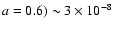 Mpc-3. This indicates that the
present-day density of the most massive black holes that were once
luminous quasars should be very low,
Mpc-3. This indicates that the
present-day density of the most massive black holes that were once
luminous quasars should be very low,
 Mpc-3. Even so, they should be much more frequent than the
very massive spheroids that would host them if the
-
relationship is valid. To estimate the density of
spheroids with
Mpc-3. Even so, they should be much more frequent than the
very massive spheroids that would host them if the
-
relationship is valid. To estimate the density of
spheroids with
 km s-1, one must
extrapolate the
distribution function provided by
Sheth et al. (2003) to unobserved domains in .
Integrating
the Sheth et al. (2003) function for
km s-1, one obtains that the comoving density of all local spheroids
is three orders of magnitude lower (
km s-1, one must
extrapolate the
distribution function provided by
Sheth et al. (2003) to unobserved domains in .
Integrating
the Sheth et al. (2003) function for
km s-1, one obtains that the comoving density of all local spheroids
is three orders of magnitude lower (
 Mpc-3) than that of the most massive black holes. A possible
implication is that the
-
relation is not linear
or of universal validity, i.e. some galaxies host larger black
hole masses than expected. This conclusion should remain valid
also at intermediate redshifts. A constant
/
ratio
cannot hold forever if bulge mass grows by secular evolutionary
processes. Evolution goes in the sense that the spheroids may
increase their masses at a later cosmic age (
Mpc-3) than that of the most massive black holes. A possible
implication is that the
-
relation is not linear
or of universal validity, i.e. some galaxies host larger black
hole masses than expected. This conclusion should remain valid
also at intermediate redshifts. A constant
/
ratio
cannot hold forever if bulge mass grows by secular evolutionary
processes. Evolution goes in the sense that the spheroids may
increase their masses at a later cosmic age ( ;
Peng et al. 2006; Treu et al. 2004) significantly more than their
central black hole: the most massive black hole should be already
"brightly shining'' at
(McLure et al. 2006, and references
therein). A nonlinear
-
relation has
been proposed (Laor 2001) for local hosts, with
accounting for only 0.05% of the bulge mass in low-luminosity
galaxies and 0.5% in giant ellipticals. In this case,
would imply
;
Peng et al. 2006; Treu et al. 2004) significantly more than their
central black hole: the most massive black hole should be already
"brightly shining'' at
(McLure et al. 2006, and references
therein). A nonlinear
-
relation has
been proposed (Laor 2001) for local hosts, with
accounting for only 0.05% of the bulge mass in low-luminosity
galaxies and 0.5% in giant ellipticals. In this case,
would imply
 ,
which is at the upper end of the spheroid masses measured locally
(Marconi & Hunt 2003).
,
which is at the upper end of the spheroid masses measured locally
(Marconi & Hunt 2003).
The problem can be made to disappear if
 .
Bernardi et al. (2005) find a maximum
.
Bernardi et al. (2005) find a maximum
 km s-1. These local galaxies (with expected
 )
may have been the hosts of the luminous quasars
at
)
may have been the hosts of the luminous quasars
at
 since the number density of spheroids
with
since the number density of spheroids
with
 km s-1 is
 Mpc-3, still somewhat larger than the present-day density of
supermassive black holes that were radiating at
Mpc-3, still somewhat larger than the present-day density of
supermassive black holes that were radiating at
 (
(
 Mpc-3).
The curves in Fig. 7, where
 has been assumed, suggest that there is no need for
at
has been assumed, suggest that there is no need for
at  .
Similarly the brightest
HE sources in the redshift range
(
.
Similarly the brightest
HE sources in the redshift range
(
 at
at
 )
are consistent
with
1 if
.
In
other words, if
,
then a source at
1 would be brighter than the brightest quasars observed
in the range
(if H0 is close to the
value assumed in this paper).
)
are consistent
with
1 if
.
In
other words, if
,
then a source at
1 would be brighter than the brightest quasars observed
in the range
(if H0 is close to the
value assumed in this paper).
?
One might envision a non-virial component that increases with
source luminosity and systematically broadens the H
profile.
In our so-called Pop. A sources, the high ionization wind that can
dominate C IV1549 emission might reasonably be expected to produce
Balmer line emission as well. Such an additional (blueshifted)
component on the H
profile would increase FWHM measures
(Sulentic et al. 2006, HE 1249-0648 and HE 1258-0823 may show this
effect). One intriguing possibility is that
high-luminosity sources are extreme Pop. A sources which is
supported by models invoking a radiation pressure driven wind.
Such an effect would make the correction (500 km s-1)
deduced for low-z Pop. A sources inadequate. At the other
extreme, strong redward asymmetries observed in Pop. B sources
indicate that the integrated profile may be affected by
gravitational redshift and non-virial motions
(Marziani et al. 2003b). A quantitative analysis of these
suggestions needs careful analysis beyond the scope of this paper,
but in both cases any correction would lower
.
It is interesting to consider in more detail the sources that
show
1010
in our sample. HE 0248-3628 with
the largest estimated
is also one of the highest
radiators with
1. It shows an anomalously large (by
a factor 10) flux with respect to our other VLT sources
which makes it an extremely luminous quasar (  ;
see Sulentic et al. 2004). It falls near the Pop. A-B boundary in
Eigenvector 1 space and is a borderline radio-loud source by our
definition (Sulentic et al. 2003). It disappears as an outlier if
the
estimated from the tabulated
is adopted. HE 2355-4621 is a second source with
.
It
behaves like a normal radio-quiet Pop. B source. The H
profile shows a prominent redward asymmetry, which is strongly
affecting the width at half maximum. It is also interesting to
consider HE 1104-1805, which is the most luminous source in our
new sample with (
-29.5). It behaves like an
ordinary Pop. A source and shows
which may be overestimated if the continuum is lens
brightened (Appendix A).
;
see Sulentic et al. 2004). It falls near the Pop. A-B boundary in
Eigenvector 1 space and is a borderline radio-loud source by our
definition (Sulentic et al. 2003). It disappears as an outlier if
the
estimated from the tabulated
is adopted. HE 2355-4621 is a second source with
.
It
behaves like a normal radio-quiet Pop. B source. The H
profile shows a prominent redward asymmetry, which is strongly
affecting the width at half maximum. It is also interesting to
consider HE 1104-1805, which is the most luminous source in our
new sample with (
-29.5). It behaves like an
ordinary Pop. A source and shows
which may be overestimated if the continuum is lens
brightened (Appendix A).
The high-mass wing of the
distribution in the redshift range
is consistent with the wing of a Gaussian
peaked at
and dispersion
 0.3 if
is computed from
FWHM
(H
)
(
if no
correction to H
is applied). The Gaussian dispersion is
consistent with the estimated errors of individual measurements.
K-S tests do not favor significantly different peak masses or a
much different dispersion. This suggests that sources with
0.3 if
is computed from
FWHM
(H
)
(
if no
correction to H
is applied). The Gaussian dispersion is
consistent with the estimated errors of individual measurements.
K-S tests do not favor significantly different peak masses or a
much different dispersion. This suggests that sources with
 of our data might be mostly due to
random errors associated to the uncertainty in individual
measurements.
of our data might be mostly due to
random errors associated to the uncertainty in individual
measurements.
A first systematic effect considers the uncertainty in the index .
Our
estimates show the onset of
at  ;
at
we observe some of the
most luminous HE quasars. The high luminosity range of the
Kaspi et al. (2005) relationship remains poorly sampled: there are
just 2-3 sources in the range
;
at
we observe some of the
most luminous HE quasars. The high luminosity range of the
Kaspi et al. (2005) relationship remains poorly sampled: there are
just 2-3 sources in the range
 (to which most of our intermediate z sources belong),
creating a sample bias and making the correlation analysis
intrinsically unstable. In addition, a recent reanalysis of the
-
correlation suggests a value of
as low as 0.5 (Vestergaard & Peterson 2006). If
is overestimated by
(to which most of our intermediate z sources belong),
creating a sample bias and making the correlation analysis
intrinsically unstable. In addition, a recent reanalysis of the
-
correlation suggests a value of
as low as 0.5 (Vestergaard & Peterson 2006). If
is overestimated by
 over a
luminosity range of 10,
may be overestimated by
0.2 in our intermediate z sources.
over a
luminosity range of 10,
may be overestimated by
0.2 in our intermediate z sources.
Pop. A sources show good evidence that LILs are emitted in a
strongly flattened system, probably an accretion disk or gas
co-planar with the disk. C IV1549 in these sources seems to be
dominated by a wind component (Bachev et al. 2004). If these
considerations apply also to Pop. B sources (but it is by no means
clear, given the large FWHM(H
)
of sources believed to be
observed pole-on) and if the maximum angle between disk axis and
line-of-sight is
 ,
a correction could imply a
factor 2 systematic increase in
.
However, these
consideration of orientation effects may not even reopen the
problem of very large
values: if our suggestion of a maximum
is appropriate, taking into
account the systematic orientation effects would yield a maximum
,
a correction could imply a
factor 2 systematic increase in
.
However, these
consideration of orientation effects may not even reopen the
problem of very large
values: if our suggestion of a maximum
is appropriate, taking into
account the systematic orientation effects would yield a maximum
 which is still plausible. The
result that
1 at
would be reinforced by
systematic orientation effects.
which is still plausible. The
result that
1 at
would be reinforced by
systematic orientation effects.
Summing up, our data suggest that very large masses
may be not be real, and may be predominantly due to
statistical errors and emission line profile broadening that is
in part non-virial. The data presented in this paper are
consistent with
not exceeding
for our
sources if the correction to FWHM(H
)
described earlier is
applied.
estimators
LILs like Mg II2800 and Fe II may yield more reliable results than
H
.
H I Balmer line emission can be substantial from gas in a
variety of physical conditions. In Pop. B sources, a very broad
component may increase the FWHM of the integrated H
profile
(also mimicked by low S/N data; Shemmer et al. 2004; McIntosh et al. 1999). This very broad component
may be optically thin to the ionizing continuum, and therefore
non-responsive to continuum changes. The H
profile of Pop. A
sources may be affected by a high-ionization component mentioned
earlier. Fe II is thought to be emitted in a region very
optically thick to Lyman continuum which is probably photoionized
(Vestergaard & Peterson 2005; Wang et al. 2005), as the part of H
responding to continuum changes should be. It is not surprising
that the reverberating part of H
and Fe II provides width
estimates which are consistent, since they are expected to measure
the width of a similar sub-region within the BLR. Similar
considerations apply to Mg II2800 (Wills et al. 1985) since Mg II2800 should be mainly emitted in the same zone as Fe II.
McLure & Dunlop (2004) present virial
estimates for
13 000 quasars in the redshift interval
 based on spectra from the SDSS first data release. The mean
increases with increasing redshift basically as shown in
Fig. 3. The mass values found by them are also
consistent with a limiting
around
,
with
large scatter. They use FWHM(H
)
or FWHM(Mg II2800) and find a
consistency between the most massive at
and those
at
based on spectra from the SDSS first data release. The mean
increases with increasing redshift basically as shown in
Fig. 3. The mass values found by them are also
consistent with a limiting
around
,
with
large scatter. They use FWHM(H
)
or FWHM(Mg II2800) and find a
consistency between the most massive at
and those
at
 .
Given measurement difficulties, and doubts
about the virial assumption for most other lines, corrected
measures for H
,
Fe II, and Mg II2800 may offer the best hope for
reliable
and
estimates out to
.
Given measurement difficulties, and doubts
about the virial assumption for most other lines, corrected
measures for H
,
Fe II, and Mg II2800 may offer the best hope for
reliable
and
estimates out to  2.5.
2.5.
Nine intermediate z VLT/ISAAC spectra with high resolution and
S/N supplement an earlier sample of 17 sources. Emission line
measurements on H
and Fe II presented in this paper
strengthen the conclusion of Sulentic et al. (2004) that
luminosity effects are weak or absent in the low-ionization lines
of AGNs. Results on the H
profile are consistent with the
population A-B hypothesis and Eigenvector 1 parameter space
concept developed for low z AGNs. We computed virial masses and
Eddington ratios for the 25 intermediate-z objects plus about
280 lower z sources, using the same emission line over the
entire redshift range for the first time.
We also have how the distributions of
and
vs. z are shaped by selection effects intrinsic to any flux-limited
survey at the low
end. At the high
end, masses
exceeding a few 109
may be rare if corrections for
non-virial broadening and statistical errors are taken into
account. This suggestion is based on just 25 objects distributed
over the entire redshift range
 .
Confirmation
from a larger sample of intermediate-z observations is needed.
.
Confirmation
from a larger sample of intermediate-z observations is needed.
Acknowledgements
We thank a referee for many useful suggestions and the tenacity to ensure that they were taken into account. We also thank Lutz Wisotzki for providing us with the HE optical spectra. D.D.-H., and J.S. acknowledge financial support from grant IN100703 from PAPIIT, DGAPA, UNAM.
HE 0512-3329 was discovered as a probable gravitationally lensed quasar with the Space Telescope Imaging Spectrograph
(STIS). It is a doubly imaged QSO with a source redshift of z = 1.58 and an image separation of 0
644. The flux
ratio
 of the lensed images shows a strong dependence on wavelength. In the R and I bands, A is
brighter than B by about 0.45 mag while the two are almost equal in the band B. For smaller wavelengths, especially
close to the limit near 2000 Å, B becomes much brighter than A by about 1.3 mag. A natural explanation for this
effect is differential reddening caused by different extinction effects in the two lines of sight (Gregg et al. 2000).
Microlensing by stars and other compact object in the lensing galaxy also plays a role in this source
(Wucknitz et al. 2003). Unfortunately, the small separation does not allow to us to distinguish component A and B on
the ISAAC spectrum. The HE 0512-3329 acquisition image is compatible with an unresolved source. Considering the flux
ratios in the R and I band, it is reasonable to assume that our spectrum is dominated by the A component.
of the lensed images shows a strong dependence on wavelength. In the R and I bands, A is
brighter than B by about 0.45 mag while the two are almost equal in the band B. For smaller wavelengths, especially
close to the limit near 2000 Å, B becomes much brighter than A by about 1.3 mag. A natural explanation for this
effect is differential reddening caused by different extinction effects in the two lines of sight (Gregg et al. 2000).
Microlensing by stars and other compact object in the lensing galaxy also plays a role in this source
(Wucknitz et al. 2003). Unfortunately, the small separation does not allow to us to distinguish component A and B on
the ISAAC spectrum. The HE 0512-3329 acquisition image is compatible with an unresolved source. Considering the flux
ratios in the R and I band, it is reasonable to assume that our spectrum is dominated by the A component.
HE 1104-1805 is a double-image lensed quasar discovered by
Wisotzki et al. (1993). The image separation is
 ,
the source redshift is
,
the source redshift is
 ,
and the lens
redshift is
,
and the lens
redshift is
 .
Wisotzki et al. (1995 ) reported that
the continuum flux in both images is highly variable but that the
line fluxes do not change, as expected if microlensing is
operating. On the acquisition image of HE 1104 there is a second
source at 3.5'' but it is completely off-slit.
.
Wisotzki et al. (1995 ) reported that
the continuum flux in both images is highly variable but that the
line fluxes do not change, as expected if microlensing is
operating. On the acquisition image of HE 1104 there is a second
source at 3.5'' but it is completely off-slit.
and
as a function of z
The absolute B magnitude
can be related to the specific luminosity at 5100 Å assuming an average spectral
shape between 4400 (effective wavelength of B band) and 5100 Å. If the spectral shape is described by a power-law
(
 )
with b = 0.3 (Marziani et al. 2003b):
)
with b = 0.3 (Marziani et al. 2003b):
 ,
with
,
with
 Å i.e., a bolometric correction
factor 10, we can write:
has been written in units of 109 .
The absolute magnitude
is:
Å i.e., a bolometric correction
factor 10, we can write:
has been written in units of 109 .
The absolute magnitude
is:
 |
(B.3) |
 is in parsec, and the last term is the K(z) correction.
Assuming
 ,
and
,
and
 ,
we have for the transverse
comoving distance:
,
we have for the transverse
comoving distance:
 |
(B.4) |
 ).
).
![\begin{displaymath}d_{\rm C} \approx \frac{c}{H_0} \left[ (1.500 ) \left( 1 - {\...
...0.996 \left( 1 - {\rm e}^{-\frac{z}{1.266 }} \right) \right].
\end{displaymath}](/articles/aa/full/2006/36/aa4153-05/img172.gif) |
(B.5) |
 |
(B.6) |
:
 are minor.
![\begin{figure}
\par\includegraphics[width=9cm,clip]{4153f1.eps}\end{figure}](/articles/aa/full/2006/36/aa4153-05/img176.gif) |
Figure 1: Calibrated VLT-ISAAC spectra for 9 new intermediate-redshift quasars. Abscissæ are rest-frame wavelength in Å, ordinates the rest-frame specific flux in units of 10-15 erg s-1 cm-1 Å-1. |
| Open with DEXTER | |
![\begin{figure}
\par\includegraphics[width=16.1cm, height=12.2cm,clip]{4153f2.eps}\end{figure}](/articles/aa/full/2006/36/aa4153-05/img177.gif) |
Figure 2:
Spectral Atlas for the new intermediate-redshift quasars. Left-hand panels show the
continuum-subtracted H
spectral region. Axes are the same as Fig. 1. The best-fit Fe II emission
model is traced as a thin (green) line. Right-hand panels show the enlarged H
profiles after continuum and Fe II subtraction. The (blue and red) thick line shows a spline fit of the short and long wavelength sides of the H
profile, respectively. |
| Open with DEXTER | |
Table 1: Basic properties of sources and Log of observations.


![\begin{displaymath}
r_{\rm BLR} \approx 0.697 \times 10^{17} \cdot \left[\frac{
...
...\AA\right)}{10^{44} ~\rm erg
~ s^{-1}}\right]^{0.67} {\rm cm}.
\end{displaymath}](/articles/aa/full/2006/36/aa4153-05/img88.gif)


![\begin{eqnarray*}{M_{{{\rm BH}},9\odot}} = & & {3.85 \times 10^6 h^{-2}}
{\left(...
...frac{z}{1.266}} \right) \right]^2 \cdot (1 + z)^{(1 - {\rm a})}.
\end{eqnarray*}](/articles/aa/full/2006/36/aa4153-05/img107.gif)
![\begin{displaymath}\log~[\lambda L_\lambda (\lambda = 5100~ {\rm\AA})] = -0.4 M_{\rm B} + 35.497.
\end{displaymath}](/articles/aa/full/2006/36/aa4153-05/img162.gif)
![\begin{displaymath}\log~[\lambda L_\lambda (\lambda = 5100~ {\rm\AA})] = \frac{L...
...cdot L_{\rm Edd}} \cdot 1.3 \times 10^{47}
M_{{\rm BH},9\odot}
\end{displaymath}](/articles/aa/full/2006/36/aa4153-05/img165.gif)
![\begin{eqnarray*}{M_{{{\rm BH}},9\odot}} &= & {3.85 \times 10^6 h^{-2}}
{\left( ...
...-\frac{z}{1.266}} \right) \right]^2 (1 + z)^{(1 -
{\rm a})}, \\
\end{eqnarray*}](/articles/aa/full/2006/36/aa4153-05/img174.gif)