 images using SOHO/SUMER observations
(Research Note)
A&A 456, 747-750 (2006)
DOI: 10.1051/0004-6361:20054714
images using SOHO/SUMER observationsSungsoo S. Kim1 - Hee-Seon Roh1 - Kyung-Seok Cho2 - Junho Shin3
1 - Dept. of Astronomy & Space Science, Kyung Hee University,
Yongin-shi, Kyungki-do 446-701, Korea
2 -
Korea Astronomy and Space Science Institute, Whaamdong,
Yooseong-ku, Daejon 305-348, Korea
3 -
Solar and Plasma Astrophysics Division, National Astronomical
Observatory of Japan, Osawa 2-21-1, Mitaka, Tokyo 181-8588, Japan
Received 18 December 2005 / Accepted 12 June 2006
Abstract
1216 Å channel images from the Transition Region and Coronal
Explorer (TRACE) contain not only the desired H I Lyman-(L)
line emission from the Sun, but also some UV continuum around
1600 Å. By comparing TRACE data with L
images from the Very
High Angular Resolution Ultraviolet Telescope, Handy et al. proposed a simple
procedure to remove the contamination: a linear combination of 1216 Å and
1600 Å channel images from the TRACE.
In order to check the reliability
of this procedure, here we compare TRACE data with L
raster scan
images from the SUMER instrument onboard the Solar and Heliospheric
Observatory (SOHO).
We obtain a linear combination coefficient very similar
to that of Handy et al., and also find that the apparent spatial resolution
of the L
raster scan images from SOHO/SUMER is at least
 ,
which is more than 2-4 times lower
than that of its single spectrum.
,
which is more than 2-4 times lower
than that of its single spectrum.
Key words: Sun: UV radiation - Sun: chromosphere - Sun: transition region
The Transition Region and Coronal Explorer (TRACE; Handy et al. 1999a),
launched in April 1998, has collected a vast number of H I
Lyman-
(L)
images of the Sun with a high spatial
(1 arcsec) and a temporal (few seconds) resolution. H I L
at
1216 Å is one of the brightest emission lines formed in the
chromosphere and the transition region, thus it is a natural tracer of solar
activity in those regions. L
images from TRACE can be used to
study the morphology and evolution of active regions on the Sun as well as the
variability of solar irradiance.
The 1216 Å images obtained with TRACE, however, contain not only the
desired line emission, but also some UV continuum near 1600 Å
and at longer wavelengths. This contamination, known prior to launch,
is due to a rather broad double peak in spectral response of the Lchannel with one peak located at  1216 Å and a second peak
at 1550 Å (see Fig. 1 of Handy et al. 1999b). This
unusual spectral response of the 1216 Å channel is a result of a
narrowband UV coating on the primary mirror at 1500 Å combined
with a filter centered at 1216 Å.
1216 Å and a second peak
at 1550 Å (see Fig. 1 of Handy et al. 1999b). This
unusual spectral response of the 1216 Å channel is a result of a
narrowband UV coating on the primary mirror at 1500 Å combined
with a filter centered at 1216 Å.
Handy et al. (1999b, H99b hereafter) have provided a simple method to
remove this contamination by using a large number of solar irradiance data
samples from the Solar-Stellar Irradiance Comparison Experiment
(SOLSTICE; Rottman et al. 1993), and by comparing TRACE 1216 Å
images with a L
image from the Very High Angular Resolution
Ultraviolet Telescope (VAULT; Korendyke et al. 2001) sounding rocket
flight of May 7, 1998.
H99b assumed that a pure L
intensity can be obtained by
a linear combination of TRACE 1216 Å and 1600 Å channels:
 is the intensity of the pure L
emission
line, I1216 and I1600 are the intensities as observed with TRACE
1216 Å and 1600 Å channels, respectively, and A and Bare the fitting parameters. Coefficient A is expected to be near unity,
while coefficient B is expected to be negative because I1216 is
contaminated by the UV continuum, which can be well represented by I1600.
is the intensity of the pure L
emission
line, I1216 and I1600 are the intensities as observed with TRACE
1216 Å and 1600 Å channels, respectively, and A and Bare the fitting parameters. Coefficient A is expected to be near unity,
while coefficient B is expected to be negative because I1216 is
contaminated by the UV continuum, which can be well represented by I1600.
To obtain an initial guess for A and B, H99b first used the SOLSTICE
database of solar spectra covering a wide range of solar activity. They
convolved a large set of SOLSTICE spectra with TRACE 1216 Å and
1600 Å channel response functions to obtain synthetic I1216 and
I1600 values, and integrated the same set of spectra along the
L
emission line profile to obtain
values.
A least-squares regression was then applied to these intensities
to find best-fit coefficients of A=0.97 and B=-0.14.
To further improve the coefficients, they then compared TRACE observations
with a VAULT L
image. For I1216 and I1600 values in
equation (1),
they used the pixel intensities of TRACE 1216 Å and 1600 Å images,
while for
values, they used the pixel intensities
of a VAULT L
image assuming that the VAULT L
image is
not contaminated by non-L
emission (the L
filter of the
VAULT has a bandpass of 150 Å). Fixing the coefficient A to be the
value obtained from the SOLSTICE spectra, 0.97, they found that B=-0.105results in the highest Spearman's rank correlation ( ,
Press et al. 1992)
between both sides of Eq. (1).
,
Press et al. 1992)
between both sides of Eq. (1).
As noted by H99b, it is desirable to confirm the reliability of this
correction method by comparing TRACE images with other observations.
In the present work, we extend the work of H99b by
cross-calibrating TRACE L
images with the Solar Ultraviolet
Measurements of Emitted Radiation (SUMER; Wilhelm et al. 1995) instrument
onboard Solar and Heliospheric Observatory (SOHO).
We have searched the SUMER data archive for L
raster scan images that
were observed within a few tens of minutes from the epoch of any TRACE
1216 Å images with an observed region overlapped, and found
only two cases: images SUM_990603_215302 and SUM_990603_220846.
SUM_990603_215302![[*]](/icons/foot_motif.gif) was acquired from 21:52:40.5
to 22:07:27.3 UT of June 3rd, 1999, and is centered at (
was acquired from 21:52:40.5
to 22:07:27.3 UT of June 3rd, 1999, and is centered at (
 ,
,
 )
with an image size of
)
with an image size of
 .
SUM_990603_220846 was acquired from 22:08:46.1
to 22:23:59.0 UT of June 3rd, 1999, and is centered at (
.
SUM_990603_220846 was acquired from 22:08:46.1
to 22:23:59.0 UT of June 3rd, 1999, and is centered at (
 ,
)
with the same image size as SUM_990603_220846.
,
)
with the same image size as SUM_990603_220846.
These SUMER images have
 pixels, making the pixel size
on the sky
pixels, making the pixel size
on the sky
 .
They are raster scan
images made from the spectra that are obtained with a slit whose size is
.
They are raster scan
images made from the spectra that are obtained with a slit whose size is
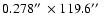 ,
and have four wavelength layers with
the first layer centered at 1215.67 Å with a
width of 2.1 Å. Their X- and Y-axis spatial resolutions are
,
and have four wavelength layers with
the first layer centered at 1215.67 Å with a
width of 2.1 Å. Their X- and Y-axis spatial resolutions are
 and
and
 ,
respectively, and the integration time for each slit
observation is 20.0 s.
,
respectively, and the integration time for each slit
observation is 20.0 s.
The TRACE 1216 Å image that was taken at the closest epoch from
SUM_990603_215302 is tri19990603.2100_0003 and its accompanying
1600 Å image is tri19990603.2100_0005. These images were acquired at
21:40:43.0 UT and 21:41:03.0 UT with exposure times of 3.44 and 1.22 sec,
respectively. The TRACE 1216 Å image that was taken at the closest epoch
from SUM_990603_220846 is tri19990603.2200_0205 and its
accompanying 1600 Å image is tri19990603.2200_0207. These images
were acquired at 22:33:36.0 UT and 22:33:55.0 UT with exposure times of
3.444 and 1.216 sec, respectively. All of these TRACE images
are centered at (
 ,
,
 )
with an image
size of
)
with an image
size of
 ,
and have
,
and have
 pixels with a pixel size of
 (a spatial
resolution of
(a spatial
resolution of
 ).
).
Although the above images are the best matches between the
TRACE and SUMER data sets, the times between the closest TRACE and SUMER
images are still rather long: 17 to 19 min (see Fig. 1
for the relative epochs of these images). We find that a better correlation
can be obtained between the two data sets when the images from the
same instrument are combined, compared to when each match is analyzed
separately. Thus for our analyses in the present study, we average
SUM_990603_215302 and SUM_990603_220846 for the SUMER
1215.67 Å image, tri19990603.2100_0003 and
tri19990603.2200_0205 for the TRACE 1216 Å image, and
tri19990603.2100_0005 and tri19990603.2200_0207 for the
TRACE 1600 Å image. When calculating the average, we appropriately
weighted each two images such that the average is centered at 22:00:00.0 UT.
![\begin{figure}
\par\includegraphics[width=7.3cm,clip]{4714fig1.eps}
\end{figure}](/articles/aa/full/2006/35/aa4714-05/img28.gif) |
Figure 1: Epochs and durations of the images analyzed in the present study. The integration times of the TRACE observations are too short to be shown in the plot, and those observations are denoted with crosses. |
| Open with DEXTER | |
Calibration of SUMER data was performed with the SUMER IDL software
included in the SolarSoft
package.
The data are first flatfielded with the procedure sumer_flatfield and
destreched with the procedure sumer_destretch. Calibration is then
performed with the procedure sumer_calib. The photons that go through
SUMER's slit do not reach the top and/or bottom few rows of CCD pixels
for calibration purposes. In case of the SUMER image we consider here,
we find that the top 7-8 rows and the bottom 6 rows of the CCD pixels are
not illuminated and have intensities lower than 50 counts per pixel.
We thus exclude these pixels from our comparison analyses below.
Calibration of TRACE data was performed with the procedure trace_prep,
which is included in the TRACE branch of the SolarSoft package.
TRACE pixels with data numbers larger than 4000 are saturated and are
excluded from our analyses.
Since the TRACE images cover a larger area than the SUMER image,
for the analyses below, we crop the TRACE images to match the
observed area of the SUMER image. While matching the images, we realized
that either or both of the SUMER and TRACE coordinate information is inaccurate
and the two images do not exactly coincide. We thus estimate the amount of
pixels to be shifted for the TRACE images to match the SUMER image
(
 ,
,
 )
by maximizing the
value between
the TRACE L
image and the SUMER 1215.67 Å image.
)
by maximizing the
value between
the TRACE L
image and the SUMER 1215.67 Å image.
We estimate the best-fit B value from the SUMER data by maximizing
between the TRACE L
image and the SUMER 1215.67 Å
image as well, thus finding the best-fit B value
and (
,
)
values is performed simultaneously.
However, three-dimensional maximization is a difficult numerical
problem and may often give incorrect results. For this reason, we maximize
hierarchically: we find (
,
)
values that
maximize
 ,
where each
value is the maximum
as a function of B for a given
(
,
)
pair. In this way, the best-fit values
for all three parameters, B,
,
and
,
are
reliably obtained.
,
where each
value is the maximum
as a function of B for a given
(
,
)
pair. In this way, the best-fit values
for all three parameters, B,
,
and
,
are
reliably obtained.
When finding the best-fit B,
,
and
values, we fix A to be 0.97 as H99b did when calculating their best-fit B value.
This is because we are not analyzing absolute-calibrated images and thus
what we actually obtain from our image comparison is the ratio between A and B, rather than absolute A and B values.
![\begin{figure}
\par\includegraphics[width=12.3cm,clip]{4714fig2.eps}
\end{figure}](/articles/aa/full/2006/35/aa4714-05/img30.gif) |
Figure 2:
TRACE and SUMER images with a sampling size of a)
 and b)
.
TRACE L
image is obtained by using Eq. (1) with
the best-fit B value of a) -0.036 and b) -0.120.
The bars indicate the intensities of the greyscale in units of
count per second for TRACE 1216 images. The greyscale for other images
are appropriately scaled for ease of comparison.
and b)
.
TRACE L
image is obtained by using Eq. (1) with
the best-fit B value of a) -0.036 and b) -0.120.
The bars indicate the intensities of the greyscale in units of
count per second for TRACE 1216 images. The greyscale for other images
are appropriately scaled for ease of comparison. |
| Open with DEXTER | |
Since the pixel sizes of TRACE and SUMER images are not identical,
we need to resample the images for our comparison. We first analyze
the images for a sampling size of
,
which is the larger of the spatial resolutions between the TRACE
and SUMER images, and obtain the best-fit parameters listed in the first row
of Table 1. Figure 2a shows the
TRACE and SUMER images for this sampling size, as well as the TRACE
L
image obtained by using equation (1) with the
best-fit B value of -0.036. The
value between TRACE Land SUMER 1215.67 (
 ), 0.8374, is only
slightly larger than that between TRACE 1216 and SUMER 1215.67
(
), 0.8374, is only
slightly larger than that between TRACE 1216 and SUMER 1215.67
(
 ), 0.8367, i.e., there is almost no gain in
correlation from combining TRACE 1216 and 1600.
This is probably because of the significant difference in apparent
spatial resolution between the TRACE and SUMER images: the spatial
resolution of the SUMER image appears to be much worse than it is
supposed to be. One possible reason would be the fact that the SUMER
image is a raster scan image that took 15 min to complete
and the features in the image could have moved during the scan.
), 0.8367, i.e., there is almost no gain in
correlation from combining TRACE 1216 and 1600.
This is probably because of the significant difference in apparent
spatial resolution between the TRACE and SUMER images: the spatial
resolution of the SUMER image appears to be much worse than it is
supposed to be. One possible reason would be the fact that the SUMER
image is a raster scan image that took 15 min to complete
and the features in the image could have moved during the scan.
Table 1: Best-fit parameters.
We then resampled the images with various, larger sampling sizes (see
Table 1). Our eye inspection finds that a sampling size
of
is
the smallest size that results in similar apparent resolutions for the
TRACE and SUMER images. Figure 2b shows the TRACE and SUMER
images for this sampling size, as well as the TRACE L
image created
with the best-fit B value, -0.120 (see the fourth row of
Table 1 for best-fit parameters).
This B value increases the correlation from
 to
to
 ,
which is
a much larger increase than for a sampling size of
.
This increase
is less than the increase obtained by H99b (from 0.809 to 0.825), but
the correlation value itself is larger.
This best-fit B value, -0.120, is similar to the value that
H99b obtained from their comparison with the VAULT observation, -0.105. When
applying B=-0.105 to images with a sampling size of
,
we obtain
,
which is
a much larger increase than for a sampling size of
.
This increase
is less than the increase obtained by H99b (from 0.809 to 0.825), but
the correlation value itself is larger.
This best-fit B value, -0.120, is similar to the value that
H99b obtained from their comparison with the VAULT observation, -0.105. When
applying B=-0.105 to images with a sampling size of
,
we obtain
 ,
which is only slightly less than our value. This is because, as shown in
Fig. 3,
,
which is only slightly less than our value. This is because, as shown in
Fig. 3,
 for a given (
,
)
has a rather broad peak around the maximum.
This implies that our comparison of TRACE data with SUMER data is
consistent with the result of H99b.
for a given (
,
)
has a rather broad peak around the maximum.
This implies that our comparison of TRACE data with SUMER data is
consistent with the result of H99b.
We have found one set of matches between the SUMER 1215.67 Å
raster scan images and
the TRACE 1216 Å images that were taken for the same area on the Sun
within a few tens of minutes. The relatively long exposure time necessary for
raster scan images makes their apparent spatial resolution worse than the
predicted value, and we found that the apparent quality of the SUMER and
TRACE images become similar when compared at a resolution of
.
We have compared the TRACE and SUMER
images at this sampling size, and by maximizing
,
we obtained the best-fit B of -0.120 and
of 0.9089.
This B value is very close to that of H99b, -0.105, and the obtained
was about 10% better than that of H99b.
Thus our comparison between the TRACE and SUMER images confirmsthe
reliability of the calibration method suggested by H99b for TRACE
1216 Å images.
![\begin{figure}
\par\includegraphics[width=7cm,clip]{4714fig3.eps}
\end{figure}](/articles/aa/full/2006/35/aa4714-05/img47.gif) |
Figure 3:
values as a function of B for
a sampling size of
and
 and
and
 .
These
and
values maximize
as described in the text. .
These
and
values maximize
as described in the text. |
| Open with DEXTER | |
Acknowledgements
We thank Kap-Sung Kim, Jongchul Chae, Yong-Jae Moon, Jin-Yi Lee for helpful discussions. We also thank Takashi Sakurai who carefully read our manuscript and gave us valuable comments. This work was supported by the Astrophysical Research Center for the Structure and Evolution of the Cosmos (ARCSEC) of the Korea Science and Engineering Foundation through the Science Research Center (SRC) program. S.S.K. was also supported by the Korea Research Foundation by the Korea Government (KRF-2005-070-C00059). K.S.C. was supported by the MOST grants (M1-0104-00-0059 and M1-0407-00-0001) of the Korean government. J.S. was supported by the Korea Research Foundation Grant funded by the Korean Government (MOEHRD) (R14-2002-043-01001-0).
