 |
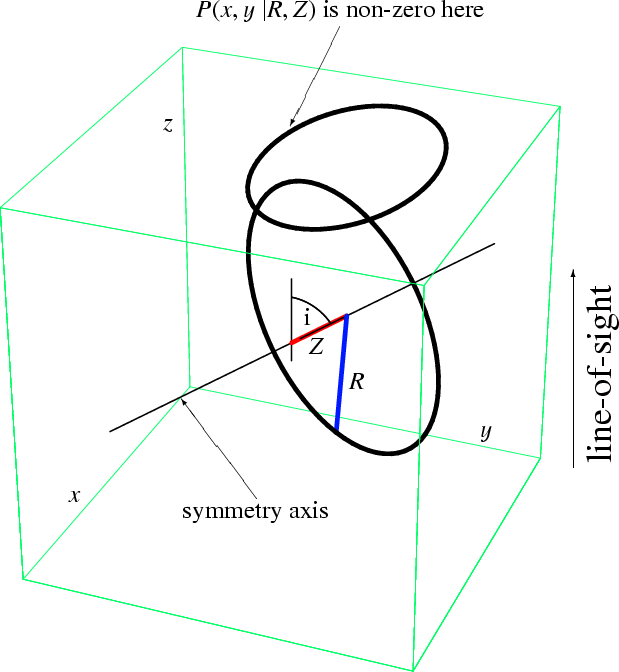
Figure 1: Projection of an axisymmetric distribution of a physical quantity. The ellipse at the top marks the region where the kernel function corresponding to the projection along the line-of-sight is non-zero for fixed R and Z. |
| Open with DEXTER | |
In the text
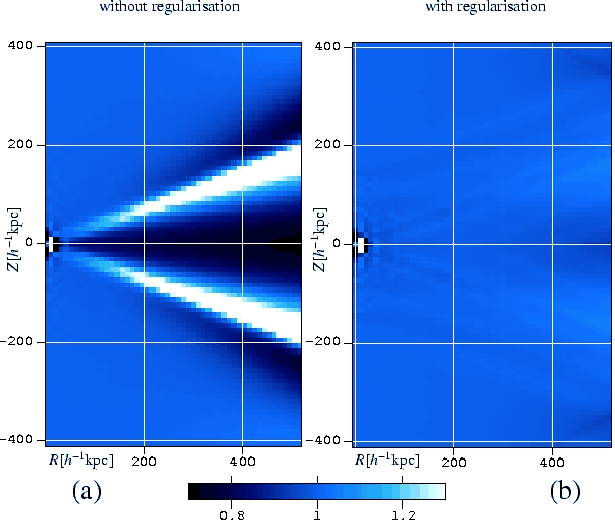 |
Figure 2:
Ratio of the reconstructed to the original X-ray emissivity
after n=30 iteration steps,
 .
The halo centre is at
the centre left of each plot. Panel a) shows the ratio obtained
without regularisation. One can clearly see the spike-shaped artifacts
of the reconstruction. Panel b) shows the ratio for the
reconstruction including the regularisation. It is close to unity
everywhere except very close to the centre, where the algorithm
converges slowly and grid resolution becomes a problem. .
The halo centre is at
the centre left of each plot. Panel a) shows the ratio obtained
without regularisation. One can clearly see the spike-shaped artifacts
of the reconstruction. Panel b) shows the ratio for the
reconstruction including the regularisation. It is close to unity
everywhere except very close to the centre, where the algorithm
converges slowly and grid resolution becomes a problem. |
| Open with DEXTER | |
In the text
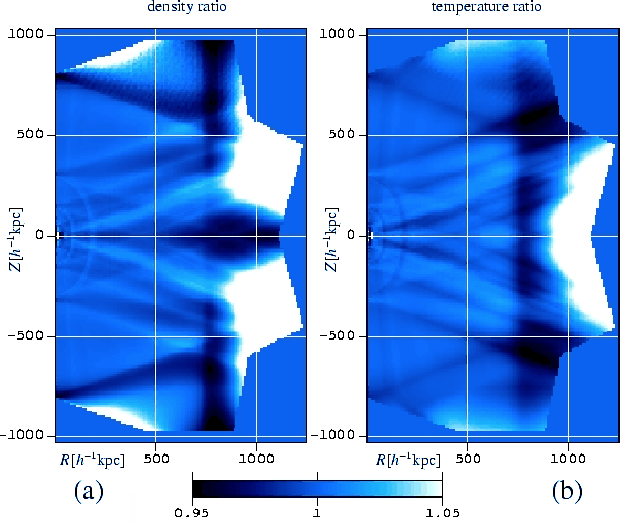 |
Figure 3:
Ratio of the reconstructed to the original density and
temperature for the analytic halo after n=20 iterations. An
inclination angle of
 was chosen and assumed to be known
in performing the reconstruction. Panel a) shows the density ratio
was chosen and assumed to be known
in performing the reconstruction. Panel a) shows the density ratio
 and panel b) the temperature ratio Tn/T. In the
central region, the errors are of the order of
and panel b) the temperature ratio Tn/T. In the
central region, the errors are of the order of  .
We plot the
ratios for all R and Z values possible within the box used for
the reconstruction (see Fig. 1). This causes the
star-like shape of the perimeter of the plot in the R, Z plane. Close to that boundary, at large R or Z values, the
ratios can significantly differ from unity. This is, however,
expected because the ellipses used in the reconstruction
of .
We plot the
ratios for all R and Z values possible within the box used for
the reconstruction (see Fig. 1). This causes the
star-like shape of the perimeter of the plot in the R, Z plane. Close to that boundary, at large R or Z values, the
ratios can significantly differ from unity. This is, however,
expected because the ellipses used in the reconstruction
of  and T at those points lie mostly outside the maps of
 and
and
 . . |
| Open with DEXTER | |
In the text
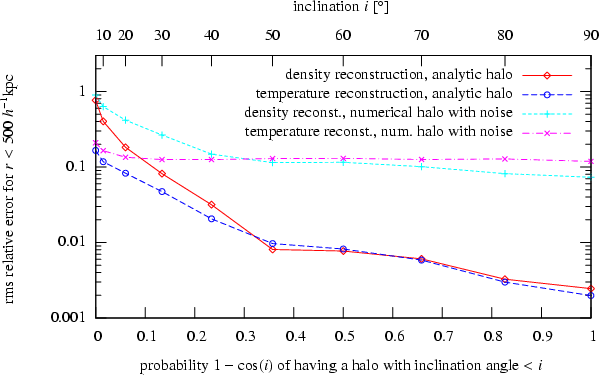 |
Figure 4:
Dependence of the quality of the deprojection on the inclination of the symmetry axis. For the analytic halo, which was deprojected as described above, we show the volume-weighted rms relative errors
 and (Tn-T)/T as functions of the inclination angle i after n=20 iterations. We also show the same errors after n=5 iterations for reconstructions of a numerical halo from maps with observational noise. A detailed description of these reconstructions is given in Sect. 4. The averages of the errors were computed within a sphere of radius
 around the halo centre. The quantity
  shown on the abscissae is chosen such as to have a flat number-density distribution for randomly oriented halos. The inclination angle i was assumed to be known in performing the deprojection.
 |
| Open with DEXTER | |
In the text
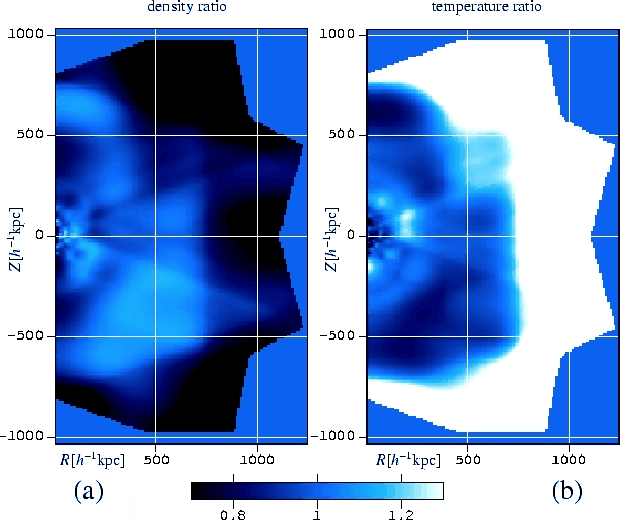 |
Figure 5:
Ratio of the reconstructed to the original density and
temperature for the analytic halo with observational noise after
n=5 iterations. An inclination of
was chosen and
assumed to be known in performing the reconstruction. "Photon-noise'' and "radius-dependent'' smoothing were applied. Panel a) shows the density ratio
,
and panel b) the temperature
ratio Tn/T. In the central region, the errors are of the order of
 to
to  . . |
| Open with DEXTER | |
In the text
![\begin{figure}
\scalebox{0.7}
{
\begin{picture}
(0,0)%
\includegraphics{4717fi...
...\strut{} radius $[h^{-1} {\rm kpc}]$ }}%
\end{picture}%
\endgroup
}
\end{figure}](/articles/aa/full/2006/33/aa4717-05/img133.gif) |
Figure 6:
Density and temperature profiles of the original and the
reconstructed analytic halos. The upper panel shows the density
(falling curves, left axis) and the temperature profiles (rising
curves, right axis) of the original analytic halo, the halo
reconstructed without observational noise (and without any
smoothing), and the halo reconstructed from maps with
observational noise to which the complete smoothing scheme was applied.
The lower panel shows the profile of the ratio of the reconstructed density  to the original density
.
The number of iterations used was n=20 in the case without
noise and n=5 in the case with noise. An inclination of
was chosen and assumed to be known in the
reconstruction.
to the original density
.
The number of iterations used was n=20 in the case without
noise and n=5 in the case with noise. An inclination of
was chosen and assumed to be known in the
reconstruction. |
| Open with DEXTER | |
In the text
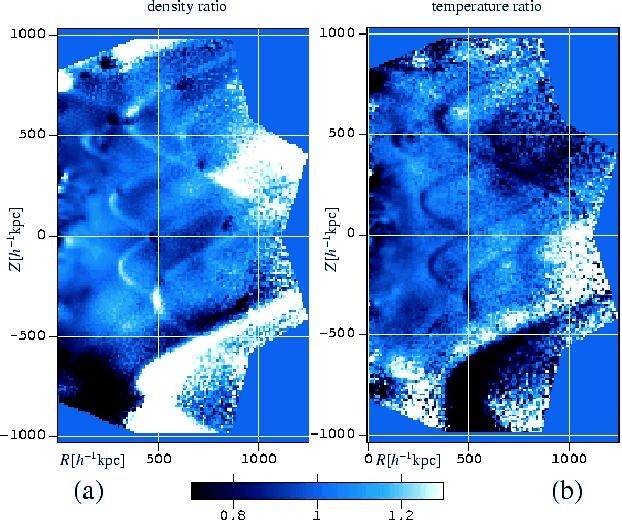 |
Figure 7:
Reconstruction of the simulated cluster g51 without noise and
smoothing. The ratios of the reconstructed to the original density
and temperature are shown. The deprojection was done with n=5 iterations. An inclination angle of
 between the
line-of-sight and the principal inertial axis of the cluster gas was
chosen and assumed to be known in the reconstruction. Panel a)
shows the density ratio
and panel b) the temperature
ratio Tn/T. In the central region, the errors are of the order of
.
between the
line-of-sight and the principal inertial axis of the cluster gas was
chosen and assumed to be known in the reconstruction. Panel a)
shows the density ratio
and panel b) the temperature
ratio Tn/T. In the central region, the errors are of the order of
. |
| Open with DEXTER | |
In the text
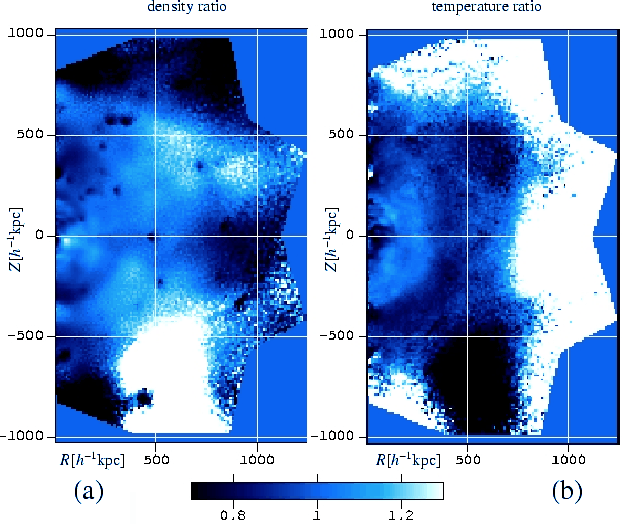 |
Figure 8:
Reconstruction of the simulated cluster g51 without noise but
with "radius-dependent smoothing''. The ratios of the reconstructed
to the original density and temperature are shown. The deprojection
was done with n=5 iterations. An inclination angle of
between the line-of-sight and the principal inertial axis of the
cluster gas was chosen and assumed to be known in the
reconstruction. Panel a) shows the density ratio
and
panel b) the temperature ratio Tn/T. In the central region, the
errors are of the order of . |
| Open with DEXTER | |
In the text
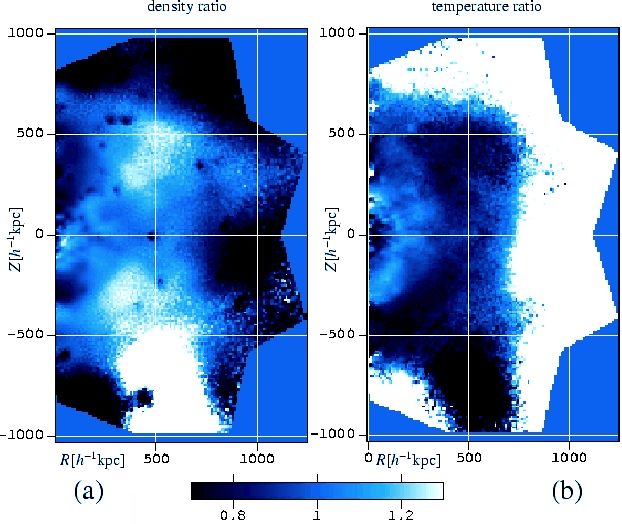 |
Figure 9:
Reconstruction of the simulated cluster g51 with noise and
and the complete smoothing scheme applied. The ratios of the reconstructed to the original density
and temperature are shown. The deprojection was done with n=5 iterations. An inclination angle of
 between the
line-of-sight and the principal inertial axis of the cluster gas was
chosen and assumed to be known in the reconstruction. Panel a)
shows the density ratio
and panel b) the temperature
ratio Tn/T. In the central region, the errors are of the order of
between the
line-of-sight and the principal inertial axis of the cluster gas was
chosen and assumed to be known in the reconstruction. Panel a)
shows the density ratio
and panel b) the temperature
ratio Tn/T. In the central region, the errors are of the order of
 . . |
| Open with DEXTER | |
In the text
![\begin{figure}
\scalebox{0.7}
{
\begin{picture}
(0,0)%
\includegraphics{4717fi...
...\strut{} radius $[h^{-1} {\rm kpc}]$ }}%
\end{picture}%
\endgroup
}
\end{figure}](/articles/aa/full/2006/33/aa4717-05/img169.gif) |
Figure 10:
Gas density and temperature profiles of the original and the
reconstructed cluster g51. The upper panel shows the density
profiles (falling curves, left axis) and the temperature profiles
(rising curves, right axis) of the original cluster, the cluster
reconstructed without observational noise but with "radius-dependent smoothing'', reconstructed without
observational noise and without any smoothing,
reconstructed from maps with observational noise and the complete smoothing scheme applied, and reconstructed
from maps with observational noise but without "radius-dependent smoothing''. The lower panel shows the profile of the ratio of the reconstructed density
to the original density .
The
number of iterations used was n=5 in all cases. An inclination
angle of
was chosen and assumed to be known in
the reconstruction. |
| Open with DEXTER | |
In the text
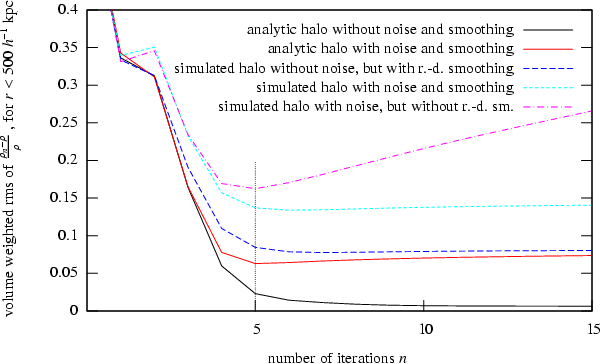 |
Figure 11:
Dependence of the quality of the density reconstruction on
the number of iterations used. We show the volume-weighted relative
rms error
 within spheres with
r=500
h-1 kpc radius and for different deprojections of our analytic
halo model and of the numerically simulated cluster g51. The figure legend explains which halo, whether or not noise, and what kind of smoothing were used for the different reconstructions shown. Note that
"photon-noise smoothing'' of the X-ray maps is always and only used for maps with noise.
within spheres with
r=500
h-1 kpc radius and for different deprojections of our analytic
halo model and of the numerically simulated cluster g51. The figure legend explains which halo, whether or not noise, and what kind of smoothing were used for the different reconstructions shown. Note that
"photon-noise smoothing'' of the X-ray maps is always and only used for maps with noise. |
| Open with DEXTER | |
In the text
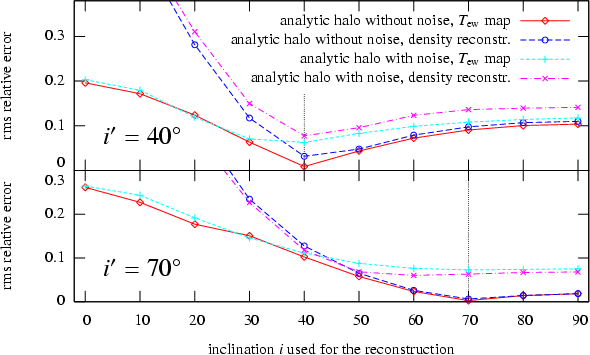 |
Figure 12:
Accuracy of emission-weighted temperature
 maps and densities of reconstructed analytic halos. The
deprojections started from maps obtained by projecting the analytic
halo along a line-of-sight with inclination angles of
maps and densities of reconstructed analytic halos. The
deprojections started from maps obtained by projecting the analytic
halo along a line-of-sight with inclination angles of
 and
and
 .
Inclination angles i between .
Inclination angles i between  and
and  were used for the reconstruction. As expected, the best
reconstructions are obtained for
were used for the reconstruction. As expected, the best
reconstructions are obtained for
 .
The errors are shown
for deprojections from maps without observational noise and from
smoothed maps with observational noise, and were averaged within a
region of radius
500 h-1 kpc around the map or halo centre. .
The errors are shown
for deprojections from maps without observational noise and from
smoothed maps with observational noise, and were averaged within a
region of radius
500 h-1 kpc around the map or halo centre. |
| Open with DEXTER | |
In the text
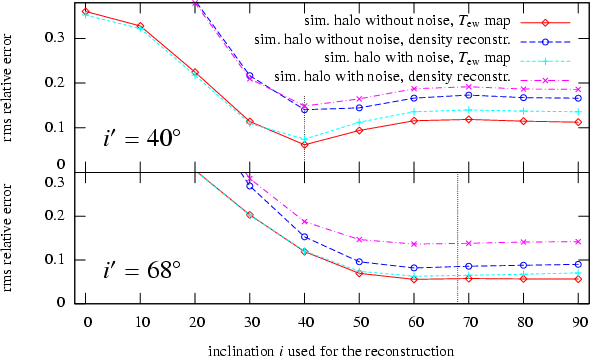 |
Figure 13:
Accuracy of emission weighted temperature
maps and densities for the reconstructed simulated halo g51. Maps
obtained by projecting g51 along a line-of-sight with inclination
angles of
and
 were used. The
reconstruction assumed inclination angles i between
and .
Best reconstructions are obtained for
.
The
errors are shown for deprojections from maps without observational
noise but using "radius-dependent smoothing'', and from maps
with observational noise on which the complete smoothing scheme was
applied. The rms relative errors were obtained within a
circle of radius
200 h-1 kpc around the map centre for the Tew maps and inside a sphere of radius
500 h-1 kpc
around the halo centre for the density reconstructions.
were used. The
reconstruction assumed inclination angles i between
and .
Best reconstructions are obtained for
.
The
errors are shown for deprojections from maps without observational
noise but using "radius-dependent smoothing'', and from maps
with observational noise on which the complete smoothing scheme was
applied. The rms relative errors were obtained within a
circle of radius
200 h-1 kpc around the map centre for the Tew maps and inside a sphere of radius
500 h-1 kpc
around the halo centre for the density reconstructions. |
| Open with DEXTER | |
In the text