![\begin{figure}
\par\includegraphics[width=8cm,clip]{4907f1.eps}
\end{figure}](/articles/aa/full/2006/32/aa4907-06/img49.gif) |
Figure 1: Three possible types of orbits of dust particles under the combined action of stellar gravity and direct radiation pressure. For illustrative purposes, grains are assumed to be released from a circular orbit. |
| Open with DEXTER | |
In the text
![\begin{figure}
\par\includegraphics[width=8cm,clip]{4907f2.eps}
\end{figure}](/articles/aa/full/2006/32/aa4907-06/img51.gif) |
Figure 2:
Grain radius that separates particles in bound and hyperbolic orbits, as a
function of the star's luminosity (assuming dust bulk density of
 ,
a
unit radiation pressure efficiency, and a standard mass-luminosity ,
a
unit radiation pressure efficiency, and a standard mass-luminosity
 relation for MS stars).
Different linestyles are for different typical eccentricities of parent bodies.
Grains between two lines of the same style may be in both types of orbits,
depending on where between the periastron and apastron they are ejected.
The upper lines separate bound and unbound orbits for ejection at the periastron
and the lower ones correspond to ejection at the apastron.
relation for MS stars).
Different linestyles are for different typical eccentricities of parent bodies.
Grains between two lines of the same style may be in both types of orbits,
depending on where between the periastron and apastron they are ejected.
The upper lines separate bound and unbound orbits for ejection at the periastron
and the lower ones correspond to ejection at the apastron. |
| Open with DEXTER | |
In the text
![\begin{figure}
\par\includegraphics[width=14cm]{fi3.eps} \end{figure}](/articles/aa/full/2006/32/aa4907-06/img106.gif) |
Figure 3:
Fragments' orbits produced by collision of two particles
(
 , ,
 , ,
 , ,
 , ,
 , ,
 , ,
 )
whose locations are shown by the two boxes. Lines of equal )
whose locations are shown by the two boxes. Lines of equal
 -ratio (at steps of 0.1 from 0.0 to 2.0, -ratio (at steps of 0.1 from 0.0 to 2.0,  is excluded)
and a running ejection point are shown, as are lines of equal ejection
point (at true anomaly steps of 45
is excluded)
and a running ejection point are shown, as are lines of equal ejection
point (at true anomaly steps of 45 starting at the pericenter) and running .
The
upper-left part contains anomalous hyperbolas, the ellipses are
located in the middle, and the normal hyperbolas are found at the lower-right. The constant
GM is set to unity.
starting at the pericenter) and running .
The
upper-left part contains anomalous hyperbolas, the ellipses are
located in the middle, and the normal hyperbolas are found at the lower-right. The constant
GM is set to unity. |
| Open with DEXTER | |
In the text
![\begin{figure}
\par\psfrag{YAxisLabel}[c][c]{$\frac{\mbox{cross section density}...
...ain radius [$\rm\mu m$ ]}
\includegraphics[width=8.8cm]{4907f4.eps} \end{figure}](/articles/aa/full/2006/32/aa4907-06/img186.gif) |
Figure 4:
Grain size distribution at 100 AU after 10 Myr for a rocky disk with
an initial outer profile
 and eccentricities from 0 to
0.375 (solid line). The contributions from the three different types of orbits,
shifted down by one order of magnitude for better visibility,
are shown by long-dashed (ellipses), short-dashed (normal hyperbolas), and dotted
(anomalous hyperbolas) lines.
and eccentricities from 0 to
0.375 (solid line). The contributions from the three different types of orbits,
shifted down by one order of magnitude for better visibility,
are shown by long-dashed (ellipses), short-dashed (normal hyperbolas), and dotted
(anomalous hyperbolas) lines. |
| Open with DEXTER | |
In the text
![\begin{figure}
\par\psfrag{YAxisLabel}[c][c]{$\frac{\mbox{cross section density}...
...ain radius [$\rm\mu m$ ]}
\includegraphics[width=8.8cm]{4907f5.eps} \end{figure}](/articles/aa/full/2006/32/aa4907-06/img187.gif) |
Figure 5: Grain size distribution at 100 AU and 10 Myr (4.5 Myr for "ice'') for different eccentricity ranges: 0.0 to 0.375 for "rock'' and "ice'', and only 0.0 to 0.125 for "circular'' orbits. The dashed lines are rescaled to coincide with the solid at large radii. The horizontal shift of the maximum for icy grains is largely due to a different bulk density. |
| Open with DEXTER | |
In the text
![\begin{figure}
\par\psfrag{YAxisLabel}[c][c]{$\frac{\mbox{cross section
density}...
...ain radius [$\rm\mu m$ ]}
\includegraphics[width=8.8cm]{4907f6.eps} \end{figure}](/articles/aa/full/2006/32/aa4907-06/img188.gif) |
Figure 6: Evolution of the size distribution of the disk of Fig. 4 at a distance of 100 AU. |
| Open with DEXTER | |
In the text
![\begin{figure}
\par\psfrag{YAxisLabel}[c][c]{$\frac{\mbox{cross section
density}...
...ain radius [$\rm\mu m$ ]}
\includegraphics[width=8.8cm]{4907f7.eps} \end{figure}](/articles/aa/full/2006/32/aa4907-06/img189.gif) |
Figure 7: Grain size distribution at distances from 50 AU to 350 AU in steps of 50 AU after 30 Myr. The initial disk is the same as in Fig. 4. The inner boundary of semimajor axes was placed at 80 AU. Therefore, only a small fraction of grains on sufficiently eccentric orbits contribute to the density at 50 AU. |
| Open with DEXTER | |
In the text
![\begin{figure}
\par\psfrag{eccentricity}[bc][bc]{Eccentricity $e$ }
\psfrag{sem...
...ajor axis $a$\space [AU]}
\includegraphics[width=8.8cm]{4907f8.eps} \end{figure}](/articles/aa/full/2006/32/aa4907-06/img191.gif) |
Figure 8: The phase space distribution for the Vega disk of Fig. 4 at a quasi-steady state after 10 Myr. Each bin in the e-a-grid represents the surface area (in cm2 per phase space bin-volume) covered by the grains of all masses belonging to it. |
| Open with DEXTER | |
In the text
![\begin{figure}
\par\psfrag{YAxisLabel}[c][c]{normal optical depth}
\psfrag{XAxi...
...c]{distance to Vega [AU]}
\includegraphics[width=8.8cm]{4907f9.eps} \end{figure}](/articles/aa/full/2006/32/aa4907-06/img192.gif) |
Figure 9:
Radial profiles of the normal optical depth after 10 Myr:
one for an initially ring-like disk only (solid),
one for the ring followed by the semimajor axis distribution
 (dashed),
and two for the ring followed by the
(dashed),
and two for the ring followed by the
 profile
(dotted for a maximum eccentricity
profile
(dotted for a maximum eccentricity
 and dash-dotted for
 ).
The ring boundaries at 80-120 AU are shown by vertical lines.
Note that these values are the minimum and maximum semimajor axes,
so that the ring in space extends somewhat inside r=80 AU and outside
r=120 AU. ).
The ring boundaries at 80-120 AU are shown by vertical lines.
Note that these values are the minimum and maximum semimajor axes,
so that the ring in space extends somewhat inside r=80 AU and outside
r=120 AU. |
| Open with DEXTER | |
In the text
![\begin{figure}
\par\psfrag{YAxisLabel}[c][c]{normal optical depth}
\psfrag{XAxi...
...]{distance to Vega [AU]}
\includegraphics[width=8.8cm]{4907f10.eps} \end{figure}](/articles/aa/full/2006/32/aa4907-06/img197.gif) |
Figure 10: Convergence of the radial profile of the normal optical depth for a rocky disk with an outer slope of -4. |
| Open with DEXTER | |
In the text
![\begin{figure}
\par\psfrag{YAxisLabel}[c][c]{$\frac{\mbox{mass
density}}{\mbox{u...
...in radius [$\rm\mu m$ ]}
\includegraphics[width=8.8cm]{4907f11.eps} \end{figure}](/articles/aa/full/2006/32/aa4907-06/img210.gif) |
Figure 11: Mass distribution at 100 AU after 10 Myr for the same disk as in Fig. 4. |
| Open with DEXTER | |
In the text
![\begin{figure}
\par\psfrag{YAxisLabel}[c][c]{total mass [$M_\oplus$ ]}
\psfrag{...
...Label}[c][c]{time [Myr]}
\includegraphics[width=8.8cm]{4907f12.eps} \end{figure}](/articles/aa/full/2006/32/aa4907-06/img211.gif) |
Figure 12: Decay of the total mass of a rocky, initially ring-only disk (thick line) and its fits through Eq. (32) with t0 = 200 (dotted), 600 (thin solid), and 2000 Myr (dashed). The largest bodies in this simulation measured 5 km in radius. |
| Open with DEXTER | |
In the text
![\begin{figure}
\includegraphics[width=8.8cm]{fiA1.eps}\end{figure}](/articles/aa/full/2006/32/aa4907-06/img228.gif) |
Figure A.1:
Collision of two groups of particles in a small volume of interaction
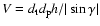 ,
where h is the
height perpendicular to the plane of projection, i.e. the disk's thickness at
that point. ,
where h is the
height perpendicular to the plane of projection, i.e. the disk's thickness at
that point. |
In the text
![\begin{figure}
\includegraphics[width=8.8cm]{fiA2.eps}\end{figure}](/articles/aa/full/2006/32/aa4907-06/img254.gif) |
Figure A.2:
Two elliptic orbits crossing in 2D: (a) two cases for fixed difference
 ,
(b) two cases for fixed ,
(b) two cases for fixed
 . . |
In the text
![\begin{figure}
\psfrag{YAxisLabelDel}[bc][bc]{$\Delta(a_{\rm p},e_{\rm p},a_{\rm...
...th=8.8cm]{4907fA3a.eps} \includegraphics[width=8.8cm]{4907fA3b.eps} \end{figure}](/articles/aa/full/2006/32/aa4907-06/img272.gif) |
Figure A.3:
The  integral ( top) and the impact velocities
 ( bottom)
for different combinations of semimajor axes and eccentricities of two
colliding particles with
( bottom)
for different combinations of semimajor axes and eccentricities of two
colliding particles with
 and
and
 .
The disk's full-opening
angle was set to .
The disk's full-opening
angle was set to
 .
For each set of orbits the
"exact''
values (symbols), obtained with a time-consuming Monte Carlo evaluation, are
compared to the 2D-based approximations, Eqs.
(A.10) and (A.14) as solid lines. The semimajor axes
are: .
For each set of orbits the
"exact''
values (symbols), obtained with a time-consuming Monte Carlo evaluation, are
compared to the 2D-based approximations, Eqs.
(A.10) and (A.14) as solid lines. The semimajor axes
are:
 , ,
 .
The projectile's eccentricities are .
The projectile's eccentricities are
 and and
 . . |
In the text