![[*]](/icons/foot_motif.gif)
A&A 455, 283-289 (2006)
DOI: 10.1051/0004-6361:20065107
N. La Palombara - S. Mereghetti
INAF - Istituto di Astrofisica Spaziale e Fisica Cosmica Milano, via Bassini 15, 20133 Milano, Italy
Received 28 February 2006 / Accepted 19 April 2006
Abstract
We report on the XMM-Newton observation of the
Be/neutron star X-ray binary system RX J0146.9+6121, a long period ( 23 m)
pulsar in the NGC 663 open cluster. The X-ray luminosity decreased by a factor of two
compared to the last observation carried out in 1998, reaching
a level of
23 m)
pulsar in the NGC 663 open cluster. The X-ray luminosity decreased by a factor of two
compared to the last observation carried out in 1998, reaching
a level of
 erg s-1, the lowest ever
observed in this source. The spectral analysis reveals the
presence of a significant excess at low energies over the main
power-law spectral component. The soft excess can be described by a
black-body spectrum with a temperature of about 1 keV and an
emitting region with a radius of 140 m. Although the current data do
not permit us to ascertain whether the soft excess is pulsed or not,
its properties are consistent with emission from the
neutron star polar cap.
This is the third detection of a soft excess in a low
luminosity (
erg s-1) pulsar, the others
being X Per and 3A 0535+262, suggesting that such a spectral component, observed
to date in higher luminosity systems, is a common feature
of accreting X-ray pulsars. The results of these three sources indicate that, in low luminosity systems, the soft excess tends to have a higher temperature and a smaller
surface area than in the high luminosity ones.
erg s-1, the lowest ever
observed in this source. The spectral analysis reveals the
presence of a significant excess at low energies over the main
power-law spectral component. The soft excess can be described by a
black-body spectrum with a temperature of about 1 keV and an
emitting region with a radius of 140 m. Although the current data do
not permit us to ascertain whether the soft excess is pulsed or not,
its properties are consistent with emission from the
neutron star polar cap.
This is the third detection of a soft excess in a low
luminosity (
erg s-1) pulsar, the others
being X Per and 3A 0535+262, suggesting that such a spectral component, observed
to date in higher luminosity systems, is a common feature
of accreting X-ray pulsars. The results of these three sources indicate that, in low luminosity systems, the soft excess tends to have a higher temperature and a smaller
surface area than in the high luminosity ones.
Key words: stars: individual: RX J0146.9+6121 - X-rays: binaries
High Mass X-Ray Binaries (HMXRBs) are binary systems consisting of
a neutron star (NS) or, less frequently, a black hole, accreting
matter from a high mass early type star. Based on the nature of
the mass donor star, either a supergiant of O/B spectral type or a
Be star, HMXRBs can be divided in two subgroups showing different
variability properties. HMXRBs with supergiant companions tend to be persistent sources, although some of them display high and low states with X-ray flux
varying by large factor (100 or more). On the other hand, neutron star Be X-ray binaries (BeXRBs) are generally transient sources, due to the long term variability of
the equatorial discs surrounding Be stars and/or the orbital
eccentricity. For both subgroups, when the compact object is a NS,
the X-ray spectra are well described by a rather flat power-law
between 0.1 and 10 keV (photon index 1) followed by a
high-energy cutoff.
With the advent of imaging X-ray satellites a large number of BeXRB systems has been discovered in the Small Magellanic Cloud (Macomb et al. 2003; Haberl & Sasaki 2000; Israel et al. 2000; Yokogawa et al. 2003; Sasaki et al. 2003; Haberl & Pietsch 2004). The observation of these sources, unaffected by the high interstellar absorption present in the Galactic plane, makes it possible to study in detail their X-ray spectra, extending down to energies of a few hundred eV. This has allowed investigators to discover that most of them have a marked soft excess above the power-law model (Haberl & Pietsch 2005; Nagase 2002).
RX J0146.9+6121 is a BeXRB hosting a neutron star characterized by a
rotational period of about 23 min, among the longest observed
in X-ray pulsars. The pulsations were discovered with non-imaging
instruments on board EXOSAT and initially attributed to a
different nearby source (White et al. 1987). Subsequent observations
clarified the picture (Hellier 1994; Mereghetti et al. 1993)
and led to the optical identification of RX J0146.9+6121 with the B0 IIIe
star LS I +61 235 (Coe et al. 1993). This star is a member
of the open cluster NGC 663 (Tapia et al. 1991; Fabregat et al. 1996; Pigulski et al. 2001) for which a distance
in the range between 2 and 2.5 kpc has been derived (Kharchenko et al. 2005; Pandey et al. 2005). In the
following we adopt d = 2.5 kpc.
Due to its relatively short distance, RX J0146.9+6121 is not much absorbed
and is therefore a good target to investigate the properties of
the soft X-ray emission in a Galactic source. Here we present the
results of a recent observation obtained with the XMM-Newton satellite,
providing the most sensitive observation of this source ever
obtained below 2 keV.
235 (Coe et al. 1993). This star is a member
of the open cluster NGC 663 (Tapia et al. 1991; Fabregat et al. 1996; Pigulski et al. 2001) for which a distance
in the range between 2 and 2.5 kpc has been derived (Kharchenko et al. 2005; Pandey et al. 2005). In the
following we adopt d = 2.5 kpc.
Due to its relatively short distance, RX J0146.9+6121 is not much absorbed
and is therefore a good target to investigate the properties of
the soft X-ray emission in a Galactic source. Here we present the
results of a recent observation obtained with the XMM-Newton satellite,
providing the most sensitive observation of this source ever
obtained below 2 keV.
RX J0146.9+6121 was observed by XMM-Newton between 22:40 UT of 2004 January 14 and 10:20 UT of 2004 January 15. Since the main target was the NGC 663 open cluster, RX J0146.9+6121 was detected at an off-axis angle of 9.3'. The three EPIC instruments, i.e. the pn camera (Strüder et al. 2001) and the MOS1 and MOS2 cameras (Turner et al. 2001), were active and operated in Full Frame mode. For all of them, the Medium thickness filter was used.
We used version 6.1 of the XMM-Newton Science Analysis System
(SAS) to process the event files. After the standard
pipeline processing of the data, we looked for possible periods of
high instrumental background, due to flares of soft protons with
energies less than a few hundred keV. We found that the first
15 ks of the observation were affected by a soft-proton
contamination. However, since RX J0146.9+6121 was detected with a count-rate
(1 cts s-1) much higher than that of the background, the
soft-protons during the bad time intervals have a negligible
effect on the source spectral and timing analysis (their count rate in the source extraction area is less than 0.01 cts s-1). Hence for our analysis we used the data of the whole observation, corresponding to exposure times of 35.4 and 41.2 ks in the pn and MOS cameras, respectively.
During our observation some flux changes on an hour timescale were present, as shown by the background subtracted light curve plotted in Fig. 1.
This is based on the data in the 0.15-10 keV range obtained from
the three EPIC cameras. A bin size of 1.4 ks, corresponding to
one spin period, has been chosen to avoid the effects
due to the periodic pulsations. Variations up to 20%
around the average level of 1.9 cts s-1 are evident.
![\begin{figure}
\par {\includegraphics[angle=-90,width=9cm,clip]{5107fig1.ps} }
\end{figure}](/articles/aa/full/2006/31/aa5107-06/img13.gif) |
Figure 1: Background subtracted light curve of RX J0146.9+6121 in the energy range 0.15-10 keV, with a time bin of 1.4 ks (i.e. 1 pulse period). |
| Open with DEXTER | |
![\begin{figure}
\par {\includegraphics[angle=-90,width=9cm,clip]{5107fig2.ps} }
\end{figure}](/articles/aa/full/2006/31/aa5107-06/img14.gif) |
Figure 2: Background subtracted light curves of RX J0146.9+6121 in the energy ranges 0.3-2, 2-4.5, 4.5-7 and 7-10 keV, folded at the best-fit period of 1396.14 s. The vertical lines indicate the phase intervals used for the spectral analysis. |
| Open with DEXTER | |
To obtain a measure of the pulse period, we converted the times
of arrival to the solar system barycenter and performed a folding
analysis using the source events of three cameras. By fitting the
 versus trial period curve with the appropriate sinc
function as described in Leahy (1987), we derived a period
of
versus trial period curve with the appropriate sinc
function as described in Leahy (1987), we derived a period
of
 s. In Fig. 2 we show the folded light
curves in four energy intervals (0.3-2, 2-4.5, 4.5-7 and 7-10
keV) chosen to allow a direct comparison with the light curves
previously derived with RossiXTE data (Mereghetti et al. 2000).
The pulse profile, characterized by a broad peak, is clearly
energy-dependent, with the maximum shifting from phase
0.4-0.5 at E < 2 keV to phase 0.6 at E > 7 keV.
s. In Fig. 2 we show the folded light
curves in four energy intervals (0.3-2, 2-4.5, 4.5-7 and 7-10
keV) chosen to allow a direct comparison with the light curves
previously derived with RossiXTE data (Mereghetti et al. 2000).
The pulse profile, characterized by a broad peak, is clearly
energy-dependent, with the maximum shifting from phase
0.4-0.5 at E < 2 keV to phase 0.6 at E > 7 keV.
The hardness ratio (HR) between the light curves above and below 2 keV, reported in Fig. 3, is characterized by a slow and regular increase from its minimum to its maximum value, followed by a rather irregular decrease. This plot, where we have divided the pulse period in ten phase intervals, shows that there is not a simple correlation between the hardness and the total count rate: we observe the same HR value at completely different count rate levels, but also very different HR values for the same count rate. This indicates that the spectral hardness of RX J0146.9+6121 does not depend in a simple way on its flux level.
![\begin{figure}
\par {\includegraphics[angle=-90,width=9cm,clip]{5107fig3.ps} }
\end{figure}](/articles/aa/full/2006/31/aa5107-06/img17.gif) |
Figure 3: Hardness ratio of the two light curves of RX J0146.9+6121 in the energy ranges 0.3-2 and 2-10 keV, as a function of the pulse phase. The HR values are obtained by folding the light curves at the best-fit period of 1396.14 s. The pulse period is divided in 10 phase bins, which are identified by progressive numbers. |
| Open with DEXTER | |
For the source spectra we used an extraction radius of 30''around the source position in the case of the MOS2 and pn cameras; for the MOS1 camera the extraction radius was reduced to 15'', since the source was imaged close to a CCD gap. We checked with the SAS task epatplot that no event pile-up affected our data, then we accumulated all the events with pattern range 0-4 (i.e. mono- and bi-pixel events) and 0-12 (i.e. from 1 to 4 pixel events) for the pn and the two MOS cameras, respectively. The background spectra were accumulated on large circular areas with no sources and radius of 210'' and 120'' for the MOS1 and the MOS2 camera, respectively. For the pn camera the background spectrum was extracted from a circular region of the same radius and at the same CCD rows of the source region. We generated ad hoc response matrices and ancillary files using the SAS tasks rmfgen and arfgen. All spectra were rebinned with a minimum of 30 counts per bin and fitted in the energy range 0.3-10 keV using XSPEC 11.3.2.
After checking that separate fits of the three spectra gave
consistent results, we fitted the spectra from the three cameras
simultaneously in order to increase the count statistics and to
reduce the uncertainties.
The fit with an absorbed power-law yielded
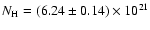 cm-2 and photon index
 ,
but with large residuals and
,
but with large residuals and
 /d.o.f. = 1.283/1480. The addition
of a blackbody component improved the fit quality significantly
(Fig. 4): we obtained
/d.o.f. = 1.283/1480. The addition
of a blackbody component improved the fit quality significantly
(Fig. 4): we obtained
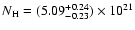 cm-2,
cm-2,
 and
and
 keV, with
/d.o.f. =
1.036/1478. The emission surface of the
thermal component has a radius
keV, with
/d.o.f. =
1.036/1478. The emission surface of the
thermal component has a radius
 m
(for d = 2.5 kpc). The unabsorbed flux in the energy range 0.3-10 keV is
m
(for d = 2.5 kpc). The unabsorbed flux in the energy range 0.3-10 keV is
 erg cm-2 s-1,
about 24% of which is due to the blackbody component.
erg cm-2 s-1,
about 24% of which is due to the blackbody component.
We also attempted to fit the soft part of the spectra with other emission models, such as mekal, thermal bremsstrahlung and broken power-law. In all these cases the results were worse than those obtained with the blackbody model, since the reduced chi-squared was higher, the residuals were larger and/or the best-fit parameter values were unrealistic.
![\begin{figure}
\par {\includegraphics[angle=-90,width=9cm,clip]{5107fig4.ps} }
\end{figure}](/articles/aa/full/2006/31/aa5107-06/img26.gif) |
Figure 4:
Top panel: pn spectrum of RX J0146.9+6121 with the best-fit power-law (dashed line) plus black-body (dotted line) model. Middle
panel: residuals (in units of  )
between data and model in the case of the single power-law. Bottom panel: residuals in the case of the power-law plus black-body. )
between data and model in the case of the single power-law. Bottom panel: residuals in the case of the power-law plus black-body. |
| Open with DEXTER | |
We did not find significant evidence for emission lines. By adding Gaussian components at various energies to the above model, we estimated upper limits of the order of 150 eV for the equivalent width of lines in the 6-7 keV energy range.
Prompted by the results described above, we performed a phase-resolved spectroscopy in order to study in more detail the source behavior. We defined phase 0 by matching the folded light curve to that observed in 1996 with RossiXTE and extracted the background subtracted spectra for the same four phase intervals used in Mereghetti et al. (2000) and indicated in Fig. 2. The first step was to fit all of them with the best-fit power law plus blackbody model of the phase averaged spectrum, leaving only the relative normalization factors free to vary. The ratios of the four spectra of each instrument to these renormalized average models show significant residuals and clearly demonstrate the spectral variability as a function of the pulse phase.
We then fitted the four spectra independently. In all cases, the absorbed power-law model was not satisfactory, while the addition of a black-body component significantly improved the fit. Therefore we used this model for all the spectra, leaving all the parameters free to vary: the results are reported in Table 1.
Table 1:
Best-fit spectral parameters for the phase-resolved spectroscopy of RX J0146.9+6121, in the case of the independent fit of the four spectra. Errors are at a 90% confidence level for a single interesting parameter.  and
and
 are measured in units of 1021 cm-2 and keV, respectively.
In order to investigate the relative variations of the two
components with the period phase, we also simultaneously fitted
the four spectra forcing common values for ,
 and
.
In this case we obtained
and
.
In this case we obtained
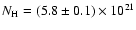 cm-2,
cm-2,
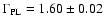 and
and
 keV, with
/d.o.f. = 1.117/1989; the corresponding
normalization values are reported in Table 2.
In this interpretation the spectral changes as a function of the
phase are reproduced by the variations in the relative
contribution of the two components.
keV, with
/d.o.f. = 1.117/1989; the corresponding
normalization values are reported in Table 2.
In this interpretation the spectral changes as a function of the
phase are reproduced by the variations in the relative
contribution of the two components.
Table 2:
Best-fit values for the black-body and power-law normalizations, when the four spectra are fitted simultaneously with common values of
(
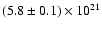 cm-2),
(
cm-2),
(
 )
and
(
1.36+0.04-0.03 keV). Errors are at a 90% confidence level for a single interesting parameter.
)
and
(
1.36+0.04-0.03 keV). Errors are at a 90% confidence level for a single interesting parameter.
However, the above results do not necessarily
imply that the soft component is pulsed. In
fact an acceptable fit (
/d.o.f. = 1.097/1989) can also be obtained
by imposing that the black-body component parameters
be the same in the four spectra, as shown in Table 3.
Table 3:
Best-fit values for the power-law parameters, when the four spectra are fitted simultaneously with common values of
(
 cm-2),
(
1.40+0.02-0.04 keV) and
cm-2),
(
1.40+0.02-0.04 keV) and
 (
111+1-4 m). Errors are at 90% confidence level for a single interesting parameter.
(
111+1-4 m). Errors are at 90% confidence level for a single interesting parameter.
The above results are summarized in Fig. 5, where we show the pulse-phase dependence of the black-body temperature, the power-law photon index and the unabsorbed flux of the two components for both fits. Since they have a similar statistical quality, we can neither confirm nor deny that the thermal component is variable.
![\begin{figure}
\par {\includegraphics[angle=-90,width=9cm,clip]{5107fig5.ps} }
\...
...ce*{2mm}
{\includegraphics[angle=-90,width=9cm,clip]{5107fig6.ps} }
\end{figure}](/articles/aa/full/2006/31/aa5107-06/img70.gif) |
Figure 5: Pulse-phase dependence of the black-body temperature, the power-law photon index and the unabsorbed flux of the two components (in units of 10-11 erg cm-2 s-1), in the case of a common temperature and index (top) and of a common black-body (bottom). |
| Open with DEXTER | |
The XMM-Newton data described here were obtained almost 6 years after
the latest X-ray observation of RX J0146.9+6121, which was performed by
BeppoSAX on 1998 February 3 (Mereghetti et al. 2000).
Therefore it is interesting to compare our results with those
obtained in the past.
In Fig. 6 we show the long term evolution of the
source spin period and luminosity since the time of the
EXOSAT discovery in 1984. If we exclude the first observation,
when the source was in outburst, a linear fit of all the periods
gives a spin-up at an average rate of
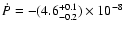 s s-1, similar to that
measured until 1998. This result suggests that during the 6 years
between the BeppoSAX and the XMM-Newton observations, the momentum transfer
onto the neutron star has proceeded with no major changes.
The flux detected by XMM-Newton corresponds to a luminosity of
s s-1, similar to that
measured until 1998. This result suggests that during the 6 years
between the BeppoSAX and the XMM-Newton observations, the momentum transfer
onto the neutron star has proceeded with no major changes.
The flux detected by XMM-Newton corresponds to a luminosity of
 erg s-1, a factor 2 lower than
the minimum level observed in the previous years, indicating that,
after the outburst of July 1997 (Haberl et al. 1998), RX J0146.9+6121 has been
continuously fading.
erg s-1, a factor 2 lower than
the minimum level observed in the previous years, indicating that,
after the outburst of July 1997 (Haberl et al. 1998), RX J0146.9+6121 has been
continuously fading.
Comparison with the RossiXTE results reported in Fig. 2 of Mereghetti et al. (2000) shows that, despite the luminosity variation, the shape of the pulse profiles in the energy interval common to the two instruments (2-10 keV) has not changed. The XMM-Newton data also confirm that, above 2 keV, there is a significant spectral softening in the initial rising part of the pulse (phase interval A).
![\begin{figure}
\par {\includegraphics[angle=-90,width=9cm,clip]{5107fig7.ps} }
\end{figure}](/articles/aa/full/2006/31/aa5107-06/img74.gif) |
Figure 6:
Pulse period and luminosity history of RX J0146.9+6121 from 1984 August 27 to 2004 January 15. The solid line in the upper panel is the best-fit linear model of the reported values and has a slope
 s s-1. The luminosities of the lower panel are based on the unabsorbed flux in the 2-10 keV energy range and on a source distance of 2.5 kpc. s s-1. The luminosities of the lower panel are based on the unabsorbed flux in the 2-10 keV energy range and on a source distance of 2.5 kpc. |
| Open with DEXTER | |
The main advantage of the data reported here, with respect to
previous observations of this source, is the better coverage of
the energy range below 2 keV.
In comparison to the BeppoSAX results, the phase averaged
spectroscopy gives a smaller hydrogen column density:
cm-2 instead of
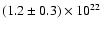 cm-2. This value is in better agreement
with that expected from the optical observations which give
E(B-V) = 0.93 (Reig et al. 1997). Assuming
cm-2. This value is in better agreement
with that expected from the optical observations which give
E(B-V) = 0.93 (Reig et al. 1997). Assuming
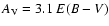 and the average relation
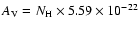 cm-2 between
optical extinction and X-ray absorption (Predehl & Schmitt 1995), this would
predict
cm-2 between
optical extinction and X-ray absorption (Predehl & Schmitt 1995), this would
predict
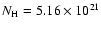 cm-2.
cm-2.
Table 4: Orbital and spectral parameters for XBPs with a detected soft excess (SE).
Moreover, we find evidence of a thermal component that was never
observed before in this source.
In recent years, similar soft excesses have been detected in
several high mass X-ray binary pulsars. The properties of these
sources are summarized in Table 4.
Hickox et al. (2004) showed that a soft excess has been detected in
all the X-ray pulsars with a sufficiently high flux and small
absorption. In fact, most of the soft excess sources are at small
distances and/or away from the Galactic plane (most of them are
in the Magellanic Clouds). This suggests that the presence of a
soft spectral component could be a very common, if not an
ubiquitous, feature intrinsic to X-ray pulsars.
These authors concluded that the origin of the soft component is
related to the source total luminosity. When
 erg s-1 the luminosity and the shape
of the soft component can be explained only by reprocessing of
hard X-rays from the neutron star by optically thick accreting
material, most likely near the inner edge of the accretion disk.
In less luminous sources, with
erg s-1 the luminosity and the shape
of the soft component can be explained only by reprocessing of
hard X-rays from the neutron star by optically thick accreting
material, most likely near the inner edge of the accretion disk.
In less luminous sources, with
 erg s-1, the soft excess can be due to other processes,
such as emission by photo-ionized or collisionally heated diffuse
gas or thermal emission from the surface of the neutron star.
Finally, in the sources of intermediate luminosity, either or both
of these types of emission can be present.
erg s-1, the soft excess can be due to other processes,
such as emission by photo-ionized or collisionally heated diffuse
gas or thermal emission from the surface of the neutron star.
Finally, in the sources of intermediate luminosity, either or both
of these types of emission can be present.
In Fig. 7 we have plotted the X-ray luminosity versus interstellar absorption of the pulsars with a soft excess. We can see that RX J0146.9+6121, together with X Persei and 3A 0535+262, is at least one order of magnitude less luminous than all the other pulsars displaying a soft excess. We note that the ratio between the unabsorbed fluxes of the thermal and the power-law components in RX J0146.9+6121 agrees well with the average value measured in the other sources. However, unlike some of the other sources, the soft excess could be fitted only with a black-body component, while any other emission model was rejected.
Based on the results obtained by Hickox et al. (2004), the luminosity
of RX J0146.9+6121 is too small for an interpretation of the soft excess in
terms of reprocessing of the hard X-ray photons in optically
thick accreting material. Moreover, both the thermal emission and
the hard X-ray reprocessing in a diffuse, optically thin gas
around the neutron star are unlikely, since these processes would
not give a black-body spectrum. We therefore favor the
interpretation of the soft excess in RX J0146.9+6121 as thermal emission from
the neutron star polar cap. If we assume that the source is in the "accretor'' status, with matter accretion on the NS surface, the blackbody emitting radius of 140 m
is consistent with the expected size of the polar cap.
In fact, if
 and
and
 cm, the source luminosity of 1034 erg s-1 implies an accretion rate
 g s-1 and, adopting
 G, a magnetospheric radius
 cm (Campana et al. 1998). In this case, based on the relation

 (Hickox et al. 2004), we would obtain
 m.
If this description is correct, we would expect to observe some
variability of the soft component along the pulse phase. From this
point of view the phase-resolved spectroscopy provides no
conclusive results, since it proves that both a variable and a
constant thermal component can account for the observed spectral
variability.
m.
If this description is correct, we would expect to observe some
variability of the soft component along the pulse phase. From this
point of view the phase-resolved spectroscopy provides no
conclusive results, since it proves that both a variable and a
constant thermal component can account for the observed spectral
variability.
RX J0146.9+6121 is in many respects very similar to X Per and 3A 0535+262, which are very low luminosity Be/NS binary with a
long pulse period. The soft excesses of these
sources have similar properties, since they tend to have a higher temperature (>1 keV) and a smaller emission radius (0.1 km) compared to the soft excesses observed in high luminosity systems, which have a temperature of about 0.1 keV and an emission radius
of a few hundred km. In these three low luminosity systems the soft excess contributes 25-35% of the total flux (Coburn et al. 2001; Mukherjee & Paul 2005).
Also in the case of X Per and 3A 0535+262 this excess has been attributed to the
emission from the polar caps.
![\begin{figure}
\par {\includegraphics[angle=-90,width=9cm,clip]{5107fig8.ps} }
\end{figure}](/articles/aa/full/2006/31/aa5107-06/img131.gif) |
Figure 7: Total X-ray luminosity of the sources of Table 4 as a function of the interstellar absorption. |
| Open with DEXTER | |
We have reported the analysis of the data collected by XMM-Newton in
a 42 ks observation of the Be/neutron-star X-ray pulsar RX J0146.9+6121.
The unabsorbed flux corresponds to a source luminosity
 erg s-1 in the 2-10 keV energy range,
about 50% lower than the lowest level ever observed from this
source, indicating a monotonic source fading over long
time scales.
erg s-1 in the 2-10 keV energy range,
about 50% lower than the lowest level ever observed from this
source, indicating a monotonic source fading over long
time scales.
Thanks to the high effective area of XMM-Newton also at low energies,
we could perform the first accurate spectral study below 2 keV for
this source. In the phase-averaged spectrum we have revealed the
presence of a significant soft excess over the primary power-law
component: this excess can be described by a black-body with
 keV, while any attempt to fit it with a
different emission model was unsuccessful.
keV, while any attempt to fit it with a
different emission model was unsuccessful.
The phase-resolved spectroscopy has confirmed the large spectral variability along the pulse period already observed above 2 keV. Unfortunately, with the current data, it is not possible to derive compelling results on the phase variability of the soft excess component. Although the emission below 2 keV is clearly pulsed and the low energy part of the spectrum varies with the phase, we have shown that such variations can be explained equally well by changes in the blackbody component or in the power law component alone.
Clearly the relatively small distance and low interstellar absorption toward RX J0146.9+6121 plays a role in the possibility of detecting a soft excess in such a low luminosity pulsar. Comparison with other X-ray binary pulsars shows that, so far, a soft excess has been detected only in much brighter sources. The data reported here support the hypothesis that a soft thermal component is a ubiquitous emission feature of this class of sources. In this sense, it would be very interesting to use the large collecting area of XMM-Newton in long observations of the faintest and longest period Be binaries, both in the SMC and in the Milky Way, such as, for example, the persistent low luminosity systems RX J0440.9+4431 and RX J1037.5-5647 (Reig & Roche 1999).
Acknowledgements
We thank A. Tiengo for his useful suggestions. The XMM-Newton data analysis is supported by the Italian Space Agency (ASI), through contract ASI/INAF I/023/05/0.