A&A 454, 617-624 (2006)
DOI: 10.1051/0004-6361:20064869
Spectral analyses of eighteen hot H-deficient (pre-) white
dwarfs from the Sloan Digital Sky Survey Data Release 4
S. D. Hügelmeyer1 - S. Dreizler1 -
D. Homeier1 - J. Krzesinski2,3 -
K. Werner4 - A. Nitta5 - S. J. Kleinman6
1 - Institut für Astrophysik, Georg-August-Universität
Göttingen, Friedrich-Hund-Platz 1, 37077 Göttingen, Germany
2 -
Apache Point Observatory, New Mexico State University, 2001 Apache
Point Road, PO Box 59, Sunspot, NM 88349, USA
3 -
Mt. Suhora
Observatory, Cracow Pedagogical University, ul. Podchorazych 2, 30-084
Cracow, Poland
4 -
Institut für Astronomie und Astrophysik,
Eberhard-Karls-Universität Tübingen, Sand 1, 72076 Tübingen,
Germany
5 -
Gemini Observatory, 670 N. A'Ohoku Place, Hilo, HI 96720, USA
6 -
Subaru Telescope, National Astronomical Observatory of Japan, 650
N. A'Ohoku Place, Hilo, HI 96720, USA
Received 17 January 2006 / Accepted 10 April 2006
Abstract
Context. The Sloan Digital Sky Survey Data Release 4 has provided spectra of several new PG 1159 stars and DO white dwarfs. This increase in known hot H-deficient compact objects significantly improves the statistics and helps to investigate late stages of stellar evolution.
Aims. From the optical SDSS spectra, effective temperatures and surface gravities are derived in order to place the observed objects in an evolutionary context. Especially the connection between PG 1159 stars and DO white dwarfs shall be investigated.
Methods. Using our non-LTE model atmospheres and applying  -fitting techniques, we determine stellar parameters and their errors. We derive total stellar masses for the DO white dwarfs using model evolutionary tracks.
Results. We confirm three PG 1159 stars, with one showing ultra-high excitation ion features, and one sdO which we originally classified as a PG 1159 star. Additionally, we re-analysed the known PG 1159 star, PG 1424+535, with our new models. Furthermore, we present the first spectral analyses of thirteen DO white dwarfs, three of which show M-star features in their spectra, while two display ultra-high excitation ion features.
Key words: stars: abundances - stars: fundamental
parameters - stars: evolution - stars: AGB and post-AGB - stars:
white dwarfs - stars: binaries: spectroscopic
White dwarfs (WDs) represent the final evolutionary stage for over
90% of all stars (initial mass
 ). Due to very high mass loss at the tip of the
Asymptotic Giant Branch (AGB), WD progenitors lose part of their
envelope, forming a planetary nebula in their subsequent evolution. The
remaining core of the star rapidly evolves toward high effective
temperatures (
). Due to very high mass loss at the tip of the
Asymptotic Giant Branch (AGB), WD progenitors lose part of their
envelope, forming a planetary nebula in their subsequent evolution. The
remaining core of the star rapidly evolves toward high effective
temperatures (
 K). When H- and
He-shell burning cease, the star enters the WD cooling
sequence. The evolution of these post-AGB objects is separated into a
H-rich and H-deficient sequence with a ratio of about 4:1.
K). When H- and
He-shell burning cease, the star enters the WD cooling
sequence. The evolution of these post-AGB objects is separated into a
H-rich and H-deficient sequence with a ratio of about 4:1.
In their catalog of spectroscopically confirmed white dwarfs from the
Sloan Digital Sky Survey (SDSS, York et al. 2000) Data
Release 4 (DR4, Adelman-McCarthy et al. 2005), Eisenstein et al. (2006a) report
31 DO white dwarfs and 10 PG 1159 stars. Following our spectral
analyses of 16 hot H-deficient objects from the DR4 WD catalog
(10 DOs, of which 9 were classified as DOs and one as DB+M, 5 PG 1159
stars, and one sdO; Hügelmeyer et al. 2005) which were included in DR3 (Abazajian et al. 2005), we now extend this work to 13 DOs and 4 PG 1159 stars which are available only since DR4. The
remaining 9 DOs from the DR4 WD
catalog not analysed in this or our previous paper are either too
noisy or insufficiently flux calibrated for a reasonable spectral
analysis.
PG 1159 stars are evolutionary transition objects between the hottest
post-AGB and WD phases. The prototype of this spectroscopic class,
PG 1159-035, was found in the Palomar Green (PG) survey
(Green et al. 1986). It shows a spectrum without detectable
H-absorption lines. It is dominated by He II and highly ionised
carbon and oxygen lines. PG 1159 stars are characterised by a broad
absorption trough around 4670  composed of He II 4686 and several C IV lines, suggesting high effective
temperatures. Spectral analyses yield
composed of He II 4686 and several C IV lines, suggesting high effective
temperatures. Spectral analyses yield
 K and gravities of
 (Dreizler et al. 1994; Werner et al. 1996,1991).
Of the 28 PG 1159 stars known prior to the SDSS, ten are
low-gravity (subtype lgE, Werner 1992) stars,
placing them in the same Hertzsprung-Russell-Diagram (HRD) region as
the hot central stars of planetary nebulae (CSPNe), while the others
are more compact objects with surface gravities of WDs (subtype A or E). Due to their rarity, the majority of the known
PG 1159 stars were discovered in large surveys (Palomar Green,
Hamburg Schmidt (HS), Hagen et al. 1995). The most
recent and only discovery within the last 10 years, besides those from
the SDSS (Werner et al. 2004), was an object from the Hamburg
ESO (HE) survey (Wisotzki et al. 1996). The SDSS thus offers a
new and relatively unique opportunity to increase the number of known
PG 1159 stars.
(Dreizler et al. 1994; Werner et al. 1996,1991).
Of the 28 PG 1159 stars known prior to the SDSS, ten are
low-gravity (subtype lgE, Werner 1992) stars,
placing them in the same Hertzsprung-Russell-Diagram (HRD) region as
the hot central stars of planetary nebulae (CSPNe), while the others
are more compact objects with surface gravities of WDs (subtype A or E). Due to their rarity, the majority of the known
PG 1159 stars were discovered in large surveys (Palomar Green,
Hamburg Schmidt (HS), Hagen et al. 1995). The most
recent and only discovery within the last 10 years, besides those from
the SDSS (Werner et al. 2004), was an object from the Hamburg
ESO (HE) survey (Wisotzki et al. 1996). The SDSS thus offers a
new and relatively unique opportunity to increase the number of known
PG 1159 stars.
The star PG 1159-035 (=GW Vir) also defines a class of variable
stars. McGraw et al. (1979) discovered low-amplitude non-radial
g-mode pulsations in this object. About one third of the PG 1159 stars show this
variability which is thought to be driven by cyclic ionisation of
carbon and oxygen as suggested by Cox (1986) and
Starrfield (1987). Analyses of HST spectra of
spectroscopically identified PG 1159 stars indicate that there is a
likely relation between high carbon and oxygen abundances and pulsations
(Dreizler & Heber 1998, hereafter DH98), which is corroborated
by theoretical calculations of Quirion et al. (2004).
The region in the HRD occupied by the PG 1159 stars overlaps
with that of the DO white dwarfs. Therefore, it is assumed that
gravitational settling of the heavier elements in the atmosphere of
the PG 1159 stars leads them to transition towards DO white dwarfs.
White dwarfs can be separated into two distinct spectroscopic classes,
DA and non-DA white dwarfs. The former show a pure hydrogen spectrum
and can be found over the entire WD cooling sequence. The latter fall
into three subclasses: DO (
 K), DB (
 K), and DC/DQ/DZ white dwarfs (
 K; pure continuum/carbon/metal lines present). The spectroscopic appearance of the
DO and DB subclasses is determined by the ionisation balance of
He I and He II. DO white dwarfs show a pure He II spectrum at the hot end and a mixed He I/II spectrum at the
cool end. The transition to the cooler DB dwarfs, characterised by
pure He I spectra, is interrupted by the so-called "DB gap'' (Liebert et al. 1986). In the HRD region of white dwarfs
with
K; pure continuum/carbon/metal lines present). The spectroscopic appearance of the
DO and DB subclasses is determined by the ionisation balance of
He I and He II. DO white dwarfs show a pure He II spectrum at the hot end and a mixed He I/II spectrum at the
cool end. The transition to the cooler DB dwarfs, characterised by
pure He I spectra, is interrupted by the so-called "DB gap'' (Liebert et al. 1986). In the HRD region of white dwarfs
with
 K, no objects with
H-deficient atmospheres have been observed to date. However,
Eisenstein et al. (2006b) describe over 25 objects taken from DR4 data which
likely fall in that temperature region. These new objects might
increase our knowledge of the spectral evolution of He-rich
white dwarfs considerably.
K, no objects with
H-deficient atmospheres have been observed to date. However,
Eisenstein et al. (2006b) describe over 25 objects taken from DR4 data which
likely fall in that temperature region. These new objects might
increase our knowledge of the spectral evolution of He-rich
white dwarfs considerably.
Additional constraints on stellar parameters may result from the
analysis of DO white dwarfs in binary systems. Currently, three DOs
with late type companions (PG 0046+078, PG 0237+116, and HD 149499 B)
are known. The first two have M-star companions with only a minor
contribution to the combined spectrum
(Heber et al. 1996; Wesemael et al. 1985). The latter one is
accompanied by a much brighter K-star which complicates the analysis of the
optical spectrum of the DO (Wegner 1979).
As in the case of PG 1159 stars, the most recent discovery of a DO white dwarf comes from the HE survey (Werner et al. 2004), while
the PG and HS surveys have contributed the majority of the 19 DOs known
prior to the SDSS.
2 Spectral analysis
In order to analyse the DO and PG 1159 spectra (SDSS
observations for these objects are described
in Hügelmeyer et al. 2005), we calculated homogeneous,
plane-parallel, non-LTE model atmospheres with a code based on the
Accelerated Lambda Iteration method (Werner et al. 2003, and
references therein). For these types of stars,
it is necessary to account for non-LTE effects in our
models, as shown by Dreizler & Werner (1996) for DO white dwarfs
and by Werner et al. (1991) for PG 1159 stars. To compare
our synthetic spectra to the observed spectra, we normalise the
observed spectra with third order polynomials fit through the
continua. The continua are determined by the normalised theoretical spectra.
Lineshifts due to radial velocities are taken into account
by means of cross-correlation. This comparison procedure is
performed by an IDL code routine in order to guarantee
consistent results. We used a -statistic to derive best-fit
models and computed 1- errors following Zhang et al. (1986).
For the PG 1159 stars in our sample, we calculated model atmospheres
using detailed
H-He-C-N-O
model atoms. The model grid ranges from
 K and
K and
 .
The abundances are fixed to
values
.
The abundances are fixed to
values
 and
and
 ,
0.03, 0.05, 0.07, 0.09,
0.10, 0.11, 0.20, 0.30, or 0.60 by number. We have a nearly
complete model grid with
,
0.03, 0.05, 0.07, 0.09,
0.10, 0.11, 0.20, 0.30, or 0.60 by number. We have a nearly
complete model grid with
 K in steps of 5000 K,
 in steps of 0.2 dex, and
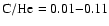 in steps of 0.02. Complete
coverage of the whole parameter space is not yet available due to the
high computational time required to compute the model
atmospheres. However, the majority of the analysed PG 1159 stars are
covered by our nearly complete model grid. Best-fit models for PG 1159
star candidates were calculated with an oxygen abundance following the
typical PG 1159 abundance-scaling ratio
in steps of 0.02. Complete
coverage of the whole parameter space is not yet available due to the
high computational time required to compute the model
atmospheres. However, the majority of the analysed PG 1159 stars are
covered by our nearly complete model grid. Best-fit models for PG 1159
star candidates were calculated with an oxygen abundance following the
typical PG 1159 abundance-scaling ratio
 .
However, variations in the oxygen
abundance do not produce a significant effect on the other stellar
parameters. The nitrogen abundance is kept fixed at
.
However, variations in the oxygen
abundance do not produce a significant effect on the other stellar
parameters. The nitrogen abundance is kept fixed at
 by number which is a typical upper
limit for PG 1159 stars. The analysed spectra of PG 1159 stars
and their best-fit models are shown in Fig. 1.
by number which is a typical upper
limit for PG 1159 stars. The analysed spectra of PG 1159 stars
and their best-fit models are shown in Fig. 1.
2.2 Spectral analysis of DO white dwarfs
![\begin{figure}
\par\includegraphics[width=17cm,clip]{4869fig1.ps}
\end{figure}](/articles/aa/full/2006/29/aa4869-06/Timg23.gif) |
Figure 1:
Normalised optical spectra (grey lines) of PG 1159 stars
and the sdO star ( bottom spectrum) along with model atmosphere fits (black
lines). The top object shows ultra-high excitation ion
features. Object names are printed on the left, with effective
temperatures, logarithmic surface gravities, and carbon abundances
( C/He), on the right. |
| Open with DEXTER |
Detailed H-He atomic models
(Dreizler & Werner 1996) were used to calculate our model
atmospheres. The model grid ranges from
 K in steps of 2500 K,
 ranges from 7.0 to 8.4 in intervals of 0.2 dex. The helium abundance
is fixed to
ranges from 7.0 to 8.4 in intervals of 0.2 dex. The helium abundance
is fixed to
 .
The spectra of our analysed DOs,
together with their corresponding best-fit models, are shown in
Fig. 2.
.
The spectra of our analysed DOs,
together with their corresponding best-fit models, are shown in
Fig. 2.
![\begin{figure}
\par\includegraphics[width=17cm,clip]{4869fig2.ps} \end{figure}](/articles/aa/full/2006/29/aa4869-06/Timg27.gif) |
Figure 2:
Normalised optical spectra (grey lines) of DO white dwarfs
along with model atmosphere fits (black lines). The two top objects show
ultra-high excitation ion features. Object names are printed on the
left, effective temperatures and logarithmic surface gravities on
the right. The spectra of the hottest stars are dominated by
He II absorption lines, while increasing line strengths of
He I are observed with decreasing temperature. |
| Open with DEXTER |
In order to derive stellar parameters for both stars from the DO+M
star spectra, we used the DO model atmospheres previously described in
Sect. 2.2 along with theoretical LTE M-star atmospheres
calculated with the PHOENIX code (Hauschildt et al. 1999). Their
construction follows the setup used for the preliminary GAIA grid
(Brott & Hauschildt 2005), but has been updated to use PHOENIX version 14.1 and compute spectra at 0.2 Å resolution. Major updates to the
input physics include the adaption of the revised solar composition of
Asplund et al. (2005) for the chemical equilibrium abundances and a
correction to the partition sum for TiO, leading to  3-times
greater line strengths for this important absorber (Allard et al., in
prep.).
3-times
greater line strengths for this important absorber (Allard et al., in
prep.).
For the fit of both spectral components, a Planck spectrum was first fitted
to represent the Rayleigh-Jeans tail contribution of the DO in the red
part of the spectrum; then we selected a model spectrum based on an
initial fit of the spectral type of the cool companion and subtracted
it from the observation. Next, we used our -fitting
routines to determine the best DO fit. This model was then subtracted
from the combined observed spectrum and the remaining cool star
spectrum was fitted to a grid of models spanning
 K
in steps of 100 K and
K
in steps of 100 K and
 in steps of 0.5 dex. The best
fit was determined by -minimisation over the entire spectral
range; however we assigned a reduced weight to the regions from 6430-6560 Å and 6720-6950 Å. In this part of the TiO bands, the models reproduce the observations rather poorly, as has been
noted in previous analyses of M dwarfs
(e.g. Leggett et al. 2002). A reason for this mismatch is probably
superposed absorption due to CaH, for which no line opacity data are
available in the PHOENIX version used for these models.
Despite these shortcomings we find acceptable fits for SDSS J091621.83+052119.2 and SDSS J133633.22-013116.5 at 3600-3700 K, with the fit quality rapidly degrading towards
higher and lower
in steps of 0.5 dex. The best
fit was determined by -minimisation over the entire spectral
range; however we assigned a reduced weight to the regions from 6430-6560 Å and 6720-6950 Å. In this part of the TiO bands, the models reproduce the observations rather poorly, as has been
noted in previous analyses of M dwarfs
(e.g. Leggett et al. 2002). A reason for this mismatch is probably
superposed absorption due to CaH, for which no line opacity data are
available in the PHOENIX version used for these models.
Despite these shortcomings we find acceptable fits for SDSS J091621.83+052119.2 and SDSS J133633.22-013116.5 at 3600-3700 K, with the fit quality rapidly degrading towards
higher and lower
 .
In light of the unknown systematic errors
due to the incomplete molecular data, flux calibration errors, and
possible interstellar reddening, we conservatively estimate an
uncertainty in
of 100 K. The much fainter spectrum of the
companion to SDSS J075606.36+421613.0 is consistent with temperatures
from at least 3000-3600 K. In all cases, the spectra show very
little sensitivity to gravity within a range of
.
In light of the unknown systematic errors
due to the incomplete molecular data, flux calibration errors, and
possible interstellar reddening, we conservatively estimate an
uncertainty in
of 100 K. The much fainter spectrum of the
companion to SDSS J075606.36+421613.0 is consistent with temperatures
from at least 3000-3600 K. In all cases, the spectra show very
little sensitivity to gravity within a range of
 .
A
direct determination of the stellar radius is therefore not possible
from these data, but the fits are entirely consistent with the
assumption of main sequence stars and the companion radius can
therefore be determined from a standard mass-radius-relation as well
as from evolutionary tracks. We did not find any improvement of the
fits using metallicities either higher or lower than solar.
.
A
direct determination of the stellar radius is therefore not possible
from these data, but the fits are entirely consistent with the
assumption of main sequence stars and the companion radius can
therefore be determined from a standard mass-radius-relation as well
as from evolutionary tracks. We did not find any improvement of the
fits using metallicities either higher or lower than solar.
Finally, we subtracted the best-fit M-star model atmosphere from the
observed spectrum and used our standard -fitting routines
again to refine
and
for the DO white dwarf. Only minor
differences in effective temperatures and surface gravities compared
to the first DO model fit were derived. The three spectra showing DO
and M-star features, together with combined DO and M-star models, are
presented in Fig. 6.
After presenting ten DO white dwarfs and five PG 1159 stars in
Hügelmeyer et al. (2005), we now extend our spectral analyses to
the recently published SDSS DR4 DOs and PG 1159 stars. We present
results from this work and Hügelmeyer et al. (2005) together in
Tables 1 and 2. Some atmospheric
parameters for the PG 1159 stars analysed in
Hügelmeyer et al. (2005) have changed after applying our
-fitting routines to these objects. The statistical
errors provided by the -analysis and presented in
Tables 1 and 2 are very small, while
suspected systematic errors are of the order of the grid steps
described in Sect. 2.
We found six spectra from the SDSS DR4 WD catalog
(Eisenstein et al. 2006a) which we identified as PG 1159 stars, although
one (SDSS J233541.47+000219.4) turns out to be best fit as a sdO rather than a PG 1159 star, even though strong C IV lines are
present. Our model grid is not adopted for the analysis of sdO stars
and the results are therefore preliminary only. We note that the
He II line cores are not well matched with the current best-fit
model. This object, known as WD 2333-002, has been previously
classified by Liebert et al. (2005) as a sdB/sdOB.
One of our six selected PG 1159 stars, SDSS J114635.23+001233.5, was
previously known as PG 1144+005. Since no new model atmospheres for
this hot object are available, the photospheric parameters
 K,
K,
 ,
and
,
and
 derived by Werner & Heber (1991) still hold and the spectrum is
not analysed in this work.
derived by Werner & Heber (1991) still hold and the spectrum is
not analysed in this work.
SDSS J121523.09+120300.8 shows features of ultra-high excitation ions
(uhei) and is the first PG 1159 star of that type discovered so
far. Lines of O VII and N VII around 3888 Å, at 5673 Å, and around 6086 Å, as well as O VIII at 4340 Å,
4658 Å, and 6064/6068 Å are clearly visible in the spectrum (see
Fig. 1). Absorption features of C VI,
N VI, Ne IX, and Ne X described by
Dreizler et al. (1995), Werner et al. (1995), and
Krzesinski et al. (2004) for DO white dwarfs, are also indicated in
Fig. 1 and are only ambiguously identifiable due to
low signal-to-noise and spectral resolution. The observed He II absorption lines are too deep to be fitted with any model. Due to the
lack of appropriate modelling of the uhei phenomenon, stellar
parameters are derived for this star from a best-fit model which is
determined without considering the uhei lines. It should be kept in
mind that significantly higher temperatures (
> 500 000 K)
are necessary to excite the uhei lines visible in this spectrum
(Dreizler et al. 1995).
Table 1:
Photospheric parameters of our PG 1159 star sample. The
C/He abundance ratio is given by number. Objects
marked with an asterisk ( )
have been analysed in
Hügelmeyer et al. (2005). The PG 1159 stars which have
been observed for pulsations do not show variations above the specified
detection limit .
)
have been analysed in
Hügelmeyer et al. (2005). The PG 1159 stars which have
been observed for pulsations do not show variations above the specified
detection limit .
Table 2:
Stellar parameters of our SDSS DO white dwarf sample. The
three objects
below the line show spectra with DO and M-star features. The letters
A and B denote the DO and the M-star component, respectively. Objects
marked with an asterisk ()
have been previously analysed in
Hügelmeyer et al. (2005).
The remaining three PG 1159 star candidates are A subtype PG 1159
stars. SDSS J142555.47+531525.1 was already known as PG 1424+535 or
WD 1424+535 and has been analysed by DH98 and
Werner et al. (1991) who derived
 K/100 000 K, respectively,
 ,
and
,
and
 using UV and optical HST spectra. Our
fit provides the same effective temperature as DH98, but a higher
surface gravity (
using UV and optical HST spectra. Our
fit provides the same effective temperature as DH98, but a higher
surface gravity (
 ), and a lower carbon abundance
(
), and a lower carbon abundance
(
 )
for the new SDSS spectrum of this
object. In our analysis we also fit the spectrum with the model used
by DH98, but we obtained a slightly lower -value for our new
model. However, the models used are not very sensitive to carbon
abundance changes above
)
for the new SDSS spectrum of this
object. In our analysis we also fit the spectrum with the model used
by DH98, but we obtained a slightly lower -value for our new
model. However, the models used are not very sensitive to carbon
abundance changes above
 in the
optical.
in the
optical.
The stellar parameters resulting from these spectral analyses are
listed in Table 1. We have also included results from
time-resolved photometric observations of four candidates for pulsating
PG 1159 stars in Table 1, obtained at the Calar Alto
Observatory 2.2 m telescope in March 2005. In Fig. 3,
positions of the four analysed PG 1159 stars and the one sdO star are
compared with evolutionary tracks as well as positions of previously
known PG 1159 stars including those from DR3
(Hügelmeyer et al. 2005). The typical SDSS
PG 1159 star has approximately
 K,
K,
 ,
and
,
and
 .
.
The position of SDSS J233541.47+000219.4 favours our classification of
it as a sdO star. It fits the evolutionary tracks of
Dorman et al. (1993) within the tiny error bars very well and
therefore suggests an Extended Horizontal Branch rather than an AGB
history.
Stellar parameters for 13 previously unanalysed DO white dwarfs are
presented in Table 2. Three objects show M-star features
in their spectra and two display uhei lines (classified
by Krzesinski et al. 2004). Table 3 lists the
DO white dwarfs from the DR4 WD catalog not analysed here - mainly
because their spectra are too noisy.
![\begin{figure}
\par\includegraphics[width=17cm,clip]{4869fig3.ps}
\end{figure}](/articles/aa/full/2006/29/aa4869-06/Timg47.gif) |
Figure 3:
Positions of the PG 1159 stars (black diamonds) analysed in
this paper compared to evolutionary tracks from
Blöcker (1995) and Schönberner (1983) (dashed
lines), and Wood & Faulkner (1986) (solid lines). The sdO star
from this work (black asterisk) and the one from
Hügelmeyer et al. (2005) are plotted together with tracks from
Dorman et al. (1993) (dash-dotted lines). Statistical error
bars for all analysed objects are smaller than the symbols. The plot
also includes previously known PG 1159 stars and proposed progenitor
objects (early and late Wolf-Rayet CSPNe:[WCE],
[WCL], and [WC]-PG 1159). Labels: mass in
 . . |
| Open with DEXTER |
The two uhei DO white dwarfs show absorption lines of O VII and N VII around 3888 Å, at 5673 Å, and around 6086 Å, as
well as O VIII at 4340 Å, 4658 Å, and 6064/6068 Å. Ne IX signatures are also present in SDSS J025403.75+ 005854.4. The He II lines, especially the one at 6556 Å, are very strong and cannot be fitted by our models. As
mentioned above, the effective temperature required to excite these ions to
a degree as detected in the two uhei DOs exceeds 500 000 K. A
massive post-AGB remnant of 1.2
can reach effective
temperatures up to 700 000 K on very short time scales
(Paczynski 1970), yet, Werner et al. (1995) argue
that uhei features in DO white dwarfs cannot be of photospheric origin
since He II lines would disappear completely at such high
temperatures. The hypothesis of optically thick and hot stellar winds
was proposed by the authors due to the triangular shape of the line
profile. Furthermore, the lines are blue shifted, which favours the
assumption of an expanding envelope. Neglecting this very hot
component in the spectral analyses, the uncertainties given by the
-fitting procedure are likely to be lower than the systematic
errors due to incomplete modelling of the uhei phenomenon.
SDSS J003343.06+142251.5 and SDSS J015629.58+ 131744.7 have been
classified by Krzesinski et al. (2004) as DBAO and DBO,
respectively, while the former is listed as DO and the latter as DBO
in the DR4 WD catalog. Comparing the spectrum of the former object to
our DO models, we note that He II lines at 4686 Å, 5412 Å,
and 6563 Å are stronger in the model than in the
observation. He I is well fitted in the whole spectrum. In
contrast, He I lines at 4026 Å and 4471 Å are stronger in
the observation than in the model for the latter. The
extension of the model grid to even lower model temperatures does not
improve the fit of the He I lines since they are almost
saturated. The rest of the He I lines in the model and the
observation match. SDSS J015629.58+131744.7 appears to be the coolest
DO known to date. The addition of small amounts of hydrogen did not lead
to a better fit for SDSS J003343.06+142251.5, so that we cannot explain
the weak He II lines by traces of hydrogen in the atmosphere.
Table 3:
DO white dwarfs from the DR4 WD catalog not analysed in
this work due to noisy spectra or as denoted.
![\begin{figure}
\par\includegraphics[width=8.8cm,clip]{4869fig4.ps}
\end{figure}](/articles/aa/full/2006/29/aa4869-06/Timg48.gif) |
Figure 4:
Mass distribution (bin = 0.1 )
of all known DO
white dwarfs. The black bars represent masses of stars from this
work while the area under the black lines shows results from all
the SDSS spectral analyses (Hügelmeyer et al. 2005; and this
work). |
| Open with DEXTER |
Masses for all objects are derived from our photospheric parameters
and evolutionary tracks from Wood (1995). The thirteen
analysed DOs are plotted with these tracks in Fig. 5 and
the mass distribution for all DO stars is shown in
Fig. 4. As already mentioned in
Hügelmeyer et al. (2005), DOs from the SDSS seem to have higher
masses than those analysed before the SDSS. We assume that this is
an effect introduced by the application of our automated fitting
routines which favour good line wing fits, thus steering the fits
towards higher surface gravities.
The three observed spectra that show both DO and M-star features, along
with combined DO and M-star model atmospheres are shown in
Fig. 6. The flux of each model is multiplied by the
squared radius of the individual component. The radii are derived
from the surface gravity and mass which come from evolutionary tracks
from Wood (1995) for the DOs and
Baraffe et al. (1998) for the M-stars. A constant factor which
accounts for our distance from the source is multiplied to DO and
M-star model fluxes. The total flux clearly fits SDSS
J133633.22-013116.5 and SDSS J075606.36+421613.0 within the
uncertainties, suggesting that the spectra come from binary
systems. SDSS J091621.83+052119.2, however, shows a deviation between
combined models and observation which cannot be explained by the
uncertainties in the stellar parameters. We therefore propose that
the spectrum originates from two unrelated stars on the same line of
sight. This is also corroborated by the images of the objects, which
have ellipsoidal shapes and different photometric centres in different
colors![[*]](/icons/foot_motif.gif) .
A sum of DO and M-star models scaled individually for distances fit
the observation well (dashed line in Fig. 6) showing that
the model parameters were derived properly.
.
A sum of DO and M-star models scaled individually for distances fit
the observation well (dashed line in Fig. 6) showing that
the model parameters were derived properly.
![\begin{figure}
\par\includegraphics[width=17cm,clip]{4869fig6.ps}
\end{figure}](/articles/aa/full/2006/29/aa4869-06/Timg50.gif) |
Figure 6:
Observed spectra of two DO+M binaries (bottom two grey lines)
and of one DO white dwarf and M-star pair which are coincidentally in the same
line of sight. Combined model atmospheres for the two components are
shown as black lines. The black dashed line plotted over SDSS J091621.83+052119.1 is the combination of the DO and M-star models
where scaling is performed for different distances. |
| Open with DEXTER |
Stellar parameters for the M-star components are shown
in Table 2. Our fitting routines found a best-fit model
with
= 55 000 K for the DO part of SDSS J091621.83+052119.2
using the normalised spectrum. However, the flux distribution of the
observed spectrum favours an effective temperature of
= 60 000 K. We chose the latter value since M-star contributions
in the normalised spectrum (observation minus M-star model) were still
significant. Error estimates are 0.2 dex for
and 5000 K in
because the continuum distribution is not properly fitted
with parameters which exceed the range given by these errors.
We have performed spectral analyses of 18 hot H-deficient (pre-)
white dwarfs that are new in Data Release 4 of the Sloan Digital Sky
Survey using our -fitting routines. We confirm three PG 1159
stars, one of which shows lines of ultra-high excitation ions (uhei). A
re-analysis of PG 1424+535 with our -programs using a SDSS spectrum has provided a lower carbon abundance and a higher surface
gravity than found by Dreizler & Heber (1998). Furthermore,
thirteen DO white dwarfs have been analysed, two of which show uhei
absorption and three of which have M-star features in their spectra. We
propose that two of the three latter objects are binary systems. The
mass distribution of the DO white dwarfs from the SDSS is shifted towards
higher masses compared to the one constructed from analyses before the
SDSS.
Acknowledgements
We thank Daniel J. Eisenstein for helpful discussions and comments on
the DR4 WD catalog.
We would also like to thank F. Allard for instructive comments on molecular
opacities and helpful discussions. Model atmospheres used for this work
were calculated in part on the IBM pSeries of the Gesellschaft für
wissenschaftliche Datenverarbeitung mbH Göttingen (GWDG).
Funding for the SDSS and SDSS-II has been provided by the Alfred
P. Sloan Foundation, the Participating Institutions, the National
Science Foundation, the US Department of Energy, the National
Aeronautics and Space Administration, the Japanese Monbukagakusho, the
Max Planck Society, and the Higher Education Funding Council for
England. The SDSS Web Site is http://www.sdss.org/.
The SDSS is managed by the Astrophysical Research Consortium for the
Participating Institutions. The Participating Institutions are the
American Museum of Natural History, Astrophysical Institute Potsdam,
University of Basel, Cambridge University, Case Western Reserve
University, University of Chicago, Drexel University, Fermilab, the
Institute for Advanced Study, the Japan Participation Group, Johns
Hopkins University, the Joint Institute for Nuclear Astrophysics, the
Kavli Institute for Particle Astrophysics and Cosmology, the Korean
Scientist Group, the Chinese Academy of Sciences (LAMOST), Los Alamos
National Laboratory, the Max-Planck-Institute for Astronomy (MPA), the
Max-Planck-Institute for Astrophysics (MPIA), New Mexico State
University, Ohio State University, University of Pittsburgh,
University of Portsmouth, Princeton University, the United States
Naval Observatory, and the University of Washington.
Photometric data for the search for pulsations in PG 1159 stars are
based on observations collected at the Centro Astronómico Hispano
Alemán (CAHA) at Calar Alto, operated jointly by the
Max-Planck-Institut für Astronomie and the Instituto de Astrofísica de
Andalucía (CSIC).
- Abazajian, K.,
Adelman-McCarthy, J. K., Agüeros, M. A., et al.
2005, AJ, 129, 1755 [NASA ADS] [CrossRef]
-
Adelman-McCarthy, J. K., Agüeros, M. A., Allam,
S. S., et al. 2005, ApJS, accepted
(In the text)
- Asplund, M., Grevesse,
N., & Sauval, A. J. 2005, in Cosmic Abundances as Records
of Stellar Evolution and Nucleosynthesis, ASP Conf. Ser., 336,
25
- Baraffe, I.,
Chabrier, G., Allard, F., & Hauschildt, P. H. 1998,
A&A, 337, 403 [NASA ADS]
- Blöcker, T.
1995, A&A, 299, 755 [NASA ADS]
- Brott, I., &
Hauschildt, P. H. 2005, in The Three-Dimensional Universe with
Gaia, ESA SP-576, 565
(In the text)
- Cox, A. N. 1986,
Highlights Astron., 7, 229 [NASA ADS]
- Dorman, B., Rood,
R. T., & O'Connell, R. W. 1993, ApJ, 419, 596 [NASA ADS] [CrossRef]
- Dreizler, S., &
Werner, K. 1996, A&A, 314, 217 [NASA ADS]
- Dreizler, S., &
Heber, U. 1998, A&A, 334, 618 [NASA ADS]
- Dreizler, S., Werner,
K., Jordan, S., & Hagen, H. 1994, A&A, 286, 463 [NASA ADS]
- Dreizler, S., Heber,
U., Napiwotzki, R., & Hagen, H. J. 1995, A&A, 303,
L53 [NASA ADS]
- Dreizler, S., Werner,
K., Heber, U., Reid, N., & Hagen, H. 1997, in The Third
Conference on Faint Blue Stars, ed. A. G. D. Philip,
J. Liebert, R. Saffer, & D. S. Hayes
(Schenectady, New York: L. Davis Press), 303
- Eisenstein, D. J.,
Liebert, J., Harris, H. C., et al. 2006a, ApJS,
submitted
- Eisenstein, D. J.,
Liebert, J., Koester, D., et al. 2006b, AJ, submitted
- Green, R. F.,
Schmidt, M., & Liebert, J. 1986, ApJS, 61, 305 [NASA ADS] [CrossRef]
- Hagen, H.-J., Groote,
D., Engels, D., & Reimers, D. 1995, A&AS, 111, 195 [NASA ADS]
- Hauschildt, P., Allard,
F., & Baron, E. 1999, ApJ, 512, 377 [NASA ADS] [CrossRef] (In the text)
- Heber, U., Dreizler,
S., & Hagen, H.-J. 1996, A&A, 311, L17 [NASA ADS]
- Hügelmeyer,
S. D., Dreizler, S., Werner, K., et al. 2005, A&A,
442, 309 [EDP Sciences] [NASA ADS] [CrossRef]
- Krzesinski, J.,
Nitta, A., Kleinman, S. J., et al. 2004, A&A, 417,
1093 [EDP Sciences] [NASA ADS] [CrossRef]
- Leggett,
S. K., Hauschildt, P. H., Allard, F., Geballe,
T. R., & Baron, E. 2002, MNRAS, 332, 78 [NASA ADS] [CrossRef] (In the text)
- Liebert, J., Wesemael,
F., Hansen, C. J., et al. 1986, ApJ, 309, 241 [NASA ADS] [CrossRef]
- Liebert, J., Bergeron,
P., & Holberg, J. B. 2005, ApJS, 156, 47 [NASA ADS] [CrossRef]
- McGraw, J. T.,
Liebert, J., Starrfield, S. G., & Green, R. 1979, in White
Dwarfs and Variable Degenerate Stars, ed. H. M. Van Horn,
& V. Weidemann (Rochester: University of Rochester), IAU
Colloq., 53, 377
- Paczynski, B. 1970,
Acta Astron., 20, 47 [NASA ADS]
- Quirion, P.-O.,
Fontaine, G., & Brassard, P. 2004, ApJ, 610, 436 [NASA ADS] [CrossRef]
- Schönberner, D.
1983, ApJ, 272, 708 [NASA ADS] [CrossRef]
- Starrfield, S. 1987,
in Second Conference on Faint Blue Stars, ed. A. G. D.
Philip, D. S. Hayes, & J. Liebert (Schenectady, New
York: L. Davis Press), IAU Colloq., 95, 309
- Wegner, G. 1979,
MNRAS, 187, 17 [NASA ADS]
- Werner, K. 1992, Lect.
Notes Phys. (Berlin: Springer-Verlag), 401, 273 [NASA ADS]
- Werner, K., &
Heber, U. 1991, A&A, 247, 476 [NASA ADS]
- Werner, K., Heber,
U., & Hunger, K. 1991, A&A, 244, 437 [NASA ADS]
- Werner, K., Dreizler,
S., Heber, U., et al. 1995, A&A, 293, L75 [NASA ADS]
- Werner, K., Dreizler,
S., Heber, U., & Rauch, T. 1996, in Astrophysics in the Extreme
Ultraviolet, ed. S. Bowyer, & R. F. Malina
(Dordrecht: Kluwer Academic Publ.), IAU Colloq., 152, 229
- Werner, K., Deetjen,
J. L., Dreizler, S., et al. 2003, in Stellar Atmosphere
Modeling, ed. I. Hubeny, D. Mihalas, & K. Werner
(San Francisco: Astronomical Society of the Pacific), ASP Conf.
Ser., 288, 31
- Werner, K., Rauch,
T., Napiwotzki, R., et al. 2004, A&A, 424, 657 [EDP Sciences] [NASA ADS] [CrossRef]
- Wesemael, F., Green,
R. F., & Liebert, J. 1985, ApJS, 58, 379 [NASA ADS] [CrossRef]
- Wisotzki, L.,
Koehler, T., Groote, D., & Reimers, D. 1996, A&AS, 115,
227 [NASA ADS]
- Wood, M. A. 1995,
Lect. Notes Phys. (Berlin: Springer-Verlag), 443, 41 [NASA ADS]
- Wood, P. R.,
& Faulkner, D. J. 1986, ApJ, 307, 659 [NASA ADS] [CrossRef]
- York, D. G.,
Adelman, J., Anderson, J. E., et al. 2000, AJ, 120,
1579 [NASA ADS] [CrossRef]
- Zhang, E.-H.,
Robinson, E. L., & Nather, R. E. 1986, ApJ, 305,
740 [NASA ADS] [CrossRef]
Copyright ESO 2006
![\begin{figure}
\par\includegraphics[width=17cm,clip]{4869fig1.ps}
\end{figure}](/articles/aa/full/2006/29/aa4869-06/img23.gif)
![\begin{figure}
\par\includegraphics[width=17cm,clip]{4869fig2.ps} \end{figure}](/articles/aa/full/2006/29/aa4869-06/img27.gif)
![\begin{figure}
\par\includegraphics[width=17cm,clip]{4869fig3.ps}
\end{figure}](/articles/aa/full/2006/29/aa4869-06/img47.gif)
![\begin{figure}
\par\includegraphics[width=8.8cm,clip]{4869fig4.ps}
\end{figure}](/articles/aa/full/2006/29/aa4869-06/img48.gif)
![\begin{figure}
\par\includegraphics[width=17cm,clip]{4869fig5.ps} \end{figure}](/articles/aa/full/2006/29/aa4869-06/img49.gif)
![\begin{figure}
\par\includegraphics[width=17cm,clip]{4869fig6.ps}
\end{figure}](/articles/aa/full/2006/29/aa4869-06/img50.gif)