A&A 453, 145-154 (2006)
DOI: 10.1051/0004-6361:20054770
Strongly induced collapse
in the Class 0 protostar NGC 1333 IRAS 4A
A. Belloche1 -
P. Hennebelle2 -
P. André3,4
1 - Max-Planck-Institut für Radioastronomie, Auf dem Hügel 69,
53121 Bonn, Germany
2 -
LERMA/LRA, École Normale Supérieure, 24 rue Lhomond,
75231 Paris Cedex 05, France
3 -
Service d'Astrophysique, CEA/DSM/DAPNIA, C.E. Saclay,
91191 Gif-sur-Yvette Cedex, France
4 -
AIM, Unité Mixte de Recherche CEA-CNRS, Université
Paris VII, UMR 7158, France
Received 23 December 2005 / Accepted 21 February 2006
Abstract
Context. The onset of gravitational collapse in cluster-forming clouds is still poorly known.
Aims. Our goal is to use the Class 0 protostar IRAS 4A, which is undergoing collapse in the active molecular cloud NGC 1333, to set constraints on this process. In particular we want to measure the mass infall rate and investigate whether the collapse could have been triggered by a strong external perturbation.
Methods. We analyze existing continuum observations to derive the density structure of the envelope, and use our new molecular line observations with the IRAM 30 m telescope to probe its velocity structure. We perform a detailed comparison of this set of data with a numerical model of collapse triggered by a fast external compression.
Results. Both the density and velocity structures of the envelope can be well fitted by this model of collapse induced by a fast external compression for a time of
 yr after the formation of the central protostar. We deduce a high mass infall rate of

 yr-1. The momentum required for the perturbation to produce this high mass infall rate is on the same order as the momenta measured for the NGC 1333 numerous outflows. Our analysis also shows that the turbulence is highly non uniform in the envelope, dropping from supersonic to subsonic values toward the center. The inner subsonic turbulence is most likely a relic of the conditions prevailing in the dense core before the onset of collapse.
Conclusions. The vigorous collapse undergone by IRAS 4A was triggered by a fast external compression, probably related to the expansion of a nearby cavity, which could have simultaneously triggered the collapse of the nearby Class 0 protostar IRAS 4B. This cavity could have been generated by an outflow but we have not found a good protostellar candidate yet.
Key words: stars: formation - stars: circumstellar matter - ISM: individual
objects: NGC 1333 IRAS 4 - ISM : kinematics and dynamics
1 Introduction
While the first phases of protostellar collapse in distributed star-forming
regions like the Taurus molecular cloud start to be observationally better
constrained (e.g. Belloche et al. 2002; Tafalla et al. 1998; Onishi et al. 1999; Motte & André 2001), little
is known still about the onset of gravitational collapse in cluster-forming
clouds where this process is likely to be more violent (see André et al. 2004).
The protostar IRAS 4A is located in the active molecular cloud
NGC 1333 that
is forming low- and intermediate-mass stars in the Perseus complex
(e.g. Sandell & Knee 2001). The NGC 1333 region contains a double cluster of
infrared sources, which is one of the least evolved embedded clusters known so
far, with an age of
 yr (Lada et al. 1996; Lada & Lada 2003). It also
contains a population of younger stellar objects, including a few Class 0
protostars (e.g. Looney et al. 2000). IRAS 4A is
one of these Class 0 protostars (André et al. 1993). It
harbors a 1.8
yr (Lada et al. 1996; Lada & Lada 2003). It also
contains a population of younger stellar objects, including a few Class 0
protostars (e.g. Looney et al. 2000). IRAS 4A is
one of these Class 0 protostars (André et al. 1993). It
harbors a 1.8
 binary system at a position angle PA of
-50
binary system at a position angle PA of
-50 (Reipurth et al. 2002) and is located in the vicinity of
another young multiple system, IRAS 4B (Lay et al. 1995).
Both sources are associated with molecular outflows oriented approximately in
the north/south direction on a 10
-scale (e.g. Choi 2005,2001).
On a larger scale, the IRAS 4A outflow has a
(Reipurth et al. 2002) and is located in the vicinity of
another young multiple system, IRAS 4B (Lay et al. 1995).
Both sources are associated with molecular outflows oriented approximately in
the north/south direction on a 10
-scale (e.g. Choi 2005,2001).
On a larger scale, the IRAS 4A outflow has a
 (e.g. Blake et al. 1995). The whole region is actually filled
with about ten molecular outflows driven by young protostars that belong to
the NGC 1333 protocluster (e.g. Knee & Sandell 2000).
(e.g. Blake et al. 1995). The whole region is actually filled
with about ten molecular outflows driven by young protostars that belong to
the NGC 1333 protocluster (e.g. Knee & Sandell 2000).
IRAS 4A was identified as a good infall candidate in the surveys of
Mardones et al. (1997) and Gregersen et al. (1997). Di Francesco et al. (2001) used the
IRAM Plateau de Bure interferometer to probe the inner parts of its envelope.
They detected inverse P-Cygni profiles in H2CO(312-211) and
CS(3-2), which they interpret as infall motions. They derived a high
mass infall rate of
 yr-1, which is about
70 times higher than the standard accretion rate
yr-1, which is about
70 times higher than the standard accretion rate
 at 10 K
(Shu 1977). Such a high mass infall rate, if confirmed, cannot occur
in an envelope collapsing spontaneously. The collapse of the IRAS 4A envelope
was therefore probably triggered by a strong external perturbation.
Several authors already argue that the numerous outflows
have created cavities affecting the density structure of the molecular cloud
and eventually triggered further star formation
(Lefloch et al. 1998; Knee & Sandell 2000; Quillen et al. 2005; Warin et al. 1996). In this respect,
Sandell & Knee (2001)
propose that NGC 1333 is "an example of self-regulated star formation''.
at 10 K
(Shu 1977). Such a high mass infall rate, if confirmed, cannot occur
in an envelope collapsing spontaneously. The collapse of the IRAS 4A envelope
was therefore probably triggered by a strong external perturbation.
Several authors already argue that the numerous outflows
have created cavities affecting the density structure of the molecular cloud
and eventually triggered further star formation
(Lefloch et al. 1998; Knee & Sandell 2000; Quillen et al. 2005; Warin et al. 1996). In this respect,
Sandell & Knee (2001)
propose that NGC 1333 is "an example of self-regulated star formation''.
However, it still remains to be shown that a collapse triggered by an external
perturbation can match the density and velocity structure of a protostellar
envelope such as IRAS 4A. This is the purpose of this work. The layout of
the paper is as follows. Section 2 summarizes observational details.
In Sect. 3 we derive the density structure of the envelope from
a compilation of existing continuum data and interpret in terms of
velocity structure our new molecular line observations done with the IRAM 30 m
telescope. We compare these results in Sect. 4 to radiative
transfer models of hydrodynamical simulations of collapse triggered by a fast
increase in the external pressure (Hennebelle et al. 2004,2003).
Finally we discuss the implications in terms of triggered star formation in
Sect. 5.
2 Observations
We carried out millimeter line observations with the IRAM 30 m telescope at Pico
Veleta, Spain, in September and October 2001, and in August 2004, in the
following molecular transitions: HCO+(1-0), H13CO+(1-0),
HC18O+(1-0), N2H+(1-0), CS(2-1), C34S(2-1), HCN(1-0) at
3 mm, CS(3-2), C34S(3-2), N2D+(2-1) at 2 mm,
H2CO(312-211), H213CO(312-211), CS(5-4),
N2D+(3-2) at 1.3 mm, and HCO+(3-2), H13CO+(3-2) at 1 mm. The
references to the frequencies we used are given in Sect. 3.2.
The half-power beamwidths can be computed with the equation HPBW (
 )
)
 .
We used four SIS heterodyne receivers
simultaneously and an autocorrelation spectrometer as backend. The spectral
resolution was 20 kHz at 3 mm and 2 mm, and 40 kHz at 1.3 mm and 1 mm in 2001,
and 10 kHz at 3 mm and 20 kHz at 1.3 mm in 2004. The observations were done
in single-sideband mode with sideband rejections of 0.01 at 3 mm and 0.05 at
2, 1.3, and 1 mm. Accordingly, the calibration uncertainty was
.
We used four SIS heterodyne receivers
simultaneously and an autocorrelation spectrometer as backend. The spectral
resolution was 20 kHz at 3 mm and 2 mm, and 40 kHz at 1.3 mm and 1 mm in 2001,
and 10 kHz at 3 mm and 20 kHz at 1.3 mm in 2004. The observations were done
in single-sideband mode with sideband rejections of 0.01 at 3 mm and 0.05 at
2, 1.3, and 1 mm. Accordingly, the calibration uncertainty was
 .
The forward efficiencies
.
The forward efficiencies
 were 0.95 at 3 mm, 0.93 at 2 mm,
0.91 at 1.3 mm, and 0.88 at 1 mm. The main-beam efficiencies were computed
using the Ruze function
were 0.95 at 3 mm, 0.93 at 2 mm,
0.91 at 1.3 mm, and 0.88 at 1 mm. The main-beam efficiencies were computed
using the Ruze function
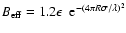 ,
with
,
with
 ,
,
 ,
and
,
and  the wavelength in mm. The
system temperatures ranged from
the wavelength in mm. The
system temperatures ranged from
 K to
K to
 K at 3 mm,
 K to
K to
 K at 2 mm,
 K to
K to
 K at 1.3 mm,
and
K at 1.3 mm,
and
 K to
K to
 K at 1 mm. The telescope pointing was checked
every
K at 1 mm. The telescope pointing was checked
every  2 h on Saturn, 3C 84, and/or NRAO 140, and found to be
accurate to 3
(rms). The telescope focus was optimized on Saturn
and/or 3C 84 every 3 h. Position-switching and on-the-fly
observations were done
with a reference position located at either (3000
,
3000
),
(1500
,
1500
), (0
,
-240
), or
(150
,
120
)
relative to the envelope center
2 h on Saturn, 3C 84, and/or NRAO 140, and found to be
accurate to 3
(rms). The telescope focus was optimized on Saturn
and/or 3C 84 every 3 h. Position-switching and on-the-fly
observations were done
with a reference position located at either (3000
,
3000
),
(1500
,
1500
), (0
,
-240
), or
(150
,
120
)
relative to the envelope center
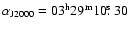 ,
,
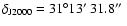 ,
as measured in
the 1.3 mm emission by Motte & André (2001)
,
as measured in
the 1.3 mm emission by Motte & André (2001)![[*]](/icons/foot_motif.gif) .
The data were reduced with the CLASS software package (Buisson et al. 2002).
The spectra were converted from antenna temperature to main-beam temperature
using the equation
.
The data were reduced with the CLASS software package (Buisson et al. 2002).
The spectra were converted from antenna temperature to main-beam temperature
using the equation
 .
.
In addition, we downloaded from the JCMT archive CS(5-4), CS(7-6),
C34S(5-4), HCO+(4-3), H13CO+(3-2), and DCO+(5-4) spectra
observed toward IRAS 4A in February and July 1992, February 1994,
November 1999, and October 2001. The data were converted into fits files with
SPECX (Matthews & Jenness 1997; Padman 1993), reduced with CLASS and converted to
main-beam temperatures using beam efficiencies
 at 1 mm and 0.63 at 0.85 mm (see Maret et al. 2004, for the conversion to
 at JCMT).
3 Results
3.1 Continuum emission
Table 1:
Interferometric measurements of dust continuum emission.
Table 2:
Single-dish measurements of dust continuum emission.
![\begin{figure}
{\resizebox{7.5cm}{!}{\includegraphics[angle=270]{4770fi1a.eps}} }
{\resizebox{7.5cm}{!}{\includegraphics[angle=270]{4770fi1b.eps}} }
\end{figure}](/articles/aa/full/2006/25/aa4770-05/Timg46.gif) |
Figure 1:
Mass distribution estimated from the integrated flux of continuum emission measured with a) interferometers (see
Table 1) and b) single-dish telescopes (see
Table 2), and computed using the best-fit opacity exponent
 . . |
| Open with DEXTER |
The mass distribution of the IRAS 4A envelope can be estimated from the dust
continuum emission. From the literature we compiled the interferometric
(Table 1) and single-dish (Table 2)
measurements done so far. Masses were estimated by various authors using
different assumptions for the dust emissivity, the dust temperature
distribution, and/or the distance to NGC 1333. Here, we analyze this set of
data homogeneously. We assume a distance of 318 pc, based on the
Hipparcos parallactic measurements of the Perseus OB2 association
(de Zeeuw et al. 1999), as discussed by Getman et al. (2002). With this distance,
the bolometric luminosity derived by Sandell et al. (1991) becomes 11.6  .
We use a dust emissivity
.
We use a dust emissivity
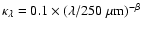 cm2 g-1 (Hildebrand 1983). The dust
temperature profile is assumed to be fixed by the heating by the central
protostar as suggested by Terebey et al. (1993):
cm2 g-1 (Hildebrand 1983). The dust
temperature profile is assumed to be fixed by the heating by the central
protostar as suggested by Terebey et al. (1993):
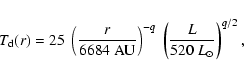 |
(1) |
with
 and L = 11.6 .
We compute the mass within a
spherical radius R assuming optically thin emission and a temperature equal
to
and L = 11.6 .
We compute the mass within a
spherical radius R assuming optically thin emission and a temperature equal
to
 .
However, this calculation overestimates the true mass
because of the radius dependence of the temperature. When the temperature and
the density are single power laws with slopes -q and -p, respectively, and
the Rayleigh-Jeans approximation is valid, the correction factor is
.
However, this calculation overestimates the true mass
because of the radius dependence of the temperature. When the temperature and
the density are single power laws with slopes -q and -p, respectively, and
the Rayleigh-Jeans approximation is valid, the correction factor is
 .
For radii smaller than
.
For radii smaller than
 AU,
AU,
 K and this approximation should be valid, provided
the density profile follows a power law. For larger radii, we expect the dust
grains to also be heated by the external UV radiation field via the
photoelectric effect (e.g. Lesaffre et al. 2005). For simplicity, we assume
that the dust temperature stays at 10 K for a radius larger than 9200 AU. In
this case, the correction factor to compute the mass within a radius R > 9200AU is
K and this approximation should be valid, provided
the density profile follows a power law. For larger radii, we expect the dust
grains to also be heated by the external UV radiation field via the
photoelectric effect (e.g. Lesaffre et al. 2005). For simplicity, we assume
that the dust temperature stays at 10 K for a radius larger than 9200 AU. In
this case, the correction factor to compute the mass within a radius R > 9200AU is
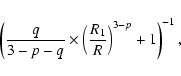 |
(2) |
where R1 (
AU) is the radius where the temperature starts to be
constant.
Given these assumptions, the emissivity exponent
minimizing the mass dispersion of the interferometric measurements shown in
Fig. 1a is
 ,
yielding
,
yielding
 cm2 g-1.
At larger radii with the
single-dish measurements, we get
cm2 g-1.
At larger radii with the
single-dish measurements, we get
 ,
which is poorly
constrained because these measurements are not spread out enough in
wavelength. In the following, we use
.
The best power-law fits
to the masses derived from the interferometric and single-dish measurements are
,
which is poorly
constrained because these measurements are not spread out enough in
wavelength. In the following, we use
.
The best power-law fits
to the masses derived from the interferometric and single-dish measurements are
 and
and
 ,
respectively
(see Fig. 1). A fit to all the data gives
,
respectively
(see Fig. 1). A fit to all the data gives
 .
For comparison, the mass of the
singular isothermal sphere enclosed in 4200 AU at 10 K is only 0.34 .
We note that the interferometric
measurements should resolve out any extended emission from the environment,
and therefore give a more reliable estimate of the mass distribution within
13
in the IRAS 4A envelope.
.
For comparison, the mass of the
singular isothermal sphere enclosed in 4200 AU at 10 K is only 0.34 .
We note that the interferometric
measurements should resolve out any extended emission from the environment,
and therefore give a more reliable estimate of the mass distribution within
13
in the IRAS 4A envelope.
Assuming a spherical geometry and a power-law density profile
 ,
the fit to the interferometric
mass measurements yields p = 2.3 and
,
the fit to the interferometric
mass measurements yields p = 2.3 and
 cm-3 at
r0 = 4200 AU. By analyzing their 2.7 mm interferometric measurements,
Looney et al. (2003) found no evidence of a circumstellar disk
and they measured a power-law index p between 1.7 and 2.3, which is
consistent
with our result (see their Table 1). Note also that n0 is 4 times higher
than the density of a singular isothermal sphere at 10 K, and this ratio is
even higher at smaller radii.
cm-3 at
r0 = 4200 AU. By analyzing their 2.7 mm interferometric measurements,
Looney et al. (2003) found no evidence of a circumstellar disk
and they measured a power-law index p between 1.7 and 2.3, which is
consistent
with our result (see their Table 1). Note also that n0 is 4 times higher
than the density of a singular isothermal sphere at 10 K, and this ratio is
even higher at smaller radii.
3.2 Spectroscopic signature of collapse
![\begin{figure}
{\resizebox{5.5cm}{!}{\includegraphics[angle=0]{4770fi2a.eps}}\hs...
...e}\resizebox{5.5cm}{!}{\includegraphics[angle=0]{4770fi2c.eps}} }
\end{figure}](/articles/aa/full/2006/25/aa4770-05/Timg64.gif) |
Figure 2:
Spectra toward the center of the IRAS 4A envelope obtained with the 30 m telescope or taken from the JCMT archive: a) CS and
N2H+ spectra, b) C34S spectra along with CS(2-1) and
N2H+(1-0), c) HCO+, H13CO+, HC18O+, and
DCO+ spectra along with N2H+(1-0).
The vertical dotted lines show the position of the blue peak, the red peak,
and the dip of the CS(2-1) spectrum in a) and b), and the
same for HCO+(3-2) in c).
The temperature scale is in
.
The beamwidth ( HPBW)
is given for each spectrum. |
| Open with DEXTER |
In Fig. 2 we compare the CS, C34S, N2H+, HCO+,
H13CO+, and HC18O+spectra that we obtained toward the central position of IRAS 4A with the IRAM
30 m telescope, as well as CS, C34S, HCO+, H13CO+, and DCO+
spectra that we took from the JCMT archive. Among the latter, CS(5-4) and
CS(7-6) were observed at a position that is slightly offset in right
ascension
(less than 3
). We used the CS and C34S frequencies measured by
Gottlieb et al. (2003), the N2H+(1-0) frequency determined by Dore et al. (2004),
the DCO+ frequencies measured by Caselli & Dore (2005), the HCO+ frequencies
from the CDMS database (as of October 2005, Müller et al. 2005), and the
H13CO+ and HC18O+ frequencies determined by
Schmid-Burgk et al. (2004).
The spectra of Fig. 2 show the classical signature of collapse,
namely self-absorbed optically thick lines, with the blue peak
stronger than the red one, and low-optical-depth spectra peaking in between
(see Evans 1999; Myers et al. 2000). This signature is seen at 20
in the
east/west direction in our HCO+(3-2) map, but is only seen on the central
position in our CS(5-4) map with a 10
spacing. Since the
smoothing of our CS(5-4) map to the JCMT resolution yields a very similar
spectrum to the JCMT one, the infall signature seen in the JCMT spectrum comes
entirely from the inner 10
probed by the IRAM 30 m telescope.
In the classical spectroscopic signature of collapse motions
(Evans 1999), the shift of the dip of
the optically thick lines with respect to the systemic velocity of the source
given by the centroid velocity of an optically thin line is an indication of
the infall velocity of the absorbing material. A fit to the hyperfine
multiplet of N2H+(1-0) yields a low optical depth of
 for
the isolated component 101-012, and a centroid velocity
for
the isolated component 101-012, and a centroid velocity
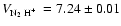 km s-1, which we take
as the systemic velocity of the source. With respect to this systemic velocity,
we measure shifts of 0.4, 0.4, and 0.5 km s-1 for CS(2-1), (3-2), and
(5-4),
respectively, and shifts of 0.5 and 0.5 km s-1 for HCO+(3-2) and (4-3),
respectively, all measured with an uncertainty of 0.1 km s-1.
Di Francesco et al. (2001) measured a self-absorption at 7.64 km s-1 with the
Plateau de Bure interferometer in H2CO(312-211), i.e. at the same
velocity as the self-absorption in our CS(2-1) spectrum.
km s-1, which we take
as the systemic velocity of the source. With respect to this systemic velocity,
we measure shifts of 0.4, 0.4, and 0.5 km s-1 for CS(2-1), (3-2), and
(5-4),
respectively, and shifts of 0.5 and 0.5 km s-1 for HCO+(3-2) and (4-3),
respectively, all measured with an uncertainty of 0.1 km s-1.
Di Francesco et al. (2001) measured a self-absorption at 7.64 km s-1 with the
Plateau de Bure interferometer in H2CO(312-211), i.e. at the same
velocity as the self-absorption in our CS(2-1) spectrum.
The C34S(2-1) and (3-2) spectra are also asymmetric, with even a marked
dip for C34S(2-1). These lines could be optically thick and
self-absorbed, like the CS lines. On the other hand, they could be optically
thin but probe two velocity components along the line of sight. This would be
the case for an infalling envelope with strong depletion at the center
(see the case of L1544 in Caselli et al. 2002), or with a small
non-thermal velocity dispersion compared to the infall velocities, or
for two independent velocity components, one being physically unrelated to
the envelope. We address this question in Sects. 4 and
5. With
a signal-to-noise ratio of 3, only one peak is detected in the JCMT
C34S(5-4) spectrum, at the same velocity as the C34S(2-1) blue
component.
![\begin{figure}
{\resizebox{8.8cm}{!}{\includegraphics[angle=270]{4770fi3.eps}} }
\end{figure}](/articles/aa/full/2006/25/aa4770-05/Timg67.gif) |
Figure 3:
a) CS(2-1) intensity maps toward IRAS 4A integrated
over [-4.10, 5.91] km s-1 (thick contours), [6.06, 8.31]
km s-1 (grey scale), and [8.46, 15.50]
km s-1 (dashed contours). The contours go from 1.5
to 6 by 1.5 and from 1.5 to 3 by 1.5 K km s-1, respectively.
b) CS(5-4) intensity maps integrated over [-1.37, 5.91]
km s-1 (thick contours), [6.26, 8.11] km s-1
(grey scale), and [8.46, 12.00] km s-1
(dashed contours). The contours are 2 and 4, and
0.7 and 1.4 K km s-1, respectively. The intensity scale is
 .
The IRAM 30 m beam size is shown in each panel
( HPBW). The big/white and small/black crosses mark the positions of
IRAS 4A and IRAS 4B, respectively. .
The IRAM 30 m beam size is shown in each panel
( HPBW). The big/white and small/black crosses mark the positions of
IRAS 4A and IRAS 4B, respectively. |
| Open with DEXTER |
3.3 Extended wings tracing the outflow
In Fig. 3 we present contour maps of the CS(2-1) and CS(5-4)
line-wing emission overlaid on the intensity maps of the line core. Both
show a clear bipolar morphology whose direction
 matches
the direction of the outflow known in this source on a small scale (see
Sect. 1). The wings of the CS (and HCO+) central spectra in
Fig. 2 are thus certainly associated with the molecular
outflow. They extend to higher velocities in CS (from v = -2 to 15
km s-1) than in HCO+ (3 to 11 km s-1).
matches
the direction of the outflow known in this source on a small scale (see
Sect. 1). The wings of the CS (and HCO+) central spectra in
Fig. 2 are thus certainly associated with the molecular
outflow. They extend to higher velocities in CS (from v = -2 to 15
km s-1) than in HCO+ (3 to 11 km s-1).
![\begin{figure}
{\resizebox{8.8cm}{!}{\includegraphics[angle=270]{4770fi4.eps}} }
\end{figure}](/articles/aa/full/2006/25/aa4770-05/Timg69.gif) |
Figure 4:
Map of H13CO+(1-0) spectra taken toward IRAS 4A with the
IRAM 30 m telescope. Each spectrum is divided into two components,
filled in black for v < 7.30 km s-1 and in grey
for v > 7.30 km s-1. The half-power beam width is 28
. |
| Open with DEXTER |
3.4 Maps of low optical depth tracers
Figure 4 shows a map of H13CO+(1-0) spectra taken
toward IRAS 4A with the IRAM 30 m telescope. Nearly all spectra are
double-peaked, as are our C34S spectra with a slightly worse
signal-to-noise ratio. The intensity of the blueshifted component peaks at the
IRAS 4A central position, this behavior being more pronounced in the
northeast/southwest direction than in the perpendicular direction. This
component is thus certainly physically
associated with the IRAS 4A envelope. By fitting two Gaussian components to
each spectrum, we measure for the blueshifted component a centroid velocity
gradient of
 km s-1 pc-1 with a
position angle
km s-1 pc-1 with a
position angle
 from North to East.
On the other hand, the intensity of the redshifted component increases from the
South-West to the North-East, and shows only a small velocity gradient of
2.4 km s-1 pc-1 at
from North to East.
On the other hand, the intensity of the redshifted component increases from the
South-West to the North-East, and shows only a small velocity gradient of
2.4 km s-1 pc-1 at
 .
The interpretation of
these velocity gradients in terms of rotation is not straightforward.
.
The interpretation of
these velocity gradients in terms of rotation is not straightforward.
In Fig. 5 we present large-scale maps of N2H+(101-012)
intensity integrated over the same velocity ranges as for H13CO+(1-0)
above (see Fig. 4). First of all, we notice that the
N2H+(101-012) emission has a local maximum very close to IRAS 4A in both
Figs. 5a and b, which strongly suggests that both
the blueshifted and redshifted components are related to the protostar.
Second, these maps show that the N2H+(101-012) emission traces the same
structure as the dust continuum emission (e.g. Hatchell et al. 2005; Sandell & Knee 2001):
a filamentary structure extending along a direction with a position angle
 ,
which bends at
,
which bends at
 in the West.
Furthermore, these maps provide
additional kinematical information and show that the two components that
we identified in H13CO+(1-0) have the same morphology but are spatially
shifted: the "blue'' filament is shifted by
in the West.
Furthermore, these maps provide
additional kinematical information and show that the two components that
we identified in H13CO+(1-0) have the same morphology but are spatially
shifted: the "blue'' filament is shifted by
 toward the
South-West with respect to the "red'' filament. Since they share the
same morphology, they are likely to be physically related and not overlap by
chance along the line of sight.
toward the
South-West with respect to the "red'' filament. Since they share the
same morphology, they are likely to be physically related and not overlap by
chance along the line of sight.
![\begin{figure}
{\resizebox{8.8cm}{!}{\includegraphics[angle=270]{4770fi5.eps}} }
\end{figure}](/articles/aa/full/2006/25/aa4770-05/Timg76.gif) |
Figure 5:
Maps of N2H+(101-012) intensity integrated over a)
the blueshifted velocity range [5.95, 7.30] km s-1 and b) the
redshifted velocity range [7.30, 8.65] km s-1, observed with the IRAM 30 m
telescope ( HPBW 26
,
shown on the left).
The first contour and contour step are 0.25 K km s-1 on
scale on both maps.
The big cross marks the central position we used for IRAS 4A. The small
crosses mark the positions of the VLA and BIMA continuum sources observed by
Reipurth et al. (2002) and Looney et al. (2000). The dashed line separates the two
components. It emphasizes the spatial shift between them and their shell-like
structure. |
| Open with DEXTER |
4 Comparison to collapse models
The classical signature of infall seen in our CS and HCO+ observations
(see Sect. 3.2 and Fig. 2) suggests that
the envelope of IRAS 4A is collapsing, confirming the analysis of
Di Francesco et al. (2001). They suggest that the inverse P-Cygni profiles
that they observed with the IRAM Plateau de Bure Interferometer toward
IRAS 4A in H2CO(312-211) are created
by an infalling envelope with a mass infall rate of
yr-1. This rate is nearly two orders of magnitude higher than
the standard accretion rate
at 10 K (Shu 1977), and
is the result of both higher densities and velocities (see
Sects. 1 and 3.1). It is thus very unlikely that the
collapse of this protostellar envelope has occurred spontaneously, so we
investigate models of collapse induced by a fast
external compression in this section.
4.1 Model of collapse induced by compression
Hennebelle et al. (2004,2003) used a
smoothed-particle-hydrodynamics code to investigate the collapse of prestellar
and
protostellar cores driven from the outside by an increase in the external
pressure. In the following, we compare our observations to their non-rotating
model with rapid compression, i.e.
 ,
where
,
where  is
the time-scale on which the external pressure doubles divided by the initial
sound-crossing time. Such a rapid compression is required to get
a density enhancement that matches the density profile of the IRAS 4A envelope
(see Sect. 4.2). On the other hand, a more rapid compression
produces infall velocities that are too high to get a good agreement with our
observations toward IRAS 4A. The initial conditions of the model correspond to
a core in stable hydrostatic equilibrium. It is embedded in a hot rarefied
external medium and has the structure of a Bonnor-Ebert sphere with a
dimensionless radius
is
the time-scale on which the external pressure doubles divided by the initial
sound-crossing time. Such a rapid compression is required to get
a density enhancement that matches the density profile of the IRAS 4A envelope
(see Sect. 4.2). On the other hand, a more rapid compression
produces infall velocities that are too high to get a good agreement with our
observations toward IRAS 4A. The initial conditions of the model correspond to
a core in stable hydrostatic equilibrium. It is embedded in a hot rarefied
external medium and has the structure of a Bonnor-Ebert sphere with a
dimensionless radius
 ,
i.e. smaller than the dimensionless radius
,
i.e. smaller than the dimensionless radius
 of the critical Bonnor-Ebert sphere (e.g. Bonnor 1956).
We normalized the model to a kinetic temperature of 10 K
and a total mass of 6.0 .
of the critical Bonnor-Ebert sphere (e.g. Bonnor 1956).
We normalized the model to a kinetic temperature of 10 K
and a total mass of 6.0 .
4.2 Mass distribution
![\begin{figure}
{\resizebox{8.8cm}{!}{\includegraphics[angle=270]{4770fi6.eps}} }
\end{figure}](/articles/aa/full/2006/25/aa4770-05/Timg81.gif) |
Figure 6:
a) Density, b) infall velocity, and c)
mass infall rate profiles of the collapse model induced
by compression described in Sect. 4.1 at times 0.8402, 0.8533,
0.8581, 0.8657, 0.8763, 0.8920, and
 yr, corresponding to
renormalized times after the formation of the central protostar of
approximately -7, 7, 11, 19, 30, 45, and yr, corresponding to
renormalized times after the formation of the central protostar of
approximately -7, 7, 11, 19, 30, 45, and
 yr, respectively.
The thick line corresponds to yr, respectively.
The thick line corresponds to
 yr and indicates
the "best-fit'' model used in Sect. 4.3 and shown in
Fig. 7.
The dashed areas in (a) show the constraints deduced for IRAS 4A from the
interferometric and single-dish continuum measurements
(see Sect. 3.1). yr and indicates
the "best-fit'' model used in Sect. 4.3 and shown in
Fig. 7.
The dashed areas in (a) show the constraints deduced for IRAS 4A from the
interferometric and single-dish continuum measurements
(see Sect. 3.1). |
| Open with DEXTER |
![\begin{figure}
{\resizebox{18cm}{!}{\includegraphics[angle=270]{4770fi7.eps}} }
\end{figure}](/articles/aa/full/2006/25/aa4770-05/Timg82.gif) |
Figure 7:
a) Density, b) kinetic temperature, c)
CS molecular abundance, d) non-thermal line broadening (FWHM), and
e) infall velocity profiles of the collapse model at time
yr used for the radiative
transfer modeling of Fig. 8. |
| Open with DEXTER |
Figure 6a compares the evolution of the density profile of the
model described in Sect. 4.1 with the density profiles deduced from
the interferometric and single-dish continuum measurements toward IRAS 4A in
Sect. 3.1. The fast external compression is responsible for
a significant increase in the density profile compared to the
profile expected for a singular isothermal sphere. The agreement with the
profiles deduced from the observations is good in the range 1500-10 000 AU at
times 1-
 yr after the formation of the central
point mass, which are on the same order as the estimated
lifetime of Class 0 protostars (André et al. 2000). The disagreement at
smaller radii, the model being less dense than what we deduced from the
observations assuming spherical symmetry, could be due to the presence of an
unresolved disk not removed
from the interferometric fluxes analyzed in Sect. 3.1. However,
Looney et al. (2003) did not find any evidence of such a disk. At
larger radii, the single-dish measurements might be contaminated by
large-scale emission from the cloud along the line of sight, which is not
related to
the protostellar envelope itself, although the dual-beam technique used for the
observations should have removed most of it.
yr after the formation of the central
point mass, which are on the same order as the estimated
lifetime of Class 0 protostars (André et al. 2000). The disagreement at
smaller radii, the model being less dense than what we deduced from the
observations assuming spherical symmetry, could be due to the presence of an
unresolved disk not removed
from the interferometric fluxes analyzed in Sect. 3.1. However,
Looney et al. (2003) did not find any evidence of such a disk. At
larger radii, the single-dish measurements might be contaminated by
large-scale emission from the cloud along the line of sight, which is not
related to
the protostellar envelope itself, although the dual-beam technique used for the
observations should have removed most of it.
4.3 Radiative transfer modeling
We used the Monte-Carlo-based radiative transfer code MAPYSO in one
spherical dimension (see Belloche et al. 2002; Blinder 1997)
to compute the CS, C34S, and N2H+ spectra that would be
observed for a source
set in collapse by fast compression, as described by the model of
Sect. 4.1. In addition to the density and velocity profiles of the
hydrodynamical model at time 1.9
 yr (see Figs. 6
and 7a, e), we used a uniform CS/C34S isotopic ratio of
22.5 but non-uniform abundance profiles (see Fig. 7c).
For N2H+, we used the collision rates of HCO+ with
H2 (Flower 1999) and assumed a constant abundance of
yr (see Figs. 6
and 7a, e), we used a uniform CS/C34S isotopic ratio of
22.5 but non-uniform abundance profiles (see Fig. 7c).
For N2H+, we used the collision rates of HCO+ with
H2 (Flower 1999) and assumed a constant abundance of
 .
We did not model the hyperfine structure but simply
rescaled the abundance effectively used for the calculations by the
statistical weight ratio
.
We did not model the hyperfine structure but simply
rescaled the abundance effectively used for the calculations by the
statistical weight ratio
 and
fitted only the 101-012 optically thin component. For all molecules,
we added a non-uniform non-thermal line broadening to the thermal
broadening (see Fig. 7d).
Although the hydrodynamical
simulation was isothermal, we used a non-uniform kinetic temperature to
compute the spectra, which are very sensitive to the heating by the central
protostar. The temperature was set to the dust temperature profile described
in Sect. 3.1 (see Fig. 7b).
and
fitted only the 101-012 optically thin component. For all molecules,
we added a non-uniform non-thermal line broadening to the thermal
broadening (see Fig. 7d).
Although the hydrodynamical
simulation was isothermal, we used a non-uniform kinetic temperature to
compute the spectra, which are very sensitive to the heating by the central
protostar. The temperature was set to the dust temperature profile described
in Sect. 3.1 (see Fig. 7b).
In Fig. 8 we compare the synthetic spectra at time
yr to the spectra observed toward IRAS 4A along the longitude
axis, i.e. roughly perpendicular to the outflow axis (see
Fig. 3). The asymmetry and the absorption dips of the central
CS(2-1) and CS(3-2) spectra are well reproduced. The asymmetry of these
optically thick lines is enhanced toward the West and reduced toward the East
at  20
,
which is not accounted for by our 1D spherical model.
However, including some rotation
could improve the modeled spectra in that respect
(see Belloche et al. 2002, for such an effect in IRAM 04191+1522 - hereafter
IRAM 04191). The line wings are
not reproduced by our model, which was expected since they trace the ouflow
that we did not include in our modeling (see Sect. 3.3). The
relative
contribution of the outflow gets stronger with the upper energy level of the
transition, and even masks the red peak of the CS(5-4) spectrum. This spectrum
is reasonably well-matched by the model, although the shape of the dip is not
reproduced fully.
20
,
which is not accounted for by our 1D spherical model.
However, including some rotation
could improve the modeled spectra in that respect
(see Belloche et al. 2002, for such an effect in IRAM 04191+1522 - hereafter
IRAM 04191). The line wings are
not reproduced by our model, which was expected since they trace the ouflow
that we did not include in our modeling (see Sect. 3.3). The
relative
contribution of the outflow gets stronger with the upper energy level of the
transition, and even masks the red peak of the CS(5-4) spectrum. This spectrum
is reasonably well-matched by the model, although the shape of the dip is not
reproduced fully.
The central C34S(2-1) modeled spectrum matches the observed one well. It
is optically thin (
 )
and the two peaks result from the large
infall velocities dominating the non-thermal line broadening in the inner
parts of the envelope. We emphasize the importance of modeling the
optically thin lines of a less abundant isotopologue simultaneously
with the optically thick lines of the main molecule. This indeed reduces
the space of free parameters drastically - especially the non-thermal line
broadening and the abundance - and helps in deriving reliable infall
velocities
from the optically-thick, self-absorbed, asymmetric spectra. In particular,
a first strong constraint is set on the abundance profile by the spatial
variations of the C34S(2-1) integrated intensity, which imply a
decrease in the abundance toward the center. Besides, a second constraint on
the abundance in the external parts comes from the depth of the absorption
dips of the CS(2-1) and CS(3-2) lines. As a result, this set of data
reveals that CS is strongly affected by depletion in the IRAS 4A envelope
(see Belloche et al. 2002, for a similar result in the Class 0 protostar
IRAM 04191).
)
and the two peaks result from the large
infall velocities dominating the non-thermal line broadening in the inner
parts of the envelope. We emphasize the importance of modeling the
optically thin lines of a less abundant isotopologue simultaneously
with the optically thick lines of the main molecule. This indeed reduces
the space of free parameters drastically - especially the non-thermal line
broadening and the abundance - and helps in deriving reliable infall
velocities
from the optically-thick, self-absorbed, asymmetric spectra. In particular,
a first strong constraint is set on the abundance profile by the spatial
variations of the C34S(2-1) integrated intensity, which imply a
decrease in the abundance toward the center. Besides, a second constraint on
the abundance in the external parts comes from the depth of the absorption
dips of the CS(2-1) and CS(3-2) lines. As a result, this set of data
reveals that CS is strongly affected by depletion in the IRAS 4A envelope
(see Belloche et al. 2002, for a similar result in the Class 0 protostar
IRAM 04191).
![\begin{figure}
{\resizebox{8.8cm}{!}{\includegraphics[angle=270]{4770fi8.eps}} }
\end{figure}](/articles/aa/full/2006/25/aa4770-05/Timg88.gif) |
Figure 8:
CS, C34S, and N2H+ spectra (histograms) in
units of main-beam
temperature observed toward IRAS 4A along the longitude axis (see references
in Fig. 2). Synthetic spectra corresponding to the
collapse model at time
yr described in
Sect. 4.1 are superimposed (red/thick line). The dotted
line indicates the envelope systemic
velocity used for the computation of the radiative transfer
(7.20 km s-1 for CS and C34S, and 7.24 km s-1 for
N2H+). |
| Open with DEXTER |
The N2H+(101-012) line is also well reproduced, although the
observed blue peak is not as blueshifted as in the model. The opacity of
the modeled spectrum is 0.24. It agrees reasonably well with the opacity
obtained from the Gaussian fit to the hyperfine structure
(see Sect. 3.2), and this small discrepancy may be due to our
simplified treatment of the radiative transfer of N2H+.
With the uniform abundance, the N2H+(1-0) transition is more sensitive
to the inner region than the C34S(2-1) line. We tried a
model that included depletion of N2H+ above
 cm-3
(see Belloche & André 2004, for N2H+ depletion in IRAM 04191), but the
shape of the line was worse, the blue and red peaks being much more pronounced
than they are in the observed spectrum. The reason the uniform abundance
produces a profile with less pronounced blue and red peaks is that, in this
case, the beam
picks up more material at low velocities projected along the line of
sight, i.e. the material infalling along a direction close to the plane of the
sky. This shows that the double-peaked profile of the C34S(2-1) line is
due not only to the large infall velocities compared to the non-thermal
broadening, as stated above, but also to the depletion in the central region.
In our model, the shape of the N2H+(101-012) line therefore indicates no
depletion of N2H+ (or very little) in the inner regions.
cm-3
(see Belloche & André 2004, for N2H+ depletion in IRAM 04191), but the
shape of the line was worse, the blue and red peaks being much more pronounced
than they are in the observed spectrum. The reason the uniform abundance
produces a profile with less pronounced blue and red peaks is that, in this
case, the beam
picks up more material at low velocities projected along the line of
sight, i.e. the material infalling along a direction close to the plane of the
sky. This shows that the double-peaked profile of the C34S(2-1) line is
due not only to the large infall velocities compared to the non-thermal
broadening, as stated above, but also to the depletion in the central region.
In our model, the shape of the N2H+(101-012) line therefore indicates no
depletion of N2H+ (or very little) in the inner regions.
As noted above, the non-thermal line broadening in the inner parts of the
envelope is strongly constrained to be small (
 km s-1, i.e.
 km s-1) by the
double-peaked line shape of the low-optical-depth C34S(2-1) spectrum. The
model with
km s-1) by the
double-peaked line shape of the low-optical-depth C34S(2-1) spectrum. The
model with
 km s-1 in
Fig. 9 indeed shows that a larger broadening smoothes out the
C34S(2-1) double-peaked line profile which traces the infall velocities
of the front and rear hemispheres. It also broadens the
N2H+(101-012) spectrum too much and produces wings that have not been
observed. On the
other hand, the CS(2-1) and (3-2) broad absorption dips require a much larger
non-thermal line broadening in the external parts of the envelope where they
are produced (
km s-1 in
Fig. 9 indeed shows that a larger broadening smoothes out the
C34S(2-1) double-peaked line profile which traces the infall velocities
of the front and rear hemispheres. It also broadens the
N2H+(101-012) spectrum too much and produces wings that have not been
observed. On the
other hand, the CS(2-1) and (3-2) broad absorption dips require a much larger
non-thermal line broadening in the external parts of the envelope where they
are produced (
 km s-1, i.e.
 km s-1). The model with
 km s-1 in Fig. 9 indeed
shows that a smaller broadening cannot produce the broad absorption dips
observed in CS(2-1) and CS(3-2). We have, therefore, strong
evidence that the non-thermal line broadening is not uniform in the
IRAS 4A envelope, decreasing by nearly a factor of three toward the center,
from supersonic down to
subsonic values. This conclusion agrees quite well with the small linewidths
km s-1 in Fig. 9 indeed
shows that a smaller broadening cannot produce the broad absorption dips
observed in CS(2-1) and CS(3-2). We have, therefore, strong
evidence that the non-thermal line broadening is not uniform in the
IRAS 4A envelope, decreasing by nearly a factor of three toward the center,
from supersonic down to
subsonic values. This conclusion agrees quite well with the small linewidths
 0.5 km s-1 observed toward IRAS 4A in
N2H+(1-0) by Di Francesco et al. (2001) on small scales with PdBI
(
0.5 km s-1 observed toward IRAS 4A in
N2H+(1-0) by Di Francesco et al. (2001) on small scales with PdBI
(
 AU) and the much larger linewidths
 -1.9 km s-1 measured in the NGC 1333
molecular cloud with the low-density tracer C18O(1-0) by Warin et al. (1996).
-1.9 km s-1 measured in the NGC 1333
molecular cloud with the low-density tracer C18O(1-0) by Warin et al. (1996).
![\begin{figure}
{\resizebox{8.5cm}{!}{\includegraphics[angle=0]{4770fi9.eps}} }
\end{figure}](/articles/aa/full/2006/25/aa4770-05/Timg99.gif) |
Figure 9:
CS, C34S, and N2H+ spectra in units of main-beam
temperature observed
toward the center of IRAS 4A (histograms). Each column shows
a different model (thick line). Synthetic spectra
corresponding to the collapse model at time
yr
described in Sect. 4.1 are superimposed in the central column
(in red). In the left and right columns, the
synthetic spectra (in green and blue)
were obtained with the same input model, except for the non-thermal
broadening, which was in both cases uniform with
 0.4 and 1.1 km s-1, respectively. The dotted line indicates the
systemic velocity of the envelope that was used to compute the radiative
transfer (see Fig. 8).
0.4 and 1.1 km s-1, respectively. The dotted line indicates the
systemic velocity of the envelope that was used to compute the radiative
transfer (see Fig. 8). |
| Open with DEXTER |
![\begin{figure}
{\resizebox{8cm}{!}{\includegraphics[angle=0]{4770fi10.eps}} }
\par
\end{figure}](/articles/aa/full/2006/25/aa4770-05/Timg100.gif) |
Figure 10:
CS and C34S spectra in units of main-beam temperature observed
toward the center of IRAS 4A (histograms). Each column shows
a different model (thick line). Synthetic spectra
corresponding to the collapse model described in Sect. 4.1
at times -7, 7, 19, and
 yr are superimposed from left to
right (in light blue, blue, red, and green).
For each model, the scaling of the abundance profile was
adjusted to match the peak intensity of the C34S(2-1) line.
The dotted line indicates the systemic velocity of the envelope that was
used to compute the radiative transfer (see Fig. 8). yr are superimposed from left to
right (in light blue, blue, red, and green).
For each model, the scaling of the abundance profile was
adjusted to match the peak intensity of the C34S(2-1) line.
The dotted line indicates the systemic velocity of the envelope that was
used to compute the radiative transfer (see Fig. 8).
|
| Open with DEXTER |
The time elapsed since the point-mass formation in the collapse model
is well constrained by the peak separations and
the linewidths of the CS and C34S spectra. The infall velocities of the
model at time
 yr in Fig. 10 are not high
enough to produce the right separation of the peaks of the CS(3-2) and
C34S(2-1) lines. On the other hand, the much higher infall velocities of
the model at time
yr in Fig. 10 are not high
enough to produce the right separation of the peaks of the CS(3-2) and
C34S(2-1) lines. On the other hand, the much higher infall velocities of
the model at time
 yr produce spectra that are too broad. As
a result, we find a good match for a time of 1-2
yr elapsed since the formation of the central protostar.
yr produce spectra that are too broad. As
a result, we find a good match for a time of 1-2
yr elapsed since the formation of the central protostar.
Finally, we could not find a better match in the framework of our 1D spherical
modeling for the C34S(3-2) and C34S(5-4) central spectra. The
modeled spectra of Fig. 8 are not asymmetric enough for these
two lines. Since our modeling suggests low optical depths of 0.35 and 0.04 for
these two lines, it is very unlikely that the observed asymmetry results
from an optical depth effect. This instead suggests that the material emitting
in these two lines at the blue and redshifted velocities - i.e. in the rear
and front hemispheres, respectively, in the framework of this collapse model
- is denser for the former and less dense for the latter than assumed in the
model.
5 Discussion
In Sect. 4 we found very good agreement between the continuum
and CS/C34S/N2H+ line observations toward IRAS 4A and the
collapse model of
Hennebelle et al. (2003) induced by a fast external compression with
.
The best match is obtained for a time of 1-2
yr
elapsed since the formation of the central protostar. This corresponds to a
mass infall rate of 4-7
 yr-1 in the range of
radii [103, 104] AU (see Fig. 6c). However, the actual mass
infall rate is probably even higher since the density profile of our model
does not perfectly match (and underestimates it by about 25
yr-1 in the range of
radii [103, 104] AU (see Fig. 6c). However, the actual mass
infall rate is probably even higher since the density profile of our model
does not perfectly match (and underestimates it by about 25 )
the density
profile deduced from the observations (see Fig. 6a). Also,
the dust opacity we used in Sect. 3.1 is 2.5 times larger than
the opacity usually assumed for protostellar envelopes (e.g. Motte & André 2001).
Therefore we estimate that the actual mass infall rate is most probably in the
range 0.7-
)
the density
profile deduced from the observations (see Fig. 6a). Also,
the dust opacity we used in Sect. 3.1 is 2.5 times larger than
the opacity usually assumed for protostellar envelopes (e.g. Motte & André 2001).
Therefore we estimate that the actual mass infall rate is most probably in the
range 0.7-
 yr-1. This is in very good
agreement with the mass infall rate of
yr-1 deduced by Di Francesco et al. (2001) from their PdBI
observations. As already mentioned in Sect. 4, such a mass
infall rate of
yr-1. This is in very good
agreement with the mass infall rate of
yr-1 deduced by Di Francesco et al. (2001) from their PdBI
observations. As already mentioned in Sect. 4, such a mass
infall rate of
 yr-1 is 60 times higher than
the standard accretion rate
at 10 K (Shu 1977). In
our model, it is
the result of both higher densities and velocities produced by the fast
compression wave propagating inwards.
Fatuzzo et al. (2004) find that the mass infall rate indeed scales
roughly linearily with the initial overdensity and the initial velocity field
in their self-similar collapse solutions where the dense core is initially
either overdense compared to the singular isothermal sphere or has nonzero
initial velocities.
yr-1 is 60 times higher than
the standard accretion rate
at 10 K (Shu 1977). In
our model, it is
the result of both higher densities and velocities produced by the fast
compression wave propagating inwards.
Fatuzzo et al. (2004) find that the mass infall rate indeed scales
roughly linearily with the initial overdensity and the initial velocity field
in their self-similar collapse solutions where the dense core is initially
either overdense compared to the singular isothermal sphere or has nonzero
initial velocities.
In the framework of the self-similar
inside-out collapse model with an effective sound speed including a
non-thermal contribution, the "standard'' accretion rate would be
 (Shu et al. 1987). This
"effective'' accretion rate would be at most 3
times higher than the pure isothermal one with
the non-thermal velocity dispersion
(Shu et al. 1987). This
"effective'' accretion rate would be at most 3
times higher than the pure isothermal one with
the non-thermal velocity dispersion
 km s-1
derived for the inner parts of the envelope in Sect. 4.3, which is
typical of the level of turbulence in prestellar condensations
(e.g. Belloche et al. 2001), but probably even an upper limit for IRAS 4A since
the smallest dispersion measured by Di Francesco et al. (2001) with PdBI is 0.09
km s-1. This cannot account for the high
mass infall rate measured in the IRAS 4A envelope.
On the other hand, the Larson-Penston similarity solution
(Penston 1969; Larson 1969) has a uniform mass infall rate of
km s-1
derived for the inner parts of the envelope in Sect. 4.3, which is
typical of the level of turbulence in prestellar condensations
(e.g. Belloche et al. 2001), but probably even an upper limit for IRAS 4A since
the smallest dispersion measured by Di Francesco et al. (2001) with PdBI is 0.09
km s-1. This cannot account for the high
mass infall rate measured in the IRAS 4A envelope.
On the other hand, the Larson-Penston similarity solution
(Penston 1969; Larson 1969) has a uniform mass infall rate of
 at the point-mass formation, and its extension
after the point-mass formation by Hunter (1977) has a mass
infall rate approaching asymptotically
at the point-mass formation, and its extension
after the point-mass formation by Hunter (1977) has a mass
infall rate approaching asymptotically
 .
This value is closer to our result for IRAS 4A, which is not surprising since
the Larson-Penston solution, among the numerous similarity solutions of
isothermal gravitational collapse, can be physically interpreted as a model
associated with a strong external compression wave (Whitworth & Summers 1985).
Similarity solutions are helpful for understanding the physics of
gravitational collapse, but they are not well suited to a detailed comparison
with observations since they do not have realistic boundary conditions.
.
This value is closer to our result for IRAS 4A, which is not surprising since
the Larson-Penston solution, among the numerous similarity solutions of
isothermal gravitational collapse, can be physically interpreted as a model
associated with a strong external compression wave (Whitworth & Summers 1985).
Similarity solutions are helpful for understanding the physics of
gravitational collapse, but they are not well suited to a detailed comparison
with observations since they do not have realistic boundary conditions.
In contrast to the high mass infall rate measured in the IRAS 4A
envelope, the spontaneous collapse of
the very young Class 0 protostar IRAM 04191 in the Taurus molecular cloud is
much less vigorous with a mass infall rate of only
 (see Belloche et al. 2002). This could explain the order of
magnitude difference between the bolometric luminosities of the two protostars
that have approximately the same age since the beginning of the main
accretion phase (see Lesaffre et al. 2005).
(see Belloche et al. 2002). This could explain the order of
magnitude difference between the bolometric luminosities of the two protostars
that have approximately the same age since the beginning of the main
accretion phase (see Lesaffre et al. 2005).
5.2 Origin of the external compression
The N2H+(1-0) maps of Fig. 5 show that the material
emitting at "blueshifted'' velocities is displaced toward the South-West with
respect to the material emitting at "redshifted'' velocities and that both
components have the same shell-like morphology at the edge of cavity 2 of
Lefloch et al. (1998) seen in maps of continuum emission
(see also Hatchell et al. 2005; Sandell & Knee 2001). We interpret the velocity
difference between the two components as the result of "inward'' motions and
conclude that the "blueshifted'' material is in the background and moving
toward the "redshifted'' material along a direction projected onto the plane
of the sky at
in the IRAS 4 region and
 in the SVS13/VLA 12 region. This geometry and this velocity
structure remind us of an expanding shell, the center of which would be
located in the background and southwest of NGC 1333. The "blueshifted''
component would be the expanding shell itself while the "redshifted''
component would be the ambient medium. In this scenario, the whole region
around IRAS 4 and IRAS 2 should show signatures of "inward'' motion,
i.e. the motion of the
"blueshifted'' component toward the "redshifted'' component. This might
indeed be the case since Walsh et al. (2006) claim that they have detected
"global infall'' in this region. On smaller scales in the IRAS 4A region,
this scenario also fits, from a kinematical point of view, into the framework
of the collapse model we investigated in Sect. 4. The external
perturbation triggering the collapse of the dense core would then be the
impact of this expanding shell on the ambient medium.
in the SVS13/VLA 12 region. This geometry and this velocity
structure remind us of an expanding shell, the center of which would be
located in the background and southwest of NGC 1333. The "blueshifted''
component would be the expanding shell itself while the "redshifted''
component would be the ambient medium. In this scenario, the whole region
around IRAS 4 and IRAS 2 should show signatures of "inward'' motion,
i.e. the motion of the
"blueshifted'' component toward the "redshifted'' component. This might
indeed be the case since Walsh et al. (2006) claim that they have detected
"global infall'' in this region. On smaller scales in the IRAS 4A region,
this scenario also fits, from a kinematical point of view, into the framework
of the collapse model we investigated in Sect. 4. The external
perturbation triggering the collapse of the dense core would then be the
impact of this expanding shell on the ambient medium.
In this scenario, the origin of the external perturbation should be located in
the background and southwest of the IRAS 4/SVS13 region. The perturbation
could result from the expansion of an H II region, from a stellar wind, or
from
a protostellar outflow. A nearby bright star in the South-West is required for
the first two assumptions. The star BD +30547, with a
spectral type between A 6 V and B 7 V
(Aspin 2003, , although Cernis 1990 found a type G 2 IV),
would be the best candidate. However, Preibisch (2003) finds with
XMM-Newton that this star is in the foreground, so in our scenario, it cannot
be the origin of the external perturbation in the IRAS 4 region.
Since NGC 1333 is filled with many outflows
(Knee & Sandell 2000), the collapse of IRAS 4 could have been triggered by one of
them. Like Hennebelle et al. (2003), Motoyama & Yoshida (2003) numerically investigated
the collapse of dense
cores triggered by an external perturbation. They initiated the collapse by
setting a nonzero inward velocity at the boundary of the dense core and
found that the maximum value of the mass infall rate is proportional to the
momentum given to the dense core by the external perturbation and, in
particular, that an input momentum of
 km s-1 yields
a mass infall rate of
km s-1 yields
a mass infall rate of
 yr-1.
The collapse of IRAS 4A could thus have been started by an external
perturbation with a momentum of
km s-1. This is a
typical value for
the present molecular outflows in NGC 1333 (Knee & Sandell 2000). The shock
created by a present or former outflow could therefore have triggered,
directly or indirectly, the collapse of IRAS 4A. This would fit the scenario
of shock-driven sequential star formation put forward by Warin et al. (1996) for
NGC 1333. Indeed, the cavity in the South-West of IRAS 4A could be the relic
of a former outflow (see Quillen et al. 2005). However, we have not yet
found a good protostellar candidate that could have been the origin of such
an outflow in the South-West.
yr-1.
The collapse of IRAS 4A could thus have been started by an external
perturbation with a momentum of
km s-1. This is a
typical value for
the present molecular outflows in NGC 1333 (Knee & Sandell 2000). The shock
created by a present or former outflow could therefore have triggered,
directly or indirectly, the collapse of IRAS 4A. This would fit the scenario
of shock-driven sequential star formation put forward by Warin et al. (1996) for
NGC 1333. Indeed, the cavity in the South-West of IRAS 4A could be the relic
of a former outflow (see Quillen et al. 2005). However, we have not yet
found a good protostellar candidate that could have been the origin of such
an outflow in the South-West.
We mentioned the limitation of our 1D spherical modeling for IRAS 4A in
Sect. 4.3 and suggested an asymmetry of the source along the line
of sight, the rear hemisphere being denser than the front hemisphere. This
asymmetry could stem from the fast external compression itself,
which is unlikely to be isotropic on the scale of the IRAS 4A envelope.
Boss (1995) showed examples of such asymmetries in dense cores set
in collapse by a shock wave hitting only one hemisphere (see his Fig. 2). It
would be geometrically consistent with the idea that the compression wave
that triggered the collapse of the IRAS 4A envelope is coming from the back,
as deduced above from the morphology and kinematics
of the N2H+(1-0) maps.
5.3 Non uniform turbulence
We found in Sect. 4.3 that the non-thermal line broadening, which
is likely to stem from turbulent motions, decreases toward the center of
IRAS 4A from supersonic to subsonic velocities by
nearly a factor of 3. A similar conclusion has already been drawn by
Di Francesco et al. (2001) based on their
N2H+ interferometric data. The turbulence is thus supersonic in the
outer parts of the IRAS 4A envelope but only subsonic in the inner dense
region. The subsonic turbulence in the inner part of the envelope
is reminiscent of the low level of turbulence found in prestellar condensations
(e.g. in the  Oph protocluster, see Belloche et al. 2001). It could then
indicate the conditions prevailing in the dense core before the onset of
collapse. In the outer parts of the envelope, the supersonic turbulence
Oph protocluster, see Belloche et al. 2001). It could then
indicate the conditions prevailing in the dense core before the onset of
collapse. In the outer parts of the envelope, the supersonic turbulence
 km s-1, which we derived from the
CS self-absorption, is nearly as large as the amplitude of the non-thermal
motions deduced by Warin et al. (1996) from the low density tracer C18O(1-0)
in the molecular cloud (see also Fig. 7 of Quillen et al. 2005, for C18O data with a
better spatial resolution). The outer parts of the IRAS 4A envelope
are therefore affected by the supersonic turbulence that permeates the whole
cloud and that may have been powered by the numerous outflows located in
NGC 1333
(Quillen et al. 2005). In the scenario we proposed in Sect. 5.2,
the supersonic turbulence could have been generated in the outer parts of the
IRAS 4A envelope by the expansion of the southwestern cavity.
km s-1, which we derived from the
CS self-absorption, is nearly as large as the amplitude of the non-thermal
motions deduced by Warin et al. (1996) from the low density tracer C18O(1-0)
in the molecular cloud (see also Fig. 7 of Quillen et al. 2005, for C18O data with a
better spatial resolution). The outer parts of the IRAS 4A envelope
are therefore affected by the supersonic turbulence that permeates the whole
cloud and that may have been powered by the numerous outflows located in
NGC 1333
(Quillen et al. 2005). In the scenario we proposed in Sect. 5.2,
the supersonic turbulence could have been generated in the outer parts of the
IRAS 4A envelope by the expansion of the southwestern cavity.
Detecting rotation and measuring its magnitude in the envelope of IRAS 4A is
not straightforward. We mentioned in Sect. 3.4 that the blue
component of the low-optical-depth tracers shows a velocity gradient of 9.7 km s-1 pc-1 at
 over
over
 ,
which
is on the same order as the gradient measured in IRAM 04191 that we interpreted
as rotation (Belloche et al. 2002). However, there are two caveats for
IRAS 4A. First, the double-peaked structure of our single-dish
low-optical-depth spectra makes the analysis difficult in terms of rotation.
Second, Di Francesco et al. (2001) observed N2H+(1-0) with PdBI and
measured
centroid velocity differences of about 0.5-1 km s-1 over
,
which
is on the same order as the gradient measured in IRAM 04191 that we interpreted
as rotation (Belloche et al. 2002). However, there are two caveats for
IRAS 4A. First, the double-peaked structure of our single-dish
low-optical-depth spectra makes the analysis difficult in terms of rotation.
Second, Di Francesco et al. (2001) observed N2H+(1-0) with PdBI and
measured
centroid velocity differences of about 0.5-1 km s-1 over
 ,
which corresponds to a velocity gradient of 30-50 km s-1 pc-1,
at a position angle
,
which corresponds to a velocity gradient of 30-50 km s-1 pc-1,
at a position angle
 .
Their position angle was only a
rough estimate and a fit to their centroid velocity map would give a
position angle probably close to 90
(see their Fig. 2b), but this is
still
.
Their position angle was only a
rough estimate and a fit to their centroid velocity map would give a
position angle probably close to 90
(see their Fig. 2b), but this is
still
 away from our single-dish measurement so it is unclear
whether these velocity gradients trace indeed rotation.
away from our single-dish measurement so it is unclear
whether these velocity gradients trace indeed rotation.
However, if we assume that the velocity gradient we measured in
Sect. 3.4 is a good estimate of the amount of rotation in the
envelope and suppose at first order that it is a solid-body rotation, then we
find a ratio of rotation energy over gravitational energy of
 .
This is similar to the conditions investigated by Hennebelle et al. (2004)
when studying the fragmentation process in a rotating core set in collapse by
a fast external compression. Their main conclusion was that a fast compression
promotes fragmentation and the formation of multiple protostars. With a very
rapid compression (
.
This is similar to the conditions investigated by Hennebelle et al. (2004)
when studying the fragmentation process in a rotating core set in collapse by
a fast external compression. Their main conclusion was that a fast compression
promotes fragmentation and the formation of multiple protostars. With a very
rapid compression (
 ), they show that this process occurs
through the formation of a ring which becomes unstable very quickly. It breaks
up into several pieces that, in their example, merge into two
protostars. For their simulation with a dense core of 1 ,
the
proto-binary separation is about 140 AU (see their Fig. 7), which corresponds
to 840 AU if we normalize their model to the mass of the IRAS 4A envelope
(6 ).
IRAS 4A is indeed a binary system with a separation of 1.8
,
i.e. 570
AU at a distance of 318 pc (see Reipurth et al. 2002; Looney et al. 2000). It is
therefore tempting to conclude that the formation of the IRAS 4A binary system
results from the fast external compression that triggered the collapse of the
dense core.
), they show that this process occurs
through the formation of a ring which becomes unstable very quickly. It breaks
up into several pieces that, in their example, merge into two
protostars. For their simulation with a dense core of 1 ,
the
proto-binary separation is about 140 AU (see their Fig. 7), which corresponds
to 840 AU if we normalize their model to the mass of the IRAS 4A envelope
(6 ).
IRAS 4A is indeed a binary system with a separation of 1.8
,
i.e. 570
AU at a distance of 318 pc (see Reipurth et al. 2002; Looney et al. 2000). It is
therefore tempting to conclude that the formation of the IRAS 4A binary system
results from the fast external compression that triggered the collapse of the
dense core.
As for IRAS 4A, Di Francesco et al. (2001) find an inverse P-Cygni
profile toward the Class 0 protostar IRAS 4B (Sandell et al. 1991).
They conclude that it is also collapsing, with a similar mass
infall rate of
 yr-1. Since it lies along
the same N2H+ filament as IRAS 4A (see Fig. 5) and is in a
similar evolutionary stage, we suggest that the gravitational collapse
of its envelope was triggered by the same external perturbation, the expanding
shell suggested in Sect. 5.2.
yr-1. Since it lies along
the same N2H+ filament as IRAS 4A (see Fig. 5) and is in a
similar evolutionary stage, we suggest that the gravitational collapse
of its envelope was triggered by the same external perturbation, the expanding
shell suggested in Sect. 5.2.
We note that IRAS 4B is an 11
binary and possibly a system
with even higher multiplicity (see Lay et al. 1995; Looney et al. 2000). However, the
main companion was not detected in
continuum emission at 3.6 cm by Reipurth et al. (2002) and is probably much more
evolved than the primary (Looney et al. 2000). This raises the question of
whether it really belongs to the IRAS 4B system or is physically
unrelated and appears close to the Class 0 protostar in the plane of the sky
just by chance.
In the past, it has been claimed that the NGC 1333 molecular cloud includes
several independent velocity components seen in emission
and/or absorption (see Choi et al. 2004; Langer et al. 1996; Choi 2001). In particular,
Choi et al. (2004) reject the infall interpretation of Di Francesco et al. (2001) and
instead propose a foreground absorbing layer at 8 km s-1 that is
physically
unrelated to IRAS 4A. They assume a very low systemic velocity of 6.7
km s-1 for IRAS 4A, yielding highly redshifted absorption dips in the
optically thick spectra, and argue that standard collapse models like the
inside-out collapse model (Shu 1977) would never produce such highly
redshifted dips given the age of the protostar, and that the faster
Larson-Penston model would produce linewidths that are much too broad to fit
these highly redshifted dips. However, the model
presented in Sect. 4 shows that a systemic velocity of
7.2 km s-1 and a collapse induced by a fast external compression can fit
both the optically thick and thin lines reasonably well. The fit to our data
set does not require any additional absorbing layer that is physically
unrelated to IRAS 4A, as claimed by Choi et al. (2004). Our scenario, which
requires only one source, is simpler. Therefore we think it is more likely.
6 Summary and conclusions
We have carried out a detailed analysis of the physical structure of the
envelope of the Class 0 protostar IRAS 4A in the NGC 1333 molecular cloud. Our
main results and conclusions are as follows:
- 1.
- The density profile deduced from previous interferometric and single-dish
millimeter continuum measurements is steep (p = 2.3), and the
envelope is much denser than a singular isothermal sphere at 10 K.
- 2.
- Our new set of molecular line data obtained with the IRAM 30 m telescope
shows the classical spectroscopic signature of collapse with absorption dips
of optically thick lines redshifted by 0.5 km s-1 with respect to the
systemic velocity of the source traced by optically thin lines.
- 3.
- Both the density structure deduced from the continuum observations and
our set of CS, C34S, and N2H+ spectra can be well fitted by
a model of collapse induced by a fast external compression with a time of
1-
 yr after the formation of the central protostar. This
age is consistent with the lifetime estimated for Class 0 protostars.
yr after the formation of the central protostar. This
age is consistent with the lifetime estimated for Class 0 protostars.
- 4.
- We deduce a very high mass infall rate of 0.7-
yr-1 in the envelope of IRAS 4A. It results from both the
overdensity and the high velocities generated by the fast external
compression.
- 5.
- Our radiative transfer modeling reveals a strong decrease in the
level of turbulence from supersonic velocities in the outer regions to
subsonic velocities near the center of the IRAS 4A envelope. The subsonic
turbulence is probably a relic of the conditions prevailing in the dense core
before the onset of collapse.
- 6.
- We found indications of the presence of an expanding shell in the
vicinity of IRAS 4A, which could be the origin of the compression.
This expanding shell could have simultaneously triggered the collapse
of the nearby Class 0 protostar IRAS 4B.
However, we did not find any evidence of a nearby bright star that could have
initiated this compression through the expansion of an H II region or through
a strong wind. On the other hand, the collapse of IRAS 4A and IRAS 4B could
have been triggered, directly or indirectly, by an outflow, but we have not
found a good protostellar candidate yet.
Acknowledgements
We would like to thank Jennifer Hatchell for her help with the software SPECX
and Holger Müller for the new HCO+ entry in the CDMS database.
We also thank the referee, Mario Tafalla, for helpful comments.
- André, P.,
Ward-Thompson, D., & Barsony, M. 1993, ApJ, 406, 122 [NASA ADS] [CrossRef] (In the text)
- André, P.,
Ward-Thompson,D., & Barsony, M. 2000, in Protostars and planets
IV, ed. V. Mannings, A. Boss, & S. Russell (Tucson: Univ.
Arizona Press), 59
(In the text)
- André, P.,
Belloche, A., Hennebelle, P., & Ward-Thompson, D. 2004, Baltic
Astronomy, 13, 392 [NASA ADS] (In the text)
- Aspin, C. 2003, AJ,
125, 1480 [NASA ADS] [CrossRef] (In the text)
- Belloche, A.,
& André, P. 2004, A&A, 419, L35 [EDP Sciences] [NASA ADS] [CrossRef] (In the text)
- Belloche, A.,
André, P., & Motte, F. 2001, From Darkness to Light:
Origin and Evolution of Young Stellar Clusters, ASP
Conf. Ser., 243, 313
(In the text)
- Belloche, A.,
André, P., Despois, D., & Blinder, S. 2002, A&A, 393,
927 [EDP Sciences] [NASA ADS] [CrossRef]
- Blake, G. A.,
Sandell, G., van Dishoeck, E. F., et al. 1995, ApJ, 441,
689 [NASA ADS] [CrossRef] (In the text)
- Blinder, S. 1997,
Thesis, Université de Bordeaux I
- Bonnor, W. B.
1956, MNRAS, 116, 351 [NASA ADS] (In the text)
- Boss, A. P. 1995,
ApJ, 439, 224 [NASA ADS] [CrossRef] (In the text)
- Buisson, G.,
Desbats, L., Duvert, G., et al. 2002, CLASS manual, version
4.0 (IRAM)
(In the text)
- Caselli, P.,
& Dore, L. 2005, A&A, 433, 1145 [EDP Sciences] [NASA ADS] [CrossRef] (In the text)
- Caselli, P.,
Walmsley, C. M., Zucconi, A., et al. 2002, ApJ, 565,
331 [NASA ADS] [CrossRef] (In the text)
- Cernis, K. 1990,
Ap&SS, 166, 315 [NASA ADS] (In the text)
- Choi, M. 2001, ApJ,
553, 219 [NASA ADS] [CrossRef]
- Choi, M. 2005, ApJ,
630, 976 [NASA ADS] [CrossRef]
- Choi, M., Kamazaki, T.,
Tatematsu, K., & Panis, J.-F. 2004, ApJ, 617, 1157 [NASA ADS] [CrossRef]
- de Zeeuw,
P. T., Hoogerwerf, R., de Bruijne, J. H. J., Brown,
A. G. A., & Blaauw, A. 1999, AJ, 117, 354 [NASA ADS] [CrossRef] (In the text)
- Di
Francesco, J., Myers, P. C., Wilner, D. J., Ohashi, N.,
& Mardones, D. 2001, ApJ, 562, 770 [NASA ADS] [CrossRef] (In the text)
- Dore, L., Caselli, P.,
Beninati, S., et al. 2004, A&A, 413, 1177 [EDP Sciences] [NASA ADS] [CrossRef] (In the text)
- Evans, N. J. II
1999, ARA&A, 37, 311 [NASA ADS]
- Fatuzzo, M.,
Adams, F. C., & Myers, P. C. 2004, ApJ, 615, 813 [NASA ADS] [CrossRef] (In the text)
- Flower, D. R.
1999, MNRAS, 305, 651 [NASA ADS] [CrossRef] (In the text)
- Getman, K. V.,
Feigelson, E. D., Townsley, L., et al. 2002, ApJ, 575,
354 [NASA ADS] [CrossRef] (In the text)
- Gottlieb,
C. A., Myers, P. C., & Thaddeus, P. 2003, ApJ, 588,
655 [NASA ADS] [CrossRef] (In the text)
- Gregersen,
E. M., Evans, N. J., Zhou, S., & Choi, M. 1997, ApJ,
484, 256 [NASA ADS] [CrossRef] (In the text)
- Hatchell, J.,
Richer, J. S., Fuller, G. A., et al. 2005, A&A,
440, 151 [EDP Sciences] [NASA ADS] [CrossRef]
- Hennebelle,
P., Whitworth, A. P., Gladwin, P. P., & André,
P. 2003, MNRAS, 340, 870 [NASA ADS] [CrossRef]
- Hennebelle,
P., Whitworth, A. P., Cha, S.-H., & Goodwin, S. P.
2004, MNRAS, 348, 687 [NASA ADS] [CrossRef]
- Hildebrand,
R. H. 1983, QJRAS, 24, 267 [NASA ADS] (In the text)
- Hunter, C. 1977,
ApJ, 218, 834 [NASA ADS] [CrossRef] (In the text)
- Knee,
L. B. G., & Sandell, G. 2000, A&A, 361, 671 [NASA ADS] (In the text)
- Lada, C. J., &
Lada, E. A. 2003, ARA&A, 41, 57 [NASA ADS]
- Lada, C. J.,
Alves, J., & Lada, E. A. 1996, AJ, 111, 1964 [NASA ADS] [CrossRef]
- Langer, W. D.,
Castets, A., & Lefloch, B. 1996, ApJ, 471, L111 [NASA ADS] [CrossRef]
- Larson, R. B.
1969, MNRAS, 145, 271 [NASA ADS]
- Lay, O. P.,
Carlstrom, J. E., & Hills, R. E. 1995, ApJ, 452,
L73 [NASA ADS] (In the text)
- Lefloch, B.,
Castets, A., Cernicharo, J., Langer, W. D., & Zylka, R.
1998, A&A, 334, 269 [NASA ADS]
- Lesaffre, P.,
Belloche, A., Chièze, J.-P., & André, P. 2005,
A&A, 443, 961 [EDP Sciences] [NASA ADS] [CrossRef] (In the text)
- Looney, L. W.,
Mundy, L. G., & Welch, W. J. 2000, ApJ, 529, 477 [NASA ADS] [CrossRef] (In the text)
- Looney, L. W.,
Mundy, L. G., & Welch, W. J. 2003, ApJ, 592, 255 [NASA ADS] [CrossRef] (In the text)
- Mardones, D.,
Myers, P. C., Tafalla, M., et al. 1997, ApJ, 489,
719 [NASA ADS] [CrossRef] (In the text)
- Maret, S.,
Ceccarelli, C., Caux, E., et al. 2004, A&A, 416, 577 [EDP Sciences] [NASA ADS] [CrossRef] (In the text)
- Matthews, H.,
& Jenness, T. 1997, Specx Cookbook Reduction of millimetre wave
data, Starlink Document sc8
- Motoyama, K.,
& Yoshida, T. 2003, MNRAS, 344, 461 [NASA ADS] [CrossRef] (In the text)
- Motte, F., &
André, P. 2001, A&A, 365, 440 [EDP Sciences] [NASA ADS] [CrossRef]
- Müller,
H. S. P., Schlöder, F., Stutzki, J., &
Winnewisser, G. 2005, J. Mol. Struct., 742, 215 [NASA ADS] [CrossRef] (In the text)
- Myers, P. C.,
Evans, N. J. II, & Ohashi, N. 2000, in Protostars and
planets IV, ed. V. Mannings, A. Boss, & S. Russell (Tucson:
Univ. Arizona Press), 217
- Onishi, T., Mizuno,
A., & Fukui, Y. 1999, PASJ, 51, 257 [NASA ADS]
- Padman, R. 1993,
SPECX Users' Manual, Version 6.3
- Penston,
M. V. 1969, MNRAS, 144, 425 [NASA ADS]
- Preibisch, T.
2003, A&A, 401, 543 [EDP Sciences] [NASA ADS] [CrossRef] (In the text)
- Quillen,
A. C., Thorndike, S. L., Cunningham, A., et al.
2005, ApJ, 632, 941 [NASA ADS] [CrossRef]
- Reipurth, B.,
Rodríguez, L. F., Anglada, G., & Bally, J. 2002, AJ,
124, 1045 [NASA ADS] [CrossRef] (In the text)
- Sandell, G.,
& Knee, L. B. G. 2001, ApJ, 546, L49 [NASA ADS] [CrossRef] (In the text)
- Sandell, G.,
Aspin, C., Duncan, W. D., Russell, A. P. G., &
Robson, E. I. 1991, ApJ, 376, L17 [NASA ADS] [CrossRef] (In the text)
-
Schmid-Burgk, J., Muders, D., Müller, H. S. P.,
& Brupbacher-Gatehouse, B. 2004, A&A, 419, 949 [EDP Sciences] [NASA ADS] [CrossRef] (In the text)
- Shu, F. H. 1977,
ApJ, 214, 488 [NASA ADS] [CrossRef] (In the text)
- Shu, F. H., Adams,
F. C., & Lizano, S. 1987, ARA&A, 25, 23 [NASA ADS] (In the text)
- Smith, K. W.,
Bonnell, I. A., Emerson, J. P., & Jenness, T. 2000,
MNRAS, 319, 991 [NASA ADS] [CrossRef]
- Tafalla, M.,
Mardones, D., Myers, P. C., et al. 1998, ApJ, 504,
900 [NASA ADS] [CrossRef]
- Terebey, S.,
Chandler, C. J., & André, P. 1993, ApJ, 414, 759 [NASA ADS] [CrossRef] (In the text)
- Walsh, A. J.,
Bourke, T. L., & Myers, P. C. 2006, ApJ, 637,
860 [NASA ADS] [CrossRef] (In the text)
- Warin, S., Castets,
A., Langer, W. D., Wilson, R. W., & Pagani, L. 1996,
A&A, 306, 935 [NASA ADS]
- Whitworth,
A., & Summers, D. 1985, MNRAS, 214, 1 [NASA ADS] (In the text)
Copyright ESO 2006
![\begin{figure}
{\resizebox{7.5cm}{!}{\includegraphics[angle=270]{4770fi1a.eps}} }
{\resizebox{7.5cm}{!}{\includegraphics[angle=270]{4770fi1b.eps}} }
\end{figure}](/articles/aa/full/2006/25/aa4770-05/img46.gif)
![\begin{figure}
{\resizebox{5.5cm}{!}{\includegraphics[angle=0]{4770fi2a.eps}}\hs...
...e}\resizebox{5.5cm}{!}{\includegraphics[angle=0]{4770fi2c.eps}} }
\end{figure}](/articles/aa/full/2006/25/aa4770-05/img64.gif)
![\begin{figure}
{\resizebox{8.8cm}{!}{\includegraphics[angle=270]{4770fi3.eps}} }
\end{figure}](/articles/aa/full/2006/25/aa4770-05/img67.gif)
![\begin{figure}
{\resizebox{8.8cm}{!}{\includegraphics[angle=270]{4770fi4.eps}} }
\end{figure}](/articles/aa/full/2006/25/aa4770-05/img69.gif)
![\begin{figure}
{\resizebox{8.8cm}{!}{\includegraphics[angle=270]{4770fi5.eps}} }
\end{figure}](/articles/aa/full/2006/25/aa4770-05/img76.gif)
![\begin{figure}
{\resizebox{8.8cm}{!}{\includegraphics[angle=270]{4770fi6.eps}} }
\end{figure}](/articles/aa/full/2006/25/aa4770-05/img81.gif)
![\begin{figure}
{\resizebox{18cm}{!}{\includegraphics[angle=270]{4770fi7.eps}} }
\end{figure}](/articles/aa/full/2006/25/aa4770-05/img82.gif)
![\begin{figure}
{\resizebox{8.8cm}{!}{\includegraphics[angle=270]{4770fi8.eps}} }
\end{figure}](/articles/aa/full/2006/25/aa4770-05/img88.gif)
![\begin{figure}
{\resizebox{8.5cm}{!}{\includegraphics[angle=0]{4770fi9.eps}} }
\end{figure}](/articles/aa/full/2006/25/aa4770-05/img99.gif)
![\begin{figure}
{\resizebox{8cm}{!}{\includegraphics[angle=0]{4770fi10.eps}} }
\par
\end{figure}](/articles/aa/full/2006/25/aa4770-05/img100.gif)