![[*]](/icons/foot_motif.gif) -
J. Gracia3
-
J. Gracia3
A&A 451, 739-746 (2006)
DOI: 10.1051/0004-6361:20054346
K. Katarzynski1,2 -
G. Ghisellini1 -
R. Svensson -
J. Gracia3
1 - Osservatorio Astronomico di Brera, via Bianchi 46, Merate and via Brera 28, Milano, Italy
2 -
Torun Centre for Astronomy, Nicolaus Copernicus University, ul. Gagarina 11, 87100 Torun, Poland
3 -
IASA, Dept. of Physics, Univ. of Athens, Panepistimiopolis, 15784 Zografos, Athens
Received 12 October 2005 / Accepted 11 January 2006
Abstract
Aims. We propose a new approximation for the cyclo-synchrotron emissivity of a single electron. In the second part of this work, we discuss a simple application for our approximation, and investigate the heating of electrons through the self-absorption process. Finally, we investigate the self-absorbed part of the spectrum produced by a power-law population of electrons.
Methods. In comparison to earlier approximations, our formula provides a few significant advantages. Integration of the emissivity over the whole frequency range, starting from the proper minimal emitting frequency, gives the correct cooling rate for any energy particle. Further, the spectrum of the emission is well-approximated over the whole frequency range, even for relatively low particle energies (
 ), where most of the power is emitted in the first harmonic. In order to test our continuous approximation, we compare it with a recently derived approximation of the first ten harmonics. Finally, our formula connects relatively smooth to the synchrotron emission at
  .
.
We show that the self-absorption is a very efficient heating mechanism for low energy particles, independent of the shape of the particle distribution responsible for the self-absorbed synchrotron emission. We find that the energy gains for low energy particles are always higher than energy losses by cyclo-synchrotron emission. We show also that the spectral index of the self-absorbed part of the spectrum at very low frequencies differs significantly from the well-known standard relation
 .
.
Key words: radiation mechanisms: non-thermal - radiation mechanisms: thermal - radiative transfer
Synchrotron emission is well understood (see e.g. reviews by Ginzburg & Syrovatskii 1965, 1969; Pacholczyk 1970) and is thought to be responsible for a significant part of the radiation we receive from a variety of cosmic objects, such as supernova remnants, radio jets, compact radio sources, active galactic nuclei, and gamma-ray bursts. The reverse process, synchrotron absorption, has only recently disclosed some novel features, when the attention of researchers shifted from what is the amount of absorbed flux of photons to what happens to the absorbing electrons. In fact, they can absorb the energy of the photons and thereby change their initial distribution (Ghisellini et al. 1988, hereafter GGS88), and/or absorb the momentum of the photons, with the possibility of bulk motion acceleration (Ghisellini et al. 1990).
These authors demonstrate that the only stable equilibrium
solution of particles emitting and absorbing synchrotron radiation
is a relativistic or quasi-relativistic Maxwellian distribution.
This paper ended a long debate about the existence of another
equilibrium solution: a power law of slope 3, i.e.
 ,
which was the main result
of the so-called "Plasma Turbulent Reactor'' (PTR)
theory, as introduced in a series of papers in the 1970s (Norman 1977;
Norman & ter Haar 1975; Kaplan & Tsytovich 1973).
Note also that the stability of this
solution was already questioned by Rees (1967), stating that this
power law solution would evolve away from
,
which was the main result
of the so-called "Plasma Turbulent Reactor'' (PTR)
theory, as introduced in a series of papers in the 1970s (Norman 1977;
Norman & ter Haar 1975; Kaplan & Tsytovich 1973).
Note also that the stability of this
solution was already questioned by Rees (1967), stating that this
power law solution would evolve away from
 ,
if slightly
perturbed (see also the numerical results by McCray 1969, demonstrating
this instability).
,
if slightly
perturbed (see also the numerical results by McCray 1969, demonstrating
this instability).
One of the aims of this paper is to explicitly demonstrate, that the
distribution is not only unstable, but is
not even an equilibrium solution.
To do so in an accurate way, however, it is necessary to
also consider the trans-relativistic regime, namely, the
cyclo-synchrotron emissivity and absorption coefficient.
This, of course, is the more complex regime, because the emitted power
is not concentrated at all in the first harmonic but also not at the
typical synchrotron frequency (i.e.
 ,
where
,
where
 is the Larmor frequency).
Recently, a useful approximation has been proposed by
Marcowith & Malzac (2003), introducing polynomial expressions
for the first 10 harmonics for a range of particle energies.
They compare their results with an
existing analytical formula that tried to approximate
the emission (and the absorption) with smooth functions
(i.e. not as sums of harmonics), as proposed by Ghisellini et al. (1998). From this comparison it appears that there might
still be room for improvement in this smooth, approximated function,
which is the second main aim of our paper here.
is the Larmor frequency).
Recently, a useful approximation has been proposed by
Marcowith & Malzac (2003), introducing polynomial expressions
for the first 10 harmonics for a range of particle energies.
They compare their results with an
existing analytical formula that tried to approximate
the emission (and the absorption) with smooth functions
(i.e. not as sums of harmonics), as proposed by Ghisellini et al. (1998). From this comparison it appears that there might
still be room for improvement in this smooth, approximated function,
which is the second main aim of our paper here.
We present our new approximation in Sect. 2, and compare it
with the Marcowith & Malzac (2003) results.
We show that our approximation works well for particles with
 ,
where
,
where  is the particle velocity,
corresponding to
is the particle velocity,
corresponding to
 .
For slightly higher energies, the standard synchrotron
formulae describe the shape of the emission well, but the
frequency-integrated emissivity must still be
corrected to become equal to the cooling rate (which is known
exactly for any particle energy).
Since we are interested in the total amount
of energy absorbed and lost by a single particle, in Sect. 3 we
introduce a correction to the standard synchrotron formula, which is
important for
.
For slightly higher energies, the standard synchrotron
formulae describe the shape of the emission well, but the
frequency-integrated emissivity must still be
corrected to become equal to the cooling rate (which is known
exactly for any particle energy).
Since we are interested in the total amount
of energy absorbed and lost by a single particle, in Sect. 3 we
introduce a correction to the standard synchrotron formula, which is
important for
 ,
but automatically negligible
for ultra-relativistic energies.
,
but automatically negligible
for ultra-relativistic energies.
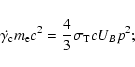
We then consider the rate of energy gains and losses suffered by an electron of a given energy as a consequence of cyclo-synchrotron emission and absorption (Sect. 4), showing that only particles at a single energy can be in equilibrium, where gains equal losses, independently of the slope of the particle distribution that produces the cyclo-synchrotron intensity. Studying the low frequency part of the synchrotron intensity in detail, we show that there are novel features below the Larmor frequencies that appear to have been overlooked in the past. These are presented in Sect. 5. Finally, we draw our conclusions in Sect. 6.
The single particle cyclo-synchrotron power spectrum can be
approximated relatively well by a simple analytical formula. One of the
best approximations was proposed by Ghisellini et al.
(1998)
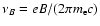 is the Larmor frequency,
 the magnetic field energy density, B the
magnetic field strength,
the magnetic field energy density, B the
magnetic field strength,
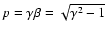 the
dimensionless particle momentum,
the
dimensionless particle momentum,  the particle Lorentz factor
related to the total energy by
the particle Lorentz factor
related to the total energy by
 ,
,
 the particle
velocity in units of c, and
the particle
velocity in units of c, and
 are
constant Thomson cross-section, electron rest mass, and the velocity of
light, respectively.
Equation (1) describes the power, integrated over the emission angles, of
an "average'' electron: i.e. the power has been averaged over the pitch
angle, which is assumed to be distributed isotropically.
In this case the emissivity of a single electron is equal to the
emitted power divided by the solid angle factor
are
constant Thomson cross-section, electron rest mass, and the velocity of
light, respectively.
Equation (1) describes the power, integrated over the emission angles, of
an "average'' electron: i.e. the power has been averaged over the pitch
angle, which is assumed to be distributed isotropically.
In this case the emissivity of a single electron is equal to the
emitted power divided by the solid angle factor  .
We use the term "power spectrum'' to indicate the
emitted power as a function of frequency of an "average'' electron,
in the sense specified above.
This phenomenological formula has three advantages:
.
We use the term "power spectrum'' to indicate the
emitted power as a function of frequency of an "average'' electron,
in the sense specified above.
This phenomenological formula has three advantages:
 up to infinity gives the correct
cooling rate
up to infinity gives the correct
cooling rate
 ]
at
large harmonics (
]
at
large harmonics (
 ).
therefore cannot correctly describe
the emission level below the frequency ;
).
therefore cannot correctly describe
the emission level below the frequency ;
 ,
as we will show;
,
as we will show;
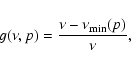
First, the problem with the lower integration limit, ()
is solved by multiplying the formula with the term
 |
(4) |
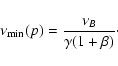
 indicates the minimal emitting frequency of the
first harmonic
in comparison to the original formula and provides
an automatic cut-off at the limiting frequency (
). Note that
this additional term becomes unity for
indicates the minimal emitting frequency of the
first harmonic
in comparison to the original formula and provides
an automatic cut-off at the limiting frequency (
). Note that
this additional term becomes unity for
 ,
thus maintaining the original formula in this regime.
However, we introduce
a
,
thus maintaining the original formula in this regime.
However, we introduce
a  -dependent term in front of the exponential
function (
-dependent term in front of the exponential
function (
![$\exp[f(1-\nu/\nu_B)]$](/articles/aa/full/2006/21/aa4346-05/img42.gif) ), which also depends on the
frequency. Therefore, the integral
over the frequency range of the new formula must be expressed by the exponential
integral.
), which also depends on the
frequency. Therefore, the integral
over the frequency range of the new formula must be expressed by the exponential
integral.
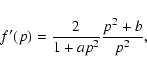
Second, to improve the shape of the spectrum for
,
we
replace the term f(p) by a modified expression f'(p) reading as
 |
(6) |
 ,
and therefore
our approximation becomes equivalent to the original formula in this regime. The necessary
change to the constant
,
and therefore
our approximation becomes equivalent to the original formula in this regime. The necessary
change to the constant
 is discussed in the next section.
Third, the new expression is normalized in order
to yield the correct cooling rate (Eq. (3)) when integrating
over the frequency range. This normalization
is done by multiplying with a factor
 is the exponential integral (e.g. Press et al. 1989).
Finally, the improved approximation for the cyclo-synchrotron power spectrum of
a single particle is given by
 gives the correct cooling rate
for any energy particle;
gives the correct cooling rate
for any energy particle;
 );
);

The approximation of the cyclo-synchrotron emission provided
by Marcowith & Malzac (2003) has been compared with the
results of the precise numerical computations showing discrepancies
that are less than 20%.
Of course, the discrepancy between our continuous approximation and the precise
calculation of (discrete) harmonics can be very large, if
we compare our formula with the emission level between two
well-separated harmonics.
On the other hand, our main goal is to derive a formula that
always provides the correct value of the total emitted energy.
This is achieved through
the normalization term (Eq. (7)) that independent of the
values of the constants a and b, always provides the correct cooling ratio.
This construction of the formula introduces a freedom in manipulating
of the spectral shape. Therefore, by choosing appropriate values
for the parameters a and b
we can approximate the spectra at different energies rather well.
![\begin{figure}
\par\includegraphics[width=7.5cm,clip]{4346fig1.ps}
\end{figure}](/articles/aa/full/2006/21/aa4346-05/img52.gif) |
Figure 1:
The comparison between different approximations of the cyclo-synchrotron
power spectrum of a single particle at four different energies. The thin
solid line in each panel shows the polynomial approximation of the first ten
harmonics provided by Marcowith & Malzac (2003).
The continuous approximation derived in this work is shown by the bold
solid line. The simple approximation proposed by Ghisellini et al.
(1998) is shown by the thin dashed line. Note that the
last approximation gives the correct cooling rate only if integrated
from frequency
(indicated by the vertical dotted line). |
| Open with DEXTER | |
In Fig. 1 we compare our new formula with the old relation and the approximation of the first ten harmonics provided by Marcowith & Malzac (2003). A few general conclusions can be drawn from this comparison:
 ), most of
the power is emitted in the first harmonic, i.e. in a very narrow frequency
range. For this energy range, our approximation shows the biggest disagreement in
comparison to the approximation of the first harmonic. However, in compared to
the old formula, our approach gives significantly better results.
), most of
the power is emitted in the first harmonic, i.e. in a very narrow frequency
range. For this energy range, our approximation shows the biggest disagreement in
comparison to the approximation of the first harmonic. However, in compared to
the old formula, our approach gives significantly better results.
 )
the contribution of
high-order harmonics to the total emission becomes more important. Moreover, with
increasing particle energy, the emission from each harmonic spreads
over a wider frequency range. The spectrum transforms from a set of discrete
lines into a continuous emission. Therefore, our approximation as a continuous
function becomes more and more accurate with increasing particle energy.
)
the contribution of
high-order harmonics to the total emission becomes more important. Moreover, with
increasing particle energy, the emission from each harmonic spreads
over a wider frequency range. The spectrum transforms from a set of discrete
lines into a continuous emission. Therefore, our approximation as a continuous
function becomes more and more accurate with increasing particle energy.
 ),
the emission is dominated by the high-order harmonics. Our approximation
gives the best agreement with the approximation for the first ten harmonics. The
old formula also provides a relatively good approximation in this energy range. However,
the total radiated power calculated from this formula is correct only if
integrated starting from frequency .
Therefore, it cannot describe the spectrum below ,
since it overestimates the total emitted energy if integrated from
The approximation of the first ten harmonics does not
provide a correct value of the total emitted energy, either
due to the fact that the ten harmonics considered
provide a good description only up to
),
the emission is dominated by the high-order harmonics. Our approximation
gives the best agreement with the approximation for the first ten harmonics. The
old formula also provides a relatively good approximation in this energy range. However,
the total radiated power calculated from this formula is correct only if
integrated starting from frequency .
Therefore, it cannot describe the spectrum below ,
since it overestimates the total emitted energy if integrated from
The approximation of the first ten harmonics does not
provide a correct value of the total emitted energy, either
due to the fact that the ten harmonics considered
provide a good description only up to
 ,
while there is still considerable power above, too.
For this particular particle energy range, many more harmonics are needed
to provide the correct value of the total emitted energy.
,
the synchrotron power spectrum can be used; however, this
coefficient also requires some correction, which we describe in the next
section.
,
while there is still considerable power above, too.
For this particular particle energy range, many more harmonics are needed
to provide the correct value of the total emitted energy.
,
the synchrotron power spectrum can be used; however, this
coefficient also requires some correction, which we describe in the next
section.
The synchrotron power spectrum from a single particle in a random magnetic field,
integrated over an isotropic distribution of pitch angles, has been derived
by Crusius & Schlickeiser (1986) and GGS88:
![$\displaystyle P_{\rm s}(\nu, \gamma) = \frac{3 \sqrt{3}}{\pi} \frac{\sigma_{\rm...
...) K_{1/3}(x) -
\frac{3}{5} x \left[ K^2_{4/3}(x)-K^2_{1/3}(x) \right] \right\},$](/articles/aa/full/2006/21/aa4346-05/img57.gif) |
(9) |
 and Ky(x) is the modified Bessel function of
order y.
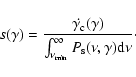
This formula does not provide the correct cooling rate for
and Ky(x) is the modified Bessel function of
order y.
This formula does not provide the correct cooling rate for
 ,
where it overestimates the total emitted energy.
Since the spectral shape, however, is approximately
correct even for low particle energies (
,
where it overestimates the total emitted energy.
Since the spectral shape, however, is approximately
correct even for low particle energies ( ),
we multiply the original formula by a simple correction
term that only depends on particle energy
),
we multiply the original formula by a simple correction
term that only depends on particle energy
 |
(10) |
![\begin{figure}
\par\includegraphics[width=8.3cm,clip]{4346fig2.ps}
\end{figure}](/articles/aa/full/2006/21/aa4346-05/img62.gif) |
Figure 2:
The approximated cyclo-synchrotron power spectrum and the corrected
synchrotron spectrum for .
The thin solid line shows the
approximation of the first ten harmonics provided by Marcowith & Malzac
(2003), the continuous approximation derived in this
paper is shown by the bold line, the synchrotron power spectrum derived
by Crusius & Schlickeiser (1986) and GGS88 is shown by the short
dashed line and the long dashed line shows the corrected synchrotron
spectrum. |
| Open with DEXTER | |
 )
and the
frequency integrated synchrotron power disappears
for
)
and the
frequency integrated synchrotron power disappears
for
 ;
therefore, the correction term reduces to unity
for high particle energies.
;
therefore, the correction term reduces to unity
for high particle energies.
In Fig. 2 we compare our approximated cyclo-synchrotron
power spectrum with the corrected synchrotron spectrum at .
Since
the correction term for the synchrotron formula only depends on the
particle energy, the correction only affects the normalization of the
synchrotron spectrum. The figure also shows, that our approximation joins
relatively smoothly to the corrected synchrotron spectrum at
.
However, in order to achieve this smooth connection, we had to modify the constant a(Eqs. (2) and (7)), that controls the spectrum shape at
.
The constant b in our formula
controls the spectral shape for
 .
Note that
any modification of the parameters a or b changes the spectral shape and
thus, in principle, also the total emitted energy. This problem has
been solved through the normalization term (Eq. (7)), which also contains
the parameters a and b, and thus changes the level of the spectrum in
order to keep the correct value of the total emission.
.
Note that
any modification of the parameters a or b changes the spectral shape and
thus, in principle, also the total emitted energy. This problem has
been solved through the normalization term (Eq. (7)), which also contains
the parameters a and b, and thus changes the level of the spectrum in
order to keep the correct value of the total emission.
We present a simple application for our approximation of the cyclo-synchrotron
power spectrum and the corrected synchrotron emission coefficient.
We analyze the amount of energy gain
corresponding to the cyclo-synchrotron absorption process.
This process may lead to an efficient exchange
of the energy, and may therefore provide a very powerful heating mechanism
for low energy particles. This kind of heating is a stochastic process.
This process of competing radiative cooling and radiative heating, through emission
and re-absorption, respectively, leads to the
accumulation of most particles around the equilibrium energy (
 ),
where heating and cooling are in balance.
In an ideal case, such a competition would transform any initial
particle distribution into a thermal Maxwellian distribution with its maximum at the
equilibrium energy.
),
where heating and cooling are in balance.
In an ideal case, such a competition would transform any initial
particle distribution into a thermal Maxwellian distribution with its maximum at the
equilibrium energy.
![\begin{figure}
\par\includegraphics[width=11.6cm,clip]{4346fig3.ps}
\end{figure}](/articles/aa/full/2006/21/aa4346-05/img67.gif) |
Figure 3:
The efficiency of absorption (solid lines) versus the cooling
efficiency (long dashed lines) for the power law particle energy
distribution (
 , ,
 )
for n=2, n=4, and n=3 (the last only in the
main panel - c). The left upper panel a)
shows the absorption efficiency calculated from the approximation of
the cyclo-synchrotron emission derived by Ghisellini et al.
(1998) and the standard synchrotron emission coefficient
provided by Crusius & Schlickeiser (1986) and GGS98. In the
upper right panel b), we show the absorption efficiency calculated only from
the corrected synchrotron emission. The dash-dot lines on this panel
indicate the result obtained from uncorrected synchrotron emission.
In the main panel c), the new cyclo-synchrotron approximation and the
corrected synchrotron emission were used. The short dashed lines in each
panel indicate a constant value of the absorption efficiency estimated
for )
for n=2, n=4, and n=3 (the last only in the
main panel - c). The left upper panel a)
shows the absorption efficiency calculated from the approximation of
the cyclo-synchrotron emission derived by Ghisellini et al.
(1998) and the standard synchrotron emission coefficient
provided by Crusius & Schlickeiser (1986) and GGS98. In the
upper right panel b), we show the absorption efficiency calculated only from
the corrected synchrotron emission. The dash-dot lines on this panel
indicate the result obtained from uncorrected synchrotron emission.
In the main panel c), the new cyclo-synchrotron approximation and the
corrected synchrotron emission were used. The short dashed lines in each
panel indicate a constant value of the absorption efficiency estimated
for
 (Eq. (17)). The equilibrium energies are
indicated by dots. Note that in the main panel we also show the absorption
efficiency calculated for
(Eq. (17)). The equilibrium energies are
indicated by dots. Note that in the main panel we also show the absorption
efficiency calculated for
 and n=3 (bold dotted
line).
and n=3 (bold dotted
line). |
| Open with DEXTER | |
In our test, we investigated the self-absorption of the radiation field
produced by electrons with a power law energy distribution
 |
(11) |
The emission coefficient for any electron energy distribution  is defined by
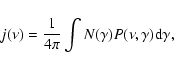 |
(12) |
 is either the cyclo-synchrotron or the corrected synchrotron
power, depending on the value of .
The self-absorption coefficient for any
particle distribution is given by Le Roux (1961)
is either the cyclo-synchrotron or the corrected synchrotron
power, depending on the value of .
The self-absorption coefficient for any
particle distribution is given by Le Roux (1961)
![\begin{displaymath}I(\nu) = C \frac{j(\nu)}{k(\nu)}
\left\{1 - \exp[-k(\nu) R] \right\},
\end{displaymath}](/articles/aa/full/2006/21/aa4346-05/img73.gif) |
(14) |
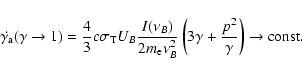
Finally, the absorption or heating efficiency
for any radiation field is described by (Ghisellini & Svensson
1991) as
![\begin{displaymath}\dot{\gamma_{\rm a}}(\gamma) = \frac{1}{m_{\rm e} c^2} \frac{...
...I(\nu)}{2 m_{\rm e} \nu^2} P(\nu, \gamma) {\rm d} \nu
\right].
\end{displaymath}](/articles/aa/full/2006/21/aa4346-05/img74.gif) |
(15) |
(
). In
this case, most of the energy is emitted in the first
harmonic, i.e. in a very narrow frequency range (see Fig. 1 for
 ). Therefore, the cyclo-synchrotron power spectrum can be
approximated by a
). Therefore, the cyclo-synchrotron power spectrum can be
approximated by a  -function
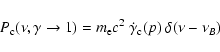 |
(16) |
 (or
),
the heating term must always be constant.
This implies, that there always is only one specific energy value for which
the heating and cooling terms are equal.
To illustrate this point, let us compare this result
with the equilibrium solution [
]
proposed in the "turbulent reactor'' scenario.
In this case, the (analytical) solution is obtained by
considering only the relativistic regime and further assuming an
infinite source (i.e. infinite self-absorption frequency).
In other words, the radiation intensity is assumed to be proportional
to
(or
),
the heating term must always be constant.
This implies, that there always is only one specific energy value for which
the heating and cooling terms are equal.
To illustrate this point, let us compare this result
with the equilibrium solution [
]
proposed in the "turbulent reactor'' scenario.
In this case, the (analytical) solution is obtained by
considering only the relativistic regime and further assuming an
infinite source (i.e. infinite self-absorption frequency).
In other words, the radiation intensity is assumed to be proportional
to  for all frequencies, with a normalization that
depends on the slope of the electron distribution (see also
Rees 1967; and Mc Cray 1969).
If one assumes that the particle distribution is a power law, but
truncated at some low energy
for all frequencies, with a normalization that
depends on the slope of the electron distribution (see also
Rees 1967; and Mc Cray 1969).
If one assumes that the particle distribution is a power law, but
truncated at some low energy
 (to self consistently
use the emissivity and absorption processes in the relativistic regime)
then the radiation field is not
(to self consistently
use the emissivity and absorption processes in the relativistic regime)
then the radiation field is not
 in the entire
frequency range, but only above
in the entire
frequency range, but only above
 .
Below this frequency,
.
Below this frequency,
 (e.g. Rybicki &
Lightman 1979),
making the electrons gain energy (through absorption)
at a slightly higher rate than what is found by assuming
(e.g. Rybicki &
Lightman 1979),
making the electrons gain energy (through absorption)
at a slightly higher rate than what is found by assuming
 .
If instead one assumes a particle distribution extending
towards mildly relativistic energies, then one obtains that
.
If instead one assumes a particle distribution extending
towards mildly relativistic energies, then one obtains that
 ,
for small particle energies
becomes constant and thus clearly larger than
the extrapolation of the
,
for small particle energies
becomes constant and thus clearly larger than
the extrapolation of the
 law.
Concerning the other energy extreme, a source
of finite size becomes transparent at some finite
value of the self-absorption frequency
law.
Concerning the other energy extreme, a source
of finite size becomes transparent at some finite
value of the self-absorption frequency
 .
Therefore the radiation field inside the source
for frequencies close to and above
is
no longer proportional to ,
with a
corresponding decrease in the energy gain rate
for high-energy particles.
These are the reasons a particle distribution
is not an equilibrium
solution.
For any given value of the slope of the particle distribution,
equilibrium is always achieved at only one specific energy.
.
Therefore the radiation field inside the source
for frequencies close to and above
is
no longer proportional to ,
with a
corresponding decrease in the energy gain rate
for high-energy particles.
These are the reasons a particle distribution
is not an equilibrium
solution.
For any given value of the slope of the particle distribution,
equilibrium is always achieved at only one specific energy.
In Fig. 3 we compare the absorption efficiency with
the cooling rate of a power law particle energy distribution from
 to
to
 (
(
 )
with three different slopes (n=2, n=3, and n=4).
We performed the computations using
three different approaches for the calculation of the cyclo-synchrotron
power spectrum in order to test the formulae derived in this work.
)
with three different slopes (n=2, n=3, and n=4).
We performed the computations using
three different approaches for the calculation of the cyclo-synchrotron
power spectrum in order to test the formulae derived in this work.
First, we used the old formula for the cyclo-synchrotron power spectrum
(Eq. (2)) and the standard, uncorrected synchrotron emission
coefficient (Eq. (8)). The result of these computations is
presented in the upper left panel of Fig. 3. In this particular
case, the transition from the old cyclo-synchrotron power spectrum to the
uncorrected synchrotron emission at  ,
produces a clearly visible
discontinuity in the absorption efficiency. The discontinuity is related
to the fact, that the uncorrected synchrotron emission overestimates
the total emitted energy for
,
produces a clearly visible
discontinuity in the absorption efficiency. The discontinuity is related
to the fact, that the uncorrected synchrotron emission overestimates
the total emitted energy for
 .
Moreover, for low
energy particles (p<0.1) the level of the absorption efficiency does not
agree with the constant level estimated from the -approximation
(Eq. (17)), which is indicated by the horizontal lines.
.
Moreover, for low
energy particles (p<0.1) the level of the absorption efficiency does not
agree with the constant level estimated from the -approximation
(Eq. (17)), which is indicated by the horizontal lines.
In the second test, presented on the main panel of Fig. 3,
we used our new approximation of the cyclo-synchrotron power spectrum and the
corrected synchrotron emission coefficient. Since both expressions provide the
correct value for the total emitted energy, the transition
from one spectrum to the other (this time at )
does not
produce any discontinuity in the absorption efficiency. Moreover, with our new
approximation of the cyclo-synchrotron emission, the absorption
efficiency at low particle energies agrees well with the -approximation.
Finally, we used only the corrected synchrotron
emission coefficient for the whole energy range (right panel in Fig. 3).
No discontinuity is present, since we used only one formula. However, this approach,
as well as the old cyclo-synchrotron power spectrum in the first test, do not agree
very well with the -approximation. Note that for low energy
particles, the uncorrected synchrotron emission gives an absorption efficiency
that is a few orders of magnitude larger than the efficiency obtained from the other
approximations.
These three approaches for the calculating of the absorption efficiency, qualitatively give the same results, but differ in the quantitative details, which indicate that the new approximation for the cyclo-synchrotron power spectrum together with the corrected synchrotron emission coefficient, provides the most precise description.
Our tests indeed show that the absorption efficiency for the very low-energy
particles becomes independent of the particle energy and is significantly
higher than the cyclo-synchrotron cooling ratio.
Therefore, self-absorption will
always cause a strong heating of the low-energy particles.
The equilibrium energy depends strongly on the slope of the particle
spectrum.
For n=2 the equilibrium energy is very close to the peak in the
absorption efficiency (the
 curve), which
is related to the maximum in the self-absorbed
spectrum (
).
If the particle spectrum is steeper (n=4), the equilibrium
is taken at a lower energy, but close to the energy
of those particles emitting at the peak of the synchrotron spectrum.
The n=3 case is particularly interesting, since it corresponds
to the previously claimed equilibrium solution.
Contrary to this claim, heating and cooling also balance in this case only
at a specific energy.
This is, on one hand, due to the finite size of the source that limits
the range of possible momenta of electrons that emit and absorb radiation
efficiently and on the other hand, more importantly, due to the trans- and
sub-relativistic regime where low energy particles always
gain more energy than they loose.
curve), which
is related to the maximum in the self-absorbed
spectrum (
).
If the particle spectrum is steeper (n=4), the equilibrium
is taken at a lower energy, but close to the energy
of those particles emitting at the peak of the synchrotron spectrum.
The n=3 case is particularly interesting, since it corresponds
to the previously claimed equilibrium solution.
Contrary to this claim, heating and cooling also balance in this case only
at a specific energy.
This is, on one hand, due to the finite size of the source that limits
the range of possible momenta of electrons that emit and absorb radiation
efficiently and on the other hand, more importantly, due to the trans- and
sub-relativistic regime where low energy particles always
gain more energy than they loose.
The value of the equilibrium energy strongly depends on the minimum
and maximum energy of the particles. In our tests the equilibrium
energy for n<3 depends on the self-absorption frequency ( ).
However, for relatively low value of
).
However, for relatively low value of
 (e.g. 7 instead of 70 in our particular calculations), the emission should be absorbed at
all frequencies of a completely optically thick source. In
such a case, the equilibrium energy depends directly on
.
For
(e.g. 7 instead of 70 in our particular calculations), the emission should be absorbed at
all frequencies of a completely optically thick source. In
such a case, the equilibrium energy depends directly on
.
For  the equilibrium energy depends on the minimal energy
of the particles. In Fig. 3 we show the heating
efficiency calculated for a relatively high value of the minimum
particle energy
.
The
value of the equilibrium energy increases with the increasing
minimum energy.
the equilibrium energy depends on the minimal energy
of the particles. In Fig. 3 we show the heating
efficiency calculated for a relatively high value of the minimum
particle energy
.
The
value of the equilibrium energy increases with the increasing
minimum energy.
Note that for sake of simplicity, our tests assume a stationary state, where the equilibrium energy is simply given by the equilibrium between the heating and cooling rates. In reality, the system evolves and the physical conditions inside the source change. The initial power law, or any other particle distribution, will be transformed into a thermal or quasi-thermal spectrum (see GGS88). Also, the equilibrium energy in such an evolving source may be different from the energy estimated from the simple stationary analysis. This does not change that there is only one preferred equilibrium energy around which most of the particles will be accumulated, forming thermal or quasi-thermal distribution. A complete description of this time dependent evolution will be the main focus of our future study.
The detailed analysis of the cyclo-synchrotron emission shows that the
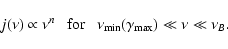
self-absorbed part of the spectrum generated by the electrons with a
power-law energy distribution, is slightly different from the well
known power law relation
.
In this section
we analyze the emission of our homogeneous source, assuming different slopes
of the particle spectrum, and discuss the reasons for the deviations
from the standard
spectrum.
The observed intensity of the emission from the homogeneous spherical
source is given by
![\begin{displaymath}I(\nu) = \frac{j(\nu)}{k(\nu)}
\left(1 - \frac{2}{\tau^2}
\left[1 - {\rm e}^{-\tau} (\tau+1)
\right]
\right),
\end{displaymath}](/articles/aa/full/2006/21/aa4346-05/img97.gif) |
(18) |
 is the optical depth (e.g. Bloom & Marscher 1996).
We calculate the intensity for a range of power law slopes, starting from n=-1
up to n=25/3 with finite steps of
is the optical depth (e.g. Bloom & Marscher 1996).
We calculate the intensity for a range of power law slopes, starting from n=-1
up to n=25/3 with finite steps of
 .
Our results are shown in Fig. 4.
For
.
Our results are shown in Fig. 4.
For  ,
the spectral index is constant at
,
the spectral index is constant at  ,
in almost the whole
self-absorbed part of the spectrum.
In the range
,
in almost the whole
self-absorbed part of the spectrum.
In the range
 ,
the slope
of the spectrum changes from
to
,
the slope
of the spectrum changes from
to  for
for  ,
and
from
to
,
and
from
to
 for
for  .
Above the limiting value
n=5/3, the spectral index remains constant
.
Above the limiting value
n=5/3, the spectral index remains constant
 |
|||
 |
 in this
particular case) close to the low frequency cut-off, the spectrum may go over
into a power law with the index
in this
particular case) close to the low frequency cut-off, the spectrum may go over
into a power law with the index  .
Therefore, in such a case the
self-absorbed part of the spectrum is described by three different indices
.
Therefore, in such a case the
self-absorbed part of the spectrum is described by three different indices
 .
It is relatively easy to understand this
specific evolution of the self-absorbed spectrum, if we analyze the limiting
cases
and
.
It is relatively easy to understand this
specific evolution of the self-absorbed spectrum, if we analyze the limiting
cases
and  .
.
In the first case (), the emission in the whole frequency range is dominated
by the synchrotron radiation produced by the highest energy electrons.
The synchrotron power spectrum of a single particle or
monoenergetic population of the particles can be approximated below the
peak frequency (
 ) by
) by
,
we obtain
 |
(20) |
 |
(21) |
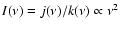 in the self-absorbed part of the spectrum.
![\begin{figure}
\par\includegraphics[width=8cm,clip]{4346fig4.ps}
\end{figure}](/articles/aa/full/2006/21/aa4346-05/img117.gif) |
Figure 4:
The self-absorbed part of the cyclo-synchrotron and the synchrotron
emission from a homogeneous spherical source. The intensities were
calculated for a range of different indices of the power law particle energy
spectrum, starting from
 up to
up to
 with a finite step size
.
The spectrum on the top [
in
almost the
entire frequency range shown] corresponds to n=-1, whereas the
lowest spectrum was calculated for n=25/3. The limiting values of
the spectral indices presented in this
figure are discussed in the Sect. 5.
with a finite step size
.
The spectrum on the top [
in
almost the
entire frequency range shown] corresponds to n=-1, whereas the
lowest spectrum was calculated for n=25/3. The limiting values of
the spectral indices presented in this
figure are discussed in the Sect. 5. |
| Open with DEXTER | |
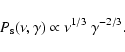
In the second limiting case (), the spectral index above
is
equivalent to the well-known solution (
 ), and we only discuss the
reason for the flattening of the spectrum ()
below this frequency.
Around
the emission is dominated by the cyclo-synchrotron radiation
of the low-energy particles.
However, for
), and we only discuss the
reason for the flattening of the spectrum ()
below this frequency.
Around
the emission is dominated by the cyclo-synchrotron radiation
of the low-energy particles.
However, for
 the emission becomes dominated by the tail of the
synchrotron emission of the high-energy particles.
Therefore, we can again use the approximation of the single-particle power
spectrum (Eq. (19)).
Integrating this approximation over the power law electron spectrum and
neglecting the lower integration boundary, we obtain
the emission becomes dominated by the tail of the
synchrotron emission of the high-energy particles.
Therefore, we can again use the approximation of the single-particle power
spectrum (Eq. (19)).
Integrating this approximation over the power law electron spectrum and
neglecting the lower integration boundary, we obtain
 .
According to Eq. (5) the maximum
energy is directly related to a given frequency
.
According to Eq. (5) the maximum
energy is directly related to a given frequency
 .
Therefore, we obtain
.
Therefore, we obtain
 ,
which gives
,
which gives
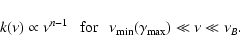 |
(23) |
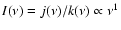 in the self-absorbed part of the
spectrum below the frequency .
in the self-absorbed part of the
spectrum below the frequency .
The low-frequency emission (
)
can be absorbed only by the
high-energy particles. For relatively steep particle spectra, the density of these
particles can be too small to efficiently absorb the low-frequency radiation.
Therefore, the source may again become optically thin and the spectral index
equivalent to the index of the emission coefficient
 (Eq. (22)).
When calculating the spectra presented in Fig. 4, we used our
new formula for the cyclo-synchrotron power spectrum and the corrected
synchrotron-emission coefficient. There is no smooth transition between these formulae at
for
 (see Fig. 2), but this is barely
visible in our spectra. The effects discussed in this section depend mostly on
the synchrotron emission; therefore, the corrected synchrotron emission can be
used in whole energy range to get almost identical results.
(see Fig. 2), but this is barely
visible in our spectra. The effects discussed in this section depend mostly on
the synchrotron emission; therefore, the corrected synchrotron emission can be
used in whole energy range to get almost identical results.
The modifications of the self-absorbed spectrum that we discuss appear at
relatively low frequencies.
Therefore, in most astrophysical objects such effects are not observable.
However, some effects might be visible in some specific physical conditions.
One example might be the synchrotron radiation (in its self-absorbed
portion) produced by steep power-law distributions of particles
in highly magnetized sources (
 [G]).
Note that isotropic distribution of the pitch-angles, assumed in order
to derive the emissivity formulae presented in this paper, may not always
be valid, especially in very highly magnetized sources.
[G]).
Note that isotropic distribution of the pitch-angles, assumed in order
to derive the emissivity formulae presented in this paper, may not always
be valid, especially in very highly magnetized sources.
We have derived a new approximation for the cyclo-synchrotron power spectrum of a
single particle and compared it with the approximation to ten first harmonics of
the cyclo-synchrotron emission provided recently by Marcowith & Malzac
(2003).
In comparison to the other approaches, our approximation self-consistently
provides the correct value of the total emitted energy over the whole range of
the particle energies. Moreover, our approach
describes the spectrum of the emission in the range
 relatively well.
Finally, the approximation provides a relatively smooth connection with the corrected
synchrotron emission at
for .
relatively well.
Finally, the approximation provides a relatively smooth connection with the corrected
synchrotron emission at
for .
All these results are useful when one needs fast computational tools to derive the cyclo-synchrotron emission and absorption, instead of using the exact expressions, which require much more computing time.
The application we will pursue is to study in detail the evolution
of the emitting particle distribution subject to acceleration and/or injection
of new particles, radiative and Coulomb cooling, and heating due to the
synchrotron self-absorption.
For the moment, we have instead analyzed a simpler process that, however,
requires a careful treatment of the trans-relativistic regime.
We have demonstrated that a power-law distribution of electrons
emitting and absorbing cyclo-synchrotron photons can never
be a steady solution.
Energy losses and gains always equal each other at a particular energy
,
and not over a range of energies.
This is contrary to previous claims that a distribution
can be an equilibrium solution (e.g. Kaplan & Tsytovich 1973).
The reason is that, at low enough, sub- or trans-relativistic energies,
energy gains always exceed losses and, at the other extreme, the absorption becomes
less efficient because the source becomes transparent (unless it is infinite
in size).
Particles therefore will tend to accumulate at
,
changing the shape
of the energy distribution they initially belonged to.
For the steep particle spectrum ( ), the equilibrium energy (
)
is small. This motivated our detailed study of the trans-relativistic
cyclo-synchrotron regime.
However, we have shown that different approximations lead to very
similar results for the amount of energy gains experienced by
the particle.
This is due to the fact that in calculating this quantity we must consider
frequency-integrated expressions, with the consequent loss of details
concerning the shape of the power spectrum.
What matters is mainly that the frequency integrated spectrum equals
the correct cooling rate (i.e.
), the equilibrium energy (
)
is small. This motivated our detailed study of the trans-relativistic
cyclo-synchrotron regime.
However, we have shown that different approximations lead to very
similar results for the amount of energy gains experienced by
the particle.
This is due to the fact that in calculating this quantity we must consider
frequency-integrated expressions, with the consequent loss of details
concerning the shape of the power spectrum.
What matters is mainly that the frequency integrated spectrum equals
the correct cooling rate (i.e.
 ).
).
Exchanging photons through emission and absorption allows particles to exchange energy, independently of Coulomb collisions. This is a very important thermalization process in those magnetized, hot and rarefied plasma where Coulomb collisions are rare. Cyclo-synchrotron absorption transforms an initially non-thermal distribution into a Maxwellian in just a few cooling times (GGS88).
Acknowledgements
We thank the anonymous referee for a number of constructive comments that improved the paper. G.G. always remembers with deep gratitude the friendship with Roland Svensson who passed away prematurely. This work is to partly acknowledge large number of ideas and work that he initiated, but did not succeed in publishing. We acknowledge the EC funding under contract HPRCN-CT-2002-00321 (ENIGMA network).

![$\displaystyle \frac{4}{3} \frac{\sigma_{\rm T} c U_B}{\nu_B} p^2
f(p) \exp\left[f(p)
\left(1 - \frac{\nu}{\nu_B} \right)\right],$](/articles/aa/full/2006/21/aa4346-05/img21.gif)

![$\displaystyle c(p) = \left\{ \exp \left[ f'(p) \left( 1-\frac{\nu_{\rm min}}{\n...
...f'(p)]
{\rm Ei}_1\left[f'(p) \frac{\nu_{\rm min}}{\nu_B} \right] \right\}^{-1},$](/articles/aa/full/2006/21/aa4346-05/img46.gif)
![\begin{displaymath}P_{\rm c}(\nu, p) = \frac{4}{3} \frac{\sigma_{\rm T} c U_B}{\...
...p\left[f'(p) \left(1 - \frac{\nu}{\nu_B}
\right)\right]\cdot
\end{displaymath}](/articles/aa/full/2006/21/aa4346-05/img48.gif)
![\begin{displaymath}k(\nu) = \frac{1}{8 \pi m_{\rm e} \nu^2} \int \frac{N(\gamma)...
...d\gamma}\left[ \gamma p P(\nu, \gamma) \right]
\rm d \gamma.
\end{displaymath}](/articles/aa/full/2006/21/aa4346-05/img72.gif)