A&A 450, 1071-1075 (2006)
DOI: 10.1051/0004-6361:20054184
Cooling of a rotating strange star in the color
superconducting phase with a crust
Y. W. Yu - X. P. Zheng
Institute of Astrophysics, Huazhong Normal University,
Wuhan 430079, PR China
Received 9 September 2005 / Accepted 14 December 2005
Abstract
Aims. We investigate the thermal evolution of strange stars in the 2-flavor color superconductivity and color-flavor locked phases under the influence of deconfinement heating.
Methods. Due to the spin-down of strange stars, the nuclear matter at the base of the thin crusts dissolves into quarks, releasing energy to heating the stars. On the other hand, the neutrino emissivities and specific heat involving pairing quarks are suppressed by the large pairing gap in color superconducting phases. Then the thermal evolution equation of strange stars is calculated.
Results. Deconfinement heating delays the cooling of strange stars considerably. The presence of color superconductivity with a large gap enhances this effect. Especially, in the color-flavor locked phase, the stars cannot be very cold at an early age but they cool slowly. For the stars with strong magnetic fields, a significant heating period could exist during the first several ten or hundred years. In addition, we reckoned that a possible theoretical limit line, which is determined by the competition between deconfinement heating and surface photon cooling, may indicate the upper limit temperature that isolated compact stars should not exceed.
Conclusions. Deconfinement heating is important for the thermal evolution of strange stars and is especially determinant for the stars in color-flavor locked phase which could show characteristic cooling behavior under this heating effect.
Key words: stars: neutron - stars: evolution - dense matter - pulsars: general
Cooling simulation based on interior physics is of significant
interest for the research of compact stars. In accordance with
nuclear physics, a quark matter core could be produced in the
interior of compact stars (hybrid star) and even strange quark
matter stars (strange star, SS) may exist. Phenomenological and
microscopic studies have confirmed that quark matter at a sufficiently high density, as in compact stars, undergoes a phase transition into a color superconducting state, which are typical
cases of the 2-flavor color superconductivity (2SC) and color-flavor
locked (CFL) phases (Shovkovy 2004; Alford 2004). Theoretical
approaches also concur that the superconducting order parameter,
which determines the gap  in the quark spectrum, lies
between 10 and 100 MeV for baryon densities existing in the interiors
of compact stars. Recently, the cooling of hybrid stars with color
superconducting quark cores have been investigated. Stars with CFL cores behave similarly to ordinary neutron stars (Shovkovy & Ellis 2002). And with a designed 2SC+X phase, hybrid
stars could also explain the cooling data properly (). In these cases, the thermal properties of the quark
cores are suppressed by the large gap, and the hadronic matter parts
of the stars play an important role in their cooling history.
in the quark spectrum, lies
between 10 and 100 MeV for baryon densities existing in the interiors
of compact stars. Recently, the cooling of hybrid stars with color
superconducting quark cores have been investigated. Stars with CFL cores behave similarly to ordinary neutron stars (Shovkovy & Ellis 2002). And with a designed 2SC+X phase, hybrid
stars could also explain the cooling data properly (). In these cases, the thermal properties of the quark
cores are suppressed by the large gap, and the hadronic matter parts
of the stars play an important role in their cooling history.
The thermal evolution of SSs has also been extensively discussed. In
early works, it was generally accepted that the surface temperature
of SSs should be lower than neutron stars at the same age due to the
quark direct Urca (QDU) processes
(Page 1992; Pizzochero 1991; Alcock et al. 1988; Schaab et al. 1996).
However, since the electron fraction could be small or even vanish,
the QDU processes may be switched off. The cooling of SSs dominated
by the quark modified Urca (QMU) and quark bremsstrahlung (QB)
processes can be slower than neutron stars with standard cooling
(Schaab et al. 1997b,a). Of course, a color
superconducting phase could occur in SSs, and its effect on the
cooling of the stars is a significant issue. Blaschke et al. (2000)
show that the cooling of the stars in the 2SC phase (2SS hereafter)
is compatible with existing X-ray data but that the stars in CFL
phase (CSS hereafter) cool down too rapidly, which disagrees with
the data. However, in those calculations an important factor, as
described below, is ignored.
An SS, both in normal phase and in color superconducting phase, can
sustain a tiny nuclear crust with a maximum density below neutron
drip (
 )
and mass
)
and mass
 due to the existence of a strong
electric field on the quark surface
(Zheng & Yu 2006; Alcock et al. 1986; Usov 2004). The spin-down of the
star makes the matter at the bottom of the crust compress. As soon
as the density exceeds neutron drip, the surplus matter in the crust
falls into the quark core in the form of neutrons. Consequently, the
engulfed neutrons dissolve into quarks, and the released energy
during this process leads to a so-called deconfinement heating (DH).
Yuan & Zhang (1999) claim that DH delays the cooling of SSs in normal
phase (NSS) and may even lead to a slight increase in the
temperature at the early ages of a star under specific conditions.
due to the existence of a strong
electric field on the quark surface
(Zheng & Yu 2006; Alcock et al. 1986; Usov 2004). The spin-down of the
star makes the matter at the bottom of the crust compress. As soon
as the density exceeds neutron drip, the surplus matter in the crust
falls into the quark core in the form of neutrons. Consequently, the
engulfed neutrons dissolve into quarks, and the released energy
during this process leads to a so-called deconfinement heating (DH).
Yuan & Zhang (1999) claim that DH delays the cooling of SSs in normal
phase (NSS) and may even lead to a slight increase in the
temperature at the early ages of a star under specific conditions.
We argue that the heating effect on the thermal evolution of stars
in color superconducting phase is huge compared to NSSs because of
the suppression of specific heat and neutrino emission involving
pairing quarks. Therefore, focus on the effects of DH on the cooling
of 2SSs and CSSs in this paper. Our paper is arranged as follows. We
recall neutrino emissivities and specific heat, color
superconductivity, and the DH mechanism in Sects. 2-4,
respectively. The cooling curves and the corresponding explanations
are presented in Sect. 5. Section 6 contains our conclusion and discussions.
The emissivity associated with the QDU processes
 and
and
 of quarks is (Iwamoto 1982)
 |
(1) |
where
 is the strong coupling constant,
 is
baryon density and
is
baryon density and
 the
nuclear saturation density, and T9 is the temperature in units of
the
nuclear saturation density, and T9 is the temperature in units of
 .
The electron fraction
.
The electron fraction
 is small and even vanishes at a certain set
of parameters of
,
and s-quark mass
is small and even vanishes at a certain set
of parameters of
,
and s-quark mass  (Duncan et al. 1983). It has not yet been considered that the
contribution to the emissivity by the s-u reaction, which
is suppressed by an extra factor
(Duncan et al. 1983). It has not yet been considered that the
contribution to the emissivity by the s-u reaction, which
is suppressed by an extra factor
 compared to the d-u reaction (Duncan et al. 1983), where
 is the Cabibbo angle. When the QDU processes are switched off due to a small electron fraction
(
is the Cabibbo angle. When the QDU processes are switched off due to a small electron fraction
(
 .), the
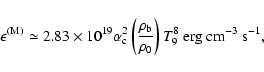
contribution to the emissivities by the QMU processes
.), the
contribution to the emissivities by the QMU processes
 and QB processes
 dominate. These emissivities were also estimated as (Iwamoto 1982)
 |
(2) |
 |
(3) |
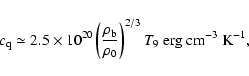
In order to compute the thermal evolution of the stars, we also need
the the specific heat involving quarks and electrons written as
(Iwamoto 1982; Blaschke et al. 2000)
 |
(4) |
 |
(5) |
Since the mass of the crust is very small,
,
compared with the total mass of the star, its contribution to neutrino emissivity and specific heat can be
neglected (Lattimer et al. 1994; ). Here we
also ignore the neutrino emissivity and specific heat due to the
photon-gluon excitation, because this excitation is only important
for a temperature higher than
 (Blaschke et al. 2000),
which is much higher than the typical temperature in our calculation.
(Blaschke et al. 2000),
which is much higher than the typical temperature in our calculation.
It is widely accepted that the color superconducting phase is the
real ground state of quantized chromodynamics at asymptotically
large densities. At a certain range of the quark chemical potential
the quark-quark interaction is attractive, driving the pairing
between the quarks
(Shovkovy 2004; Alford et al. 1998; Rapp et al. 1998; Alford et al. 1999; Alford & Reddy 2003).
Because of the pairing, QDU processes are suppressed by a factor
 ,
and QMU & QB processes are suppressed by a factor
,
and QMU & QB processes are suppressed by a factor
 for
for
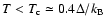 (Blaschke et al. 2000). In the 2SC phase, two color states of u and d quarks pair, whereas the s quark is unpaired. To be specific, we suppose that blue-green and green-blue u-d quarks are paired,
whereas red u and d quarks (
(Blaschke et al. 2000). In the 2SC phase, two color states of u and d quarks pair, whereas the s quark is unpaired. To be specific, we suppose that blue-green and green-blue u-d quarks are paired,
whereas red u and d quarks (
 ) remain
unpaired. As a consequence, the QDU processes on the red (unpaired)
quarks, as
) remain
unpaired. As a consequence, the QDU processes on the red (unpaired)
quarks, as
 ,
as well as QMU,
,
as well as QMU,
 ,
and QB,
,
and QB,
 ,
are not
blocked, whereas other processes involving paired quarks are blocked
out by a large pairing gap. Therefore, it can be estimated that the
neutrino emissivities in 2SC phase are reduced by about one magnitude (Blaschke et al. 2000). On the other hand, the neutrino processes involving all flavors are suppressed in the CFL phase by
the exponential factors. For both phases where the specific heat
contributed by the paired quarks is also changed, we apply the
formula (Blaschke et al. 2000)
,
are not
blocked, whereas other processes involving paired quarks are blocked
out by a large pairing gap. Therefore, it can be estimated that the
neutrino emissivities in 2SC phase are reduced by about one magnitude (Blaschke et al. 2000). On the other hand, the neutrino processes involving all flavors are suppressed in the CFL phase by
the exponential factors. For both phases where the specific heat
contributed by the paired quarks is also changed, we apply the
formula (Blaschke et al. 2000)
![\begin{displaymath}%
c_{s\rm q} = 3.2c_{\rm q}\left({\frac{T_{\rm c}}{T}}\right)...
...^2\right]{\rm
exp}\left(-\frac{\Delta}{k_{\rm B}T}\right)\cdot
\end{displaymath}](/articles/aa/full/2006/18/aa4184-05/img33.gif) |
(6) |
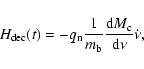
The effect of DH is determined by the number of neutrons engulfed by
the quark core, in other words, the variation in the mass of the
crust. The total heat released per time unit as a function of t is
 |
(7) |
where  ,
the heat release per absorbed neutron, is expected to
be in the range
,
the heat release per absorbed neutron, is expected to
be in the range
 (Haensel & Zdunik 1991), and
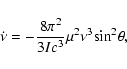
  is the mass of baryon. Assuming the spin-down is induced by
the magnetic dipole radiation, the evolution of the rotation
frequency
is the mass of baryon. Assuming the spin-down is induced by
the magnetic dipole radiation, the evolution of the rotation
frequency  is given by
 |
(8) |
where I is the stellar moment of inertia,
 is the magnetic dipole moment, and
  is the inclination angle
between magnetic and rotational axes. The mass of the crust
is the inclination angle
between magnetic and rotational axes. The mass of the crust  is calculated by a quadratic function of
by
Glendenning & Weber (1992), whose result describes the cases with
intermediate frequencies (
is calculated by a quadratic function of
by
Glendenning & Weber (1992), whose result describes the cases with
intermediate frequencies (
 )
very well.
Zdunik et al. (2001) improve the calculation nearly up to the
Keplerian frequency using a polynomial including terms of higher
order in .
The mass of the crust reads (Zdunik et al. 2001)
)
very well.
Zdunik et al. (2001) improve the calculation nearly up to the
Keplerian frequency using a polynomial including terms of higher
order in .
The mass of the crust reads (Zdunik et al. 2001)
 |
(9) |
where
 Hz, and
 is the mass of the crust in the static case.
The thermal evolution with DH of a star is determined by the equation
 |
(10) |
where C is the total specific heat,  the neutrino
luminosity, and
the neutrino
luminosity, and
 the surface photon luminosity given by
 |
(11) |
where  is the Stefan-Boltzmann constant and
  the
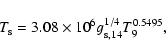
surface temperature. The internal structure of SSs can be regarded
as temperature-independent (Glen & Sutherland 1980), and the surface
temperature is related to internal temperature by a coefficient
determined by the scattering processes occurring in the crust. In
the work of Blaschke et al. (2000), this relation is given by a simple expression
the
surface temperature. The internal structure of SSs can be regarded
as temperature-independent (Glen & Sutherland 1980), and the surface
temperature is related to internal temperature by a coefficient
determined by the scattering processes occurring in the crust. In
the work of Blaschke et al. (2000), this relation is given by a simple expression

 10-2 T, but following Yuan & Zhang (1999), we apply an accurate formula that is
demonstrated by Gudmundsson et al. (1983),
10-2 T, but following Yuan & Zhang (1999), we apply an accurate formula that is
demonstrated by Gudmundsson et al. (1983),
 |
(12) |
where
 is the proper surface gravity of the star in units
of
is the proper surface gravity of the star in units
of
 ;
or for a recent version see the result of Potekhin et al. (1997).
;
or for a recent version see the result of Potekhin et al. (1997).
In our calculations, to be specific, we consider a model of canonical SS of
 at a constant density, which is a very good approximation for SSs of mass
 (Alcock et al. 1986). As used by Blaschke et al. (2000), we take
 ,
,
 ,
,
 for
for
 ,
which is a representative set of parameters for which the QDU processes contribute to the cooling, whereas
,
which is a representative set of parameters for which the QDU processes contribute to the cooling, whereas
 ,
,
 ,
,
 for
for
 .
And we also choose
.
And we also choose
 MeV and
 ,
the
initial temperature
,
the
initial temperature
 ,
initial period
,
initial period
 ,
and the magnetic tilt angle
,
and the magnetic tilt angle
 .
The
gravitational red-shift is also taken into account. Then the
effective surface temperature detected by a distant observer is
.
The
gravitational red-shift is also taken into account. Then the
effective surface temperature detected by a distant observer is
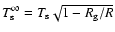 ,
where
,
where  is the
gravitational stellar radius.
is the
gravitational stellar radius.
We plot the cooling curves without DH of NSSs (solid curves), 2SSs (dotted curves), and CSSs (dashed curves) in Fig. 1. And the observational data, which are taken from Tables 1 and 2 in
Page et al. (2004), are also shown in order to give the
readers a feeling of the position of the illustrative curves in the
logarithm
 plane. But we will not try to fit the
data carefully in this paper. It shows that the cooling history of
2SSs are similar to NSSs, whereas CSSs become very cold at an early
age since the specific heat is very small, cooler than 104.5 K
after 1000 yr for
or several hours for
(this curve is not shown in Fig. 1). We can see the curves of CSSs
are very far from the data. These conclusions are also indicated by
Blaschke et al. (2000) using the relation of
10-2 T.
plane. But we will not try to fit the
data carefully in this paper. It shows that the cooling history of
2SSs are similar to NSSs, whereas CSSs become very cold at an early
age since the specific heat is very small, cooler than 104.5 K
after 1000 yr for
or several hours for
(this curve is not shown in Fig. 1). We can see the curves of CSSs
are very far from the data. These conclusions are also indicated by
Blaschke et al. (2000) using the relation of
10-2 T.
![\begin{figure}
\par\includegraphics[width=7cm,clip]{4184fig2.eps}\end{figure}](/articles/aa/full/2006/18/aa4184-05/Timg77.gif) |
Figure 2:
Cooling curves of 2SSs with DH for various magnetic fields
(curve a: 1012 G, b: 1011 G, c: 1010 G, d: 109 G, e:
108 G) and the curves without DH (thick curve). |
| Open with DEXTER |
Figure 2 shows the cooling behaviors of 2SSs with DH for various
magnetic fields (
108-1012 G). And the analogs for NSSs can be
seen in Yuan & Zhang (1999). We can see DH delays the stellar cooling
considerably. As discussed by Yuan & Zhang (1999), the stronger the
magnetic field the more rapid the spin-down, and most of the nuclear
matter in the crust dissolves during an earlier and shorter time.
For a 2SS with a strong (B=1012 G) field and small electron
fraction (dotted curve a), a distinct heating period exists in the
first several ten years. And in the cases of weak fields
(B<1010 G), stars could maintain high temperatures even at older
ages (>106 yr). In the following paragraph, we discuss in
detail how DH induces temperature rise and delays cooling.
![\begin{figure}
\par\includegraphics[width=7cm,clip]{4184fig3.eps}\end{figure}](/articles/aa/full/2006/18/aa4184-05/Timg78.gif) |
Figure 3:
Cooling curves of CSSs with DH for a strong (B=1011 G)
and a weak (B=109 G) magnetic field and the curve without DH
(thick curve). |
| Open with DEXTER |
We here pay more attention to the situation of CSSs because we argue
the existence of a marked heating effect relative to the reduced
emissions. To be clear, Fig. 3 shows the cooling curves of CSSs with DH for both a strong (B=1011 G) and a weak (B=109 G) magnetic field. It is obvious that the cooling curves are changed dramatically by DH. The strong magnetic field induces a rapid
spin-down of the star at the earliest ages, which could enhance the
effect of DH to make it greater than the cooling effect at the
beginning. As a result, the temperature should rise due to the
surplus heat until the increasing luminosity equals the heating
effect,
 ,
so a net heating period appears at
the earliest ages. On the other hand, the temperature of the star
with a weak field decreases but does not rise, due to the relative
greater cooling effect at the start until the thermal release is
compensated for by DH entirely:
.
In this
case, since the confinement energy deposited in the crust is
released slowly to heat the star, the star with a weak field can
maintain a high temperature even at older ages (>
,
so a net heating period appears at
the earliest ages. On the other hand, the temperature of the star
with a weak field decreases but does not rise, due to the relative
greater cooling effect at the start until the thermal release is
compensated for by DH entirely:
.
In this
case, since the confinement energy deposited in the crust is
released slowly to heat the star, the star with a weak field can
maintain a high temperature even at older ages (>
 ). To conclude, both the stars with strong and weak fields, after several hundred years (the specific value of the time is
determined by the specific condition of the star), could arrive at
an equilibrium between the cooling and heating effects. From then on, the temperature could only be reduced in order to rebuild the equilibrium when
). To conclude, both the stars with strong and weak fields, after several hundred years (the specific value of the time is
determined by the specific condition of the star), could arrive at
an equilibrium between the cooling and heating effects. From then on, the temperature could only be reduced in order to rebuild the equilibrium when
 deceases with time, so the cooling of
the stars is delayed. Due to this delay, the curves of CSSs cannot
be in conflict with observational data as shown in Fig. 3. Since the
neutrino emission involving all quarks in CSSs is suppressed, the
equilibrium discussed above is only determined by DH and photon
emission, and has hardly anything to do with the interior thermal
properties of the star. Therefore, the dependence of the cooling on
the electron fraction is eliminated after the first several hundred years. Going back to Fig. 2, we see that the mechanism described
above also influences the cooling of 2SSs. However, since the
equilibrium (
deceases with time, so the cooling of
the stars is delayed. Due to this delay, the curves of CSSs cannot
be in conflict with observational data as shown in Fig. 3. Since the
neutrino emission involving all quarks in CSSs is suppressed, the
equilibrium discussed above is only determined by DH and photon
emission, and has hardly anything to do with the interior thermal
properties of the star. Therefore, the dependence of the cooling on
the electron fraction is eliminated after the first several hundred years. Going back to Fig. 2, we see that the mechanism described
above also influences the cooling of 2SSs. However, since the
equilibrium (
 )
should involve
neutrino luminosity, which is larger at high temperature whereas
smaller at low temperature than photon luminosity, the evolution of 2SSs may be more complicated than it is for CSSs (see Fig. 4 for detail), i.e., the cooling history can be roughly divided into a neutrino cooling stage (
)
should involve
neutrino luminosity, which is larger at high temperature whereas
smaller at low temperature than photon luminosity, the evolution of 2SSs may be more complicated than it is for CSSs (see Fig. 4 for detail), i.e., the cooling history can be roughly divided into a neutrino cooling stage (
 )
and a photon
cooling stage (
)
and a photon
cooling stage (
 ), and the cooling is
sensitive to the electron fraction; and the moment when the
equilibrium is achieved could be very different for different
magnetic fields.
), and the cooling is
sensitive to the electron fraction; and the moment when the
equilibrium is achieved could be very different for different
magnetic fields.
![\begin{figure}
\par\includegraphics[width=7cm,clip]{4184fig4.eps}\end{figure}](/articles/aa/full/2006/18/aa4184-05/Timg85.gif) |
Figure 4:
The same as Fig. 2 but for CSSs. The dash-dotted curve is the limit line,
and the band-like structure is supposed to reflect the uncertainty of . |
| Open with DEXTER |
Figure 4 shows the cooling curves of CSSs with different magnetic
fields. We can see the cooling of the stars with any field is
delayed, just as we find in Fig. 2. However, in comparison with
Fig. 2, there is a question of why the temperature rise of CSSs can
be more significant than the one of 2SSs. For both CSSs and 2SSs, as
discussed in the previous paragraph, the reason for the temperature
rise is that the heating effect is greater than the cooling effect
at the beginning:
 for CSSs and
 for 2SSs. Since the neutrino term is absent
for CSSs, the initial difference between the heating term and
luminosity of CSSs is much larger than the one of 2SSs with the same
magnetic field and initial temperature. On the other hand, with the
rise in temperature, the increase in the luminosity is proportional
to T2.2 for CSSs (see Eqs. (11), (12)) but to T8 for 2SSs
with a small electron fraction (see Eqs. (2), (3), where the term of
photon luminosity is ignored since
at high
temperature). Therefore, 2SSs can achieve the equilibrium easily
after a comparatively small temperature rise, but the magnitude of
the rise for CSSs needs to be much larger. In addition, the needed
magnetic field intensity to induce the temperature rise of CSSs
could be smaller than 2SSs since the initial cooling effect of CSSs
is smaller.
for 2SSs. Since the neutrino term is absent
for CSSs, the initial difference between the heating term and
luminosity of CSSs is much larger than the one of 2SSs with the same
magnetic field and initial temperature. On the other hand, with the
rise in temperature, the increase in the luminosity is proportional
to T2.2 for CSSs (see Eqs. (11), (12)) but to T8 for 2SSs
with a small electron fraction (see Eqs. (2), (3), where the term of
photon luminosity is ignored since
at high
temperature). Therefore, 2SSs can achieve the equilibrium easily
after a comparatively small temperature rise, but the magnitude of
the rise for CSSs needs to be much larger. In addition, the needed
magnetic field intensity to induce the temperature rise of CSSs
could be smaller than 2SSs since the initial cooling effect of CSSs
is smaller.
We link the points where the cooling curves turn down together as a line (dash-dotted curve) in logarithm
plane in Fig. 4. The temperature indicated by the line is expressed as a power form

 .
It
may be well-founded that any other cooling curves of isolated stars
(to our knowledge), regardless of star models, will be below this
line due to the high heating effect and low cooling effect in CSSs.
Hence we reckon that the indicated temperature may be the upper
limit to what compact stars can reach at a given age. We must
emphasize that this line found from the cooling curves of CSSs is
only determined by the equilibrium between DH and surface photon cooling.
.
It
may be well-founded that any other cooling curves of isolated stars
(to our knowledge), regardless of star models, will be below this
line due to the high heating effect and low cooling effect in CSSs.
Hence we reckon that the indicated temperature may be the upper
limit to what compact stars can reach at a given age. We must
emphasize that this line found from the cooling curves of CSSs is
only determined by the equilibrium between DH and surface photon cooling.
![\begin{figure}
\par\includegraphics[width=7cm,clip]{4184fig5.eps}\end{figure}](/articles/aa/full/2006/18/aa4184-05/Timg91.gif) |
Figure 5:
Cooling curves of CSSs with
 for different
gaps. The thick curves correspond to NSSs.
for different
gaps. The thick curves correspond to NSSs. |
| Open with DEXTER |
Finally, we present the cooling curves of CSSs for different gaps in
Fig. 5. It can be seen that the cooling curves are almost independent
of the gap on a very large parameter scale (
 ).
).
We have studied the cooling behaviors of rotating SSs in the
presence of color superconductivity by considering the effect of DH.
The thermal evolution of SSs is now quite different from previous
results, because DH can delay the cooling, and color
superconductivity enhances this effect significantly, especially in
the CFL phase. For CSSs, the previous discussions point out that the
specific heat is determined by electrons since the contribution of
quarks has been suppressed. This reduction leads to a very rapid
cooling that disagrees with observational data
(Blaschke et al. 2000). However, when we consider the effect of DH,
the results should imply that the cooling curves could not be in
serious conflict with the data. We even find it is possible that
CSSs reach a higher temperature than other kinds of compact stars in
their cooling history. The limit temperature line should illustrate
this conjecture.
To be specific, as pointed out by Yuan & Zhang (1999), a temperature
rising period could exist at the early ages due to the DH with a strong magnetic field. And we argue that the presence of color superconductivity may lead to a significant rise. Yuan & Zhang (1999)
propose that this phenomena may be a signature of the existence of
SS. In our opinion, if the theory of the color superconductivity is
reliable, observing a young and quite hot source may be possible,
although we also note that an important so-called brightness
constraint has been suggested recently by Grigorian (2005),
who argues that it is unlikely that objects with a given age are
hotter than those already observed. Statistically, this constraint
is a good finding, but we think that in theory the possibility of
the existence of young hotter stars still cannot be rejected
absolutely. Of course, for our model, the early evolution also may
be changed to a certain extent if we consider the formation of the
crust of the star. On the other hand, for those stars with weak
fields (<1010 G), our results show that they can maintain a high
temperature at older ages (>106 yr). Unfortunately, these older
sources with weak fields also have been not detected up to now (see,
for example, Popov et al. (2003) for the list of close-by
cooling pulsars). To summarize, at the present point of
observations, there is no evidence of the existence of extra hot
sources. It may imply that the model needs some further
improvements. However, it still should be emphasized that the
various heating mechanisms in compact stars need to be given more
importance when we talk about the star's cooling when using the
so-called standard scenario.
Acknowledgements
We would like to thank Prof. D. F. Hou for the useful discussion. We are especially indebted to the
anonymous referee for his/her useful comments that helped us to
improve the paper. This work was supported by the NFSC under Grant Nos. 10373007 and 90303007.
- Alcock, C.,
Farhi, E., & Olinto, A. 1986, ApJ, 310, 261 [NASA ADS] [CrossRef]
- Alcock, C.,
& Olinto, A. 1988, Ann. Rev. Nucl. Sci., 38, 161 [NASA ADS]
- Alford, M.
2004, J. Phys. G, 30, 441 [NASA ADS] [CrossRef]
- Alford, M.,
Rajagopal, K., & Wilczek, F. 1998, Phys. Lett. B, 422, 247 [NASA ADS]
- Alford, M.,
Rajagopal, K., & Wilczek, F. 1999, Nucl. Phys. B, 537, 443 [NASA ADS] [CrossRef]
- Alford, M.,
& Reddy, S. 2003, Phys. Rev. D, 67, 074024 [NASA ADS] [CrossRef]
- Blaschke,
D., & Klähn, T., & Voskresensky, D. N. 2000, ApJ,
533, 406 [NASA ADS] [CrossRef] (In the text)
- Duncan, R. C.,
Shapiro, S. L., & Wasserman, I. 1983, ApJ, 267, 358 [NASA ADS] [CrossRef] (In the text)
- Glen, G., &
Sutherland, P. 1980, ApJ, 239, 671 [NASA ADS] [CrossRef] (In the text)
-
Glendenning, N. K., & Weber, F. 1992, ApJ, 400, 647 [NASA ADS] [CrossRef] (In the text)
-
Grigorian, H., Blaschke, D., & Voskresensky, D. 2005, Phys.
Rev. C, 71, 045801 [NASA ADS] [CrossRef]
-
Grigorian, H. 2005 [arXiv:astro-ph/0507052]
(In the text)
- Gudmundsson, E. H., Pethick, C.
J., & Epstein, R. I. 1983, ApJ, 272, 286 [NASA ADS] [CrossRef] (In the text)
- Haensel, P.,
& Zdunik, J. 1991, in Strange Quark Matter in Physics and
Astrophysics, ed. J. Madsen, & P. Haensel (Nucl. Phys. B
[Proc. Suppl.], 24), 139
(In the text)
- Iwamoto, N.
1982, Ann. Phys., 141, 1 (In the text)
- Lattimer,
J. M., Van Riper, K. A., Prakash, M., & Prakash, M. 1994, ApJ,
425, 802 [NASA ADS] [CrossRef]
- Page, D. 1992, in
Proc. of the work-shop on High Energy Phenomenology, ed. M.
Péréz, & R. Huerta (Singapore: World Scientific),
347
- Page, D.,
Lattimer, J. M., Prakash, M., & Steiner, A. W. 2004, ApJS,
155, 623 [NASA ADS] [CrossRef] (In the text)
-
Pizzochero, P. M. 1991, Phys. Rev. Lett., 66, 2425 [NASA ADS] [CrossRef]
- Potekhin,
A. Y., Chabrier, G., & Yakovlev, D. G. 1997, A&A, 323,
415 [NASA ADS] (In the text)
- Popov, S.
B., Colpi, M., Prokhorov, M. E., Treves, A., & Turolla, R.
2003, A&A, 406, 111 [EDP Sciences] [NASA ADS] [CrossRef] (In the text)
- Rapp, R.,
Schäfer, T., Shuryak, E. V., & Velkovsky, M. 1998,
Phys. Rev. Lett., 81, 53 [NASA ADS] [CrossRef]
- Schaab, C.,
Hermann, B., Weber, F., & Weigel, M. K. 1997a, ApJ, 480,
L111 [NASA ADS] [CrossRef]
- Schaab, C.,
Hermann, B., Weber, F., & Weigel, M. K. 1997b, J. Phys. G,
23, 2029 [NASA ADS] [CrossRef]
- Schaab, C.,
Weber, F., Weigel, M. K., & Glendenning, N. K. 1996, Nucl.
Phys. A, 605, 531 [NASA ADS] [CrossRef]
- Shovkovy,
I. A. 2004, lectures delivered at the IARD 2004 conference, Saas
Fee, Switzerland, June 12-19, and at the Helmholtz
International Summer School and Workshop on Hot points in
Astrophysics and Cosmology, JINR, Dubna, Russia, Aug. 2-13
[arXiv:nucl-th/0410091]
- Shovkovy,
I. A., & Ellis, P. J. 2002, talk presented at workshop,
Continuous Advances in QCD 2002/Arkadyfest, Minneapolis, USA, May,
17-23 [arXiv:astro-ph/0207346]
(In the text)
- Usov, V.V. 2004,
Phys. Rev. D, 70, 067301 [NASA ADS] [CrossRef]
- Yuan, Y. F., &
Zhang, J. L. 1999, A&A, 344, 371 [NASA ADS] (In the text)
- Zdunik, J. L.,
Haensel, P., & Gourgoulhon, E. 2001, A&A, 372, 535 [EDP Sciences] [NASA ADS] [CrossRef] (In the text)
- Zheng, X. P.,
& Yu, Y. W. 2006, A&A, 445, 627 [EDP Sciences] [NASA ADS] [CrossRef]
Copyright ESO 2006
![\begin{figure}
\par\includegraphics[width=7cm,clip]{4184fig1.eps}\end{figure}](/articles/aa/full/2006/18/aa4184-05/img76.gif)
![\begin{figure}
\par\includegraphics[width=7cm,clip]{4184fig2.eps}\end{figure}](/articles/aa/full/2006/18/aa4184-05/img77.gif)
![\begin{figure}
\par\includegraphics[width=7cm,clip]{4184fig3.eps}\end{figure}](/articles/aa/full/2006/18/aa4184-05/img78.gif)
![\begin{figure}
\par\includegraphics[width=7cm,clip]{4184fig4.eps}\end{figure}](/articles/aa/full/2006/18/aa4184-05/img85.gif)
![\begin{figure}
\par\includegraphics[width=7cm,clip]{4184fig5.eps}\end{figure}](/articles/aa/full/2006/18/aa4184-05/img91.gif)