A&A 448, 571-577 (2006)
DOI: 10.1051/0004-6361:20054004
The bimodal metallicity distribution function of the globular clusters in
the Galaxy: halo disc complementarity
E. Casuso1 - J. E. Beckman1,2
1 - Instituto de Astrofísica de Canarias, 38200 La Laguna,
Tenerife, Spain
2 -
Consejo Superior de Investigaciones Científicas, Spain
Received 7 August 2005 / Accepted 31 October 2005
Abstract
Aims. Our aim in this paper is to present an explanatory scenario for the formation of the observed relatively metal rich globular clusters associated with the thick disc of the Galaxy, distinct from the mode of formation of the lower metallicity halo clusters.
Methods. The observations to be accounted for here are the two peaks in the metallicity distribution of the thick disc globular clusters, at [Fe/H
![$] \sim -0.7$](/articles/aa/full/2006/11/aa4004-05/img2.gif) and at [Fe/H
and at [Fe/H
![$] \sim -0.4$](/articles/aa/full/2006/11/aa4004-05/img3.gif) .
The first step is to verify the statistical significance of these peaks, and the insignificance of a much smaller peak at [Fe/H
.
The first step is to verify the statistical significance of these peaks, and the insignificance of a much smaller peak at [Fe/H
![$] \sim -0.2$](/articles/aa/full/2006/11/aa4004-05/img4.gif) .
The basic model assumption is that these globular clusters were formed as the most massive long term survivors of a much larger set of open clusters whose epochs of formation coincided with the main epochs of star formation in the thin disc. These latter are identified using established data sets giving the local stellar frequency distribution in time based on stellar activity indices.
.
The basic model assumption is that these globular clusters were formed as the most massive long term survivors of a much larger set of open clusters whose epochs of formation coincided with the main epochs of star formation in the thin disc. These latter are identified using established data sets giving the local stellar frequency distribution in time based on stellar activity indices.
Results. Our simple stellar accretion model accounts reasonably for the presence of the observed peaks in the cluster metallicity distribution, and the long time constant for the accretion as a massive cluster moves through the stellar environment explains qualitatively why the most recent peak in the local star formation rate has not yet given rise to a corresponding peak in the globular cluster distribution. It also explains in broad terms how a uniform process of cluster formation originating both open clusters and disc globular clusters can yield the observed high numbers of open clusters and the few surviving globulars.
Key words: Galaxy: abundances - Galaxy: globular clusters: general - Galaxy: kinematics and dynamics
1 Introduction
Globular clusters contain only a small fraction of the total stellar
mass of galaxies, but provide tracers which can be used to shed
significant light on models of galaxy formation and evolution. The
globular clusters (GCs) of the Milky Way define geometrically a
spheroidal spatial structure which has traditionally be called the "old
halo'' of the Galaxy, and extends out to some 40 kpc from the Galactic
centre. At distances beyond 40 kpc the few observed clusters in the
outer halo join with several of the dwarf galaxy satellites of
the Milky Way to form a much larger scale planar distribution which
almost certainly has a distinct origin and a different history
(Harris 1976; Zinn 1985; Majewski 1994). The total number of known
globular clusters in the Galaxy is close to 150 (Harris 1996). The
presence of two major and remarkably distinct sub-populations of GCs, based on criteria of both metallicity and kinematics was
suspected long ago (Kinman 1959), and was established clearly by
Zinn (1985). The metal poor component contains around three quarters
of the clusters, and is spread throughout the halo, while the metal
rich component contains the remaining one quarter of the clusters
and is almost entirely restricted to within the Solar circle, at
galactocentric distances of less than 8 kpc. The complete metallicity
distribution function (MDF), say in [Fe/H], can be quite well described
by a combination of two
Gaussians, with a clear separation of rather
more than 1 dex in metallicity between their peaks, which suggests
distinct evolutionary histories for the two groups. Zinn (1985) and
Armandroff (1989) interpreted the metal rich clusters as a disc
population not only because of their high metallicities, but also
because of their large systemic rotation velocity.
A model, which has become popular recently, to explain the
bimodality in the observed MDF of the globular clusters is that
of interactions of minor galaxies with the Milky Way (Bekki &
Chiba 2002; Li et al. 2004). The suggestion is that tidal interactions
between galaxies dramatically change the formation rates of both
field stars and globular clusters due to tidal compression of gas
clouds, and their relatively efficient conversion into stars
(Noguchi & Ishibashi 1986; Ashman & Zepf 1992; Kennicutt 1998;
Bekki & Couch 2001; Bekki et al. 2002). A recent and very
interesting application of this mechanism is by Bekki et al. (2004)
in which the authors explain the observed age gap of globular clusters
in the Large Magellanic Cloud (LMC) by following the evolution of the LMC as it orbits
the Galaxy and interacts with the Small Magellanic Cloud (SMC). However, the MDF of Galactic
globular clusters requires a rather different explanation. The reason
for this can be seen in Fig. 1 of Bekki et al. (2004). While the
SMC and the LMC have gradually approached one another during their
evolution, the effective mean distances between the SMC or the LMC
and the Milky Way have changed relatively slowly during the
lifetime of the Galactic disc, which implies that this kind of interaction
cannot cope so well with the long term trends in the
observational data. However other interactions of this kind cannot be ruled out as triggers of
star and cluster formation. The thick disk, for example has been explained
as the sequel of an early merger with a satellite galaxy
(see e.g. Robin et al. 1996) and we know that the Sag dwarf galaxy is in the process of being
incorporated into the Milky Way, with the interactive processes implied.
However for the chemical evolution parameters to be satisfactorily explained,
such interactions would have to be accompanied by the inflow of low metallicity
gas.
Vandenberg (2000) derived the ages of 26 Galactic globular
clusters with values of [Fe/H] between -2.5 and -0.5 (Fig. 40
of the cited article) obtaining a global decrease in age from  14 Gyr for the low metallicity population to around 8 Gyr for
that with higher metallicity. Although the absolute ages are subject
to fairly large errors, these could not account for this major
difference. Furthermore the difference is comparable to that inferred
for the populations of halo and disc field stars (Vandenberg 2000) which
points to a possible causal relation linking
star formation in the disc in general with the formation of GCs
in the disc, in the thick disc, and in the halo.
14 Gyr for the low metallicity population to around 8 Gyr for
that with higher metallicity. Although the absolute ages are subject
to fairly large errors, these could not account for this major
difference. Furthermore the difference is comparable to that inferred
for the populations of halo and disc field stars (Vandenberg 2000) which
points to a possible causal relation linking
star formation in the disc in general with the formation of GCs
in the disc, in the thick disc, and in the halo.
Our model is designed to explain the properties of the metal rich clusters
including their kinematics. We do not try to determine the properties of the
metal poor clusters with thick disc kinematics (Dinescu et al. 1999) which must
have formed at a distinct epoch and under distinct conditions, and require a
further modelling exercise which we have not attempted here. We note here that there
is a debate in the literature about whether the
metal rich clusters should be identified with the thick disc or the bulge.
Specifically, the metal rich globular clusters within 4 kpc of the Galactic
centre are kinematically correlated with the HI in the bulge/bar (Minniti
1996; Cote 1999). However Heasley et al. (2000)
found that the close
similarity of the ages and metallicities of two bulge globular clusters
(NGC 6624 and NGC 6637) to those of the thick disc globular clusters 47 Tuc
and NGC 6342 indicates that the age-metallicity relations of these populations
intersect, pointing to the possibility that these have a common origin.
In Sect. 2 of this article we present the model, in Sect. 3 we
compare our theoretical results with the observations, and in Sect. 4 we
derive and discuss our conclusions.
If one compares the MDF of the stars in the solar neighbourhood
to that of the Galactic globular clusters, as presented in Fig. 1, one
finds an interesting relation between their peaks. There are two
principal peaks in both distributions, which correlate well in
value of metallicity, but anticorrelate in frequency. This
suggests some kind of complementarity in the events leading to the
two distributions. In this context Jehin et al. (1998), using
high resolution spectra, established correlations between the relative
abundances of 16 elements in field halo stars and globular clusters,
finding two populations which differ in the variation of the
relative abundances of the s-process elements, on the one hand, and
the r-process and alpha elements on the other. Their inference was
that there exists a relation between the origin of the field halo
stars and the globular clusters in the halo.
![\begin{figure}
\par\includegraphics[width=8cm,clip]{4004fg1.eps}
\end{figure}](/articles/aa/full/2006/11/aa4004-05/Timg5.gif) |
Figure 1:
Metallicity distribution functions for comparison: full line are the
data corresponding to the globular clusters, taken from Harris (1999); dashed
line are the data corresponding to the stars in the solar neighbourhood, taken from Carney
et al. (1990). The bin taken for [Fe/H] is 0.1 dex. Is there any complementarity? |
| Open with DEXTER |
![\begin{figure}
\par\includegraphics[width=8cm,clip]{4004fg2.eps}
\end{figure}](/articles/aa/full/2006/11/aa4004-05/Timg6.gif) |
Figure 2:
Iron metallicity in the solar neighbourhood as a function
of age. Observational comparison points with error bars are plotted from Meusinger
et al. (1991, crosses) and Twarog (1986, circles plus signs). |
| Open with DEXTER |
If we examine Fig. 1 we can see that in the metal rich peak
of the globular cluster MDF there are two secondary peaks, which
are outside the error bars of the observations
(see Harris 1999, and also the results of our KMM test, see below). There is a highly significant
peak at [Fe/H] = -0.6, and a smaller peak at [Fe/H] = -0.35.
We have used the KMM algorithm (Ashman et al. 1994) to study
the question of the bimodality of the metal rich galactic globular
cluster MDF data of Harris (1999). This study yielded
the following results. The p-value (the probability that the likelihood ratio test statistic would be at least as large as the
observed value if the null hypothesis were true, i.e. the probability of determining the
observed values from a sample distribution drawn from a unimodal Gaussian) for the data set is 0.01, which
indicates a significant rejection of the unimodal hypothesis. The algorithm in fact assigns
29 clusters to a set of data centred at a mean value of [Fe/H] of -0.65, and 16 clusters to another set centred at a mean [Fe/H]
of -0.30 with a common variance of 0.015 and a confidence level of 97 .
This result implies that the two small peaks
close to [Fe/H] = 0.0 are not statistically significant, but the two main peaks are
statistically robust.
We used a binning interval of 0.1 dex for [Fe/H] in this work.
If we use a bin of 0.2 dex following VanDalfsen & Harris (2004)
although the two main peaks in the metal rich part of the
[Fe/H] diagram are not readily distinguishable, they do appear
when the metallicity scale used is linear (see Figs. 1 and 2 of VanDalfsen & Harris 2004).
.
This result implies that the two small peaks
close to [Fe/H] = 0.0 are not statistically significant, but the two main peaks are
statistically robust.
We used a binning interval of 0.1 dex for [Fe/H] in this work.
If we use a bin of 0.2 dex following VanDalfsen & Harris (2004)
although the two main peaks in the metal rich part of the
[Fe/H] diagram are not readily distinguishable, they do appear
when the metallicity scale used is linear (see Figs. 1 and 2 of VanDalfsen & Harris 2004).
Our basic scenario here takes into account the existence of
two distinct populations of stars now observed in the halo and in
the thick disc. The first population formed during the initial
collapse of the Galaxy and the second accumulated during the
disc lifetime, fed by star formation in the thin disc and was puffed up
in height above the plane by dynamical inputs due to interactive activity (mergers or SN explosions, see below). The model presented here is aimed at explaining the
metal-rich part of the MDF of the globular clusters. It takes as
its starting point two observationally derived relations: that of
the local SFR as a function of epoch as presented in the work of Rocha-Pinto et al. (2000), presented in Fig. 2, and of the local iron
metallicity as a function of epoch compiled from studies by Meusinger
et al. (1991), Ibukiyama & Arimoto (2002), Feltzing et al. (2001) and
Bensby et al. (2004), shown in Fig. 3. The working hypothesis takes
stellar numbers proportional to the peaks in the SFR of the disc, each
star with its corresponding metallicity. The model asumes that when
there was a peak in the disc SFR the resulting collective energy
inputs from supernovae and winds of stars at the high mass end of the
IMF were capable of driving quite massive gas clouds away from the
Galactic plane (see Ikeuchi 1988). These clouds gave rise to star
formation and in particular to stellar cluster formation, which we will
model numerically here. The peaks observed by Rocha-Pinto et al. (2000) in the SFR of the thin disc
is well explained by quasi-periodic fall of HVCs to the Galactic disc (see Casuso  Beckman 1997; 2000, 2001, 2004). Both support against gravity and maintenance of observed motions appear
to depend on continued driving of the turbulence (Mac Low & Klessen 2004).
A comprehensive parameter here is the ratio between the dissipation rate for isothermal, supersonic turbulence:
Beckman 1997; 2000, 2001, 2004). Both support against gravity and maintenance of observed motions appear
to depend on continued driving of the turbulence (Mac Low & Klessen 2004).
A comprehensive parameter here is the ratio between the dissipation rate for isothermal, supersonic turbulence:
 where
where  is the driving scale, and the energy supplied by the shock front due to the HVC encounter with the ISM:
 where D is the length scale of the shock front.
If this ratio is less than 1 it implies that the HVC collision breaks the
cloud equilibrium and the gas cloud collapse to form stars. Taking tipical values
for the parameters one obtain a range of values for the ratio between 10-3 for the
HI gas clouds and 3 for the HII gas clouds, then implying that the HVCs collisions
can account for well the main peaks observed for the SFR in the thin disc.
where D is the length scale of the shock front.
If this ratio is less than 1 it implies that the HVC collision breaks the
cloud equilibrium and the gas cloud collapse to form stars. Taking tipical values
for the parameters one obtain a range of values for the ratio between 10-3 for the
HI gas clouds and 3 for the HII gas clouds, then implying that the HVCs collisions
can account for well the main peaks observed for the SFR in the thin disc.
![\begin{figure}
\par\includegraphics[width=8cm,clip]{4004fg3.eps}
\end{figure}](/articles/aa/full/2006/11/aa4004-05/Timg12.gif) |
Figure 3:
History of the Galactic SFR. Data are in units
of past average star formation, with error bars from
Rocha-Pinto et al. (2000). The dashed line is the prediction of closed-box (no infall)
model of star formation in the Galactic disc. |
| Open with DEXTER |
If we define N([Fe/H]i) as the number of stars which form in
the thick disc from material expelled during one of the epochs
of peak SFR in the disc, at which time the iron abundance of the
star forming gas is i, then we have:
![\begin{displaymath}N([{\rm Fe/H}]{_{i}}) = {\gamma}{\int_{0}^{T}}{\int_{T}^{t}}n({\tau},[{\rm Fe/H}]{_{i}}){\rm d}{\tau}{\rm d}t
\end{displaymath}](/articles/aa/full/2006/11/aa4004-05/img13.gif) |
(1) |
where T is the total age of the Galactic disc and
![$n({\tau},[{\rm Fe/H}]{_{i}})$](/articles/aa/full/2006/11/aa4004-05/img14.gif) is the number of stars in each peak of the observed SFR in the
disc itself, which we will take from the observations of Rocha-Pinto et al. (2000), and
is the number of stars in each peak of the observed SFR in the
disc itself, which we will take from the observations of Rocha-Pinto et al. (2000), and  is a normalization constant. The model
results of this first step are presented in detail in Fig. 4,
together with the observational data. The two main peaks in the
higher metallicity lobe of the MDF for the globular clusters
are reproduced in this model, but the direct association of peaks
in this distribution with peaks in the SFR predict a third peak at near solar metallicity which is not observed at
a statistically significant level (see Fig. 4).
is a normalization constant. The model
results of this first step are presented in detail in Fig. 4,
together with the observational data. The two main peaks in the
higher metallicity lobe of the MDF for the globular clusters
are reproduced in this model, but the direct association of peaks
in this distribution with peaks in the SFR predict a third peak at near solar metallicity which is not observed at
a statistically significant level (see Fig. 4).
![\begin{figure}
\par\includegraphics[width=8cm,clip]{4004fg4.eps}\end{figure}](/articles/aa/full/2006/11/aa4004-05/Timg16.gif) |
Figure 4:
Metallicity distribution function of metal-rich Galactic globular clusters.
Data from Harris (1999, short dashed line). Model prediction with production of
GCs inside the thin disc and then expulsed by SN explosions to the thick-disc and
halo or GCs formed in the thick-disc inside a gas GMC expulsed from the thin-disc, in both cases
following the SFR vs. age observed by Rocha-Pinto et al. (2000, dashed line).
The same as previous but with a SFR vs. age modelled without infall of gas to the disc, and so
increasing with age against the observations of Rocha-Pinto et al. (2000, long dashed line).
The prediction of our model with production of open clusters and individual stars in the thin disc
following the observed SFR of Rocha-Pinto et al. (2000), expulsed by SN to the thick disc and halo,
and forming GCs by gravitational agregation during the sweeping path of some open clusters through the thin-disc over 5 Gyr (full line). |
| Open with DEXTER |
We removed the third peak using a straightforward model
in which stars are aggregated gravitationally during the path of
a cluster through the thin disc to the thick disc in a characteristic
time of 5 Gyr, which is commensurate with the time between the
SFR peaks observed by Rocha-Pinto et al. (2000), shown in Fig. 3.
We assume a homogeneous distribution for individual stars, and also
for the nuclei of gravitationaol aggregation, which are the
gravitationally bound star groups. We also make the simplifying
assumption that globular clusters are form from open clusters
by more or less rapid aggregation of stars. The underlying mechanism we
use is that of Mac Low & Klessen (2004), whereby multiple SNe
produce major shockwaves which accelerate and compress gas in
giant molecular clouds. There are two types of dynamical effects
relevant to the formation of the star clusters we are considering.
One is the net impulse given to a GMC as a whole, and the other is
the breaking of the equilibrium between self-gravity and driven
supersonic turbulence which leads to collapse and star formation.
If a star cluster encounters a GMC before it has aggregated a stellar
mass of 10
 to 10
to 10
 it will disrupt and not go on to form
a more massive cluster. So we can compute a probability for
disruption which is proportional to the density of GMC's in the
Galactic disc. Taking a constant volume
to observe the formation of the Galactic disc assumed as a fall of gaseous giant HVCs from the
intergalactic medium (IGM):
it will disrupt and not go on to form
a more massive cluster. So we can compute a probability for
disruption which is proportional to the density of GMC's in the
Galactic disc. Taking a constant volume
to observe the formation of the Galactic disc assumed as a fall of gaseous giant HVCs from the
intergalactic medium (IGM):
 |
(2) |
where
 is the velocity of an HVC in the IGM, and tr and tD are the time when a HVC is at a distance r (normal to the disc plane)
from the disc plane and the time when the HVC penetrates the thin disc tidal height, respectively.
And due to the HVC density
is the velocity of an HVC in the IGM, and tr and tD are the time when a HVC is at a distance r (normal to the disc plane)
from the disc plane and the time when the HVC penetrates the thin disc tidal height, respectively.
And due to the HVC density
 ,
HVC surface
,
HVC surface
 and local disc mass
 can be
taken approximately constant at first order, one has
can be
taken approximately constant at first order, one has
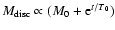 ,
where
M0 and T0 are the initial mass of the disc and the characteristic time of the process.
Then, we have a similar expresion for the density
,
where
M0 and T0 are the initial mass of the disc and the characteristic time of the process.
Then, we have a similar expresion for the density
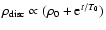 .
And so, we have for the probability of disruption for open clusters before GCs are formed, a
proportionality to the same time exponential with the same characteristic time, and inverting
we have that the probability of formation of globular clusters is proportional to the same time
exponential but changing time by age. The value of the key constant T0 is determined by the time interval between conditions favourable
to the peaks in the SFR, which can be taken from the observed separation
present in the data of Rocha-Pinto et al. (2000) and we will adopt a
working value of 5 Gyr for this parameter (see Fig. 3).
.
And so, we have for the probability of disruption for open clusters before GCs are formed, a
proportionality to the same time exponential with the same characteristic time, and inverting
we have that the probability of formation of globular clusters is proportional to the same time
exponential but changing time by age. The value of the key constant T0 is determined by the time interval between conditions favourable
to the peaks in the SFR, which can be taken from the observed separation
present in the data of Rocha-Pinto et al. (2000) and we will adopt a
working value of 5 Gyr for this parameter (see Fig. 3).
Then the number of metal-rich globular clusters
 will vary with age, t as
 |
(3) |
and this equation has the solution:
![\begin{displaymath}N{_{\rm GCs}}([{\rm Fe/H}]{_{i}}) = N([{\rm Fe/H}]{_{i}}) {\rm e}{^{\frac{t([{\rm Fe/H}]{_{i}})}{T_{0}}}}
\end{displaymath}](/articles/aa/full/2006/11/aa4004-05/img28.gif) |
(4) |
where
![$t([{\rm Fe/H}]{_{i}})$](/articles/aa/full/2006/11/aa4004-05/img29.gif) is the age at each relevant value of the iron
metallicity in the disc, which we have taken from the observational
compilation of Meusinger et al. (1991).
is the age at each relevant value of the iron
metallicity in the disc, which we have taken from the observational
compilation of Meusinger et al. (1991).
In order to find a quantitative solution to the problem of
nuclei of aggregation for the thick disc globular clusters we
propose that they were formed during the events which expelled the
GMCs from close to the Galactic plane via multiple SN explosions.
During the epochs when the star formation rate was at its highest,
represented by the peaks in the observed function of Rocha-Pinto
et al. (2000) clusters are formed inside the GMCs which
are expelled omnidirectionally. A small fraction of these clusters will be able to
accumulate further stars and remain stable. Those which accompany gas clouds heights above the
plane characteristic of the thick disc, and serve as cluster formation
nuclei. A group of a few hundred stars can initiate in this way
a cluster of 105 to 106 stars. Those clusters which stay
very close to the plane have an enhanced probability of suffering many
gravitational encounters with the massive and ubiquitous GMC's and such
clusters are disrupted on timescales of less than 108 years (see e.g. Binney & Tremaine 1987).
However those few clusters which rise out of the
plane and can stimulate further star formation in out of plane gas clouds
may accumulate enough stars this way to remain gravitationally bound. The fact that there are of order 105 open
clusters in the Galaxy but only a couple of hundred globular clusters is
consistent with a secnario in which gobular clusters can form around undisrupted
open clusters or open cluster remnants, but only those massive enought, and
which are in suitable gas cloud surroundings can survive, and these increase
their densities as they incorporate new stars to form a globular cluster.
We can carry out a numerical demonstration to see whether the
nucleus of stars in the open cluster can serve as a suitable
accretion core. If we let the tidal radius of the open cluster take
a value of 20 pc and take a representative value for the
density of stars in the Galactic disc as 0.05 pc-3 we can assume
a path through the Galaxy of order 10 kpc to 15 kpc in length during
a time interval commensurate with the disc lifetime, for the
cluster formed under the conditions needed (i.e. inside a major
gas cloud expelled from the plane during a period of maximum SFR),
the number of stars accreted would be of order 105 to 106. It is
not difficult to show that under the conditions relevant to this
scenario the initial cluster is unlikely to have been disrupted
by encounters with GMCs. Using the formalism of
Binney & Tremaine (1987) the time
 for the disruption of a
cluster is given by
for the disruption of a
cluster is given by
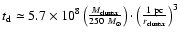 yr,
and
yr,
and
 ,
where the subscripts GC and OC mean globular cluster and open cluster
respectively. This formula leads to a typical disruption time for an open cluster of order
,
where the subscripts GC and OC mean globular cluster and open cluster
respectively. This formula leads to a typical disruption time for an open cluster of order
 yr, while for a globular cluster this time is of order
 yr.
(This is a time similar to that obtained by Dinescu et al.
(1999) from a model in which the main disruption mechanism is two-body
relaxation destruction rates). Our results are consistent with the relative general stability of the
globular cluster population.
yr.
(This is a time similar to that obtained by Dinescu et al.
(1999) from a model in which the main disruption mechanism is two-body
relaxation destruction rates). Our results are consistent with the relative general stability of the
globular cluster population.
We can make an order of magnitude estimate for the amount of gas expelled by major SF episodes in the
Galactic thin disc (within 350 pc from the plane of symmetry) into the thick
disc region (between 350 pc and 1 kpc). Assuming a SN rate in the Galactic disc of 1 SN per 50 yr
(Mac Low & Klessen 2004), the number of SN produced during a major peak of the
SFR lasting 1.5 Gyr will be
 i.e.
i.e.
 .
We have to make
assumptions about how much mass this can raise into the thick disc, but a
plausible order of magnitude estimate can be made by simply assigning 1
.
We have to make
assumptions about how much mass this can raise into the thick disc, but a
plausible order of magnitude estimate can be made by simply assigning 1  of material per SN expelled into the thick disc, which then gives us
 of material, a value which equals the total mass of observed metal rich
GC's, i.e.,
of material, a value which equals the total mass of observed metal rich
GC's, i.e.,
 .
A slightly more refined estimate can be
obtained by taking a mean SN remnant radius of 10 pc and a mean gas density
within an SN remnant of 0.001
per cubic pc (Ikeuchi 1988) which gives
a total gas mass for expulsion of
.
A slightly more refined estimate can be
obtained by taking a mean SN remnant radius of 10 pc and a mean gas density
within an SN remnant of 0.001
per cubic pc (Ikeuchi 1988) which gives
a total gas mass for expulsion of
 .
However we must
reduce this by a factor
.
However we must
reduce this by a factor  3 since we need the gas to be driven in the z direction so we obtain an upper limit estimate this way of 10
 which is
consistent with the stellar mass in GC's as just shown.
which is
consistent with the stellar mass in GC's as just shown.
Now we give an outline scenario of how an open cluster with 100 stars can go
on to accumulate as many as 106 stars to form a globular cluster. We first note that of the 105 open clusters
which form during an episode of enhanced star
formation in the disc, only a very small fraction survive tidal disruption.
We consider one of these survivors which begins as a GMC accelerated by many SN explosions in the
optimal direction, i.e., moving at a small angle to the disc plane, an angle which is
optimal for the accumulation process. Although clusters which
move away from the plane will tend to suffer less purely tidal disruption,
they are subject to disruption by disc shocking if their orbits lead them
to pass across the plane. However we consider the selected cluster
to survive long enough to be present while further stars are formed around it
either from its own GMC which has been pushed with it by the SN explosions
due to some of its more massive initial members, or from other GMC's as it
moves through them. Its capture radius  will increase with time as its mass
increases, according to the relation
will increase with time as its mass
increases, according to the relation
 where M(t) is the mass of the cluster at time t,
and
where M(t) is the mass of the cluster at time t,
and  is the velocity dispersion of stars in the cluster.
If one assumes that the density of the cluster (
is the velocity dispersion of stars in the cluster.
If one assumes that the density of the cluster (
 )
remains approximately constant
as it accretes stars, we can use a simple
dynamical model to get an approximate expression for the variation of the
cluster mass with time. The general expression will be:
)
remains approximately constant
as it accretes stars, we can use a simple
dynamical model to get an approximate expression for the variation of the
cluster mass with time. The general expression will be:
 |
(5) |
and if we now incorporate our expression for
as a function of M(t) and
also assume a moving cluster slowed by dynamical friction so that
 where V0 is the initial velocity
and
the characteristic velocity decay time, we can integrate Eq. (5) to obtain
where V0 is the initial velocity
and
the characteristic velocity decay time, we can integrate Eq. (5) to obtain
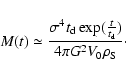 |
(6) |
We can then use a set of standard values for the fixed parameters:
 yr,
yr,
 pc-3,
pc-3,
 km s-1 (Ikeuchi 1988), and
 km s-1, and calculate
the time needed to form a globular cluster, containing say 106 stars, from an open cluster
of say 102 stars via this mechanism, i.e. following Eq. (6). The
calculation gives a characteristic time of 5 Gyr.
Now, we know that there are 105 open clusters in the Galaxy. If we assume that these
were formed during the last major peak in the SFR (see Fig. 3), we can calculate that the number of open
clusters which can survive to form globulars in this time will be
km s-1, and calculate
the time needed to form a globular cluster, containing say 106 stars, from an open cluster
of say 102 stars via this mechanism, i.e. following Eq. (6). The
calculation gives a characteristic time of 5 Gyr.
Now, we know that there are 105 open clusters in the Galaxy. If we assume that these
were formed during the last major peak in the SFR (see Fig. 3), we can calculate that the number of open
clusters which can survive to form globulars in this time will be
 .
This result give interesting agreement
with the observed total number of metal rich globular clusters, since there are
two observed peaks in the SFR so that from this modelling exercise we would
expect to find around 40 clusters. There is a current SFR peak but this will
not give rise to GCs for several Gyr.
.
This result give interesting agreement
with the observed total number of metal rich globular clusters, since there are
two observed peaks in the SFR so that from this modelling exercise we would
expect to find around 40 clusters. There is a current SFR peak but this will
not give rise to GCs for several Gyr.
There is a marked observational trend relating kinematics with
metallicity, in the sense that the more metal-poor population has a higher
velocity dispersion and a lower rotational velocity than the metal-rich
population (Minniti 1996). However it is important to note specifically
that the metal-rich globular clusters within 4 kpc from the Galactic center
have their kinematics correlated with that of the HI in the bulge/bar (Minniti
1996; Cote 1999). As the GC's in general are old, (their ages are greater
than 7 Gyr) all of those which formed in the disc but have moved to within
4 kpc of the center are tidally dominated (gravitationally trapped) by the
potential of the bulge and by the present epoch show bulge kinematics. It is
known that Galactic dynamical friction brings clusters to the center of the
system in a time of 10 Gyr (Binney & Tremaine 1987, p. 428) which is
consistent with the scenario we present here. Our model can thus give a
natural explanation for the kinematic observations of Minniti (1996) and
Cote (1999). There is also evidence from external galaxies that metal
rich GC's within a few kpc of the center of a galaxy show bulge/bar
kinematics (Fobres et al. 2001). Uncertainties in the present three dimensional
galactocentric positions for most of the GC's do not yet permit an
unambiguous discrimination between their belonging to a rigidly rotating bar
or to a bulge which may be an oblate isotropic rotator (Cote et al. 1999).
It is of considerable interest for the present scenario that
Morrison et al. (2004) have recently found that there is a subsytem of GC's in M 31
which clearly show thin disc kinematics. These clusters are found across the
entire disc of M 31 and form some 40
of the clusters projected against the
disc, which certainly indicates a thin disc origin of this population of
GC's.
In Fig. 4 we can see how the present model gives an excellent
fit to the main peak of the MDF of Galactic globular clusters.
The observed peak for the thick disc component of this MDF falls
close to [Fe/H
![$] \simeq -0.6$](/articles/aa/full/2006/11/aa4004-05/img55.gif) which is well predicted here. The detailed
model also predicts the subsidiary peak observed at [Fe/H
which is well predicted here. The detailed
model also predicts the subsidiary peak observed at [Fe/H
![$] \simeq -0.4$](/articles/aa/full/2006/11/aa4004-05/img56.gif) .
The good correlation of our model with the observed MDF
of the globular clusters is based on the observational peaks of
the MDF of disc stars by Rocha-Pinto et al. (2000) which occur
at disc metallicities which correspond rather well (Meusinger et al.
1991; Twarog 1986) to those required for the globular clusters.
Thus the present model requires either the interaction of dwarf galaxies
with the Galactic disc or the accretion of HVC's to induce the increases
in the SFR noted in the SF peaks, which lead to the formation of open clusters
and subsequently of globular clusters. Although we prefer the hypothesis of
the HVC's, since there is considerable evidence from chemical evolution that
not only has star formation been triggered but that low metallicity gas has
been continually incorporated into the Galactic disc, (Casuso
Beckman
1997, 2000, 2001, 2004) we would not wish to rule out minor galaxy interactions
as orginators of at least some of the SF peaks and hence of the peaks in the
GC metallicity distribution. In Fig. 5 we show the predictions of a model
with a minor galaxy merger, which does give a fair account of the main peak
in the MDF of the thick disc GC's.
.
The good correlation of our model with the observed MDF
of the globular clusters is based on the observational peaks of
the MDF of disc stars by Rocha-Pinto et al. (2000) which occur
at disc metallicities which correspond rather well (Meusinger et al.
1991; Twarog 1986) to those required for the globular clusters.
Thus the present model requires either the interaction of dwarf galaxies
with the Galactic disc or the accretion of HVC's to induce the increases
in the SFR noted in the SF peaks, which lead to the formation of open clusters
and subsequently of globular clusters. Although we prefer the hypothesis of
the HVC's, since there is considerable evidence from chemical evolution that
not only has star formation been triggered but that low metallicity gas has
been continually incorporated into the Galactic disc, (Casuso
Beckman
1997, 2000, 2001, 2004) we would not wish to rule out minor galaxy interactions
as orginators of at least some of the SF peaks and hence of the peaks in the
GC metallicity distribution. In Fig. 5 we show the predictions of a model
with a minor galaxy merger, which does give a fair account of the main peak
in the MDF of the thick disc GC's.
![\begin{figure}
\par\includegraphics[width=8cm,clip]{4004fg5.eps}
\end{figure}](/articles/aa/full/2006/11/aa4004-05/Timg57.gif) |
Figure 5:
Metallicity distribution function of metal-rich Galactic globular clusters.
Data from Harris (1999, short dashed line). Model prediction based on the formation of disc globular clusters in early dissipative
minor merging (Bekki & Chiba 2002). The prediction of our model with production of open clusters and individual stars in the thin disc
following the observed SFR of Rocha-Pinto et al. (2000), expulsed by SN to the thick-disc and halo,
and forming GCs by gravitational agregation during the sweeping path of some open clusters through the thin-disc over 5 Gyr (full line). |
| Open with DEXTER |
Although there are few observations the fact that these indicate values of [Mg/Fe] close to 0.3 for GC's (see below) together with
the clear observational tendency in the disc population for [Mg/Fe] to
increase with decreasing metallicity (Abia & Mashonkina 2004) or with increasing
age (Casuso et al. 1996) give a clear indication that the globular
clusters we are pinpointing in this article have ages greater than 7 Gyr and
could therefore well have been formed in the thick disc from gas expelled
in SN explosions in the major star forming episodes in the thin disc.
Yong et al. (2003) reported observed abundances in 20 bright giants in
the globular cluster NGC 6752. The dispersions for [O/Fe], [Na/Fe] and [Al/Fe]
are high, but for [Mg/Fe] all the values lie between +0.3 and +0.5, so that
it does appear that this is the most reliable index for studying the
[alpha/Fe] ratio in the GC's.
In the decades prior to the 1990's it was generally believed that very different
mechanisms were needed to explain the formation of open clusters and globular
clusters. The current consensus is that all clusters form in a basically
similar way, but that globular clusters form preferentially in regions of high
ISM pressure and high SFR
(Elmegreen & Efremov 1997; Ashman & Zepf 2001).
It would not be correct to claim uniqueness for our model
reproduction of the observed MDF of the globular clusters in the Milky
Way. A key restriction here is the dispersion in the age-metallicity
relation, which could displace the peaks in both the observations
and the model by as much as 0.2 dex in [Fe/H] (Ibukiyama & Arimoto
2002; Feltzing et al. 2001; Bensby et al. 2004). While we do not
doubt that the process of galaxy mergers gives rise to
star formation, and could specifically lead to the formation of
globular clusters, chemical evolution models for
the Milky Way do seem to point to the existence of long term low metallicity gas inflow, and the embodiment of
this inflow in the HVC's leads naturally to an alternative mechanism. Here
we propose that during episodes of the most enhanced star formation
in the Galaxy a small but significant fraction of the open
clusters are effectively either expelled to thick disc altitudes or
are formed at these altitudes, and are able to survive there
undisrupted for periods long enough for them to nucleate globular
clusters by gravitational stellar accretion. This mechanism gives
us not only a qualitative picture of how the more metallic globular
clusters were formed, but allows us to explain their observed MDF in
considerable quantitative detail.
Acknowledgements
We are happy to thank the anonymous referee for very helpful comments and suggestions.
This research was supported by grant AYA 2004-08251-C02-01 of the Spanish Ministry of Science and Education.
- Abia, C., &
Mashonkina, L. 2004, MNRAS, 350, 1127 [NASA ADS] [CrossRef] (In the text)
- Armandroff,
T. E. 1989, AJ, 97, 375 [NASA ADS] [CrossRef] (In the text)
- Ashman, K. M.,
& Zepf, S. E. 1992, ApJ, 384, 50 [NASA ADS] [CrossRef] (In the text)
- Ashman, K. M.,
Bird, C. M., & Zepf, S. E. 1994, AJ, 108, 2348 [NASA ADS] [CrossRef] (In the text)
- Ashman, K. M.,
& Zepf, S. E. 2001, AJ, 122, 1888 [NASA ADS] [CrossRef] (In the text)
- Bekki, K., &
Couch, W. J. 2001, ApJ, 557, L19 [NASA ADS] [CrossRef] (In the text)
- Bekki, K., &
Chiba, M. 2002, ApJ, 566, 245 [NASA ADS] [CrossRef] (In the text)
- Bekki, K., Forbes,
D. A., Beasley, M. A., & Couch, W. J. 2002, MNRAS, 335,
1176 [NASA ADS] [CrossRef] (In the text)
- Bekki, K., Couch, W.
J., Beasley, M. A., et al. 2004, ApJ, 610, L93 [NASA ADS] [CrossRef] (In the text)
- Bensby, T.,
Feltzing, S., & Lundstrom, I. 2004, A&A, 421, 969 [EDP Sciences] [NASA ADS] [CrossRef] (In the text)
- Binney, J., &
Tremaine, S. 1987, in Galactic Dynamics (USA: Princeton University
Press), 26
(In the text)
- Carney, B. W.,
Latham, D. W., & Laird, J. B. 1990, AJ, 99, 572 [NASA ADS] [CrossRef] (In the text)
- Casuso, E.,
Vazdekis, A., Peletier, R. F., & Beckman, J. E. 1996, ApJ, 458,
533 [NASA ADS] [CrossRef] (In the text)
- Casuso, E., &
Beckman, J. E. 1997, ApJ, 475, 155 [NASA ADS] [CrossRef] (In the text)
- Casuso, E., &
Beckman, J. E. 2000, PASP, 112, 942 [NASA ADS] [CrossRef] (In the text)
- Casuso, E., &
Beckman, J. E. 2001, ApJ, 557, 681 [NASA ADS] [CrossRef] (In the text)
- Casuso, E., &
Beckman, J. E. 2004, A&A, 419, 181 [EDP Sciences] [NASA ADS] [CrossRef] (In the text)
- Cote, P. 1999, AJ, 118,
406 [NASA ADS] [CrossRef] (In the text)
- Dinescu, D. I.,
Girard, T. M., & van Altena, W. F. 1999, AJ, 117, 1792 [NASA ADS] [CrossRef] (In the text)
- Elmegreen, B.
G., & Efremov, Y. N. 1997, ApJ, 480, 235 [NASA ADS] [CrossRef] (In the text)
- Feltzing, S.,
Holmberg, J., & Hurley, J. R. 2001, A&A, 377, 911 [EDP Sciences] [NASA ADS] [CrossRef] (In the text)
- Harris, W. E. 1976,
AJ, 81, 1095 [NASA ADS] [CrossRef] (In the text)
- Harris, W. E. 1996,
AJ, 112, 1487 [NASA ADS] [CrossRef] (In the text)
- Harris, W. E. 1999,
in Globular Clusters (CUP)
(In the text)
- Heasley, J. N.,
Janes, K. A., Zinn, R., et al. 2000, AJ, 120, 879 [NASA ADS] [CrossRef] (In the text)
- Ibukiyama,
A., & Arimoto, N. 2002, A&A, 394, 927 [EDP Sciences] [NASA ADS] [CrossRef] (In the text)
- Ikeuchi, S. 1988,
Fund. Cosmic Phys., 12, 255 [NASA ADS] (In the text)
- Jehin, E., Magain,
P., Neuforge, C., Noels, A., & Thoul, A. A. 1998, A&A, 330,
L33 [NASA ADS] (In the text)
- Kennicutt, R.
C., Jr. 1998, ARA&A, 36, 189 [NASA ADS] (In the text)
- Kinman, T. D. 1959,
MNRAS, 119, 538 [NASA ADS] (In the text)
- Li, Y., Maclow, M., &
Klessen, R. S. 2004, ApJ, 614, L29 [NASA ADS] [CrossRef] (In the text)
- Mac Low, M. M.,
& Klessen, R. S. 2004, Rev. Mod. Phys., 76, 125 [NASA ADS] [CrossRef] (In the text)
- Majewski, S. R.
1994, ApJ, 431, L17 [NASA ADS] [CrossRef] (In the text)
- Meusinger,
H., Reimann, H., & Stecklum, B. 1991, A&A, 245, 51 [NASA ADS] (In the text)
- Minniti, D. 1996,
ApJ, 459, 175 [NASA ADS] [CrossRef] (In the text)
- Morrison, H.
L., Harding, P., Perrett, K., & Hurley-Keller, D. 2004, ApJ,
603, 87 [NASA ADS] [CrossRef] (In the text)
- Noguchi, M.,
& Ishibashi, S. 1986, MNRAS, 219, 305 [NASA ADS] (In the text)
- Robin, A. C.,
Haywood, M., Creze, M., Ojha, D. K., & Bienayme, O. 1996,
A&A, 305, 125 [NASA ADS] (In the text)
-
Rocha-Pinto, H. J., Scalo, J., Maciel, W. J., & Flynn, C. 2000,
A&A, 358, 869 [NASA ADS] (In the text)
- Twarog, B. A. 1986,
ApJ, 242, 242 [NASA ADS] [CrossRef] (In the text)
- VanDalfsen,
M. L., & Harris, W. E. 2004, AJ, 127, 368 [NASA ADS] [CrossRef] (In the text)
- Vandenberg,
D. A. 2000, ApJSS, 129, 315 [NASA ADS] (In the text)
- Yong, D., Grundahl, F.,
Lambert, D. L., Nissen, P. E., & Shetrone, M. D. 2003, A&A,
402, 985 [EDP Sciences] [NASA ADS] [CrossRef] (In the text)
- Zinn, R. 1985, ApJ,
293, 424 [NASA ADS] [CrossRef] (In the text)
Copyright ESO 2006
![\begin{figure}
\par\includegraphics[width=8cm,clip]{4004fg1.eps}
\end{figure}](/articles/aa/full/2006/11/aa4004-05/img5.gif)
![\begin{figure}
\par\includegraphics[width=8cm,clip]{4004fg2.eps}
\end{figure}](/articles/aa/full/2006/11/aa4004-05/img6.gif)
![\begin{figure}
\par\includegraphics[width=8cm,clip]{4004fg3.eps}
\end{figure}](/articles/aa/full/2006/11/aa4004-05/img12.gif)
![\begin{figure}
\par\includegraphics[width=8cm,clip]{4004fg4.eps}\end{figure}](/articles/aa/full/2006/11/aa4004-05/img16.gif)
![\begin{figure}
\par\includegraphics[width=8cm,clip]{4004fg5.eps}
\end{figure}](/articles/aa/full/2006/11/aa4004-05/img57.gif)