![[*]](/icons/foot_motif.gif)
A&A 448, 181-187 (2006)
DOI: 10.1051/0004-6361:20054163
M. A. T. Groenewegen
Instituut voor Sterrenkunde, Katholieke Universiteit Leuven, Celestijnenlaan 200B, 3001 Leuven, Belgium
Received 6 September 2005 / Accepted 27 October 2005
Abstract
With the advent of space missions, like SPITZER and ASTRO-F, with
sensitive detectors in the near- and mid-infra red covering a reasonable
field-of-view and having a good spatial resolution, it will be possible
to detect individual AGB stars in Local Group galaxies. The filters used by these
missions are non-standard and different from mission to mission.
In this paper, the colours of mass-losing AGB and post-AGB stars are
calculated in the broad-band filters of the SPITZER and ASTRO-F
missions, as well as Bessell V,I and 2MASS J,H,K to connect these
results to existing ground-based data.
The models are calculated for carbon- and oxygen-rich chemistry and
cover different effective temperatures and dust compositions.
Key words: stars: circumstellar matter - stars: mass-loss - stars: AGB and post-AGB
Asymptotic Giant Branch (AGB) and post-AGB stars are prominent
emitters in the infrared (IR), firstly because of their low effective
temperatures and secondly because of their mass loss rates, which can
go up to 10-4  yr-1 for brief spells of time, in conjunction
with dust formation. The importance of the mid-IR was first
demonstrated by the results of the IRAS mission (Beichman et al. 1988)
which discovered many mass-losing AGB stars (e.g. van de Veen &
Habing 1988) in the solar neighbourhood but also luminous
mass-losing AGB stars in the Large Magellanic Cloud (LMC) (see Reid et al. 1990;
Reid 1991; Wood et al. 1992; Zijlstra et al. 1996;
Loup et al. 1997), and Small MC (Whitelock et al. 1989;
Groenewegen & Blommaert 1998), at the limiting magnitudes of IRAS near 100 mJy
at 12 micron. When the ISO satellite was launched many of these mass-losing
AGB stars discovered by IRAS in the MCs were followed up (e.g. Trams
et al. 1999; van Loon et al. 1999), and new surveys in the
MCs were conducted (Loup et al. 1999a,b), in particular using the
ISOCAM instrument (Cesarsky et al. 1996; Blommaert et al. 2003) that
had imaging filters covering 3 to 15 micron with a field-of-view of
typically 1.5
yr-1 for brief spells of time, in conjunction
with dust formation. The importance of the mid-IR was first
demonstrated by the results of the IRAS mission (Beichman et al. 1988)
which discovered many mass-losing AGB stars (e.g. van de Veen &
Habing 1988) in the solar neighbourhood but also luminous
mass-losing AGB stars in the Large Magellanic Cloud (LMC) (see Reid et al. 1990;
Reid 1991; Wood et al. 1992; Zijlstra et al. 1996;
Loup et al. 1997), and Small MC (Whitelock et al. 1989;
Groenewegen & Blommaert 1998), at the limiting magnitudes of IRAS near 100 mJy
at 12 micron. When the ISO satellite was launched many of these mass-losing
AGB stars discovered by IRAS in the MCs were followed up (e.g. Trams
et al. 1999; van Loon et al. 1999), and new surveys in the
MCs were conducted (Loup et al. 1999a,b), in particular using the
ISOCAM instrument (Cesarsky et al. 1996; Blommaert et al. 2003) that
had imaging filters covering 3 to 15 micron with a field-of-view of
typically 1.5 by 1.5.
In addition, the Galactic Centre
region, where IRAS was severely confusion limited, was imaged during
the ISOGAL survey (Omont et al. 2003), discovering many AGB stars
(Omont et al. 1999).
by 1.5.
In addition, the Galactic Centre
region, where IRAS was severely confusion limited, was imaged during
the ISOGAL survey (Omont et al. 2003), discovering many AGB stars
(Omont et al. 1999).
IRAS and ISO showed the importance of the IR region, from the Near-IR to the Far-IR. The SPITZER mission (Werner et al. 2004), launched on 25 August 2003, and the ASTRO-F mission (e.g. Pearson et al. 2004; Matsuhura et al. 2005), with a planned launch date of spring 2006, carry a range of imaging filters that cover the near-, mid- and far-IR. Due to an improved sensitivity and spatial resolution it is expected to resolve individual AGB stars in galaxies far beyond the MCs.
In the present work, series of dust radiative transfer models are presented that cover the spectral types, dust composition and mass loss rates seen for Galactic AGB stars. The flux-densities are computed in the SPITZER IRAC (Fazio et al. 2004) and MIPS (Rieke et al. 2004) filters, and the ASTRO-F IRC, MIR-S, MIR-L and FIS filters. For comparison to ground based data V,I and J,H,K magnitudes are also presented.
Section 2 presents the radiative transfer model and the inputs to it, including the various dust compositions considered. Section 3 gives details on the considered filter curves and the adopted flux-calibration. Section 4 presents the results, scaling laws to arbitrary luminosities and distances, and some caveats in the use of the results. Section 5 concludes by illustrating colour-magnitude diagrams for AGB stars in M 31 and the Wolf-Lundmark-Melotte (WLM) galaxy.
Earlier results from this kind of dust modelling (in particular for the ISOCAM filters) were available as private communication and have been used in Blommaert et al. (2000), Ortiz et al. (2002) and Ojha et al. (2003).
The models have been calculated with a 1-dimensional dust radiative transfer (RT) code that solves the radiative transfer equation and the thermal balance equation in a self-consistent way (Groenewegen 1993, also see Groenewegen 1995).
Basic inputs to the model are the stellar luminosity (L), distance (d),
photospheric spectrum, (total) mass loss rate, dust-to-gas ratio,
(terminal) outflow velocity, dust condensation temperature ( )
and composition of the dust.
)
and composition of the dust.
The models have been calculated for (arbitrary) values of L = 3000  ,
d = 8.5 kpc,
,
d = 8.5 kpc,
 km s-1, dust-to-gas (
 )
ratio = 0.005,
and no interstellar reddening.
Scaling relations will be presented later.
)
ratio = 0.005,
and no interstellar reddening.
Scaling relations will be presented later.
Photospheric input spectrum for O-rich stars are taken from Fluks et al. (1994) for spectral types M0 (
 K),
M 6 (
K),
M 6 (
 K) and M 10 (
 K). For C-rich
stars the models by Loidl et al. (2001) for
K). For C-rich
stars the models by Loidl et al. (2001) for
 and
2650 K are considered.
and
2650 K are considered.
![\begin{figure}
\par\includegraphics[width=8.5cm,clip]{plotopacity.ps}
\end{figure}](/articles/aa/full/2006/10/aa4163-05/img16.gif) |
Figure 1:
The absorption efficiency for the five dust species considered here,
plotted over the whole wavelength range ( top panel), and the
mid-IR. Dashed lines indicate 100% AMC, and the combination of 85%
AMC + 15% SiC, which peaks near 11.3  m. The solid lines indicate 100% silicate (with a narrow feature that peaks near 10 m), 40%
silicate + 60% AlOx, and 100% AlOx (with a broad feature that peaks
near 12 m). m. The solid lines indicate 100% silicate (with a narrow feature that peaks near 10 m), 40%
silicate + 60% AlOx, and 100% AlOx (with a broad feature that peaks
near 12 m). |
| Open with DEXTER | |
Several types of dust are considered that cover the main features observed in AGB stars. The absorption coefficients as a function of wavelength are displayed in Fig. 1. For dust around O-rich stars they are:
 K.
K.
K.
The dust species with 60 to 100% AlOx can explain the observed
Spectral Energy Distributions (SEDs) and ISOCAM CVF 5-14 m
spectra in Galactic Bulge AGB stars which have mass loss rates up to
10-7 yr-1 (Blommaert 2003; Blommaert et al. 2005, in preparation).
 K.
K.
For dust around C-rich stars two species are considered:
 -SiC from Pégourié (1988).
A
of 1200 K is adopted.
-SiC from Pégourié (1988).
A
of 1200 K is adopted.
of 1000 K.
This range of AMC with zero to 15% percent SiC and the corresponding
condensation temperatures can explain the SEDs and IRAS LRS spectra of
the majority of (Galactic) C-stars (Groenewegen 1995; Groenewegen et al. 1998).
For all dust species a uniform grain size of 0.1 m is adopted.
In this paper the broad-band filters of the SPITZER and ASTRO-F
missions are considered. Both contain filters in the near- and mid-IR
which are ideal to identify mass losing stars. Filtercurves have been
obtained from official
websites, and are reproduced
in Fig. 2. The filter names and their central
wavelengths are given in Table 1.
To connect this data to existing ground-based data Bessell V,I and 2MASS J,H,K magnitudes are also calculated, whose filter curves are also shown in Fig. 2.
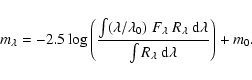
The main output of the RT code is the flux emerging from the AGB star
and its dust envelope. This flux is folded with the filter curves and
flux-densities and magnitudes are calculated from (following the
definition used by IRAS, ISOCAM and IRAC, see e.g. Blommaert et al. 2003):
 |
(1) |
![\begin{figure}
\par\includegraphics[width=14cm,clip]{filtercurves_PAPER.ps}
\end{figure}](/articles/aa/full/2006/10/aa4163-05/img22.gif) |
Figure 2: Filter curves adopted: Bessell VI, 2MASS JHK ( left top), Spitzer-IRAC ( left middle), Spitzer-MIPS ( left bottom), ASTRO-F IRC and MIR-S ( right top), ASTRO-F MIR-L ( right middle), and ASTRO-F FIS ( right bottom). |
| Open with DEXTER | |
Table 1: Adopted flux-densities for a zero-magnitude star.
As mentioned before, the results of the numerical code have already been used to successfully fit the SEDs of individual stars (Groenewegen 1994a,b, 1995, 1997; Groenewegen et al. 1995, 1997, 1998) and predict the colours of AGB stars (Blommaert et al. 2000; Ortiz et al. 2002; Ojha et al. 2003) and has been bench-marked against other codes (Ivezic et al. 1997). To illustrate the typical accuracies that can be achieved in fitting SEDs and colours, Fig. 3 shows a fit to the SED and the IRAS LRS spectrum of the Mira V Oph (cf. Fig. 33 in Groenewegen et al. 1998), but now with the 2650 K model atmosphere instead of a black-body in Groenewegen et al. (1998). The agreement is quite good over the whole wavelength range.
Figure 4 shows colour-colour diagrams of (J-K) versus
(J-H), (J-[3.6]) and (J-[4.5]) (the latter two being
representative for (J-L) and (J-M), respectively). The data are
the mean
 magnitudes of carbon and oxygen-rich stars based on the
monitoring of the light curves from Le Bertre (1992, 1993) and
Taranova & Shenavrin (2004). Only stars with magnitudes in all bands
and without uncertain magnitudes were considered.
magnitudes of carbon and oxygen-rich stars based on the
monitoring of the light curves from Le Bertre (1992, 1993) and
Taranova & Shenavrin (2004). Only stars with magnitudes in all bands
and without uncertain magnitudes were considered.
Although such a comparison between models and data is not trivial because of the effects of reddening (although most sources are within 2.5 kpc and reddening at these wavelengths should be small) and the fact that the IRAC [3.6] and [4.5] filters are not directly comparable to L and M, it may nevertheless illustrate the overall correctness of the models, as suggested by the referee. Again, the overall agreement between models and data is quite good with most data points within 0.1 magnitude of any of the sequences.
![\begin{figure}
\par\includegraphics[angle=-90,width=8.5cm,clip]{voph.ps}
\end{figure}](/articles/aa/full/2006/10/aa4163-05/img26.gif) |
Figure 3:
Model fit to the SED and IRAS LRS spectrum of the carbon Mira V Oph
(cf. Groenewegen et al. 1998). Used is the 2650 K model atmosphere,
L = 4390 ,
d = 0.68 kpc,  = =
 yr-1, and a
combination of 85% AMC and 15% SiC. yr-1, and a
combination of 85% AMC and 15% SiC. |
| Open with DEXTER | |
![\begin{figure}
\par\includegraphics[width=8.1cm,clip]{cmd_JK_JH.ps}\par\vspace*{...
...}\par\vspace*{1mm}
\includegraphics[width=8.1cm,clip]{cmd_JK_JM.ps}
\end{figure}](/articles/aa/full/2006/10/aa4163-05/img27.gif) |
Figure 4:
Colour-Colour diagrams with (J-K) plotted against (J-H),
(J-[3.6]) ((J-L) for the observations), and (J-[4.5]) ((J-M) for
the observations).
Carbon stars are plotted as open circles, oxygen-rich stars as filled circles.
Shown are model sequences for carbon stars (solid lines) for
K, 85% AMC + 15% SiC dust, and
 K, 100% AMC dust (the redder sequence), and
oxygen-rich stars (dashed lines) for spectral type M0 and 100% AlOx dust, M6 and 40% silicate + 60% AlOx, and M10 and 100% silicate dust
(from top to bottom for a given (J-K)). K, 100% AMC dust (the redder sequence), and
oxygen-rich stars (dashed lines) for spectral type M0 and 100% AlOx dust, M6 and 40% silicate + 60% AlOx, and M10 and 100% silicate dust
(from top to bottom for a given (J-K)). |
| Open with DEXTER | |
The results of the models obtained in the present paper for the V, I, J, H, K, IRAC, MIPS and ASTRO-F magnitudes and fluxes are listed in Tables A.1 to A.26 for AGB stars and Tables A.27 to A.36 for post-AGB stars. Table A.1 is repeated as Table 2 to illustrate the content.
The AGB models have been calculated for mass loss rates up to a value
resulting in a (J-K) colour of about 10, roughly the reddest known
AGB stars (Groenewegen et al. 1998).
For every set of input in terms of stellar input spectrum and dust
composition there are two tables, listing, respectively, V,I,J,H,K(in magnitudes) and the flux-densities (in mJy) for SPITZER IRAC and
MIPS, and the flux-densities (in mJy) for the ASTRO-F IRC, MIR-S,
MIR-L and FIS filters. Tables A.1-A.26 also list the mass loss rate
and the dust optical depth, at
11.75 m for AMC+SiC and
11.33 m for AMC,
11.75 m for AlOx and AlOx+silicate, and
10.20 m for silicate.
Optical depths at other wavelengths can be estimated from Fig. 1.
For the post-AGB models the dust temperature at the inner radius is
listed instead of the mass loss rate. By decreasing this parameter the
expansion of the dust envelope after cessation of mass loss at the end
of the AGB can be simulated.
The post-AGB tracks have only been calculated for the 100% silicate
and 100% AMC models, as it appears that dust with appreciable amounts
of, respectively, AlOx and SiC only appear at lower mass loss rates,
and not at the tip of the AGB.
The model runs are such that the first entry for the post-AGB models
corresponds to the same parameter set as for the last entry in the
corresponding AGB model (e.g. Tables A.27-A.3, A.29-A.11, A.34-A.24) but
listed as the result of an independent calculation. One can notice
small differences of  1% in the fluxes and this is due to the
accuracy of the RT model at these large optical depths.
1% in the fluxes and this is due to the
accuracy of the RT model at these large optical depths.
Table 2:
Optical, NIR, IRAC and MIPS magnitudes and fluxes for a
C-rich AGB star,
K, 85% AMC + 15% SiC. All
tables are available on-line in Appendix A as Table A.1-A.36. In all
tables
represents the mass loss rate in yr-1, while  represents the dust optical depth at the wavelengths listed in
Sect. 4.
represents the dust optical depth at the wavelengths listed in
Sect. 4.
The fluxes listed in the tables scale with
(L/3000) / (d/ 8.5)2(and the magnitudes as  of this factor).
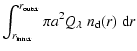
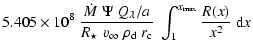
The spectral energy distribution is-for a given stellar input
spectrum-determined only by the dust optical depth, defined by (Groenewegen 1993, 1995):
 |
= |  |
|
| = |  |
(2) |
 is the number density of dust particles,
 and
and
 .
The units are: the (present-day)
mass loss rate at the inner radius
in yr-1,
the
dust-to-gas mass ratio,
.
The units are: the (present-day)
mass loss rate at the inner radius
in yr-1,
the
dust-to-gas mass ratio,
 the absorption coefficient of
the dust over the grain radius in cm-1,
the absorption coefficient of
the dust over the grain radius in cm-1,  the stellar
radius in solar radii,
the stellar
radius in solar radii,
 the terminal velocity of the
circumstellar envelope in km s-1,
the terminal velocity of the
circumstellar envelope in km s-1,
 the dust grain
density in gr cm-3,
the dust grain
density in gr cm-3,  the inner dust radius in stellar
radii and
the inner dust radius in stellar
radii and
 the outer radius in units of .
For
the assumptions adopted in the present paper-a constant velocity and
mass loss rate, and a outer radius much larger than the inner
radius-the integral becomes unity.
the outer radius in units of .
For
the assumptions adopted in the present paper-a constant velocity and
mass loss rate, and a outer radius much larger than the inner
radius-the integral becomes unity.
This relation implies a necessary scaling when the expansion velocity
and/or dust-to-gas ratio and/or luminosity are different from the nominal ones, and this
scaling is like 
 km s-1) (0.005/)
 .
.
My expectation is that these tracks might be useful to identify AGB stars in colour-colour and colour-magnitude diagrams that will become available when SPITZER and ASTRO-F results on external galaxies become available. Such a comparison might also be useful to provide indications of the chemical type and dust optical depth. However, when doing such comparisons some limitations of the models must be kept in mind.
m of 0.24 mag
(Jenness et al. 2002).
m in carbon stars, e.g. Hony et al. 2002, several
crystalline silicate complexes near 23, 28, 33, 40 and 60 m, see
e.g. Molster et al. 2002) and that may influence some fluxes,
especially below
 .
.
 )
either way.
)
either way.
and 10 km s-1 expansion velocity it takes about 1100 year for
the dust shell to expand to an inner dust radius temperature of 100 K,
8300 yr to 50 K, and 600 000 yr to 10 K.
The transition timescale between the end of the AGB and the start of the PN phase (typically assumed to start at 10 000 K) is highly uncertain, and depends on the core mass (i.e. initial mass) of the star (the larger, the faster the evolution). Typical values are thought to be between 500 and 1500 years (e.g. Marigo et al. 2001, 2004).
This implies that only for inner dust radius temperatures above  150 K the flow times scale is short enough for the assumption of
constant luminosity and effective temperature likely to be valid.
150 K the flow times scale is short enough for the assumption of
constant luminosity and effective temperature likely to be valid.
Dust radiative transfer models for (post-)AGB stars are presented from the optical to the far-infrared. The models are calculated in view of the (upcoming) results from SPITZER and (hopefully) ASTRO-F. They may be useful to identify AGB stars, and provide rough estimates of spectral type, luminosity and mass loss rate. I warn again, though, that once candidate AGB stars have been selected, the best estimates for mass loss rate, luminosity and dust composition can only be obtained by detailed fitting of the entire SED (and spectra if available) of individual stars.
As an illustration, Figs. 5 and 6 show some
tracks in a colour-magnitude diagram for, respectively, SPITZER IRAC
filters for an AGB star of 3000
at a distance of 932 Kpc
(appropriate for WLM, McConnachie et al. 2005), and SPITZER MIPS
filters for an AGB star of 3000
at a distance of 785 Kpc
(appropriate for M 31, McConnachie et al. 2005).
WLM and M 31 are actual targets for those instruments according
to the Spitzer Reserved Observations Catalog.
One can observe that the tracks of the C- and O-rich mass-loss
sequence largely overlap in [3.6-4.5] colour. Also the post-AGB tracks
cover the same range in this colour. On the other hand, the [3.6]
magnitude is a good indicator of the luminosity and the [3.6-4.5]
colours of the mass loss rate. By comparison, in Fig. 6
C- and O-rich models separate, as well as AGB from post-AGB
models. This illustrates the usefulness of a 70 m filter to
trace post-AGB evolution. The MIPS 24 m filter traces the wing of
the silicate 18 m feature and therefore the 24 m magnitude
brightens quickly with the onset of mass-loss, so that the [24-70]
colour initially becomes negative for O-rich stars. On the other hand,
luminosity and mass loss rate are difficult to discriminate as the AGB sequence is almost vertical in [24-70] colour.
![\begin{figure}
\par\includegraphics[width=8.5cm,clip]{cmdWLM.ps}
\end{figure}](/articles/aa/full/2006/10/aa4163-05/img48.gif) |
Figure 5:
IRAC colour-magnitude diagram for models with 3000
at 932 Kpc.
The following sequences of increasing mass loss are shown:
Carbon-rich AGB star with
K, and 85% AMC + 15% SiC (circles & solid line),
Carbon-rich post-AGB star with
K, and 100% AMC (crosses & solid line),
Oxygen-rich AGB star with
K, and 60% silicate + 40% AlOx (circles & dashed line), and
oxygen-rich post-AGB star with
K, and 100% silicate (crosses & dashed line). |
| Open with DEXTER | |
![\begin{figure}
\par\includegraphics[width=8.5cm,clip]{cmdM31.ps}
\end{figure}](/articles/aa/full/2006/10/aa4163-05/img49.gif) |
Figure 6:
MIPS colour-magnitude diagram for models with 3000
at 785 Kpc.
Model tracks as in Fig. 5. |
| Open with DEXTER | |
Acknowledgements
I would like to thank Issei Yamamura (Institute of Space and Astronomical Science, ISAS, Kanagawa, Japan) for pointing out the availability of the ASTRO-F filter curves, and Leen Decin (K.U. Leuven) for providing a MARCS code model atmosphere for Vega. Joris Blommaert is thanked for reading an earlier version of the paper.
 rgensen, U. G. 2001, A&A, 371, 1065 [EDP Sciences] [NASA ADS] [CrossRef] (In the text)