![[*]](/icons/foot_motif.gif)
A&A 448, 101-121 (2006)
DOI: 10.1051/0004-6361:20053986
A. Gabasch1,2 - U. Hopp1,2 - G. Feulner1,2 - R. Bender1,2 - S. Seitz1 - R. P. Saglia2 - J. Snigula1,2 - N. Drory3 - I. Appenzeller4 - J. Heidt4 - D. Mehlert4 - S. Noll2,4 - A. Böhm5 - K. Jäger5 - B. Ziegler5
1 -
Universitäts-Sternwarte München, Scheinerstr. 1, 81679 München,
Germany
2 -
Max-Planck-Institut für Extraterrestrische Physik,
Giessenbachstraße, 85748 Garching, Germany
3 -
McDonald Observatory, University of Texas at Austin, Austin, Texas 78712, USA
4 -
Landessternwarte Heidelberg, Königstuhl,
69117 Heidelberg, Germany
5 -
Institut für Astrophysik, Friedrich-Hund-Platz 1,
37077 Göttingen, Germany
Received 4 August 2005 / Accepted 11 October 2005
Abstract
We present the redshift evolution of the restframe galaxy
luminosity function (LF) in the red r', i', and z' bands, as derived
from the FORS Deep Field (FDF), thus extending our earlier results
to longer wavelengths. Using the deep and
homogeneous I-band selected dataset of the FDF, we were able to follow
the red LFs over the redshift range
0.5 < z < 3.5. The
results are based on photometric redshifts for 5558 galaxies derived
from the photometry in 9 filters and achieving an accuracy of
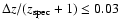 with only
  1%
outliers. A comparison with results from the literature shows the
reliability of the derived LFs. Because of the depth of the FDF, we
can give relatively tight constraints on the faint-end slope
1%
outliers. A comparison with results from the literature shows the
reliability of the derived LFs. Because of the depth of the FDF, we
can give relatively tight constraints on the faint-end slope  of the LF; the faint-end of the red LFs does not show a
large redshift evolution and is compatible within
of the LF; the faint-end of the red LFs does not show a
large redshift evolution and is compatible within  to
to  with a constant slope over the redshift range
 .
Moreover, the slopes in r', i', and z' are
very similar to a best-fitting value of
.
Moreover, the slopes in r', i', and z' are
very similar to a best-fitting value of
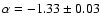 for the combined bands. There is a clear trend of
to
steepen with increasing wavelength:
for the combined bands. There is a clear trend of
to
steepen with increasing wavelength:


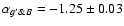
 .
We
subdivided our galaxy sample into four SED types and determined the
contribution of a typical SED type to the overall LF. We show that
the wavelength dependence of the LF slope can be explained by the
relative contribution of different SED-type LFs to the overall LF,
as different SED types dominate the LF in the blue and red bands.
Furthermore we also derived and analyzed the luminosity density
evolution of the different SED types up to
.
We
subdivided our galaxy sample into four SED types and determined the
contribution of a typical SED type to the overall LF. We show that
the wavelength dependence of the LF slope can be explained by the
relative contribution of different SED-type LFs to the overall LF,
as different SED types dominate the LF in the blue and red bands.
Furthermore we also derived and analyzed the luminosity density
evolution of the different SED types up to  .
.
We investigated the evolution of  and
and  by means of
the redshift parametrization
by means of
the redshift parametrization
 and
and
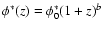 .
Based on the FDF data, we found only a mild brightening
of
(
.
Based on the FDF data, we found only a mild brightening
of
(
 ,
and
,
and
 )
and
a decreasing
(
)
and
a decreasing
(
 )
with increasing
redshift. Therefore, from
)
with increasing
redshift. Therefore, from
 to
to
 the characteristic luminosity
increases by 0.8, 0.4, and 0.4 mag in
the r', i', and z' bands, respectively. Simultaneously the
characteristic density decreases by about 40% in all analyzed
wavebands.
A comparison of the LFs with semi-analytical galaxy formation models
by Kauffmann et al. (1999) shows a similar result to the blue bands:
the semi-analytical models predict LFs that describe the data at
low redshift very well, but show growing disagreement with
increasing redshifts.
the characteristic luminosity
increases by 0.8, 0.4, and 0.4 mag in
the r', i', and z' bands, respectively. Simultaneously the
characteristic density decreases by about 40% in all analyzed
wavebands.
A comparison of the LFs with semi-analytical galaxy formation models
by Kauffmann et al. (1999) shows a similar result to the blue bands:
the semi-analytical models predict LFs that describe the data at
low redshift very well, but show growing disagreement with
increasing redshifts.
Key words: galaxies: luminosity function, mass function - galaxies: fundamental parameters - galaxies: high-redshift - galaxies: distances and redshifts - galaxies: evolution
One major effort in extragalactic astronomy has been to derive and analyze the restframe galaxy luminosity function in different bandpasses and redshift slices, in order to follow the time evolution of galaxy populations by a statistical approach. This is of particular importance because the energy output at different wavelengths is dominated by stars of different masses. While galaxy luminosities measured in the ultraviolet are sensitive to the energy output of hot, short-living O and B type stars and, therefore, to ongoing star formation (Tinsley 1971; Madau et al. 1996,1998), the optical and NIR luminosities provide constraints on more evolved stellar populations (Hunter et al. 1982). This can be used, in principle, to derive the evolution of such basic galaxy properties as the stellar mass function (see e.g. Drory et al. 2005, and references therein), the star-formation rate density (see e.g. Pérez-González et al. 2005, and references therein), or the specific star-formation rate (see e.g. Feulner et al. 2005, and references therein). The determination of these quantities, however, is based on assumptions, e.g., on the shape of the initial mass function or on the details in modeling the stellar population like age, chemical composition, and star formation history. Hence, studying the LF at different wavelengths and cosmic epochs offers a more direct approach to the problem of galaxy evolution.
As the LF is one of the fundamental observational tools, the amount of work dedicated by different groups to derive accurate LFs is substantial. Based on either spectroscopic redshifts, drop-out techniques, or photometric redshifts, it has been possible to derive luminosity functions at different redshifts in the ultraviolet & blue bands (Baldry et al. 2005; Budavári et al. 2005; Treyer et al. 2005; Arnouts et al. 2005; Croton et al. 2005; see also Gabasch et al. 2004a, and references therein), in the red bands (Trentham et al. 2005; Lin et al. 1996; Wolf et al. 2003; Chen et al. 2003; Lin et al. 1997; Ilbert et al. 2005; Shapley et al. 2001; Dahlen et al. 2005; Brown et al. 2001), as well as in the near-IR bands (Cole et al. 2001; Feulner et al. 2003; Kochanek et al. 2001; Pozzetti et al. 2003; Loveday 2000; Balogh et al. 2001; Huang et al. 2003; Drory et al. 2003; Dahlen et al. 2005).
The evolution of the characteristic luminosity and density of galaxy
populations can be analyzed by fitting a Schechter function
(Schechter 1976) to the LF. The redshift evolution of the three
free parameters of the Schechter function - the characteristic
magnitude ,
the density ,
and the faint-end slope
- can be used to quantitatively describe the change of the LF
as a function of redshift.
Unfortunately, the Schechter parametrization of the LF cannot
account for possible excesses at the bright and faint ends or at other
subtle shape deviations. Furthermore, the Schechter parameters are
highly correlated, making it challenging, but not impossible, to
clearly separate the evolution of the different parameters (see e.g.
Andreon 2004, for a discussion).
The evolution of the LFs is also very suitable to constrain the free parameters of theoretical models (e.g. semi-analytical or smoothed particle hydrodynamics models). Ideally a comparison between model predictions and observations should be done simultaneously for different wavebands (UV, optical, NIR) and for different redshift slices, as different stellar populations are involved in generating the flux in the different bands. Therefore, the FDF (Heidt et al. 2003) provides a unique testing ground for model predictions, since the depth and the covered area allow relatively precise LF measurements from the UV to the z' bands up to high redshift in a very homogeneous way.
In this paper we extend the measurements of the blue luminosity
functions presented in Gabasch et al. (2004a, hereafter FDFLF I) to the
red r', i', and z' bands. In Sect. 2 we derive
the LFs and show the best-fitting Schechter parameters ,
,
and
in the redshift range
0.5 < z <
3.5. We also present a detailed analysis of the slope of the LF as
a function of redshift and wavelength. Furthermore, we analyze the
contributions of different SED types to the overall LF and present the
evolution of the type-dependent luminosity density up to redshift
.
Section 3 shows a parametric
analysis of the redshift evolution of the LF, whereas comparisons
with the LFs of other surveys and then with model predictions are
given in Sect. 4 and in Sect. 5,
respectively. We summarize our work in
Sect. 6.
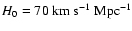
Throughout this paper we use AB magnitudes and adopt a  cosmology with
 ,
,
 ,
and
,
and
 .
.
The results presented in this paper are all based on the deep part of
the I-band selected catalog of the FDF (Heidt et al. 2003), as introduced
in FDFLF I. Galaxy distances were determined by the photometric
redshift technique (Bender et al. 2001) with a typical accuracys of
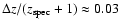 ,
if compared to the
spectroscopic sample (Böhm et al. 2004; Noll et al. 2004) of more than 350 objects.
To derive the absolute magnitude for a given band (which will be
briefly summarized below) we used the best fitting SED as determined by
the photometric redshift code, thus reducing possible systematic
errors that could be introduced by using k-corrections applied to a
single observed magnitude. To account for the fact that some fainter
galaxies are not visible in the whole survey volume, we performed a
,
if compared to the
spectroscopic sample (Böhm et al. 2004; Noll et al. 2004) of more than 350 objects.
To derive the absolute magnitude for a given band (which will be
briefly summarized below) we used the best fitting SED as determined by
the photometric redshift code, thus reducing possible systematic
errors that could be introduced by using k-corrections applied to a
single observed magnitude. To account for the fact that some fainter
galaxies are not visible in the whole survey volume, we performed a
 (Schmidt 1968) correction. The errors of the LFs were
calculated by means of Monte-Carlo simulations and included the
photometric redshift error of every single galaxy, as well as the
statistical error (Poissonian error). To derive precise Schechter
parameters, we limited our analysis of the LF to the magnitude bin where
(Schmidt 1968) correction. The errors of the LFs were
calculated by means of Monte-Carlo simulations and included the
photometric redshift error of every single galaxy, as well as the
statistical error (Poissonian error). To derive precise Schechter
parameters, we limited our analysis of the LF to the magnitude bin where
 .
We also show the uncorrected LF in the various plots as open circles.
We did not assume any evolution of the galaxies within the
single redshift bins, since the number of galaxies and the distance
determination based on photometric redshifts would not be able to
constrain it.
The redshift binning was chosen such that we have good
statistics in the various redshift bins and so that the influence of
redshift clustering was minimized. In order to have good statistics at
the bright end (rare objects) of the LF, we had to slightly change some
of the redshift bins if compared to FDFLF I. The new redshift binning,
together with the number of galaxies in every bin, is shown in
Table 1. As can be seen from
Table 1, the redshift intervals are
approximately the same size in
.
We also show the uncorrected LF in the various plots as open circles.
We did not assume any evolution of the galaxies within the
single redshift bins, since the number of galaxies and the distance
determination based on photometric redshifts would not be able to
constrain it.
The redshift binning was chosen such that we have good
statistics in the various redshift bins and so that the influence of
redshift clustering was minimized. In order to have good statistics at
the bright end (rare objects) of the LF, we had to slightly change some
of the redshift bins if compared to FDFLF I. The new redshift binning,
together with the number of galaxies in every bin, is shown in
Table 1. As can be seen from
Table 1, the redshift intervals are
approximately the same size in  ,
and most of the results
we are going to discuss in this paper are based on 700-1000 galaxies per redshift bin.
,
and most of the results
we are going to discuss in this paper are based on 700-1000 galaxies per redshift bin.
Table 1: Number of galaxies in the FDF for the redshift intervals used for computing the LFs. Note that we derived the LF in all redshift bins, but excluded the lowest (z < 0.45) and highest redshift bins (z > 3.81) from our analysis of the LF evolution, since the lowest redshift bin corresponds to too small a volume, while the z>3.81 bin suffers from extrapolation errors.
To investigate the redshift evolution of the faint-end slope of the
LF, we fitted a three-parameter Schechter function (,
,
and )
to the data points. The best fitting slope
and the corresponding errors for the 3 wavebands
are reported in Table 2 for the various
redshift bins.
It can be inferred from Table 2 that there
is only marginal evidence of a change of
with redshift, at
least up to
where we are able to sample the LF to a suitable
depth. Under the assumption that
does not depend on
redshift, Table 3 (upper part) yields the
slopes' best error-weighted values in the redshift range from
 to
to
 (also including the higher redshift bins changes
only
marginally). Since the slopes in all bands are very similar, we derived
a combined slope of
(Table 3, lower
part).
(also including the higher redshift bins changes
only
marginally). Since the slopes in all bands are very similar, we derived
a combined slope of
(Table 3, lower
part).
Almost all of the slopes listed in Table 2
are compatible within
 with
.
Therefore, we fixed the slope to this value for the subsequent
analysis. Please note that this slope is steeper than for the blue
bands (
with
.
Therefore, we fixed the slope to this value for the subsequent
analysis. Please note that this slope is steeper than for the blue
bands (
 and
and
 ), but it
follows the trend observed in FDFLF I: with increasing wavelength the
slope steepens; i.e. the ratio of faint to bright galaxies increases.
This trend is illustrated best in Fig. 1,
where we combine the results derived in FDFLF I with those of this
work and plot the wavelength dependence of the LF slope. As we will
show in Sect. 2.3, this effect can be
explained by the contribution of different galaxy populations to the
overall LF in the various wavebands.
), but it
follows the trend observed in FDFLF I: with increasing wavelength the
slope steepens; i.e. the ratio of faint to bright galaxies increases.
This trend is illustrated best in Fig. 1,
where we combine the results derived in FDFLF I with those of this
work and plot the wavelength dependence of the LF slope. As we will
show in Sect. 2.3, this effect can be
explained by the contribution of different galaxy populations to the
overall LF in the various wavebands.
We checked the dependence of our results on the selection band by
comparing the I-band selected catalog and the I+B selected FDF
catalog. The combined catalog has been described in Heidt et al. (2003),
and it reaches limiting magnitudes of
 and
and
 .
In the combined sample,
agrees within its
errors
with the values derived from the I-band catalog only. The slope
tends to be slightly steeper in the combined sample, but
not by more than .
The larger number of objects in the combined
catalog mostly influences the characteristic density ,
which
is a factor of 1.05 to 1.20 larger (depending on the redshift bin).
Given the errors of ,
this is on the order of
to .
.
In the combined sample,
agrees within its
errors
with the values derived from the I-band catalog only. The slope
tends to be slightly steeper in the combined sample, but
not by more than .
The larger number of objects in the combined
catalog mostly influences the characteristic density ,
which
is a factor of 1.05 to 1.20 larger (depending on the redshift bin).
Given the errors of ,
this is on the order of
to .
Table 2: Slope of the LF for all wavelengths and all redshifts as derived from a 3-parameter Schechter fit.
To better understand the filter-dependence of the LF slope shown in
Fig. 1, we analyzed the contribution of
different galaxy types to the overall LF.
Thus, we subdivided our galaxy sample into four SED types and analyzed
the type-dependent LF; i.e. we determined the contribution of a typical
SED type to the overall LF.
The SEDs were mainly grouped according to the UV-K color (see
Fig. 2): for increasing spectral type (SED
type 1
SED type 4) the SEDs become bluer; i.e. the UV flux (and thus the recent star formation rate) increases if compared
to the K-band flux. Pannella et al. (2005) analyze the morphology of
about 1400 galaxies in the FDF down to  mag on HST (ACS)
data, and find a good correlation between the four main SED types and
the
morphology of the galaxies, at least up to redshift
mag on HST (ACS)
data, and find a good correlation between the four main SED types and
the
morphology of the galaxies, at least up to redshift
 .
.
The four SED types also show a sequence in the restframe U-V color that is often used to discriminate between blue and red galaxies (see e.g. Giallongo et al. 2005, and references therein). As the restframe U-V color includes the 4000 Å break, it is quite sensitive to such galaxy properties as age and star formation. The U-V color lies in the range between 2.3-1.9, 2.0-1.6, 1.6-0.9, and 0.9-0 for SED type 1, 2, 3, and 4, respectively. Therefore, in a rough classification one can refer to SED types 1 and 2 (SED type 3 and 4) as red (blue) galaxies. We used the same SED cuts at all redshifts (see below); i.e. we did not use the time evolution of the galaxy color bimodality (see e.g. Giallongo et al. 2005) to redefine the main SED type of a galaxy as a function of redshift.
We show the LFs for the four SED types in three redshift intervals in
Fig. 3:
 ,
,
 ,
and
,
and
 .
The
SED type increases from the left panel to the right panel; i.e. the
extremely star-forming galaxies are shown in the rightmost panel. The
LFs for the different filters are color-coded and denoted in the upper
part of the various panels. We show every LF to the limiting
magnitude where the
begins to contribute by at most a
factor of 1.5, which is more conservative as for the overall LF
(
for every bin). For clarity, a Schechter function
fit to the data is included.
.
The
SED type increases from the left panel to the right panel; i.e. the
extremely star-forming galaxies are shown in the rightmost panel. The
LFs for the different filters are color-coded and denoted in the upper
part of the various panels. We show every LF to the limiting
magnitude where the
begins to contribute by at most a
factor of 1.5, which is more conservative as for the overall LF
(
for every bin). For clarity, a Schechter function
fit to the data is included.
First of all, it is clear from Fig. 3 that the faint-end of the LF is always dominated by SED type 4 galaxies. This is true for all analyzed bands. If we focus on the bright end of the SED type 4 LFs, we only see a relatively small variation between the different filters. On the other hand, the difference between the filters for SED type 1 (for the bright end) is very large. Although (because of the low number density) SED type 1 does not contribute at all to the faint-end of the LFs, the picture changes for the bright end. While for the bright end of the LF in the UV (black line), SED type 1 and 4 galaxies have about the same number density, in the red bands SED type 1 galaxies dominate the LF.
This trend applies for all three redshift bins, although it is more
pronounced at lower redshift. It explains the change of the
LF slope naturally as a function of waveband. This can be best seen in
Fig. 4 where we concentrate on only
two filters. There we show the Schechter functions fitted to the LFs
in the UV, as well as in the i'-band for the redshift intervals
,
,
and
.
We plot the single Schechter functions for all four
SED types, as well as for the overall LF. In the UV the overall LF
is completely dominated by the SED type 4 galaxies. On
the other hand, the overall LF in the i'-band is mainly dominated by
SED type 1 to type 3 at the bright end, and SED type 4 at the
faint-end. This results in a steeper slope for the overall LF.
Please note that in Figs. 3 and 4 we show the SED type LFs and
Schechter functions to the limiting magnitude where the
begins to contribute by at most a factor of 1.5, which is more
conservative than for the overall LF, for which we allow a correction
factor of 3. Furthermore, all Schechter functions in
Fig. 4 are fits to the data points.
This is also true for the overall Schechter function, which is
not the sum of the individual SED type Schechter functions,
and this explains why, at the bright end, the overall Schechter function is
below individual SED type Schechter functions in some plots.
Table 3:
In the upper part of the table, we show the slope
of the luminosity
functions for the different wavebands as determined from an
error-weighted fit to the data, under
the assumption that
 In the
lower part of the table, we show the best values of
after
combining the data of all bands.
In the
lower part of the table, we show the best values of
after
combining the data of all bands.
![\begin{figure}
\par\includegraphics[width=8.2cm,clip]{3986f01a.ps}
\end{figure}](/articles/aa/full/2006/10/aa3986-05/img90.gif) |
Figure 1: Slope of the LF as a function of wavelength. The filled red squares denote the values derived in FDFLF I, whereas the filled red dots are taken from this work (Table 3, upper part). Local slope values (black) are shown as filled squares (Baldry et al. 2005), open squares (Driver et al. 2005), filled triangles (Budavári et al. 2005), open triangles (Blanton et al. 2003), and as an asterisk (Norberg et al. 2002). |
| Open with DEXTER | |
![\begin{figure}
\par\includegraphics[width=8.1cm,clip]{3986f02a.ps}
\end{figure}](/articles/aa/full/2006/10/aa3986-05/img91.gif) |
Figure 2: SEDs grouped according to their spectral type. See text for details. |
| Open with DEXTER | |
![\begin{figure}
\par\includegraphics[width=18cm,clip]{3986f03a.ps}
\end{figure}](/articles/aa/full/2006/10/aa3986-05/img92.gif) |
Figure 3:
LFs for the four SED types in the redshift intervals
( upper panels),
( middle panels), and
( lower panels): SED type
increases from left to right. The filters are color-coded and
denoted in the upper part of the various panels. For clarity, the
three-parameter Schechter function fit to the data is shown as
a solid line with the same color coding as the LF. |
| Open with DEXTER | |
![\begin{figure}
\par\includegraphics[width=6cm,clip]{3986f04a.ps}\hspace*{2mm}
\includegraphics[width=6cm,clip]{3986f04b.ps}
\end{figure}](/articles/aa/full/2006/10/aa3986-05/img93.gif) |
Figure 4:
Schechter
functions fitted to the LFs in the UV ( left panels), as well as in
the i'-band ( right panels) for the redshift intervals
( upper panels),
( middle panels), and
( lower panels). The solid
lines show the best-fitting Schechter functions for the four SED
types. The SED type is color-coded and denoted in the upper left
panel. The dotted black line shows the total LF (as fitted to the
data), whereas the shaded region represents the corresponding 1 error of the latter. For the slope values of the
different SED types, see Table 5.
Please note that we show the SED type LFs to the limiting magnitude
where the
begins to contribute by at most a factor of 1.5, which is more conservative than for the overall LF, for which we
allow a correction factor of 3.
error of the latter. For the slope values of the
different SED types, see Table 5.
Please note that we show the SED type LFs to the limiting magnitude
where the
begins to contribute by at most a factor of 1.5, which is more conservative than for the overall LF, for which we
allow a correction factor of 3. |
| Open with DEXTER | |
Another interesting aspect found from
Fig. 4 is the fast decrease in number
density of bright SED type 1 to 3 galaxies if compared to SED type 4 galaxies (for increasing redshift). Therefore at high redshift (), SED type 4 galaxies also start to dominate the overall
i'-band LF.
This can be seen best if one follows the redshift evolution of the
type-dependent luminosity density (LD), i.e. the integrated
light emitted by the different SED types. The results (for the UV and
i' bands) are shown in Fig. 5.
We calculated
the LD as described in Gabasch et al. (2004b). First, we
derived the LD at a given redshift by summing the
completeness-corrected (using a
correction) luminosity of
every single galaxy up to the absolute magnitude limits. Second, we
applied a further correction (to zero galaxy luminosity) ZGL, to take
the missing contribution to the LD of the fainter
galaxies into account. To this end we used the best-fitting Schechter function for
a slope
constant with redshift. For every SED type, we derived
by an error-weighted averaging of the slopes given
in Table 5. This resulted in slopes
between
 and
and
 .
For the FDF, the ZGL
corrections are at most 22% in size (see last column in
Table 4). The small ZGL correction employed
here stems from the faint magnitude limits probed by our deep FDF data
set and the relatively flat slopes of the Schechter function. Errors
were computed from Monte Carlo simulations that take the
probability distributions of the
photometric redshifts and the Poissonian error into account.
.
For the FDF, the ZGL
corrections are at most 22% in size (see last column in
Table 4). The small ZGL correction employed
here stems from the faint magnitude limits probed by our deep FDF data
set and the relatively flat slopes of the Schechter function. Errors
were computed from Monte Carlo simulations that take the
probability distributions of the
photometric redshifts and the Poissonian error into account.
As shown on the left panel of Fig. 5, the contribution of type 1 and 2 galaxies to the UV LD is negligible at all analyzed redshifts. The SED types 3 and 4 completely dominate the UV output, and although the number density of these galaxies decreases with increasing redshift, the luminosity density (and thus the SFR) increases.
If we analyze the i'-band LD, in the lowest redshift bin SED types 1 and 3 dominate (by a factor of about three if compared to types 2 and 4) and have about the same LD. At higher redshifts the relative contribution of the different SED types changes, because the LD of types 1 and 2 galaxies decreases with increasing redshift, and SED types 3 and 4 take over.
A detailed analysis of the type-dependent LF will be presented in a
future paper (Gabasch et al., in preparation), where we combine the
I-band selected MUNICS catalog (MUNICS IX, Feulner et al., in
preparation, 900 arcmin2) with the FDF (40 arcmin2) catalog. This overcomes the small volume of the FDF at
lower redshift, making it possible to also include rare bright objects
in the analysis of the LF. First results in the MUNICS fields will be
presented in MUNICS IX.
In this section we analyze the LF by means of a Schechter function fit
with a fixed slope of
 .
In Figs. 6 and 7, we present the LFs in the r'-band
and in the i'-band, while the results for the z'-band can be found in
Fig. 8. The filled (open) symbols denote
the LF with (without) completeness correction. The solid lines show
the Schechter function fitted to the luminosity function. The best
fitting Schechter parameter, the redshift binning, as well as the
reduced
.
In Figs. 6 and 7, we present the LFs in the r'-band
and in the i'-band, while the results for the z'-band can be found in
Fig. 8. The filled (open) symbols denote
the LF with (without) completeness correction. The solid lines show
the Schechter function fitted to the luminosity function. The best
fitting Schechter parameter, the redshift binning, as well as the
reduced  ,
are also listed in each figure. The values of the
reduced
are very good for all redshift bins below .
We do not fit our lowest redshift bin data (
,
are also listed in each figure. The values of the
reduced
are very good for all redshift bins below .
We do not fit our lowest redshift bin data (
 )
with a Schechter function, because the volume is
too small.
For comparison we also show the local LF derived by
Blanton et al. (2003) in the SDSS (see also
Fig. 9).
The best fitting Schechter
parameters and corresponding errors are summarized in
Tables 6-8 for the r', i', and z' bands.
Even without fitting Schechter functions to the data,
it is obvious that the evolution in characteristic luminosity and
number density between redshifts
)
with a Schechter function, because the volume is
too small.
For comparison we also show the local LF derived by
Blanton et al. (2003) in the SDSS (see also
Fig. 9).
The best fitting Schechter
parameters and corresponding errors are summarized in
Tables 6-8 for the r', i', and z' bands.
Even without fitting Schechter functions to the data,
it is obvious that the evolution in characteristic luminosity and
number density between redshifts
 and
and
 is very moderate, if compared to the evolution in the
blue bands.
is very moderate, if compared to the evolution in the
blue bands.
![\begin{figure}
\par\includegraphics[width=8.8cm,clip]{3986f05a.ps}
\end{figure}](/articles/aa/full/2006/10/aa3986-05/img100.gif) |
Figure 5:
Luminosity densities in the UV ( left panel) and i'
( right panel)
bands for the four SED types in the redshift intervals
,
,
and
.
The luminosity densities are completeness-corrected
to zero luminosity (ZGL, see text for details). The values are
listed in Table 4. |
| Open with DEXTER | |
To better quantify the redshift evolution of the LFs, we used the
method introduced in FDFLF I. We parameterized the evolution of
and
with redshift assuming the following simple
relations:
 ,
and
,
and
 by minimizing the
of
and
by minimizing the
of
and
 are
used.
and
are
used.
and
 are
used.
and
as well
as the local LF of Blanton et al. (2003) are used.
are
used.
and
as well
as the local LF of Blanton et al. (2003) are used.
 .
On the other hand,
the
value of the B-band LF of
Driver et al. (2005) is consistent with those derived by
Blanton et al. (2001) after that
has been renormalized
according to Liske et al. (2003). Once corrected, the Blanton et al. (2001)
B-band LF agrees well with the MGC, the 2dFGRS, and the ESO Slice
Project estimates. Driver et al. (2005) conclude that the discrepancy
between the MGC and the Blanton et al. (2003) LFs is complex, but
caused predominantly by a color bias within the SDSS. They also
conclude that the color selection bias might be a general trend
across all filters.
.
On the other hand,
the
value of the B-band LF of
Driver et al. (2005) is consistent with those derived by
Blanton et al. (2001) after that
has been renormalized
according to Liske et al. (2003). Once corrected, the Blanton et al. (2001)
B-band LF agrees well with the MGC, the 2dFGRS, and the ESO Slice
Project estimates. Driver et al. (2005) conclude that the discrepancy
between the MGC and the Blanton et al. (2003) LFs is complex, but
caused predominantly by a color bias within the SDSS. They also
conclude that the color selection bias might be a general trend
across all filters.
Table 4: Luminosity densities in the UV and i' bands for the four SED types. See also Fig. 5.
Table 5: Slope of the UV (2800 Å) and i' band LF for the different SED types from a 3-parameter Schechter fit. The Schechter functions are shown in Fig. 4.
In Fig. 10 we compare the local
Schechter functions as given by Blanton et al. (2003) and Blanton et al. (2001,
 ), they disagree at fainter
magnitudes. On the other hand, the slope of the LF is strongly
dependent on the depth of the survey. The flux limit in the r-band
selected SDSS survey is about
mr < 17.79. A very rough estimate
of the absolute limiting magnitude at the mean redshift of the
survey (
), they disagree at fainter
magnitudes. On the other hand, the slope of the LF is strongly
dependent on the depth of the survey. The flux limit in the r-band
selected SDSS survey is about
mr < 17.79. A very rough estimate
of the absolute limiting magnitude at the mean redshift of the
survey (
 )
is therefore
)
is therefore
 .
This means that the faint-end of the LF as shown in
Fig. 10 depends on the applied
completeness correction (see also the discussion
in Andreon 2004). Therefore, we decided to use only the bright part
()
of the SDSS LFs to constrain the free evolutionary
parameter of Case 3.
.
This means that the faint-end of the LF as shown in
Fig. 10 depends on the applied
completeness correction (see also the discussion
in Andreon 2004). Therefore, we decided to use only the bright part
()
of the SDSS LFs to constrain the free evolutionary
parameter of Case 3.
As the Schechter parameters are coupled, and
and
of Blanton et al. (2003) are derived for a different slope ,
we decided not to use
and
itself, but
to reconstruct a magnitude binned luminosity function out of the
Schechter values ,
,
and
given in
Blanton et al. (2003). Following the method described in
Sect. 4 to visualize the errors of the literature
LFs (shaded regions in the plots) we derived the 1-mag-binned
LF as shown in Fig. 10 (solid points).
Figure 10 shows that a Schechter
function fit to the SDSS data with a slope of
(as
derived from the FDF data) results in a reduced
 .
This large
.
This large
 increases the errorbars of the
evolutionary parameter since we normalize the result of
Eq. (2) to
increases the errorbars of the
evolutionary parameter since we normalize the result of
Eq. (2) to
 before
calculating the errors.
before
calculating the errors.
The
and
confidence levels of the
evolution parameters a and b for the different filters and cases
are shown in Fig. 11. These contours were
derived by projecting the four-dimensional
distribution to
the a-b plane, i.e. for given a and b we used the value of
and
,
which minimizes the
 .
.
For Case 1 (left panel) the errorbars of a and b are
rather large; and although the best fitting values suggest a redshift
evolution they are also compatible (within )
with no
evolution of
and .
The error ellipses for Case 2
(middle panel) are smaller than in Case 1, and for the r'-band
LF, we see a luminosity and a density evolution on a level.
For the i'-band and z'-band LFs, we see only density evolution on a
level.
Also including the local LF of Blanton et al. (2003) in
the evolution analysis, as in Case 3 (left panel), we were able
to derive a and b with higher precision since
and
are more restricted. The luminosity and density
evolution is clearly visible on more than the level. Please
note that combining different datasets, such as the FDF and the SDSS, can
introduce systematic errors due to the different selection techniques and
calibration differences not being fully taken into account
(see also discussion above).
Nevertheless, a comparison of the FDF LFs with the SDSS Schechter
functions in Fig. 9 shows relatively
good agreement (at the bright end).
Furthermore, a detailed comparison of the UV LFs of the
FDF with the LF derived in large surveys e.g. Wolf et al. (2003, based on
COMBO-17), Steidel et al. (1999, based on LBG analysis),
Ouchi et al. (2004, based on Subaru Deep Field/Survey); Iwata et al. (2003) or
pencil beam surveys e.g. Poli et al. (2001, based on both HDFs)
presented in FDFLF I shows good agreement in the overlapping magnitude
range at all redshifts. We are thus confident that the remaining
systematic differences (e.g. due to the influence of large scale
structure; LSS) must be small.
The values for the free parameters a, b, ,
and
,
as well as the associated errors, can be found in
Table 9. The evolution parameters a,
b, ,
and
derived in Case 1,
Case 2, and Case 3 all agree within .
Most of the values differ only by
or less.
In Fig. 12 we illustrate the relative
redshift evolution of
for the different filters and different
cases, while the relative redshift evolution of
is shown
in Fig. 13. Note that a, b,
,
and
were derived by minimizing
Eq. (2) and not the differences between the (best
fitting) lines and the data points in
Figs. 12 and 13. As for the blue bands
(FDFLF I), the simple parametrization of
Eq. (1) is also able to describe the
evolution of the galaxy LFs in the red bands very well.
![\begin{figure}
\par\includegraphics[width=4.8cm,clip]{3986f06a.ps}\hspace*{3mm}
...
...e.ps}\hspace*{3mm}
\includegraphics[width=4.8cm,clip]{3986f06f.ps}
\end{figure}](/articles/aa/full/2006/10/aa3986-05/img124.gif) |
Figure 6:
The LFs in the r'-band from low redshift
(
 ,
upper left panel) to high redshift
(
,
lower right panel). The filled
(open) symbols show the LF corrected (uncorrected)
for
.
The fitted Schechter functions for a fixed slope
are shown as solid lines. Note that we only fit the
LFs from
to
.
The parameters of the Schechter functions can be
found in Table 6. The dotted line represents
the local r'-band LF derived from the SDSS
(Blanton et al. 2003). The Schechter fit for redshift
is indicated as a dashed line in all panels. ,
upper left panel) to high redshift
(
,
lower right panel). The filled
(open) symbols show the LF corrected (uncorrected)
for
.
The fitted Schechter functions for a fixed slope
are shown as solid lines. Note that we only fit the
LFs from
to
.
The parameters of the Schechter functions can be
found in Table 6. The dotted line represents
the local r'-band LF derived from the SDSS
(Blanton et al. 2003). The Schechter fit for redshift
is indicated as a dashed line in all panels. |
| Open with DEXTER | |
![\begin{figure}
\par\includegraphics[width=4.8cm,clip]{3986f07a.ps}\hspace*{3mm}
...
...7e.ps}\hspace*{3mm}
\includegraphics[width=4.8cm,clip]{3986f07f.ps}
\end{figure}](/articles/aa/full/2006/10/aa3986-05/img125.gif) |
Figure 7:
The LFs in the i'-band from low redshift
(
,
upper left panel) to high redshift
(
,
lower right panel). The filled
(open) symbols show the LF corrected (uncorrected)
for
.
The fitted Schechter functions for a fixed slope
are shown as solid lines. Note that we only fit the
LFs from
to
.
The parameters of the Schechter functions can be
found in Table 7. The dotted line represents
the local i'-band LF derived from the SDSS
(Blanton et al. 2003). The Schechter fit for redshift
is indicated as a dashed line in all panels. |
| Open with DEXTER | |
Table 6: Schechter function fit in the r'-band.
Table 7: Schechter function fit in the i'-band.
Table 8: Schechter function fit in the z'-band.
Recently, Blanton et al. (2005) used the data of the SDSS Data Release 2
to analyze the very local LF (
0.00 < z < 0.05; corrected for
surface-brightness incompleteness) down to extremely low luminosity
galaxies. They found that a Schechter function is an insufficient
parametrization of the LF, as there is an upturn in the slope of the LF for
 .
In
Fig. 9 we therefore compare the red FDF
LFs in two redshift ranges (
and
.
In
Fig. 9 we therefore compare the red FDF
LFs in two redshift ranges (
and
 )
with the local Schechter functions as
derived in the SDSS by Blanton et al. (2003) and Blanton et al. (2005).
Considering the small volume covered by the FDF in the redshift bin
and the fact that we see clustered spectroscopic redshifts at z=0.22, z=0.33, and z=0.39, the
agreement between the LFs and the Schechter functions is relatively
good for M < -19. For the fainter part, the measured number density
disagrees with Blanton et al. (2003) and Blanton et al. (2005) in all three
analyzed bands. If we do the same comparison at
where the FDF covers a relatively large volume
minimizing the influence of LSS, the measured LFs also follow the very
local Schechter function of Blanton et al. (2005) in the faint
magnitude regime. Moreover, the upturn of the faint-end of the LF as
found by Blanton et al. (2005) in the SDSS or by Popesso et al. (2005) in the
RASS-SDSS Galaxy Cluster Survey (see also Pérez-González et al. 2005), is
also visible in the FDF data (at least at
).
)
with the local Schechter functions as
derived in the SDSS by Blanton et al. (2003) and Blanton et al. (2005).
Considering the small volume covered by the FDF in the redshift bin
and the fact that we see clustered spectroscopic redshifts at z=0.22, z=0.33, and z=0.39, the
agreement between the LFs and the Schechter functions is relatively
good for M < -19. For the fainter part, the measured number density
disagrees with Blanton et al. (2003) and Blanton et al. (2005) in all three
analyzed bands. If we do the same comparison at
where the FDF covers a relatively large volume
minimizing the influence of LSS, the measured LFs also follow the very
local Schechter function of Blanton et al. (2005) in the faint
magnitude regime. Moreover, the upturn of the faint-end of the LF as
found by Blanton et al. (2005) in the SDSS or by Popesso et al. (2005) in the
RASS-SDSS Galaxy Cluster Survey (see also Pérez-González et al. 2005), is
also visible in the FDF data (at least at
).
![\begin{figure}
\par\includegraphics[width=4.8cm,clip]{3986f08a.ps}\hspace*{3mm}
...
...8e.ps}\hspace*{3mm}
\includegraphics[width=4.8cm,clip]{3986f08f.ps}
\end{figure}](/articles/aa/full/2006/10/aa3986-05/img128.gif) |
Figure 8:
The LFs in the z'-band from low redshift
(
,
upper left panel) to high redshift
(
,
lower right panel). The filled
(open) symbols show the LF corrected (uncorrected)
for
.
The fitted Schechter functions for a fixed slope
are shown as solid lines. Note that we only fit the
LFs from
to
.
The parameters of the Schechter functions can be
found in Table 8. The dotted line represents
the local z'-band LF derived from the SDSS
(Blanton et al. 2003). The Schechter fit for redshift
is indicated as a dashed line in all panels. |
| Open with DEXTER | |
![\begin{figure}
\par\includegraphics[width=4.8cm,clip]{3986f09a.ps}\hspace*{3mm}
...
...9e.ps}\hspace*{3mm}
\includegraphics[width=4.8cm,clip]{3986f09f.ps}
\end{figure}](/articles/aa/full/2006/10/aa3986-05/img129.gif) |
Figure 9:
Comparison of the red FDF LFs in the redshift range
( upper panels) and
( lower panels) with the local Schechter functions as derived in the
SDSS by
Blanton et al. (2003, dotted
line) and Blanton et al. (2005, dashed line). The filled
(open) symbols show the FDF LF corrected (uncorrected) for
. |
| Open with DEXTER | |
This upturn seems to be less pronounced in the UV (FDFLF I). A
possible reason for this could again be the different contribution of
the SED-type LFs presented in Fig. 4.
In the red bands, the difference between the characteristic
luminosities between the LFs for types 1, 2, 3 and 4, together
with the dominance of the type-4 LF at the faint end, results in a dip
at  .
.
Although a Schechter function is an insufficient parametrization of
the LF derived by Blanton et al. (2005), we used their results as local
reference point to calculate the evolution of the LF in the various
bands by minimizing Eq. (2). Due to the upturn of
the faint-end of the local LF and the fact that our evolutionary model
assumes a normal Schechter function, the reduced
of
Eq. (2) is on the order of 9. As we do not want to
increase the number of free parameters by using a double Schechter
function (at higher redshifts the data are not able to constrain a
possible upturn in the LF), we increase the errors of a, b,
,
and
.
We do this by an appropriate scaling
of the errors
 of Eq. (2) to obtain a
reduced
of unity.
A comparison of the evolution parameters a and b with
those derived in Case 3 shows that the evolution in the
characteristic luminosity agrees with Case 3, but the
evolution of the characteristic density decreases from
of Eq. (2) to obtain a
reduced
of unity.
A comparison of the evolution parameters a and b with
those derived in Case 3 shows that the evolution in the
characteristic luminosity agrees with Case 3, but the
evolution of the characteristic density decreases from
 to
to
 and therefore is closer to Case 1 and
Case 2.
However, a no-evolution
hypothesis can be excluded on the
level in all three
bands if the results of Blanton et al. (2005) are used as local reference
points.
and therefore is closer to Case 1 and
Case 2.
However, a no-evolution
hypothesis can be excluded on the
level in all three
bands if the results of Blanton et al. (2005) are used as local reference
points.
If we compare the evolutionary parameters a and b of the red bands
with those derived in the blue bands (FDFLF I), the following trend
can be seen: with increasing waveband the redshift evolution of  and
and
 decreases. Furthermore, if we also include in
our analysis the results obtained in the SDSS (Blanton et al. 2003),
the brightening of
and the decrease in
for
increasing redshift is still visible in the red bands at more than .
decreases. Furthermore, if we also include in
our analysis the results obtained in the SDSS (Blanton et al. 2003),
the brightening of
and the decrease in
for
increasing redshift is still visible in the red bands at more than .
![\begin{figure}
\par\includegraphics[width=5.4cm,clip]{3986f10a.ps}\includegraphi...
...m,clip]{3986f10b.ps}\includegraphics[width=5.4cm,clip]{3986f10c.ps}
\end{figure}](/articles/aa/full/2006/10/aa3986-05/img136.gif) |
Figure 10:
The local LFs
as given by Blanton et al. (2003) for the r' ( left panel), i'
( middle panel), and z' ( left panel) bands. The dotted lines in all plots
represent the best fitting Schechter function of Blanton et al. (2003).
The solid points and the associated errorbars are derived by the
Schechter values and corresponding errors of the latter (see text).
The dashed lines represent the result of Blanton et al. (2001) after
renormalizing
according to Liske et al. (2003). We also
fit a Schechter function (solid line) with a fixed slope of -1.33 as
derived from the FDF data do the LF (solid dots). The corresponding ,
,
and the reduced
of the fit are
also given in the figures. |
| Open with DEXTER | |
![\begin{figure}
\par\includegraphics[width=5.4cm,clip]{3986f11a.ps}\hspace*{2mm}
...
...1b.ps}\hspace*{2mm}
\includegraphics[width=5.4cm,clip]{3986f11c.ps}
\end{figure}](/articles/aa/full/2006/10/aa3986-05/img137.gif) |
Figure 11:
and
confidence levels of the parameters a and b in different bands
(r', i', and z') for the evolutionary model described in the text.
Left panel: FDF LFs between redshift
and
are used (Case 1). The values for a and b can be found in
Table 9.
Middle panel: FDF LFs between redshift
and
are used (Case 2). The values for a and b can be found in
Table 9.
Right panel: FDF LFs between redshift
and
as well as the local LF of
Blanton et al. (2003) are used (Case 3).
The values for a and b can be found in
Table 9. |
| Open with DEXTER | |
To put the FDF results on the evolution of the LFs into perspective,
we compared them to other surveys using the following
approach.
First we convert results from the literature to our cosmology
(
,
,
and
). Although
this conversion may not be perfect (we can only transform number
densities and magnitudes but lack knowledge of the individual
magnitudes and redshifts of the galaxies), the errors introduced in
this way are not large, so the method is suitable for our purpose.
Second, in order to avoid uncertainties due to conversion
between different filter bands, we always convert our data to the same
band as the survey we want to compare with. Third, we try to
use the same redshift binning as in the literature.
To visualize the errors of the literature LFs, we performed Monte-Carlo
simulations using the  ,
,
 ,
and
,
and
 given in the papers. In cases where all of these
values could not be found in the paper, this is mentioned in the figure
caption. We do not take into account any correlation between the
Schechter parameters and assume a Gaussian distribution of the errors ,
,
and
.
From 1000
simulated Schechter functions, we derived the region where 68.8% of the realizations lie. The resulting region, roughly
corresponding to 1 errors, is shaded in the figures. The LFs
derived in the FDF are also shown as filled and open circles. The
filled circles are completeness corrected, whereas the open circles are
not corrected. The redshift binning used to derive the LF in the FDF,
as well as the literature redshift binning, is given in the upper part
of every figure. Moreover, the limiting magnitude of the respective
survey is indicated by the low-luminosity cut-off of the shaded region
in all figures. If the limiting magnitude was not explicitly given, it
was estimated from the figures
in the literature.
given in the papers. In cases where all of these
values could not be found in the paper, this is mentioned in the figure
caption. We do not take into account any correlation between the
Schechter parameters and assume a Gaussian distribution of the errors ,
,
and
.
From 1000
simulated Schechter functions, we derived the region where 68.8% of the realizations lie. The resulting region, roughly
corresponding to 1 errors, is shaded in the figures. The LFs
derived in the FDF are also shown as filled and open circles. The
filled circles are completeness corrected, whereas the open circles are
not corrected. The redshift binning used to derive the LF in the FDF,
as well as the literature redshift binning, is given in the upper part
of every figure. Moreover, the limiting magnitude of the respective
survey is indicated by the low-luminosity cut-off of the shaded region
in all figures. If the limiting magnitude was not explicitly given, it
was estimated from the figures
in the literature.
A comparison of our FDF results with LFs based on spectroscopic
distance determinations
(Ilbert et al. 2005; Lin et al. 1996; Blanton et al. 2003,2005; Shapley et al. 2001; Lin et al. 1997; Brown et al. 2001),
as well as with LFs based on photometric redshifts
(Wolf et al. 2003; Chen et al. 2003; Dahlen et al. 2005), follows:
Blanton et al. (2005,2003)
In Fig. 9 we compare the red FDF LFs in
two redshift regimes (
and
)
with the local Schechter functions as derived in
the SDSS by Blanton et al. (2003), and Blanton et al. (2005). As previously
discussed, the agreement between the LFs and the Schechter functions
is relatively good for M < -19. For the fainter part, the measured
number density disagrees with Blanton et al. (2003) and Blanton et al. (2005).
If we make the same comparison at
,
where
the FDF covers a relatively large volume minimizing the influence of
LSS, the measured LFs also follow the very local Schechter function of
Blanton et al. (2005) in the faint magnitude regime.
Note that Blanton et al. (2005) explicitly corrected for
surface-brightness incompleteness when deriving the very local LFs.
Lin et al. (1996)
Despite the small volume covered by the FDF at low redshift,
we compare in Fig. 14 (left panel) our LF with the LF
derived by Lin et al. in the Las Campanas Redshift Survey (LCRS).
Their sample contains 18678 sources selected from CCD photometry in a
"hybrid'' red Kron-Cousins R-band with a mean redshift of
 .
The solid line in
Fig. 14 represents the LF in the R-band
from Lin et al., whereas the filled circles show our
corrected LF derived at
.
The solid line in
Fig. 14 represents the LF in the R-band
from Lin et al., whereas the filled circles show our
corrected LF derived at
 .
There is rather large
disagreement between the LF in the FDF and in the LCRS, which is
mainly due to the different slope (
.
There is rather large
disagreement between the LF in the FDF and in the LCRS, which is
mainly due to the different slope (
 for the LCRS), but
the FDF galaxy number density at the bright end also seems to be
slightly higher than in the LCRS. This might be attributed partly to
cosmic variance and/or to the selection method. The difference at the
faint end is a well-known LCRS feature related to their selection
method, which biases LCRS towards early type systems. Indeed, our LF
for SED type 1 galaxies (Fig. 14) agrees
very well with Lin et al.
for the LCRS), but
the FDF galaxy number density at the bright end also seems to be
slightly higher than in the LCRS. This might be attributed partly to
cosmic variance and/or to the selection method. The difference at the
faint end is a well-known LCRS feature related to their selection
method, which biases LCRS towards early type systems. Indeed, our LF
for SED type 1 galaxies (Fig. 14) agrees
very well with Lin et al.
Table 9: Evolution parameters according to Eq. (1).
Lin et al. (1997)
Based on 389 field galaxies from the Canadian Network for
Observational Cosmology cluster redshift survey (CNOC1) selected in
the Gunn-r-band, Lin et al. derived the LF in the restframe
Gunn-r-band. In Fig. 14 (right panel) we compare our
luminosity function with the LF derived by Lin et al. in the
redshift range z=0.2-0.6. There is very good agreement between
the FDF data and the CNOC1 survey concerning the LF, if we compare
only the magnitude range common to both surveys.
Also the slope derived in Lin et al. (
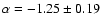 ,
Table 2 of the paper) is compatible with the slope in the FDF.
,
Table 2 of the paper) is compatible with the slope in the FDF.
![\begin{figure}
\par\includegraphics[width=5.5cm,clip]{3986f12a.ps}\hspace*{2mm}
...
...2b.ps}\hspace*{2mm}
\includegraphics[width=5.5cm,clip]{3986f12c.ps}
\end{figure}](/articles/aa/full/2006/10/aa3986-05/img179.gif) |
Figure 12:
Relative
evolution of
with redshift. The solid lines represent the
best fit of the evolutionary model according to
Eq. (1). Left panel: FDF
LFs between redshift
and
are used to
constrain the evolutionary model (Case 1). Middle panel:
FDF LFs between redshift
and
are
used to constrain the evolutionary model (Case 2).
Right panel: FDF LFs between redshift
and
,
as well
as the local LF of Blanton et al. (2003), are used to
constrain the evolutionary model (Case 3) (see also text). |
| Open with DEXTER | |
![\begin{figure}
\par\includegraphics[width=5.5cm,clip]{3986f13a.ps}\hspace*{2mm}
...
...3b.ps}\hspace*{2mm}
\includegraphics[width=5.5cm,clip]{3986f13c.ps}
\end{figure}](/articles/aa/full/2006/10/aa3986-05/img180.gif) |
Figure 13:
Relative
evolution of
with redshift. The solid lines represent the
best fit of the evolutionary model according to
Eq. (1). Left panel: FDF
LFs between redshift
and
are used to
constrain the evolutionary model (Case 1). Middle panel:
FDF LFs between redshift
and
are
used to constrain the evolutionary model (Case 2).
Right panel: FDF LFs between redshift
and
,
as well
as the local LF of Blanton et al. (2003), are used to
constrain the evolutionary model (Case 3) (see also text). |
| Open with DEXTER | |
Brown et al. (2001)
 .
.
A comparison between the LF of Brown et al. and the FDF is shown in
Fig. 15 for the V-band (left panel) and the R-band
(right panel). Although the agreement is quite good for the bright
end, the number density of the faint-end is substantially higher in
the FDF; while the slope of the LF derived in the FDF is
,
the slope derived by Brown et al. is
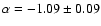 in the V- as well as in the R-band.
Shapley et al. (2001)
Shapley et al. analyze 118 photometrically selected LBGs with
 -band measurements covering an area of 30 arcmin2. Of these,
63 galaxies
have additional J-band measurements and 81 are
spectroscopically confirmed. Using this sample, Shapley et al.
derive the luminosity function in the restframe V-band at redshift of
-band measurements covering an area of 30 arcmin2. Of these,
63 galaxies
have additional J-band measurements and 81 are
spectroscopically confirmed. Using this sample, Shapley et al.
derive the luminosity function in the restframe V-band at redshift of
 .
Figure 16 shows
a comparison of the V-band LF derived by Shapley et al. with the LF
in the FDF at
.
The agreement is
very good, if we again concentrate on the shaded region. On the other
hand, because of the depth of the FDF we can trace the LF two
magnitudes deeper and, therefore, give better constraints on the slope
of the Schechter function. Comparing the faint-end of the FDF LF with
the extrapolated Schechter function of Shapley et al. clearly
shows that the very steep slope of
.
Figure 16 shows
a comparison of the V-band LF derived by Shapley et al. with the LF
in the FDF at
.
The agreement is
very good, if we again concentrate on the shaded region. On the other
hand, because of the depth of the FDF we can trace the LF two
magnitudes deeper and, therefore, give better constraints on the slope
of the Schechter function. Comparing the faint-end of the FDF LF with
the extrapolated Schechter function of Shapley et al. clearly
shows that the very steep slope of
 is not seen
in the FDF dataset.
is not seen
in the FDF dataset.
Ilbert et al. (2005)
 to constrain the LF to
redshift .
In Fig. 17 we
compare the V, R, and I band LF of the FDF with the Schechter function
derived in the VVDS survey for different redshift bins:
to constrain the LF to
redshift .
In Fig. 17 we
compare the V, R, and I band LF of the FDF with the Schechter function
derived in the VVDS survey for different redshift bins:
 ,
,
 ,
,
 ,
,
 ,
,
 ,
and
,
and
 .
Because of the limited sample size of the FDF at low
redshift, we could not use the same local redshift binning as
Ilbert et al.. We therefore compare
(Fig. 17) the VVDS Schechter
function at
and
with the FDF LF derived
at
.
Because of the limited sample size of the FDF at low
redshift, we could not use the same local redshift binning as
Ilbert et al.. We therefore compare
(Fig. 17) the VVDS Schechter
function at
and
with the FDF LF derived
at
 ,
as well as
the Schechter function at
,
as well as
the Schechter function at
 and
and
 with the FDF LF
derived at
with the FDF LF
derived at
 .
There is very
good agreement between the FDF data and the VVDS survey at all
redshifts under investigation, if we compare only the magnitude range
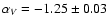
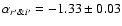
common to both surveys. Ilbert et al. derive
the faint-end slope from shallower data, if compared with the FDF that
have only a limited sensitivity for the latter. Nevertheless, in all
three bands, the differences between the formal
derived in the
FDF (
.
There is very
good agreement between the FDF data and the VVDS survey at all
redshifts under investigation, if we compare only the magnitude range
common to both surveys. Ilbert et al. derive
the faint-end slope from shallower data, if compared with the FDF that
have only a limited sensitivity for the latter. Nevertheless, in all
three bands, the differences between the formal
derived in the
FDF (
 and
and
 constant in redshift) and in the VVDS are compatible within
to
up to redshift
constant in redshift) and in the VVDS are compatible within
to
up to redshift
 (only one bin in
the I-band LF differs by slightly more than ). At higher
redshift, we do not see the steep slope (-1.5) as derived by
Ilbert et al. That in the FDF we are able to
follow the LF about 3-4 mag deeper may explain the
disagreement between the extrapolated faint-end slope of
Ilbert et al. and the FDF result.
(only one bin in
the I-band LF differs by slightly more than ). At higher
redshift, we do not see the steep slope (-1.5) as derived by
Ilbert et al. That in the FDF we are able to
follow the LF about 3-4 mag deeper may explain the
disagreement between the extrapolated faint-end slope of
Ilbert et al. and the FDF result.
![\begin{figure}
\par\includegraphics[width=7.3cm,clip]{3986f14a.ps}\hspace*{2mm}
\includegraphics[width=7.3cm,clip]{3986f14b.ps}
\end{figure}](/articles/aa/full/2006/10/aa3986-05/img194.gif) |
Figure 14:
Left panel: comparison of the R-band luminosity
function of the FDF (filled/open circles
)
with the Schechter function derived in
Lin et al. (1996) (
). The
shaded region is based on ,
,
and
.
The triangles show the r'-band FDF LF at
for SED type 1 galaxies. Right
panel: Comparison of the Gunn-r-band LF of the FDF with the
Schechter function derived in Lin et al. (1997) (z=0.2-0.6). The
shaded region is based on ,
,
and
. |
| Open with DEXTER | |
![\begin{figure}
\par\includegraphics[width=7.3cm,clip]{3986f15a.ps}\hspace*{4mm}
\includegraphics[width=7.3cm,clip]{3986f15b.ps}
\end{figure}](/articles/aa/full/2006/10/aa3986-05/img195.gif) |
Figure 15:
Comparison of the V-band ( left panel) and
R-band ( right panel) LF of the FDF with the local
(
)
Schechter function derived in
Brown et al. (2001). The shaded region is based on
,
,
and
.
|
| Open with DEXTER | |
![\begin{figure}
\par\includegraphics[width=8.8cm,clip]{3986f16a.ps}
\end{figure}](/articles/aa/full/2006/10/aa3986-05/img196.gif) |
Figure 16:
Comparison of the V-band luminosity
function of the FDF with the Schechter function derived in
Shapley et al. (2001) at
.
The shaded region is based on ,
,
and
,
where the cut-off at low luminosity indicates
the limiting magnitude of the sample. |
| Open with DEXTER | |
Wolf et al. (2003)
In Fig. 18 we compare the r'-band LF of
the FDF with the R-band selected luminosity function derived in the
COMBO-17 survey (Wolf et al. 2003) for different redshift bins: 0.2-0.6, 0.6-0.8, 0.8-1.0,
1.0-1.2. Because of the limited
sample size of the FDF at low redshift we could not use the same local
redshift binning as Wolf et al.. We therefore compare in
Fig. 18 the COMBO17
Schechter function at
and
with the FDF LF
derived at
.
There is very good agreement between
the FDF data and the COMBO-17 survey at all redshifts under
investigation, if we compare only the magnitude range common to
both surveys. Although the number density of the FDF seems to be
slightly higher for the restframe UV LF (FDFLF I), this is not the
case if we compare the LF in the R-band. Wolf et al. derived
the faint-end slope from relatively shallow data which have only a
limited sensitivity for the latter. This may explain the disagreement
between the extrapolated faint-end slope of
Wolf et al. and the FDF result.
Chen et al. (2003)
The galaxy sample analyzed by Chen et al. contains 6700H-band selected galaxies (within 847 arcmin2) in the HDFS region
with complementary optical U, B, V, R, and I colors, and 7400H-band selected galaxies (within 561 arcmin2) in the Chandra Deep
Field South region with complementary optical V, R, I, and z' colors.
The galaxy sample is part of the Las Campanas Infrared Survey
(LCIR Marzke et al. 1999; McCarthy et al. 2001) and is based on photometric
redshifts.
Figure 19 shows a comparison of the R-band luminosity function derived by Chen et al. with the LF in the FDF for three different redshift bins: 0.50-0.75 (left panel), 0.75-1.00 (middle panel), and 1.00-1.50 (right panel). There is good agreement between the FDF LF and the Schechter function derived by Chen et al. in the lowest redshift bin (z=0.50-0.75), if we compare only the magnitude range common to both surveys. At intermediate redshift (z=0.75-1.00), the number density of the bright end of the FDF LF is slightly higher than in Chen et al.. On the other hand, for the highest redshift bin (z=1.00-1.50) the number density of the bright end derived by Chen et al. roughly agrees with the results obtained in the FDF.
Dahlen et al. (2005)
Dahlen et al. use HST and ground-based U through photometry in the GOODS-S Field to measure the evolution of the R-band
luminosity function out to .
They combine a wider area,
optically selected (1100 arcmin2, R <24.5) catalog with a
smaller area but deep NIR selected (130 arcmin2,
 )
catalog. Distances are based on photometric redshifts
with an accuracy of
)
catalog. Distances are based on photometric redshifts
with an accuracy of
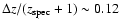 (0.06 after excluding 3% of outliers). To
determine the restframe R-band galaxy luminosity function out to
,
they use the deep
selected catalog. A comparison
between the R-band LF of Dahlen et al. and the FDF is shown in
Fig. 20. There is very good agreement in
nearly all redshift bins. Only at
(0.06 after excluding 3% of outliers). To
determine the restframe R-band galaxy luminosity function out to
,
they use the deep
selected catalog. A comparison
between the R-band LF of Dahlen et al. and the FDF is shown in
Fig. 20. There is very good agreement in
nearly all redshift bins. Only at
 and
and
 does the characteristic density in the FDF
seem to be slightly higher.
does the characteristic density in the FDF
seem to be slightly higher.
To summarize, we can say that the LFs derived in the FDF in general
show very good agreement with other observational datasets from the
literature. At the bright end of the LF, most of the datasets agree
within .
Differences between the extrapolated Schechter
function of the literature and the measured faint-end in the FDF can
be attributed to the shallower limiting magnitudes of the other
surveys.
As discussed for example in Benson et al. (2003), different physical processes are involved in shaping the bright and the faint ends of the galaxy LF. Therefore, it is interesting to compare LFs predicted by models with observational results in order to constrain those processes better. In this section we compare the R-band and I-band LFs in different redshift bins with the model predictions of Kauffmann et al. (1999).
In Fig. 21 we show the R-band luminosity
function of the FDF, together with the semi-analytic model predictions
by Kauffmann et al. (1999)
for
 ,
,
 ,
,
 ,
whereas in
Fig. 22 we show the I-band LF in the
redshift bins
,
,
,
,
whereas in
Fig. 22 we show the I-band LF in the
redshift bins
,
,
,
 ,
,
 ,
and
,
and
 .
For the R-band
no semi-analytic model predictions are available for redshifts larger
than
.
.
For the R-band
no semi-analytic model predictions are available for redshifts larger
than
.
The model agrees well with the measured LFs in the R-band. Also for
the I-band there is good agreement between the models and the
luminosity functions derived in the FDF up to redshift
(of course at
 the model is tuned
to reproduce the data). At
the model is tuned
to reproduce the data). At
 the
discrepancy increases, as the model does not contain enough bright
galaxies. Unfortunately, the models only predict luminosities for
massive galaxies and, because of lack of resolution, do not predict
galaxy number densities for faint
galaxies.
the
discrepancy increases, as the model does not contain enough bright
galaxies. Unfortunately, the models only predict luminosities for
massive galaxies and, because of lack of resolution, do not predict
galaxy number densities for faint
galaxies.
In this paper we use a sample of about 5600 I-band selected galaxies
in the FORS Deep Field down to a limiting magnitude of I = 26.8 mag
to analyze the evolution of the LFs in the r', i', and z' bands over
the redshift range
0.5 < z < 3.5, thus extending the results
presented in FDFLF I to longer wavelengths. All the results are based
on the same catalog and the same state of the art photometric
redshifts (
with only 1% outliers) as in FDFLF I.
The error budget of the luminosity functions includes the photometric
redshift error of each single galaxy, as well as the
Poissonian error.
Because of the depth of the FDF, we can trace the LFs deeper than most
other surveys can and therefore obtain good constraints on the faint-end
slope
of the LF. A detailed analysis of
leads to
similar conclusions to those found in FDFLF I for the blue regime: the
faint-end of the red LFs does not show a large redshift evolution over
the redshift range
and is compatible
within
to
with a constant slope in most of the
redshift bins. Moreover, the slopes in r', i', and z' are very similar
with a best-fitting slope of
for the combined
bands and redshift intervals
considered here.
Interestingly, an analysis of the slope of the LFs as a function of
wavelength shows a prominent trend of
to steepen with
increasing wavelength:
.
To better understand
this wavelength dependence of the LF slope, we analyze the
contribution of different galaxy types to the overall LF by
subdividing our galaxy sample into 4 typical SED types with restframe
U-V colors between 2.3-1.9, 2.0-1.6, 1.6-0.9, and 0.9-0
for SED type 1, 2, 3, and 4, respectively. Therefore, in a rough
classification one can refer to SED types 1 and 2 (SED type 3 and 4)
as red (blue) galaxies.
![\begin{figure}
\par\includegraphics[width=5.3cm,clip]{3986f17a.ps}\hspace*{2mm}
...
...7k.ps}\hspace*{2mm}
\includegraphics[width=5.3cm,clip]{3986f17l.ps}
\end{figure}](/articles/aa/full/2006/10/aa3986-05/img207.gif) |
Figure 17:
Comparison of the V ( left panels),
R ( middle panels), and I ( right panels) band LF of the FDF with the
Schechter function derived in Ilbert et al. (2005) (VVDS) at
(first row, light gray),
(first row, dark gray),
(second row, light gray),
(second row, dark gray),
(third row), and
(fourth row).
The shaded regions of all plots with  are based on
,
,
and
.
Only in the
two high redshift bins (third and fourth row) is the shaded region
based on
and
.
Please note that
we use the average error, if the upper and lower values reported by
Ilbert et al. (2005) disagree.
are based on
,
,
and
.
Only in the
two high redshift bins (third and fourth row) is the shaded region
based on
and
.
Please note that
we use the average error, if the upper and lower values reported by
Ilbert et al. (2005) disagree. |
| Open with DEXTER | |
![\begin{figure}
\par\includegraphics[width=6.7cm,clip]{3986f18a.ps}\hspace*{4mm}
...
...8c.ps}\hspace*{2mm}
\includegraphics[width=6.7cm,clip]{3986f18d.ps}
\end{figure}](/articles/aa/full/2006/10/aa3986-05/img208.gif) |
Figure 18:
Comparison of the LF in the r'-band of the FDF
with the Schechter function derived in
Wolf et al. (2003):
 ( upper left panel, light gray),
 ( upper left panel, dark grey),
 ( upper right panel),
 ( lower left panel),
 ( lower right panel).
The shaded regions of nearly all plots are based on ,
,
and
.
Only in the highest redshift
bin ( lower right panel) the shaded region is based only on
and
.
The cut-off at low luminosity
indicates the limiting magnitude of the sample.
( lower right panel).
The shaded regions of nearly all plots are based on ,
,
and
.
Only in the highest redshift
bin ( lower right panel) the shaded region is based only on
and
.
The cut-off at low luminosity
indicates the limiting magnitude of the sample. |
| Open with DEXTER | |
![\begin{figure}
\par\includegraphics[width=5.5cm,clip]{3986f19a.ps}\hspace*{2mm}
...
...9b.ps}\hspace*{2mm}
\includegraphics[width=5.5cm,clip]{3986f19c.ps}
\end{figure}](/articles/aa/full/2006/10/aa3986-05/img209.gif) |
Figure 19:
Comparison of the luminosity
function in the R-band of the FDF with the Schechter function
derived in Chen et al. (2003):
 ( left panel),
 ( middle panel), and
 ( right panel).
The shaded region is based on ,
and
for
( left panel). For
( middle panel) and
( right panel), the shaded region is based only on
and
.
The cut-off at low luminosity indicates the
limiting magnitude of the sample.
( right panel).
The shaded region is based on ,
and
for
( left panel). For
( middle panel) and
( right panel), the shaded region is based only on
and
.
The cut-off at low luminosity indicates the
limiting magnitude of the sample. |
| Open with DEXTER | |
![\begin{figure}
\par\includegraphics[width=5.4cm,clip]{3986f20a.ps}\hspace*{2mm}
...
...0e.ps}\hspace*{2mm}
\includegraphics[width=5.4cm,clip]{3986f20f.ps}
\end{figure}](/articles/aa/full/2006/10/aa3986-05/img210.gif) |
Figure 20:
Comparison of the R-band LF of the FDF
with the Schechter function derived in
Dahlen et al. (2005) at
 ,
, ,
,
 ,
, ,
,
 ,
and ,
and
 ( from upper left to lower right panel). The shaded region is based on
,
,
and
for all panels.
The cut-off of the shaded region at low luminosity indicates the
limiting magnitude of the sample.
( from upper left to lower right panel). The shaded region is based on
,
,
and
for all panels.
The cut-off of the shaded region at low luminosity indicates the
limiting magnitude of the sample. |
| Open with DEXTER | |
![\begin{figure}
\par\includegraphics[width=5.4cm,clip]{3986f21a.ps}\hspace*{2mm}
...
...1b.ps}\hspace*{2mm}
\includegraphics[width=5.4cm,clip]{3986f21c.ps}
\end{figure}](/articles/aa/full/2006/10/aa3986-05/img211.gif) |
Figure 21:
Comparison of the R-band LF of the FDF with
predictions based on
Kauffmann et al. (1999) (solid line):
,
,
and
,
( from left to right panel). The filled (open) symbols
show the LF corrected (uncorrected) for
.
The drops of the theoretical curves towards the faint ends are caused by
the limited mass resolution of the models, see Kauffmann et al. (1999) for
details. |
| Open with DEXTER | |
![\begin{figure}
\par\includegraphics[width=5.4cm,clip]{3986f22a.ps}\hspace*{2mm}
...
...2e.ps}\hspace*{2mm}
\includegraphics[width=5.4cm,clip]{3986f22f.ps}
\end{figure}](/articles/aa/full/2006/10/aa3986-05/img212.gif) |
Figure 22:
Comparison of the I-band LF of the FDF with
predictions based on
Kauffmann et al. (1999) (solid line):
,
,
,
,
,
and
( from upper left to lower right panel). The filled (open) symbols
show the LF corrected (uncorrected) for
.
The drops of the theoretical curves towards the faint ends are caused by
the limited mass resolution of the models; see Kauffmann et al. (1999) for
details. |
| Open with DEXTER | |
Although the overall LF is completely dominated in the UV regime by extreme star-forming galaxies, the overall LF in the red regime is mainly dominated by early to late type galaxies at the bright end, but extreme star-forming galaxies at the faint end. The relative contribution of the different SED type LF to the overall LF clearly changes as a function of analyzed waveband resulting (at the depth of the FDF) in a steeper slope for the overall LF in the red regime if compared to the blue regime.
To quantify the contribution of the different SED types to the total luminosity density, we derive and analyze the latter in the UV and in the red bands as a function of redshift. The contribution of type 1 and 2 galaxies to the UV LD is negligible at all analyzed redshifts, as SED types 3 and 4 completely dominate. On the other hand, the relative contribution to the overall luminosity density of type 1 and 2 galaxies is of the same order or even exceeds those of type 3 and 4 in the red bands.
We investigate the evolution of
and
(for a fixed
slope )
by means of the redshift parametrization introduced
in FDFLF I.
Based on the FDF data (Case 1 and
Case 2), we find only a mild brightening of
and
decrease of
with increasing redshifts in all three
of these analyzed wavebands. If we follow the evolution of the characteristic
luminosity from
to
,
we find an increase of 0.8 mag in
the r', and 0.4 mag in the i' and z' bands.
Simultaneously the characteristic density decreases by about 40%
in all the analyzed wavebands.
We compare the LFs with previous observational datasets and discuss
discrepancies. As for the blue bands, we find good/very good agreement
with most of the datasets, especially at the bright end. Differences
in the faint-end slope in most cases can be attributed to the
shallower limiting magnitudes of the other surveys.
We also compare our results with predictions of semi-analytical models
at various redshifts. The semi-analytical models predict LFs that
describe the data at low redshift very well, but as for the blue
bands, they show growing disagreement with increasing redshifts.
Unfortunately, the models only predict luminosities for massive
galaxies,so that a comparison between the predicted and
observed galaxy number densities for low luminosity galaxies (
 )
could not be done.
)
could not be done.
Acknowledgements
We thank the anonymous referee for the helpful comments that improved the presentation of the paper. We acknowledge the support of the ESO Paranal staff during several observing runs. This work was supported by the Deutsche Forschungsgemeinschaft, DFG, SFB 375 Astroteilchenphysik, SFB 439 (Galaxies in the young Universe), the Volkswagen Foundation (I/76 520), and the Deutsches Zentrum für Luft- und Raumfahrt (50 OR 0301).

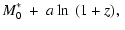

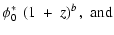


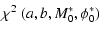
![$\displaystyle \sum_{j=1}^{N_j} \sum_{i=1}^{N_i} ~ \frac{\left[
\phi (M_{ij}) - \Psi (M_{ij}, z_j, a, b, M^\ast_0,\phi^\ast_0)
\right]^2}{\sigma_{ij}^2} ,$](/articles/aa/full/2006/10/aa3986-05/img111.gif)