A&A 447, 863-876 (2006)
DOI: 10.1051/0004-6361:20054127
Gas metallicity in the narrow-line regions of
high-redshift active galactic nuclei
T. Nagao 1,2 -
R. Maiolino 1 -
A. Marconi 1
1 -
INAF - Osservatorio Astrofisico di Arcetri,
Largo Enrico Fermi 5, 50125 Firenze, Italy
2 -
National Astronomical Observatory of Japan,
2-21-1 Osawa, Mitaka, Tokyo 151-8588, Japan
Received 30 August 2005 / Accepted 4 October 2005
Abstract
We analyze optical (UV rest-frame) spectra of X-ray
selected narrow-line QSOs at redshift
 found in the
Chandra Deep Field South and of narrow-line radio
galaxies at redshift
found in the
Chandra Deep Field South and of narrow-line radio
galaxies at redshift
 to investigate the gas
metallicity of the narrow-line regions and their
evolution in this redshift range.
Such spectra are also compared with UV spectra of
local Seyfert 2 galaxies.
The observational data are inconsistent with the
predictions of shock models, suggesting that
the narrow-line regions are mainly photoionized.
The photoionization models with dust grains predict
line flux ratios which are also in disagreement with most
of the observed values, suggesting that the high-ionization
part of the narrow-line regions (which is sampled by the
available spectra) is dust-free.
The photoionization dust-free models provide two
possible scenarios which are consistent with the observed
data: low-density gas clouds
(
to investigate the gas
metallicity of the narrow-line regions and their
evolution in this redshift range.
Such spectra are also compared with UV spectra of
local Seyfert 2 galaxies.
The observational data are inconsistent with the
predictions of shock models, suggesting that
the narrow-line regions are mainly photoionized.
The photoionization models with dust grains predict
line flux ratios which are also in disagreement with most
of the observed values, suggesting that the high-ionization
part of the narrow-line regions (which is sampled by the
available spectra) is dust-free.
The photoionization dust-free models provide two
possible scenarios which are consistent with the observed
data: low-density gas clouds
(
 cm-3) with a sub-solar
metallicity
(
cm-3) with a sub-solar
metallicity
(
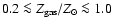 ), or
high-density gas clouds
(
), or
high-density gas clouds
(
 cm-3) with a wide range of
gas metallicity
(
cm-3) with a wide range of
gas metallicity
(
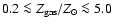 ).
Regardless of the specific interpretation, the observational
data do not show any evidence for a significant evolution
of the gas metallicity in the narrow-line regions
within the redshift range
.
Instead, we
find a trend for more luminous active galactic
nuclei to have more
metal-rich gas clouds (luminosity-metallicity relation),
which is in agreement with the same finding in the
studies of the broad-line regions.
The lack of evolution for the gas metallicity of the narrow-line
regions implies that the major epoch of star formation in
the host galaxies of these active galactic nuclei is at
).
Regardless of the specific interpretation, the observational
data do not show any evidence for a significant evolution
of the gas metallicity in the narrow-line regions
within the redshift range
.
Instead, we
find a trend for more luminous active galactic
nuclei to have more
metal-rich gas clouds (luminosity-metallicity relation),
which is in agreement with the same finding in the
studies of the broad-line regions.
The lack of evolution for the gas metallicity of the narrow-line
regions implies that the major epoch of star formation in
the host galaxies of these active galactic nuclei is at  .
.
Key words:
galaxies: active -
galaxies: evolution -
galaxies: nuclei -
quasars: emission lines -
quasars: general
Understanding galaxy formation and evolution is one of the
key astrophysical issues of this
decade. The chemical composition of gas and stars in galaxies
provides important information because it is
a tracer of the star formation history in galaxies. A
promising way to study the chemical evolution of galaxies
is to measure their metallicity as a function of redshift.
Since it is extremely hard and time-consuming to measure
stellar metallicity of faint high-z galaxies, because high
quality spectra of shallow absorption features are required
(but see, e.g., Pettini et al. 2000; Mehlert et al. 2002),
investigating the gas metallicity through emission lines is
a promising strategy. However, most of the available diagnostic
emission lines associated with massive star formation (e.g.,
[O II] 3727, [O III]
 4959,5007,
[N II]6548,6583) are in the rest-frame
optical wavelength and thus are shifted to near infrared
in high-z galaxies. Accordingly, observations
of these emission lines in high-z galaxies are feasible only
for relatively bright targets (e.g., Teplitz et al. 2000;
Pettini et al. 2001; Tecza et al. 2004; Shapley et al. 2004).
Instead, active galactic nuclei (AGNs) exhibit bright
emission lines at rest-frame UV wavelengths, which can be
used to investigate the gas metallicity even in high-zobjects. Spectroscopic observations of high-z QSOs suggest
that gas metallicity in the broad-line region (BLR) tends to be
much higher than solar (e.g., Hamann & Ferland 1992;
Dietrich et al. 2003; Nagao et al. 2006) reaching as much as
4959,5007,
[N II]6548,6583) are in the rest-frame
optical wavelength and thus are shifted to near infrared
in high-z galaxies. Accordingly, observations
of these emission lines in high-z galaxies are feasible only
for relatively bright targets (e.g., Teplitz et al. 2000;
Pettini et al. 2001; Tecza et al. 2004; Shapley et al. 2004).
Instead, active galactic nuclei (AGNs) exhibit bright
emission lines at rest-frame UV wavelengths, which can be
used to investigate the gas metallicity even in high-zobjects. Spectroscopic observations of high-z QSOs suggest
that gas metallicity in the broad-line region (BLR) tends to be
much higher than solar (e.g., Hamann & Ferland 1992;
Dietrich et al. 2003; Nagao et al. 2006) reaching as much as
 (Baldwin et al. 2003).
However it is not clear how the gas metallicity inferred from the
broad lines is related to the chemical properties of the host galaxies,
since the broad lines of AGNs sample only a very small
region of galactic nuclei (
(Baldwin et al. 2003).
However it is not clear how the gas metallicity inferred from the
broad lines is related to the chemical properties of the host galaxies,
since the broad lines of AGNs sample only a very small
region of galactic nuclei (
 1 pc; e.g.,
Kaspi et al. 2000), which
may have evolved more rapidly than the host galaxy.
1 pc; e.g.,
Kaspi et al. 2000), which
may have evolved more rapidly than the host galaxy.
An alternative possibility is to use narrow line AGNs. In
this paper we focus on narrow-line AGNs at high redshift,
in particular on high-z radio galaxies (HzRGs) and type-2
QSOs (QSO2s). The nuclei of narrow-line AGNs are thought to
be obscured by edge-on optically thick tori (e.g.,
Antonucci & Miller 1985; Antonucci 1993; Cohen et al. 1999).
Since the broad emission lines and the strong ionizing
continuum are blocked by this
"natural coronagraph'', we can investigate narrow UV
emission lines whose spatial extension is roughly comparable
to that of the host galaxies (
 pc), without
any complex deblending of broad and narrow components for
the emission lines. Although narrow emission lines of
HzRGs are often strongly influenced by a radio jet in terms
of kinematics and morphological properties (e.g., McCarthy
et al. 1991; Baum & McCarthy 2000), the ionization
mechanism is mostly dominated by photoionization, not by
shock ionization (e.g., Villar-Martin et al. 1997;
Allen et al. 1998; Iwamuro et al. 2003).
Therefore, we can obtain information on the
gas metallicity of the narrow-line regions (NLRs) by comparing
the observed emission-line flux ratios with the predictions of
photoionization models.
By comparing the NLRs of HzRGs and QSO2s with low-ztype 2 AGNs (Seyfert 2 galaxies; Sy2s), we can investigate
whether the gas metallicity evolves on a cosmological
timescale or not.
pc), without
any complex deblending of broad and narrow components for
the emission lines. Although narrow emission lines of
HzRGs are often strongly influenced by a radio jet in terms
of kinematics and morphological properties (e.g., McCarthy
et al. 1991; Baum & McCarthy 2000), the ionization
mechanism is mostly dominated by photoionization, not by
shock ionization (e.g., Villar-Martin et al. 1997;
Allen et al. 1998; Iwamuro et al. 2003).
Therefore, we can obtain information on the
gas metallicity of the narrow-line regions (NLRs) by comparing
the observed emission-line flux ratios with the predictions of
photoionization models.
By comparing the NLRs of HzRGs and QSO2s with low-ztype 2 AGNs (Seyfert 2 galaxies; Sy2s), we can investigate
whether the gas metallicity evolves on a cosmological
timescale or not.
By focusing on the flux ratio of
N V1240/C IV1549 that is one of
the most frequently used metallicity diagnostics for AGNs
(generally for the BLR; e.g., Hamann & Ferland 1992, 1999;
Dietrich et al. 2003), De Breuck et al.
(2000) reported gas metallicity of HzRGs in the range
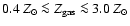 or
possibly even much higher (see also van Ojik et al. 1994;
Vernet et al. 2001). They also claimed a metallicity evolution
within their sample from z > 3 to z < 3:
the gas metallicity of all HzRGs at z > 3 in their sample is
or
possibly even much higher (see also van Ojik et al. 1994;
Vernet et al. 2001). They also claimed a metallicity evolution
within their sample from z > 3 to z < 3:
the gas metallicity of all HzRGs at z > 3 in their sample is
 ,
at variance with their sample
at z < 3. Norman et al. (2002) reported that the strong
N V1240 emission of a X-ray selected
high-z QSO2 found in Chandra Deep Field South (CDFS;
Giacconi et al. 2002; Rosati et al. 2002), CDFS-202
(
,
at variance with their sample
at z < 3. Norman et al. (2002) reported that the strong
N V1240 emission of a X-ray selected
high-z QSO2 found in Chandra Deep Field South (CDFS;
Giacconi et al. 2002; Rosati et al. 2002), CDFS-202
(
 ), is consistent with a super-solar metallicity
of its NLR, and more specifically
), is consistent with a super-solar metallicity
of its NLR, and more specifically
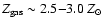 .
However, since the N V1240 emission becomes very
weak for metal-poor gas (i.e.,
.
However, since the N V1240 emission becomes very
weak for metal-poor gas (i.e.,
 ),
only upper-limit fluxes on N V1240 are available
for the majority of the HzRG sample in De Breuck et al. (2000),
which makes the investigation of the metallicity evolution
difficult. An additional issue is that Iwamuro et al. (2003),
based on rest-frame optical spectra obtained by
sensitive near-infrared spectroscopy,
recently reported that HzRGs at
2.0 < z < 2.6 tend to show
sub-solar metallicities (
),
only upper-limit fluxes on N V1240 are available
for the majority of the HzRG sample in De Breuck et al. (2000),
which makes the investigation of the metallicity evolution
difficult. An additional issue is that Iwamuro et al. (2003),
based on rest-frame optical spectra obtained by
sensitive near-infrared spectroscopy,
recently reported that HzRGs at
2.0 < z < 2.6 tend to show
sub-solar metallicities (
 ),
significantly lower than values reported by
De Breuck et al. (2000). Although it is clear that improved and
additional observational data for a larger
sample of HzRGs are required to reconcile this disagreement,
both more sensitive measurements of N V1240
and deeper near-infrared spectroscopic data are
very difficult to obtain for HzRGs and QSO2s.
),
significantly lower than values reported by
De Breuck et al. (2000). Although it is clear that improved and
additional observational data for a larger
sample of HzRGs are required to reconcile this disagreement,
both more sensitive measurements of N V1240
and deeper near-infrared spectroscopic data are
very difficult to obtain for HzRGs and QSO2s.
To tackle these issues, it is useful to find alternative
metallicity diagnostics that consists only of strong
UV emission lines. In this paper, we investigate
strong UV emission lines for HzRGs, QSO2s, and Sy2s.
By comparing the compiled data with photoionization model
calculations, we discuss the evolution of the gas metallicity
of the NLRs in AGNs, from high-z to the local universe,
using only strong UV emission lines. The compiled data and
our photoionization model calculations are presented in
Sect. 2 and Sect. 3, respectively. We compare the observational data with
the model results, discuss the properties of NLR gas clouds
and the implications for the chemical evolution of AGNs in Sect. 4.
A brief summary is given in Sect. 5.
Table 1:
Emission-line measurements of X-ray selected QSO2s at z > 1.2.
Table 2:
Emission-line measurements of Sy2s.
To investigate the possible chemical evolution of the NLRs
in AGNs, we compiled the fluxes of some strong UV emission
lines, N V1240, C IV1549,
He II1640 and C III]1909.
We focus only on these emission lines since
fainter lines were measured only in a few type 2 AGNs.
The details of the data compilation for each population
of objects are given below.
(1) HzRGs: we used emission-line fluxes of HzRGs given by
De Breuck et al. (2000), who compiled emission-line flux data
of 165 radio galaxies from the literature.
This sample contains 114 HzRGs at
 for which we can investigate the rest-frame UV spectra.
We assigned the error
on each line flux by checking the original references.
For objects whose emission-line flux errors are not given in the
original reference, we assigned a 20% error for each emission line.
For emission-line fluxes measured with a statistical significance
lower than 3
for which we can investigate the rest-frame UV spectra.
We assigned the error
on each line flux by checking the original references.
For objects whose emission-line flux errors are not given in the
original reference, we assigned a 20% error for each emission line.
For emission-line fluxes measured with a statistical significance
lower than 3 ,
we adopted 3
upper-limit values
instead of the measured fluxes.
We also referred to the measurements of emission-line flux data of
9 HzRGs presented by Vernet et al. (2001). Although these HzRGs
are included in the sample of De Breuck et al. (2000), we
adopted the data of Vernet et al. (2001) for these 9 HzRGs
because of the higher signal-to-noise ratios of the
Vernet et al. (2001) data.
Accordingly, the number of HzRGs whose fluxes of
C IV1549, He II1640
and C III]1909 are measured is
51 in total, of which two objects are lower- or upper-limit data.
,
we adopted 3
upper-limit values
instead of the measured fluxes.
We also referred to the measurements of emission-line flux data of
9 HzRGs presented by Vernet et al. (2001). Although these HzRGs
are included in the sample of De Breuck et al. (2000), we
adopted the data of Vernet et al. (2001) for these 9 HzRGs
because of the higher signal-to-noise ratios of the
Vernet et al. (2001) data.
Accordingly, the number of HzRGs whose fluxes of
C IV1549, He II1640
and C III]1909 are measured is
51 in total, of which two objects are lower- or upper-limit data.
(2) QSO2s: we used the spectra of X-ray selected QSO2s
in CDFS recently obtained by Szokoly et al. (2004).
Among 288 objects whose spectra
were obtained with VLT/FORS by Szokoly et al. (2004),
51 objects are at z > 1.2. From these 51 objects,
we selected 9 objects with a high quality spectrum that shows
only narrow emission lines.
All of these 9 objects (distributed at
 ;
see Table 1) show strong C IV1549
emission which indicates, along with their X-ray emission,
that these objects harbor an AGN
(i.e., not starburst galaxies). We obtained spectral data
of these 9 objects from the CDFS web
site
;
see Table 1) show strong C IV1549
emission which indicates, along with their X-ray emission,
that these objects harbor an AGN
(i.e., not starburst galaxies). We obtained spectral data
of these 9 objects from the CDFS web
site![[*]](/icons/foot_motif.gif) ,
and measured their emission-line fluxes and errors by means
of a simple Gaussian fitting. The measured fluxes are given in
Table 1. In this table fluxes of Ly
,
and measured their emission-line fluxes and errors by means
of a simple Gaussian fitting. The measured fluxes are given in
Table 1. In this table fluxes of Ly are also given
for the
reader's convenience, although we do not use the Ly
flux in the analysis and discussion in this paper. The reported
errors do not take any possible systematic errors into account.
In addition to the nine QSO2s in the CDFS, we also used
the emission-line flux data of CXO J084837.9+445352 (CXO 52),
a QSO2 at z=3.288 found by Stern et al. (2002).
Since the flux error for N V1240 is
not given by Stern et al. (2002), we assigned a 20% error
for this line as for the HzRGs mentioned above.
Therefore the number of QSO2s is 10 in total.
are also given
for the
reader's convenience, although we do not use the Ly
flux in the analysis and discussion in this paper. The reported
errors do not take any possible systematic errors into account.
In addition to the nine QSO2s in the CDFS, we also used
the emission-line flux data of CXO J084837.9+445352 (CXO 52),
a QSO2 at z=3.288 found by Stern et al. (2002).
Since the flux error for N V1240 is
not given by Stern et al. (2002), we assigned a 20% error
for this line as for the HzRGs mentioned above.
Therefore the number of QSO2s is 10 in total.
![\begin{figure}
\par\includegraphics[width=5.5cm]{4127f01.eps}
\end{figure}](/articles/aa/full/2006/09/aa4127-05/Timg41.gif) |
Figure 1:
Redshift distributions of the sample objects.
a) The HzRG sample. The white histogram denotes
the original HzRG sample (at
 ;
114 objects) of De Breuck et al. (2000) while the black
histogram denotes the 49 HzRGs whose emission-line fluxes
of C IV1549, He II1640 and
C III]1909 are measured.
b) The QSO2 sample. The white histogram denotes
the AGNs (including both broad-line and narrow-line AGNs)
at ;
114 objects) of De Breuck et al. (2000) while the black
histogram denotes the 49 HzRGs whose emission-line fluxes
of C IV1549, He II1640 and
C III]1909 are measured.
b) The QSO2 sample. The white histogram denotes
the AGNs (including both broad-line and narrow-line AGNs)
at
 found in the CDFS (51 objects;
Szokoly et al. 2004) and one additional QSO2 reported by
Stern et al. (2002), while the black histogram denotes the
narrow-line AGNs among them (10 objects) which are
presented in Table 1.
found in the CDFS (51 objects;
Szokoly et al. 2004) and one additional QSO2 reported by
Stern et al. (2002), while the black histogram denotes the
narrow-line AGNs among them (10 objects) which are
presented in Table 1.
|
| Open with DEXTER |
![\begin{figure}
\par\rotatebox{-90}{\includegraphics[width=12cm,clip]{4127f02.eps}}
\end{figure}](/articles/aa/full/2006/09/aa4127-05/Timg42.gif) |
Figure 2:
a) Compiled data plotted on a diagram of
C IV1549/He II1640 versus
N V1240/C IV1549.
Arrows denote the upper-limit or lower-limit on the flux ratios.
Filled circles and arrows denote the HzRG data
and open circles and arrows denote the QSO2 data.
Open triangles denote the Sy2 data.
The arrow at the lower-left corner in the panel denote
the effect of a correction for dust extinction (
 mag).
b) Logarithmically averaged flux ratios of
HzRGs (filled circle), QSO2s (open circle) and Sy2s (open
triangle) plotted on a diagram of
C IV1549/He II1640 versus
N V1240/C IV1549.
The arrow at the lower-left corner is the same as in a).
Thin bars denote the RMS of the data distribution, and
thick bars denote the estimated errors on the averaged values. mag).
b) Logarithmically averaged flux ratios of
HzRGs (filled circle), QSO2s (open circle) and Sy2s (open
triangle) plotted on a diagram of
C IV1549/He II1640 versus
N V1240/C IV1549.
The arrow at the lower-left corner is the same as in a).
Thin bars denote the RMS of the data distribution, and
thick bars denote the estimated errors on the averaged values.
|
| Open with DEXTER |
(3) Sy2s: we compiled the flux data of 9 Sy2s observed by
IUE from the literature. The object name, the compiled
flux data and their errors and the reference are given in
Table 2. For the data obtained by Thuan (1984),
they reported UV emission-line fluxes for
IC 5135, not only for NCG 5135; however, we do not include
the data of IC 5135 because the signal-to-noise ratio
is too low (see Thuan 1984 for details).
For fluxes with no information on their errors in the
reference, we assigned a 20% error as for the
HzRGs and QSO2s (except for low-accuracy measurements
explicitly mentioned in the reference for which we assigned a
30% error).
All of the targets are at z < 0.03 and thus we regard this
sample as representative of the NLRs in the local universe.
The redshift distributions of the HzRG and the QSO2 samples
are shown in Fig. 1.
The compiled data are not corrected for Galactic and
intrinsic dust reddening. Possible effects of the reddening
on our analysis are discussed later (Sect. 2.2).
Since most of these data were obtained with low-dispersion
spectroscopy, the measured C III] flux may be
contaminated by the Si III]
1883,1892 flux.
However, the contribution of Si III] is thought to be
small and we will discuss this issue further in Sect. 3.2.
In Fig. 2a the compiled line flux ratios are
plotted on the
C IV1549/He II1640 versus
C III]1909/C IV1549 diagram.
The C IV1549/He II1640 flux ratio
is expected to be sensitive to the gas metallicity.
This is because the gas temperature decreases when the
metallicity increases in low-density
( cm-3) gas clouds
(e.g., Ferland et al. 1984) and thus the collisional
excitation of C IV is gradually suppressed, while the
He II1640 luminosity is basically proportional
to the volume of the doubly-ionized helium region and thus
rather insensitive to the gas metallicity.
The C III]1909/C IV1549 ratio is
instead expected to be sensitive to the ionization degree of
the gas clouds. Therefore,
C III]1909/C IV1549 can be used
to check any dependence of
C IV1549/He II1640 on the
ionization state of the gas. Thus, a diagnostic
diagram that consists of these two flux ratios is expected to
be useful to estimate the properties of
NLRs only with strong UV emission lines, as discussed more
extensively in Sects. 3 and 4 (see also Groves et al. 2004b).
cm-3) gas clouds
(e.g., Ferland et al. 1984) and thus the collisional
excitation of C IV is gradually suppressed, while the
He II1640 luminosity is basically proportional
to the volume of the doubly-ionized helium region and thus
rather insensitive to the gas metallicity.
The C III]1909/C IV1549 ratio is
instead expected to be sensitive to the ionization degree of
the gas clouds. Therefore,
C III]1909/C IV1549 can be used
to check any dependence of
C IV1549/He II1640 on the
ionization state of the gas. Thus, a diagnostic
diagram that consists of these two flux ratios is expected to
be useful to estimate the properties of
NLRs only with strong UV emission lines, as discussed more
extensively in Sects. 3 and 4 (see also Groves et al. 2004b).
Table 3:
Averaged diagnostic flux ratios.
In Fig. 2 we also show the effect of the dust extinction
on the line ratios, for the case of
 mag. An extinction curve described by
Cardelli et al. (1989) is adopted.
Since the dust extinction in typical
type 2 AGNs is generally
mag. An extinction curve described by
Cardelli et al. (1989) is adopted.
Since the dust extinction in typical
type 2 AGNs is generally
 mag
(see, e.g., Fig. 5 of Nagao et al. 2001b), we conclude
that the effect of dust extinction on our analysis and
discussion is not important.
mag
(see, e.g., Fig. 5 of Nagao et al. 2001b), we conclude
that the effect of dust extinction on our analysis and
discussion is not important.
As clearly shown in Fig. 2a, there is no significant
difference in these two flux ratios between the high-z QSO2
sample and the local Sy2 sample. Some HzRGs show similar flux
ratios to QSO2s and Sy2s, although other HzRGs show lower
C IV1549/He II1640 and higher
C III]1909/C IV1549 than
QSO2s and Sy2s. The logarithmically averaged ratios
for these three populations
(excluding upper-limits and lower-limits) are
summarized in Table 3.
These averaged flux ratios are also plotted in Fig. 2b.
The average flux ratios of HzRGs appears systematically
different to those of QSO2s and Sy2s.
To see the statistical significance of the differences in
the line flux ratios between HzRGs and QSO2s - Sy2s,
the Kolmogorov-Smirnov (K-S) statistical test is applied to
the data, discarding upper limits and lower limits.
The null hypothesis is that the flux ratios
(C IV1549/He II1640 and
C III]1909/C IV1549) of HzRGs
(
 )
and QSO2s - Sy2s (
)
and QSO2s - Sy2s (
 )
come from the same underlying population. The derived
K-S probabilities are
)
come from the same underlying population. The derived
K-S probabilities are
 for
C IV1549/He II1640 and
for
C IV1549/He II1640 and
 for
C III]1909/C IV1549. These
results suggest that the difference in the
C IV1549/He II1640 ratio is
statistically significant while the difference in the
C III]1909/C IV1549 ratio is
statistically marginal.
for
C III]1909/C IV1549. These
results suggest that the difference in the
C IV1549/He II1640 ratio is
statistically significant while the difference in the
C III]1909/C IV1549 ratio is
statistically marginal.
When focusing only on HzRGs, an anti-correlation between
the emission-line flux ratios of
C IV1549/He II1640 and
C III]1909/C IV1549 is apparent
in Fig. 2a. To examine the statistical significance
of this correlation, the Spearman rank-order test is applied
to the HzRG data, discarding upper limits and lower limits.
The derived Spearman rank-order correlation
coefficient ( )
and their statistical significance
)
and their statistical significance
 ,
which is the probability of the data being
consistent with the null hypothesis that the flux ratios are
not correlated, are
,
which is the probability of the data being
consistent with the null hypothesis that the flux ratios are
not correlated, are
 and
and
 (
).
This indicates that the apparent anti-correlation between
C IV1549/He II1640 and
C III]1909/C IV1549 of HzRGs
is statistically significant.
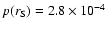
This significance does not disappear by including QSO2s
and Sy2s: the corresponding Spearman rank-order correlation
coefficient and its statistical significance become
(
).
This indicates that the apparent anti-correlation between
C IV1549/He II1640 and
C III]1909/C IV1549 of HzRGs
is statistically significant.
This significance does not disappear by including QSO2s
and Sy2s: the corresponding Spearman rank-order correlation
coefficient and its statistical significance become
 and
and
 (
(
 ). This anti-correlation has also been
shown by Allen et al. (1998) for a smaller HzRG sample.
We will discuss the interpretation of this trend in Sect. 4.1.
). This anti-correlation has also been
shown by Allen et al. (1998) for a smaller HzRG sample.
We will discuss the interpretation of this trend in Sect. 4.1.
To provide a quantitative interpretation of Fig. 2,
we carried out
photoionization model calculations. The method and
the results are given below.
We performed model runs by using the public photoionization
code Cloudy version 94
(Ferland 1997; Ferland et al. 1998).
For simplicity, we assumed uniform gas density clouds with a
plane-parallel geometry, and we examined both
dust-free and dusty cases. For the models with dust,
Orion-type graphite and silicate grains (Baldwin et al. 1991;
Ferland 1997) were included. Note that the calculations are
not sensitive to the assumption of the grain composition
(Sect. 4.1.2).
Effects of dust grains on the depletion of heavy elements
and on the radiative transfer were considered by Cloudy.
The parameters for the calculations are (1) the spectral energy
distribution (SED) of the photoionizing continuum radiation;
(2) the hydrogen density of a cloud ( );
(3) the ionization parameter (U), i.e., the ratio of the
ionizing photon density to the hydrogen density at the
irradiated surface of a cloud;
(4) the column density of a cloud (
);
(3) the ionization parameter (U), i.e., the ratio of the
ionizing photon density to the hydrogen density at the
irradiated surface of a cloud;
(4) the column density of a cloud ( ); and
(5) the elemental composition of the gas.
); and
(5) the elemental composition of the gas.
![\begin{figure}
\par\rotatebox{-90}{\includegraphics[width=5cm]{4127f03.eps}}
\end{figure}](/articles/aa/full/2006/09/aa4127-05/Timg66.gif) |
Figure 3:
Adopted SEDs for our photoionization model calculations.
Thin solid line denotes a SED with a strong UV bump and
thick dashed line denotes a SED with a weak UV bump.
Thin dotted line denotes the SED used by Mathews & Ferland
(1983). All the three SEDs are normalized to the flux at
1 keV ( 73 Ryd). 73 Ryd).
|
| Open with DEXTER |
![\begin{figure}
\par\rotatebox{-90}{\includegraphics[width=10.4cm]{4127f04.eps}}
\end{figure}](/articles/aa/full/2006/09/aa4127-05/Timg67.gif) |
Figure 4:
Model results plotted on a diagram of
C IV1549/He II1640 versus
C III]1909/C IV1549.
Models for gas clouds with
 cm-3 (thin lines) and 103 cm-3 (thick lines) are presented.
Constant- cm-3 (thin lines) and 103 cm-3 (thick lines) are presented.
Constant-
 sequences and constant-U sequences are denoted by dotted and solid lines, respectively.
a) Dust-free models adopting the input SED with a large UV bump.
b) Dusty models adopting the input SED with a large UV bump.
c) Dust-free models adopting the input SED with a small UV bump.
d) Dusty models adopting the input SED with a small UV bump.
sequences and constant-U sequences are denoted by dotted and solid lines, respectively.
a) Dust-free models adopting the input SED with a large UV bump.
b) Dusty models adopting the input SED with a large UV bump.
c) Dust-free models adopting the input SED with a small UV bump.
d) Dusty models adopting the input SED with a small UV bump.
|
| Open with DEXTER |
As for the SED of the ionizing photons, two extreme cases of
SED were investigated. The first one is a SED with a weak UV
thermal bump, which matches the HST QSO templates
(Zheng et al. 1998; Telfer et al. 2002; see Marconi et al. 2004
for more details). The second one has a strong UV thermal bump
to match the QSO template by Scott et al. (2004). Both
SEDs have the same optical to X-ray ratio
 (Zamorani et al. 1981),
i.e.,
(Zamorani et al. 1981),
i.e.,
 (see Elvis et al. 2002),
but different slopes in
the energy range of
(see Elvis et al. 2002),
but different slopes in
the energy range of
 ;
;
 for the SED with a strong UV bump and
 for the SED with a weaker UV bump, where
 .
See Fig. 3 for a graphical representation of the two SEDs.
For convenience, in Fig. 3 we also show
the SED deduced by Mathews & Ferland
(1983) that has been sometimes used for photoionization model
calculations (see Ferland 1997), although we do not use this
SED in this work.
.
See Fig. 3 for a graphical representation of the two SEDs.
For convenience, in Fig. 3 we also show
the SED deduced by Mathews & Ferland
(1983) that has been sometimes used for photoionization model
calculations (see Ferland 1997), although we do not use this
SED in this work.
![\begin{figure}
\par\rotatebox{-90}{\includegraphics[width=10.4cm]{4127f05.eps}}
\end{figure}](/articles/aa/full/2006/09/aa4127-05/Timg76.gif) |
Figure 5:
Same as Fig. 4 but models with
 cm-3 are plotted. In panels a) and c), constant-
sequences (dotted lines) are plotted for cm-3 are plotted. In panels a) and c), constant-
sequences (dotted lines) are plotted for
 ,
0.5, 1.0, 2.0 and 5.0 ,
0.5, 1.0, 2.0 and 5.0 (but not for
 ), although constant-U sequences (solid lines) are plotted for the range ), although constant-U sequences (solid lines) are plotted for the range
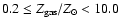 . .
|
| Open with DEXTER |
We investigated gas clouds with gas densities
cm-3, 103 cm-3,
105 cm-3 and 106 cm-3, and
ionization parameters
U = 10-2.8 - 10-0.8,
as presented in Sect. 3.2. The column
density
was determined by the criterion that the
calculations for dust-free gas clouds were stopped when the
temperature falls to 100 K, below which the gas does not
contribute significantly to the observed optical emission
line spectra. Although this lower-limit temperature is much
lower than other calculations for ionization-bounded clouds
in the literature, this criterion is necessary to calculate
low-density dust-free gas clouds with a high metallicity
because the equilibrium temperature of such gas clouds is
sometimes lower than 1000 K, as it will be shown later (see
also Ferland et al. 1984). For models with dust grains, the
stopping temperature was set to 2000 K. This is because the
gas temperature does not decrease efficiently in
partially-ionized regions when clouds contain dust, due
mainly to the depletion of heavy elements (i.e., coolants)
and to the heating by photoelectrons emitted from grains
(see, e.g., Shields & Kennicutt 1995 for details). Note
that the results of our calculations are not sensitive to the
lower-limit temperature because we are concerned only with
relatively high-ionization emission lines, which arise in
fully-ionized regions, and not within partially-ionized
regions. For the chemical composition of dust-free gas
clouds, we assumed that the all metals scale by keeping
solar proportions except for nitrogen, that scales as the
square power of other metal abundances, because nitrogen
is a secondary element (see, e.g., Hamann et al. 2002).
Here the solar elemental abundances are taken from
Grevesse & Anders (1989) with extensions by
Grevesse & Noels (1993). For dusty gas clouds, we assumed
the depleted gas-phase elemental abundance ratios by
adopting the depletion factors given by Ferland (1997).
In Figs. 4-6, the results of the model
calculations are plotted on a diagram with
C IV1549/He II1640 and
C III]1909/C IV1549,
for both dust-free and dusty cases. Models for low-density
gas clouds (
cm-3 and
103 cm-3) are presented in Fig. 4, those for
high-density gas clouds (
cm-3)
are presented in Fig. 5, and those for very high-density
gas clouds (
 cm-3) are presented
in Fig. 6. For low-density cases, the
difference of the model results between
those with
cm-3 and those with
cm-3) are presented
in Fig. 6. For low-density cases, the
difference of the model results between
those with
cm-3 and those with
 cm-3 is very small.
For low-density gas clouds without dust grains, the flux
ratio of C IV1549/He II1640
strongly depends on the gas metallicity while
C III]1909/C IV1549 allows to
remove the degeneracy with U, and thus the diagram
with C IV1549/He II1640 and
C III]1909/C IV1549 is good
metallicity diagnostic (Figs. 4a and 4c).
The strong variation of
C IV1549/He II1640 with
metallicity is due to the strong dependence of
C IV1549 emissivity on the gas temperature,
which decreases rapidly with metallicity (in dust-free
clouds) due to an efficient cooling by infrared
fine-structure lines (e.g., Ferland et al. 1984).
The metallicity dependencies of
some infrared fine-structure lines ([O III]88  m,
[N III]57 m and [Ne III]15.6 m) and
gas temperature for gas clouds with
cm-3
are shown in Fig. 7. Here we adopt the averaged
temperature over doubly-ionized helium regions as a
representative temperature in photoionization equilibrium.
The fluxes of the fine-structure lines plotted in Fig. 7
are normalized to the H
m,
[N III]57 m and [Ne III]15.6 m) and
gas temperature for gas clouds with
cm-3
are shown in Fig. 7. Here we adopt the averaged
temperature over doubly-ionized helium regions as a
representative temperature in photoionization equilibrium.
The fluxes of the fine-structure lines plotted in Fig. 7
are normalized to the H flux, because the H flux scales with the ionization photon flux.
![\begin{figure}
\par\rotatebox{-90}{\includegraphics[width=10.4cm]{4127f07.eps}}
\end{figure}](/articles/aa/full/2006/09/aa4127-05/Timg79.gif) |
Figure 7:
a) Predicted flux ratios of [O III]88 m/H,
[N III]57 m/H
and
[Ne III]15.6 m/H
as functions of metallicity,
from dust-free gas clouds
with
cm-3 (solid lines) and those
with
cm-3 (dashed lines). The
ionization parameter of
U = 10-2.0 and the input SED
with a small UV bump are assumed.
b) Averaged temperature of doubly-ionized helium regions of
dust-free gas clouds with
cm-3 (solid line) and those with
cm-3 (dashed line) as a function of metallicity.
The ionization parameter and the adopted SED
are the same as a).
c) Same as a) but for clouds with dust grains. The predicted
flux ratio of [O III]88 m/H
is too low
(<0.01) and thus not presented in the panel.
d) Same as b) but for clouds with dust grains.
|
| Open with DEXTER |
The metallicity dependence of
C IV1549/He II1640 in
dust-free gas clouds becomes weaker at
higher gas densities (Figs. 5a, 5c, 6a, and 6c).
This is mainly due to the decreased cooling efficiency of
infrared fine-structure lines, which are suppressed in
high-density gas clouds owing to collisional de-excitation
(Fig. 7). However, even when gas clouds with
cm-3 are concerned, the diagram
with C IV1549/He II1640 and
C III]1909/C IV1549 maybe
useful to constrain the gas metallicity, because
the C IV1549/He II1640 ratio
depends on metallicity even at
cm-3,
although the inferred metallicity is different depending on
the specific gas density (Figs. 5a and 5c).
The C IV1549/He II1640 versus
C III]1909/C IV1549 diagram is
no more useful when the gas density is very high,
cm-3 (Figs. 6a and 6c). The
metallicity dependence of the
C IV1549/He II1640 has almost
disappeared at this gas density. However, as shown later,
the very high-density models (
cm-3)
do not provide a good description of the observed data.
Gas clouds with dust grains show only a very weak dependence
of C IV1549/He II1640 on
metallicity (Figs. 4b, 4d, 5b, 6d, 6b, and 6d).
This is mainly because the equilibrium temperature of gas
clouds does not drop off significantly when gas metallicity
is high, thanks to the presence of dust grains (Fig. 7d;
see Shields & Kennicutt 1995 for more details). This
result is almost independent of the adopted SED,
gas density and ionization parameter.
Figures 4-6 indicate that the results
with a large UV bump SED and
with a small UV bump SED are similar. We thus conclude that
SED effects on our analysis and discussion are negligible.
In the following discussion, we only refer to the models
with a small UV bump SED.
Note that the diagnostic diagram on which we are focusing has
been investigated for various purposes in the past, since
all the three lines (He II1640,
C IV1549 and C III]1909) are
very strong and the wavelength separation is small (i.e.,
their ratios are little sensitive to dust extinction).
Allen et al. (1998)
investigated photoionization models and fast-shock models
showing that the data of HzRGs on the
C IV1549/He II1640 versus
C III]1909/C IV1549 diagram are
consistent with photoionization, but are hard to account with
by fast-shock models. Groves et al. (2004b) showed
that this diagram is useful to examine the gas metallicity
of NLRs and mentioned that HzRGs may have gas clouds with
sub-solar metallicity. We use this diagram to analyze the
gas metallicity of NLRs for a larger sample of high-znarrow-line AGNs and to investigate the possible metallicity
evolution of NLRs.
Finally we tackle the issue of whether the flux of
C III]1909 is significantly contaminated by the
Si III]
1883,1892 emission.
The predicted ratio of
Si III]
1883,1892/C III]1909
is plotted as a function of ionization parameter in Fig. 8.
Here we investigate gas clouds with (,
)
= (102 cm-3, 0.5  ),
(102 cm-3, 2.0 ),
(105 cm-3, 0.5 )
and
(105 cm-3, 2.0 ).
For clouds with dust grains, the predicted ratio is
),
(102 cm-3, 2.0 ),
(105 cm-3, 0.5 )
and
(105 cm-3, 2.0 ).
For clouds with dust grains, the predicted ratio is  0.01
regardless of density, metallicity and ionization parameter.
The contribution of Si III]
1883,1892 is
thus negligible when dusty clouds are concerned.
For dust-free clouds, the predicted ratios are higher,
i.e., 0.1. However, this is still
significantly smaller than the measurement errors on
C III]1909 fluxes.
Therefore, we conclude that the contribution of
Si III]
1883,1892 does not affect our
results and discussion significantly.
0.01
regardless of density, metallicity and ionization parameter.
The contribution of Si III]
1883,1892 is
thus negligible when dusty clouds are concerned.
For dust-free clouds, the predicted ratios are higher,
i.e., 0.1. However, this is still
significantly smaller than the measurement errors on
C III]1909 fluxes.
Therefore, we conclude that the contribution of
Si III]
1883,1892 does not affect our
results and discussion significantly.
![\begin{figure}
\par\rotatebox{-90}{\includegraphics[height=8.5cm]{4127f08.eps}}
\end{figure}](/articles/aa/full/2006/09/aa4127-05/Timg84.gif) |
Figure 8:
Predicted flux ratio of
Si III]
1883,1892/C III]1909
as a function of ionization parameter. Solid and dashed lines
denote the models with
cm-3 and
cm-3, respectively.
Thin and thick lines denote the models with
 and
and
 ,
respectively.
a) Dust-free models with a large UV bump SED.
b) Dusty models with a large UV bump SED.
c) Dust-free models with a small UV bump SED.
d) Dusty models with a small UV bump SED. ,
respectively.
a) Dust-free models with a large UV bump SED.
b) Dusty models with a large UV bump SED.
c) Dust-free models with a small UV bump SED.
d) Dusty models with a small UV bump SED.
|
| Open with DEXTER |
![\begin{figure}
\par\rotatebox{-90}{\includegraphics[width=8cm]{4127f09.eps}}
\end{figure}](/articles/aa/full/2006/09/aa4127-05/Timg85.gif) |
Figure 9:
Same as Fig. 2a but shock models of Dopita & Sutherland (1996)
are overplotted. Solid and dashed lines denote the predictions of
the pure shock-only models and the shock-plus-precursor models,
respectively, with magnetic parameters of
0, 1, 2, and 4 G cm-3/2 (from left to right in the panel).
Shock models with faster shock velocities are located at
lower positions in the panel.
|
| Open with DEXTER |
Before comparing the data presented in Sect. 2 with
the photoionization models presented in Sect. 3, we examine
whether shock models can explain the observed flux ratios.
In Fig. 9, we compare the
data of the HzRG, QSO2 and Sy2 samples with the shock models
presented by Dopita & Sutherland (1996).
Both pure shock-only models and shock-plus-precursor models
are examined here, with the parameter ranges of the shock velocity
150 km s
 km s-1and the magnetic parameter 0 G cm-3/2
  B/n1/2
4 G cm-3/2.
As shown in Fig. 9, both pure shock-only models and
shock-plus-precursor models underpredict the flux ratio of
C III]1909/C IV1549 and thus
cannot explain the observed data. This suggests that
the main ionization mechanism of NLRs (or at least the
C IV1549, He II1640 and
C III]1909 emitting regions in NLRs) is not
associated with shocks, but rather is due to photoionization.
Figure 9 also suggests that the difference in the flux ratios
between HzRGs and QSO2s - Sy2s cannot be ascribed to
shocks. Instead, a preferential contribution of shocks to QSO2s
(not to HzRGs) is required if shocks are at the origin of the
difference in the flux ratios. This requirement is in the
opposite direction as the natural expectation (HzRGs should
be more affected by shocks because of jets and expanding
radio lobes). Therefore, the systematic difference in the
flux ratios between HzRGs and QSO2s - Sy2s must be ascribed
to causes other than shocks. This issue will be discussed
further in Sect. 4.1.3.
B/n1/2
4 G cm-3/2.
As shown in Fig. 9, both pure shock-only models and
shock-plus-precursor models underpredict the flux ratio of
C III]1909/C IV1549 and thus
cannot explain the observed data. This suggests that
the main ionization mechanism of NLRs (or at least the
C IV1549, He II1640 and
C III]1909 emitting regions in NLRs) is not
associated with shocks, but rather is due to photoionization.
Figure 9 also suggests that the difference in the flux ratios
between HzRGs and QSO2s - Sy2s cannot be ascribed to
shocks. Instead, a preferential contribution of shocks to QSO2s
(not to HzRGs) is required if shocks are at the origin of the
difference in the flux ratios. This requirement is in the
opposite direction as the natural expectation (HzRGs should
be more affected by shocks because of jets and expanding
radio lobes). Therefore, the systematic difference in the
flux ratios between HzRGs and QSO2s - Sy2s must be ascribed
to causes other than shocks. This issue will be discussed
further in Sect. 4.1.3.
In Fig. 10, we compare the observational data with the
results of our photoionization model calculations, both
with and without dust grains. Contrary to the dust-free
models, the dusty models predict too narrow ranges of the
C IV1549/He II1640 flux ratio,
regardless of the gas density (Figs. 10b, 10d, and 10f).
The C IV1549/He II1640 flux
ratio varies only by a factor of 3 at maximum even when
the metallicity varies in the range
 .
More importantly, the dusty models
cannot explain values of
C IV1549/He II1640 larger
than
.
More importantly, the dusty models
cannot explain values of
C IV1549/He II1640 larger
than  ,
which are instead observed in
most sources. These results suggest that the
C IV1549,
He II1640 and C III]1909
emitting regions in NLRs are dust-free. This is consistent
with previous works in that gas clouds in the high-ionization
part of NLRs are dust-free (e.g., Marconi et al. 1994;
Ferguson et al. 1997; Nagao et al. 2003).
We verified that the effects of changing the grain composition
(see Ferland 1997 for details) are less than
30% for the line flux ratios.
We thus conclude that the models with dust
grains are not appropriate to interpret the ratios of
C IV1549/He II1640 and
C III]1909/C IV1549.
,
which are instead observed in
most sources. These results suggest that the
C IV1549,
He II1640 and C III]1909
emitting regions in NLRs are dust-free. This is consistent
with previous works in that gas clouds in the high-ionization
part of NLRs are dust-free (e.g., Marconi et al. 1994;
Ferguson et al. 1997; Nagao et al. 2003).
We verified that the effects of changing the grain composition
(see Ferland 1997 for details) are less than
30% for the line flux ratios.
We thus conclude that the models with dust
grains are not appropriate to interpret the ratios of
C IV1549/He II1640 and
C III]1909/C IV1549.
Groves et al. (2004b) reported that the rest-UV emission-line
spectra of HzRGs are well described by their dusty, radiation
pressure dominated photoionization models (Dopita et al. 2002;
Groves et al. 2004a), which appears to be in contrast to our
conclusion. However the results of the dusty photoionization
models presented here are roughly consistent with those
reported by Groves et al. (2004b) and there are likely slight
differences due to the different depletion
factors adopted for the model calculations. The most important
result of dusty photoionization models (both presented by us
and by Groves et al. 2004b) is that the dusty models cannot
explain the several observational data points with
C IV1549/He II
 .
Although such observational data were rather rare in the
presentation by Groves et al. (2004b), our data compilation
clarifies that the HzRGs with the flux ratio of
C IV1549/He II1640
larger than 1.5 are not rare objects but rather are
quite common (Fig. 2a).
.
Although such observational data were rather rare in the
presentation by Groves et al. (2004b), our data compilation
clarifies that the HzRGs with the flux ratio of
C IV1549/He II1640
larger than 1.5 are not rare objects but rather are
quite common (Fig. 2a).
![\begin{figure}
\par\rotatebox{-90}{\includegraphics[width=10cm]{4127f10.eps}}
\end{figure}](/articles/aa/full/2006/09/aa4127-05/Timg91.gif) |
Figure 10:
Observational data and model results are plotted on a diagram
of C IV1549/He II1640 versus
C III]1909/C IV1549. A SED with a
small UV bump is adopted in the models. Symbols are the same as
those in Fig. 2.
Dust-free models are plotted in the upper panels ( a), c), e)) while
dusty models are plotted in the lower panels ( b), d), f)).
Adopted gas densities are
cm-3 (panels a), b)),
cm-3 (panels c), d)), and
cm-3 (panels e), f)).
|
| Open with DEXTER |
In the case of dust-free models, the models with low
density (
cm-3 and 103 cm-3)
and high density (
cm-3) can
successfully explain the observed range of flux ratios
C IV1549/He II1640 and
C III]1909/C IV1549
(Figs. 10a and 10c), while the very high-density
models (
cm-3) cannot explain most
of the observational data (Fig. 10e).
We can deduce that
cm-3 is an
upper bound to the average NLR density.
Both high-density models and low-density models suggest
that the observational data are consistent with clouds
with an ionization parameter
 for HzRGs and
 for QSO2s and Sy2s (Figs. 10a and 10c).
The model sequences with a constant ionization
parameter have negative slope in the diagram of
C IV1549/He II1640 versus
C III]1909/C IV1549, which
is consistent with the observational trend described in
Sect. 2.2. Therefore the anti-correlation
between C IV1549/He II1640 and
C III]1909/C IV1549 seen in HzRGs
can be naturally explained by the wide range of the ionization
parameter for HzRGs. Although the inferred range of ionization
parameter is higher than the range estimated through
rest-frame optical diagnostics (which use lower ionization
emission lines) reported by some previous works (e.g.,
Ferland & Netzer 1983; Ho et al. 1993), it is consistent with
previous estimates of the ionization parameter for the
high-ionization parts in NLRs (e.g., Oliva et al. 1994;
Murayama & Taniguchi 1998; Nagao et al. 2001a, 2001b).
for QSO2s and Sy2s (Figs. 10a and 10c).
The model sequences with a constant ionization
parameter have negative slope in the diagram of
C IV1549/He II1640 versus
C III]1909/C IV1549, which
is consistent with the observational trend described in
Sect. 2.2. Therefore the anti-correlation
between C IV1549/He II1640 and
C III]1909/C IV1549 seen in HzRGs
can be naturally explained by the wide range of the ionization
parameter for HzRGs. Although the inferred range of ionization
parameter is higher than the range estimated through
rest-frame optical diagnostics (which use lower ionization
emission lines) reported by some previous works (e.g.,
Ferland & Netzer 1983; Ho et al. 1993), it is consistent with
previous estimates of the ionization parameter for the
high-ionization parts in NLRs (e.g., Oliva et al. 1994;
Murayama & Taniguchi 1998; Nagao et al. 2001a, 2001b).
As mentioned in the last subsection, photoionization models
with
cm-3 predict too narrow
ranges of the flux ratios of
C IV1549/He II1640 and
C III]1909/C IV1549 with respect
to the observed ranges. This suggests that the typical density
of the C IV1549, He II1640 and
C III]1909-emitting region in the NLR should
be less than 106 cm-3. Therefore, in the following
discussion, we consider only the two models, i.e.,
the low-density models with
cm-3 (note
that the results are very similar if adopting
cm-3) and the high-density models
with
cm-3.
![\begin{figure}
\par\rotatebox{-90}{\includegraphics[width=10cm]{4127f11.eps}}
\end{figure}](/articles/aa/full/2006/09/aa4127-05/Timg94.gif) |
Figure 11:
Observed and predicted flux ratios. Dust-free models with a small
UV bump are plotted. Symbols are the same as those in Fig. 2.
Observed data compared with models for
cm-3 on a diagram of N V1240/C IV1549
versus C IV1549/He II1640 a) and on
a diagram of N V1240/He II1640 versus
C IV1549/He II1640 b). Data compared
with models for
cm-3 on
N V1240/C IV1549
versus C IV1549/He II1640 c) and on
N V1240/He II1640 versus
C IV1549/He II1640 d).
|
| Open with DEXTER |
As shown in Figs. 10a and 10c, the estimated metallicity
is different when different gas densities are adopted.
Models with
cm-3 suggest sub-solar
metallicities
(
;
Fig. 10a)
while models with
cm-3
suggest a wide metallicity range
(
;
Fig. 10c).
The "low-density and sub-solar metallicity'' scenario
appears to be consistent with the results reported by
Iwamuro et al. (2003), while the "high-density with wide
metallicity distribution'' scenario appears in agreement
with the results reported by De Breuck et al. (2000).
Although some observational data with lower
C IV1549/He II1640 and
C III]1909/C IV1549 ratios
appear to deviate from the model predictions with
cm-3 (Fig. 10c), these deviations
can be reconciled by introducing a moderate amount of
extinction.
Although the above two scenarios are hard to
discriminate only by means of the
C IV1549/He II1640 versus
C III]1909/C IV1549 diagram,
the actual situation may be intermediate
between the two possible scenarios (Sect. 4.2).
Note that the absolute values of the inferred
gas metallicity are not very accurate due to a density
dependence of the flux ratio
C IV1549/He II1640 at
high-densities (
 cm-3).
Nevertheless the diagnostic diagram in Fig. 10 is useful if
we are interested in the relative metallicity trends of NLR
clouds, or in the evolution of gas metallicity, adopting the
assumption that there are no strong correlations between gas
density and redshift.
Finally, we note that the density affects the inferred
metallicity mostly at
cm-3).
Nevertheless the diagnostic diagram in Fig. 10 is useful if
we are interested in the relative metallicity trends of NLR
clouds, or in the evolution of gas metallicity, adopting the
assumption that there are no strong correlations between gas
density and redshift.
Finally, we note that the density affects the inferred
metallicity mostly at
 .
At low metallicities (
)
the models are less sensitive to the gas density
(Figs. 10a and 10c).
This result is important since it allows to use this
diagnostic diagram to identify low metallicity NLRs,
regardless of the gas density.
.
At low metallicities (
)
the models are less sensitive to the gas density
(Figs. 10a and 10c).
This result is important since it allows to use this
diagnostic diagram to identify low metallicity NLRs,
regardless of the gas density.
The gas metallicity of the BLR clouds in QSOs has been
often investigated by using the diagnostic flux ratios of
N V1240/C IV1549 and
N V1240/He II1640 (e.g.,
Hamann & Ferland 1992, 1999; Dietrich et al. 2003;
Nagao et al. 2006). This method has been sometimes applied
also to the NLR clouds (e.g., van Ojik et al. 1994;
Villar-Martin et al. 1999; De Breuck et al. 2000;
Vernet et al. 2001). Therefore it is interesting to compare
our diagnostics with the N V1240 diagnostics.
In Fig. 11, the observational data are compared with the
photoionization models for
cm-3and
cm-3 on the diagram of
N V1240/C IV1549 versus
C IV1549/He II1640, and
N V1240/He II1640 versus
C IV1549/He II1640.
Although high ratios of
N V1240/C IV1549 and
N V1240/He II1640 are sometimes
interpreted simply as a result of high metallicities,
the low-density models (
cm-3)
with a high metallicity predict not only high
N V1240/C IV1549 ratios but
also very low C IV1549/He II1640
ratios, in disagreement with the observed data (Fig. 11a).
This is mainly attributed to the decreased equilibrium
gas temperature due to the efficient cooling by infrared
fine-structure lines as investigated in Sect. 3.2 (Fig. 7).
Moreover the low-density models predict
N V1240/He II1640 < 0.4
when
 is concerned, which is also in
disagreement with the observed data (Fig. 11b).
The high-density models (
cm-3),
on the other hand, predict higher
C IV1549/He II1640 ratios than
the low-density models owing to the suppressed cooling.
Since the high-density models predict higher
C IV1549/He II1640 ratios than
the observed values (Figs. 11c and 11d), the typical
gas density of (the high-ionization part of) the NLRs
may be lower than
cm-3.
is concerned, which is also in
disagreement with the observed data (Fig. 11b).
The high-density models (
cm-3),
on the other hand, predict higher
C IV1549/He II1640 ratios than
the low-density models owing to the suppressed cooling.
Since the high-density models predict higher
C IV1549/He II1640 ratios than
the observed values (Figs. 11c and 11d), the typical
gas density of (the high-ionization part of) the NLRs
may be lower than
cm-3.
Table 4:
Averaged diagnostic flux ratios of HzRGs.
Although the N V1240-detected objects appear
to have super-solar metallicity, the N V1240
fluxes of more than half of the objects in the sample are
upper-limits and they might be consistent with
sub-solar metallicities.
Summarizing, since N V1240 becomes very
weak (generally undetected) for
 NLRs, it is very difficult to investigate the
metallicity evolution of the NLR based on
the N V1240 diagnostics.
NLRs, it is very difficult to investigate the
metallicity evolution of the NLR based on
the N V1240 diagnostics.
Now we discuss whether the gas metallicity of the NLRs in
high-z AGNs evolves as a function of redshift. We first
focus only on the HzRG data, because HzRGs and QSO2s may
have different NLR properties, as discussed above.
To investigate this issue, we divide the sample of
objects having a measurement of both
C IV1549/He II1640 and
C III]1909/C IV1549 (49
objects, discarding the objects with upper-limits or
lower-limits) into three groups:
1.2 < z < 2.0 (17
objects),
2.0 < z < 2.5 (20 objects) and
2.5 < z < 3.8(12 objects). Note that most of the highest-z sample are
at
2.5 < z < 3.0 and only two objects are at z > 3(Fig. 1a). We calculate the logarithmically
averaged flux ratios of
C IV1549/He II1640 and
C III]1909/C IV1549 for
these three groups. The results are given in Table 4
and plotted on the diagnostic diagram in Figs. 12a
and 12c. The thick errorbars give the estimated errors on
the means. As clearly seen, no evolutionary tendency in
the flux ratios within our HzRG sample is found.
The higher-z objects do not show
significant metallicity decrease with respect to the
lower-z objects, at variance with the result reported
by De Breuck et al. (2000). Although the absolute value
of the gas metallicity derived from Fig. 10 is subject
to non-negligible uncertainties, as discussed in
Sect. 4.1.4, our conclusion is not affected by this issue
in terms of relative gas metallicities,
i.e., the gas metallicity in NLRs of HzRGs does not
change significantly in the redshift range
1.2 < z < 3.8,
or more conservatively, in the range
1.2 < z < 3(owing to the lack of objects at z > 3).
Recently Nagao et al. (2006) reported that the gas
metallicity of the BLR in QSOs with a given luminosity
is independent of redshift in the range
2.0 < z < 4.5.
This result is consistent with that obtained for the
NLR metallicity of HzRGs presented in this
paper. Nagao et al. (2006) also reported that the BLR
metallicity is tightly correlated with the QSO luminosity
(see also, e.g., Hamann & Ferland 1993, 1999).
Motivated by this correlation between BLR metallicity
and QSO luminosity, we have investigated whether
the NLR metallicity is correlated with the AGN luminosity
or not. However, it is very difficult to measure the
luminosity of both AGNs and their host galaxies when
type-2 AGNs are concerned. This is because the
central engine is hidden by the dusty torus and because
the broad-band photometric flux is largely attributed to
the nebular emission, not only to the stellar continuum
emission. We thus adopt the He II1640
emission-line luminosity [L(He II)] as an
indicator of the AGN luminosity. This assumption
is based on the fact that the He II1640
luminosity is simply proportional to the volume of
the doubly-ionized helium region, which scales to the
AGN luminosity.
We calculate L(He II) from the
He II1640 flux by
adopting a cosmology with (
 ,
,
 ,
,
 ,
0.3, 0.7)
and H0 = 70 km s-1 cm-1 Mpc-1.
L(He II) is not corrected for the
slit loss, which may be non-negligible for some cases.
To investigate the dependence of the line flux ratios on
L(He II), we divide HzRGs into three groups:
,
0.3, 0.7)
and H0 = 70 km s-1 cm-1 Mpc-1.
L(He II) is not corrected for the
slit loss, which may be non-negligible for some cases.
To investigate the dependence of the line flux ratios on
L(He II), we divide HzRGs into three groups:
 (He II) < 42.5 (13 objects),
 (He II) < 43.0 (21 objects), and
 (He II) < 45.0 (15 objects), where
L(He II) is in units of erg s-1.
The logarithmically averaged flux ratios and the RMS
of C IV1549/He II1640
and C III]1909/C IV1549 for
these three groups are given in Table 4, and are plotted
on the diagnostic diagram in Figs. 12b and 12d.
The thick errorbars give the errors of the means.
As a result, we find a systematic trend in our HzRG sample
that the HzRGs with larger L(He II) (i.e.,
more luminous AGNs) tend to have lower
C IV1549/He II1640
and C III]1909/C IV1549
flux ratios. This result is consistent with the interpretation
that the NLR in more luminous HzRGs have higher metallicity
gas clouds. This "luminosity-metallicity relation'' for
the NLR in HzRGs is in agreement with the same relation
seen for the BLRs in high-z QSOs.
(He II) < 45.0 (15 objects), where
L(He II) is in units of erg s-1.
The logarithmically averaged flux ratios and the RMS
of C IV1549/He II1640
and C III]1909/C IV1549 for
these three groups are given in Table 4, and are plotted
on the diagnostic diagram in Figs. 12b and 12d.
The thick errorbars give the errors of the means.
As a result, we find a systematic trend in our HzRG sample
that the HzRGs with larger L(He II) (i.e.,
more luminous AGNs) tend to have lower
C IV1549/He II1640
and C III]1909/C IV1549
flux ratios. This result is consistent with the interpretation
that the NLR in more luminous HzRGs have higher metallicity
gas clouds. This "luminosity-metallicity relation'' for
the NLR in HzRGs is in agreement with the same relation
seen for the BLRs in high-z QSOs.
![\begin{figure}
\par\includegraphics[width=10.5cm]{4127f12.eps}
\end{figure}](/articles/aa/full/2006/09/aa4127-05/Timg117.gif) |
Figure 12:
Averaged flux ratios compared with the model predictions
on the C IV1549/He II1640
versus C III]1909/C IV1549
diagram. Filled circle, open circle and open triangle
denote the average values of the HzRG sample, the
QSO2 sample and Sy2s sample. Models with
cm-3 are plotted in panels
a) and b), while models with
cm-3 are plotted in panels
c) and d). For both cases, models with a small UV
bump SED and without dust are plotted.
The redshift dependence of the flux ratios of the HzRGs
are investigated in panels a) and c), where filled
diamond, square and star denote the average flux ratios
of the HzRGs at
1.2 < z < 2.0,
2.0 < z < 2.5 and
2.5 < z < 3.8, respectively. The luminosity dependence
of the flux ratios of the HzRGs are investigated in panels
b) and d), where filled diamond, square and star denote
the averaged flux ratios of the HzRGs with
41.5 < log L(He II) < 42.5,
42.5 < log L(He II) < 43.0, and
43.0 < log L(He II) < 45.0 respectively, where
L(He II) is in units of erg s-1.
Error bars are as in Fig. 2b.
|
| Open with DEXTER |
Unfortunately the QSO2 sample contains only 6 usable
objects and thus it is very difficult to discuss the
possible dependences of the NLR metallicity of the QSO2s
on redshift and luminosity, at variance with the HzRGs.
However it is interesting to search for any possible hints
of such dependences based on currently available data.
We therefore divide the QSO sample into two groups;
one is "lower-z, less-luminous QSO2s'' that contains
CDFS-153 [z=1.536, logL(He II)=41.0], CDFS-531
[z=1.544, logL(He II)=41.4] and CDFS-027
[z=1.603, logL(He II)=41.4], and the other is
"higher-z, more-luminous QSO2s'' that contains CDFS-057
[z=2.562, logL(He II)=41.6], CDFS-112a
[z=2.940, logL(He II)=41.8] and CXO52
[z=3.288, logL(He II)=42.2], where L(He II)
is again in units of erg s-1. We then calculate the
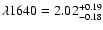
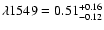
mean flux ratios of
C IV1549/He II1640 and
C III]1909/C IV1549 and their
estimated errors for the two groups, which results in
C IV1549/He II
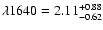 and
C III]1909/C IV
and
C III]1909/C IV
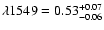 for the former group and
C IV1549/He II
for the former group and
C IV1549/He II
 and
C III]1909/C IV
and
C III]1909/C IV
 for the latter group, respectively.
This result suggests that there is no apparent
metallicity dependence on redshift and luminosity,
although the statistics are extremely poor. Further
spectroscopic observations of QSO2s at high-redshift are
required to investigate this issue.
for the latter group, respectively.
This result suggests that there is no apparent
metallicity dependence on redshift and luminosity,
although the statistics are extremely poor. Further
spectroscopic observations of QSO2s at high-redshift are
required to investigate this issue.
It has been observationally confirmed that QSOs including
radio galaxies tend to reside in massive elliptical galaxies
at least in the local universe (e.g., McLure et al. 1999;
Dunlop et al. 2003; Floyd et al. 2004) and probably also
in the high-z universe (e.g., Falomo et al. 2005;
Kuhlbrodt et al. 2005). Our results suggest that the main
star-formation event in such massive host galaxies is
completed. This picture is consistent with the
recent findings of massive evolved galaxies at z > 1.5(e.g., Cimatti et al. 2004; McCarthy et al. 2004;
Labbé et al. 2005; Saracco et al. 2005).
The non-evolution of the gas metallicity of the NLR in our
sample suggests that the epoch of major chemical enrichment
in the host galaxies of QSO2s and HzRGs must have occurred
at  .
If the minimum timescale for
significant enrichment of carbon (0.5 Gyr) is
taken into account, the major epoch of star formation may be
at .
.
If the minimum timescale for
significant enrichment of carbon (0.5 Gyr) is
taken into account, the major epoch of star formation may be
at .
Finally we briefly discuss a specific, interesting QSO2,
CDFS-901 (Fig. 2a). Although the emission-line spectrum
of this object is hard to explain by photoionization
models, as seen in Fig. 10, it appears to be consistent
with pure shock-only models and with shock-plus-precursor
models as shown in Fig. 9. This
may suggest that the NLR of CDFS-901 is dominated by
shocks. However, there is another possibility, that is
CDFS-901 may be a narrow-line type-1 QSO, i.e., a
brighter analogue of narrow-line Seyfert 1 galaxies
(NLS1s). If the emission-line spectrum of CDFS-901 is not
from its NLR but from its BLR, its very large
C IV1549/He II1640 ratio
(>7.0) is naturally explained, since this flux ratio is
expected to be  for BLRs (although its
C III]1909/C IV1549 ratio
0.2 is very small for a BLR, e.g., Nagao et al. 2006).
Since the X-ray spectral slope (hardness ratio) of this
object was not measured due to the lack of photon
statistics, its nature remains ambiguous based on the
currently available data. This object is interesting
because NLS1s are sometimes thought to be AGNs with
super-massive black holes in their growing phase
(e.g., Mathur 2000). If this object is a high-z
analogue of NLS1s, it may be a very interesting target to
investigate the evolution of AGN activities and
supermassive black holes.
for BLRs (although its
C III]1909/C IV1549 ratio
0.2 is very small for a BLR, e.g., Nagao et al. 2006).
Since the X-ray spectral slope (hardness ratio) of this
object was not measured due to the lack of photon
statistics, its nature remains ambiguous based on the
currently available data. This object is interesting
because NLS1s are sometimes thought to be AGNs with
super-massive black holes in their growing phase
(e.g., Mathur 2000). If this object is a high-z
analogue of NLS1s, it may be a very interesting target to
investigate the evolution of AGN activities and
supermassive black holes.
In order to investigate the possible metallicity evolution
of NLR gas clouds in AGNs, we compiled the fluxes of
C IV1549, He II1640 and
C III]1909 for a large sample of narrow-line
AGNs, including HzRGs, high-z QSO2s, and local Sy2s.
Since all of these three emission lines are moderately
strong even in the faint HzRGs and QSO2s, this approach
enables us to investigate a large number of such objects.
By comparing the compiled flux ratios with the results
of our photoionization model calculations, we found the
following results.
- The observational data are inconsistent with the
predictions of shock models, suggesting that
the NLRs are mainly photoionized.
- The photoionization models with dust grains predict
too narrow ranges of flux ratios and are in disagreement
with the observed ranges, suggesting that the
high-ionization part of NLRs (on which we focused in
this work) is dust-free.
- The ionization parameter of (the high-ionization parts
of) NLRs is estimated to be
for HzRGs
and
for QSO2s and Sy2s.
- The photoionization models with
cm-3 cannot explain the
observational data, suggesting that the typical gas
density is lower than 106 cm-3.
- There are two possible interpretations for the observed
data: low-density gas clouds
(
cm-3) with a sub-solar
metallicity
(
), or
high-density gas clouds (
cm-3)
with a wide range of gas metallicity
(
).
- Our method using only the flux ratios of
C IV1549/He II1640 and
C III]1909/C IV1549 is
particularly useful to examine relative difference in
gas metallicity of NLR clouds, or to investigate
possible metallicity evolution of NLRs, although
the inferred absolute values of metallicity contain
non-negligible uncertainties.
- Regardless of the density, the proposed
diagnostic diagram is useful to identify low metallicity
NLRs (
).
- We find no evidence suggesting a significant evolution
of the gas metallicity in the NLRs of HzRGs in the redshift
range
 .
.
- We find a systematic trend for more luminous AGNs to have more
metal-rich NLRs (luminosity-metallicity relation),
which is in agreement with the results from the
studies on the BLRs.
- The non-evolution of the gas metallicity of the NLRs
implies that the major epoch of star formation in
the host galaxies is at .
Acknowledgements
We thank T. Murayama for useful comments, G. Ferland
for providing the excellent photoionization code Cloudy,
G. Szokoly for providing us the data of
the HzRGs, and the anonymous referee for valuable suggestions.
T.N. acknowledges financial support from the Japan Society for the
Promotion of Science (JSPS) through JSPS Research Fellowship for
Young Scientists. R.M. acknowledges financial support from MIUR
under grant PRIN-03-02-23.
- Allen, M. G.,
Dopita, M. A., & Tsvetanov, Z. I. 1998, ApJ, 493, 571 [NASA ADS] [CrossRef] (In the text)
-
Antonucci, R. R. J. 1993, ARA&A, 31, 473 [NASA ADS] (In the text)
-
Antonucci, R. R. J., & Miller, J. S. 1985, ApJ, 297, 621 [NASA ADS] [CrossRef] (In the text)
- Baldwin, J.
A., Ferland, G. J., Martin, P. G., et al. 1991, ApJ, 374, 580 [NASA ADS] [CrossRef] (In the text)
- Baldwin, J.
A., Hamann, F., Korista, K. T., et al. 2003, ApJ, 583, 649 [NASA ADS] [CrossRef] (In the text)
- Baum, S. A., &
McCarthy, P. J. 2000, AJ, 119, 2634 [NASA ADS] [CrossRef] (In the text)
- Bergeron,
J., Maccacaro, T., & Perola, C. 1981, A&A, 97, 94 [NASA ADS]
- Cardelli,
J. A., Clayton, G. C., & Mathis, J. S. 1989, ApJ, 345, 245 [NASA ADS] [CrossRef] (In the text)
- Cimatti, A.,
Daddi, E., Renzini, A., et al. 2004, Nature, 430, 184 [NASA ADS] [CrossRef] (In the text)
- Cohen, M. H.,
Ogle, P. M., Tran, H. D., Goodrich, R. W., & Miller, J. S.
1999, AJ, 118, 1963 [NASA ADS] [CrossRef] (In the text)
- De Breuck, C.,
Röttgering, H., Miley, G., van Breugel, W., & Best, P.
2000, A&A, 362, 519 [NASA ADS] (In the text)
- De
Robertis, M. M., Hutchings, J. B., & Pitts, R. E. 1988, AJ, 95,
1371 [NASA ADS] [CrossRef]
- Dietrich,
M., Hamann, F., Shields, J. C., et al. 2003, ApJ, 589, 722 [NASA ADS] [CrossRef] (In the text)
- Dunlop, J. S.,
McLure, R. J., Kukula, M. J., et al. MNRAS, 340, 1095
(In the text)
- Dopita, M. A.,
Groves, B. A., Sutherland, R. S., Binette, L., & Cecil, G.
2002, ApJ, 572, 753 [NASA ADS] [CrossRef] (In the text)
- Dopita, M. A.,
& Sutherland, R. S. 1996, ApJS, 102, 161 [NASA ADS] [CrossRef] (In the text)
- Elvis, M.,
Risaliti, G., & Zamorani, G. 2002, ApJ, 565, L75 [NASA ADS] [CrossRef] (In the text)
- Falomo, R.,
Kotilainen, J. K., Scarpa, R., & Treves, A. 2005, A&A, 434,
469 [EDP Sciences] [NASA ADS] [CrossRef] (In the text)
- Ferguson,
J. W., Korista, K. T., & Ferland, G. J. 1997, ApJS, 110,
287 [NASA ADS] [CrossRef] (In the text)
- Ferland, G.
J. 1997, Hazy: A Brief Introduction to Cloudy 94.00 (Lexington:
Univ. Kentucky Dept. Phys. Astron.)
(In the text)
- Ferland, G.
J., & Netzer, H. 1983, ApJ, 264, 105 [NASA ADS] [CrossRef] (In the text)
- Ferland, G.
J., Williams, R. E., Lambert, D. L., et al. 1984, ApJ, 281,
194 [NASA ADS] [CrossRef] (In the text)
- Ferland, G.
J., Korista, K. T., Verner, D. A., et al. 1998, PASP, 110, 761 [NASA ADS] (In the text)
- Floyd, D. J. E.,
Kukula, M. J., Dunlop, J. S., et al. 2004, MNRAS, 355, 196 [NASA ADS] [CrossRef] (In the text)
- Giacconi,
R., Zirm, A., Wang, J., et al. 2002, ApJS, 139, 369 [NASA ADS] [CrossRef] (In the text)
- Grevesse,
N., & Anders, E. 1989, in AIP Conf. Proc. 183, Cosmic Abundance
of Matter, ed. C. J. Waddington (New York: AIP), 1
(In the text)
- Grevesse,
N., & Noels, A. 1993, in Origin and Evolution of the Elements,
ed. N. Prantzos, E. Vangioni-Flam, & M. Casse (Cambridge Univ.
Press), 15
(In the text)
- Groves, B.
A., Dopita, M. A., & Sutherland, R. S. 2004a, ApJS, 153, 9 [NASA ADS] [CrossRef] (In the text)
- Groves, B.
A., Dopita, M. A., & Sutherland, R. S. 2004b, ApJS, 153,
75 [NASA ADS] [CrossRef] (In the text)
- Hamann, F.,
& Ferland, G. J. 1992, ApJ, 391, L53 [NASA ADS] [CrossRef] (In the text)
- Hamann, F.,
& Ferland, G. J. 1993, ApJ, 418, 11 [NASA ADS] [CrossRef] (In the text)
- Hamann, F.,
& Ferland, G. J. 1999, ARA&A, 37, 487 [NASA ADS] (In the text)
- Hamann, F.,
Korista, K. T., Ferland, G. J., Warner, C., & Baldwin, J. A.
2002, ApJ, 564, 592 [NASA ADS] [CrossRef] (In the text)
- Ho, L. C., Shields, J.
C., & Filippenko, A. V. 1993, ApJ, 410, 567 [NASA ADS] [CrossRef] (In the text)
- Iwamuro, F.,
Motohara, K., Maihara, T., et al. 2003, ApJ, 598, 178 [NASA ADS] [CrossRef] (In the text)
- Kaspi, S., Smith,
P. S., Netzer, H., et al. 2000, ApJ, 533, 631 [NASA ADS] [CrossRef] (In the text)
- Kraemer, S.
B., Wu, C. -C., Crenshaw, D. M., & Harrington, J. P. 1994, ApJ,
435, 171 [NASA ADS] [CrossRef]
-
Kuhlbrodt, B., Örndahl, E., Wisotzki, L., & Jahnke, K.
2005, A&A, 439, 497 [EDP Sciences] [NASA ADS] [CrossRef] (In the text)
- Labbé, I.,
Huang, J., Franx, M., et al. 2005, ApJ, 624, L81 [NASA ADS] [CrossRef] (In the text)
- Malkan, M. A.,
& Oke, J. B. 1983, ApJ, 265, 92 [NASA ADS] [CrossRef]
- Marconi, A.,
Moorwood, A. F. M., Salvati, M., & Oliva, E. 1994, A&A,
291, 18 [NASA ADS] (In the text)
- Marconi, A.,
Risaliti, G., Gilli, R., et al. 2004, MNRAS, 351, 169 [NASA ADS] [CrossRef] (In the text)
- Mathews, W.
G., & Ferland, G. J. 1987, ApJ, 323, 456 [NASA ADS] [CrossRef]
- Mathur, S.
2000, MNRAS, 314, L17 [NASA ADS] [CrossRef] (In the text)
- McAlpine,
G. M. 1988, PASP, 100, 65 [NASA ADS] [CrossRef]
- McCarthy,
P. J., Le Borgne, D., Crampton, D., et al. 2004, ApJ, 614, L9 [NASA ADS] [CrossRef] (In the text)
- McCarthy,
P. J., van Breugel, W., & Kapahi, V. K. 1991, ApJ, 371,
478 [NASA ADS] [CrossRef] (In the text)
- McLure, R. J.,
Kukula, M. J., Dunlop, J. S., et al. 1999, MNRAS, 308, 377 [NASA ADS] [CrossRef] (In the text)
- Mehlert, D.,
Noll, S., Appenzeller, I., et al. 2002, A&A, 393, 809 [EDP Sciences] [NASA ADS] [CrossRef] (In the text)
- Murayama,
T., & Taniguchi, Y. 1998, ApJ, 503, L115 [NASA ADS] [CrossRef] (In the text)
- Nagao, T.,
Murayama, T., & Taniguchi, Y. 2001a, ApJ, 549, 155 [NASA ADS] [CrossRef] (In the text)
- Nagao, T.,
Murayama, T., & Taniguchi, Y. 2001b, PASJ, 53, 629 [NASA ADS] (In the text)
- Nagao, T.,
Murayama, T., Taniguchi, Y., & Shioya, Y. 2003, AJ, 125,
1729 [NASA ADS] [CrossRef] (In the text)
- Nagao, T.,
Marconi, A., & Maiolino, R. 2006, A&A, 447, 157 [EDP Sciences] [NASA ADS] [CrossRef] (In the text)
- Oliva, E.,
Salvati, M., Moorwood, A. F. M., & Marconi, A. 1994, A&A,
288, 457 [NASA ADS] (In the text)
- Pettini, M.,
Shapley, A. E., Steidel, C. C., et al. 2001, ApJ, 554, 981 [NASA ADS] [CrossRef] (In the text)
- Pettini, M.,
Steidel, C. C., Adelberger, K. L., Dickinson, M., & Giavalisco,
M. 2000, ApJ, 528, 96 [NASA ADS] [CrossRef] (In the text)
-
Rodríguez-Ardila, A., Pastoriza, M. G., & Donzelli, C. J.
2000, ApJS, 126, 63 [NASA ADS] [CrossRef]
- Rosati, P.,
Tozzi, P., Giacconi, R., et al. 2002, ApJ, 566, 667 [NASA ADS] [CrossRef] (In the text)
- Saracco, P.,
Longhetti, M., Severgini, P., et al. 2005, MNRAS, 357, L40 [NASA ADS] (In the text)
- Scott, J. E.,
Kriss, G. A., Brotherton, M., et al. 2004, ApJ, 615, 135 [NASA ADS] [CrossRef] (In the text)
- Shapley, A.
E., Erb, D. K., Pettini, M., Steidel, C. C., & Adelberger, K.
L. 2004, ApJ, 612, 108 [NASA ADS] [CrossRef] (In the text)
- Shields, J.
C., & Kennicutt, R. C., Jr. 1995, ApJ, 454, 807 [NASA ADS] [CrossRef] (In the text)
- Snijders,
M. A. J., Netzer, H., & Boksenberg, A. 1986, MNRAS, 222,
549 [NASA ADS]
- Stern, D., Moran,
E. C., Coil, A. L., et al. 2002, ApJ, 568, 71 [NASA ADS] [CrossRef] (In the text)
- Szokoly, G.
P., Bergeron, J., Hasinger, G., et al. 2004, ApJS, 155, 271 [NASA ADS] [CrossRef] (In the text)
- Tecza, M., Baker,
A. J., Davies, R. I., et al. 2004, ApJ, 605, L109 [NASA ADS] [CrossRef] (In the text)
- Telfer, R. C.,
Zheng, W., Kriss, G. A., & Davidsen, A. F. 2002, ApJ, 565,
773 [NASA ADS] [CrossRef] (In the text)
- Teplitz, H.
I., McLean, I. S., Becklin, E. E., et al. 2000, ApJ, 533, L65 [NASA ADS] [CrossRef] (In the text)
- Thuan, T. X.
1984, ApJ, 281, 126 [NASA ADS] [CrossRef] (In the text)
- van Ojik, R.,
Röttgering, H. J. A., Miley, G. K., et al. 1994, A&A, 289,
54 [NASA ADS] (In the text)
- Vernet, J.,
Fosbury, R. A. E., Villar-Martin, M., et al. 2001, A&A, 366,
7 [EDP Sciences] [NASA ADS] [CrossRef] (In the text)
- Villar-Martin,
M., Tadhunter, C., & Clark, N. 1997, A&A, 323, 21 [NASA ADS] (In the text)
- Zamorani,
G., Henry, J. P., Maccacaro, T., et al. 1981, ApJ, 245, 357 [NASA ADS] [CrossRef] (In the text)
- Zheng, W., Kriss,
G. A., Telfer, R. C., Grimes, J. P., & Davidsen, A. F. 1998,
ApJ, 492, 855 [NASA ADS] [CrossRef] (In the text)
Copyright ESO 2006
![\begin{figure}
\par\includegraphics[width=5.5cm]{4127f01.eps}
\end{figure}](/articles/aa/full/2006/09/aa4127-05/img41.gif)
![\begin{figure}
\par\rotatebox{-90}{\includegraphics[width=12cm,clip]{4127f02.eps}}
\end{figure}](/articles/aa/full/2006/09/aa4127-05/img42.gif)
![\begin{figure}
\par\rotatebox{-90}{\includegraphics[width=5cm]{4127f03.eps}}
\end{figure}](/articles/aa/full/2006/09/aa4127-05/img66.gif)
![\begin{figure}
\par\rotatebox{-90}{\includegraphics[width=10.4cm]{4127f04.eps}}
\end{figure}](/articles/aa/full/2006/09/aa4127-05/img67.gif)
![\begin{figure}
\par\rotatebox{-90}{\includegraphics[width=10.4cm]{4127f05.eps}}
\end{figure}](/articles/aa/full/2006/09/aa4127-05/img76.gif)
![\begin{figure}
\par\rotatebox{-90}{\includegraphics[width=10.4cm]{4127f06.eps}}
\end{figure}](/articles/aa/full/2006/09/aa4127-05/img77.gif)
![\begin{figure}
\par\rotatebox{-90}{\includegraphics[width=10.4cm]{4127f07.eps}}
\end{figure}](/articles/aa/full/2006/09/aa4127-05/img79.gif)
![\begin{figure}
\par\rotatebox{-90}{\includegraphics[height=8.5cm]{4127f08.eps}}
\end{figure}](/articles/aa/full/2006/09/aa4127-05/img84.gif)
![\begin{figure}
\par\rotatebox{-90}{\includegraphics[width=8cm]{4127f09.eps}}
\end{figure}](/articles/aa/full/2006/09/aa4127-05/img85.gif)
![\begin{figure}
\par\rotatebox{-90}{\includegraphics[width=10cm]{4127f10.eps}}
\end{figure}](/articles/aa/full/2006/09/aa4127-05/img91.gif)
![\begin{figure}
\par\rotatebox{-90}{\includegraphics[width=10cm]{4127f11.eps}}
\end{figure}](/articles/aa/full/2006/09/aa4127-05/img94.gif)
![\begin{figure}
\par\includegraphics[width=10.5cm]{4127f12.eps}
\end{figure}](/articles/aa/full/2006/09/aa4127-05/img117.gif)