![[*]](/icons/foot_motif.gif)
A&A 447, 441-451 (2006)
DOI: 10.1051/0004-6361:20053204
L. M. Buson1 - M. Cappellari2 - E. M. Corsini3,4 - E. V. Held1 - J. Lim5 - A. Pizzella3
1 - INAF Osservatorio Astronomico di Padova, vicolo
dell'Osservatorio 5, 35122 Padova, Italy
2 -
Leiden Observatory, Postbus 9513, 2300 RA Leiden, The Netherlands
3 -
Dipartimento di Astronomia, Università di Padova, vicolo
dell'Osservatorio 2, 35122 Padova, Italy
4 -
Scuola Galileiana di Studi Superiori, via VIII Febbraio 2, 35122 Padova, Italy
5 -
Institute of Astronomy and Astrophysics, Academia Sinica,
PO Box 23-141, Taipei 106, Taiwan
Received 6 April 2005 / Accepted 24 September 2005
Abstract
Morphological disturbances and gas kinematics of the SB0
galaxy NGC 7679 = Arp 216 are investigated to understand the history
of this highly composite object, where AGN and starburst signatures
dominate in the X-ray and optical/IR regime,
respectively. Perturbations of the ionized gas velocity field appear
quite mild within 15'' ( 5 kpc) of the center, so it can
be straightforwardly modeled as a circularly rotating disk. Outside
that radius, significant disturbances are seen. In
particular, the eastern distorted arm as well as the huge neutral
hydrogen bridge connecting NGC 7679 to the nearby Seyfert spiral
NGC 7682 unambiguously represent the vestige of a close encounter of
the two objects 500 Myr ago. The relationship of
such a past event with the much more recent, centrally located starburst
(not older than 20 Myr) cannot be easily established. Together,
the classification of NGC 7679 is less extreme than that
proposed in the past, being simply a (disturbed) galaxy where
starburst and AGN activity coexist with a starburst dominating the
bolometric luminosity.
5 kpc) of the center, so it can
be straightforwardly modeled as a circularly rotating disk. Outside
that radius, significant disturbances are seen. In
particular, the eastern distorted arm as well as the huge neutral
hydrogen bridge connecting NGC 7679 to the nearby Seyfert spiral
NGC 7682 unambiguously represent the vestige of a close encounter of
the two objects 500 Myr ago. The relationship of
such a past event with the much more recent, centrally located starburst
(not older than 20 Myr) cannot be easily established. Together,
the classification of NGC 7679 is less extreme than that
proposed in the past, being simply a (disturbed) galaxy where
starburst and AGN activity coexist with a starburst dominating the
bolometric luminosity.
Key words: galaxies: individual: NGC 7679 - galaxies: kinematics and dynamics - galaxies: starburst - galaxies: interaction - galaxies: Seyfert
The barred galaxy we discuss in detail here, NGC 7679, has all the necessary "qualifications'' to be regarded as a rare member of a class of composite (AGN/starburst) systems whose X-ray bright Seyfert nucleus becomes unexpectedly weak at optical wavelengths. Alhough a few objects of this kind are known since observations with the Einstein spacecraft (e.g. Elvis et al. 1981) and are currently identified in Chandra deep fields (e.g. Fiore et al. 2000), NGC 7679 could represent a low-redshift example of such peculiar objects showing anomalous absorption processes, i.e. hosting dusty ionized absorbers capable of selectively obscuring the AGN optical emission, while leaving its X-ray emission almost unabsorbed (cf. Della Ceca et al. 2001).
Other well-known obscured Type-2 AGNs, NGC 4945 and NGC 6240 (see Matt 2001, and references therein) are reminiscent of the phenomenology showed by NGC 7679 (e.g. the full emergence of the powerful AGN emission only in the X-ray waveband). NGC 7679, however, is so peculiar as to challenge the standard AGN Unification Scheme since - presumably - its absorption processes can work quite differently, so as to leave its X-ray emission totally unabsorbed, while producing a limited amount of absorption of the AGN in the optical (or, alternatively, hosting an optically underluminous Seyfert 1 nucleus; cf. Della Ceca et al. 2001).
Simply classified as SB0p in the Third Reference Catalogue of Bright
Galaxies (RC3; de Vaucouleurs et al. 1991), NGC 7679 appears
unmistakably disturbed, so as to have been included in the Arp's
catalog of peculiar galaxies (Arp 1966). In particular, its asymmetric
morphology points toward a barred Seyfert companion (NGC 7682), lying
only 4
 5 North-East of it. The recession velocity of
NGC 7682 (
5 North-East of it. The recession velocity of
NGC 7682 (
 km s-1) is virtually identical to
that of NGC 7679 (
km s-1) is virtually identical to
that of NGC 7679 (
 km s-1), once both are
referred to the 3 K background on the basis of their RC3 redshift and
cosmological parameters H0=75 km s-1 Mpc-1 and
q0=0. We adopt here the distance of NGC 7679 of 63.9 Mpc; at such a
distance 1' is equivalent to 19 kpc and the projected distance
of the two galaxies becomes 83.7 kpc.
km s-1), once both are
referred to the 3 K background on the basis of their RC3 redshift and
cosmological parameters H0=75 km s-1 Mpc-1 and
q0=0. We adopt here the distance of NGC 7679 of 63.9 Mpc; at such a
distance 1' is equivalent to 19 kpc and the projected distance
of the two galaxies becomes 83.7 kpc.
This object received only sporadic attention in the
literature in the past two decades. The optical spectroscopic survey
of Dahari (1985) includes NGC 7679 in the transition class of
H II/LINER objects. A pioneering investigation of its ionized gas
velocity field was performed by Durret & Warin (1990), in the context
of their study of extended nebulosities surrounding AGNs. The first
deep insight into its starburst nature was provided by the narrow-band
H imaging survey of Pogge & Eskridge (1993) who reveal the
presence of a roundish, nuclear star-forming complex, consisting of
bright clumps. An estimate of the relative contribution of
its very young population component (a few Myr old) has been derived
only recently by Gu et al. (2001), by means of spectral synthesis
techniques.
imaging survey of Pogge & Eskridge (1993) who reveal the
presence of a roundish, nuclear star-forming complex, consisting of
bright clumps. An estimate of the relative contribution of
its very young population component (a few Myr old) has been derived
only recently by Gu et al. (2001), by means of spectral synthesis
techniques.
As far the galaxy's activity is concerned, an optical classification as a Seyfert 2 nucleus is given by Veilleux et al. (1995) and such a classification is kept in the 10th edition of the Catalogue of Quasars and Active Nuclei (Veron & Veron 2001). A proper description of the composite (Seyfert+H II) nature of the object, again on the basis of optical data alone, can be found in Kewley et al. (2001). The full power of the AGN at the center of NGC 7679 was shown in the X-ray domain by means of both BeppoSAX and ASCA observations which reveal a bright and variable central source (Della Ceca et al. 2001). Unlike previous classifications, these authors conclude that the only kind of AGN consistent with its X-ray properties is a Seyfert 1 nucleus.
In the following we make use of narrow-band imaging, optical and UV spectroscopy, as well as of radio observations to characterize the role of the plausible close encounter of the two galaxies, to quantify the central current star formation episode in NGC 7679 and - speculatively - to investigate whether the onset of activity in both nuclei is related to a such past event. In particular, (i) we show in detail the pattern of star-forming regions close to NGC 7679 nucleus; (ii) we compare the inner ionized-gas velocity field of the galaxy with the extended velocity field of the neutral hydrogen component; (iii) we constrain both age and current star formation rate of the current starburst and, finally; (iv) try to place this rich phenomenology in the context of the discussed AGN-starburst connection.
Narrow-band imaging of NGC 7679 was obtained under good seeing
conditions (0.8'' FWHM) on September 28, 1999 with the European
Southern Observatory (ESO) Multi-mode Instrument (EMMI) of the 3.58 m
New Technology Telescope (NTT). The detector was the Tektronix TK2048
CCD mounted on the EMMI Red Channel, giving an effective pixel size of 0.27'' with a
 field of view. The on-band and
off-band H
filters were ESO #598 and #596, centered at
field of view. The on-band and
off-band H
filters were ESO #598 and #596, centered at
 Å and
Å and
 Å and having a nominal
FWHM of
Å and having a nominal
FWHM of
 = 67 Å and
= 73 Å,
respectively. An exposure time of 600 s was adopted for both science
frames, while a shorter (200 s) exposure of the star Feige 110 was
obtained through the on-band filter for calibration purposes.
= 67 Å and
= 73 Å,
respectively. An exposure time of 600 s was adopted for both science
frames, while a shorter (200 s) exposure of the star Feige 110 was
obtained through the on-band filter for calibration purposes.
Using standard MIDAS routines the images were bias
subtracted, corrected for flat field using sky flats and cleaned for
cosmic rays. The sky background level was removed as a constant value
estimated in regions free of sources in the images. The two
consecutive NGC 7679 images obtained through the off-band/on-band
filters, respectively, were shifted and aligned using common field
stars. The point spread function (PSF) of the H
image shows a
slight North-West/South-East elongation not seen in the adjacent
continuum image. After performing several convolution tests to match
the two PSFs, we subtracted directly the scaled off-band continuum
from the on-band image in order to keep as much as possible the fine
detail of the emission-line features allowed by the good seeing
conditions. The best scaling parameter turned out to be very close to
unity, as expected from the relative efficiencies and bandwidths
for the on-band and off-band filter. A fine tuning of this parameter,
obtained by imposing that the resulting continuum-subtracted image
does not show spurious negative areas, did confirm that the best
choice was to avoid any kind of re-scaling before subtraction.
Flux calibration was derived by means of the observation of the star
Feige 110. Under the assumption that the sensitivity and the absolute
flux for Feige 110 are constant across the on-band filter, following
Sparks et al. (1993) one can estimate the sensitivity function (in erg cm-2 count-1) at the redshifted H
on the basis of the
measured star count rate (in count s-1) and equivalent width of
the filter. This parameter, in turn, provides the needed conversion to
derive the total emission-line flux
![$F_{\rm H\alpha+[NII]}$](/articles/aa/full/2006/08/aa3204-05/img19.gif) from the
observed count rate for the chosen galaxy region. The derived flux
was later corrected for atmospheric extinction.
from the
observed count rate for the chosen galaxy region. The derived flux
was later corrected for atmospheric extinction.
The long-slit spectroscopic observations of NGC 7679 were carried out at the European Southern Observatory in La Silla (Chile) with the ESO 1.52-m telescope (runs 1 and 4-5), at the Mt. Ekar Observatory in Asiago (Italy) with the 1.82-m telescope (runs 2 and 3), and at the Multiple Mirror Telescope Observatory in Arizona with the Multiple Mirror Telescope (MMT, run 6). The details about the instrumental setup of each observing run are given below in Table 1.
Table 1: Instrumental setup and log of spectroscopic observations.
Different medium-resolution spectra (runs 1, 2, 3, 5, and 6) were taken along several axes after centering the galaxy nucleus on the slit using the guiding camera. Two low-resolution spectra (run 4) were taken with the long slit crossing the nucleus along the North-South direction. An overall picture of the velocity field sampling assured by our set of medium-resolution spectra is shown in Fig. 1. A lamp spectrum was taken before and/or after each science exposure for wavelength calibration purposes.
![\begin{figure}
\par\includegraphics[width=8.2cm,clip]{3204f1.eps} \end{figure}](/articles/aa/full/2006/08/aa3204-05/img42.gif) |
Figure 1: The angular coverage of our medium-resolution long-slit spectra of NGC 7679. The lines mark the nominal position of the slits. |
| Open with DEXTER | |
Basic data reduction was performed as in Corsini et al. (1999). Using
standard ESO-MIDAS routines, all the spectra were bias
subtracted, flat-field corrected by quartz lamp and twilight
exposures, cleaned of cosmic rays, and wavelength calibrated.
The flat-field correction was performed by means of both quartz lamp
and twilight sky spectra in order to correct for pixel-to-pixel
sensitivity variations and large-scale illumination patterns due to
slit vignetting.
Cosmic rays were identified by comparing the photon counts in each
pixel with the local mean and standard deviation and they were
eliminated by interpolation. Residual cosmic rays were eliminated
by manually editing the spectra.
We checked that the wavelength rebinning was done properly by
referring to the brightest night-sky emission lines in the observed
spectral ranges. The resulting accuracy in the wavelength calibration
is typically 5
 .
.
For each observing run the instrumental resolution was derived in the
spectral region of the H
emission line as the mean of Gaussian
FWHMs measured for a number of unblended arc-lamp lines of a
wavelength-calibrated comparison spectrum. The mean FWHM of the
arc-lamp lines and the corresponding resolution at H
are given in
Table 1.
After the calibration, all the spectra were corrected for CCD
misalignment. The contribution of the sky was determined from the
outermost
 at the two edges of the resulting frames where
the galaxy light was negligible, and then subtracted. In runs 4
and 5 the two spectra obtained at
at the two edges of the resulting frames where
the galaxy light was negligible, and then subtracted. In runs 4
and 5 the two spectra obtained at
 were coadded
using the center of the stellar-continuum radial profile as reference.
In run 4 we observed some spectrophotometric standard stars to allow
the flux calibration of the low-resolution spectra.
were coadded
using the center of the stellar-continuum radial profile as reference.
In run 4 we observed some spectrophotometric standard stars to allow
the flux calibration of the low-resolution spectra.
The occurrence of a powerful star formation event in NGC 7679 is made
clear by the availability in the International Ultraviolet Explorer
(IUE) archives of a long-exposure (7 h), large aperture
(
 )
SWP spectrum covering the
wavelength range 1200-1900 Å. Unlike the majority of IUE spectra of
nearby galaxies, the relatively high redshift of this object allows
the Ly
emission of its disk to appear fully detached from the
contaminating geocoronal Ly.
Such an intrinsic line is indeed
quite strong and extended (12'') along the spatial direction
(at PA = 134
)
SWP spectrum covering the
wavelength range 1200-1900 Å. Unlike the majority of IUE spectra of
nearby galaxies, the relatively high redshift of this object allows
the Ly
emission of its disk to appear fully detached from the
contaminating geocoronal Ly.
Such an intrinsic line is indeed
quite strong and extended (12'') along the spatial direction
(at PA = 134 ).
).
The IUE spectrum has been re-extracted by means of our own MIDAS routines. We started from the so-called NEWSIPS spatially-resolved, low-resolution image (SILO), obtained from the archive of the Italian National Host of INES (IUE Newly Extracted Spectra) distribution system. The properly fluxed, redshift and galactic reddening corrected UV spectrum is presented and discussed below. The adopted foreground galactic extinction was E(B-V)=0.06 from Burstein & Heiles (1984).
The presence of an extended H I halo around NGC 7679 and its
companion galaxy NGC 7682 has been pointed out by observations carried
out at Arecibo Observatory since 1986 (Duprie & Schneider 1996). They
derive for either galaxy a neutral gas mass
 .
A subsequent work of
Kandalyan (2003), taking into account radio CO line observations,
indicates that NGC 7679 possesses a comparable amount of
molecular hydrogen (
.
A subsequent work of
Kandalyan (2003), taking into account radio CO line observations,
indicates that NGC 7679 possesses a comparable amount of
molecular hydrogen (
 ).
).
Our recent observations of NGC 7679 and its neighbor NGC 7682 in the
21-cm line of H I were obtained on July 28 and August 20, 2000 using
the D configuration (i.e. the best-suited to detect faint
extended emission) of the NRAO Very Large Array (VLA). Both galaxies, with an angular separation of
 ,
easily fit into the field of view of the VLA, which
has half-power beamwidth at 21 cm of
,
easily fit into the field of view of the VLA, which
has half-power beamwidth at 21 cm of  .
The VLA correlator was
configured so as to provide a velocity resolution of 21 km
s-1. The total on-source time was 2.0 h. The data were
calibrated, continuum subtracted and mapped in the standard fashion
using the Astronomical Image Processing System (AIPS).
.
The VLA correlator was
configured so as to provide a velocity resolution of 21 km
s-1. The total on-source time was 2.0 h. The data were
calibrated, continuum subtracted and mapped in the standard fashion
using the Astronomical Image Processing System (AIPS).
The NGC 7679 continuum, the overall continuum-subtracted pure emission image, and innermost spiral-like circumnuclear emitting region are shown in Fig. 2.
![\begin{figure}
\par\includegraphics[width=8.1cm,clip]{3204f2.eps} \end{figure}](/articles/aa/full/2006/08/aa3204-05/img50.gif) |
Figure 2:
a) Narrow-band continuum image of NGC 7679 and
its surrounding distorted arm. North is up and East on the
left. The circled object is a background galaxy not
involved in the outer tidal distortion of NGC 7679 (see
discussion below).
b) Pure H+[N II] image of the same field showing
individual bright knots and loose gaseous debris; the
squared inset is zoomed in panel c) in order to
show the circumnuclear emitting region. |
| Open with DEXTER | |
The distribution of the "pure'' H+[N II] emission consists mainly
of a roundish component hiding a brighter, very central spiral-like
structure. Thanks to the higher NTT/EMMI dynamical range and resolution,
such an image represents an evident improvement over the emission-line
image recorded by Pogge & Eskridge (1993).
In particular the circumnuclear complex morphology indicates that the starburst activity goes down to the very central regions. Moreover, both its appearance and absolute size are reminiscent of the circumnuclear starburst in NGC 5248 that is interpreted as induced by a stellar bar in the very central region as recently discussed by Jogee et al. (2002).
The rotation curves and the velocity dispersion profiles we measured along the observed axes of NGC 7679 are shown in Fig. 3.
![\begin{figure}
\par\includegraphics[width=7.9cm,clip]{3204f3a.eps}\hspace*{1mm}
\includegraphics[width=7.9cm,clip]{3204f3b.eps} \end{figure}](/articles/aa/full/2006/08/aa3204-05/img51.gif) |
Figure 3: Ionized-gas rotation velocity curves ( left panels) and velocity dispersion profiles ( right panels) measured along the observed axes of NGC 7679. Plotted velocities are subtracted by systemic velocity and not corrected for galaxy inclination. Each subframe contains both the corresponding PA ( upper left) as well as the observing run number ( upper right; see Table 1). |
| Open with DEXTER | |
The line-of-sight velocities and velocity dispersions of the
ionized-gas component were measured by means of the MIDAS
package ALICE.
At each radius, we measured the H,
[N II]
 and [S II]
 emission
lines where they were clearly detected. The position, the FWHM, and
the uncalibrated flux of each emission line were determined by
interactively fitting one Gaussian to each line plus a polynomial to
its local continuum.
The central wavelength of the fitting Gaussian was converted into
velocity in the optical convention and the standard heliocentric
correction was applied.
emission
lines where they were clearly detected. The position, the FWHM, and
the uncalibrated flux of each emission line were determined by
interactively fitting one Gaussian to each line plus a polynomial to
its local continuum.
The central wavelength of the fitting Gaussian was converted into
velocity in the optical convention and the standard heliocentric
correction was applied.
The heliocentric systemic velocity (
 km s-1)
was derived from the center of symmetry of the rotation curve along
the galaxy major axis. It corresponds to
km s-1)
was derived from the center of symmetry of the rotation curve along
the galaxy major axis. It corresponds to
 km s-1after applying the 3 K background correction following Fixsen et al. (1996). Note that the latter value derived by us is consistent,
within the error, with the previous, analogously corrected RC3
velocity given in the introduction.
The Gaussian FWHM was corrected for the instrumental FWHM, and then
converted into the velocity dispersion. In the regions where the
intensity of the emission lines was low, we binned adjacent spectral
rows in order to improve the signal-to-noise ratio of the lines.
km s-1after applying the 3 K background correction following Fixsen et al. (1996). Note that the latter value derived by us is consistent,
within the error, with the previous, analogously corrected RC3
velocity given in the introduction.
The Gaussian FWHM was corrected for the instrumental FWHM, and then
converted into the velocity dispersion. In the regions where the
intensity of the emission lines was low, we binned adjacent spectral
rows in order to improve the signal-to-noise ratio of the lines.
The velocity profiles presented in Fig. 3 display a
high degree of symmetry within the central regions, suggesting that
they may be well represented by a simple disk geometry. To determine
whether a regular disk rotation can explain the observed gas
kinematics we used the kinemetry software by Krajnovic et al. (2005) to construct the best fitting non-parametric disk model of
the gas kinematics within the innermost 15'' from the galaxy
nucleus. The idea behind our procedure is that for a disk that is
observed at an inclination i, an ellipse of axial ratio  and the same position angle as the disk, will sample equal radii in
the disk plane. Moreover, if the motion is purely circular, the
observed velocity along that ellipse will be described by a cosine
law. Our procedure consists of iteratively changing the inclination
until these two conditions are satisfied. In more detail we performed
the following steps:
and the same position angle as the disk, will sample equal radii in
the disk plane. Moreover, if the motion is purely circular, the
observed velocity along that ellipse will be described by a cosine
law. Our procedure consists of iteratively changing the inclination
until these two conditions are satisfied. In more detail we performed
the following steps:
and
PA as defined above, using linear interpolation when needed to
estimate the velocity;
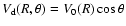 ,
which describes the line-of-sight
velocity along the disk where the circular velocity is
,
which describes the line-of-sight
velocity along the disk where the circular velocity is
 .
Here
.
Here  is the eccentric anomaly, measured
from the projected major axis of the ellipse;
is the eccentric anomaly, measured
from the projected major axis of the ellipse;
 at the observed N coordinates (x,y) on the sky using linear
interpolation;
at the observed N coordinates (x,y) on the sky using linear
interpolation;
![$\chi^2=\sum_{j=1}^{N}
[(V_{{\rm d},j}-V_j)/\Delta V]^2$](/articles/aa/full/2006/08/aa3204-05/img61.gif) ,
where
,
where  are the
measurements errors;
are the
measurements errors;
 .
.
 and
and
 (3
(3 errors). The interpolated data and the ellipses along which the
velocity was sampled are presented in the top panel of
Fig. 4,
errors). The interpolated data and the ellipses along which the
velocity was sampled are presented in the top panel of
Fig. 4,
While the best fitting disk model is shown in the middle panel. The
residuals between the data and the best fitting model are displayed in
the bottom panel. It is apparent that the observation can be
remarkably well described by the adopted simple thin disk
approximation. The best fitting
 also indicates that the
gas kinematics in the central is marginally consistent with a pure
nearly face-on (
also indicates that the
gas kinematics in the central is marginally consistent with a pure
nearly face-on (
 )
disk model. No obvious regular
features are apparent in the residual map, suggesting that the
difference of the
)
disk model. No obvious regular
features are apparent in the residual map, suggesting that the
difference of the  from unity is due only to residual
systematics in the different data sets. Unfortunately the near face-on
geometry of the observed disk, and the small spatial extension of the
data, is unfavorable for a detailed mass modeling of this galaxy, due
to large uncertainties in the mass deprojection and inclination
effects. We will not explore this further in this paper.
from unity is due only to residual
systematics in the different data sets. Unfortunately the near face-on
geometry of the observed disk, and the small spatial extension of the
data, is unfavorable for a detailed mass modeling of this galaxy, due
to large uncertainties in the mass deprojection and inclination
effects. We will not explore this further in this paper.
![\begin{figure}
\par\includegraphics[width=6.6cm,clip]{3204f4.eps} \end{figure}](/articles/aa/full/2006/08/aa3204-05/img69.gif) |
Figure 4: Interpolated velocity field and sampling ellipses ( top panel), best fitting velocity field for a disk model ( middle panel), and residuals between interpolated and best fitting velocity field ( bottom panel) for the ionized gas component of NGC 7679 within 15'' from the center. |
| Open with DEXTER | |
A particularly intriguing feature of NGC 7679 morphology is that the
most disturbed side of the galaxy's body coincides with the position
(29'' East) of a much fainter, slightly elongated companion
one could easily misinterpret as an interacting satellite galaxy
capable of distorting the outer regions of the main galaxy. The
projection effect is so convincing as to induce Pogge & Eskridge
(1993) to ascribe to the interaction with this object the most
pronounced tidal structures of NGC 7679. The same oversight can be
noticed also in the later study by Della Ceca et al. (2001).
Thanks to a long-slit spectrum obtained in run 6 with MMT we can now
demonstrate that such an "intruder'' is actually a
background galaxy with a measured heliocentric recession velocity
 km s-1 which corresponds to
 km s-1 after applying the 3 K background correction
following Fixsen et al. (1996). By adopting the proper relativistic
redshift formula we derive z=0.1158, i.e. approximately
km s-1 after applying the 3 K background correction
following Fixsen et al. (1996). By adopting the proper relativistic
redshift formula we derive z=0.1158, i.e. approximately
 the observed redshift of NGC 7679.
Assuming
 and
and
 (cf. Tegmark et
al. 2004), we derive an angular diameter distance of
400 Mpc. Since the corresponding angular scale is 1.94 kpc
arcsec-1, its observed ionized-gas rotation curve extends to
(cf. Tegmark et
al. 2004), we derive an angular diameter distance of
400 Mpc. Since the corresponding angular scale is 1.94 kpc
arcsec-1, its observed ionized-gas rotation curve extends to
 kpc (see Fig. 5). The mass within such
a radius turns out to be
kpc (see Fig. 5). The mass within such
a radius turns out to be
 assuming a
spherical mass distribution and the galaxy seen edge-on.
assuming a
spherical mass distribution and the galaxy seen edge-on.
![\begin{figure}
\par\includegraphics[width=8.2cm,clip]{3204f5.eps} \end{figure}](/articles/aa/full/2006/08/aa3204-05/img77.gif) |
Figure 5:
The derived gaseous rotation curve and velocity
dispersion profile of the background object projected on
the outskirts of NGC 7679. The scale is  kpc
arcsec-1. kpc
arcsec-1. |
| Open with DEXTER | |
As pointed out above, NGC 7679 has previously been detected in a number of single-dish observations (see Duprie & Schneider 1996, and references therein). Duprie & Schneider (1996) reported that the H I line profile of the galaxy is peculiar, but cautioned against possible contamination from the neighbor Seyfert galaxy NGC 7682.
Our H I image (Fig. 6a) shows that NGC 7679 and NGC 7682 share a common gaseous envelope: an examination of the channel maps (Kuo et al., in preparation) demonstrates that this envelope comprises a tidal bridge connecting the two galaxies, as well as opposing tidal tails from the two galaxies. The extended and diffuse optical feature on the eastern side of NGC 7679 (Fig. 3a) can be identified with the inner region of this H I tidal bridge.
![\begin{figure}
\par\includegraphics[width=15.8cm,clip]{3204f6.eps} \end{figure}](/articles/aa/full/2006/08/aa3204-05/img79.gif) |
Figure 6:
a) H I total intensity (moment 0) map superposed
to the optical image of NGC 7679 ( lower right) and
NGC 7682 ( upper left). The peak flux is
 Jy beam-1 m s-1. Contour levels are
(0.3, 0.9, 1.5, 2.1, 2.7, 4.5, 9, 15, 21) Jy beam-1 m s-1. Contour levels are
(0.3, 0.9, 1.5, 2.1, 2.7, 4.5, 9, 15, 21)  102 Jy beam-1 m s-1.
b) H I velocity field (moment 1) contour map on the total
intensity (moment 0) color-coded map. Coded colors (from
blue to red) are for 4750, 4775, 4800, 4825, 4850, 4875,
4900, 4925, 4950, 4975, 5000, 5025 km s-1.
c) H I continuum emission map. The peak flux
is
102 Jy beam-1 m s-1.
b) H I velocity field (moment 1) contour map on the total
intensity (moment 0) color-coded map. Coded colors (from
blue to red) are for 4750, 4775, 4800, 4825, 4850, 4875,
4900, 4925, 4950, 4975, 5000, 5025 km s-1.
c) H I continuum emission map. The peak flux
is
 Jy beam-1 m s-1. Contour levels are (3.6, 4.8, 7.2, 9.6, 19.2,
36, 60, 96, 144, 216, 288, 384, 480) Jy beam-1 m s-1. Contour levels are (3.6, 4.8, 7.2, 9.6, 19.2,
36, 60, 96, 144, 216, 288, 384, 480)
 Jy beam-1 m s-1.
The synthesized beam of all the maps is Jy beam-1 m s-1.
The synthesized beam of all the maps is
 . .
|
| Open with DEXTER | |
The total flux density of each of the three components is
 mJy for NGC 7679,
 mJy for NGC 7682,
 mJy for the bridge. Assuming our adopted distance of 63.9 Mpc, their radio continuum luminosities are
 erg s-1 Hz,
 erg s-1 Hz,
 erg s-1 Hz, respectively. The continuum emission associated with each Seyfert
galaxy is not spatially resolved as seen in
Fig. 6c.
The latter shows an image of the continuum
emission at 21 cm, most probably produced or dominated by synchrotron
emission from relativistic electrons. The two strongest sources
visible are those associated with NGC 7679 and NGC 7682.
Interestingly, a continuum source is visible lying between NGC 7679
and 7682, and perhaps forming a bridge between these two objects.
This source or bridge coincides with the H I tidal bridge connecting
the two galaxies, and may be produced by star-formation activity in
this bridge. Of course, we cannot rule out the possibility that this
source is an unrelated foreground or background source.
erg s-1 Hz, respectively. The continuum emission associated with each Seyfert
galaxy is not spatially resolved as seen in
Fig. 6c.
The latter shows an image of the continuum
emission at 21 cm, most probably produced or dominated by synchrotron
emission from relativistic electrons. The two strongest sources
visible are those associated with NGC 7679 and NGC 7682.
Interestingly, a continuum source is visible lying between NGC 7679
and 7682, and perhaps forming a bridge between these two objects.
This source or bridge coincides with the H I tidal bridge connecting
the two galaxies, and may be produced by star-formation activity in
this bridge. Of course, we cannot rule out the possibility that this
source is an unrelated foreground or background source.
Although NGC 7682 does not appear to be disturbed in the optical, not
only does it exhibit extended H I tidal features, but its H I kinematic major axis shows a wide misalignment (>50)
with
its optical major axis (see Fig. 6b). The
highly extended tidal features indicate that this system must have
started to gravitationally interact some time ago, and can be used to
estimate the timescale since closest approach. More precisely, tidal
features seen in both galaxies extend to about 80 kpc from each
galaxy, and have a measured maximum radial velocity of 120 km s-1. If the latter also is their maximum velocity in the plane
of the sky, and assuming that the gas originates from the outer
regions of a disk with radius of 20 kpc, the tidal structures
would therefore have a kinematic age of 500 Myr.
In Seyfert 2 galaxies the optical energy distribution toward shorter wavelengths is increasingly dominated by the so-called "featureless continuum'' (FC; cf. Heckman et al. 1995). A fraction of it has to be ascribed to the reflected (polarized) light by a "hidden'' Seyfert 1 nucleus (FC1) while the majority of it (FC2; appearing as a blue, unpolarized continuum) is currently thought originated in a population of hot, massive stars. Understanding the relative role of these two components is quite important for a system like NGC 7679, owing to its highly composite nature.
In order to remove the degeneracy of the above two continua observed
at optical wavelengths for the youngest populations (<10 Myr;
cf. Storchi-Bergmann et al. 2000), one has to move to the UV region
where an ongoing starburst, when present unambiguously reveals
several strong absorption stellar wind resonance lines, such as
N V  1240, Si IV 1400 and
C IV 1550, superposed on the underlying continuum. In
this respect, the continuum originated by very young stars (FC2)
should not be named "featureless'' at all. Besides showing the above
strong stellar-wind lines, the NGC 7679 IUE spectrum
(Fig. 7) reveals that C IV 1550 does
possess an outstanding P-Cygni profile (instead of being pure
photospheric absorption), thus assuring that the burst we are
observing is still within its early phase, dominated by strong stellar
winds. Within the IUE large aperture (
1240, Si IV 1400 and
C IV 1550, superposed on the underlying continuum. In
this respect, the continuum originated by very young stars (FC2)
should not be named "featureless'' at all. Besides showing the above
strong stellar-wind lines, the NGC 7679 IUE spectrum
(Fig. 7) reveals that C IV 1550 does
possess an outstanding P-Cygni profile (instead of being pure
photospheric absorption), thus assuring that the burst we are
observing is still within its early phase, dominated by strong stellar
winds. Within the IUE large aperture (
 ), such a
burst generates an extinction-corrected Ly
flux
), such a
burst generates an extinction-corrected Ly
flux
 erg cm-2 s-1, whose
equivalent width is 37 Å.
erg cm-2 s-1, whose
equivalent width is 37 Å.
![\begin{figure}
\par\includegraphics[width=8.2cm,clip]{3204f7.eps} \end{figure}](/articles/aa/full/2006/08/aa3204-05/img88.gif) |
Figure 7:
Comparison of the UV spectra of NGC 7679 (IUE) and the
young starburst IRAS 0339+6517 (HUT) in the region
where they overlap (
 1200-1800 Å). Both
spectra have been corrected for redshift and galactic
extinction as given by Burstein & Heiles (1984). The
HUT spectrum of IRAS 08339+6517 has been smoothed with
a 7 pixel window. A constant amount of 1200-1800 Å). Both
spectra have been corrected for redshift and galactic
extinction as given by Burstein & Heiles (1984). The
HUT spectrum of IRAS 08339+6517 has been smoothed with
a 7 pixel window. A constant amount of
 flux units has been added to the
NGC 7679 UV energy distribution - previously normalized
to match the HUT spectrum around 1500 Å - for
display purposes. The most prominent stellar wind
absorption lines are marked.
flux units has been added to the
NGC 7679 UV energy distribution - previously normalized
to match the HUT spectrum around 1500 Å - for
display purposes. The most prominent stellar wind
absorption lines are marked. |
| Open with DEXTER | |
A reliable estimate of the age of the recently formed stars (and thus an estimate of the epoch of the starburst onset in NGC 7679) can be derived by comparing its IUE/SWP spectrum with the overlapping portion of Hopkins Ultraviolet Telescope (HUT) spectra of similar starburst galaxies presented by Leitherer et al. (2002). In particular, one can easily notice the good match of NGC 7679 with both the continuum and - allowing for more pronounced P-Cygni effects - the UV absorption features of their young starburst IRAS 08339+6517 (see Fig. 7).
The match between the UV energy distributions of the two
starburst objects presented in Fig. 7 is quite
impressive. Both spectra have been corrected for redshift, galactic
and internal extinction. The latter value has been assumed to be close
to
 for both galaxies. In the case of
IRAS 08339+6517 the absorption
A1500=2.34 mag estimated by
Leitherer et al. (2002) corresponds to
for both galaxies. In the case of
IRAS 08339+6517 the absorption
A1500=2.34 mag estimated by
Leitherer et al. (2002) corresponds to
 ,
if one
applies the extinction curve of Savage
& Mathis (1979), while for the overall line-emitting disk of NGC 7679 one
can assume a value
,
if one
applies the extinction curve of Savage
& Mathis (1979), while for the overall line-emitting disk of NGC 7679 one
can assume a value
 obtained by the observed ratio
Ly/H 0.9 to be compared with the theoretical "Case B'' ratio Ly/H
obtained by the observed ratio
Ly/H 0.9 to be compared with the theoretical "Case B'' ratio Ly/H = 31.6 for
 K and
K and
 ,
having assumed the standard Balmer decrement H/H = 2.86 (see Dopita & Sutherland 2003).
This strongly suggests that we are
comparing young-star dominated systems very close in age.
In particular, Leitherer et al. (2002) ascribe the UV spectrum of
IRAS 08339+6517 to a 10 Myr-old stellar population of solar
composition, though compatible with an age between 5 and 20 Myr. As a
consequence, we date back to 5-20 Myr ago also the
onset of star-formation episode we are witnessing today in NGC 7679.
For comparison, the internal extinction we derive within the slice
(
,
having assumed the standard Balmer decrement H/H = 2.86 (see Dopita & Sutherland 2003).
This strongly suggests that we are
comparing young-star dominated systems very close in age.
In particular, Leitherer et al. (2002) ascribe the UV spectrum of
IRAS 08339+6517 to a 10 Myr-old stellar population of solar
composition, though compatible with an age between 5 and 20 Myr. As a
consequence, we date back to 5-20 Myr ago also the
onset of star-formation episode we are witnessing today in NGC 7679.
For comparison, the internal extinction we derive within the slice
(
 at
at
 )
of the NGC 7679 covered
by our own low-resoultion spectrum (run 4) by measuring its Balmer
decrement, turns out to be higher (
)
of the NGC 7679 covered
by our own low-resoultion spectrum (run 4) by measuring its Balmer
decrement, turns out to be higher (
![$E[B-V]\sim0.60$](/articles/aa/full/2006/08/aa3204-05/img97.gif) ). Given the
tiny portion of the emitting region recorded by this latter spectrum,
likely affected by local, innermost inhomogeneities, we keep
as the representative absorption of the NGC 7679
disk as a whole.
). Given the
tiny portion of the emitting region recorded by this latter spectrum,
likely affected by local, innermost inhomogeneities, we keep
as the representative absorption of the NGC 7679
disk as a whole.
The existence of ongoing starburst in a galaxy reflects an enhancement of the far-infrared (FIR) continuum emission, due to dust re-radiation of ultraviolet photons from hot OB stars. At the same time, in the case of a composite object like NGC 7679, one has to expect a substantial contribution to the FIR continuum by the underlying AGN. In order to identify which source dominates the IR emission in our object, one can use the classification scheme adopted by Mouri & Taniguchi (2002) on the basis of far-infrared flux densities of the IRAS database.
Having defined
 as the observed flux between 40 and 120
  m
and
m
and  as the monochromatic flux at 4300 Å, respectively, the IR
data of Kewley et al. (2001) imply for NGC 7679 a ratio
/
as the monochromatic flux at 4300 Å, respectively, the IR
data of Kewley et al. (2001) imply for NGC 7679 a ratio
/
 .
This, in turn, implies that our object belongs to
the Mouri & Taniguchi (2002) class of starburst-dominated
Seyfert galaxies. For comparison, the nearby Seyfert 2 galaxy
NGC 7682, likely interacting with NGC 7679, has to be classified
within the above scheme as an AGN-dominated Seyfert, owing to
its measured
/
.
This, in turn, implies that our object belongs to
the Mouri & Taniguchi (2002) class of starburst-dominated
Seyfert galaxies. For comparison, the nearby Seyfert 2 galaxy
NGC 7682, likely interacting with NGC 7679, has to be classified
within the above scheme as an AGN-dominated Seyfert, owing to
its measured
/
 (Mouri & Taniguchi 2002). As such,
the two systems, although sharing the nuclear Seyfert phenomenon, appear
quite different in the mutual dominance of the central AGN and the
young star emission.
(Mouri & Taniguchi 2002). As such,
the two systems, although sharing the nuclear Seyfert phenomenon, appear
quite different in the mutual dominance of the central AGN and the
young star emission.
Correcting for the galactic extinction by Burstein & Heiles (1984),
our pure emission-line image of NGC 7679 gives a extinction corrected
total flux
![$F_{\rm H\alpha+[NII]} = 8.0 \times 10^{-13}$](/articles/aa/full/2006/08/aa3204-05/img103.gif) erg cm-2 s-1. The innermost (
erg cm-2 s-1. The innermost ( )
region ()
- i.e.
the central spiral pattern - gives a corresponding flux
)
region ()
- i.e.
the central spiral pattern - gives a corresponding flux
![$F_{\rm H\alpha+[NII]} = 5.9 \times 10^{-13}$](/articles/aa/full/2006/08/aa3204-05/img105.gif) erg cm-2 s-1. As such, the latter region alone provides approximately 75%
of the total H+[N II] emitted flux.
The spectrophotometry of Contini et al. (1998), showing that the
fraction of light due to H
amounts to 64% of the total
H+[N II] emission, allows us to approximately correct such flux
for the contamination of the [N II]
doublet emission, thus giving a
"pure'' H
flux received from NGC 7679 of
erg cm-2 s-1. As such, the latter region alone provides approximately 75%
of the total H+[N II] emitted flux.
The spectrophotometry of Contini et al. (1998), showing that the
fraction of light due to H
amounts to 64% of the total
H+[N II] emission, allows us to approximately correct such flux
for the contamination of the [N II]
doublet emission, thus giving a
"pure'' H
flux received from NGC 7679 of
 erg cm-2 s-1.
Moreover, one has to assume that the latter value is still affected by
some amount of internal extinction, which, in localized regions of
starburst galaxies, can be as high as A(H) 2 mag (cf.
Kennicutt 1998). In the specific case of NGC 7679, assuming
E(B-V)=0.33 as the color excess due to its internal extinction close
to the center (see Sect. 3.6), the intrinsic H
flux is
erg cm-2 s-1.
Moreover, one has to assume that the latter value is still affected by
some amount of internal extinction, which, in localized regions of
starburst galaxies, can be as high as A(H) 2 mag (cf.
Kennicutt 1998). In the specific case of NGC 7679, assuming
E(B-V)=0.33 as the color excess due to its internal extinction close
to the center (see Sect. 3.6), the intrinsic H
flux is
 erg cm-2 s-1. The latter value, properly
transformed into the corresponding
erg cm-2 s-1. The latter value, properly
transformed into the corresponding
 ,
allows us, in turn, to
estimate the current star formation rate.
,
allows us, in turn, to
estimate the current star formation rate.
On the basis of our adopted distance of 63.9 Mpc, the above flux
translates into an H
luminosity of
 erg s-1. By assuming the calibration of Kennicutt et al. (1994) this
implies a
erg s-1. By assuming the calibration of Kennicutt et al. (1994) this
implies a
 yr-1. An independent SFR estimate
can be derived also by the UV continuum measured in the IUE
spectrum. After correcting for redshift, and galactic extinction, the
measured average flux in the absorption-free wavelength range between
1425 and 1515 Å is
yr-1. An independent SFR estimate
can be derived also by the UV continuum measured in the IUE
spectrum. After correcting for redshift, and galactic extinction, the
measured average flux in the absorption-free wavelength range between
1425 and 1515 Å is
 erg cm-2 s-1 Å-1. This translates into a luminosity of
 erg s-1 Hz-1 corresponding, with the
calibration given by Kennicutt (1998), to a
erg s-1 Hz-1 corresponding, with the
calibration given by Kennicutt (1998), to a
 yr-1. The two levels of star formation (i.e. the one
derived from the optical recombination line and that obtained from the
UV continuum) are then quite similar and appear relatively high, being
comparable to that shown by other similarly disturbed starburst
systems like, for instance NGC 7673 (
yr-1. The two levels of star formation (i.e. the one
derived from the optical recombination line and that obtained from the
UV continuum) are then quite similar and appear relatively high, being
comparable to that shown by other similarly disturbed starburst
systems like, for instance NGC 7673 (
 yr-1; Homeier et al. 2002).
For the radio data, using the empirical correlation
between the radio continuum luminosity at 1.4 GHz and SFR (Condon
1992; Lou & Bian 2005) we find a
 yr-1 for
NGC 7679,
yr-1 for
NGC 7679,
 yr-1 for NGC 7682, and
 yr-1 for the bridge region. For both NGC 7679 and NGC 7682, the
computed SFR are, of course, upper limits as a part of the radio emission
could arise from the central AGN. For NGC 7679 such an estimate is within
the range derived from optical and UV measurements.
yr-1 for the bridge region. For both NGC 7679 and NGC 7682, the
computed SFR are, of course, upper limits as a part of the radio emission
could arise from the central AGN. For NGC 7679 such an estimate is within
the range derived from optical and UV measurements.
Having definitely excluded any role of the close background
companion in the origin of distorted morphology of NGC 7679, the most
likely culprit becomes NGC 7682, the face-on barred spiral located
only
 North-East. This latter galaxy - itself a
Seyfert 2 system with an almost identical redshift - offers
straightforward evidence, thanks to the radio observations discussed
above, of a tidal interaction that happened a few hundred
million years ago. Although interaction is often invoked as a
starburst-triggering phenomenon (cf. Greene et al. 2004), whether
this specific encounter played a role in the onset of the current
central starburst in NGC 7679 remains difficult to say, because
of the evident youth of the latter phenomenon.
North-East. This latter galaxy - itself a
Seyfert 2 system with an almost identical redshift - offers
straightforward evidence, thanks to the radio observations discussed
above, of a tidal interaction that happened a few hundred
million years ago. Although interaction is often invoked as a
starburst-triggering phenomenon (cf. Greene et al. 2004), whether
this specific encounter played a role in the onset of the current
central starburst in NGC 7679 remains difficult to say, because
of the evident youth of the latter phenomenon.
NGC 7679, showing simultaneously a vigorous starburst in the optical and a powerful AGN in the X-ray waveband, is a prototypical composite object.
We derived extinction-corrected diagnostic ratios from optical
emission lines, namely log([O III]
 /H) = 0.172 and log([N II]
 /H) = -0.343. Such observed ratios are consistent with the earlier
corresponding values measured by Dahari (1985). On the basis of the
most recent diagnostic diagrams by Kauffmann et al. (2003) and its low
[O III]
luminosity (
/H) = -0.343. Such observed ratios are consistent with the earlier
corresponding values measured by Dahari (1985). On the basis of the
most recent diagnostic diagrams by Kauffmann et al. (2003) and its low
[O III]
luminosity (
![$L_{\rm [OIII]} = 3.2\times10^6~ L_\odot$](/articles/aa/full/2006/08/aa3204-05/img121.gif) )
i.e. the main parameter they adopt as an AGN activity tracer,
NGC 7679 falls closer to the region of proper starburst galaxies
(Fig. 8) also in agreement with previous results by
Panessa & Bassani (2002).
)
i.e. the main parameter they adopt as an AGN activity tracer,
NGC 7679 falls closer to the region of proper starburst galaxies
(Fig. 8) also in agreement with previous results by
Panessa & Bassani (2002).
![\begin{figure}
\par\includegraphics[width=8.3cm,clip]{3204f8.eps} \end{figure}](/articles/aa/full/2006/08/aa3204-05/img122.gif) |
Figure 8: The location of NGC 7679 in the optical emission-line diagnostic diagram of Kauffmann et al. (2003; filled circle). The short and long dashed lines mark the demarcation between starburst galaxies and AGNs according to Kauffmann et al. (2003) and Kewley et al. (2001), respectively. The vast majority of the galaxies studied by Kauffmann et al. (2003) are located in the hatched region. |
| Open with DEXTER | |
Given the dominance of star formation at optical wavelengths for
composite systems, specific indicators capable of tracing "pure'' AGN
power by disentangling it from superposed vigorous star formation are
required. Two useful indicators are currently known, namely the
absorption-corrected intrinsic 2-10 keV X-ray luminosity and the
luminosity of broad hydrogen emission lines which come from the
high-velocity gas around the central supermassive black hole in the
AGN. A recent study of the correlation between these two quantities
(for type-1 AGNs) is given by Imanishi & Terashima (2004). Although
the quality of our own optical spectra of NGC 7679 are not suitable to
study in detail its faint broad Balmer component, we resorted - for
its classification - to the high S/N spectrum of Kewley et
al. (2001), who identified a broad component with
 km s-1 at the basis of its narrow H.
From Della Ceca et al. (2001) we know that the luminosity of such a broad component is
estimated by the above authors to be
km s-1 at the basis of its narrow H.
From Della Ceca et al. (2001) we know that the luminosity of such a broad component is
estimated by the above authors to be
 erg s-1. Assuming the 2-10 keV X-ray
luminosity by Della Ceca et al. (2001) scaled to our adopted distance
(
erg s-1. Assuming the 2-10 keV X-ray
luminosity by Della Ceca et al. (2001) scaled to our adopted distance
(
 erg s-1) NGC 7679 falls among the
dust-unabsorbed Type 1 AGNs with an underluminous broad H
component,
as shown in Fig. 9. This is in strict agreement with
the proposed classification by Della Ceca et al. (2001).
erg s-1) NGC 7679 falls among the
dust-unabsorbed Type 1 AGNs with an underluminous broad H
component,
as shown in Fig. 9. This is in strict agreement with
the proposed classification by Della Ceca et al. (2001).
![\begin{figure}
\par\includegraphics[width=8.3cm,clip]{3204f9.eps} \end{figure}](/articles/aa/full/2006/08/aa3204-05/img126.gif) |
Figure 9: The location of NGC 7679 in the X-ray/optical diagnostic diagram of Imanishi & Terashima (2004; filled circle). Luminosities of NGC 7679 are taken from Della Ceca et al. (2001). The region of dust-unabsorbed Type 1 AGNs (open circles) is marked with dashed lines. |
| Open with DEXTER | |
At the same time NGC 7679 offers much more to the
researchers currently exploring the elusive link between AGN activity
and ongoing SB. For instance, hosting simultaneously a bar and having
undergone a past interaction, it has at least two
distinct efficient mechanisms to drive gas from its outer parts to the
nuclear region (cf. Gonzàlez Delgado et al. 1998). Once the
expected inward flow of gas reaches its central region, it is capable not
only of triggering star formation, but also of forming a gas reservoir
(in the form of a molecular torus) which likely feeds the nucleus
itself. This twofold scenario is further enriched by the presence of
an amount of molecular hydrogen - as derived from radio CO
observations (Kandalyan 2003) - comparable to that of neutral
hydrogen (a few
 ). What is more, unlike other
Markarian galaxies, the CO in NGC 7679 distinguishes itself for having
its line FWHM larger than that of its H I line. Since the CO gas
kinematics reveals the rotation and/or velocity dispersion close to
the nucleus, this phenomenon is interpreted as due to a rapidly
rotating nuclear disk (cf. Kandalyan 2003). As such, part of this
circumnuclear gas is likely prone to streaming inward with velocities
100 km s-1 directly onto the nucleus (cf. Regan et al. 1999), so that a phenomenon usually unobservable in other AGN,
appears at the center of this galaxy.
). What is more, unlike other
Markarian galaxies, the CO in NGC 7679 distinguishes itself for having
its line FWHM larger than that of its H I line. Since the CO gas
kinematics reveals the rotation and/or velocity dispersion close to
the nucleus, this phenomenon is interpreted as due to a rapidly
rotating nuclear disk (cf. Kandalyan 2003). As such, part of this
circumnuclear gas is likely prone to streaming inward with velocities
100 km s-1 directly onto the nucleus (cf. Regan et al. 1999), so that a phenomenon usually unobservable in other AGN,
appears at the center of this galaxy.
NGC 7679 has a wealth of distinct interlaced phenomena. The investigation of its special properties is made easier both by its relative proximity and projected orientation.
Among the most interesting features we were able to identify are the following:
imaging shows several knots and loose
ionized gas debris. In addition it reveals a central
circumnuclear star-forming spiral/ring capable of producing
75% of the optical line emission within a radius of
1 kpc. Observations from the literature suggest that this
central region contains a large amount of
molecular gas, likely giving rise to a stream moving inward, so
as to possibly fuel the galaxy nucleus.
 yr-1, as derived from optical and UV observations, and consistent also with 14 GHz radio continuum
observations. The onset of the phenomenon is not earlier than
20 Myr ago, as shown by the prominent stellar wind absorption
lines seen in its IUE ultraviolet spectrum shortward of
2000 Å.
yr-1, as derived from optical and UV observations, and consistent also with 14 GHz radio continuum
observations. The onset of the phenomenon is not earlier than
20 Myr ago, as shown by the prominent stellar wind absorption
lines seen in its IUE ultraviolet spectrum shortward of
2000 Å.
 (corresponding to 5-6 kpc). Although the latter appears
characterized by a basically regular rotation within the
innermost (15'') region, clear signs of asymmetries (i.e,
perturbations) are recognizable at a radius just beyond
such a distance.
(corresponding to 5-6 kpc). Although the latter appears
characterized by a basically regular rotation within the
innermost (15'') region, clear signs of asymmetries (i.e,
perturbations) are recognizable at a radius just beyond
such a distance.
 PA >
PA >  ).
).
luminosity vs. hard X
luminosity, cf. Fig. 9) and a transition
object at optical wavelengths (cf. Fig. 8.
This allows us to conclude that NGC 7679 is a galaxy where
starburst and a mildly obscured AGN (given the upper limit of
the column density of the neutral hydrogen corresponding to
 according to the above authors) coexist with
the starburst dominating the bolometric luminosity.
according to the above authors) coexist with
the starburst dominating the bolometric luminosity.
Acknowledgements
M.C. acknowledges support from a VENI grant 639.041.203 awarded by the Netherlands Organization for Scientific Research (NWO).