 Ophiuchi molecular cloud
![[*]](/icons/foot_motif.gif) ,
,
A&A 447, 609-622 (2006)
DOI: 10.1051/0004-6361:20041331
Ophiuchi molecular cloud,T. Stanke 1,2 - M. D. Smith3,5 - R. Gredel4 - T. Khanzadyan4,6
1 - Max-Planck-Institut für Radioastronomie Bonn,
Auf dem Hügel 69, 53121 Bonn, Germany
2 -
Institute for Astronomy, University of Hawai'i, 2680 Woodlawn Drive,
Honolulu, Hawai'i 96822, USA
3 -
Armagh Observatory, College Hill, Armagh BT61 9DG, Northern Ireland,
UK
4 -
Max-Planck-Institut für Astronomie, Königsstuhl 17,
69117 Heidelberg, Germany
5 -
Centre for Astrophysics and Planetary Science, School of Physical
Sciences, University of Kent CT2 7NR
6 -
Centro de Astrofísica da Universidade do Porto, rua das Estrelas, 4150-726 Porto, Portugal
Received 21 May 2004 / Accepted 21 October 2005
Abstract
The dense cores which conceive and cradle young stars can be explored
through continuum emission from associated dust grains. We have performed
a wide field survey for dust sources at 1.2 millimetres in the
Ophiuchi molecular cloud, covering more than 1 square degree in an
unbiased fashion. We detect a number of previously unknown sources, ranging
from extended cores over compact, starless cores to envelopes surrounding
young stellar objects of Class 0, Class I, and Class II type. We analyse
the mass distribution, spatial distribution and the potential equilibrium
of the cores. For the inner regions, the survey results are consistent with
the findings of previous narrower surveys. The core mass function resembles
the stellar initial mass function, with the core mass function shifted by
a factor of two to higher masses (for the chosen opacity and temperature).
In addition, we find no statistical variation in the core mass function
between the crowded inner regions and those in more isolated fields except
for the absence of the most massive cores in the extended cloud. The inner
region contains compacter cores. This is interpreted as due to a medium of
higher mean pressure although strong pressure variations are evident in
each region. The cores display a hierarchical spatial distribution with
no preferred separation scale length. However, the frequency distribution
of nearest neighbours displays two peaks, one of which at 5000 AU can be
the result of core fragmentation. The orientations of the major axes of
cores are consistent with an isotropic distribution. In contrast, the
relative orientations of core pairs are preferentially in the NW-SE
direction on all separation scales. These results are consistent with
core production and evolution in a turbulent environment.
Finally, we report the discovery of a new, low-mass Class 0 object
candidate and its CO outflow.
Key words: stars: formation - ISM: clouds -
ISM: individual objects:
Ophiuchi - ISM: structure
As one of the nearest star-forming regions, the Ophiuchi
molecular cloud complex has been the target of numerous investigations.
A prime focus has been the densest part of the L 1688 cloud which harbours a
large number of young stellar objects, studied at near- to mid-infrared
wavelengths (Comeron et al. 1993; Vrba et al. 1975; Barsony et al. 1989; Wilking et al. 2001; Bontemps et al. 2001; Luhman & Rieke 1999; Allen et al. 2002; Elias 1978; Wilking et al. 1989) and at (sub)millimetre wavelengths
(Tachihara et al. 2000; Nürnberger et al. 1998; Andre & Montmerle 1994; Andre et al. 1993; Wilson et al. 1999).
To investigate how these stars are conceived, we wish to to relate their
properties to those of the embedding cloud of molecular gas and dust which
both nurture and obscure the stars. However, technical capabilities restrict
the field over which area-covering surveys can be undertaken, bearing the
danger of picking peculiar objects prevalent in the "more interesting''
parts, thus biasing the results obtained from statistical investigations.
In order to further exclude such selection effects, we have
performed an unbiased survey of a wide area around the L 1688 molecular cloud
for dust continuum sources, including the dense molecular cores as well
as the areas which apparently do not harbour dense molecular material.
The entire star formation complex extends over several degrees on the sky
(Loren 1989a), containing a few major clouds.
The L 1688 cloud is situated about
one degree south of the Ophiuchus star itself. This "main cloud'' of
Oph covers an area of roughly 480 arcmin2 and has been dissected
into about a dozen
cloud components (Mezger et al. 1992). This area was surveyed
at 1.3 mm by Motte et al. (1998, hereafter MAN98), who uncovered
62 starless cores and 41 circumstellar structures. These observations had a
resolution of just 11 arcsec, corresponding to 1400 AU. The inferred
distribution of masses of these cores was found to be comparable to the
stellar initial mass function, suggesting that stellar masses are
determined at conception. Subsequently, the results of a larger, somewhat more
sensitive survey at 0.85 mm were presented by Johnstone et al. (2000)
(hereafter J00). This survey covered  700 arcmin2 with a resolution
of 14 arcsec, identifying 55 cores.
This survey was recently followed up by a much more extensive (4 square
degrees) but significantly more shallow survey by Johnstone et al. (2004, hereafter J04), mainly extending to the north/north-west of the main cloud.
700 arcmin2 with a resolution
of 14 arcsec, identifying 55 cores.
This survey was recently followed up by a much more extensive (4 square
degrees) but significantly more shallow survey by Johnstone et al. (2004, hereafter J04), mainly extending to the north/north-west of the main cloud.
In the present 1.2 mm survey, we cover an area of 4600 arcmin2.
This constitutes a significant extension to the above works although the
resolution is 24
 .
Our immediate goals are to (i) derive the core
masses (Sect. 3), (ii) estimate the mass relative to a critical
Bonnor-Ebert sphere or Jeans mass by including the core sizes
(Sect. 4), (iii) quantify the spatial distribution and orientations
(Sect. 5 and Appendix B), and (iv) quantify the mass
distribution (Sect. 6). In addition, we report the discovery
of a new low-mass candidate Class 0 source and its CO outflow
(Sect. 7).
A companion paper (Khanzadyan et al. 2004) presents the results of a
near-infrared imaging search for protostellar H2 outflows over a large
section of the present survey area. Finally, the core, outflow and
protostellar properties will be related in detail in a forthcoming paper.
.
Our immediate goals are to (i) derive the core
masses (Sect. 3), (ii) estimate the mass relative to a critical
Bonnor-Ebert sphere or Jeans mass by including the core sizes
(Sect. 4), (iii) quantify the spatial distribution and orientations
(Sect. 5 and Appendix B), and (iv) quantify the mass
distribution (Sect. 6). In addition, we report the discovery
of a new low-mass candidate Class 0 source and its CO outflow
(Sect. 7).
A companion paper (Khanzadyan et al. 2004) presents the results of a
near-infrared imaging search for protostellar H2 outflows over a large
section of the present survey area. Finally, the core, outflow and
protostellar properties will be related in detail in a forthcoming paper.
Quoted distances to the Ophiuchi cloud lie in the range
D = 125-165 pc, as recently summarised by Rebull et al. (2004).
de Geus et al. (1989) analysed photometry of the stars in the nearby
Sco OB2 association. It was shown that the Ophiuchus dark clouds are on the
near side of Upper Scorpius, at 125 pc. Hipparcos data confirm the
distance to Upper Scorpius and yield a distance of 128 pc to the
quadruple Oph system (de Zeeuw et al. 1999). Here, we shall
follow the suggestion by Rebull et al. (2004) and take the
weighted average distance of 130 pc.
In the following, we will designate all well-defined low mass
structures as "cores'' (with mass below about
 )
and apply the term "clump'' to more
massive structures defined through low resolution CO mapping. A clump
usually corresponds spatially to a cluster of cores.
)
and apply the term "clump'' to more
massive structures defined through low resolution CO mapping. A clump
usually corresponds spatially to a cluster of cores.
![\begin{figure}
\par\includegraphics[angle=0,width=14.5cm,clip]{1331f01.eps} \end{figure}](/articles/aa/full/2006/08/aa1331-04/img20.gif) |
Figure 1:
SIMBA 1.2 mm continuum mosaic image of the -Ophiuchi cloud.
Intensity scaling is in mJy/beam (linear). Prominent clumps are marked as
A, B1/1, C, D, E, and F. Dashed lines mark some filamentary structures
east of the major clumps, with three more compact sources (MMS038, MMS051,
and MMS126) within them also labeled. MMS126 is identified as a new, low-mass
Class 0 object candidate in Sect. 7. |
| Open with DEXTER | |
The observations were carried out using the SIMBA bolometer array at the SEST
telescope on La Silla/Chile during an observing run lasting from
2002 July 7 to 12. SIMBA is a 37-channel bolometer array, operating at 1.2 mm,
and provides a HPBW of 24
(as measured on maps of Uranus).
The weather was good and fairly
stable with zenith opacities ranging between 0.17 and 0.3.
In total, 78 maps in the fast mapping mode were taken (i.e., no wobbler was
used). Typical map sizes were
 with a
scanning velocity of 80
/s and 8
steps between subscans.
A number of maps were taken with a scanning velocity of 160
/s
(size
with a
scanning velocity of 80
/s and 8
steps between subscans.
A number of maps were taken with a scanning velocity of 160
/s
(size
 )
in order to improve sensitivity
for extended structures. Pointing and focus were checked regularly;
pointing corrections were typically a few arcsec and always below 10
.
Skydips were taken every 1 to 2 h, and Uranus
was mapped several times for calibration purposes.
)
in order to improve sensitivity
for extended structures. Pointing and focus were checked regularly;
pointing corrections were typically a few arcsec and always below 10
.
Skydips were taken every 1 to 2 h, and Uranus
was mapped several times for calibration purposes.
The data reduction was performed with MOPSI, a software package developed by Robert Zylka, following standard bolometer data reduction principles. First, noisy or dead channels were identified and deleted. Then, a low order baseline was subtracted from the data and an initial de-spiking was made. The data direct from the telescope consist of the true signal convolved with the response of the electronics, hence requiring deconvolution (Weferling et al. 2002; Reichertz et al. 2001). We chose to reconstruct the signal at a specific time using only data from a given window (typically 6 s) around this time, including the data recorded during the "turning'' of the telescope between two on-map sub-scans (in the standard deconvolution only data taken during the on-map subscans are used, and the signal is reconstructed from the entire on-map sub-scan). This deconvolution was found to provide significantly better results than the standard deconvolution, for two reasons: the restriction to a shorter time span reduces noise that goes into the reconstruction of a given data point, and including the time during the turning of the telescope ensures a proper reconstruction of the data at the edges of the map, as sky fluctuations during turning (which are convolved into the data recorded during the on-map subscans) are properly taken out of the data recorded during the on-map subscans. Then, after the deconvolution, the data corresponding to off-map data taken during the turning of the telescope were deleted. After further low-order baseline corrections, correction for atmospheric extinction and correction for gain-elevation effects, correlated sky brightness variations (sky-noise) were removed. Here, an iterative procedure was used: for each iteration, we used the resulting mosaic of the previous iteration as an input model for the brightness distribution. Following another careful de-spiking and baseline subtraction, the data were then combined into a mosaic, weighting individual maps according to their noise (1/rms2). After each iteration, for each sub-map the polygons defining emission-free regions to be used for baseline fitting were carefully checked and, if necessary, adjusted, followed by a check of the degree of the polynomial used for baseline subtraction.
The noise level in the final mosaic is of the order of 10 mJy/beam
throughout most of the map. Close to the edges, it degrades to 12-15 mJy/beam.
For a point source, assuming a flux-to-mass conversion as outlined
below, this corresponds to a 3 detection limit of the order of 0.014
  .
In terms of column density, the 1 noise level
corresponds to about
.
In terms of column density, the 1 noise level
corresponds to about
 cm-2. This is slightly better
than the 1.3 mm survey done by MAN98, but somewhat less sensitive than the J00 850
cm-2. This is slightly better
than the 1.3 mm survey done by MAN98, but somewhat less sensitive than the J00 850  m survey; it is significantly more sensitive than the recent J04 850 m survey.
Similar to other (sub)millimetre surveys, our new map is sensitive only to
sufficiently small structures (see also J00 for a discussion of this issue).
In the case of SIMBA fast mapping observations,
this is due to two effects: the subtraction of the sky emission removes any
flux due to large scale, more or less uniform emission, and a high-pass filter
applied to the signal from the bolometer will further suppress large-scale
emission features. On top of these technical effects, baseline subtraction may
further contribute; however, baseline subtraction was done very carefully
in order to minimise this. Filtering of low frequencies and residuals from
the deconvolution of the data are responsible for residual negative map
values close to the brightest parts of the mosaic (dipping to
-20 mJy/beam ( )
in the most negative patches),
a feature generally found in SIMBA maps.
)
in the most negative patches),
a feature generally found in SIMBA maps.
The final 1.2 mm mosaic is shown in Fig. 1. In line with previous (sub)millimetre maps, a large variety of sources is seen, ranging from extended cores over more compact features to unresolved point sources. In those regions which were also covered by the MAN98 and J00 surveys we generally see a very good agreement between the different data sets (limited by the poorer angular resolution of our new data).
In the part of the mosaic which had not been previously observed, besides a number of fainter, extended structures, two more remarkable features turned up. On the one hand, there is a filamentary structure (dashed lines in Fig. 1) to the east of the previously revealed cores Oph-B/C/E/F, containing two more compact sources (MMS126 and MMS038/MMS051). MMS126 appears to be a newly discovered, low-mass Class 0 source (see Sect. 7 for details).
The second remarkable structure is the presence of a bright dust core MMS041 at the tip of the cometary dark cloud L 1696B. A similar core was already found in the neighbouring cloud L 1696 by MAN98.
The variety in source morphologies makes a detailed source identification
mandatory: e.g., using simple source detection algorithms with a certain
detection threshold will not identify extended structures, which are clearly
present, but might have maximum surface brightnesses of the order of the
1 noise level. To account for this, sources were identified
using a wavelet decomposition similar to the method used by MAN98.
The final map was split into 5 planes using the TRANSFORM/WAVE and EXTRACT/WAVE tasks provided by the ESO/MIDAS wavelet context package. We will refer to the most compact scale as scale 1, and scale 2, 3, 4, and 5 to the next more extended scales.
We then used the 2-D adaption of the clumpfind algorithm developed by Williams et al. (1994) to identify features in the 5 planes individually. The lower limits for source identifications were set to 3-4 times the rms fluctuation of emission-free parts of the respective planes, with contours spaced by about 1 rms. The minimum number of pixels required to identify a sufficiently bright feature as a source was set according to the characteristic scale of each plane (i.e., to very small for scale 1, and getting bigger for larger scales). The thus detected features were then visually inspected to reject false detections due to residual scanning artifacts (found to be restricted to scales 1 and 2) or other misidentifications.
From the list of features identified at the various scales a final
source list was compiled, including all features identified in scale 1,
and all sources in the more extended scales which did not overlap with
sources identified in the next more compact scale (i.e., for each
feature we determined the part of the clump area as given by the
clumpfind routine, in which the intensity was greater than 1/2 the
maximum intensity, and checked if it overlapped with the corresponding
area of all features of the next more compact scale). This resulted in
a list of 139 sources (MMS001 to MMS139).
![\begin{figure}
\par\includegraphics[angle=-90,width=14.5cm,clip]{1331f02.eps}
\end{figure}](/articles/aa/full/2006/08/aa1331-04/img27.gif) |
Figure 2: Model of the 1.2 mm continuum emission derived from the superposition of models for the 143 sources identified from the SIMBA data. Intensity scaling is in mJy/beam (linear). |
| Open with DEXTER | |
![\begin{figure}
\par\includegraphics[angle=-90,width=14.5cm,clip]{1331f03.eps}
\end{figure}](/articles/aa/full/2006/08/aa1331-04/img28.gif) |
Figure 3: Residual after subtracting the model source distribution (Fig. 2) from the 1.2 mm mosaic (Fig. 1). Intensity scaling is in mJy/beam (linear). |
| Open with DEXTER | |
A full finding chart showing the location of all 143 sources is shown in Fig. A.1 (online version only), and closeups of crowded regions are shown in Figs. A.2-A.4 (online version only).
Table A.1 (online version only) lists the 1.2 mm sources found in our survey in the order they were identified by the wavelet decomposition plus clumpfind technique. In addition to the source position, it holds the integrated source flux and the peak flux determined in various ways, the major and minor axis and the position angle of the major axis, cross-identifications to the sources identified by Motte et al. (1998) and Johnstone et al. (2000), and a comment on association with known YSOs. In Sect. A we give notes on the individual sources.
We then performed a detailed modelling of the overall brightness distribution using Gaussian sources, the result of which is shown in Fig. 2 (Fig. 3 shows the residual, after subtracting the model source distribution from the mosaic). In some cases, more than one Gaussian component centered on the source position had to be assumed in order to properly reproduce the shape of the sources (e.g., a bright source with a radial intensity distribution falling off as a power law will not be satisfactorily fitted by a single Gaussian).
The sources we detect within the inner core-crowded region are generally coincident with those found in previous surveys. Figures 4 and 5 show that this is true for separate samples of all cores and starless cores. In particular, we recover all the cores from J00, despite the different observing wavelength. This confirms the reliability of our core-finding technique.
The fluxes of the sources were determined by first subtracting the model for all other sources from the mosaic, and then integrating over a certain area around the source within some given radius or (for more complex sources) within a certain polygon around the centre of the source. Similarly, sizes and position angles for each source were determined by (single) Gaussian fits to the mosaic with the model for all other sources subtracted.
Peak fluxes were calculated in four differing ways and are also
given in Table A.1: the column labelled as
 (a) gives the peak
flux obtained from searching the maximum pixel value in an ellipse
(with the minor and major axes as given in the table) around the
peak position;
(b) is the same as (a), but
using only the sum of scales 5 down to the scale where the source
was detected first;
(c) gives the maximum pixel value in the
same ellipse after re-binning according to the size of the
sources minor axis (i.e., by
(a) gives the peak
flux obtained from searching the maximum pixel value in an ellipse
(with the minor and major axes as given in the table) around the
peak position;
(b) is the same as (a), but
using only the sum of scales 5 down to the scale where the source
was detected first;
(c) gives the maximum pixel value in the
same ellipse after re-binning according to the size of the
sources minor axis (i.e., by
 /24
pixels);
(d) gives the maximum pixel value of the model of
the source. As done in deriving the total
source flux, the models of all other sources were subtracted from the
mosaic before determining the respective peak fluxes.
/24
pixels);
(d) gives the maximum pixel value of the model of
the source. As done in deriving the total
source flux, the models of all other sources were subtracted from the
mosaic before determining the respective peak fluxes.
Depending on the source morphology and brightness, one or the other
method can be expected to yield more accurate results. Relatively
bright, compact sources should be best represented by
(a),
whereas faint, extended sources should be best measured by
(b) or (c). Generally, the results agree well, apart from an obvious
overestimate for large, low surface-brightness sources using the first
method and systematic underestimates for compact sources using the
second and third methods.
At this point it might be worth adding a note on the dependency of the
effective mass/column density sensitivity limit on source
size. The surveys of J00 and J04 identified sources setting a
fixed threshold in peak flux, i.e., column density. In contrast, we also
include sources whose surface brightness is nominally lower than,
e.g., 3,
but which are still clearly recognised because they
are extended (the MAN98 analysis using a wavelet decomposition might
be comparable in this respect). This introduces a size-dependent
column density limit: for a source which has twice the radius R, we
can rebin the mosaic by  pixels, effectively reducing the
noise by a factor of two. I.e., the column density detection limit
scales as R-1, which implies a mass detection limit scaling as R1 (whereas a fixed surface brightness cutoff implies a mass
detection limit scaling as R2; always assuming that all sources
have the same temperature and dust properties).
In this sense, we can expect that our method of source identification
yields, for a given mass, a more complete census than applying simply
a column density cutoff, because it also includes the more extended,
hence fainter (in surface brightness), sources.
pixels, effectively reducing the
noise by a factor of two. I.e., the column density detection limit
scales as R-1, which implies a mass detection limit scaling as R1 (whereas a fixed surface brightness cutoff implies a mass
detection limit scaling as R2; always assuming that all sources
have the same temperature and dust properties).
In this sense, we can expect that our method of source identification
yields, for a given mass, a more complete census than applying simply
a column density cutoff, because it also includes the more extended,
hence fainter (in surface brightness), sources.
Our method of source identification yielded significantly more sources than identified by J00 in areas covered by both surveys, despite the somewhat poorer angular resolution and slightly lower sensitivity. This is due to two reasons. First, J00 explicitly filter out more extended emission before applying clumpfind, thus removing extended features and lowering the signal also for more compact features. Second, they limit their identification to features with a given column density threshold, again biasing against low surface brightness, extended sources. Detailed comparison of our data with the J00 map before filtering out the extended emission shows that virtually all features that we identify are also seen on the J00 map, even if not identified in their list of objects. We have marked those features as "n.i.'' in the "J00'' column of Table A.1.
![\begin{figure}
\par\includegraphics[width=7.3cm,clip]{1331f04.eps}
\end{figure}](/articles/aa/full/2006/08/aa1331-04/img31.gif) |
Figure 4: The locations of all the 143 cores detected here (squares) compared to all the cores detected by J00 (asterisks). The coordinates are centred on -16:26:58.4, -24:45:36 (2000). A, B, and E mark the location of prominent clumps. |
| Open with DEXTER | |
![\begin{figure}
\par\includegraphics[width=7.3cm,clip]{1331f05.eps} \end{figure}](/articles/aa/full/2006/08/aa1331-04/img32.gif) |
Figure 5: The locations of the 111 starless cores detected here (squares) compared to the the starless cores detected by MAN98 (asterisks). The circle is that employed to separate inner cores from the outer regions. |
| Open with DEXTER | |
 |
Figure 6:
Upper panel: the mass and radius derived from the observations
for each core. The crosses correspond to the 79 cores found within the
central circle of radius 0.2 shown in Fig. 12 and
diamonds to those 64 outside. Lines of constant column density are
overplotted for reference as dashed lines, with columns of atomic
hydrogen from
shown in Fig. 12 and
diamonds to those 64 outside. Lines of constant column density are
overplotted for reference as dashed lines, with columns of atomic
hydrogen from
 cm-2 (right) to cm-2 (right) to
 cm-2 (left). The solid line marks the detection
limit.
Lower panel:
the masses and radii for just the starless cores, consisting of 62 within
the circle (crosses) and 49 outside (diamonds). cm-2 (left). The solid line marks the detection
limit.
Lower panel:
the masses and radii for just the starless cores, consisting of 62 within
the circle (crosses) and 49 outside (diamonds). |
| Open with DEXTER | |
 |
Figure 7: The number distribution of the mean column density of the cores (also proportional to the surface pressure predicted if a sub-sample were critical Bonnor-Ebert spheres, as given from Eq. (3)). Upper panel: the full sample of 143 cores, with 79 within the inner crowded core and 64 external to it; lower panel: the same distribution for just the starless cores (111 in total, 62 within the inner crowded core and 49 external to it). |
| Open with DEXTER | |
The mass of each core is estimated on assuming it to be proportional
to the measured 1.2 mm flux. The radiation is taken to be emitted from
cool dust grains and the intervening medium is optically thin. The
standard formulae for black bodies then yield the core masses from the
fluxes
 expressed in Janskys (e.g. MAN98 and J00):
 cm2 g-1and a fixed dust temperature of
 K. It should be noted that these
quantities may vary across the cloud by a factor of order two, as fully
discussed by MAN98 and J00.
K. It should be noted that these
quantities may vary across the cloud by a factor of order two, as fully
discussed by MAN98 and J00.
The derived masses are plotted as a function of core size in
Fig. 6.
Here, we do not attempt to deconvolve the apparent cloud
dimensions and define the mean observed clump angular radius of
 (
(
 )1/2 from the
FWHMs of the major and minor axes given in Table A.1.
)1/2 from the
FWHMs of the major and minor axes given in Table A.1.
Although the inferred masses and radii are widely distributed,
a mass-radius correlation is evident in Fig. 6.
However, it should be remarked that large, low-surface brightness features
might have been supressed by the observational procedure and data reduction,
as discussed above. Hence, the apparent
correlation is possibly only produced by a deficiency of extended, moderately
massive features. (It should be noted that the smallest core radii
presented in the diagram are at the limit of our resolution and subject to
significant error). At small radii and masses, the lower envelope to the
distribution of sources reasonably well reproduces the size dependency of the
mass detection limit as argued above,
 .
To investigate a possible mass-radius correlation, locii of constant
average column
density, corresponding to
.
To investigate a possible mass-radius correlation, locii of constant
average column
density, corresponding to
 ,
are
overplotted in Fig. 6. This demonstrates that at low radii and
masses the detection limit yields a lower envelope to the
distribution which influences the correlation.
,
are
overplotted in Fig. 6. This demonstrates that at low radii and
masses the detection limit yields a lower envelope to the
distribution which influences the correlation.
Splitting the sample into cores within the inner, crowded region (marked by
crosses, corresponding to the region investigated by MAN98 and J00) and those
spread over the extended cloud (diamonds) hints at
distinct lower envelopes for cores in the inner and outer regions,
corresponding to average atomic hydrogen columns
of
 cm-2 (inner region) and
 cm-2 (outer regions).
We believe that this is at least partially due to observational
limitations, as low surface-brighntess features are hard to identify
in the crowded central region.
cm-2 (outer regions).
We believe that this is at least partially due to observational
limitations, as low surface-brighntess features are hard to identify
in the crowded central region.
The number distribution for the core columns is displayed in Fig. 7. This demonstrates that the offset in column density between the inner and outer regions is real and extends to the entire distribution and not just the lower bound to the column density. It is not caused only by a (possibly obervationally introduced) deficiency of low column density cores in the inner region, but also by the absence of high column density cores in the outer region, which would have been easily detected. The inner cores possess a systematically higher column density by a factor of approximately two on average.
This suggests that a form of segregation, present in stellar clusters, is
also taking place in the clumps in Ophiuchus. However, as we will
demonstrate in Sect. 6,
the mass distribution is very similar in the inner and outer regions.
The segregation is not in the mass but in the column density or pressure,
hence compactness
of the cores. That is, the cores must be somewhat more compact to survive
in the crowded regions. This could also suggest that cores, in general,
cannot be treated as isolated objects although the compacter cores, which
exist sufficiently long, may have reached a relatively independent state.
This scenario, however, must be reconciled with the dynamical time scales
(Belloche et al. 2001) which allow little time for core-core interactions.
The existence of two exceptionally massive, high density cores in the inner region can be considered to be the result of physical processes rather than core overlap along the line of sight. As can be seen from Fig. 6, these two cores are both massive and distinctly compact and so lie in a distinct region of the mass-radius diagram. These are the cores MMS001 (known as SM1 and SM1N) and MMS004 (SM2) within the most crowded Clump A. They appear to outline a cavity around the bright, young star S1 (Grasdalen et al. 1973). This suggests that they consist of swept-up and compressed gas, locally triggered into the collapse process.
Note also that restricting the analysis to just the starless cores (Figs. 6 and 7, lower panels) does not alter the above results. However, the majority of the very low mass compact cores, both within and outside the crowded region, already contain young stellar objects. This suggests that such low-pressure cores only form or survive by being gravitationally bound to a point source.
 ,
i.e., steeper than
that corresponding to cores of constant column. This is clearly not
observed.
,
i.e., steeper than
that corresponding to cores of constant column. This is clearly not
observed.
Alternatively, the derived masses can be compared to those expected from
isothermal spheres
of the same size which are in hydrostatic equilibrium. In particular, there is
a maximum cloud mass which is stable to perturbations in pressure
(Bonnor 1956; Ebert 1955). The maximum
stable mass of a Bonnor-Ebert sphere, which assumes self-gravitating,
isothermal cores bounded by an external surface pressure,
is
 where
where  is the
surface pressure and
is the one-dimensional velocity dispersion,
here equivalent to the isothermal sound speed (Galli et al. 2002).
Evaluating in terms of a typical molecular cloud pressure, we obtain
is the
surface pressure and
is the one-dimensional velocity dispersion,
here equivalent to the isothermal sound speed (Galli et al. 2002).
Evaluating in terms of a typical molecular cloud pressure, we obtain
 .
Assuming a fixed core temperature (MAN), we thus predict a shallower
relationship
.
Assuming a fixed core temperature (MAN), we thus predict a shallower
relationship
 if the cores are close to
the critical state.
if the cores are close to
the critical state.
In a similar fashion, we could assume that the surface pressure is quite
uniform and allow the temperature of the cores to vary by a small factor,
consistent with Eq. (2). Then, eliminating
we obtain the
critical radius
.
The data, displayed in Fig. 6, indicate a wide range in core
masses for any given core size. Under the strict assumption that all cores
are critical Bonner-Ebert spheres, have the same temperature and only
thermal internal motions, this would imply a range in surface pressures
exceeding 100. The loci of constant mean column
presented in Fig. 6 also correspond to surface pressures
of
 dyne cm-2
(upper left line),
dyne cm-2
(upper left line),
 dyne cm-2 (middle line) and
 dyne cm-2 (lower right line).
In contrast, J00 found a much narrower mass-radius correlation for cores in the
inner region, consistent with a smaller range in surface pressure.
dyne cm-2 (lower right line).
In contrast, J00 found a much narrower mass-radius correlation for cores in the
inner region, consistent with a smaller range in surface pressure.
The core mass is significantly less sensitive to the core size than that
predicted by a constant column. Least squares fits of the form
 |
(4) |
 and
and
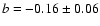 for all starless cores
(correlation coefficient is 0.50) with
for all starless cores
(correlation coefficient is 0.50) with
 and
and
 for the outer starless cores (correlation coefficient
is 0.70) and
for the outer starless cores (correlation coefficient
is 0.70) and
 and
and
 for the inner
starless cores (correlation coefficient is 0.51).
Figure 8 displays the mass-radius relation for just the outer
starless cores. Obviously, the correlation is not very stringent, as also
indicated by the fairly low correlation coefficients. The offset between the
power laws for the inner and outer cores corresponds to a difference in size by
a factor of 1.2-1.3, which using Eq. (3) translates to a
pressure difference of a factor of 2-3. This is significantly less than
the surface pressure variations which can be inferred from the range of core
masses at some given radius or as have been derived by J00. Random pressure
variations within the inner and outer cloud gas seem to dominate the systematic
increase in pressure when going from the outer to the inner part, as one could
expect for a medium being subject to random, turbulent motions.
for the inner
starless cores (correlation coefficient is 0.51).
Figure 8 displays the mass-radius relation for just the outer
starless cores. Obviously, the correlation is not very stringent, as also
indicated by the fairly low correlation coefficients. The offset between the
power laws for the inner and outer cores corresponds to a difference in size by
a factor of 1.2-1.3, which using Eq. (3) translates to a
pressure difference of a factor of 2-3. This is significantly less than
the surface pressure variations which can be inferred from the range of core
masses at some given radius or as have been derived by J00. Random pressure
variations within the inner and outer cloud gas seem to dominate the systematic
increase in pressure when going from the outer to the inner part, as one could
expect for a medium being subject to random, turbulent motions.
![\begin{figure}
\par\includegraphics[width=7cm,clip]{1331f08.eps}\end{figure}](/articles/aa/full/2006/08/aa1331-04/img62.gif) |
Figure 8:
The mass-radius relation for the starless cores in the outer
regions. The solid line is the least squares fit and the dashed line is
suspected to be the detection limit with
 . .
|
| Open with DEXTER | |
Although the observational limit tends to flatten the mass-radius relation,
we cannot exclude an underlying intrinsic law of the form
,
as given by critical Bonnor-Ebert
spheres with a constant velocity dispersion. In this case, however, the wide
range in masses implies a range of 100 in the surface pressures to maintain
the cores in equilibrium, as given by Eq. (2).
This variation in pressure could be present, resulting from highly
supersonic turbulent motions (see Sect. 8).
In fact more likely would be a steeper relation than indicated by the fit,
approaching
,
as expected for
critical Bonnor-Ebert spheres immersed in a constant external pressure
medium having varying velocity dispersions; due to the  dependence
of
dependence
of
 only moderate variations would be needed to create the
more than 1 order of magnitude dispersion of mass at a given radius.
Again, this would more likely be a sign for turbulent in addition
to thermal motions, as it appears unlikely that starless cores exhibit large
enough temperature variations. Moreover, in a turbulent medium, cores will be
continually forming and dispersing, and may
temporarily resemble bound cores. In recent gravo-turbulent simulations, starless
cores were generally gravitationally unbound, suggesting that gravitational collapse
occurs promptly after gravity becomes dominant (Klessen et al. 2005).
only moderate variations would be needed to create the
more than 1 order of magnitude dispersion of mass at a given radius.
Again, this would more likely be a sign for turbulent in addition
to thermal motions, as it appears unlikely that starless cores exhibit large
enough temperature variations. Moreover, in a turbulent medium, cores will be
continually forming and dispersing, and may
temporarily resemble bound cores. In recent gravo-turbulent simulations, starless
cores were generally gravitationally unbound, suggesting that gravitational collapse
occurs promptly after gravity becomes dominant (Klessen et al. 2005).
The identified cores are strongly clustered at first sight. To quantify this,
we employ a two-point correlation function treating each core as a point
object in space. Following J00, we determine the number of core pairs,
Hd(r), with separation between  and
and
 .
This is compared to the predicted distribution for a random sample of
cores spread over the apparent volume, Hr(r). The two-point
correlation function is then defined as
.
This is compared to the predicted distribution for a random sample of
cores spread over the apparent volume, Hr(r). The two-point
correlation function is then defined as
 |
(5) |
105 AU.
For comparison, the data obtained by J00 are also plotted on
the figure.
![\begin{figure}
\par\includegraphics[width=7.8cm,clip]{1331f09.eps}\end{figure}](/articles/aa/full/2006/08/aa1331-04/img69.gif) |
Figure 9:
The two point correlation function as defined in the text
for the Ophiuchus cores. The error bars correspond to  statistics. The dotted straight line corresponds to a power-law of the form
 . .
|
| Open with DEXTER | |
The survey size is seen to influence the correlation with the present
survey displaying more large scale structure while the J00 survey detected more
smaller cores, as expected from the observational constraints.
J00 found that a power law of the form
 fitted the data well out to
 AU. The new survey suggests that this relationship can be
extended to above 105 AU. Therefore, in contrast to J00, we exclude the existence
of a preferential scale near to
AU, which could correspond to
a Jeans length. Instead, the most obvious possible cause of hierarchical clustering
is turbulence. Supersonic turbulence would also generate a
wide range in pressure and column density, as required to interpret the
mass-size distribution (see Sect. 8).
AU. The new survey suggests that this relationship can be
extended to above 105 AU. Therefore, in contrast to J00, we exclude the existence
of a preferential scale near to
AU, which could correspond to
a Jeans length. Instead, the most obvious possible cause of hierarchical clustering
is turbulence. Supersonic turbulence would also generate a
wide range in pressure and column density, as required to interpret the
mass-size distribution (see Sect. 8).
The inferred power law index of -0.63 is somewhat flatter than found by J00,
although within the error bars except on the largest comparable scales. Note
that, as remarked by J00, this value is close to the value measured for
galactic clustering of -0.668 for scales under 1(Maddox et al. 1990). Furthermore, the function  is closely
related to the mean surface density of companions (MSDC), being approximately
proportional for values of
exceeding unity (Simon 1997).
Thus, it is interesting that the power law radial dependence of the MSDC for
pre-main-sequence stars in Taurus-Aurigae is -0.6 for scales
r > 0.04 pc (and corresponds to a fractal point distribution with
index 1.4). The lower limit separates the bound systems from the unbound
stars, and was suggested by Luhman & Rieke (1999) to correspond to both
a Jeans length and the size of bound molecular cores.
is closely
related to the mean surface density of companions (MSDC), being approximately
proportional for values of
exceeding unity (Simon 1997).
Thus, it is interesting that the power law radial dependence of the MSDC for
pre-main-sequence stars in Taurus-Aurigae is -0.6 for scales
r > 0.04 pc (and corresponds to a fractal point distribution with
index 1.4). The lower limit separates the bound systems from the unbound
stars, and was suggested by Luhman & Rieke (1999) to correspond to both
a Jeans length and the size of bound molecular cores.
For samples of Ophiuchi stars, Simon (1997) found an MSDC index
of
 above a break at 5000 AU. On the other hand,
Nakajima et al. (1998) found
above a break at 5000 AU. On the other hand,
Nakajima et al. (1998) found
 .
As noted by
Bate et al. (1998), flattening of the
correlation is expected on a timescale of 105 yr, as unbound stars separate
and the system expands.
.
As noted by
Bate et al. (1998), flattening of the
correlation is expected on a timescale of 105 yr, as unbound stars separate
and the system expands.
The frequency of separation between neighbouring cores complements the two-point correlation function since it contains information on all orders of the correlation functions. The mean neighbour separation might also be interpreted as a typical Jeans fragmentation length (Larson 1995; Gomez et al. 1993). A length scale could be apparent which might be hidden in the distribution involving all pairs. In fact, the mean separation between neighbours in our starless core sample is 17 400 AU and Fig. 10 indicates that there is indeed a frequency peak near this separation distance. For comparison, a random sample would have a mean separation of 22 100 AU (we simulated 500 sets of randomly distributed starless cores spread through the entire region). The random sample also indicates that we cannot interpret the peak in the separation frequency as being derived from som physical process which generates a break (knee) in a power-law functions with a steep decline at large distances since a turnover is expected even in random data.
Of much more significance is the second frequency peak at low separations (5000 AU) prominent in both panels of Fig. 10, appearing as if the hierarchical core clustering is modified by the fragmentation of some close cores. In fact, this separation distance corresponds well to the size of the cores themselves (see Fig. 6). Hence, it is not surprising that spatial structure is present on this scale.
![\begin{figure}
\par\includegraphics[width=6.8cm,clip]{1331f10a.eps}\par\vspace*{2mm}
\includegraphics[width=6.8cm,clip]{1331f10b.eps}\end{figure}](/articles/aa/full/2006/08/aa1331-04/img75.gif) |
Figure 10:
The number distribution of separations between neighbouring cores for
all cores ( upper panel) and the starless cores ( lower panel). The error bars
correspond to
statistics. The superimposed lines correspond to the
predicted mean numbers for a random sample. The mean separation values are
15 400 AU (all cores) and 17 200 AU (starless cores). |
| Open with DEXTER | |
The distribution of core masses is displayed in Fig. 11 for all
the starless cores in the sample.
We also display in Fig. 12, the mass functions for the inner (62)
and outer (49) starless samples, defined by a circle of radius 0.2,
located so as to encompass the crowded inner region studied by MAN98 and J00.
We find that a similar mass function to that found by MAN98 and J00 for
the inner zone applies to the entire region.
![\begin{figure}
\par\includegraphics[width=7.4cm,clip]{1331f11.eps}\end{figure}](/articles/aa/full/2006/08/aa1331-04/img76.gif) |
Figure 11:
The number distribution by mass of the 111 starless cores in
Ophiuchus. The inset displays their locations. The dotted lines are
the power law fits of the form dN/d
 .
Breaks in the power laws occur around
0.1-0.3
and around 0.5-1 .
The Salpeter mass function
would have a slope of .
Breaks in the power laws occur around
0.1-0.3
and around 0.5-1 .
The Salpeter mass function
would have a slope of
 in this format. The error bars
correspond to
in this format. The error bars
correspond to  counting statistics. The inset displays the core
positions in a wide region stretching 1
counting statistics. The inset displays the core
positions in a wide region stretching 1
 ,
with
the locations of the clumps A, B and E marked. ,
with
the locations of the clumps A, B and E marked. |
| Open with DEXTER | |
![\begin{figure}
\par\includegraphics[width=7.4cm,clip]{1331f12.eps}\end{figure}](/articles/aa/full/2006/08/aa1331-04/img77.gif) |
Figure 12:
The number distribution by mass and location of the cores in
Ophiuchus for 111 starless cores. The dotted circle drawn in
the inset divides the cores into an inner zone of 62 objects (diamond
symbols) and an outer area of 49 objects (triangles). The dotted lines,
error bars and inset are as described in the Fig. 11 caption. |
| Open with DEXTER | |
The core mass function appears to be hard to fit with a single
power law, being steeper at higher masses and flattening continously
towards lower masses. Power law fits with one or two breaks are
reqired for a satisfying fit.
The two-break power law fit as displayed in Figs. 11
and 12 is comparable to the
approximation for the stellar initial mass function (IMF) derived by
Kroupa (2001), where the power law indices are -0.3, -1.3,
and -2.3, although with considerable potential variation. Note that the
flatter power law holds for core masses below 0.14 ,
in
comparison to the value of 0.08
quoted for the stellar IMF
(Kroupa 2001).
If we suppose that the break at low core masses is real and indeed occurs at
around 0.14 ,
then the shift to a 0.08
break for the
stellar mass function has to be explained. On the one hand, it could be due
to errors in the assumptions which go into the core mass determination.
Although a closer distance would lower the derived core masses,
we have already assumed a quite close distance to Ophiuchus. A larger
opacity would also reduce the core masses: an opacity of 0.009 cm2 g-1would move the first break point to 0.08
for the distance of 130 pc.
However, a somewhat lower dust temperature than the assumed 20 K in the
flux-to-mass conversion would tend to shift the break point to higher masses.
Alternatively, if we assume the first break and the opacity are accurate, we
can speculate that just about one half of a core mass ends up constructing the
star. The other half is dispersed in (i) jets (up to 30%), (ii) dispersal
by jet impact, (iii) early stellar and disc winds and (iv) other stars, brown
dwarves and planets.
Bontemps et al. (2001) infer a 2 component power law IMF for Class II
young stellar objects in Oph from ISOCAM data. The break
the IMF is seen at around 0.55
and separates power law slopes
with indices
 and -2.7 below and above the break,
respectively. This
IMF is "statistically indistinguishable'' from the core mass function derived
by MAN98 and is also consistent with the present data sets.
and -2.7 below and above the break,
respectively. This
IMF is "statistically indistinguishable'' from the core mass function derived
by MAN98 and is also consistent with the present data sets.
Broken power law fits to the core mass function are not very well constrained, concerning the number of breaks as well as their location. A more continously changing distribution such as a log-normal function might do a better job. In fact, Ballesteros-Paredes et al. (2005) derive core mass distributions from numerical models of turbulent molecular clouds, finding mass functions similar to log-normals. As their technique of clump extraction is similar to our approach (taking all density enhancements, whether bound or not) both studies should be well comparable. Finding a core mass function similar to the ones derived from simulations further supports the idea of turbulence as the main agent in shaping the cloud.
Whatever the exact, detailed shape of the core mass function is, its general, overall behaviour resembles the stellar mass function. The MAN98 and J00 surveys both concentrate on cores which are argued to be likely gravitationally bound. Our survey includes more extended, lower surface brightness features, which are less likely to be bound. However, numerical simulations showed that the structure of transient density peaks forming and dispersing in a turbulent cloud may closely resemble hydrostatic, gravitationally bound objects (Ballesteros-Paredes et al. 2003), so even the cores identified by J00 and MAN98 might turn out not to be bound. Any scenario which closely correlates the core and stellar masses makes presumptions concerning the stratification of the envelopes and their subsequent evolution (i.e. whether certain cores might collapse while others disperse). To select cores according to such criteria requires a consistent means of interpreting the data from cores of very contrasting sizes and masses. Moreover, as pointed out by J00, such surveys are inevitably incomplete despite our unbiased strategy. Given all these caveats, the resemblance of core and stellar mass functions is even more remarkable.
Possibly the most important result of our study is that no significant difference is measured in the core mass function between the inner and the outer regions where the functions overlap. As shown in Fig. 12, the few highest mass cores lie in the inner region. Thus, while the compactness of a core varies in space, the mass distribution does not. This must be reconciled with the fact that the inferred surface pressures are, on average, lower in the external region which would imply a higher Jeans mass (neglecting possible temperature differences).
Table 1:
Physical properties of the MMS126 molecular outflow. The values
given in parentheses have been corrected for optical depth (assuming
 )
and inclination (assuming
)
and inclination (assuming
 ).
).
MMS126 is a compact but resolved source forming part of a roughly east-west
oriented, filamentary structure. It appears to coincide
with a faint, cold IRAS source (IRAS 16253-2429: F12: <0.25 Jy; F25:
<0.42 Jy; F60: 2.91 Jy; F100: 16.34 Jy). Close inspection of the HIRES
processed IRAS maps reveals a faint source at 25 m, which however
coincides with the nearby MMS060 = WSB 60. This latter source
is also detected by ISO at 7 and 14 m (Bontemps et al. 2001)
but no clear source is seen at the position of MMS126. Finally, MMS126
appears to be driving a collimated near-IR H2 outflow
(Khanzadyan et al. 2004) and a molecular (CO) outflow
(see Sect. 7.1 below).
Taking these arguments together (apparently cold FIR to millimetre source,
no clear counterpart at wavelengths shorter than 25 m, and association
with an outflow) we conclude that MMS126 is a very young stellar object,
possibly still in the Class 0 phase. MMS126 would then be the second
Class 0 object found in the -Oph main cloud besides the
prototypical source VLA1623 (Andre et al. 1993) but is
of significantly smaller mass: using Eq. (1), we
derive a circumstellar dust mass of about 0.2
(VLA1623: 0.6 ,
this work; Andre et al. 1993).
![\begin{figure}
\par\includegraphics[angle=270,width=7.8cm,clip]{1331f13.eps}
\end{figure}](/articles/aa/full/2006/08/aa1331-04/img85.gif) |
Figure 13: CO J=3-2 velocity channel maps of the MMS126 outflow. The greyscale is tailored to emphasize the low surface brightness outflow lobes. The contours are spaced by 1 K. |
| Open with DEXTER | |
We observed the area around MMS126 in the CO(3-2) line using the
JCMT on
June 17 and 30 and on July 30, 2005. We took two position switched on-the-fly
maps centered on MMS126, each covering a
 field
at a position angle of 32,
sampling every 5
with a 5
spacing between rows. Smaller maps were added towards the end of the outflow
lobes. The
integration time on each point was 4 s. The weather was good, with
a stable atmosphere and
field
at a position angle of 32,
sampling every 5
with a 5
spacing between rows. Smaller maps were added towards the end of the outflow
lobes. The
integration time on each point was 4 s. The weather was good, with
a stable atmosphere and
 (June 17),
0.08 (June 30), and 0.045 (July 30).
In addition, spectra in frequency-switched mode were taken towards the
position-switch OFF position.
The spectra were baseline-subtracted, resampled to 0.6 km s-1 resolution,
the OFF-position spectrum added, and finally gridded into one datacube
within CLASS.
(June 17),
0.08 (June 30), and 0.045 (July 30).
In addition, spectra in frequency-switched mode were taken towards the
position-switch OFF position.
The spectra were baseline-subtracted, resampled to 0.6 km s-1 resolution,
the OFF-position spectrum added, and finally gridded into one datacube
within CLASS.
Figure 13 shows the resulting channel maps. Along
the outflow axis indicated by our near-infrared H2 observations there
is clear evidence for a CO flow. Red-shifted emission is seen towards the
south-west and some blue-shifted emission towards the north-east.
Overall, the range over which higher-velocity gas is seen is fairly narrow.
In the south-western, red-shifted lobe, it extends over a few velocity bins
from about 5.7 to 8.5 km s-1. Reasonably bright emission in the north-eastern,
blue-shifted lobe is only seen in its tip, otherwise it is hardly
separated and only faintly seen in two channels around 0 km s-1; the contours in
the velocity bins around 1 km s-1 indicate that this lobe contributes
significantly at these velocities too, but is diluted by ambient emission.
Outflow emission extends over about 2
 5 (20 000 AU/0.1 pc) out to the
edges of the map, with both lobes showing a somewhat brighter, compact CO blob
there, which might well be a terminating working surface; H2 emission is
also seen out to a similar distance in the south-western lobe.
5 (20 000 AU/0.1 pc) out to the
edges of the map, with both lobes showing a somewhat brighter, compact CO blob
there, which might well be a terminating working surface; H2 emission is
also seen out to a similar distance in the south-western lobe.
We have derived estimates of basic flow properties as follows:
the measured brightness temperature was converted to molecular gas
column densities assuming the CO to be optically thin and in LTE at a
temperature of 30 K; the CO abundance was assumed to be 10-4 of the
H2 abundance. Masses were derived as a function of velocity for each
0.6 km s-1 wide channel. Kinetic energies and momenta were derived as
 and
and
 ,
with
,
with
 km s-1.
A characteristic timescale was derived by dividing the maximum distance
at which high-velocity emission was seen by the maximum CO velocity
observed.
Finally, mechanical luminosities and momentum input rates were determined
by dividing the total kinetic energy and momentum by the characteristic
timescale.
km s-1.
A characteristic timescale was derived by dividing the maximum distance
at which high-velocity emission was seen by the maximum CO velocity
observed.
Finally, mechanical luminosities and momentum input rates were determined
by dividing the total kinetic energy and momentum by the characteristic
timescale.
Table 1 gives a list of outflow properties, for the
blue- and red-shifted lobes alone and for the entire outflow. In
parentheses we also list the outflow parameters after applying
corrections for optical depth effects and inclination, following
Bontemps et al. (1996) (assuming
and an inclination
).
The red- and blue-shifted emission does not seem to overlap, indicating
that the flow axis is neither very close to the plane of the sky nor
very nearly perpendicular to it, so
might in fact be a
reasonable assumption.
A comparison with the outflow parameters listed in Bontemps et al. (1996) shows that the MMS126 molecular outflow is one of the less energetic flows, as could be anticipated by the poor contrast of the flow against the ambient cloud material even in the CO(3-2) line and its fairly narrow extent in velocity space. Its momentum flux rate is much more typical for a more evolved object than for a Class 0 protostar. However, our map shows the flow to be fairly well collimated, which is more typical for the very youngest molecular outflows. Along with the deeply embedded, low circumstellar mass, low-luminosity nature of the driving source, the more likely explanation for the low energy/momentum input rate to the flow seems to be a very low protostellar mass (and age) rather than MMS126 being a relatively mature object at the end of the accretion and outflow phase.
We have performed a 1.2 millimetre survey of the main body of the
Ophiuchi star-forming cloud. Our one square degree field enables us
to verify and extend the results from previous surveys (MAN98 and J00).
We detect and measure 143 cores, including 111 with no detected stellar
objects. We identify a core, MMS126, which appears to harbour a new low-mass
Class 0 protostar, driving a CO molecular outflow.
By comparing core masses with their sizes (as measured by the flux and FWHMs),
we find that the cores contained within an inner circle of 0.2are compacter. This implies they are generally denser and of higher pressure.
However, on comparison to the surface pressure required for hydrostatic
equilibrium, there appear to be vast pressure variations (by a factor 10 to 100) within each location.
The data indicate that the mean core mass increases with the core radius. This
can be measured despite the expected lower bound to the core masses given by
the observational sensitivity (which would tend to distort the relation
towards the form
)
and despite the very wide range in possible core masses at each radius.
The clustering has also been investigated by deriving the two-point correlation function. We confirm previous results that the cores are highly clustered, similar to that of galaxy clusters (J00). However, from the two-point correlation function, we find no evidence for a critical length to identify with a Jeans length. However, the frequency of nearest neighbours provides a more local measure and reveals an abundance of small cores with low separation (5000 AU) - of order of the mean core size. This suggests that larger cores may fragment on this scale.
Moreover, the relevant velocity dispersion (in place of the sound speed) will also vary across the cloud, possibly producing velocity variations positively correlated with separation. Therefore, although the Jeans length remains a relevant length scale in turbulent fragmentation and collapse theory, an extended power-law correlation function could still be expected in a turbulent environment.
The cores are not distributed isotropically. There is a strongly preferred direction, transverse to the direction of the Sco OB association. However, the orientations of the major axes of the individual cores are consistent with a random distribution (Appendix B, online version only).
The mass function may be approximated by a broken power law. As previously
noted by MAN98 for the inner regions, this is similar to
that of the galactic field IMF for stars. The flattening at lower masses
occurs at a mass of 0.1 to 0.3 ,
about twice as high as the
equivalent break mass found for stars. We suggest that this difference
is consistent with the core mass loss expected during the star formation
process although the absolute value of the break is sensitive to
assumed mass conversion parameters. An upper break at 0.5-1.0
is also found.
A smoothly changing function such as a log-normal
might be better suited to describe the core mass function derived from
our observations, similar to the mass functions derived from numerical models
of turbulence driven clouds by Ballesteros-Paredes et al. (2005).
The core mass function does not vary with position. That is, there is no evidence for a general mass segregation although the few highest core masses are found in the inner crowded zone.
How have the cores in L1688 developed? Turbulent motions are inherent to the entire clumps (Loren et al. 1990) and (although subsonic) also to the cores (Belloche et al. 2001). We may thus expect supersonic turbulence to drive high pressure and density variations on the scale of the cloud and clumps. Some density peaks within the chaotic flow may involve sufficient mass to become gravitationally bound; Elmegreen & Shadmehri (2003) argue that this scenario is the most likely one of the three they consider to have produced the millimetre continuum sources in Ophiuchus. The turbulence then decays within these proto-cores although it is still sufficient to generate molecular line profiles and contribute to core support in the observed cores (Belloche et al. 2001). As found in numerical simulations, the structure of these dynamical cores may closely resemble hydrostatic, gravitationally bound objects (Ballesteros-Paredes et al. 2003); they should also possess prominent infall signatures as indeed are found in several starless cores (Belloche et al. 2001). Furthermore, it is very likely that the detected cores are biased towards the slowest evolving long-lived objects. That is, the cores we actually observe are not typical of those which form but are simply a particular subset of cores which evolve very slowly, perhaps not even prone to collapse into stars.
The present study is consistent with a supersonic turbulence interpretation through the wide range in pressures, the hierarchical clustering and the randomness in core orientations, and the shape of the mass function. Turbulence, however, is generally supposed to be a means of dynamical support and rapid dispersal rather than quiescent confinement of equilibrium core configurations. If the clouds are close to equilibrium, the linear mass-radius relation would correspond to a fixed velocity dispersion. This indicates that a transition to coherence has already taken place and is a sign that the H2 velocity dispersion is transonic or subsonic in the cores (Goodman et al. 1998). In recent hydrodynamic gravoturbulent simulations (Klessen et al. 2005), the majority of cores are actually found to be coherent and 80% are subsonic or transonic. The cores are produced behind shock waves, at stagnation points in converging turbulent flows. However, starless cores are also found to be gravitationally unbound in these simulations. This should in the future be tested by measurement of the virial masses of a large sample of the starless cores.
Further implications of the above results will be explored in a following work
in which we relate the millimetre properties to those of the infrared and
optical outflows from protostars and young stars. In combination with
molecular spectroscopic studies of the cores, we will be able to constrain
models for star formation in Ophiuchus.
Acknowledgements
T.S. thanks the Alexander von Humboldt Gesellschaft for support through a Feodor Lynen fellowship. MDS thanks DCAL, Northern Ireland. Thanks are due to Doug Johnstone for providing the J00 and J04
In this section we present a list of sources identified from our survey (Table A.1), along with finding charts (Figs. A.1-A.4) and short notes on the properties of individual sources, such as the presence of optical or near-infrared (stellar) counterparts, or whether absorption features as seen on the DSS or 2MASS images can be associated.
Table A.1:
List of 1.2 mm sources found in our survey. The sources are
listed in the order they were identified by the wavelet decomposition plus
clumpfind technique.
 gives the integrated source flux in mJy;
(a), (b), (c), and (d) give the peak fluxes
determined in the following ways:
(a): the maximum pixel value inside an ellipse defined
by the minor and major axes of a Gauss-fit to the source;
(b): as above, but using only the wavelet scales from where on
the source is detected first (given in parenthesis);
(c): the peak flux after re-binning according to the source minor
axis (see Sect. 3 for details);
(d): the peak flux of the composite Gaussian model for the source.
The columns labelled maj and min give the
major and minor axis of a single Gaussian fit to the source (in arcseconds).
PA gives the position angle of the source major axis in degrees
east of north. The columns labelled as
MAN98 and J00 give cross-identifications to the sources identified by
Motte et al. (1998) and Johnstone et al. (2000), respectively.
A long dash means that the source is outside the
respective survey area, and "n.i.'' labels features which are visible in the
respective survey, but not identified as a separate feature.
Cross-identifications given in parentheses mean that a feature found here is
a part of a feature noted by MAN98 or J00. Finally, a comment on
association with known YSOs is given. Apparently starless features are marked
as "sl''.
gives the integrated source flux in mJy;
(a), (b), (c), and (d) give the peak fluxes
determined in the following ways:
(a): the maximum pixel value inside an ellipse defined
by the minor and major axes of a Gauss-fit to the source;
(b): as above, but using only the wavelet scales from where on
the source is detected first (given in parenthesis);
(c): the peak flux after re-binning according to the source minor
axis (see Sect. 3 for details);
(d): the peak flux of the composite Gaussian model for the source.
The columns labelled maj and min give the
major and minor axis of a single Gaussian fit to the source (in arcseconds).
PA gives the position angle of the source major axis in degrees
east of north. The columns labelled as
MAN98 and J00 give cross-identifications to the sources identified by
Motte et al. (1998) and Johnstone et al. (2000), respectively.
A long dash means that the source is outside the
respective survey area, and "n.i.'' labels features which are visible in the
respective survey, but not identified as a separate feature.
Cross-identifications given in parentheses mean that a feature found here is
a part of a feature noted by MAN98 or J00. Finally, a comment on
association with known YSOs is given. Apparently starless features are marked
as "sl''.
MMS001: ridge NE of VLA1623: includes starless cores SM1 and SM1N; no optical/IR stellar counterpart.
MMS002: VLA1623 Class 0 (Andre et al. 1993); no opt/ir counterpart.
MMS003: pointlike source; optical/IR stellar counterpart YLW32.
MMS004: SM2 starless core; no opt/ir counterpart.
MMS005: compact condensation in filament W of SM1/VLA1623 ridge; YSO LFAM1; no optical counterpart; bright NIR source, extended K-band nebula.
MMS006: pointlike source; GSS39/Elia2-27; no opt. counterpart; IR counterpart.
MMS007: part of filament extending NE of SM1/VLA1623; no clear opt/IR stellar counterpart.
MMS008: compact source: multiple T Tauri star SR24; the flux seems to be associated with the (so far) unresolved southern single component, as claimed by Nürnberger et al. (1998) and confirmed recently by Andrews & Williams (2005), rather than the northern (close binary) component. Our flux measurement is in good agreement with the result of Nürnberger et al. (1998).
MMS009: compact source; no opt. stellar counterpart; NIR star Elias 2-29 (also includes GY210).
MMS010: compact source; optical/IR counterpart YLW34.
MMS011: compact source; YSO WLY 2-43; Class I; no opt. stellar counterpart; NIR star; high extinction.
MMS012: compact, but clearly extended source; SMM16267 of Wilson et al. (1999) (suggesting it to be a prestellar core) no optical counterpart; high extinction; fuzzy K band emission south of clump.
MMS013: compact source; no opt. star; NIR star GSS26.
MMS014: elongated feature SE of MMS005; no optical counterpart; some IR stars might be associated. Breaks up into chain of three subcores in MAN98.
MMS015: bright compact core; no opt. stellar counterpart; NIR counterpart VSSG17; YSO; high opt. extinction.
MMS016: bright elongated core; YSO VSSG18 appears to be associated with this feature.
MMS017: part of filament extending NE of SM1/VLA1623; very faint K-band source at NE tip?
MMS018: compact core; no opt./NIR stellar counterpart.
MMS019: faint compact source; faint opt./bright NIR stellar counterpart YLW31.
MMS020: bright core; no clear opt./NIR stellar counterpart; high opt. extinction.
MMS021: highly elongated; no opt./NIR stellar counterpart.
MMS022: bright large core; no opt./NIR stellar counterpart; high extinction.
MMS023: compact source; no clear optical counterpart; possibly IR star associated; high opt. extinction.
MMS024: LFAM3 faint opt., bright nebulous NIR source; visible on J00 map, but not noted as separate feature.
MMS025: compact source (possibly surrounded by extended Halo); no opt. stellar counterpart; IR stellar counterpart WL12; high opt. extinction.
MMS026: elongated core NE of MMS005; no optical counterpart; faint K-band source?
MMS027: bright core; no clear opt./NIR stellar counterpart; possibly IR star to the SE associated; high opt. extinction.
MMS028: compact core; no clear opt./NIR stellar counterpart; high opt. extinction.
MMS029: elongated core. No opt./NIR stellar counterpart.
MMS030: extended core at SE tip of ridge (MMS088); no related optical feature.
MMS031: elongated core; no opt./NIR stellar counterpart.
MMS032: faint compact source; no optical counterpart; faint IR star CRBR42; ISO-Oph 54; [GY92] 91.
MMS033: elongated core; no opt./NIR stellar counterpart.
MMS034: faint compact source; no optical counterpart; IR stellar counterpart CRBR12.
MMS035: compact source; no opt. stellar counterpart; NIR stellar counterpart, YSO CRBR85 Class I?; splits into two cores in MAN98 (YSO CRBR85 and F-MM2 starless core).
MMS036: no stellar counterpart for main core; MAN98 E-MM2b might have faint K-band counterpart.
MMS037: elongated core; no opt./NIR stellar counterpart.
MMS038: bright compact core; no opt./NIR stellar counterpart; high extinction.
MMS039: bright core adjacent to MMS022; no opt./NIR stellar counterpart; high extinction.
MMS040: elongated core; no opt./NIR stellar counterpart; high extinction. Contains MAN98 starless core F-MM1 and, at its north-western tip, the YSO CRBR72 (Class I).
MMS041: bright core; no opt./NIR stellar counterpart; near tip of cometary shaped high-optical-extinction cloud. The edge of the cloud are outlined by faint extensions to the east and west of this core.
MMS042: compact source; YSO LFAM26; no opt. stellar counterpart; faint K-Band source; optical extinction ridge.
MMS043: compact faint source, YSO SR21
MMS044: large core; compact source at center? no opt./NIR stellar counterpart; high extinction.
MMS045: faint compact core; no opt. stars; 3 NIR YSO stellar sources: IRS44/IRS46; CRBR88; 3 subsources det. by MAN98.
MMS046: faint compact source; no clear opt/NIR counterpart.
MMS047:
bright core; no opt./NIR stellar counterpart; at tip of cometary dark cloud.
![\begin{figure}
\includegraphics[angle=-90,width=16.5cm,clip]{1331fa01.eps} \end{figure}](/articles/aa/full/2006/08/aa1331-04/img92.gif) |
Figure A.1: The location, size, and orientation of the 143 millimetre sources identified from our survey. |
MMS048: small core; no optical/NIR counterpart; high extinction. Part of small clump (together with MMS079 and MMS085).
MMS049: small faint core; no opt./NIR stellar counterpart; high opt. extinction.
MMS050: core in SM1 ridge; no clear opt/NIR stellar counterpart.
MMS051: compact core; no opt./NIR stellar counterpart; high extinction.
MMS052: rather bright elongated core; no opt./NIR stellar counterpart; tail of cometary dark cloud.
MMS053: small faint core; high optical extinction; no stellar opt./NIR counterpart.
MMS054: faint core; high optical extinction; no clear opt/IR stellar counterpart.
MMS055: faint core; no clear opt./NIR stars associated; high extinction.
MMS056: diffuse core; no opt./NIR stellar counterpart; high opt. extinction.
MMS057: small core; no clear optical/NIR counterpart. Part of small core (together with MMS063 and MMS069).
MMS058: faint compact source; YSO WSB52/LFAM p8/[GY92] 314; opt./NIR star.
MMS059: no opt./NIR stellar counterpart; high opt. extinction.
MMS060: faint compact source; opt/NIR stellar counterpart WSB 60 = BKLT J162816-243657.
MMS061: elongated core; superposition of several NIR YSOs: WL3/WL4/WL5/IRS37; no optical stellar counterpart; high extinction. Class II sources. MAN98 classify this feature as composite pre-collapse core, but it might actually just be a superposition of circumstellar dust emission from the 4 NIR YSOs visible in this area.
MMS062: compact source; associated with edge-on disk YSO (Brandner et al. 2000).
MMS063: small core; no clear optical/NIR counterpart. Part of small clump (together with MMS057 and MMS069).
MMS064: faint compact source; no opt. star; NIR stellar counterpart; YSO: IRS51 = WLY 2-51 = YLW 45.
MMS065: faint compact source; seems to be associated with IR RN; YSO? hardly visible on MAN98 map; visible on J00 map, but not noted as separate feature.
![\begin{figure}
\includegraphics[angle=-90,width=8.8cm]{1331fa02.eps} \end{figure}](/articles/aa/full/2006/08/aa1331-04/img93.gif) |
Figure A.2: The location, size, and orientation of the millimetre sources in and around the molecular clump A. |
![\begin{figure}
\includegraphics[angle=-90,width=8.8cm]{1331fa03.eps} \end{figure}](/articles/aa/full/2006/08/aa1331-04/img94.gif) |
Figure A.3: The location, size, and orientation of the millimetre sources in and around the molecular clump B. |
![\begin{figure}
\includegraphics[angle=-90,width=8.8cm]{1331fa04.eps} \end{figure}](/articles/aa/full/2006/08/aa1331-04/img95.gif) |
Figure A.4: The location, size, and orientation of the millimetre sources in and around the molecular clumps C, E, and F. |
MMS067: no opt./NIR stellar counterpart.
MMS068: extended core; no clear opt./IR stellar counterpart. There is emission visible in the MAN98 map, but there is some morphological difference from our and the J00 maps.
MMS069: small core; no clear optical/NIR counterpart. Part of small clump (together with MMS057 and MMS063).
MMS070: faint core; core + envelope structure? No opt. stellar counterpart; NIR star WLY 2-54.
MMS071: elongated core; no opt./NIR stellar counterpart; high extinction. Might split into a chain of faint sources. Includes NIR YSO WL20 at its south-eastern tip.
MMS072: faint core at eastern end of clump B2; no opt./NIR stellar counterpart.
MMS073: elongated core; no direct stellar counterpart, but [GY92] 301 is within core area.
MMS074: filament extending north of SM1 core; GSS31 on base of filament; possibly very faint nebulosity at tip.
MMS075: faint compact source nearby MMS041; no opt./NIR stellar counterpart.
MMS076: faint compact source; bright opt/NIR counterpart; V* V2058 Oph; HBC 259; SR4.
MMS077: small faint core; located on high-extinction filament; no IR counterpart; not clearly visible in MAN98 map, part of their clump Oph-AC2.
MMS078: faint small core, no opt./NIR counterpart.
MMS079: small core; no optical/NIR counterpart; high extinction. Part of small clump (together with MMS048 and MMS085).
MMS080: faint large core; no opt./NIR stellar counterpart.
MMS081: large, elongated core; 3 NIR (YSO?) stars on our around the core: GY344, GY370, GY352; high opt. extinction.
MMS082: faint filament; no opt/NIR stellar counterpart; high extinction. Corresponds roughly to MAN98 E-MM1, but differs in morphology from our and the J00 maps.
MMS083: faint core at eastern end of clump B2; no opt./NIR stellar counterpart.
MMS084: large core; no clear opt./NIR stellar counterpart; close to edge of high-extinction cloud; close to edge of J00 map; there is some emission, but it is not marked as separate feature.
MMS085: small core; no optical/NIR counterpart; high extinction. Part of small clump (together with MMS048 and MMS079).
MMS086: compact source; no clear opt./NIR counterpart; high opt. extinction.
MMS087: large core; no opt./NIR stellar counterpart; high extinction patch.
MMS088: SE-NW elongated ridge bounded by MMS030 and MMS105; apparently illuminated from the SW by HD147889 (SR1).
MMS089: faint extended core; no clear opt./NIR stellar counterpart; some bright NIR stars around; extinction patch.
MMS090: faint core; on optical extinction filament; no clear opt/IR stellar counterpart.
MMS091: faint large core; no stellar counterpart; optical extinction patch.
MMS092: faint core, no opt./NIR stellar counterpart; MMS092, MMS109, and MMS122 form a filament associated with high extinction.
MMS093: low surface brightness core; on high optical extinction lane (along with MMS095, MMS125, and MMS137); no clear opt/NIR stellar counterpart.
MMS094: part of larger ridge; no opt./IR stellar counterpart; on opt. extinction lane.
MMS095: low surface brightness core; on high optical extinction lane (along with MMS093, MMS125, and MMS137); no clear opt/NIR stellar counterpart.
MMS096: small low surface brightness core; no clearly associated optical/NIR counterpart.
MMS097: extended low surface brightness feature; no clear feature seen on DSS/2MASS.
MMS098: faint core; no stellar counterpart; optical extinction patch.
MMS099: ridgelike, elongated core; no opt./NIR stellar counterpart; high-extinction lane.
MMS100: large elongated core; no opt./NIR stellar counterpart; high extinction.
MMS101: part of larger ridge; on high optical extinction lane; no clear opt/NIR stellar counterpart; on edge of J00 map.
MMS102: very faint large core; no opt./NIR stellar counterpart; extinction patch.
MMS103: faint core; no opt./NIR stellar counterpart; high extinction.
MMS104: faint large core; no opt/NIR stellar counterpart; high-extinction.
MMS105: extended low surface brightness feature at NW end of ridge (MMS088); associated with diffuse K-band RN at SW edge; maybe some optical extiction patches associated.
MMS106: core on larger ridge; no opt./IR stellar counterpart; on opt. extinction lane.
MMS107: faint core; no clear opt./NIR stellar counterpart, but there are some IR stars in the core area which might belong to this feature; optical extinction filament.
MMS108/MMS118/MMS143: faint cores; no opt./NIR stellar counterpart; high optical extinction. part of MAN98 B3.
MMS109: faint core, no opt./NIR stellar counterpart; MMS092, MMS109, and MMS122 form a filament associated with high extinction.
MMS110: small faint core; small optical extinction whisps; IR star near peak position.
MMS111: faint core; no opt./NIR stellar counterpart; high extinction.
MMS112: faint core; no clear opt./NIR stellar counterpart; high opt. extinction lane?
MMS113: faint large core; possibly faint compact source also; no opt./NIR stellar counterpart; high-extinction lane.
MMS114: faint core; located on high optical extinction filament; no clear opt./NIR stellar counterpart.
MMS115: faint, large core; no opt./NIR stellar counterpart; high extinction lane.
MMS116/120: extended low surface brightness features; no clear features seen on DSS/2MASS.
MMS117: faint large core; no opt./NIR stellar counterpart; high extinction.
MMS118: see MMS108.
MMS119: very faint large core; no opt./NIR stellar counterpart; extinction patch.
MMS120: see MMS116.
MMS121: faint core; no stellar counterpart, roughly corresponds to optical extinction patch.
MMS122: faint core, no opt./NIR stellar counterpart; MMS092, MMS109, and MMS122 form a filament associated with high extinction.
MMS123: faint core; no optical counterpart; NIR star within core area; high extinction. Faint on J00 map.
MMS124: faint core, no opt./NIR stellar counterpart; high extinction.
MMS125: faint core; on high optical extinction lane (along with MMS093, MMS095, and MMS137); no clear opt/NIR stellar counterpart.
MMS126: compact source; no opt./NIR stellar counterpart; IRAS 16253-2429? Class 0? Main source might have a companion to the north-east.
MMS127: faint core; the YSO YLW37 (BKLT J162646-241203) is located at its north-eastern periphery.
MMS128: very faint large core; no opt./NIR stellar counterpart; extinction patch.
MMS129: very faint large core; no opt./NIR stellar counterpart; extinction patch.
MMS130: large, faint, elongated core; no opt./NIR star associated; extinction lane.
MMS131/132/133/139: extended low surface brightness features; no clear features seen on DSS/2MASS.
MMS134: low surface brightness; no opt. stellar counterpart, diffuse nebulosity; NIR star GSS15/BKLT J162535-243400 at north-eastern periphery. Faint stuff on J00 map.
MMS135: low surface brightness; small optical extinction patch.
MMS136: low surface brightness; 2 optical/NIR stars, V 2059 Oph and ISO-Oph 180 (Bontemps et al. 2001) within core area. On edge of MAN98 and J00 maps.
MMS137: low surface brightness; on high optical extinction lane (along with MMS093, MMS095, and MMS125); no clear opt/NIR stellar counterpart.
MMS138: low surface brightness; some opt./NIR stars visible at core periphery.
MMS139: see MMS131.
MMS140: faint compact source plus more extended core; no opt. counterpart; NIR star WL17; high extinction.
MMS141: faint compact source; stellar NIR counterpart; optically very faint; Class I/II?
MMS142: faint extended core.
MMS143: see MMS108.
On the largest scale, the
Ophiuchi cloud possesses southeast-northwest
ridges (general orientation of 145)
along with filamentary
tails stretching in the NNE direction (70)
over four degrees
on the sky (Loren 1989a).
A preferred cloud direction on sub-degree scales is also apparent, as shown on our 1.2 mm image (Fig. 1). Here, we quantify this by determining the orientation between each pair of cores. The resulting number distribution is displayed in Fig. B.1.
Not surprisingly, the result is that the preferred core-pair direction is not only
maintained on the sub-degree scale (solid line) but remains just as
prominent below the separation of 30 000 AU (0.06). Thus the preferred
direction of 130-150
corresponds to the ridge direction -
the expected direction of compression from shocks transmitted from the Sco OB2
association (Vrba 1977; Loren 1989b).
Is the preferred direction still present on even smaller scales? To answer this, we plot the number distribution of the orientations of the major axis of each core in Fig. B.2. We find no obvious trend in the data although the statistics are quite small. This result applies to the entire sample as well as the starless cores which implies that any preferred direction is lost at any early stage in core development.
![\begin{figure}
\par\includegraphics[width=6.3cm,clip]{1331fb02.eps}\par\vspace*{2mm}
\includegraphics[width=6.3cm,clip]{1331fb03.eps}\end{figure}](/articles/aa/full/2006/08/aa1331-04/img97.gif) |
Figure B.2: The number distribution of orientations of the major axes of the 111 starless cores ( upper panel) and the entire 143 cores ( lower panel). |
To further check for the presence of local (or global) alignment of core
orientations, we have analysed the absolute difference in position angles
( PA) that every
core includes with its neighbours. Figure B.3 (upper panel) shows
the average position angle difference of all cores with respect to their
n'th nearest neighbour. The large scatter in PA around 45indicates that
the large majority of cores is randomly oriented with respect to their
neighbours. At most a tiny tendency towards lower average PA
is seen for the few very next neighbours; the still large scatter indicates
that this can only be due to very few cases showing some degree of alignment,
while the great majority is randomly oriented.
PA) that every
core includes with its neighbours. Figure B.3 (upper panel) shows
the average position angle difference of all cores with respect to their
n'th nearest neighbour. The large scatter in PA around 45indicates that
the large majority of cores is randomly oriented with respect to their
neighbours. At most a tiny tendency towards lower average PA
is seen for the few very next neighbours; the still large scatter indicates
that this can only be due to very few cases showing some degree of alignment,
while the great majority is randomly oriented.
Figure B.3 (lower panel) shows the average PA as a function
of the projected distance from every core. Again, at most a very small
trend towards smaller average PA at the smallest separations can
be seen. The large scatter again indicates that this trend
is caused by only a few core pairs, with most core pairs including random
PA.
Thus it appears that there is virtually no tendency for alignment of core orientations, supporting the idea of core formation as a result of unordered, turbulent motions. In particular, supposing that the orientation of the core major axis is perpendicular to the direction of preferred contraction, this contradicts the idea of ordered magnetic fields as producing agent of aligned protostellar disk/jet systems.
Two (counteracting) effects should be kept in mind in the interpretation of this result: residual scanning effects might locally push measured core orientations towards a similar position angle. On the other hand, we only can analyse the projected core distribution; a core seen to be the nearest neighbour in this 2-D projection might in fact be at much larger distance in 3-D, which will tend to dilute any local alignment, thus in fact alignment might be more prevalent than seen here.
![$\displaystyle M_{\rm c} = 0.58 \times S_{\rm 1.2~mm}~~
\left[\frac{\kappa_{\rm ...
...T_{\rm d}}\right) - 1 \right]
\left[\frac {D}{130~{\rm pc}}\right]^2~{M}_\odot.$](/articles/aa/full/2006/08/aa1331-04/img36.gif)
![\begin{displaymath}M_{\rm BE} = 1.2 \left[ \frac{T}{20~{\rm K}} \right]^2
\left...
...times 10^{-10}~~ {\rm dyne~cm}^{-2}} \right]^{-1/2}~
M_\odot.
\end{displaymath}](/articles/aa/full/2006/08/aa1331-04/img48.gif)
![\begin{displaymath}R_{\rm BE} = 5.1 \times 10^3 \left[ \frac{M_{\rm BE}}{1~M_\od...
...2 \times 10^{-10}~{\rm dyne~cm}^{-2}} \right]^{-1/4}~{\rm AU},
\end{displaymath}](/articles/aa/full/2006/08/aa1331-04/img51.gif)
![\begin{figure}
\par\includegraphics[width=6.7cm,clip]{1331fb01.eps}\end{figure}](/articles/aa/full/2006/08/aa1331-04/img96.gif)
![\begin{figure}
\includegraphics[width=7.5cm,clip]{1331fb04.ps}\par\vspace*{2mm}
\includegraphics[width=7.7cm,clip]{1331fb05.ps}\end{figure}](/articles/aa/full/2006/08/aa1331-04/img99.gif)