![\begin{figure}
\par\includegraphics[width=5cm]{3447fig1} \end{figure}](/articles/aa/full/2006/03/aa3447-05/img1.gif) |
Figure 1: Orbital elements of the system (not to scale). |
| Open with DEXTER | |
A&A 445, 1159-1163 (2006)
DOI: 10.1051/0004-6361:20053447
J. Schneider - J. Cabrera
Observatoire de Paris-Meudon, 92195 Meudon Cedex, France
Received 17 May 2005 / Accepted 9 September 2005
Abstract
The first extrasolar planets were detected by the
measurement of the wobble of the parent star. This wobble leads to the
periodic modulation of three observables: the radial velocity, the position
on the sky and the time of arrival of periodic signals. We show that the same
wobble, and therefore the same modulation of the three observables, can be due
to the presence of a more distant binary stellar companion. Thus, the
observation of the wobble does not, by itself, constitute a proof of a planet
detection. In particular, astrometric confirmation of a wobble does not
necessarily provide a sufficient proof of the existence of a planet candidate
detected by radial velocity. Additional conditions, which we discuss here,
must be fulfilled. We investigate the observed wobble for the planet
candidates already detected and we find that, for each case,
a wobble due to a binary
stellar companion can be excluded.
However, for apparent Saturn-like planets in wide orbits, there may be an ambiguity in future detections, especially in spaceborne astrometric missions. We conclude that, in some cases, a definitive proof of the presence of a planet requires further observations such as direct imaging.
Key words: stars: planetary systems - astrometry - celestial mechanics
The detection of the first extrasolar planets rests on an indirect method, namely the measurement of the reflex motion of the parent star. In cases where only the wobble is detected, one can ask whether the detection of radial velocity (RV) variations 1) are indeed due to a stellar wobble and not to other effects (such as stellar rotation or variable stellar activity); 2) are due to a planet and not to other dynamical effects; 3) that the companion is a planet (and not for instance a planetary mass black hole or strange matter object). In a few cases, the planet detection is confirmed by (or was preceded by) the detection of a transit of a planet, but the question of the planetary explanation of the wobble remains a priori open for the other candidates.
Here we consider the case where the wobble is real but due to the perturbation by a distant binary star first suggested by Schneider (1999).
| |
Figure 1: Orbital elements of the system (not to scale). |
| Open with DEXTER | |
Consider a triple hierachical system consisting of a binary system (with
masses
M1 = M2 = M; separation between components
 )
and a third companion orbiting the center of mass of the system in a
larger circular orbit (mass M3; radius of the orbit
)
and a third companion orbiting the center of mass of the system in a
larger circular orbit (mass M3; radius of the orbit
 ). The perturbation caused by the binary system on the orbit of
the third companion can imitate the perturbation caused by a planet
around the latter star. In the appendix we have derived the equations
of motion of such an approximation. The result of the perturbation of
the binary system is an elliptical periodic motion superimposed on the
larger orbit of the third star. Studying this perturbation in the
plane of the orbit of the third star, let the X axis lay from the
center of mass of the binary system to the target star, and the Y axis
perpendicular to it (see Fig. 1); the magnitude
of this perturbation (see appendix) on both axes is:
). The perturbation caused by the binary system on the orbit of
the third companion can imitate the perturbation caused by a planet
around the latter star. In the appendix we have derived the equations
of motion of such an approximation. The result of the perturbation of
the binary system is an elliptical periodic motion superimposed on the
larger orbit of the third star. Studying this perturbation in the
plane of the orbit of the third star, let the X axis lay from the
center of mass of the binary system to the target star, and the Y axis
perpendicular to it (see Fig. 1); the magnitude
of this perturbation (see appendix) on both axes is:
 )
and the third star ()
together with
the mass of the stars in the binary system (M) and gives the
amplitude of the perturbation (
)
and the third star ()
together with
the mass of the stars in the binary system (M) and gives the
amplitude of the perturbation (
 )
which the
binary system causes in the movement of the third star.
)
which the
binary system causes in the movement of the third star.
Stellar wobble and planetary companion produce, in principle, the same perturbation: a periodical elliptical motion which can be measured either by radial velocity or astrometry.
We have made simulations of such triple systems with the code
KAPPA. Taking as initial parameters ,
and M(see Fig. 1) we can calculate the initial position
and velocities for the three bodies which are required by the
code (using Eqs. (A.1), (A.5) and
(A.7)). Finally, we compare the results obtained in the
simulation with those expected according to Eq. (A.6).
As an example, we choose
 .
In
Fig. 2 we see the radius of the orbit of the third star
around the center of mass of the system. Over three years,
it oscillates three times (half the period of the binary system, as
expected). The radius fits very well to Eq. (A.6).
.
In
Fig. 2 we see the radius of the orbit of the third star
around the center of mass of the system. Over three years,
it oscillates three times (half the period of the binary system, as
expected). The radius fits very well to Eq. (A.6).
![\begin{figure}
\par\includegraphics[width=7.2cm,clip]{3447fig2}
\end{figure}](/articles/aa/full/2006/03/aa3447-05/img8.gif) |
Figure 2: Variation of the distance from the third star to the center of mass of the binary system. |
| Open with DEXTER | |
The perturbation of the binary system can induce a motion in the
target star imitating a planet. In other words, we see a star with a
periodic elliptical wobble. We suppose that this wobble is caused by
the orbit of the star around the center of mass of the system
star-planet. However, this wobble can be caused by a far
binary system to which our target star is gravitationally linked. In
our model, this motion will have the amplitude given by
Eq. (1) and the following period:
half
the semi-major axis of the orbit of the binary system, as described
previously. The subscripts * and pl refer to the target star
and the supposed planet respectively. Other parameters are:
One may wonder if the low amplitude wobble detected more than 150 stars (for a permanent update, see http://www.obspm.fr/planets) is due to a planet or to a more distant binary system. From the point of view of radial velocity measurements, a star is considered as single if there is no long term drift in its velocity curve.
In our model, we take a star supposed to be single with a planet
companion but what is rather a star in a triple system. The absence of
velocity drift imposes a minimum value for the distance of a
hypothetical companion.
 being the acceleration
of the target star due to a companion at a distance ,
the velocity drift acquired over time
being the acceleration
of the target star due to a companion at a distance ,
the velocity drift acquired over time  is
is
 .
The star is single
if
.
The star is single
if  is smaller than the the observational limit. Taking from
the last years of radial velocity surveys
is smaller than the the observational limit. Taking from
the last years of radial velocity surveys
 m/s and
 yr, one gets, for
 ,
,
 pc.
pc.
From Eqs. (A.7), (2), (3)
and (5) we obtain a relation between the mass of the
supposed planet and the period of the wobble (with
M = M* = 1solar mass):
 AU and
 AU together with the data for most of the
known extrasolar planets. Clearly, none of the planets
showed a risk of being a triple system, because the effect that a binary
system causes is small.
AU together with the data for most of the
known extrasolar planets. Clearly, none of the planets
showed a risk of being a triple system, because the effect that a binary
system causes is small.
![\begin{figure}
\par\includegraphics[width=7.5cm,clip]{3447fig3.eps} \end{figure}](/articles/aa/full/2006/03/aa3447-05/img25.gif) |
Figure 3: The perturbation caused by the binary system in the target star will imitate a planet whose mass (for a given orbital period) lies on the straight lines, which represent distances from the target star to the center of mass of the binary system of 50 and 300 AU. |
| Open with DEXTER | |
There are presently around 15 planets detected in binary star systems (Eggenberger et al. 2004). One may wonder to what extent the companion of the target star hosting a planet is a binary system inducing a stellar wobble, imitating the effect of a planet.
Since the separation ,
the orbital parameters of the planet and
the mass of the star (given its spectral type) are then known, the
mass of the hypothetical binary is given by Eq. (6).
In other words, if there is no
planet and that there is a binary system perturbing the motion of
the target star, we can calculate the mass of this system to see if
this hypothesis is reliable. From the data of Eggenberger et al. (2004), Table 1 shows in each case
the value for M derived from Eq. (6).
Table 1: Experimental data for planets in binary systems. The last column is the mass (calculated with 6) for each star of a hypothetical binary system which would cause in the target star the same wobble as the planet (see text). Data taken from Eggenberger et al. (2004) and from the Extrasolar Planets Encyclopaedia (http://www.obspm.fr/planets).
The values found for M are aberrant (except in the case of  Ceph); thus the corresponding stellar wobble cannot be explained as
due to the binary nature of the companion star. In
Ceph the
value of 2 solar masses is not aberrant; however, the mass found for
the companion is 0.4 solar masses (Dvorak et al. 2003). Our
model is consistent with a binary system of two solar masses each
orbiting at 2.4 AU. That system has not been discovered and observational
results do suggest this. We discart the existence of
the triple system and accept the presence of a planet.
Ceph); thus the corresponding stellar wobble cannot be explained as
due to the binary nature of the companion star. In
Ceph the
value of 2 solar masses is not aberrant; however, the mass found for
the companion is 0.4 solar masses (Dvorak et al. 2003). Our
model is consistent with a binary system of two solar masses each
orbiting at 2.4 AU. That system has not been discovered and observational
results do suggest this. We discart the existence of
the triple system and accept the presence of a planet.
This may become more of an issue in the future, when more accurate measurements of stellar wobbles become available. Clearly, from Fig. 3, the wobble induced by a distant binary star mimics low mass planets on wide orbits. This configuration escapes planet detection by radial velocity but is well adapted to astrometric detection.
In Fig. 4 we represent the expected discovery space for two spatial missions: GAIA (Sozzetti et al. 2003) and SIM (Space Interferometry Mission, JPL). The constraints are the limiting resolution of 10 and 2 micro arcsec respectively and the lifetime of the missions: three years. Both will detect planets in regions still unexplored by radial velocity methods.
![\begin{figure}
\par\includegraphics[width=7.5cm]{3447fig4.eps} \end{figure}](/articles/aa/full/2006/03/aa3447-05/img49.gif) |
Figure 4: Discovery space for GAIA, SIM and radial velocity missions, together with the expected perturbation caused by binary systems at 50 and 300 AU. |
| Open with DEXTER | |
In Fig. 5 we compare the expected results for SIM and PRIMA (Phase-Referenced Imaging and Microarcsecond Astrometry at ESO VLTI). PRIMA has the same resolution as GAIA (10 micro arcsec) but is not constrained by the three years lifetime, having access to a low-mass long-period region where this stellar wobble effect will be more important.
![\begin{figure}
\par\includegraphics[width=7.5cm]{3447fig5.eps} \end{figure}](/articles/aa/full/2006/03/aa3447-05/img50.gif) |
Figure 5: Discovery space for SIM, PRIMA and radial velocity missions, together with the expected perturbation caused by binary systems at 50 and 300 AU. |
| Open with DEXTER | |
The possibility of stellar wobble simulating a planet is small,
however, for long periods and if the distance from the target star to
the binary system ()
is small (e.g. 50 AU), these effects will
have to be taken into account.
Stellar wobble by itself is not a proof that a planet has been
detected. It is necessary to verify that no far binary star generates the
wobble or to confirm the planet by transit or direct imaging
observations. For the presently known planets, the explanation of a
perturbing binary star can nevertheless be ruled out. But the
sensitivity of GAIA, PRIMA and SIM is such that for some regions of the
(
 ,
,
 )
plane there can be an ambiguity between a true
planet detected by astrometry and a wobble induced by a binary star.
)
plane there can be an ambiguity between a true
planet detected by astrometry and a wobble induced by a binary star.
Acknowledgements
We are grateful to R. Dvorak for the use of his 3-body numerical simulation software KAPPA.
This research has made use of the SIMBAD database, operated at CDS, Strasbourg, France.
Consider a simplified triple hierachical system consisting of a binary
system of two equal mass bodies (
M1 = M2 = M) in a circular
orbit with radius
plus a third companion orbiting the center
of mass of the binary system in a larger circular orbit with radius
 .
.
Suppose that the motion of the binary system is not perturbed by
the third body (let M3=0) and let them move in the plane
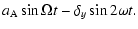
z=0. As we want a circular orbit with a given angular velocity
 ,
we find that the equation of motion of the bodies M1and M2 is:
,
we find that the equation of motion of the bodies M1and M2 is:
 caused by these two bodies of mass Mis:
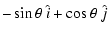
 with the identities for
the unitary vectors:
with the identities for
the unitary vectors:
 = =  |
|
 = =  |
 )
and the angular force (perpendicular to the former,
parallel to
)
and the angular force (perpendicular to the former,
parallel to
 ):
):
 |
= |  |
|
| = | ![$\displaystyle \left[ r \cos{\theta} ~ \hat{i}
+ r \sin{\theta} ~ \hat{j} \right...
...m B} \left(
\cos{\omega t} ~ \hat{i} + \sin{\omega t} ~ \hat{j} \right)
\right]$](/articles/aa/full/2006/03/aa3447-05/img70.gif) |
||
| = | ![$\displaystyle \left[ r \mp a_{\rm B} \cos{ \left( \omega t - \theta \right) }
\right] \hat{r} \mp a_{\rm B} \sin{ \left( \omega t - \theta \right) }
\hat{\theta}$](/articles/aa/full/2006/03/aa3447-05/img71.gif) |
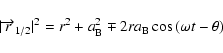
![\begin{eqnarray*}%
&&\frac{1}{ \vert \overrightarrow{r}_{1/2}^{3} \vert } \appro...
...t]
\\ &&{\rm where} ~~ \epsilon \equiv \frac{a_{\rm B}}{r} \ll 1
\end{eqnarray*}](/articles/aa/full/2006/03/aa3447-05/img73.gif)
 and which is the same expression that
we can find in Eq. (14.25) of Roy (1979) (under our
assumption that the masses of the binary system are equal and the
third mass is zero). As
and which is the same expression that
we can find in Eq. (14.25) of Roy (1979) (under our
assumption that the masses of the binary system are equal and the
third mass is zero). As
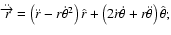 we get:
around the center of mass of the binary system
with angular velocity
we get:
around the center of mass of the binary system
with angular velocity  perturbed by another elliptical motion
of semiaxes
perturbed by another elliptical motion
of semiaxes
 and
and
 both much smaller than
.
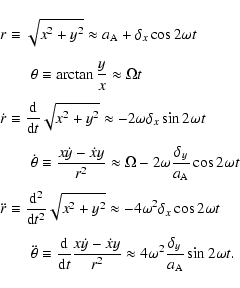
Thus the equation of motion of this body is, in rectangular
coordinates:
both much smaller than
.
Thus the equation of motion of this body is, in rectangular
coordinates:
 .
As the
two bodies of the binary system have the same mass, every half a
revolution of the system the third body sees the same
configuration of the binary system, in other words, the same
configuration of the perturbation.
.
As the
two bodies of the binary system have the same mass, every half a
revolution of the system the third body sees the same
configuration of the binary system, in other words, the same
configuration of the perturbation.
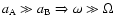 .
.
 ):
):
 |
|||
 |
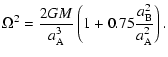
from wich we get:
 ). The angular velocity
is bigger than the Keplerian
one, which means that for the same mass, the system is less bounded
(the total energy E=T-U is less negative).
). The angular velocity
is bigger than the Keplerian
one, which means that for the same mass, the system is less bounded
(the total energy E=T-U is less negative).
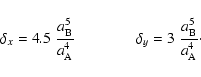


![$\displaystyle - \frac{2 G M}{r^{2}} \left( \left[ 1 + \frac{3}{4} ~
\epsilon^{2} + \frac{9}{4} ~ \epsilon^{2} \cos 2 (\omega t -
\theta) \right] \hat{r}\right.$](/articles/aa/full/2006/03/aa3447-05/img77.gif)

![$\displaystyle \ddot{r}-r \dot{\theta}^{2} \approx
- \frac{2 G M}{r^{2}}
\left[ ...
...}{4} \epsilon^{2} + \frac{9}{4} \epsilon^{2} \cos
2 (\omega t - \theta) \right]$](/articles/aa/full/2006/03/aa3447-05/img81.gif)