![[*]](/icons/foot_motif.gif) ,
,
A&A 444, 831-836 (2005)
DOI: 10.1051/0004-6361:20053700
,L. R. Bedin1 - G. Piotto2 - G. Baume2,3 - Y. Momany2 - G. Carraro2,4 - J. Anderson5 - M. Messineo1 - S. Ortolani2
1 - European Southern Observatory, Karl-Schwarzschild-Str. 2,
85748, Garching, Germany
2 -
Dipartimento di Astronomia, Università di Padova,
vicolo dell'Osservatorio 2, Padova 35122, Italy
3 -
Facultad de Ciencias Astronómicas y Geofísicas de la
UNLP, IALP-CONICET, Paseo del Bosque s/n, La Plata, Argentina
4 -
Andes Fellow, Departamento de Astronómia, Universidad de Chile,
Casilla 36-D, Santiago, Chile
5 -
Department of Physics and Astronomy, Mail Stop 108,
Rice University, 6100 Main Street, Houston, TX 77005, USA
Received 27 June 2005 / Accepted 19 August 2005
Abstract
In this work we present the detection of 33 star clusters and 51
candidates in one field of the near by galaxy M 33. This study is
based on WFC/ACS images available from the HST archive. Thanks to
the high resolving power, we were able to confirm that two candidates
previously indicated by Christian & Schommer (1982, ApJS, 49, 405) are indeed star
clusters. We list the main properties for the star clusters (and
candidates), along with some peculiar objects, such as background
galaxies and possible HII regions.
Key words: catalogs - galaxies: clusters: general
The distribution and properties of star clusters provide fundamental information for understanding star-formation history within galaxies, and how it is related to the dynamical and to the chemical enrichment history of the system.
The face-on orientation of Scd-galaxy M 33 minimizes absorption effects
and makes it an ideal target for studying cluster distributions in
spiral galaxies. Moreover, it has a morphology intermediate between
the large spiral galaxies and the dwarf irregulars of our Local Group.
Finally, it is close enough to make identifying star clusters almost
straightforward on images collected from space with  .
.
M 33's star clusters have been the subject of several studies from the
ground in the recent past (Hiltner 1960; Kron & Mayall 1960; Melnick
& D'Odorico 1978; Christian & Schommer 1982, 1988), and, with more
success, from space (Chandar et al. 1999a, 2001). The last two works
based on 55 WFPC2/HST fields, discovered 162 candidate star
clusters. Here we present a new list of 33 candidate open clusters,
discovered on a single ACS/HST WFC field.
Even if we are limited to just one 
 field, we were
able to increase the number of known star clusters in M 33 by 20% with
respect to previous works based on WFPC2 images, is the result of the
superb resolving capabilities and sensitivity of the WFC/ACS.
field, we were
able to increase the number of known star clusters in M 33 by 20% with
respect to previous works based on WFPC2 images, is the result of the
superb resolving capabilities and sensitivity of the WFC/ACS.
The purpose of this paper is to continue the ongoing mapping of the M 33's star cluster population, with the aim of exploring the faintest part of the cluster distribution. These clusters would be excellent targets for multicolor or spectroscopic follow-up to measure cluster parameters, such as age.
Table 1: Catalog of the newly identified clusters in the ACS/WFC studied field. This table gives the main properties.
Proposals GO-9480/9578 (PI: Rhodes) took several parallel fields with the purpose of studying the amount and the distribution of dark matter, which, with its gravity, causes small distortions in the shapes of background galaxies.
One of these parallel fields falls in M 33, and it is the source of the
present work. The field is centered at
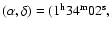
 ,
with a position angle of the HSTV3-axis of
,
with a position angle of the HSTV3-axis of  .
The data set includes 5 images in F775W band (SDSS-i), one of 400 s, and four of 700 s. Figure 1 shows that
our ACS field is located between two spiral arms of M 33, partially
overlapping the arms themselves.
.
The data set includes 5 images in F775W band (SDSS-i), one of 400 s, and four of 700 s. Figure 1 shows that
our ACS field is located between two spiral arms of M 33, partially
overlapping the arms themselves.
We stacked the five FLT images into a distortion-corrected
super-sampled frame using the distortion correction of Anderson (2002)
and the stacking technique described in King et al. (2005). Briefly,
we determined the corresponding location in each of the FLT
images for each pixel in the super-sampled image. We then
interpolated the five FLT images at this location to get five
estimates for the pixel value at the stacked-frame location. We then
used a sigma-clipped mean to arrive at a value for each pixel in the
super-sampled frame. This image of
 pixels, with a
pixel scale of 25 mas/pixel, can be download from the web-site: http://www.eso.org/~lbedin/M33/M33.fits.gz (68 Mb).
pixels, with a
pixel scale of 25 mas/pixel, can be download from the web-site: http://www.eso.org/~lbedin/M33/M33.fits.gz (68 Mb).
The astrometric calibration of the M 33 reference image was computed
employing stars from the GSC2.2 catalog and using the IRAF MSCRED
package (Valdes 1998). Of the 100 GSC2.2 stars, we extracted
and used only 12 "good'' stars that seemed associated with resolved
stars. The rest of GSC2.2 were clearly unresolved objects.
The external accuracy (absolute astrometry) was estimated to be about 0.30 arcsec. This was made comparing the rms of the GMS2.2 catalog
with the positions of the same objects measured in our image (whose
header contains the WCS informations of our astrometric solution).
The internal precision (relative astrometry) is much higher than that,
better than one mas (Anderson 2002; Anderson et al. 2005 in
preparation).
The fluxes measured on this image were calibrated to the Vega-mag WFC/ACS system described in Bedin et al. (2005), which is consistent with Sirianni et al. (2005).
![\begin{figure}
\par\includegraphics[width=8.8cm,clip]{bedin_f4.eps}
\end{figure}](/articles/aa/full/2005/48/aa3700-05/img17.gif) |
Figure 4: Example of radius determination for the first four clusters in the catalog presented in this work. For each cluster, the radius was obtained with three different methods (see the text). |
| Open with DEXTER | |
In Figs. 2 and 3 we show the location of the 33 new star-cluster candidates identified in our field. The WFC/ACS field overlaps neither with any of the WFPC2 fields in Chandar et al. (1999a-c) and of Chandar et al. (2001) nor with any of the CCD fields in Christian & Schommer (1988), but it does contain two cluster candidates and two HII regions indicated by Christian & Schommer (1982, hereafter CS82) on a photographic plate-based study.
We did not need to develop a special algorithm to detect star
clusters. On ACS images at the distance of M 33, most of the star
clusters can be detected by eye on the super-stack image on which,
assuming a distance of 840 kpc for M 33 (Freedman et al.
1991), one pixel (
 )
corresponds to 0.1 pc (i.e. one parsec
is mapped by 10 pixels).
)
corresponds to 0.1 pc (i.e. one parsec
is mapped by 10 pixels).
Table 1 lists our new candidate star clusters. The first three
columns give the ID number and the ( ,
,
 )
position at J2000.0; Col. 4 gives radius, and Col. 5 the integrated F775W magnitude (
)
position at J2000.0; Col. 4 gives radius, and Col. 5 the integrated F775W magnitude (
 ). Some clusters were identified as a
star in the GSC-2 and/or USNO catalog, so we also listed their
corresponding identification numbers in Col. 6.
). Some clusters were identified as a
star in the GSC-2 and/or USNO catalog, so we also listed their
corresponding identification numbers in Col. 6.
To derive clusters radius, we built their individual radial profiles
by using three methods. The first one is the standard "star counts
method'' within 0.5 arcsec wide concentric annuli, previous star
detections, and PSF photometry for each cluster. The second method
directly employed the measure of the flux, say
 ,
within 0.25 arcsec wide concentric annuli. The third
method made use of the formalism developed by Mackey & Gilmore (2003)
to derive an estimate of the radius of a star cluster. The fitting
formula (Eq. (3) in their paper) reads:
,
within 0.25 arcsec wide concentric annuli. The third
method made use of the formalism developed by Mackey & Gilmore (2003)
to derive an estimate of the radius of a star cluster. The fitting
formula (Eq. (3) in their paper) reads:
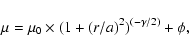
 is the stellar density and r the distance from the
cluster center. We calculated
is the stellar density and r the distance from the
cluster center. We calculated  as the average stellar density at
![$3.5 \leq r[{\rm arcsec}] \leq r = 7.0$](/articles/aa/full/2005/48/aa3700-05/img25.gif) .
Finally,
.
Finally,  is always
kept below 3.
is always
kept below 3.
Table 2: Bright galaxies and miscellaneous objects.
The three methods applied to all the clusters and candidates, and the corresponding values (when available) reported in Col. 4. As for the fitting, we only report the derived radius (a) with the corresponding error. As an example, in Fig. 4 we show the derived profiles for the first four clusters of our catalog and the corresponding fits. In some cases, however, the fit with the Mackey & Gilmore formula was not possible due to the complicated structure of the profile. For these cases, a question mark is inserted.
Notice that in almost all the cases, the three determinations are very
similar within the errors. Because of its definition of core radius
(Mackey & Gilmore 2003), the values of a are always smaller than
the other two radius estimates, which were derived as the distances
from the cluster center at which the stellar profile reaches the
background.
![\begin{figure}
\par\mbox{\includegraphics[width=4cm,clip]{41_CS82.eps}\hspace*{1...
...pace*{1mm}\includegraphics[width=4cm,clip]{H9_CS82.eps} }
\protect
\end{figure}](/articles/aa/full/2005/48/aa3700-05/img27.gif) |
Figure 5:
( Top panels) The two cluster candidates labeled in CS82 as  and
and  ,
were confirmed in this work to be star clusters;
namely: 24, 22 according to IDs given in Table 1.
( Bottom panels) Also, the two HII regions labeled in CS82 as
H ,
were confirmed in this work to be star clusters;
namely: 24, 22 according to IDs given in Table 1.
( Bottom panels) Also, the two HII regions labeled in CS82 as
H 8 and H 8 and H were confirmed in this work to be star clusters,
whose IDs are 4, 25, respectively.
were confirmed in this work to be star clusters,
whose IDs are 4, 25, respectively. |
| Open with DEXTER | |
Table 3: Other cluster candidates.
![\begin{figure}
\par\begin{tabular}{ccc}
\fbox{\includegraphics[width=5cm]{bedin_...
...{\includegraphics[width=5cm]{bedin_F.eps}}\\
\end{tabular}\protect
\end{figure}](/articles/aa/full/2005/48/aa3700-05/img28.gif) |
Figure 6: Example of galaxy (51), populous cluster (31), compact (9), populous (7), low density + HII(8), association (12), and HII shell structure (34). |
| Open with DEXTER | |
The integrated magnitude obtained as the integral of the flux within
the indicated radius.
The related uncertainties obtained from the rms of the background
fluxes from 4 areas of equal size around the cluster candidate center.
These uncertainties do not take uncertainties in the cluster radius
into account. The flux calibrated to the Vega-mag system.
Furthermore, Col. 6 associates a simple morphological description to
each cluster based on their size and degree of concentration. Those
clusters with higher central concentration and approximately spherical
symmetry are classified as
 ;
the others as
;
the others as
 .
The clusters richest in stars have been labeled as
.
The clusters richest in stars have been labeled as
 ,
and wide
groups of bright stars are considered as probable associations.
,
and wide
groups of bright stars are considered as probable associations.
The transmission curve for the F775W filter includes several emission
lines that are commonly seen in HII regions - HeI(7065),
ArIII(7136), HeI(7282), OII(7321), ArIII(7752), HI(8359), HI(8374),
HI(8392), HI(8413), HI(8437), OI (8446), HI(8467), HI(8502) - of
which the strongest typically is ArIII(7136) with an intensity of
10-20 times that of the H line (Esteban et al. 2002; Lee &
Skillman 2004). We therefore identified as HII all those objects
which show faint diffuse brightness, but we do not distinguish between
SN remnants and star-formation regions.
In Table 2 we list some background bright galaxy candidates and two
other notable objects.
Table 3 contains a list of diffuse objects which could be either low
density star cluster candidates or HII regions; see Fig. 6 for
examples of this morphological classification.
line (Esteban et al. 2002; Lee &
Skillman 2004). We therefore identified as HII all those objects
which show faint diffuse brightness, but we do not distinguish between
SN remnants and star-formation regions.
In Table 2 we list some background bright galaxy candidates and two
other notable objects.
Table 3 contains a list of diffuse objects which could be either low
density star cluster candidates or HII regions; see Fig. 6 for
examples of this morphological classification.
The HST archive continues to serve as a gold mine full of secondary science. In this work, we used an ACS/HST parallel field taken for other purposes to identify 33 star cluster candidates in the spiral galaxy M 33. We were able to confirm 2 cluster candidates previously suggested by CS82 and to reveal two objects classified as HII regions in the same work, each hosting a star cluster (Fig. 5). We give the size and a preliminary photometry both for these clusters and for an additional 51 objects that are less certain to be clusters.
Follow-up multi-band observations or spectroscopy could provide additional cluster parameters, such as color and age.
Acknowledgements
We thank the anonymous referee for careful reading of the manuscript and for the useful suggestions. We acknowledge the support of the Italian MIUR under the program PRIN2003. The work of GC was supported by Fundación Andes.
![\begin{figure}
\par\includegraphics[width=8.8cm,angle=-90,clip]{bedin_f1.eps}
\end{figure}](/articles/aa/full/2005/48/aa3700-05/img33.gif) |
Figure 1:
WFC/ACS field finding chart. The field of view is
 ,
North on top, and East to the left. ,
North on top, and East to the left.
|
| Open with DEXTER | |
![\begin{figure}
\par\includegraphics[width=20cm,angle=90,clip]{bedin_f2.eps}
\end{figure}](/articles/aa/full/2005/48/aa3700-05/img34.gif) |
Figure 2: Cluster identification charts for WFC/ACS top chip. Squares indicate the new clusters (Table 1), circles mark background galaxies (Table 2) and cluster candidates (Table 3). Triangles indicate the presence of gas or of diffuse objects. |
| Open with DEXTER | |
![\begin{figure}
\par\includegraphics[width=20cm,angle=90,clip]{bedin_f3.eps}
\end{figure}](/articles/aa/full/2005/48/aa3700-05/img35.gif) |
Figure 3: Cluster identification charts for WFC/ACS bottom chip. Symbols as in Fig. 2. |
| Open with DEXTER | |