A&A 444, 961-976 (2005)
DOI: 10.1051/0004-6361:20053600
Current sheet formation in quasi-separatrix layers and hyperbolic flux tubes
G. Aulanier - E. Pariat - P. Démoulin
Observatoire de Paris, LESIA, 92195 Meudon Cedex, France
Received 9 June 2005 / Accepted 26 July 2005
Abstract
In 3D magnetic field configurations, quasi-separatrix
layers (QSLs) are defined as volumes in which field lines
locally display strong gradients of connectivity. Considering
QSLs both as the preferential locations for current sheet development
and magnetic reconnection, in general, and as a natural model
for solar flares and coronal heating, in particular, has been
strongly debated issues over the past decade.
In this paper, we perform zero- resistive MHD simulations
of the development of electric currents in smooth magnetic
configurations which are, strictly speaking, bipolar though they
are formed by four flux concentrations, and whose potential fields
contain QSLs. The configurations are driven by smooth and large-scale
sub-Alfvénic footpoint motions.
Extended electric currents form naturally in the configurations,
which evolve through a sequence of quasi non-linear force-free
equilibria.
Narrow current layers also develop. They spontaneously form at small
scales all around the QSLs, whatever the footpoint motions are.
For long enough motions, the strongest currents develop where the
QSLs are the thinnest, namely at the Hyperbolic Flux Tube (HFT), which
generalizes the concept of separator. These currents progressively take
the shape of an elongated sheet, whose formation is associated with
a gradual steepening of the magnetic field gradients over tens of
Alfvén times, due to the different motions applied to the field
lines which pass on each side of the HFT.
Our model then self-consistently accounts for the long-duration energy
storage prior to a flare, followed by a switch-on of reconnection when
the currents reach the dissipative scale at the HFT.
In configurations whose potential fields contain broader QSLs, when
the magnetic field gradients reach the dissipative scale, the currents
at the HFT
reach higher magnitudes. This implies that major
solar flares which are not related to an early large-scale
ideal instability,
must occur in regions whose corresponding potential fields have broader
QSLs.
Our results lead us to conjecture that physically, current layers
must always form on the scale of the QSLs. This implies that electric
currents around QSLs may be gradually amplified in time only if the
QSLs are broader than the dissipative length-scale.
We also discuss the potential role of QSLs in coronal heating in
bipolar configurations made of a continuous distribution of flux
concentrations.
resistive MHD simulations
of the development of electric currents in smooth magnetic
configurations which are, strictly speaking, bipolar though they
are formed by four flux concentrations, and whose potential fields
contain QSLs. The configurations are driven by smooth and large-scale
sub-Alfvénic footpoint motions.
Extended electric currents form naturally in the configurations,
which evolve through a sequence of quasi non-linear force-free
equilibria.
Narrow current layers also develop. They spontaneously form at small
scales all around the QSLs, whatever the footpoint motions are.
For long enough motions, the strongest currents develop where the
QSLs are the thinnest, namely at the Hyperbolic Flux Tube (HFT), which
generalizes the concept of separator. These currents progressively take
the shape of an elongated sheet, whose formation is associated with
a gradual steepening of the magnetic field gradients over tens of
Alfvén times, due to the different motions applied to the field
lines which pass on each side of the HFT.
Our model then self-consistently accounts for the long-duration energy
storage prior to a flare, followed by a switch-on of reconnection when
the currents reach the dissipative scale at the HFT.
In configurations whose potential fields contain broader QSLs, when
the magnetic field gradients reach the dissipative scale, the currents
at the HFT
reach higher magnitudes. This implies that major
solar flares which are not related to an early large-scale
ideal instability,
must occur in regions whose corresponding potential fields have broader
QSLs.
Our results lead us to conjecture that physically, current layers
must always form on the scale of the QSLs. This implies that electric
currents around QSLs may be gradually amplified in time only if the
QSLs are broader than the dissipative length-scale.
We also discuss the potential role of QSLs in coronal heating in
bipolar configurations made of a continuous distribution of flux
concentrations.
Key words: magnetohydrodynamics (MHD) - methods: numerical - Sun: magnetic fields
- Sun: flares
1 Introduction
The energy needed to power solar flares and to sustain coronal heating
is thought to come from the coronal magnetic field, since its energy
dominates over all other forms of stored energy. However, the coronal
plasma, like most natural magnetized plasmas, has typical Lundquist numbers
far larger that unity. So the resistive term in the induction equation
can become large enough only if small-scale magnetic field gradients
(i.e. narrow current layers) are created. Regions in which either
the magnetic field, or the velocity field, or the Alfvén speed
initially have small scale gradients can naturally result in
such current layers. However, those are not necessarily typical
of the solar corona, and other situations can also exist. Magnetic
configurations with a complex topology, i.e. with separatrices, are
the most obvious configurations where current sheets can form,
when no steep gradient is initially present in the system. Separatrices
are magnetic surfaces where the magnetic field line
linkage is discontinuous. A particularly important location for
current-sheet formation, then for reconnection in a classical view, is
the intersection of two separatrices, which is a null point (a point
where the magnetic field vanishes) or a separator. In most cases,
a separator is a singular field line joining two null points.
More generally, current sheets are thought to form along the
separatrices when arbitrary footpoint motions are imposed at
a line-tied boundary
at the separatrices (e.g. Lau 1993; Low & Wolfson 1988; Aly 1990).
The initial studies of the topology in 3D magnetic configurations have
been realized by defining a magnetic field created by discrete
sub-photospheric sources (Baum & Bratenahl 1980). Hénoux & Somov (1987) proposed
that reconnection along the separator can interrupt currents flowing
there, thus permitting to release the energy stored in these currents.
Gorbachev & Somov (1988) further applied the theory to an observed solar flare
and showed that field lines passing close to the separator connect to
observed chromospheric bright ribbons. Furthermore, numerous analyses
of flares have shown that H and UV flare brightenings are typically
located along the intersection of separatrices with the chromosphere:
they are connected by field lines which are expected to have formed
through magnetic reconnection in the given configuration
(e.g. Mandrini et al. 1991; Démoulin et al. 1994b; van Driel-Gesztelyi et al. 1994; Mandrini et al. 1995).
and UV flare brightenings are typically
located along the intersection of separatrices with the chromosphere:
they are connected by field lines which are expected to have formed
through magnetic reconnection in the given configuration
(e.g. Mandrini et al. 1991; Démoulin et al. 1994b; van Driel-Gesztelyi et al. 1994; Mandrini et al. 1995).
The description of the magnetic field with sub-photospheric sources,
as well as its related topological analysis irrespective of the location
of the line-tied photosphere, is only an approximation to describe
the organization of the magnetic field in flux tubes: it implicitly
assumes that the origin of a flare is rooted below the line-tied
boundary, where the magnetic configuration has no reason to be
that of what is prescribed by the sources. Assuming that all the
sources are located in the line-tied plane permits this difficulty
to be bypassed. However it also leads to some undesirable effects
which may not be relevant of the solar photosphere, especially
within active regions: wide areas in this plane have purely tangential
magnetic fields, except in the vicinity of the sources and of null
points located at the boundary. Also, these boundary nulls fully
constrain the topology above, which may be considered to be
at least restrictive, if not artifical. Finally, the very
definition of point charges prevents modeling twisting motions.
This approach is nevertheless very interesting, since it allows
to use powerful mathematical (analytical) tools, which permit many
aspects of the complex problem to be explored without the need of
heavy numerical simulations (e.g. Priest et al. 2005; Longcope & Klapper 2002).
The above results have demonstrated that the location of energy release
in solar flares is defined by the magnetic topology and that the physical
mechanism is magnetic reconnection. However, it has been shown that
the energy release did not involve all of the separatrix; e.g. H
flare brightenings were always present only on a restricted part of
the chromospheric footprint of the computed separatrices. Moreover,
for some observed events, a coronal magnetic null related to the
flare was not always present in the configurations associated
with the observed photospheric magnetic field (Démoulin et al. 1994a).
Another well-known possibility getting separatrices is when field lines
are tangent to the photospheric boundary (called "bald
patches'', Titov et al. 1993). But just as with coronal nulls, bald patches
have been found only in a small fraction of observed events
(e.g. Aulanier et al. 1998). In fact, in many flaring configurations,
the computed separatrices were only associated with the magnetic nulls
being also located below the photosphere (located between the assumed
sub-photospheric sources). These studies
teach us that coronal magnetic reconnection must occur in a broader
variety of magnetic configurations than traditionally thought, as
derived from studies of 2D configurations. It is also worth noticing
that the separatrices of a magnetic configurations invariant by
translation along one direction disappear in most cases when the
configuration is fully extended to 3D (Schindler et al. 1988). This
structural instability of separatrices point also to the need
of a broader concept.
In order to address these difficulties, Démoulin et al. (1996b,a)
proposed that "quasi-separatrix layers'' (QSLs) generalize the definition
of separatrices to cases where there is no coronal magnetic null.
QSLs are regions where there is a drastic change in field line linkage,
while the linkage is truly discontinuous at separatrices. For each
observed flare studied with this approach, the brightenings were always
found along, or just nearby, the intersection of QSLs with the
chromosphere (Mandrini et al. 1997; Démoulin et al. 1997; Bagalá et al. 2000, and references therein).
These results demonstrate that flares are coronal events, where the
release of free magnetic energy is due to the presence of regions
where the magnetic field line linkage changes drastically, and not
necessarily discontinuously.
Physically, the magnetic energy available for flaring must be associated
with non-potential magnetic fields, so in the presence of extended
and/or narrow electric current distributions. Indeed, when photospheric
vector magnetic field measurements were available in the studies quoted
above, two photospheric current concentrations of opposite sign were
always found in the close vicinity of the computed QSLs, both linked
by modeled coronal field lines (Démoulin et al. 1997, and references therein).
Theoretically, the formation of a strong current layer in any QSL is expected
with almost any kind of boundary motion which crosses a QSL, as conjectured
analytically by Démoulin et al. (1996a). The main reason is that the magnetic
stress of very distant regions can be brought close to one another,
typically over the QSL thickness. Unfortunately, analytical arguments
for current layer formation in QSLs cannot go too far in configurations
without symmetry: the derivation of the currents is both a non-linear
and a non-local problem requiring in particular integration over
field lines. So Titov et al. (2003) considered a straightened magnetic
configuration between two plates, with a Hyperbolic Flux tube (or
HFT) at the center of QSLs. They
calculated analytically that currents form and increase exponentially with
time in a HFT, only when the boundary shearing motions create a stagnation
point in the middle of the configuration.
MHD numerical simulations are required to analyze the evolution
of general magnetic configurations having QSLs. A numerical difficulty
is that the currents are expected to form on the scale of the QSLs, a
scale that can be many orders of magnitude lower than the scale of
the whole studied magnetic configuration. The simulation of
Milano et al. (1999) was the first to show that currents did
form along QSLs. But the latter were not present in the initial
uniform field configuration. They were dynamically formed by
the prescribed boundary motions, which consisted of two vortices
with a stagnation point in between. The numerical simulation
of Galsgaard et al. (2003) was aimed at addressing
the problem of pre-existing QSLs. Unfortunately, it considered
very broad initial QSLs, with a thickness of about one tenth of
the numerical domain, so that only weak currents formed there.
The selected boundary motions produced a stagnation point inside the
domain, which resulted in the formation of a strong current sheet,
as predicted analytically by Titov et al. (2003). However,
Démoulin (2005) extensively explained that these strong currents
were not associated with the initial broad QSLs, but rather
with a new set of much thinner QSLs that dynamically formed
thanks both to the stagnation point and to the large-scale boundary
displacements. It is then unclear how the results of Milano et al. (1999)
and of Galsgaard et al. (2003) can be generalized to magnetic
configurations which initially possess narrow QSLs.
In order to really address this issue, the one
conjectured in previous studies of observed solar flares, in this paper
we instead perform MHD simulations of the slow current build-up
associated with pre-existing narrow QSLs.
In Sect. 2, we consider and analyze the properties of
two potential magnetic configurations that have large differences
in QSL thickness. In Sect. 3, we describe the
numerical method which we used to evolve both configurations with
two different forms of line-tied motions. In Sect. 4,
we discuss our results in terms of the formation conditions of
narrow current layers within QSLs, in general, and at the HFT, in
particular, as a function of the boundary flow. The results
are summarized and discussed in the frame of solar flare and
coronal heating modeling in Sect. 5. Numerical
and physical issues on the width of current sheets are discussed
in Appendix A.
We considered a 3D Cartesian domain
![$x \in [-0.65 ,~
0.65]$](/articles/aa/full/2005/48/aa3600-05/img28.gif) ,
,
![$y \in [-0.41 ,~ 0.41]$](/articles/aa/full/2005/48/aa3600-05/img29.gif) ,
,
![$z \in [0 ,~ 0.65]$](/articles/aa/full/2005/48/aa3600-05/img30.gif) ,
where z is
altitude. z=0 is considered as the photospheric plane, which
is treated as a line-tied boundary in which kinematic motions were
prescribed in the MHD simulations. In this domain, we calculated two
potential magnetic field configurations (
,
where z is
altitude. z=0 is considered as the photospheric plane, which
is treated as a line-tied boundary in which kinematic motions were
prescribed in the MHD simulations. In this domain, we calculated two
potential magnetic field configurations (
 )
made
up of four polarities: P1 (resp. N1) is the positive (resp. negative)
polarity of an outer bipole, and P2 (resp. N2) is the positive (resp.
negative) polarity of an inner bipole which contains less magnetic
flux than the outer one, but which has stronger magnetic field
concentrations.
)
made
up of four polarities: P1 (resp. N1) is the positive (resp. negative)
polarity of an outer bipole, and P2 (resp. N2) is the positive (resp.
negative) polarity of an inner bipole which contains less magnetic
flux than the outer one, but which has stronger magnetic field
concentrations.
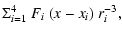
Each of the four polarities results from point-sources located at
various depths beneath the photosphere. Throughout this paper, both
configurations are labeled by
 and
and  ,
which are the angle between the axes of both bipoles
when the field is potential at t=0. The magnetic field
,
which are the angle between the axes of both bipoles
when the field is potential at t=0. The magnetic field  of these configurations is given by:
| bx(x,y,z) |
= |
 |
|
| by(x,y,z) |
= |
 |
|
| bz(x,y,z) |
= |
 |
|
| ri |
= |
 |
(1) |
The values of the free parameters for each polarity
(
xi,yi,zi,Fi) are given in
Table 1. Typical field lines for both configurations are
shown in the upper row of Figs. 1 and 2.
Note that the point sources are used only to define the initial magnetic
field. Later, only the magnetic field for  is considered
(Sect. 3).
is considered
(Sect. 3).
Table 1:
Parameters of the magnetic configurations.
The chosen settings imply that there is neither a magnetic null point
in  nor field lines tangential to the photospheric boundary
at z=0, so there are no separatrices in the domain.
Topologically speaking, the configurations are bipolar,
equivalent to an arcade, even though they display four contrasted
magnetic field concentrations. The following numbers permit to
estimate the degree of contrast at z=0 for
and :
nor field lines tangential to the photospheric boundary
at z=0, so there are no separatrices in the domain.
Topologically speaking, the configurations are bipolar,
equivalent to an arcade, even though they display four contrasted
magnetic field concentrations. The following numbers permit to
estimate the degree of contrast at z=0 for
and :
 ,
,
 ,
and
,
and
 .
.
 |
Figure 1:
Top views of the magnetic configurations for two orientations of the
central bipole with respect to the large one (
and
): potential field ( top row) and configurations
resulting from the translational ( middle row) and twisting (
bottom row) motions applied at z=0 (see Fig. 5). The
horizontal (resp. vertical) axis corresponds to the x (resp. y)
coordinate. Pink (resp. blue) contours show positive (resp.
negative) values of
 .
The inversion
line
bz(z=0)=0 is plotted in yellow. The other lines are magnetic
field lines. In each panel, they are plotted starting from the same
positions at z=0 in the negative polarities, so these lines are
comparable from one panel to another since their fixed footpoint is
not displaced by the flows (see Fig. 5). The time unit corresponds
to the transit time of an Alfvén wave on a distance of 0.2 at the
initial homogeneous Alfvén speed. .
The inversion
line
bz(z=0)=0 is plotted in yellow. The other lines are magnetic
field lines. In each panel, they are plotted starting from the same
positions at z=0 in the negative polarities, so these lines are
comparable from one panel to another since their fixed footpoint is
not displaced by the flows (see Fig. 5). The time unit corresponds
to the transit time of an Alfvén wave on a distance of 0.2 at the
initial homogeneous Alfvén speed. |
| Open with DEXTER |
 |
Figure 2:
Same as Fig. 1, but projection views in the full numerical
domain are shown. The viewing angle is rotated approximatively  around the z axis relative to Fig. 1.
 |
| Open with DEXTER |
QSLs are defined as regions where there is a drastic change in
field-line linkage (Démoulin et al. 1996b,a).
More precisely, let us consider
the mapping from one photospheric polarity to the opposite one:
 and the
reversed one
and the
reversed one
 .
These mappings can be represented by some vector
functions
[X-(x+,y+), Y-(x+,y+)] and
[X+(x-,y-), Y+(x-,y-)], respectively.
The norms
.
These mappings can be represented by some vector
functions
[X-(x+,y+), Y-(x+,y+)] and
[X+(x-,y-), Y+(x-,y-)], respectively.
The norms
 and
and
 of the respective
Jacobian matrices in Cartesian coordinates are:
of the respective
Jacobian matrices in Cartesian coordinates are:
A QSL was first defined by the condition
 in both photospheric polarities (Démoulin et al. 1996b).
Let us now consider a field line linking photospheric locations
(x+,y+) and
(x-,y-), which both have different
normal field components bz+ and bz-. In this case, a
difficulty with the definition of QSLs by Eq. (2) is that
 if
if
 ,
so
QSLs do not fulfill a unique condition, in general, when defined
by Eq. (2). Recently, Titov et al. (2002) defined another
characteristic function for QSLs which is independent of the
mapping direction: the squashing degree Q. It is calculated
as follows:
,
so
QSLs do not fulfill a unique condition, in general, when defined
by Eq. (2). Recently, Titov et al. (2002) defined another
characteristic function for QSLs which is independent of the
mapping direction: the squashing degree Q. It is calculated
as follows:
 |
(3) |
where asterisking the functions indicates that their arguments x-and y- are substituted in
X-(x+,y+) and
Y-(x+,y+), respectively. With this new prescription,
a QSL is defined by  ,
the value Q=2 being the lowest value
possible (Titov et al. 2002). By definition, Q is uniquely
defined along a field line by:
,
the value Q=2 being the lowest value
possible (Titov et al. 2002). By definition, Q is uniquely
defined along a field line by:
 |
(4) |
The physical meaning of this apparently complex definition
can, in fact, be simply explained as follows. Let us consider an
elementary flux tube rooted in an infinitesimal circular region
in one polarity. Q simply measures the aspect ratio of the
distorted ellipse defined by the footpoint mapping of this flux
tube in the other polarity. In other words, Q measures how much the
initial elementary region is squashed by the field-line mapping.
Other quantities which define the mapping properties of QSLs do exist, one of
them being the ratio
|bz+ /bz-*|. Their full description and meaning
are analyzed in Titov et al. (2002). In this paper, we only use Q, since it is
sufficient to localize the QSLs and to define their thickness. A global view
of QSL properties and their application to coronal physics is presented in
Démoulin (2005) and Titov (2005).
2.3 Numerical calculation of quasi-separatrix layers
3D magnetic configurations, where the maximal value of Q is
large, are challenging for numerical computation of the associated
QSLs, because their related widths are often orders of magnitudes below
the spatial resolution of any numerical mesh. For local quantities
such as the magnetic field, computing gradients below the mesh size
has no meaning. But this is not true for N and Q, because
their values are dominantly determined by the large-scale properties
of the magnetic configuration. This was thoroughly explained in
Démoulin et al. (1997,1996a), where the effect of spatial discretization
defining the analytical magnetic fields was tested. There it was
demonstrated that calculating QSLs below the scale of the discretization
is relevant and reliable as long as the large scale-lengths of
the magnetic field are well resolved.
In order to accurately compute N (or Q) in a plane (e.g. z=0), one
needs to determine a 2D grid (e.g. in x,y) which is locally adapted to
the QSL width. The latter must then be different than the grid
used later in the MHD simulations. One must also be able to compute the
connectivities with high precision. In the case of a uniform grid,
with a mesh interval  small enough to resolve all the connectivity
gradients, the computation of N is only limited both by the numerical
precision of the field line integration and by the numerical derivatives
in Eq. (2). With the best integration algorithms,
the position
small enough to resolve all the connectivity
gradients, the computation of N is only limited both by the numerical
precision of the field line integration and by the numerical derivatives
in Eq. (2). With the best integration algorithms,
the position
 of the second footpoint of the field line passing by the grid point of
index (i,j) can be known with relative precision of 10-11.
This permits us to calculate the field line connectivities very accurately.
Since local small-scales of the magnetic field have a low effect on
the QSLs, the magnetic field in between the mesh points is computed
simply by a linear interpolation of the nearest points values. Then
from Eq. (2), the computed value Ni,j of N at the grid
point (i,j) is given by the knowledge of the field line connectivity
of the four surrounding points on the grid:
of the second footpoint of the field line passing by the grid point of
index (i,j) can be known with relative precision of 10-11.
This permits us to calculate the field line connectivities very accurately.
Since local small-scales of the magnetic field have a low effect on
the QSLs, the magnetic field in between the mesh points is computed
simply by a linear interpolation of the nearest points values. Then
from Eq. (2), the computed value Ni,j of N at the grid
point (i,j) is given by the knowledge of the field line connectivity
of the four surrounding points on the grid:
 |
(5) |
Qi,j is then derived from Ni,j using Eq. (3).
 |
Figure 3:
Top views of the quasi-separatrix layers (QSLs) for the potential
field configurations for
and .
The
greyscale images show the distribution of the squashing degree Q
(Eq. (3)) at z=0 in
logarithmic scale. For
(resp. ), white
corresponds to Q=5 (resp. 6) and black to
 (resp. 1011). Typical field lines that are rooted in
the vicinity of the QSLs, and the same bz(z=0) contours as in
Fig. 1, are overplotted in the bottom row.
(resp. 1011). Typical field lines that are rooted in
the vicinity of the QSLs, and the same bz(z=0) contours as in
Fig. 1, are overplotted in the bottom row. |
| Open with DEXTER |
In practice and in order to save computational time, we never use a uniform
grid. Q is first computed on a coarse grid, whose resolution progressively
improves adaptively in a multi-step procedure. In a first step, Q is
calculated
everywhere, but only those regions where Q is the highest are kept. In
these regions, the spatial resolution is doubled. In a second step, Q is re-computed in the previously selected points, as well as in the new
four neighboring point of the improved grid. This procedure is repeated
until the number of points where Q is computed reaches some previously
fixed value. In the present paper, this number of point was 3500, which
corresponds to a spatial resolution of 
 ,
twice
larger than the smallest cell which is considered in the MHD simulations
(see Sect. 3.1).
,
twice
larger than the smallest cell which is considered in the MHD simulations
(see Sect. 3.1).
With such grid resolution, however, Q is still approximatively computed
where the gradients of connectivity are strong, i.e. where the QSL are the
thinnest. For the refined calculation of Q in 2D, we consider a local square
around each saved position of the latter grid.
In a second multi-step procedure, Q is then successively
re-computed in the central point of each square, as the resolution
progressively increases by a factor two at each step.
The recurrence is stopped when the values of Q computed at two consecutive
steps
converge, i.e. when their
ratio exceeds a fixed value (which we choose to be equal to 0.9 in this
paper). At that stage, Q is calculated well at the 3500 selected points.
Note than in separatrices, this second iteration never
converges since Q tends to infinity.
The results of these two iterative procedures were used to generate
all Q maps at z=0 shown in this paper and to calculate the corresponding
 .
Figure 3 shows such maps
for the potential magnetic field configurations defined in
Sect. 2.1. The shape of the QSLs and their significance
are discussed below in Sect. 2.4.
.
Figure 3 shows such maps
for the potential magnetic field configurations defined in
Sect. 2.1. The shape of the QSLs and their significance
are discussed below in Sect. 2.4.
We define the QSL width as the full width at half maximum of the
Q profile. In order to calculate the latter, we recompute Q
along several 1D segments that cross the QSL at various angles,
in the plane z=0. The 2D Q maps are used to choose the position
of these segments. Q can there be computed using various spatial
resolutions
 .
The true QSL width along a given
direction is reached when
is small enough to
ensure that any further refinement does not change the Q profile.
The minimum full width at half maximum of the Q profiles along
each of the segments finally results in the QSL width.
.
The true QSL width along a given
direction is reached when
is small enough to
ensure that any further refinement does not change the Q profile.
The minimum full width at half maximum of the Q profiles along
each of the segments finally results in the QSL width.
Table 2:
Maximum amplitude of the footpoint motions, of the squashing degree and minimum width
of its profile across the QSLs, in each configuration studied. The amplitude of the
translation motions,
 ,
is measured by the ratio of the maximum displacement
(
,
is measured by the ratio of the maximum displacement
( ), divided by characteristic size along y of the
system (0.5). The amplitude of the twisting motions is measured by the maximum numbers
of turns
), divided by characteristic size along y of the
system (0.5). The amplitude of the twisting motions is measured by the maximum numbers
of turns  within P2. The importance of the mapping distortion is given by the
maximum value of squashing degree (Eq. (3)),
.
Finally the thicknesses of the QSLs are given by the ratio of the full width at half maximum
of Q,
within P2. The importance of the mapping distortion is given by the
maximum value of squashing degree (Eq. (3)),
.
Finally the thicknesses of the QSLs are given by the ratio of the full width at half maximum
of Q,
 with the smallest cell size, d (Sect. 3.1). Both
and
with the smallest cell size, d (Sect. 3.1). Both
and
 are computed with a low spatial
resolution of
are computed with a low spatial
resolution of
 (resp. at a much higher spatial resolution,
see Sect. 2.3) and the values are noted with a subscript "L'' (resp. "H'').
(resp. at a much higher spatial resolution,
see Sect. 2.3) and the values are noted with a subscript "L'' (resp. "H'').
Figure 4 shows QSL profiles for both configurations
defined in Sect. 2.1, using two different segment
lengths, thus with two different spatial resolutions
.
With the lower resolution which is of the order of the MHD mesh resolution
(see Sect. 3.1), one can neither obtain the correct value of
,
nor the real width of the central
peak of the QSL profile. The broad wings of the QSL are, however,
well visible. The properties of the QSL, as calculated with
both resolutions, are given in Table 2. It shows that
the issue of resolution is the most sensitive for
 .
The QSL for
at t=0, however, is almost resolved by
the numerical mesh used in the MHD simulations: "almost'', because
the mesh is non-uniform and d is only the smallest grid size
(see Sect. 3.1).
.
The QSL for
at t=0, however, is almost resolved by
the numerical mesh used in the MHD simulations: "almost'', because
the mesh is non-uniform and d is only the smallest grid size
(see Sect. 3.1).
2.4 Topology of the potential fields
 |
Figure 4:
Profiles of
 perpendicular to the QSL for the initial
configurations
( left column) and
( right column). The cuts are centered at
(x,y)=(xQ,yQ), with
(xQ,yQ)=(-0.155,-0.145) for
and
(xQ,yQ)=(-0.121,-0.203)
for
.
The profiles are calculated using a spatial resolution
corresponding to the smallest cell in the numerical mesh
perpendicular to the QSL for the initial
configurations
( left column) and
( right column). The cuts are centered at
(x,y)=(xQ,yQ), with
(xQ,yQ)=(-0.155,-0.145) for
and
(xQ,yQ)=(-0.121,-0.203)
for
.
The profiles are calculated using a spatial resolution
corresponding to the smallest cell in the numerical mesh
 ( upper row) and using an optimized higher spatial
resolution
( lower row), as explained in Sect. 2.3.
( upper row) and using an optimized higher spatial
resolution
( lower row), as explained in Sect. 2.3. |
| Open with DEXTER |
In the bipolar potential configurations defined in Sect. 2.1,
the magnetic field line linkage has four basic sets of magnetic
connectivities (see Figs. 1 and 2), just as in
2D quadrupolar magnetic configurations, but without separatrix
between them. For both configurations, the intersections of the QSLs
with the z=0 boundary have only two extended thin strips, one over
each magnetic polarity (see Fig. 3, top row).
These potential configurations are thus very similar to the one
analyzed by Démoulin et al. (1996a) and Titov et al. (2002).
Two close field lines rooted at z=0 on both sides of one strip rapidly
diverge in the volume to connect, on the other strip, regions which
are very far from each other, as shown in Fig. 3, bottom row.
The thin volume, where Q has the highest values, is of particular
interest: the way field lines diverge there suggests to call the magnetic
structure of QSLs a HFT Titov et al. (2002).
The 3D shape of this HFT is better understood as one follows its 2D cross-section from one polarity to the other one on the boundary. Let us
define the edge of the QSL by the value  ,
which is a fraction of
the maximal value of Q. The HFT starts as an elongated strip over one
polarity, then it is transformed progressively in a cross shape in the
volume, and it ends in the form of another elongated strip on the other
polarity. Each strip at z=0 involve one branch of the cross at z>0.
A cartoon of the cross-section from one polarity to the other is then:
,
which is a fraction of
the maximal value of Q. The HFT starts as an elongated strip over one
polarity, then it is transformed progressively in a cross shape in the
volume, and it ends in the form of another elongated strip on the other
polarity. Each strip at z=0 involve one branch of the cross at z>0.
A cartoon of the cross-section from one polarity to the other is then:
 |
(6) |
This shape is similar for any values
 .
The volume defined by
.
The volume defined by
 fully encloses the volume defined by
if
fully encloses the volume defined by
if
 ,
so that defining an increasing series of
values defines a series of volumes that are somehow organized like
Russian dolls.
,
so that defining an increasing series of
values defines a series of volumes that are somehow organized like
Russian dolls.
The QSL shape is robust to the transformation of the magnetic configuration,
as the locations of the highest values of Q for the two configurations of
Fig. 3 have similarly curved shapes. The slight modifications
of these shapes mostly follow the displacement of the polarities.
The maximum value of Q however, is extremely sensitive to modifications
of the magnetic configurations: when Q is calculated at a spatial resolution
much higher than the numerical discretization chosen for the MHD simulation so
as to obtain its true profile (see Sect. 2.3),
 for
,
while
for
,
while
 for
,
five orders of
magnitude higher. Asymptotically,
tends to
infinity as
for
,
five orders of
magnitude higher. Asymptotically,
tends to
infinity as  tends to .
3 Method for MHD evolution
3.1 Equations and mesh
We use a simplified version of our zero-
(pressureless)
time-dependent 3D MHD code, which is extensively
described in Aulanier et al. (2005). The present version solves the
following equations:
 |
= |
 |
(7) |
 |
= |
 |
(8) |
 |
= |
 |
(9) |
 |
= |
0 , |
(10) |
where  is the mass density,
  the plasma velocity,
the magnetic field,
the plasma velocity,
the magnetic field,
 the electric
current density and
the electric
current density and  the magnetic resistivity. The
calculations are achieved in a dimensionless form, so that the magnetic
permeability is set to 1.
the magnetic resistivity. The
calculations are achieved in a dimensionless form, so that the magnetic
permeability is set to 1.
 is a diffusion operator for the velocity (see
Sect. 3.3).
is a diffusion operator for the velocity (see
Sect. 3.3).
Since we are only interested in quasi-static evolutions and to
save computer time, we fix
in time to its initial value given
below:
 |
(11) |
so that
 .
This leads to define the time
unit as the transit time of Alfvén waves over a distance of 0.2, which
corresponds to the physical spacing between both central polarities P2
and N2. This setting does not lead to any singularity, since the
studied configurations contain no magnetic null point in the domain.
.
This leads to define the time
unit as the transit time of Alfvén waves over a distance of 0.2, which
corresponds to the physical spacing between both central polarities P2
and N2. This setting does not lead to any singularity, since the
studied configurations contain no magnetic null point in the domain.
The boundary conditions at z=0 are line-tied, and those of the five
other faces are open. Their numerical implementation with the use of
ghost cells is described in details in Aulanier et al. (2005).
The simulations are done in the domain defined in Sect. 2.1,
using a non-uniform mesh
 points. The mesh intervals vary in the
range d
points. The mesh intervals vary in the
range d
![$x \in [1.5\times 10^{-3}~ ,~ 1.8\times 10^{-2}]$](/articles/aa/full/2005/48/aa3600-05/img99.gif) ,
d
,
d
![$y \in
[1.5\times 10^{-3}~ ,~ 1.2\times 10^{-2}]$](/articles/aa/full/2005/48/aa3600-05/img100.gif) ,
d
,
d
![$z \in [1.5\times
10^{-3}~ ,~ 0.8\times 10^{-2}]$](/articles/aa/full/2005/48/aa3600-05/img101.gif) ,
expanding from x=y=z=0 following
dxi+1/dxi=dyj+1/dyj=1.027 and
dzk+1/dzk=1.01.
,
expanding from x=y=z=0 following
dxi+1/dxi=dyj+1/dyj=1.027 and
dzk+1/dzk=1.01.
3.2 Boundary motions
 |
Figure 5:
Boundary flow patterns applied for
and ,
shown by dark arrows superposed to the same bz(z=0) isocontours as
shown in the top row of Fig. 1.
The flows are fixed in time for t>13 (see Eq. (15)).
|
| Open with DEXTER |
The magnetic configurations evolve in response to large-scale
kinematic motions
 which we prescribe in the line-tied
plane at z=0. Since we want to study the dependence of the
generation of electric currents at QSLs with respect to the precise
nature of the footpoint motions, we consider various types of motions
which move only a part of the QSLs.
Firstly, we only apply motions within the positive central polarity P2. Secondly, we choose two types of motions
which contain neither X-type stagnation point, nor small scales.
The first type of motion is a nearly solid translation of P2 along y. The second type of motion is twisting of the strongest fields in P2, which has a nearly solid rotation over more than half of the
vortex radius. Both types of
boundary motions are shown in Fig. 5, superposed on
contours of bz(z=0).
They both do not directly affect the field lines which
have a footpoint in P1.
which we prescribe in the line-tied
plane at z=0. Since we want to study the dependence of the
generation of electric currents at QSLs with respect to the precise
nature of the footpoint motions, we consider various types of motions
which move only a part of the QSLs.
Firstly, we only apply motions within the positive central polarity P2. Secondly, we choose two types of motions
which contain neither X-type stagnation point, nor small scales.
The first type of motion is a nearly solid translation of P2 along y. The second type of motion is twisting of the strongest fields in P2, which has a nearly solid rotation over more than half of the
vortex radius. Both types of
boundary motions are shown in Fig. 5, superposed on
contours of bz(z=0).
They both do not directly affect the field lines which
have a footpoint in P1.
The translation motion is defined by:
| ux(z=0) |
= |
0 , |
|
| uy(z=0) |
= |
![$\displaystyle \frac{u^\circ}{4} \bigg{[}\tanh\bigg{(}
\frac{y-y^\circ(x)}{\delta y^\circ}\bigg{)}+1\bigg{]}$](/articles/aa/full/2005/48/aa3600-05/img104.gif) |
|
| |
|
![$\displaystyle \bigg{[}\tanh\bigg{(}\frac{x-x_1^\circ}{\delta x^\circ}\bigg{)}
-\tanh\bigg{(}\frac{x-x_2^\circ}{\delta x^\circ}\bigg{)}
\bigg{]} ,$](/articles/aa/full/2005/48/aa3600-05/img105.gif) |
|
 |
= |
 |
(12) |
where  is the maximum velocity at the boundary. In all our simulations,
we set
is the maximum velocity at the boundary. In all our simulations,
we set
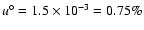 of
of  (defined
with Eq. (11)) so as to ensure a
relatively slow driving of the system.
(defined
with Eq. (11)) so as to ensure a
relatively slow driving of the system.
The twisting motion in P2 is defined by:
| |
|
 |
(13) |
| |
|
![$\displaystyle \psi = \psi^\circ \tanh\big{[}\alpha_1^\circ~ b_z^2(z=0)\big{]}
\tanh^4\big{[}\alpha_2^\circ~ b_z^2(z=0)\big{]},$](/articles/aa/full/2005/48/aa3600-05/img112.gif) |
(14) |
where
 is a parameter which is adjusted so as to prescribe
a maximum twisting velocity of
(same value as above).
With the velocity written
as in Eq. (13), bz(z=0) is only advected with time (without
modifying its Lagrangian value), and this is re-enforced
numerically at each numerical iteration. The choice of such complex
is a parameter which is adjusted so as to prescribe
a maximum twisting velocity of
(same value as above).
With the velocity written
as in Eq. (13), bz(z=0) is only advected with time (without
modifying its Lagrangian value), and this is re-enforced
numerically at each numerical iteration. The choice of such complex  functions (Eq. (14)) was motivated to prescribe
a nearly uniform
twisting motion in the strong field regions, surrounded by a region of
fast velocity decrease and a last outer region in which both the
velocities and their horizontal derivatives tend to zero close to
the inversion line around P2. In this way, the central part of P2 does
not incorporate small scales, and its outer regions do not lead
to numerical instabilities, since no small unresolved field line
is advected and since the velocity is numerically derivable everywhere.
functions (Eq. (14)) was motivated to prescribe
a nearly uniform
twisting motion in the strong field regions, surrounded by a region of
fast velocity decrease and a last outer region in which both the
velocities and their horizontal derivatives tend to zero close to
the inversion line around P2. In this way, the central part of P2 does
not incorporate small scales, and its outer regions do not lead
to numerical instabilities, since no small unresolved field line
is advected and since the velocity is numerically derivable everywhere.
The values for the remaining free parameters in Eqs. (12)
and (14) are given in Table 3. In the simulations,
all the velocities given above are multiplied by  :
:
![\begin{displaymath}
\gamma(t) = \frac{1}{2}~ \tanh\bigg{[}\frac{2(t-10)}{3}\bigg{]} + \frac{1}{2} ,
\end{displaymath}](/articles/aa/full/2005/48/aa3600-05/img116.gif) |
(15) |
which allows the system to first relax to a numerical equilibrium
for 0<t<7, followed by an early acceleration phase for 7<t<13,
towards a constant boundary driving for t>13.
Table 3:
Parameters for line-tied boundary motions.
 |
Figure 6:
Greyscale images of the coronal currents j(x,z) at y=0.07 in
linear scale. In all panels, dark grey corresponds to j(x,z)=0.
White corresponds to
j(x,z)=100,300,100,150 respectively, for the
( upper-left), ( lower-left), ( upper-right), and (
lower-right) panels. Each image shows the co-existence of
"extended'' currents which result from the line-tied footpoint
motions, of "narrow'' currents layers within the whole QSLs, and of an
intense current layer at a Hyperbolic Flux Tube ("HFT'') located
where the narrow current layers intersect. The plots are drawn a
few Alfvén times before the magnetic field gradients reach the
scale of the mesh in the HFT. |
| Open with DEXTER |
3.3 Diffusion operators
Some strong Lorentz forces develop during the calculations
on small-scales. They lead to strong vorticity layers on the scale of
a few cells, which are typically located around the QSLs at z>0. Their
proper numerical treatment leads us to use the following diffusion operator
for velocity:
 |
(16) |
where ui is the velocity component along either axis (x,y,z) and d is the smallest cell size in the domain.
 is the characteristic diffusion
speed. We set to
is the characteristic diffusion
speed. We set to
 in all our
simulations. This leads to strong viscous effects, which are
unfortunately required: setting
in all our
simulations. This leads to strong viscous effects, which are
unfortunately required: setting
 ,
which is
the standard value in turbulent simulations, leads to numerical
instabilities in the HFT typically at
,
which is
the standard value in turbulent simulations, leads to numerical
instabilities in the HFT typically at  ,
which do not permit us
to follow the development of strong electric currents over long time-scales.
,
which do not permit us
to follow the development of strong electric currents over long time-scales.
 is a second-derivative operator with respect to the
mesh rather than to spatial units. For any quantity f, this
operator is equal to:
is a second-derivative operator with respect to the
mesh rather than to spatial units. For any quantity f, this
operator is equal to:
 |
(17) |
So as to reach a compromise which ensures that the effects of
resistivity are small, but enough to ensure numerical stability for a
long time, we set
 in all our simulations.
This leads to a low characteristic resistive speed of
in all our simulations.
This leads to a low characteristic resistive speed of
 .
.
Considering
as the characteristic velocity of the system
implies the following magnetic Reynolds and Lundquist numbers:
 and Lu=200 at the scale of the smallest cell,
 and
and
 at the scale of the central bipole P2N2,
 and
and
 at the scale of the full
magnetic configuration.
at the scale of the full
magnetic configuration.
4 Development of electric currents
In spite of the very small scales in the QSLs, which are intrinsic to
the studied configurations, our MHD simulations do not result in
numerical instabilities for several tens of Alfvén times. During
this long time interval, electric currents develop in various regions
(Sect. 4.1). In particular narrow current layers develop
all along the QSLs (Sect. 4.2), while the strongest current layer
is formed at the HFT
where the QSLs are the narrowest (Sect. 4.3).
4.1 Extended and narrow current layers
In all our simulations, the footpoint motions naturally lead to the
formation of nearly-field-aligned currents distributed over wide
volumes which are defined by the envelope of the field lines which
are transported. We call them "extended current layers''. These
currents are stronger for the twisting motions
than for the translation motions (see Fig. 6).
Even though these currents are relatively strong, they do
not tend to dissipate easily, since they result from large-scale
magnetic field gradients in the domain induced by the line-tied motions.
Indeed, the resistive dissipation term is 
 ,
which clearly shows that for equal electric current
densities, the narrowest current layers will dissipate more quickly.
Since the boundary motions are less than 1% of the Alfvén
speed, the electric current remains nearly aligned with the magnetic
field in these extended regions, so the whole configuration is always
very close to a force-free state. This behavior is typical of every
MHD simulation with slow line-tied boundary motions
(e.g. Török & Kliem 2003; DeVore & Antiochos 2000; Aulanier et al. 2005).
,
which clearly shows that for equal electric current
densities, the narrowest current layers will dissipate more quickly.
Since the boundary motions are less than 1% of the Alfvén
speed, the electric current remains nearly aligned with the magnetic
field in these extended regions, so the whole configuration is always
very close to a force-free state. This behavior is typical of every
MHD simulation with slow line-tied boundary motions
(e.g. Török & Kliem 2003; DeVore & Antiochos 2000; Aulanier et al. 2005).
It must be noted that in the time interval during which our motions
are prescribed, the footpoint displacements remain relatively small,
at most of the order of 1/4th (resp. 1/7th) of the characteristic size of the system
for
(resp. ). This is shown in
Figs. 1 and 2. Also, as
explained in Sect. 3.2, none of the prescribed line-tine
motions possess very small scales. In spite of all this, the footpoint
displacements in our simulations lead to the development of "narrow
current layers'' at .
They begin to form on small scales
as soon as the motions start, so they mostly do not come from some
time-varying steepening effect. Another property is
that, for a given magnetic field configuration, these narrow currents
layers form in the same specific locations (see Fig. 6),
whatever the prescribed motions, translation or twisting.
All the above properties lead to the conclusion that these narrow
current layers are not a direct consequence of the prescribed velocity
gradients at z=0, as is usually the case in line-tied MHD
simulations in which large-scale and long-duration braiding or
twisting or shearing motions are applied (see
e.g. DeVore & Antiochos 2000; Galsgaard & Nordlund 1996; Aulanier et al. 2005; Mikic et al. 1989; van Ballegooijen 1986; Galsgaard et al. 2003).
2D slabs (in x,z) of the 3D currents layers
are shown in Fig. 6, a few Alfvén times
before magnetic field gradients reach the scale of the mesh and halt
the simulations. These currents display a shape which is reminiscent
of separatrices with a null point or with a separator, though none of
the latter exist in the 3D magnetic configurations that are analyzed.
In the translation cases, the electric current densities in the narrow
layers are almost everywhere larger than the extended currents. They
are also associated with Lorentz forces, so that they are not fully
force-free. In the twisting cases, the extended currents are
the highest at low altitude above the polarity P2 for
 ,
but they have similar magnitudes than those in the narrow layers
almost everywhere else. For both types of motions, the magnitude of
the currents in the narrow layers and in the extended regions
increase in time at similar rates, except in the region where two
narrow layers intersect (Fig. 6). In all runs,
the smallest-scale currents eventually form in this latter region.
Their time-evolution is described in Sect. 4.3.
,
but they have similar magnitudes than those in the narrow layers
almost everywhere else. For both types of motions, the magnitude of
the currents in the narrow layers and in the extended regions
increase in time at similar rates, except in the region where two
narrow layers intersect (Fig. 6). In all runs,
the smallest-scale currents eventually form in this latter region.
Their time-evolution is described in Sect. 4.3.
4.2 Current layers at QSLs
 |
Figure 7:
( Left column): greyscale images of the electric currents at the
lower boundary j(z=0) in logarithmic scale. In all panels, white
(resp. dark grey) corresponds to
j(z=0)=850 (resp.
10-3). ( Right column): greyscale images of the squashing
degree at the lower boundary Q(z=0) in logarithmic scale. As in
Fig. 3, for
(resp. ),
white corresponds to Q=5 (resp. 6) and black to
(resp. 1011). |
| Open with DEXTER |
 |
Figure 8:
Color images of 2D slabs (in x,z) at y=0.07 of the HFT for the
configuration
at t=38 evolved with twisting motions
(see Fig. 6, lower-right panel).
( Left panel): logarithm of the squashing degree  .
( Middle panel): inverse of the scale-length of the magnetic field
gradients in current layers .
( Middle panel): inverse of the scale-length of the magnetic field
gradients in current layers  .
( Right panel): magnitude of the electric currents .
( Right panel): magnitude of the electric currents  . .
|
| Open with DEXTER |
In order to investigate the relation between the current
layers and the QSLs, we calculate the distribution of the squashing
degree Q(z=0) with exactly the same procedure as described in
Sect. 2.3 for the potential fields. For all configurations,
the maximum values of the squashing degree
and the associated widths
of the QSLs are given in
Table 2, as calculated with spatial resolutions that are
typical of the numerical mesh and with resolutions that are much finer
than the mesh. With both resolutions, we note that
is larger than 2 by several orders of magnitudes.
The precise characteristics of the QSLs, however, strongly depend
on the resolution at which they are computed. For a resolution equal
to the smallest grid size d of the MHD simulations,
 for both configurations. But for the higher resolution,
the minimum value of
is always much smaller than d
(except for the potential field of the configuration
where
for both configurations. But for the higher resolution,
the minimum value of
is always much smaller than d
(except for the potential field of the configuration
where
 ). Thus the numerical grid of the MHD simulations
does not resolve most of the QSLs which result from the footpoint
motions.
). Thus the numerical grid of the MHD simulations
does not resolve most of the QSLs which result from the footpoint
motions.
The 2D maps of Q and j at z=0 are drawn in Fig. 7
at the same times as in Fig. 6. Apart from the regions
that were directly affected by the boundary motions (i.e. within
and around P2), Q and j show a striking resemblance in all four
cases. The similarity is most evident for the translation motions,
since the latter produce less extended field-aligned currents in the
displaced flux tubes. But the similarity is also very visible when
twisting motions are applied. Also, apart from the region covered
by the flows, the QSLs are weakly deformed by the line-tied motions
(compare Figs. 3 and 7). The currents
then spontaneously form where the QSLs are located in the potential
fields.
Since the selected motions have no relationship with the QSLs,
we then reach the interesting conclusion that any boundary line-tied
motion invariably results in the formation of current layers all along
narrow QSLs. In our simulations, most of the spatial locations of these
current layers are defined by the intrinsic properties of the magnetic
configurations that already exist for the corresponding potential
field. They are not defined by the topological properties of the
boundary motions. Then these current layers are formed just like
current sheets in configurations which have separatrices. We then
reach an opposite conclusion from Titov et al. (2003) and Galsgaard et al. (2003),
who pretend that the nature of the boundary motions is a determining
factor in the formation of current layers in QSLs.
Figure 7, especially for
for which larger twists could be applied, clearly shows how the
rotational motions deform the QSL in the middle of P2, and how
they tend to develop new wide and well resolved QSLs (with weaker Q) around the envelope of the twisted area. These new QSLs result
directly from the twisting profile, which rapidly decreases to zero
away from the center of P2. It is worth noticing that these new
QSLs are also matched by electric currents, but they are neither
as intense nor as narrow as the current layers which form in
the main QSLs (see Fig. 6).
It is finally interesting to note that in our four simulations, the
widths of the narrow current layers that form around QSLs tend to
be larger for initially broader QSLs, as seen in Figs. 6
and 7. Also, the width of the current layers is
well resolved, of the order of
as calculated with the
resolution of the numerical simulations. This issue and its consequences
are discussed further both in the context of QSLs and separatrices
in Appendix A.
4.3 The hyperbolic flux tube
Apart from the regions right above sheared/twisted polarities, the strongest
electric currents ,which eventually form in all our simulations, are
always located at high z, even though the magnetic fields are the
strongest at low z (see Fig. 6).
The location of these currents corresponds to the region in the QSL
that has the highest squashing degree Q. It is the core of the QSL.
In the limit of infinitely
thin QSLs, this region corresponds to the intersection of two separatrices,
which is called a separator. Contrary to a separator, which is a singular line,
the HFT is a complex layer-like volume that takes the very elongated shape
of the QSLs at the boundary, as shown in Eq. (6)).
For the specific configuration
at t=38 evolved with
twisting motions, Fig. 8 shows the comparison of the
squashing number in the vicinity of the HFT, calculated from global field
line integrations with both the magnitude and the
width of the current layers calculated from the local magnetic field
derivatives. The Q map was calculated as explained in Sect. 2.3,
except that the grid was defined on the plane y=0.07 (instead of
z=0) and that the field lines were integrated in both directions
from this plane. A similar behavior was found in all our runs. It is
obvious that even though the strongest currents are the distributed
ones at low altitude, the current layers are narrower within QSLs. These
narrow currents reach their minimum thickness within the core of
the QSLs, i.e. in the HFT. As mentioned in Sect. 4.2, it is also
clear from Fig. 8 that the currents which form in the MHD
simulations are broader than the unresolved central peaks of the QSLs.
At early times, the current layer, which develops in the vicinity of
the HFT at high z, first has a nearly circular shape in the (x,z)
plane around y=0, with four extensions along the QSLs. Its diameter
is
 .
In the case of twisting motions,
it is a combination of the outer parts of the extended currents and
of the currents which form right in the middle of the HFT. This
combination explains the spatial
shift between the center of the current sheet and of the HFT visible in Fig. 8. In the case of translation motions,
however, the maximum currents are almost co-spatial with the center
of the HFT. Then in all our runs, as time progresses,
this current layer flattens vertically along z and slowly expands
horizontally, mostly along x. We thus find that, whatever the precise
form of the boundary motions, HFTs are preferential places for the
formation of an intense current layer.
.
In the case of twisting motions,
it is a combination of the outer parts of the extended currents and
of the currents which form right in the middle of the HFT. This
combination explains the spatial
shift between the center of the current sheet and of the HFT visible in Fig. 8. In the case of translation motions,
however, the maximum currents are almost co-spatial with the center
of the HFT. Then in all our runs, as time progresses,
this current layer flattens vertically along z and slowly expands
horizontally, mostly along x. We thus find that, whatever the precise
form of the boundary motions, HFTs are preferential places for the
formation of an intense current layer.
We checked that no stagnation point for the velocity
ever forms in the vicinity of the HFT in any of our simulations.
This is again contradictory to the restricted conditions that
Galsgaard et al. (2003) found for current sheet formation in HFTs.
This quantitative difference is probably due to our much thinner
pre-existing QSLs combined with the absence of special symmetry
properties in our models. All our magnetic field lines are
rooted in one single line-tied plane (whereas Galsgaard et al. 2003, considered
a straightened configuration between two opposite line-tied plates),
and only one of our four polarities is located in the boundary
flow region (whereas all four polarities are displaced
in Galsgaard et al. 2003). The precise dynamics and geometry of the HFT
current sheets in our simulations are still controlled by the form
of the line-tied motions, as shown in Fig. 6. The
steepening of the current layer is mostly due to local compressive
shearing motions, which result from a combination of the different
vertical expansions and of the horizontal rotations of the field
lines across the HFT, since they have different sizes and
are not rooted in the same regions at z=0. It is then natural
that Galsgaard et al. (2003) could not obtain this behavior and thus
needed to create a stagnation point so as to create a current
sheet at the HFT, considering the absence of both short and long
field lines in their straightened magnetic field configuration.
 |
Figure 9:
Plots of the three components of
and  along z at
(x, y)=(-0.02, 0.07). The whole domain along z is shown. In the
first and second rows, (continuous-red, dashed-blue, long-dashed-green)
lines respectively correspond to (bx, by, bz). In the
third row, (continuous-red, dashed-blue, long-dashed-green,
thick-continuous-black) lines respectively correspond to (
along z at
(x, y)=(-0.02, 0.07). The whole domain along z is shown. In the
first and second rows, (continuous-red, dashed-blue, long-dashed-green)
lines respectively correspond to (bx, by, bz). In the
third row, (continuous-red, dashed-blue, long-dashed-green,
thick-continuous-black) lines respectively correspond to ( , ,
 , ,
 , ,
 ). In both cases, the location of the
smallest scale for
associated with the narrowest peak of
corresponds to the HFT. Note
that in this region, when the same small scale is achieved, the jump
in ,
so the current magnitude, is larger for initially wider
QSLs (i.e. for
shown in the left column). ). In both cases, the location of the
smallest scale for
associated with the narrowest peak of
corresponds to the HFT. Note
that in this region, when the same small scale is achieved, the jump
in ,
so the current magnitude, is larger for initially wider
QSLs (i.e. for
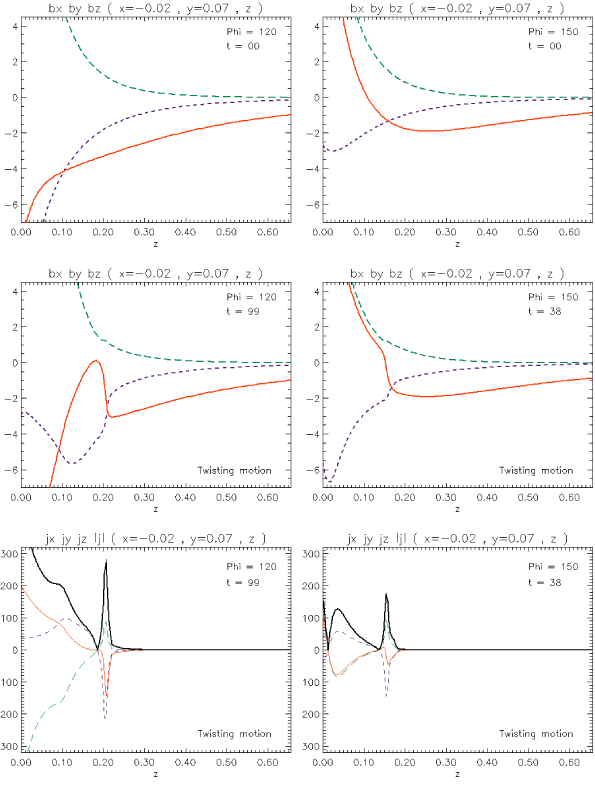
shown in the left column). |
| Open with DEXTER |
Electric current and magnetic field
profiles along z for fixed (x,y) positions passing through
the middle of the HFT
are shown in Fig. 9; from these plots, one can
estimate more quantitatively what the greyscale levels correspond
to in Figs. 6 and 7. The potential
field profiles are also drawn for comparison. These plots are comparable
in the sense that they correspond to the formation of similar small
scales in the HFT.
These plots suggest that for a given magnetic configuration, the broader
the QSLs are for its potential field, the longer the twist can be applied
on the boundary and the higher the electric currents can be generated
in the HFT, before the latter reach the scale of the mesh, i.e. the dissipative
scale.
In all our simulations, provided that the viscous term was well
adapted, the steep magnetic field gradients which progressively
form in the HFT invariably caused numerical instabilities after
several tens of Alfvén times, which eventually halted the simulations.
We verified that increasing permits to further evolve
the systems for longer times. But we did not pursue in this direction,
since the aim of this paper was to study the formation of current layers
and their possible collapse at the scale of the mesh, with reduced
diffusive effects.
The Lorentz forces are the strongest at the HFT. First analyses
show that once the scale-lengths are small enough, the Lorentz forces
lead to an undriven collapse of the current layer, and they accelerate
the plasma at its outer edges for non-zero resistivities. This results
in a magnetic reconnection-like process, but the related change of
connectivity during the diffusion is not discontinuous. Instead the
field lines tend to slip along each other on both sides of the
HFT, while their footpoints at z=0 quickly shift along the QSLs
over long distances.
Field line slippage was in fact first envisioned in the general
context of magnetic reconnection with no null point by Priest & Démoulin (1995).
Theoretical arguments for it were developed by Priest et al. (2003).
It was only recently identified in non-zero
MHD simulations
of reconnection within a thick HFT (Pontin et al. 2005) and between
sheared arcades in the frame of prominence modeling (Aulanier et al. in preparation; DeVore et al. 2005).
We thus believe that this specific behavior is the generalization
magnetic reconnection from 2D to 3D, when neither null points
nor separators are present in the system. Detailed analysis of
this process in zero-
for our modeled configurations
will be the object of a forthcoming paper following the present
one.
5 Discussion
We considered two quadrupolar configurations (Figs. 1
and 2).
They only differed by
the respective angle made between the axes of the large outer and the
small inner bipoles within one configuration. In spite of their
quadrupolar nature, these configurations were, strictly speaking,
bipolar. They did not possess separatrices. They still had strong
gradients of field line connectivity in regions called QSLs
(Figs. 3 and 4).
We considered two types of line-tied boundary motions,
with zero-
resistive MHD
simulations, using a
 non-uniform mesh.
These motions were prescribed so as to displace only the field line
footpoints within one of the polarities of the inner bipole, either by
translation, or by twisting motions (see Fig. 5).
Their maximum velocity was very
sub-Alfvénic, allowing tens of wave reflections from one footpoint
to another. They led to the advection of field lines over distances that
were small compared to the characteristic scale-lengths of the configurations
(see Fig. 1).
Their gradients had typical scale-lengths which were between that of one
single polarity and that of the whole quadrupolar configuration.
These flows neither possessed any stagnation point at the line-tied boundary
nor did they result in the formation of stagnation points in the domain
as a result of the MHD evolutions.
non-uniform mesh.
These motions were prescribed so as to displace only the field line
footpoints within one of the polarities of the inner bipole, either by
translation, or by twisting motions (see Fig. 5).
Their maximum velocity was very
sub-Alfvénic, allowing tens of wave reflections from one footpoint
to another. They led to the advection of field lines over distances that
were small compared to the characteristic scale-lengths of the configurations
(see Fig. 1).
Their gradients had typical scale-lengths which were between that of one
single polarity and that of the whole quadrupolar configuration.
These flows neither possessed any stagnation point at the line-tied boundary
nor did they result in the formation of stagnation points in the domain
as a result of the MHD evolutions.
The prescribed motions firstly resulted in the development of extended
quasi force-free currents. The location and amplitude of these currents
were directly related to the form of the motions, as is the case
in all line-tied magnetic field simulations.
The key result is that these motions also invariably resulted in the
formation of very narrow current layers, even though no true magnetic
separatrices were present in the systems (see Fig. 6).
These narrow current layers were always cospatial with the QSLs
for various footpoint motions (see Fig. 7).
Most QSLs already existed in the
potential fields, and the evolution of their shapes mainly resulted
from the advection by the boundary motions. Some secondary QSLs also formed
where the boundary motions had the steepest shear gradients. Current
layers naturally developed in these QSLs as well.
The thin volume corresponding to the highest squashing degree Q of the
QSLs had a specific shape which led us to call it a HFT. For long enough motions,
the strongest and narrowest current layer
developed around the HFT (see Figs. 6 and 8),
even though no stagnation point ever formed in this region.
In typical magnetic configurations that possess separatrices, a current
sheet is known to form with almost all kinds of boundary evolution
at the separator, or at the null point if the 3D separatrix is only
made of a fan surface and a singular spine field line. The current layer
forming at the HFT is a generalization of the latter for configurations without
separatrices, but with QSLs instead.
When the magnetic field
gradients reached the scale of the mesh, numerical instabilities developed
as a natural result of the formation of unresolved gradients in this region.
This instability could only be prevented by increasing the resistivity.
Comparisons of several configurations have shown that the wider the QSLs
were in the potential field, the stronger the currents became in the HFT
before they reached the dissipative scale (see Fig. 9).
Since we varied both magnetic field configurations and footpoint
motions, we started exploring the parameter space. The generic characteristics
of our results on the development of electric currents suggests that they must
also be valid in any magnetic configurations that have thin QSLs.
5.2 A model for solar flares: topology, energy build-up and
switch-on of reconnection
Our results have strong implications for the physics
of solar flares in general. Flare models that are based
on magnetic reconnection in narrow current layers can
be divided into two main classes. The first class involves
a large-scale MHD instability (e.g. Amari & Luciani 1999) or
a global non-equilibrium (e.g. Forbes 2000), which results
in a fast flux tube deformation on time-scales that can
be Alfvénic. The latter leads to strong vortical and/or
compressive motions,
which naturally results in the dynamic
formation of narrow current layers and in the triggering
of reconnection, with or without complex topologies in the pre-flare
configuration.
Since we have considered only modest
footpoint motions, our simulations are not directly relevant
to these models. The second class of flare models considers the
slow buildup of large current sheets in separatrices
(Somov 1992, and references therein). They
predict that the width of the current sheets
that spontaneously form in separatrices tends to zero in the
limit of infinite Lundquist number (e.g. Lau 1993; Aly 1990).
So they require that the current sheets do not diffuse for a long
time (which is problematic, as discussed by Low & Wolfson 1988),
before reconnection is switched on due to the triggering of
plasma (or MHD) instabilities within the current sheets when
some threshold is reached. Our simulations extend
the latter models, and provide natural solutions to their
difficulties.
In magnetic configurations which initially contained broader QSLs, the
electric currents in the HFT increased to higher magnitudes when
the magnetic field gradients reached the dissipative scale (Sect. 4.3).
Then if the fast energy release is not the result of a global instability,
as in our simulations, the narrower the initial QSLs are, the shorter the
time it takes to reach the dissipative scale and the less energy is likely
to be accumulated before (and released during) a flare-like event.
We then argue that the most energetic solar flares that are not triggered
by an early large-scale ideal instability must occur in magnetic configurations
whose corresponding potential field have broad QSLs. This is rather
counter-intuitive if one considers the long history of the separatrix-related
flare models mentioned above, which involve the formation of long
current sheets, which are spontaneously infinitely thin, during the
energy build-up phase.
Let us now rescale our models to solar units for an active region.
Typically, distances between P2 and N2 should be 20 Mm,
photospheric velocities should be 0.1 km s-1, and Alfvén
speeds should be 103 km s-1. In this context, the Alfvén
time is 20 s and the photospheric velocity is 10-4
of the Alfvén speed. In our simulations for
,
the
currents in the HFT reached the scale of the mesh in 102 Alfvén
times, and we used a line-tied velocity of 10-2 of the
Alfvén speed. The energy build-up phase converted to solar units
should then be of the order of 104 Alfven times, i.e.
2.3 days. This is of the order of the observed time-scales.
We then propose that the above estimations, combined with the slow
driven gradual steepening of the magnetic field gradients in the vicinity
of a HFT, until they reach small dissipative scales, permits to solve
the long standing paradigm for both the long-duration energy storage before
a flare takes place, and for the switch-on of magnetic reconnection
during the impulsive phase of the flare. This has been, in fact, one
of the main problems in line-tied separatrix-related models, as discussed
by Low & Wolfson (1988).
Our results then support and extend past works that associate
temporal and spatial properties of observed solar flares with
QSLs computed from magnetic field extrapolations.
When the magnetic configuration has a low free magnetic energy
stored or when the configuration is strongly quadrupolar, the potential field
extrapolations of observed photospheric magnetograms and
calculation of the resulting QSLs are sufficient to predict
where a flare can potentially take place (Démoulin et al. 1997; Gaizauskas et al. 1998).
When the distributed currents are important (so the free energy is
high) and the configuration is more bipolar, force-free field
extrapolations are needed to determine
the location of the QSLs with more accuracy, so the flare location
(Bagalá et al. 2000; Mandrini et al. 1996; Schmieder et al. 1997).
Extrapolations and QSLs should then also be useful for
predictingthe acceleration sites and trajectories
of solar energetic particles in flares.
5.3 The role of QSLs in coronal heating
Many models exist for heating the corona by the dissipation
of thin current layers, as extensively reviewed in
Mandrini et al. (2000). The related currents
can either be of the AC (alternative current) or of the DC
(direct current) type. Only the latter are related to
low-frequency perturbations such as sub-Alfvénic line-tied
footpoint motions. Presently, observational constraints
permit to select the most relevant models (Démoulin et al. 2003; Schrijver & Title 2005).
DC type models are among the ones which fulfill observational
requirements.
Recently, Gudiksen & Nordlund (2005) have performed MHD simulations of turbulent
flux braiding in a potential field that was extrapolated from
an observed magnetogram. The development of narrow current layers
in their simulations
was due to the line-tied driving. Since their boundary flows follow
a turbulent power-spectrum, it should naturally create small
scales and stagnation points in the velocity profiles, as
directly prescribed in the simulations of van Ballegooijen (1986)
and Galsgaard et al. (2003). Thus, one may argue that the topology of the
flow was directly at the origin of the current layers which develop
within the coronal volume.
Here we propose that another effect might play a non-negligible
role in this particular simulation, and on the Sun more generally,
based on the idea that well developed active regions are typically
composed of numerous flux concentrations. Even with strictly
bipolar and potential configurations, Démoulin & Priest (1997)
found very thin QSLs, when several flux concentrations were
embedded in a (non-zero) weaker vertical field background.
They show that the QSL thickness strongly depends on
the intensity of this background. In the present paper, we have
shown numerically that narrow current layers spontaneously develop
in such QSLs, even though we considered much simpler configurations
with only two flux concentrations on each side of the inversion line.
So we believe that at least some of the current layers in
Gudiksen & Nordlund (2005) must be associated with QSLs defined by the magnetic
flux concentrations at the boundary, rather than with the topology
of the boundary flows, which must anyway create others QSLs, even
if the magnetic field is initially homogeneous.
This conjecture and its associated time-scales should be tested in
the future. If QSLs associated to the flux concentrations dominate in
general, their calculation in potential (or force-free) field extrapolations
of any high resolution magnetogram could be a good proxy not only for
the occurrence of solar flares, but also for the locations where coronal
heating results in the illumination of discrete loops in EUV images
of the corona. Wang et al. (2000) and Fletcher et al. (2001) provided
first observational evidences of this.
Appendix A: Numerical and physical issues regarding resistive and viscous
effects in separatrices and QSLs
For the bipolar magnetic configurations that we studied, especially
for
,
but also for more general configurations, the profile
of the squashing degree Q can be very strongly peaked
(Titov et al. 2002; Démoulin et al. 1996a,b).
This peak is, in fact, infinitely high and thin in the case of separatrices. The
related full width at half maximum of the Q profiles can then often be orders
of magnitudes below the grid resolutions presently achievable in MHD simulations.
We argue that in an ideal plasma, the continuous characteristics of
the ideal MHD equations (with neither resistive nor viscous effect) should
physically advect the field lines in the volume according to the
line-tied boundary
motions. We believe that this physical advection should then typically form
thin current layers, with a thickness comparable to the QSL thickness
(zero in the case of a separatrix, see e.g. Lau 1993; Low & Wolfson 1988; Aly 1990).
The width of the current sheets that form is of major importance for
flare and reconnection modeling, since it clearly determines the diffusive
time, thus the duration of energy storage (see Sect. 5.2)
and the reconnection rate (see e.g. Petsheck 1964; Sweet 1958).
If the physical behaviour described above is also true when discretized
equations are used in a numerical simulation, the line-tied motions should
try to form sharp current layers at the QSLs on a time-scale of the order of
the travel time of Alfvén waves along a QSL field line, and at a scale
below the grid resolution, thus further leading to a quick numerical
instability over a few time steps. This fast instability clearly does not
happen in our simulations. It does happen in the HFT, but only after tens
of Alfvén time units.
Outside the HFT, but still within the QSLs, all our simulations result in
current layers that are indeed narrow, but that are still resolved and far
wider than the QSL itself (see Fig. 8 and Table 2).
The same behavior is found in many separatrix line-tied 2.5D MHD simulations
(e.g. Ma et al. 1995; Longcope & Magara 2004), which should physically result in
spontaneous zero-width current sheet formation (as discussed by Low & Wolfson 1988).
In the case of MHD numerical simulations, three questions therefore arise:
- (1)
- How is the discretized system of MHD equations sensitive to the
QSL small-scales (or separatrix zero-scale) that already exist below
the mesh resolution at t=0?
- (2)
- How do the resistive and viscous terms control the width of the
current layers that form around separatrices and QSLs?
- (3)
- How reliable are line-tied simulations of unresolved QSLs and
separatrices in the calculation of time-scales associated with
reconnection (duration of the energy storage and reconnection rate)?
In order to discuss these major issues, we performed two other
simulations (hereafter labeled "S1'' and "S2'') of our sharpest case:
with twisting motions. Both simulations were done with
exactly the same settings as the original (let us call it "S0''), except
that  in S1 and
and
in S1 and
and
 in S2.
S1 surprisingly gave very similar results to S0. In particular,
the narrow current layers that formed in the QSL, although they were
slightly more intense, spontaneously developed on the same (resolved)
scale, for tens of time units. The main difference is that S1 was
halted earlier than S0, at about
in S2.
S1 surprisingly gave very similar results to S0. In particular,
the narrow current layers that formed in the QSL, although they were
slightly more intense, spontaneously developed on the same (resolved)
scale, for tens of time units. The main difference is that S1 was
halted earlier than S0, at about  instead of 40, because of numerical instabilities developing
in the HFT, not elsewhere in the QSL. This earlier instability
was expected off course, since the
current build up at the HFT was not weakened by diffusion. However
the long duration of the ideal simulation was not expected according
to the idea that magnetic diffusion was not there to ensure that the
current layers within the QSLs remained resolved.
S2 remained stable for about one Aflvén time after the viscous
term was set to zero at t=13, and fast growing numerical instabilities
stopped the run by
instead of 40, because of numerical instabilities developing
in the HFT, not elsewhere in the QSL. This earlier instability
was expected off course, since the
current build up at the HFT was not weakened by diffusion. However
the long duration of the ideal simulation was not expected according
to the idea that magnetic diffusion was not there to ensure that the
current layers within the QSLs remained resolved.
S2 remained stable for about one Aflvén time after the viscous
term was set to zero at t=13, and fast growing numerical instabilities
stopped the run by  .
Even though common sense tells us that
setting all diffusive terms in an MHD simulations cannot result in
anything else than a numerical instability, we still performed this
run to see where and how the instability first developed. We
found that it did not occur in the HFT, but on both sides of the
magnetic configuration, around
.
Even though common sense tells us that
setting all diffusive terms in an MHD simulations cannot result in
anything else than a numerical instability, we still performed this
run to see where and how the instability first developed. We
found that it did not occur in the HFT, but on both sides of the
magnetic configuration, around
 .
These
regions did not correspond to the strongest squashing degree Q,
but rather to the regions where the ratio between the (non-uniform)
grid size to the width of the unresolved QSL peak was the highest.
.
These
regions did not correspond to the strongest squashing degree Q,
but rather to the regions where the ratio between the (non-uniform)
grid size to the width of the unresolved QSL peak was the highest.
Comparing the three simulations permits us to give some answers
to the questions addressed above.
- (1)
- Since with no diffusive term, numerical instabilities first
and very quickly develop where the QSLs are the least resolved, we
argue that our MHD code is somehow aware of the field line connectivities,
even if the latter have strong unresolved gradients. Since our numerical
scheme (described in detail in Aulanier et al. 2005) has no explicit feature
to ensure this, we believe that it is a general property of all explicit
codes that do not incorporate any important scheme-based diffusive effects.
- (2)
- Since a simulation with only viscosity is barely distinguishable
from another one with both viscous and resistive effects, it appears that
not only resistivity, but also viscosity, is a determining factor in the broadening
of current sheets. The effect of the latter is in fact to smoothe the velocity
profiles that result from the Aflvén waves that transport the information
from one field line footpoint to another. So the shearing profile of the magnetic
field on both sides of the QSL at z>0 is artificially broadened, regardless
of any resistive effect. This issue is not mentioned often in numerical simulations
of separatrices and null points, which tend to focus their parameter study on
the value of the Lundquist number.
- (3)
- Since viscosity and resistivity both limit the width of
the current layers (to achieve long runs), it seems that the
slow amplification of electric currents in magnetic field gradients that are
on the scale of the mesh (i.e. the pre-flare energy build-up phase) is fully
conditioned by the diffusive terms, which are always much higher than in
a real plasma. Hence, the current sheet gradual stretching that is calculated
in unresolved HFTs (see Fig. 8, middle panel) or at
the intersection of separatrices (e.g. Ma et al. 1995; Longcope & Magara 2004; Biskamp 1986)
may then be unphysical. This could have strong consequences in the evaluation
of reconnection rates.
In a real physical system such as the solar corona, however, the continuous MHD equations are applicable to a much broader range of spatial scales than in present
numerical simulations. We conjecture that the true width of the current layers
within QSLs should then be defined by the true profile of the squashing degree Q
(as in Fig. 8, left panel), while the boundary motions
should define the precise current magnitude within these thin layers. The central
peak of Q can have very high values, tending to infinity for a true separatrix,
and the peak width can be extremely narrow, tending to zero for a true separatrix).
Physical limitations to achieve these small scales should then be micro-physics
(diffusive) effects and finite time evolutions, if the characteristic wave
propagation speed is locally slow, e.g. in the vicinity of a magnetic null point.
More generally, this implies that the gradual amplification of electric currents
in QSLs can only be possible as long as the later are broader than the
physical dissipative scale, whatever its precise nature (resistive or
collisionless). This suggests that slow line-tying motions around separatrices
cannot account for anything more than steady coronal heating, since there, the
currents readily form at the dissipative scale.
All these conjectures are difficult to test quantitatively, since resolving thin
QSLs numerically is difficult. For very thin QSLs, MHD simulations should be
performed with very small grid scales (see the values of
 given in Table 2), which are hardly reachable with
present computers facilities. Adaptive mesh refinement techniques are plausible
ways to study a much larger range of scales. For wider QSLs, the
amplitude of footpoint motions required to generate enough currents
in the initial QSLs may be so large that new QSLs may form earlier
on smaller scales, due to the prescribed velocity-field topology at the
boundary. The newly formed QSLs can become much thinner than the
initial QSLs, thereby dominate the current buildup. This is what
happened in the simulations of Galsgaard et al. (2003), as discussed
in Démoulin (2005). Since our configuration for
has QSLs that remain resolved during about one fourth of the duration
of our simulations, a compromise between both possibilities should be
possible to investigate in a close future.
given in Table 2), which are hardly reachable with
present computers facilities. Adaptive mesh refinement techniques are plausible
ways to study a much larger range of scales. For wider QSLs, the
amplitude of footpoint motions required to generate enough currents
in the initial QSLs may be so large that new QSLs may form earlier
on smaller scales, due to the prescribed velocity-field topology at the
boundary. The newly formed QSLs can become much thinner than the
initial QSLs, thereby dominate the current buildup. This is what
happened in the simulations of Galsgaard et al. (2003), as discussed
in Démoulin (2005). Since our configuration for
has QSLs that remain resolved during about one fourth of the duration
of our simulations, a compromise between both possibilities should be
possible to investigate in a close future.
Acknowledgements
The authors thank C. R. DeVore and R. Grappin for fruitful discussions.
The calculations in this paper were done on the Digital-UNIX ES40 and
on the Compaq-HP Quadri-Opteron computers of the Service Informatique
de l'Observatoire de Paris (SIO).
- Aly, J. J. 1990, in
The Dynamic Sun, 176
- Amari, T., &
Luciani, J. F. 1999, ApJ, 515, L81 [NASA ADS] [CrossRef] (In the text)
- Aulanier, G.,
Démoulin, P., Schmieder, B., Fang, C., & Tang, Y. H.
1998, Sol. Phys., 183, 369 [NASA ADS] [CrossRef] (In the text)
- Aulanier, G.,
Démoulin, P., & Grappin, R. 2005, A&A, 430, 1067 [EDP Sciences] [NASA ADS] [CrossRef] (In the text)
- Aulanier, G.,
DeVore, C. R., & Antiochos, S. K.,
in preparation
- Bagalá,
L. G., Mandrini, C. H., Rovira, M. G., &
Démoulin, P. 2000, A&A, 363, 779 [NASA ADS]
- Baum, P. J., &
Bratenahl, A. 1980, Sol. Phys., 67, 245 [NASA ADS] [CrossRef] (In the text)
- Biskamp, D. 1986,
Phys. Fluids, 29, 1520 [NASA ADS] [CrossRef]
- Démoulin,
P. 2005, Adv. Space Res., in press
(In the text)
-
Démoulin, P., & Priest, E. R. 1997, Sol. Phys.,
175, 123 [NASA ADS] [CrossRef] (In the text)
-
Démoulin, P., Hénoux, J. C., & Mandrini,
C. H. 1994a, A&A, 285, 1023 [NASA ADS] (In the text)
-
Démoulin, P., Mandrini, C. H., Rovira, M. G.,
Hénoux, J. C., & Machado, M. E. 1994b,
Sol. Phys., 150, 221 [NASA ADS]
-
Démoulin, P., Hénoux, J. C., Priest, E. R.,
& Mandrini, C. H. 1996a, A&A, 308, 643 [NASA ADS]
-
Démoulin, P., Priest, E. R., & Lonie, D. P.
1996b, J. Geophys. Res., 101, 7631 [NASA ADS] [CrossRef]
- Démoulin,
P., Bagalá, L. G., Mandrini, C. H., Hénoux,
J. C., & Rovira, M. G. 1997, A&A, 325, 305 [NASA ADS]
- Démoulin,
P., van Driel-Gesztelyi, L., Mandrini, C. H., Klimchuk,
J. A., & Harra, L. 2003, ApJ, 586, 592 [NASA ADS] [CrossRef]
- DeVore,
C. R., & Antiochos, S. K. 2000, ApJ, 539, 954 [NASA ADS] [CrossRef]
- DeVore, C. R.,
Antiochos, S. K., & Aulanier, G. 2005, ApJ, 629, 1122 [NASA ADS] [CrossRef]
- Fletcher, L.,
López Fuentes, M. C., Mandrini, C. H., et al.
2001, Sol. Phys., 203, 255 [NASA ADS] [CrossRef] (In the text)
- Forbes, T. G.
2000, J. Geophys. Res., 105, 23153 [NASA ADS] [CrossRef] (In the text)
- Gaizauskas,
V., Mandrini, C. H., Démoulin, P., Luoni, M. L.,
& Rovira, M. G. 1998, A&A, 332, 353 [NASA ADS]
- Galsgaard,
K., & Nordlund, Å. 1996, J. Geophys. Res., 101,
13445 [NASA ADS] [CrossRef]
- Galsgaard,
K., Titov, V. S., & Neukirch, T. 2003, ApJ, 595, 506 [NASA ADS] [CrossRef] (In the text)
- Gorbachev,
V. S., & Somov, B. V. 1988, Sol. Phys., 117,
77 [NASA ADS] [CrossRef] (In the text)
- Gudiksen,
B. V., & Nordlund, Å. 2005, ApJ, 618, 1020 [NASA ADS] [CrossRef] (In the text)
- Hénoux,
J. C., & Somov, B. V. 1987, A&A, 185, 306 [NASA ADS] (In the text)
- Lau, Y. T. 1993,
Sol. Phys., 148, 301 [NASA ADS] [CrossRef]
- Longcope,
D. W., & Klapper, I. 2002, ApJ, 579, 468 [NASA ADS] [CrossRef]
- Longcope,
D. W., & Magara, T. 2004, ApJ, 608, 1106 [NASA ADS] [CrossRef]
- Low, B. C., &
Wolfson, R. 1988, ApJ, 324, 574 [NASA ADS] [CrossRef]
- Ma, Z. W., Ng,
C. S., Wang, X., & Bhattacharjee, A. 1995, Phys. Plasmas,
2, 3184 [NASA ADS] [CrossRef]
- Mandrini,
C. H., Démoulin, P., Hénoux, J. C., &
Machado, M. E. 1991, A&A, 250, 541 [NASA ADS]
- Mandrini,
C. H., Démoulin, P., Rovira, M. G., de La
Beaujardiere, J.-F., & Hénoux, J. C. 1995, A&A,
303, 927 [NASA ADS]
- Mandrini,
C. H., Démoulin, P., van Driel-Gesztelyi, L., et al.
1996, Sol. Phys., 168, 115 [NASA ADS] [CrossRef]
- Mandrini,
C. H., Démoulin, P., Bagalá, L. G., et al.
1997, Sol. Phys., 174, 229 [NASA ADS] [CrossRef]
- Mandrini,
C. H., Démoulin, P., & Klimchuk, J. A. 2000,
ApJ, 530, 999 [NASA ADS] [CrossRef] (In the text)
- Mikic, Z., Schnack,
D. D., & van Hoven, G. 1989, ApJ, 338, 1148 [NASA ADS] [CrossRef]
- Milano, L. J.,
Dmitruk, P., Mandrini, C. H., Gómez, D. O., &
Démoulin, P. 1999, ApJ, 521, 889 [NASA ADS] [CrossRef] (In the text)
- Petsheck,
H. E. 1964, in AAS-NASA Symp. Solar Flares, NASA SP-50,
425
- Pontin, D. I.,
Galsgaard, K., Hornig, G., & Priest, E. R. 2005, Phys.
plasmas, 052307
(In the text)
- Priest, E. R.,
& Démoulin, P. 1995, J. Geophys. Res., 100,
23443 [NASA ADS] [CrossRef] (In the text)
- Priest, E. R.,
Hornig, G., & Pontin, D. I. 2003,
J. Geophys. Res., 108, 1285 [CrossRef] (In the text)
- Priest, E. R.,
Longcope, D. W., & Heyvaerts, J. 2005, ApJ, 624, 1057 [NASA ADS] [CrossRef]
- Schindler,
K., Hesse, M., & Birn, J. 1988, J. Geophys. Res., 93,
5547 [NASA ADS] (In the text)
- Schmieder,
B., Aulanier, G., Démoulin, P., et al. 1997, A&A,
325, 1213 [NASA ADS]
- Schrijver,
C. J., & Title, A. M. 2005, ApJ, 619, 1077 [NASA ADS] [CrossRef]
- Somov, B. V.
1992, Physical processes in solar flares (Kluwer Academic
Publishers, Astrophysics and Space Science Library),
Vol. 172
(In the text)
- Sweet, P. A.
1958, in Electromagnetic Phenomena in Cosmical Physics, IAU Symp.,
6, 123
- Török, T.,
& Kliem, B. 2003, A&A, 406, 1043 [EDP Sciences] [NASA ADS] [CrossRef]
- Titov, V. S.
2005, in Reconnection of Magnetic Fields, ed. J. Birn, & E. R.
Priest (Cambridge, UK: Cambridge University Press)
(In the text)
- Titov, V. S.,
Priest, E. R., & Démoulin, P. 1993, A&A, 276,
564 [NASA ADS] (In the text)
- Titov, V. S.,
Hornig, G., & Démoulin, P. 2002,
J. Geophys. Res., 107, SSH 3, 1
(In the text)
- Titov, V. S.,
Galsgaard, K., & Neukirch, T. 2003, ApJ, 582, 1172 [NASA ADS] [CrossRef] (In the text)
-
van Ballegooijen, A. A. 1986, ApJ, 311, 1001 [NASA ADS] [CrossRef]
- van
Driel-Gesztelyi, L., Hofmann, A., Démoulin, P., Schmieder, B.,
& Csepura, G. 1994, Sol. Phys., 149, 309 [NASA ADS] [CrossRef]
- Wang, H., Yan, Y.,
Sakurai, T., & Zhang, M. 2000, Sol. Phys., 197, 263 [NASA ADS] [CrossRef] (In the text)
Copyright ESO 2005