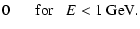
-ray emission from the starburst nucleus of NGC 253
![[*]](/icons/foot_motif.gif)
A&A 444, 403-415 (2005)
DOI: 10.1051/0004-6361:20053613
-ray emission from the starburst nucleus of NGC 253E. Domingo-Santamaría1 - D. F. Torres2,1
1 - Institut de Física d'Altes Energies (IFAE),
Edifici C-n, Campus UAB, 08193 Bellaterra, Spain
2 - Lawrence Livermore National Laboratory, 7000
East Avenue, L-413, Livermore, CA 94550, USA
Received 10 June 2005 / Accepted 9 August 2005
Abstract
Both the high density medium that characterizes the
central regions of starburst galaxies and its power to accelerate
particles up to relativistic energies make these objects good
candidates for -ray sources. In this paper we present a
self-consistent model of the multifrequency emission of the
starburst galaxy NGC 253 from radio to -rays. The model
agrees with all current measurements and provides predictions for
the high energy behavior of the NGC 253 central region. In
particular, we discuss prospects for observations with the HESS
array (and comparison with their recently obtained data) and GLAST
satellite.
Key words: ISM: cosmic rays - galaxies: starburst - galaxies: individual: NGC 253
Starburst galaxies (and star-forming regions in general) are
expected to be detected as -ray sources. They have both a
large amount of target material and multiple shocks to accelerate
particles up to relativistic energies, due to the presence of
supernova remnants and the powerful stellar winds of their
numerous young stars. Pion decay production of -rays,
usually dominant under such conditions, is thought to produce
significant -ray fluxes.
Approximately 90% of the high-energy -ray luminosity of
the Milky Way ( 1.3
1.3

 ,
Strong et al. 2000) is diffuse emission from cosmic ray
interactions with interstellar gas and photons (Hunter et al.
1997). However, the LMC is the only external galaxy that has
been detected in its diffuse -ray emission (Sreekumar et al. 1992), a fact explained by the isotropic flux dilution by
distance. At 1 Mpc, for example, the flux of the Milky Way would
be approximately
,
Strong et al. 2000) is diffuse emission from cosmic ray
interactions with interstellar gas and photons (Hunter et al.
1997). However, the LMC is the only external galaxy that has
been detected in its diffuse -ray emission (Sreekumar et al. 1992), a fact explained by the isotropic flux dilution by
distance. At 1 Mpc, for example, the flux of the Milky Way would
be approximately
 photons cm-2 s-1(>100 MeV), which is below the sensitivity achieved up to now in
the relevant energy domain. The Energetic -ray Experiment,
EGRET, did not detect any starburst. Upper limits were imposed for M 82,
photons cm-2 s-1(>100 MeV), which is below the sensitivity achieved up to now in
the relevant energy domain. The Energetic -ray Experiment,
EGRET, did not detect any starburst. Upper limits were imposed for M 82,
 photons cm-2 s-1, and NGC 253,
 photons cm-2 s-1 (Blom et al. 1999), the two nearest
starbursts, as well as for many luminous infrared galaxies, for
which similar constraints were found (Torres et al. 2004a). These
upper limits are barely above the theoretical predictions of
models for the -ray emission of galaxies, constructed with
different levels of detail (see Torres 2004b for a review).
Starbursts and luminous infrared galaxies are expected to
compensate for the flux dilution produced by their relatively
larger distance to Earth with their higher cosmic ray flux, and
become sources for the next generation of instruments measuring
photons in the 100 MeV-10 GeV regime, like the Gamma-ray Large
Area Telescope, GLAST (e.g., Völk et al.
1996; Paglione et al. 1996; Blom et al. 1999; Torres et al. 2004;
Torres 2004).
photons cm-2 s-1 (Blom et al. 1999), the two nearest
starbursts, as well as for many luminous infrared galaxies, for
which similar constraints were found (Torres et al. 2004a). These
upper limits are barely above the theoretical predictions of
models for the -ray emission of galaxies, constructed with
different levels of detail (see Torres 2004b for a review).
Starbursts and luminous infrared galaxies are expected to
compensate for the flux dilution produced by their relatively
larger distance to Earth with their higher cosmic ray flux, and
become sources for the next generation of instruments measuring
photons in the 100 MeV-10 GeV regime, like the Gamma-ray Large
Area Telescope, GLAST (e.g., Völk et al.
1996; Paglione et al. 1996; Blom et al. 1999; Torres et al. 2004;
Torres 2004).
In this paper, we analyze one such galaxy, the well-studied starburst NGC 253. We present a self-consistent multiwavelength modelling of the central region of the galaxy, taking into account the latest measurements of densities, supernova explosion rate, radio emission, and molecular mass, among other physical parameters that we use as input for our scenario.
Recently, the CANGAROO collaboration reported detection of NGC 253
at TeV -ray energies (an 11 confidence level
claim), observed during a period of two years in 2000 and 2001 for
about 150 h (Itoh et al. 2002, 2003). Their measured
differential flux was fitted by Itoh et al. (2003) with a power
law and an exponential cutoff, obtaining
confidence level
claim), observed during a period of two years in 2000 and 2001 for
about 150 h (Itoh et al. 2002, 2003). Their measured
differential flux was fitted by Itoh et al. (2003) with a power
law and an exponential cutoff, obtaining
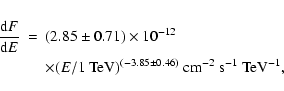
 and
and
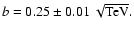 Both parameterizations are
reasonable reproductions of the observational data, although the
former is clearly preferred for simplicity given an equally good
fit. The flux uncertainty is the square root of the quadratic sum
of the statistical and systematic errors. Note that the slope of
the power law spectrum is very uncertain, but steep. Indeed, an
extrapolation of this power-law spectrum to lower energies
violates the measured upper limits in the GeV regime. The CANGAROO
collaboration suggested a turn-over below the TeV region and
proposed the second spectral form. They also claimed that the
emission at the highest energies is inconsistent with it being
produced in a point-like source, and instead proposed an inverse
Compton origin for it in a kpc-scale -ray halo.
Both parameterizations are
reasonable reproductions of the observational data, although the
former is clearly preferred for simplicity given an equally good
fit. The flux uncertainty is the square root of the quadratic sum
of the statistical and systematic errors. Note that the slope of
the power law spectrum is very uncertain, but steep. Indeed, an
extrapolation of this power-law spectrum to lower energies
violates the measured upper limits in the GeV regime. The CANGAROO
collaboration suggested a turn-over below the TeV region and
proposed the second spectral form. They also claimed that the
emission at the highest energies is inconsistent with it being
produced in a point-like source, and instead proposed an inverse
Compton origin for it in a kpc-scale -ray halo.
The HESS array has also observed NGC 253 (see below). In several other observations of sources that have previously been targets for CANGAROO, the HESS collaboration has presented results in clear contradiction to the former CANGAROO reports. This is most notably the case for SN 1006 (Aharonian et al. 2005a), PSR B1706-44 (Aharonian et al. 2005b), also for the supernova remnant RX J1713-3857 to some extent (Aharonian et al. 2004a), and the Galactic Center (Aharonian et al. 2004b). This may suggest some kind of systematic difference in the treatment of both sets of observational data. Such a systematic effect should explain why CANGAROO spectra are steeper and why their measured fluxes are one order of magnitude higher than the upper limits or measurements obtained with HESS. The CANGAROO collaboration is now calibrating their stereo system and will be re-observing these problematic cases within a year or so (R. Enomoto 2005, private communication).
In what follows, we focus on producing a detailed multiwavelength
theoretical model for the central region of NGC 253, irrespective
of CANGAROO measurements; i.e., we will not try to reproduce their
spectrum, but will derive predictions of fluxes based on a set of
well-founded assumptions. The aim is to see whether a model based
on observations at all wavelengths and first principles would
-while consistent with multiwavelength testing- predict that the
central region of NGC 253 alone can produce a sufficiently high
-ray flux to be detected by the current ground-based
Cerenkov telescopes and future MeV-GeV satellites. The central
region of the galaxy would look like a point-like source for the
field of view and angular resolution of imaging Cerenkov
telescopes. Therefore, we will be able to answer if one can expect
a HESS non-confirmation of CANGAROO results regarding perhaps both
the flux and the extension.
A wealth of new multiwavelength data was obtained for NGC 253
during the last decade, after the previous modelling by Paglione
et al. (1996), which did not include photons energies above 100 GeV
(see below).
It is located at a distance of 2.5 Mpc (Turner & Ho 1985;
Maurbersger et al. 1996) and is a nearly edge-on (inclination
78 ,
Pence 1981) barred Sc galaxy. The continuum spectrum of
NGC 253 peaks in the FIR at about 100
,
Pence 1981) barred Sc galaxy. The continuum spectrum of
NGC 253 peaks in the FIR at about 100  m with a luminosity of
 (Telesco & Harper 1980; Rice et al.
1988; Melo et al. 2002). The FIR luminosity is at least a factor
of 2 larger than that of our own Galaxy (Cox & Mezger 1989; Dudley & Wynn-Williams 1999), and it mainly comes from the
central nucleus, about half of it according to the Melo et al.
(2002) 1 arcmin resolution ISOPHOT observations. IR emission can
be understood as cold (
(Telesco & Harper 1980; Rice et al.
1988; Melo et al. 2002). The FIR luminosity is at least a factor
of 2 larger than that of our own Galaxy (Cox & Mezger 1989; Dudley & Wynn-Williams 1999), and it mainly comes from the
central nucleus, about half of it according to the Melo et al.
(2002) 1 arcmin resolution ISOPHOT observations. IR emission can
be understood as cold (
 )
dust reprocessing of stellar
photon fields.
)
dust reprocessing of stellar
photon fields.
When observed at 1 pc resolution, at least 64 individual compact
radio sources have been detected within the central 200 pc of the
galaxy (Ulvestad & Antonucci 1997), and roughly 15 of them are
within the central arcsec of the strongest radio source,
considered to be either a buried active nucleus or a very compact
SNR. Of the strongest 17 sources, about one half have flat spectra
and half have steep spectra. This indicates that perhaps half of
the individual radio sources are dominated by thermal emission
from H II regions, and half are optically thin synchrotron
sources, presumably SNRs. There is no compelling evidence of any
sort of variability in any of the compact sources over an 8-yr
time baseline.
The most powerful flat-spectrum central radio source is clearly
resolved in the study of Ulvestad & Antonucci (1997) and appears
to be larger than the R136 cluster located in 30 Doradus,
containing about 105  in stars and 600
in
ionized gas. The age was estimated to be less than
in stars and 600
in
ionized gas. The age was estimated to be less than
 yr.
The region surrounding the central 200 pc has also been observed
with subarcsec resolution and 22 additional radio sources stronger
than 0.4 mJy were detected within 2 kpc of the galaxy nucleus
(Ulvestad 2000). The region outside the central starburst
may account for about 20% of the star formation of NGC 253, is
subject to a supernova explosion rate well below 0.1 yr-1,
and has an average gas density in the range 20-200 cm-3,
much less than in the most active nuclear region of NGC 253
(Ulvestad 2000).
yr.
The region surrounding the central 200 pc has also been observed
with subarcsec resolution and 22 additional radio sources stronger
than 0.4 mJy were detected within 2 kpc of the galaxy nucleus
(Ulvestad 2000). The region outside the central starburst
may account for about 20% of the star formation of NGC 253, is
subject to a supernova explosion rate well below 0.1 yr-1,
and has an average gas density in the range 20-200 cm-3,
much less than in the most active nuclear region of NGC 253
(Ulvestad 2000).
Carilli (1996) presented low frequency radio continuum observations of the nucleus at high spatial resolution. Free-free absorption was claimed as the mechanism producing a flattening of the synchrotron curve at low energies, with a turnover frequency located between 108.5 and 109 Hz. The emission measures needed for this turnover to happen is at least 105 pc cm-6for temperatures on the order of 104 K. Tingay (2004) observed NGC 253 using the Australian Long Baseline Array and provided fits with free-free absorption models for the radio spectrum of six sources. He concluded that the free-free opacity in the central region has to be in the range of 1 to 4 at 1.4 GHz, implying emission measures of a few times 106 pc cm-6 in this particular direction, again for temperatures of the order of 104 K.
As shown by infrared, millimeter, and centimeter observations, the
200 pc central region dominates the current star formation in
NGC 253, and is considered as the starburst central nucleus (e.g.,
Ulvestad & Antonucci 1997; Ulvestad 2000). Centimeter imaging of
this inner starburst and the limits on variability of radio
sources indicate a supernova rate less than 0.3 yr-1(Ulvestad & Antonucci 1997), which is consistent with results
ranging from 0.1 to 0.3 yr-1 inferred from models of the
infrared emission of the entire galaxy (Rieke et al. 1980, 1988; Forbes et al. 1993). Van Buren &
Greenhouse (1994) developed a direct relationship between the FIR
luminosity and the rate of supernova explosions, starting from
Chevalier's (1982) model for radio emission from supernovae blast
waves expanding into the ejecta of their precursor stars. The
result is
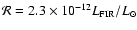 yr-1, which is in agreement with the previous estimates
within uncertainties. The star formation rate at the central
region has been computed from IR observations, resulting in 3.5 yr-1, and it represents about 70% of the total
star formation rate measured for NGC 253 (Melo et al. 2002). When
compared with Local Group Galaxies, the supernova rate in NGC 253
is one order of magnitude larger than that of M 31, the largest of
the Local Group (Pavlidou & Fields 2001).
yr-1, which is in agreement with the previous estimates
within uncertainties. The star formation rate at the central
region has been computed from IR observations, resulting in 3.5 yr-1, and it represents about 70% of the total
star formation rate measured for NGC 253 (Melo et al. 2002). When
compared with Local Group Galaxies, the supernova rate in NGC 253
is one order of magnitude larger than that of M 31, the largest of
the Local Group (Pavlidou & Fields 2001).
Paglione et al. (2004) obtained high resolution (5
 2
2  5
2) interferometric observations of the CO line
5
2) interferometric observations of the CO line
 in order to study the structure and kinematics of the molecular
gas in the central nucleus. This study enhances that of Sorai et al. (2000), which obtained compatible results, although done with
less angular resolution. The general morphology of the CO map is
consistent with other high resolution studies. It shows an
extended ridge of emission aligned with an infrared-bright bar and
a central group of bright clouds aligned with the major axis of
the galaxy, orbiting the radio nucleus in a possible ring. The
central clouds move around the radio nucleus as a solid body,
similar to the distribution of the radio sources, central HCN
clouds, and central near-infrared emission (Paglione et al. 1995, 1997; Ulvestad & Antonucci 1997).
Much of the molecular gas in NGC 253 appears to be highly excited
(Wild et al. 1992; Mao et al. 2000; Ward et al. 2003).
Observations of
in order to study the structure and kinematics of the molecular
gas in the central nucleus. This study enhances that of Sorai et al. (2000), which obtained compatible results, although done with
less angular resolution. The general morphology of the CO map is
consistent with other high resolution studies. It shows an
extended ridge of emission aligned with an infrared-bright bar and
a central group of bright clouds aligned with the major axis of
the galaxy, orbiting the radio nucleus in a possible ring. The
central clouds move around the radio nucleus as a solid body,
similar to the distribution of the radio sources, central HCN
clouds, and central near-infrared emission (Paglione et al. 1995, 1997; Ulvestad & Antonucci 1997).
Much of the molecular gas in NGC 253 appears to be highly excited
(Wild et al. 1992; Mao et al. 2000; Ward et al. 2003).
Observations of
 and
and
 transitions of CO, as well as HCN lines, suggest the existence of
localized spots with values of densities in excess of 104 cm-3 (Israel & Baas 2002; Paglione et al.
1997, 1995; Harris et al. 1991).
Bradford et al. (2003) report CO
transitions of CO, as well as HCN lines, suggest the existence of
localized spots with values of densities in excess of 104 cm-3 (Israel & Baas 2002; Paglione et al.
1997, 1995; Harris et al. 1991).
Bradford et al. (2003) report CO
 observations
and also find that the bulk of molecular gas in the central 180 pc
of the galaxy is highly excited and at a temperature of about 120 K. They conclude that the best mechanism for heating the gas is
cosmic ray bombardment over the gas residing in clouds, with
density about
observations
and also find that the bulk of molecular gas in the central 180 pc
of the galaxy is highly excited and at a temperature of about 120 K. They conclude that the best mechanism for heating the gas is
cosmic ray bombardment over the gas residing in clouds, with
density about
 cm-3.
cm-3.
Current estimates of the gas mass in the central 20
 -50
(<600 pc) region range from
-50
(<600 pc) region range from
 (Harrison et al. 1999) to
 (Houghton et al. 1997); see Bradford et al. (2003),
Sorai et al. (2000), and Engelbracht et al. (1998) for discussions.
For example, using the standard CO to gas mass conversion, the
central molecular mass was estimated as
(Houghton et al. 1997); see Bradford et al. (2003),
Sorai et al. (2000), and Engelbracht et al. (1998) for discussions.
For example, using the standard CO to gas mass conversion, the
central molecular mass was estimated as
 (Mauersberger et al. 1996). It would be factor of 3 lower if such is the correction to the conversion factor in
starburst regions, which are better described as a filled
intercloud medium, as in the case of ULIRGs, instead of a
collection of separate large molecular clouds; see Solomon et al.
(1997), Downes & Solomon (1998), and Bryant & Scoville (1999)
for discussions. Thus we will assume, in agreement with the
mentioned measurements, that within the central 200 pc, a disk of
70 pc height has
(Mauersberger et al. 1996). It would be factor of 3 lower if such is the correction to the conversion factor in
starburst regions, which are better described as a filled
intercloud medium, as in the case of ULIRGs, instead of a
collection of separate large molecular clouds; see Solomon et al.
(1997), Downes & Solomon (1998), and Bryant & Scoville (1999)
for discussions. Thus we will assume, in agreement with the
mentioned measurements, that within the central 200 pc, a disk of
70 pc height has
 uniformly
distributed, with a density of 600 cm-3. Additional
target gas mass with an average density of 50 cm-3 is
assumed to populate the central kpc outside the innermost region,
but subject to a smaller supernova explosion rate 0.01 yr-1, 10% of that found in the most powerful nucleus
(Ulvestad 2000).
uniformly
distributed, with a density of 600 cm-3. Additional
target gas mass with an average density of 50 cm-3 is
assumed to populate the central kpc outside the innermost region,
but subject to a smaller supernova explosion rate 0.01 yr-1, 10% of that found in the most powerful nucleus
(Ulvestad 2000).
The central region of this starburst is packed with massive stars.
Watson et al. (1996) discovered four young globular clusters near
the center of NGC 253; they alone can account for a mass well in
excess of
 (see also Keto et al.
1999). Assuming that the star formation rate has been continuous
in the central region for the past 109 yrs and a Salpeter IMF
for 0.08-100 ,
Watson et al. (1996) find that the
bolometric luminosity of NGC 253 is consistent with
(see also Keto et al.
1999). Assuming that the star formation rate has been continuous
in the central region for the past 109 yrs and a Salpeter IMF
for 0.08-100 ,
Watson et al. (1996) find that the
bolometric luminosity of NGC 253 is consistent with
 of young stars.
Physical, morphological, and kinematic evidence for the existence
of a galactic superwind has been found for NGC 253 (e.g., McCarthy
et al. 1987; Heckman et al. 1990; Strickland et al. 2000, 2002;
Pietsch et al. 2001; Forbes et al. 2000; Weaver et al. 2002;
Sugai et al. 2003). This superwind creates a cavity of
hot (108 K) gas, with longer cooling times than the typical
expansion timescales. As the cavity expands, a strong shock front
is formed on the contact surface with the cool interstellar
medium. Shock interactions with low and high density clouds can
produce X-ray continuum and optical line emission, respectively,
both of which have been directly observed (McCarthy et al. 1987).
The shock velocity can reach thousands of km s-1. This wind
has been proposed as the convector of particles that have been
already accelerated in individual SNRs, to the larger superwind
region, where Fermi processes could upgrade their energy up to
that detected in ultra high energy cosmic rays (Anchordoqui et al.
1999; Anchordoqui et al. 2003; Torres & Anchordoqui 2004).
of young stars.
Physical, morphological, and kinematic evidence for the existence
of a galactic superwind has been found for NGC 253 (e.g., McCarthy
et al. 1987; Heckman et al. 1990; Strickland et al. 2000, 2002;
Pietsch et al. 2001; Forbes et al. 2000; Weaver et al. 2002;
Sugai et al. 2003). This superwind creates a cavity of
hot (108 K) gas, with longer cooling times than the typical
expansion timescales. As the cavity expands, a strong shock front
is formed on the contact surface with the cool interstellar
medium. Shock interactions with low and high density clouds can
produce X-ray continuum and optical line emission, respectively,
both of which have been directly observed (McCarthy et al. 1987).
The shock velocity can reach thousands of km s-1. This wind
has been proposed as the convector of particles that have been
already accelerated in individual SNRs, to the larger superwind
region, where Fermi processes could upgrade their energy up to
that detected in ultra high energy cosmic rays (Anchordoqui et al.
1999; Anchordoqui et al. 2003; Torres & Anchordoqui 2004).
The approach to compute the steady multiwavelength emission from
NGC 253 follows the one implemented in  - DIFFUSE,
which we have already used, but with some further improvements
(Torres 2004). The steady state particle distribution is
computed within - DIFFUSE as the result of an
injection distribution being subject to losses and secondary
production in the ISM. In general, the injection distribution may
be defined to a lesser degree of uncertainty when compared with
the steady state one, since the former can be directly linked to
observations. The injection proton emissivity, following Bell
(1978), is assumed to be a power law in proton kinetic energies,
with index p,
- DIFFUSE,
which we have already used, but with some further improvements
(Torres 2004). The steady state particle distribution is
computed within - DIFFUSE as the result of an
injection distribution being subject to losses and secondary
production in the ISM. In general, the injection distribution may
be defined to a lesser degree of uncertainty when compared with
the steady state one, since the former can be directly linked to
observations. The injection proton emissivity, following Bell
(1978), is assumed to be a power law in proton kinetic energies,
with index p,
 , where K is a normalization constant and
units are such that [Q] = GeV-1 cm-3 s-1.
The normalization K is obtained from the total power transferred
by supernovae into CRs kinetic energy within a given volume
, where K is a normalization constant and
units are such that [Q] = GeV-1 cm-3 s-1.
The normalization K is obtained from the total power transferred
by supernovae into CRs kinetic energy within a given volume
 where it was assumed that
  and we used the fact that
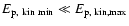 in the second
equality. The expression
in the second
equality. The expression
 (
(
 )
is defined as the rate of supernova explosions in the
star-forming region being considered, with V its volume and
)
is defined as the rate of supernova explosions in the
star-forming region being considered, with V its volume and
 the transferred fraction of the supernova explosion power
(
the transferred fraction of the supernova explosion power
(
 erg) into CRs (e.g., Torres et al. 2003
and references therein). The summation over i takes into account
that not all supernovae will transfer the same amount of power
into CRs (alternatively, that not all supernovae will release the
same power). The rate of power transfer is assumed to be in the
range
erg) into CRs (e.g., Torres et al. 2003
and references therein). The summation over i takes into account
that not all supernovae will transfer the same amount of power
into CRs (alternatively, that not all supernovae will release the
same power). The rate of power transfer is assumed to be in the
range
 ,
and the average value
for
,
and the average value
for  is
is  .
At low energies, the distribution of
cosmic rays is flatter; e.g., it would be given by Eq. (6) of Bell
(1978), correspondingly normalized. We numerically verified that
to neglect this difference at low energy does not produce any
important change in the computation of secondaries, and especially
on -rays at the energies of interest.
.
At low energies, the distribution of
cosmic rays is flatter; e.g., it would be given by Eq. (6) of Bell
(1978), correspondingly normalized. We numerically verified that
to neglect this difference at low energy does not produce any
important change in the computation of secondaries, and especially
on -rays at the energies of interest.
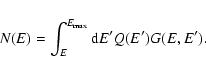
The general diffusion-loss equation is given by (see, e.g.,
Longair 1994, p. 279; Ginzburg & Syrovatskii 1964, p. 296)
 stands for the confinement
timescale, N(E) is the distribution of particles with energies
in the range E and
stands for the confinement
timescale, N(E) is the distribution of particles with energies
in the range E and
 per unit volume, and
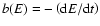 is the rate of loss of energy. The functions
b(E), ,
and Q(E) depend on the kind of particles. In
the steady state,
is the rate of loss of energy. The functions
b(E), ,
and Q(E) depend on the kind of particles. In
the steady state,
 and, under
the assumption of a homogeneous distribution of sources, the
spatial dependence is considered to be irrelevant, so that
and, under
the assumption of a homogeneous distribution of sources, the
spatial dependence is considered to be irrelevant, so that
 Equation (1) can be solved by
using the Green function
Equation (1) can be solved by
using the Green function
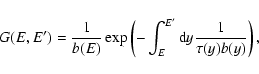 |
(2) |
 where
where  is the
velocity of the particle in units of c, R is the spatial
extent of the region from where particles diffuse away, and D(E)is the energy-dependent diffusion coefficient, whose dependence is
assumed
is the
velocity of the particle in units of c, R is the spatial
extent of the region from where particles diffuse away, and D(E)is the energy-dependent diffusion coefficient, whose dependence is
assumed 
 ,
with
,
with
 .
.  is the characteristic diffusive escape time at 1 GeV. It is
not known for NGC 253, one can only assume its value and compare it
with the one for other galaxies (e.g. our own Galaxy, or M 33,
Duric et al. 1995); the value we choose also parallels the one
obtained in an earlier study of NGC 253 or on M 82 (Paglione et al.
1996; Blom et al. 1999). We analyze the sensitivity of the model
to
below. On the other, the total escape timescale will
also take into account that particles can be carried away by the
collective effect of stellar winds and supernovae. The convective
timescale,
is the characteristic diffusive escape time at 1 GeV. It is
not known for NGC 253, one can only assume its value and compare it
with the one for other galaxies (e.g. our own Galaxy, or M 33,
Duric et al. 1995); the value we choose also parallels the one
obtained in an earlier study of NGC 253 or on M 82 (Paglione et al.
1996; Blom et al. 1999). We analyze the sensitivity of the model
to
below. On the other, the total escape timescale will
also take into account that particles can be carried away by the
collective effect of stellar winds and supernovae. The convective
timescale,
 ,
is R / V, where V is the collective
wind velocity. For a wind velocity of 300 km s-1 and a radius of
about the size of the innermost starburst (see below), this
timescale is less than a million years (
,
is R / V, where V is the collective
wind velocity. For a wind velocity of 300 km s-1 and a radius of
about the size of the innermost starburst (see below), this
timescale is less than a million years (
 yr). The
outflow velocity is not very well known; however, minimum
reasonable values between 300 and 600 km s-1 have been
claimed, and could even reach values on the order of thousands of km s-1 (Strickland et al. 2002). Pion losses (which are
catastrophic, since the inelasticity of the collision is about 50%) produce a loss timescale
yr). The
outflow velocity is not very well known; however, minimum
reasonable values between 300 and 600 km s-1 have been
claimed, and could even reach values on the order of thousands of km s-1 (Strickland et al. 2002). Pion losses (which are
catastrophic, since the inelasticity of the collision is about 50%) produce a loss timescale
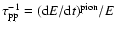 (see, e.g., Mannheim & Schlickeiser 1994), which is
similar in magnitude to the convective timescale and dominates
with it the shaping of the proton spectrum. Thus, in general, for
energies higher than the pion production threshold,
(see, e.g., Mannheim & Schlickeiser 1994), which is
similar in magnitude to the convective timescale and dominates
with it the shaping of the proton spectrum. Thus, in general, for
energies higher than the pion production threshold,
 For electrons, the total rate of energy loss
considered is given by the sum of that involving ionization,
inverse Compton scattering, bremsstrahlung, and synchrotron
radiation. We also incorporated adiabatic losses. A full
Klein-Nishina cross section is used while computing photon
emission, and either Thomson or extreme Klein-Nishina
approximations, as needed, are used while computing losses. For
the production of secondary electrons, - DIFFUSE
computes knock-on electrons and charged pion processes producing
both electrons and positrons. In the case of -ray photons,
we compute bremsstrahlung, inverse Compton and neutral pion decay
processes. For the latter, an Appendix provides a more detailed
discussion of the different approaches to compute the neutral
pion-induced -ray emissivity. For radio photons, we
compute the synchrotron and free-free emission using the steady
distribution of electrons. Free-free absorption is also considered
in order to reproduce the radio data at low frequencies. The FIR
emission is modelled with a dust emissivity law given by
For electrons, the total rate of energy loss
considered is given by the sum of that involving ionization,
inverse Compton scattering, bremsstrahlung, and synchrotron
radiation. We also incorporated adiabatic losses. A full
Klein-Nishina cross section is used while computing photon
emission, and either Thomson or extreme Klein-Nishina
approximations, as needed, are used while computing losses. For
the production of secondary electrons, - DIFFUSE
computes knock-on electrons and charged pion processes producing
both electrons and positrons. In the case of -ray photons,
we compute bremsstrahlung, inverse Compton and neutral pion decay
processes. For the latter, an Appendix provides a more detailed
discussion of the different approaches to compute the neutral
pion-induced -ray emissivity. For radio photons, we
compute the synchrotron and free-free emission using the steady
distribution of electrons. Free-free absorption is also considered
in order to reproduce the radio data at low frequencies. The FIR
emission is modelled with a dust emissivity law given by
 ,
where
,
where
 and B is the
Planck function. The computed FIR photon density is used as a
target for inverse Compton process as well as to account for
losses in the -ray scape. The latter basically comes from
the opacity to
and B is the
Planck function. The computed FIR photon density is used as a
target for inverse Compton process as well as to account for
losses in the -ray scape. The latter basically comes from
the opacity to
 pair production with the photon
field of the galaxy nucleus. The fact that the dust within the
starburst reprocesses the UV star radiation to the less energetic
infrared photons implies that the opacity to
process is significant only at the highest energies. The opacity
to pair production from the interaction of a -ray photon
in the presence of a nucleus of charge Z is considered, too. For
further details and relevant formulae see Torres (2004).
pair production with the photon
field of the galaxy nucleus. The fact that the dust within the
starburst reprocesses the UV star radiation to the less energetic
infrared photons implies that the opacity to
process is significant only at the highest energies. The opacity
to pair production from the interaction of a -ray photon
in the presence of a nucleus of charge Z is considered, too. For
further details and relevant formulae see Torres (2004).
Table 1: Measured, assumed, and derived values for different physical quantities at the innermost starburst region of NGC 253 (IS), a cylindrical disk with height 70 pc, and its surrounding disk (SD).
When compared with the previous study of high energy emission from
NGC 253 by Paglione et al. (1996), several methodological and
modelling differences need to be mentioned. The distance, size,
gas mass, density, and supernova explosion rate of the central
region that they assume are different from those quoted in Table 1. Based on earlier data (e.g., Canzian et al. 1988), the former
authors modelled a starburst region at 3.4 Mpc (a factor of 1.36
farther than the one currently adopted), with a 325 pc radius
(about 3 times larger than the one adopted here). This region is
larger than implied by current knowledge of the central starburst,
where the supernova explosion rate Paglione et al. used is
actually found and the cosmic ray density is maximally enhanced.
The average density assumed by Paglione et al., 300 cm-3,
gives a target mass
 ,
which is at
the upper end of all current claims for the central nucleus or was
already found excessive. The target mass of the innermost region
differs from ours by a factor of about 6, ours being smaller. The
fraction of the supernova explosion converted into cosmic rays
(20% for Paglione et al., a factor of 2 larger than ours) also
seems excessive as regards the current measurements of SNR at the
highest energies. We also considered a surrounding disk with a
smaller supernova rate, following the discovery of several SNRs in
that region (Ulvestad 2000), especially to test its influence in
the total -ray output. Finally, the Paglione et al. (1996)
study did not produce results above 200 GeV.
,
which is at
the upper end of all current claims for the central nucleus or was
already found excessive. The target mass of the innermost region
differs from ours by a factor of about 6, ours being smaller. The
fraction of the supernova explosion converted into cosmic rays
(20% for Paglione et al., a factor of 2 larger than ours) also
seems excessive as regards the current measurements of SNR at the
highest energies. We also considered a surrounding disk with a
smaller supernova rate, following the discovery of several SNRs in
that region (Ulvestad 2000), especially to test its influence in
the total -ray output. Finally, the Paglione et al. (1996)
study did not produce results above 200 GeV.
The - DIFFUSE set uses different parameterizations
for pion cross sections as compared with those used by Marscher
& Brown (1978), whose code was the basis of the Paglione et al.
study. Our computation of neutral pion decay -rays is
discussed in the Appendix. In addition, - DIFFUSE
uses the full inverse Compton Klein-Nishina cross section,
computes secondaries (e.g., knock-on electrons) without resorting
to parameterizations that are valid only for Earth-like cosmic ray
(CR) intensities, fixes the photon target for Compton scattering
starting from modelling the observations in the FIR, and considers
opacities to -ray scape.
We begin the discussion of our results by presenting a summary of the parameters we have used for, and obtained from, our modelling. These are given in Table 1. There, the mark OM refers to Obtained from modelling and ST or see text refers to parameters discussed in more detail in the previous section on phenomenology, where references are also given. These parameter values or range of values are fixed by observations. Finally, the mark A refers to assumed parameters, in general within a range. Variations to the values given in Table 1 are discussed below.
![\begin{figure}
\par\includegraphics[width=5.6cm,height=7cm,clip]{3613fg1a.eps}\h...
...*{4mm}
\includegraphics[width=5.6cm,height=7cm,clip]{3613fg1b.eps}
\end{figure}](/articles/aa/full/2005/47/aa3613-05/img86.gif) |
Figure 1: Steady proton ( left panel) and electron ( right panel) distributions in the innermost region of NGC 253. |
| Open with DEXTER | |
![\begin{figure}
\par\includegraphics[width=5.6cm,height=7cm,clip]{3613fg2a.eps}\h...
...*{4mm}
\includegraphics[width=5.6cm,height=7cm,clip]{3613fg2b.eps}
\end{figure}](/articles/aa/full/2005/47/aa3613-05/img87.gif) |
Figure 2: Left: ratio of the steady proton population in the surrounding disk to that in the innermost starburst region. Right: ratio between the steady proton distribution in the IS, when the gas density is artificially enhanced and diminished by a factor of 2. |
| Open with DEXTER | |
The numerical solution of the diffusion-loss equation for protons
and electrons, each subject to the losses previously described, is
shown in Fig. 1. We adopted a diffusive residence
timescale of 10 Myr, a convective timescale of 1 Myr, and a
density of 600 cm-3. In the case of electrons, the
magnetic field with which synchrotron losses are computed in Fig. 1 is 300 G. The latter is fixed below, requiring
that the steady electron population produces a flux level of radio
emission matching observations. An injection electron spectrum is
considered - in addition to the secondaries - in generating the
steady electron distribution. The primary electron spectrum is
assumed as that of the protons times a scaling factor, the inverse
of the ratio between the number of protons and electrons,
 (e.g., Bell 1978). This ratio is about 100 for the
Galaxy, but could be smaller in star-forming regions, where there
are multiple acceleration sites. For instance, Völk et al.
(1989) obtained
(e.g., Bell 1978). This ratio is about 100 for the
Galaxy, but could be smaller in star-forming regions, where there
are multiple acceleration sites. For instance, Völk et al.
(1989) obtained
 for M 82, where
 is
assumed for the central disk of NGC 253. From about
is
assumed for the central disk of NGC 253. From about
 to 10 GeV, the secondary population of electrons
(slightly) dominates, in any case. This is shown in Fig. 3. It is in this region of energies where most of the
synchrotron radio emission is generated, such that the ability to
produce a high energy model compatible with radio observations is
a cross check for the primary proton distribution.
to 10 GeV, the secondary population of electrons
(slightly) dominates, in any case. This is shown in Fig. 3. It is in this region of energies where most of the
synchrotron radio emission is generated, such that the ability to
produce a high energy model compatible with radio observations is
a cross check for the primary proton distribution.
![\begin{figure}
\par\includegraphics[width=6.7cm,height=7.6cm,clip]{3613fg3.eps}
\end{figure}](/articles/aa/full/2005/47/aa3613-05/img91.gif) |
Figure 3: Steady population of primary-only and secondary-only electrons. Only the region of the secondary dominance of the distribution is shown. |
| Open with DEXTER | |
Figure 2 shows the ratio of the steady proton
population in the SD to that in the IS. Because the SD is subject
to a smaller supernova explosion rate, it has a smaller number of
protons in its steady distribution, at all energies, on the order
of 1% of that of the IS. Then, it will play a subdominant role in
the generation of -ray emission, as we show below. In the
right panel of Fig. 2, and for further discussion in
the following sections, we present the ratio between the steady
proton distribution in the IS, when the gas density is
artificially enhanced and diminished by a factor of 2 from the
assumed value of 600 cm-3.
The continuum emission from NGC 253, at wavelengths between 1 cm and 10 microns, was measured by several authors,
e.g., see Fig. 4 and Sect. 3. Due to angular
resolution, these observations did not in general distinguish only
the emission coming from the innermost starburst region. Instead,
they also contain a contribution from the photons produced in the
surrounding disk and farther away from the nucleus. The IR
continuum emission is mainly produced thermally by dust, and thus
it could be modelled with a spectrum having a dilute blackbody
(graybody) emissivity law, proportional to
,
where B is the Planck function.
Figure 4 shows the result of this modelling and its
agreement with observational data when the dust emissivity index
,
and the dust temperature
 .
Different total luminosities, i.e. the normalization of the dust
emission (see the appendix of Torres 2004 for details), are shown
in the figure to give an idea of the contribution of the innermost
region with respect to that of the rest of the galaxy. According
to Melo et al. (2002), about half of the total IR luminosity is
produced in the IS, which is consistent with the data points being
intermediate between the curves with
.
Different total luminosities, i.e. the normalization of the dust
emission (see the appendix of Torres 2004 for details), are shown
in the figure to give an idea of the contribution of the innermost
region with respect to that of the rest of the galaxy. According
to Melo et al. (2002), about half of the total IR luminosity is
produced in the IS, which is consistent with the data points being
intermediate between the curves with

 and
,
since the latter were
obtained with beamsizes of about 20-50 arcsec (240-600 pc
at the NGC 253 distance).
and
,
since the latter were
obtained with beamsizes of about 20-50 arcsec (240-600 pc
at the NGC 253 distance).
The influence of the magnetic field upon the steady state electron
distribution is twofold. On one hand, the greater the field, the
larger the synchrotron losses - which is particularly visible at
high energies, where synchrotron losses play a relevant role. On
the other, the larger the field, the smaller the steady
distribution. These effects evidently compete with each other in
determining the final radio flux. The magnetic field is required
to be such that the radio emission generated by the steady
electron distribution is in agreement with the observational radio
data. This is achieved by iterating the feedback between the
choice of magnetic field, the determination of the steady
distribution, and the computation of radio flux, additionally
taking free-free emission and absorption processes into account.
While free-free emission is subdominant when compared with the
synchrotron flux density, free-free absorption plays a key role at
low frequencies, determining the opacity. We have found a
reasonable agreement with all observational data for a magnetic
field in the innermost region of 300 G, an ionized gas
temperature of about 104 K, and an emission measure of
 pc cm-6, the latter two in separate agreement
with the free-free modelling of the opacity of particular radio
sources, as discussed in Sect. 3. The value of magnetic field we
found for the IS is very similar to the one found for the disk of
Arp 220 (Torres 2004) and compatible with measurements in
molecular clouds (Crutcher 1988, 1994, 1999).
pc cm-6, the latter two in separate agreement
with the free-free modelling of the opacity of particular radio
sources, as discussed in Sect. 3. The value of magnetic field we
found for the IS is very similar to the one found for the disk of
Arp 220 (Torres 2004) and compatible with measurements in
molecular clouds (Crutcher 1988, 1994, 1999).
-ray emission
![\begin{figure}
\par\includegraphics[width=5.6cm,height=7cm,clip]{3613fg4a.eps}\h...
...e*{4mm}
\includegraphics[width=5.6cm,height=7cm,clip]{3613fg4b.eps}
\end{figure}](/articles/aa/full/2005/47/aa3613-05/img93.gif) |
Figure 4:
Left: multifrequency spectrum of NGC 253 from radio to
IR, with the result of our modelling. The experimental data points
correspond to: pentagons, Melo et al. (2002); diamonds, Telesco et al. (1980); down-facing triangles, Rieke et al. (1973); stars,
Hildebrand et al. (1977); up-facing triangles, Elias et al.
(1978); circles, Ott et al. (2005); squares, Carilli (1996).
Right: IR flux from NGC 253 assuming a dilute blackbody with
temperature
 K and different total
luminosities.
K and different total
luminosities. |
| Open with DEXTER | |
![\begin{figure}
\par\includegraphics[width=5.6cm,height=7cm,clip]{3613fg5a.eps}\h...
...e*{4mm}
\includegraphics[width=5.6cm,height=7cm,clip]{3613fg5b.eps}
\end{figure}](/articles/aa/full/2005/47/aa3613-05/img94.gif) |
Figure 5:
Left: differential -ray fluxes from the central
region of NGC 253. Total contribution of the surrounding disk is
shown separately, as are the EGRET upper limits. In the case of
the IS, we show the relative contributions of bremsstrahlung,
inverse Compton, and neutral pion decay to the -ray flux
separately. Right: integral -ray fluxes. The EGRET upper
limit (for energies above 100 MeV), the CANGAROO integral flux as
estimated from their fit, and the HESS sensitivity (for a
5
detection in 50 h) are given. Absorption effects are
already taken into account. Also shown is the recently released
HESS upper limit curve on NGC 253. |
| Open with DEXTER | |
In the left panel of Fig. 5, bremsstrahlung, inverse
Compton, and pion decay -ray fluxes of the IS are shown
together with the total contribution of the SD and the total
differential flux of the whole system. These results are obtained
with the model that was just shown to be in agreement with radio
and IR observations. As mentioned before, the contribution of the
SD, even when having a factor of 8 more mass than the IS,
is subdominant. The reason for this is that this region is much
less active (Ulvestad 2000).
While complying with EGRET upper limits, our predictions are
barely below them. If this model is correct, NGC 253 is bound to
be a bright -ray source for GLAST.
The integral fluxes are shown in the right panel of Fig. 5. Our model again complies with the integral EGRET upper limit for photons above 100 MeV, and predicts that, given enough observation time, NGC 253 will also appear as a point-like source in an instrument like HESS. Note, however, that quite a long exposure may be needed to detect the galaxy and also that our fluxes are only a few percent of those reported by the CANGAROO collaboration.
An additional source of TeV photons not considered here is the
hadronic production in the winds of massive stars (Romero &
Torres 2003). However, a strong star-forming region, such as the
nucleus of NGC 253, is bound to possess much more free gas than
that contained within the winds of massive stars, which albeit
numerous, have mass loss rates typically in the range of
10-6-10-7 .
-ray escape
![\begin{figure}
\par\includegraphics[width=5.6cm,height=7cm,clip]{3613fg6a.eps}\h...
...e*{4mm}
\includegraphics[width=5.6cm,height=7cm,clip]{3613fg6b.eps}
\end{figure}](/articles/aa/full/2005/47/aa3613-05/img95.gif) |
Figure 6:
Left: opacities to -ray scape as a function of
energy. The highest energy is dominated by
processes, whereas  dominates the opacity at low
energies. Significant
dominates the opacity at low
energies. Significant
 are only encountered above
1 TeV. Right: modification of the -ray spectrum introduced
by the opacity to -ray escape.
are only encountered above
1 TeV. Right: modification of the -ray spectrum introduced
by the opacity to -ray escape. |
| Open with DEXTER | |
Two sources of opacities are considered: pair production from
the -rays interaction with the photon field or with the
charged nucleus present in the medium. Compton scattering and
attenuation in the magnetic field by one-photon pair production
are negligible.
The opacity to
pair production with the photon
field, which at the same time is the target for inverse Compton
processes, can be computed as

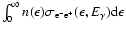 ,
where
,
where  is the energy of the target photons,
 is the energy of the -ray in consideration,
 is the place where the -ray photon was created
within the system, and
is the place where the -ray photon was created
within the system, and
 with
with
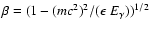 and
and
 being the Thomson cross section, is the cross section for
pair production (e.g. Cox 1999, p. 214). Note that
the lower limit of the integral on
in the expression
for the opacity is determined from the condition that the center
of mass energy of the two colliding photons should be such that
being the Thomson cross section, is the cross section for
pair production (e.g. Cox 1999, p. 214). Note that
the lower limit of the integral on
in the expression
for the opacity is determined from the condition that the center
of mass energy of the two colliding photons should be such that
 .
The fact that the dust within the starburst
reprocesses the UV star radiation to the less energetic infrared
photons implies that the opacities to
process is
significant only at the highest energies. No source of this kind
of opacity is assumed outside the system under consideration,
since the nearness of NGC 253 makes the opacity generated by
cosmological fields negligible.
.
The fact that the dust within the starburst
reprocesses the UV star radiation to the less energetic infrared
photons implies that the opacities to
process is
significant only at the highest energies. No source of this kind
of opacity is assumed outside the system under consideration,
since the nearness of NGC 253 makes the opacity generated by
cosmological fields negligible.
The cross section for pair production from the interaction of a
-ray photon in the presence of a nucleus of charge Z in
the completely screened regime (
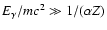 )
is independent of energy and is given by (e.g. Cox 1999,
p. 213)
)
is independent of energy and is given by (e.g. Cox 1999,
p. 213)
 .
At lower energies, the
relevant cross section is that of the no-screening case, which has
a logarithmic dependency on energy,
.
At lower energies, the
relevant cross section is that of the no-screening case, which has
a logarithmic dependency on energy,
 ,
and matches the complete screening cross section at
around 0.5 GeV. Both of these expressions are used to compute the
opacity, depending on .
,
and matches the complete screening cross section at
around 0.5 GeV. Both of these expressions are used to compute the
opacity, depending on .
Table 2:
Exploring the parameter space for p and
.
The results of our adopted model are given in the first
column. These results already take the opacity to photon escape
into account.
In the left panel of Fig. 6 we show the different
contributions to the opacity. The equation of radiation transport
appropriate for a disk is used to compute the predicted
-ray flux taking all absorption processes into account
(see appendix in Torres 2004 for details). The right panel of Fig. 6 shows the effect of the opacity on the integral
-ray fluxes, only evident above 3 TeV.
As summarized in Table 1, most of the model parameters are well
fixed from observations. There are, however, a couple of
assumptions which may produce slight degeneracies, while not being
well bounded from experiments. Consider for instance the proton
injection slope p and the diffusive scale .
For the
former we have assumed p=2.3, which agrees with the recent
results from HESS regarding -ray observations at TeV
energies of supernova remnants and unidentified extended sources.
However, it would certainly be within what one would expect from
proton acceleration in supernova remnants, and also within
experimental uncertainty, if a better description for the average
proton injection slope in NGC 253 is 2.2 instead of 2.3. Table 2 shows the influence of this kind of choice on our final
results. A harder slope slightly increases the integral flux.
Similarly, the diffusive timescale is not well-determined, and it
may be arguable perhaps within one order of magnitude. Table 2 also shows the influence of this choice. Ultimately,
high energy -ray observations (from GeV to TeV) are the
ones to impose constraints on these values. In any case, we notice
that pp interaction and convection timescales are much shorter (<1 Myr), thus dominating the form of N(E). To show this in
greater detail, we give the result for the proton distribution in
Fig. 7 when different convective and the pp
timescales are taken into account as compared with the solution
when
 ,
i.e., diffusion only. Clearly, convection
plus pp timescales dominates the spectrum.
,
i.e., diffusion only. Clearly, convection
plus pp timescales dominates the spectrum.
![\begin{figure}
\par\includegraphics[width=5.6cm,height=7cm,clip]{3613fg7.eps}
\end{figure}](/articles/aa/full/2005/47/aa3613-05/img112.gif) |
Figure 7:
Proton distribution when different convective and the pp
timescales are taken into account as compared with a (arbitrary)
solution when
 ,
i.e., diffusion only. Clearly,
convection plus pp timescales dominates the spectrum. ,
i.e., diffusion only. Clearly,
convection plus pp timescales dominates the spectrum. |
| Open with DEXTER | |
Regarding degeneracies, both the proton slope and the confinement timescales, however, cannot be much different from what we have assumed. If the former were to differ significantly, it would be impossible to reproduce the radio data, which is the result of the synchrotron emission of the secondary electrons. Changes in the number of protons in the IS would imply a change in the magnetic field to reproduce radio observations, which clearly cannot be pushed much either.
In a less impacting way, varying the value of
can also
vary the results. This variation would be slight because of the
influence of the more numerous secondary electrons in the
energetic region of interest for radio emission. On the same
track, varying the diffusion coefficient
does not cause
substantial changes. Finally, if the maximum proton energy were to
differ from the value of 100 TeV we have assumed, the end of the
spectrum would accordingly shift slightly, but we do not expect it
to happen in a significant way, since we do now observationally
know that supernova remnants are sources of 10 TeV photons.
Even within an artificially enlarged uncertainty of the gas
density, the results will not be modified much; if for any reason
the average particle density were to be a factor of 2 smaller or
larger, the -ray integral flux variations would be within 4% for energies above 100 MeV, and within 25% for energies
above 200 GeV. Table 3 shows these results by
presenting the integral fluxes above a given threshold if the
assumed density of 600 cm-3 is doubled or halved. As can be
seen in the right panel of Fig. 2, if the density is
larger (smaller) by a factor 2, the resulting steady proton
distribution from the same proton injection population is smaller
(bigger) by a similar factor over a wide range of proton energies.
As -ray emissivities are proportional to both the medium
density and the number of steady protons, the variations in
-ray fluxes are compensated for quite well.
Table 3:
The effect of the medium gas density on the
-ray integral fluxes. Results provided are in units of
photons cm-2 s-1, and already take the opacity to photon
escape into account.
The left panel of Fig. 8 presents the energy density
contained in the steady proton population above a certain energy;
i.e., based on Fig. 1, the curve shows the integral
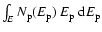 .
The total energy density
contained by the steady population of cosmic rays above 1 GeV is
about 10-3 of the power emitted by all supernova explosions
in the last 5 million years. The energy density contained in the
steady electron population is several orders of magnitude less
important.
.
The total energy density
contained by the steady population of cosmic rays above 1 GeV is
about 10-3 of the power emitted by all supernova explosions
in the last 5 million years. The energy density contained in the
steady electron population is several orders of magnitude less
important.
The cosmic ray enhancement is a useful parameter in estimating
-ray luminosities in different scenarios. It is defined as
the increase in the cosmic ray energy density with respect to the
local value,
 ,
where
,
where
 is the local cosmic ray
distribution obtained from the measured cosmic ray flux that we
quote in the Appendix. The enhancement factor
is the local cosmic ray
distribution obtained from the measured cosmic ray flux that we
quote in the Appendix. The enhancement factor  is then
a function of energy given by
is then
a function of energy given by
 .
Values of enhancement
for NGC 253 were proposed
.
Values of enhancement
for NGC 253 were proposed
 for energies
above 1 GeV (e.g., Suchkov et al. 1993), and we can actually
verify this in our model. The right panel of Fig. 8
presents the enhancement factor as a function of proton energy.
The larger the energy, the larger the enhancement, due to the
steep decline (E-2.75) of the local cosmic ray
spectrum.
for energies
above 1 GeV (e.g., Suchkov et al. 1993), and we can actually
verify this in our model. The right panel of Fig. 8
presents the enhancement factor as a function of proton energy.
The larger the energy, the larger the enhancement, due to the
steep decline (E-2.75) of the local cosmic ray
spectrum.
![\begin{figure}
\par\includegraphics[width=5.6cm,height=7cm,clip]{3613fg8a.eps}\h...
...e*{4mm}
\includegraphics[width=5.6cm,height=7cm,clip]{3613fg8b.eps}
\end{figure}](/articles/aa/full/2005/47/aa3613-05/img119.gif) |
Figure 8: Left: energy density contained in the steady population of protons above the energy given by the x-axis. Right: cosmic ray enhancement factor obtained from the steady spectrum distribution in the innermost starburst nucleus of NGC 253. |
| Open with DEXTER | |
The HESS array has just released (Aharonian et al. 2005c) their
results for NGC 253. These are based on data taken during the
construction of the array with 2 and 3 telescopes operating. The
total observation time was 28 hs, with a mean zenith angle of
about 14 degrees. Only events where at least two telescopes were
triggered were used, to enable stereoscopic reconstruction. The
energy threshold for this dataset was 190 GeV. Upper limits from
HESS on the integral flux of -rays from NGC 253 (99%
confidence level) are shown, together with our predictions, in the
right panel of Fig. 5, and zoomed in the region above
100 GeV in Fig. 9. As an example, above 300 GeV, the
upper limit is
 photons cm-2 s-1.
It can be seen that our predictions are below these upper limits
at all energies but still above HESS sensitivity for reasonable
observation times.
photons cm-2 s-1.
It can be seen that our predictions are below these upper limits
at all energies but still above HESS sensitivity for reasonable
observation times.
We have presented a multifrequency model of the central region of
NGC 253. Following recent observations, we modelled an innermost
starburst with a radius of 100 pc and a supernova explosion rate
of 0.08 yr-1, and with a surrounding disk up to a 1 kpc in
radius with an explosion rate about tenfold smaller. As a result
of our modelling, we found that a magnetic field of 300 G for
the innermost region is consistent with high resolution radio
observations, with the radiation at 1 GHz mostly produced by
secondary electrons of cosmic ray interactions. The magnetic field
found for the innermost part of NGC 253 is typical of dense
molecular clouds in our Galaxy, and is close to the (270 G)
value proposed by Weaver et al. (2002) using the equipartition
argument. We estimated free-free emission and absorption, and
considered opacities to the -ray escape. The hard X-ray
emission from IC and bremsstrahlung processes produced in this
model is below observational constraints, e.g., by OSSE in
agreement with previous estimations of bremsstrahlung diffuse
emission (Bhattacharya et al. 1994). This is consistent with
measurements in the center of the Galaxy, where INTEGRAL have
shown that hard X-ray emission is not diffusive, but produced by
point-like sources (Lebrun et al. 2004).
![\begin{figure}
\par\includegraphics[width=5.6cm,height=7cm,clip]{3613fg9.eps}
\end{figure}](/articles/aa/full/2005/47/aa3613-05/img121.gif) |
Figure 9:
Integral -ray fluxes zoomed in the region above
100 GeV, together with the (2 telescopes) HESS upper limits and
the (4 telescopes) HESS sensitivity. |
| Open with DEXTER | |
The predicted flux is based on a set of a few well-founded
assumptions, mainly a) that supernova remnants accelerate most of
the cosmic rays in the central region of NGC 253, and b) that they
interact with the present gas, whose amount has been measured
using a variety of techniques. The low opacity to -ray
escape ensures that basically all -rays produced in the
direction towards Earth reach us. Observational constraints
establish the values of the supernova explosion rate and gas
content (see Sect. 2 for references).
The ease of all the assumptions made in our model, its concurrence
with all observational constraints, and the unavoidability of the
processes analyzed, all lead us to conclude that: 1) GLAST will
detect NGC 253, with our predicted luminosity (
 photons cm-2 s-1 above 100 MeV) well above its
1 yr all-sky survey sensitivity (GLAST Science Requirements Doc.
2003); 2) that our predicted TeV fluxes are about one order of
magnitude smaller than what was claimed by CANGAROO and, thus,
that perhaps in this case, a similar problem to that found in
other sources affected their data taking or analysis, and 3) that
HESS could detect the galaxy as a point-like source, provided it
is observed long enough with the full array (
photons cm-2 s-1 above 100 MeV) well above its
1 yr all-sky survey sensitivity (GLAST Science Requirements Doc.
2003); 2) that our predicted TeV fluxes are about one order of
magnitude smaller than what was claimed by CANGAROO and, thus,
that perhaps in this case, a similar problem to that found in
other sources affected their data taking or analysis, and 3) that
HESS could detect the galaxy as a point-like source, provided it
is observed long enough with the full array ( 50 h,
for a detection between 300 and 1000 GeV).
We finally note that this model predicts a steady -ray
source, so that a posteriori variability estimators (e.g., Torres
et al. 2001) can be checked for consistency.
50 h,
for a detection between 300 and 1000 GeV).
We finally note that this model predicts a steady -ray
source, so that a posteriori variability estimators (e.g., Torres
et al. 2001) can be checked for consistency.
Acknowledgements
The work of ED-S was done under a FPI grant of the Ministry of Science and Tecnology of Spain. The work of DFT was performed under the auspices of the U.S. D.O.E. (NNSA), by the University of California Lawrence Livermore National Laboratory under contract No. W-7405-Eng-48. We thank Juan Cortina, Igor Moskalenko, and Olaf Reimer for comments. We thank the referee, V. Dogiel, for remarks that led to improvement of this work.
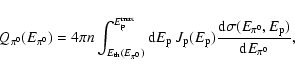
The  emissivity resulting from an isotropic intensity of
protons,
emissivity resulting from an isotropic intensity of
protons,
 ,
interacting with fixed target nuclei with
number density n, through the reaction
,
interacting with fixed target nuclei with
number density n, through the reaction
 ,
is given by (e.g., Stecker
1971)
,
is given by (e.g., Stecker
1971)
 is the maximum energy of protons in the system, and
 is the minimum proton energy required to
produce a pion with total energy
is the minimum proton energy required to
produce a pion with total energy  .
The integral lower
limit is determined through kinematical considerations. It is
basically obtained using the invariant,
.
The integral lower
limit is determined through kinematical considerations. It is
basically obtained using the invariant,
 ,
where s is the square of the total energy in the
center-of-mass system, MX depends on the reaction channel and
represents the invariant mass of the system consisting of all
particles except the pion, and
,
where s is the square of the total energy in the
center-of-mass system, MX depends on the reaction channel and
represents the invariant mass of the system consisting of all
particles except the pion, and  is the CMS energy of
the produced meson, which is connected with the laboratory system
energy via a Lorentz transformation (see appendices of Moskalenko
& Strong 1998 and Blattnig et al. 2000b). Then,
is the CMS energy of
the produced meson, which is connected with the laboratory system
energy via a Lorentz transformation (see appendices of Moskalenko
& Strong 1998 and Blattnig et al. 2000b). Then,
 ,
so that for a given
value of s,
will be maximum when Mx takes its
minimum value. For the case of neutral pion production,
,
so that for a given
value of s,
will be maximum when Mx takes its
minimum value. For the case of neutral pion production,
 .
The laboratory system pion energy, obtained from
,
can be put as a function of s. Inverting this
relation, thus obtaining
.
The laboratory system pion energy, obtained from
,
can be put as a function of s. Inverting this
relation, thus obtaining
 ,
and using
,
and using
 allow for the minimum proton energy to
be derived. Finally,
allow for the minimum proton energy to
be derived. Finally,
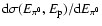 is
the differential cross section for the production of a pion with
energy
in the lab frame, due to a collision of a
proton of energy
is
the differential cross section for the production of a pion with
energy
in the lab frame, due to a collision of a
proton of energy  with a hydrogen atom at rest.
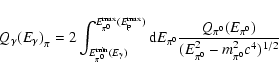
The -ray emissivity is obtained from the neutral pion
emissivity  as
as
 is the minimum pion energy required to produce a
photon of energy
(e.g., Stecker 1971), and
is the minimum pion energy required to produce a
photon of energy
(e.g., Stecker 1971), and
 is the maximum pion energy that the
population of protons can produce. It is obtained using the
invariant equation for the maximum proton energy resident in the
system.
is the maximum pion energy that the
population of protons can produce. It is obtained using the
invariant equation for the maximum proton energy resident in the
system.
As a result, an accurate knowledge of the differential cross
section for pion production becomes very important to estimate the
-ray emissivity. Note that
can be thought to contain the inclusive total
inelastic cross section (i.e. the cross section multiplied by the
average pion multiplicity). This can be stated explicitly as, for
instance, in Dermer's (1986a) Eq. (3).
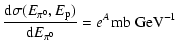
 -function approximation
In this formalism (Aharonian & Atoyan 2000),
is the total cross-section of inelastic pp collisions, and
 is the mean fraction of the kinetic energy
 of the proton transferred to the secondary meson
per collision. In a broad region from GeV to TeV energies,
of the proton transferred to the secondary meson
per collision. In a broad region from GeV to TeV energies,
 .
In this approximation, then, an accurate knowledge of
the total inelastic cross section is needed to compute the
-ray emissivity.
.
In this approximation, then, an accurate knowledge of
the total inelastic cross section is needed to compute the
-ray emissivity.
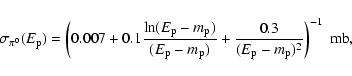
Aharonian & Atoyan (2000) propose that, since the cross section
appears to rise rapidly from the threshold at
 GeV to about 30 mb at energies about
 GeV, and since after that energy it increases only
logarithmically, a sufficiently good approximation is to assume
GeV, and since after that energy it increases only
logarithmically, a sufficiently good approximation is to assume
-ray emissitivities,
since most of the -rays are generated by primary protons
having more energy than a few GeV, provided the spectrum of
primaries is sufficiently broad.
![\begin{figure}
\par\includegraphics[width=5.6cm,height=7cm,clip]{3613f10a.eps}\h...
...e*{4mm}
\includegraphics[width=5.6cm,height=7cm,clip]{3613f10b.eps}
\end{figure}](/articles/aa/full/2005/47/aa3613-05/img154.gif) |
Figure 10: Comparing sum of diffractive and non-diffractive contributions Kamae et al. model A with Aharonian and Atoyan's formula for the total inelastic cross section. |
| Open with DEXTER | |
In a recent paper, Kamae et al. (2005) introduced the effect of
diffractive interactions and scaling violations in
 interactions. The diffractive interactions' contribution
was usually neglected in all the other computations of
-ray emissivity from neutral pion decay to date, and thus
one would expect an increase in the predicted fluxes. The best
model by Kamae et al., dubbed A, for the inelastic (not
inclusive)
cross section is given in Table 1 of their paper, Cols. 2 and 3.
When one compares the sum of both diffractive and non-diffractive
contributions of the Kamae et al. model with Aharonian and
Atoyan's formula, one sees that the latter produces an actually
larger (but quite close) cross section. Figure 10 shows
these results above proton kinetic energies of 1 GeV, as well as
the difference between these cross sections. Kamae et al.'s model
A was compared with Hagiwara's (2002) compilation of pp cross
section measurements and found to be in good agreement. When
multiplicity is taken into account, Kamae et al.'s model also
agrees with the data on inclusive cross sections, a point we
discuss in more detail below.
interactions. The diffractive interactions' contribution
was usually neglected in all the other computations of
-ray emissivity from neutral pion decay to date, and thus
one would expect an increase in the predicted fluxes. The best
model by Kamae et al., dubbed A, for the inelastic (not
inclusive)
cross section is given in Table 1 of their paper, Cols. 2 and 3.
When one compares the sum of both diffractive and non-diffractive
contributions of the Kamae et al. model with Aharonian and
Atoyan's formula, one sees that the latter produces an actually
larger (but quite close) cross section. Figure 10 shows
these results above proton kinetic energies of 1 GeV, as well as
the difference between these cross sections. Kamae et al.'s model
A was compared with Hagiwara's (2002) compilation of pp cross
section measurements and found to be in good agreement. When
multiplicity is taken into account, Kamae et al.'s model also
agrees with the data on inclusive cross sections, a point we
discuss in more detail below.
Figure 11 shows a comparison of the -ray
emissivity obtained when using Kamae et al.'s model A and Eq. (6). Curves are practically indistinguishable in this
scale, and their ratio is well within a factor of 1.3. In
this comparison, the proton spectrum is the Earth-like one,
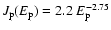 protons cm-2 s-1 sr-1 GeV-1 and n=1 cm-3. The resulting -ray
emissivity is multiplied by 1.45 to account for the contribution
to the pion spectrum produced in interactions with heavier nuclei
both as targets and as projectiles (Dermer 1986a). Aharonian and
Atoyan's expression for the cross section produces a slightly
larger value of emissivity than that obtained with Kamae's model A, including non-diffractive interactions.
protons cm-2 s-1 sr-1 GeV-1 and n=1 cm-3. The resulting -ray
emissivity is multiplied by 1.45 to account for the contribution
to the pion spectrum produced in interactions with heavier nuclei
both as targets and as projectiles (Dermer 1986a). Aharonian and
Atoyan's expression for the cross section produces a slightly
larger value of emissivity than that obtained with Kamae's model A, including non-diffractive interactions.
![\begin{figure}
\par\includegraphics[width=5.6cm,height=7cm,clip]{3613f11.eps}
\end{figure}](/articles/aa/full/2005/47/aa3613-05/img157.gif) |
Figure 11:
Comparing -ray emissivities within the
-function approximation (Kamae et al.'s model A and
Aharonian and Atoyan's formula for the inelastic cross section)
with computations using differential cross section
parameterizations. |
| Open with DEXTER | |
Recently, Blattnig et al. (2000) developed parameterizations of
the differential cross sections. They have presented a
parameterization of the Stephens & Badhwar's (1981) model by
numerically integrating the Lorentz-invariant differential cross
section (LIDCS). The expression of such parameterization is
divided into two regions, depending on the (laboratory frame)
proton energy (Blattnig et al. 2000, see their Eqs. (23) and (24)).
Blattnig et al. have also developed an alternative
parameterization that has a much simpler analytical form. It is
given by
 |
50 GeV in Blattnig et al.'s
(2000) paper. It was found that a single expression is needed to
represent the total inclusive cross section,
-ray photon yield that is output from the use of
these two differential cross sections in Eqs. (4) and (5) is also shown for an Earth-like
spectrum, in Fig. 11.
![\begin{figure}
\par\includegraphics[width=5.6cm,height=7cm,clip]{3613f12a.eps}\h...
...e*{4mm}
\includegraphics[width=5.6cm,height=7cm,clip]{3613f12b.eps}
\end{figure}](/articles/aa/full/2005/47/aa3613-05/img161.gif) |
Figure 12:
Left: comparing inclusive cross sections. Kamae et al.'s
model A data comes from their Fig. 5. The Blattnig et al. curve is
obtained from Eq. (9) and the experimental compilation is
from Dermer (1986b). Right: -ray emissivities as in Fig.
11 multiplied by E2.75, with 2.75 being the
slope of the proton primary spectrum. |
| Open with DEXTER | |
Table 4: Integrated emissivities for an Earth-like spectrum. Values are in units of photons cm-3 s-1.
![\begin{figure}
\par\includegraphics[width=5.6cm,height=7cm,clip]{3613f13a.eps}\h...
...e*{4mm}
\includegraphics[width=5.6cm,height=7cm,clip]{3613f13b.eps}
\end{figure}](/articles/aa/full/2005/47/aa3613-05/img162.gif) |
Figure 13: Comparing inclusive cross sections for charged pions. Solid curves are obtained from Eqs. (30) and (31) of Blattnig et al. (2000b), and experimental compilation is from Dermer (1986b). |
| Open with DEXTER | |
However, the inclusive total inelastic cross section (9)
seems to work well at energies higher than 50 GeV, which we show
in Fig. 12, together with a compilation of
experimental data (Dermer 1986b).
In the same figure we also show the results for the inclusive
total cross section from model A of Kamae et al. (2005), obtained
from his Fig. 5. Indeed, this model produces a slightly higher
cross section, although both correlate reasonably well with
experimental data, at least up to 3 TeV. It is the differential cross section parameterization
(given by Eq. (8)) that looks suspicious at such
high energies. The right panel of Fig. 12 shows the
emissivities as computed in the different approaches multiplied by
E2.75. As expected, Stephen and Badhwar's parameterization
falls quickly at high energy, whereas both the Kamae et al. and
Aharonian and Atoyan cross sections ensure that the -rays
emitted maintain a spectrum close to that of the proton primaries.
For -rays above few TeV (i.e., -rays mostly
generated by protons above few tens of TeV), Blattnig et al.
differential cross section parameterization makes the -ray
emitted spectrum much harder than the proton spectrum that
produced them. This signals that a direct extrapolation of Eq. (8) for computing photon emissivity above TeV
with Eq. (5) induces overpredictions of fluxes.
Table 4 presents the results for the integrated
emissivity,
 ,
with Q(E) being the different
curves of Fig. 11. To obtain integrated fluxes
from a source of volume V at a distance D, one has to multiply
by the constant
,
with Q(E) being the different
curves of Fig. 11. To obtain integrated fluxes
from a source of volume V at a distance D, one has to multiply
by the constant
 ,
so that the difference in
integrated emissivities indeed represent those among integrated
fluxes. As Table 4 shows -disregarding those coming
from the Blattnig et al. parameterization of Stephen and Badwhar's
results, which are quoted here just for completeness - above 100 MeV, differences are less than a factor of 1.5, which most likely
is washed away by other uncertainties in any given model. But
above 300 GeV, difference are larger and a conservative choice is
in order.
,
so that the difference in
integrated emissivities indeed represent those among integrated
fluxes. As Table 4 shows -disregarding those coming
from the Blattnig et al. parameterization of Stephen and Badwhar's
results, which are quoted here just for completeness - above 100 MeV, differences are less than a factor of 1.5, which most likely
is washed away by other uncertainties in any given model. But
above 300 GeV, difference are larger and a conservative choice is
in order.
If interested in the GLAST-domain (say, E>100 MeV, E<50 GeV)
predictions, the most conservative choice seems to be to use the
new Blattnig et al. differential cross section parameterization
(Eq. (8)), with no other approximation, in Eqs. (4) and (5). This choice, while not taking
non-diffractive processes into account, will possibly slightly underpredict the integrated flux (as shown in Table 4). Up to this moment, there is no public
parameterization of the differential cross section including
diffractive effects, but one is to be presented soon (T. Kamae,
private communication). By using the Blattnig et al. approach,
there is no -function approximation involved or an ad-hoc
histogram of particle numbers as proposed in the treatment of
Kamae et al. (2005). One has an analytical expression that can be
directly used in the numerical estimates of Eq. (5).
However, the price to pay is that this form of computation cannot
be considered reliable at higher energies and should not be used.
For the IACTs-domain (E>100 GeV), the safest and also
computationally-preferable choice appears to be to take either
Kamae et al.'s model A, or even the simpler Aharonian and Atoyan's
expression (Eq. (7)) and a -function approximation.
This approach would probably be slightly underestimating the
integrated flux at such high energies. All in all, assuming either
Kamae et al.'s or Aharonian and Atoyan's expression for all
energies does not introduce substantial differences, as Table
4 shows.
Finally, in Fig. 13 we compare the inclusive cross sections for charged pions with experimental data up to about 1 TeV, which are again found to agree with experimental data, except for a bunch of data points at low proton energies in the case of positive charged pions. In any case, for situations where the density of cosmic rays or of target nuclei or both are high, neutral pion decay is expected to be the dominant process above 100 MeV, so that possible uncertainties in parameterizations of the cross sections of charged pions are not expected to play a significant role in the prediction of fluxes.
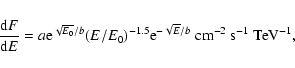
![\begin{displaymath}- D \bigtriangledown ^2 N(E)+\frac{N(E)}{\tau(E)} -
\frac{\rm...
...ght]\! -\! Q(E) \!=\! - \frac{\partial
N(E)}{\partial t} \cdot
\end{displaymath}](/articles/aa/full/2005/47/aa3613-05/img53.gif)