![[*]](/icons/foot_motif.gif)
A&A 444, 45-50 (2005)
DOI: 10.1051/0004-6361:20053647
J. An - N. W. Evans
Institute of Astronomy, University of Cambridge, Madingley Road, Cambridge CB3 0HA, UK
Received 17 June 2005 / Accepted 17 August 2005
Abstract
We introduce a simple family of models for representing the dark
matter in galaxies. The potential and phase space distribution
function are all elementary, while the density is cusped. The models
are all hypervirial, that is, the virial theorem holds locally, as
well as globally. As an application to dark matter studies, we
compute some of the properties of  -ray sources caused by
neutralino self-annihilation in dark matter clumps.
-ray sources caused by
neutralino self-annihilation in dark matter clumps.
Key words: galaxies: kinematics and dynamics - galaxy: halo - cosmology: dark matter - gamma rays: theory
It is worthwhile to find simple models for the distribution of dark
matter in galaxy haloes. This is tantamount to solving the collisionless
Boltzmann and Poisson equations for the distribution function f,
potential  ,
and density
,
and density  of the dark matter particles.
Many authors start by assuming a profile for the dark matter density and then solving for the self-consistent potential and distribution function. This has provided some widely-used and notable models for dark matter haloes (e.g., Hernquist 1990; Jaffe 1983). A drawback to this approach is that, even if the density and potential are simple, the distribution function is often unwieldy. For example, the distribution function of the Jaffe (1983) model is a higher transcendental function, while the distribution function of the Hernquist (1990) model is composed of an unwieldy bunch of elementary functions.
It can be advantageous to tackle this problem the other way round, by assuming a simple distribution function (DF) and then solving for the self-consistent potential and the density. Except for Toomre (1982), this reverse approach has not been widely used. Here, we exploit it to build a flexible family of cusped dark matter halo models with an elementary DF and potential (Sects. 2 and 3).
As a simple application, we use our models to study the signal from
indirect detection experiments (Sect. 4). In particular,
-rays from dark matter annihilation may be identified by
forthcoming atmospheric Cerenkov telescopes such as
VERITAS or by
satellite-borne detectors like
GLAST, and so it is
useful to have definite predictions from halo models.
Let us assume that the dark halo is spherical, in which case the DF
may depend on the binding energy E and the magnitude of the angular
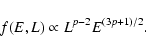
momentum L. Let us note that the generalized Plummer models,
recently studied by Evans & An (2005) have very simple power-law DFs of the
form
 |
(1) |
 and
and
 respectively. Whereas the anisotropy parameter
 is no longer constant in contrast to models of Evans & An (2005),
we still find the remarkably simple relation between the
three-dimensional velocity dispersion and the potential;
is no longer constant in contrast to models of Evans & An (2005),
we still find the remarkably simple relation between the
three-dimensional velocity dispersion and the potential;
 )
is exactly one-half of the magnitude of the local
contribution to the potential energy by the same volume element
(
)
is exactly one-half of the magnitude of the local
contribution to the potential energy by the same volume element
(
 ). This idea can be traced back to the classical
investigations of Plummer (1911) and Eddington (1916). It has received
additional impetus from the recent N-body simulations of
Sota et al. (2005).
). This idea can be traced back to the classical
investigations of Plummer (1911) and Eddington (1916). It has received
additional impetus from the recent N-body simulations of
Sota et al. (2005).
While we have established that any spherical system described by a
distribution function of the form of Eq. (2) is
hypervirial, we still have to find the corresponding density and
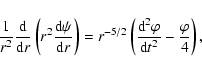
potential by solving Poisson's equation (here G=1)
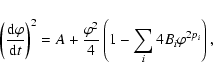
Even for the general case when the sum contains more than one terms,
the order of Eq. (6) can be reduced in a similar manner
(cf., Chandrasekhar 1939). First, let us consider the substitution
 and
and  .
Then, the
left hand side of Eq. (6) transforms
.
Then, the
left hand side of Eq. (6) transforms
 |
(7) |
 |
(8) |
 |
(9) |
 and
and
 ), we find that A=0.
Then, after
introducing a further transformation of the variable,
), we find that A=0.
Then, after
introducing a further transformation of the variable,
 ,
equation (10) reduces to
,
equation (10) reduces to
 if p=pi or p=2pi for all distinct pi's. For the
simplest case when the sum contains only a single term, it is
straightforward to show that either choice of p leads to the
solution that reduces to the models of Evans & An (2005) with the
integration constant being the scalelength. The only other possibility
is that the sum contains two terms with
p=p1=2p2, which is
investigated in the following section.
if p=pi or p=2pi for all distinct pi's. For the
simplest case when the sum contains only a single term, it is
straightforward to show that either choice of p leads to the
solution that reduces to the models of Evans & An (2005) with the
integration constant being the scalelength. The only other possibility
is that the sum contains two terms with
p=p1=2p2, which is
investigated in the following section.
For this case, the integration results in
![\begin{displaymath}\vartheta=2d\cosh\left[\frac{p}{2}(t\!-\!t_0)\right]+2B_2
=d\...
...ht)^{p/2}
\!\!+\left(\frac{r}{r_0}\right)^{-p/2}\right]+2B_2,~
\end{displaymath}](/articles/aa/full/2005/46/aa3647-05/img32.gif) |
(13) |
 is the integration constant, and
d=(B1+B22)1/2.
By reinstating
is the integration constant, and
d=(B1+B22)1/2.
By reinstating
 ,
we obtain
,
we obtain
![\begin{displaymath}\frac{1}{\psi^p}
=dr_0^{p/2}\left[1+2c\left(\frac{r}{r_0}\right)^{p/2}
\!\!+\left(\frac{r}{r_0}\right)^p\right],
\end{displaymath}](/articles/aa/full/2005/46/aa3647-05/img35.gif) |
(14) |
 ,
we find that
d=r0p/2. So, we arrive at a two-parameter - c and p -
potential of the form of (incorporating the dimensional constants G,
M and r0)
,
we find that
d=r0p/2. So, we arrive at a two-parameter - c and p -
potential of the form of (incorporating the dimensional constants G,
M and r0)
| f(E,L)=C1Lp-2E3p/2+1/2+C2Lp/2-2E3p/4+1/2. | (16) |
 .
In
particular, if c=0 or c=1, the models reduce to those of
Evans & An (2005). We note that the model with
(p,c)=(a,1) is identical
to the one with
(p,c)=(a/2,0).
.
In
particular, if c=0 or c=1, the models reduce to those of
Evans & An (2005). We note that the model with
(p,c)=(a,1) is identical
to the one with
(p,c)=(a/2,0).
Thusfar, we have obtained the gravitational potential (15) corresponding to the simple DF (2). Various limits are already well-known. For example, when (p,c)=(1,0) or (2,1), this is the Hernquist (1990) potential generated by the distribution function first found by Baes & Dejonghe (2002). When (p,c)=(2,0) or (4,1), this is the isotropic Plummer (1911) model.
The density generated by the potential (15) is
 ,
the second term in Eq. (17) is
dominant when
,
the second term in Eq. (17) is
dominant when
 [
[
 ]
and
]
and
 [
[
 ]. If
]. If  ,
the
density is monotonically decreasing outwards-radially regardless of
the value of c. If 2<p<4, there may be a region of increasing
density depending on the value of c, although the model still
exhibits a cuspy centre. The p=4 model is cored whereas there is a
hole at the centre if p>4.
,
the
density is monotonically decreasing outwards-radially regardless of
the value of c. If 2<p<4, there may be a region of increasing
density depending on the value of c, although the model still
exhibits a cuspy centre. The p=4 model is cored whereas there is a
hole at the centre if p>4.
Notice that the density profile - although composed of entirely elementary functions - is a bit more complicated than either the potential or the DF. We argue that this is the right way round as most applications will use the potential (for example, for integrating the orbits in numerical simulations) or the DF (for example, for calculating the flux of dark matter particles on a detector). It is much more useful to have models with simple potentials and DFs than those with simple density profile.
Evidence from N-body simulations suggests that the density profile of the dark halo follows a simple functional form. One of the most commonly cited examples is that of Navarro et al. (1995,1996), which is basically a double power-law characterized by r-1 cusp at the centre and r-3 fall-off at large radii. Since every member of the generalized hypervirial models has a finite mass, none of them can reproduce the r-3 density fall-off - which implies an infinite mass - in the outer region. Regarding the behavior in the inner region, however, many members of the family indeed exhibit a r-1-like cusp, including the well-known example of the Hernquist (1990) model. In fact, the additional freedom afforded by the parameter c admits more flexibility in the behavior around the scale length. For example, we find that the model with (p,c)=(2,3/4)provides a better fit to the NFW profile witin a scalelength than the Hernquist (1990) model. Actually, if we allow a slight deviation of the cusp slop, there exists a trade-off between varying p and cwhich produces very similar behaviour of the density profiles in the inner parts.
![\begin{figure}
\par\includegraphics[width=8.5cm,clip]{3647fig1.eps}
\end{figure}](/articles/aa/full/2005/46/aa3647-05/img46.gif) |
Figure 1: The density profile of the generalized hypervirial models. The Plummer and Hernquist models are included in the generalized hypervirial family as the cases (p,c)=(2,0) [or (4,1)] and (p,c)=(1,0) [or (2,1)] respectively. Note that the model with (p,c)=(1/2,0) is the same as (p,c)=(1,1). |
| Open with DEXTER | |
The circular speed and the cumulative mass can be found as
 |
(18) |
 |
(19) |
 ). Figure 2 shows plots of the circular velocity
as a function of r/r1/2, where r1/2 is the half-mass radius,
(i.e.,
Mr1/2=1/2).
The models with inner density slopes
). Figure 2 shows plots of the circular velocity
as a function of r/r1/2, where r1/2 is the half-mass radius,
(i.e.,
Mr1/2=1/2).
The models with inner density slopes
 or
or
 have rotation curves similar to those of the
Navarro et al. (1995,1996) and Moore et al. (1998) models and so are
flattish over a wide range of radii.
have rotation curves similar to those of the
Navarro et al. (1995,1996) and Moore et al. (1998) models and so are
flattish over a wide range of radii.
The velocity dispersions are
 |
(22) |
,
the central velocity dispersions are
 and
and
![$\langle
v_{\rm T}^2\rangle=p/[2(p+2)]$](/articles/aa/full/2005/46/aa3647-05/img55.gif) .
In addition,
.
In addition,
 |
(23) |
 decreases from
 at r=0 to
![$\beta=1-p/[2(1+c)]$](/articles/aa/full/2005/46/aa3647-05/img59.gif) at r=1and then increases back to
at r=1and then increases back to
 as
.
In other words, in this model, the velocity
dispersions are more radially anisotropic near the centre and the
outskirts whereas they are relatively less radially anisotropic around
the region of the radial scalelength. However, we also note that the
model as a whole always possesses a more radially biased velocity
dispersion than the isotropic model unless p>2(1+c).
as
.
In other words, in this model, the velocity
dispersions are more radially anisotropic near the centre and the
outskirts whereas they are relatively less radially anisotropic around
the region of the radial scalelength. However, we also note that the
model as a whole always possesses a more radially biased velocity
dispersion than the isotropic model unless p>2(1+c).
It has been suggested that dark matter haloes achieve an almost
isotropic state near the centre and become more and more radially
anisotropic in the outer parts, at least according to cosmological
N-body simulations (Hansen & Moore 2005). Our DFs are radially anisotropic and
therefore better suited to modelling the outer parts and envelopes of
dark haloes. They are unsuitable for the class of problems in which
central anisotropy plays a critical role.
![\begin{figure}
\par\includegraphics[width=8.2cm,clip]{3647fig2.eps}
\end{figure}](/articles/aa/full/2005/46/aa3647-05/img61.gif) |
Figure 2: The circular velocity curves of the generalized hypervirial models as a function of r/r1/2, where r1/2 is the half-mass radius. Here, v02=GM/r0. The line types are as in Fig. 1. |
| Open with DEXTER | |
![\begin{figure}
\par\includegraphics[width=6.8cm,clip]{3647fg3a.eps}\hspace*{1.8cm}
\includegraphics[width=6.8cm,clip]{3647fg3b.eps}
\end{figure}](/articles/aa/full/2005/46/aa3647-05/img62.gif) |
Figure 3:
Contour plots of the (projected) number
density of -ray sources in equatorial coordinates. The left
hand panel refers to a model with
at the centre
(p,c)=(2,1/2), while the right-hand panel to a model with
 at the centre
(p,c)=(1/2,1/2). The grey-scale
gives the relative number density, with white representing the highest
values and black the lowest. The number density changes by a factor of
10 on moving from one contour to the next. The Galactic centre and the
Galactic plane are marked.
at the centre
(p,c)=(1/2,1/2). The grey-scale
gives the relative number density, with white representing the highest
values and black the lowest. The number density changes by a factor of
10 on moving from one contour to the next. The Galactic centre and the
Galactic plane are marked. |
| Open with DEXTER | |
![\begin{figure}
\par\includegraphics[width=11.8cm,clip]{3647fig4.ps} %
\end{figure}](/articles/aa/full/2005/46/aa3647-05/img63.gif) |
Figure 4: The distribution of line of sight velocities and proper motions of dark matter particles towards the Galactic Centre ( upper panels), the anti-Centre ( middle panels) and the Galactic North Pole ( lower panels). The left-hand panels refer to the model with (p,c)=(2,1/2), while the right-hand panels refer to the model with (p,c)=(1/2,1/2). The velocity is given in units of v0= (GM/r0)1/2. |
| Open with DEXTER | |
-ray sources
Diemand et al. (2005) have presented evidence from numerical
simulations that dark matter may be clumped into mini-haloes of Earth
mass and larger. They estimate that  50% of the total
mass of the dark matter halo is bound to dark matter
substructures. These objects may be detectable by virtue of the
-rays from neutralino annihilation in the very centres of the
clumps. Diemand et al. (2005) also point out that the nearest
mini-haloes will be amongst the very brightest sources from neutralino
annihilation and may be found either with the forthcoming GLAST
satellite or next-generation atmospheric Cerenkov telescopes as high
proper motion, discrete -ray sources.
50% of the total
mass of the dark matter halo is bound to dark matter
substructures. These objects may be detectable by virtue of the
-rays from neutralino annihilation in the very centres of the
clumps. Diemand et al. (2005) also point out that the nearest
mini-haloes will be amongst the very brightest sources from neutralino
annihilation and may be found either with the forthcoming GLAST
satellite or next-generation atmospheric Cerenkov telescopes as high
proper motion, discrete -ray sources.
If this idea is correct, then there are some immediate consequences.
First, because of the offset of the Sun's location from the centre of
the dark halo, the distribution of such -ray sources is
anisotropic and the magnitude of the anisotropy is an indicator of the
cusp slope at the Galactic Centre. This effect is already well-known
in studies of halo origin of the ultra-high energy cosmic rays
(e.g., Evans et al. 2000). Let us use Galactic coordinates
 ,
where
,
where
 is heliocentric distance, and
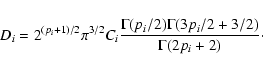
 are Galactic longitude and latitude. Then, the relative
number density of -ray sources is
are Galactic longitude and latitude. Then, the relative
number density of -ray sources is
 is the Galactocentric solar position and w(s) is
the selection function. For bright sources, the selection function is
proportional to the relative luminosity and so
is the Galactocentric solar position and w(s) is
the selection function. For bright sources, the selection function is
proportional to the relative luminosity and so
 .
The density profile is truncated at a radius at which the dark matter
annihilation rate matches the collapse timescale of the cusp. With
this assumption, a tiny constant density core is created
(e.g., Tyler 2002) and convergence of the integral (24)
is guaranteed. The overall normalisation of the integral depends
on the fraction of dark matter bound in mini-haloes, as opposed to
smoothly distributed dark matter. The anisotropy effect is clearly
illustrated in Fig. 3, which shows Hamer-Aitoff
projections in equatorial coordinates for two of the halo models. The
first is a model with
at the centre
(p,c)=
(2,1/2), and second a model with
at the
centre
(p,c)=(1/2,1/2). The more highly cusped the model, the greater
the anisotropy. If there are enough detections, the magnitude of the
anisotropy can be quantified by harmonic analysis (see e.g., Evans et al. 2000).
.
The density profile is truncated at a radius at which the dark matter
annihilation rate matches the collapse timescale of the cusp. With
this assumption, a tiny constant density core is created
(e.g., Tyler 2002) and convergence of the integral (24)
is guaranteed. The overall normalisation of the integral depends
on the fraction of dark matter bound in mini-haloes, as opposed to
smoothly distributed dark matter. The anisotropy effect is clearly
illustrated in Fig. 3, which shows Hamer-Aitoff
projections in equatorial coordinates for two of the halo models. The
first is a model with
at the centre
(p,c)=
(2,1/2), and second a model with
at the
centre
(p,c)=(1/2,1/2). The more highly cusped the model, the greater
the anisotropy. If there are enough detections, the magnitude of the
anisotropy can be quantified by harmonic analysis (see e.g., Evans et al. 2000).
Second, if the high proper motion sources can be identified, this will
provide the first direct evidence on the velocity distribution of the
dark matter. It is therefore useful to have predictions of the velocity
distributions. The proper motion and radial velocity
distribution of dark matter clumps can be calculated easily for
our models, because the DFs are simple. The proper motion and radial
velocity distributions in direction
 is
is
 |
(25) |
 |
(26) |
 based on Galactic coordinates while
f(E,L) is the distribution function of the dark matter. For models
with DFs (2), the above triple integrals are easily
computed via Gaussian quadrature. In fact, the second moments of
these distributions are entirely analytic, as sketched out in
Appendix A. Figure 4 shows the proper motion
and line of sight velocity distributions for the dark matter clumps in
three directions. When looking towards the Galactic Centre or
anti-Centre in spherical models, then the distributions of the two
tangential velocity components
based on Galactic coordinates while
f(E,L) is the distribution function of the dark matter. For models
with DFs (2), the above triple integrals are easily
computed via Gaussian quadrature. In fact, the second moments of
these distributions are entirely analytic, as sketched out in
Appendix A. Figure 4 shows the proper motion
and line of sight velocity distributions for the dark matter clumps in
three directions. When looking towards the Galactic Centre or
anti-Centre in spherical models, then the distributions of the two
tangential velocity components  and vb are the same, though
this is not necessarily the case in other directions. All three
velocity distributions show very significant deviations from
Gaussianity. The sources with highest tangential velocity occur
towards the the Galactic Centre direction and it is therefore in this
direction that GLAST or VERITAS may find it easiest
to detect them unambiguously.
and vb are the same, though
this is not necessarily the case in other directions. All three
velocity distributions show very significant deviations from
Gaussianity. The sources with highest tangential velocity occur
towards the the Galactic Centre direction and it is therefore in this
direction that GLAST or VERITAS may find it easiest
to detect them unambiguously.
Although these facts have been established in the context of our simple family of models, we argue that they are likely to be generic. The anisotropy effect in source positions is a consequence of the Sun's offset from the center. The fastest moving sources are likely to be found in the direction in which the gravitational potential well is deepest.
We have presented a simple family of halo models useful for the study
of dark matter haloes. They have a simple potential and distribution
function, being composed of two terms of the form terms like
Lp-2E(3p+1)/2 - where L is the total angular momentum, Ethe binding energy and p is some constant. As an application, we
have presented the properties of discrete -ray sources arising
from neutralino annihilation in dark matter mini-haloes. This
suggestion for the composition of the dark matter is derived the
numerical simulations of Diemand et al. (2005). If true, then nearby, high
proper motion discrete -rays sources may be detectable by
forthcoming missions such as GLAST. We have shown that there
is an anisotropy in the positions of such -ray sources because
of the offset of the Sun from the Galactic Centre. We have also
provided distributions of proper motions and line of sight velocities
of such sources. The best direction in which to look is towards the
Galactic Centre
 .
There are more sources in this
direction and they have the highest proper motion.
.
There are more sources in this
direction and they have the highest proper motion.
This paper also continues the study of hyperviriality begun by Eddington (1916) and further developed by Evans & An (2005). In spherical symmetry, any model which has a distribution function that is a sum of terms like Lp-2E(3p+1)/2 is hypervirial. This leads to the derivation of a general differential equation that any spherical hypervirial system must satisfy. We have solved it to find the most general models, for which the potential can be written down in terms of elementary functions.
We briefly note that, in the case of axisymmetry, any model which has a distribution function that is a sum of terms like Lzp-2E(3p+1)/2 - where Lz is the angular momentum component about the axis of symmetry - is also hypervirial. It is possible to derive the equation for the corresponding potential and demonstrate that at least two analytical solutions exist, corresponding to the flattened Plummer model studied by Lynden-Bell (1962) and a particular case among the prolate galaxy models of Lake (1981). In fact, only the Plummer model - the sole isotropic, hypervirial model - can be generalized to give an axisymmetric hypervirial system. It is an open question whether any further hypervirial generalizations of the Plummer model can be found.
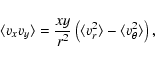
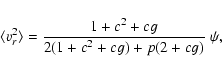
It is straightforward to compute the six independent components of
the velocity dispersion tensor in a Galactic coordinate system.
These formulae do not appear to have been given before, and so
we quote them here:
 |
(A.1) |
 |
(A.2) |
 |
(A.3) |
 |
(A.4) |
 |
(A.5) |
 |
(A.6) |
 |
(A.7) |
 |
(A.8) |
 |
(A.9) |
 |
(A.10) |
 |
(A.11) |
 |
(A.12) |
 .
Hence, by substituting in the known velocity dispersions in
spherical polars (Eqs. (20) and (21)),
we obtain the second moments of the observable distributions
(the line of sight velocities and the proper motions).
.
Hence, by substituting in the known velocity dispersions in
spherical polars (Eqs. (20) and (21)),
we obtain the second moments of the observable distributions
(the line of sight velocities and the proper motions).







![\begin{displaymath}F(\ell,b)\propto\int\!s^2~{\rm d}s~w(s)~
\rho[\vec{R}_{\hbox{$\odot$ }}+\vec{s}_{\ell,b}]
\end{displaymath}](/articles/aa/full/2005/46/aa3647-05/img68.gif)