
A&A 443, 831-839 (2005)
DOI: 10.1051/0004-6361:20042208
A. Hempel 1,2 - T. M. Herbst2 - D. J. Thompson2,3
1 - Geneva Observatory,
51 Ch. des Maillettes,
Sauverny 1290, Switzerland
2 -
Max Planck Institute for Astronomy (MPIA),
Königstuhl 17, 69117 Heidelberg, Germany
3 -
The Palomar Observatory,
California Institute of Technology, Pasadena, CA 91125, USA
Received 19 October 2004 / Accepted 5 April 2005
Abstract
We present the results of a wide-field survey for extremely red objects
(EROs), based on J and R band imaging. The survey covers 2.89 deg2,
consisting of 50 single fields, each approximately 210 arcmin2 in size. This
survey provides a sample of 60 extended objects with a colour of
 and J band magnitudes more than 10
 above background (
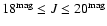 ).
).
Thirty five of these objects have been detected in both J and R-band.
We derive a surface density
for such EROs of
 arcmin-2, which is about seven times lower than for galaxies with
  .
.
Stellar population models suggest that these EROs are massive
galaxies with an old stellar population in a redshift range of
 .
For this scenario, we estimate the co-moving volume density to be
(
.
For this scenario, we estimate the co-moving volume density to be
(
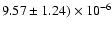 Mpc-3.
Key words: Galaxy: evolution - galaxies: high-redshift - galaxies: elliptical and lenticular, cD
Extremely red objects (EROs), discovered in deep optical and near-infrared
surveys, are proving to be a heterogeneous population. Defined mostly
by a single colour, usually R-K, the ERO population contains substellar objects,
cool stars, galaxies, and active galactic nuclei. Galaxies may appear very red
because of extreme redshifts, old populations at intermediate
redshifts, or severe dust reddening (or combinations of these factors).
The very red optical-to-near-infrared
colour covers a wide range ( or
or  ), hence allowing
various interpretations regarding their nature. First detections of EROs were
initially presumed to be high-redshift (z>6) galaxies in a luminous
star-forming phase (Elston et al. 1988).
Multi-colour follow-up observations identified these objects as luminous galaxies at
z=0.8, dominated by an old stellar population (Elston et al. 1989). The detection of HR10 and HR14, two
bright (
), hence allowing
various interpretations regarding their nature. First detections of EROs were
initially presumed to be high-redshift (z>6) galaxies in a luminous
star-forming phase (Elston et al. 1988).
Multi-colour follow-up observations identified these objects as luminous galaxies at
z=0.8, dominated by an old stellar population (Elston et al. 1989). The detection of HR10 and HR14, two
bright ( )
extended objects with I-K colours near 6.5 by Hu & Ridgway (1994) gave an indication of the difficulties in classifying these objects. When first
discovered, HR10 and HR14 were interpreted as being ellipticals at
)
extended objects with I-K colours near 6.5 by Hu & Ridgway (1994) gave an indication of the difficulties in classifying these objects. When first
discovered, HR10 and HR14 were interpreted as being ellipticals at  .
Subsequent spectroscopic and morphological observations indicated that HR10 is not a
quiescent elliptical galaxy, but rather a bright interacting galaxy at z=1.44
(Graham & Dey 1996).
.
Subsequent spectroscopic and morphological observations indicated that HR10 is not a
quiescent elliptical galaxy, but rather a bright interacting galaxy at z=1.44
(Graham & Dey 1996).
Additional EROs, both massive old and dusty interacting galaxies, were found by various groups (e.g. Cimatti et al. 2002a; Afonso et al. 2001; Soifer et al. 1999; McCracken et al. 2000; Cowie et al. 1994; Thompson et al. 1999). These objects appeared in the field of quasars (Smith et al. 2002a; Hall et al. 2001; Liu et al. 2000), as counterparts of sub-millimeter galaxies (Smail et al. 1999; Mohan et al. 2002), and in dedicated surveys (Cimatti et al. 2002a,b; Daddi et al. 2002).
Strategies to distinguish the fraction of different extragalactic ERO types include
near-infrared photometric classification (Pozzetti & Mannucci 2000; Hempel et al. 2003; Mannucci et al. 2002; Martini 2001),
morphological tests (Yan et al. 2000; Moriondo et al. 2000; Gilbank et al. 2003; Yan & Thompson 2003),
and an increasing number of spectroscopic discriminators
(Cimatti et al. 1999,2002a; Smith et al. 2001).
Near-infrared spectroscopy of 9 EROs (R-K>5 and K<19.0) by
Cimatti et al. (1999) showed neither strong emission lines nor continuum breaks. Two of
their observed EROs were classified as dusty starburst candidates, because they require
strong dust reddening to produce the observed global spectral energy distributions. The
remaining  2/3 of the total ERO sample is consistent with
being dustless, old, passively evolved, spheroidals at
2/3 of the total ERO sample is consistent with
being dustless, old, passively evolved, spheroidals at  .
A larger
sample of 30 EROs with
.
A larger
sample of 30 EROs with  showed an almost equal distribution between old
and star forming galaxies (Cimatti et al. 2002a). Based on the classification method of
Pozzetti & Mannucci (2000), and using the (R-K) vs. (J-K) colour plane, Mannucci
et al. (2002) also found an equal distribution of elliptical and starburst galaxies.
showed an almost equal distribution between old
and star forming galaxies (Cimatti et al. 2002a). Based on the classification method of
Pozzetti & Mannucci (2000), and using the (R-K) vs. (J-K) colour plane, Mannucci
et al. (2002) also found an equal distribution of elliptical and starburst galaxies.
Morphological observations, based on optical and near-infrared HST data, allow a more
detailed classification. Yan & Thompson (2003) visually classified both pure bulge or
disk galaxies and bulge or disk-dominated galaxies, using HST/WFPC2 F814W and groundbased  -band
images of 115 EROs. They found that
-band
images of 115 EROs. They found that  of the (
 )
selected sample have morphologies consistent with a pure-bulge dominated galaxy (E/S0),
while
)
selected sample have morphologies consistent with a pure-bulge dominated galaxy (E/S0),
while  of the sample can be described as disks. A small fraction,
 ,
could not be classified unambiguously. In addition, a significant fraction
of edge-on spirals was detected:
,
could not be classified unambiguously. In addition, a significant fraction
of edge-on spirals was detected:  of the disks, or
  of the total sample,
were of this type. Similar relative fractions of early and late type galaxies
were found among a sample of 275 EROs (
of the total sample,
were of this type. Similar relative fractions of early and late type galaxies
were found among a sample of 275 EROs ( ), detected in the Great Observatories Origins Deep
Survey-South (GOODS-South) (Moustakas et al. 2004).
Optical spectroscopy on a sub-sample of 36 sources
(Yan et al. 2004) revealed a more complicated relation between spectral class and
morphological appearance.
), detected in the Great Observatories Origins Deep
Survey-South (GOODS-South) (Moustakas et al. 2004).
Optical spectroscopy on a sub-sample of 36 sources
(Yan et al. 2004) revealed a more complicated relation between spectral class and
morphological appearance.
Hard X-ray observations are especially useful for detecting AGNs among the ERO population.
Between ten and thirty percent of hard X-ray sources could be associated with EROs, depending
on the limiting fluxes reached in the optical and the X-ray band (Brusa et al. 2002).
The fraction of AGN among the optically detected EROs is still unclear, but possibly below
 ,
suggesting that the majority of EROs are not related to AGN phenomena.
A similarly low fraction of EROs has been found in the soft X-ray band, indicating
either a low-luminosity AGN or starburst activity (Alexander et al. 2002; Brusa 2003).
EROs, especially the dusty starburst population, contribute significantly to the
,
suggesting that the majority of EROs are not related to AGN phenomena.
A similarly low fraction of EROs has been found in the soft X-ray band, indicating
either a low-luminosity AGN or starburst activity (Alexander et al. 2002; Brusa 2003).
EROs, especially the dusty starburst population, contribute significantly to the
 background (Wehner et al. 2002), pointing to a connection with sub-millimeter
galaxies (SMG). Their near-infrared colour ranges from J-K=2 for bright sources
(K<19) to extremely red (J-K=3) for fainter SMG (Frayer et al. 2004).
background (Wehner et al. 2002), pointing to a connection with sub-millimeter
galaxies (SMG). Their near-infrared colour ranges from J-K=2 for bright sources
(K<19) to extremely red (J-K=3) for fainter SMG (Frayer et al. 2004).
The variety of colour criteria used to define EROs, for example ,
5.3 or 6,
the different survey depths, and the apparent strong clustering (Roche et al. 2003; Daddi et al. 2000; Roche et al. 2002), result in a wide range of surface densities
(e.g. Yan et al. 2000; Hu & Ridgway 1994; Thompson et al. 1999). Recent and larger surveys suggest that
the surface density of  galaxies (
 )
is
)
is
 arcmin-2, increasing to
 at
at
 (Daddi et al. 2000).
For EROs with
(Daddi et al. 2000).
For EROs with
 and brighter than
 ,
Daddi et al.
(2000) derived a surface density of
,
Daddi et al.
(2000) derived a surface density of
 arcmin-2.
The determination of the nature of EROs and their density is important, since EROs provide valuable clues to massive structure formation on large scales. In the CDM-based galaxy formation models, massive objects form through mergers and accretion. The number density of such massive structures at high redshifts can be used to test these models, by comparing their predictions with the observed number densities. Although hierarchical models reproduce the global star formation quite well (Roche et al. 2002; Bell et al. 2004), they have difficulties reproducing the observed number of extremely red objects, both quiescent ellipticals and dust-obscured star forming galaxies (Firth et al. 2002; Im et al. 2002a; Somerville et al. 2001; Cimatti et al. 2002b).
The main goal of our survey is to obtain a sample of ERO candidates with an extremely red colour
of  5 and relatively bright J magnitudes (
 ), suitable for spectroscopic follow-up.
Clearly, the available data allow also the application of less strict colour criteria, which will be
subject in a forthcoming paper.
This colour limit is considerably redder than
the ,
5.3 or 6 criterion assumed for most ERO surveys (Cimatti et al. 2002a; Roche et al. 2002),
and selects a different galaxy population. In Sect. 3.1 we investigate how the star
formation history can redden the spectral energy distribution of
a galaxy sufficiently to classify them as ERO ().
), suitable for spectroscopic follow-up.
Clearly, the available data allow also the application of less strict colour criteria, which will be
subject in a forthcoming paper.
This colour limit is considerably redder than
the ,
5.3 or 6 criterion assumed for most ERO surveys (Cimatti et al. 2002a; Roche et al. 2002),
and selects a different galaxy population. In Sect. 3.1 we investigate how the star
formation history can redden the spectral energy distribution of
a galaxy sufficiently to classify them as ERO ().
In covering a larger area, we minimize the influence of clustering on the mean surface
density of EROs, possibly measure the clustering itself, and provide targets for
thorough spectroscopic follow-up. The total survey area is more than one order of magnitude larger
than all previous ERO surveys (Daddi et al. 2000; Roche et al. 2002; Thompson et al. 1999).
The only comparable ERO sample (see Sect. 3.1), using a colour threshold of  (Daddi et al. 2002),
covers only 701 arcmin2, and shows large statistical uncertainties.
(Daddi et al. 2002),
covers only 701 arcmin2, and shows large statistical uncertainties.
Throughout this paper, a cosmology with
H0 = 70 km s-1 Mpc-1,
 and
and
 is assumed.
![\begin{figure}
\par\includegraphics[width=17cm,clip=true]{2208fig1.ps} \end{figure}](/articles/aa/full/2005/45/aa2208-04/img47.gif) |
Figure 1:
a) Gray-scale image showing the depth of a
 pixel J-band
mosaic. The lighter regions indicate higher noise due to a smaller number of
exposures or bad pixels. Each sky position is measured at least 4 times. The rightmost two frames show a typical field in J- and R-band. The black line
encloses the usable region ( b) and c) respectively).
pixel J-band
mosaic. The lighter regions indicate higher noise due to a smaller number of
exposures or bad pixels. Each sky position is measured at least 4 times. The rightmost two frames show a typical field in J- and R-band. The black line
encloses the usable region ( b) and c) respectively). |
| Open with DEXTER | |
The J-band data were taken during observing runs in October 1997, October 1998 and
May 1999 with the 3.5 m telescope on Calar Alto. The observations were carried out
using the prime focus camera Omega-Prime (Bizenberger et al. 1998), equipped with a
 pixel HAWAII array. The pixel scale of 0
 3961/pixel gave a field of
about
3961/pixel gave a field of
about
 .
The J-band filter, centered at
.
The J-band filter, centered at
 and with a bandwidth of
 m was used. Each survey field was covered
by a mosaic of 4 pointings, each consisting of 4 exposures of 60 s with small
angular offsets. Herbst et al. (1999) provide further details on the observations.
m was used. Each survey field was covered
by a mosaic of 4 pointings, each consisting of 4 exposures of 60 s with small
angular offsets. Herbst et al. (1999) provide further details on the observations.
The images were dark- and sky-subtracted using a sky-image constructed from science
exposures taken close in time. Each image was then flat-fielded and cosmic rays and
bad pixels were removed. The final images are
pixels, i.e. approximately
(
 ) arcmin2. Figure 1 contains an example field and indicates
the depth of exposure. Adding up the usable area of all 50 fields results in a total survey area of
2.89 degree2.
) arcmin2. Figure 1 contains an example field and indicates
the depth of exposure. Adding up the usable area of all 50 fields results in a total survey area of
2.89 degree2.
The photometric zero-points were measured using the standard stars from the UKIRT
catalogue observed at similar airmass. The effective image quality of
the final mosaics ranges from about 1
 to 2
1.
to 2
1.
The R-band observations were made by the High-z Supernova Search Team Cosmology
Project with the 4.0 m Blanco telescope at the Cerro Tololo Inter-American Observatory
(CTIO) during observing runs in 1994 through 1996 (Schmidt et al. 1998). The Prime Focus CCD
Direct camera (PFCCD) was equipped with a
 pixel array with 0
40/pixel.
pixel array with 0
40/pixel.
The observed fields span a wide range of right ascension, and consist of both
clustered (Fig. 2) and isolated pointings. In order to minimize stellar contamination,
we selected fields at high galactic latitudes, i.e
 .
The fields are equatorial, and therefore accessible from observing sites in both
the northern and southern hemispheres.
.
The fields are equatorial, and therefore accessible from observing sites in both
the northern and southern hemispheres.
![\begin{figure}
\par\resizebox{6.2cm}{!}{\includegraphics[]{2208fig2.ps}} \end{figure}](/articles/aa/full/2005/45/aa2208-04/img56.gif) |
Figure 2:
Distribution on the sky of 3 survey fields, with a field
size of about (
)
arcmin2. The symbols identify the
detected EROs(). Fields are named by the letter G, followed
by a three digit sequence number. |
| Open with DEXTER | |
The total R-band exposure time varies from field to field, since evidence of supernovae resulted in additional observations, and hence longer integration times, for some locations. The slightly different pixel scale, a positional offset and a different orientation between the R and J-band image was compensated by adjusting the R-band images.
Since the available R-band data set did not include standard star observations, we used the
Sloan Digital Sky Survey for calibration. We constructed a catalogue of
un-saturated stars (between 50-80 stars per field, depending on image depth) and compared
their R-band magnitudes with SDSS photometry (Fig. 3). For the transformation between
 (R-Cousins filter) and the Sloan
system we used the equations from Smith et al. (2002b) (see Table 1):
the data were calibrated to match the transformed SDSS magnitudes, and R-band
magnitudes were calculated for all near-infrared sources. The transformation
equations were derived from the
u'g'r'i'z' photometry of 158
standard stars. The uncertainty in the mean calibrated magnitudes for any given
standard star should be less than 1
(R-Cousins filter) and the Sloan
system we used the equations from Smith et al. (2002b) (see Table 1):
the data were calibrated to match the transformed SDSS magnitudes, and R-band
magnitudes were calculated for all near-infrared sources. The transformation
equations were derived from the
u'g'r'i'z' photometry of 158
standard stars. The uncertainty in the mean calibrated magnitudes for any given
standard star should be less than 1 in g' and r', resulting in a error of
less than 0.02 mag in g'-r'.
in g' and r', resulting in a error of
less than 0.02 mag in g'-r'.
![\begin{figure}
\par\resizebox{6.2cm}{!}{\includegraphics[]{2208fig3.ps}} \end{figure}](/articles/aa/full/2005/45/aa2208-04/img59.gif) |
Figure 3:
The R-band zero point calibration for a typical field, based on Sloan Digital
Sky Survey magnitudes. After correcting the assumed zero point, our photometry
agrees very well with the SDSS results (standard deviation
 mag).
mag). |
| Open with DEXTER | |
Table 1:
Transformation between g'-r' and
 .
.
Sources were first identified in the near-infrared data using
SExtractor 2.2.2 (Bertin & Arnouts 1996), with
the criterion that a source must exceed 5
above the
background in at least 5 pixels. The photometry is based on the
SExtractor "BEST''-magnitude and refers to Vega magnitudes.
Photometry in the R-band was then obtained by running SExtractor
in 'double-image' mode, using the source position in the J-band image to measure the R-band
fluxes. The number of sources and their positions are therefore
given by the J-band. On average, each field contains approximately 600
stellar or extragalactic objects with J-band detections.
Objects closer than 3 pixels from the borders of the effective
area (Fig. 1) were excluded from the initial catalogue.
Although our selected fields are at relatively high galactic
latitude, the frames inevitably contain stellar objects. To separate galaxies
from stars, we used the stellarity index (CLASS-STAR parameter), provided by
SExtractor. This star/galaxy classifier uses
a total of 10 parameters (8 isophotal areas, peak intensity
and 1 control parameter, which is the seeing) to identify stars
(stellarity index = 1.0) and galaxies (stellarity index = 0.0).
The commonly used cut-off for this index is 0.8 as taken from the
K-band data (e.g. Best et al. 2003).
In our survey, we used a stellarity index below 0.8 in J and R
to classify an object as a galaxy. Objects which have R magnitudes
fainter than the limiting magnitude were counted as objects with
no optical detection. The calculated J-band stellarity index was
used for the star-galaxy separation for these objects. For example objects
classified as a galaxy in J but without a detection in R are
classified as a galaxy.
In addition to this automatic selection, we visually examined each ERO candidate to ensure that it is indeed a real detection (i.e. seen in all exposures, not an uncorrected bad pixel, etc.).
At this point we did not correct for extinction. Nevertheless, according
to de Vaucouleurs & Buta (1983), and references therein, the Sun is at the common apex
of two dust-free cones of 90 aperture centered at the galactic poles.
One of their models for galactic extinction assumes
aperture centered at the galactic poles.
One of their models for galactic extinction assumes  at all
 (polar windows) and assigns a low value at
 ,
either
,
either
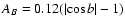 or
or
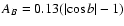 (Sandage 1972), with an unspecified smooth transition in the latitude interval
 .
The second approximation was successfully used by
Chen et al. (1999) in their 3-dimensional extinction model.
Its application to globular and open cluster data indicates that the COBE/IRAS
reddening map by Schlegel et al. (1998) has an accuracy of
18
and overestimates visual absorption by a factor of 1.16. This systematic
error does not change with galactic latitude.
.
The second approximation was successfully used by
Chen et al. (1999) in their 3-dimensional extinction model.
Its application to globular and open cluster data indicates that the COBE/IRAS
reddening map by Schlegel et al. (1998) has an accuracy of
18
and overestimates visual absorption by a factor of 1.16. This systematic
error does not change with galactic latitude.
As a result of the varying exposure times for the
R-band data, the fields differ in depth, which is especially important for assigning
a colour to objects which have a near-infrared detection but no optical counter-part.
This is the case for many EROs. The colour for objects without R-band detection,
i.e.
 ,
was calculated in terms of
,
was calculated in terms of
 instead
of R-J, making the R-J colour a lower limit. The detection limit is
obtained from the
instead
of R-J, making the R-J colour a lower limit. The detection limit is
obtained from the
 plot (Fig. 4), and corresponds to
the maximum
plot (Fig. 4), and corresponds to
the maximum
 for which
 mag (
mag (
 is the error
of the magnitude as given by SExtractor).
is the error
of the magnitude as given by SExtractor).
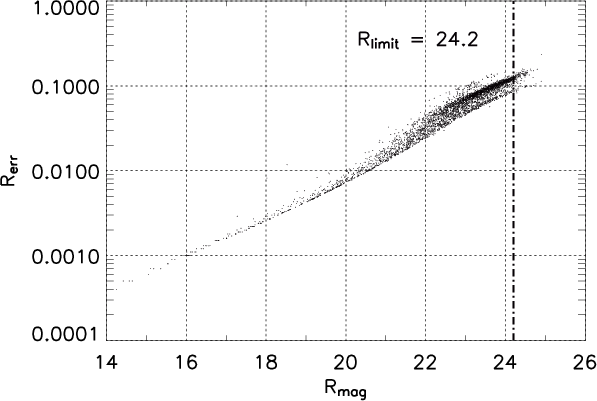 |
Figure 4: The R-band detection limit is given by the magnitude at which the majority of photometric errors reach 0.1 mag. |
| Open with DEXTER | |
 5 colour criterion
Most ERO surveys of recent years rely on a colour criterion based on R-K,
such as
(Daddi et al. 2000; Roche et al. 2002) or
(Yan & Thompson 2003). This
selects old, passively evolved galaxies as well as starbursts.
In order to clarify the colour evolution for various galaxy populations, we used the
PÉGASE2 code by Fioc & Rocca-Volmerange (1997) to model different
formation scenarios. All
galaxies were assumed to have formed with a Salpeter IMF and a solar metallicity,
but otherwise different parameters. We have investigated 5 scenarios:
 ,
with star formation lasting 200 Myr
and an exponential decay time (
,
with star formation lasting 200 Myr
and an exponential decay time (
 Gyr);
Gyr);
 ;
;
 for a galaxy with
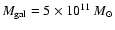 and strong dust reddening (
E(B-V) = 1.0,
);
and strong dust reddening (
E(B-V) = 1.0,
);
 ,
for a galaxy with
,
;
,
for a galaxy with
,
;
To simplify matters, all K filters (
 )
as well R-band
filters (
)
as well R-band
filters (
 )
were treated as equal.
)
were treated as equal.
The left panel in Fig. 5 shows the evolution of R-J colour with redshift for the
different galaxy formation scenarios. Our results show that only elliptical galaxies
with an already old stellar population, at redshift  ,
have colours redder
than R-J=5. For example, models representing a starburst galaxy or an evolving spiral
galaxy do not produce such red (R-J) colours. For comparison, panel (b) in Fig. 5 shows the evolution of the R-K colour for the same models. In agreement with
previous works (Roche et al. 2003; Väisänen & Johansson 2004; Roche et al. 2002), a sample of galaxies with
consists of both evolved ellipticals and starburst galaxies.
,
have colours redder
than R-J=5. For example, models representing a starburst galaxy or an evolving spiral
galaxy do not produce such red (R-J) colours. For comparison, panel (b) in Fig. 5 shows the evolution of the R-K colour for the same models. In agreement with
previous works (Roche et al. 2003; Väisänen & Johansson 2004; Roche et al. 2002), a sample of galaxies with
consists of both evolved ellipticals and starburst galaxies.
![\begin{figure}
\includegraphics[width=14cm,clip]{2208fig5.ps} \end{figure}](/articles/aa/full/2005/45/aa2208-04/img84.gif) |
Figure 5:
Colour evolution for different models representing
an evolved elliptical galaxy, a dust reddened starburst and a normal spiral galaxy
both in an edge-on and face-on orientation. The three panels show the evolution of R-J (panel a)),
R-K (panel b)) and J-K (panel c)) colours for all 5 models described in Sect. 3.1. The horizontal dashed line shows the
applied colour threshold of our EROs selection ,
indicating that we select
only ellipticals at redshift 1.4 and above with this colour
criteria. |
| Open with DEXTER | |
It is clear that our ERO sample is not comparable with a
selected sample,
since these colour criteria select different ERO populations. However, a small fraction
of
selected objects might be as red as R-K>7, which is comparable to ,
and
our sample can be considered as
subset of R-K selected EROs. Therefore, we would expect the surface density of
selected objects to be
smaller than that one for the
sample.
Any comparison of our results regarding surface density requires an assumption as to the relation
between R-K and R-J colours. In addition to the general colour conversion, we have
to consider the differences between
the various filters, e.g the R-band filter function provided by PÉGASE2 and the filter function for our data set. The obtained colours refer
to the specific filters used for our observations. The modeled magnitudes are based on the
the transmission function of the R-band filter of the PFCCD (CTIO), the J-band filter of
OmegaPrime (Calar Alto) and the
filter of ISAAC (VLT).
The right panel of Fig. 5 shows the evolution of J-K colour, suggesting that an old
elliptical galaxy with
and redshift  would have
 .
This is consistent with the
results of van Dokkum et al. (2003), who found galaxies with
.
This is consistent with the
results of van Dokkum et al. (2003), who found galaxies with
 and redshifts
of z>1.2 (
and redshifts
of z>1.2 (
 of the sample) and z>2.3 respectively. Finding such an elliptical
galaxy at even higher redshift requires a J-K colour around 3 (for
)
and higher
(for
), according to our models. Objects with such red near-infrared colours are
named Hyper Extremely Red Objects (HEROs), and are thought to be dusty star-forming objects at
of the sample) and z>2.3 respectively. Finding such an elliptical
galaxy at even higher redshift requires a J-K colour around 3 (for
)
and higher
(for
), according to our models. Objects with such red near-infrared colours are
named Hyper Extremely Red Objects (HEROs), and are thought to be dusty star-forming objects at
 or old galaxies at
 (Im et al. 2002b, and references therein). The combination of
our models and the properties of HEROs support the assumption that objects with
are indeed
elliptical galaxies with redshift 1.5-3.0 (for
).
(Im et al. 2002b, and references therein). The combination of
our models and the properties of HEROs support the assumption that objects with
are indeed
elliptical galaxies with redshift 1.5-3.0 (for
).
Compared to the results of Yan & Thompson (2003), our J-K
colour for evolved ellipticals at redshift 1.5 and
is about 0.25 mag bluer,
which might be the result of either different evolutionary scenarios or slightly different
filter functions.
The Sarraco et al. (1999) survey extends to much fainter galaxies
than does ours, and the two surveys overlap only at our faintest magnitudes. In this
range, the calculated surface density is affected by the small number statistics.
All the J-band counts in the range 13-18 mag have essentially the same slope
as our data,
 .
Also the flattening at the faint end agrees
with the result of Saracco et al. (1999),
who found slopes of
.
Also the flattening at the faint end agrees
with the result of Saracco et al. (1999),
who found slopes of  0.35 and 0.34, respectively.
Table 2: R-J colour distribution. The two values represent the total number of EROs in the specified magnitude interval and the fraction which has an optical counterpart.
The observed differences can be partially explained by different definitions of the J magnitude, e.g. IRAF aperture magnitude or SExtractor magnitude.
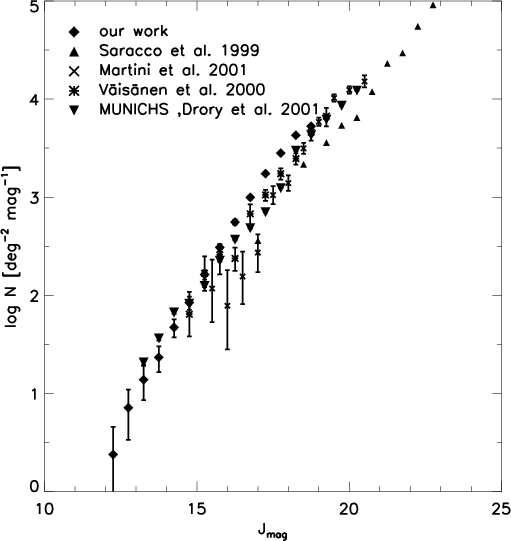 |
Figure 6: Differential counts (number mag-1 deg-2) of galaxies in the J-band compared to a collection of published data, including Saracco et al. (1999), Martini (2001), Väisänen et al. (2000) and the MUNICS survey (Drory et al. 2001). The error bars for our data represent only counting statistics. |
| Open with DEXTER | |
 ,
from
which the mean R-J colour and FWHM in different J magnitude intervals have been calculated (see Table 2).
The mean colour in the intervals up to J<20 increases by 1.17 mag from R-J=1.68 to R-J=2.85.
Such a trend was also observed by Daddi et al. (2000) and Thompson et al. (1999) for the mean
R-K colours, which reach their maximum between
,
from
which the mean R-J colour and FWHM in different J magnitude intervals have been calculated (see Table 2).
The mean colour in the intervals up to J<20 increases by 1.17 mag from R-J=1.68 to R-J=2.85.
Such a trend was also observed by Daddi et al. (2000) and Thompson et al. (1999) for the mean
R-K colours, which reach their maximum between
 .
This reddening of the mean colour might result
from a growing fraction of high-redshift galaxies.
.
This reddening of the mean colour might result
from a growing fraction of high-redshift galaxies.
![\begin{figure}
\par\includegraphics[width=16.3cm,clip]{2208fig7.ps} \end{figure}](/articles/aa/full/2005/45/aa2208-04/img98.gif) |
Figure 7:
R-J colour distribution for all galaxies, i.e. stellarity index  0.8 in R and J-band.
Magnitude ranges are indicated in the upper left-hand corner of each panel. The data show
the colour distributions without visual check (as was done for the final catalogue of extremely red
objects, ), i.e. objects to the left of the dashed line were not manually checked in each individual
frame. The error bars indicate the Poisson uncertainties and the dot-dashed lines
show the one or two Gaussians used to fit the peak position and width of the distribution reported
in Table 2. The second peak is
the result of assigning the limiting R magnitude to objects with no optical detection (see text
for details). 0.8 in R and J-band.
Magnitude ranges are indicated in the upper left-hand corner of each panel. The data show
the colour distributions without visual check (as was done for the final catalogue of extremely red
objects, ), i.e. objects to the left of the dashed line were not manually checked in each individual
frame. The error bars indicate the Poisson uncertainties and the dot-dashed lines
show the one or two Gaussians used to fit the peak position and width of the distribution reported
in Table 2. The second peak is
the result of assigning the limiting R magnitude to objects with no optical detection (see text
for details). |
| Open with DEXTER | |
The EROs satisfying our colour criterion lie in a range
 ,
and appear
to build a second population of galaxies. Such an additional peak has never
been observed before and therefore requires clarification. Follow-up analysis shows this feature
to be the result of the R-band detection limit. About 42 percent of these EROs have no R-band
detection. Therefore, the limiting R-band magnitude for each separate field has been used as
substitute. As a result the R-J colour of those objects is an estimate for the lower limit.
The second peak, therefore, is an artefact of assigning the limiting R magnitude to non-detections.
,
and appear
to build a second population of galaxies. Such an additional peak has never
been observed before and therefore requires clarification. Follow-up analysis shows this feature
to be the result of the R-band detection limit. About 42 percent of these EROs have no R-band
detection. Therefore, the limiting R-band magnitude for each separate field has been used as
substitute. As a result the R-J colour of those objects is an estimate for the lower limit.
The second peak, therefore, is an artefact of assigning the limiting R magnitude to non-detections.
Column 4 in Table 2 lists number of visually confirmed EROs and number of EROs with R-band
detection. In total, we found 35 objects with ,
which have a stellarity index of 0.8 in both bands.
An additional 25 objects have no R-band detection but their J-band stellarity classifies them as galaxy.
Examples of both classes appear in Fig. 8. The limited
spatial resolution in R and J permits no discrimination between the different morphological
galaxy types. However, their appearance will be useful for the selection of objects for follow-up
observations.
![\begin{figure}
\includegraphics[width=14.4cm]{2208fig8.ps} \end{figure}](/articles/aa/full/2005/45/aa2208-04/img100.gif) |
Figure 8:
Examples of EROs, with
R-band detection ( leftmost three panels) and
without optical detection ( rightmost two panels). The images
are 40
 on a side.
 |
| Open with DEXTER | |
Figure 9 shows the colour-magnitude diagram for these 79 extremely red objects, including both stars (19) and galaxies (60). We also differentiate between objects which are stars or galaxies in both bands or in the J-band alone. Although we used the stellarity index as a criterion to distinguish between stars and galaxies, the number of galaxies with no R-band detection has to be treated as an upper limit. Deeper optical photometry might identify these as stars.
![\begin{figure}
\par\rotatebox{90}{\includegraphics[height=13cm]{2208fig9.ps}} \end{figure}](/articles/aa/full/2005/45/aa2208-04/img101.gif) |
Figure 9:
Colour-magnitude diagram for extremely red stellar objects (19) and galaxies
(60) found in our survey.
For objects without R detection, the star/galaxy classification in R is arbitrary
and solely based on the SExtractor result,
the dashed line marks the
colour threshold. |
| Open with DEXTER | |
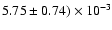 arcmin-2 (Poisson uncertainties). Counting only
objects which have both optical and near-infrared detection, this number decreases
to 35, dropping the surface density to (
arcmin-2 (Poisson uncertainties). Counting only
objects which have both optical and near-infrared detection, this number decreases
to 35, dropping the surface density to (
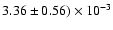 arcmin-2.
Figure 10 shows our result in comparison to the only other survey selecting EROs with
an extreme colour threshold, the
selection from Daddi et al. (2000). For comparison,
we have adopted a colour relation of J-K = 2.3 based on the stellar
population models.
arcmin-2.
Figure 10 shows our result in comparison to the only other survey selecting EROs with
an extreme colour threshold, the
selection from Daddi et al. (2000). For comparison,
we have adopted a colour relation of J-K = 2.3 based on the stellar
population models.
Daddi found 5 such objects within the completeness limit of their deep survey
(,
area = 447 arcmin2). Keeping in mind that the Daddi et al. sample has
fainter near-infrared magnitudes, the resulting surface density of 0.011 arcmin-2
is larger than our result by a factor of 1.9. This difference increases by another factor
of 2 if we count only objects with R-band detection. Deeper follow-up observations,
e.g. with ISAAC and FORS, will constrain the surface density further.
The large variations in the spatial distribution, and the high density of EROs in single fields, suggest that EROs are clustered. Figure 11 shows the distribution of all 60 extremely red galaxies found in all 50 survey fields. In approximately one third of the fields, no ERO was detected, while 4 fields contain 4 EROs yielding a surface density of 0.0192 arcmin-2, more than three times the the average surface density of the whole sample.
However, the small number of
galaxies in each field prevents
the calculation of clustering amplitudes. Deeper follow-up observations on selected fields which contain
a larger than average number of EROs may also find fainter or less red members of a galaxy cluster.
![\begin{figure}
\par\rotatebox{0}{\includegraphics[width=6.2cm]{2208fig10.ps}} \end{figure}](/articles/aa/full/2005/45/aa2208-04/img104.gif) |
Figure 10:
Cumulative ERO surface density from this work, compared to the results for
objects from Daddi et al. (2000). The uncertainties are derived assuming only
Poisson counting statistics. To convert the
Daddi K-band magnitudes into J-band we use the result
of the stellar population synthesis models, which found a J-K=2.25 for objects with
(Fig. 5). |
| Open with DEXTER | |
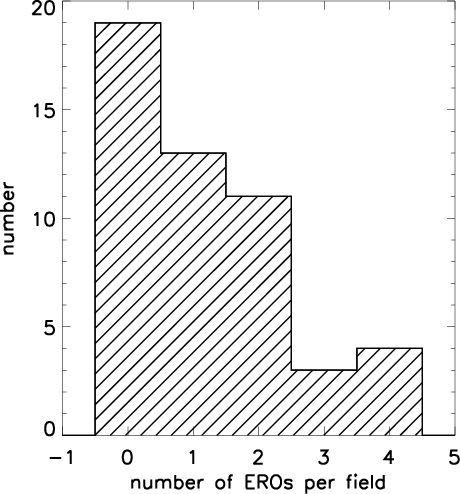 |
Figure 11: Number distribution of the 60 extremely red galaxies found in 50 survey fields. |
| Open with DEXTER | |
the SSP model
(model ii in Sect. 3.1) predicts a redshift range
 ,
for which this
colour criteria is satisfied.
,
for which this
colour criteria is satisfied.
The co-moving volume covered in this range, accumulated over all 50 fields in the assumed
cosmology is
 Mpc 3. For our sample of 60 EROs, this yields a volume
density of
Mpc 3. For our sample of 60 EROs, this yields a volume
density of
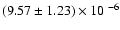 Mpc-3. The error reflects only the low
number statistics, and not the uncertainty in the volume estimate. EROs with a generally bluer cutoff, ,
have a volume density which is approximately twice the volume density of our sample,
averaged over a redshift range of
Mpc-3. The error reflects only the low
number statistics, and not the uncertainty in the volume estimate. EROs with a generally bluer cutoff, ,
have a volume density which is approximately twice the volume density of our sample,
averaged over a redshift range of
 (Thompson et al. 1999).
This space density is approximately four times higher than that for other bright objects, e.g. quasars.
Boyle et al. (2000) found a space density of
 Mpc-3
for quasars with
Mpc-3
for quasars with
 in a similar redshift range. The comparatively large
volume density at higher redshifts suggests that massive structures have been formed early in the universe.
in a similar redshift range. The comparatively large
volume density at higher redshifts suggests that massive structures have been formed early in the universe.
In order to study the properties of galaxies with ,
we have constructed a sample of
EROs from R and J-band photometry of a total of a 2.89 deg2 area of sky.
Taking into account the varying 10
detection limits in the J-band (19.5
 ),
we are looking at an extremely bright, i.e. very massive galaxy population. Stellar evolution models
indicate that these galaxies to lie in a redshift range between 1.4 and 3.0.
),
we are looking at an extremely bright, i.e. very massive galaxy population. Stellar evolution models
indicate that these galaxies to lie in a redshift range between 1.4 and 3.0.
We have detected 60 EROs, 35 of which have both J and R-band (10)
detections. The total sample of
EROs has a surface density of
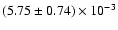 arcmin-2, leading to a
volume density of (
arcmin-2, leading to a
volume density of (
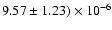 Mpc-3, assuming a model-dependent redshift.
This sample, being bright, lends itself well to spectroscopic follow-up observations, which will allow both the determination of the redshift and a clear classification as a distinct ERO population.
Acknowledgements
We would like to thank the members of the High-z Supernova Search Project team, for making the R-band observations available for this survey. The authors thank Eric Bell, Wolfgang Brandner and Gregory Rudnick for useful comments.