![\begin{figure}
\par\includegraphics[width=17cm,clip=true]{2208fig1.ps} \end{figure}](/articles/aa/full/2005/45/aa2208-04/img47.gif) |
Figure 1:
a) Gray-scale image showing the depth of a
 pixel J-band
mosaic. The lighter regions indicate higher noise due to a smaller number of
exposures or bad pixels. Each sky position is measured at least 4 times. The rightmost two frames show a typical field in J- and R-band. The black line
encloses the usable region ( b) and c) respectively).
pixel J-band
mosaic. The lighter regions indicate higher noise due to a smaller number of
exposures or bad pixels. Each sky position is measured at least 4 times. The rightmost two frames show a typical field in J- and R-band. The black line
encloses the usable region ( b) and c) respectively). |
| Open with DEXTER | |
In the text
![\begin{figure}
\par\resizebox{6.2cm}{!}{\includegraphics[]{2208fig2.ps}} \end{figure}](/articles/aa/full/2005/45/aa2208-04/img56.gif) |
Figure 2:
Distribution on the sky of 3 survey fields, with a field
size of about (
 )
arcmin2. The symbols identify the
detected EROs( )
arcmin2. The symbols identify the
detected EROs( ). Fields are named by the letter G, followed
by a three digit sequence number. ). Fields are named by the letter G, followed
by a three digit sequence number. |
| Open with DEXTER | |
In the text
![\begin{figure}
\par\resizebox{6.2cm}{!}{\includegraphics[]{2208fig3.ps}} \end{figure}](/articles/aa/full/2005/45/aa2208-04/img59.gif) |
Figure 3:
The R-band zero point calibration for a typical field, based on Sloan Digital
Sky Survey magnitudes. After correcting the assumed zero point, our photometry
agrees very well with the SDSS results (standard deviation
 mag).
mag). |
| Open with DEXTER | |
In the text
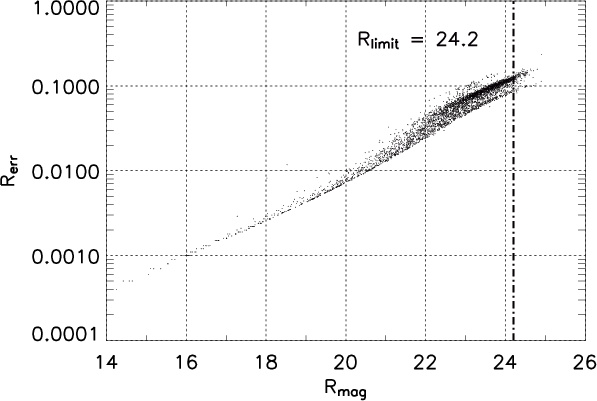 |
Figure 4: The R-band detection limit is given by the magnitude at which the majority of photometric errors reach 0.1 mag. |
| Open with DEXTER | |
In the text
![\begin{figure}
\includegraphics[width=14cm,clip]{2208fig5.ps} \end{figure}](/articles/aa/full/2005/45/aa2208-04/img84.gif) |
Figure 5:
Colour evolution for different models representing
an evolved elliptical galaxy, a dust reddened starburst and a normal spiral galaxy
both in an edge-on and face-on orientation. The three panels show the evolution of R-J (panel a)),
R-K (panel b)) and J-K (panel c)) colours for all 5 models described in Sect. 3.1. The horizontal dashed line shows the
applied colour threshold of our EROs selection ,
indicating that we select
only ellipticals at redshift 1.4 and above with this colour
criteria. |
| Open with DEXTER | |
In the text
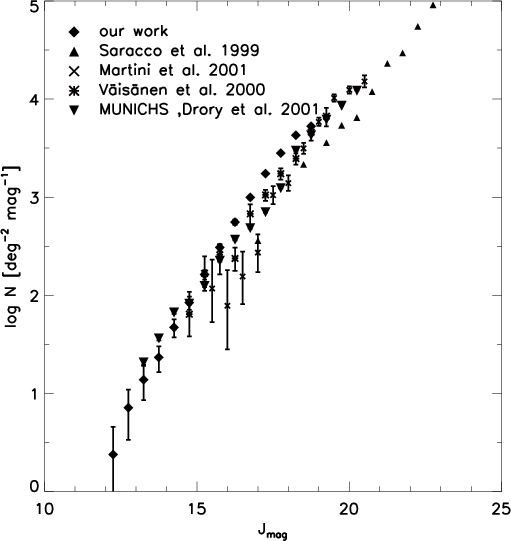 |
Figure 6: Differential counts (number mag-1 deg-2) of galaxies in the J-band compared to a collection of published data, including Saracco et al. (1999), Martini (2001), Väisänen et al. (2000) and the MUNICS survey (Drory et al. 2001). The error bars for our data represent only counting statistics. |
| Open with DEXTER | |
In the text
![\begin{figure}
\par\includegraphics[width=16.3cm,clip]{2208fig7.ps} \end{figure}](/articles/aa/full/2005/45/aa2208-04/img98.gif) |
Figure 7:
R-J colour distribution for all galaxies, i.e. stellarity index  0.8 in R and J-band.
Magnitude ranges are indicated in the upper left-hand corner of each panel. The data show
the colour distributions without visual check (as was done for the final catalogue of extremely red
objects, ), i.e. objects to the left of the dashed line were not manually checked in each individual
frame. The error bars indicate the Poisson uncertainties and the dot-dashed lines
show the one or two Gaussians used to fit the peak position and width of the distribution reported
in Table 2. The second peak is
the result of assigning the limiting R magnitude to objects with no optical detection (see text
for details). 0.8 in R and J-band.
Magnitude ranges are indicated in the upper left-hand corner of each panel. The data show
the colour distributions without visual check (as was done for the final catalogue of extremely red
objects, ), i.e. objects to the left of the dashed line were not manually checked in each individual
frame. The error bars indicate the Poisson uncertainties and the dot-dashed lines
show the one or two Gaussians used to fit the peak position and width of the distribution reported
in Table 2. The second peak is
the result of assigning the limiting R magnitude to objects with no optical detection (see text
for details). |
| Open with DEXTER | |
In the text
![\begin{figure}
\includegraphics[width=14.4cm]{2208fig8.ps} \end{figure}](/articles/aa/full/2005/45/aa2208-04/img100.gif) |
Figure 8:
Examples of EROs, with
R-band detection ( leftmost three panels) and
without optical detection ( rightmost two panels). The images
are 40
 on a side.
 |
| Open with DEXTER | |
In the text
![\begin{figure}
\par\rotatebox{90}{\includegraphics[height=13cm]{2208fig9.ps}} \end{figure}](/articles/aa/full/2005/45/aa2208-04/img101.gif) |
Figure 9:
Colour-magnitude diagram for extremely red stellar objects (19) and galaxies
(60) found in our survey.
For objects without R detection, the star/galaxy classification in R is arbitrary
and solely based on the SExtractor result,
the dashed line marks the
colour threshold. |
| Open with DEXTER | |
In the text
![\begin{figure}
\par\rotatebox{0}{\includegraphics[width=6.2cm]{2208fig10.ps}} \end{figure}](/articles/aa/full/2005/45/aa2208-04/img104.gif) |
Figure 10:
Cumulative ERO surface density from this work, compared to the results for
 objects from Daddi et al. (2000). The uncertainties are derived assuming only
Poisson counting statistics. To convert the
Daddi K-band magnitudes into J-band we use the result
of the stellar population synthesis models, which found a J-K=2.25 for objects with
(Fig. 5).
objects from Daddi et al. (2000). The uncertainties are derived assuming only
Poisson counting statistics. To convert the
Daddi K-band magnitudes into J-band we use the result
of the stellar population synthesis models, which found a J-K=2.25 for objects with
(Fig. 5). |
| Open with DEXTER | |
In the text
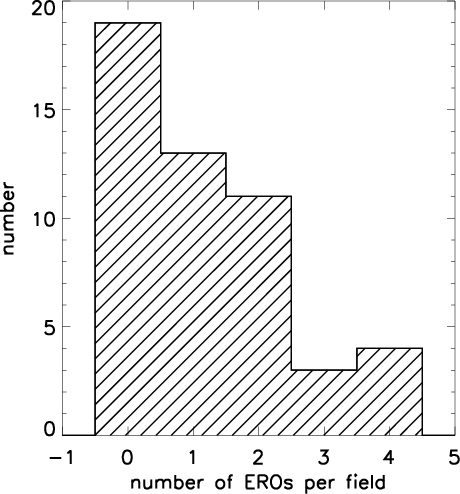 |
Figure 11: Number distribution of the 60 extremely red galaxies found in 50 survey fields. |
| Open with DEXTER | |
In the text